

Exploratory Sequential Data Analysis (ESDA) Angela Tan M6603 Human Factors Methods
What is ESDA? E xploratory vs Confirmatory S equential – ordinal, temporal, pattern D ata A nalysis
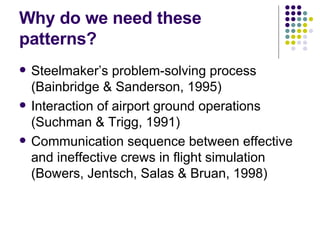
Why do we need these patterns? Steelmaker’s problem-solving process (Bainbridge & Sanderson, 1995) Interaction of airport ground operations (Suchman & Trigg, 1991) Communication sequence between effective and ineffective crews in flight simulation (Bowers, Jentsch, Salas & Bruan, 1998)
What is ESDA?  (Sanderson & Fisher,1994) ESDA is any  empirical  undertaking seeking to analyze systems, environmental, and/or behaviour data (usually recorded) in which the  sequential integrity  of events has been preserved. The analysis of such data  (a) represents a quest for their meaning in relation to some research or design question,  (b) is guided methodologically by one or more   traditions of practice, and  (c) is approached (at least at the outset) in an exploratory mode.
In a nutshell ESDA is used when we want to observe what people do over time. ESDA is a family of observational  methodologies
How do we do ESDA?
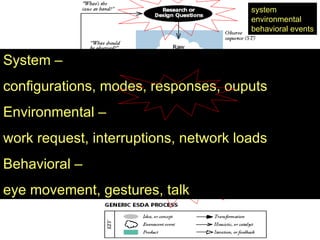
system environmental behavioral events System –  configurations, modes, responses, ouputs Environmental –  work request, interruptions, network loads Behavioral –  eye movement, gestures, talk
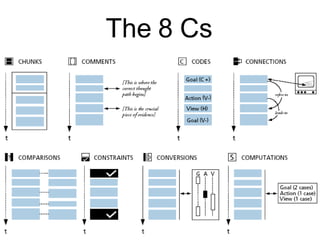
The 8 Cs
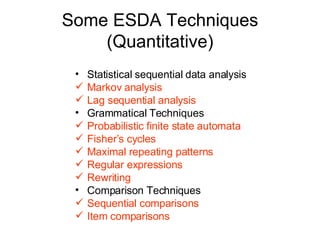
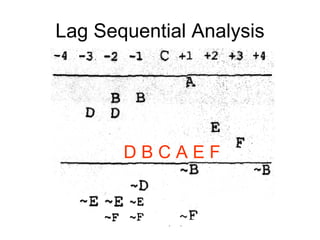
Some ESDA Techniques (Quantitative) Statistical sequential data analysis Markov analysis Lag sequential analysis Grammatical Techniques Probabilistic finite state automata Fisher’s cycles Maximal repeating patterns Regular expressions Rewriting Comparison Techniques Sequential comparisons Item comparisons
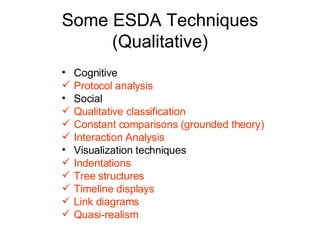
Some ESDA Techniques (Qualitative) Cognitive Protocol analysis Social Qualitative classification Constant comparisons (grounded theory) Interaction Analysis Visualization techniques Indentations Tree structures Timeline displays Link diagrams Quasi-realism
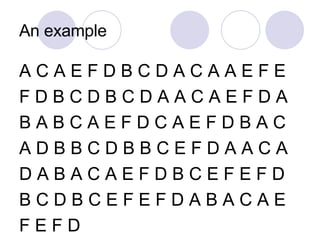
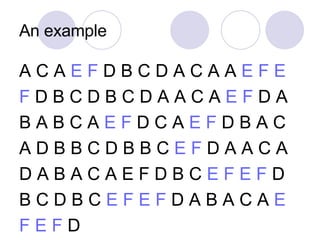
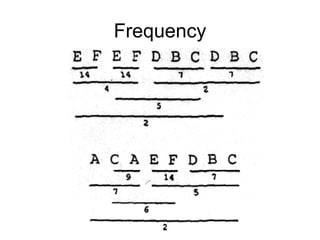
An example A C A E F D B C D A C A A E F E  F D B C D B C D A A C A E F D A  B A B C A E F D C A E F D B A C  A D B B C D B B C E F D A A C A  D A B A C A E F D B C E F E F D  B C D B C E F E F D A B A C A E  F E F D
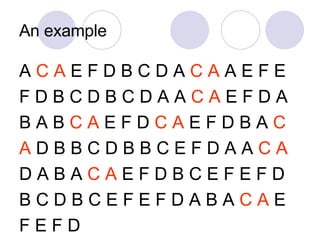
An example A  C A  E F D B C D A  C A  A E F E  F D B C D B C D A A  C A  E F D A  B A B  C A  E F D  C A  E F D B A  C  A  D B B C D B B C E F D A A  C A   D A B A  C A  E F D B C E F E F D  B C D B C E F E F D A B A  C A  E  F E F D
An example A C A  E F  D B C D A C A A  E F   E  F  D B C D B C D A A C A  E F  D A  B A B C A  E F  D C A  E F  D B A C  A D B B C D B B C  E F  D A A C A  D A B A C A E F D B C  E F   E F  D  B C D B C  E F E F  D A B A C A  E  F E F  D
Timeline
Lag Sequential Analysis D B C A E F
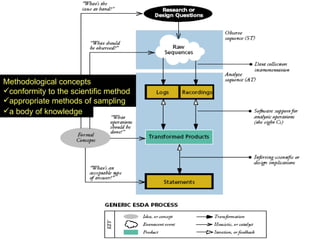
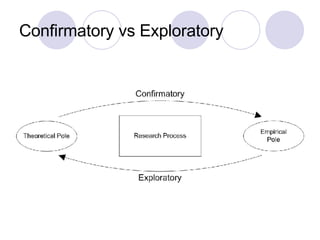
Theoretical concepts notions of usability,  models of cognition,  a body of knowledge Methodological concepts  conformity to the scientific method  appropriate methods of sampling
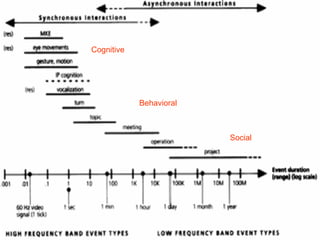
Cognitive Behavioral Social
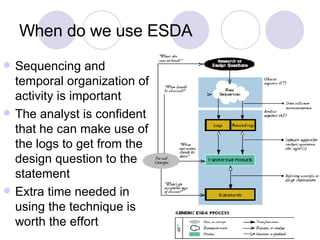
When do we use ESDA Sequencing and temporal organization of activity is important The analyst is confident that he can make use of the logs to get from the design question to the statement Extra time needed in using the technique is worth the effort
Thank You!
Confirmatory vs Exploratory
Frequency

Exploratory Sequential Data Analysis2

  • 1.
    Exploratory Sequential DataAnalysis (ESDA) Angela Tan M6603 Human Factors Methods
  • 2.
    What is ESDA?E xploratory vs Confirmatory S equential – ordinal, temporal, pattern D ata A nalysis
  • 3.
    Why do weneed these patterns? Steelmaker’s problem-solving process (Bainbridge & Sanderson, 1995) Interaction of airport ground operations (Suchman & Trigg, 1991) Communication sequence between effective and ineffective crews in flight simulation (Bowers, Jentsch, Salas & Bruan, 1998)
  • 4.
    What is ESDA? (Sanderson & Fisher,1994) ESDA is any empirical undertaking seeking to analyze systems, environmental, and/or behaviour data (usually recorded) in which the sequential integrity of events has been preserved. The analysis of such data (a) represents a quest for their meaning in relation to some research or design question, (b) is guided methodologically by one or more traditions of practice, and (c) is approached (at least at the outset) in an exploratory mode.
  • 5.
    In a nutshellESDA is used when we want to observe what people do over time. ESDA is a family of observational methodologies
  • 6.
    How do wedo ESDA?
  • 7.
    system environmental behavioralevents System – configurations, modes, responses, ouputs Environmental – work request, interruptions, network loads Behavioral – eye movement, gestures, talk
  • 8.
  • 9.
    Some ESDA Techniques(Quantitative) Statistical sequential data analysis Markov analysis Lag sequential analysis Grammatical Techniques Probabilistic finite state automata Fisher’s cycles Maximal repeating patterns Regular expressions Rewriting Comparison Techniques Sequential comparisons Item comparisons
  • 10.
    Some ESDA Techniques(Qualitative) Cognitive Protocol analysis Social Qualitative classification Constant comparisons (grounded theory) Interaction Analysis Visualization techniques Indentations Tree structures Timeline displays Link diagrams Quasi-realism
  • 11.
    An example AC A E F D B C D A C A A E F E F D B C D B C D A A C A E F D A B A B C A E F D C A E F D B A C A D B B C D B B C E F D A A C A D A B A C A E F D B C E F E F D B C D B C E F E F D A B A C A E F E F D
  • 12.
    An example A C A E F D B C D A C A A E F E F D B C D B C D A A C A E F D A B A B C A E F D C A E F D B A C A D B B C D B B C E F D A A C A D A B A C A E F D B C E F E F D B C D B C E F E F D A B A C A E F E F D
  • 13.
    An example AC A E F D B C D A C A A E F E F D B C D B C D A A C A E F D A B A B C A E F D C A E F D B A C A D B B C D B B C E F D A A C A D A B A C A E F D B C E F E F D B C D B C E F E F D A B A C A E F E F D
  • 14.
  • 15.
  • 16.
    Theoretical concepts notionsof usability, models of cognition, a body of knowledge Methodological concepts conformity to the scientific method appropriate methods of sampling
  • 17.
  • 18.
    When do weuse ESDA Sequencing and temporal organization of activity is important The analyst is confident that he can make use of the logs to get from the design question to the statement Extra time needed in using the technique is worth the effort
  • 19.
  • 20.
  • 21.