Function Point Analysis

Rosu Gabriel,
Anul I Master AES
Introduction
Software

systems are becoming more and more
difficult to understand. Improvement of coding
tools allows software developers to produce
large amounts of software to meet an ever
expanding need from users.
As systems grow a method to understand and
communicate size needs to be used.
Function Point Analysis is a structured
technique of problem solving. It is a method to
break systems into smaller components, so they
can be better understood and analyzed. 
Objectives
 Function

Points measures systems from a functional
perspective and they are independent of technology.
 Regardless of language, development method, or
hardware platform used, the number of function
points for a system will remain constant.
 The only variable is the amount of effort needed to
deliver a given set of function points; therefore,
Function Point Analysis can be used to determine
whether a tool, an environment, a language is more
productive compared with others within an
organization or among organizations. This is a critical
point and one of the greatest values of Function Point
Analysis.
Objectives
 Function

Point Analysis can provide a mechanism to track
and monitor scope creep.
 Function Point Counts at the end of requirements, analysis,
design, code, testing and implementation can be compared.
 The function point count at the end of requirements and/or
designs can be compared to function points actually
delivered.
 If the project has grown, there has been scope creep. The
amount of growth is an indication of how well requirements
were gathered by and/or communicated to the project team.
 If the amount of growth of projects declines over time it is a
natural assumption that communication with the user has
improved.
Components
External



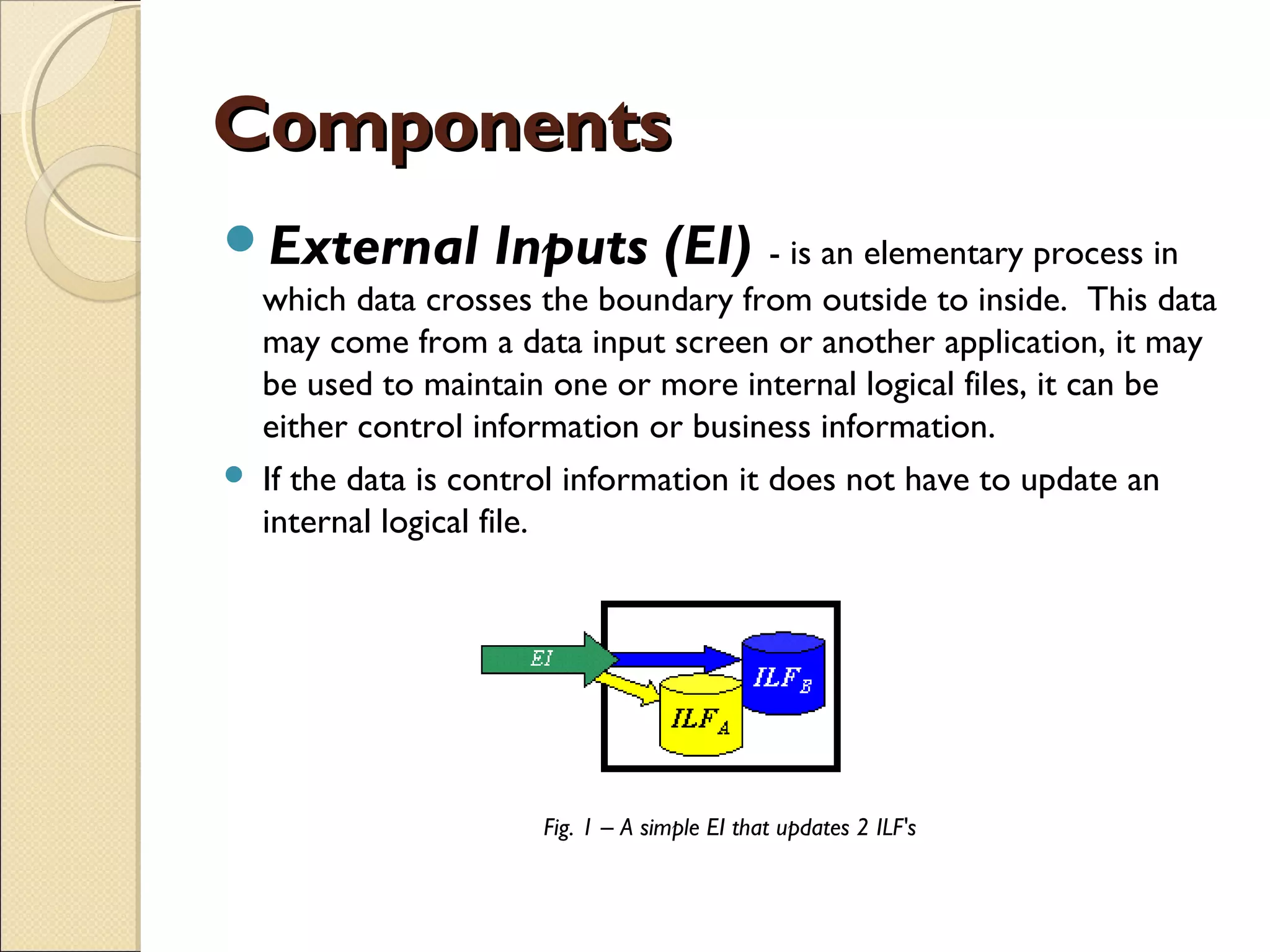
Inputs (EI) - is an elementary process in

which data crosses the boundary from outside to inside.  This data
may come from a data input screen or another application, it may
be used to maintain one or more internal logical files, it can be
either control information or business information.  
If the data is control information it does not have to update an
internal logical file. 

Fig. 1 – A simple EI that updates 2 ILF's
Components
External

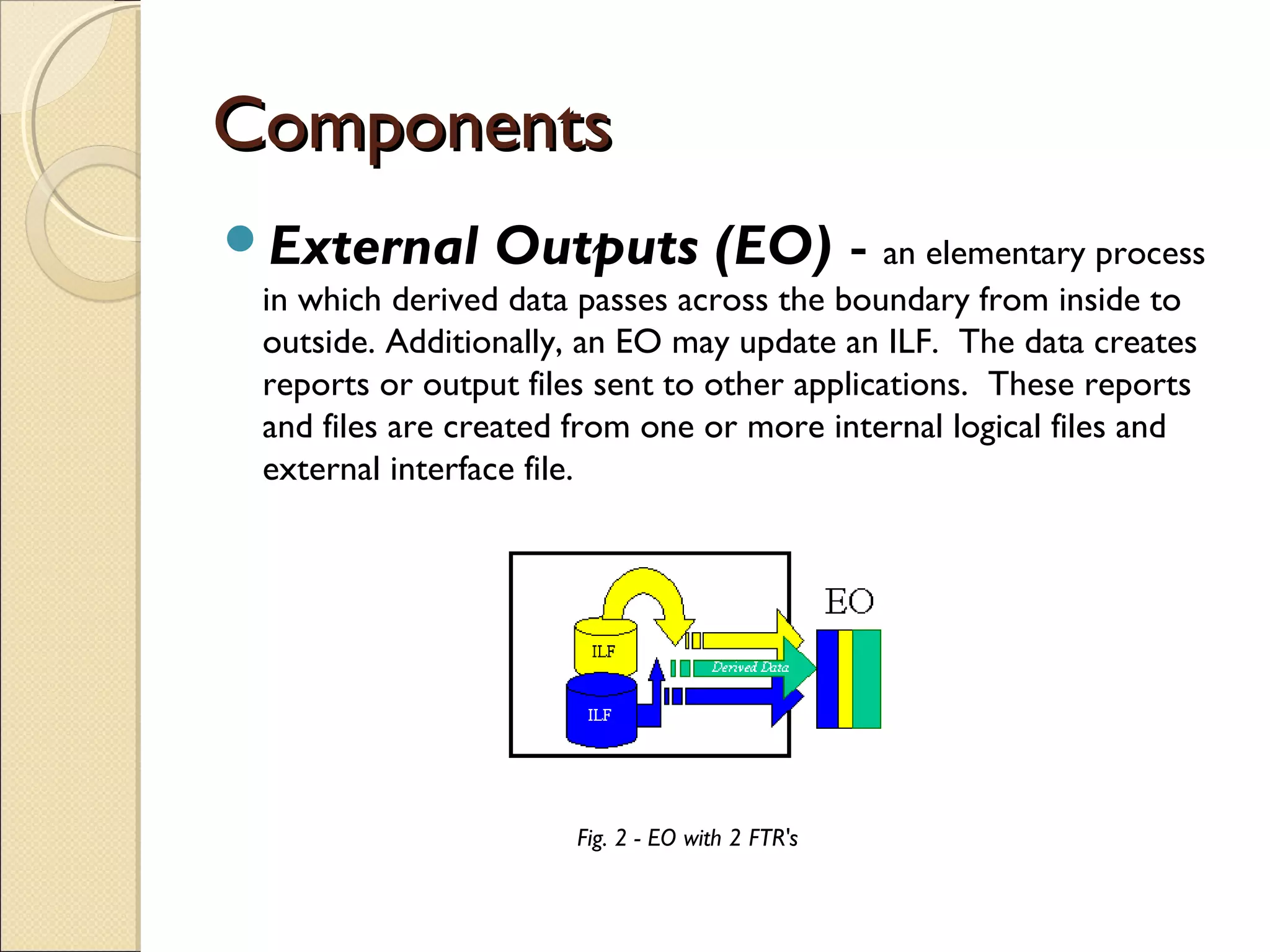
Outputs (EO) - an elementary process

in which derived data passes across the boundary from inside to
outside. Additionally, an EO may update an ILF.  The data creates
reports or output files sent to other applications.  These reports
and files are created from one or more internal logical files and
external interface file. 

Fig. 2 - EO with 2 FTR's
Components
External



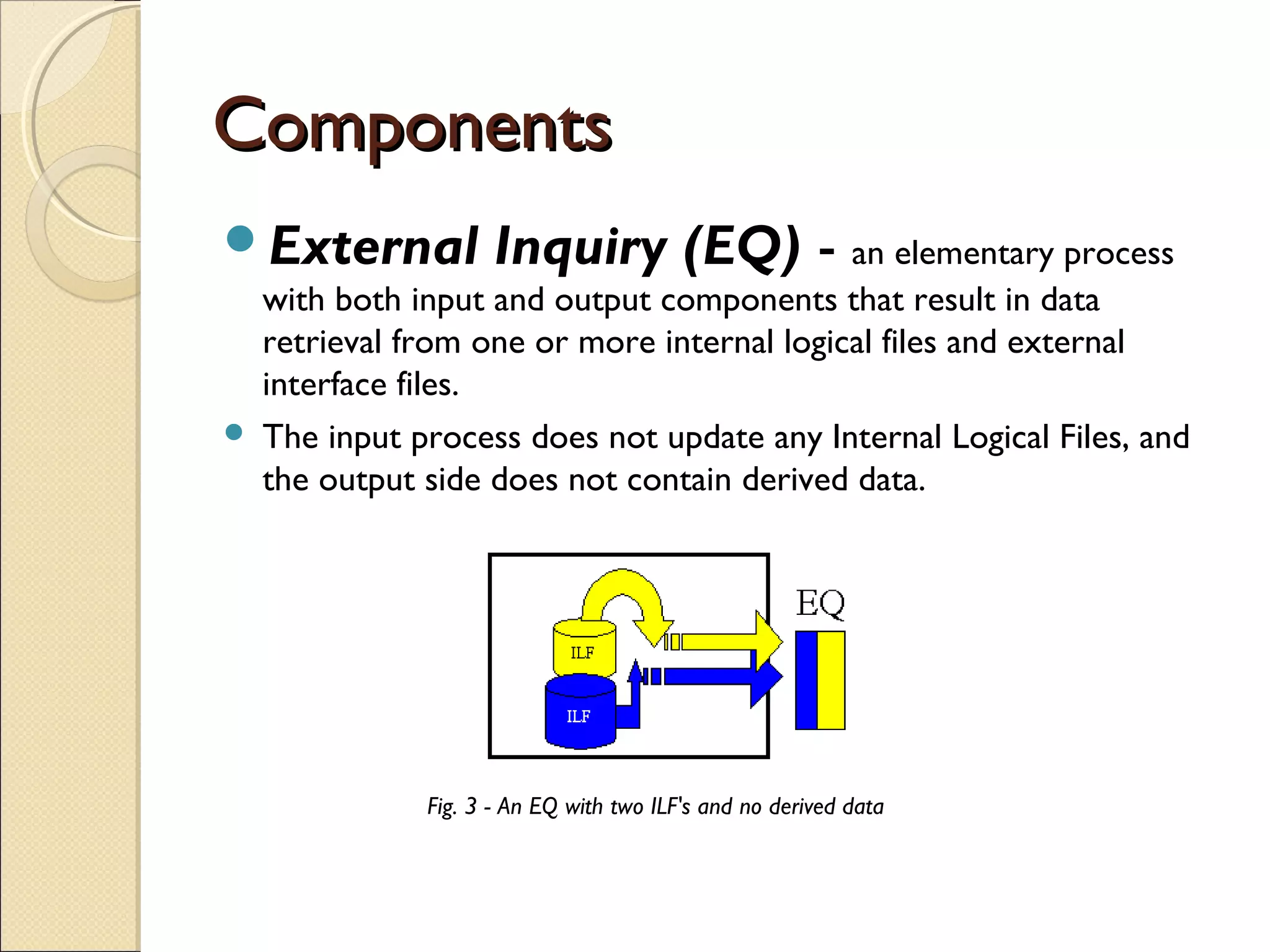
Inquiry (EQ) - an elementary process

with both input and output components that result in data
retrieval from one or more internal logical files and external
interface files.  
The input process does not update any Internal Logical Files, and
the output side does not contain derived data.

Fig. 3 - An EQ with two ILF's and no derived data
Components
Internal

Logical Files (ILF’s) - a user

identifiable group of logically related data that resides
entirely within the applications boundary and is maintained
through external inputs.

External

Interface Files (EIF’s) - a user

identifiable group of logically related data that is used for
reference purposes only. The data resides entirely outside
the application and is maintained by another application. The
external interface file is an internal logical file for another
application.
Benefits of Function Point Analysis
 Function

Points can be used to size software
applications accurately - sizing is an important
component in determining productivity
(outputs/inputs).
 They can be counted by different people, at different
times, to obtain the same measure within a
reasonable margin of error.
 Function Points are easily understood by the non
technical user. This helps communicate sizing
information to a user or customer.
 Function Points can be used to determine whether a
tool, a language, an environment, is more productive
when compared with others.
Conclusions
 Function

Points are becoming widely accepted as the
standard metric for measuring software size. Now that
Function Points have made adequate sizing possible, it can
now be anticipated that the overall rate of progress in
software productivity and software quality will improve.
 Understanding software size is the key to understanding
both productivity and quality. Without a reliable sizing
metric relative changes in productivity or relative changes in
quality can not be calculated.
 If relative changes in productivity and quality can be
calculated and plotted over time, then focus can be put upon
an organizations strengths and weaknesses. Most important,
any attempt to correct weaknesses can be measured for
effectiveness.
Bibliography
http://www.ifpug.org/?page_id=10

http://www.softwaremetrics.com/Articles/de

Function point analysis

  • 1.
    Function Point Analysis RosuGabriel, Anul I Master AES
  • 2.
    Introduction Software systems are becomingmore and more difficult to understand. Improvement of coding tools allows software developers to produce large amounts of software to meet an ever expanding need from users. As systems grow a method to understand and communicate size needs to be used. Function Point Analysis is a structured technique of problem solving. It is a method to break systems into smaller components, so they can be better understood and analyzed. 
  • 3.
    Objectives  Function Points measuressystems from a functional perspective and they are independent of technology.  Regardless of language, development method, or hardware platform used, the number of function points for a system will remain constant.  The only variable is the amount of effort needed to deliver a given set of function points; therefore, Function Point Analysis can be used to determine whether a tool, an environment, a language is more productive compared with others within an organization or among organizations. This is a critical point and one of the greatest values of Function Point Analysis.
  • 4.
    Objectives  Function Point Analysiscan provide a mechanism to track and monitor scope creep.  Function Point Counts at the end of requirements, analysis, design, code, testing and implementation can be compared.  The function point count at the end of requirements and/or designs can be compared to function points actually delivered.  If the project has grown, there has been scope creep. The amount of growth is an indication of how well requirements were gathered by and/or communicated to the project team.  If the amount of growth of projects declines over time it is a natural assumption that communication with the user has improved.
  • 5.
    Components External  Inputs (EI) - isan elementary process in which data crosses the boundary from outside to inside.  This data may come from a data input screen or another application, it may be used to maintain one or more internal logical files, it can be either control information or business information.   If the data is control information it does not have to update an internal logical file.  Fig. 1 – A simple EI that updates 2 ILF's
  • 6.
    Components External Outputs (EO) - anelementary process in which derived data passes across the boundary from inside to outside. Additionally, an EO may update an ILF.  The data creates reports or output files sent to other applications.  These reports and files are created from one or more internal logical files and external interface file.  Fig. 2 - EO with 2 FTR's
  • 7.
    Components External  Inquiry (EQ) - anelementary process with both input and output components that result in data retrieval from one or more internal logical files and external interface files.   The input process does not update any Internal Logical Files, and the output side does not contain derived data. Fig. 3 - An EQ with two ILF's and no derived data
  • 8.
    Components Internal Logical Files (ILF’s) -a user identifiable group of logically related data that resides entirely within the applications boundary and is maintained through external inputs. External Interface Files (EIF’s) - a user identifiable group of logically related data that is used for reference purposes only. The data resides entirely outside the application and is maintained by another application. The external interface file is an internal logical file for another application.
  • 9.
    Benefits of FunctionPoint Analysis  Function Points can be used to size software applications accurately - sizing is an important component in determining productivity (outputs/inputs).  They can be counted by different people, at different times, to obtain the same measure within a reasonable margin of error.  Function Points are easily understood by the non technical user. This helps communicate sizing information to a user or customer.  Function Points can be used to determine whether a tool, a language, an environment, is more productive when compared with others.
  • 10.
    Conclusions  Function Points arebecoming widely accepted as the standard metric for measuring software size. Now that Function Points have made adequate sizing possible, it can now be anticipated that the overall rate of progress in software productivity and software quality will improve.  Understanding software size is the key to understanding both productivity and quality. Without a reliable sizing metric relative changes in productivity or relative changes in quality can not be calculated.  If relative changes in productivity and quality can be calculated and plotted over time, then focus can be put upon an organizations strengths and weaknesses. Most important, any attempt to correct weaknesses can be measured for effectiveness.
  • 11.