SOFTWARE COST AND SCHEDULE
ESTIMATION
Presented By:
Deep kumar sharma
Mtech(1st sem)
1
TOPICS COVERED
1. Software Cost components
2. Software productivity
3. Productivity measures
4. Measurement problems
5. Estimation techniques
6. Project scheduling
7. References
2
1.SOFTWARE COST COMPONENTS
 Travel and training costs
 Effort costs (the dominant factor in most
projects)
 The salaries of engineers involved in the project
 Social and insurance costs
 Effort costs must take overheads into account
 Costs of building, heating, lighting
 Costs of networking and communications
 Costs of shared facilities (eg. library, staff restaurant, etc.)
 Hardware and software costs 3
2.SOFTWARE PRODUCTIVITY
 A measure of the rate at which individual engineers
involved in software development produce software and
associated documentation
 Not quality-oriented although quality assurance is a factor
in productivity assessment
 Essentially, we want to measure useful functionality
produced per time unit
4
3.PRODUCTIVITY MEASURES
 Function-related measures based on an estimate of
the functionality of the delivered software. Function-
points are the best known of this type of measure
 Size related measures based on some output from
the software process. This may be lines of delivered
source code, object code instructions, etc
5
4.MEASUREMENT PROBLEMS
 Estimating the size of the measure (e.g. how many function
points)
 Estimating the total number of programmer
months that have elapsed
 Estimating contractor productivity (e.g.
documentation team) and incorporating this
estimate in overall estimate
6
5.ESTIMATION TECHNIQUES
5.1. SOURCE LINES OF CODE
5.2. FUNCTION POINT ANALYSIS
7
5.1.SOURCE LINES OF CODE
 LOC is a software metric used to measure the size of a
computer program by counting the number of lines in the text
of the program's source code
 LOC is typically used to predict the amount of effort that will
be required to develop a program, as well as to estimate
programming productivity or maintainability once the software
is produced
 This model assumes that there is a linear relationship between
system size and volume of documentation
8
5.1.1.PRODUCTIVITY COMPARISONS
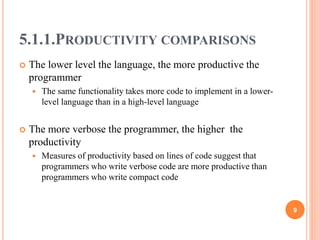
 The lower level the language, the more productive the
programmer
 The same functionality takes more code to implement in a lower-
level language than in a high-level language
 The more verbose the programmer, the higher the
productivity
 Measures of productivity based on lines of code suggest that
programmers who write verbose code are more productive than
programmers who write compact code
9
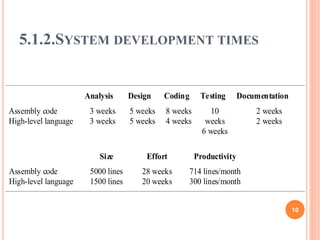
5.1.2.SYSTEM DEVELOPMENT TIMES
Analysis Design Coding Testing Documentation
Assembly code
High-level language
3 weeks
3 weeks
5 weeks
5 weeks
8 weeks
4 weeks
10
weeks
6 weeks
2 weeks
2 weeks
Size Effort Productivity
Assembly code
High-level language
5000 lines
1500 lines
28 weeks
20 weeks
714 lines/month
300 lines/month
10
5.2.FUNCTION POINT ANALYSIS
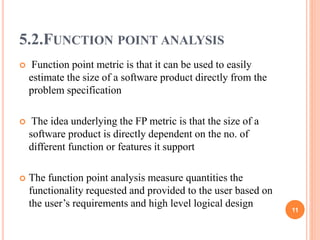
 Function point metric is that it can be used to easily
estimate the size of a software product directly from the
problem specification
 The idea underlying the FP metric is that the size of a
software product is directly dependent on the no. of
different function or features it support
 The function point analysis measure quantities the
functionality requested and provided to the user based on
the user’s requirements and high level logical design
11
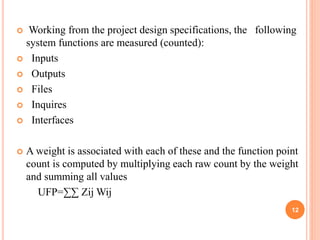
 Working from the project design specifications, the following
system functions are measured (counted):
 Inputs
 Outputs
 Files
 Inquires
 Interfaces
 A weight is associated with each of these and the function point
count is computed by multiplying each raw count by the weight
and summing all values
UFP=∑∑ Zij Wij
12
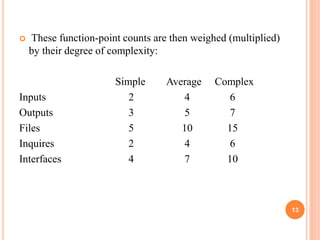
 These function-point counts are then weighed (multiplied)
by their degree of complexity:
Simple Average Complex
Inputs 2 4 6
Outputs 3 5 7
Files 5 10 15
Inquires 2 4 6
Interfaces 4 7 10
13
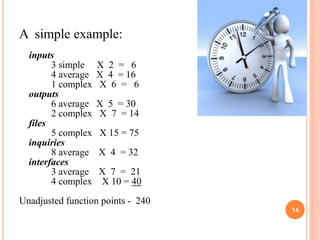
A simple example:
inputs
3 simple X 2 = 6
4 average X 4 = 16
1 complex X 6 = 6
outputs
6 average X 5 = 30
2 complex X 7 = 14
files
5 complex X 15 = 75
inquiries
8 average X 4 = 32
interfaces
3 average X 7 = 21
4 complex X 10 = 40
Unadjusted function points - 240
14
Adjustment factor
Complex internal processing = 3
Code to be reusable = 2
High performance = 4
Multiple sites = 3
Distributed processing = 5
Project adjustment factor = 17
Adjustment calculation:
Adjusted FP = Unadjusted FP X [0.65 + (adjustment factor X
0.01)]
= 240 X [0.65 + (17 X 0.01)]
= 240 X [0.82]
= 197 Adjusted function points
15
 The function point count is modified by complexity of the
project
 FPs can be used to estimate LOC depending on the average
number of LOC per FP for a given language
 FP = UFP * CAF
UFP is unadjusted function point
CAF is complexity adjustment factor
 CAF= 0.65 + 0.01 * ∑ fi
16
6.PROJECT SCHEDULING
 Split project into tasks (= create a WBS)
 Estimate time and resources required to complete each
task
 Organize tasks concurrently to make optimal
use of workforce
 Minimize task dependencies to avoid delays
caused by one task waiting for another to complete
 Dependent on project managers intuition and
experience 17
 Once tasks (from the WBS) and size/effort (from
estimation) are known: then schedule
 Primary objectives
• Best time
• Least cost
• Least risk
 Secondary objectives
• Evaluation of schedule alternatives
• Effective use of resources
• Communications
18
8.REFERENCES
 http://www.cfm.va.gov/til/dManual/dmCost.pdf
 http://doit.maryland.gov/SDLC/Documents/Cost_Estimating
.pdf
 http://www.efcog.org/wg/pm_ce/docs/OMBE_Guidelines.
pdf
 http://www.infosys.com/infosys-
labs/publications/Documents/practical-software-
estimation.pdf 19
20

Software cost estimation

  • 1.
    SOFTWARE COST ANDSCHEDULE ESTIMATION Presented By: Deep kumar sharma Mtech(1st sem) 1
  • 2.
    TOPICS COVERED 1. SoftwareCost components 2. Software productivity 3. Productivity measures 4. Measurement problems 5. Estimation techniques 6. Project scheduling 7. References 2
  • 3.
    1.SOFTWARE COST COMPONENTS Travel and training costs  Effort costs (the dominant factor in most projects)  The salaries of engineers involved in the project  Social and insurance costs  Effort costs must take overheads into account  Costs of building, heating, lighting  Costs of networking and communications  Costs of shared facilities (eg. library, staff restaurant, etc.)  Hardware and software costs 3
  • 4.
    2.SOFTWARE PRODUCTIVITY  Ameasure of the rate at which individual engineers involved in software development produce software and associated documentation  Not quality-oriented although quality assurance is a factor in productivity assessment  Essentially, we want to measure useful functionality produced per time unit 4
  • 5.
    3.PRODUCTIVITY MEASURES  Function-relatedmeasures based on an estimate of the functionality of the delivered software. Function- points are the best known of this type of measure  Size related measures based on some output from the software process. This may be lines of delivered source code, object code instructions, etc 5
  • 6.
    4.MEASUREMENT PROBLEMS  Estimatingthe size of the measure (e.g. how many function points)  Estimating the total number of programmer months that have elapsed  Estimating contractor productivity (e.g. documentation team) and incorporating this estimate in overall estimate 6
  • 7.
    5.ESTIMATION TECHNIQUES 5.1. SOURCELINES OF CODE 5.2. FUNCTION POINT ANALYSIS 7
  • 8.
    5.1.SOURCE LINES OFCODE  LOC is a software metric used to measure the size of a computer program by counting the number of lines in the text of the program's source code  LOC is typically used to predict the amount of effort that will be required to develop a program, as well as to estimate programming productivity or maintainability once the software is produced  This model assumes that there is a linear relationship between system size and volume of documentation 8
  • 9.
    5.1.1.PRODUCTIVITY COMPARISONS  Thelower level the language, the more productive the programmer  The same functionality takes more code to implement in a lower- level language than in a high-level language  The more verbose the programmer, the higher the productivity  Measures of productivity based on lines of code suggest that programmers who write verbose code are more productive than programmers who write compact code 9
  • 10.
    5.1.2.SYSTEM DEVELOPMENT TIMES AnalysisDesign Coding Testing Documentation Assembly code High-level language 3 weeks 3 weeks 5 weeks 5 weeks 8 weeks 4 weeks 10 weeks 6 weeks 2 weeks 2 weeks Size Effort Productivity Assembly code High-level language 5000 lines 1500 lines 28 weeks 20 weeks 714 lines/month 300 lines/month 10
  • 11.
    5.2.FUNCTION POINT ANALYSIS Function point metric is that it can be used to easily estimate the size of a software product directly from the problem specification  The idea underlying the FP metric is that the size of a software product is directly dependent on the no. of different function or features it support  The function point analysis measure quantities the functionality requested and provided to the user based on the user’s requirements and high level logical design 11
  • 12.
     Working fromthe project design specifications, the following system functions are measured (counted):  Inputs  Outputs  Files  Inquires  Interfaces  A weight is associated with each of these and the function point count is computed by multiplying each raw count by the weight and summing all values UFP=∑∑ Zij Wij 12
  • 13.
     These function-pointcounts are then weighed (multiplied) by their degree of complexity: Simple Average Complex Inputs 2 4 6 Outputs 3 5 7 Files 5 10 15 Inquires 2 4 6 Interfaces 4 7 10 13
  • 14.
    A simple example: inputs 3simple X 2 = 6 4 average X 4 = 16 1 complex X 6 = 6 outputs 6 average X 5 = 30 2 complex X 7 = 14 files 5 complex X 15 = 75 inquiries 8 average X 4 = 32 interfaces 3 average X 7 = 21 4 complex X 10 = 40 Unadjusted function points - 240 14
  • 15.
    Adjustment factor Complex internalprocessing = 3 Code to be reusable = 2 High performance = 4 Multiple sites = 3 Distributed processing = 5 Project adjustment factor = 17 Adjustment calculation: Adjusted FP = Unadjusted FP X [0.65 + (adjustment factor X 0.01)] = 240 X [0.65 + (17 X 0.01)] = 240 X [0.82] = 197 Adjusted function points 15
  • 16.
     The functionpoint count is modified by complexity of the project  FPs can be used to estimate LOC depending on the average number of LOC per FP for a given language  FP = UFP * CAF UFP is unadjusted function point CAF is complexity adjustment factor  CAF= 0.65 + 0.01 * ∑ fi 16
  • 17.
    6.PROJECT SCHEDULING  Splitproject into tasks (= create a WBS)  Estimate time and resources required to complete each task  Organize tasks concurrently to make optimal use of workforce  Minimize task dependencies to avoid delays caused by one task waiting for another to complete  Dependent on project managers intuition and experience 17
  • 18.
     Once tasks(from the WBS) and size/effort (from estimation) are known: then schedule  Primary objectives • Best time • Least cost • Least risk  Secondary objectives • Evaluation of schedule alternatives • Effective use of resources • Communications 18
  • 19.
    8.REFERENCES  http://www.cfm.va.gov/til/dManual/dmCost.pdf  http://doit.maryland.gov/SDLC/Documents/Cost_Estimating .pdf http://www.efcog.org/wg/pm_ce/docs/OMBE_Guidelines. pdf  http://www.infosys.com/infosys- labs/publications/Documents/practical-software- estimation.pdf 19
  • 20.