Functions of Memory


                      http://improvec.blogspot.in/   1
Objective:
 On completion of this period, you would be able to
 learn

 Functions of memory.

 Types of memory.


                 http://improvec.blogspot.in/         2
Recap

 Blocks in CPU
    Control unit & Arithmetic and Logical Unit.

 Functions of CPU
    Performs calculations, takes decisions, and
 controls all the units.


                  http://improvec.blogspot.in/    3
Prerequisites:


What is a memory?
 Memory is a device that stores computer’s data
 & programs.


                 http://improvec.blogspot.in/     4
Memory hierarchies


                        Primary               Secondary
Registers
                        Memory                 Memory


               http://improvec.blogspot.in/               5
Memory (Contd..)

 A space to keep computer’s data.

 It stores program, data results or any kind of
  information.

 Memory stores binary information i.e. 0’s and
  1’s.


                   http://improvec.blogspot.in/    6
Memory (contd)

 Place where results get stored prior to the output
 Memory is measured in bytes
 One byte of memory is needed to store a
  character


                   http://improvec.blogspot.in/        7
Units of measure for computer memory


Unit       Abbrevia- Approximate                    Actual Value
           tion      Value (Bytes)                  (Bytes)
Kilobyte   KB        1,000                          1,024

Megabyte MB           1,000,000         1,048,576
                      (1 million)
Gigabyte   GB         1,000,000,000     1,073,741,824
                      (1 billion)
Terabyte   TB         1,000,000,000,000 1,099,511,627,776
                      (1 trillion)
                     http://improvec.blogspot.in/                  8
Types of memory
                                 MEMORY
                                 MEMORY

         PRIMARY MEMORY
          PRIMARY MEMORY                          SECONDARY MEMORY
                                                   SECONDARY MEMORY
       (INTERNAL MEMORY)
        (INTERNAL MEMORY)                         (EXTERNAL MEMORY)
                                                   (EXTERNAL MEMORY)

     CPU
     CPU
                                               MAGNETIC MAGNETIC
                                               MAGNETIC MAGNETIC       OPTICAL
                                                                       OPTICAL
            ON CHIP                              TAPE
                                                  TAPE    DISK
REGISTER     ON CHIP                                       DISK         DISK
                                                                         DISK
 REGISTER   CACHE
             CACHE

                 RAM                           ROM
                                               ROM
                 RAM


      DRAM             SRAM         PROM
                                     PROM            EPROM
                                                      EPROM   EEPROM
       DRAM             SRAM                                   EEPROM


                               http://improvec.blogspot.in/                  9
Random Access Memory (RAM)

 It is volatile memory i.e. temporary memory.

 Performs read and write operations.

 Usually hidden to users.


                   http://improvec.blogspot.in/   10
RAM (Contd..)


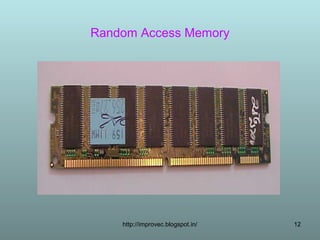
 It exists as a chip on the motherboard near the
  CPU.

 RAM stores data and programs while they are
  being used.


                   http://improvec.blogspot.in/     11
Random Access Memory


    http://improvec.blogspot.in/   12
Types of RAM

1. DRAM (Dynamic RAM)


2. SRAM (Static RAM)


                http://improvec.blogspot.in/   13
Dynamic RAM


Dynamic RAM loses its stored information
 in a very short time even though the power
 supply is on.

Only one transistor is needed to form a
 memory cell and result in high packing
 density and moderate speed.


               http://improvec.blogspot.in/   14
Dynamic RAM (Contd...)

 Consume less power.

 Used where large capacity of memory is
  needed.

 Dynamic RAM being cheaper is used for main
  memory.


                 http://improvec.blogspot.in/   15
Static RAM
 Static RAM retain stored information only as
  long as power supply is on.

 Static RAMs are costlier and consume more
  power.

 Static RAM being faster is used in cache
  memory.

 Static RAMs hold information in flip-flop
  consisting of two cross coupled inverters.
                   http://improvec.blogspot.in/   16
Read Only Memory (ROM)

 It is non volatile memory .i.e. permanent storage.

 Performs only read operations.

 Hidden to users.

 used to store routine & fixed programs, during the
  booting process.

                     http://improvec.blogspot.in/   17
Types of ROM


1. PROM    - (Programmable Read Only Memory)

2. EPROM - (Erasable Programmable Read Only
    Memory)

3. EEPROM - (Electrically Erasable PROM)


                 http://improvec.blogspot.in/   18
Cache memory

 Placed between the CPU and the main memory.

 It increases the speed of the computer up to 15%.


                   http://improvec.blogspot.in/   19
Cache memory (contd)

 It is not accessible to users i.e. information
  cannot be written into cache memory by users.

 It stores instructions and data which are to be
  immediately executed.


                   http://improvec.blogspot.in/     20
Primary memory

 The storage is temporary.

 Data stored in it lost when power supply is cut
  off.

 Storage capacity is limited.


                 http://improvec.blogspot.in/       21
Primary memory (contd)


 Known as Main Memory or Internal Memory

 It is a part of CPU

 Used for storing a little volume of data at the
  time of processing


                   http://improvec.blogspot.in/     22
Secondary memory

The storage is permanent.

The data stored in it does not get erased when the
power is switched off.


                   http://improvec.blogspot.in/   23
Secondary memory (contd)

 Known as External Memory or Auxiliary Memory

 Storage capacity is unlimited

 Used to store large volumes of data permanently


                 http://improvec.blogspot.in/   24
Secondary Memory - Examples

 Magnetic tape

 Magnetic disk

 Optical disk


                  http://improvec.blogspot.in/   25
Summary:

In this class, we have learnt about

            Functions of memory.

           Types of memory used in computers.


                   http://improvec.blogspot.in/   26
Questions

 Explain the types of memory devices used?

 List the differences between RAM & ROM.

 Explain the functions of memory?


                 http://improvec.blogspot.in/   27
Quiz:
1. Is RAM a volatile memory?
  a. Yes
  b. No
Answer: a


                 http://improvec.blogspot.in/   28
Quiz:


2. ROM is a
  a. Volatile
  b. Non-volatile
  c. both a & c
Answer: b


                    http://improvec.blogspot.in/   29
Quiz:


3. The data stored in memory is in
  a. Decimal form
  b. Hexadecimal form
  c. Binary form
  d. Octal form
Answer: c


                    http://improvec.blogspot.in/   30

Function of memory.4to5

  • 1.
    Functions of Memory http://improvec.blogspot.in/ 1
  • 2.
    Objective: On completionof this period, you would be able to learn  Functions of memory.  Types of memory. http://improvec.blogspot.in/ 2
  • 3.
    Recap  Blocks inCPU Control unit & Arithmetic and Logical Unit.  Functions of CPU Performs calculations, takes decisions, and controls all the units. http://improvec.blogspot.in/ 3
  • 4.
    Prerequisites: What is amemory? Memory is a device that stores computer’s data & programs. http://improvec.blogspot.in/ 4
  • 5.
    Memory hierarchies Primary Secondary Registers Memory Memory http://improvec.blogspot.in/ 5
  • 6.
    Memory (Contd..)  Aspace to keep computer’s data.  It stores program, data results or any kind of information.  Memory stores binary information i.e. 0’s and 1’s. http://improvec.blogspot.in/ 6
  • 7.
    Memory (contd)  Placewhere results get stored prior to the output  Memory is measured in bytes  One byte of memory is needed to store a character http://improvec.blogspot.in/ 7
  • 8.
    Units of measurefor computer memory Unit Abbrevia- Approximate Actual Value tion Value (Bytes) (Bytes) Kilobyte KB 1,000 1,024 Megabyte MB 1,000,000 1,048,576 (1 million) Gigabyte GB 1,000,000,000 1,073,741,824 (1 billion) Terabyte TB 1,000,000,000,000 1,099,511,627,776 (1 trillion) http://improvec.blogspot.in/ 8
  • 9.
    Types of memory MEMORY MEMORY PRIMARY MEMORY PRIMARY MEMORY SECONDARY MEMORY SECONDARY MEMORY (INTERNAL MEMORY) (INTERNAL MEMORY) (EXTERNAL MEMORY) (EXTERNAL MEMORY) CPU CPU MAGNETIC MAGNETIC MAGNETIC MAGNETIC OPTICAL OPTICAL ON CHIP TAPE TAPE DISK REGISTER ON CHIP DISK DISK DISK REGISTER CACHE CACHE RAM ROM ROM RAM DRAM SRAM PROM PROM EPROM EPROM EEPROM DRAM SRAM EEPROM http://improvec.blogspot.in/ 9
  • 10.
    Random Access Memory(RAM)  It is volatile memory i.e. temporary memory.  Performs read and write operations.  Usually hidden to users. http://improvec.blogspot.in/ 10
  • 11.
    RAM (Contd..)  Itexists as a chip on the motherboard near the CPU.  RAM stores data and programs while they are being used. http://improvec.blogspot.in/ 11
  • 12.
    Random Access Memory http://improvec.blogspot.in/ 12
  • 13.
    Types of RAM 1.DRAM (Dynamic RAM) 2. SRAM (Static RAM) http://improvec.blogspot.in/ 13
  • 14.
    Dynamic RAM Dynamic RAMloses its stored information in a very short time even though the power supply is on. Only one transistor is needed to form a memory cell and result in high packing density and moderate speed. http://improvec.blogspot.in/ 14
  • 15.
    Dynamic RAM (Contd...) Consume less power.  Used where large capacity of memory is needed.  Dynamic RAM being cheaper is used for main memory. http://improvec.blogspot.in/ 15
  • 16.
    Static RAM  StaticRAM retain stored information only as long as power supply is on.  Static RAMs are costlier and consume more power.  Static RAM being faster is used in cache memory.  Static RAMs hold information in flip-flop consisting of two cross coupled inverters. http://improvec.blogspot.in/ 16
  • 17.
    Read Only Memory(ROM)  It is non volatile memory .i.e. permanent storage.  Performs only read operations.  Hidden to users.  used to store routine & fixed programs, during the booting process. http://improvec.blogspot.in/ 17
  • 18.
    Types of ROM 1.PROM - (Programmable Read Only Memory) 2. EPROM - (Erasable Programmable Read Only Memory) 3. EEPROM - (Electrically Erasable PROM) http://improvec.blogspot.in/ 18
  • 19.
    Cache memory  Placedbetween the CPU and the main memory.  It increases the speed of the computer up to 15%. http://improvec.blogspot.in/ 19
  • 20.
    Cache memory (contd) It is not accessible to users i.e. information cannot be written into cache memory by users.  It stores instructions and data which are to be immediately executed. http://improvec.blogspot.in/ 20
  • 21.
    Primary memory  Thestorage is temporary.  Data stored in it lost when power supply is cut off.  Storage capacity is limited. http://improvec.blogspot.in/ 21
  • 22.
    Primary memory (contd) Known as Main Memory or Internal Memory  It is a part of CPU  Used for storing a little volume of data at the time of processing http://improvec.blogspot.in/ 22
  • 23.
    Secondary memory The storageis permanent. The data stored in it does not get erased when the power is switched off. http://improvec.blogspot.in/ 23
  • 24.
    Secondary memory (contd) Known as External Memory or Auxiliary Memory  Storage capacity is unlimited  Used to store large volumes of data permanently http://improvec.blogspot.in/ 24
  • 25.
    Secondary Memory -Examples  Magnetic tape  Magnetic disk  Optical disk http://improvec.blogspot.in/ 25
  • 26.
    Summary: In this class,we have learnt about  Functions of memory. Types of memory used in computers. http://improvec.blogspot.in/ 26
  • 27.
    Questions  Explain thetypes of memory devices used?  List the differences between RAM & ROM.  Explain the functions of memory? http://improvec.blogspot.in/ 27
  • 28.
    Quiz: 1. Is RAMa volatile memory? a. Yes b. No Answer: a http://improvec.blogspot.in/ 28
  • 29.
    Quiz: 2. ROM isa a. Volatile b. Non-volatile c. both a & c Answer: b http://improvec.blogspot.in/ 29
  • 30.
    Quiz: 3. The datastored in memory is in a. Decimal form b. Hexadecimal form c. Binary form d. Octal form Answer: c http://improvec.blogspot.in/ 30