Molten Carbonate
Fuel Cell
Prepared By:-
Nainesh M Patel
(13MCHN01)
Contents
• Introduction
• Working MCFC.
• Performance of Cell
• Effect of Pressure
• Effect of Temperature
• Effect of Reactant Gas Composition and Utilization
• Effect of impurities
• Advantages & Disadvantages
• Reference
INTRODUCTION
• The molten carbonate fuel cell operates at
approximately 650 C (1200 F).low-cost metal
cell components.
• A benefit associated with this high temperature is
that noble metal catalysts are not required for the
cell electrochemical oxidation and reduction
processes.
• Molten carbonate fuel cells are being developed
for natural gas and coal-based power plants for
industrial, electrical utility, and military
applications.
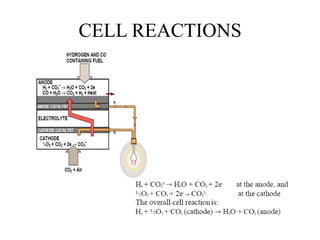
CELL REACTIONS
WORKING
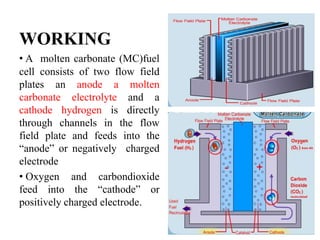
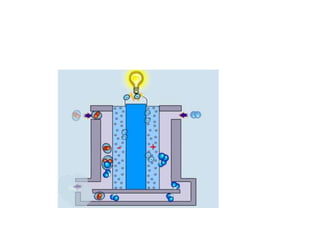
• A molten carbonate (MC)fuel
cell consists of two flow field
plates an anode a molten
carbonate electrolyte and a
cathode hydrogen is directly
through channels in the flow
field plate and feeds into the
“anode” or negatively charged
electrode
• Oxygen and carbondioxide
feed into the “cathode” or
positively charged electrode.
WORKING MODEL
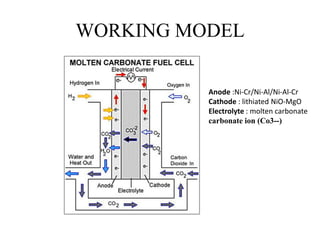
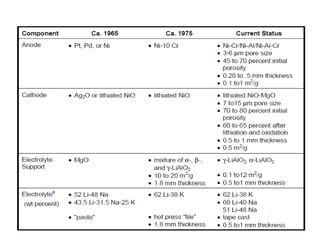
Anode :Ni-Cr/Ni-Al/Ni-Al-Cr
Cathode : lithiated NiO-MgO
Electrolyte : molten carbonate
carbonate ion (Co3--)
• When the hydrogen reaches the anode, the
catalyst encourage it to split into positively
charged protons and negatively charged electrons.
• The negatively charged electrons are not allowed
through the membrane.
• They are diverted so must go through an external
circuit generating electricity.
• When the electrons enter the cathode they are
combined with oxygen from the air and carbon
dioxide recycled from the used fuel.
• These molecules from a carbonate ion (Co3--).
• The negatively charged carbonate ions then move
through the electrolyte to the anode where they
combined with the protons to maintain the charge
balance.
• This is only possible if the electrolyte is very hot,
above 600 degree Celsius.
• The byproducts at the anode are carbon dioxide
and water.
• The carbon dioxide is separated and recycled to
the cathode side.
• Some of the heat produced in the process is
exhausted with the water in the from of vapor. A
cooling system remove the rest of it.
• The obtain desired amount of electrical power
individual fuel cells are combined in to fuel cell
“stacks”.
• A typical stack may consist of hundreds of fuel
cells.
• Increasing the number of cells in a stack increases
the voltage.
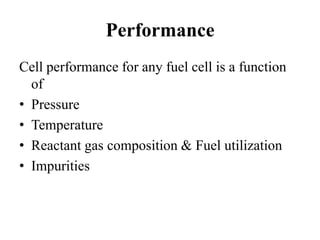
Performance
Cell performance for any fuel cell is a function
of
• Pressure
• Temperature
• Reactant gas composition & Fuel utilization
• Impurities
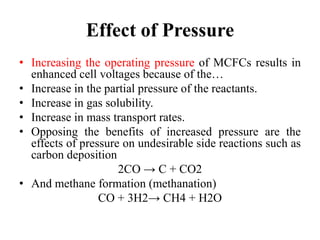
Effect of Pressure
• Increasing the operating pressure of MCFCs results in
enhanced cell voltages because of the…
• Increase in the partial pressure of the reactants.
• Increase in gas solubility.
• Increase in mass transport rates.
• Opposing the benefits of increased pressure are the
effects of pressure on undesirable side reactions such as
carbon deposition
2CO → C + CO2
• And methane formation (methanation)
CO + 3H2→ CH4 + H2O
• The addition of H2O and CO2 to the fuel gas modifies the
equilibrium gas composition so that the formation of CH4 is
not favored.
• Increasing the partial pressure of H2O in the gas stream can
reduce
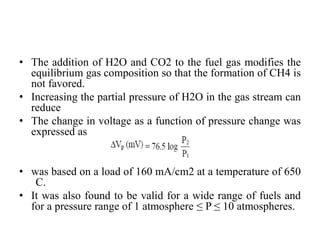
• The change in voltage as a function of pressure change was
expressed as
• was based on a load of 160 mA/cm2 at a temperature of 650
C.
• It was also found to be valid for a wide range of fuels and
for a pressure range of 1 atmosphere ≤ P ≤ 10 atmospheres.
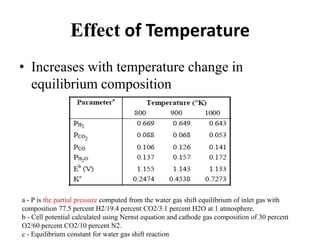
Effect of Temperature
• Increases with temperature change in
equilibrium composition
a - P is the partial pressure computed from the water gas shift equilibrium of inlet gas with
composition 77.5 percent H2/19.4 percent CO2/3.1 percent H2O at 1 atmosphere.
b - Cell potential calculated using Nernst equation and cathode gas composition of 30 percent
O2/60 percent CO2/10 percent N2.
c - Equilibrium constant for water gas shift reaction
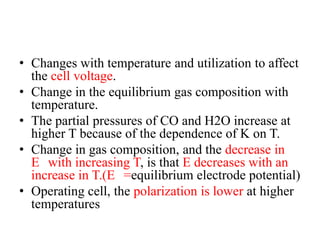
• Changes with temperature and utilization to affect
the cell voltage.
• Change in the equilibrium gas composition with
temperature.
• The partial pressures of CO and H2O increase at
higher T because of the dependence of K on T.
• Change in gas composition, and the decrease in
E with increasing T, is that E decreases with an
increase in T.(E =equilibrium electrode potential)
• Operating cell, the polarization is lower at higher
temperatures
Effect of Reactant Gas Composition
and Utilization
• The voltage of MCFCs varies with the
composition of the reactant gases.
• The effect of reactant gas partial pressure,
however, is somewhat difficult to analyze.
• As reactant gases are consumed in an operating
cell, the cell voltage decreases in response to the
polarization (i.e., activation, concentration) and to
the changing gas composition.
• These effects are related to the partial pressures of
the reactant gases.
Effect of Impurities
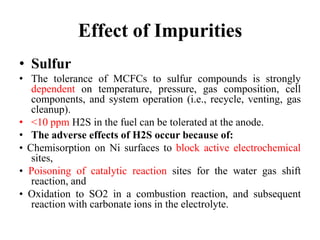
• Sulfur
• The tolerance of MCFCs to sulfur compounds is strongly
dependent on temperature, pressure, gas composition, cell
components, and system operation (i.e., recycle, venting, gas
cleanup).
• <10 ppm H2S in the fuel can be tolerated at the anode.
• The adverse effects of H2S occur because of:
• Chemisorption on Ni surfaces to block active electrochemical
sites,
• Poisoning of catalytic reaction sites for the water gas shift
reaction, and
• Oxidation to SO2 in a combustion reaction, and subsequent
reaction with carbonate ions in the electrolyte.
Nitrogen Compounds
• NH3 and HCN do not appear to harm MCFCs
in small amounts.
• NH3 tolerance of MCFCs was 0.1 ppm.
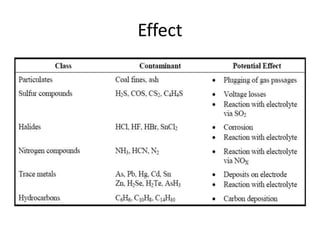
Effect
Advantages
• Support spontaneous internal reforming of
light hydro-carbon fuels
• Generate high-grade waste heat
• Have fast reaction kinetics (react quickly)
• Have high efficiency
• Do not need noble metal catalysts
Disadvantages
• Have a high intolerance to sulfur. The anode in
particular cannot tolerate more than 1-5 ppm
of sulfur compounds (primarily H2S and COS)
in the fuel gas without suffering a significant
performance loss.
• Have a liquid electrolyte, which introduces
liquid handling problems.
• Require a considerable warm up period
Reference
• http://www.fuelcellenergy.com/why-fuelcell-energy/types-of-fuel-cells/
• http://www.ceret.us/HydrogenFuelcells/MC_FC.html (Animation)
• http://en.wikipedia.org/wiki/Molten_carbonate_fuel_cell
• Fuel Cell Handbook (Seventh Edition) By EG&G Technical Services, Inc.
• Module 4 fuel cell technology :collage of the desert.
molten carbonate fuel cell

molten carbonate fuel cell

  • 1.
    Molten Carbonate Fuel Cell PreparedBy:- Nainesh M Patel (13MCHN01)
  • 2.
    Contents • Introduction • WorkingMCFC. • Performance of Cell • Effect of Pressure • Effect of Temperature • Effect of Reactant Gas Composition and Utilization • Effect of impurities • Advantages & Disadvantages • Reference
  • 3.
    INTRODUCTION • The moltencarbonate fuel cell operates at approximately 650 C (1200 F).low-cost metal cell components. • A benefit associated with this high temperature is that noble metal catalysts are not required for the cell electrochemical oxidation and reduction processes. • Molten carbonate fuel cells are being developed for natural gas and coal-based power plants for industrial, electrical utility, and military applications.
  • 4.
  • 5.
    WORKING • A moltencarbonate (MC)fuel cell consists of two flow field plates an anode a molten carbonate electrolyte and a cathode hydrogen is directly through channels in the flow field plate and feeds into the “anode” or negatively charged electrode • Oxygen and carbondioxide feed into the “cathode” or positively charged electrode.
  • 6.
    WORKING MODEL Anode :Ni-Cr/Ni-Al/Ni-Al-Cr Cathode: lithiated NiO-MgO Electrolyte : molten carbonate carbonate ion (Co3--)
  • 7.
    • When thehydrogen reaches the anode, the catalyst encourage it to split into positively charged protons and negatively charged electrons. • The negatively charged electrons are not allowed through the membrane. • They are diverted so must go through an external circuit generating electricity. • When the electrons enter the cathode they are combined with oxygen from the air and carbon dioxide recycled from the used fuel. • These molecules from a carbonate ion (Co3--).
  • 8.
    • The negativelycharged carbonate ions then move through the electrolyte to the anode where they combined with the protons to maintain the charge balance. • This is only possible if the electrolyte is very hot, above 600 degree Celsius. • The byproducts at the anode are carbon dioxide and water. • The carbon dioxide is separated and recycled to the cathode side.
  • 9.
    • Some ofthe heat produced in the process is exhausted with the water in the from of vapor. A cooling system remove the rest of it. • The obtain desired amount of electrical power individual fuel cells are combined in to fuel cell “stacks”. • A typical stack may consist of hundreds of fuel cells. • Increasing the number of cells in a stack increases the voltage.
  • 13.
    Performance Cell performance forany fuel cell is a function of • Pressure • Temperature • Reactant gas composition & Fuel utilization • Impurities
  • 14.
    Effect of Pressure •Increasing the operating pressure of MCFCs results in enhanced cell voltages because of the… • Increase in the partial pressure of the reactants. • Increase in gas solubility. • Increase in mass transport rates. • Opposing the benefits of increased pressure are the effects of pressure on undesirable side reactions such as carbon deposition 2CO → C + CO2 • And methane formation (methanation) CO + 3H2→ CH4 + H2O
  • 15.
    • The additionof H2O and CO2 to the fuel gas modifies the equilibrium gas composition so that the formation of CH4 is not favored. • Increasing the partial pressure of H2O in the gas stream can reduce • The change in voltage as a function of pressure change was expressed as • was based on a load of 160 mA/cm2 at a temperature of 650 C. • It was also found to be valid for a wide range of fuels and for a pressure range of 1 atmosphere ≤ P ≤ 10 atmospheres.
  • 16.
    Effect of Temperature •Increases with temperature change in equilibrium composition a - P is the partial pressure computed from the water gas shift equilibrium of inlet gas with composition 77.5 percent H2/19.4 percent CO2/3.1 percent H2O at 1 atmosphere. b - Cell potential calculated using Nernst equation and cathode gas composition of 30 percent O2/60 percent CO2/10 percent N2. c - Equilibrium constant for water gas shift reaction
  • 17.
    • Changes withtemperature and utilization to affect the cell voltage. • Change in the equilibrium gas composition with temperature. • The partial pressures of CO and H2O increase at higher T because of the dependence of K on T. • Change in gas composition, and the decrease in E with increasing T, is that E decreases with an increase in T.(E =equilibrium electrode potential) • Operating cell, the polarization is lower at higher temperatures
  • 18.
    Effect of ReactantGas Composition and Utilization • The voltage of MCFCs varies with the composition of the reactant gases. • The effect of reactant gas partial pressure, however, is somewhat difficult to analyze. • As reactant gases are consumed in an operating cell, the cell voltage decreases in response to the polarization (i.e., activation, concentration) and to the changing gas composition. • These effects are related to the partial pressures of the reactant gases.
  • 19.
    Effect of Impurities •Sulfur • The tolerance of MCFCs to sulfur compounds is strongly dependent on temperature, pressure, gas composition, cell components, and system operation (i.e., recycle, venting, gas cleanup). • <10 ppm H2S in the fuel can be tolerated at the anode. • The adverse effects of H2S occur because of: • Chemisorption on Ni surfaces to block active electrochemical sites, • Poisoning of catalytic reaction sites for the water gas shift reaction, and • Oxidation to SO2 in a combustion reaction, and subsequent reaction with carbonate ions in the electrolyte.
  • 20.
    Nitrogen Compounds • NH3and HCN do not appear to harm MCFCs in small amounts. • NH3 tolerance of MCFCs was 0.1 ppm.
  • 21.
  • 22.
    Advantages • Support spontaneousinternal reforming of light hydro-carbon fuels • Generate high-grade waste heat • Have fast reaction kinetics (react quickly) • Have high efficiency • Do not need noble metal catalysts
  • 23.
    Disadvantages • Have ahigh intolerance to sulfur. The anode in particular cannot tolerate more than 1-5 ppm of sulfur compounds (primarily H2S and COS) in the fuel gas without suffering a significant performance loss. • Have a liquid electrolyte, which introduces liquid handling problems. • Require a considerable warm up period
  • 24.
    Reference • http://www.fuelcellenergy.com/why-fuelcell-energy/types-of-fuel-cells/ • http://www.ceret.us/HydrogenFuelcells/MC_FC.html(Animation) • http://en.wikipedia.org/wiki/Molten_carbonate_fuel_cell • Fuel Cell Handbook (Seventh Edition) By EG&G Technical Services, Inc. • Module 4 fuel cell technology :collage of the desert.