Name of FS Student: Ma. Cristina D. Panganoran

Course & Year: BSE-3 English

Resource Teacher: Mrs. Irenea P. Dizon           Signature: ________________
                                                 Date Signed: ______________

Cooperating School: Holy Cross College (High School Department)

Instructor: Mrs. Gloria A. Silva

Date of Submission: July 19, 2011

Date Submitted: July 19, 2011
Cooperating School: Holy Cross College(H.S. Dept.)      Date of Interview: July 07,2011
Resource Teacher: Mrs. Irenea P. Dizon                  Class Observed: 3-3

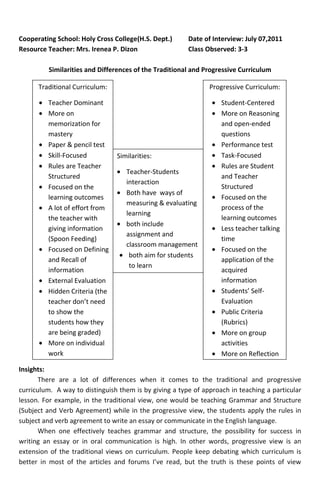
         Similarities and Differences of the Traditional and Progressive Curriculum

      Traditional Curriculum:                                  Progressive Curriculum:

         Teacher Dominant                                          Student-Centered
         More on                                                   More on Reasoning
         memorization for                                          and open-ended
         mastery                                                   questions
         Paper & pencil test                                       Performance test
         Skill-Focused          Similarities:                      Task-Focused
         Rules are Teacher                                         Rules are Student
                                   Teacher-Students
         Structured                                                and Teacher
                                   interaction
         Focused on the                                            Structured
                                   Both have ways of
         learning outcomes                                         Focused on the
                                   measuring & evaluating
         A lot of effort from                                      process of the
                                   learning
         the teacher with                                          learning outcomes
                                   both include
         giving information                                        Less teacher talking
                                   assignment and
         (Spoon Feeding)                                           time
                                   classroom management
         Focused on Defining                                       Focused on the
                                    both aim for students
         and Recall of                                             application of the
                                    to learn
         information                                               acquired
         External Evaluation                                       information
         Hidden Criteria (the                                      Students’ Self-
         teacher don’t need                                        Evaluation
         to show the                                               Public Criteria
         students how they                                         (Rubrics)
         are being graded)                                         More on group
         More on individual                                        activities
         work                                                      More on Reflection

Insights:
       There are a lot of differences when it comes to the traditional and progressive
curriculum. A way to distinguish them is by giving a type of approach in teaching a particular
lesson. For example, in the traditional view, one would be teaching Grammar and Structure
(Subject and Verb Agreement) while in the progressive view, the students apply the rules in
subject and verb agreement to write an essay or communicate in the English language.
       When one effectively teaches grammar and structure, the possibility for success in
writing an essay or in oral communication is high. In other words, progressive view is an
extension of the traditional views on curriculum. People keep debating which curriculum is
better in most of the articles and forums I’ve read, but the truth is these points of view
regarding curriculum go hand in hand. They actually complement each other. Each has its own
specialty in developing a student. What matters is they both agree in making the students
improve, learn and be a productive citizen of our country in their own different way.
                                            --o0o--

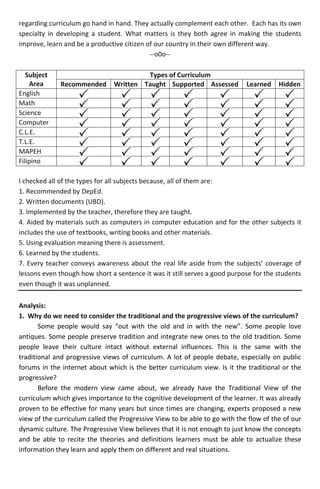
   Subject                               Types of Curriculum
    Area      Recommended       Written Taught Supported Assessed           Learned    Hidden
English
Math
Science
Computer
C.L.E.
T.L.E.
MAPEH
Filipino

I checked all of the types for all subjects because, all of them are:
1. Recommended by DepEd.
2. Written documents (UBD).
3. Implemented by the teacher, therefore they are taught.
4. Aided by materials such as computers in computer education and for the other subjects it
includes the use of textbooks, writing books and other materials.
5. Using evaluation meaning there is assessment.
6. Learned by the students.
7. Every teacher conveys awareness about the real life aside from the subjects’ coverage of
lessons even though how short a sentence it was it still serves a good purpose for the students
even though it was unplanned.

Analysis:
1. Why do we need to consider the traditional and the progressive views of the curriculum?
       Some people would say “out with the old and in with the new”. Some people love
antiques. Some people preserve tradition and integrate new ones to the old tradition. Some
people leave their culture intact without external influences. This is the same with the
traditional and progressive views of curriculum. A lot of people debate, especially on public
forums in the internet about which is the better curriculum view. Is it the traditional or the
progressive?
       Before the modern view came about, we already have the Traditional View of the
curriculum which gives importance to the cognitive development of the learner. It was already
proven to be effective for many years but since times are changing, experts proposed a new
view of the curriculum called the Progressive View to be able to go with the flow of the of our
dynamic culture. The Progressive View believes that it is not enough to just know the concepts
and be able to recite the theories and definitions learners must be able to actualize these
information they learn and apply them on different and real situations.
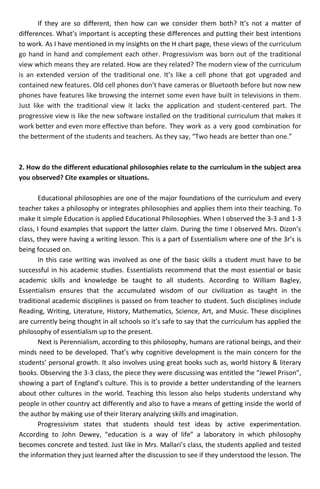
If they are so different, then how can we consider them both? It’s not a matter of
differences. What’s important is accepting these differences and putting their best intentions
to work. As I have mentioned in my insights on the H chart page, these views of the curriculum
go hand in hand and complement each other. Progressivism was born out of the traditional
view which means they are related. How are they related? The modern view of the curriculum
is an extended version of the traditional one. It’s like a cell phone that got upgraded and
contained new features. Old cell phones don’t have cameras or Bluetooth before but now new
phones have features like browsing the internet some even have built in televisions in them.
Just like with the traditional view it lacks the application and student-centered part. The
progressive view is like the new software installed on the traditional curriculum that makes it
work better and even more effective than before. They work as a very good combination for
the betterment of the students and teachers. As they say, “Two heads are better than one.”


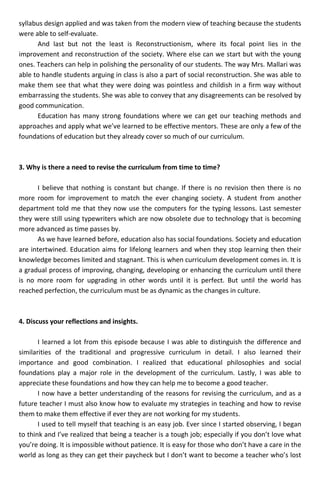
2. How do the different educational philosophies relate to the curriculum in the subject area
you observed? Cite examples or situations.

       Educational philosophies are one of the major foundations of the curriculum and every
teacher takes a philosophy or integrates philosophies and applies them into their teaching. To
make it simple Education is applied Educational Philosophies. When I observed the 3-3 and 1-3
class, I found examples that support the latter claim. During the time I observed Mrs. Dizon’s
class, they were having a writing lesson. This is a part of Essentialism where one of the 3r’s is
being focused on.
       In this case writing was involved as one of the basic skills a student must have to be
successful in his academic studies. Essentialists recommend that the most essential or basic
academic skills and knowledge be taught to all students. According to William Bagley,
Essentialism ensures that the accumulated wisdom of our civilization as taught in the
traditional academic disciplines is passed on from teacher to student. Such disciplines include
Reading, Writing, Literature, History, Mathematics, Science, Art, and Music. These disciplines
are currently being thought in all schools so it’s safe to say that the curriculum has applied the
philosophy of essentialism up to the present.
       Next is Perennialism, according to this philosophy, humans are rational beings, and their
minds need to be developed. That’s why cognitive development is the main concern for the
students’ personal growth. It also involves using great books such as, world history & literary
books. Observing the 3-3 class, the piece they were discussing was entitled the “Jewel Prison”,
showing a part of England’s culture. This is to provide a better understanding of the learners
about other cultures in the world. Teaching this lesson also helps students understand why
people in other country act differently and also to have a means of getting inside the world of
the author by making use of their literary analyzing skills and imagination.
       Progressivism states that students should test ideas by active experimentation.
According to John Dewey, “education is a way of life” a laboratory in which philosophy
becomes concrete and tested. Just like in Mrs. Mallari’s class, the students applied and tested
the information they just learned after the discussion to see if they understood the lesson. The
syllabus design applied and was taken from the modern view of teaching because the students
were able to self-evaluate.
      And last but not the least is Reconstructionism, where its focal point lies in the
improvement and reconstruction of the society. Where else can we start but with the young
ones. Teachers can help in polishing the personality of our students. The way Mrs. Mallari was
able to handle students arguing in class is also a part of social reconstruction. She was able to
make them see that what they were doing was pointless and childish in a firm way without
embarrassing the students. She was able to convey that any disagreements can be resolved by
good communication.
      Education has many strong foundations where we can get our teaching methods and
approaches and apply what we’ve learned to be effective mentors. These are only a few of the
foundations of education but they already cover so much of our curriculum.


3. Why is there a need to revise the curriculum from time to time?

      I believe that nothing is constant but change. If there is no revision then there is no
more room for improvement to match the ever changing society. A student from another
department told me that they now use the computers for the typing lessons. Last semester
they were still using typewriters which are now obsolete due to technology that is becoming
more advanced as time passes by.
      As we have learned before, education also has social foundations. Society and education
are intertwined. Education aims for lifelong learners and when they stop learning then their
knowledge becomes limited and stagnant. This is when curriculum development comes in. It is
a gradual process of improving, changing, developing or enhancing the curriculum until there
is no more room for upgrading in other words until it is perfect. But until the world has
reached perfection, the curriculum must be as dynamic as the changes in culture.


4. Discuss your reflections and insights.

       I learned a lot from this episode because I was able to distinguish the difference and
similarities of the traditional and progressive curriculum in detail. I also learned their
importance and good combination. I realized that educational philosophies and social
foundations play a major role in the development of the curriculum. Lastly, I was able to
appreciate these foundations and how they can help me to become a good teacher.
       I now have a better understanding of the reasons for revising the curriculum, and as a
future teacher I must also know how to evaluate my strategies in teaching and how to revise
them to make them effective if ever they are not working for my students.
       I used to tell myself that teaching is an easy job. Ever since I started observing, I began
to think and I’ve realized that being a teacher is a tough job; especially if you don’t love what
you’re doing. It is impossible without patience. It is easy for those who don’t have a care in the
world as long as they can get their paycheck but I don’t want to become a teacher who’s lost
his heart in teaching. But I would rather be someone who becomes an instrument in molding
many students into good and competent people.

FS4: Episode 1

  • 1.
    Name of FSStudent: Ma. Cristina D. Panganoran Course & Year: BSE-3 English Resource Teacher: Mrs. Irenea P. Dizon Signature: ________________ Date Signed: ______________ Cooperating School: Holy Cross College (High School Department) Instructor: Mrs. Gloria A. Silva Date of Submission: July 19, 2011 Date Submitted: July 19, 2011
  • 2.
    Cooperating School: HolyCross College(H.S. Dept.) Date of Interview: July 07,2011 Resource Teacher: Mrs. Irenea P. Dizon Class Observed: 3-3 Similarities and Differences of the Traditional and Progressive Curriculum Traditional Curriculum: Progressive Curriculum: Teacher Dominant Student-Centered More on More on Reasoning memorization for and open-ended mastery questions Paper & pencil test Performance test Skill-Focused Similarities: Task-Focused Rules are Teacher Rules are Student Teacher-Students Structured and Teacher interaction Focused on the Structured Both have ways of learning outcomes Focused on the measuring & evaluating A lot of effort from process of the learning the teacher with learning outcomes both include giving information Less teacher talking assignment and (Spoon Feeding) time classroom management Focused on Defining Focused on the both aim for students and Recall of application of the to learn information acquired External Evaluation information Hidden Criteria (the Students’ Self- teacher don’t need Evaluation to show the Public Criteria students how they (Rubrics) are being graded) More on group More on individual activities work More on Reflection Insights: There are a lot of differences when it comes to the traditional and progressive curriculum. A way to distinguish them is by giving a type of approach in teaching a particular lesson. For example, in the traditional view, one would be teaching Grammar and Structure (Subject and Verb Agreement) while in the progressive view, the students apply the rules in subject and verb agreement to write an essay or communicate in the English language. When one effectively teaches grammar and structure, the possibility for success in writing an essay or in oral communication is high. In other words, progressive view is an extension of the traditional views on curriculum. People keep debating which curriculum is better in most of the articles and forums I’ve read, but the truth is these points of view
  • 3.
    regarding curriculum gohand in hand. They actually complement each other. Each has its own specialty in developing a student. What matters is they both agree in making the students improve, learn and be a productive citizen of our country in their own different way. --o0o-- Subject Types of Curriculum Area Recommended Written Taught Supported Assessed Learned Hidden English Math Science Computer C.L.E. T.L.E. MAPEH Filipino I checked all of the types for all subjects because, all of them are: 1. Recommended by DepEd. 2. Written documents (UBD). 3. Implemented by the teacher, therefore they are taught. 4. Aided by materials such as computers in computer education and for the other subjects it includes the use of textbooks, writing books and other materials. 5. Using evaluation meaning there is assessment. 6. Learned by the students. 7. Every teacher conveys awareness about the real life aside from the subjects’ coverage of lessons even though how short a sentence it was it still serves a good purpose for the students even though it was unplanned. Analysis: 1. Why do we need to consider the traditional and the progressive views of the curriculum? Some people would say “out with the old and in with the new”. Some people love antiques. Some people preserve tradition and integrate new ones to the old tradition. Some people leave their culture intact without external influences. This is the same with the traditional and progressive views of curriculum. A lot of people debate, especially on public forums in the internet about which is the better curriculum view. Is it the traditional or the progressive? Before the modern view came about, we already have the Traditional View of the curriculum which gives importance to the cognitive development of the learner. It was already proven to be effective for many years but since times are changing, experts proposed a new view of the curriculum called the Progressive View to be able to go with the flow of the of our dynamic culture. The Progressive View believes that it is not enough to just know the concepts and be able to recite the theories and definitions learners must be able to actualize these information they learn and apply them on different and real situations.
  • 4.
    If they areso different, then how can we consider them both? It’s not a matter of differences. What’s important is accepting these differences and putting their best intentions to work. As I have mentioned in my insights on the H chart page, these views of the curriculum go hand in hand and complement each other. Progressivism was born out of the traditional view which means they are related. How are they related? The modern view of the curriculum is an extended version of the traditional one. It’s like a cell phone that got upgraded and contained new features. Old cell phones don’t have cameras or Bluetooth before but now new phones have features like browsing the internet some even have built in televisions in them. Just like with the traditional view it lacks the application and student-centered part. The progressive view is like the new software installed on the traditional curriculum that makes it work better and even more effective than before. They work as a very good combination for the betterment of the students and teachers. As they say, “Two heads are better than one.” 2. How do the different educational philosophies relate to the curriculum in the subject area you observed? Cite examples or situations. Educational philosophies are one of the major foundations of the curriculum and every teacher takes a philosophy or integrates philosophies and applies them into their teaching. To make it simple Education is applied Educational Philosophies. When I observed the 3-3 and 1-3 class, I found examples that support the latter claim. During the time I observed Mrs. Dizon’s class, they were having a writing lesson. This is a part of Essentialism where one of the 3r’s is being focused on. In this case writing was involved as one of the basic skills a student must have to be successful in his academic studies. Essentialists recommend that the most essential or basic academic skills and knowledge be taught to all students. According to William Bagley, Essentialism ensures that the accumulated wisdom of our civilization as taught in the traditional academic disciplines is passed on from teacher to student. Such disciplines include Reading, Writing, Literature, History, Mathematics, Science, Art, and Music. These disciplines are currently being thought in all schools so it’s safe to say that the curriculum has applied the philosophy of essentialism up to the present. Next is Perennialism, according to this philosophy, humans are rational beings, and their minds need to be developed. That’s why cognitive development is the main concern for the students’ personal growth. It also involves using great books such as, world history & literary books. Observing the 3-3 class, the piece they were discussing was entitled the “Jewel Prison”, showing a part of England’s culture. This is to provide a better understanding of the learners about other cultures in the world. Teaching this lesson also helps students understand why people in other country act differently and also to have a means of getting inside the world of the author by making use of their literary analyzing skills and imagination. Progressivism states that students should test ideas by active experimentation. According to John Dewey, “education is a way of life” a laboratory in which philosophy becomes concrete and tested. Just like in Mrs. Mallari’s class, the students applied and tested the information they just learned after the discussion to see if they understood the lesson. The
  • 5.
    syllabus design appliedand was taken from the modern view of teaching because the students were able to self-evaluate. And last but not the least is Reconstructionism, where its focal point lies in the improvement and reconstruction of the society. Where else can we start but with the young ones. Teachers can help in polishing the personality of our students. The way Mrs. Mallari was able to handle students arguing in class is also a part of social reconstruction. She was able to make them see that what they were doing was pointless and childish in a firm way without embarrassing the students. She was able to convey that any disagreements can be resolved by good communication. Education has many strong foundations where we can get our teaching methods and approaches and apply what we’ve learned to be effective mentors. These are only a few of the foundations of education but they already cover so much of our curriculum. 3. Why is there a need to revise the curriculum from time to time? I believe that nothing is constant but change. If there is no revision then there is no more room for improvement to match the ever changing society. A student from another department told me that they now use the computers for the typing lessons. Last semester they were still using typewriters which are now obsolete due to technology that is becoming more advanced as time passes by. As we have learned before, education also has social foundations. Society and education are intertwined. Education aims for lifelong learners and when they stop learning then their knowledge becomes limited and stagnant. This is when curriculum development comes in. It is a gradual process of improving, changing, developing or enhancing the curriculum until there is no more room for upgrading in other words until it is perfect. But until the world has reached perfection, the curriculum must be as dynamic as the changes in culture. 4. Discuss your reflections and insights. I learned a lot from this episode because I was able to distinguish the difference and similarities of the traditional and progressive curriculum in detail. I also learned their importance and good combination. I realized that educational philosophies and social foundations play a major role in the development of the curriculum. Lastly, I was able to appreciate these foundations and how they can help me to become a good teacher. I now have a better understanding of the reasons for revising the curriculum, and as a future teacher I must also know how to evaluate my strategies in teaching and how to revise them to make them effective if ever they are not working for my students. I used to tell myself that teaching is an easy job. Ever since I started observing, I began to think and I’ve realized that being a teacher is a tough job; especially if you don’t love what you’re doing. It is impossible without patience. It is easy for those who don’t have a care in the world as long as they can get their paycheck but I don’t want to become a teacher who’s lost
  • 6.
    his heart inteaching. But I would rather be someone who becomes an instrument in molding many students into good and competent people.