
Proficiency-Based
Teaching and Learning
   The Adventure Approach
  Stories From Another Place
          OSBA 2011
      November 12, 2011
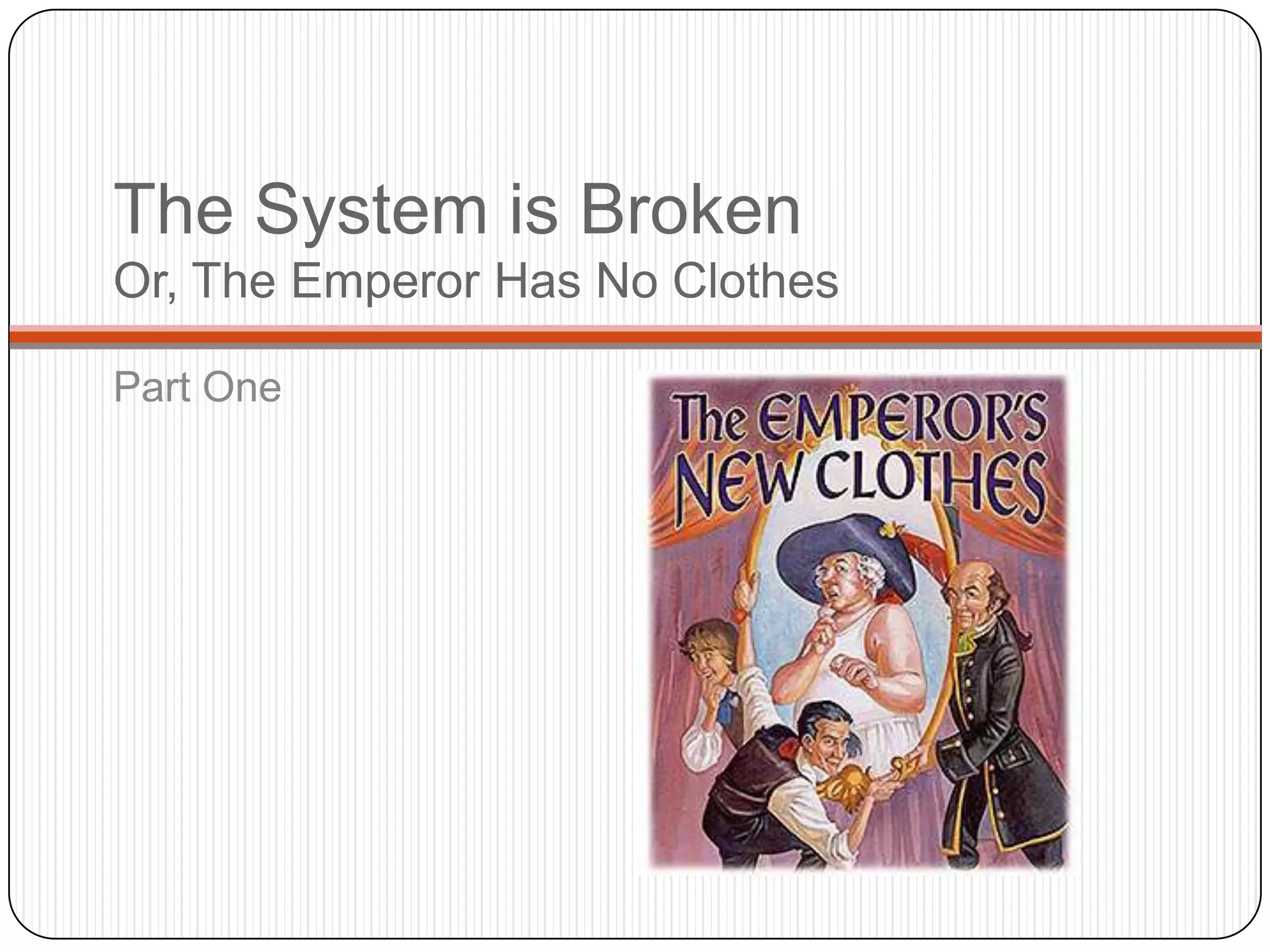
The System is Broken
Or, The Emperor Has No Clothes

Part One
The Experts in the Room
 How did you teach your children?
   To walk?
   To ride a bicycle
   To talk?
   To tie their shoes?
   Or even ???


 When did you know they could do it?
Would you teach those skills like
this?


Watch video here:
http://www.youtube.com/watch?v=dxPVyieptwA
Or this?

Watch video here:
http://www.youtube.com/watch?v=aOJEdMIC
mAY
How would you recognize good
teaching for those skills?
Question
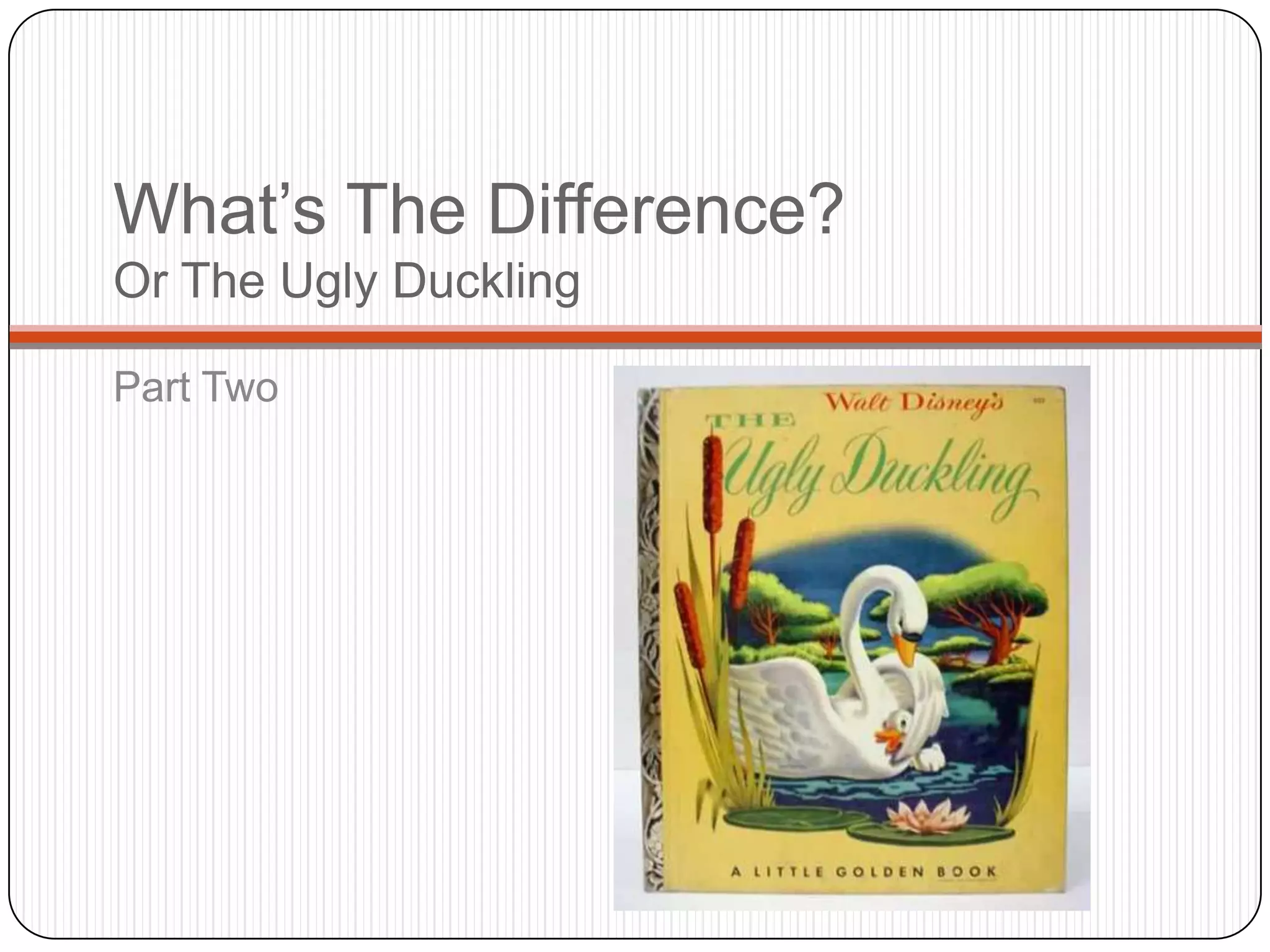
What‟s The Difference?
Or The Ugly Duckling

Part Two
What I Know About Kids
 Thirsty for knowledge
 Creative
 School kills that
Traditional and Proficiency-Based
Comparing Two Educational Models
View of Learners
Traditional               Proficiency
 Some will excel, some    All of them can
 will do average           achieve at high
 work, a portion will      standards; failure is
 fail.                     not an option
Learning Program
Traditional                Proficiency
 Time based; learning      Learning based; time
 is a variable. It‟s        is the variable. It‟s
 effective for a portion    effective for all
 of students.               students.
Grades
Traditional                   Proficiency
 Based on various, and        Indicate only what
  sometimes                     student has learned
  subjective, points rather     (knows and can do)
  than proficiencies; may       by demonstration of
  reflect quantity over         proficiency; quality of
  quality (such as extra-
                                work is based on
  credit work); may be
  used in part to               agreements about
  punish, reward, or            evidence of
  control student               proficiency.
  behavior; subject to         End-of-course grades
  inflation                     reflect student
 Grades are sometimes          proficiency at the end
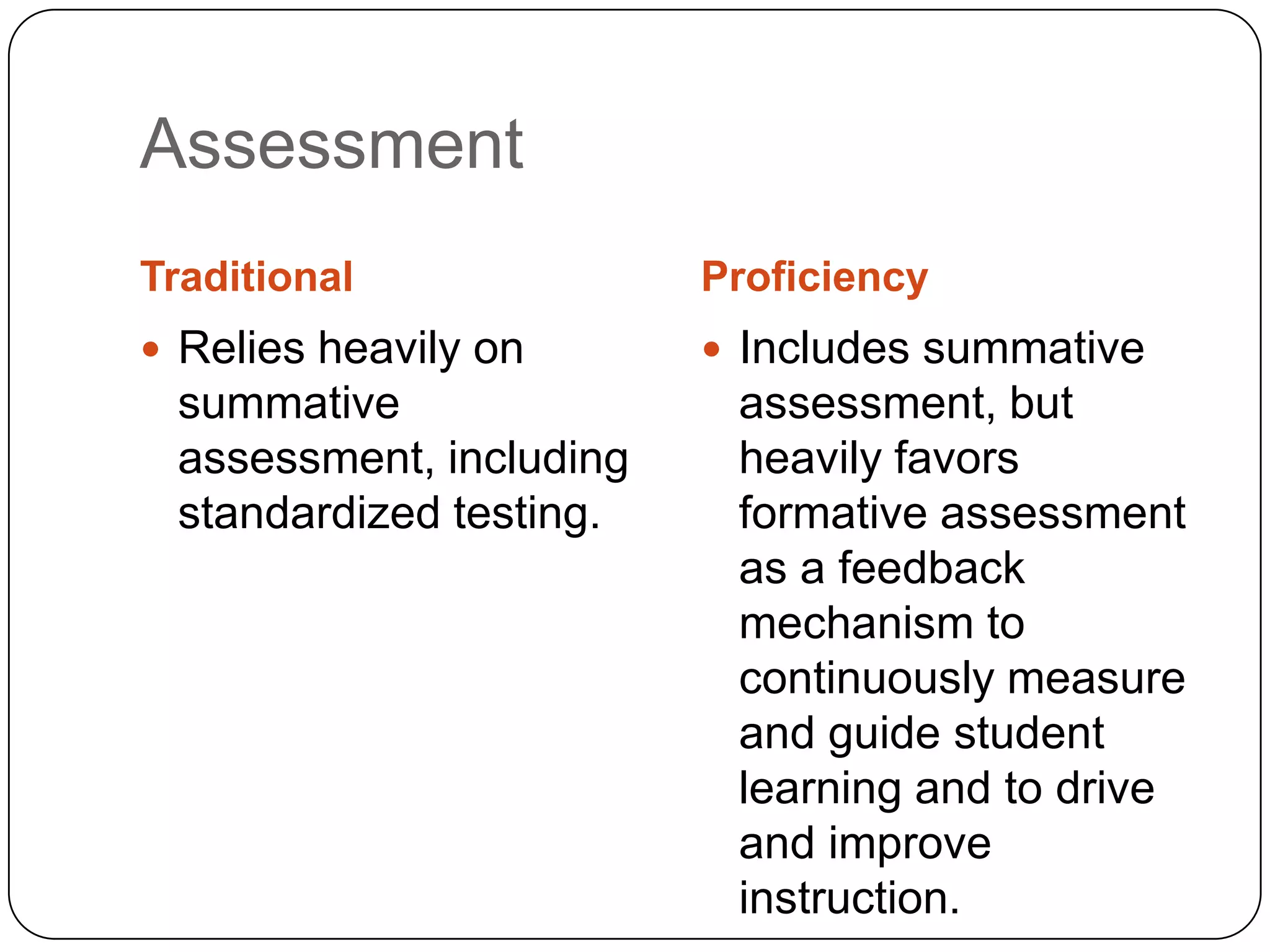
Assessment
Traditional              Proficiency
 Relies heavily on       Includes summative
 summative                assessment, but
 assessment, including    heavily favors
 standardized testing.    formative assessment
                          as a feedback
                          mechanism to
                          continuously measure
                          and guide student
                          learning and to drive
                          and improve
                          instruction.
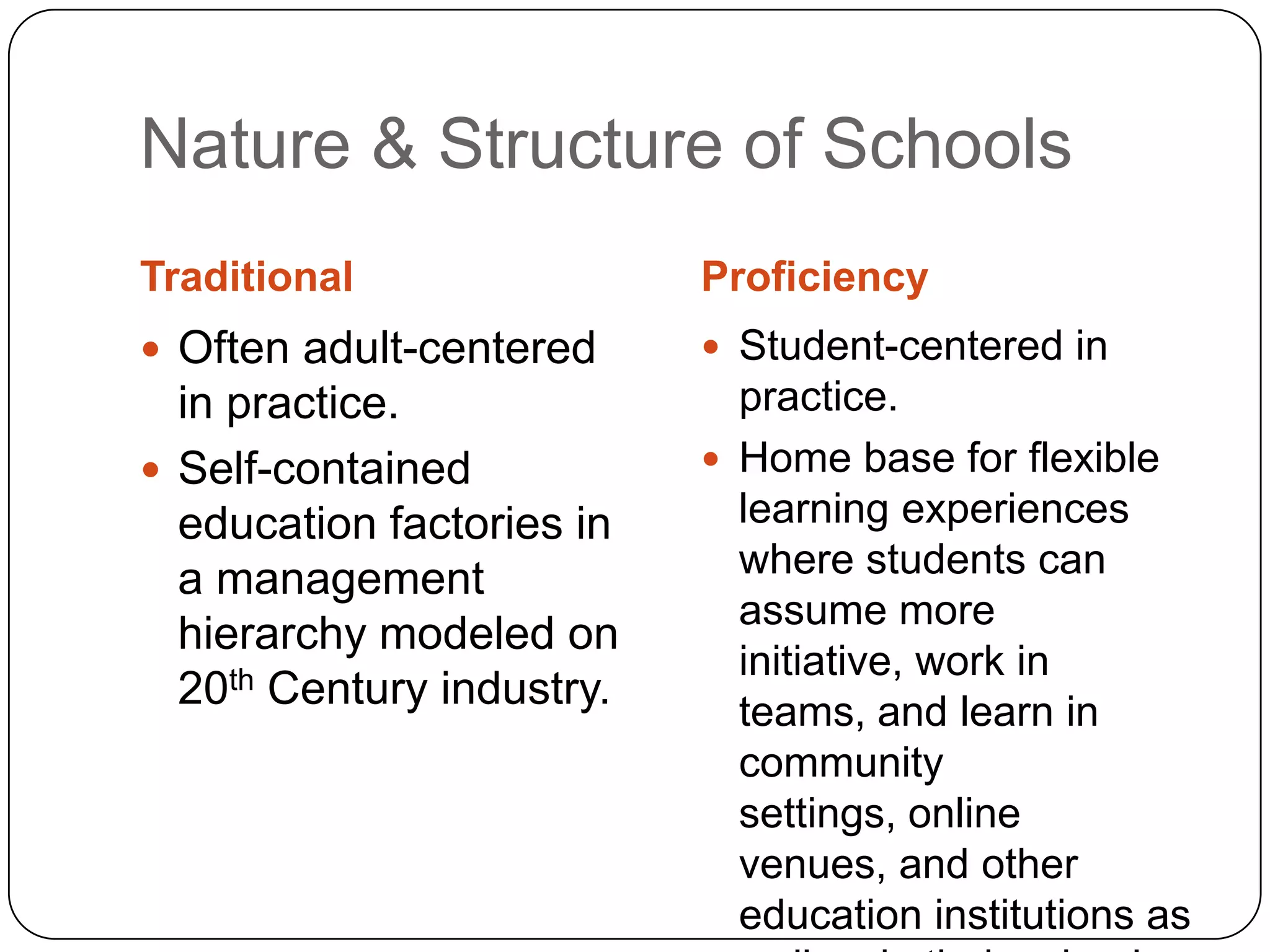
Nature & Structure of Schools
Traditional                Proficiency
 Often adult-centered      Student-centered in
  in practice.               practice.
 Self-contained            Home base for flexible
  education factories in     learning experiences
  a management               where students can
                             assume more
  hierarchy modeled on
                             initiative, work in
  20th Century industry.     teams, and learn in
                             community
                             settings, online
                             venues, and other
                             education institutions as
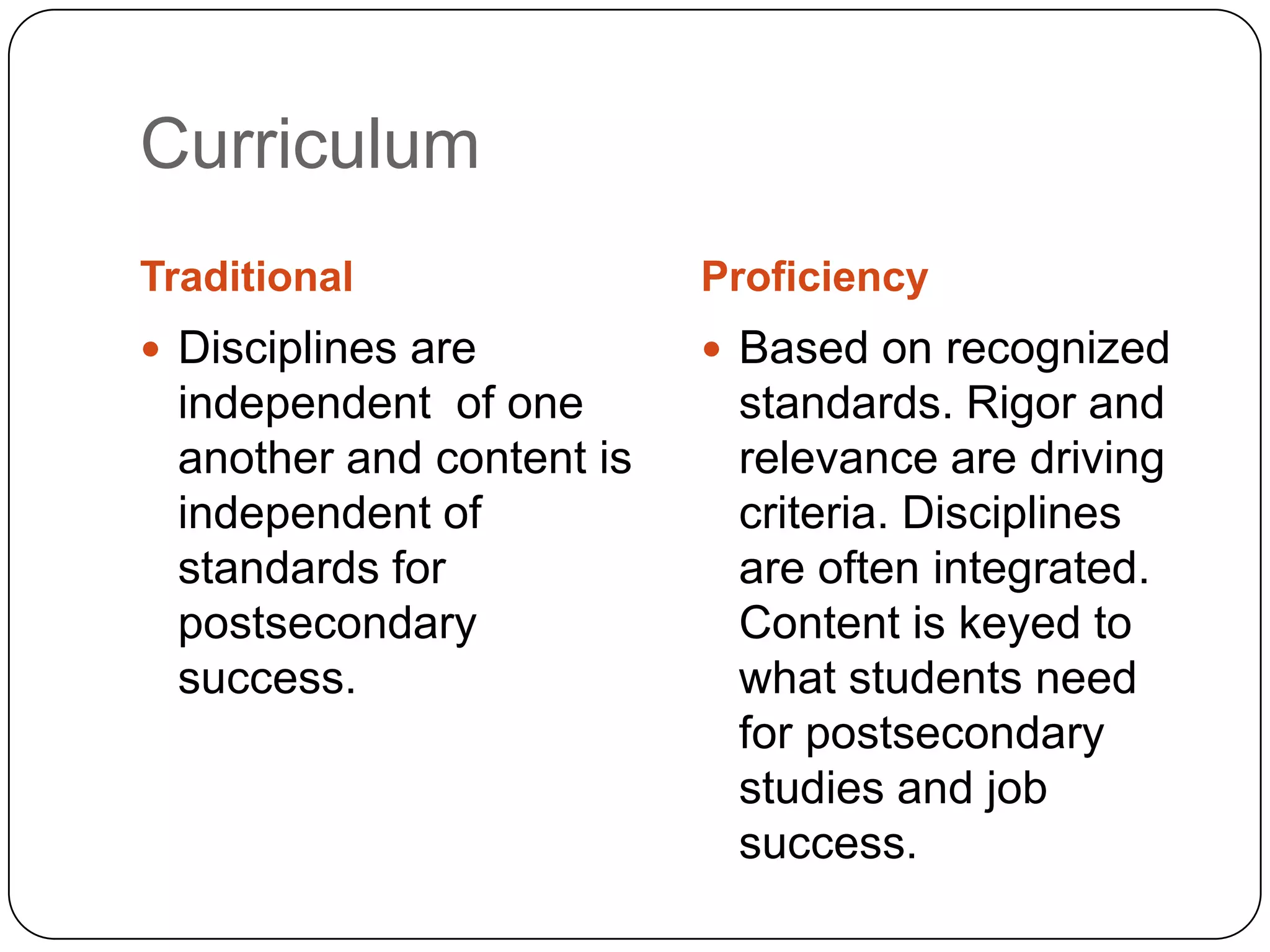
Curriculum
Traditional               Proficiency
 Disciplines are          Based on recognized
 independent of one        standards. Rigor and
 another and content is    relevance are driving
 independent of            criteria. Disciplines
 standards for             are often integrated.
 postsecondary             Content is keyed to
 success.                  what students need
                           for postsecondary
                           studies and job
                           success.
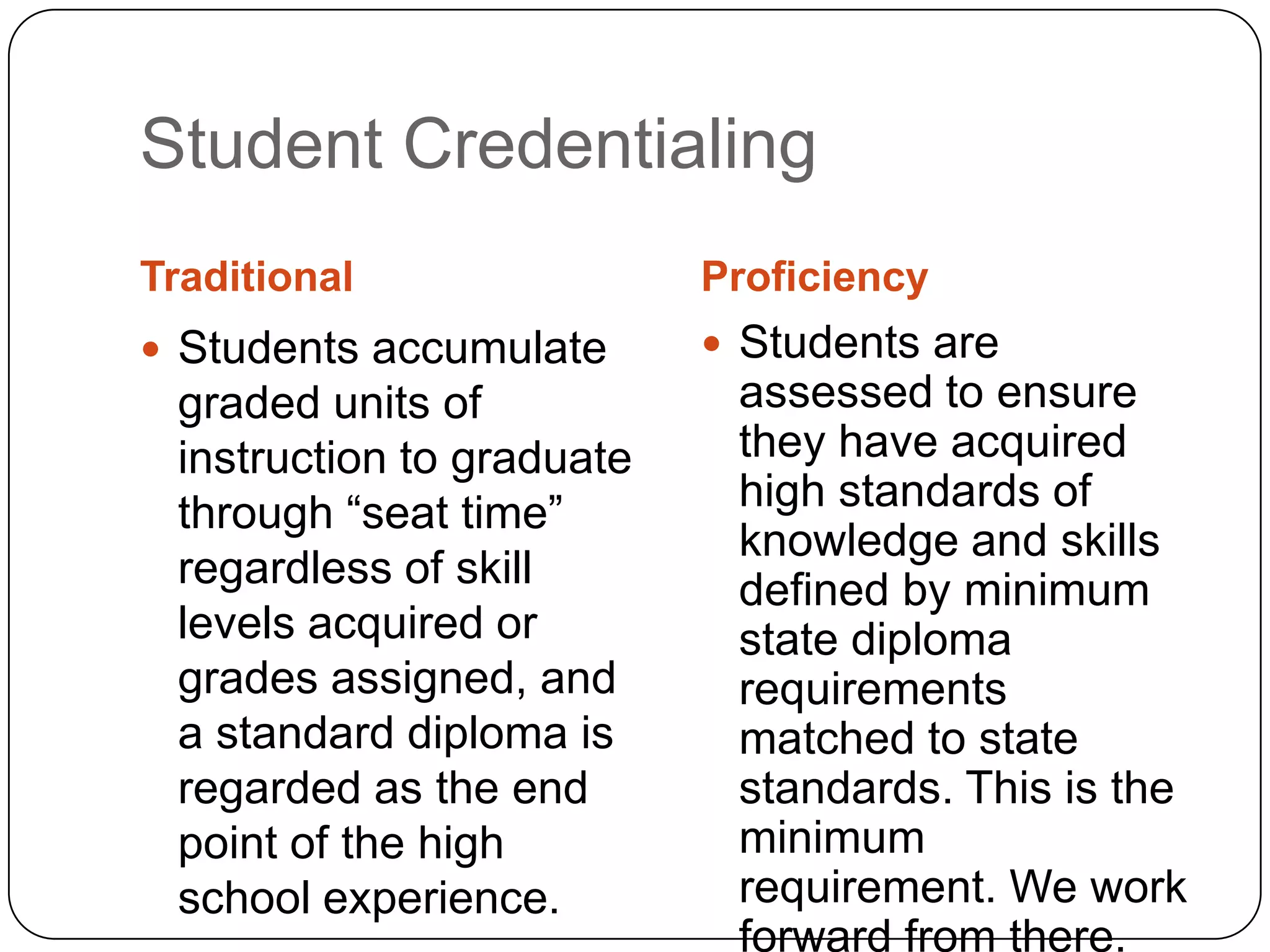
Student Credentialing
Traditional                Proficiency
 Students accumulate       Students are
 graded units of            assessed to ensure
 instruction to graduate    they have acquired
 through “seat time”        high standards of
                            knowledge and skills
 regardless of skill        defined by minimum
 levels acquired or         state diploma
 grades assigned, and       requirements
 a standard diploma is      matched to state
 regarded as the end        standards. This is the
 point of the high          minimum
 school experience.         requirement. We work
                            forward from there.
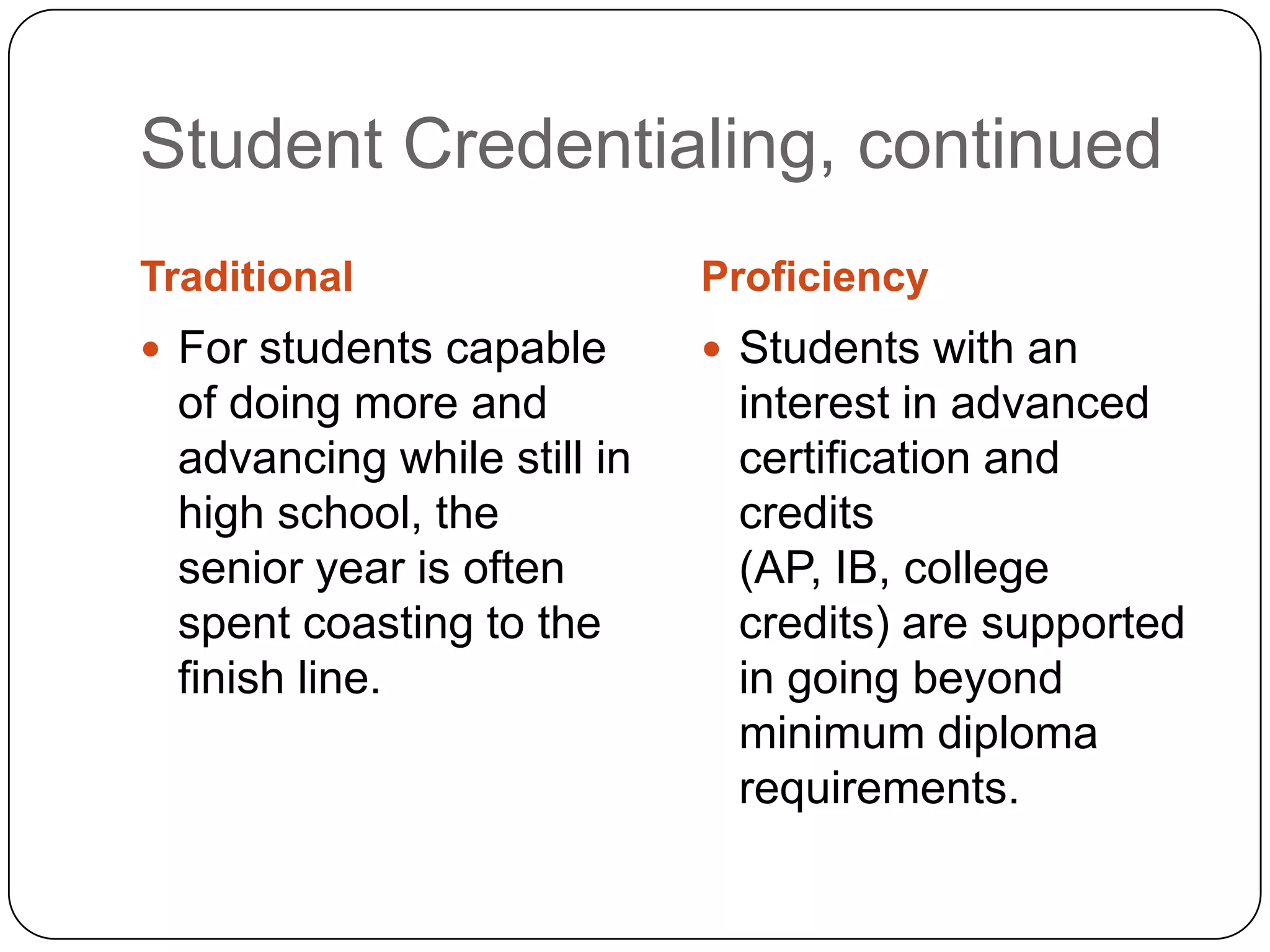
Student Credentialing, continued
Traditional                 Proficiency
 For students capable       Students with an
 of doing more and           interest in advanced
 advancing while still in    certification and
 high school, the            credits
 senior year is often        (AP, IB, college
 spent coasting to the       credits) are supported
 finish line.                in going beyond
                             minimum diploma
                             requirements.
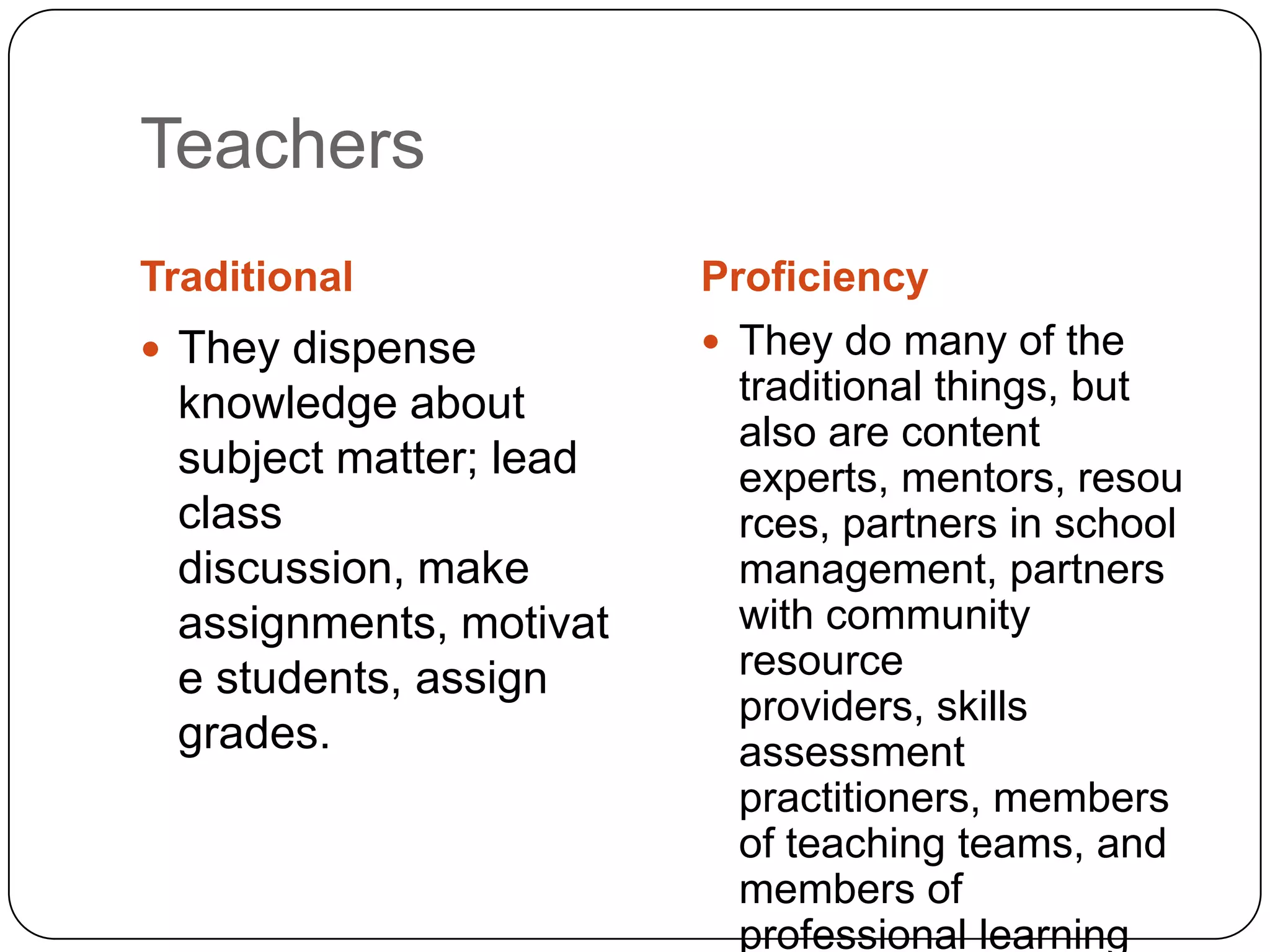
Teachers
Traditional             Proficiency
 They dispense          They do many of the
 knowledge about         traditional things, but
                         also are content
 subject matter; lead    experts, mentors, resou
 class                   rces, partners in school
 discussion, make        management, partners
 assignments, motivat    with community
 e students, assign      resource
                         providers, skills
 grades.                 assessment
                         practitioners, members
                         of teaching teams, and
                         members of
                         professional learning
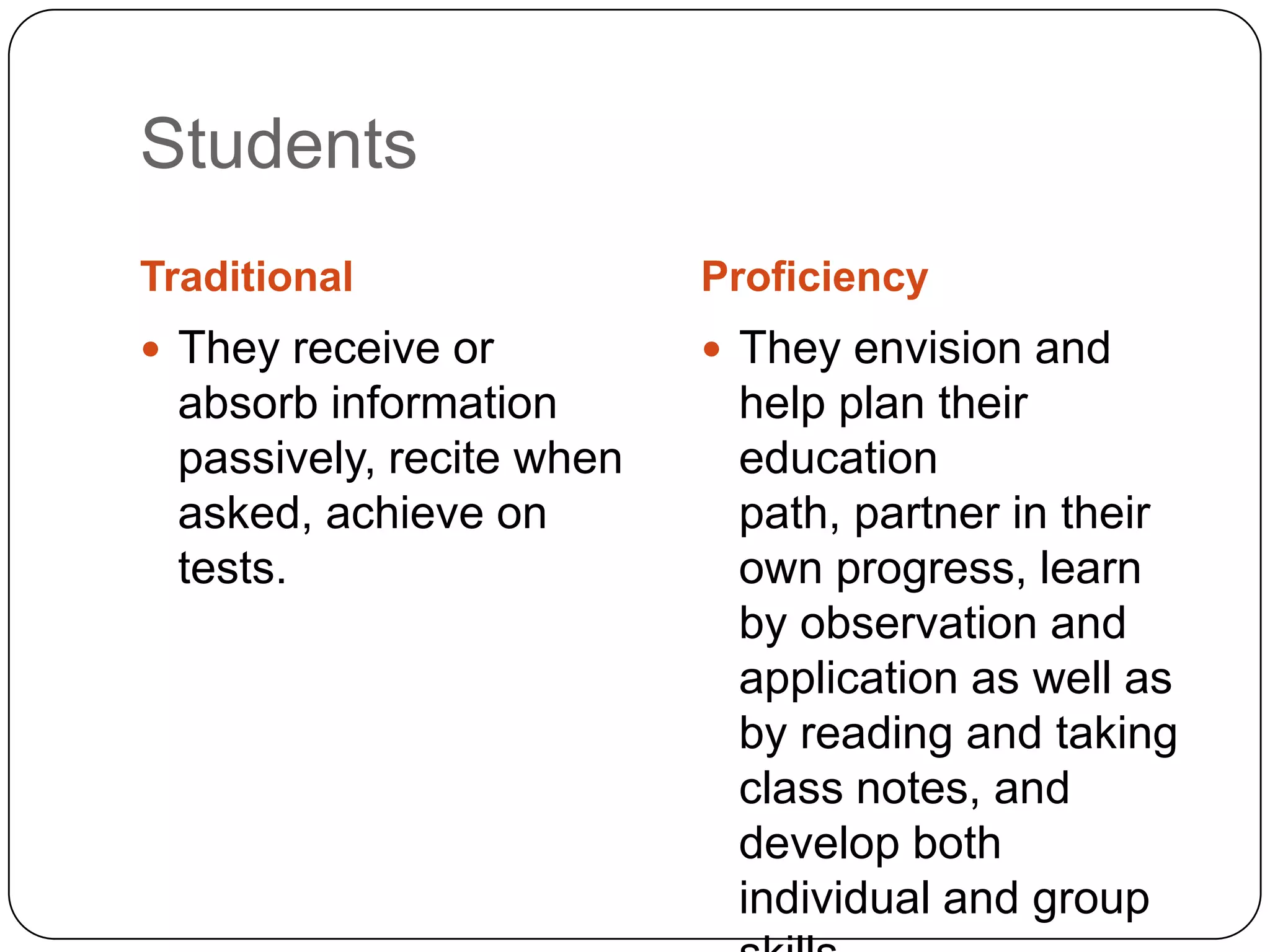
Students
Traditional               Proficiency
 They receive or          They envision and
 absorb information        help plan their
 passively, recite when    education
 asked, achieve on         path, partner in their
 tests.                    own progress, learn
                           by observation and
                           application as well as
                           by reading and taking
                           class notes, and
                           develop both
                           individual and group
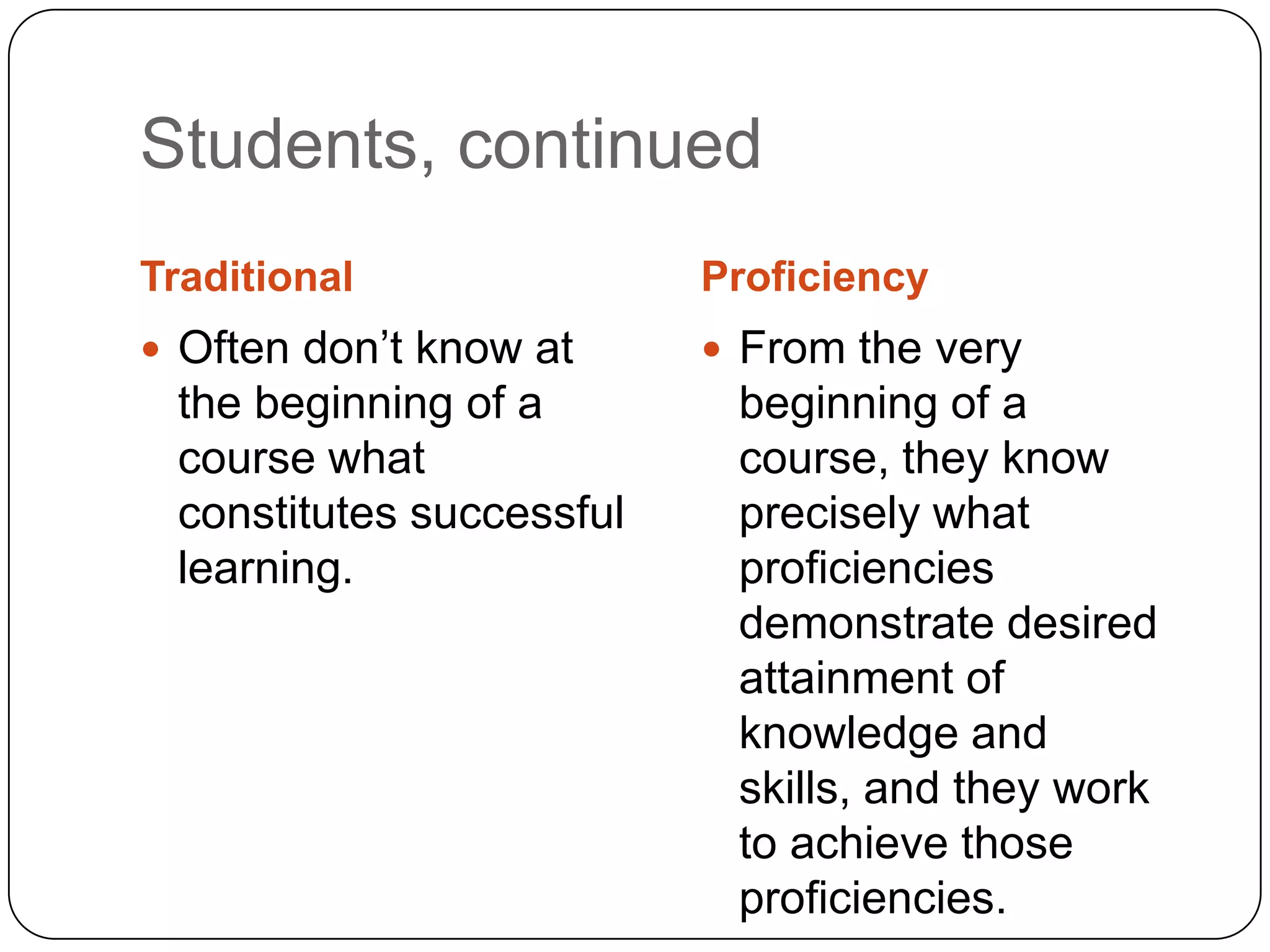
Students, continued
Traditional               Proficiency
 Often don‟t know at      From the very
 the beginning of a        beginning of a
 course what               course, they know
 constitutes successful    precisely what
 learning.                 proficiencies
                           demonstrate desired
                           attainment of
                           knowledge and
                           skills, and they work
                           to achieve those
                           proficiencies.
Student Performance Data
Traditional                 Proficiency
 Infrequently collected     Frequently collected
 and analyzed, if at all.    and analyzed
                             (currently and
                             longitudinally) by
                             teachers, professional
                             learning
                             communities, and
                             curriculum and
                             instruction
                             administrators for
                             program
Background Philosophy
 Bloom‟s Revised Taxonomy
   See handout
 What skills align with each level?
 When you scaffold learning, you create student
 ownership.
   Tell me, I forget
   Show me, I remember
   Involve me, I understand
Teacher to Principal
When I Taught          Now as a Principal
 Traditional Model     School Culture
 Forced to push the    Academic
  boundaries               implementation
 Used student            Change in teacher
  performance to           role
  change my program/      Student responsibility
  instruction              and self management
 Used formative          Parent responsibilities
  assessment data         Community school
  regularly
One Dad‟s Story
Then                         Now
 Guiding meant telling       Guiding means asking
    how to do it.                scaffolded questions.
   I knew the best way.        They come up with
                                 really good ways.
   I decide what‟s right.
                                They evaluate
   I point to the goal.         whether it works.
   It‟s right when Daddy       Together we find the
    says so.                     goal
                                They can make their
                                 own decisions.
How are we so different?
Question
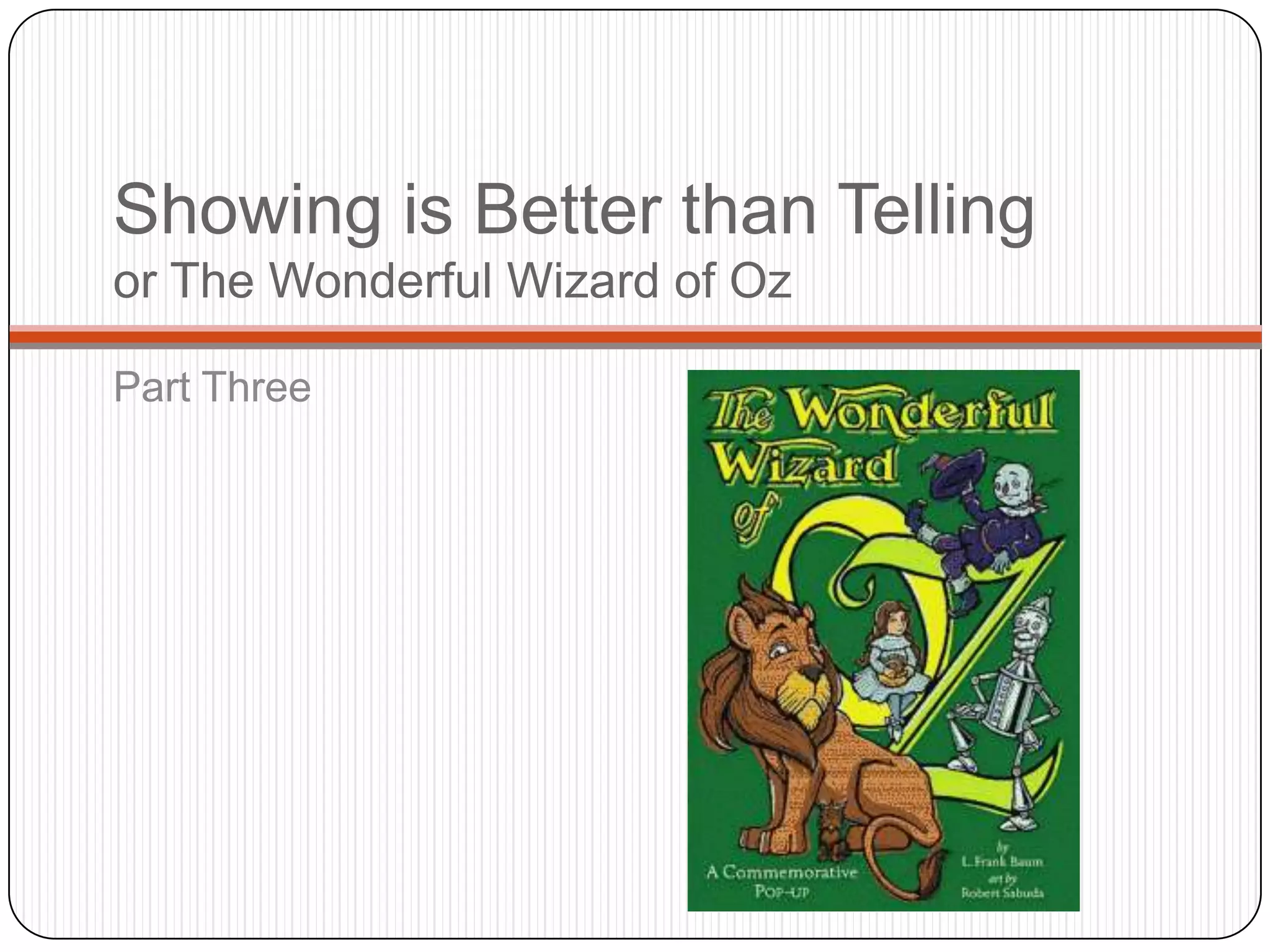
Showing is Better than Telling
or The Wonderful Wizard of Oz

Part Three
Think About It
 How to break down in bicycling in terms of skills
    (think self)
   How would you deliver/teach those skills? (pair)
   Share with your neighboring pair your skills
    (share)
   How many skills did you have? (Raise hands with
    number)
   How many learned from another person or pair?
The Proficiency Teacher
I Used To                    Now I
 Write lesson plans          Have modules students
 Grade papers                   can go through at their
 Create resources               own pace.
 Prepare for conferences       Evaluate skills as
                                 students work.
 Teach everyone
                                Sometimes revise
 Reteach everyone
                                 modules.
 Reteach again
                                Watch students present
 Catch kids up who              data at conferences
  came to me behind
                                Reach each child
 Stay at the front of the
                                Teach at one reading or
  room
                                 math level at a time.
                                Coach among students
In the Classroom
 Mini Lessons
 Flipping the Model
 Small- and full-group teaching
 Aides in every classroom
What examples can you give of
this in the world of work?
Question
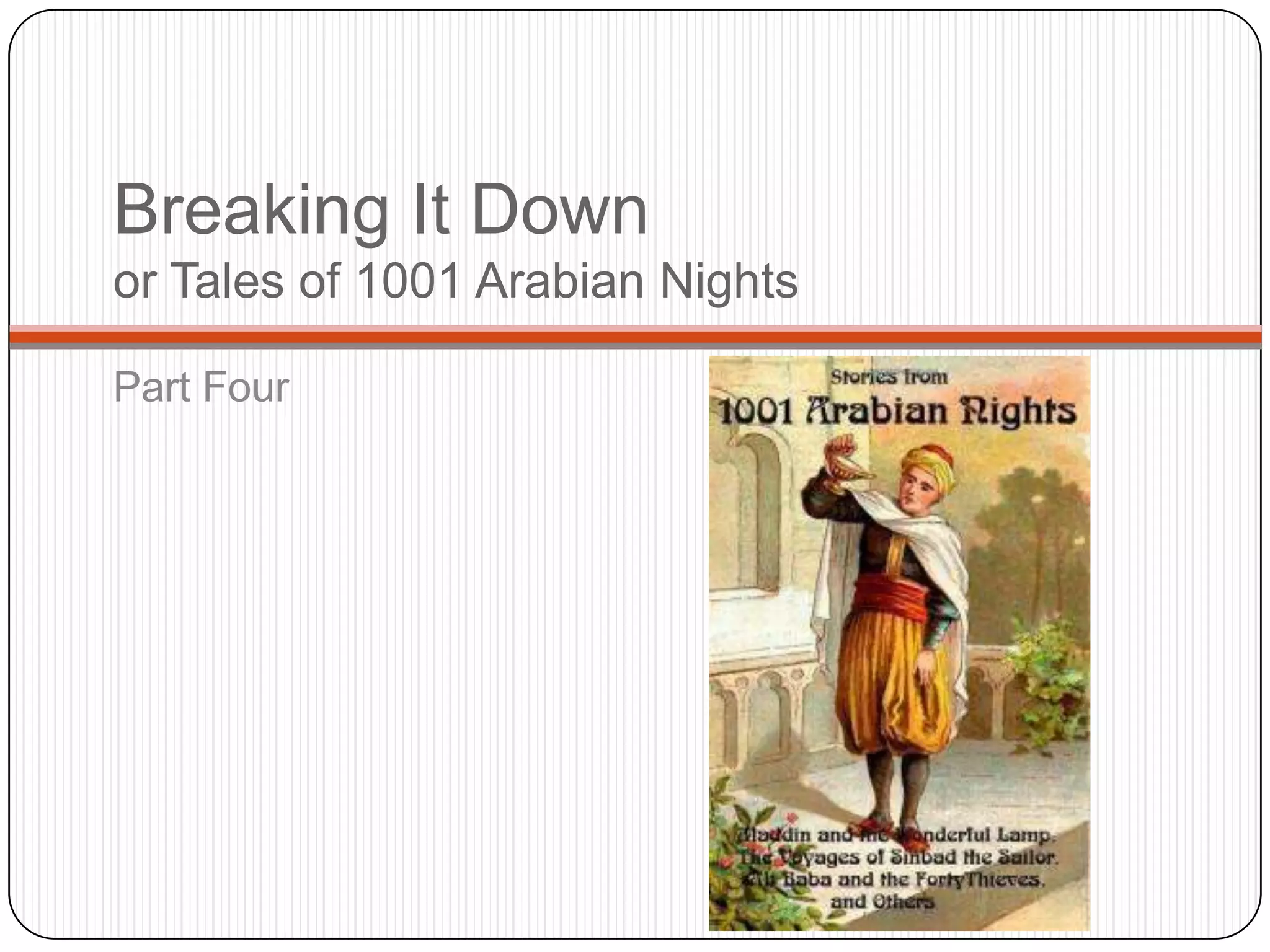
Breaking It Down
or Tales of 1001 Arabian Nights

Part Four
Common Core State Standard
 Show a CCSS standard, ask for an activity or test
  that would fit this.
 Demonstrate a breakdown into skills and
  knowledge
 Align with Bloom
 Review the process
Typical Standard
 Informational Text
 Grade 4
 Domain: Integration of Knowledge and Ideas
 Standard:
   Interpret information presented visually, orally, or
   quantitatively (e.g., in
   charts, graphs, diagrams, timelines, animations, or
   interactive elements on Web pages) and explain
   how the information contributes to an understanding
   of the text in which it appears.
 http://corestandards.org/the-standards
 How can you test that?
Knowledge and Skills
 Interpret information presented
 visually, orally, or quantitatively
 (e.g., in
 charts, graphs, diagrams, timelines,
  animations, or interactive elements
 on Web pages) and explain how
 the information contributes to an
 understanding of the text in
 which it appears.
The Process
 Parse the standards
 Lay out according to difficulty of knowledge or
    skill
   Find associated pieces of standards
   Group
   Align to Bloom‟s
   Choose a Theme
   Create Activities
   Write Instructions
   Design rubrics/scoring guides
   Outline roles and responsibilities for
    Teacher, Student, Parent
The Outcome
 Leslie‟s roll-out plan for level 3 language arts and
  social studies.
 A photo here would be great!
Which ideas from teaching bicycling
justifies this approach to standards?
Question
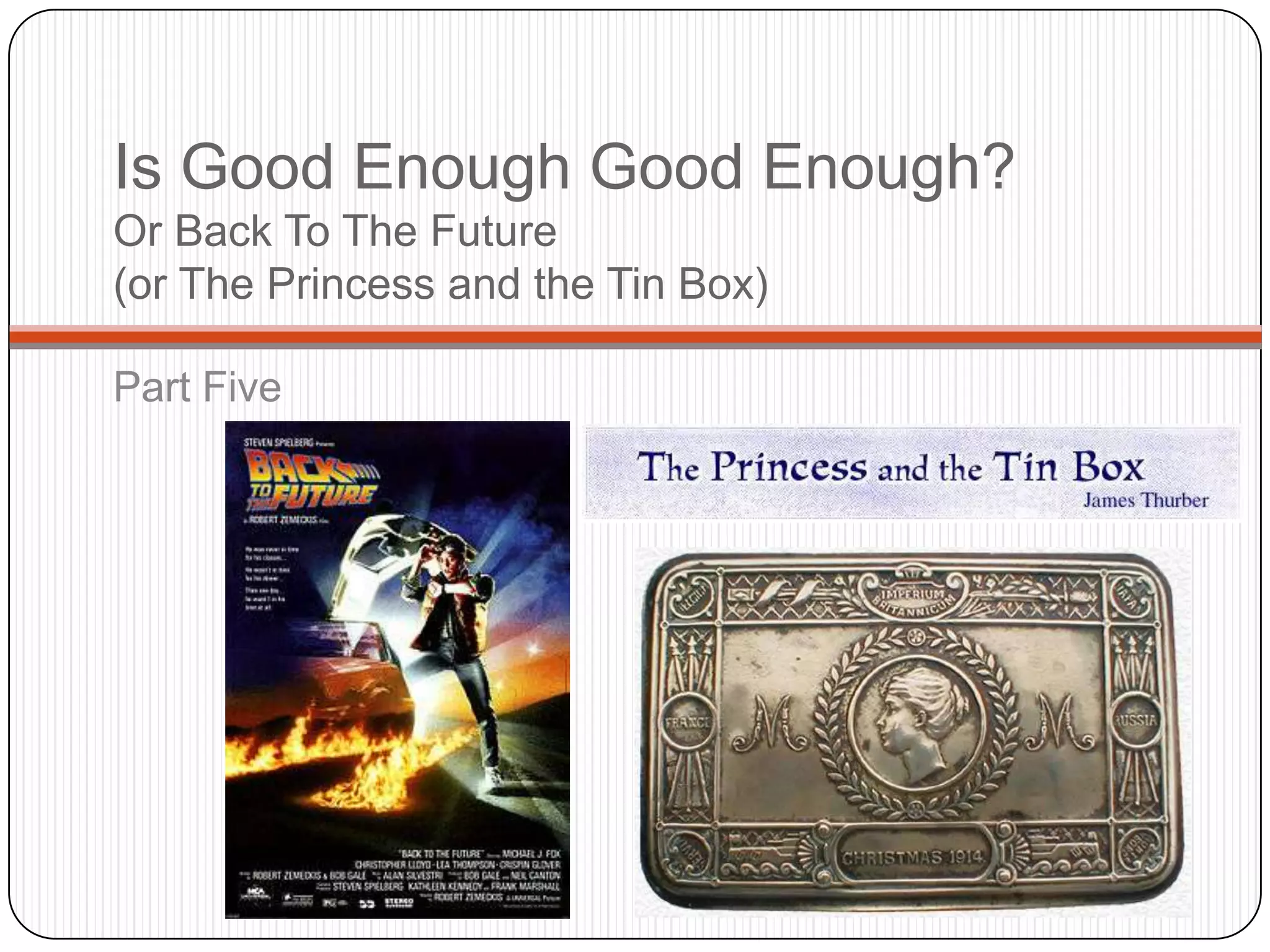
Is Good Enough Good Enough?
Or Back To The Future
(or The Princess and the Tin Box)

Part Five
Today‟s Reality
 What is happening in your schools?
 How will kids be prepared for jobs of the future?
 What does each activity do to prepare them for
 life and work?
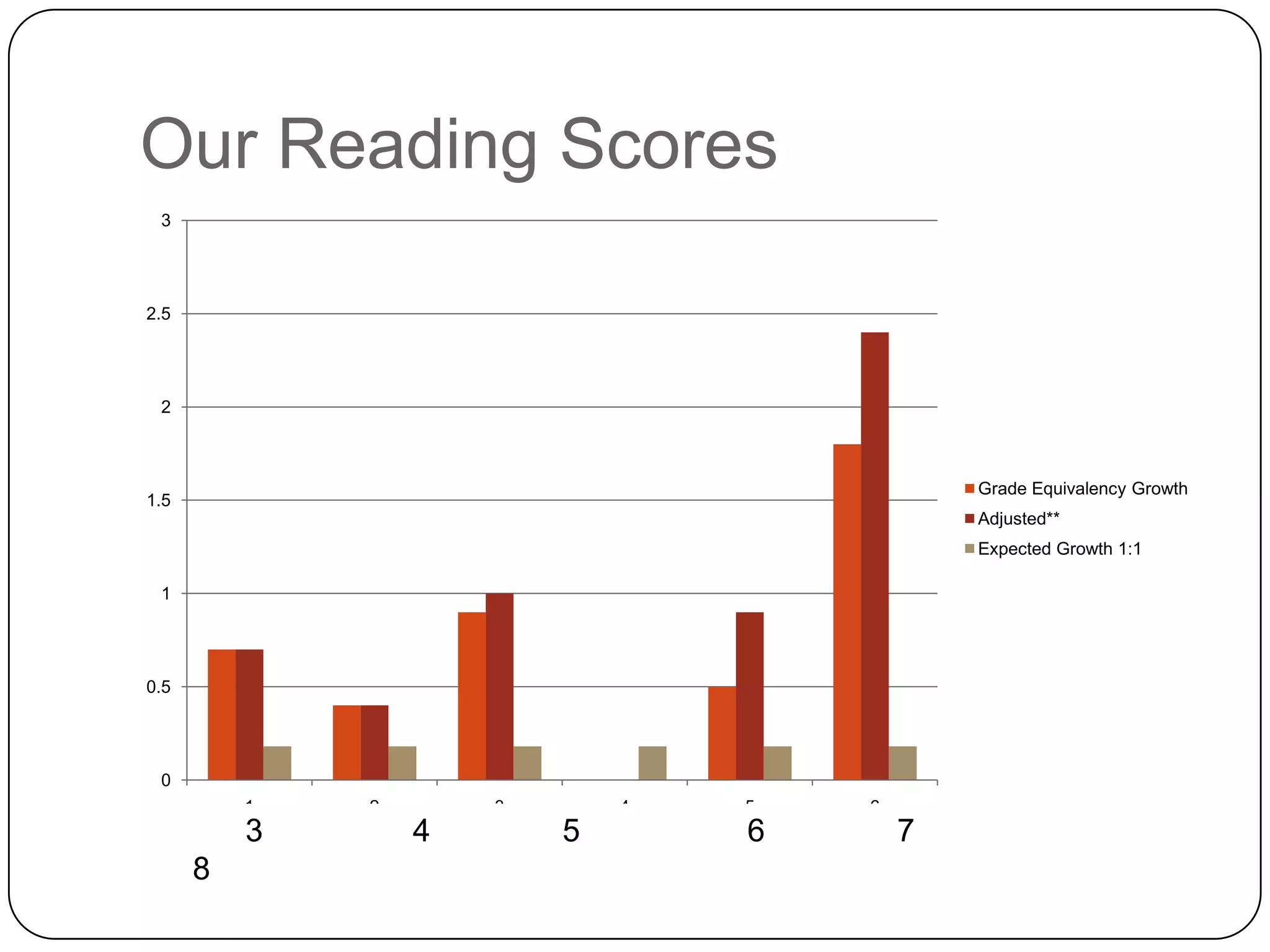
Our Reading Scores
 3


2.5


 2


                                              Grade Equivalency Growth
1.5
                                              Adjusted**
                                              Expected Growth 1:1

 1


0.5


 0
          1   2       3       4   5   6
          3       4       5       6       7
      8
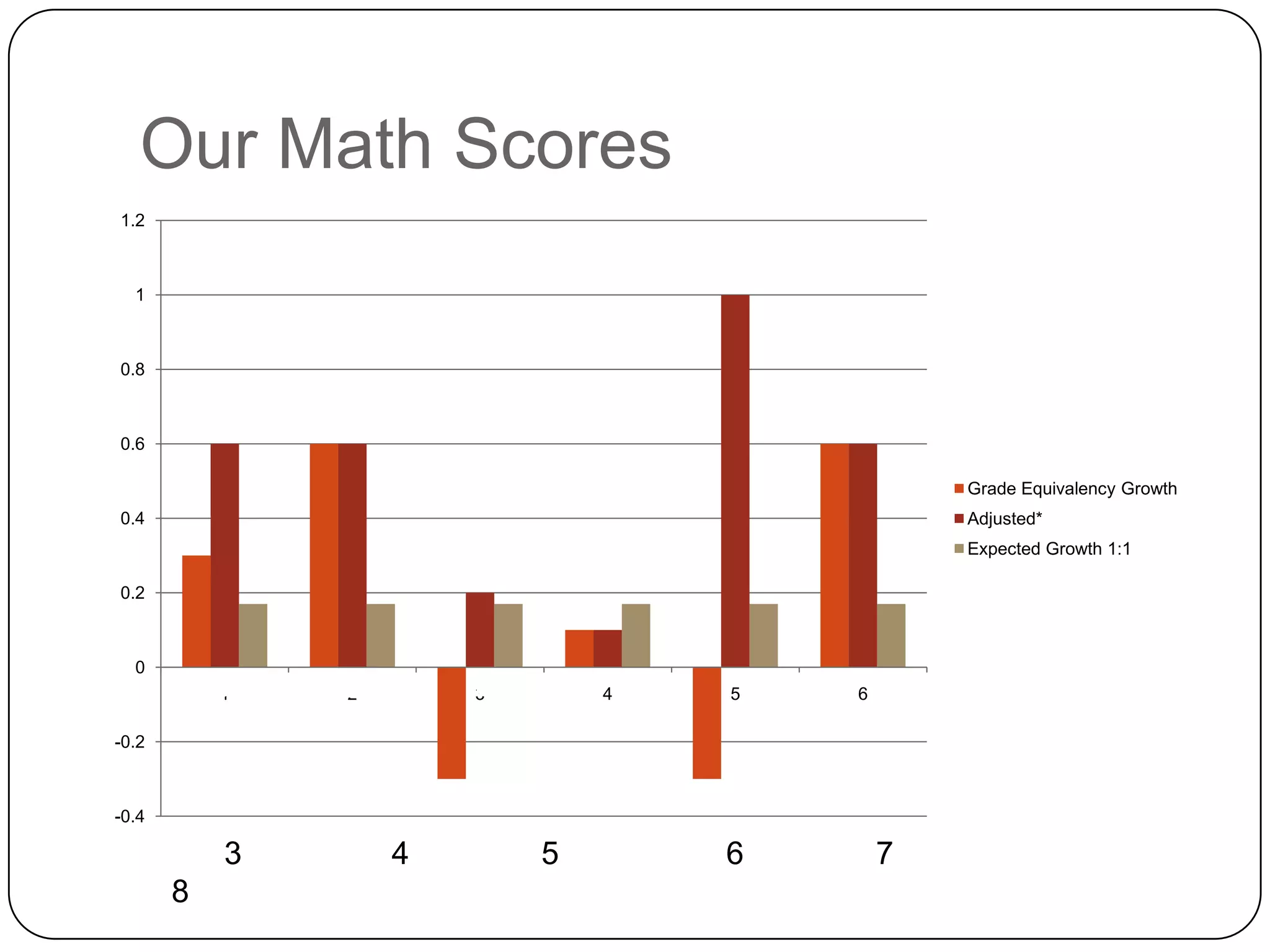
Our Math Scores
1.2


  1


0.8


0.6

                                               Grade Equivalency Growth
0.4                                            Adjusted*
                                               Expected Growth 1:1

0.2


  0
           1   2       3       4   5   6

-0.2


-0.4

           3       4       5       6       7
       8
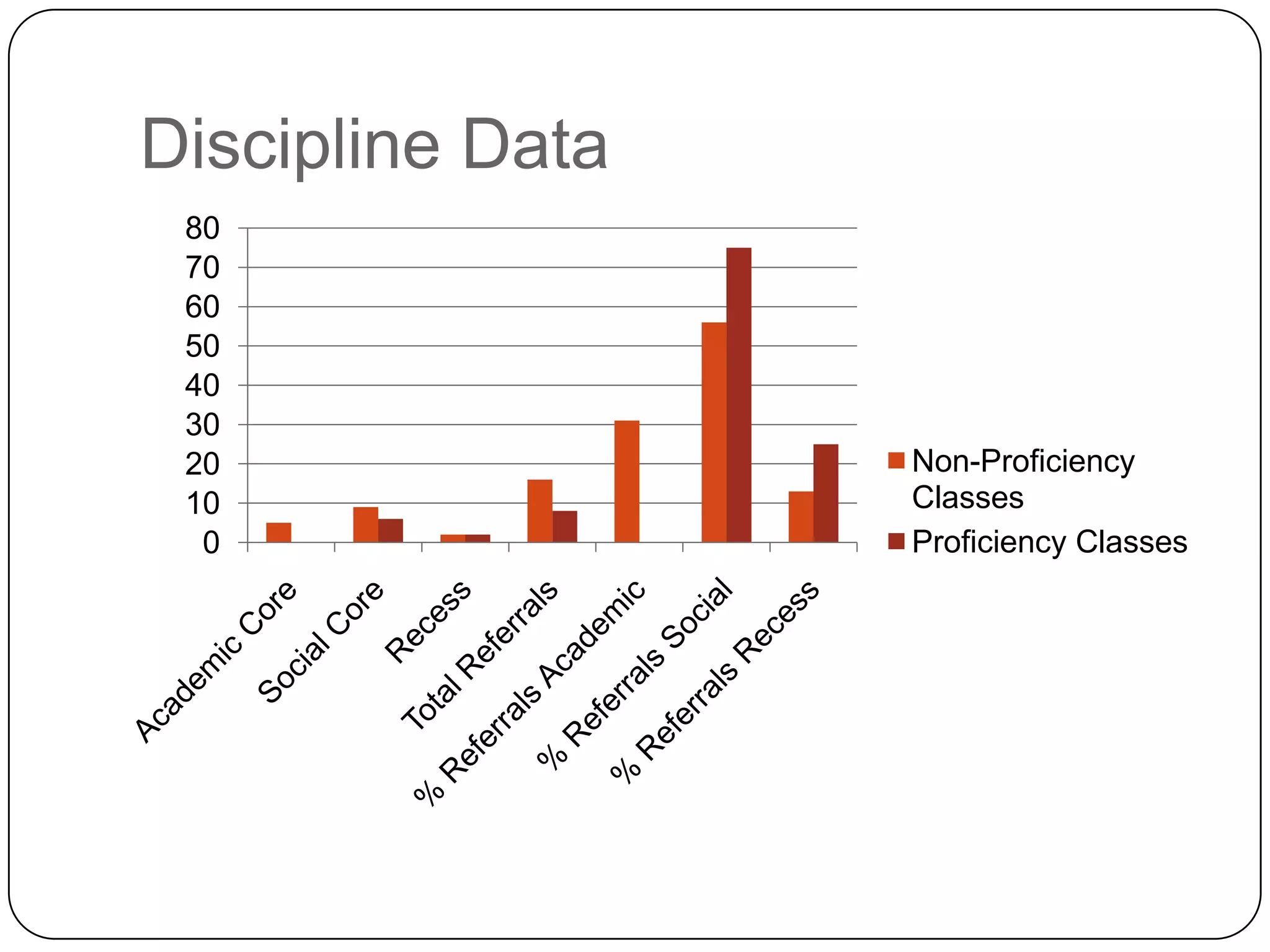
Discipline Data
 80
 70
 60
 50
 40
 30
 20               Non-Proficiency
 10               Classes
  0               Proficiency Classes
Success Stories
 Student Engagement
 Level of Performance
 Teacher Perception
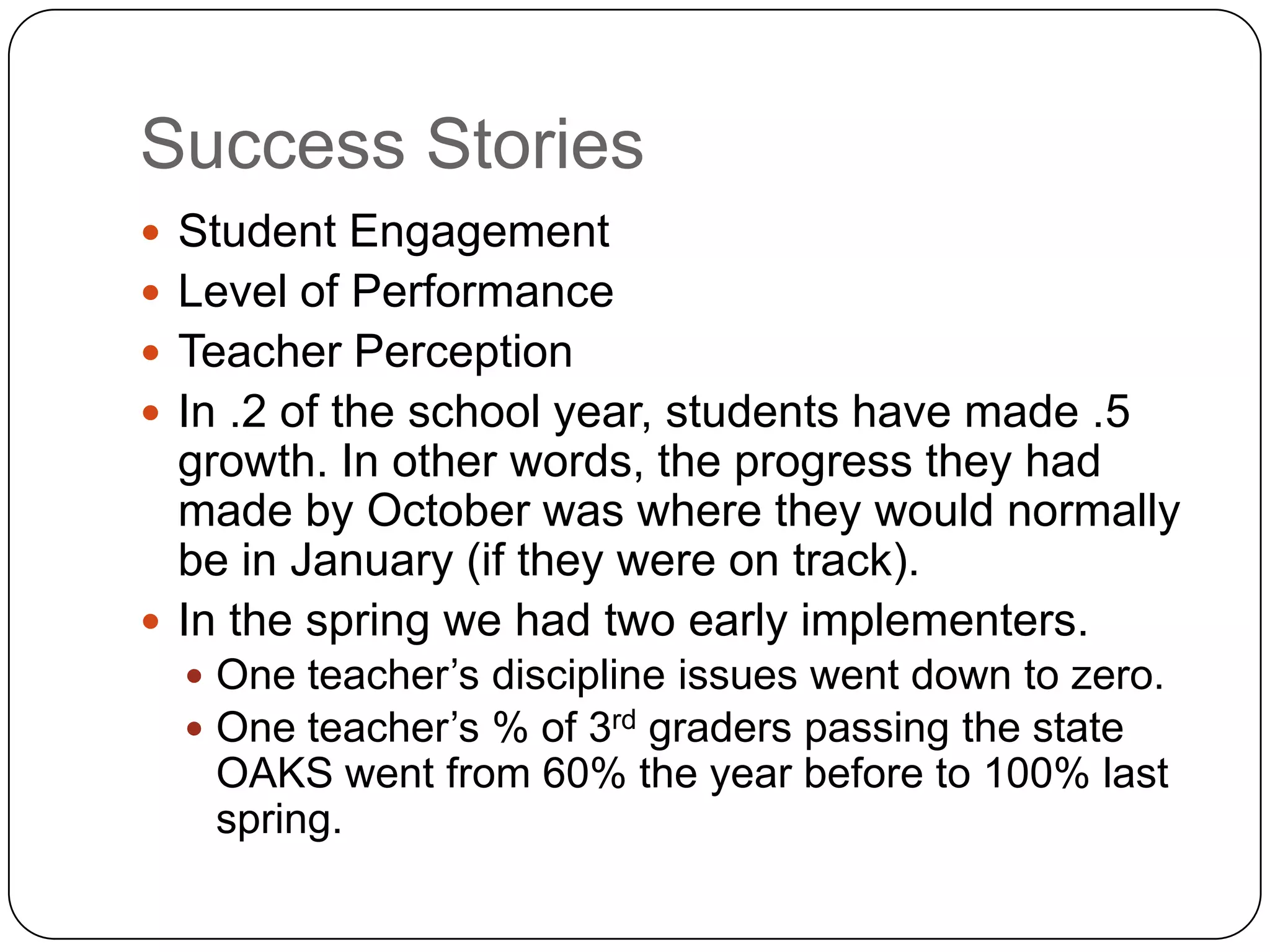
 In .2 of the school year, students have made .5
  growth. In other words, the progress they had
  made by October was where they would normally
  be in January (if they were on track).
 In the spring we had two early implementers.
   One teacher‟s discipline issues went down to zero.
   One teacher‟s % of 3rd graders passing the state
   OAKS went from 60% the year before to 100% last
   spring.
Sara‟s Project
 See video here:
 http://www.youtube.com/watch?v=hE_TNsVJyck
What future is your school
preparing kids for?
Question
Which Path Will You Take?
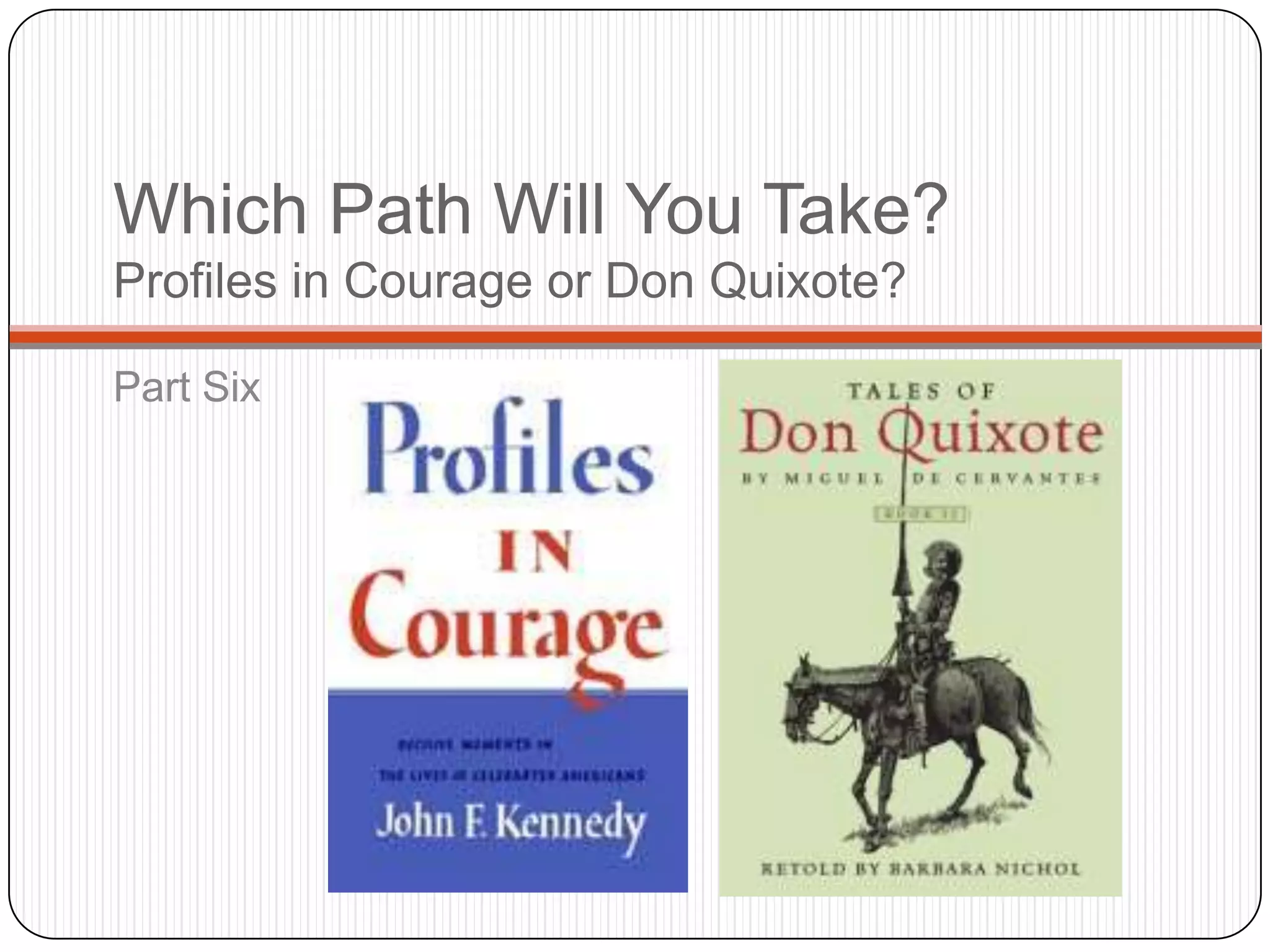
Profiles in Courage or Don Quixote?

Part Six
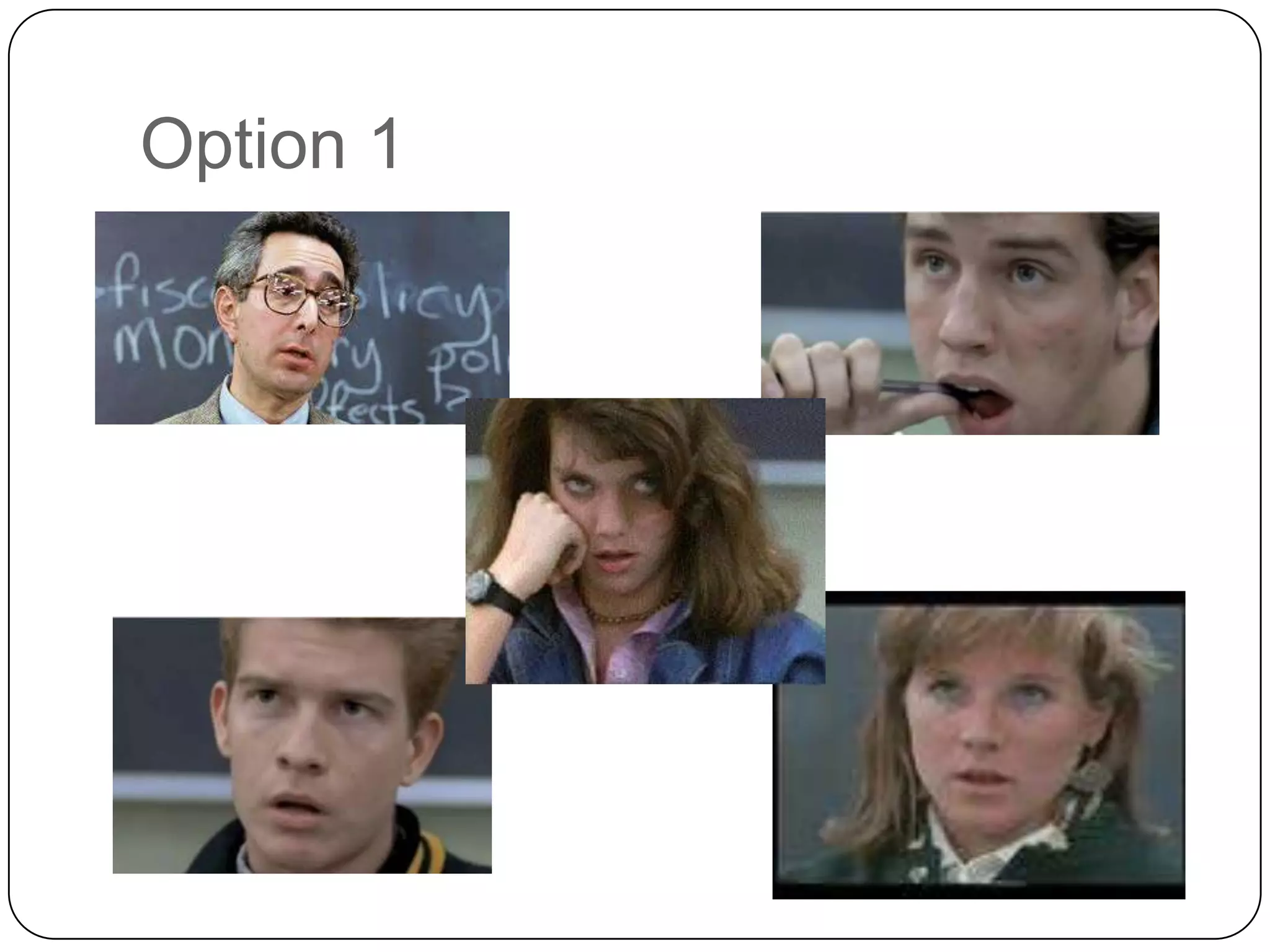
Option 1
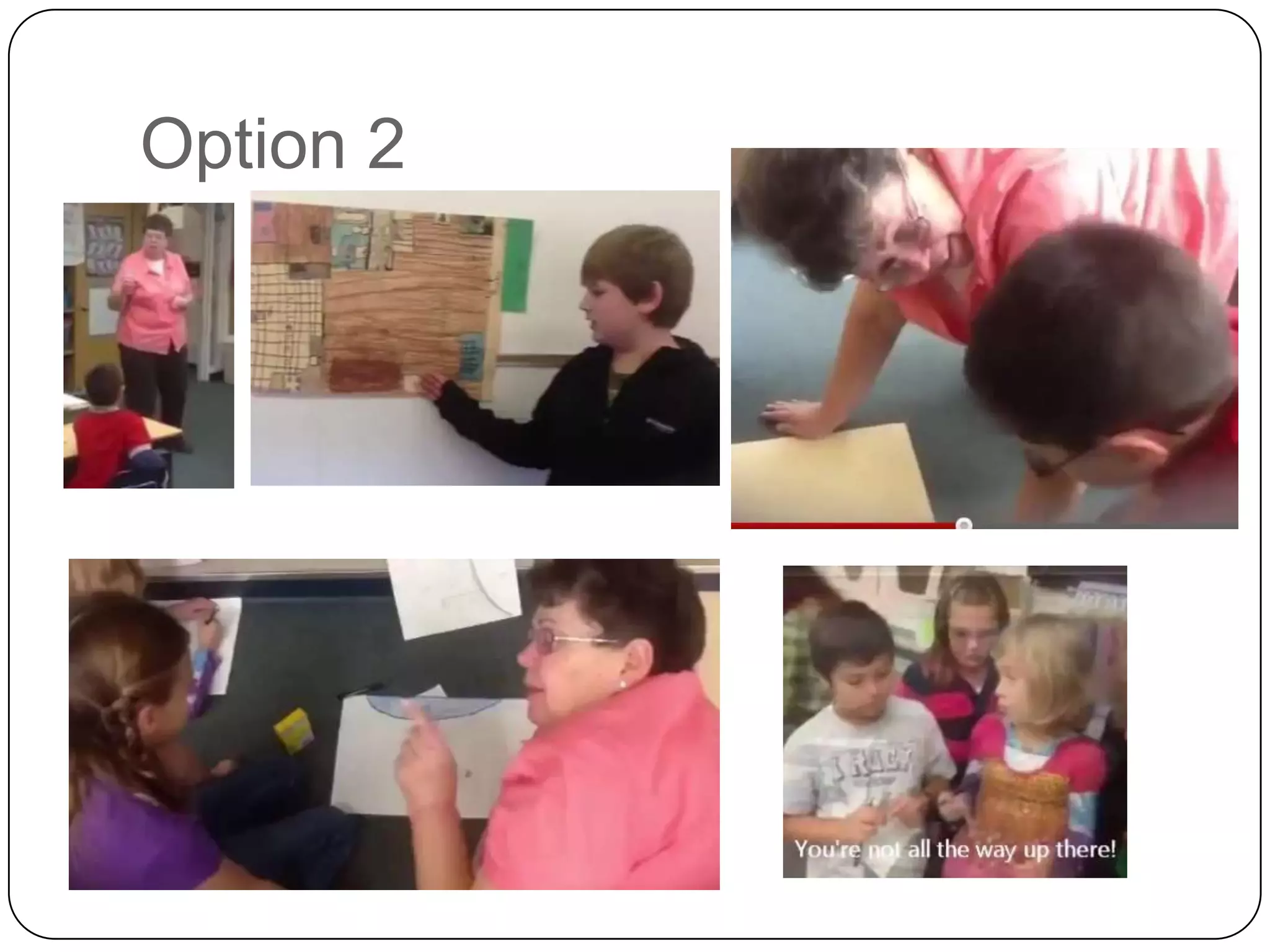
Option 2
Your Choice
 Which teaching do you want for your children?
“The illiterates of the 21st century will not be
those who cannot read and write but those who
      cannot learn, unlearn, and relearn”
                    - Alvin Toffler
A New Skill
 Geomicrobiologist
 Pieces together bits of geology, environmental
 science and microbiology to figure how micro-
 organisms might help make new medicine or
 clean up pollution.
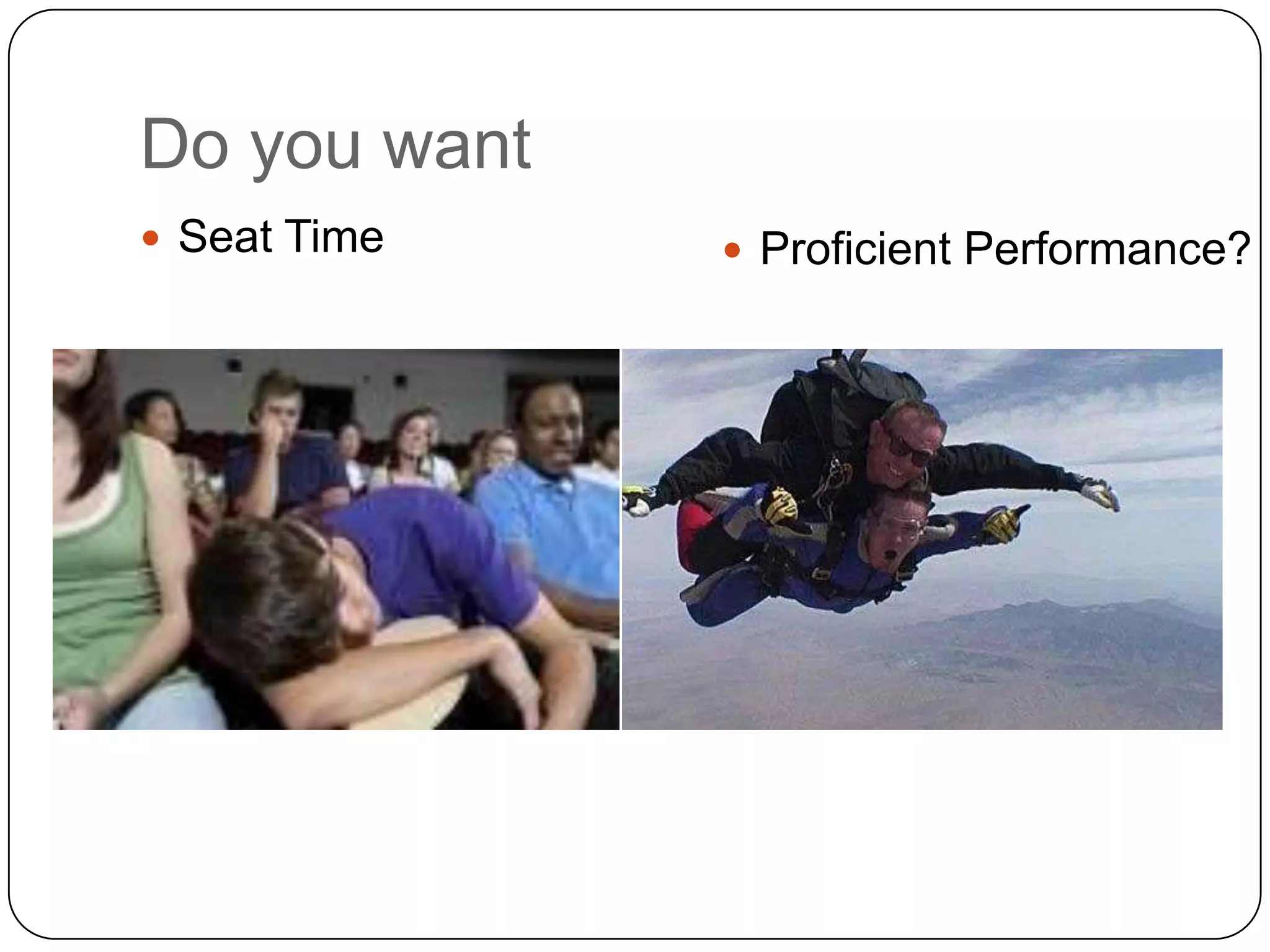
Do you want
 Seat Time    Proficient Performance?
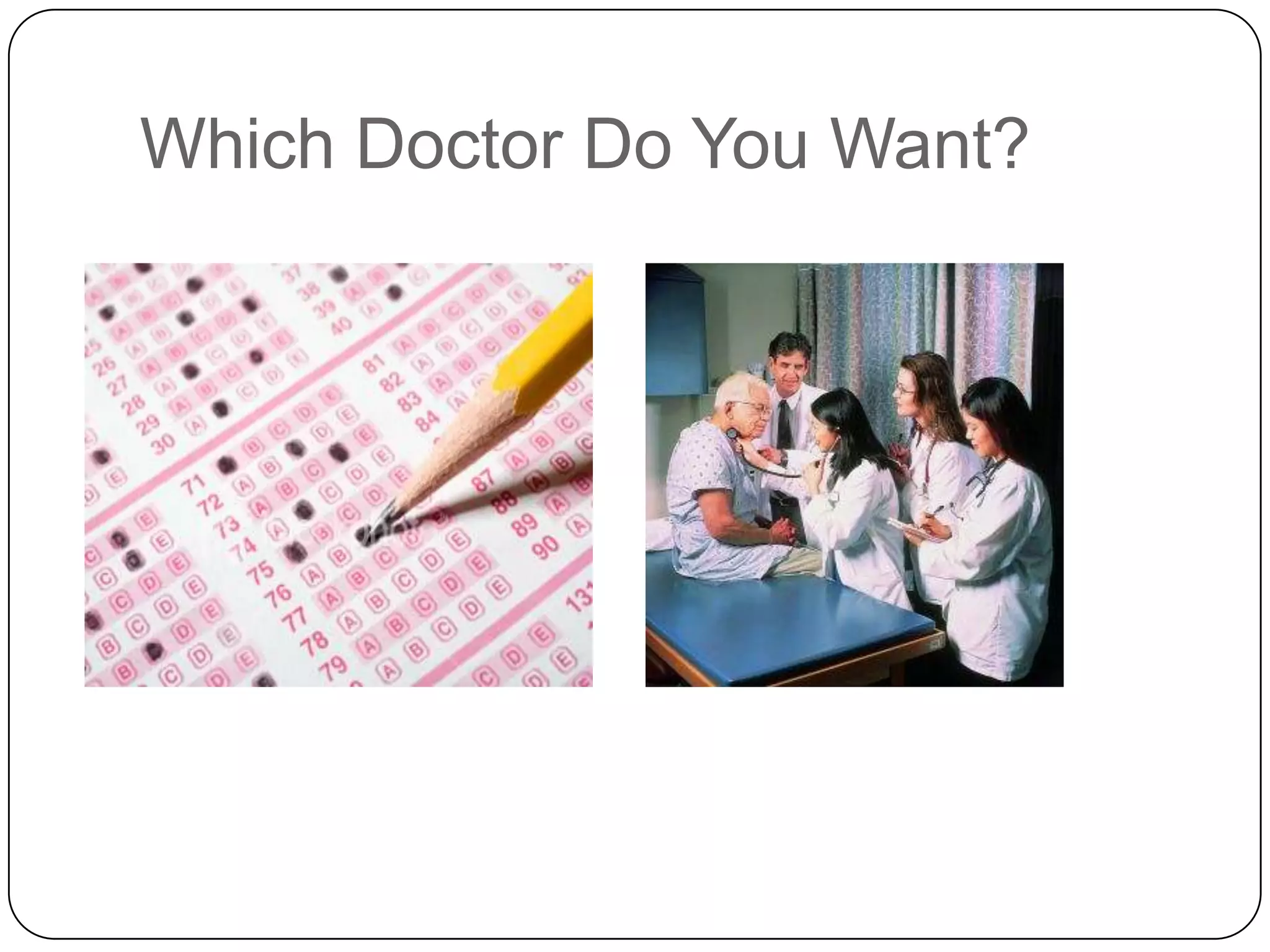
Which Doctor Do You Want?
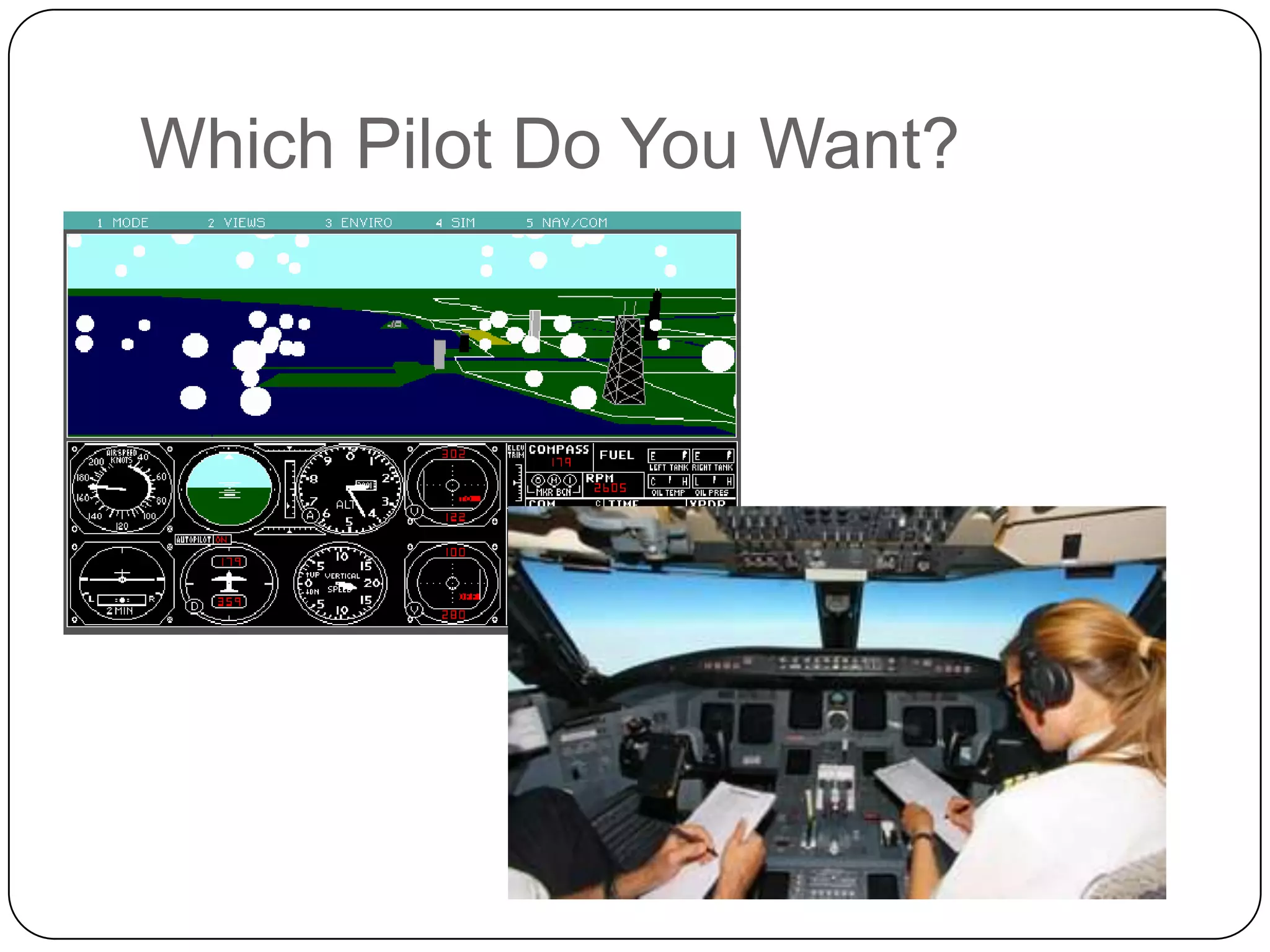
Which Pilot Do You Want?
Question


What are you going to do to make school
relevant in your students‟ lives?
The Full Picture
or The Time Machine

Review
What Did You Just See?
Presentation               Level’s of Bloom’s
Components                 Revised
1.   The System Is         1. Remembering
     Broken
2.   What‟s the            2. Understanding
     Difference?           3. Applying
3.   Showing Is Better
     Than Telling          4. Analyzing
4.   Breaking it Down      5. Evaluating
5.   Is Good Enough        6. Creating
     Good Enough?
6.   Which Path Will You
     Take?
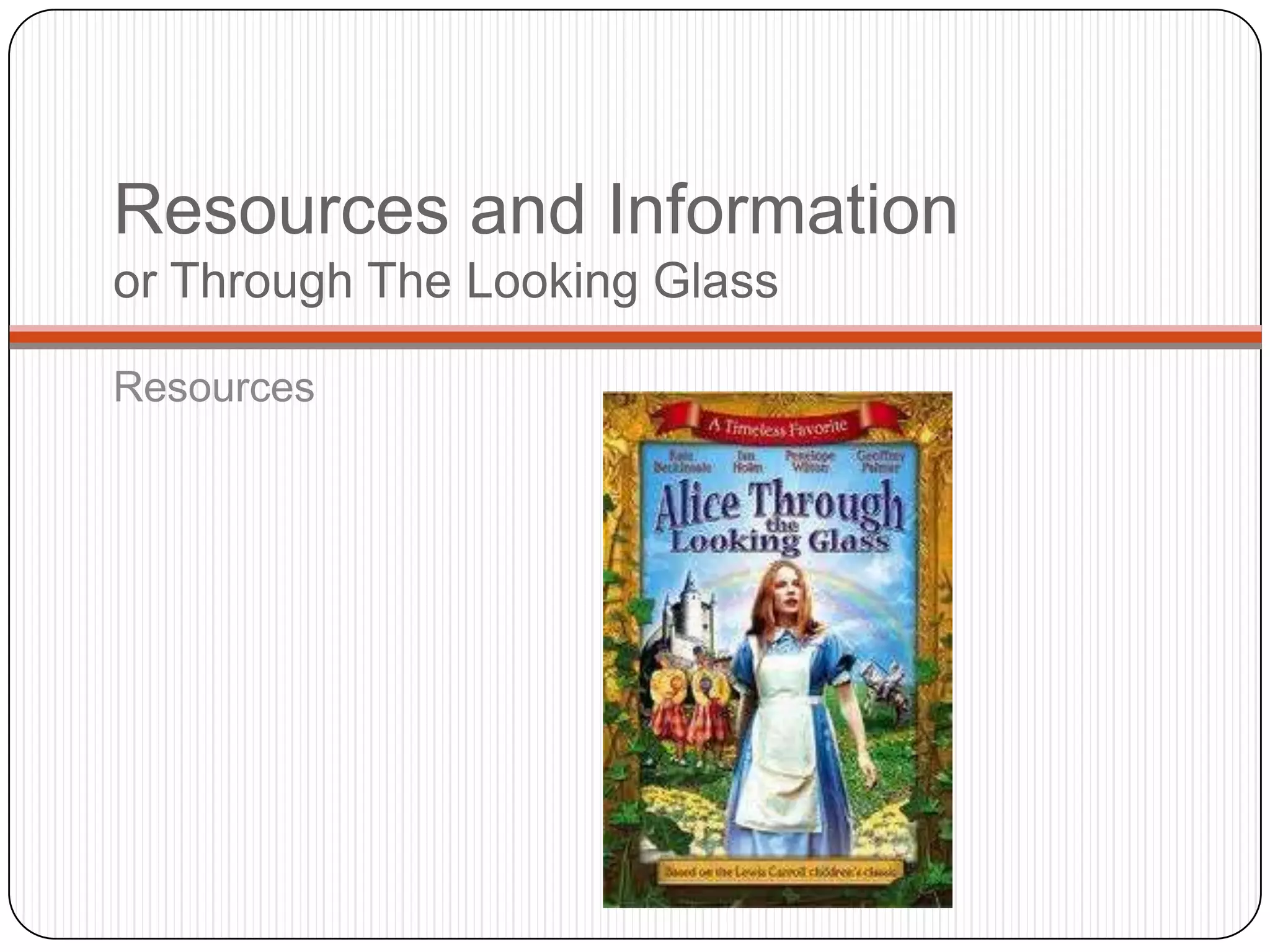
Resources and Information
or Through The Looking Glass

Resources
Essential Differences
 Systems Approach
       No multi-year transition approach
       NOT one teacher at a time
       Not a slow-down approach
       Kids First/Adults Get Paid to Be There
 Know the Students
 Progress Monitor regularly
 Skills are based on turning standards into skills—you
    can‟t teach or test a standard
   Teacher-created modules
   Partnerships
   Professional Development
   Fluidity/Flexibility
FAQs
 How can you scale it up for larger schools?
 Can you begin with only a few teachers?
 How did you pay for the technology?
 How did you pay for the additional personnel?
 How did special education become student
    services?
   How did you get a partnership going?
   Don‟t you have to buy textbooks?
   How can my school do this?
   Who can help?
What do I need to accomplish
this?
 A system‟s approach
 The right people in the right jobs
 Courage
 Passion
 A deep understanding of what you want for
 children
Web 2.0 Resources
   ACCS‟ PBTL LiveBinder
     http://livebinders.com/edit?id=44141
   20 Jobs That Will Not Exist in 20 Years
     http://www.ilookforwardto.com/2010/07/20-jobs-that-will-not-exist-in-20-years.html
   Jobs of the Future
     http://www.guardian.co.uk/money/2010/jan/09/jobs-of-the-future
   How Do We Prepare Students For Jobs That Don‟t Exist Yet?
     http://edudemic.com/2011/10/students-of-the-future/
   How to Teach Students for Jobs That Don‟t Exist Yet
     http://www.ehow.com/how_7909655_teach-jobs-dont-exist-yet.html
   Star Wars and Bloom‟s Taxonomy
     http://www.youtube.com/watch?v=gG52jFCWiac&feature=related
   Bloom‟s Taxonomy According to Pirates of the Caribbean
     http://www.youtube.com/watch?v=qjhKmhKjzsQ
   You Can‟t Be My Teacher
     http://www.youtube.com/watch?v=0VSymMbMYHA&feature=related
   Education “The times are a-changing”
     http://www.youtube.com/watch?v=wuyrP_HhWEg&feature=related
Today‟s Presentation Team

Steve                Rinda Montgomery
Boynton, Superintendent
                     Conwell
 Arlington Community        Assistant Superintendent
 Charter School             North Central
                            Education Service District

                      Leslie
Travis Reeser, Principal
  Arlington Community Walborn*, Teacher
 Charter School              Arlington Community
                            Charter School
                             This year‟s
                               Oregon Small Schools
                            Association Teacher of the
                                       Year
Those who say it can’t be done
should not interrupt those of us
       who are doing it.
Notes to Presenters
 Leslie: If asked about having to create your own
  curriculum as opposed to getting a published
  kit, talk about the benefits of going through the
  process of breaking down standards and building
  modules, how much better you know the purpose
  of the activities and the standards.
 Travis: Talk about how it has changed your
  approach to the overall view of what education
  is, and how it has changed your activities as a
  father.
 Rinda: Don‟t talk too much.
 Steve: Go get „em!

Proficiency-Based Teaching and Learning for OSBA 2011

  • 1.
    Proficiency-Based Teaching and Learning The Adventure Approach Stories From Another Place OSBA 2011 November 12, 2011
  • 2.
    The System isBroken Or, The Emperor Has No Clothes Part One
  • 3.
    The Experts inthe Room  How did you teach your children?  To walk?  To ride a bicycle  To talk?  To tie their shoes?  Or even ???  When did you know they could do it?
  • 4.
    Would you teachthose skills like this? Watch video here: http://www.youtube.com/watch?v=dxPVyieptwA
  • 5.
    Or this? Watch videohere: http://www.youtube.com/watch?v=aOJEdMIC mAY
  • 6.
    How would yourecognize good teaching for those skills? Question
  • 7.
    What‟s The Difference? OrThe Ugly Duckling Part Two
  • 8.
    What I KnowAbout Kids  Thirsty for knowledge  Creative  School kills that
  • 9.
  • 10.
    View of Learners Traditional Proficiency  Some will excel, some  All of them can will do average achieve at high work, a portion will standards; failure is fail. not an option
  • 11.
    Learning Program Traditional Proficiency  Time based; learning  Learning based; time is a variable. It‟s is the variable. It‟s effective for a portion effective for all of students. students.
  • 12.
    Grades Traditional Proficiency  Based on various, and  Indicate only what sometimes student has learned subjective, points rather (knows and can do) than proficiencies; may by demonstration of reflect quantity over proficiency; quality of quality (such as extra- work is based on credit work); may be used in part to agreements about punish, reward, or evidence of control student proficiency. behavior; subject to  End-of-course grades inflation reflect student  Grades are sometimes proficiency at the end
  • 13.
    Assessment Traditional Proficiency  Relies heavily on  Includes summative summative assessment, but assessment, including heavily favors standardized testing. formative assessment as a feedback mechanism to continuously measure and guide student learning and to drive and improve instruction.
  • 14.
    Nature & Structureof Schools Traditional Proficiency  Often adult-centered  Student-centered in in practice. practice.  Self-contained  Home base for flexible education factories in learning experiences a management where students can assume more hierarchy modeled on initiative, work in 20th Century industry. teams, and learn in community settings, online venues, and other education institutions as
  • 15.
    Curriculum Traditional Proficiency  Disciplines are  Based on recognized independent of one standards. Rigor and another and content is relevance are driving independent of criteria. Disciplines standards for are often integrated. postsecondary Content is keyed to success. what students need for postsecondary studies and job success.
  • 16.
    Student Credentialing Traditional Proficiency  Students accumulate  Students are graded units of assessed to ensure instruction to graduate they have acquired through “seat time” high standards of knowledge and skills regardless of skill defined by minimum levels acquired or state diploma grades assigned, and requirements a standard diploma is matched to state regarded as the end standards. This is the point of the high minimum school experience. requirement. We work forward from there.
  • 17.
    Student Credentialing, continued Traditional Proficiency  For students capable  Students with an of doing more and interest in advanced advancing while still in certification and high school, the credits senior year is often (AP, IB, college spent coasting to the credits) are supported finish line. in going beyond minimum diploma requirements.
  • 18.
    Teachers Traditional Proficiency  They dispense  They do many of the knowledge about traditional things, but also are content subject matter; lead experts, mentors, resou class rces, partners in school discussion, make management, partners assignments, motivat with community e students, assign resource providers, skills grades. assessment practitioners, members of teaching teams, and members of professional learning
  • 19.
    Students Traditional Proficiency  They receive or  They envision and absorb information help plan their passively, recite when education asked, achieve on path, partner in their tests. own progress, learn by observation and application as well as by reading and taking class notes, and develop both individual and group
  • 20.
    Students, continued Traditional Proficiency  Often don‟t know at  From the very the beginning of a beginning of a course what course, they know constitutes successful precisely what learning. proficiencies demonstrate desired attainment of knowledge and skills, and they work to achieve those proficiencies.
  • 21.
    Student Performance Data Traditional Proficiency  Infrequently collected  Frequently collected and analyzed, if at all. and analyzed (currently and longitudinally) by teachers, professional learning communities, and curriculum and instruction administrators for program
  • 22.
    Background Philosophy  Bloom‟sRevised Taxonomy  See handout  What skills align with each level?  When you scaffold learning, you create student ownership.  Tell me, I forget  Show me, I remember  Involve me, I understand
  • 23.
    Teacher to Principal WhenI Taught Now as a Principal  Traditional Model  School Culture  Forced to push the  Academic boundaries implementation  Used student  Change in teacher performance to role change my program/  Student responsibility instruction and self management  Used formative  Parent responsibilities assessment data  Community school regularly
  • 24.
    One Dad‟s Story Then Now  Guiding meant telling  Guiding means asking how to do it. scaffolded questions.  I knew the best way.  They come up with really good ways.  I decide what‟s right.  They evaluate  I point to the goal. whether it works.  It‟s right when Daddy  Together we find the says so. goal  They can make their own decisions.
  • 25.
    How are weso different? Question
  • 26.
    Showing is Betterthan Telling or The Wonderful Wizard of Oz Part Three
  • 27.
    Think About It How to break down in bicycling in terms of skills (think self)  How would you deliver/teach those skills? (pair)  Share with your neighboring pair your skills (share)  How many skills did you have? (Raise hands with number)  How many learned from another person or pair?
  • 28.
    The Proficiency Teacher IUsed To Now I  Write lesson plans  Have modules students  Grade papers can go through at their  Create resources own pace.  Prepare for conferences  Evaluate skills as students work.  Teach everyone  Sometimes revise  Reteach everyone modules.  Reteach again  Watch students present  Catch kids up who data at conferences came to me behind  Reach each child  Stay at the front of the  Teach at one reading or room math level at a time.  Coach among students
  • 29.
    In the Classroom Mini Lessons  Flipping the Model  Small- and full-group teaching  Aides in every classroom
  • 30.
    What examples canyou give of this in the world of work? Question
  • 31.
    Breaking It Down orTales of 1001 Arabian Nights Part Four
  • 32.
    Common Core StateStandard  Show a CCSS standard, ask for an activity or test that would fit this.  Demonstrate a breakdown into skills and knowledge  Align with Bloom  Review the process
  • 33.
    Typical Standard  InformationalText  Grade 4  Domain: Integration of Knowledge and Ideas  Standard:  Interpret information presented visually, orally, or quantitatively (e.g., in charts, graphs, diagrams, timelines, animations, or interactive elements on Web pages) and explain how the information contributes to an understanding of the text in which it appears.  http://corestandards.org/the-standards  How can you test that?
  • 34.
    Knowledge and Skills Interpret information presented visually, orally, or quantitatively (e.g., in charts, graphs, diagrams, timelines, animations, or interactive elements on Web pages) and explain how the information contributes to an understanding of the text in which it appears.
  • 35.
    The Process  Parsethe standards  Lay out according to difficulty of knowledge or skill  Find associated pieces of standards  Group  Align to Bloom‟s  Choose a Theme  Create Activities  Write Instructions  Design rubrics/scoring guides  Outline roles and responsibilities for Teacher, Student, Parent
  • 36.
    The Outcome  Leslie‟sroll-out plan for level 3 language arts and social studies.  A photo here would be great!
  • 37.
    Which ideas fromteaching bicycling justifies this approach to standards? Question
  • 38.
    Is Good EnoughGood Enough? Or Back To The Future (or The Princess and the Tin Box) Part Five
  • 39.
    Today‟s Reality  Whatis happening in your schools?  How will kids be prepared for jobs of the future?  What does each activity do to prepare them for life and work?
  • 40.
    Our Reading Scores 3 2.5 2 Grade Equivalency Growth 1.5 Adjusted** Expected Growth 1:1 1 0.5 0 1 2 3 4 5 6 3 4 5 6 7 8
  • 41.
    Our Math Scores 1.2 1 0.8 0.6 Grade Equivalency Growth 0.4 Adjusted* Expected Growth 1:1 0.2 0 1 2 3 4 5 6 -0.2 -0.4 3 4 5 6 7 8
  • 42.
    Discipline Data 80 70 60 50 40 30 20 Non-Proficiency 10 Classes 0 Proficiency Classes
  • 43.
    Success Stories  StudentEngagement  Level of Performance  Teacher Perception  In .2 of the school year, students have made .5 growth. In other words, the progress they had made by October was where they would normally be in January (if they were on track).  In the spring we had two early implementers.  One teacher‟s discipline issues went down to zero.  One teacher‟s % of 3rd graders passing the state OAKS went from 60% the year before to 100% last spring.
  • 44.
    Sara‟s Project  Seevideo here:  http://www.youtube.com/watch?v=hE_TNsVJyck
  • 45.
    What future isyour school preparing kids for? Question
  • 46.
    Which Path WillYou Take? Profiles in Courage or Don Quixote? Part Six
  • 47.
  • 48.
  • 49.
    Your Choice  Whichteaching do you want for your children?
  • 50.
    “The illiterates ofthe 21st century will not be those who cannot read and write but those who cannot learn, unlearn, and relearn” - Alvin Toffler
  • 51.
    A New Skill Geomicrobiologist  Pieces together bits of geology, environmental science and microbiology to figure how micro- organisms might help make new medicine or clean up pollution.
  • 52.
    Do you want Seat Time  Proficient Performance?
  • 53.
    Which Doctor DoYou Want?
  • 54.
    Which Pilot DoYou Want?
  • 55.
    Question What are yougoing to do to make school relevant in your students‟ lives?
  • 56.
    The Full Picture orThe Time Machine Review
  • 57.
    What Did YouJust See? Presentation Level’s of Bloom’s Components Revised 1. The System Is 1. Remembering Broken 2. What‟s the 2. Understanding Difference? 3. Applying 3. Showing Is Better Than Telling 4. Analyzing 4. Breaking it Down 5. Evaluating 5. Is Good Enough 6. Creating Good Enough? 6. Which Path Will You Take?
  • 58.
    Resources and Information orThrough The Looking Glass Resources
  • 59.
    Essential Differences  SystemsApproach  No multi-year transition approach  NOT one teacher at a time  Not a slow-down approach  Kids First/Adults Get Paid to Be There  Know the Students  Progress Monitor regularly  Skills are based on turning standards into skills—you can‟t teach or test a standard  Teacher-created modules  Partnerships  Professional Development  Fluidity/Flexibility
  • 60.
    FAQs  How canyou scale it up for larger schools?  Can you begin with only a few teachers?  How did you pay for the technology?  How did you pay for the additional personnel?  How did special education become student services?  How did you get a partnership going?  Don‟t you have to buy textbooks?  How can my school do this?  Who can help?
  • 61.
    What do Ineed to accomplish this?  A system‟s approach  The right people in the right jobs  Courage  Passion  A deep understanding of what you want for children
  • 62.
    Web 2.0 Resources  ACCS‟ PBTL LiveBinder  http://livebinders.com/edit?id=44141  20 Jobs That Will Not Exist in 20 Years  http://www.ilookforwardto.com/2010/07/20-jobs-that-will-not-exist-in-20-years.html  Jobs of the Future  http://www.guardian.co.uk/money/2010/jan/09/jobs-of-the-future  How Do We Prepare Students For Jobs That Don‟t Exist Yet?  http://edudemic.com/2011/10/students-of-the-future/  How to Teach Students for Jobs That Don‟t Exist Yet  http://www.ehow.com/how_7909655_teach-jobs-dont-exist-yet.html  Star Wars and Bloom‟s Taxonomy  http://www.youtube.com/watch?v=gG52jFCWiac&feature=related  Bloom‟s Taxonomy According to Pirates of the Caribbean  http://www.youtube.com/watch?v=qjhKmhKjzsQ  You Can‟t Be My Teacher  http://www.youtube.com/watch?v=0VSymMbMYHA&feature=related  Education “The times are a-changing”  http://www.youtube.com/watch?v=wuyrP_HhWEg&feature=related
  • 63.
    Today‟s Presentation Team Steve Rinda Montgomery Boynton, Superintendent Conwell Arlington Community Assistant Superintendent Charter School North Central Education Service District Leslie Travis Reeser, Principal Arlington Community Walborn*, Teacher Charter School Arlington Community Charter School This year‟s Oregon Small Schools Association Teacher of the Year
  • 64.
    Those who sayit can’t be done should not interrupt those of us who are doing it.
  • 66.
    Notes to Presenters Leslie: If asked about having to create your own curriculum as opposed to getting a published kit, talk about the benefits of going through the process of breaking down standards and building modules, how much better you know the purpose of the activities and the standards.  Travis: Talk about how it has changed your approach to the overall view of what education is, and how it has changed your activities as a father.  Rinda: Don‟t talk too much.  Steve: Go get „em!

Editor's Notes

  • #2 Rinda and Steve start out.Overview: Each section or “part” begins with a topic related to a familiar story, has content words, then ends with a question.To Do November 2, 2011Put in picturesClip videosInsert data chartsWrite speaking notes for Leslie and TravisRealign slides for new backgrounds
  • #3 Rinda
  • #4 Rinda
  • #5 Rinda
  • #6 Rinda
  • #7 Rinda
  • #8 Steve
  • #9 Steve
  • #10 Steve
  • #11 Steve
  • #12 Steve
  • #13 Steve
  • #14 Steve
  • #15 Steve
  • #16 Steve
  • #17 Steve
  • #18 Steve
  • #19 Steve
  • #20 Steve
  • #21 Steve
  • #22 Steve
  • #23 TravisTalk about Bloom’s Taxonomy by referencing handout.Discuss the -ing words that go with each level.Talk about what happens when
  • #25 Travis: let me know how you want these changed. Photos of the girls wouldn’t go amiss.
  • #26 TravisIf you had to summarize how we are different, what would you say to people? Share with your elbow partner.
  • #27 Travis: Since showing is better than telling, we’re going to let one of our teachers show you what’s going on in the classroom.(Introduce Leslie)
  • #28 LeslieAsk them to break down bicycling in terms of skills and think of the order to teach those skills.Let them think for 15 seconds.Pair up and share your skills in order with each other. Make additions and adjustments.Let them talk for 30 seconds.Have pairs join up to form quads and share their skills and the order and agree.Ask one person in each quad to hold up the number of fingers for the number of skils they agreed on.Ask them whether they learned from others.
  • #29 Leslie: Walk through the slide bullets and overview what you used to do as a teacher, and what you do now in a proficiency model. The point is to let them know your activities are more focused and effective, you’re not wasting time grading and proving student progress—the kids do that themselves. Etc.
  • #30 Leslie: talk about the main differences in the proficiency model, as above. Your mini lessons are laser focused and based on performance and dataThe “homework” is done in classThe teaching of small and full groups is targeted and focused on specific skills in standards.You have help.
  • #31 LeslieThis is the end of this part/section of the presentation. Ask them the reflection question on the slide. It can be rhetorical, or pair shares. The idea is can they see in work environments these concepts of proficiency implementation we are using in schools?
  • #32 Leslie:Part Four will break it down, or tell the story of the teacher’s 1001 nights of preparation (supposed to be a joke).
  • #33 Leslie:We are going to show you one of the Common Core State Standards for one of my grade levels. We will ask you to tell us one activity or test that would prove the nine-year-old child was proficient in this standard.Then we will show you how to break down or parse or unpack the standard.We will talk about aligning with Bloom’s Revised Taxonomy.Then we will review the process.
  • #34 Leslie: Review the slide content…this is one standard. Ask the final bulleted question. The point they should get is that a 9 year old couldn’t possibly do this or learn this or demonstrate knowing this in one sitting…
  • #35 Leslie and RindaI’ll take it from here to talk about parsing standards
  • #36 Rinda Leslie prepare with Travis or Steve to quickly roll out your butcher paper on cue.
  • #37 Leslie: roll out the butcher paper.
  • #38 Rinda
  • #39 Rinda
  • #40 Rinda
  • #43 Travis(Note that referrals go up in all classes, particularly those students who experience the proficiency courses, when they have moved into the social core which is not proficiency based.)
  • #46 Rinda
  • #47 Rinda
  • #48 Rinda
  • #49 Rinda
  • #50 Rinda
  • #51 Rinda
  • #52 Steve and Rinda
  • #53 Steve
  • #54 Steve
  • #55 Steve
  • #56 Steve
  • #58 Part One: The System Is BrokenParents are good teachers/schools have forgotten they prepare students for the future.Part Two: What’s the Difference?How is the proficiency approach different from the traditional model?Part Three: Showing is Better Than TellingHow can you teach this standard?Part Four: Breaking It DownShow the standard broken down, aligned to Bloom’s, reorganized.Part Five: Is Good Enough Good Enough?Are we preparing kids for the future we cannot define?Part Six: Which Path Will You Take?Will your schools continue to align to the factory model of instruction, or step up to life and work expectations?
  • #61 $50k in textbooks was diverted to tech and personnel. Reallocated to technology. Have spent just over $30K for tech so far.$8,150 per aide. Split full-time aides into half-timers, now have six aides.