Forensic Analysis
PhD Seminar( I ) in Analytical Chemistry
By:
Fereshte Mohamadi
January 2016
Outline
2
o Forensic Science Definition
o Forensic chemistry
o Forensic toxicology
o Doping analysis
o Illicit drugs analysis
o Poisons analysis
Forensic Science
3
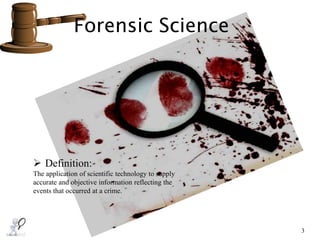
 Definition:
The application of scientific technology to supply
accurate and objective information reflecting the
events that occurred at a crime.
The History of Forensic
Science
4
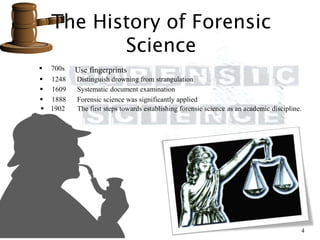
 700s Use fingerprints
 1248 Distinguish drowning from strangulation
 1609 Systematic document examination
 1888 Forensic science was significantly applied
 1902 The first steps towards establishing forensic science as an academic discipline.
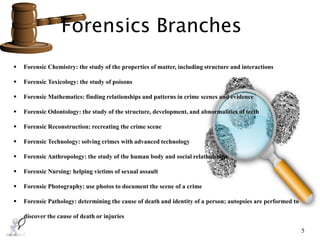
Forensics Branches
5
 Forensic Chemistry: the study of the properties of matter, including structure and interactions
 Forensic Toxicology: the study of poisons
 Forensic Mathematics: finding relationships and patterns in crime scenes and evidence
 Forensic Odontology: the study of the structure, development, and abnormalities of teeth
 Forensic Reconstruction: recreating the crime scene
 Forensic Technology: solving crimes with advanced technology
 Forensic Anthropology: the study of the human body and social relationships
 Forensic Nursing: helping victims of sexual assault
 Forensic Photography: use photos to document the scene of a crime
 Forensic Pathology: determining the cause of death and identity of a person; autopsies are performed to
discover the cause of death or injuries
Forensic chemistry
6
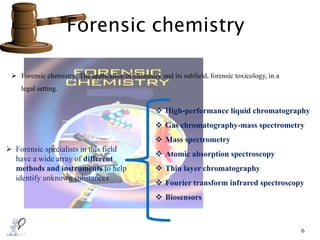
 Forensic chemistry: The application of chemistry and its subfield, forensic toxicology, in a
legal setting.
 High-performance liquid chromatography
 Gas chromatography-mass spectrometry
 Mass spectrometry
 Atomic absorption spectroscopy
 Thin layer chromatography
 Fourier transform infrared spectroscopy
 Biosensors
 Forensic specialists in this field
have a wide array of different
methods and instruments to help
identify unknown substances
Affinity sensor
7
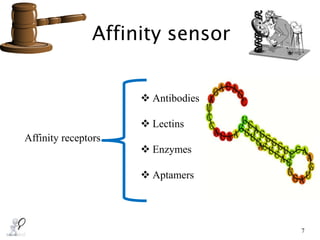
Affinity receptors
 Antibodies
 Lectins
 Enzymes
 Aptamers
Forensic toxicology
8
 Forensic toxicology is the use of toxicology and other disciplines such as analytical chemistry,
pharmacology and clinical chemistry to aid medical or legal investigation of death, poisoning, and
drug use.
 The forensic toxicologist must determine which toxic substances are present, in what
concentrations, and the probable effect of those chemicals on the person.
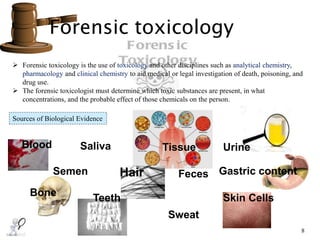
Sources of Biological Evidence
Blood
Semen
Saliva
Teeth
Bone
Hair
Tissue
Feces
Urine
Skin Cells
Sweat
Gastric content
Forensic toxicology
9
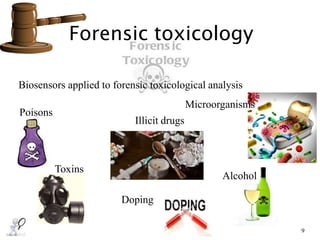
Biosensors applied to forensic toxicological analysis
Poisons
Toxins
Microorganisms
Alcohol
Illicit drugs
Doping
Doping analysis
10
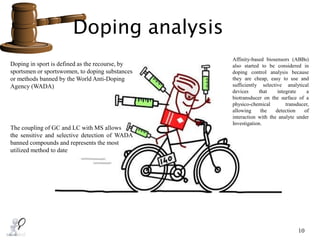
Doping in sport is defined as the recourse, by
sportsmen or sportswomen, to doping substances
or methods banned by the World Anti-Doping
Agency (WADA)
The coupling of GC and LC with MS allows
the sensitive and selective detection of WADA
banned compounds and represents the most
utilized method to date
Affinity-based biosensors (ABBs)
also started to be considered in
doping control analysis because
they are cheap, easy to use and
sufficiently selective analytical
devices that integrate a
biotransducer on the surface of a
physico-chemical transducer,
allowing the detection of
interaction with the analyte under
Investigation.
Anabolic steroid
11
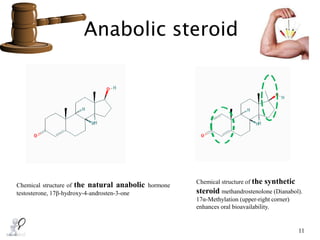
Chemical structure of the natural anabolic hormone
testosterone, 17β-hydroxy-4-androsten-3-one
Chemical structure of the synthetic
steroid methandrostenolone (Dianabol).
17α-Methylation (upper-right corner)
enhances oral bioavailability.
Surface plasmon resonance
12
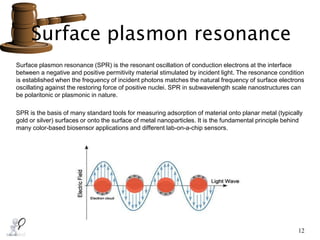
Surface plasmon resonance (SPR) is the resonant oscillation of conduction electrons at the interface
between a negative and positive permitivity material stimulated by incident light. The resonance condition
is established when the frequency of incident photons matches the natural frequency of surface electrons
oscillating against the restoring force of positive nuclei. SPR in subwavelength scale nanostructures can
be polaritonic or plasmonic in nature.
SPR is the basis of many standard tools for measuring adsorption of material onto planar metal (typically
gold or silver) surfaces or onto the surface of metal nanoparticles. It is the fundamental principle behind
many color-based biosensor applications and different lab-on-a-chip sensors.
SPR sensors
13
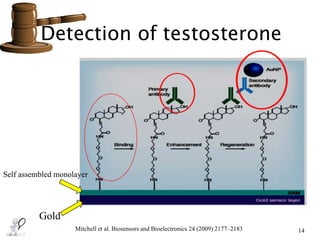
Detection of testosterone
14Mitchell et al. Biosensors and Bioelectronics 24 (2009) 2177–2183
Gold
Self assembled monolayer
Illicit drugs analysis
15
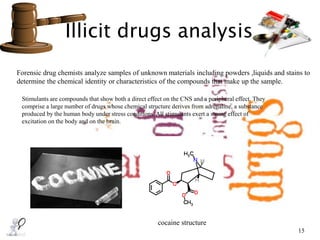
Forensic drug chemists analyze samples of unknown materials including powders ,liquids and stains to
determine the chemical identity or characteristics of the compounds that make up the sample.
Stimulants are compounds that show both a direct effect on the CNS and a peripheral effect. They
comprise a large number of drugs whose chemical structure derives from adrenaline, a substance
produced by the human body under stress conditions. All stimulants exert a strong effect of
excitation on the body and on the brain.
cocaine structure
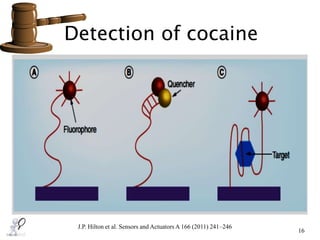
Detection of cocaine
16
J.P. Hilton et al. Sensors and Actuators A 166 (2011) 241–246
Förster resonance energy transfer (FRET)
Poisons analysis
17
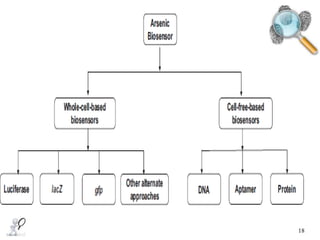
Arsenic is a wide spread heavy metal which has influenced human history more
than any other element or toxic compound. In terms of abundance, it ranks20th in
the earth's crust,14th in sea water and 12th in the human system.
In nature, arsenic exists in both organic and inorganic forms, having different
speciations such as arsenate [As(V)] and arsenite[As(III)].
It is great difference in toxicity between the two oxidation states, being As(III)
about sixty times more toxic.
Arsenic has been associated with mutagenic and carcinogenic potential up on pro-
longed exposure
18
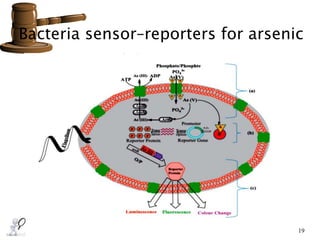
Bacteria sensor–reporters for arsenic
19
20
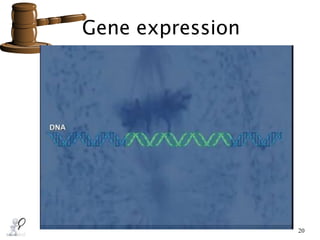
Gene expression
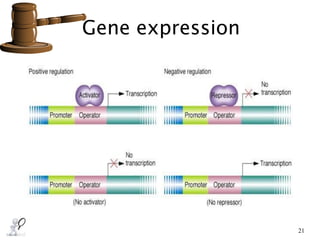
Gene expression
21
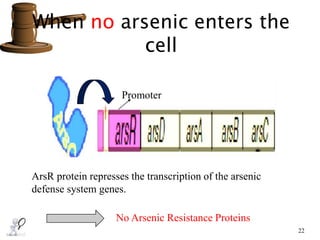
When no arsenic enters the
cell
22
Promoter
ArsR protein represses the transcription of the arsenic
defense system genes.
No Arsenic Resistance Proteins
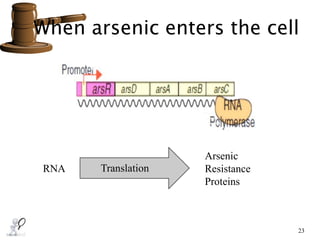
When arsenic enters the cell
23
RNA Translation
Arsenic
Resistance
Proteins
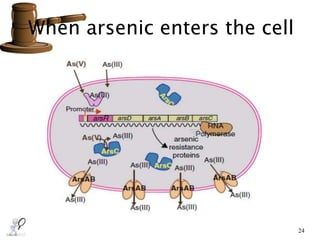
24
When arsenic enters the cell
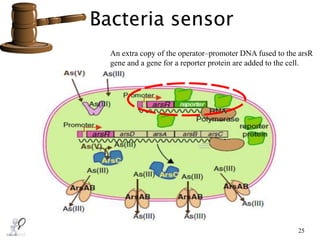
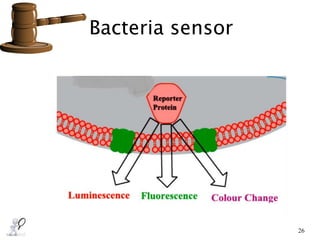
Bacteria sensor
25
An extra copy of the operator–promoter DNA fused to the arsR
gene and a gene for a reporter protein are added to the cell.
26
Bacteria sensor
Conclusions
Biosensors have emerged as important tools in different areas of forensic analysis.
Biosensors possess to be used as rapid, reliable and affordable analytical tools in this branch
of modern Analytical Chemistry that is characterized by the legal context affecting both the
work implementation and the results, and the variety of analytes and samples able to be
investigated.
27
References
28
 Maxime Julien et al. Talanta,(2016) 147, 383-389.
 Franco Mazzei et al. Bioanalysis (2014) 6(2), 225–245.
 C. Cattaneo et al. Forensic Science International (2015) 254, 29–35.
 P. Yáñez-Sedeño, et al., Biosensors in forensic analysis. A review, Anal. Chim.
Acta(2014), http://dx.doi.org/10.1016/j.aca.2014.03.011
 O. Drummer. Encyclopedia of Forensic and Legal Medicine (2nd Edition), 2016, 602-607.
 J.P. Hilton et al. Sensors and Actuators A 166 (2011) 241–246.
 Mitchell et al. Biosensors and Bioelectronics 24 (2009) 2177–2183.
 Hardeep Kaur et al. Biosensors and Bioelectronics 63(2015)533–545.
 Merulla et al..Curr.Opin.Biotechnol. (2013)24(3),534–541
29
Just A Thought
It’s not what you know that hurts
you, its what you think you know
and it’s not so . . .
Mark Twain
30
31

Forensic chemistry

  • 1.
    Forensic Analysis PhD Seminar(I ) in Analytical Chemistry By: Fereshte Mohamadi January 2016
  • 2.
    Outline 2 o Forensic ScienceDefinition o Forensic chemistry o Forensic toxicology o Doping analysis o Illicit drugs analysis o Poisons analysis
  • 3.
    Forensic Science 3  Definition: Theapplication of scientific technology to supply accurate and objective information reflecting the events that occurred at a crime.
  • 4.
    The History ofForensic Science 4  700s Use fingerprints  1248 Distinguish drowning from strangulation  1609 Systematic document examination  1888 Forensic science was significantly applied  1902 The first steps towards establishing forensic science as an academic discipline.
  • 5.
    Forensics Branches 5  ForensicChemistry: the study of the properties of matter, including structure and interactions  Forensic Toxicology: the study of poisons  Forensic Mathematics: finding relationships and patterns in crime scenes and evidence  Forensic Odontology: the study of the structure, development, and abnormalities of teeth  Forensic Reconstruction: recreating the crime scene  Forensic Technology: solving crimes with advanced technology  Forensic Anthropology: the study of the human body and social relationships  Forensic Nursing: helping victims of sexual assault  Forensic Photography: use photos to document the scene of a crime  Forensic Pathology: determining the cause of death and identity of a person; autopsies are performed to discover the cause of death or injuries
  • 6.
    Forensic chemistry 6  Forensicchemistry: The application of chemistry and its subfield, forensic toxicology, in a legal setting.  High-performance liquid chromatography  Gas chromatography-mass spectrometry  Mass spectrometry  Atomic absorption spectroscopy  Thin layer chromatography  Fourier transform infrared spectroscopy  Biosensors  Forensic specialists in this field have a wide array of different methods and instruments to help identify unknown substances
  • 7.
    Affinity sensor 7 Affinity receptors Antibodies  Lectins  Enzymes  Aptamers
  • 8.
    Forensic toxicology 8  Forensictoxicology is the use of toxicology and other disciplines such as analytical chemistry, pharmacology and clinical chemistry to aid medical or legal investigation of death, poisoning, and drug use.  The forensic toxicologist must determine which toxic substances are present, in what concentrations, and the probable effect of those chemicals on the person. Sources of Biological Evidence Blood Semen Saliva Teeth Bone Hair Tissue Feces Urine Skin Cells Sweat Gastric content
  • 9.
    Forensic toxicology 9 Biosensors appliedto forensic toxicological analysis Poisons Toxins Microorganisms Alcohol Illicit drugs Doping
  • 10.
    Doping analysis 10 Doping insport is defined as the recourse, by sportsmen or sportswomen, to doping substances or methods banned by the World Anti-Doping Agency (WADA) The coupling of GC and LC with MS allows the sensitive and selective detection of WADA banned compounds and represents the most utilized method to date Affinity-based biosensors (ABBs) also started to be considered in doping control analysis because they are cheap, easy to use and sufficiently selective analytical devices that integrate a biotransducer on the surface of a physico-chemical transducer, allowing the detection of interaction with the analyte under Investigation.
  • 11.
    Anabolic steroid 11 Chemical structureof the natural anabolic hormone testosterone, 17β-hydroxy-4-androsten-3-one Chemical structure of the synthetic steroid methandrostenolone (Dianabol). 17α-Methylation (upper-right corner) enhances oral bioavailability.
  • 12.
    Surface plasmon resonance 12 Surfaceplasmon resonance (SPR) is the resonant oscillation of conduction electrons at the interface between a negative and positive permitivity material stimulated by incident light. The resonance condition is established when the frequency of incident photons matches the natural frequency of surface electrons oscillating against the restoring force of positive nuclei. SPR in subwavelength scale nanostructures can be polaritonic or plasmonic in nature. SPR is the basis of many standard tools for measuring adsorption of material onto planar metal (typically gold or silver) surfaces or onto the surface of metal nanoparticles. It is the fundamental principle behind many color-based biosensor applications and different lab-on-a-chip sensors.
  • 13.
  • 14.
    Detection of testosterone 14Mitchellet al. Biosensors and Bioelectronics 24 (2009) 2177–2183 Gold Self assembled monolayer
  • 15.
    Illicit drugs analysis 15 Forensicdrug chemists analyze samples of unknown materials including powders ,liquids and stains to determine the chemical identity or characteristics of the compounds that make up the sample. Stimulants are compounds that show both a direct effect on the CNS and a peripheral effect. They comprise a large number of drugs whose chemical structure derives from adrenaline, a substance produced by the human body under stress conditions. All stimulants exert a strong effect of excitation on the body and on the brain. cocaine structure
  • 16.
    Detection of cocaine 16 J.P.Hilton et al. Sensors and Actuators A 166 (2011) 241–246 Förster resonance energy transfer (FRET)
  • 17.
    Poisons analysis 17 Arsenic isa wide spread heavy metal which has influenced human history more than any other element or toxic compound. In terms of abundance, it ranks20th in the earth's crust,14th in sea water and 12th in the human system. In nature, arsenic exists in both organic and inorganic forms, having different speciations such as arsenate [As(V)] and arsenite[As(III)]. It is great difference in toxicity between the two oxidation states, being As(III) about sixty times more toxic. Arsenic has been associated with mutagenic and carcinogenic potential up on pro- longed exposure
  • 18.
  • 19.
  • 20.
  • 21.
  • 22.
    When no arsenicenters the cell 22 Promoter ArsR protein represses the transcription of the arsenic defense system genes. No Arsenic Resistance Proteins
  • 23.
    When arsenic entersthe cell 23 RNA Translation Arsenic Resistance Proteins
  • 24.
  • 25.
    Bacteria sensor 25 An extracopy of the operator–promoter DNA fused to the arsR gene and a gene for a reporter protein are added to the cell.
  • 26.
  • 27.
    Conclusions Biosensors have emergedas important tools in different areas of forensic analysis. Biosensors possess to be used as rapid, reliable and affordable analytical tools in this branch of modern Analytical Chemistry that is characterized by the legal context affecting both the work implementation and the results, and the variety of analytes and samples able to be investigated. 27
  • 28.
    References 28  Maxime Julienet al. Talanta,(2016) 147, 383-389.  Franco Mazzei et al. Bioanalysis (2014) 6(2), 225–245.  C. Cattaneo et al. Forensic Science International (2015) 254, 29–35.  P. Yáñez-Sedeño, et al., Biosensors in forensic analysis. A review, Anal. Chim. Acta(2014), http://dx.doi.org/10.1016/j.aca.2014.03.011  O. Drummer. Encyclopedia of Forensic and Legal Medicine (2nd Edition), 2016, 602-607.  J.P. Hilton et al. Sensors and Actuators A 166 (2011) 241–246.  Mitchell et al. Biosensors and Bioelectronics 24 (2009) 2177–2183.  Hardeep Kaur et al. Biosensors and Bioelectronics 63(2015)533–545.  Merulla et al..Curr.Opin.Biotechnol. (2013)24(3),534–541
  • 29.
  • 30.
    Just A Thought It’snot what you know that hurts you, its what you think you know and it’s not so . . . Mark Twain 30
  • 31.