Chapter 5
Police Officers and the Law
US Constitution
Due process:


-rights of accused


-procedures

-lacks specifics
5th Amendment
No person shall be held to answer for a capital, or
 otherwise infamous crime, unless on a presentment or
 indictment of a Grand Jury, except in cases arising in
 the land or naval forces, or in the Militia, when in
 actual service in time of War or public danger; nor
 shall any person be subject for the same offense to be
 twice put in jeopardy of life or limb; nor shall be
 compelled in any criminal case to be a witness against
 himself, nor be deprived of life, liberty, or
 property, without due process of law; nor shall
 private property be taken for public use, without just
 compensation
Procedural Law
Body of laws


Governing each stage


Criminal Justice process


Violation-person goes free


Legislative/judicial oversight
Rules of Evidence
Police gather evidence


Prosecutor presents evidence


Defense argues against


Judge rules
Rules of Evidence
Requirements of admitting evidence


Define qualifications of an expert


Nature of testimony
Rules of Evidence
Search and seizure


Interrogation


Arresting


Relevance of evidence
Exclusionary Rule
Evidence obtained illegally is inadmissible


Weeks v. US (1918);
-no warrant
-evidence thrown out
-federal level only
Fruit of the
            Poisoned Tree Doctrine
Exclusionary rule extended:


-from evidence directly obtained illegally

-to evidence indirectly obtained illegally
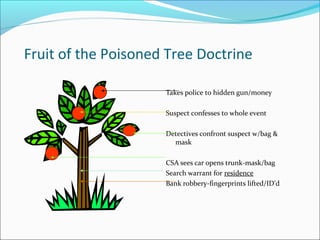
Fruit of the Poisoned Tree Doctrine

                     Takes police to hidden gun/money

                     Suspect confesses to whole event

                     Detectives confront suspect w/bag &
                       mask

                     CSA sees car opens trunk-mask/bag
                     Search warrant for residence
                     Bank robbery-fingerprints lifted/ID’d
Fruit of the Poisoned Tree Doctrine
Probable cause hearing:
-defense -search warrant listed residence
-judge rules car search illegal
-any/all evidence obtained inadmissible
-objects in car/confession/suspect leading to hidden items
-left? fingerprints at bank---suspect has banked many
   times /past three years
Mapp v. Ohio 1961
No punishment for illegal evidence


Police:
-forced confessions
-ignore constitutional rights of accused


Supreme Court applied Exclusionary Rule to state courts
Search & Seizure
4th Amendment:
The right of the people to be secure in their persons,
  houses, papers, and effects, against unreasonable searches
  and seizures, shall not be violated, and no Warrants shall
  issue, but upon probable cause, supported by Oath or
  affirmation, and particularly describing the place to be
  searched, and the persons or things to be seized.
Probable Cause

A set of facts and circumstances that would lead a
 reasonable person to believe a crime has been
 committed and that the person accused had
 committed the crime.
Search & Seizure
4th Amendment:


-right to privacy not clearly defined

-Supreme Court interpretations

-”reasonable expectation “of privacy
Search & Seizure
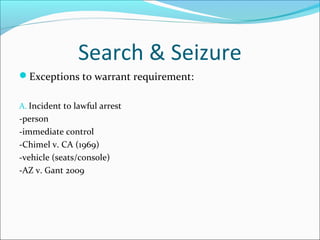
Exceptions to warrant requirement:

A. Incident to lawful arrest
-person
-immediate control
-Chimel v. CA (1969)
-vehicle (seats/console)
-AZ v. Gant 2009
Search & Seizure
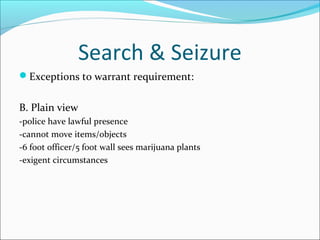
Exceptions to warrant requirement:


B. Plain view
-police have lawful presence
-cannot move items/objects
-6 foot officer/5 foot wall sees marijuana plants
-exigent circumstances
Search & Seizure
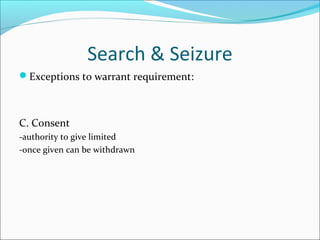
Exceptions to warrant requirement:


C. Consent
-authority to give limited
-once given can be withdrawn
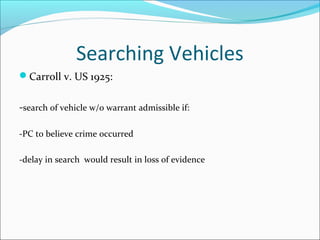
Searching Vehicles
Carroll v. US 1925:


-search of vehicle w/o warrant admissible if:

-PC to believe crime occurred

-delay in search would result in loss of evidence
Searching Vehicles
Drug dogs:


-sniff exterior of vehicle

-w/o particular reason

-legal stop

-no “unreasonable” prolonged stop
Searching Vehicles
Impounded vehicles:


-inventory

-clear written protocols/standards

-force locks

-protect police libability
Searching Persons
Court recognizes officer safety!!!


-pat down searches for weapons

-Terry v. Ohio (1968): Terry stop
-stop
-talk
-frisk
-”reasonable suspicion”
-PO articulate reason for stop
Public Safety Exceptions
Immediate action by police to protect public
-armed suspect-no weapon upon arrest
-search immediate area of suspect’s path
-ask where gun is


Search of airline/bus passengers/subway (2005):
-w/o PC
-w/o warrant
-”implied consent”
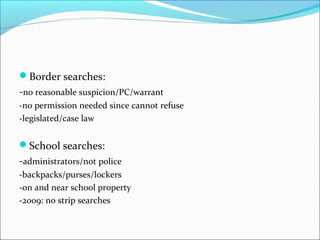
Border searches:
-no reasonable suspicion/PC/warrant
-no permission needed since cannot refuse
-legislated/case law


School searches:
-administrators/not police
-backpacks/purses/lockers
-on and near school property
-2009: no strip searches
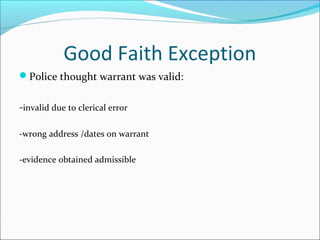
Good Faith Exception
Police thought warrant was valid:


-invalid due to clerical error

-wrong address /dates on warrant

-evidence obtained admissible
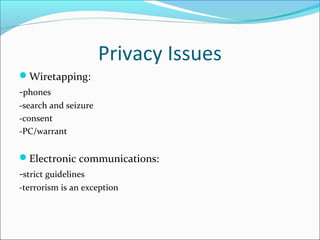
Privacy Issues
Wiretapping:
-phones
-search and seizure
-consent
-PC/warrant


Electronic communications:
-strict guidelines
-terrorism is an exception
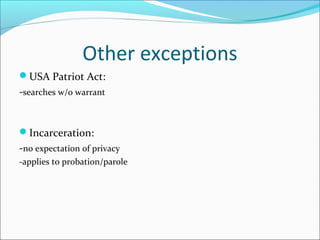
Other exceptions
USA Patriot Act:
-searches w/o warrant


Incarceration:
-no expectation of privacy
-applies to probation/parole
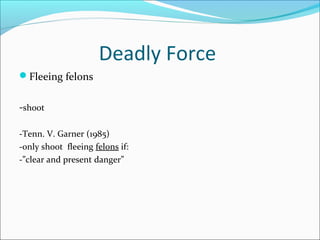
Deadly Force
Fleeing felons


-shoot

-Tenn. V. Garner (1985)
-only shoot fleeing felons if:
-”clear and present danger”
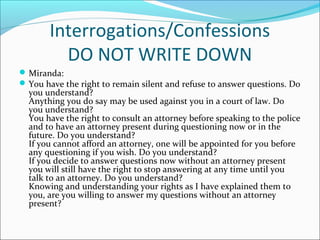
Interrogations/Confessions
         DO NOT WRITE DOWN
 Miranda:
 You have the right to remain silent and refuse to answer questions. Do
  you understand?
  Anything you do say may be used against you in a court of law. Do
  you understand?
  You have the right to consult an attorney before speaking to the police
  and to have an attorney present during questioning now or in the
  future. Do you understand?
  If you cannot afford an attorney, one will be appointed for you before
  any questioning if you wish. Do you understand?
  If you decide to answer questions now without an attorney present
  you will still have the right to stop answering at any time until you
  talk to an attorney. Do you understand?
  Knowing and understanding your rights as I have explained them to
  you, are you willing to answer my questions without an attorney
  present?
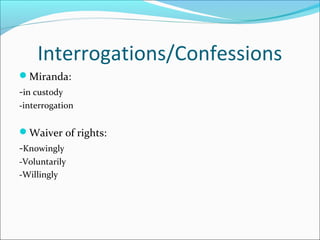
Interrogations/Confessions
Miranda:
-in custody
-interrogation


Waiver of rights:
-Knowingly
-Voluntarily
-Willingly
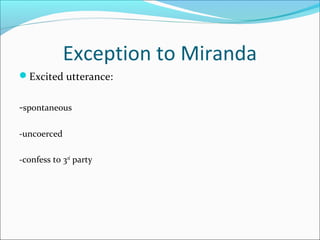
Exception to Miranda
Excited utterance:


-spontaneous

-uncoerced

-confess to 3rd party
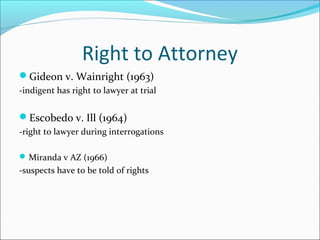
Right to Attorney
Gideon v. Wainright (1963)
-indigent has right to lawyer at trial


Escobedo v. Ill (1964)
-right to lawyer during interrogations

 Miranda v AZ (1966)
-suspects have to be told of rights
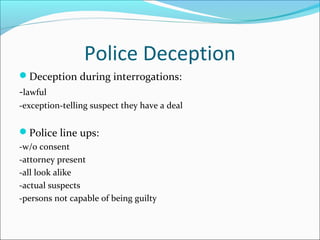
Police Deception
Deception during interrogations:
-lawful
-exception-telling suspect they have a deal


Police line ups:
-w/o consent
-attorney present
-all look alike
-actual suspects
-persons not capable of being guilty
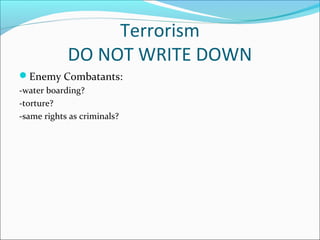
Terrorism
            DO NOT WRITE DOWN
Enemy Combatants:
-water boarding?
-torture?
-same rights as criminals?

Ch 5

  • 1.
  • 2.
    US Constitution Due process: -rightsof accused -procedures -lacks specifics
  • 3.
    5th Amendment No personshall be held to answer for a capital, or otherwise infamous crime, unless on a presentment or indictment of a Grand Jury, except in cases arising in the land or naval forces, or in the Militia, when in actual service in time of War or public danger; nor shall any person be subject for the same offense to be twice put in jeopardy of life or limb; nor shall be compelled in any criminal case to be a witness against himself, nor be deprived of life, liberty, or property, without due process of law; nor shall private property be taken for public use, without just compensation
  • 4.
    Procedural Law Body oflaws Governing each stage Criminal Justice process Violation-person goes free Legislative/judicial oversight
  • 5.
    Rules of Evidence Policegather evidence Prosecutor presents evidence Defense argues against Judge rules
  • 6.
    Rules of Evidence Requirementsof admitting evidence Define qualifications of an expert Nature of testimony
  • 7.
    Rules of Evidence Searchand seizure Interrogation Arresting Relevance of evidence
  • 8.
    Exclusionary Rule Evidence obtainedillegally is inadmissible Weeks v. US (1918); -no warrant -evidence thrown out -federal level only
  • 9.
    Fruit of the Poisoned Tree Doctrine Exclusionary rule extended: -from evidence directly obtained illegally -to evidence indirectly obtained illegally
  • 10.
    Fruit of thePoisoned Tree Doctrine Takes police to hidden gun/money Suspect confesses to whole event Detectives confront suspect w/bag & mask CSA sees car opens trunk-mask/bag Search warrant for residence Bank robbery-fingerprints lifted/ID’d
  • 11.
    Fruit of thePoisoned Tree Doctrine Probable cause hearing: -defense -search warrant listed residence -judge rules car search illegal -any/all evidence obtained inadmissible -objects in car/confession/suspect leading to hidden items -left? fingerprints at bank---suspect has banked many times /past three years
  • 12.
    Mapp v. Ohio1961 No punishment for illegal evidence Police: -forced confessions -ignore constitutional rights of accused Supreme Court applied Exclusionary Rule to state courts
  • 13.
    Search & Seizure 4thAmendment: The right of the people to be secure in their persons, houses, papers, and effects, against unreasonable searches and seizures, shall not be violated, and no Warrants shall issue, but upon probable cause, supported by Oath or affirmation, and particularly describing the place to be searched, and the persons or things to be seized.
  • 14.
    Probable Cause A setof facts and circumstances that would lead a reasonable person to believe a crime has been committed and that the person accused had committed the crime.
  • 15.
    Search & Seizure 4thAmendment: -right to privacy not clearly defined -Supreme Court interpretations -”reasonable expectation “of privacy
  • 16.
    Search & Seizure Exceptionsto warrant requirement: A. Incident to lawful arrest -person -immediate control -Chimel v. CA (1969) -vehicle (seats/console) -AZ v. Gant 2009
  • 17.
    Search & Seizure Exceptionsto warrant requirement: B. Plain view -police have lawful presence -cannot move items/objects -6 foot officer/5 foot wall sees marijuana plants -exigent circumstances
  • 18.
    Search & Seizure Exceptionsto warrant requirement: C. Consent -authority to give limited -once given can be withdrawn
  • 19.
    Searching Vehicles Carroll v.US 1925: -search of vehicle w/o warrant admissible if: -PC to believe crime occurred -delay in search would result in loss of evidence
  • 20.
    Searching Vehicles Drug dogs: -sniffexterior of vehicle -w/o particular reason -legal stop -no “unreasonable” prolonged stop
  • 21.
    Searching Vehicles Impounded vehicles: -inventory -clearwritten protocols/standards -force locks -protect police libability
  • 22.
    Searching Persons Court recognizesofficer safety!!! -pat down searches for weapons -Terry v. Ohio (1968): Terry stop -stop -talk -frisk -”reasonable suspicion” -PO articulate reason for stop
  • 23.
    Public Safety Exceptions Immediateaction by police to protect public -armed suspect-no weapon upon arrest -search immediate area of suspect’s path -ask where gun is Search of airline/bus passengers/subway (2005): -w/o PC -w/o warrant -”implied consent”
  • 24.
    Border searches: -no reasonablesuspicion/PC/warrant -no permission needed since cannot refuse -legislated/case law School searches: -administrators/not police -backpacks/purses/lockers -on and near school property -2009: no strip searches
  • 25.
    Good Faith Exception Policethought warrant was valid: -invalid due to clerical error -wrong address /dates on warrant -evidence obtained admissible
  • 26.
    Privacy Issues Wiretapping: -phones -search andseizure -consent -PC/warrant Electronic communications: -strict guidelines -terrorism is an exception
  • 27.
    Other exceptions USA PatriotAct: -searches w/o warrant Incarceration: -no expectation of privacy -applies to probation/parole
  • 28.
    Deadly Force Fleeing felons -shoot -Tenn.V. Garner (1985) -only shoot fleeing felons if: -”clear and present danger”
  • 29.
    Interrogations/Confessions DO NOT WRITE DOWN  Miranda:  You have the right to remain silent and refuse to answer questions. Do you understand? Anything you do say may be used against you in a court of law. Do you understand? You have the right to consult an attorney before speaking to the police and to have an attorney present during questioning now or in the future. Do you understand? If you cannot afford an attorney, one will be appointed for you before any questioning if you wish. Do you understand? If you decide to answer questions now without an attorney present you will still have the right to stop answering at any time until you talk to an attorney. Do you understand? Knowing and understanding your rights as I have explained them to you, are you willing to answer my questions without an attorney present?
  • 30.
  • 31.
    Exception to Miranda Excitedutterance: -spontaneous -uncoerced -confess to 3rd party
  • 32.
    Right to Attorney Gideonv. Wainright (1963) -indigent has right to lawyer at trial Escobedo v. Ill (1964) -right to lawyer during interrogations  Miranda v AZ (1966) -suspects have to be told of rights
  • 33.
    Police Deception Deception duringinterrogations: -lawful -exception-telling suspect they have a deal Police line ups: -w/o consent -attorney present -all look alike -actual suspects -persons not capable of being guilty
  • 34.
    Terrorism DO NOT WRITE DOWN Enemy Combatants: -water boarding? -torture? -same rights as criminals?