Deterioration factors of Fruits and Vegetables and their control
1. Enzymic changes
Enzymes which are endogenous to plant tissues can have undesirable or
desirable consequences. Examples include
a) the post-harvest senescence and spoilage of fruit and vegetables;
b) oxidation of phenolic substances in plant tissues by phenolase
(leading to browning);
c) sugar - starch conversion in plant tissues by amylases;
d) post-harvest demethylation of pectic substances in plant tissues
(leading to softening of plant tissues during ripening, and firming of
plant tissues during processing).
CONTROL: The major factors useful in controlling enzyme activity are:
temperature, water activity, pH, chemicals which can inhibit enzyme
action, alteration of substrates, alteration of products and pre-processing
control. 1
2. Chemical changes
The two major chemical changes which occur during the
processing and storage of foods and lead to a deterioration
in sensory quality are lipid oxidation and non-enzymatic
browning. Chemical reactions are also responsible for
changes in the colour and flavour of foods during processing
and storage.
2
Colour changes - Chlorophylls. Almost any type of food
processing or storage causes some deterioration of
the chlorophyll pigments. Phenophytinisation (with
consequent formation of a dull olive brown
phenophytin) is the major change; this reaction is
accelerated by heat and is acid catalysed.
For example, dehydrated products such as green peas
and beans packed in clear glass containers undergo
photo-oxidation and loss of desirable colour.
Anthocyanins. The rate of anthocyanin destruction is
pH dependent, being greater at higher pH values. Of
interest from a packaging point of view is the ability of
some anthocyanins to form complexes with metals
such as Al, Fe, Cu and Sn.
3
Carotenoids. The main cause of carotenoid degradation in
foods is oxidation. The pigments may auto-oxidise by
reaction with atmospheric oxygen at rates dependent on
light, heat and the presence of pro- and antioxidants.
Flavour changes
In fruit and vegetables, enzymically generated compounds
derived from long-chain fatty acids play an extremely
important role in the formation of characteristic flavours. In
addition, these types of reactions can lead to significant
off-flavours.
CONTROL:The permeability of packaging materials is of
importance in retaining desirable volatile components
within packages, or not permitting undesirable components
to permeate through the package from the ambient
atmosphere. 4
5
Fruit quality
Fruit quality goes back to tree stock, growing practices and
weather conditions. Closer to the shipper and processor,
however, are the degrees of maturity and ripeness when picked
and the method of picking or harvesting. There is a distinction
between maturity and ripeness of a fruit.
Maturity is the condition when the fruit is ready to eat or if
picked will become ready to eat after further ripening.
Ripeness is that optimum condition when colour, flavour and
texture have developed to their peak.
• Fruit ripening agents
-Speed up the process of ripening
-Unsaturated hydrocarbons; acetylene, ethylene, etc.
 Calcium Carbide (CaC2) is most commonly used for
artificial ripening of fruits. Calcium carbide, when hydrolysed,
produces acetylene, which causes artificial ripening of fruits.
 Ethylene:
A very small concentration of ethylene in air is sufficient to
promote the fruit ripening process. Externally applied Ethylene
is likely to trigger or initiate the natural ripening process.
 Ethephon:
 Take less time than calcium carbide for ripening.
 More acceptable colour than naturally ripened fruits.
 Longer shelf life than fruits ripened with Calcium carbide.
6
• From a technological point of view, fruit
characterisation by species and varieties is
performed on the basis of physical as well
chemical properties: shape, size, texture,
flavour, colour/pigmentation, dry matter
content (soluble solids content), pectic
substances, acidity, vitamins, etc.
• These properties are directly correlated with
fruit utilisation.
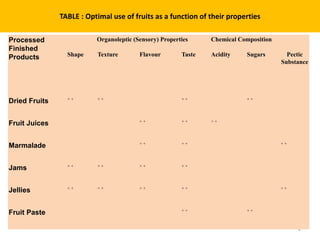
• Table 6 shows which of the above mentioned
properties have a major impact on the finished
products obtained by fruit processing.
7
8
Processed
Finished
Products
Organoleptic (Sensory) Properties Chemical Composition
Shape Texture Flavour Taste Acidity Sugars Pectic
Substance
Dried Fruits + + + + + + + +
Fruit Juices + + + + + +
Marmalade + + + + + +
Jams + + + + + + + +
Jellies + + + + + + + + + +
Fruit Paste + + + +
TABLE : Optimal use of fruits as a function of their properties
9
When to pick fruits
The proper time to pick fruit depends upon several factors;
these include variety, location, weather, ease of removal
from the tree (which change with time), and purpose to
which the fruit will be put.
For example, oranges change with respect to both sugar
and acid as they ripen on the tree; sugar increases and acid
decreases. The ratio of sugar to acid determines the taste
and acceptability of the fruit and the juice.
Quality measurements of fruits
Many quality measurements can be made before a fruit
crop is picked in order to determine if proper maturity or
degree of ripeness has developed.
Colour may be measured with instruments or by
comparing the colour of fruit on the tree with standard
picture charts.
Texture may be measured by compression by hand or
by simple type of plungers.
10
• As fruit mature on the tree its concentration of juice solids,
which are mostly sugars, changes. The concentration of
soluble solids in the juice can be estimated with a
refractometer or a hydrometer. The refractometer measures
the ability of a solution to bend or refract a light beam
which is proportional to the solution's concentration. A
hydrometer is a weighted spindle with a graduated neck
which floats in the juice at a height related to the juice
density.
11
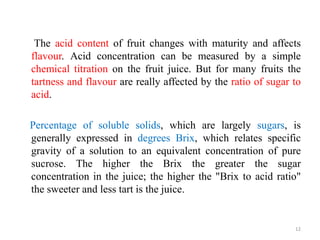
The acid content of fruit changes with maturity and affects
flavour. Acid concentration can be measured by a simple
chemical titration on the fruit juice. But for many fruits the
tartness and flavour are really affected by the ratio of sugar to
acid.
Percentage of soluble solids, which are largely sugars, is
generally expressed in degrees Brix, which relates specific
gravity of a solution to an equivalent concentration of pure
sucrose. The higher the Brix the greater the sugar
concentration in the juice; the higher the "Brix to acid ratio"
the sweeter and less tart is the juice.
12
Harvesting and pre-processing
a. Harvesting
A large amount of the harvesting of most fruit crops is
still done by hand; this labour may represent about half
of the cost of growing the fruit.
Mechanical harvesting is currently one of the most
active fields of research for the agricultural engineer, but
also requires geneticists to breed fruit of nearly equal
size, that matures uniformly and that is resistant to
mechanical damage.
13
A correct manual harvesting includes some simple but essential
rules:
• the fruit should be picked by hand and placed carefully in the
harvesting basket; all future handling has to be performed
carefully in order to avoid any mechanical damage;
• the harvesting basket should be clean, could be lined with
wrapping papers, box liners and cushions.
• the hands of the harvester should be clean with no sharp finger
nails;
• the fruit are picked when it is ready to be able to be processed
into a quality product depending on the treatment which it will
undergo.
14
It is worth emphasising the fact that the proximity of the processing
centre to the source of supply for fresh raw materials presents
major advantages; some are as follows:
• possibility to pick at the best suitable moment;
• reduction of losses by handling/transportation;
• minimises raw material transport costs;
• possibility to use simpler/cheaper receptacles for raw material
transport.
15
Once it has left the tree, the organoleptic properties, nutritional
value, safety and aesthetic appeal of the fruit deteriorates in varying
degrees. The major causes of deterioration include the following:
•growth and activity of micro-organisms;
•activities of the natural food enzymes;
•insects, parasites and rodents;
•temperature, both heat and cold;
•moisture and dryness;
•air and in particular oxygen;
•light and
•time.
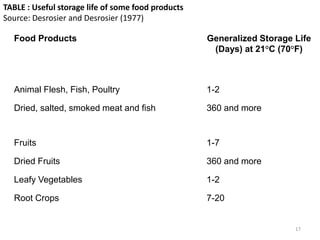
The rapidity with which foods spoil if proper measures are not taken
is indicated in Table .
16
17
Food Products Generalized Storage Life
(Days) at 21°C (70°F)
Animal Flesh, Fish, Poultry 1-2
Dried, salted, smoked meat and fish 360 and more
Fruits 1-7
Dried Fruits 360 and more
Leafy Vegetables 1-2
Root Crops 7-20
TABLE : Useful storage life of some food products
Source: Desrosier and Desrosier (1977)
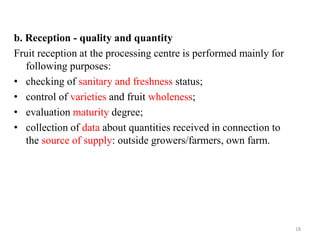
b. Reception - quality and quantity
Fruit reception at the processing centre is performed mainly for
following purposes:
• checking of sanitary and freshness status;
• control of varieties and fruit wholeness;
• evaluation maturity degree;
• collection of data about quantities received in connection to
the source of supply: outside growers/farmers, own farm.
18
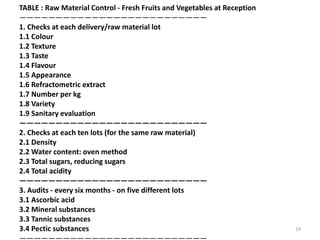
19
TABLE : Raw Material Control - Fresh Fruits and Vegetables at Reception
——————————————————————————
1. Checks at each delivery/raw material lot
1.1 Colour
1.2 Texture
1.3 Taste
1.4 Flavour
1.5 Appearance
1.6 Refractometric extract
1.7 Number per kg
1.8 Variety
1.9 Sanitary evaluation
——————————————————————————
2. Checks at each ten lots (for the same raw material)
2.1 Density
2.2 Water content: oven method
2.3 Total sugars, reducing sugars
2.4 Total acidity
——————————————————————————
3. Audits - every six months - on five different lots
3.1 Ascorbic acid
3.2 Mineral substances
3.3 Tannic substances
3.4 Pectic substances
d. Washing
Harvested fruit is washed to
 Remove soil, micro-organisms and pesticide residues.
 Eliminate spoiled fruit before washing.
Fruit washing can be carried out by
• immersion,
• spray/ showers or by combination
of these two processes which is generally the best
solution: pre-washing and washing.
20
Some usual practices in fruit washing are:
• addition of detergents or 1.5% HCl solution in washing water
to remove traces of insect-fungicides;
• use of warm water (about 50°C) in the pre-washing phase;
• higher water pressure in spray/shower washers.
Washing must be done before the fruit is cut in order to avoid
losing high nutritive value soluble substances (vitamins,
minerals, sugars, etc.).
21
e. Sorting
Fruit sorting covers two main separate processing operations:
• removal of damaged fruit and any foreign bodies (which might
have been left behind after washing);
• qualitative sorting based on organoleptic criteria and maturity
stage.
Mechanical sorting for size is usually not done at the preliminary
stage. The most important initial sorting is for variety and
maturity. However, for some fruit and in special processing
technologies it is advisable to proceed to a manual dimensional
sorting (grading).
22
f. Trimming and peeling (skin removal)
This processing step aims at removing the parts of the fruit which
are either not edible or difficult to digest especially the skin. Up
to now the industrial peeling of fruit and vegetables was
performed by three procedures:
• mechanically;
• by using water steam;
• chemically; this method consists in treating fruit and vegetables
by dipping them in a caustic soda solution at a temperature of 90
to 100° C; the concentration of this solution as well as the
dipping or immersion time varying according to each specific
case.
23
g. Cutting
This step is performed according to the specific requirements of
the fruit processing technology.
h. Heat blanching
Fruit is not usually heat blanched because of the damage from the
heat and the associated sogginess and juice loss after thawing.
Instead, chemicals are commonly used without heat to
inactivate the oxidative enzymes or to act as antioxidants and
they are combined with other treatments.
24
Fresh fruit storage
• Some fruit species and specially apples and pears can be
stored in fresh state during cold season in some
countries' climatic conditions.
• Fruit for fresh storage have to be autumn or winter
varieties and be harvested before they are fully mature.
• This fruit also has to be sound and without any bruising;
control and sorting by quality are mandatory operations.
25
• Sorting has to be carried out according to size and weight and
also by appearance;
• fruit which is not up to standard for storage will be used for
semi-processed product manufacturing which will be
submitted further to industrial processing.
• Harvested fruit has to be transported as soon as possible to
storage areas.
• Leaving fruit in bulk in order to generate transpiration is a bad
practice as this reduces storage time and accelerates
maturation processes during storage.
• In order to store large quantities of fruit, silos have to be built.
26

Fruits and Vegetables Processing Technology

  • 1.
    Deterioration factors ofFruits and Vegetables and their control 1. Enzymic changes Enzymes which are endogenous to plant tissues can have undesirable or desirable consequences. Examples include a) the post-harvest senescence and spoilage of fruit and vegetables; b) oxidation of phenolic substances in plant tissues by phenolase (leading to browning); c) sugar - starch conversion in plant tissues by amylases; d) post-harvest demethylation of pectic substances in plant tissues (leading to softening of plant tissues during ripening, and firming of plant tissues during processing). CONTROL: The major factors useful in controlling enzyme activity are: temperature, water activity, pH, chemicals which can inhibit enzyme action, alteration of substrates, alteration of products and pre-processing control. 1
  • 2.
    2. Chemical changes Thetwo major chemical changes which occur during the processing and storage of foods and lead to a deterioration in sensory quality are lipid oxidation and non-enzymatic browning. Chemical reactions are also responsible for changes in the colour and flavour of foods during processing and storage. 2
  • 3.
    Colour changes -Chlorophylls. Almost any type of food processing or storage causes some deterioration of the chlorophyll pigments. Phenophytinisation (with consequent formation of a dull olive brown phenophytin) is the major change; this reaction is accelerated by heat and is acid catalysed. For example, dehydrated products such as green peas and beans packed in clear glass containers undergo photo-oxidation and loss of desirable colour. Anthocyanins. The rate of anthocyanin destruction is pH dependent, being greater at higher pH values. Of interest from a packaging point of view is the ability of some anthocyanins to form complexes with metals such as Al, Fe, Cu and Sn. 3
  • 4.
    Carotenoids. The maincause of carotenoid degradation in foods is oxidation. The pigments may auto-oxidise by reaction with atmospheric oxygen at rates dependent on light, heat and the presence of pro- and antioxidants. Flavour changes In fruit and vegetables, enzymically generated compounds derived from long-chain fatty acids play an extremely important role in the formation of characteristic flavours. In addition, these types of reactions can lead to significant off-flavours. CONTROL:The permeability of packaging materials is of importance in retaining desirable volatile components within packages, or not permitting undesirable components to permeate through the package from the ambient atmosphere. 4
  • 5.
    5 Fruit quality Fruit qualitygoes back to tree stock, growing practices and weather conditions. Closer to the shipper and processor, however, are the degrees of maturity and ripeness when picked and the method of picking or harvesting. There is a distinction between maturity and ripeness of a fruit. Maturity is the condition when the fruit is ready to eat or if picked will become ready to eat after further ripening. Ripeness is that optimum condition when colour, flavour and texture have developed to their peak.
  • 6.
    • Fruit ripeningagents -Speed up the process of ripening -Unsaturated hydrocarbons; acetylene, ethylene, etc.  Calcium Carbide (CaC2) is most commonly used for artificial ripening of fruits. Calcium carbide, when hydrolysed, produces acetylene, which causes artificial ripening of fruits.  Ethylene: A very small concentration of ethylene in air is sufficient to promote the fruit ripening process. Externally applied Ethylene is likely to trigger or initiate the natural ripening process.  Ethephon:  Take less time than calcium carbide for ripening.  More acceptable colour than naturally ripened fruits.  Longer shelf life than fruits ripened with Calcium carbide. 6
  • 7.
    • From atechnological point of view, fruit characterisation by species and varieties is performed on the basis of physical as well chemical properties: shape, size, texture, flavour, colour/pigmentation, dry matter content (soluble solids content), pectic substances, acidity, vitamins, etc. • These properties are directly correlated with fruit utilisation. • Table 6 shows which of the above mentioned properties have a major impact on the finished products obtained by fruit processing. 7
  • 8.
    8 Processed Finished Products Organoleptic (Sensory) PropertiesChemical Composition Shape Texture Flavour Taste Acidity Sugars Pectic Substance Dried Fruits + + + + + + + + Fruit Juices + + + + + + Marmalade + + + + + + Jams + + + + + + + + Jellies + + + + + + + + + + Fruit Paste + + + + TABLE : Optimal use of fruits as a function of their properties
  • 9.
    9 When to pickfruits The proper time to pick fruit depends upon several factors; these include variety, location, weather, ease of removal from the tree (which change with time), and purpose to which the fruit will be put. For example, oranges change with respect to both sugar and acid as they ripen on the tree; sugar increases and acid decreases. The ratio of sugar to acid determines the taste and acceptability of the fruit and the juice.
  • 10.
    Quality measurements offruits Many quality measurements can be made before a fruit crop is picked in order to determine if proper maturity or degree of ripeness has developed. Colour may be measured with instruments or by comparing the colour of fruit on the tree with standard picture charts. Texture may be measured by compression by hand or by simple type of plungers. 10
  • 11.
    • As fruitmature on the tree its concentration of juice solids, which are mostly sugars, changes. The concentration of soluble solids in the juice can be estimated with a refractometer or a hydrometer. The refractometer measures the ability of a solution to bend or refract a light beam which is proportional to the solution's concentration. A hydrometer is a weighted spindle with a graduated neck which floats in the juice at a height related to the juice density. 11
  • 12.
    The acid contentof fruit changes with maturity and affects flavour. Acid concentration can be measured by a simple chemical titration on the fruit juice. But for many fruits the tartness and flavour are really affected by the ratio of sugar to acid. Percentage of soluble solids, which are largely sugars, is generally expressed in degrees Brix, which relates specific gravity of a solution to an equivalent concentration of pure sucrose. The higher the Brix the greater the sugar concentration in the juice; the higher the "Brix to acid ratio" the sweeter and less tart is the juice. 12
  • 13.
    Harvesting and pre-processing a.Harvesting A large amount of the harvesting of most fruit crops is still done by hand; this labour may represent about half of the cost of growing the fruit. Mechanical harvesting is currently one of the most active fields of research for the agricultural engineer, but also requires geneticists to breed fruit of nearly equal size, that matures uniformly and that is resistant to mechanical damage. 13
  • 14.
    A correct manualharvesting includes some simple but essential rules: • the fruit should be picked by hand and placed carefully in the harvesting basket; all future handling has to be performed carefully in order to avoid any mechanical damage; • the harvesting basket should be clean, could be lined with wrapping papers, box liners and cushions. • the hands of the harvester should be clean with no sharp finger nails; • the fruit are picked when it is ready to be able to be processed into a quality product depending on the treatment which it will undergo. 14
  • 15.
    It is worthemphasising the fact that the proximity of the processing centre to the source of supply for fresh raw materials presents major advantages; some are as follows: • possibility to pick at the best suitable moment; • reduction of losses by handling/transportation; • minimises raw material transport costs; • possibility to use simpler/cheaper receptacles for raw material transport. 15
  • 16.
    Once it hasleft the tree, the organoleptic properties, nutritional value, safety and aesthetic appeal of the fruit deteriorates in varying degrees. The major causes of deterioration include the following: •growth and activity of micro-organisms; •activities of the natural food enzymes; •insects, parasites and rodents; •temperature, both heat and cold; •moisture and dryness; •air and in particular oxygen; •light and •time. The rapidity with which foods spoil if proper measures are not taken is indicated in Table . 16
  • 17.
    17 Food Products GeneralizedStorage Life (Days) at 21°C (70°F) Animal Flesh, Fish, Poultry 1-2 Dried, salted, smoked meat and fish 360 and more Fruits 1-7 Dried Fruits 360 and more Leafy Vegetables 1-2 Root Crops 7-20 TABLE : Useful storage life of some food products Source: Desrosier and Desrosier (1977)
  • 18.
    b. Reception -quality and quantity Fruit reception at the processing centre is performed mainly for following purposes: • checking of sanitary and freshness status; • control of varieties and fruit wholeness; • evaluation maturity degree; • collection of data about quantities received in connection to the source of supply: outside growers/farmers, own farm. 18
  • 19.
    19 TABLE : RawMaterial Control - Fresh Fruits and Vegetables at Reception —————————————————————————— 1. Checks at each delivery/raw material lot 1.1 Colour 1.2 Texture 1.3 Taste 1.4 Flavour 1.5 Appearance 1.6 Refractometric extract 1.7 Number per kg 1.8 Variety 1.9 Sanitary evaluation —————————————————————————— 2. Checks at each ten lots (for the same raw material) 2.1 Density 2.2 Water content: oven method 2.3 Total sugars, reducing sugars 2.4 Total acidity —————————————————————————— 3. Audits - every six months - on five different lots 3.1 Ascorbic acid 3.2 Mineral substances 3.3 Tannic substances 3.4 Pectic substances
  • 20.
    d. Washing Harvested fruitis washed to  Remove soil, micro-organisms and pesticide residues.  Eliminate spoiled fruit before washing. Fruit washing can be carried out by • immersion, • spray/ showers or by combination of these two processes which is generally the best solution: pre-washing and washing. 20
  • 21.
    Some usual practicesin fruit washing are: • addition of detergents or 1.5% HCl solution in washing water to remove traces of insect-fungicides; • use of warm water (about 50°C) in the pre-washing phase; • higher water pressure in spray/shower washers. Washing must be done before the fruit is cut in order to avoid losing high nutritive value soluble substances (vitamins, minerals, sugars, etc.). 21
  • 22.
    e. Sorting Fruit sortingcovers two main separate processing operations: • removal of damaged fruit and any foreign bodies (which might have been left behind after washing); • qualitative sorting based on organoleptic criteria and maturity stage. Mechanical sorting for size is usually not done at the preliminary stage. The most important initial sorting is for variety and maturity. However, for some fruit and in special processing technologies it is advisable to proceed to a manual dimensional sorting (grading). 22
  • 23.
    f. Trimming andpeeling (skin removal) This processing step aims at removing the parts of the fruit which are either not edible or difficult to digest especially the skin. Up to now the industrial peeling of fruit and vegetables was performed by three procedures: • mechanically; • by using water steam; • chemically; this method consists in treating fruit and vegetables by dipping them in a caustic soda solution at a temperature of 90 to 100° C; the concentration of this solution as well as the dipping or immersion time varying according to each specific case. 23
  • 24.
    g. Cutting This stepis performed according to the specific requirements of the fruit processing technology. h. Heat blanching Fruit is not usually heat blanched because of the damage from the heat and the associated sogginess and juice loss after thawing. Instead, chemicals are commonly used without heat to inactivate the oxidative enzymes or to act as antioxidants and they are combined with other treatments. 24
  • 25.
    Fresh fruit storage •Some fruit species and specially apples and pears can be stored in fresh state during cold season in some countries' climatic conditions. • Fruit for fresh storage have to be autumn or winter varieties and be harvested before they are fully mature. • This fruit also has to be sound and without any bruising; control and sorting by quality are mandatory operations. 25
  • 26.
    • Sorting hasto be carried out according to size and weight and also by appearance; • fruit which is not up to standard for storage will be used for semi-processed product manufacturing which will be submitted further to industrial processing. • Harvested fruit has to be transported as soon as possible to storage areas. • Leaving fruit in bulk in order to generate transpiration is a bad practice as this reduces storage time and accelerates maturation processes during storage. • In order to store large quantities of fruit, silos have to be built. 26