Seminar on
By
AUGUSTINE DSOUZA
(1MJ15MAE02)
Under the guidance of
P.DINESH KUMAR
Asst. Professor
MVJCE
COMPOSITE MATERIAL
REPAIR METHODOLOGIES
What is Composite MATERIAL ?
• A composite material is a material made from two or more
constituent materials with significantly
different physical or chemical properties that, when combined,
produce a material with characteristics different from the
individual components. The individual components remain
separate and distinct within the finished structure.
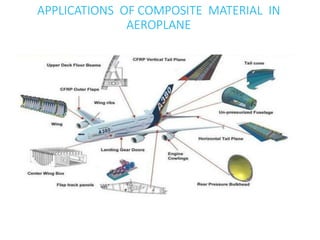
APPLICATIONS OF COMPOSITE MATERIAL IN
AEROPLANE
INTRODUCTION
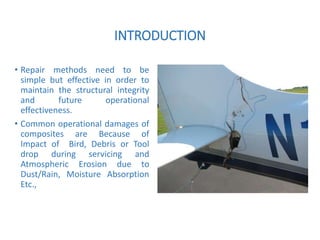
• Repair methods need to be
simple but effective in order to
maintain the structural integrity
and future operational
effectiveness.
• Common operational damages of
composites are Because of
Impact of Bird, Debris or Tool
drop during servicing and
Atmospheric Erosion due to
Dust/Rain, Moisture Absorption
Etc.,
TYPES OF DAMAGES
All repair types are “zone dependent “requiring aerodynamic/aero elastic considerations
EROSION DAMAGE(without major fiber damage)
- abrade, clean, fill and fair with suitable epoxy or polyurethane filler.
MINOR SCRATHES OR DINGS AFFECTING SURFACE PLY
- Abrade, to remove paint around damage down to the laminate surface, fill scratches or ding
with filler paste and apply 1-layer of fine glass fabric with epoxy.
DAMAGE INTO OR BEYOND OUTER PLY OF LAMINATE
-Remove and replace damaged plies or apply a bonded doubler repair
DAMAGE INTO SANDWICH CORE STRUCTURE
-Remove and replace damaged core and structural plies in damaged skin or apply doubler
DAMAGE THROUGH STRUCTURE
-Remove damage through structure and repair from both sides (if accessible) using repair plies
or doublers .
Option : repair from one side using “no backside access” techniques
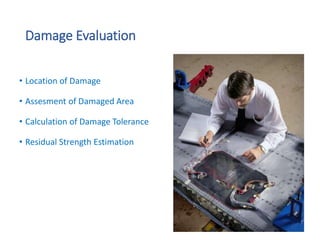
Damage Evaluation
• Location of Damage
• Assesment of Damaged Area
• Calculation of Damage Tolerance
• Residual Strength Estimation
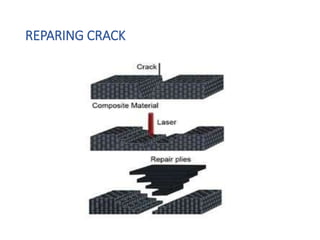
REPARING CRACK
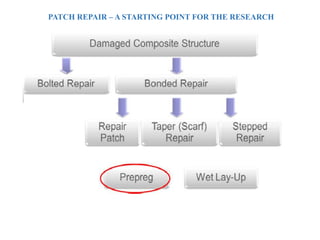
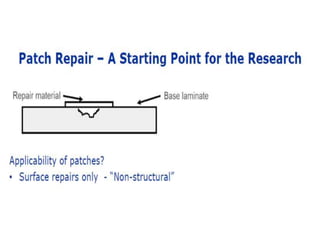
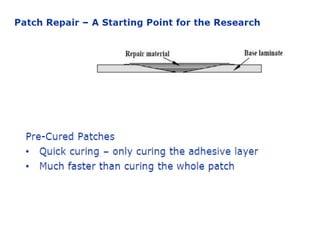
PATCH REPAIR – A STARTING POINT FOR THE RESEARCH
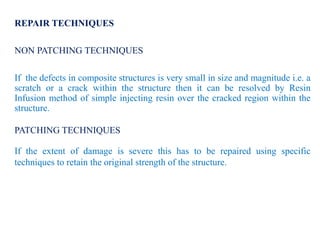
REPAIR TECHNIQUES
NON PATCHING TECHNIQUES
If the defects in composite structures is very small in size and magnitude i.e. a
scratch or a crack within the structure then it can be resolved by Resin
Infusion method of simple injecting resin over the cracked region within the
structure.
PATCHING TECHNIQUES
If the extent of damage is severe this has to be repaired using specific
techniques to retain the original strength of the structure.
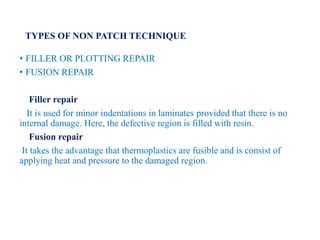
TYPES OF NON PATCH TECHNIQUE
• FILLER OR PLOTTING REPAIR
• FUSION REPAIR
Filler repair
It is used for minor indentations in laminates provided that there is no
internal damage. Here, the defective region is filled with resin.
Fusion repair
It takes the advantage that thermoplastics are fusible and is consist of
applying heat and pressure to the damaged region.
TYPES OF PATCHING TECHNIQUE
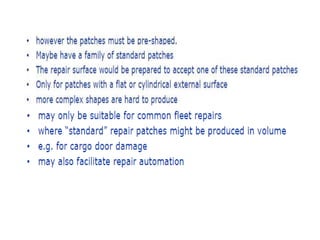
• BONDED EXTERNAL PATCH
• BONDED SCARF PATCH
• BOLTED EXTERNAL PATCH
BONDED EXTERNAL PATCH :
• Suitable for repairs to laminates up to 16 plies thick.
• Excellent restoration of mechanical properties.
• Easy to implement, well suited for field application.
• Minimum further damage to structure.
BONDED SCARF PATCH:
• Suitable only to thick laminates.
• Excellent restoration of mechanical properties.
• Obtrusive; requires significant material removal.
• Difficult to repair, suited to depot level repair.
BOLTED EXTERNAL PATCH:
• Suitable only to thick laminates.
• Limited restoration of mechanical properties.
• Require large number of extra fasteners holes.
• Easy to implement, well suited for field application
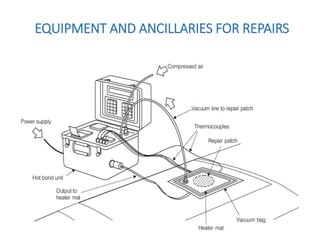
EQUIPMENT AND ANCILLARIES FOR REPAIRS
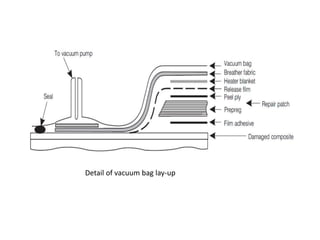
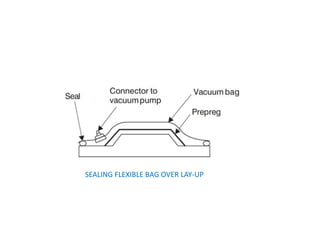
Detail of vacuum bag lay-up
SEALING FLEXIBLE BAG OVER LAY-UP
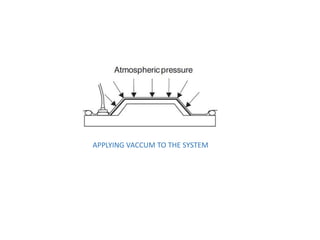
APPLYING VACCUM TO THE SYSTEM
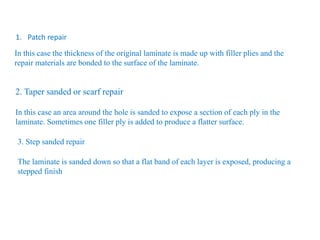
In this case the thickness of the original laminate is made up with filler plies and the
repair materials are bonded to the surface of the laminate.
1. Patch repair
2. Taper sanded or scarf repair
In this case an area around the hole is sanded to expose a section of each ply in the
laminate. Sometimes one filler ply is added to produce a flatter surface.
3. Step sanded repair
The laminate is sanded down so that a flat band of each layer is exposed, producing a
stepped finish
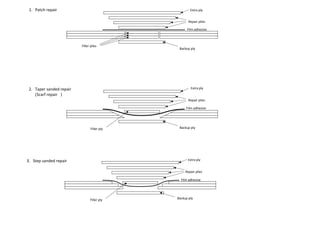
1. Patch repair Extra ply
Repair plies
Film adhesive
Filler plies
Backup ply
2. Taper sanded repair
(Scarf repair )
Extra ply
Repair plies
Film adhesive
Filler ply Backup ply
3. Step sanded repair Extra ply
Repair plies
Film adhesive
Filler ply Backup ply
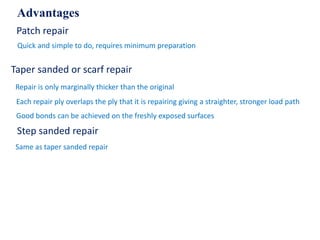
Advantages
Quick and simple to do, requires minimum preparation
Patch repair
Taper sanded or scarf repair
Repair is only marginally thicker than the original
Each repair ply overlaps the ply that it is repairing giving a straighter, stronger load path
Good bonds can be achieved on the freshly exposed surfaces
Step sanded repair
Same as taper sanded repair
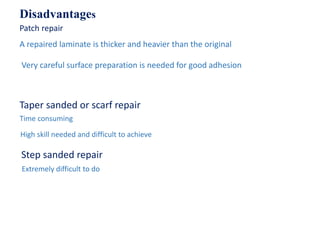
Disadvantages
Patch repair
A repaired laminate is thicker and heavier than the original
Very careful surface preparation is needed for good adhesion
Time consuming
Taper sanded or scarf repair
High skill needed and difficult to achieve
Step sanded repair
Extremely difficult to do
CONCLUSION
The repair of composite materials are done using all the
explained Techniques.
With the increasing usage of fiber-reinforced composites in
aircraft structures, it has become necessary to establish reliable
repair methods that will restore the structure’s integrity. The
purpose of this document was to investigate the effective
composite repair technique.
REFERECNCE
T. Mitrevski, I.H. Marchall, R. Thomson, R. Jones, B. Whittingham, The effect of
impactor shape on the impact response of composite laminates, Composite Structures 67
(2005) 139–148.
AC20-107B, Composite Aircraft Structures, FAA, 1984.
Keith B. Armstron, et al., Care and Repair of Advanced Composite, SAE International, 2005.
Shin-etsu Fujimoto, Hideki Sekine, Identification of crack and disband fronts in repaired
aircraft structural panels with bonded FRP composite patches, Composite Structures 77
(2007) 533–545
Standard test method for compressive residual strength properties of damaged polymer
matrix composite plates, 2005.
Baker A, Dutton S, Donald K. Composite materials for aircraft structures. American
Institute of Aeronautics and Astronautics; 2004.
Giangiacomo Minak, Daniele Ghelli, Influence of diameter and boundary conditions on
low velocity impact response of CFRP circular laminated plates, Composites Part B:
Engineering 39 (2008) 962–972.
THANK YOU

Frp composites

  • 1.
    Seminar on By AUGUSTINE DSOUZA (1MJ15MAE02) Underthe guidance of P.DINESH KUMAR Asst. Professor MVJCE
  • 2.
  • 3.
    What is CompositeMATERIAL ? • A composite material is a material made from two or more constituent materials with significantly different physical or chemical properties that, when combined, produce a material with characteristics different from the individual components. The individual components remain separate and distinct within the finished structure.
  • 4.
    APPLICATIONS OF COMPOSITEMATERIAL IN AEROPLANE
  • 5.
    INTRODUCTION • Repair methodsneed to be simple but effective in order to maintain the structural integrity and future operational effectiveness. • Common operational damages of composites are Because of Impact of Bird, Debris or Tool drop during servicing and Atmospheric Erosion due to Dust/Rain, Moisture Absorption Etc.,
  • 6.
    TYPES OF DAMAGES Allrepair types are “zone dependent “requiring aerodynamic/aero elastic considerations EROSION DAMAGE(without major fiber damage) - abrade, clean, fill and fair with suitable epoxy or polyurethane filler. MINOR SCRATHES OR DINGS AFFECTING SURFACE PLY - Abrade, to remove paint around damage down to the laminate surface, fill scratches or ding with filler paste and apply 1-layer of fine glass fabric with epoxy.
  • 7.
    DAMAGE INTO ORBEYOND OUTER PLY OF LAMINATE -Remove and replace damaged plies or apply a bonded doubler repair DAMAGE INTO SANDWICH CORE STRUCTURE -Remove and replace damaged core and structural plies in damaged skin or apply doubler DAMAGE THROUGH STRUCTURE -Remove damage through structure and repair from both sides (if accessible) using repair plies or doublers . Option : repair from one side using “no backside access” techniques
  • 8.
    Damage Evaluation • Locationof Damage • Assesment of Damaged Area • Calculation of Damage Tolerance • Residual Strength Estimation
  • 9.
  • 10.
    PATCH REPAIR –A STARTING POINT FOR THE RESEARCH
  • 11.
    REPAIR TECHNIQUES NON PATCHINGTECHNIQUES If the defects in composite structures is very small in size and magnitude i.e. a scratch or a crack within the structure then it can be resolved by Resin Infusion method of simple injecting resin over the cracked region within the structure. PATCHING TECHNIQUES If the extent of damage is severe this has to be repaired using specific techniques to retain the original strength of the structure.
  • 12.
    TYPES OF NONPATCH TECHNIQUE • FILLER OR PLOTTING REPAIR • FUSION REPAIR Filler repair It is used for minor indentations in laminates provided that there is no internal damage. Here, the defective region is filled with resin. Fusion repair It takes the advantage that thermoplastics are fusible and is consist of applying heat and pressure to the damaged region.
  • 13.
    TYPES OF PATCHINGTECHNIQUE • BONDED EXTERNAL PATCH • BONDED SCARF PATCH • BOLTED EXTERNAL PATCH BONDED EXTERNAL PATCH : • Suitable for repairs to laminates up to 16 plies thick. • Excellent restoration of mechanical properties. • Easy to implement, well suited for field application. • Minimum further damage to structure.
  • 14.
    BONDED SCARF PATCH: •Suitable only to thick laminates. • Excellent restoration of mechanical properties. • Obtrusive; requires significant material removal. • Difficult to repair, suited to depot level repair. BOLTED EXTERNAL PATCH: • Suitable only to thick laminates. • Limited restoration of mechanical properties. • Require large number of extra fasteners holes. • Easy to implement, well suited for field application
  • 15.
  • 16.
    Detail of vacuumbag lay-up
  • 17.
  • 18.
  • 23.
    In this casethe thickness of the original laminate is made up with filler plies and the repair materials are bonded to the surface of the laminate. 1. Patch repair 2. Taper sanded or scarf repair In this case an area around the hole is sanded to expose a section of each ply in the laminate. Sometimes one filler ply is added to produce a flatter surface. 3. Step sanded repair The laminate is sanded down so that a flat band of each layer is exposed, producing a stepped finish
  • 24.
    1. Patch repairExtra ply Repair plies Film adhesive Filler plies Backup ply 2. Taper sanded repair (Scarf repair ) Extra ply Repair plies Film adhesive Filler ply Backup ply 3. Step sanded repair Extra ply Repair plies Film adhesive Filler ply Backup ply
  • 25.
    Advantages Quick and simpleto do, requires minimum preparation Patch repair Taper sanded or scarf repair Repair is only marginally thicker than the original Each repair ply overlaps the ply that it is repairing giving a straighter, stronger load path Good bonds can be achieved on the freshly exposed surfaces Step sanded repair Same as taper sanded repair
  • 26.
    Disadvantages Patch repair A repairedlaminate is thicker and heavier than the original Very careful surface preparation is needed for good adhesion Time consuming Taper sanded or scarf repair High skill needed and difficult to achieve Step sanded repair Extremely difficult to do
  • 27.
    CONCLUSION The repair ofcomposite materials are done using all the explained Techniques. With the increasing usage of fiber-reinforced composites in aircraft structures, it has become necessary to establish reliable repair methods that will restore the structure’s integrity. The purpose of this document was to investigate the effective composite repair technique.
  • 28.
    REFERECNCE T. Mitrevski, I.H.Marchall, R. Thomson, R. Jones, B. Whittingham, The effect of impactor shape on the impact response of composite laminates, Composite Structures 67 (2005) 139–148. AC20-107B, Composite Aircraft Structures, FAA, 1984. Keith B. Armstron, et al., Care and Repair of Advanced Composite, SAE International, 2005. Shin-etsu Fujimoto, Hideki Sekine, Identification of crack and disband fronts in repaired aircraft structural panels with bonded FRP composite patches, Composite Structures 77 (2007) 533–545 Standard test method for compressive residual strength properties of damaged polymer matrix composite plates, 2005. Baker A, Dutton S, Donald K. Composite materials for aircraft structures. American Institute of Aeronautics and Astronautics; 2004. Giangiacomo Minak, Daniele Ghelli, Influence of diameter and boundary conditions on low velocity impact response of CFRP circular laminated plates, Composites Part B: Engineering 39 (2008) 962–972.
  • 29.