PRESENTED BY
S.SELVAPRAKASH
IMPACT STRENGTH
 Impact strength: resistance to sudden shock
or load.
 Impact strength is of importance in driving
concrete piles, in foundations for machines
exerting impulsive loading, and also when
accidental impact is possible, e.g. when
handling precast concrete members.
 There is no unique relation between impact
strength and static compressive strength.
 For this reason, impact strength has to be
assessed, usually by the ability of a concrete
specimen to withstand repeated blows and to
absorb energy.
 The number of blows which the concrete can
withstand before reaching the 'no-rebound'
condition indicates a definite state of damage.
 Generally, for a given type of aggregate, the
higher the compressive strength of the concrete
the lower the energy absorbed per blow before
cracking, but the greater the number of blows to
reach 'no-rebound'.
 Hence, the impact strength and the total
energy absorbed by the concrete increase
with its static compressive strength.
 the relation between impact strength and
compressive strength depends upon the type
of coarse aggregate but the relation depends
also on the storage condition of the concrete.
 The impact strength of water-stored concrete
is lower than when the concrete is dry.
 Thus, the compressive strength without
reference to storage conditions does not give
an adequate indication of impact strength.
 For the same compressive strength, impact
strength is greater for concrete made with
coarse aggregate of greater angularity and
surface roughness,
 a feature which suggests that impact
strength of concrete is more closely related to
its flexural strength than to the compressive
strength .
 Thus concrete made with a gravel coarse
aggregate has a low impact strength owing
to the weaker bond between mortar and
coarse aggregate.
 A smaller maximum size of aggregate
significantly improves the impact strength.
NON DESTRUCTIVE TEST
 In non destructive methods of testing , the
specimen are not loaded to failure .
Schmidt hammer
 This test is also known as the rebound
hammer, impact hammer or sclero-meter test,
and is a non-destructive method of testing
concrete.
 The test is based on the principle that the
rebound of an elastic mass depends on the
hardness of the surface against which the mass
impinges.
 REBOUND NUMBER:
 The mass rebounds from the plunger (still in
contact with the concrete surface), and
the distance travelled by the mass, expressed
as a percentage of the initial extension of the
spring, is called the rebound number; it is
indicated by a rider moving along a graduated
scale.
 The rebound number is an arbitrary measure
since it depends on the energy stored in the
given spring and on the size of the mass.
 AIM:To measure surface of the hardness
concrete.
 APPARATUS: Schmidt’s hammer test
 PROCEDURE:
 1. press the plunger against the force of the
spring.
 2. push the button the rider will held in
positions
 3. Note down the reading.
 4.The compressive strength of the concrete
can be interpolated from the chart.
 5.This shows the relationship between
compressive strength and rebound number.
CHART
Ultrasonic pulse velocity test
 The principle of this test is that the velocity of sound
in a solid material, V, is a function of the square root
of the ratio of its modulus of elasticity, E, to its
density, p
 V = f [gE/ p]^1/2
 where g is the acceleration due to gravity.
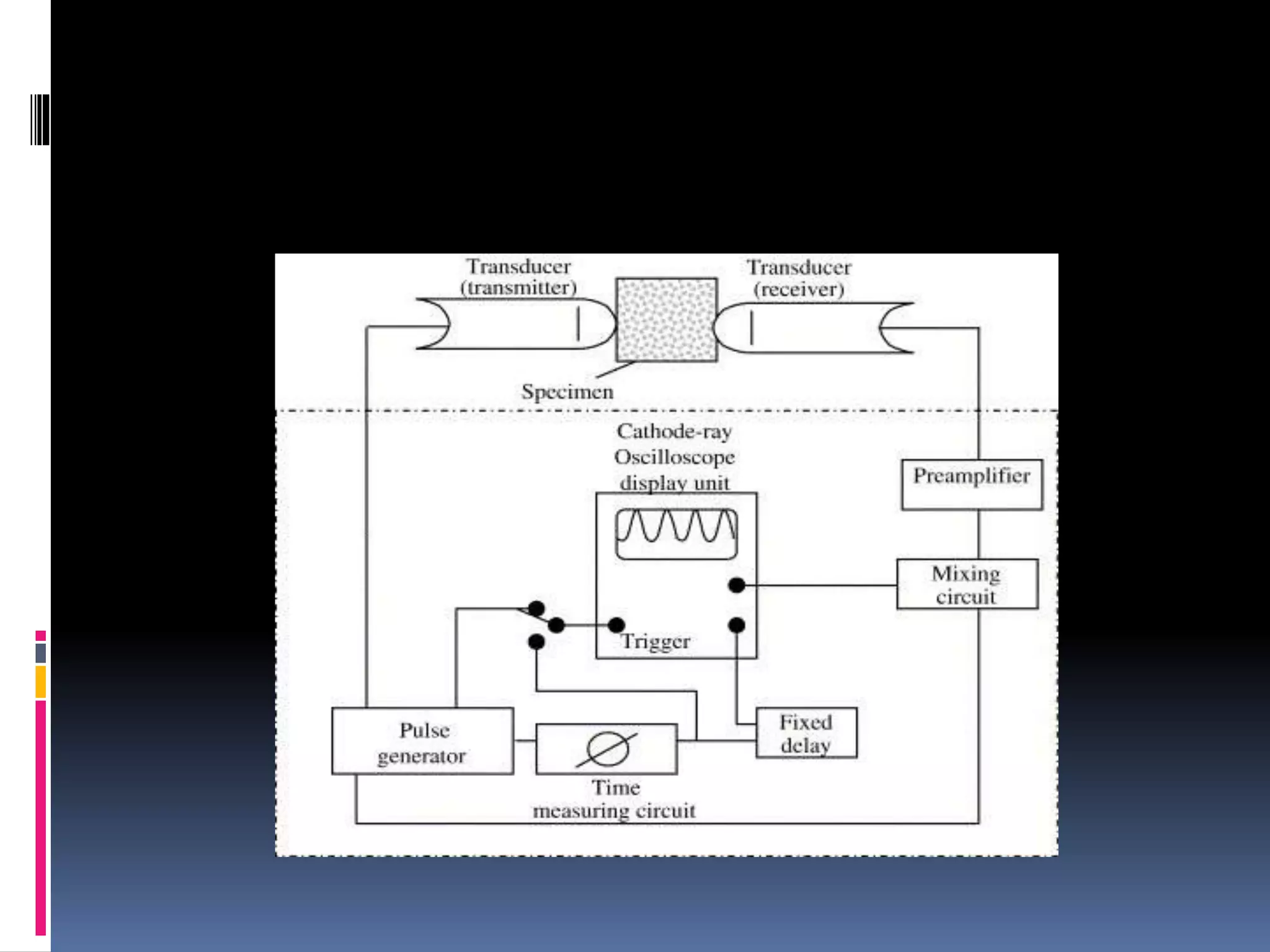
UPV APPARATUS
 The apparatus generates a pulse of vibrations
at an ultrasonic frequency
 which are transmitted by an electro-
acoustics at an ultrasonic frequency which are
transmitted by an electro-acoustic transducer
held in contact with the surface of the
concrete under test.

 After passing through the concrete, the
vibrations are received and converted to an
electrical signal by a second electro-acoustic
transducer, the signal being fed through an
amplifier to a cathode-ray oscilloscope.
 The time taken by the pulse to travel through
the concrete is measured by an electrical
timing-unit with
 an accuracy of ±0.1 microsecond and,
knowing the length of path travelled through
the concrete, the pulse velocity can be
calculated.
KINDS OF WAVES
 longitudinal waves,
 shear waves and
 surface waves.
 These three waves travel at different speeds.
The longitudinal or compression waves travel
about twice as fast as the other two types.
The shear or transverse waves are not
 so fast, the surface waves are the slowest.
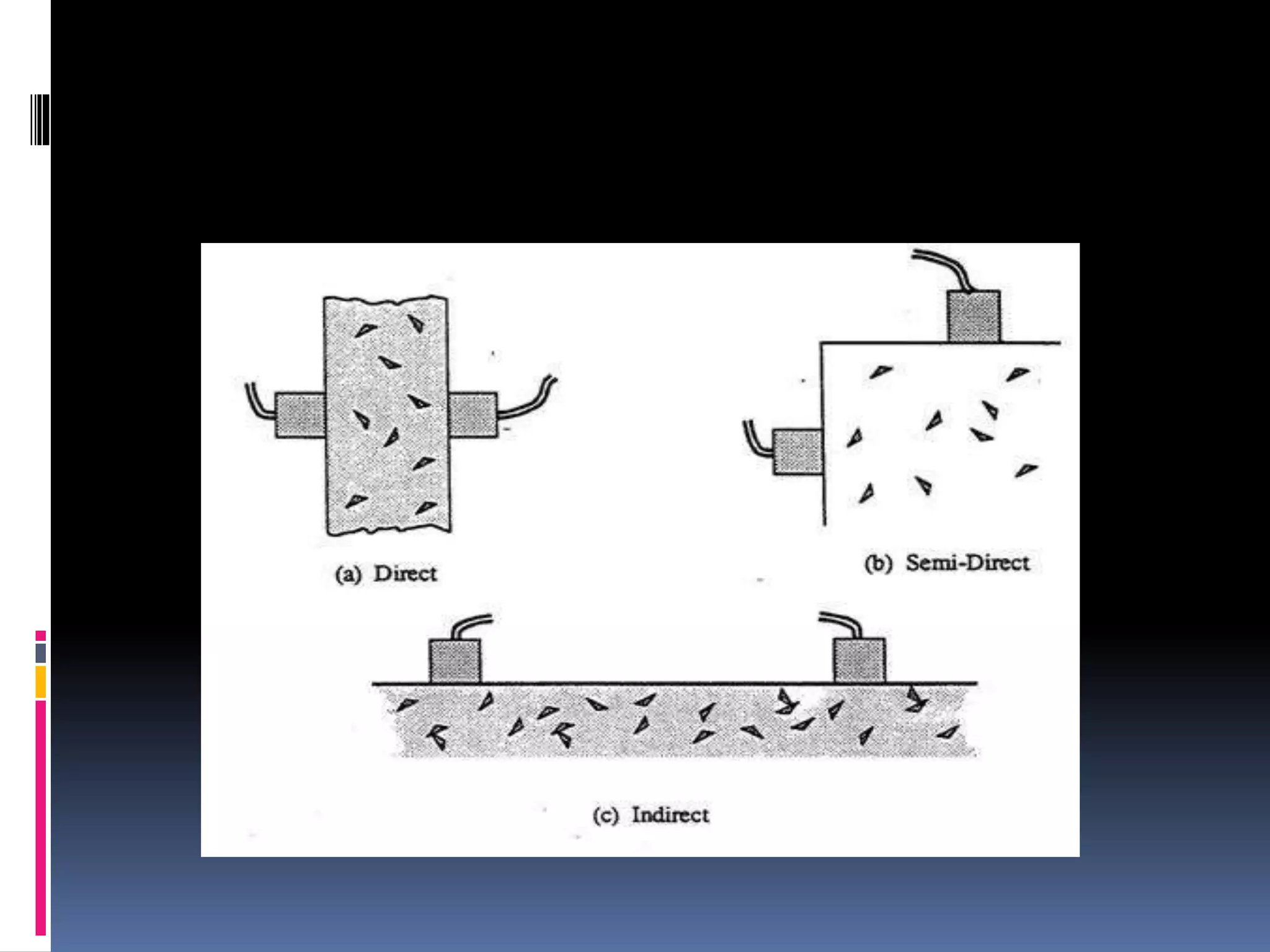
Techniques of Measuring
Pulse Velocity
 (a ) Direct transmission.
 (b) Indirect transmission.
 (c ) Surface transmission
Impact strength in concrete test

Impact strength in concrete test

  • 1.
  • 2.
     Impact strength:resistance to sudden shock or load.  Impact strength is of importance in driving concrete piles, in foundations for machines exerting impulsive loading, and also when accidental impact is possible, e.g. when handling precast concrete members.
  • 3.
     There isno unique relation between impact strength and static compressive strength.  For this reason, impact strength has to be assessed, usually by the ability of a concrete specimen to withstand repeated blows and to absorb energy.
  • 4.
     The numberof blows which the concrete can withstand before reaching the 'no-rebound' condition indicates a definite state of damage.  Generally, for a given type of aggregate, the higher the compressive strength of the concrete the lower the energy absorbed per blow before cracking, but the greater the number of blows to reach 'no-rebound'.
  • 5.
     Hence, theimpact strength and the total energy absorbed by the concrete increase with its static compressive strength.  the relation between impact strength and compressive strength depends upon the type of coarse aggregate but the relation depends also on the storage condition of the concrete.
  • 6.
     The impactstrength of water-stored concrete is lower than when the concrete is dry.  Thus, the compressive strength without reference to storage conditions does not give an adequate indication of impact strength.
  • 7.
     For thesame compressive strength, impact strength is greater for concrete made with coarse aggregate of greater angularity and surface roughness,  a feature which suggests that impact strength of concrete is more closely related to its flexural strength than to the compressive strength .
  • 8.
     Thus concretemade with a gravel coarse aggregate has a low impact strength owing to the weaker bond between mortar and coarse aggregate.  A smaller maximum size of aggregate significantly improves the impact strength.
  • 9.
    NON DESTRUCTIVE TEST In non destructive methods of testing , the specimen are not loaded to failure .
  • 10.
    Schmidt hammer  Thistest is also known as the rebound hammer, impact hammer or sclero-meter test, and is a non-destructive method of testing concrete.  The test is based on the principle that the rebound of an elastic mass depends on the hardness of the surface against which the mass impinges.
  • 11.
     REBOUND NUMBER: The mass rebounds from the plunger (still in contact with the concrete surface), and the distance travelled by the mass, expressed as a percentage of the initial extension of the spring, is called the rebound number; it is indicated by a rider moving along a graduated scale.
  • 12.
     The reboundnumber is an arbitrary measure since it depends on the energy stored in the given spring and on the size of the mass.
  • 13.
     AIM:To measuresurface of the hardness concrete.  APPARATUS: Schmidt’s hammer test  PROCEDURE:  1. press the plunger against the force of the spring.  2. push the button the rider will held in positions
  • 14.
     3. Notedown the reading.  4.The compressive strength of the concrete can be interpolated from the chart.  5.This shows the relationship between compressive strength and rebound number.
  • 16.
  • 17.
    Ultrasonic pulse velocitytest  The principle of this test is that the velocity of sound in a solid material, V, is a function of the square root of the ratio of its modulus of elasticity, E, to its density, p  V = f [gE/ p]^1/2  where g is the acceleration due to gravity.
  • 18.
  • 19.
     The apparatusgenerates a pulse of vibrations at an ultrasonic frequency  which are transmitted by an electro- acoustics at an ultrasonic frequency which are transmitted by an electro-acoustic transducer held in contact with the surface of the concrete under test. 
  • 20.
     After passingthrough the concrete, the vibrations are received and converted to an electrical signal by a second electro-acoustic transducer, the signal being fed through an amplifier to a cathode-ray oscilloscope.
  • 21.
     The timetaken by the pulse to travel through the concrete is measured by an electrical timing-unit with  an accuracy of ±0.1 microsecond and, knowing the length of path travelled through the concrete, the pulse velocity can be calculated.
  • 23.
    KINDS OF WAVES longitudinal waves,  shear waves and  surface waves.  These three waves travel at different speeds. The longitudinal or compression waves travel about twice as fast as the other two types. The shear or transverse waves are not  so fast, the surface waves are the slowest.
  • 24.
    Techniques of Measuring PulseVelocity  (a ) Direct transmission.  (b) Indirect transmission.  (c ) Surface transmission