Manufacturing That Eliminates Risk & Improves Reliability
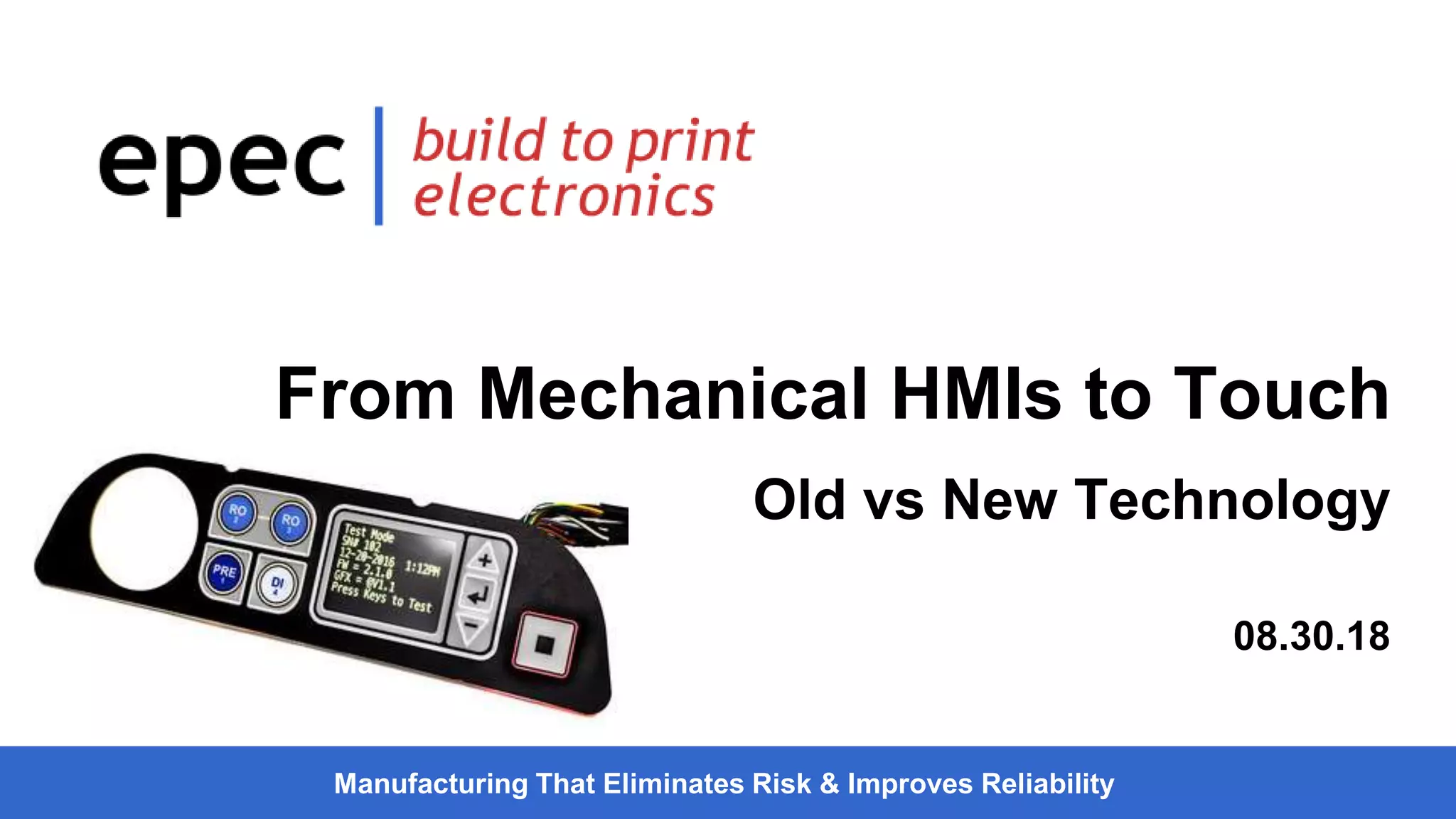
From Mechanical HMIs to Touch
Old vs New Technology
08.30.18
Manufacturing That Eliminates Risk & Improves Reliability
2
Agenda
 “Old” vs “New” Generation HMI Technologies
 When to use FPC (Polyimide)
 Capacitive Touch & Touchscreens
 Switch from Membrane Switch to Capacitive Touch
 How to Nextgen your SMART HMI Device
Manufacturing That Eliminates Risk & Improves Reliability
3
“Old” vs “New” Generation HMI Technologies
Manufacturing That Eliminates Risk & Improves Reliability
4
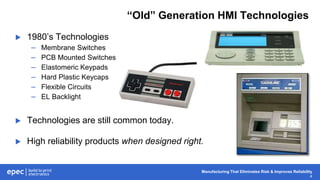
“Old” Generation HMI Technologies
 1980’s Technologies
– Membrane Switches
– PCB Mounted Switches
– Elastomeric Keypads
– Hard Plastic Keycaps
– Flexible Circuits
– EL Backlight
 Technologies are still common today.
 High reliability products when designed right.
Manufacturing That Eliminates Risk & Improves Reliability
5
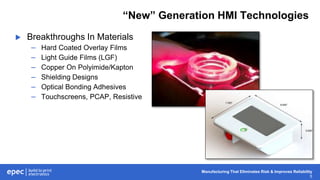
“New” Generation HMI Technologies
 Breakthroughs In Materials
– Hard Coated Overlay Films
– Light Guide Films (LGF)
– Copper On Polyimide/Kapton
– Shielding Designs
– Optical Bonding Adhesives
– Touchscreens, PCAP, Resistive
Manufacturing That Eliminates Risk & Improves Reliability
6
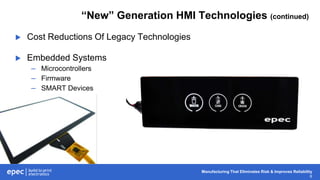
“New” Generation HMI Technologies (continued)
 Cost Reductions Of Legacy Technologies
 Embedded Systems
– Microcontrollers
– Firmware
– SMART Devices
Manufacturing That Eliminates Risk & Improves Reliability
7
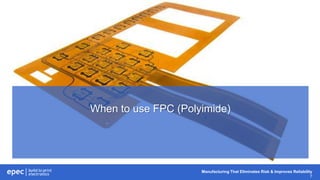
When to use FPC (Polyimide)
Manufacturing That Eliminates Risk & Improves Reliability
8
When To Use FPC (Polyimide)
 Ultra High Reliability Devices
– Circuit layout and design is vital
 Fine Trace Widths
– Footprint reduction, tail exit location
 Surface Mount Components
– Small package LEDs, ICs
 Minimal Cost Impact for Small Devices
– ~20 in2 or less
 Excellent for Capacitive Touch
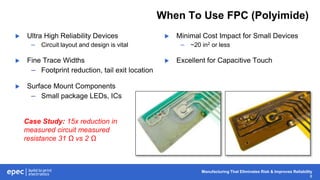
Case Study: 15x reduction in
measured circuit measured
resistance 31 Ω vs 2 Ω
Manufacturing That Eliminates Risk & Improves Reliability
9
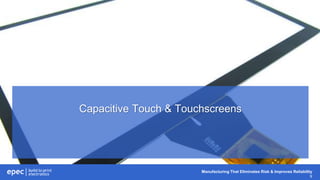
Capacitive Touch & Touchscreens
Manufacturing That Eliminates Risk & Improves Reliability
10
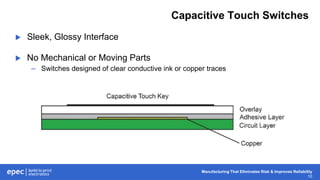
Capacitive Touch Switches
 Sleek, Glossy Interface
 No Mechanical or Moving Parts
– Switches designed of clear conductive ink or copper traces
Manufacturing That Eliminates Risk & Improves Reliability
11
Capacitive Touch Switches (continued)
 Do not behave as a normally open switch
– Must be paired with microcontroller
 Uniform backlighting options
 Digital control of switch function and sensitivity
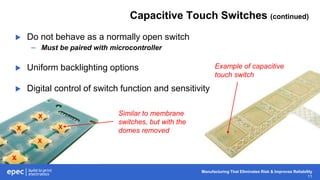
Example of capacitive
touch switch
X
X
X
X
X
Similar to membrane
switches, but with the
domes removed
Manufacturing That Eliminates Risk & Improves Reliability
12
Material Properties - Capacitive Touch
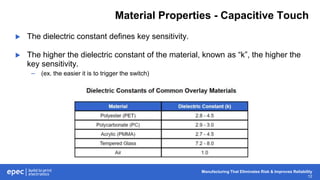
 The dielectric constant defines key sensitivity.
 The higher the dielectric constant of the material, known as “k”, the higher the
key sensitivity.
– (ex. the easier it is to trigger the switch)
Manufacturing That Eliminates Risk & Improves Reliability
13
Material Properties - Capacitive Touch (continued)
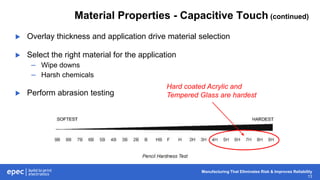
 Overlay thickness and application drive material selection
 Select the right material for the application
– Wipe downs
– Harsh chemicals
 Perform abrasion testing
Hard coated Acrylic and
Tempered Glass are hardest
Manufacturing That Eliminates Risk & Improves Reliability
14
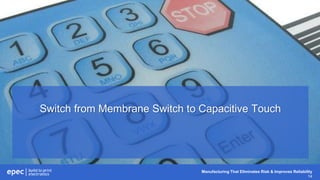
Switch from Membrane Switch to Capacitive Touch
Manufacturing That Eliminates Risk & Improves Reliability
15
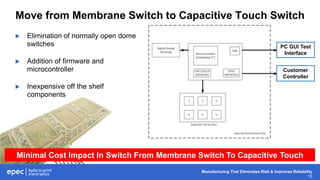
Move from Membrane Switch to Capacitive Touch Switch
 Elimination of normally open dome
switches
 Addition of firmware and
microcontroller
 Inexpensive off the shelf
components
PC GUI Test
Interface
Customer
Controller
Minimal Cost Impact In Switch From Membrane Switch To Capacitive Touch
Manufacturing That Eliminates Risk & Improves Reliability
16
Touchscreens
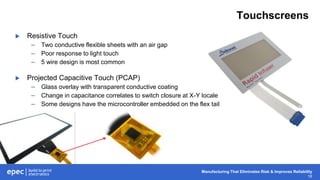
 Resistive Touch
– Two conductive flexible sheets with an air gap
– Poor response to light touch
– 5 wire design is most common
 Projected Capacitive Touch (PCAP)
– Glass overlay with transparent conductive coating
– Change in capacitance correlates to switch closure at X-Y locale
– Some designs have the microcontroller embedded on the flex tail
Manufacturing That Eliminates Risk & Improves Reliability
17
Touchscreens (continued)
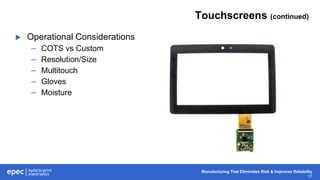
 Operational Considerations
– COTS vs Custom
– Resolution/Size
– Multitouch
– Gloves
– Moisture
Manufacturing That Eliminates Risk & Improves Reliability
18
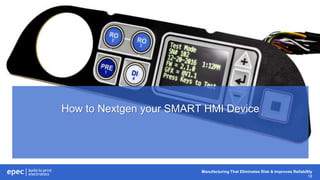
How to Nextgen your SMART HMI Device
Manufacturing That Eliminates Risk & Improves Reliability
19
How to Nextgen your SMART HMI Device
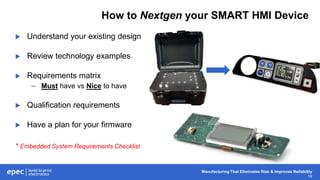
 Understand your existing design
 Review technology examples
 Requirements matrix
– Must have vs Nice to have
 Qualification requirements
 Have a plan for your firmware
* Embedded System Requirements Checklist
Manufacturing That Eliminates Risk & Improves Reliability
20
Summary
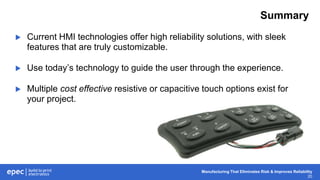
 Current HMI technologies offer high reliability solutions, with sleek
features that are truly customizable.
 Use today’s technology to guide the user through the experience.
 Multiple cost effective resistive or capacitive touch options exist for
your project.
Manufacturing That Eliminates Risk & Improves Reliability
21
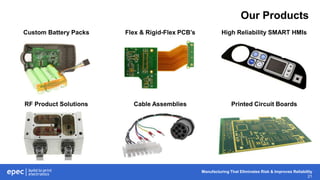
Our Products
Custom Battery Packs Flex & Rigid-Flex PCB’s High Reliability SMART HMIs
RF Product Solutions Cable Assemblies Printed Circuit Boards
Manufacturing That Eliminates Risk & Improves Reliability
22
Q&A
 Questions?
– Enter any questions you may have
in the Control Panel
– If we don’t have time to get to it, we
will reply via email
Manufacturing That Eliminates Risk & Improves Reliability
23
Thank You
Check out our website at www.epectec.com.
For more information email sales@epectec.com.
Stay Connected with Epec Engineered Technologies
Follow us on our social media sites for continuous technical updates and information:

From Mechanical HMIs to Touch: Old vs New Technology

  • 1.
    Manufacturing That EliminatesRisk & Improves Reliability From Mechanical HMIs to Touch Old vs New Technology 08.30.18
  • 2.
    Manufacturing That EliminatesRisk & Improves Reliability 2 Agenda  “Old” vs “New” Generation HMI Technologies  When to use FPC (Polyimide)  Capacitive Touch & Touchscreens  Switch from Membrane Switch to Capacitive Touch  How to Nextgen your SMART HMI Device
  • 3.
    Manufacturing That EliminatesRisk & Improves Reliability 3 “Old” vs “New” Generation HMI Technologies
  • 4.
    Manufacturing That EliminatesRisk & Improves Reliability 4 “Old” Generation HMI Technologies  1980’s Technologies – Membrane Switches – PCB Mounted Switches – Elastomeric Keypads – Hard Plastic Keycaps – Flexible Circuits – EL Backlight  Technologies are still common today.  High reliability products when designed right.
  • 5.
    Manufacturing That EliminatesRisk & Improves Reliability 5 “New” Generation HMI Technologies  Breakthroughs In Materials – Hard Coated Overlay Films – Light Guide Films (LGF) – Copper On Polyimide/Kapton – Shielding Designs – Optical Bonding Adhesives – Touchscreens, PCAP, Resistive
  • 6.
    Manufacturing That EliminatesRisk & Improves Reliability 6 “New” Generation HMI Technologies (continued)  Cost Reductions Of Legacy Technologies  Embedded Systems – Microcontrollers – Firmware – SMART Devices
  • 7.
    Manufacturing That EliminatesRisk & Improves Reliability 7 When to use FPC (Polyimide)
  • 8.
    Manufacturing That EliminatesRisk & Improves Reliability 8 When To Use FPC (Polyimide)  Ultra High Reliability Devices – Circuit layout and design is vital  Fine Trace Widths – Footprint reduction, tail exit location  Surface Mount Components – Small package LEDs, ICs  Minimal Cost Impact for Small Devices – ~20 in2 or less  Excellent for Capacitive Touch Case Study: 15x reduction in measured circuit measured resistance 31 Ω vs 2 Ω
  • 9.
    Manufacturing That EliminatesRisk & Improves Reliability 9 Capacitive Touch & Touchscreens
  • 10.
    Manufacturing That EliminatesRisk & Improves Reliability 10 Capacitive Touch Switches  Sleek, Glossy Interface  No Mechanical or Moving Parts – Switches designed of clear conductive ink or copper traces
  • 11.
    Manufacturing That EliminatesRisk & Improves Reliability 11 Capacitive Touch Switches (continued)  Do not behave as a normally open switch – Must be paired with microcontroller  Uniform backlighting options  Digital control of switch function and sensitivity Example of capacitive touch switch X X X X X Similar to membrane switches, but with the domes removed
  • 12.
    Manufacturing That EliminatesRisk & Improves Reliability 12 Material Properties - Capacitive Touch  The dielectric constant defines key sensitivity.  The higher the dielectric constant of the material, known as “k”, the higher the key sensitivity. – (ex. the easier it is to trigger the switch)
  • 13.
    Manufacturing That EliminatesRisk & Improves Reliability 13 Material Properties - Capacitive Touch (continued)  Overlay thickness and application drive material selection  Select the right material for the application – Wipe downs – Harsh chemicals  Perform abrasion testing Hard coated Acrylic and Tempered Glass are hardest
  • 14.
    Manufacturing That EliminatesRisk & Improves Reliability 14 Switch from Membrane Switch to Capacitive Touch
  • 15.
    Manufacturing That EliminatesRisk & Improves Reliability 15 Move from Membrane Switch to Capacitive Touch Switch  Elimination of normally open dome switches  Addition of firmware and microcontroller  Inexpensive off the shelf components PC GUI Test Interface Customer Controller Minimal Cost Impact In Switch From Membrane Switch To Capacitive Touch
  • 16.
    Manufacturing That EliminatesRisk & Improves Reliability 16 Touchscreens  Resistive Touch – Two conductive flexible sheets with an air gap – Poor response to light touch – 5 wire design is most common  Projected Capacitive Touch (PCAP) – Glass overlay with transparent conductive coating – Change in capacitance correlates to switch closure at X-Y locale – Some designs have the microcontroller embedded on the flex tail
  • 17.
    Manufacturing That EliminatesRisk & Improves Reliability 17 Touchscreens (continued)  Operational Considerations – COTS vs Custom – Resolution/Size – Multitouch – Gloves – Moisture
  • 18.
    Manufacturing That EliminatesRisk & Improves Reliability 18 How to Nextgen your SMART HMI Device
  • 19.
    Manufacturing That EliminatesRisk & Improves Reliability 19 How to Nextgen your SMART HMI Device  Understand your existing design  Review technology examples  Requirements matrix – Must have vs Nice to have  Qualification requirements  Have a plan for your firmware * Embedded System Requirements Checklist
  • 20.
    Manufacturing That EliminatesRisk & Improves Reliability 20 Summary  Current HMI technologies offer high reliability solutions, with sleek features that are truly customizable.  Use today’s technology to guide the user through the experience.  Multiple cost effective resistive or capacitive touch options exist for your project.
  • 21.
    Manufacturing That EliminatesRisk & Improves Reliability 21 Our Products Custom Battery Packs Flex & Rigid-Flex PCB’s High Reliability SMART HMIs RF Product Solutions Cable Assemblies Printed Circuit Boards
  • 22.
    Manufacturing That EliminatesRisk & Improves Reliability 22 Q&A  Questions? – Enter any questions you may have in the Control Panel – If we don’t have time to get to it, we will reply via email
  • 23.
    Manufacturing That EliminatesRisk & Improves Reliability 23 Thank You Check out our website at www.epectec.com. For more information email sales@epectec.com. Stay Connected with Epec Engineered Technologies Follow us on our social media sites for continuous technical updates and information: