MEP 302 MANUFACTRUING LABORATORY

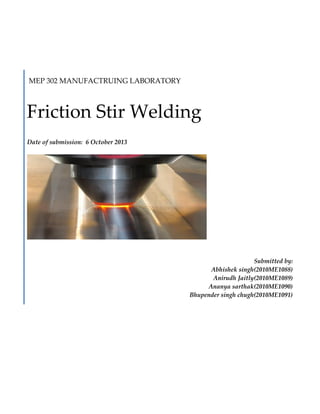
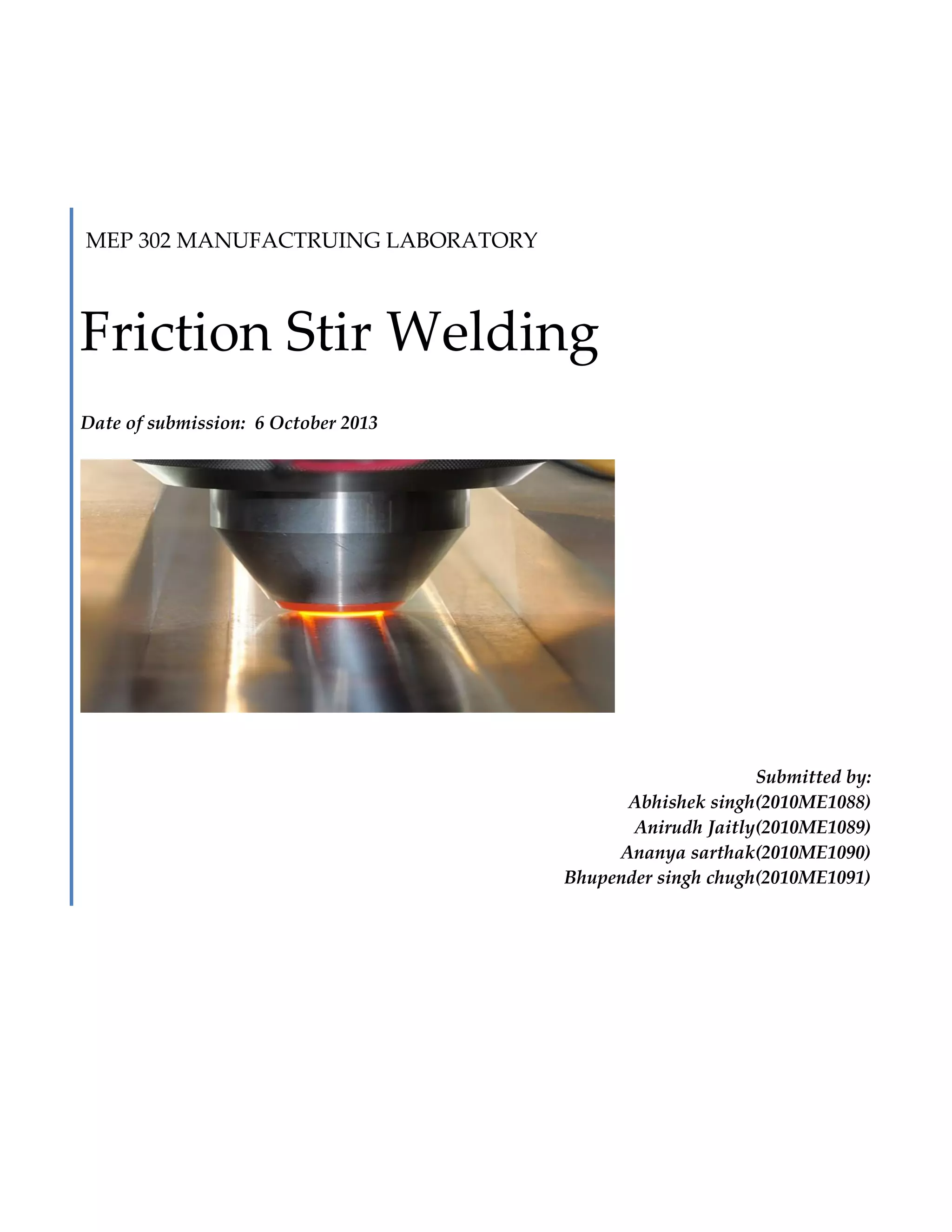
Friction Stir Welding
Date of submission: 6 October 2013

Submitted by:
Abhishek singh(2010ME1088)
Anirudh Jaitly(2010ME1089)
Ananya sarthak(2010ME1090)
Bhupender singh chugh(2010ME1091)
AIM
To observe the process of friction stir welding and to measure the hardness and tensile strength
of the welded joint.

APPARATUS REQUIRED






Aluminum Sample
Copper Sample
Fixture of Sample Holding
Friction Stir Welding Tool
CNC

THEORY
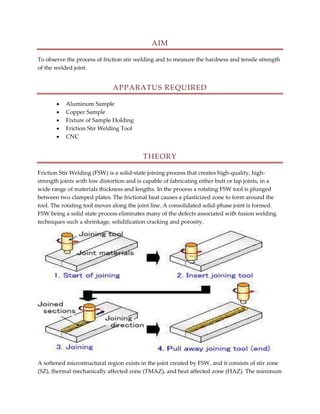
Friction Stir Welding (FSW) is a solid-state joining process that creates high-quality, highstrength joints with low distortion and is capable of fabricating either butt or lap joints, in a
wide range of materials thickness and lengths. In the process a rotating FSW tool is plunged
between two clamped plates. The frictional heat causes a plasticized zone to form around the
tool. The rotating tool moves along the joint line. A consolidated solid-phase joint is formed.
FSW being a solid state process eliminates many of the defects associated with fusion welding
techniques such a shrinkage, solidification cracking and porosity.

A softened microstructural region exists in the joint created by FSW, and it consists of stir zone
(SZ), thermal mechanically affected zone (TMAZ), and heat affected zone (HAZ). The minimum
hardness is located in TMAZ, and the average hardness value in SZ can be improved by
appropriately increasing the welding heat input. The area of complete bonding region at the
interface increases with increase in welding heat input as more interface metals get mixed. In a
certain range of FSW parameters, the tensile shear failure load of the joint increases with
increasing rotation speed, but it decreases with increasing plunge rate or decreasing shoulder
plunging depth.
Advantages of Friction Stir Welding are:














Low distortion and shrinkage, even in long welds
Excellent mechanical properties in fatigue, tensile and bend tests
No arc or fumes
No porosity
No spatter
Can operate in all positions
Energy efficient
One tool can typically be used for up to 1000m of weld length in 6XXX series aluminium
alloys
No filler wire required
No gas shielding for welding aluminum
Some tolerance to imperfect weld preparations - thin oxide layers can be accepted
No grinding, brushing or pickling required in mass production
Can weld aluminum and copper of >75mm thickness in one pass.

Friction Stir Welding finds its applications mostly in shipbuilding, aerospace industry and the
railway industry.

OBSERVATIONS
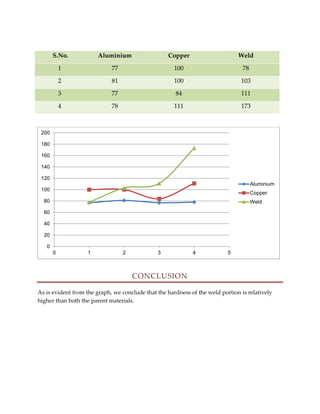
Parameters used for Friction Stir Welding were:






Tool RPM: 950 rpm
Feed Rate: 20mm/min
Tool Diameter: 4mm
Plunge Depth: 2mm
Shoulder Diameter: 18mm
S.No.

Aluminium

Copper

Weld

1

77

100

78

2

81

100

103

3

77

84

111

4

78

111

173

200
180
160
140
120
Aluminium
100

Copper

80

Weld

60
40
20
0
0

1

2

3

4

5

CONCLUSION
As is evident from the graph, we conclude that the hardness of the weld portion is relatively
higher than both the parent materials.
REFRENCES







http://www.youtube.com/watch?v=aNbQH8XBgxQ
http://www.youtube.com/watch?v=WVxFu5HR98E
http://en.wikipedia.org/wiki/Friction_stir_welding
http://www.hitachi.com/rd/portal/story/monozukuri_platform/index.html
http://www.twi.co.uk/technologies/welding-coating-and-material-processing/frictionstir-welding/
http://www.caranddriver.com/features/two-metals-enter-one-metal-leaves-the-miracleof-friction-stir-welding-tech-dept

Fsw report

  • 1.
    MEP 302 MANUFACTRUINGLABORATORY Friction Stir Welding Date of submission: 6 October 2013 Submitted by: Abhishek singh(2010ME1088) Anirudh Jaitly(2010ME1089) Ananya sarthak(2010ME1090) Bhupender singh chugh(2010ME1091)
  • 2.
    AIM To observe theprocess of friction stir welding and to measure the hardness and tensile strength of the welded joint. APPARATUS REQUIRED      Aluminum Sample Copper Sample Fixture of Sample Holding Friction Stir Welding Tool CNC THEORY Friction Stir Welding (FSW) is a solid-state joining process that creates high-quality, highstrength joints with low distortion and is capable of fabricating either butt or lap joints, in a wide range of materials thickness and lengths. In the process a rotating FSW tool is plunged between two clamped plates. The frictional heat causes a plasticized zone to form around the tool. The rotating tool moves along the joint line. A consolidated solid-phase joint is formed. FSW being a solid state process eliminates many of the defects associated with fusion welding techniques such a shrinkage, solidification cracking and porosity. A softened microstructural region exists in the joint created by FSW, and it consists of stir zone (SZ), thermal mechanically affected zone (TMAZ), and heat affected zone (HAZ). The minimum
  • 3.
    hardness is locatedin TMAZ, and the average hardness value in SZ can be improved by appropriately increasing the welding heat input. The area of complete bonding region at the interface increases with increase in welding heat input as more interface metals get mixed. In a certain range of FSW parameters, the tensile shear failure load of the joint increases with increasing rotation speed, but it decreases with increasing plunge rate or decreasing shoulder plunging depth. Advantages of Friction Stir Welding are:              Low distortion and shrinkage, even in long welds Excellent mechanical properties in fatigue, tensile and bend tests No arc or fumes No porosity No spatter Can operate in all positions Energy efficient One tool can typically be used for up to 1000m of weld length in 6XXX series aluminium alloys No filler wire required No gas shielding for welding aluminum Some tolerance to imperfect weld preparations - thin oxide layers can be accepted No grinding, brushing or pickling required in mass production Can weld aluminum and copper of >75mm thickness in one pass. Friction Stir Welding finds its applications mostly in shipbuilding, aerospace industry and the railway industry. OBSERVATIONS Parameters used for Friction Stir Welding were:      Tool RPM: 950 rpm Feed Rate: 20mm/min Tool Diameter: 4mm Plunge Depth: 2mm Shoulder Diameter: 18mm
  • 4.
    S.No. Aluminium Copper Weld 1 77 100 78 2 81 100 103 3 77 84 111 4 78 111 173 200 180 160 140 120 Aluminium 100 Copper 80 Weld 60 40 20 0 0 1 2 3 4 5 CONCLUSION As is evidentfrom the graph, we conclude that the hardness of the weld portion is relatively higher than both the parent materials.
  • 5.