Poultry Meat
Inspection
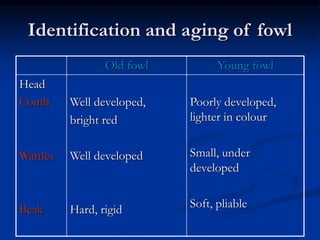
Identification and aging of fowl
Young fowl
Old fowl
Poorly developed,
lighter in colour
Small, under
developed
Soft, pliable
Well developed,
bright red
Well developed
Hard, rigid
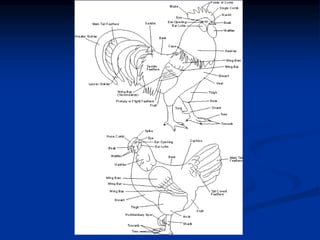
Head
Comb
Wattles
Beak
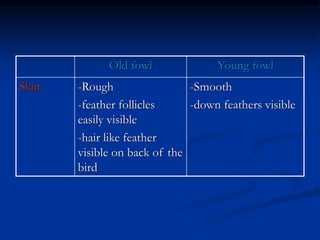
Young fowl
Old fowl
-Smooth
-down feathers visible
-Rough
-feather follicles
easily visible
-hair like feather
visible on back of the
bird
Skin
Young fowl
Old fowl
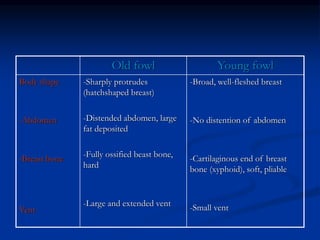
-Broad, well-fleshed breast
-No distention of abdomen
-Cartilaginous end of breast
bone (xyphoid), soft, pliable
-Small vent
-Sharply protrudes
(hatchshaped breast)
-Distended abdomen, large
fat deposited
-Fully ossified beast bone,
hard
-Large and extended vent
Body shape
-Abdomen
-Breast bone
Vent
Young fowl
Old fowl
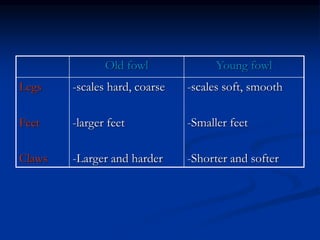
-scales soft, smooth
-Smaller feet
-Shorter and softer
-scales hard, coarse
-larger feet
-Larger and harder
Legs
Feet
Claws
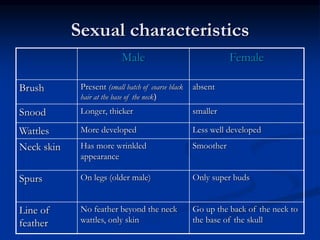
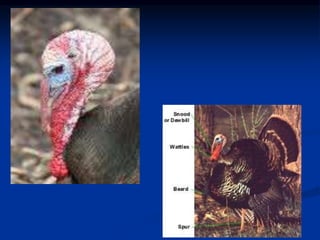
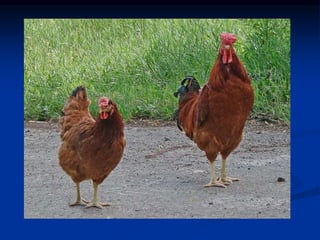
Sexual characteristics
Female
Male
absent
Present (small batch of coarse black
hair at the base of the neck(
Brush
smaller
Longer, thicker
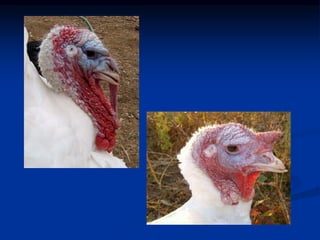
Snood
Less well developed
More developed
Wattles
Smoother
Has more wrinkled
appearance
Neck skin
Only super buds
On legs (older male)
Spurs
Go up the back of the neck to
the base of the skull
No feather beyond the neck
wattles, only skin
Line of
feather
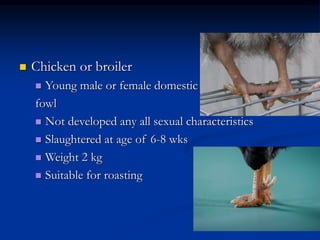
 Chicken or broiler
 Young male or female domestic
fowl
 Not developed any all sexual characteristics
 Slaughtered at age of 6-8 wks
 Weight 2 kg
 Suitable for roasting
 Roaster
 Older male chicken, up to 8 month
 Weight 2.7 kg
 Broiler breeder or cob
 Female, sexually mature
 Laid fertilized eggs
 18 month age
 Weight 2.7 kg
 Suitable for roasting, boiling
 Hen or boiling fowl
 Egg-laying female
 18 month age, completed at least one laying season
 Not tender enough to roast
 Suitable for boiling
 Cockerel
 Male, sexually mature
 Not used for human consumption
 Pullet
 Young hen
Post mortem inspection
 1- Whole carcase inspection
 After defeathering
 Lesions like bad bleeding, emaciated, septic wounds should
be removed from the line
 2- Evisceration inspection
 Various techniques of inspection
 Within limited time frame (1200 birds/hr)
 Viscera attached (intestine, gizzard, liver, spleen, heart, lungs, ovary)
 Body cavity, legs carcase also examined , not only viscera
 3- Final inspection
 After removal of viscera, and washing of body
cavity
 Done by QC officer
Report on poultry carcase examination
 I- Definition
 II- Findings
 1- Organoleptic exam
 Muscles (colour, consistency)
 Fat (colour, odour, consistency)
 2- Chemical exam
 pH
 Eber’s test
 Lead acetate test
 3-Bacteriological exam
 4- Boiling and roasting
 III - Diagnosis
 IV - Judgment
Inspection of fishes
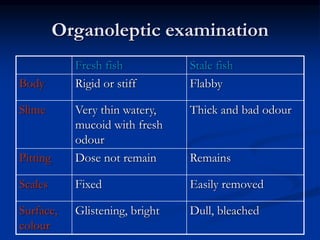
Organoleptic examination
Stale fish
Fresh fish
Flabby
Rigid or stiff
Body
Thick and bad odour
Very thin watery,
mucoid with fresh
odour
Slime
Remains
Dose not remain
Pitting
Easily removed
Fixed
Scales
Dull, bleached
Glistening, bright
Surface,
colour
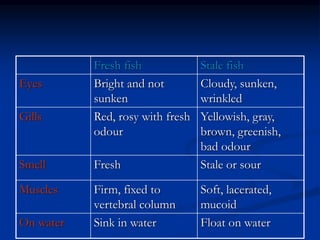
Stale fish
Fresh fish
Cloudy, sunken,
wrinkled
Bright and not
sunken
Eyes
Yellowish, gray,
brown, greenish,
bad odour
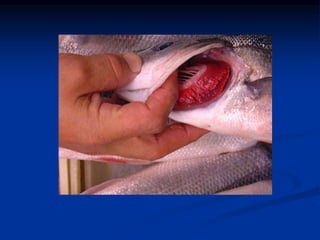
Red, rosy with fresh
odour
Gills
Stale or sour
Fresh
Smell
Soft, lacerated,
mucoid
Firm, fixed to
vertebral column
Muscles
Float on water
Sink in water
On water
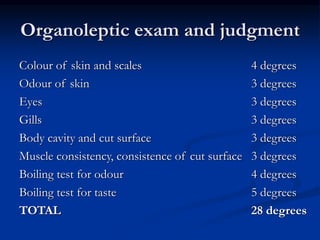
Organoleptic exam and judgment
4 degrees
Colour of skin and scales
3 degrees
Odour of skin
3 degrees
Eyes
3 degrees
Gills
3 degrees
Body cavity and cut surface
3 degrees
Muscle consistency, consistence of cut surface
4 degrees
Boiling test for odour
5 degrees
Boiling test for taste
28 degrees
TOTAL
 Result
 e.g total degrees = 18
 Percentage of the degrees = = 64.3 degrees
 Judgment
 50 degree or more-----------------Fit for consumption
 25 – less 50 degree----------------On border line
 Less than 25 degree---------------Unfit for consumption
18 X 100
28
Inspection of frozen fish
 Defrosting frozen fish
 For canning
 Rapid thawing is better to avoid exposure to high temp
 For consumption
 Slow thawing in current water
Microbiological examination of fish,
shellfish, their products
 Sampling
 Packaged fish
 Minimum 5 retail packages (minimum 200g each)
 bulk fish
 Number of fish to give same total weight as packaged fish
 Canned fish (sample numbers depends on can size and
cases number)
Minimum number of samples
Can size, case numbers
- 24 cans
- 48 cans, 1 can/case
- 72 cans, 1 can/case
108mm diameter X 123.8mm height
-small lots
-up to 1000 cases
-up to 1001 to 3600 cases
- 24 cans, 1 can/case
- 30 cans, 1 can/case
- 36 cans, 1 can/case
Larger cans
-up to 600 cases
-up to 601 to 900 cases
-up to 901 to 1300 cases
 Samples transportation and storage
 Investigated within 6 hours after collection (up to 24
hrs)
 Over 24 hrs should not be used for microbiological
exam
 Sample data
 Date, time and place of collection
 Area from which fish were harvested
 Time of harvesting
 Storage condition between harvesting and collection
 Sample preparation
 Fish
 Remove scales, fins, sterilize the surface with alcohol and
flame
 5 gm muscle above lateral line removed under a septic
condition to sterile flask containing 45 ml saline, peptone
water, mixing, allow to stand for 15 min.
 Prepare 10 fold serial dilution up to 10-6
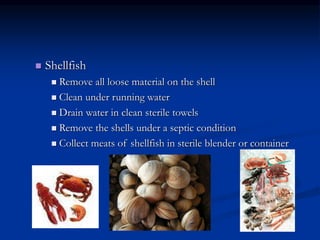
 Shellfish
 Remove all loose material on the shell
 Clean under running water
 Drain water in clean sterile towels
 Remove the shells under a septic condition
 Collect meats of shellfish in sterile blender or container
Microbial investigation
 A- Direct smear
 From skin and muscle
 Stained with methylene blue, count number of
bacteria
 Judgment
 1-3 m.os/field +
 4-10 m.os/field ++
 11-40 m.os/field +++
 More than 40 m.os ++++ (bad quality)
 B- Enumeration and isolation of spoilage and
pathogenic microorganisms
 Total bacterial count
 Coliforms, faecal coliforms counts (MPN)
 Isolation and identification of E. coli, Aeromonase,
Vibrio, Salmonellae
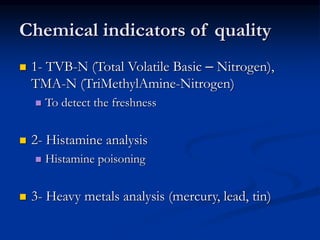
Chemical indicators of quality
 1- TVB-N (Total Volatile Basic – Nitrogen),
TMA-N (TriMethylAmine-Nitrogen)
 To detect the freshness
 2- Histamine analysis
 Histamine poisoning
 3- Heavy metals analysis (mercury, lead, tin)
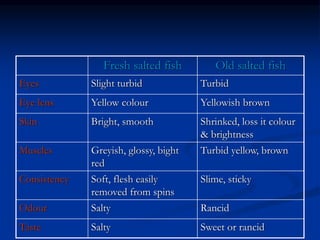
Inspection of
salted fish
Old salted fish
Fresh salted fish
Turbid
Slight turbid
Eyes
Yellowish brown
Yellow colour
Eye lens
Shrinked, loss it colour
& brightness
Bright, smooth
Skin
Turbid yellow, brown
Greyish, glossy, bight
red
Muscles
Slime, sticky
Soft, flesh easily
removed from spins
Consistency
Rancid
Salty
Odour
Sweet or rancid
Salty
Taste
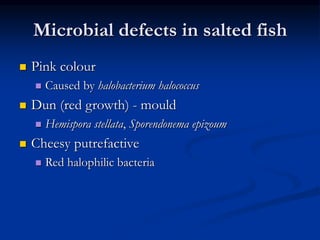
Microbial defects in salted fish
 Pink colour
 Caused by halobacterium halococcus
 Dun (red growth) - mould
 Hemispora stellata, Sporendonema epizoum
 Cheesy putrefactive
 Red halophilic bacteria
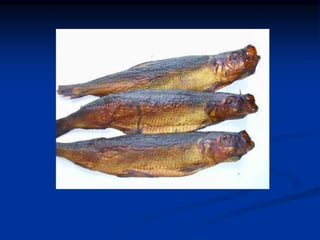
Inspection of
smoked fish
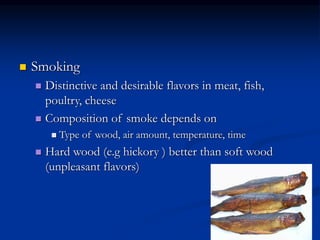
 Smoking
 Distinctive and desirable flavors in meat, fish,
poultry, cheese
 Composition of smoke depends on
 Type of wood, air amount, temperature, time
 Hard wood (e.g hickory ) better than soft wood
(unpleasant flavors)
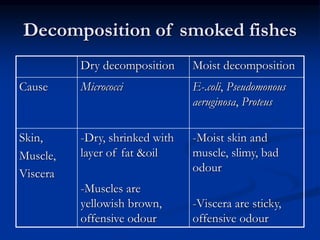
Decomposition of smoked fishes
Moist decomposition
Dry decomposition
E-.coli, Pseudomonous
aeruginosa, Proteus
Micrococci
Cause
-Moist skin and
muscle, slimy, bad
odour
-Viscera are sticky,
offensive odour
-Dry, shrinked with
layer of fat &oil
-Muscles are
yellowish brown,
offensive odour
Skin,
Muscle,
Viscera
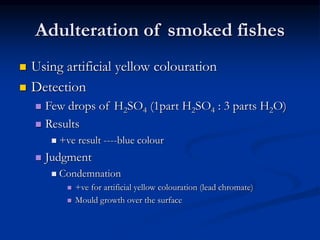
Adulteration of smoked fishes
 Using artificial yellow colouration
 Detection
 Few drops of H2SO4 (1part H2SO4 : 3 parts H2O)
 Results
 +ve result ----blue colour
 Judgment
 Condemnation
 +ve for artificial yellow colouration (lead chromate)
 Mould growth over the surface
Inspection of Caviar
Definitions
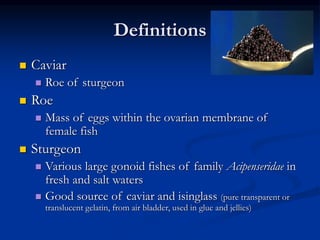
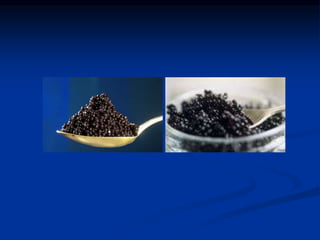
 Caviar
 Roe of sturgeon
 Roe
 Mass of eggs within the ovarian membrane of
female fish
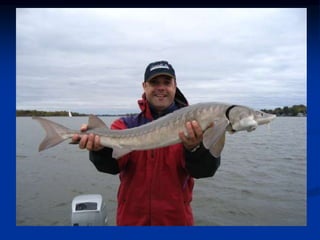
 Sturgeon
 Various large gonoid fishes of family Acipenseridae in
fresh and salt waters
 Good source of caviar and isinglass (pure transparent or
translucent gelatin, from air bladder, used in glue and jellies)
 Types of caviar
 1-Caviar from Caspian sturgeon (authentic)
 Beluga, Osetra, Sevruga)
 2-American domestic caviar
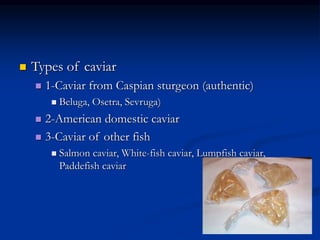
 3-Caviar of other fish
 Salmon caviar, White-fish caviar, Lumpfish caviar,
Paddefish caviar
 Composition of salmon caviar
 47 vitamins & minerals
 68 gram fat/pound (25% cholesterol, 75% lecithin)
 74 calories/pound
 Storage
 Stored at (-2) – (-10) °C
 Stored for up to 1 year
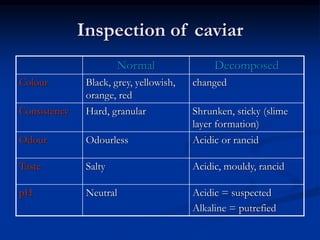
Inspection of caviar
Decomposed
Normal
changed
Black, grey, yellowish,
orange, red
Colour
Shrunken, sticky (slime
layer formation)
Hard, granular
Consistency
Acidic or rancid
Odourless
Odour
Acidic, mouldy, rancid
Salty
Taste
Acidic = suspected
Alkaline = putrefied
Neutral
pH
Lab investigation
 1- Microbiological tests
 Examined for spoilage and pathogenic bacteria
 2- Chemical tests
 pH, H2S, Amonia, free fatty acids
Poultry & fish inspection           .ppt

Poultry & fish inspection .ppt

  • 1.
  • 2.
    Identification and agingof fowl Young fowl Old fowl Poorly developed, lighter in colour Small, under developed Soft, pliable Well developed, bright red Well developed Hard, rigid Head Comb Wattles Beak
  • 3.
    Young fowl Old fowl -Smooth -downfeathers visible -Rough -feather follicles easily visible -hair like feather visible on back of the bird Skin
  • 4.
    Young fowl Old fowl -Broad,well-fleshed breast -No distention of abdomen -Cartilaginous end of breast bone (xyphoid), soft, pliable -Small vent -Sharply protrudes (hatchshaped breast) -Distended abdomen, large fat deposited -Fully ossified beast bone, hard -Large and extended vent Body shape -Abdomen -Breast bone Vent
  • 5.
    Young fowl Old fowl -scalessoft, smooth -Smaller feet -Shorter and softer -scales hard, coarse -larger feet -Larger and harder Legs Feet Claws
  • 6.
    Sexual characteristics Female Male absent Present (smallbatch of coarse black hair at the base of the neck( Brush smaller Longer, thicker Snood Less well developed More developed Wattles Smoother Has more wrinkled appearance Neck skin Only super buds On legs (older male) Spurs Go up the back of the neck to the base of the skull No feather beyond the neck wattles, only skin Line of feather
  • 12.
     Chicken orbroiler  Young male or female domestic fowl  Not developed any all sexual characteristics  Slaughtered at age of 6-8 wks  Weight 2 kg  Suitable for roasting
  • 13.
     Roaster  Oldermale chicken, up to 8 month  Weight 2.7 kg  Broiler breeder or cob  Female, sexually mature  Laid fertilized eggs  18 month age  Weight 2.7 kg  Suitable for roasting, boiling
  • 14.
     Hen orboiling fowl  Egg-laying female  18 month age, completed at least one laying season  Not tender enough to roast  Suitable for boiling
  • 15.
     Cockerel  Male,sexually mature  Not used for human consumption  Pullet  Young hen
  • 16.
    Post mortem inspection 1- Whole carcase inspection  After defeathering  Lesions like bad bleeding, emaciated, septic wounds should be removed from the line  2- Evisceration inspection  Various techniques of inspection  Within limited time frame (1200 birds/hr)  Viscera attached (intestine, gizzard, liver, spleen, heart, lungs, ovary)  Body cavity, legs carcase also examined , not only viscera
  • 17.
     3- Finalinspection  After removal of viscera, and washing of body cavity  Done by QC officer
  • 18.
    Report on poultrycarcase examination  I- Definition  II- Findings  1- Organoleptic exam  Muscles (colour, consistency)  Fat (colour, odour, consistency)  2- Chemical exam  pH  Eber’s test  Lead acetate test  3-Bacteriological exam  4- Boiling and roasting  III - Diagnosis  IV - Judgment
  • 19.
  • 20.
    Organoleptic examination Stale fish Freshfish Flabby Rigid or stiff Body Thick and bad odour Very thin watery, mucoid with fresh odour Slime Remains Dose not remain Pitting Easily removed Fixed Scales Dull, bleached Glistening, bright Surface, colour
  • 21.
    Stale fish Fresh fish Cloudy,sunken, wrinkled Bright and not sunken Eyes Yellowish, gray, brown, greenish, bad odour Red, rosy with fresh odour Gills Stale or sour Fresh Smell Soft, lacerated, mucoid Firm, fixed to vertebral column Muscles Float on water Sink in water On water
  • 23.
    Organoleptic exam andjudgment 4 degrees Colour of skin and scales 3 degrees Odour of skin 3 degrees Eyes 3 degrees Gills 3 degrees Body cavity and cut surface 3 degrees Muscle consistency, consistence of cut surface 4 degrees Boiling test for odour 5 degrees Boiling test for taste 28 degrees TOTAL
  • 24.
     Result  e.gtotal degrees = 18  Percentage of the degrees = = 64.3 degrees  Judgment  50 degree or more-----------------Fit for consumption  25 – less 50 degree----------------On border line  Less than 25 degree---------------Unfit for consumption 18 X 100 28
  • 25.
    Inspection of frozenfish  Defrosting frozen fish  For canning  Rapid thawing is better to avoid exposure to high temp  For consumption  Slow thawing in current water
  • 26.
    Microbiological examination offish, shellfish, their products  Sampling  Packaged fish  Minimum 5 retail packages (minimum 200g each)  bulk fish  Number of fish to give same total weight as packaged fish  Canned fish (sample numbers depends on can size and cases number)
  • 27.
    Minimum number ofsamples Can size, case numbers - 24 cans - 48 cans, 1 can/case - 72 cans, 1 can/case 108mm diameter X 123.8mm height -small lots -up to 1000 cases -up to 1001 to 3600 cases - 24 cans, 1 can/case - 30 cans, 1 can/case - 36 cans, 1 can/case Larger cans -up to 600 cases -up to 601 to 900 cases -up to 901 to 1300 cases
  • 28.
     Samples transportationand storage  Investigated within 6 hours after collection (up to 24 hrs)  Over 24 hrs should not be used for microbiological exam  Sample data  Date, time and place of collection  Area from which fish were harvested  Time of harvesting  Storage condition between harvesting and collection
  • 29.
     Sample preparation Fish  Remove scales, fins, sterilize the surface with alcohol and flame  5 gm muscle above lateral line removed under a septic condition to sterile flask containing 45 ml saline, peptone water, mixing, allow to stand for 15 min.  Prepare 10 fold serial dilution up to 10-6
  • 30.
     Shellfish  Removeall loose material on the shell  Clean under running water  Drain water in clean sterile towels  Remove the shells under a septic condition  Collect meats of shellfish in sterile blender or container
  • 33.
    Microbial investigation  A-Direct smear  From skin and muscle  Stained with methylene blue, count number of bacteria  Judgment  1-3 m.os/field +  4-10 m.os/field ++  11-40 m.os/field +++  More than 40 m.os ++++ (bad quality)
  • 34.
     B- Enumerationand isolation of spoilage and pathogenic microorganisms  Total bacterial count  Coliforms, faecal coliforms counts (MPN)  Isolation and identification of E. coli, Aeromonase, Vibrio, Salmonellae
  • 35.
    Chemical indicators ofquality  1- TVB-N (Total Volatile Basic – Nitrogen), TMA-N (TriMethylAmine-Nitrogen)  To detect the freshness  2- Histamine analysis  Histamine poisoning  3- Heavy metals analysis (mercury, lead, tin)
  • 36.
  • 37.
    Old salted fish Freshsalted fish Turbid Slight turbid Eyes Yellowish brown Yellow colour Eye lens Shrinked, loss it colour & brightness Bright, smooth Skin Turbid yellow, brown Greyish, glossy, bight red Muscles Slime, sticky Soft, flesh easily removed from spins Consistency Rancid Salty Odour Sweet or rancid Salty Taste
  • 38.
    Microbial defects insalted fish  Pink colour  Caused by halobacterium halococcus  Dun (red growth) - mould  Hemispora stellata, Sporendonema epizoum  Cheesy putrefactive  Red halophilic bacteria
  • 39.
  • 40.
     Smoking  Distinctiveand desirable flavors in meat, fish, poultry, cheese  Composition of smoke depends on  Type of wood, air amount, temperature, time  Hard wood (e.g hickory ) better than soft wood (unpleasant flavors)
  • 41.
    Decomposition of smokedfishes Moist decomposition Dry decomposition E-.coli, Pseudomonous aeruginosa, Proteus Micrococci Cause -Moist skin and muscle, slimy, bad odour -Viscera are sticky, offensive odour -Dry, shrinked with layer of fat &oil -Muscles are yellowish brown, offensive odour Skin, Muscle, Viscera
  • 42.
    Adulteration of smokedfishes  Using artificial yellow colouration  Detection  Few drops of H2SO4 (1part H2SO4 : 3 parts H2O)  Results  +ve result ----blue colour  Judgment  Condemnation  +ve for artificial yellow colouration (lead chromate)  Mould growth over the surface
  • 44.
  • 45.
    Definitions  Caviar  Roeof sturgeon  Roe  Mass of eggs within the ovarian membrane of female fish  Sturgeon  Various large gonoid fishes of family Acipenseridae in fresh and salt waters  Good source of caviar and isinglass (pure transparent or translucent gelatin, from air bladder, used in glue and jellies)
  • 46.
     Types ofcaviar  1-Caviar from Caspian sturgeon (authentic)  Beluga, Osetra, Sevruga)  2-American domestic caviar  3-Caviar of other fish  Salmon caviar, White-fish caviar, Lumpfish caviar, Paddefish caviar
  • 47.
     Composition ofsalmon caviar  47 vitamins & minerals  68 gram fat/pound (25% cholesterol, 75% lecithin)  74 calories/pound  Storage  Stored at (-2) – (-10) °C  Stored for up to 1 year
  • 48.
    Inspection of caviar Decomposed Normal changed Black,grey, yellowish, orange, red Colour Shrunken, sticky (slime layer formation) Hard, granular Consistency Acidic or rancid Odourless Odour Acidic, mouldy, rancid Salty Taste Acidic = suspected Alkaline = putrefied Neutral pH
  • 49.
    Lab investigation  1-Microbiological tests  Examined for spoilage and pathogenic bacteria  2- Chemical tests  pH, H2S, Amonia, free fatty acids