•Diagramming the Data
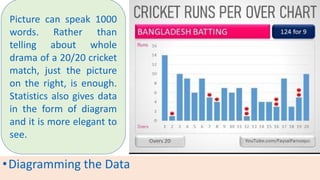
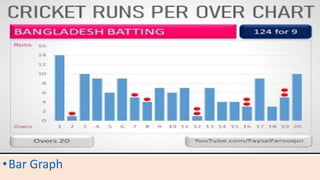
Picture can speak 1000
words. Rather than
telling about whole
drama of a 20/20 cricket
match, just the picture
on the right, is enough.
Statistics also gives data
in the form of diagram
and it is more elegant to
see.
•Diagrammatisation of Data
Types of Diagram
Pie diagram
Bar graph
Frequency Polygon
Histogram
Cumulative frequency curve
Cumulative frequency percentage curve
•Pie Diagram
Pie diagram is in the form of circle,
hence it is also called as circle
diagram. It can be fragmented in to
different proportions, which
represents the data.
In English, the word pie means a type
of food made with meat, vegetables
or fruit covered in pastry and baked.
•Charting a Pie
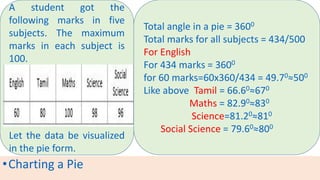
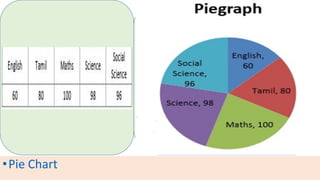
A student got the
following marks in five
subjects. The maximum
marks in each subject is
100.
Let the data be visualized
in the pie form.
Total angle in a pie = 3600
Total marks for all subjects = 434/500
For English
For 434 marks = 3600
for 60 marks=60x360/434 = 49.70≈500
Like above Tamil = 66.60≈670
Maths = 82.90≈830
Science=81.20≈810
Social Science = 79.60≈800
•Pie Chart
isualized in the pie form.
•Assignment
Draw a pie chart manually having your own X standard marks.
•Bar Graph
•Diagrammatisation of Data
Types of Diagram
Pie diagram
Bar graph
Frequency curve
Histogram
Cumulative frequency curve
Cumulative frequency percentage curve
•Bar Graph
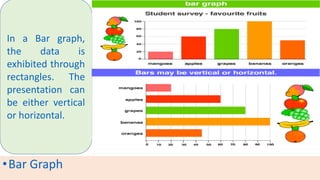
In a Bar graph,
the data is
exhibited through
rectangles. The
presentation can
be either vertical
or horizontal.
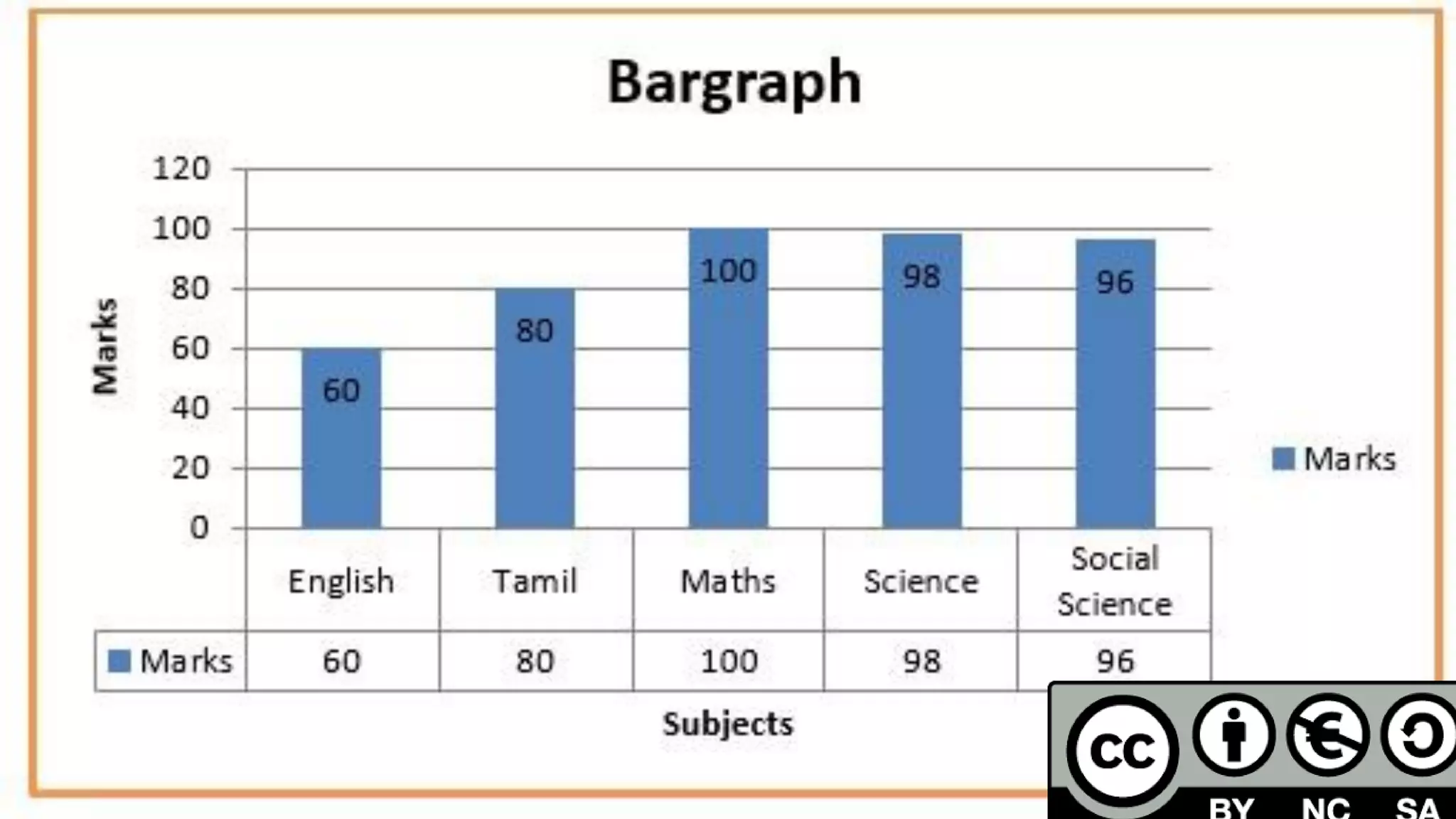
•Charting a Bar Graph
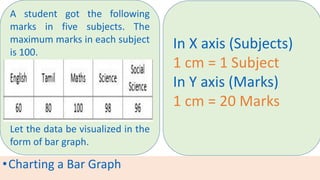
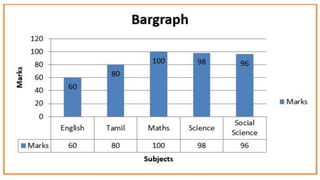
A student got the following
marks in five subjects. The
maximum marks in each subject
is 100.
Let the data be visualized in the
form of bar graph.
In X axis (Subjects)
1 cm = 1 Subject
In Y axis (Marks)
1 cm = 20 Marks
•Assignment
Draw a Bar Graph manually having your own X standard marks. Draw
in a piece of graph sheet and paste it in your assignment.
•Frequency Polygon
Types of Diagram
Pie diagram
Bar graph
Frequency Polygon
Histogram
Cumulative frequency curve
Cumulative frequency percentage curve
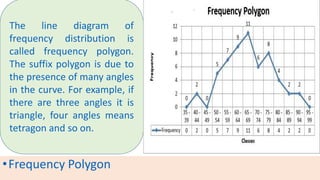
•Frequency Polygon
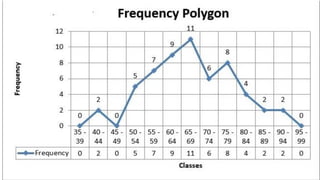
The line diagram of
frequency distribution is
called frequency polygon.
The suffix polygon is due to
the presence of many angles
in the curve. For example, if
there are three angles it is
triangle, four angles means
tetragon and so on.
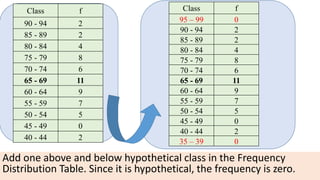
Add one above and below hypothetical class in the Frequency
Distribution Table. Since it is hypothetical, the frequency is zero.
Class f
90 - 94 2
85 - 89 2
80 - 84 4
75 - 79 8
70 - 74 6
65 - 69 11
60 - 64 9
55 - 59 7
50 - 54 5
45 - 49 0
40 - 44 2
Class f
95 – 99 0
90 - 94 2
85 - 89 2
80 - 84 4
75 - 79 8
70 - 74 6
65 - 69 11
60 - 64 9
55 - 59 7
50 - 54 5
45 - 49 0
40 - 44 2
35 – 39 0
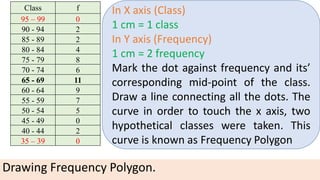
Drawing Frequency Polygon.
In X axis (Class)
1 cm = 1 class
In Y axis (Frequency)
1 cm = 2 frequency
Mark the dot against frequency and its’
corresponding mid-point of the class.
Draw a line connecting all the dots. The
curve in order to touch the x axis, two
hypothetical classes were taken. This
curve is known as Frequency Polygon
Class f
95 – 99 0
90 - 94 2
85 - 89 2
80 - 84 4
75 - 79 8
70 - 74 6
65 - 69 11
60 - 64 9
55 - 59 7
50 - 54 5
45 - 49 0
40 - 44 2
35 – 39 0
•Assignment
Draw a frequency polygon manually having the data of your
frequency distribution table drawn before. Draw frequency polygon
in a piece of graph sheet and paste it in your assignment.
•Frequency Polygon
Types of Diagram
Pie diagram
Bar graph
Frequency Polygon
Histogram
Cumulative frequency curve
Cumulative frequency percentage curve
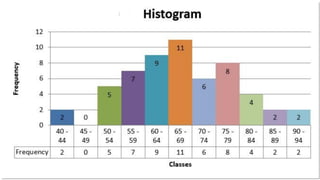
•Histogram
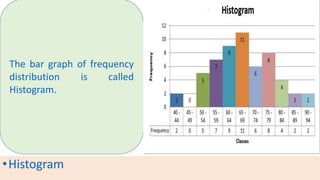
The bar graph of frequency
distribution is called
Histogram.
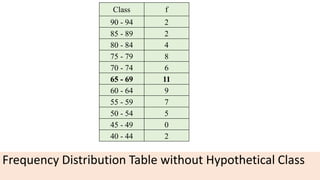
Frequency Distribution Table without Hypothetical Class
Class f
90 - 94 2
85 - 89 2
80 - 84 4
75 - 79 8
70 - 74 6
65 - 69 11
60 - 64 9
55 - 59 7
50 - 54 5
45 - 49 0
40 - 44 2
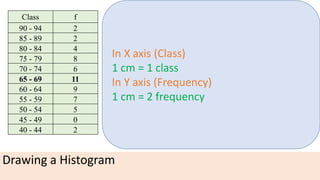
Drawing a Histogram
In X axis (Class)
1 cm = 1 class
In Y axis (Frequency)
1 cm = 2 frequency
Class f
90 - 94 2
85 - 89 2
80 - 84 4
75 - 79 8
70 - 74 6
65 - 69 11
60 - 64 9
55 - 59 7
50 - 54 5
45 - 49 0
40 - 44 2
Drawing a Histogram
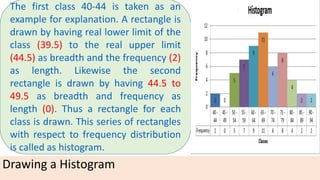
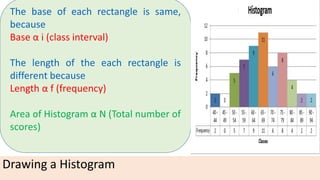
The first class 40-44 is taken as an
example for explanation. A rectangle is
drawn by having real lower limit of the
class (39.5) to the real upper limit
(44.5) as breadth and the frequency (2)
as length. Likewise the second
rectangle is drawn by having 44.5 to
49.5 as breadth and frequency as
length (0). Thus a rectangle for each
class is drawn. This series of rectangles
with respect to frequency distribution
is called as histogram.
Drawing a Histogram
The base of each rectangle is same,
because
Base α i (class interval)
The length of the each rectangle is
different because
Length α f (frequency)
Area of Histogram α N (Total number of
scores)
•Assignment
Draw a histogram manually having the data of your frequency
distribution table drawn before. Draw Histogram in a piece of graph
sheet and paste it in your assignment.
•Frequency Polygon
Types of Diagram
Pie diagram
Bar graph
Frequency Polygon
Histogram
Cumulative frequency curve
Cumulative frequency percentage curve
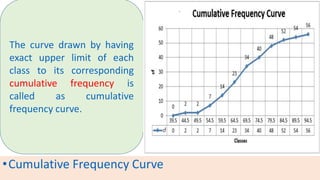
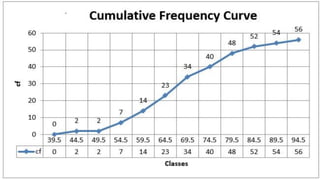
•Cumulative Frequency Curve
The curve drawn by having
exact upper limit of each
class to its corresponding
cumulative frequency is
called as cumulative
frequency curve.
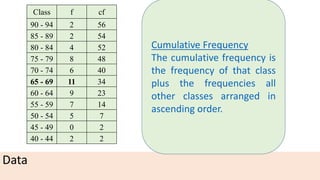
Data
Class f cf
90 - 94 2 56
85 - 89 2 54
80 - 84 4 52
75 - 79 8 48
70 - 74 6 40
65 - 69 11 34
60 - 64 9 23
55 - 59 7 14
50 - 54 5 7
45 - 49 0 2
40 - 44 2 2
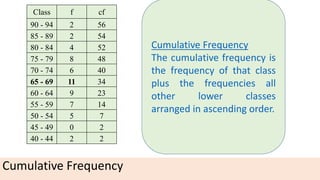
Cumulative Frequency
The cumulative frequency is
the frequency of that class
plus the frequencies all
other classes arranged in
ascending order.
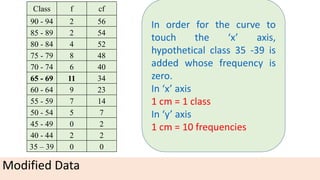
Modified Data
Class f cf
90 - 94 2 56
85 - 89 2 54
80 - 84 4 52
75 - 79 8 48
70 - 74 6 40
65 - 69 11 34
60 - 64 9 23
55 - 59 7 14
50 - 54 5 7
45 - 49 0 2
40 - 44 2 2
35 – 39 0 0
In order for the curve to
touch the ‘x’ axis,
hypothetical class 35 -39 is
added whose frequency is
zero.
In ‘x’ axis
1 cm = 1 class
In ‘y’ axis
1 cm = 10 frequencies
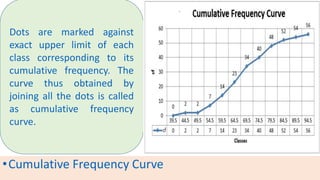
•Cumulative Frequency Curve
Dots are marked against
exact upper limit of each
class corresponding to its
cumulative frequency. The
curve thus obtained by
joining all the dots is called
as cumulative frequency
curve.
•Assignment
Draw a cumulative frequency curve manually having the data of your
frequency distribution table. Draw cumulative frequency curve in a
piece of graph sheet and paste it in your assignment.
•Cumulative Frequency Percentage Curve
Types of Diagram
Pie diagram
Bar graph
Frequency Polygon
Histogram
Cumulative frequency curve
Cumulative frequency percentage curve
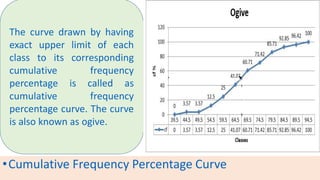
•Cumulative Frequency Percentage Curve
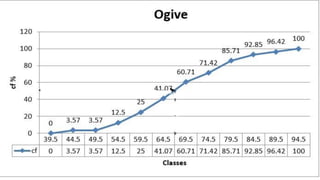
The curve drawn by having
exact upper limit of each
class to its corresponding
cumulative frequency
percentage is called as
cumulative frequency
percentage curve. The curve
is also known as ogive.
Cumulative Frequency
Class f cf
90 - 94 2 56
85 - 89 2 54
80 - 84 4 52
75 - 79 8 48
70 - 74 6 40
65 - 69 11 34
60 - 64 9 23
55 - 59 7 14
50 - 54 5 7
45 - 49 0 2
40 - 44 2 2
Cumulative Frequency
The cumulative frequency is
the frequency of that class
plus the frequencies all
other lower classes
arranged in ascending order.
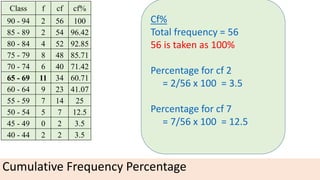
Cumulative Frequency Percentage
Class f cf cf%
90 - 94 2 56 100
85 - 89 2 54 96.42
80 - 84 4 52 92.85
75 - 79 8 48 85.71
70 - 74 6 40 71.42
65 - 69 11 34 60.71
60 - 64 9 23 41.07
55 - 59 7 14 25
50 - 54 5 7 12.5
45 - 49 0 2 3.5
40 - 44 2 2 3.5
Cf%
Total frequency = 56
56 is taken as 100%
Percentage for cf 2
= 2/56 x 100 = 3.5
Percentage for cf 7
= 7/56 x 100 = 12.5
Data
Class f cf
90 - 94 2 56
85 - 89 2 54
80 - 84 4 52
75 - 79 8 48
70 - 74 6 40
65 - 69 11 34
60 - 64 9 23
55 - 59 7 14
50 - 54 5 7
45 - 49 0 2
40 - 44 2 2
35 – 39 0 0
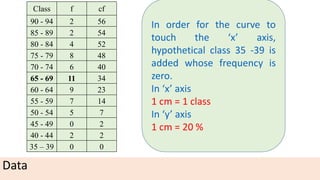
In order for the curve to
touch the ‘x’ axis,
hypothetical class 35 -39 is
added whose frequency is
zero.
In ‘x’ axis
1 cm = 1 class
In ‘y’ axis
1 cm = 20 %
•Cumulative Frequency Percentage Curve
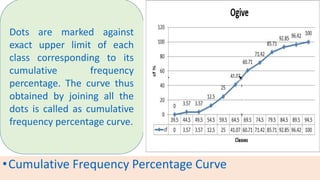
Dots are marked against
exact upper limit of each
class corresponding to its
cumulative frequency
percentage. The curve thus
obtained by joining all the
dots is called as cumulative
frequency percentage curve.
•Percentile - Concept
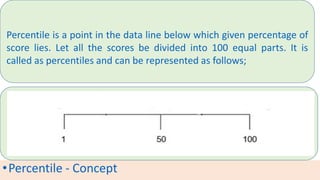
Percentile is a point in the data line below which given percentage of
score lies. Let all the scores be divided into 100 equal parts. It is
called as percentiles and can be represented as follows;
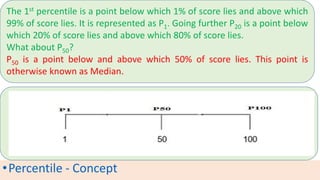
•Percentile - Concept
The 1st percentile is a point below which 1% of score lies and above which
99% of score lies. It is represented as P1. Going further P20 is a point below
which 20% of score lies and above which 80% of score lies.
What about P50?
P50 is a point below and above which 50% of score lies. This point is
otherwise known as Median.
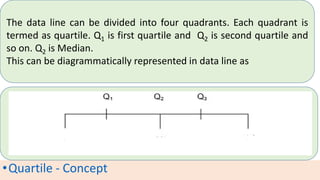
•Quartile - Concept
The data line can be divided into four quadrants. Each quadrant is
termed as quartile. Q1 is first quartile and Q2 is second quartile and
so on. Q2 is Median.
This can be diagrammatically represented in data line as
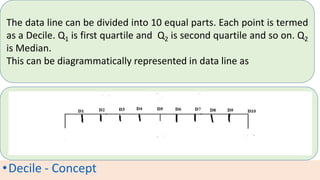
•Decile - Concept
The data line can be divided into 10 equal parts. Each point is termed
as a Decile. Q1 is first quartile and Q2 is second quartile and so on. Q2
is Median.
This can be diagrammatically represented in data line as
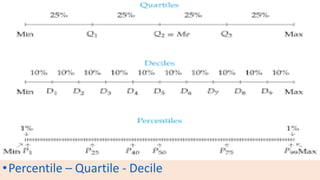
•Percentile – Quartile - Decile
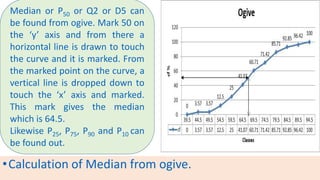
•Calculation of Median from ogive.
Median or P50 or Q2 or D5 can
be found from ogive. Mark 50 on
the ‘y’ axis and from there a
horizontal line is drawn to touch
the curve and it is marked. From
the marked point on the curve, a
vertical line is dropped down to
touch the ‘x’ axis and marked.
This mark gives the median
which is 64.5.
Likewise P25, P75, P90 and P10 can
be found out.
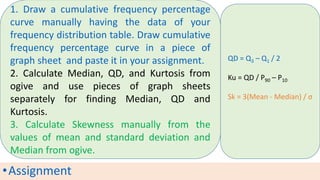
•Assignment
1. Draw a cumulative frequency percentage
curve manually having the data of your
frequency distribution table. Draw cumulative
frequency percentage curve in a piece of
graph sheet and paste it in your assignment.
2. Calculate Median, QD, and Kurtosis from
ogive and use pieces of graph sheets
separately for finding Median, QD and
Kurtosis.
3. Calculate Skewness manually from the
values of mean and standard deviation and
Median from ogive.
QD = Q3 – Q1 / 2
Ku = QD / P90 – P10
Sk = 3(Mean - Median) / σ
•Musings
With this, our class for this semester comes to an end. This is an
opportunity provided by you upon me. Thanks for coming along with
me in this journey. I can’t say that syllabus is covered but it has to be
discovered by us. Having said to take on Writing Questions,
Standardizing a Question Paper and Statistics, I have done a bit.
•Musings
The success of the teaching lies in applying all that you have learnt in
AL in understanding about measurement, assessment and
evaluation, different types of evaluation, writing GIO & SIO with
respect to Bloom’s taxonomy, writing questions, preparing blue print,
standardizing a question paper, fair evaluation of the scripts,
understand what the data says, ……
References
• Garrett, H. E. (1926). Statistics in psychology and education. Longman’s Green & Co
• Mathew, T.K., and Mollykutty, T.M. (2011). Science education -Theoretical bases of
teaching and pedagogic analysis - Physical Science and Natural Science. Rainbow Book
Publishers
• Mangal. S. K. (2014). Statistics in psychology and education. PHI Learning Private
Limited
• NCERT. (2013). Teaching of science.
• Radha Mohan. (2007). Teaching of physical science. (3rd ed.). PHI Learning
• Rathinasabapathy, P. (2001). கல்வியில் தேர்வு [Examination in Education]. (2nd
ed.). Shantha Publishers.
• Srinivasan, P. (2011). அறிவியல் கற்பிே்ேல் [Teaching of science]. DDE, Tamil
Univeristy
• Images from google

Frequency distribtution curve

  • 2.
    •Diagramming the Data Picturecan speak 1000 words. Rather than telling about whole drama of a 20/20 cricket match, just the picture on the right, is enough. Statistics also gives data in the form of diagram and it is more elegant to see.
  • 3.
    •Diagrammatisation of Data Typesof Diagram Pie diagram Bar graph Frequency Polygon Histogram Cumulative frequency curve Cumulative frequency percentage curve
  • 4.
    •Pie Diagram Pie diagramis in the form of circle, hence it is also called as circle diagram. It can be fragmented in to different proportions, which represents the data. In English, the word pie means a type of food made with meat, vegetables or fruit covered in pastry and baked.
  • 5.
    •Charting a Pie Astudent got the following marks in five subjects. The maximum marks in each subject is 100. Let the data be visualized in the pie form. Total angle in a pie = 3600 Total marks for all subjects = 434/500 For English For 434 marks = 3600 for 60 marks=60x360/434 = 49.70≈500 Like above Tamil = 66.60≈670 Maths = 82.90≈830 Science=81.20≈810 Social Science = 79.60≈800
  • 6.
  • 7.
    •Assignment Draw a piechart manually having your own X standard marks.
  • 8.
  • 9.
    •Diagrammatisation of Data Typesof Diagram Pie diagram Bar graph Frequency curve Histogram Cumulative frequency curve Cumulative frequency percentage curve
  • 10.
    •Bar Graph In aBar graph, the data is exhibited through rectangles. The presentation can be either vertical or horizontal.
  • 11.
    •Charting a BarGraph A student got the following marks in five subjects. The maximum marks in each subject is 100. Let the data be visualized in the form of bar graph. In X axis (Subjects) 1 cm = 1 Subject In Y axis (Marks) 1 cm = 20 Marks
  • 13.
    •Assignment Draw a BarGraph manually having your own X standard marks. Draw in a piece of graph sheet and paste it in your assignment.
  • 14.
    •Frequency Polygon Types ofDiagram Pie diagram Bar graph Frequency Polygon Histogram Cumulative frequency curve Cumulative frequency percentage curve
  • 15.
    •Frequency Polygon The linediagram of frequency distribution is called frequency polygon. The suffix polygon is due to the presence of many angles in the curve. For example, if there are three angles it is triangle, four angles means tetragon and so on.
  • 16.
    Add one aboveand below hypothetical class in the Frequency Distribution Table. Since it is hypothetical, the frequency is zero. Class f 90 - 94 2 85 - 89 2 80 - 84 4 75 - 79 8 70 - 74 6 65 - 69 11 60 - 64 9 55 - 59 7 50 - 54 5 45 - 49 0 40 - 44 2 Class f 95 – 99 0 90 - 94 2 85 - 89 2 80 - 84 4 75 - 79 8 70 - 74 6 65 - 69 11 60 - 64 9 55 - 59 7 50 - 54 5 45 - 49 0 40 - 44 2 35 – 39 0
  • 17.
    Drawing Frequency Polygon. InX axis (Class) 1 cm = 1 class In Y axis (Frequency) 1 cm = 2 frequency Mark the dot against frequency and its’ corresponding mid-point of the class. Draw a line connecting all the dots. The curve in order to touch the x axis, two hypothetical classes were taken. This curve is known as Frequency Polygon Class f 95 – 99 0 90 - 94 2 85 - 89 2 80 - 84 4 75 - 79 8 70 - 74 6 65 - 69 11 60 - 64 9 55 - 59 7 50 - 54 5 45 - 49 0 40 - 44 2 35 – 39 0
  • 19.
    •Assignment Draw a frequencypolygon manually having the data of your frequency distribution table drawn before. Draw frequency polygon in a piece of graph sheet and paste it in your assignment.
  • 20.
    •Frequency Polygon Types ofDiagram Pie diagram Bar graph Frequency Polygon Histogram Cumulative frequency curve Cumulative frequency percentage curve
  • 21.
    •Histogram The bar graphof frequency distribution is called Histogram.
  • 22.
    Frequency Distribution Tablewithout Hypothetical Class Class f 90 - 94 2 85 - 89 2 80 - 84 4 75 - 79 8 70 - 74 6 65 - 69 11 60 - 64 9 55 - 59 7 50 - 54 5 45 - 49 0 40 - 44 2
  • 23.
    Drawing a Histogram InX axis (Class) 1 cm = 1 class In Y axis (Frequency) 1 cm = 2 frequency Class f 90 - 94 2 85 - 89 2 80 - 84 4 75 - 79 8 70 - 74 6 65 - 69 11 60 - 64 9 55 - 59 7 50 - 54 5 45 - 49 0 40 - 44 2
  • 24.
    Drawing a Histogram Thefirst class 40-44 is taken as an example for explanation. A rectangle is drawn by having real lower limit of the class (39.5) to the real upper limit (44.5) as breadth and the frequency (2) as length. Likewise the second rectangle is drawn by having 44.5 to 49.5 as breadth and frequency as length (0). Thus a rectangle for each class is drawn. This series of rectangles with respect to frequency distribution is called as histogram.
  • 26.
    Drawing a Histogram Thebase of each rectangle is same, because Base α i (class interval) The length of the each rectangle is different because Length α f (frequency) Area of Histogram α N (Total number of scores)
  • 27.
    •Assignment Draw a histogrammanually having the data of your frequency distribution table drawn before. Draw Histogram in a piece of graph sheet and paste it in your assignment.
  • 28.
    •Frequency Polygon Types ofDiagram Pie diagram Bar graph Frequency Polygon Histogram Cumulative frequency curve Cumulative frequency percentage curve
  • 29.
    •Cumulative Frequency Curve Thecurve drawn by having exact upper limit of each class to its corresponding cumulative frequency is called as cumulative frequency curve.
  • 30.
    Data Class f cf 90- 94 2 56 85 - 89 2 54 80 - 84 4 52 75 - 79 8 48 70 - 74 6 40 65 - 69 11 34 60 - 64 9 23 55 - 59 7 14 50 - 54 5 7 45 - 49 0 2 40 - 44 2 2 Cumulative Frequency The cumulative frequency is the frequency of that class plus the frequencies all other classes arranged in ascending order.
  • 31.
    Modified Data Class fcf 90 - 94 2 56 85 - 89 2 54 80 - 84 4 52 75 - 79 8 48 70 - 74 6 40 65 - 69 11 34 60 - 64 9 23 55 - 59 7 14 50 - 54 5 7 45 - 49 0 2 40 - 44 2 2 35 – 39 0 0 In order for the curve to touch the ‘x’ axis, hypothetical class 35 -39 is added whose frequency is zero. In ‘x’ axis 1 cm = 1 class In ‘y’ axis 1 cm = 10 frequencies
  • 32.
    •Cumulative Frequency Curve Dotsare marked against exact upper limit of each class corresponding to its cumulative frequency. The curve thus obtained by joining all the dots is called as cumulative frequency curve.
  • 34.
    •Assignment Draw a cumulativefrequency curve manually having the data of your frequency distribution table. Draw cumulative frequency curve in a piece of graph sheet and paste it in your assignment.
  • 35.
    •Cumulative Frequency PercentageCurve Types of Diagram Pie diagram Bar graph Frequency Polygon Histogram Cumulative frequency curve Cumulative frequency percentage curve
  • 36.
    •Cumulative Frequency PercentageCurve The curve drawn by having exact upper limit of each class to its corresponding cumulative frequency percentage is called as cumulative frequency percentage curve. The curve is also known as ogive.
  • 37.
    Cumulative Frequency Class fcf 90 - 94 2 56 85 - 89 2 54 80 - 84 4 52 75 - 79 8 48 70 - 74 6 40 65 - 69 11 34 60 - 64 9 23 55 - 59 7 14 50 - 54 5 7 45 - 49 0 2 40 - 44 2 2 Cumulative Frequency The cumulative frequency is the frequency of that class plus the frequencies all other lower classes arranged in ascending order.
  • 38.
    Cumulative Frequency Percentage Classf cf cf% 90 - 94 2 56 100 85 - 89 2 54 96.42 80 - 84 4 52 92.85 75 - 79 8 48 85.71 70 - 74 6 40 71.42 65 - 69 11 34 60.71 60 - 64 9 23 41.07 55 - 59 7 14 25 50 - 54 5 7 12.5 45 - 49 0 2 3.5 40 - 44 2 2 3.5 Cf% Total frequency = 56 56 is taken as 100% Percentage for cf 2 = 2/56 x 100 = 3.5 Percentage for cf 7 = 7/56 x 100 = 12.5
  • 39.
    Data Class f cf 90- 94 2 56 85 - 89 2 54 80 - 84 4 52 75 - 79 8 48 70 - 74 6 40 65 - 69 11 34 60 - 64 9 23 55 - 59 7 14 50 - 54 5 7 45 - 49 0 2 40 - 44 2 2 35 – 39 0 0 In order for the curve to touch the ‘x’ axis, hypothetical class 35 -39 is added whose frequency is zero. In ‘x’ axis 1 cm = 1 class In ‘y’ axis 1 cm = 20 %
  • 40.
    •Cumulative Frequency PercentageCurve Dots are marked against exact upper limit of each class corresponding to its cumulative frequency percentage. The curve thus obtained by joining all the dots is called as cumulative frequency percentage curve.
  • 42.
    •Percentile - Concept Percentileis a point in the data line below which given percentage of score lies. Let all the scores be divided into 100 equal parts. It is called as percentiles and can be represented as follows;
  • 43.
    •Percentile - Concept The1st percentile is a point below which 1% of score lies and above which 99% of score lies. It is represented as P1. Going further P20 is a point below which 20% of score lies and above which 80% of score lies. What about P50? P50 is a point below and above which 50% of score lies. This point is otherwise known as Median.
  • 44.
    •Quartile - Concept Thedata line can be divided into four quadrants. Each quadrant is termed as quartile. Q1 is first quartile and Q2 is second quartile and so on. Q2 is Median. This can be diagrammatically represented in data line as
  • 45.
    •Decile - Concept Thedata line can be divided into 10 equal parts. Each point is termed as a Decile. Q1 is first quartile and Q2 is second quartile and so on. Q2 is Median. This can be diagrammatically represented in data line as
  • 46.
  • 47.
    •Calculation of Medianfrom ogive. Median or P50 or Q2 or D5 can be found from ogive. Mark 50 on the ‘y’ axis and from there a horizontal line is drawn to touch the curve and it is marked. From the marked point on the curve, a vertical line is dropped down to touch the ‘x’ axis and marked. This mark gives the median which is 64.5. Likewise P25, P75, P90 and P10 can be found out.
  • 48.
    •Assignment 1. Draw acumulative frequency percentage curve manually having the data of your frequency distribution table. Draw cumulative frequency percentage curve in a piece of graph sheet and paste it in your assignment. 2. Calculate Median, QD, and Kurtosis from ogive and use pieces of graph sheets separately for finding Median, QD and Kurtosis. 3. Calculate Skewness manually from the values of mean and standard deviation and Median from ogive. QD = Q3 – Q1 / 2 Ku = QD / P90 – P10 Sk = 3(Mean - Median) / σ
  • 49.
    •Musings With this, ourclass for this semester comes to an end. This is an opportunity provided by you upon me. Thanks for coming along with me in this journey. I can’t say that syllabus is covered but it has to be discovered by us. Having said to take on Writing Questions, Standardizing a Question Paper and Statistics, I have done a bit.
  • 50.
    •Musings The success ofthe teaching lies in applying all that you have learnt in AL in understanding about measurement, assessment and evaluation, different types of evaluation, writing GIO & SIO with respect to Bloom’s taxonomy, writing questions, preparing blue print, standardizing a question paper, fair evaluation of the scripts, understand what the data says, ……
  • 51.
    References • Garrett, H.E. (1926). Statistics in psychology and education. Longman’s Green & Co • Mathew, T.K., and Mollykutty, T.M. (2011). Science education -Theoretical bases of teaching and pedagogic analysis - Physical Science and Natural Science. Rainbow Book Publishers • Mangal. S. K. (2014). Statistics in psychology and education. PHI Learning Private Limited • NCERT. (2013). Teaching of science. • Radha Mohan. (2007). Teaching of physical science. (3rd ed.). PHI Learning • Rathinasabapathy, P. (2001). கல்வியில் தேர்வு [Examination in Education]. (2nd ed.). Shantha Publishers. • Srinivasan, P. (2011). அறிவியல் கற்பிே்ேல் [Teaching of science]. DDE, Tamil Univeristy • Images from google