Characteristics of a Good Test
•Objectivity
•Reliability
•Validity
•Usability
Objectivity
• Gronlund and Linn (1995) states “Objectivity of a test refers to the degree to
which equally competent scores obtain the same results
• C.V. Good (1973) defines objectivity in testing is “the extent to which the
instrument is free from personal error (personal bias), that is subjectivity on the
part of the scorer”.
Reliability
• Refers to consistency of the scores
• Refers to the repeatability of the scores
• Gronlund and Linn (1995) “Reliability refers to the consistency of measurement—
that is, how consistent test scores or other evaluation results are from one
measurement to other.”
• C.V. Good (1973) has defined reliability as the “worthiness with which a
measuring device measures something; the degree to which a test or other
instrument of evaluation measures consistently whatever it does in fact measure.”
Validity
•The degree to which the test actually succeeds in
measuring what it sets out to measure
•C.V. Good (1973)—In the dictionary of education defines
validity as the “extent to which a test or other measuring
instrument fulfils the purpose for which it is used.”
•Lindquist (1942) has said, “validity of a test may be
defined as the accuracy with which it measures that
which it is intended to measure, or as the degree to which
it approaches infallibility in measuring what it purports to
measure.”
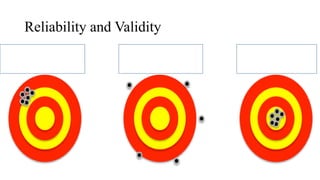
Reliability and Validity
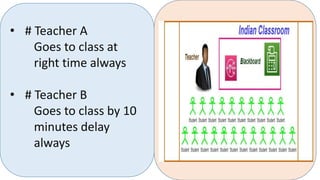
• # Teacher A
Goes to class at
right time always
• # Teacher B
Goes to class by 10
minutes delay
always
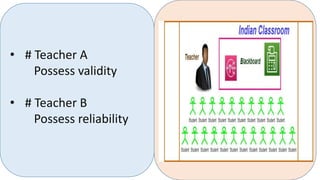
• # Teacher A
Possess validity
• # Teacher B
Possess reliability
•Reliability ensures validity or
•Validity ensures reliability?
Usability
• Practicable with respect to following aspects;
• Ease of aministration
• Duration
• Ease of interpretation and application
• Availability of equivalent forms
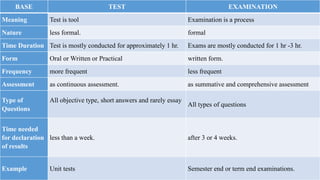
BASE TEST EXAMINATION
Meaning Test is tool Examination is a process
Nature less formal. formal
Time Duration Test is mostly conducted for approximately 1 hr. Exams are mostly conducted for 1 hr -3 hr.
Form Oral or Written or Practical written form.
Frequency more frequent less frequent
Assessment as continuous assessment. as summative and comprehensive assessment
Type of
Questions
All objective type, short answers and rarely essay
All types of questions
Time needed
for declaration
of results
less than a week. after 3 or 4 weeks.
Example Unit tests Semester end or term end examinations.
References
• Henry E Garrett. (1961). Statistics in education and psychology.
Paragaon International Publisher.
• Marami Goswami. (2014). Measurement and evaluation in psychology and
education. Neelkamal Publication.
• Mathew, T.K., and Mollykutty, T.M. (2011). Science education -Theoretical bases of
teaching and pedagogic analysis - Physical Science and Natural Science.
Rainbow Book Publishers
• NCERT. (2013). Teaching of science. Delhi: Author
• Radha Mohan. (2007). Teaching of physical science. (3rd ed.). PHI Learning
• Rathinasabapathy, P. (2001). கல்வியில் தேர்வு [Examination in Education].
(2nd ed.). Shantha Publishers.
• Srinivasan, P. (2011). அறிவியல் கற்பிே்ேல் [Teaching of science]. DDE, Tamil
Univeristy
• Images from google

Characteristic of good test

  • 2.
    Characteristics of aGood Test •Objectivity •Reliability •Validity •Usability
  • 3.
    Objectivity • Gronlund andLinn (1995) states “Objectivity of a test refers to the degree to which equally competent scores obtain the same results • C.V. Good (1973) defines objectivity in testing is “the extent to which the instrument is free from personal error (personal bias), that is subjectivity on the part of the scorer”.
  • 4.
    Reliability • Refers toconsistency of the scores • Refers to the repeatability of the scores • Gronlund and Linn (1995) “Reliability refers to the consistency of measurement— that is, how consistent test scores or other evaluation results are from one measurement to other.” • C.V. Good (1973) has defined reliability as the “worthiness with which a measuring device measures something; the degree to which a test or other instrument of evaluation measures consistently whatever it does in fact measure.”
  • 5.
    Validity •The degree towhich the test actually succeeds in measuring what it sets out to measure •C.V. Good (1973)—In the dictionary of education defines validity as the “extent to which a test or other measuring instrument fulfils the purpose for which it is used.” •Lindquist (1942) has said, “validity of a test may be defined as the accuracy with which it measures that which it is intended to measure, or as the degree to which it approaches infallibility in measuring what it purports to measure.”
  • 6.
  • 7.
    • # TeacherA Goes to class at right time always • # Teacher B Goes to class by 10 minutes delay always
  • 8.
    • # TeacherA Possess validity • # Teacher B Possess reliability
  • 9.
    •Reliability ensures validityor •Validity ensures reliability?
  • 10.
    Usability • Practicable withrespect to following aspects; • Ease of aministration • Duration • Ease of interpretation and application • Availability of equivalent forms
  • 11.
    BASE TEST EXAMINATION MeaningTest is tool Examination is a process Nature less formal. formal Time Duration Test is mostly conducted for approximately 1 hr. Exams are mostly conducted for 1 hr -3 hr. Form Oral or Written or Practical written form. Frequency more frequent less frequent Assessment as continuous assessment. as summative and comprehensive assessment Type of Questions All objective type, short answers and rarely essay All types of questions Time needed for declaration of results less than a week. after 3 or 4 weeks. Example Unit tests Semester end or term end examinations.
  • 12.
    References • Henry EGarrett. (1961). Statistics in education and psychology. Paragaon International Publisher. • Marami Goswami. (2014). Measurement and evaluation in psychology and education. Neelkamal Publication. • Mathew, T.K., and Mollykutty, T.M. (2011). Science education -Theoretical bases of teaching and pedagogic analysis - Physical Science and Natural Science. Rainbow Book Publishers • NCERT. (2013). Teaching of science. Delhi: Author • Radha Mohan. (2007). Teaching of physical science. (3rd ed.). PHI Learning • Rathinasabapathy, P. (2001). கல்வியில் தேர்வு [Examination in Education]. (2nd ed.). Shantha Publishers. • Srinivasan, P. (2011). அறிவியல் கற்பிே்ேல் [Teaching of science]. DDE, Tamil Univeristy • Images from google