Yash Goel
Kashish Warsa
Akshita Tewari
Honey
Arjun Sharma
Harshita Kinra
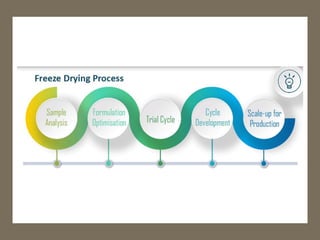
Freeze Drying
• Freeze-drying also called as Lyophilization
• It is a process in which material is freeze then high-pressure vacuum is
applied to sublimate the water in the form of vapour
• Process was first applied to food products after the Second World War
• Coffee was first freeze dried food products to be produced, but now
vegetables, fruits, meats, fish, dairy products, herbs and food
flavorings can be freeze dried
Principle
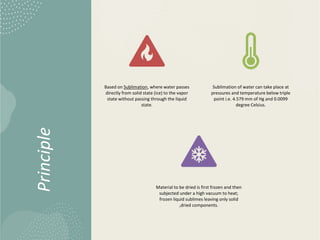
Based on Sublimation, where water passes
directly from solid state (ice) to the vapor
state without passing through the liquid
state.
Sublimation of water can take place at
pressures and temperature below triple
point i.e. 4.579 mm of Hg and 0.0099
degree Celsius.
Material to be dried is first frozen and then
subjected under a high vacuum to heat;
frozen liquid sublimes leaving only solid
,dried components.
Phase
diagram of
water
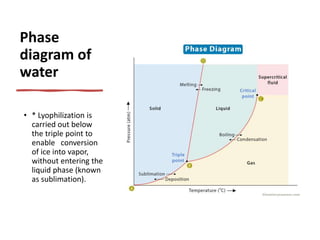
• * Lyophilization is
carried out below
the triple point to
enable conversion
of ice into vapor,
without entering the
liquid phase (known
as sublimation).
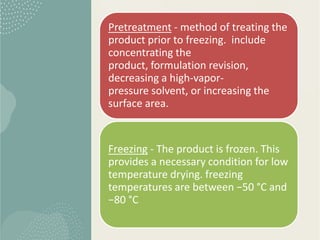
Pretreatment - method of treating the
product prior to freezing. include
concentrating the
product, formulation revision,
decreasing a high-vapor-
pressure solvent, or increasing the
surface area.
Freezing - The product is frozen. This
provides a necessary condition for low
temperature drying. freezing
temperatures are between −50 °C and
−80 °C
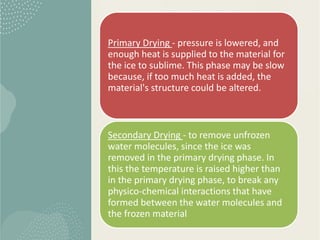
Primary Drying - pressure is lowered, and
enough heat is supplied to the material for
the ice to sublime. This phase may be slow
because, if too much heat is added, the
material's structure could be altered.
Secondary Drying - to remove unfrozen
water molecules, since the ice was
removed in the primary drying phase. In
this the temperature is raised higher than
in the primary drying phase, to break any
physico-chemical interactions that have
formed between the water molecules and
the frozen material
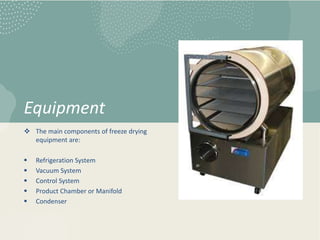
Equipment
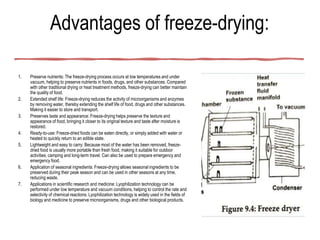
 The main components of freeze drying
equipment are:
 Refrigeration System
 Vacuum System
 Control System
 Product Chamber or Manifold
 Condenser
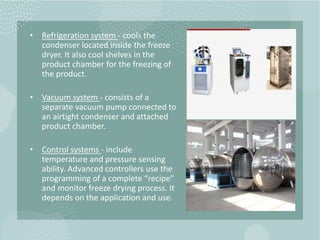
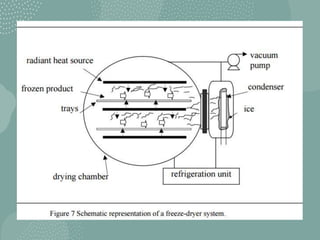
• Refrigeration system - cools the
condenser located inside the freeze
dryer. It also cool shelves in the
product chamber for the freezing of
the product.
• Vacuum system - consists of a
separate vacuum pump connected to
an airtight condenser and attached
product chamber.
• Control systems - include
temperature and pressure sensing
ability. Advanced controllers use the
programming of a complete “recipe”
and monitor freeze drying process. It
depends on the application and use.
• Product chambers - a larger
chamber with a system of shelves
on which to place the product.
• Condenser – It is to attract the
vapors being sublimed off of the
product. The sublimated ice
accumulates in the condenser.
temperature of the condenser
substantially below the
temperature of the product.
Heat & Mass transfer
 There are 3 methods of heat transfer
 Through frozen layer
 Through dried layer
 Heating by microwaves
 When heat reaches sublimation
front, it raises temperature and
water vapour pressure of ice,
vapour then moves through dried
food to region of low vapour
pressure in drying chamber.
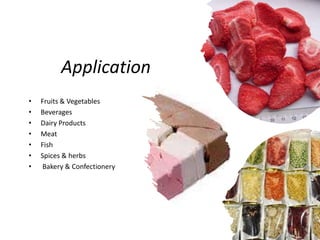
Application
• Fruits & Vegetables
• Beverages
• Dairy Products
• Meat
• Fish
• Spices & herbs
• Bakery & Confectionery
Advantages
Lightweight, which reduces the cost of shipping.
Requires no refrigeration, storage costs are
reduced.
Physical structure of the food is not altered, food
retains much of its color, shape, texture, and
flavor when it is prepared for consumption.
Reconstituted quickly and easily by adding water.
Have a long shelf life when packed properly.
Conclusion
• The freeze-drying process is expensive, which
restricts its application on wide range in the food
industry.
• New technical solutions are applied to modify the
freeze-drying process and make it time- and cost-
effective.
• It is suitable for high value products with specific
biological and phytochemical properties
Advantages of freeze-drying:
1. Preserve nutrients: The freeze-drying process occurs at low temperatures and under
vacuum, helping to preserve nutrients in foods, drugs, and other substances. Compared
with other traditional drying or heat treatment methods, freeze-drying can better maintain
the quality of food.
2. Extended shelf life: Freeze-drying reduces the activity of microorganisms and enzymes
by removing water, thereby extending the shelf life of food, drugs and other substances.
Making it easier to store and transport.
3. Preserves taste and appearance: Freeze-drying helps preserve the texture and
appearance of food, bringing it closer to its original texture and taste after moisture is
restored.
4. Ready-to-use: Freeze-dried foods can be eaten directly, or simply added with water or
heated to quickly return to an edible state.
5. Lightweight and easy to carry: Because most of the water has been removed, freeze-
dried food is usually more portable than fresh food, making it suitable for outdoor
activities, camping and long-term travel. Can also be used to prepare emergency and
emergency food.
6. Application of seasonal ingredients: Freeze-drying allows seasonal ingredients to be
preserved during their peak season and can be used in other seasons at any time,
reducing waste.
7. Applications in scientific research and medicine: Lyophilization technology can be
performed under low temperature and vacuum conditions, helping to control the rate and
selectivity of chemical reactions. Lyophilization technology is widely used in the fields of
biology and medicine to preserve microorganisms, drugs and other biological products.

freeze drying ppt and lyophilization.pptx

  • 1.
    Yash Goel Kashish Warsa AkshitaTewari Honey Arjun Sharma Harshita Kinra
  • 2.
    Freeze Drying • Freeze-dryingalso called as Lyophilization • It is a process in which material is freeze then high-pressure vacuum is applied to sublimate the water in the form of vapour • Process was first applied to food products after the Second World War • Coffee was first freeze dried food products to be produced, but now vegetables, fruits, meats, fish, dairy products, herbs and food flavorings can be freeze dried
  • 3.
    Principle Based on Sublimation,where water passes directly from solid state (ice) to the vapor state without passing through the liquid state. Sublimation of water can take place at pressures and temperature below triple point i.e. 4.579 mm of Hg and 0.0099 degree Celsius. Material to be dried is first frozen and then subjected under a high vacuum to heat; frozen liquid sublimes leaving only solid ,dried components.
  • 4.
    Phase diagram of water • *Lyophilization is carried out below the triple point to enable conversion of ice into vapor, without entering the liquid phase (known as sublimation).
  • 6.
    Pretreatment - methodof treating the product prior to freezing. include concentrating the product, formulation revision, decreasing a high-vapor- pressure solvent, or increasing the surface area. Freezing - The product is frozen. This provides a necessary condition for low temperature drying. freezing temperatures are between −50 °C and −80 °C
  • 7.
    Primary Drying -pressure is lowered, and enough heat is supplied to the material for the ice to sublime. This phase may be slow because, if too much heat is added, the material's structure could be altered. Secondary Drying - to remove unfrozen water molecules, since the ice was removed in the primary drying phase. In this the temperature is raised higher than in the primary drying phase, to break any physico-chemical interactions that have formed between the water molecules and the frozen material
  • 8.
    Equipment  The maincomponents of freeze drying equipment are:  Refrigeration System  Vacuum System  Control System  Product Chamber or Manifold  Condenser
  • 9.
    • Refrigeration system- cools the condenser located inside the freeze dryer. It also cool shelves in the product chamber for the freezing of the product. • Vacuum system - consists of a separate vacuum pump connected to an airtight condenser and attached product chamber. • Control systems - include temperature and pressure sensing ability. Advanced controllers use the programming of a complete “recipe” and monitor freeze drying process. It depends on the application and use.
  • 10.
    • Product chambers- a larger chamber with a system of shelves on which to place the product. • Condenser – It is to attract the vapors being sublimed off of the product. The sublimated ice accumulates in the condenser. temperature of the condenser substantially below the temperature of the product.
  • 12.
    Heat & Masstransfer  There are 3 methods of heat transfer  Through frozen layer  Through dried layer  Heating by microwaves  When heat reaches sublimation front, it raises temperature and water vapour pressure of ice, vapour then moves through dried food to region of low vapour pressure in drying chamber.
  • 13.
    Application • Fruits &Vegetables • Beverages • Dairy Products • Meat • Fish • Spices & herbs • Bakery & Confectionery
  • 14.
    Advantages Lightweight, which reducesthe cost of shipping. Requires no refrigeration, storage costs are reduced. Physical structure of the food is not altered, food retains much of its color, shape, texture, and flavor when it is prepared for consumption. Reconstituted quickly and easily by adding water. Have a long shelf life when packed properly.
  • 15.
    Conclusion • The freeze-dryingprocess is expensive, which restricts its application on wide range in the food industry. • New technical solutions are applied to modify the freeze-drying process and make it time- and cost- effective. • It is suitable for high value products with specific biological and phytochemical properties
  • 16.
    Advantages of freeze-drying: 1.Preserve nutrients: The freeze-drying process occurs at low temperatures and under vacuum, helping to preserve nutrients in foods, drugs, and other substances. Compared with other traditional drying or heat treatment methods, freeze-drying can better maintain the quality of food. 2. Extended shelf life: Freeze-drying reduces the activity of microorganisms and enzymes by removing water, thereby extending the shelf life of food, drugs and other substances. Making it easier to store and transport. 3. Preserves taste and appearance: Freeze-drying helps preserve the texture and appearance of food, bringing it closer to its original texture and taste after moisture is restored. 4. Ready-to-use: Freeze-dried foods can be eaten directly, or simply added with water or heated to quickly return to an edible state. 5. Lightweight and easy to carry: Because most of the water has been removed, freeze- dried food is usually more portable than fresh food, making it suitable for outdoor activities, camping and long-term travel. Can also be used to prepare emergency and emergency food. 6. Application of seasonal ingredients: Freeze-drying allows seasonal ingredients to be preserved during their peak season and can be used in other seasons at any time, reducing waste. 7. Applications in scientific research and medicine: Lyophilization technology can be performed under low temperature and vacuum conditions, helping to control the rate and selectivity of chemical reactions. Lyophilization technology is widely used in the fields of biology and medicine to preserve microorganisms, drugs and other biological products.