The document discusses the equilibrium of rigid bodies, focusing on conditions necessary for stability, including forces and moments. It emphasizes the importance of free body diagrams in identifying forces and support reactions in various scenarios, such as truck ramps and suspended platforms. Key concepts include the differences between internal and external forces, and the need for proper modeling to ensure accurate assessments of tension and support reactions.
EQUILIBRIUM OF ARIGID BODY
5.1 Conditions For Rigid Body
5.2 Free Body Diagram
CE 201 - Statics
2.
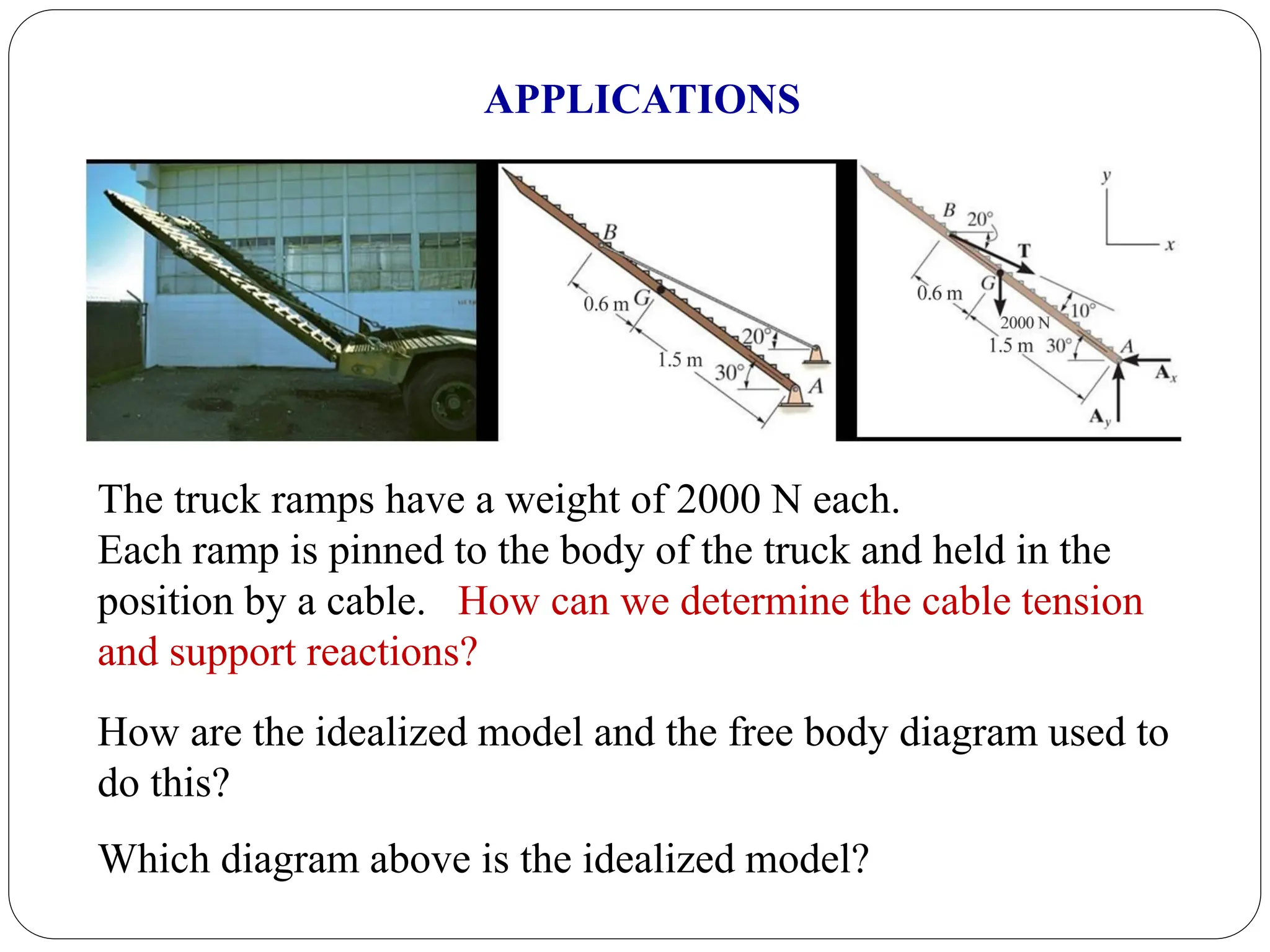
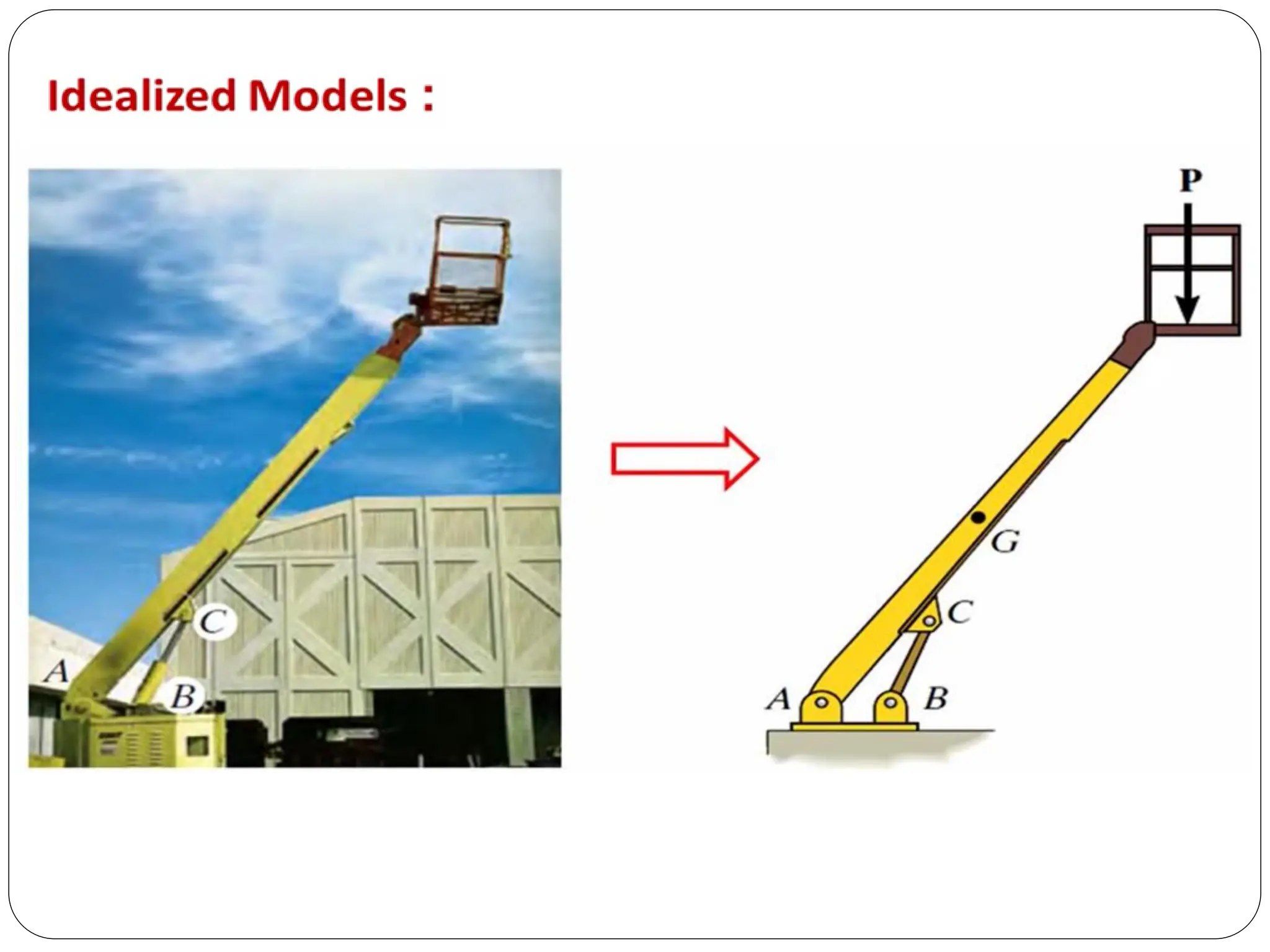
How are theidealized model and the free body diagram used to
do this?
Which diagram above is the idealized model?
APPLICATIONS
The truck ramps have a weight of 2000 N each.
Each ramp is pinned to the body of the truck and held in the
position by a cable. How can we determine the cable tension
and support reactions?
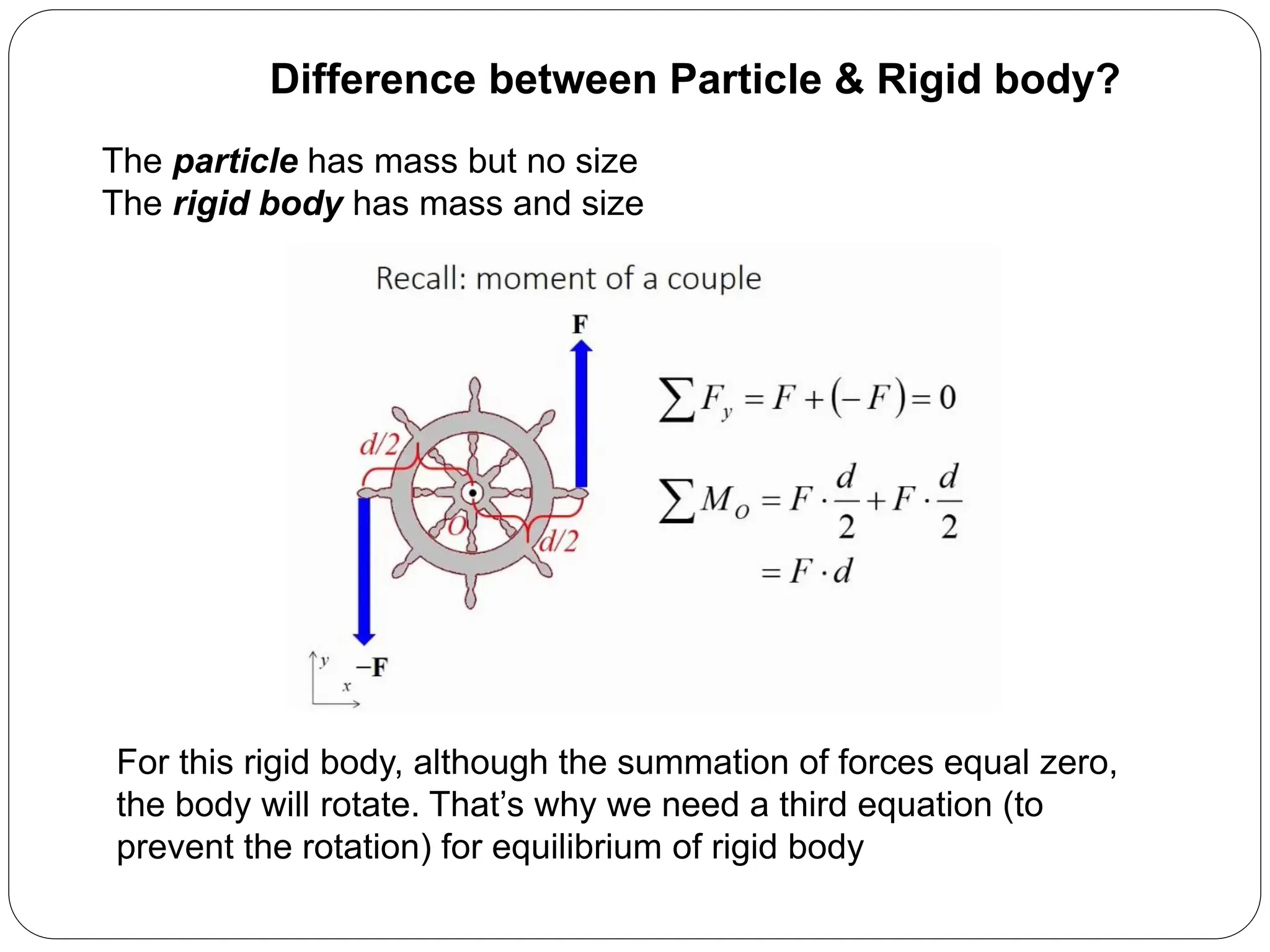
For this rigidbody, although the summation of forces equal zero,
the body will rotate. That’s why we need a third equation (to
prevent the rotation) for equilibrium of rigid body
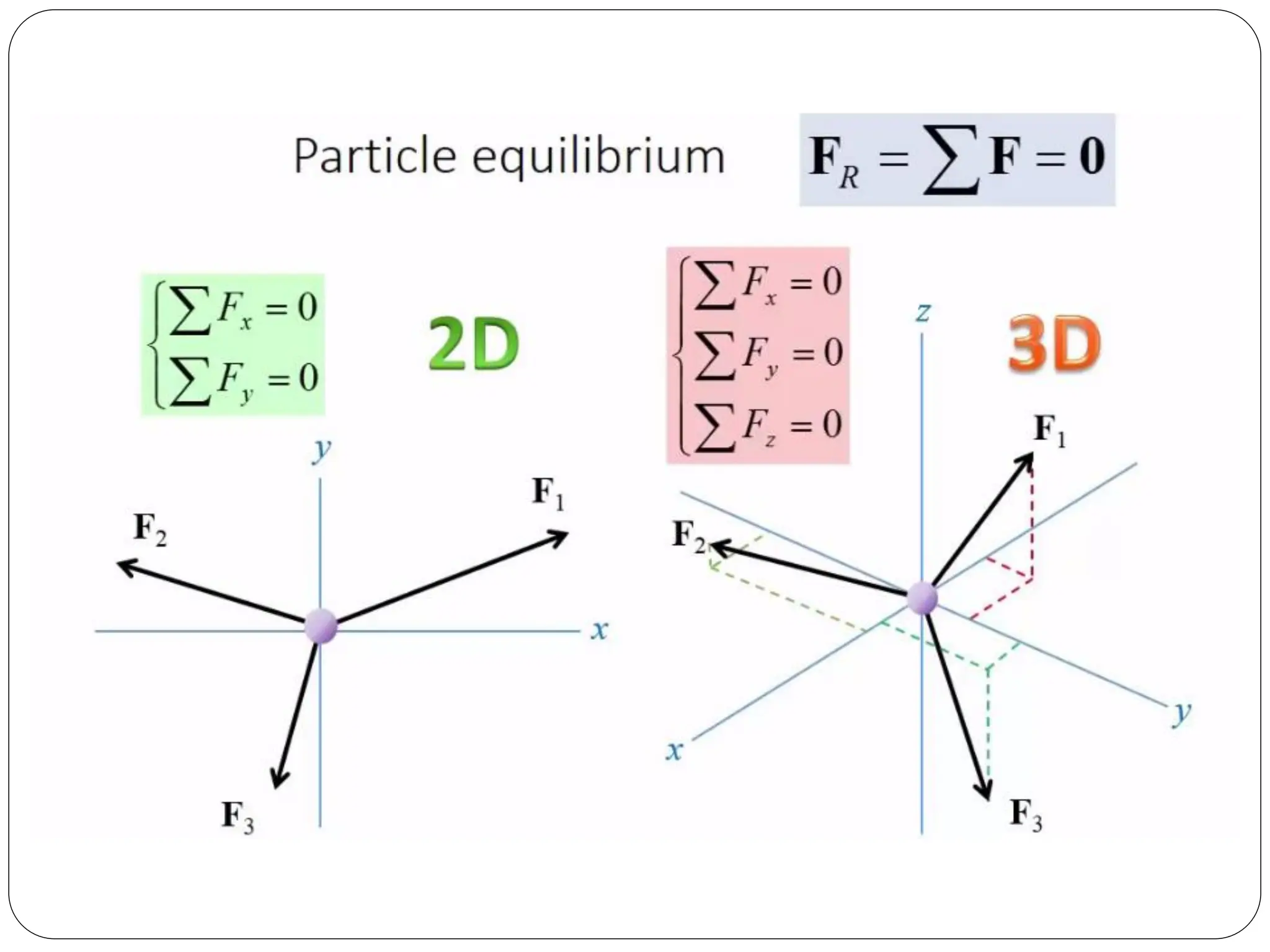
The particle has mass but no size
The rigid body has mass and size
Difference between Particle & Rigid body?
6.
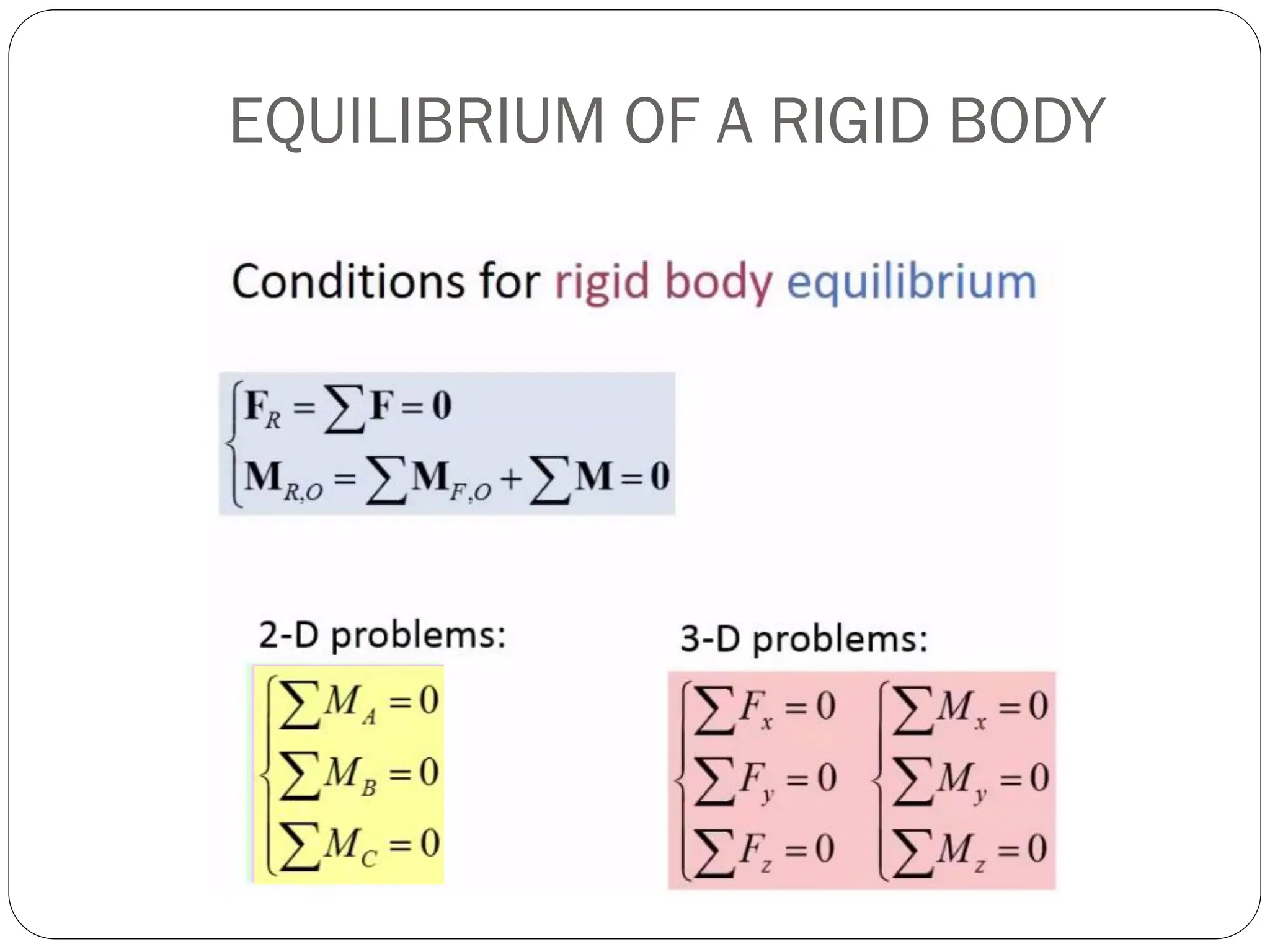
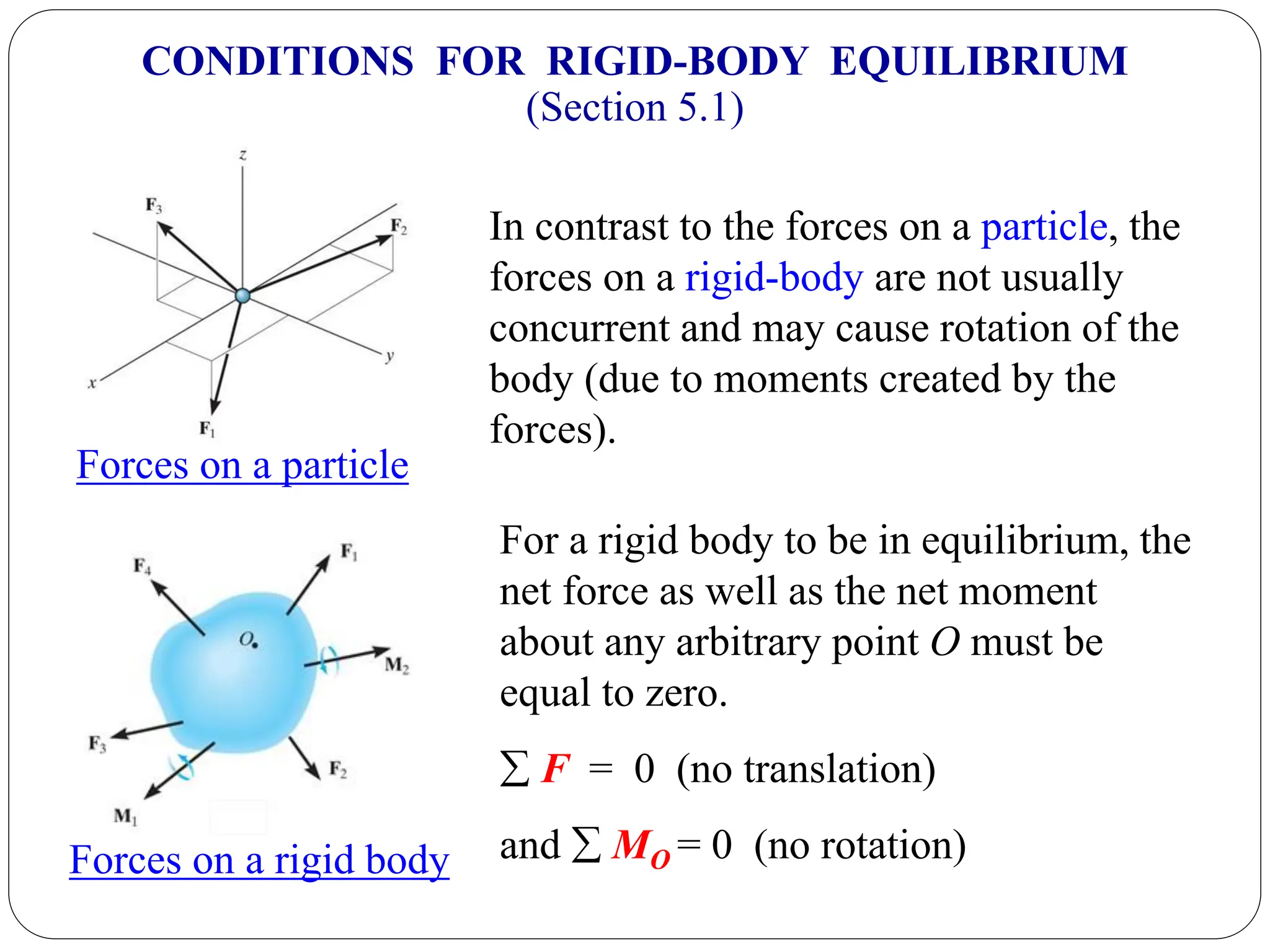
For a rigidbody to be in equilibrium, the
net force as well as the net moment
about any arbitrary point O must be
equal to zero.
F = 0 (no translation)
and MO = 0 (no rotation)
Forces on a rigid body
In contrast to the forces on a particle, the
forces on a rigid-body are not usually
concurrent and may cause rotation of the
body (due to moments created by the
forces).
Forces on a particle
CONDITIONS FOR RIGID-BODY EQUILIBRIUM
(Section 5.1)
8.
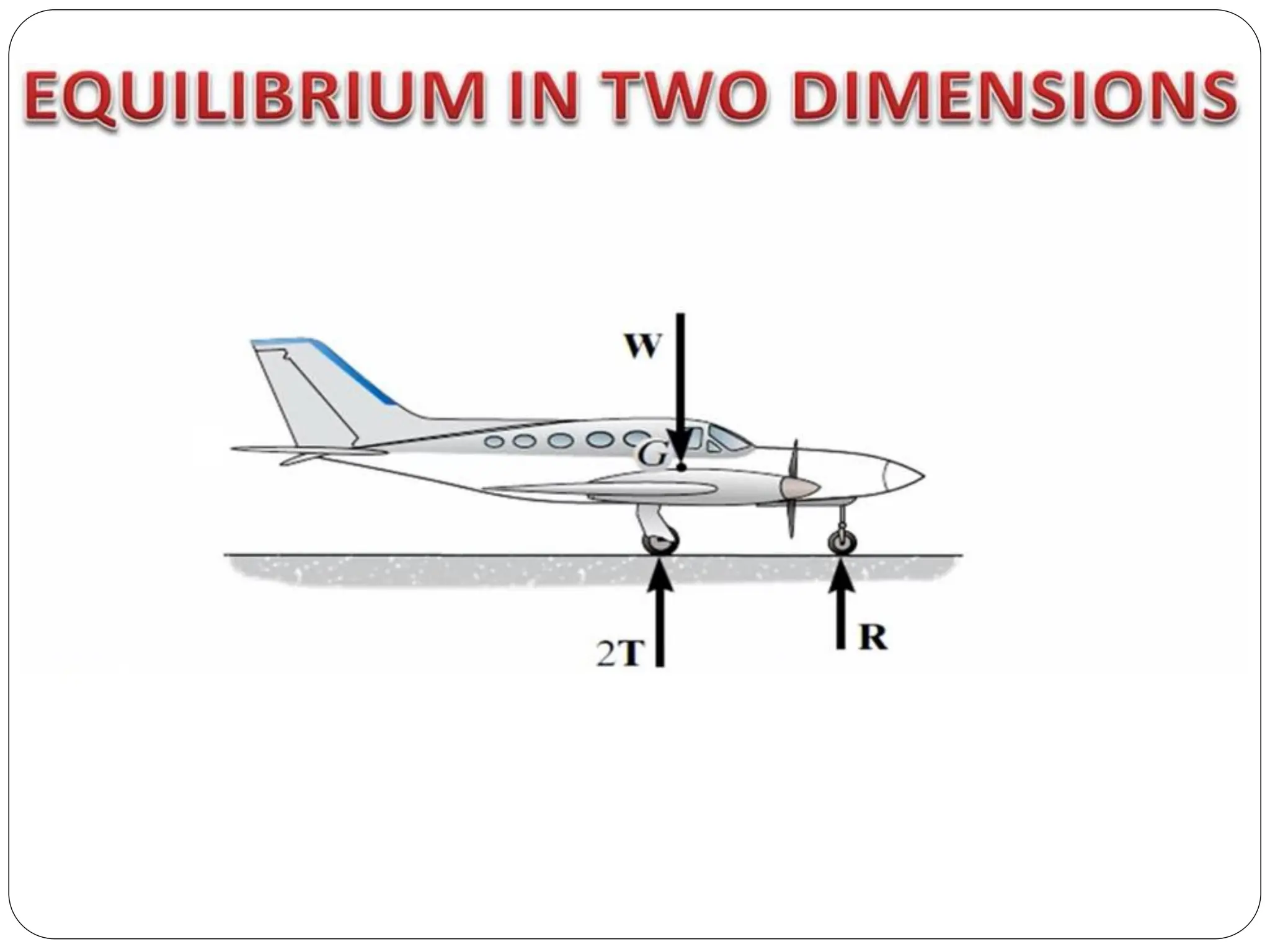
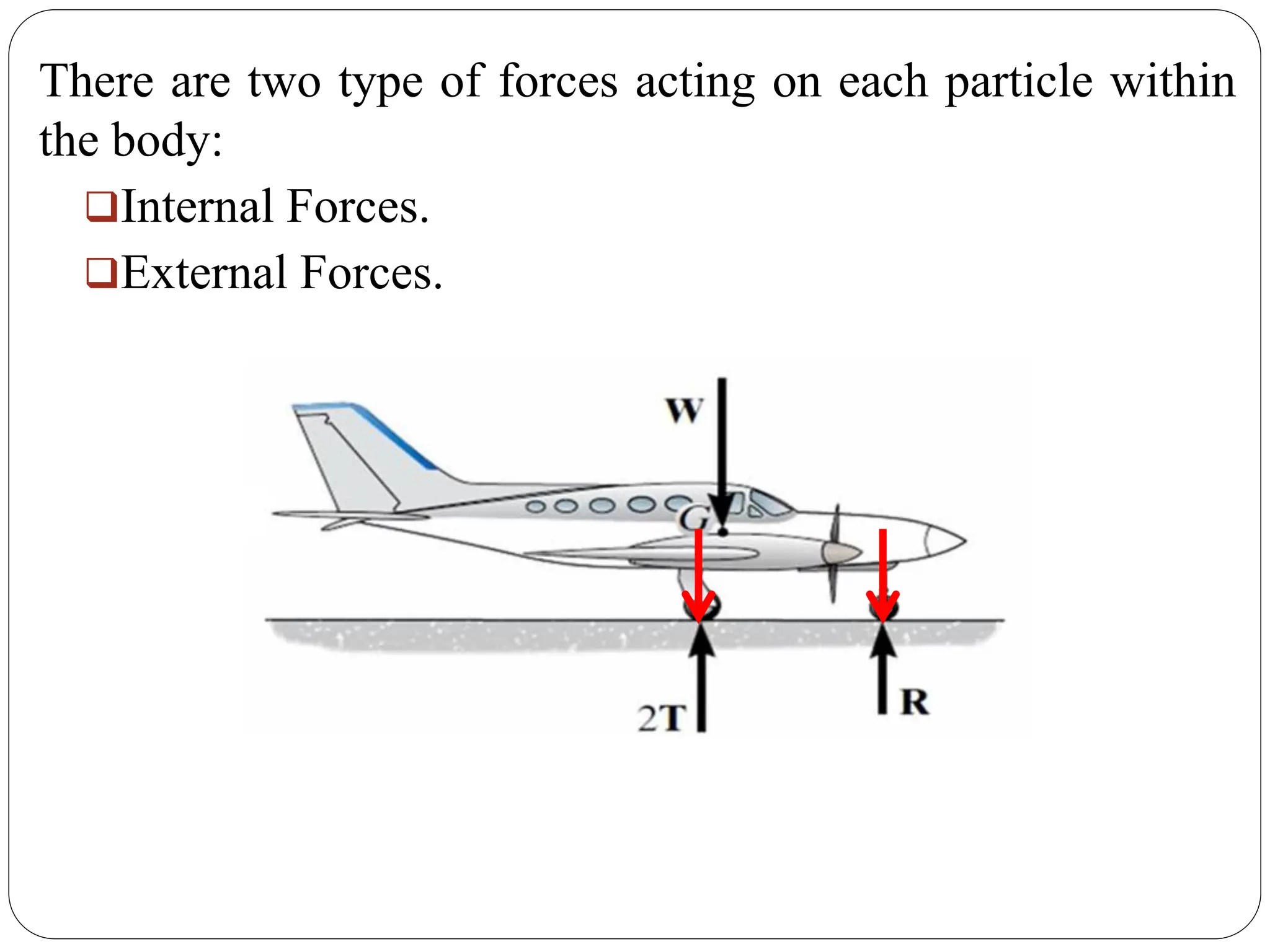
There are twotype of forces acting on each particle within
the body:
❑Internal Forces.
❑External Forces.
9.
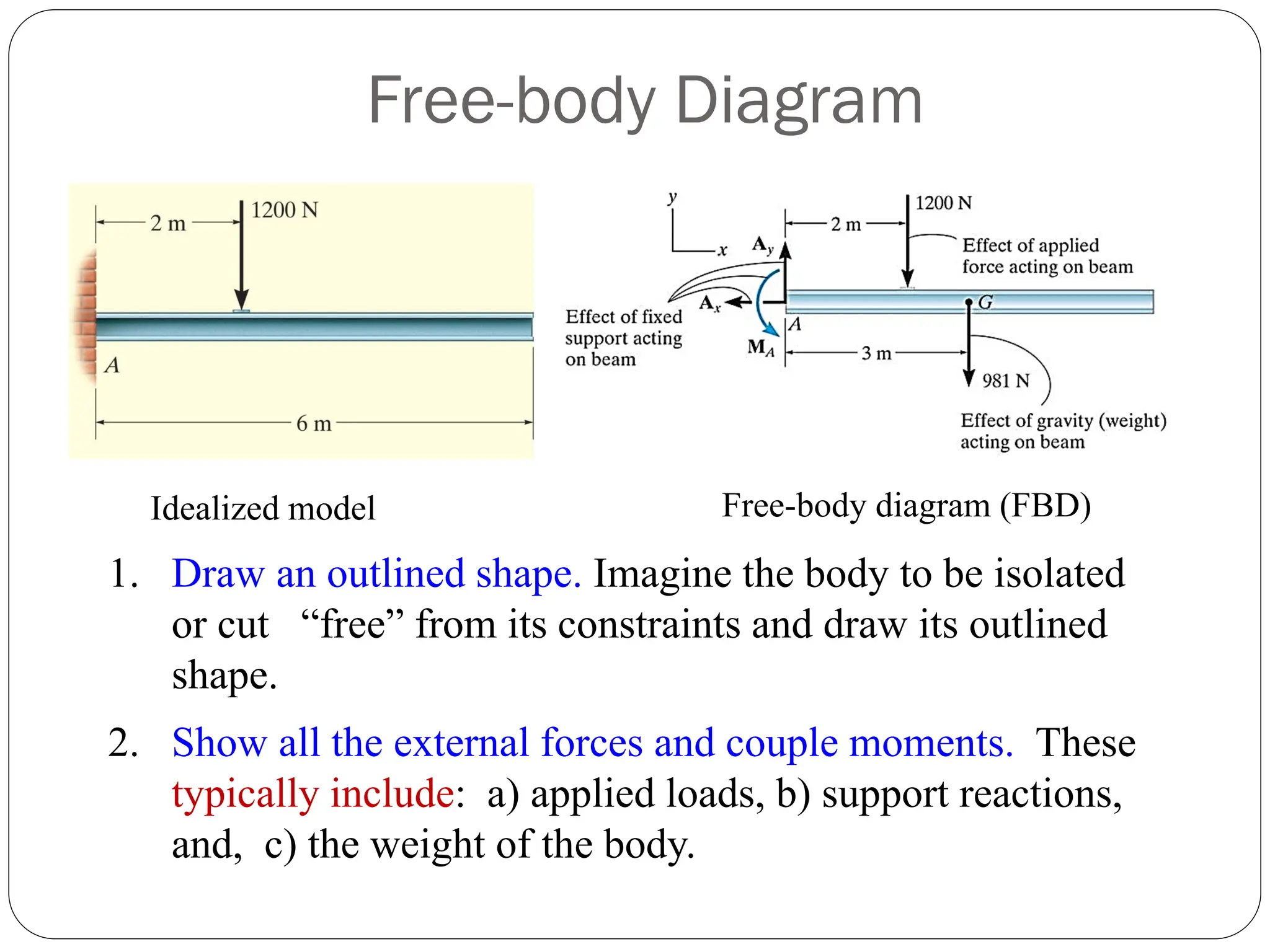
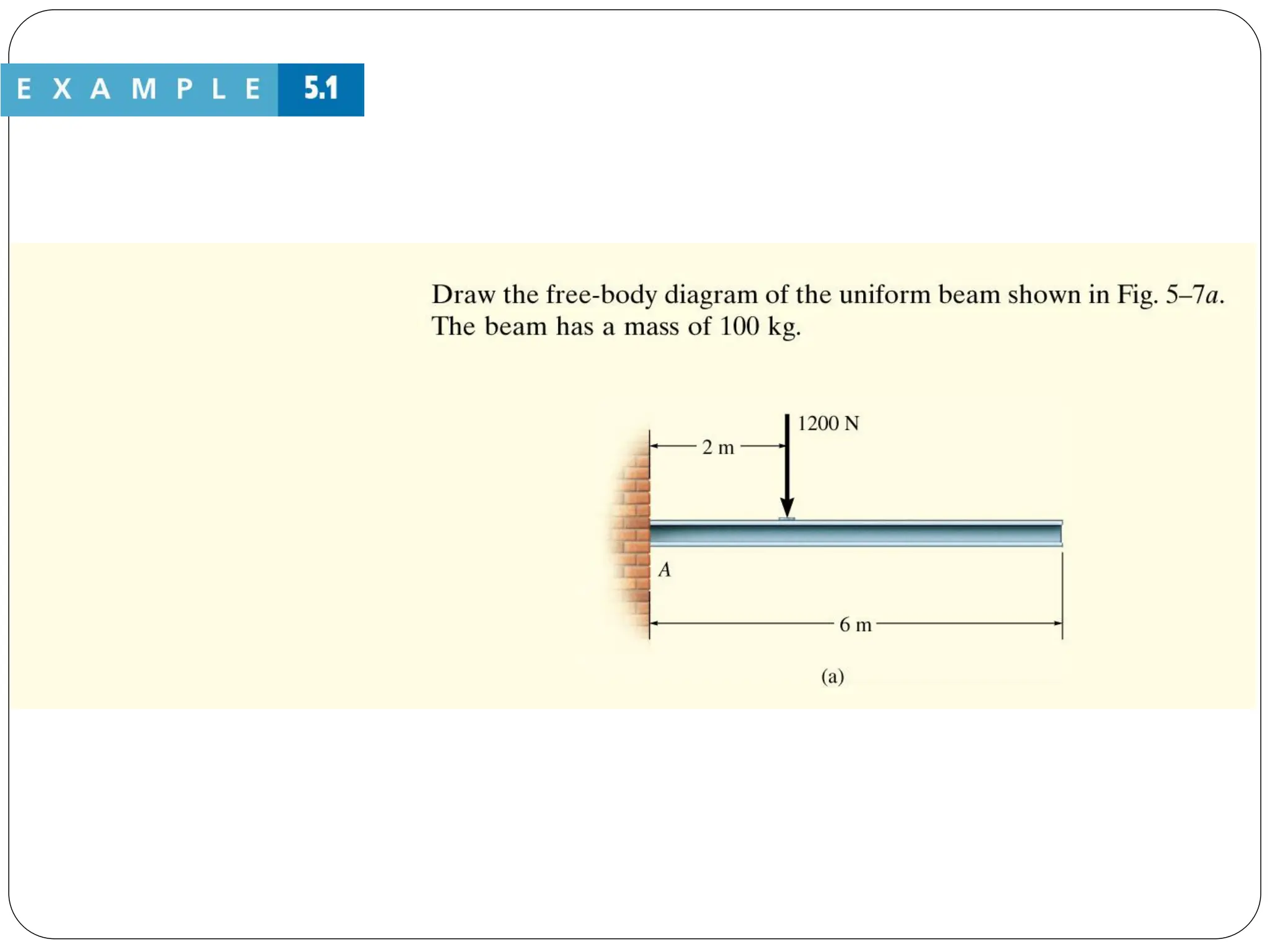
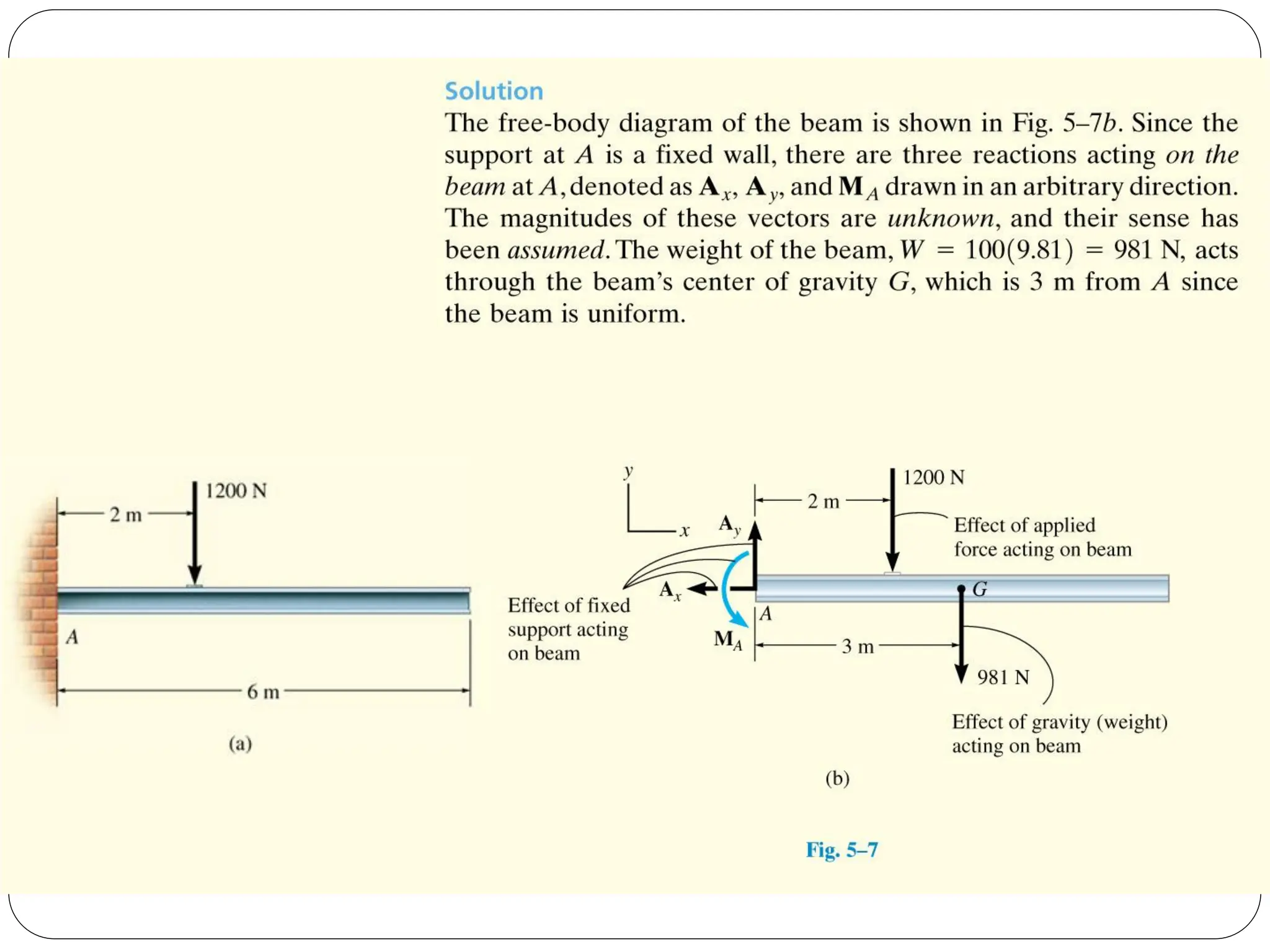
2. Show allthe external forces and couple moments. These
typically include: a) applied loads, b) support reactions,
and, c) the weight of the body.
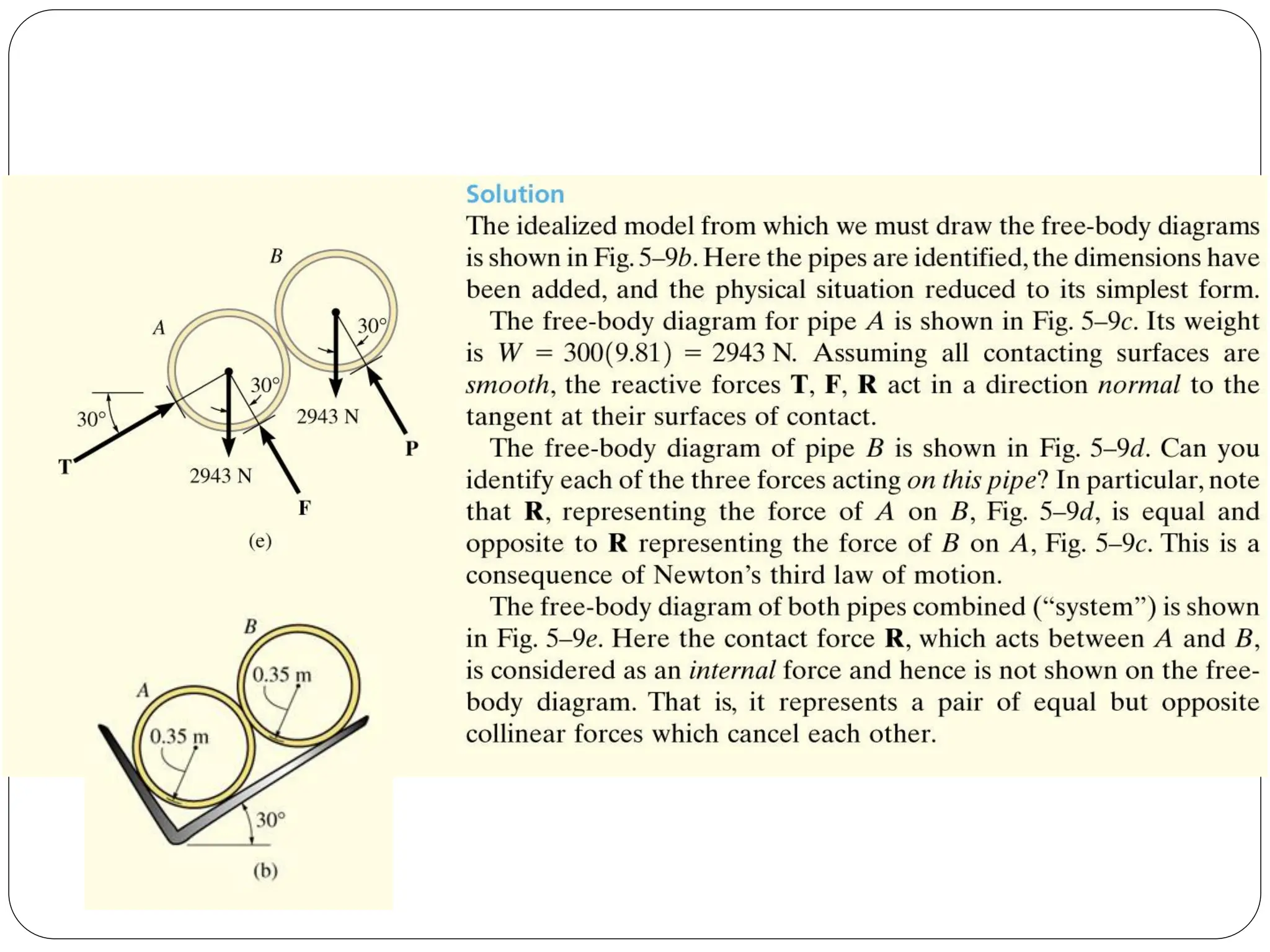
Idealized model Free-body diagram (FBD)
1. Draw an outlined shape. Imagine the body to be isolated
or cut “free” from its constraints and draw its outlined
shape.
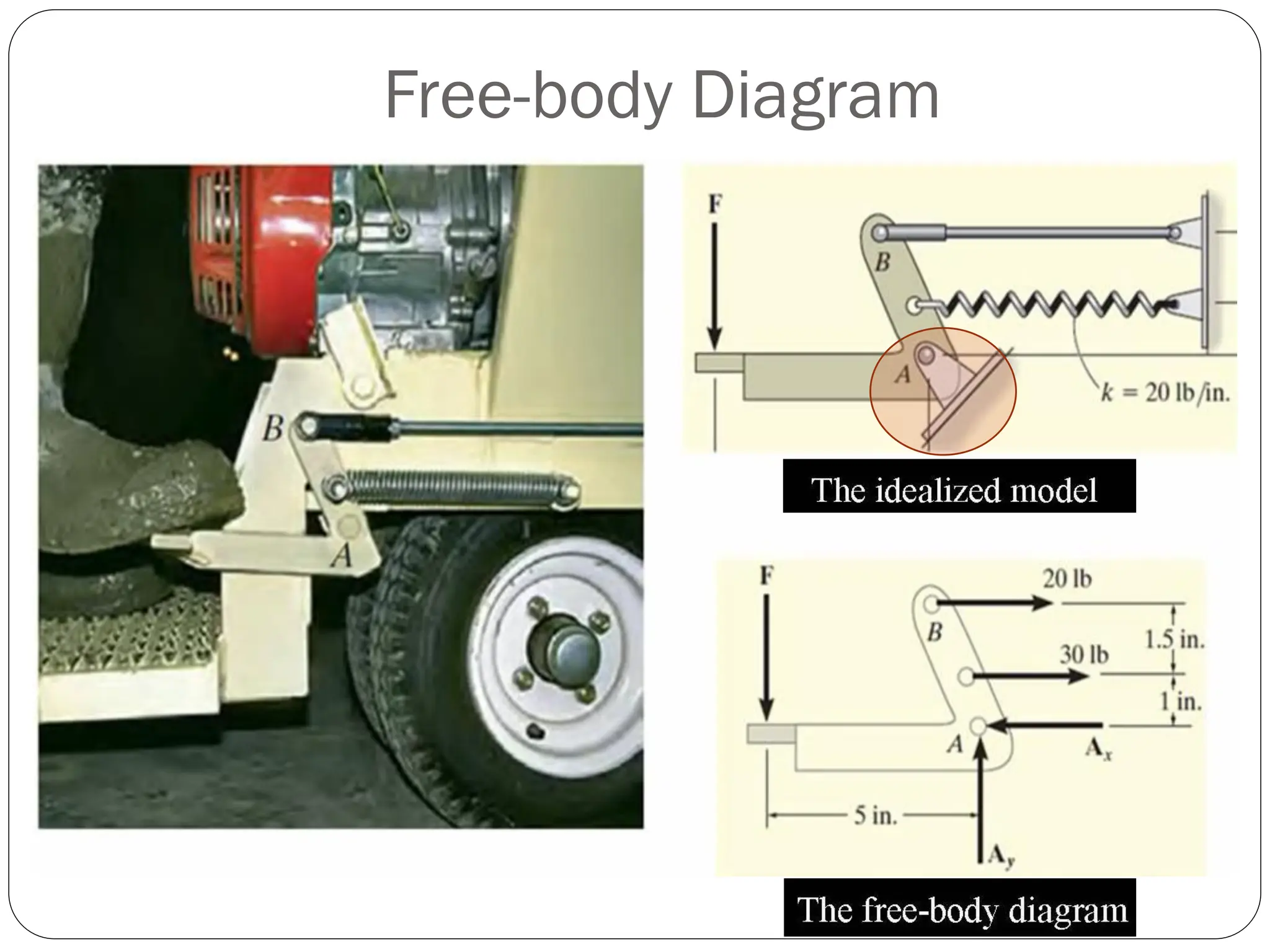
Free-body Diagram
10.
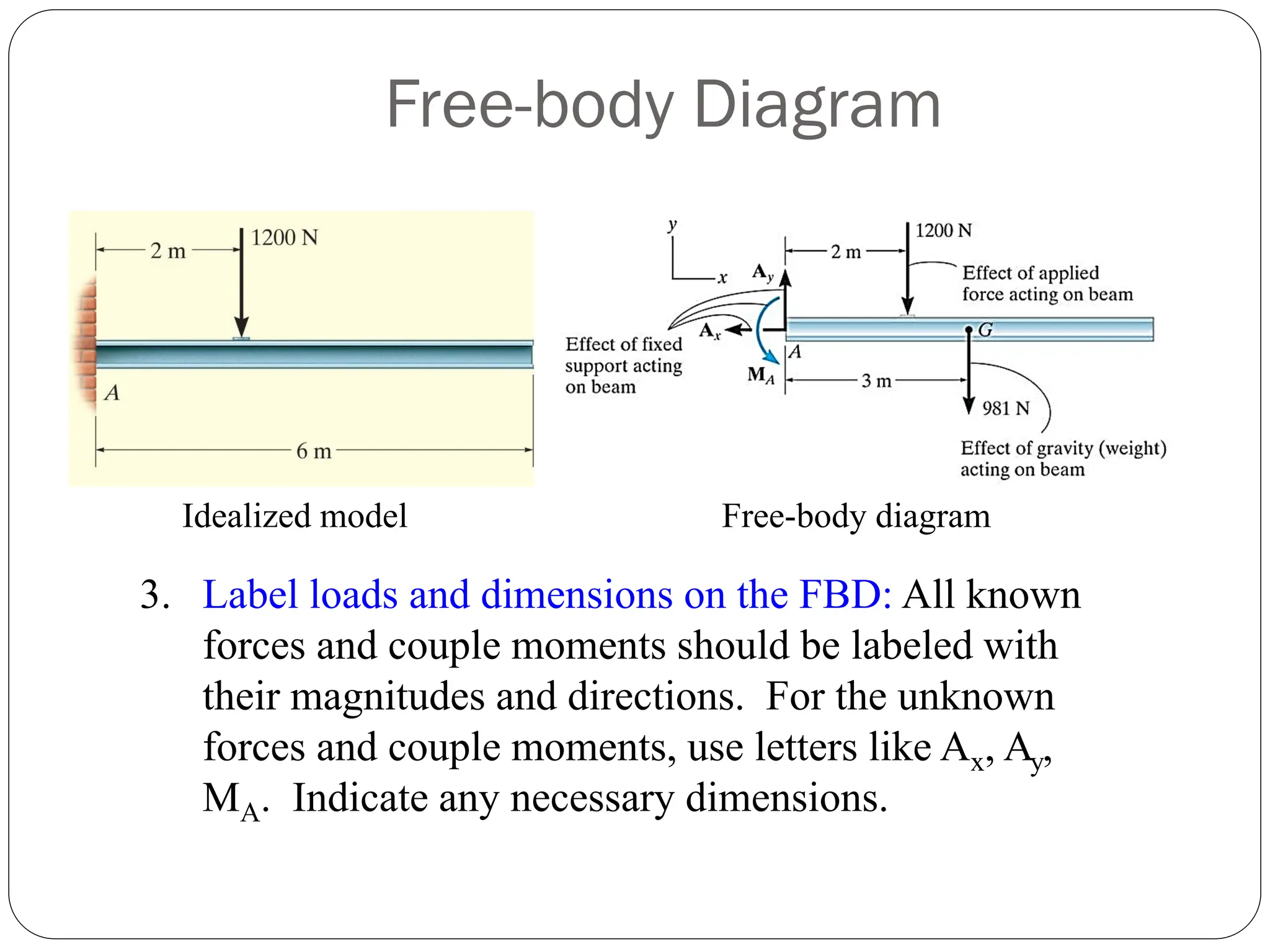
3. Label loadsand dimensions on the FBD: All known
forces and couple moments should be labeled with
their magnitudes and directions. For the unknown
forces and couple moments, use letters like Ax, Ay,
MA. Indicate any necessary dimensions.
Idealized model Free-body diagram
Free-body Diagram
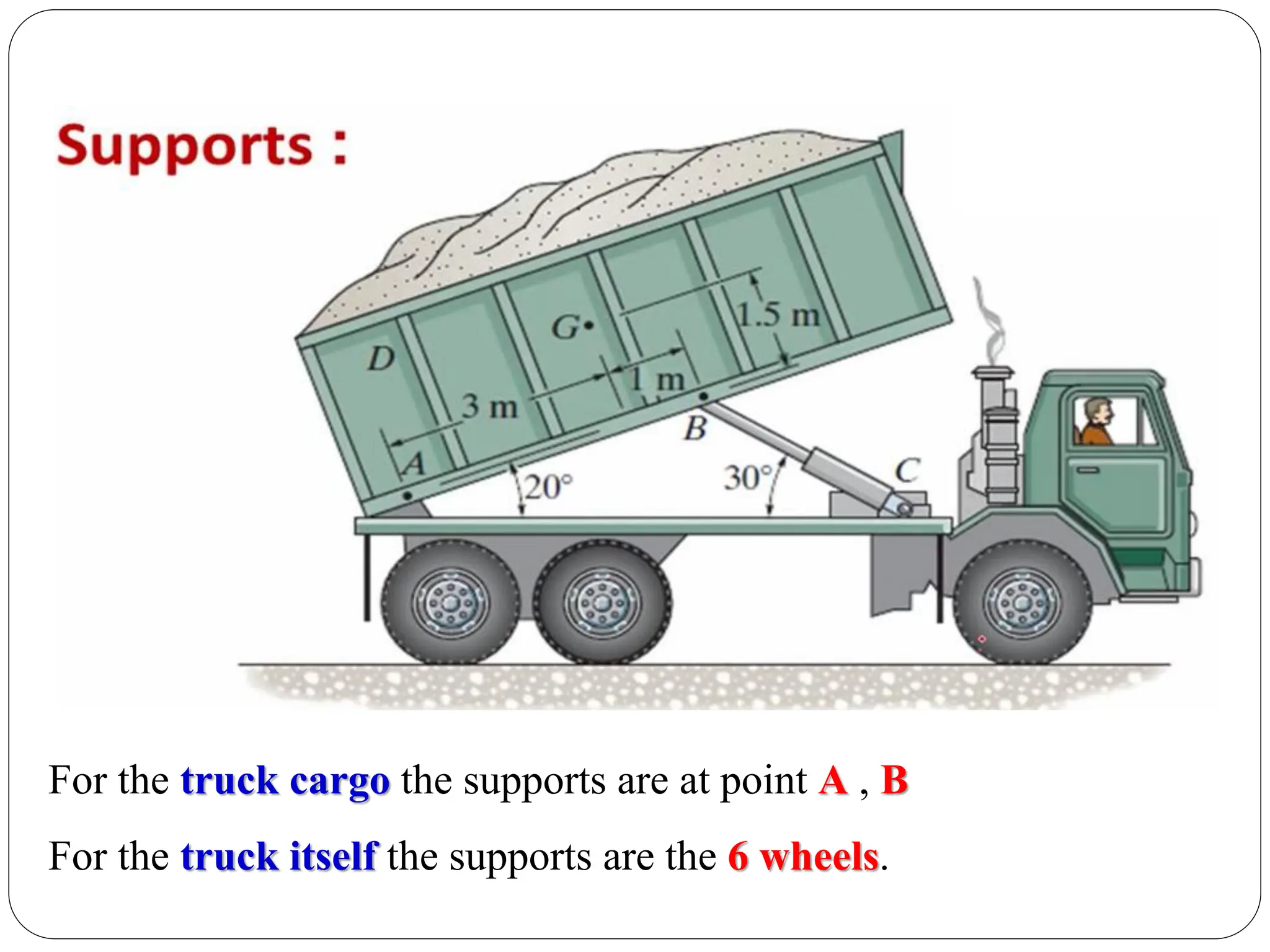
For the truckcargo the supports are at point A , B
For the truck itself the supports are the 6 wheels.
13.
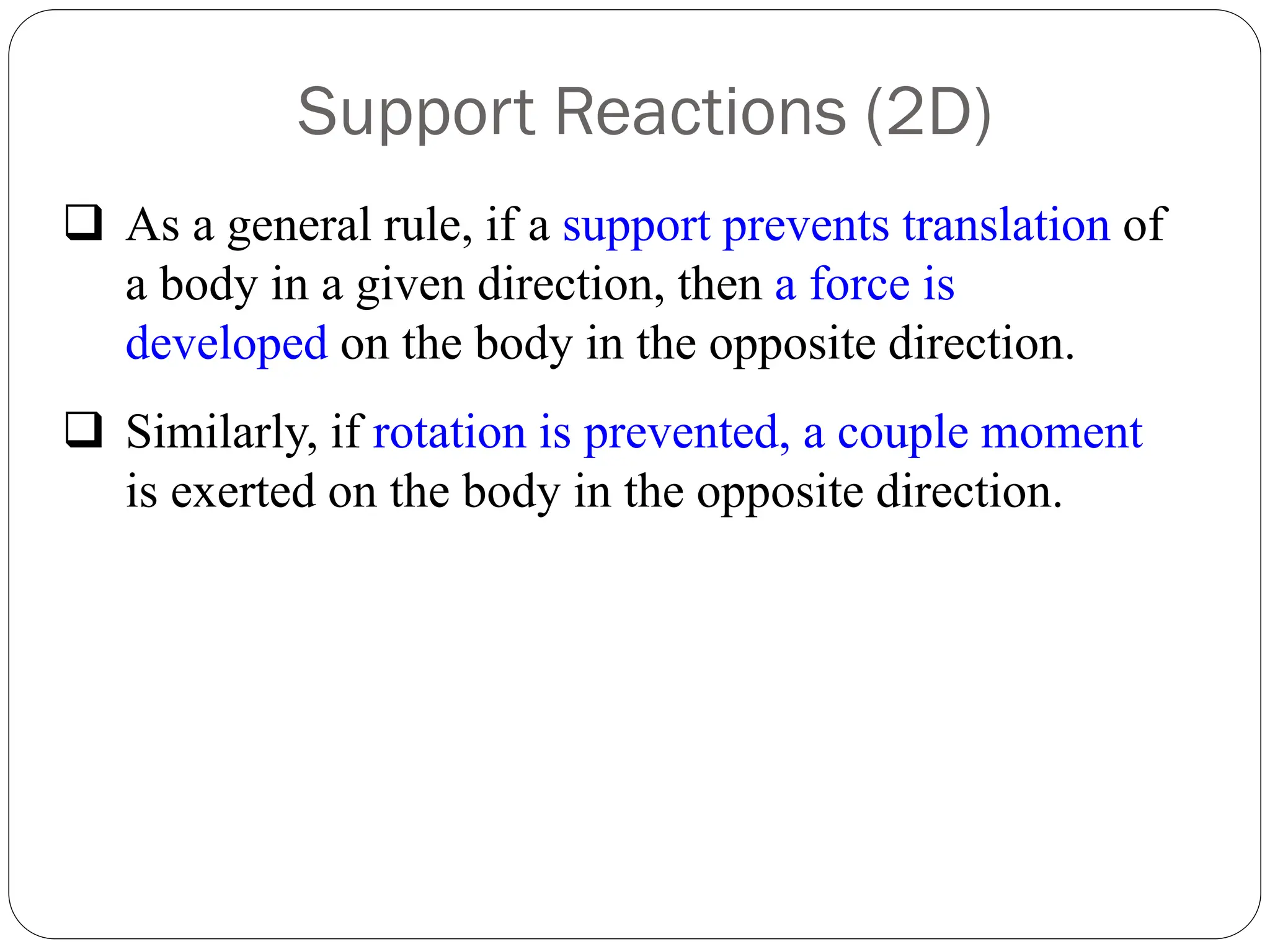
Support Reactions (2D)
❑As a general rule, if a support prevents translation of
a body in a given direction, then a force is
developed on the body in the opposite direction.
❑ Similarly, if rotation is prevented, a couple moment
is exerted on the body in the opposite direction.
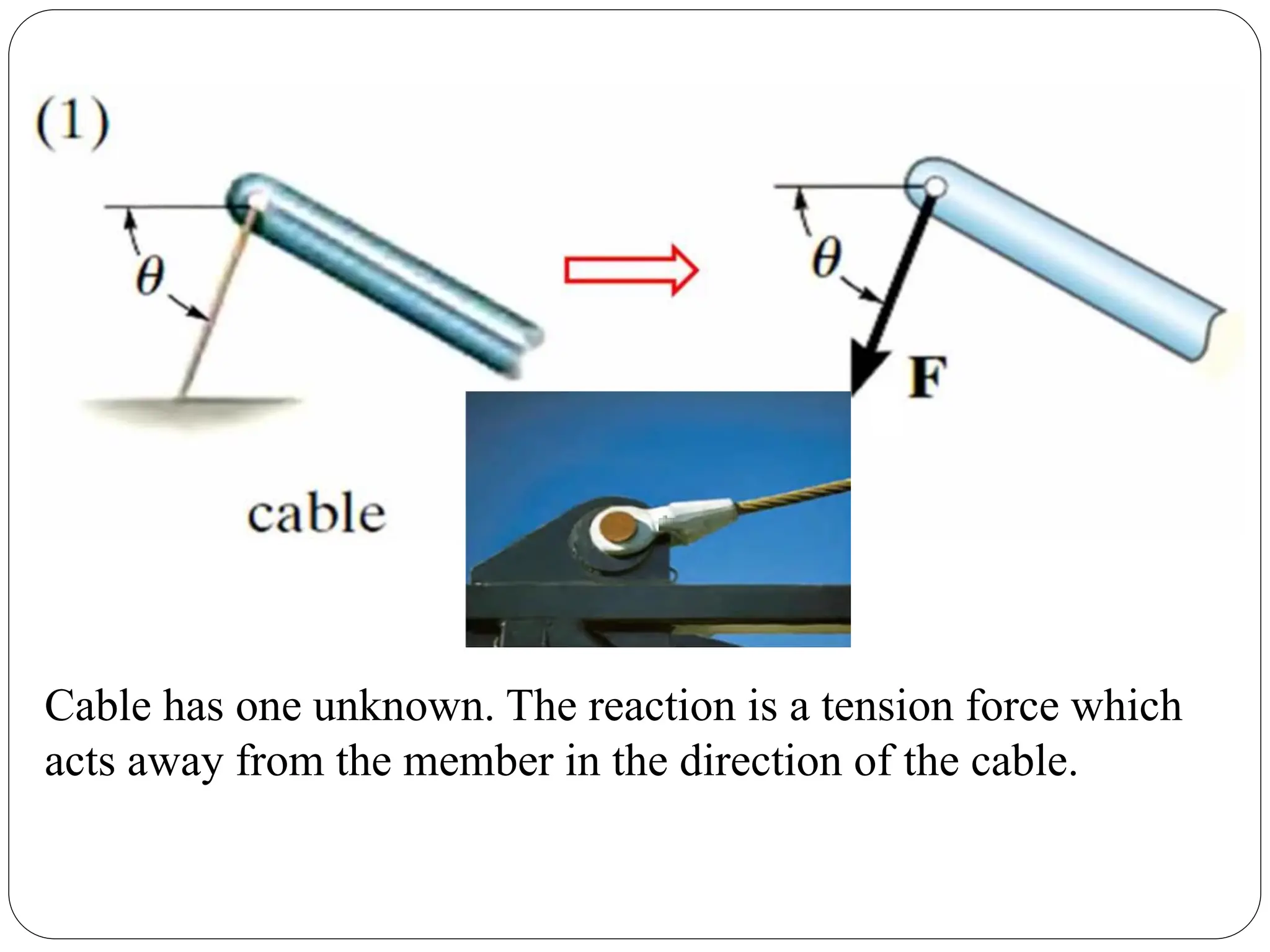
14.
Cable has oneunknown. The reaction is a tension force which
acts away from the member in the direction of the cable.
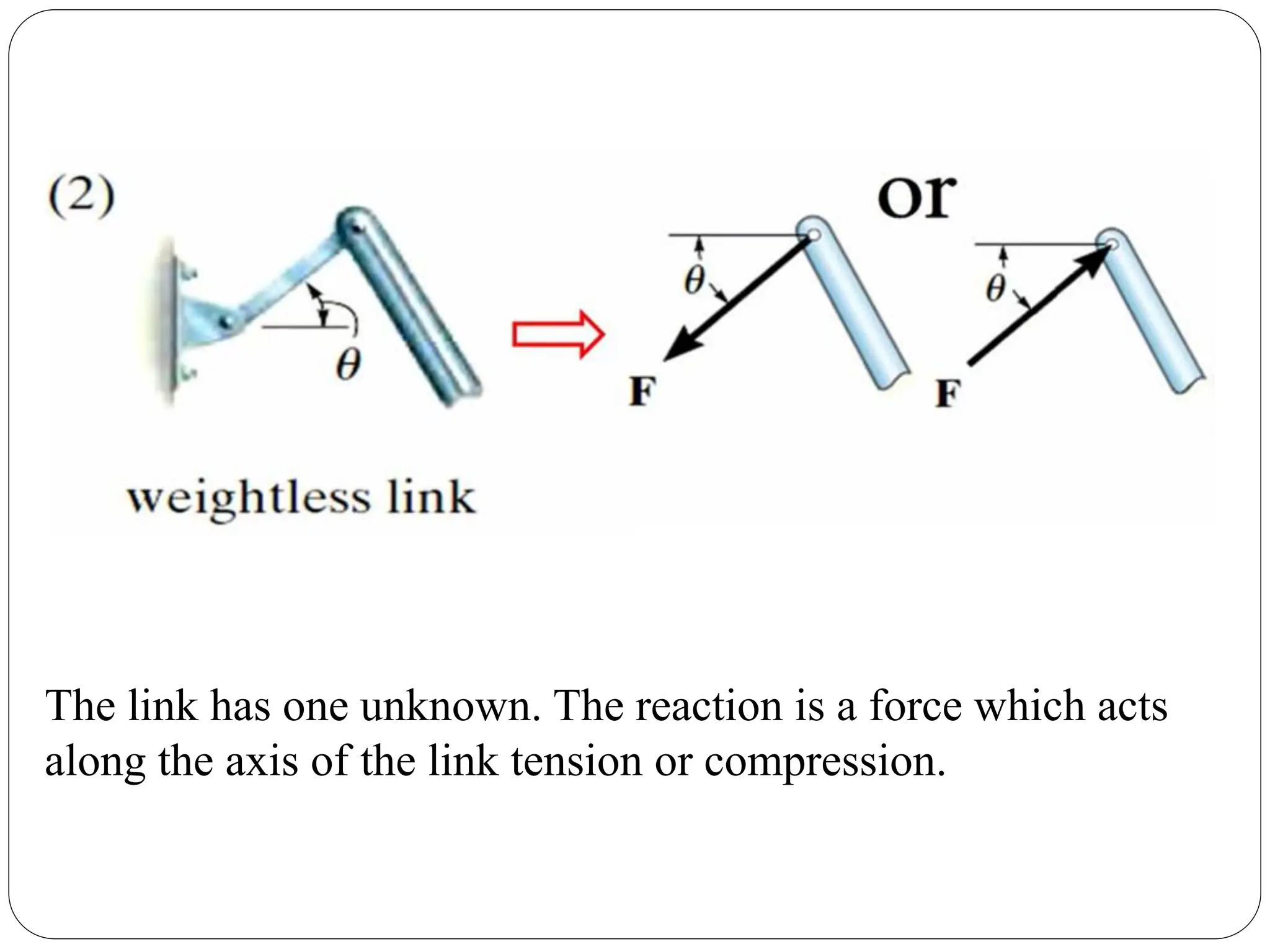
15.
The link hasone unknown. The reaction is a force which acts
along the axis of the link tension or compression.
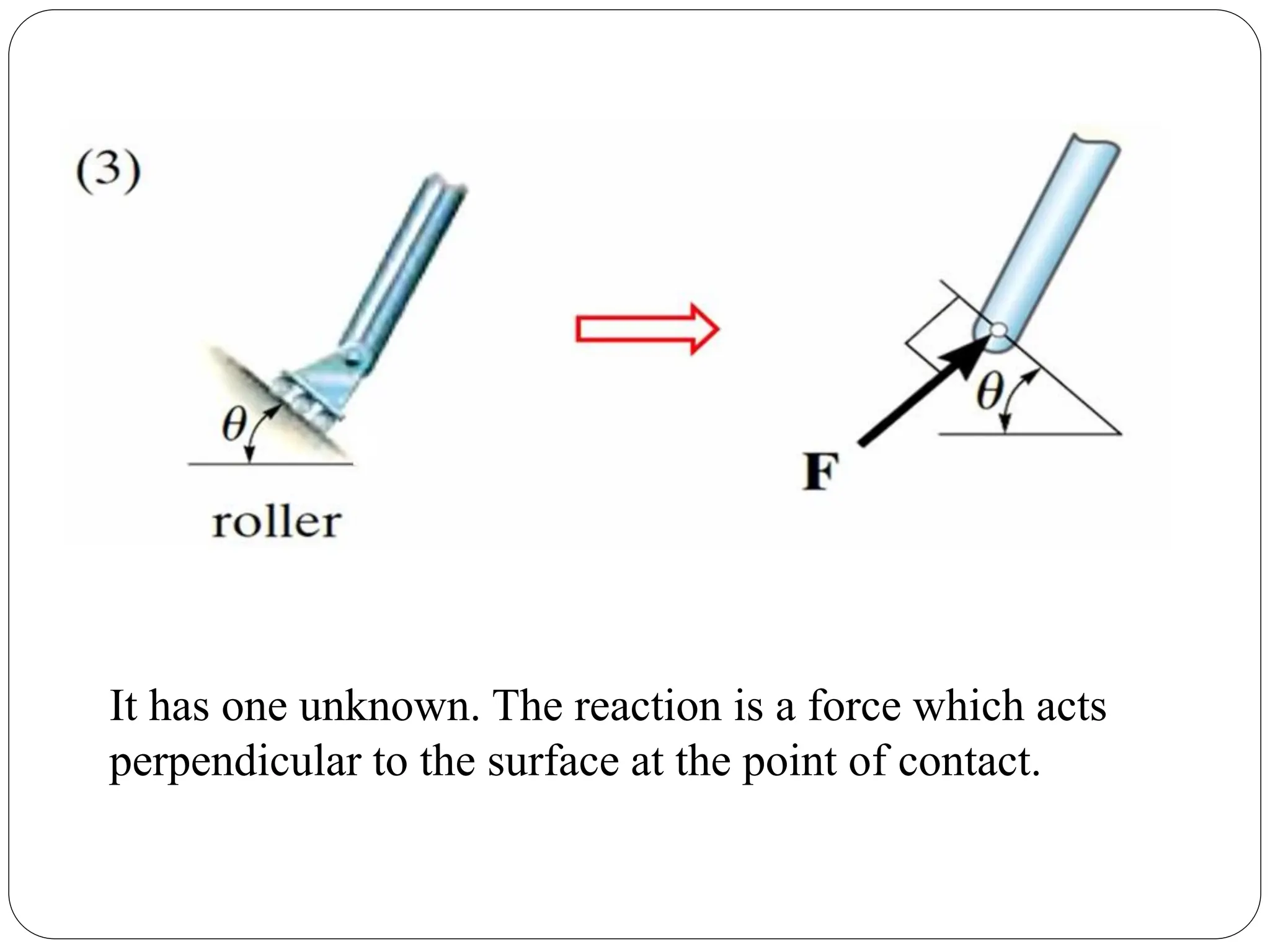
16.
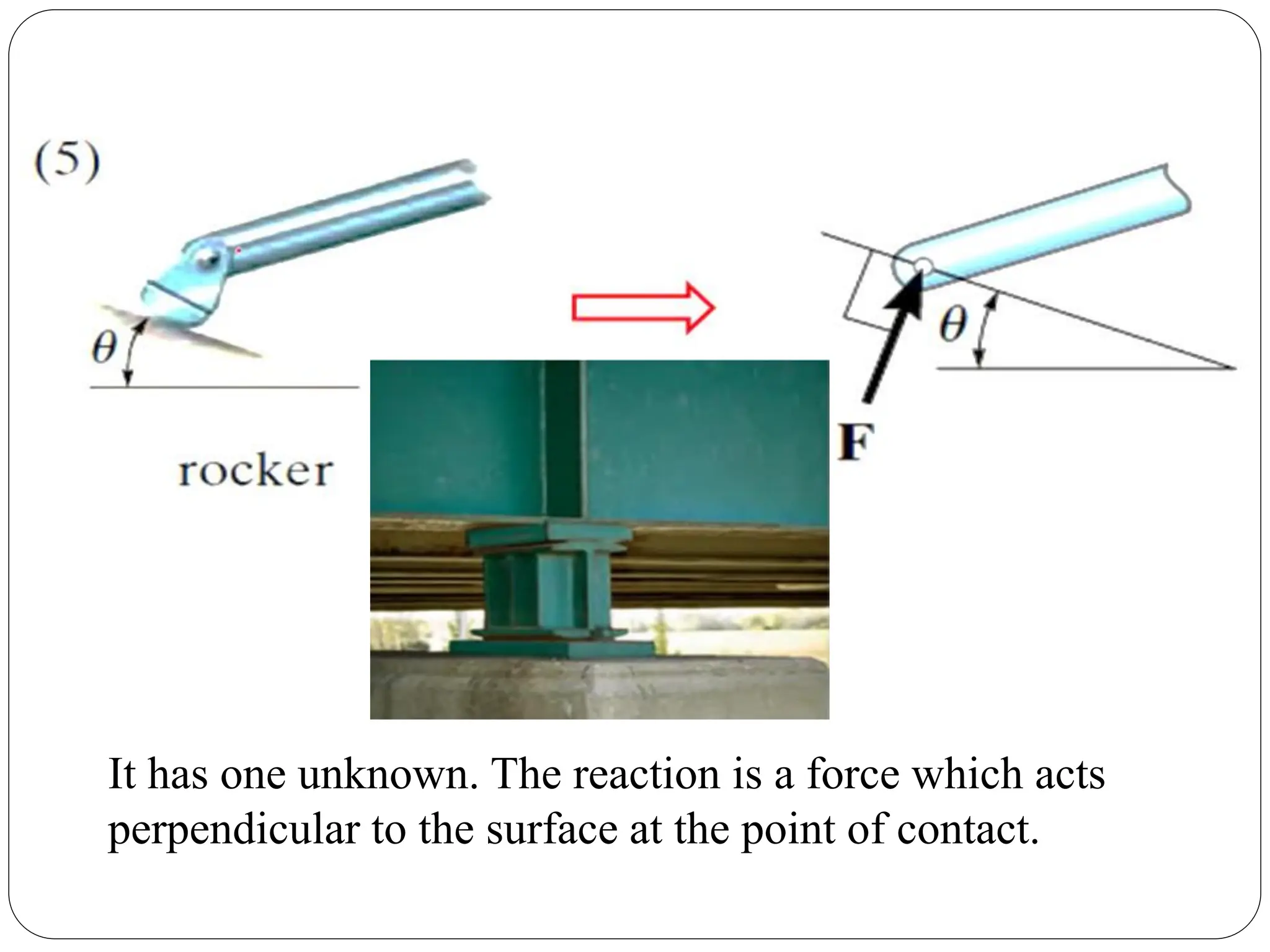
It has oneunknown. The reaction is a force which acts
perpendicular to the surface at the point of contact.
17.
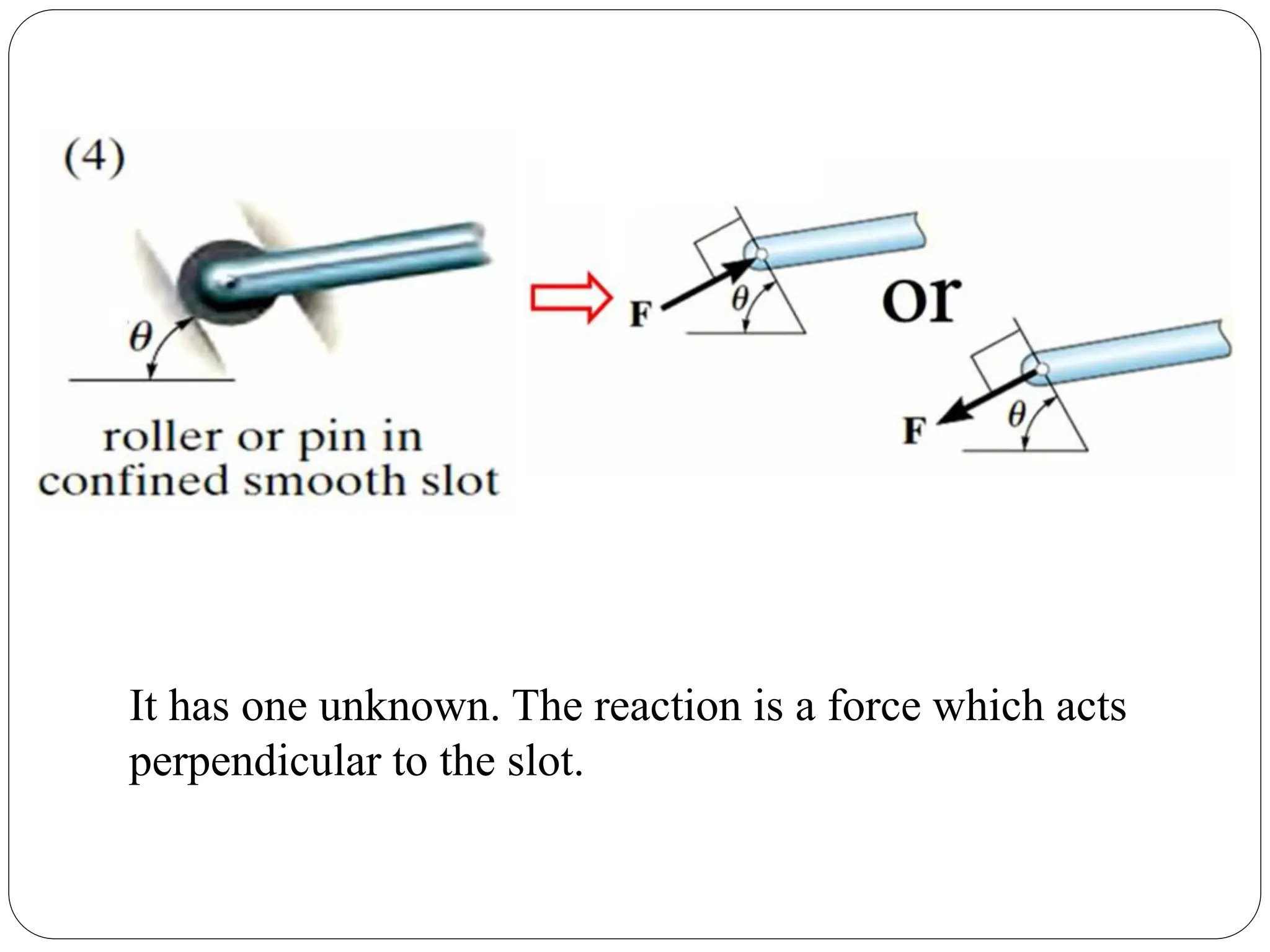
It has oneunknown. The reaction is a force which acts
perpendicular to the slot.
18.
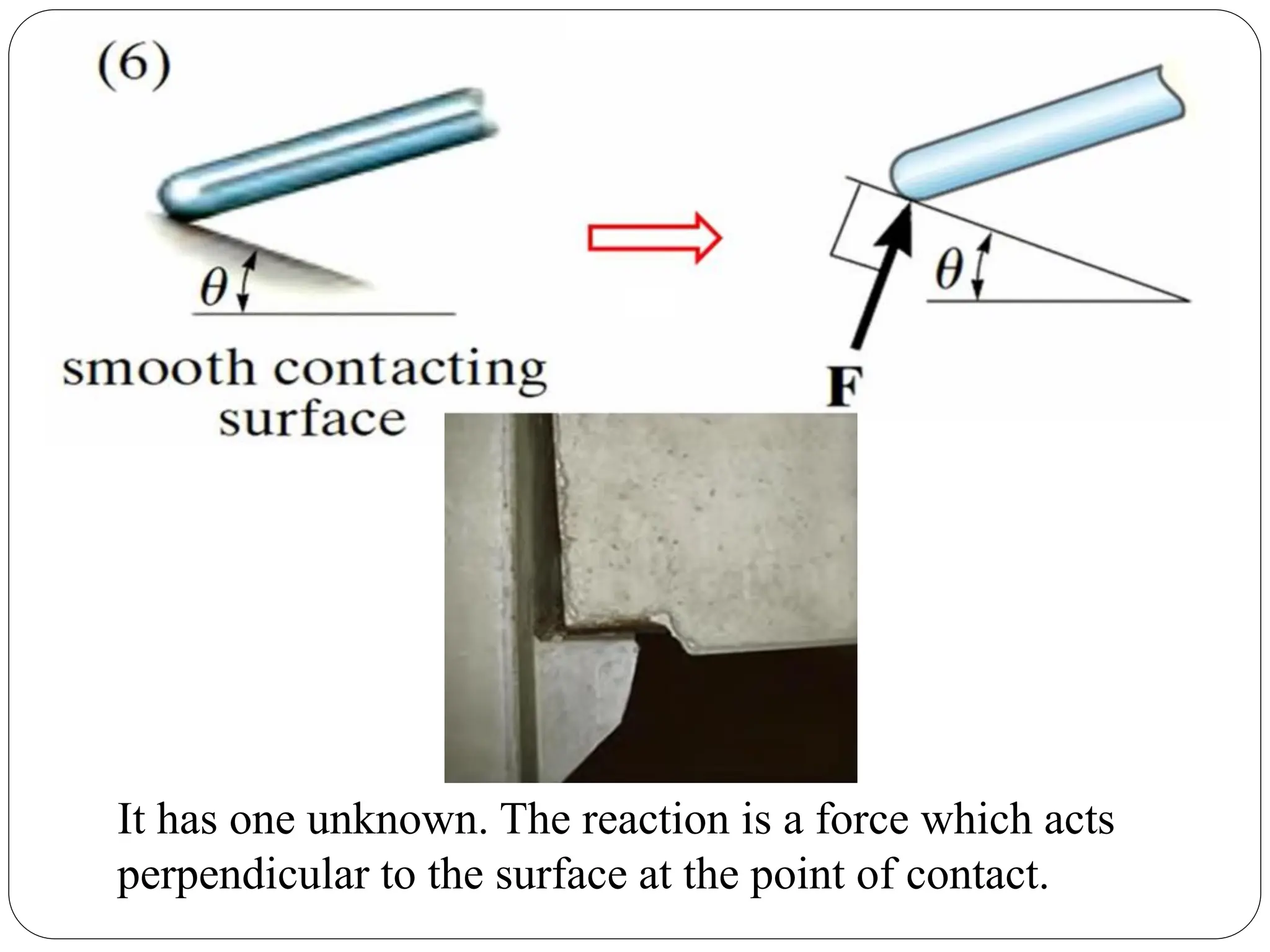
It has oneunknown. The reaction is a force which acts
perpendicular to the surface at the point of contact.
19.
It has oneunknown. The reaction is a force which acts
perpendicular to the surface at the point of contact.
20.
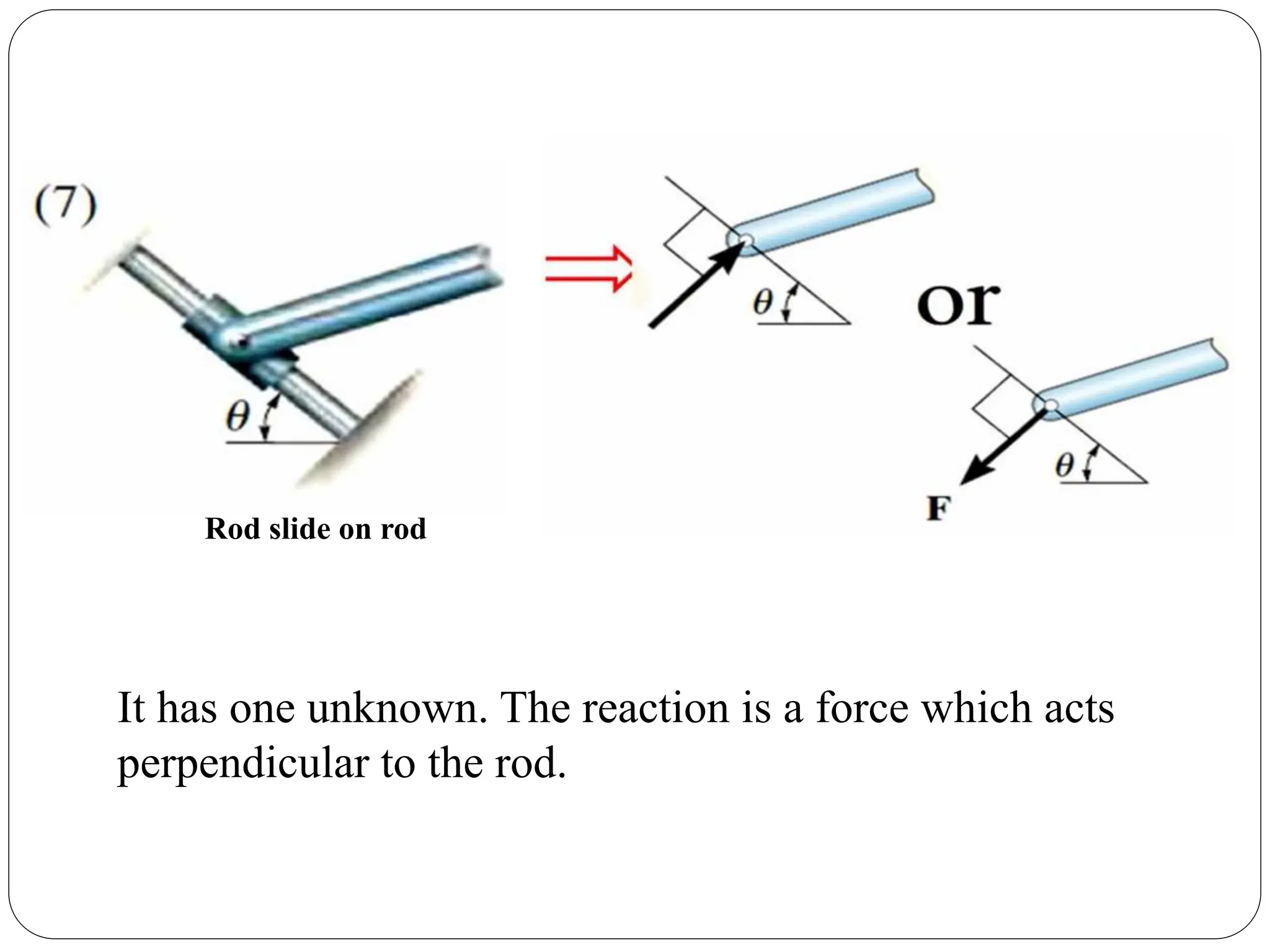
It has oneunknown. The reaction is a force which acts
perpendicular to the rod.
Rod slide on rod
21.
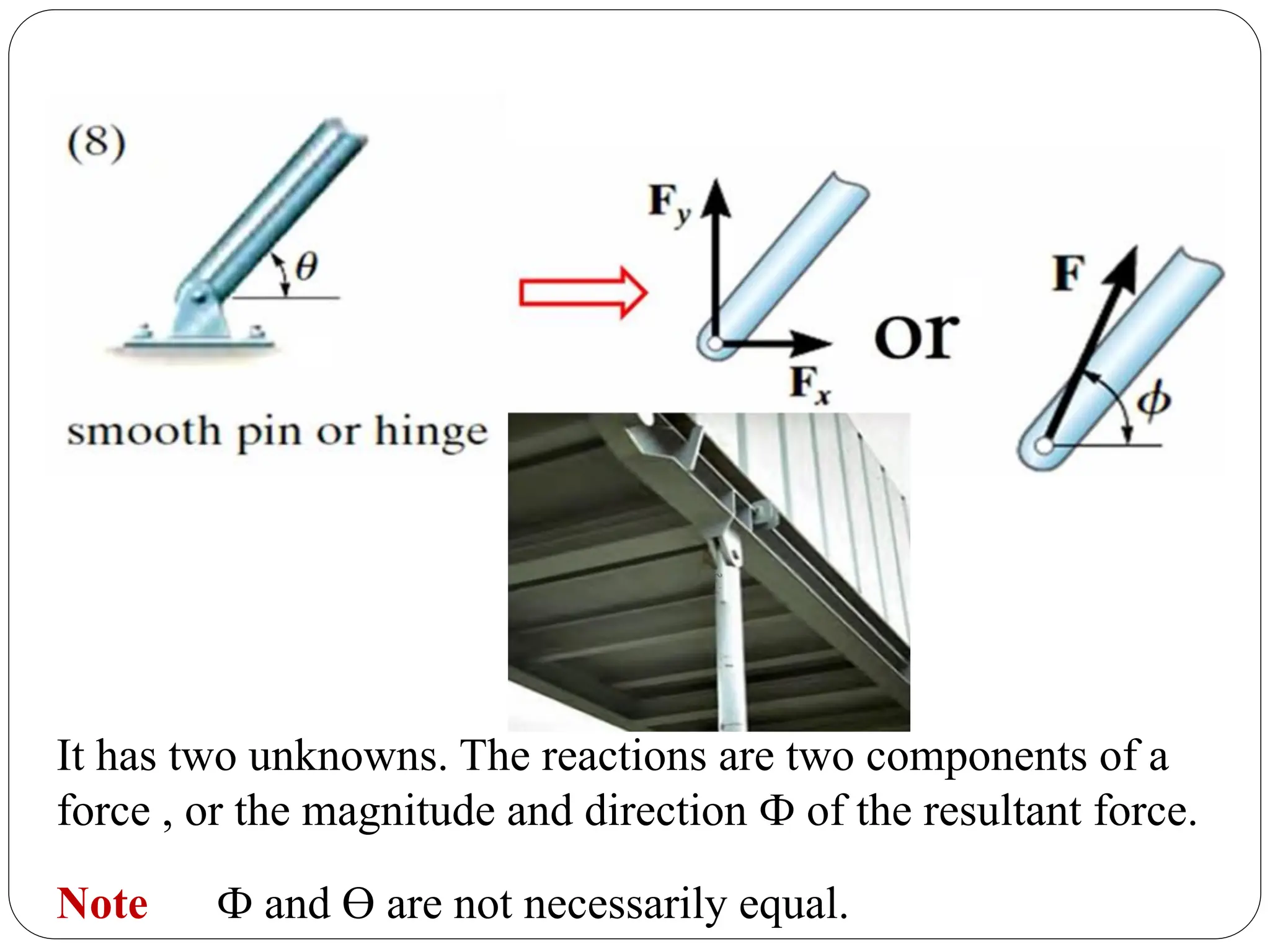
It has twounknowns. The reactions are two components of a
force , or the magnitude and direction Ф of the resultant force.
Note Ф and ϴ are not necessarily equal.
22.
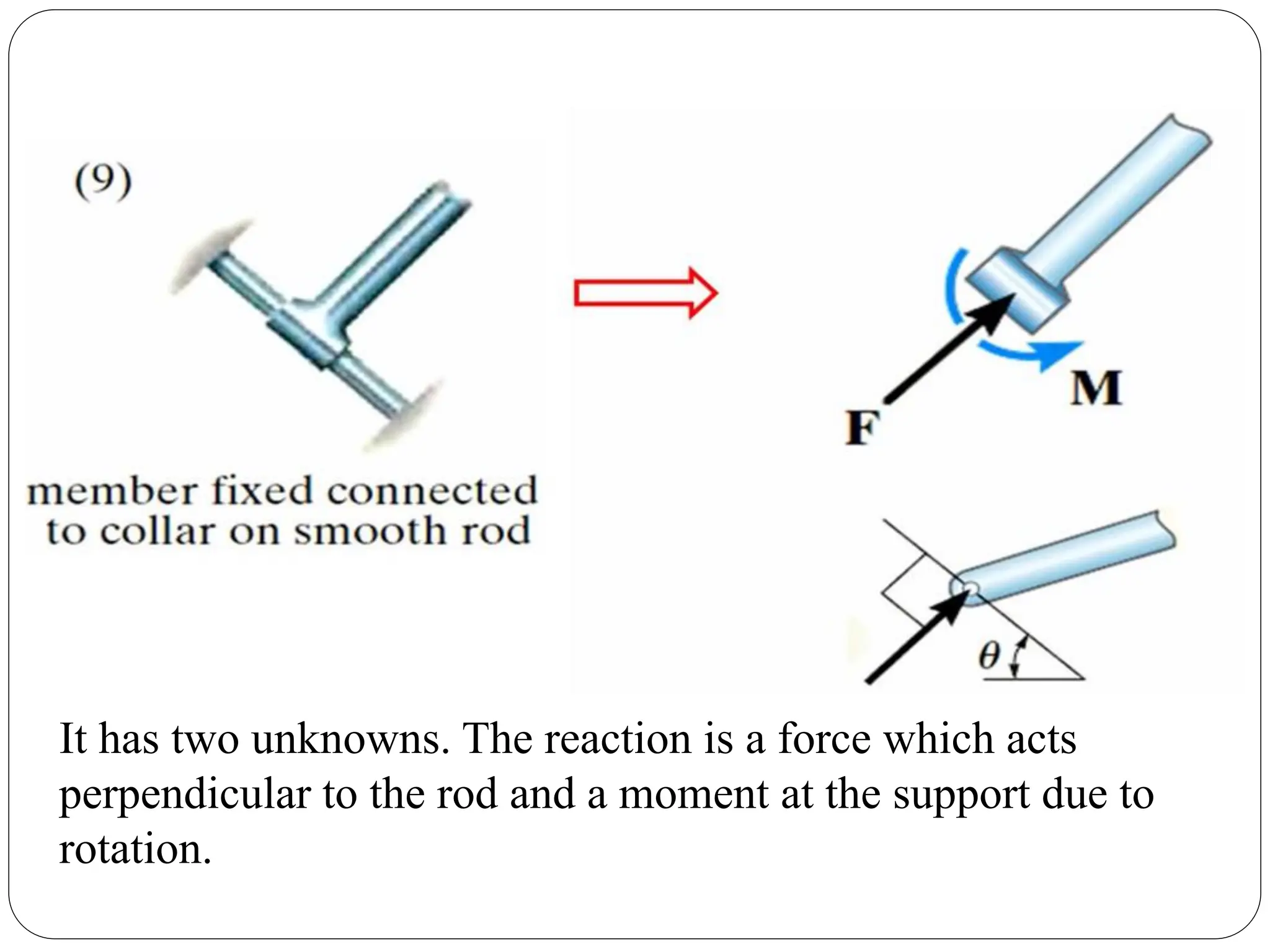
It has twounknowns. The reaction is a force which acts
perpendicular to the rod and a moment at the support due to
rotation.
23.
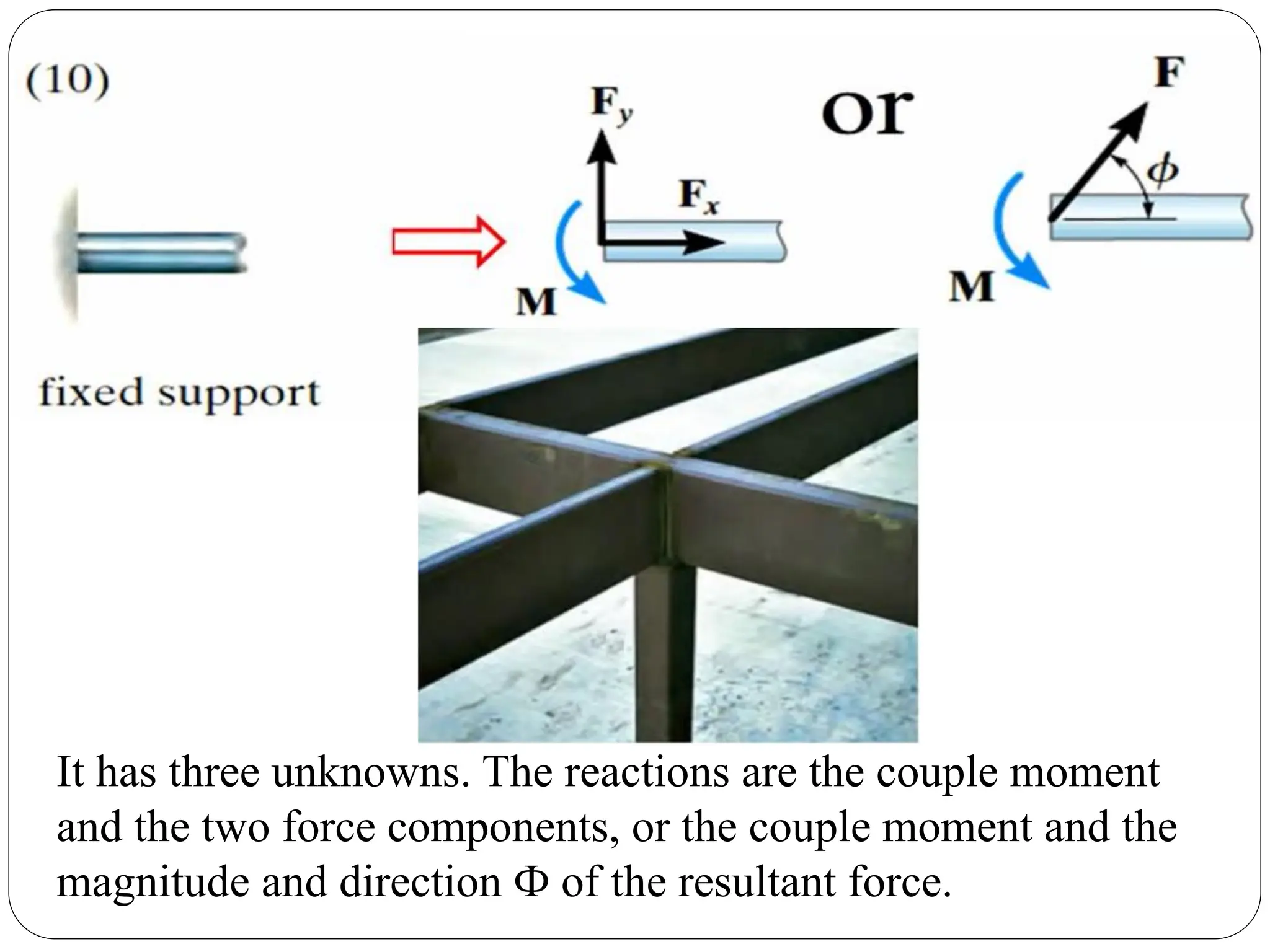
It has threeunknowns. The reactions are the couple moment
and the two force components, or the couple moment and the
magnitude and direction Ф of the resultant force.
24.
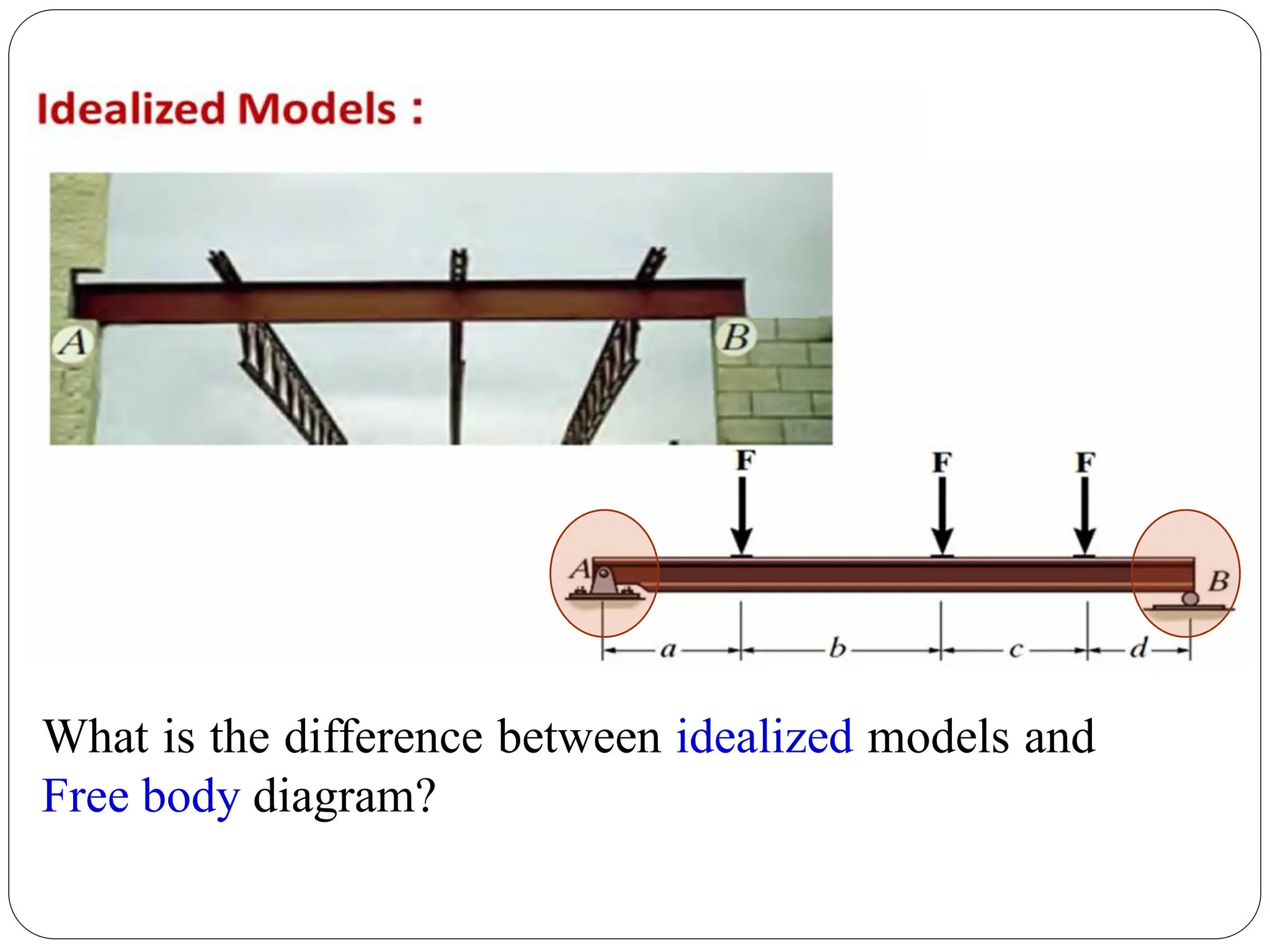
What is thedifference between idealized models and
Free body diagram?
30.
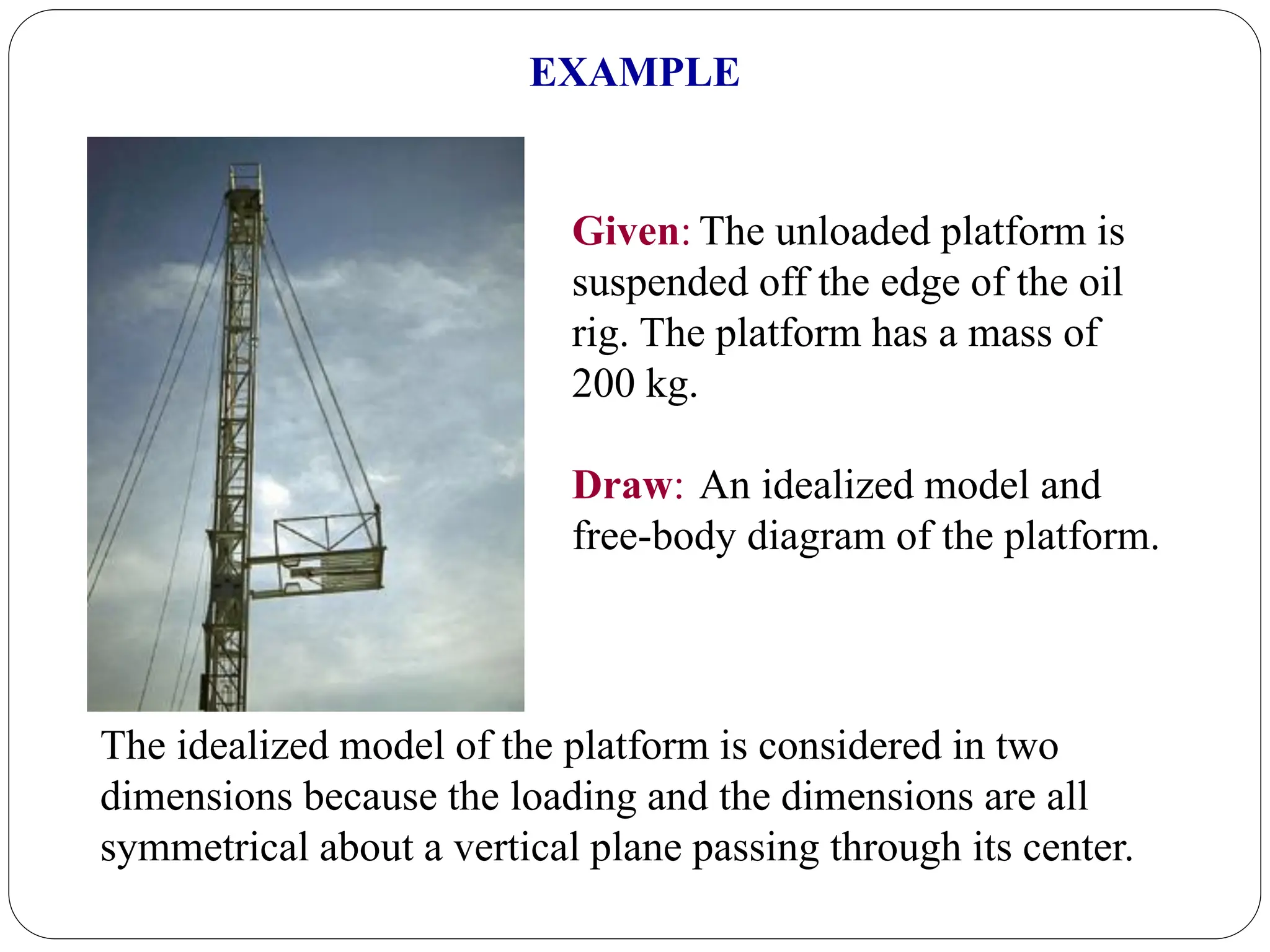
Given: The unloadedplatform is
suspended off the edge of the oil
rig. The platform has a mass of
200 kg.
Draw: An idealized model and
free-body diagram of the platform.
EXAMPLE
The idealized model of the platform is considered in two
dimensions because the loading and the dimensions are all
symmetrical about a vertical plane passing through its center.
31.
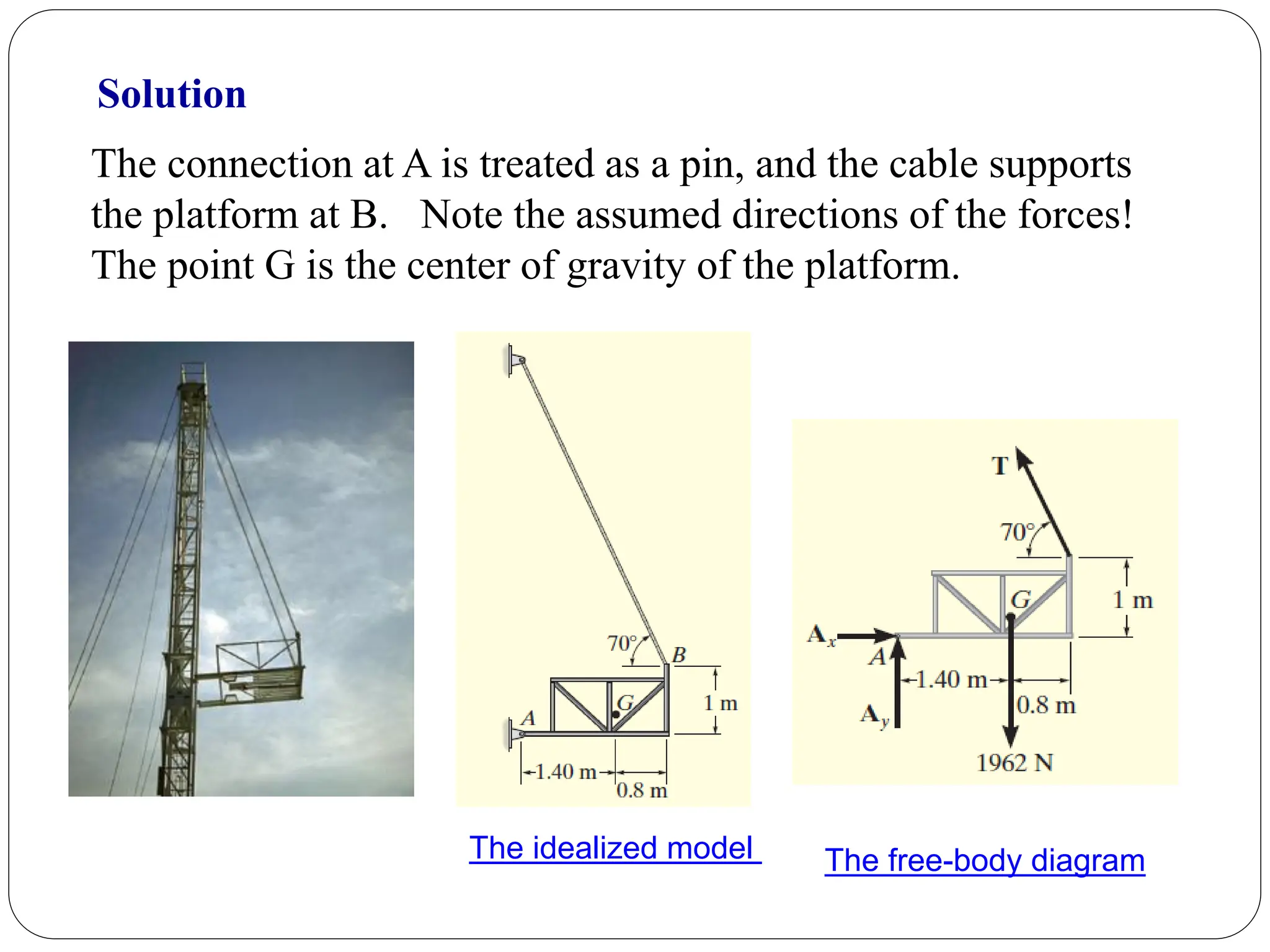
The connection atA is treated as a pin, and the cable supports
the platform at B. Note the assumed directions of the forces!
The point G is the center of gravity of the platform.
Solution
The idealized model The free-body diagram
32.
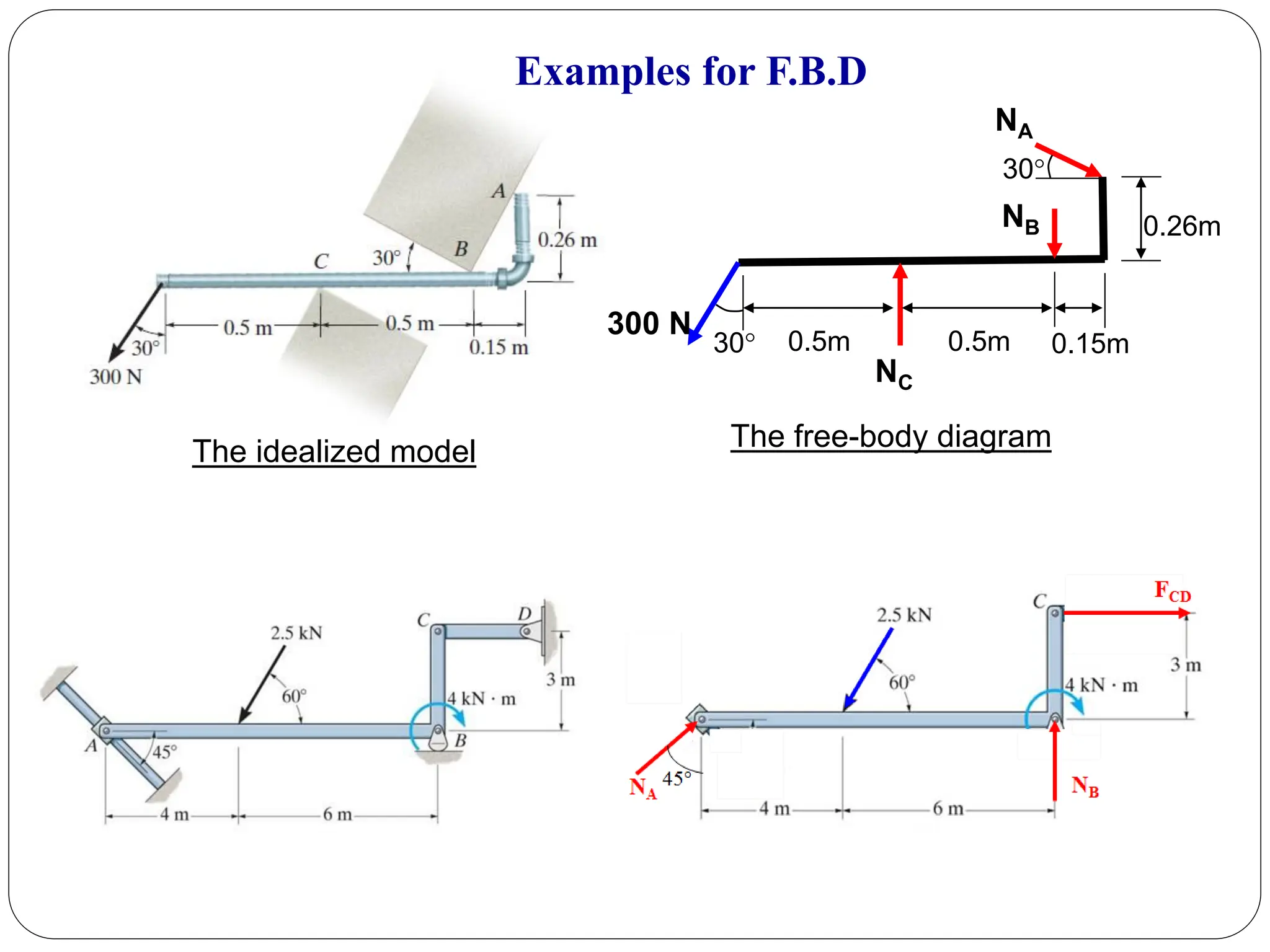
The idealized model
300N
0.5m 0.5m 0.15m
0.26m
30
30
NC
NB
NA
The free-body diagram
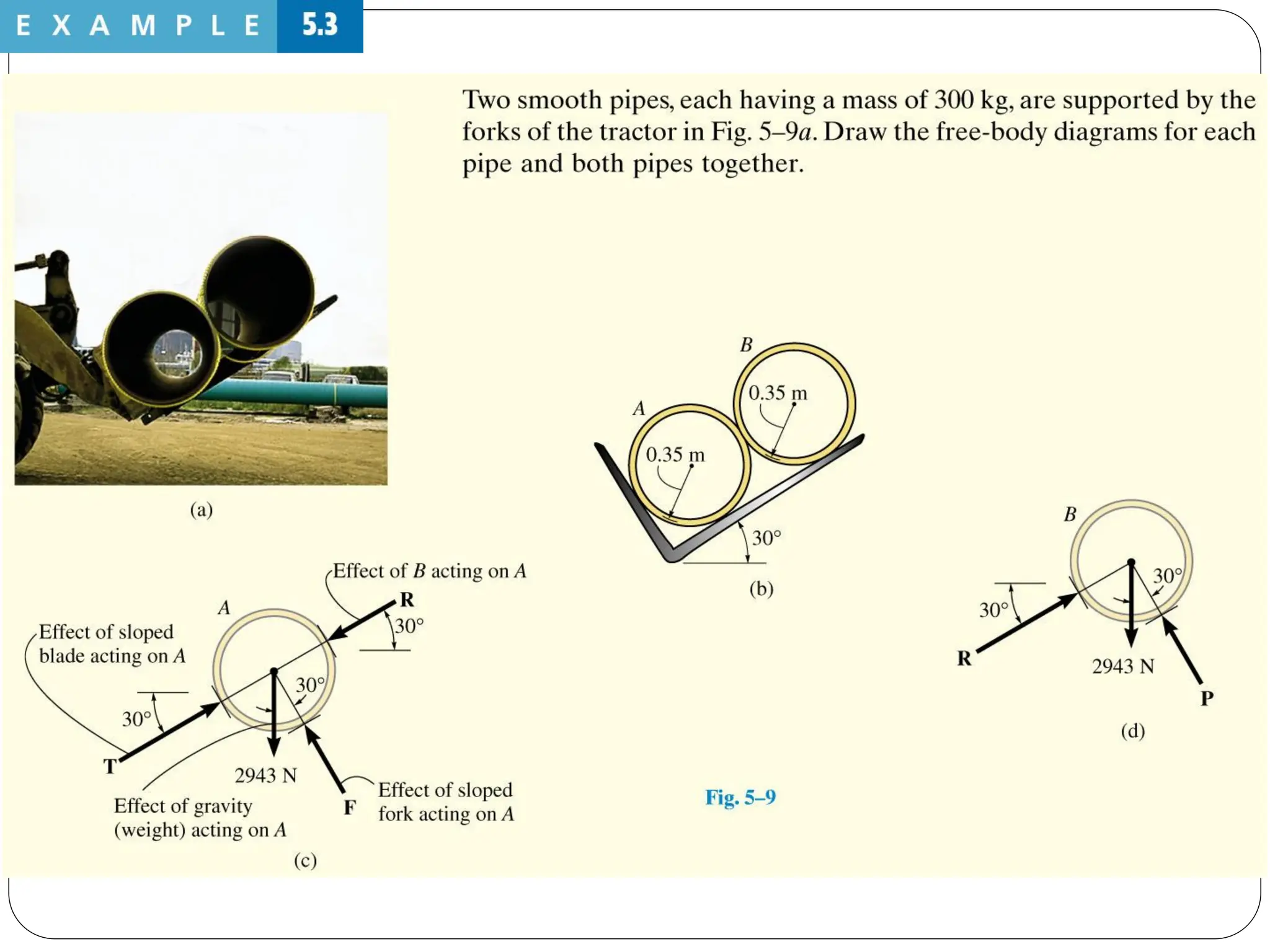
Examples for F.B.D
33.
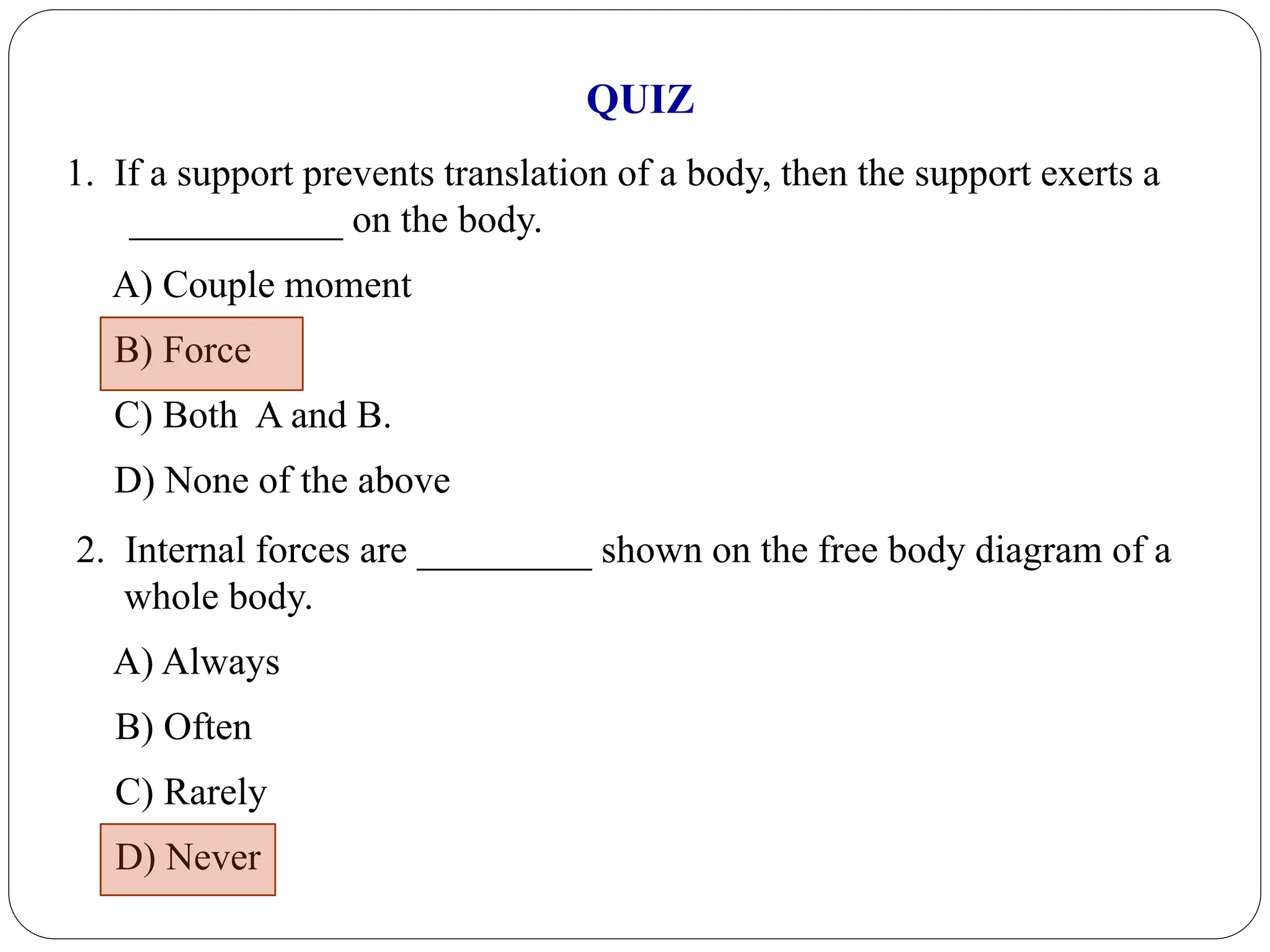
1. If asupport prevents translation of a body, then the support exerts a
___________ on the body.
A) Couple moment
B) Force
C) Both A and B.
D) None of the above
2. Internal forces are _________ shown on the free body diagram of a
whole body.
A) Always
B) Often
C) Rarely
D) Never
QUIZ
34.
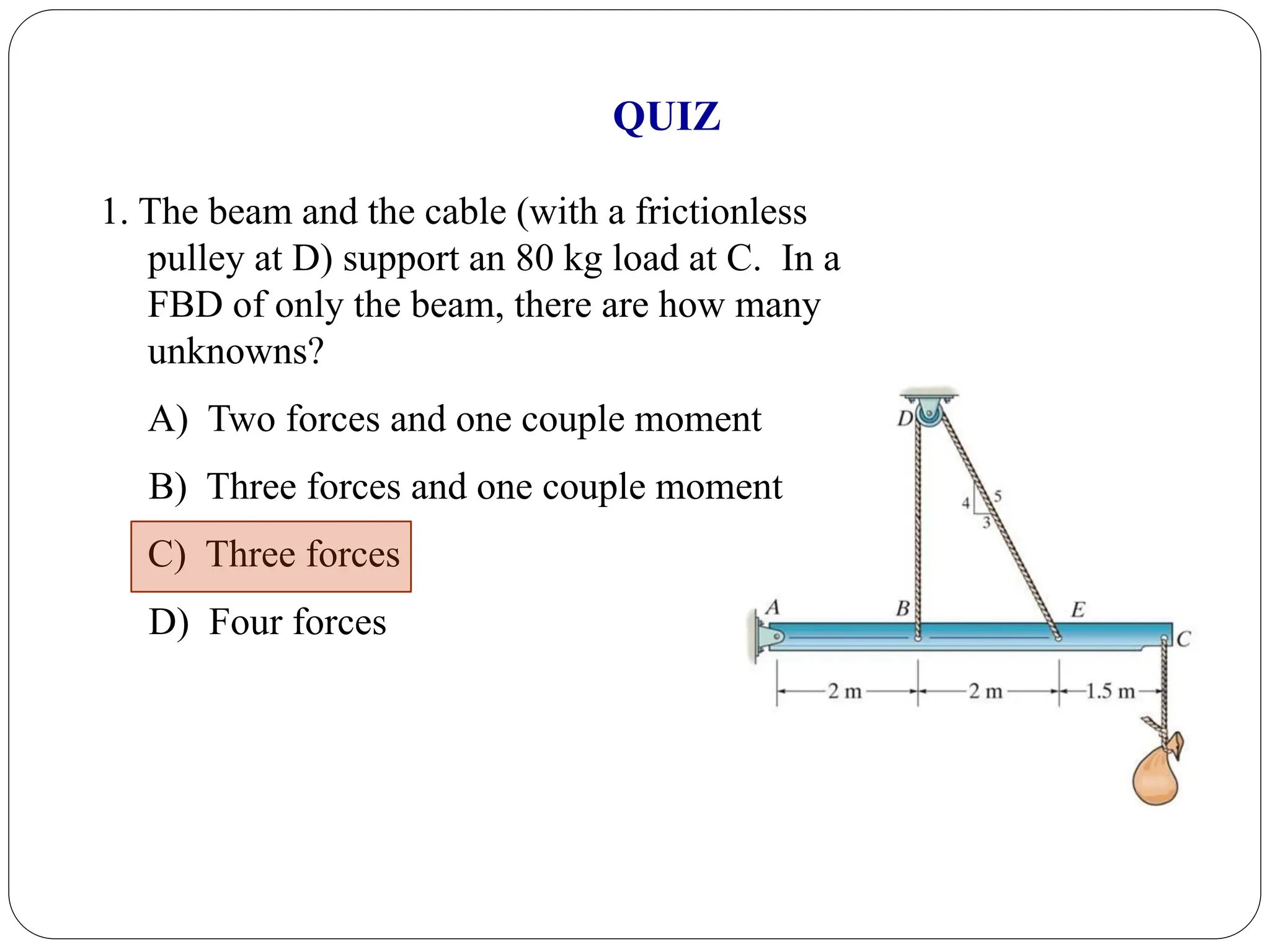
1. The beamand the cable (with a frictionless
pulley at D) support an 80 kg load at C. In a
FBD of only the beam, there are how many
unknowns?
A) Two forces and one couple moment
B) Three forces and one couple moment
C) Three forces
D) Four forces
QUIZ
35.
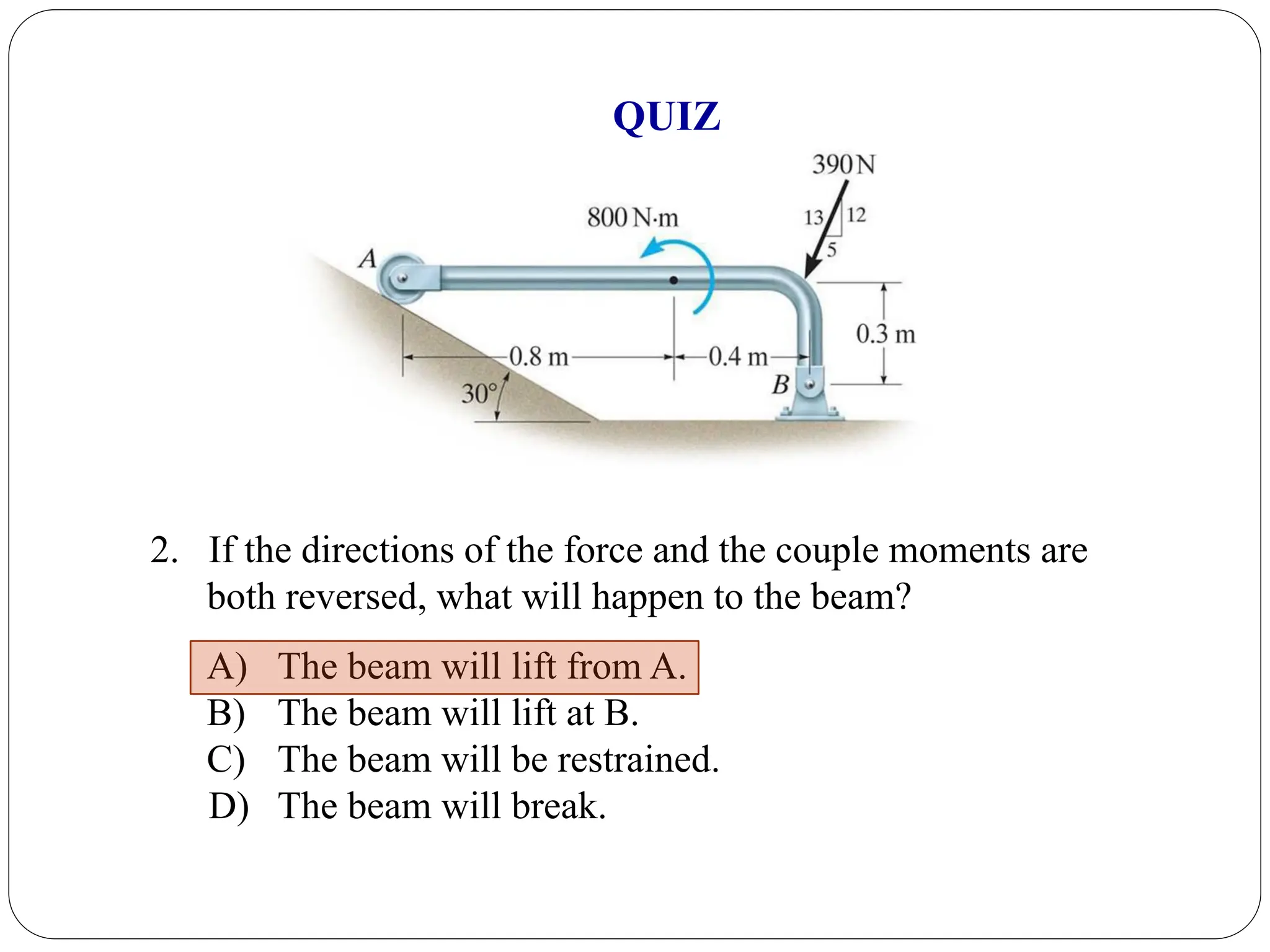
2. If thedirections of the force and the couple moments are
both reversed, what will happen to the beam?
A) The beam will lift from A.
B) The beam will lift at B.
C) The beam will be restrained.
D) The beam will break.
QUIZ
36.
1. Internal forcesare not shown on a free-body diagram because the
internal forces are _____. (Choose the most appropriate answer.)
A) Equal to zero B) Equal and opposite and they do not
affect the calculations
C) Negligibly small D) Not important
QUIZ
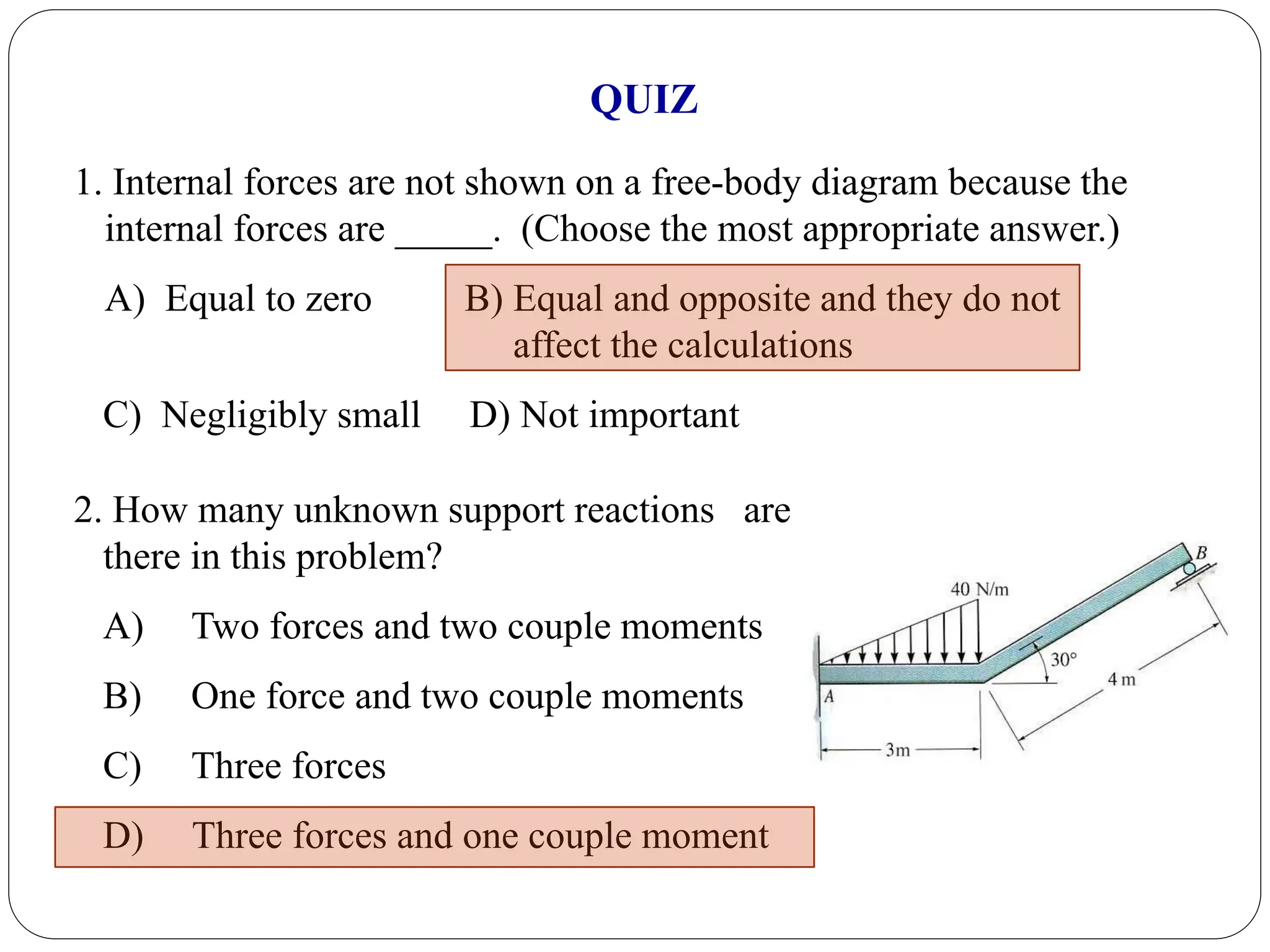
2. How many unknown support reactions are
there in this problem?
A) Two forces and two couple moments
B) One force and two couple moments
C) Three forces
D) Three forces and one couple moment