Free radicals and antioxidants in health and disease
Electrons in an atom or molecule occupy orbits The outer most orbital contains two electrons, each spinning in opposite directions The chemical covalent bond consists of a pair of electrons, each component of the bond donating one electron each A free radical is a molecule or molecular fragment that contains one or more unpaired electrons in its outer orbital Free radical is conventionally represented by a superscript dot (R ● )  Introduction
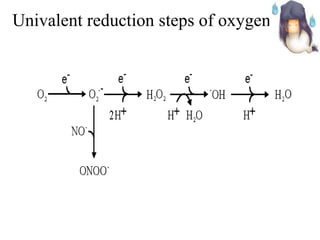
Aerobic organisms produce a number of reactive free radicals continuously in cells during respiration, metabolism and phagocytosis.  Out of these, the most important source of free radicals being the respiratory chain where ~ 1 to 2% oxygen is converted into superoxide radicals (O2•−). Oxidation reactions ensure that molecular oxygen is completely reduced to water Products of partial reduction of oxygen are highly reactive and make havoc in the living systems Hence they are also called  Reactive oxygen species (ROS) Introduction
Members of ROS group Superoxide anion radical (O 2 - ) Hydroperoxyl radical (HOO ● ) Hydrogen peroxide (H 2 O 2 ) Hydroxyl radical (OH ● ) Lipid peroxide radical (ROO ● ) Singlet oxygen ( 1 O 2 ) Nitric oxide (NO ● ) Peroxy nitrite (ONOO --● )
Univalent reduction steps of oxygen
Important characteristics  Extreme reactivity Short life span Generation of new ROS by chain reaction Damage to various tissues
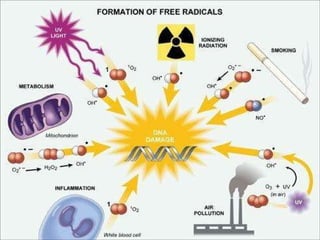
Generation of free radicals Constantly produced during the normal oxidation of foodstuffs, due to leaks in the electron transport chain in mitochondria Some enzymes such as xanthine oxidase and aldehyde oxidase form superoxide anion radical or hydrogen peroxide NADPH oxidase in the inflammatory cells produces superoxide anion by a process of respiratory burst during phagocytosis Macrophages also produce NO from arginine by the enzyme nitric oxide synthase Peroxidation is also catalysed by lipo-oxygenase in platelets and leukocytes

Generation of free radicals Ionising radiation damages tissues by producing hydroxyl radicals, hydrogen peroxide and superoxide anion Light of appropriate wavelengths can cause photolysis of oxygen to produce singlet oxygen In the presence of free iron, H 2 O 2  can generate OH ●  which is highly reactive Cigarette smoke contains high concentrations of various free radicals  Toxic compounds such as carbon tetrachloride, drugs and inhalation of air pollutants will increase the production of free radicals
 
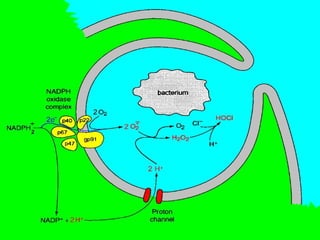
Respiratory burst NADPH oxidase in the inflammatory cells produces superoxide anion  The superoxide is converted to hydrogen peroxide and then to hypochlorous acid (HClO) with the help of superoxide dismutase (SOD) and myeloperoxidase (MPO) The superoxide and hypochlorous ions are the final effectors of bactericidal action This is a deliberate production of free radicals by the body About 10% of the oxygen uptake by macrophage is used for free radical generation  Along with the activation of macrophages, the consumption of oxygen is increased drastically; this is called respiratory burst
 
Damage produced by ROS Free radicals are extremely reactive  Their mean effective radius of action is only 30 Å Their half life is only a few milliseconds When a free radical reacts with a normal compound, other free radicals are generated Peroxidation of PUFA in plasma membrane leads to loss of membrane functions Lipid peroxidation and consequent degradation products such as malondialdehyde are seen in biological fluids Their estimation in serum is often employed to assess the oxidative stress
Damage produced by ROS Almost all biological macromolecules are damaged by the free radicals  Oxidation of sulfhydryl containing enzymes, modification of amino acids, loss of function and fragmentation of proteins are noticed Polysaccharides undergo degradation DNA is damaged by strand breaks The DNA damage may directly cause inhibition of protein and enzyme synthesis and indirectly cause cell death or mutation and carcinogenesis
Clinical significance Chronic inflammation Chronic inflammatory diseases such as rheumatoid arthritis is self-perpetuated by the free radicals released by neutrophills Both corticosteroids and non-steroid anti-inflammatory drugs interfere with formation of free radicals and interrupt the disease process ROS induced tissue damage appears to be involved in pathogenesis of chronic ulcerative colitis, chronic glomerulonephritis etc.
Clinical significance 2.  Acute inflammation At the inflammatory site, activated macrophages produce free radicals Respiratory burst and increased activity of NADPH oxidase are seen in macrophages and neutrophils
Clinical significance 3.  Respiratory diseases Breathing of 100% oxygen for more than 24 hrs produces destruction of endothelium and lung edema This is due to release of free radicals by activated neutrophils In premature newborn infants, prolonged exposure to high oxygen concentration is responsible for broncho-pulmonary dysplasia ARDS is produced when neutrophils are recruited to lungs which subsequently release free radicals Cigarette smoke contains free radicals. Soot attracts neutrophils to the site which releases free radicals
Clinical significance 4.  Diseases of the eye Retrolental fibroplasia or retinopathy of prematurity is a condition seen in premature infants treated with pure oxygen for a long time It is caused by free radicals, causing thromboxane release, sustained vascular contracture and cellular injury Cataract is partly due to photochemical generation of free radicals  Tissues of the eye, including the lens, has high concentration of free radical scavenging enzymes
Clinical significance 5.  Reperfusion injury Reperfusion injury after myocardial ischemia is caused by free radicals During ischemia, the concentration of xanthine oxidase is increased and when reperfused this causes conversion of hypoxanthine to xanthine and superoxide anion At the same time, the availability of scavenging enzymes is decreased, leading to aggravation of myocardial injury Allopurinol, a xanthine oxidase inhibitor, reduces the severity of reperfusion injury
Clinical significance 6.  Shock related injury Release of free radicals from phagocytes damage membranes by lipid peroxidation  They release leucotrienes from platelets and proteases from macrophages  All these factors cause increased vascular permeability, resulting in tissue edema Antioxidants have a protective effect
Clinical significance 7.  Atherosclerosis and myocardial infarction Low density lipoproteins (LDL) promote atherosclerosis  They are deposited under the endothelial cell, which undergo oxidation by free radicals released from endothelial cells This attracts macrophages which are then converted to foam cells This initiates the atherosclerotic plaque formation Alpha tocopherol offers some protective effect
Clinical significance 8.  Peptic ulcer Peptic ulcer is produced by erosion of gastric mucosa by HCl It is shown that superoxide anions are involved in the formation of ulcer  Helicobacter pylori infection perpetuates the disease This infection potentiates the macrophage oxidative burst leading to tissue destruction
Clinical significance 9.  Skin diseases Due to inborn defects, porphyrins accumulate in the skin Exposure to sunlight will lead to erythema and eruptions in the patients Sunlight acting on porphyrins produces singlet oxygen, which trigger inflammatory reaction, leading to the above symptoms Certain plant products, called psoralens are administered in the treatment of psoriasis and leukoderma
Clinical significance 10.  Cancer treatment Free radicals contribute to cancer development because of their mutagenic property Free radicals produce DNA damage, and accumulated damages lead to somatic mutation and malignancy Cancer is treated by radiotherapy Irradiation produces reactive oxygen species in the cells which trigger the cell death To increase the therapeutic effect of radiation, radio-sensitisers are administered, which increase the production of ROS
Lipid peroxidation Polyunsaturated fatty acids (PUFA) are normal constituents of cellular and subcellular membranes The integrity of the cell membranes is affected by peroxidation of PUFA Damage to cell membrane will cause increased permeability to sodium ions, rapid influx of calcium, osmotic entrance of water into the cell, leading to cell damage
Lipid peroxidation The auto-oxidation of membrane lipids proceeds as a chain reaction and it occurs in 3 steps Initiation phase Propagation phase Termination phase
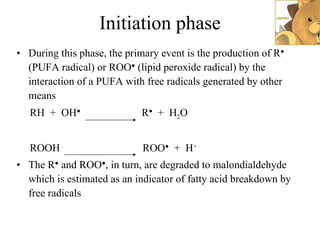
Initiation phase During this phase, the primary event is the production of R ●  (PUFA radical) or ROO ●  (lipid peroxide radical) by the interaction of a PUFA with free radicals generated by other means RH  +  OH ●   R ●   +  H 2 O  ROOH  ROO ●   +  H + The R ●  and ROO ● , in turn, are degraded to malondialdehyde which is estimated as an indicator of fatty acid breakdown by free radicals
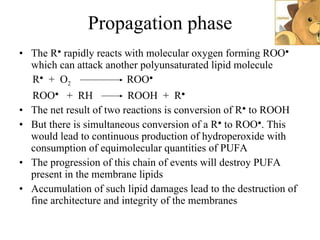
Propagation phase The R ●  rapidly reacts with molecular oxygen forming ROO ●  which can attack another polyunsaturated lipid molecule R ●   +  O 2   ROO ● ROO ●   +  RH  ROOH  +  R ● The net result of two reactions is conversion of R ●  to ROOH But there is simultaneous conversion of a R ●  to ROO ● . This would lead to continuous production of hydroperoxide with consumption of equimolecular quantities of PUFA The progression of this chain of events will destroy PUFA present in the membrane lipids Accumulation of such lipid damages lead to the destruction of fine architecture and integrity of the membranes
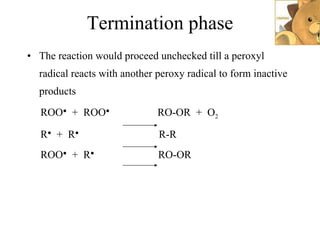
Termination phase The reaction would proceed unchecked till a peroxyl radical reacts with another peroxy radical to form inactive products ROO ●   +  ROO ●   RO-OR  +  O 2 R ●   +  R ●   R-R ROO ●   +  R ●   RO-OR
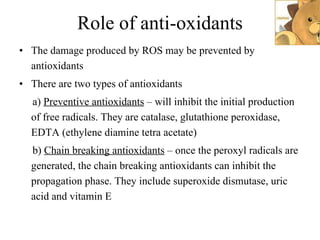
Role of anti-oxidants The damage produced by ROS may be prevented by antioxidants There are two types of antioxidants a)  Preventive antioxidants  – will inhibit the initial production of free radicals. They are catalase, glutathione peroxidase, EDTA (ethylene diamine tetra acetate) b)  Chain breaking antioxidants  – once the peroxyl radicals are generated, the chain breaking antioxidants can inhibit the propagation phase. They include superoxide dismutase, uric acid and vitamin E
Superoxide dismutase SOD is a non-heme protein The gene coding SOD is on chromosome 21 Different iso-enzymes of SOD are described. The mitochondrial enzyme is manganese dependent; cytoplasmic enzyme is copper-zinc dependent A defect in SOD gene is seen in some patients with amylotrophic lateral sclerosis
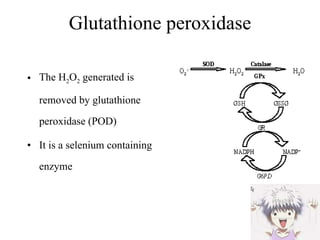
Glutathione peroxidase The H 2 O 2  generated is removed by glutathione peroxidase (POD) It is a selenium containing enzyme
Glutathione reductase The oxidised glutathione is reduced by glutathione reductase (GR) in presence of NADPH This NADPH is generated with the help of glucose-6-phosphate dehydrogenase (G6PD) in HMP shunt pathway Therefore in G6PD deficiency the RBCs are liable to lysis, especially when oxidising agents are administered (drug induced hemolytic anemia)
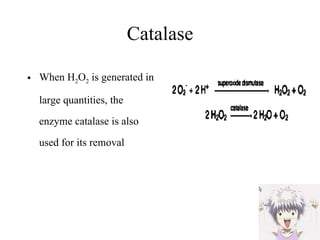
Catalase When H 2 O 2  is generated in large quantities, the enzyme catalase is also used for its removal
Alpha-tocopherol Alpha tocopherol (T-OH) would intercept the peroxyl free radical and inactivate it before a PUFA can be attacked T-OH  +  ROO ●   TO ●   +  ROOH The phenolic hydrogen of the alpha tocopherol reacts with the peroxyl radical, converting it to a hydroperoxide product The tocopherol radical thus formed is stable and will not propagate the cycle any further The tocopherol radical can react with another peroxyl radical getting converted to inactive products TO ●   +  ROO ●   inactive products
Alpha tocopherol Vitamin E acts as the most effective naturally occurring chain breaking antioxidant in tissues Only traces of tocopherol is required to protect considerable amounts of polyunsaturated fat But in this process vitamin E is consumed Hence it has to be replenished to continue its activity  This is achieved by daily dietary supply
Vitamin C   Vitamin C, or ascorbic acid, is a water-soluble vitamin.  This vitamin is a free radical scavenger,  it is considered to be one of the most important antioxidants in extra cellular fluids.   Its protective effects extend to cancer, coronary artery disease, arthritis and aging.
THANK  YOU

Free radicals & antioxidants

  • 1.
    Free radicals andantioxidants in health and disease
  • 2.
    Electrons in anatom or molecule occupy orbits The outer most orbital contains two electrons, each spinning in opposite directions The chemical covalent bond consists of a pair of electrons, each component of the bond donating one electron each A free radical is a molecule or molecular fragment that contains one or more unpaired electrons in its outer orbital Free radical is conventionally represented by a superscript dot (R ● ) Introduction
  • 3.
    Aerobic organisms producea number of reactive free radicals continuously in cells during respiration, metabolism and phagocytosis. Out of these, the most important source of free radicals being the respiratory chain where ~ 1 to 2% oxygen is converted into superoxide radicals (O2•−). Oxidation reactions ensure that molecular oxygen is completely reduced to water Products of partial reduction of oxygen are highly reactive and make havoc in the living systems Hence they are also called Reactive oxygen species (ROS) Introduction
  • 4.
    Members of ROSgroup Superoxide anion radical (O 2 - ) Hydroperoxyl radical (HOO ● ) Hydrogen peroxide (H 2 O 2 ) Hydroxyl radical (OH ● ) Lipid peroxide radical (ROO ● ) Singlet oxygen ( 1 O 2 ) Nitric oxide (NO ● ) Peroxy nitrite (ONOO --● )
  • 5.
  • 6.
    Important characteristics Extreme reactivity Short life span Generation of new ROS by chain reaction Damage to various tissues
  • 7.
    Generation of freeradicals Constantly produced during the normal oxidation of foodstuffs, due to leaks in the electron transport chain in mitochondria Some enzymes such as xanthine oxidase and aldehyde oxidase form superoxide anion radical or hydrogen peroxide NADPH oxidase in the inflammatory cells produces superoxide anion by a process of respiratory burst during phagocytosis Macrophages also produce NO from arginine by the enzyme nitric oxide synthase Peroxidation is also catalysed by lipo-oxygenase in platelets and leukocytes
  • 8.
    Generation of freeradicals Ionising radiation damages tissues by producing hydroxyl radicals, hydrogen peroxide and superoxide anion Light of appropriate wavelengths can cause photolysis of oxygen to produce singlet oxygen In the presence of free iron, H 2 O 2 can generate OH ● which is highly reactive Cigarette smoke contains high concentrations of various free radicals Toxic compounds such as carbon tetrachloride, drugs and inhalation of air pollutants will increase the production of free radicals
  • 9.
  • 10.
    Respiratory burst NADPHoxidase in the inflammatory cells produces superoxide anion The superoxide is converted to hydrogen peroxide and then to hypochlorous acid (HClO) with the help of superoxide dismutase (SOD) and myeloperoxidase (MPO) The superoxide and hypochlorous ions are the final effectors of bactericidal action This is a deliberate production of free radicals by the body About 10% of the oxygen uptake by macrophage is used for free radical generation Along with the activation of macrophages, the consumption of oxygen is increased drastically; this is called respiratory burst
  • 11.
  • 12.
    Damage produced byROS Free radicals are extremely reactive Their mean effective radius of action is only 30 Å Their half life is only a few milliseconds When a free radical reacts with a normal compound, other free radicals are generated Peroxidation of PUFA in plasma membrane leads to loss of membrane functions Lipid peroxidation and consequent degradation products such as malondialdehyde are seen in biological fluids Their estimation in serum is often employed to assess the oxidative stress
  • 13.
    Damage produced byROS Almost all biological macromolecules are damaged by the free radicals Oxidation of sulfhydryl containing enzymes, modification of amino acids, loss of function and fragmentation of proteins are noticed Polysaccharides undergo degradation DNA is damaged by strand breaks The DNA damage may directly cause inhibition of protein and enzyme synthesis and indirectly cause cell death or mutation and carcinogenesis
  • 14.
    Clinical significance Chronicinflammation Chronic inflammatory diseases such as rheumatoid arthritis is self-perpetuated by the free radicals released by neutrophills Both corticosteroids and non-steroid anti-inflammatory drugs interfere with formation of free radicals and interrupt the disease process ROS induced tissue damage appears to be involved in pathogenesis of chronic ulcerative colitis, chronic glomerulonephritis etc.
  • 15.
    Clinical significance 2. Acute inflammation At the inflammatory site, activated macrophages produce free radicals Respiratory burst and increased activity of NADPH oxidase are seen in macrophages and neutrophils
  • 16.
    Clinical significance 3. Respiratory diseases Breathing of 100% oxygen for more than 24 hrs produces destruction of endothelium and lung edema This is due to release of free radicals by activated neutrophils In premature newborn infants, prolonged exposure to high oxygen concentration is responsible for broncho-pulmonary dysplasia ARDS is produced when neutrophils are recruited to lungs which subsequently release free radicals Cigarette smoke contains free radicals. Soot attracts neutrophils to the site which releases free radicals
  • 17.
    Clinical significance 4. Diseases of the eye Retrolental fibroplasia or retinopathy of prematurity is a condition seen in premature infants treated with pure oxygen for a long time It is caused by free radicals, causing thromboxane release, sustained vascular contracture and cellular injury Cataract is partly due to photochemical generation of free radicals Tissues of the eye, including the lens, has high concentration of free radical scavenging enzymes
  • 18.
    Clinical significance 5. Reperfusion injury Reperfusion injury after myocardial ischemia is caused by free radicals During ischemia, the concentration of xanthine oxidase is increased and when reperfused this causes conversion of hypoxanthine to xanthine and superoxide anion At the same time, the availability of scavenging enzymes is decreased, leading to aggravation of myocardial injury Allopurinol, a xanthine oxidase inhibitor, reduces the severity of reperfusion injury
  • 19.
    Clinical significance 6. Shock related injury Release of free radicals from phagocytes damage membranes by lipid peroxidation They release leucotrienes from platelets and proteases from macrophages All these factors cause increased vascular permeability, resulting in tissue edema Antioxidants have a protective effect
  • 20.
    Clinical significance 7. Atherosclerosis and myocardial infarction Low density lipoproteins (LDL) promote atherosclerosis They are deposited under the endothelial cell, which undergo oxidation by free radicals released from endothelial cells This attracts macrophages which are then converted to foam cells This initiates the atherosclerotic plaque formation Alpha tocopherol offers some protective effect
  • 21.
    Clinical significance 8. Peptic ulcer Peptic ulcer is produced by erosion of gastric mucosa by HCl It is shown that superoxide anions are involved in the formation of ulcer Helicobacter pylori infection perpetuates the disease This infection potentiates the macrophage oxidative burst leading to tissue destruction
  • 22.
    Clinical significance 9. Skin diseases Due to inborn defects, porphyrins accumulate in the skin Exposure to sunlight will lead to erythema and eruptions in the patients Sunlight acting on porphyrins produces singlet oxygen, which trigger inflammatory reaction, leading to the above symptoms Certain plant products, called psoralens are administered in the treatment of psoriasis and leukoderma
  • 23.
    Clinical significance 10. Cancer treatment Free radicals contribute to cancer development because of their mutagenic property Free radicals produce DNA damage, and accumulated damages lead to somatic mutation and malignancy Cancer is treated by radiotherapy Irradiation produces reactive oxygen species in the cells which trigger the cell death To increase the therapeutic effect of radiation, radio-sensitisers are administered, which increase the production of ROS
  • 24.
    Lipid peroxidation Polyunsaturatedfatty acids (PUFA) are normal constituents of cellular and subcellular membranes The integrity of the cell membranes is affected by peroxidation of PUFA Damage to cell membrane will cause increased permeability to sodium ions, rapid influx of calcium, osmotic entrance of water into the cell, leading to cell damage
  • 25.
    Lipid peroxidation Theauto-oxidation of membrane lipids proceeds as a chain reaction and it occurs in 3 steps Initiation phase Propagation phase Termination phase
  • 26.
    Initiation phase Duringthis phase, the primary event is the production of R ● (PUFA radical) or ROO ● (lipid peroxide radical) by the interaction of a PUFA with free radicals generated by other means RH + OH ● R ● + H 2 O ROOH ROO ● + H + The R ● and ROO ● , in turn, are degraded to malondialdehyde which is estimated as an indicator of fatty acid breakdown by free radicals
  • 27.
    Propagation phase TheR ● rapidly reacts with molecular oxygen forming ROO ● which can attack another polyunsaturated lipid molecule R ● + O 2 ROO ● ROO ● + RH ROOH + R ● The net result of two reactions is conversion of R ● to ROOH But there is simultaneous conversion of a R ● to ROO ● . This would lead to continuous production of hydroperoxide with consumption of equimolecular quantities of PUFA The progression of this chain of events will destroy PUFA present in the membrane lipids Accumulation of such lipid damages lead to the destruction of fine architecture and integrity of the membranes
  • 28.
    Termination phase Thereaction would proceed unchecked till a peroxyl radical reacts with another peroxy radical to form inactive products ROO ● + ROO ● RO-OR + O 2 R ● + R ● R-R ROO ● + R ● RO-OR
  • 29.
    Role of anti-oxidantsThe damage produced by ROS may be prevented by antioxidants There are two types of antioxidants a) Preventive antioxidants – will inhibit the initial production of free radicals. They are catalase, glutathione peroxidase, EDTA (ethylene diamine tetra acetate) b) Chain breaking antioxidants – once the peroxyl radicals are generated, the chain breaking antioxidants can inhibit the propagation phase. They include superoxide dismutase, uric acid and vitamin E
  • 30.
    Superoxide dismutase SODis a non-heme protein The gene coding SOD is on chromosome 21 Different iso-enzymes of SOD are described. The mitochondrial enzyme is manganese dependent; cytoplasmic enzyme is copper-zinc dependent A defect in SOD gene is seen in some patients with amylotrophic lateral sclerosis
  • 31.
    Glutathione peroxidase TheH 2 O 2 generated is removed by glutathione peroxidase (POD) It is a selenium containing enzyme
  • 32.
    Glutathione reductase Theoxidised glutathione is reduced by glutathione reductase (GR) in presence of NADPH This NADPH is generated with the help of glucose-6-phosphate dehydrogenase (G6PD) in HMP shunt pathway Therefore in G6PD deficiency the RBCs are liable to lysis, especially when oxidising agents are administered (drug induced hemolytic anemia)
  • 33.
    Catalase When H2 O 2 is generated in large quantities, the enzyme catalase is also used for its removal
  • 34.
    Alpha-tocopherol Alpha tocopherol(T-OH) would intercept the peroxyl free radical and inactivate it before a PUFA can be attacked T-OH + ROO ● TO ● + ROOH The phenolic hydrogen of the alpha tocopherol reacts with the peroxyl radical, converting it to a hydroperoxide product The tocopherol radical thus formed is stable and will not propagate the cycle any further The tocopherol radical can react with another peroxyl radical getting converted to inactive products TO ● + ROO ● inactive products
  • 35.
    Alpha tocopherol VitaminE acts as the most effective naturally occurring chain breaking antioxidant in tissues Only traces of tocopherol is required to protect considerable amounts of polyunsaturated fat But in this process vitamin E is consumed Hence it has to be replenished to continue its activity This is achieved by daily dietary supply
  • 36.
    Vitamin C Vitamin C, or ascorbic acid, is a water-soluble vitamin. This vitamin is a free radical scavenger, it is considered to be one of the most important antioxidants in extra cellular fluids. Its protective effects extend to cancer, coronary artery disease, arthritis and aging.
  • 37.