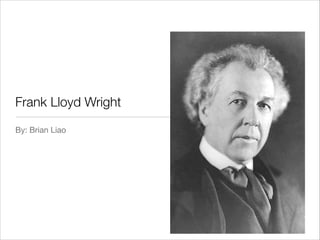
Frank Lloyd Wright
By: Brian Liao
Table of Contents
• Childhood


• Taliesin II


• Adulthood


• Taliesin III


• Robie House


• Taliesin West


• Hollyhock House


• Falling water


• Taliesin


• Guggenheim Museum

• Taliesin I
Childhood
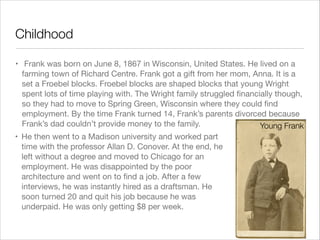
• Frank was born on June 8, 1867 in Wisconsin, United States. He lived on a
farming town of Richard Centre. Frank got a gift from her mom, Anna. It is a
set a Froebel blocks. Froebel blocks are shaped blocks that young Wright
spent lots of time playing with. The Wright family struggled financially though,
so they had to move to Spring Green, Wisconsin where they could find
employment. By the time Frank turned 14, Frank’s parents divorced because
Frank’s dad couldn’t provide money to the family.
Young Frank
• He then went to a Madison university and worked part
time with the professor Allan D. Conover. At the end, he
left without a degree and moved to Chicago for an
employment. He was disappointed by the poor
architecture and went on to find a job. After a few
interviews, he was instantly hired as a draftsman. He
soon turned 20 and quit his job because he was
underpaid. He was only getting $8 per week.
Adulthood
• When Frank left the job, he went on as a designer. But before long, he
decided that he wasn’t ready to design buildings himself so he went back to
his old job but with a raise. In less than a year, he was interviewed and got a
position as Sullivan’s apprentice. He didn’t get along with other draftsmen
though. He even had a violent quarrel with one of the draftsman. Sullivan also
showed very little respect for the draftsman. Soon Frank got a place on 17th
floor on the auditorium building.
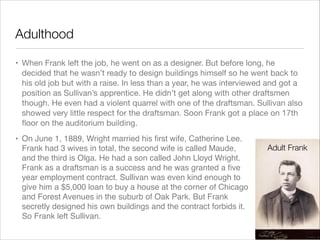
• On June 1, 1889, Wright married his first wife, Catherine Lee.
Frank had 3 wives in total, the second wife is called Maude,
and the third is Olga. He had a son called John Lloyd Wright.
Frank as a draftsman is a success and he was granted a five
year employment contract. Sullivan was even kind enough to
give him a $5,000 loan to buy a house at the corner of Chicago
and Forest Avenues in the suburb of Oak Park. But Frank
secretly designed his own buildings and the contract forbids it.
So Frank left Sullivan.

Adult Frank
Adulthood
• By 1901, Wright had completed about 50 projects, including many houses in
Oak Park. Wright moved out of the Schiller Building and into the nearby and
newly completed Steinway Building. By 1895, Frank made his own draftsman
crew and the first female architect in United States helped Frank Lloyd Wright
make windows, furniture, and light fixtures. Between 1894 and 1910, several
other architects and many of Wright's employees launched their careers in the
offices of Steinway Hall.
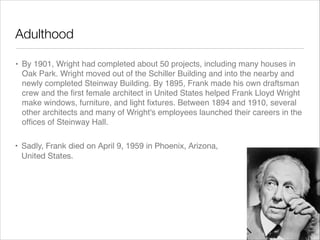
• Sadly, Frank died on April 9, 1959 in Phoenix, Arizona,
United States.
Robie House
History

• 1908-1909 Robie was only 28 years old and the assistant manager of the
Excelsior Supply Company, a company on the South Side of Chicago owned
and by his father. The construction of Robie house started on April 15, 1909.
The Robie family moved in before the construction was finished which was
January 1911. The Robie family also struggled financially that caused the
death of his father. The Robie family had to move out after 1 year and 2
months.

Materials
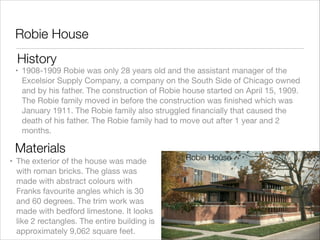
• The exterior of the house was made
with roman bricks. The glass was
made with abstract colours with
Franks favourite angles which is 30
and 60 degrees. The trim work was
made with bedford limestone. It looks
like 2 rectangles. The entire building is
approximately 9,062 square feet.

Robie House
Robie House
Architecture
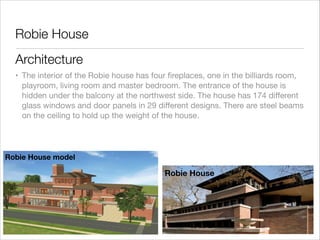
• The interior of the Robie house has four fireplaces, one in the billiards room,
playroom, living room and master bedroom. The entrance of the house is
hidden under the balcony at the northwest side. The house has 174 different
glass windows and door panels in 29 different designs. There are steel beams
on the ceiling to hold up the weight of the house.

Robie House model

Robie House
Hollyhock House
History
• The hollyhock house was originally meant to be part arts and movie theatre.
This is Frank’s second building built in California. The hollyhock house was
built between 1919–1921. The Barnsdall, owner of the building donated this
structure to the city of Los Angeles in 1927.

Architecture
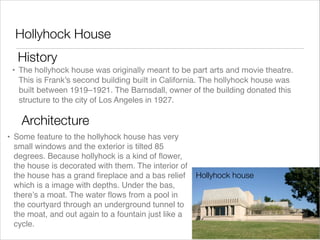
• Some feature to the hollyhock house has very
small windows and the exterior is tilted 85
degrees. Because hollyhock is a kind of flower,
the house is decorated with them. The interior of
the house has a grand fireplace and a bas relief
which is a image with depths. Under the bas,
there’s a moat. The water flows from a pool in
the courtyard through an underground tunnel to
the moat, and out again to a fountain just like a
cycle.

Hollyhock house
The Taliesin Buildings
History
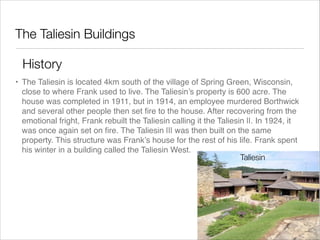
• The Taliesin is located 4km south of the village of Spring Green, Wisconsin,
close to where Frank used to live. The Taliesin’s property is 600 acre. The
house was completed in 1911, but in 1914, an employee murdered Borthwick
and several other people then set fire to the house. After recovering from the
emotional fright, Frank rebuilt the Taliesin calling it the Taliesin ||. In 1924, it
was once again set on fire. The Taliesin ||| was then built on the same
property. This structure was Frank’s house for the rest of his life. Frank spent
his winter in a building called the Taliesin West.
Taliesin
Taliesin I
Architecture
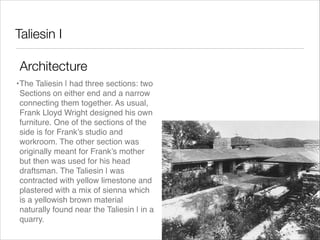
•The Taliesin | had three sections: two
Sections on either end and a narrow
connecting them together. As usual,
Frank Lloyd Wright designed his own
furniture. One of the sections of the
side is for Frank’s studio and
workroom. The other section was
originally meant for Frank’s mother
but then was used for his head
draftsman. The Taliesin | was
contracted with yellow limestone and
plastered with a mix of sienna which
is a yellowish brown material
naturally found near the Taliesin | in a
quarry.
Taliesin II
History

• After the Taliesin I was burnt to the ground by a crazy employee, Frank
started another project to rebuild the Taliesin II. The Taliesin II was inspired to
be built like a Japanese temple. This time Frank lived close to the Taliesin II,
but the tragedy doesn’t end here. When Frank returned to the Taliesin II one
day, a blanket of smoke rose to the sky from the house. Frank reacted quickly
to stop the fire but due to the wind, the fire spread quickly. The Taliesin II also
burnt down but Frank’s workroom was spared.

Architecture
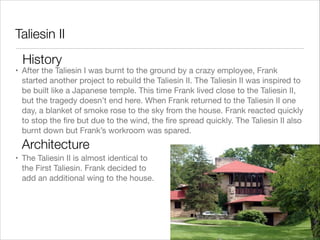
• The Taliesin II is almost identical to
the First Taliesin. Frank decided to
add an additional wing to the house.
Taliesin III
History

• After the Taliesin II was burnt once again, Frank did not give up. He made a
third construction called the Taliesin III. Luckily, the person that burnt down
the 2 pervious buildings gave up and stopped destroying Frank’s
constructions. The Taliesin III was built on a 593 acres of land. Frank now
lives in Taliesin the rest of his life but he had another project in mind. It was to
build the Taliesin West in Arizona and use it as a winter house.

Architecture
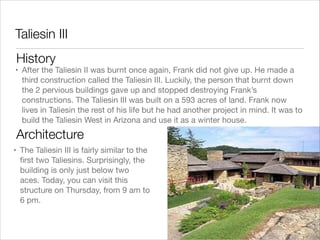
• The Taliesin III is fairly similar to the
first two Taliesins. Surprisingly, the
building is only just below two
aces. Today, you can visit this
structure on Thursday, from 9 am to
6 pm.
Taliesin West
Architecture
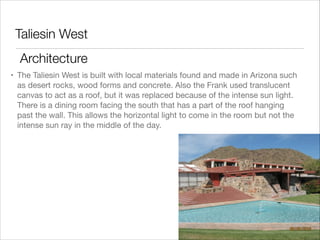
• The Taliesin West is built with local materials found and made in Arizona such
as desert rocks, wood forms and concrete. Also the Frank used translucent
canvas to act as a roof, but it was replaced because of the intense sun light.
There is a dining room facing the south that has a part of the roof hanging
past the wall. This allows the horizontal light to come in the room but not the
intense sun ray in the middle of the day.
Falling Water
History
• Falling water was the building that bought back Frank’s fame. One day when
he and the Kaufmann visited the Bear Run, he convinced Kaufmann to let him
build a house on Bear Run. Wright lied to Kaufmann about already drawing
and planning the structure. In reality Wright only took 2 hours doing the
planning and drawing. The Kaufmann weren’t satisfied that the building was
location on top of the waterfall but still agreed to build it there in the end.
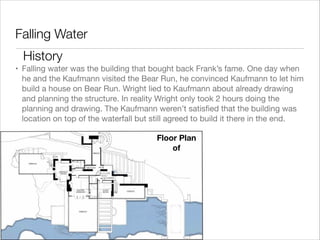
Floor Plan
of
Falling Water
Architecture
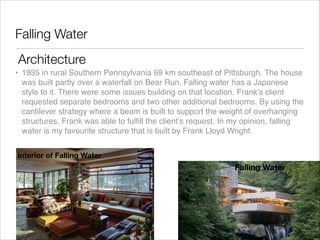
• 1935 in rural Southern Pennsylvania 69 km southeast of Pittsburgh. The house
was built partly over a waterfall on Bear Run. Falling water has a Japanese
style to it. There were some issues building on that location. Frank’s client
requested separate bedrooms and two other additional bedrooms. By using the
cantilever strategy where a beam is built to support the weight of overhanging
structures, Frank was able to fulfill the client’s request. In my opinion, falling
water is my favourite structure that is built by Frank Lloyd Wright.
Interior of Falling Water

Falling Water
Guggenheim Museum
History
• The guggenheim is actually a museum. The construction started in 1937. It
opened in 1959. The guggenheim museum is located at the Upper East Side
of Manhattan. Frank had the idea of establishing this museum because of the
collections that he had. The grand opening of this museum is after six months
of Frank Lloyd Wright’s death. Sadly, Frank did not get to see his own finished
project.

Architecture

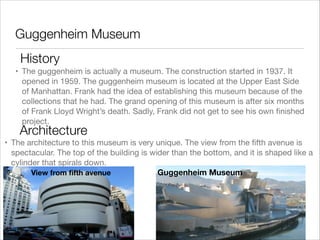
• The architecture to this museum is very unique. The view from the fifth avenue is
spectacular. The top of the building is wider than the bottom, and it is shaped like a
cylinder that spirals down.
Guggenheim Museum
View from fifth avenue
Bibliography
• http://en.wikipedia.org/wiki/Frank_Lloyd_Wright

• http://en.wikipedia.org/wiki/Fallingwater

• http://en.wikipedia.org/wiki/Robie_House

• http://en.wikipedia.org/wiki/Hollyhock_House

• http://en.wikipedia.org/wiki/Solomon_R._Guggenheim_Museum

• http://en.wikipedia.org/wiki/Taliesin_(studio)

• http://en.wikipedia.org/wiki/Taliesin_West
Thanks For Watching

Approved!
Self Reflection
• In my opinion, I think that I deserve
an exceeds expectation because I
kept each slide organized with
different categories and I also
inserted each slide according to the
timeline. 

• Another reason I believe that I
should get an exceeds on this
passion project is because
everything I wrote is in detail. The
history, architecture, and the time
spent building. 


• I don’t use the same word over and
over again. I also don’t think that I
have lots of grammar mistakes in
my writing. 

• My interests has grown since I
started the presentation because I
have always wanted to be an
architect and Frank Lloyd Wright is
a great model that I look upon to.

Frank lloyd wright By Brian

  • 1.
  • 2.
    Table of Contents •Childhood • Taliesin II • Adulthood • Taliesin III • Robie House • Taliesin West • Hollyhock House • Falling water • Taliesin • Guggenheim Museum • Taliesin I
  • 3.
    Childhood • Frank wasborn on June 8, 1867 in Wisconsin, United States. He lived on a farming town of Richard Centre. Frank got a gift from her mom, Anna. It is a set a Froebel blocks. Froebel blocks are shaped blocks that young Wright spent lots of time playing with. The Wright family struggled financially though, so they had to move to Spring Green, Wisconsin where they could find employment. By the time Frank turned 14, Frank’s parents divorced because Frank’s dad couldn’t provide money to the family. Young Frank • He then went to a Madison university and worked part time with the professor Allan D. Conover. At the end, he left without a degree and moved to Chicago for an employment. He was disappointed by the poor architecture and went on to find a job. After a few interviews, he was instantly hired as a draftsman. He soon turned 20 and quit his job because he was underpaid. He was only getting $8 per week.
  • 4.
    Adulthood • When Frankleft the job, he went on as a designer. But before long, he decided that he wasn’t ready to design buildings himself so he went back to his old job but with a raise. In less than a year, he was interviewed and got a position as Sullivan’s apprentice. He didn’t get along with other draftsmen though. He even had a violent quarrel with one of the draftsman. Sullivan also showed very little respect for the draftsman. Soon Frank got a place on 17th floor on the auditorium building. • On June 1, 1889, Wright married his first wife, Catherine Lee. Frank had 3 wives in total, the second wife is called Maude, and the third is Olga. He had a son called John Lloyd Wright. Frank as a draftsman is a success and he was granted a five year employment contract. Sullivan was even kind enough to give him a $5,000 loan to buy a house at the corner of Chicago and Forest Avenues in the suburb of Oak Park. But Frank secretly designed his own buildings and the contract forbids it. So Frank left Sullivan. Adult Frank
  • 5.
    Adulthood • By 1901,Wright had completed about 50 projects, including many houses in Oak Park. Wright moved out of the Schiller Building and into the nearby and newly completed Steinway Building. By 1895, Frank made his own draftsman crew and the first female architect in United States helped Frank Lloyd Wright make windows, furniture, and light fixtures. Between 1894 and 1910, several other architects and many of Wright's employees launched their careers in the offices of Steinway Hall. • Sadly, Frank died on April 9, 1959 in Phoenix, Arizona, United States.
  • 6.
    Robie House History • 1908-1909Robie was only 28 years old and the assistant manager of the Excelsior Supply Company, a company on the South Side of Chicago owned and by his father. The construction of Robie house started on April 15, 1909. The Robie family moved in before the construction was finished which was January 1911. The Robie family also struggled financially that caused the death of his father. The Robie family had to move out after 1 year and 2 months. Materials • The exterior of the house was made with roman bricks. The glass was made with abstract colours with Franks favourite angles which is 30 and 60 degrees. The trim work was made with bedford limestone. It looks like 2 rectangles. The entire building is approximately 9,062 square feet. Robie House
  • 7.
    Robie House Architecture • Theinterior of the Robie house has four fireplaces, one in the billiards room, playroom, living room and master bedroom. The entrance of the house is hidden under the balcony at the northwest side. The house has 174 different glass windows and door panels in 29 different designs. There are steel beams on the ceiling to hold up the weight of the house. Robie House model Robie House
  • 8.
    Hollyhock House History • Thehollyhock house was originally meant to be part arts and movie theatre. This is Frank’s second building built in California. The hollyhock house was built between 1919–1921. The Barnsdall, owner of the building donated this structure to the city of Los Angeles in 1927. Architecture • Some feature to the hollyhock house has very small windows and the exterior is tilted 85 degrees. Because hollyhock is a kind of flower, the house is decorated with them. The interior of the house has a grand fireplace and a bas relief which is a image with depths. Under the bas, there’s a moat. The water flows from a pool in the courtyard through an underground tunnel to the moat, and out again to a fountain just like a cycle. Hollyhock house
  • 9.
    The Taliesin Buildings History •The Taliesin is located 4km south of the village of Spring Green, Wisconsin, close to where Frank used to live. The Taliesin’s property is 600 acre. The house was completed in 1911, but in 1914, an employee murdered Borthwick and several other people then set fire to the house. After recovering from the emotional fright, Frank rebuilt the Taliesin calling it the Taliesin ||. In 1924, it was once again set on fire. The Taliesin ||| was then built on the same property. This structure was Frank’s house for the rest of his life. Frank spent his winter in a building called the Taliesin West. Taliesin
  • 10.
    Taliesin I Architecture •The Taliesin| had three sections: two Sections on either end and a narrow connecting them together. As usual, Frank Lloyd Wright designed his own furniture. One of the sections of the side is for Frank’s studio and workroom. The other section was originally meant for Frank’s mother but then was used for his head draftsman. The Taliesin | was contracted with yellow limestone and plastered with a mix of sienna which is a yellowish brown material naturally found near the Taliesin | in a quarry.
  • 11.
    Taliesin II History • Afterthe Taliesin I was burnt to the ground by a crazy employee, Frank started another project to rebuild the Taliesin II. The Taliesin II was inspired to be built like a Japanese temple. This time Frank lived close to the Taliesin II, but the tragedy doesn’t end here. When Frank returned to the Taliesin II one day, a blanket of smoke rose to the sky from the house. Frank reacted quickly to stop the fire but due to the wind, the fire spread quickly. The Taliesin II also burnt down but Frank’s workroom was spared. Architecture • The Taliesin II is almost identical to the First Taliesin. Frank decided to add an additional wing to the house.
  • 12.
    Taliesin III History • Afterthe Taliesin II was burnt once again, Frank did not give up. He made a third construction called the Taliesin III. Luckily, the person that burnt down the 2 pervious buildings gave up and stopped destroying Frank’s constructions. The Taliesin III was built on a 593 acres of land. Frank now lives in Taliesin the rest of his life but he had another project in mind. It was to build the Taliesin West in Arizona and use it as a winter house. Architecture • The Taliesin III is fairly similar to the first two Taliesins. Surprisingly, the building is only just below two aces. Today, you can visit this structure on Thursday, from 9 am to 6 pm.
  • 13.
    Taliesin West Architecture • TheTaliesin West is built with local materials found and made in Arizona such as desert rocks, wood forms and concrete. Also the Frank used translucent canvas to act as a roof, but it was replaced because of the intense sun light. There is a dining room facing the south that has a part of the roof hanging past the wall. This allows the horizontal light to come in the room but not the intense sun ray in the middle of the day.
  • 14.
    Falling Water History • Fallingwater was the building that bought back Frank’s fame. One day when he and the Kaufmann visited the Bear Run, he convinced Kaufmann to let him build a house on Bear Run. Wright lied to Kaufmann about already drawing and planning the structure. In reality Wright only took 2 hours doing the planning and drawing. The Kaufmann weren’t satisfied that the building was location on top of the waterfall but still agreed to build it there in the end. Floor Plan of
  • 15.
    Falling Water Architecture • 1935in rural Southern Pennsylvania 69 km southeast of Pittsburgh. The house was built partly over a waterfall on Bear Run. Falling water has a Japanese style to it. There were some issues building on that location. Frank’s client requested separate bedrooms and two other additional bedrooms. By using the cantilever strategy where a beam is built to support the weight of overhanging structures, Frank was able to fulfill the client’s request. In my opinion, falling water is my favourite structure that is built by Frank Lloyd Wright. Interior of Falling Water Falling Water
  • 16.
    Guggenheim Museum History • Theguggenheim is actually a museum. The construction started in 1937. It opened in 1959. The guggenheim museum is located at the Upper East Side of Manhattan. Frank had the idea of establishing this museum because of the collections that he had. The grand opening of this museum is after six months of Frank Lloyd Wright’s death. Sadly, Frank did not get to see his own finished project. Architecture • The architecture to this museum is very unique. The view from the fifth avenue is spectacular. The top of the building is wider than the bottom, and it is shaped like a cylinder that spirals down. Guggenheim Museum View from fifth avenue
  • 17.
    Bibliography • http://en.wikipedia.org/wiki/Frank_Lloyd_Wright • http://en.wikipedia.org/wiki/Fallingwater •http://en.wikipedia.org/wiki/Robie_House • http://en.wikipedia.org/wiki/Hollyhock_House • http://en.wikipedia.org/wiki/Solomon_R._Guggenheim_Museum • http://en.wikipedia.org/wiki/Taliesin_(studio) • http://en.wikipedia.org/wiki/Taliesin_West
  • 18.
  • 19.
    Self Reflection • Inmy opinion, I think that I deserve an exceeds expectation because I kept each slide organized with different categories and I also inserted each slide according to the timeline. • Another reason I believe that I should get an exceeds on this passion project is because everything I wrote is in detail. The history, architecture, and the time spent building. • I don’t use the same word over and over again. I also don’t think that I have lots of grammar mistakes in my writing. • My interests has grown since I started the presentation because I have always wanted to be an architect and Frank Lloyd Wright is a great model that I look upon to.