
Domino/ Open
House
The use of the frame and skin as a modern building system and theoretical
mandala.
The materialization of ideas.
To put together materials and elements in an
architectural ordering system.
Abstract
System
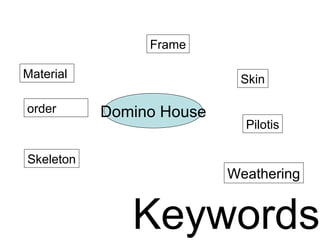
Keywords
order
Material
Frame
Weathering
Skeleton
Skin
Pilotis
Domino House
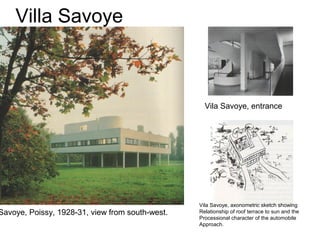
Villa Savoye,
Poissy, 1928-31,
Le Corbusier
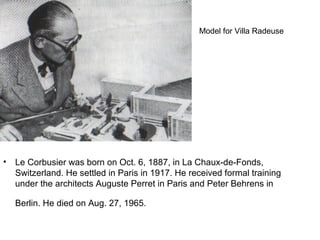
• Le Corbusier was born on Oct. 6, 1887, in La Chaux-de-Fonds,
Switzerland. He settled in Paris in 1917. He received formal training
under the architects Auguste Perret in Paris and Peter Behrens in
Berlin. He died on Aug. 27, 1965.
Model for Villa Radeuse
Villa Savoye
Vila Savoye, entrance
Savoye, Poissy, 1928-31, view from south-west.
Vila Savoye, axonometric sketch showing
Relationship of roof terrace to sun and the
Processional character of the automobile
Approach.
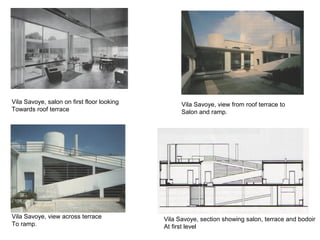
Vila Savoye, salon on first floor looking
Towards roof terrace
Vila Savoye, view from roof terrace to
Salon and ramp.
Vila Savoye, view across terrace
To ramp.
Vila Savoye, section showing salon, terrace and bodoir
At first level
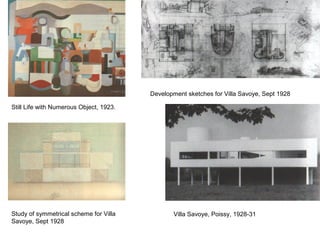
Study of symmetrical scheme for Villa
Savoye, Sept 1928
Villa Savoye, Poissy, 1928-31
Still Life with Numerous Object, 1923.
Development sketches for Villa Savoye, Sept 1928
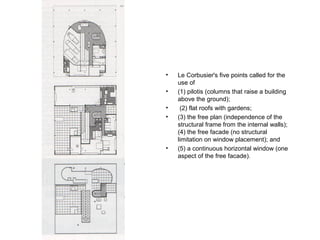
• Le Corbusier's five points called for the
use of
• (1) pilotis (columns that raise a building
above the ground);
• (2) flat roofs with gardens;
• (3) the free plan (independence of the
structural frame from the internal walls);
(4) the free facade (no structural
limitation on window placement); and
• (5) a continuous horizontal window (one
aspect of the free facade).
Breaking the box, opening up the walls.
Another way to see windows.
Mies van der Rohe 1889-1969, Born in Germany, practised in Berlin and
emigrated to the USA in 1937 to head the Illinois Institute of Technology
in Chicago until 1959.
Abstract
Opening up
Keywords
Structure
Material
Walls
Framings
Edges
Planes
Openings
Open House
Farnsworth House,
Plano, Illinois, 1946-
50,
Mies van der Rohe
‘Architecture is the will of the age
conceived in spatial terms’
Mies van der Rohe
~
TRUTH
‘Truth is the significance of fact’
Thomas Aquinas
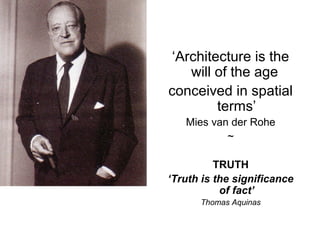
‘Architecture is the
will of the age
conceived in spatial
terms’
Mies van der Rohe
~
TRUTH
‘Truth is the significance
of fact’
Thomas Aquinas
Farnsworth House,1946-50
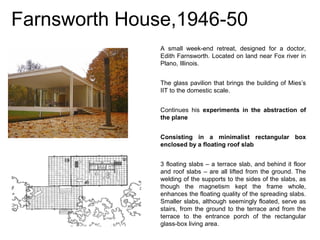
A small week-end retreat, designed for a doctor,
Edith Farnsworth. Located on land near Fox river in
Plano, Illinois.
The glass pavilion that brings the building of Mies’s
IIT to the domestic scale.
Continues his experiments in the abstraction of
the plane
Consisting in a minimalist rectangular box
enclosed by a floating roof slab
3 floating slabs – a terrace slab, and behind it floor
and roof slabs – are all lifted from the ground. The
welding of the supports to the sides of the slabs, as
though the magnetism kept the frame whole,
enhances the floating quality of the spreading slabs.
Smaller slabs, although seemingly floated, serve as
stairs, from the ground to the terrace and from the
terrace to the entrance porch of the rectangular
glass-box living area.
Farnsworth House,1946-50
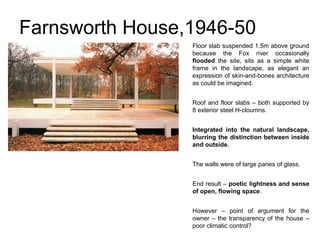
Floor slab suspended 1.5m above ground
because the Fox river occasionally
flooded the site, sits as a simple white
frame in the landscape, as elegant an
expression of skin-and-bones architecture
as could be imagined.
Roof and floor slabs – both supported by
8 exterior steel H-cloumns.
Integrated into the natural landscape,
blurring the distinction between inside
and outside.
The walls were of large panes of glass.
End result – poetic lightness and sense
of open, flowing space.
However – point of argument for the
owner – the transparency of the house –
poor climatic control?
Farnsworth House,1946-50
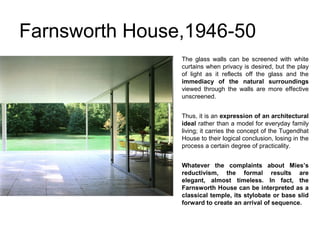
The glass walls can be screened with white
curtains when privacy is desired, but the play
of light as it reflects off the glass and the
immediacy of the natural surroundings
viewed through the walls are more effective
unscreened.
Thus, it is an expression of an architectural
ideal rather than a model for everyday family
living; it carries the concept of the Tugendhat
House to their logical conclusion, losing in the
process a certain degree of practicality.
Whatever the complaints about Mies’s
reductivism, the formal results are
elegant, almost timeless. In fact, the
Farnsworth House can be interpreted as a
classical temple, its stylobate or base slid
forward to create an arrival of sequence.
Farnsworth House,1946-50
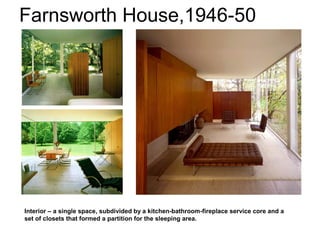
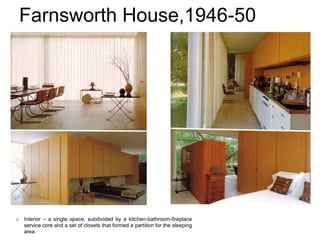
Interior – a single space, subdivided by a kitchen-bathroom-fireplace service core and a
set of closets that formed a partition for the sleeping area.
Farnsworth House,1946-50
Required Reading
“Five Points Towards a
New Architecture”
Le Corbusier 1964
End!

Openhousex

  • 1.
  • 2.
    The use ofthe frame and skin as a modern building system and theoretical mandala. The materialization of ideas. To put together materials and elements in an architectural ordering system. Abstract System
  • 3.
  • 4.
  • 5.
    • Le Corbusierwas born on Oct. 6, 1887, in La Chaux-de-Fonds, Switzerland. He settled in Paris in 1917. He received formal training under the architects Auguste Perret in Paris and Peter Behrens in Berlin. He died on Aug. 27, 1965. Model for Villa Radeuse
  • 6.
    Villa Savoye Vila Savoye,entrance Savoye, Poissy, 1928-31, view from south-west. Vila Savoye, axonometric sketch showing Relationship of roof terrace to sun and the Processional character of the automobile Approach.
  • 7.
    Vila Savoye, salonon first floor looking Towards roof terrace Vila Savoye, view from roof terrace to Salon and ramp. Vila Savoye, view across terrace To ramp. Vila Savoye, section showing salon, terrace and bodoir At first level
  • 8.
    Study of symmetricalscheme for Villa Savoye, Sept 1928 Villa Savoye, Poissy, 1928-31 Still Life with Numerous Object, 1923. Development sketches for Villa Savoye, Sept 1928
  • 9.
    • Le Corbusier'sfive points called for the use of • (1) pilotis (columns that raise a building above the ground); • (2) flat roofs with gardens; • (3) the free plan (independence of the structural frame from the internal walls); (4) the free facade (no structural limitation on window placement); and • (5) a continuous horizontal window (one aspect of the free facade).
  • 10.
    Breaking the box,opening up the walls. Another way to see windows. Mies van der Rohe 1889-1969, Born in Germany, practised in Berlin and emigrated to the USA in 1937 to head the Illinois Institute of Technology in Chicago until 1959. Abstract Opening up
  • 11.
  • 12.
    Farnsworth House, Plano, Illinois,1946- 50, Mies van der Rohe
  • 13.
    ‘Architecture is thewill of the age conceived in spatial terms’ Mies van der Rohe ~ TRUTH ‘Truth is the significance of fact’ Thomas Aquinas
  • 14.
    ‘Architecture is the willof the age conceived in spatial terms’ Mies van der Rohe ~ TRUTH ‘Truth is the significance of fact’ Thomas Aquinas
  • 15.
    Farnsworth House,1946-50 A smallweek-end retreat, designed for a doctor, Edith Farnsworth. Located on land near Fox river in Plano, Illinois. The glass pavilion that brings the building of Mies’s IIT to the domestic scale. Continues his experiments in the abstraction of the plane Consisting in a minimalist rectangular box enclosed by a floating roof slab 3 floating slabs – a terrace slab, and behind it floor and roof slabs – are all lifted from the ground. The welding of the supports to the sides of the slabs, as though the magnetism kept the frame whole, enhances the floating quality of the spreading slabs. Smaller slabs, although seemingly floated, serve as stairs, from the ground to the terrace and from the terrace to the entrance porch of the rectangular glass-box living area.
  • 16.
    Farnsworth House,1946-50 Floor slabsuspended 1.5m above ground because the Fox river occasionally flooded the site, sits as a simple white frame in the landscape, as elegant an expression of skin-and-bones architecture as could be imagined. Roof and floor slabs – both supported by 8 exterior steel H-cloumns. Integrated into the natural landscape, blurring the distinction between inside and outside. The walls were of large panes of glass. End result – poetic lightness and sense of open, flowing space. However – point of argument for the owner – the transparency of the house – poor climatic control?
  • 17.
    Farnsworth House,1946-50 The glasswalls can be screened with white curtains when privacy is desired, but the play of light as it reflects off the glass and the immediacy of the natural surroundings viewed through the walls are more effective unscreened. Thus, it is an expression of an architectural ideal rather than a model for everyday family living; it carries the concept of the Tugendhat House to their logical conclusion, losing in the process a certain degree of practicality. Whatever the complaints about Mies’s reductivism, the formal results are elegant, almost timeless. In fact, the Farnsworth House can be interpreted as a classical temple, its stylobate or base slid forward to create an arrival of sequence.
  • 18.
    Farnsworth House,1946-50 Interior –a single space, subdivided by a kitchen-bathroom-fireplace service core and a set of closets that formed a partition for the sleeping area.
  • 19.
  • 20.
    Required Reading “Five PointsTowards a New Architecture” Le Corbusier 1964
  • 21.