FRACTURE AND ITS CLASSIFICATIONS
Presenter-
Dr.Raunit Thakur
(PGY-1)
Orthopedics
Moderator
Asso.Prof. Dr. Mukesh pd.
Kushwaha
Objectives
 Definition
 Basic principle of classifications
 Types
 Conclusions
Fracture
Definition-a fracture is a break in the continuity of a bone
Why classify the fractures?
 To assist treatment guide
 To prognosticate the pathology
 To speak a universal common
language
CLASSIFICATION
 Based on relationship with external environment
 Based on displacement
 Based on etiology
 Based on complexity of treatment
 Based on force causing fracture
 Based on basis of site
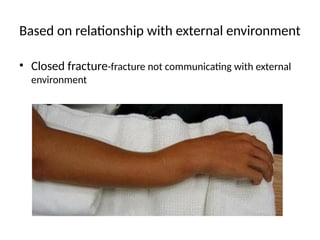
Based on relationship with external environment
• Closed fracture-fracture not communicating with external
environment
2.Open fracture: communication with external environment;
break in the skin and underlying soft tissue communicates
directly with the fracture and its hematoma
 Internally open: sharp fracture end pierces the skin from
within
 Externally open: object causing the fracture lacerates the
skin and soft tissues over the bone
OPEN FRACTURE CLASSIFICATION
Based on displacement
• Displaced fracture-factors responsible for
displacement are:
 Muscle pull on the fracture fragments
 The gravity
 The fracturing force
The displacement can be in the form of
• shift,
• angulations or
• rotation
• Undisplaced fracture-these fractures are easy to identify
by the absence of significant displacement
Based on etiology
• Traumatic
• Pathological
• Stress fracture
Based on complexity of treatment
• Simple fracture-fracture in two pieces, usually easy to treat
• Complex fracture: fracture in multiple pieces, usually
difficult to treat
Basis of force causing fracture
• High velocity force: fracture sustained as a result of severe
trauma force
• Low velocity force: fracture sustained as a result of mild
trauma force
Basis of fracture site
1. Epiphyseal fractures
2. Metaphyseal fracture
3. Diaphyseal fractures
 Proximal third
 Middle third
 Distal third
 Junctional fractures
Basis of pattern
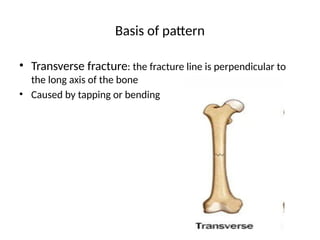
• Transverse fracture: the fracture line is perpendicular to
the long axis of the bone
• Caused by tapping or bending
Basis of pattern
• Oblique fracture: fracture line is oblique to long axis of
bone
• Caused by bending force
Basis of pattern
• Spiral fracture: fracture line runs spirally in more than one
plane
• Caused by primarily twisting force
Basis of pattern
• Comminuted fracture: fracture with multiple fragements
• Caused by crushing or compression force
Basis of pattern
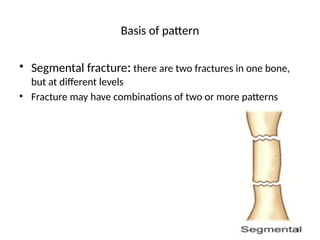
• Segmental fracture: there are two fractures in one bone,
but at different levels
• Fracture may have combinations of two or more patterns
• Impacted fractures: fractures where a vertical force drives
the distal fragment of the fracture into the proximal fragment
• Depressed fractures: fracture occurs in the skull where a
segment of bone gets depressed into the cranium
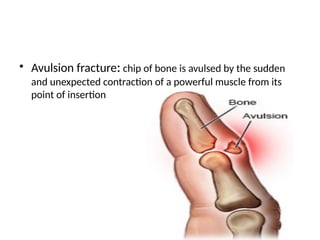
• Avulsion fracture: chip of bone is avulsed by the sudden
and unexpected contraction of a powerful muscle from its
point of insertion
AO classification system
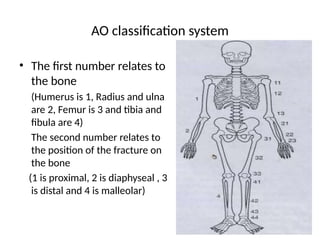
• The first number relates to
the bone
(Humerus is 1, Radius and ulna
are 2, Femur is 3 and tibia and
fibula are 4)
The second number relates to
the position of the fracture on
the bone
(1 is proximal, 2 is diaphyseal , 3
is distal and 4 is malleolar)
AO classification system
• The position number is followed
by a letter which defines severity
of the fractures
 For proximal and distal fractures (type
1& 2):
- A is extra articular
- B is partial articular
- C is intra articular
 For diaphyseal fractures (type 2):
- A is simple fracture
- B is wedge or butterfly type
- C is communited fracture
Conclusion
 Fracture classification being a universal coding system,has
helped for global understanding about the disease
 Help to plan for management of specific features
 Preoperative counseling regarding morbidity and mortality to
patient has becomes much easy
 Improvising the old and giving new classification model is a
continuous process which increases the accuracy of outcomes
References
 Hand book of fractures
 Classifications of fractures and dislocation in orthopedics
FRACTURE AND ITS CLASSIFICATIONS.slideshare

FRACTURE AND ITS CLASSIFICATIONS.slideshare

  • 1.
    FRACTURE AND ITSCLASSIFICATIONS Presenter- Dr.Raunit Thakur (PGY-1) Orthopedics Moderator Asso.Prof. Dr. Mukesh pd. Kushwaha
  • 2.
    Objectives  Definition  Basicprinciple of classifications  Types  Conclusions
  • 3.
    Fracture Definition-a fracture isa break in the continuity of a bone
  • 4.
    Why classify thefractures?  To assist treatment guide  To prognosticate the pathology  To speak a universal common language
  • 5.
    CLASSIFICATION  Based onrelationship with external environment  Based on displacement  Based on etiology  Based on complexity of treatment  Based on force causing fracture  Based on basis of site
  • 6.
    Based on relationshipwith external environment • Closed fracture-fracture not communicating with external environment
  • 7.
    2.Open fracture: communicationwith external environment; break in the skin and underlying soft tissue communicates directly with the fracture and its hematoma
  • 8.
     Internally open:sharp fracture end pierces the skin from within  Externally open: object causing the fracture lacerates the skin and soft tissues over the bone
  • 9.
  • 10.
    Based on displacement •Displaced fracture-factors responsible for displacement are:  Muscle pull on the fracture fragments  The gravity  The fracturing force
  • 11.
    The displacement canbe in the form of • shift, • angulations or • rotation
  • 12.
    • Undisplaced fracture-thesefractures are easy to identify by the absence of significant displacement
  • 13.
    Based on etiology •Traumatic • Pathological • Stress fracture
  • 14.
    Based on complexityof treatment • Simple fracture-fracture in two pieces, usually easy to treat • Complex fracture: fracture in multiple pieces, usually difficult to treat
  • 15.
    Basis of forcecausing fracture • High velocity force: fracture sustained as a result of severe trauma force • Low velocity force: fracture sustained as a result of mild trauma force
  • 16.
    Basis of fracturesite 1. Epiphyseal fractures 2. Metaphyseal fracture 3. Diaphyseal fractures  Proximal third  Middle third  Distal third  Junctional fractures
  • 17.
    Basis of pattern •Transverse fracture: the fracture line is perpendicular to the long axis of the bone • Caused by tapping or bending
  • 18.
    Basis of pattern •Oblique fracture: fracture line is oblique to long axis of bone • Caused by bending force
  • 19.
    Basis of pattern •Spiral fracture: fracture line runs spirally in more than one plane • Caused by primarily twisting force
  • 20.
    Basis of pattern •Comminuted fracture: fracture with multiple fragements • Caused by crushing or compression force
  • 21.
    Basis of pattern •Segmental fracture: there are two fractures in one bone, but at different levels • Fracture may have combinations of two or more patterns
  • 22.
    • Impacted fractures:fractures where a vertical force drives the distal fragment of the fracture into the proximal fragment
  • 23.
    • Depressed fractures:fracture occurs in the skull where a segment of bone gets depressed into the cranium
  • 24.
    • Avulsion fracture:chip of bone is avulsed by the sudden and unexpected contraction of a powerful muscle from its point of insertion
  • 25.
    AO classification system •The first number relates to the bone (Humerus is 1, Radius and ulna are 2, Femur is 3 and tibia and fibula are 4) The second number relates to the position of the fracture on the bone (1 is proximal, 2 is diaphyseal , 3 is distal and 4 is malleolar)
  • 26.
    AO classification system •The position number is followed by a letter which defines severity of the fractures  For proximal and distal fractures (type 1& 2): - A is extra articular - B is partial articular - C is intra articular  For diaphyseal fractures (type 2): - A is simple fracture - B is wedge or butterfly type - C is communited fracture
  • 27.
    Conclusion  Fracture classificationbeing a universal coding system,has helped for global understanding about the disease  Help to plan for management of specific features  Preoperative counseling regarding morbidity and mortality to patient has becomes much easy  Improvising the old and giving new classification model is a continuous process which increases the accuracy of outcomes
  • 28.
    References  Hand bookof fractures  Classifications of fractures and dislocation in orthopedics