FRACTIONS This presentation will help you to add, subtract, multiply and divide fractions. Left click on the mouse to reveal the next section
To learn about: Adding fractions click   Subtracting fractions click   Dividing fractions click   Multiplying  fractions click
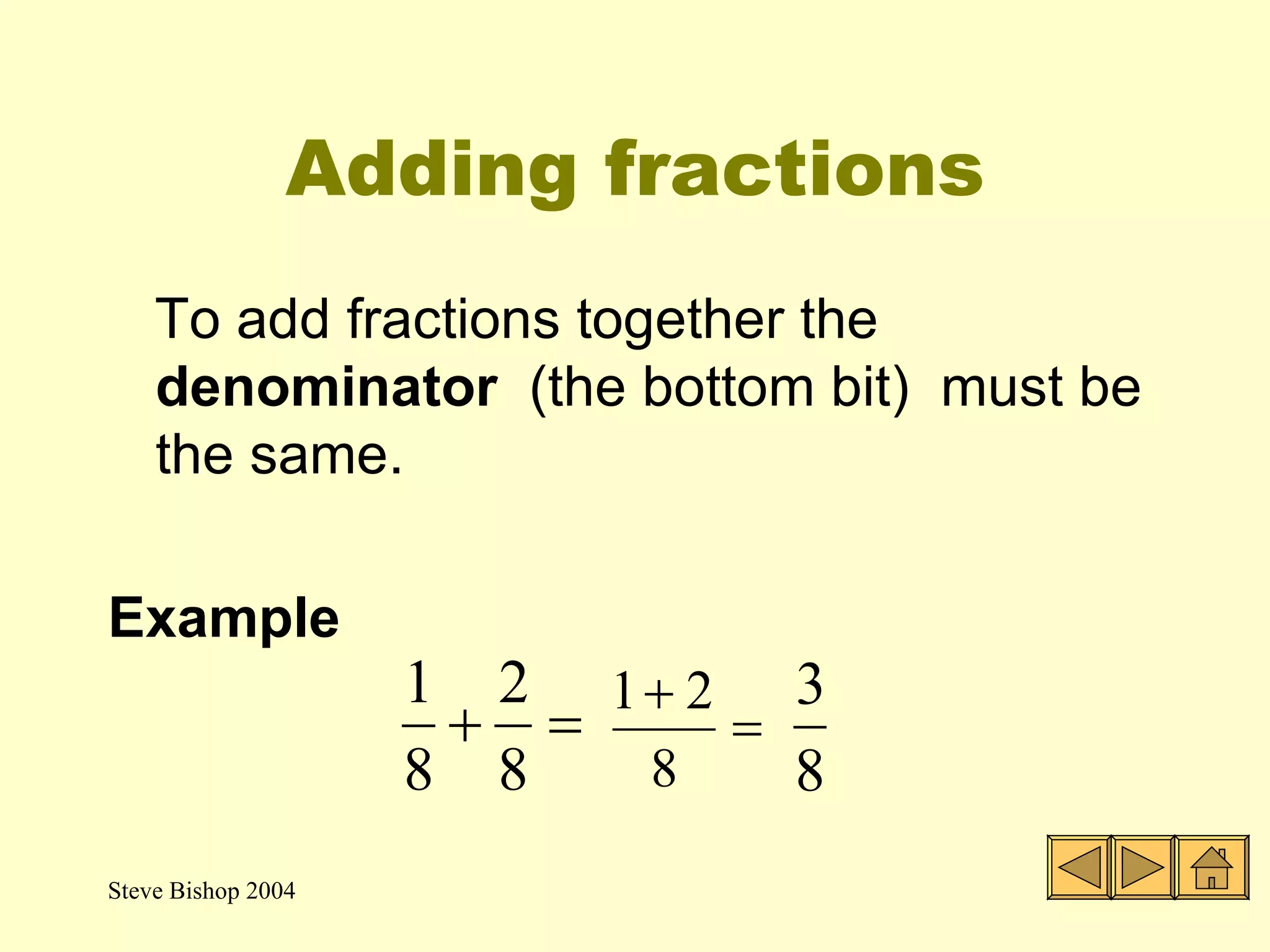
Adding fractions To add fractions together the  denominator  (the bottom bit)  must be the same. Example
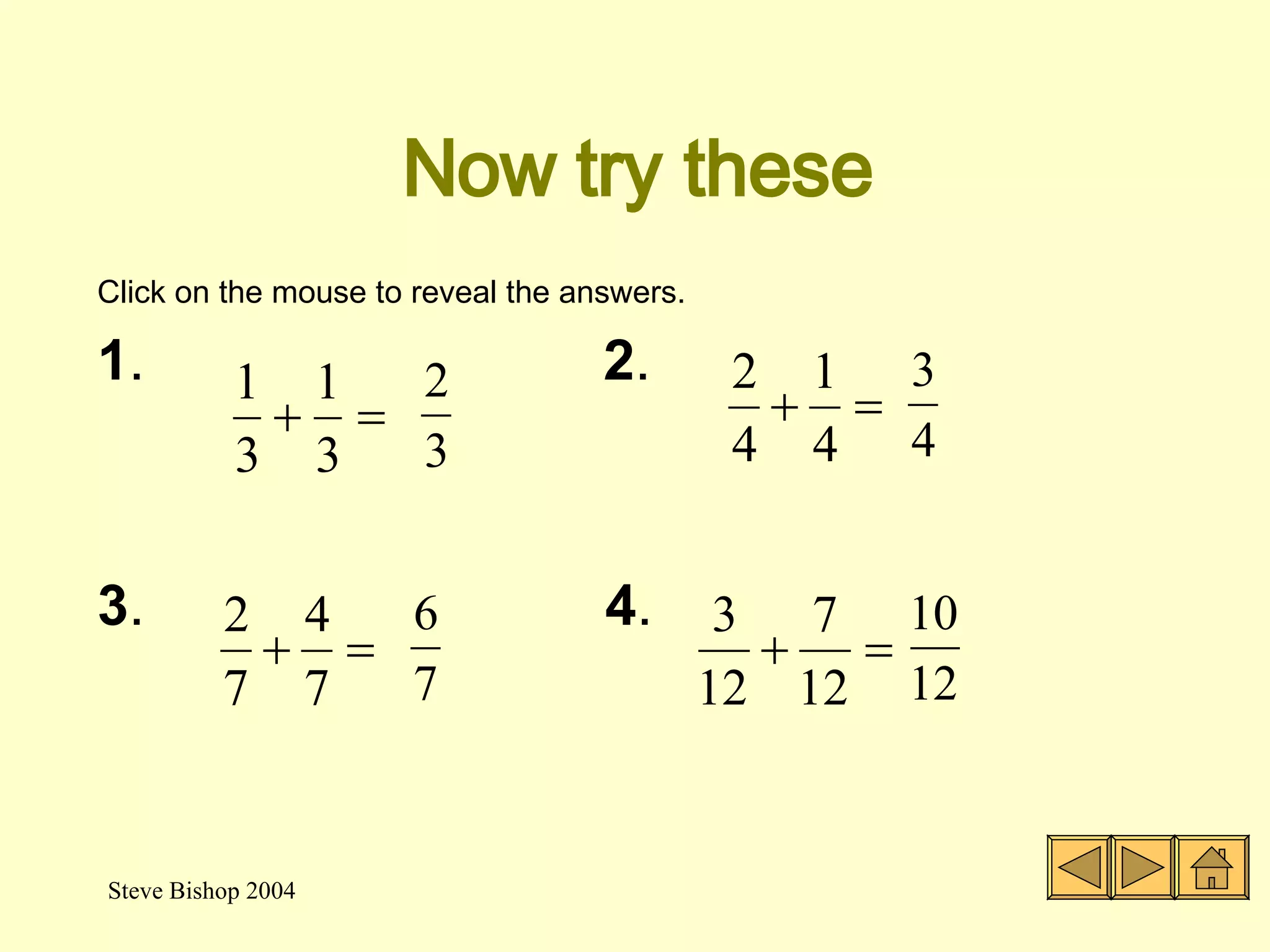
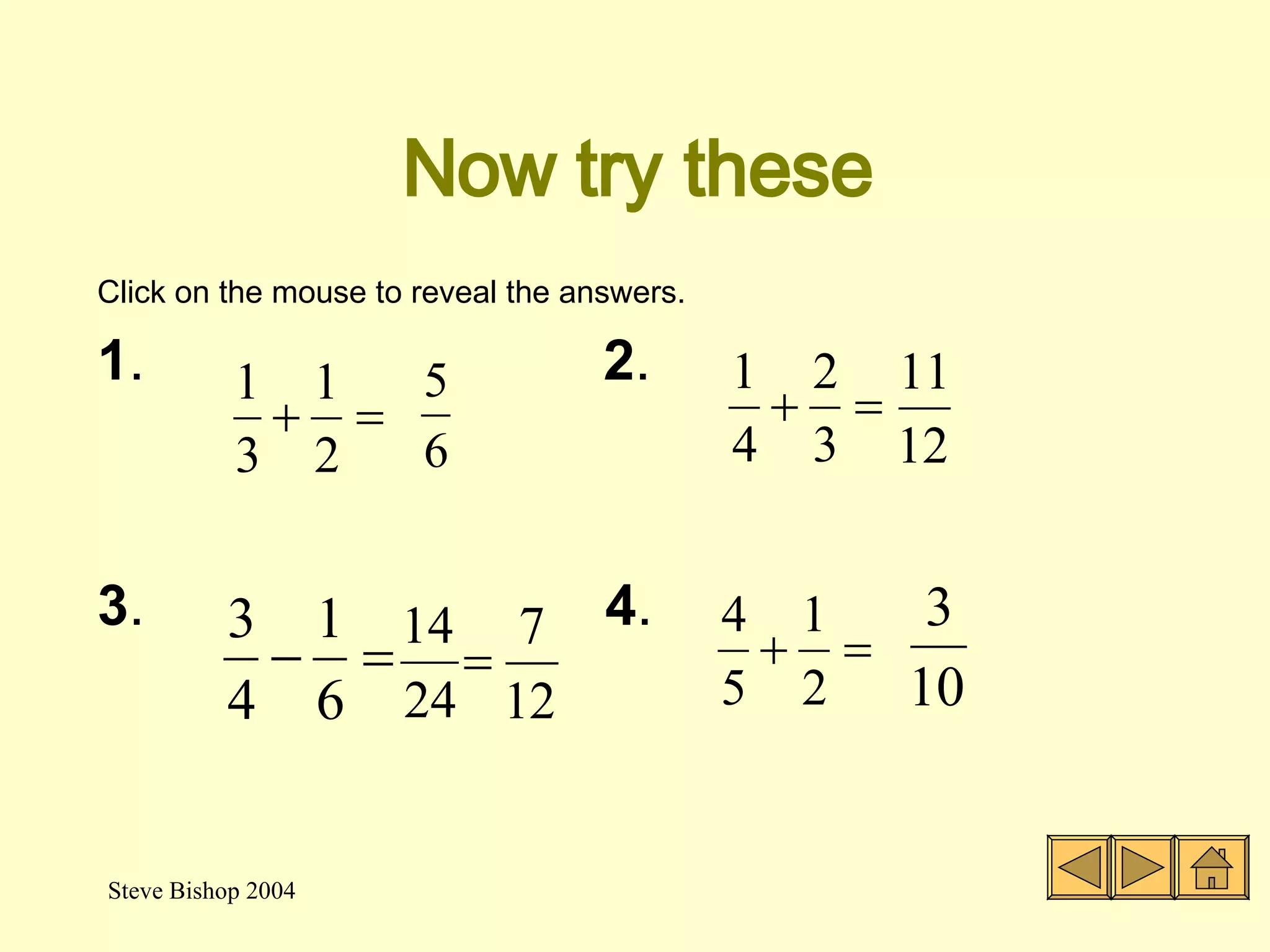
Now try these Click on the mouse to reveal the answers. 1 .    2 . 3 .  4 .
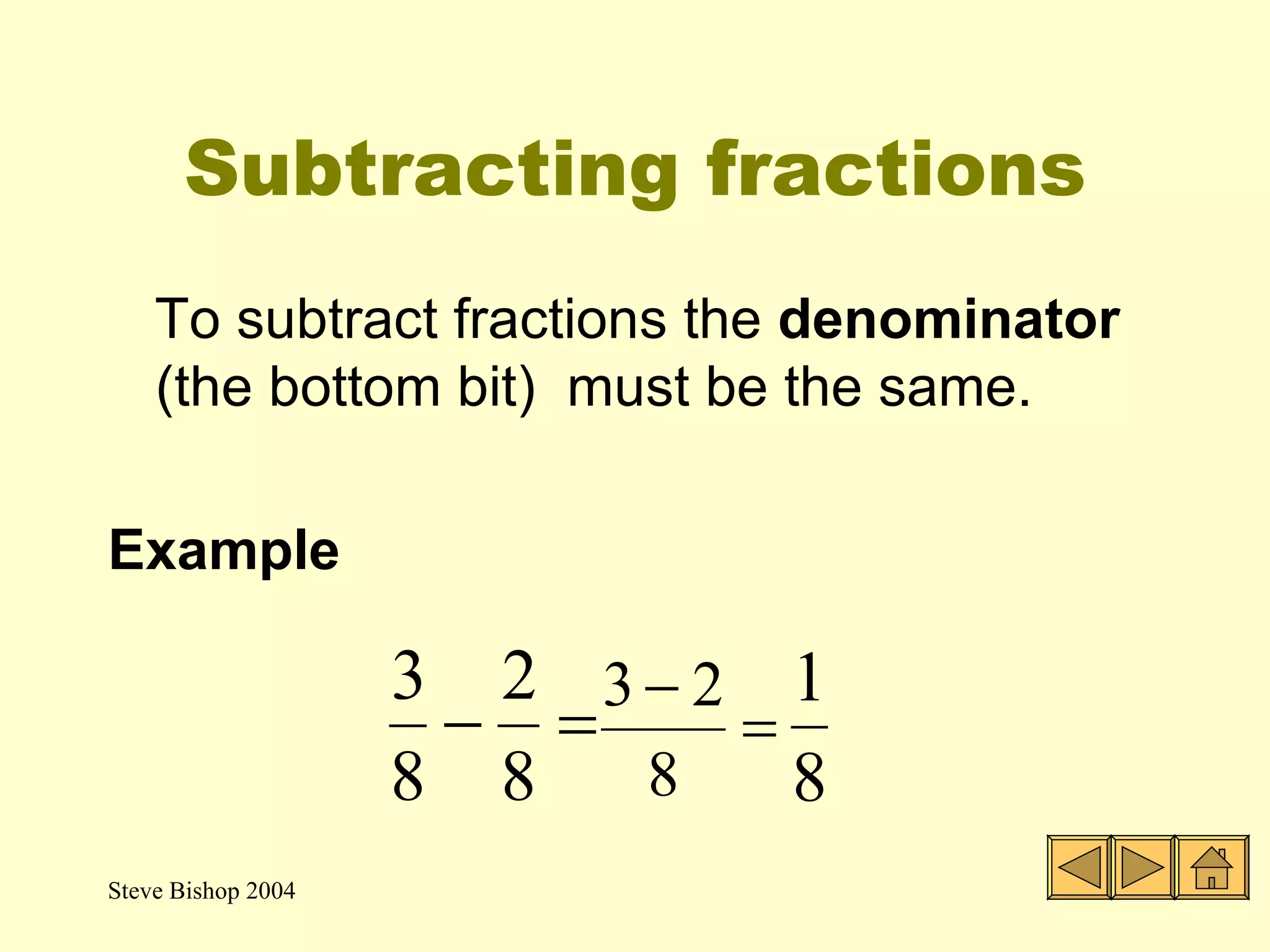
Subtracting fractions To subtract fractions the  denominator  (the bottom bit)  must be the same. Example
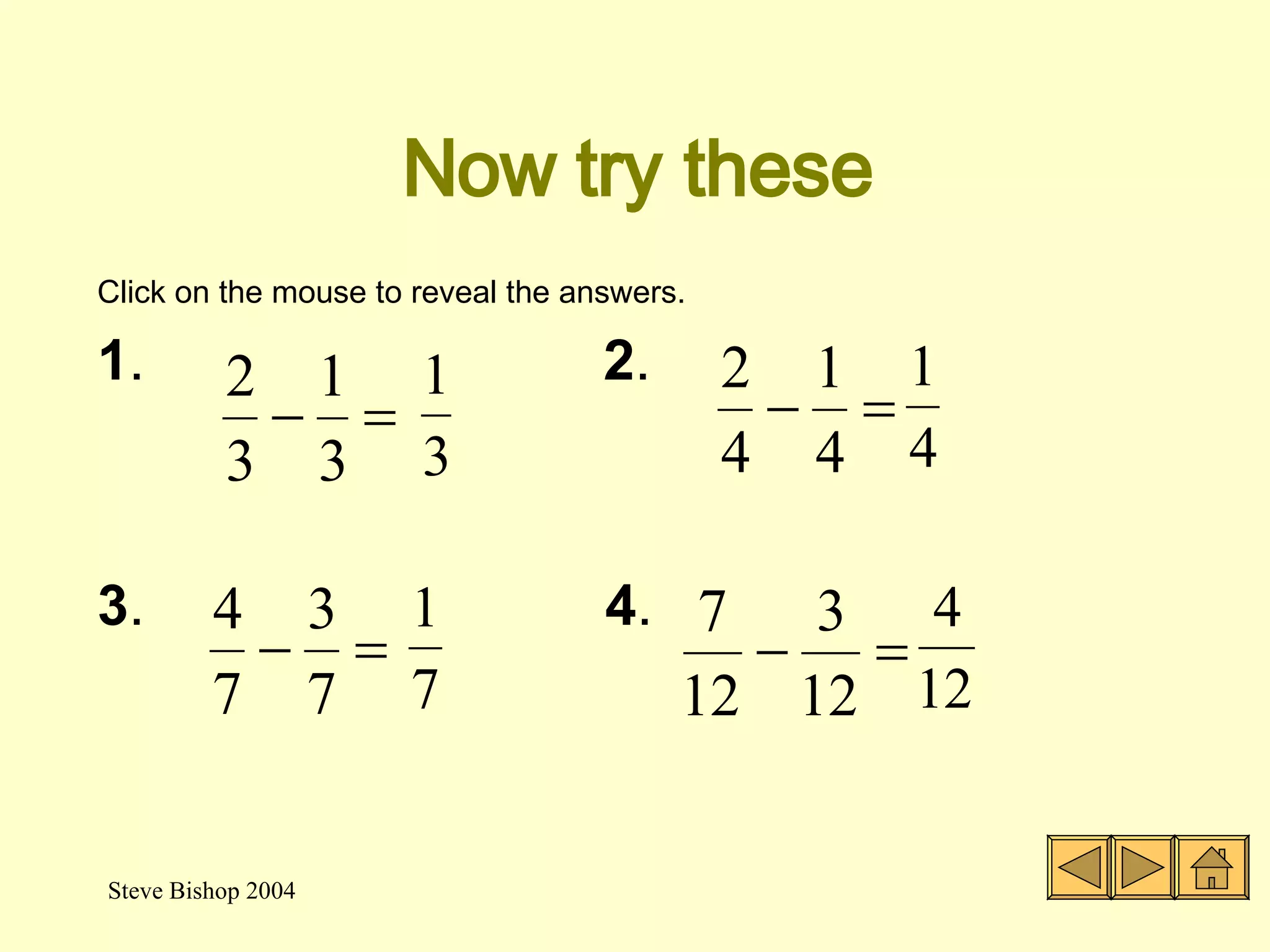
Now try these Click on the mouse to reveal the answers. 1 .    2 .  3 .  4 .
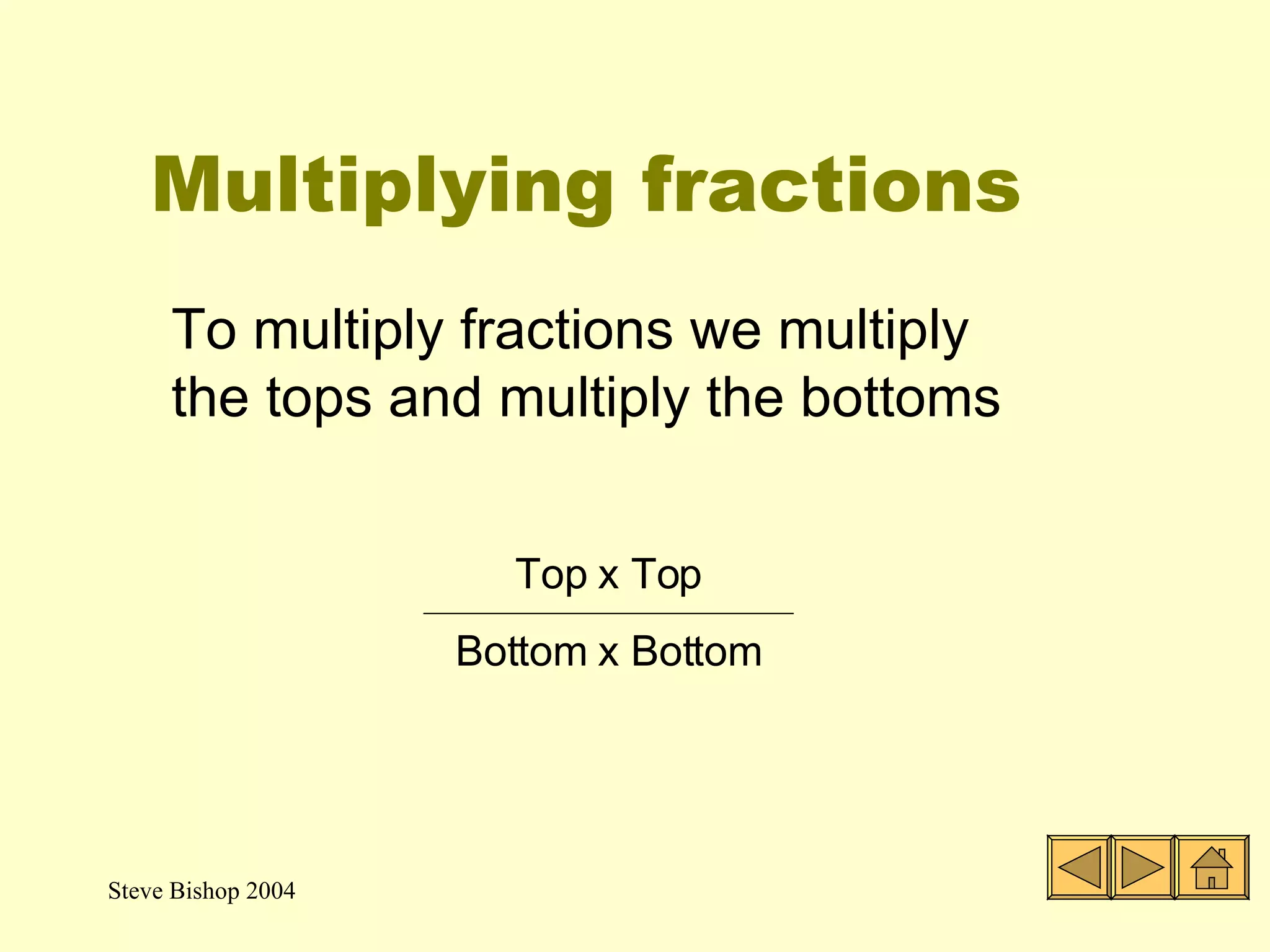
Multiplying fractions To multiply fractions we multiply the tops and multiply the bottoms Top x Top Bottom x Bottom
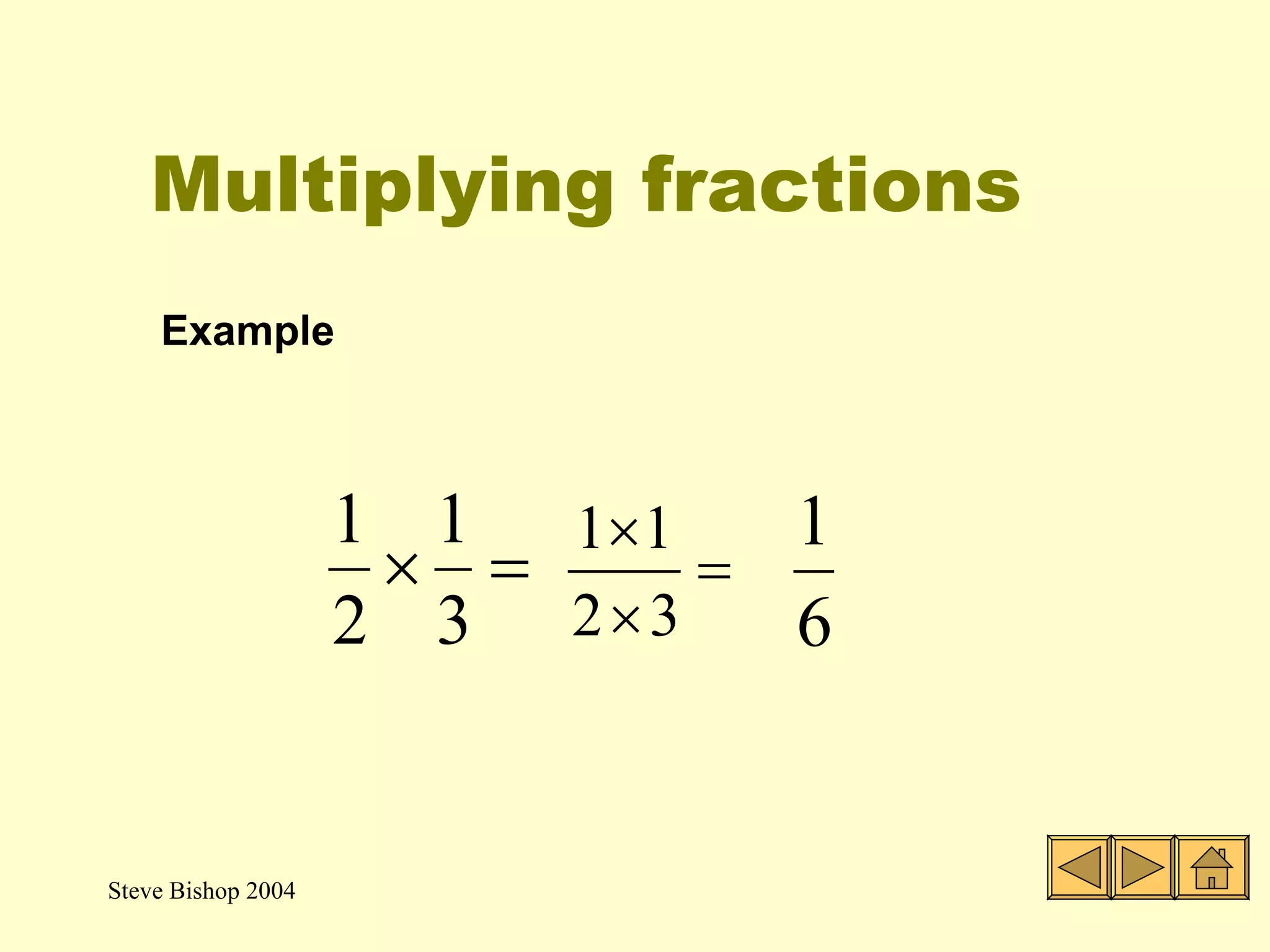
Multiplying fractions Example
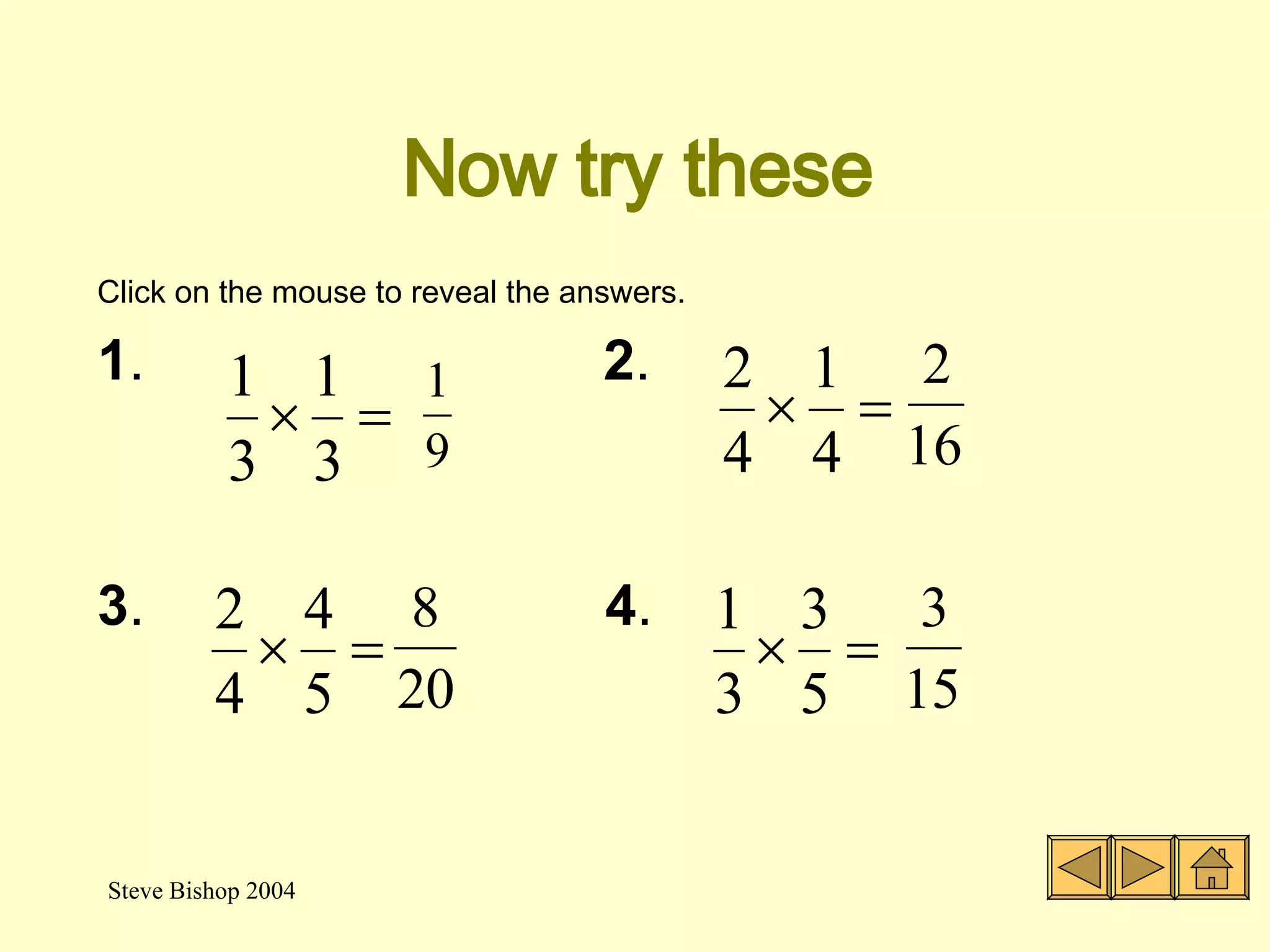
Now try these Click on the mouse to reveal the answers. 1 .    2 . 3 .  4 .
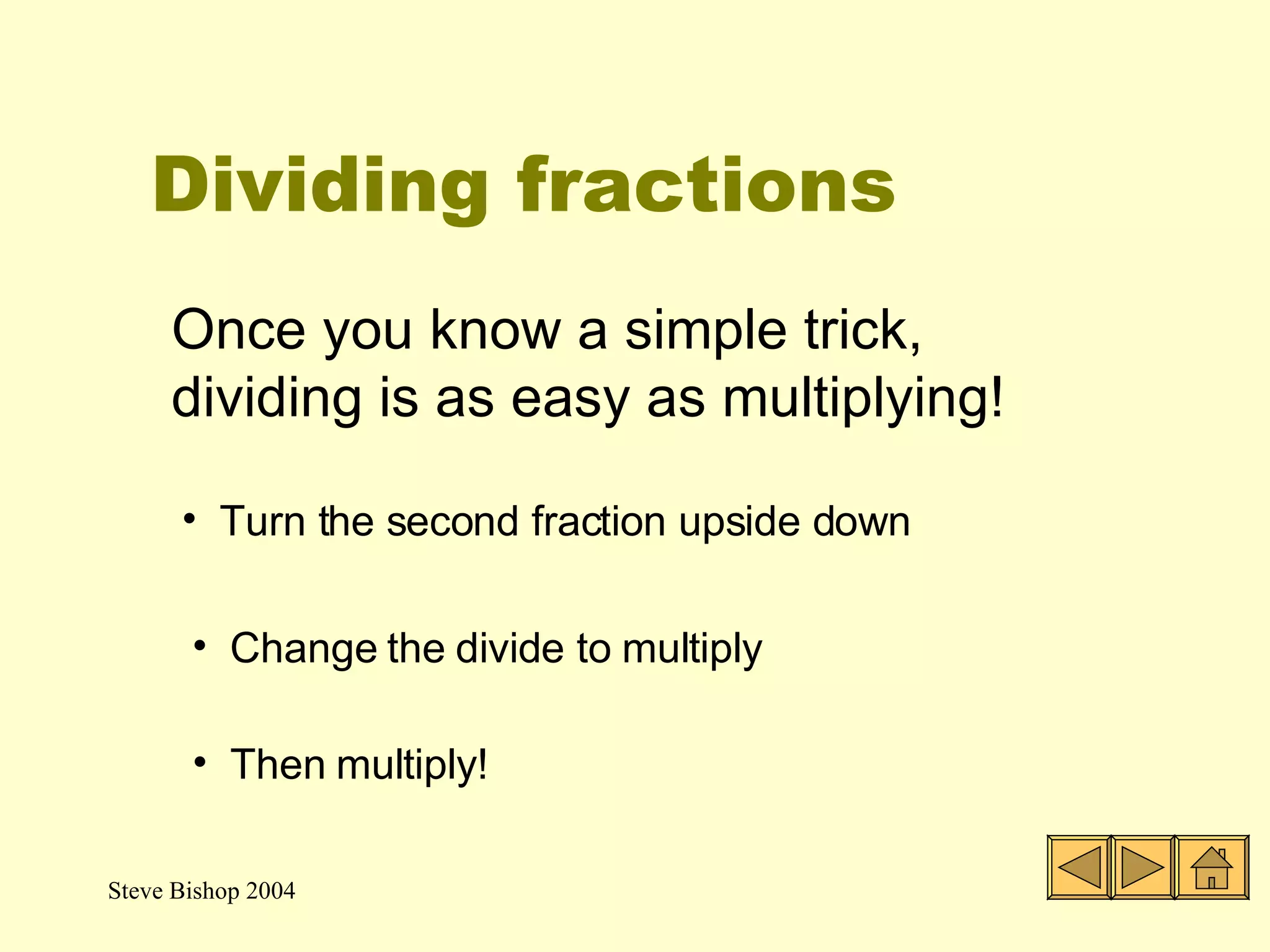
Dividing fractions Once you know a simple trick, dividing is as easy as multiplying! Turn the second fraction upside down Change the divide to multiply Then multiply!
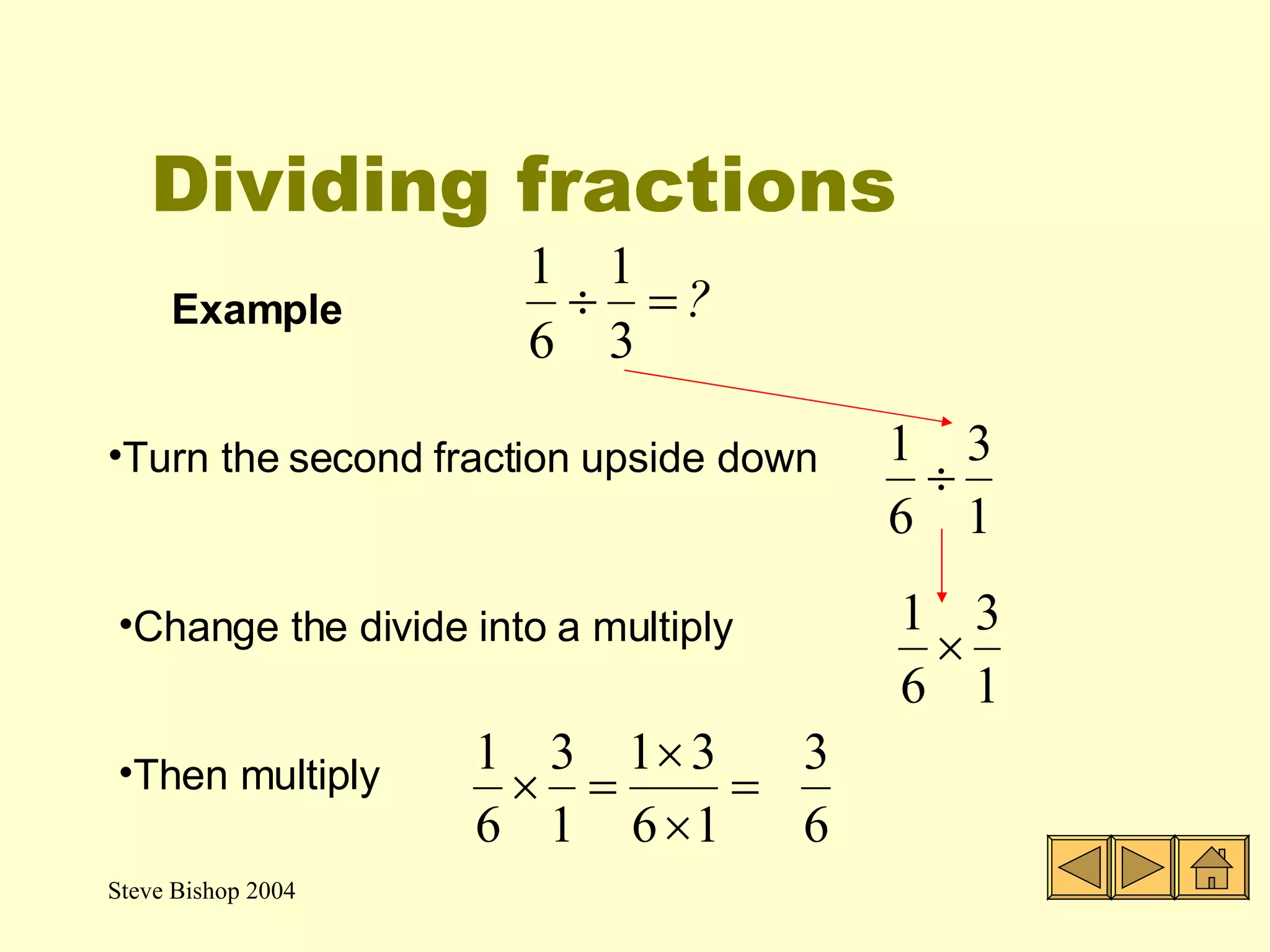
Dividing fractions Turn the second fraction upside down Example Change the divide into a multiply Then multiply
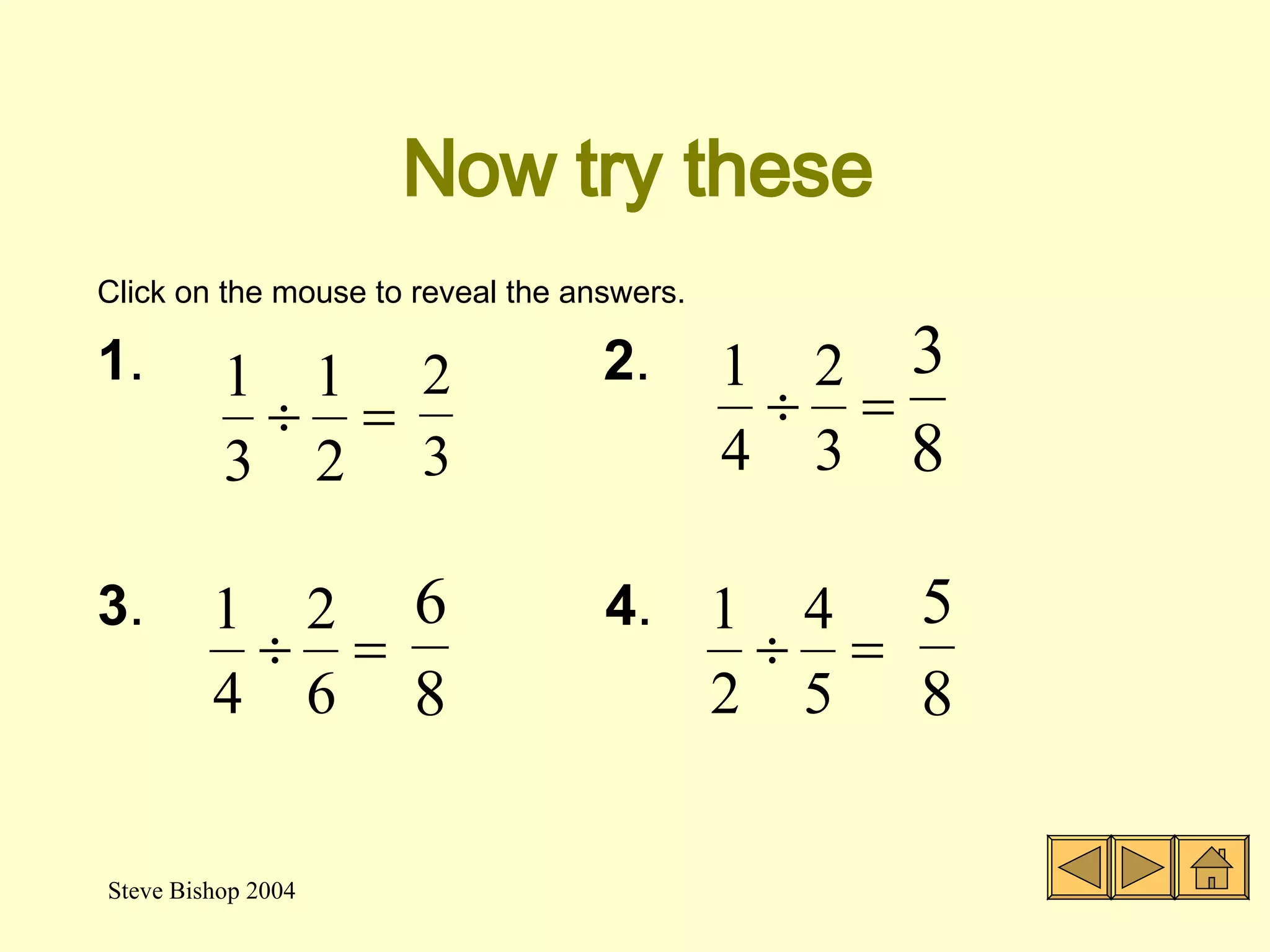
Now try these Click on the mouse to reveal the answers. 1 .    2 . 3 .  4 .
Common denominators To add or subtract fractions together the  denominator  (the bottom bit)  must be the same. So, sometimes we have to change the bottoms to make them the same. In “maths-speak” we say we must get  common denominators
Common denominators To get a common denominator we have to: 1. Multiply the bottoms together. 2. Then multiply the top bit by the correct number to get an equivalent fraction
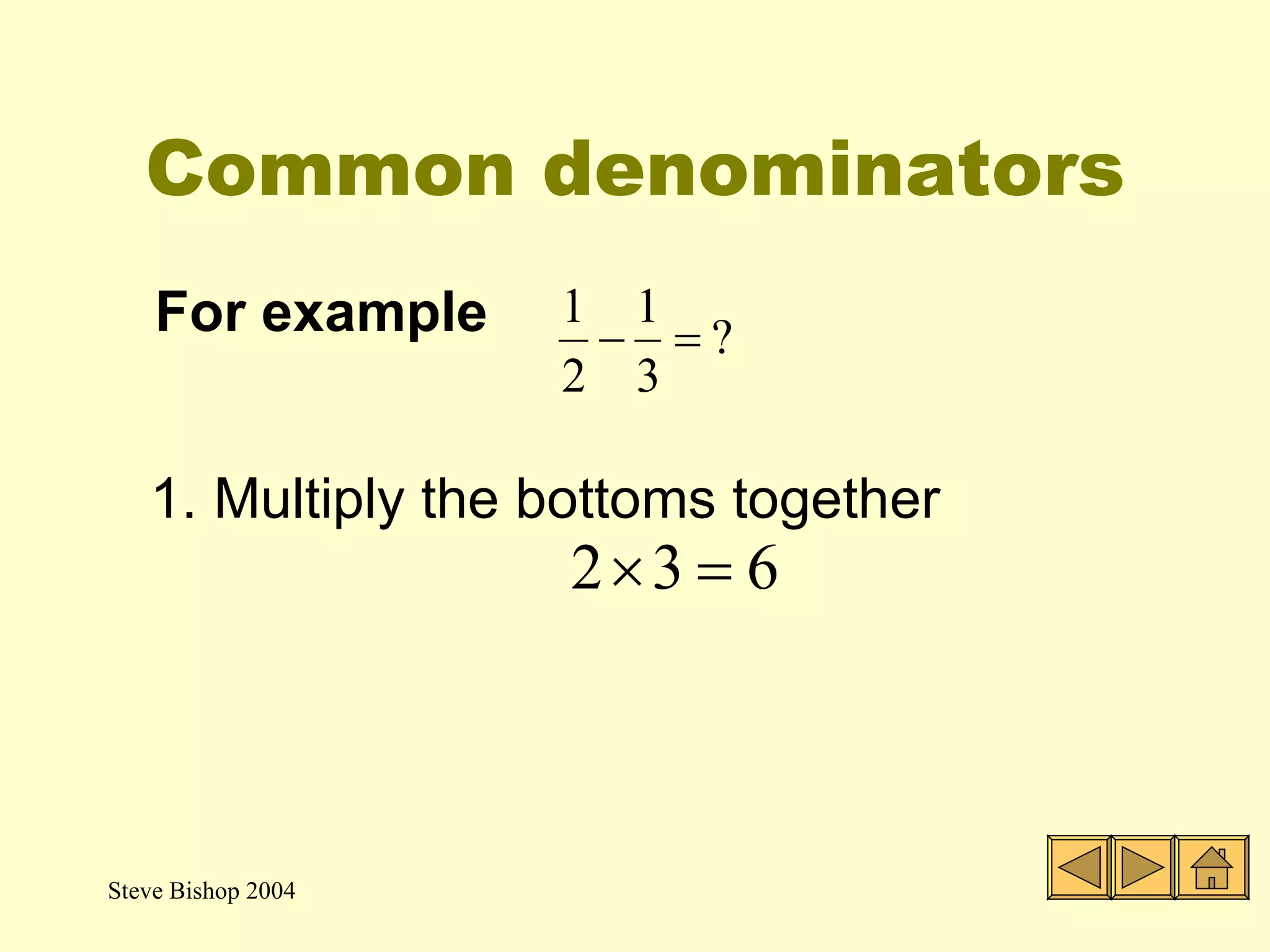
Common denominators For example  Multiply the bottoms together
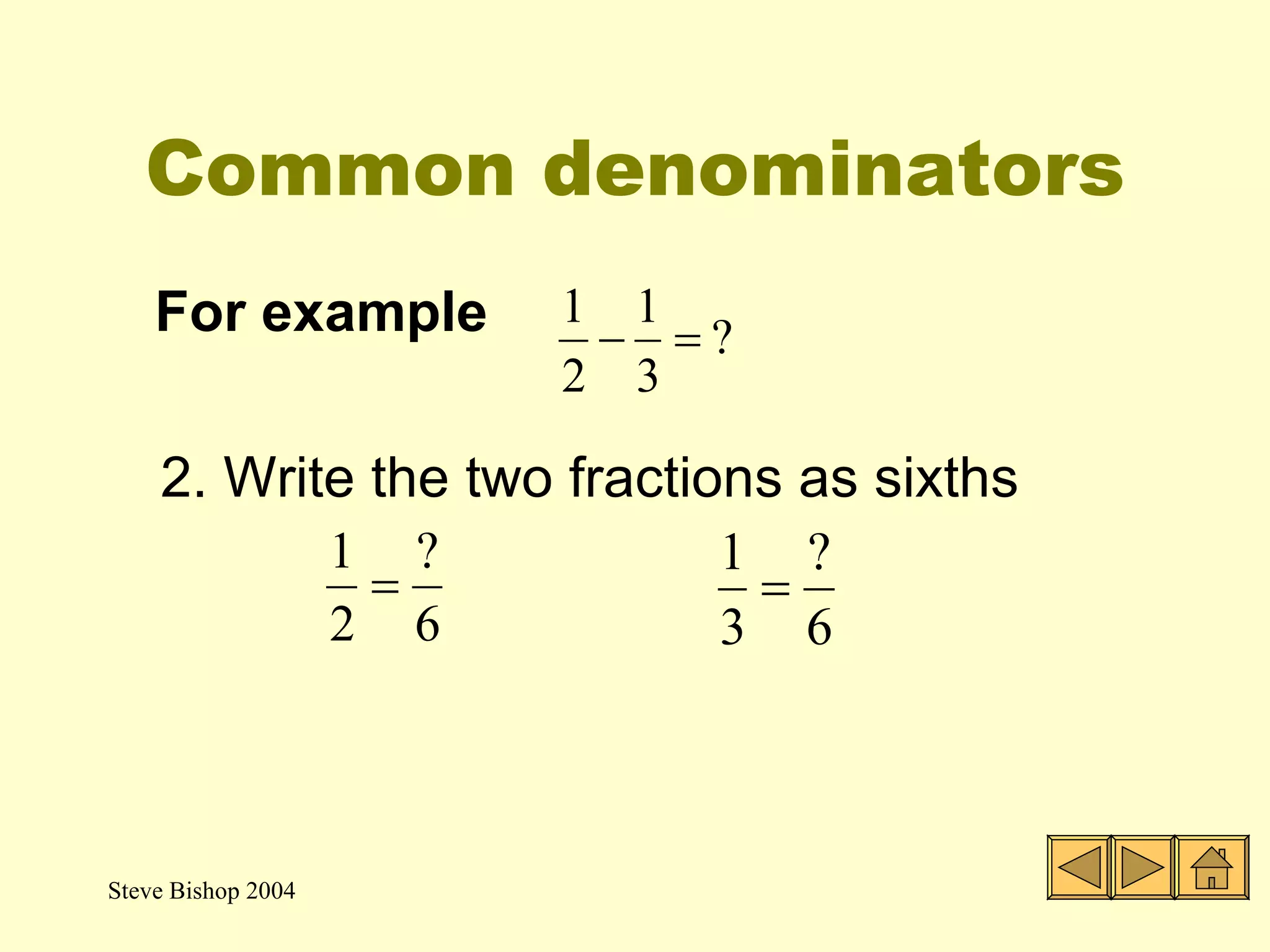
Common denominators For example  2. Write the two fractions as sixths
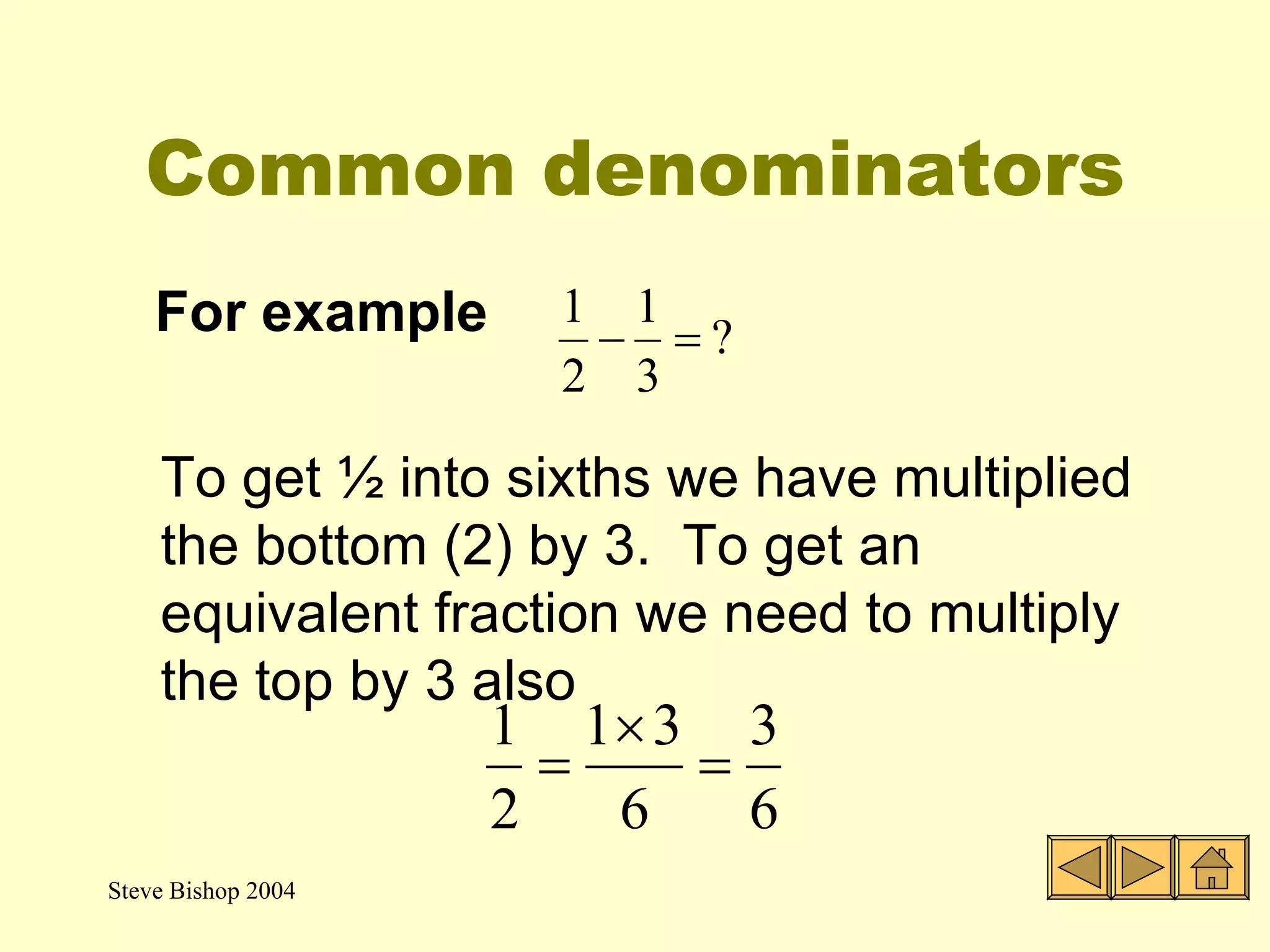
Common denominators For example  To get ½ into sixths we have multiplied the bottom (2) by 3.  To get an equivalent fraction we need to multiply the top by 3 also
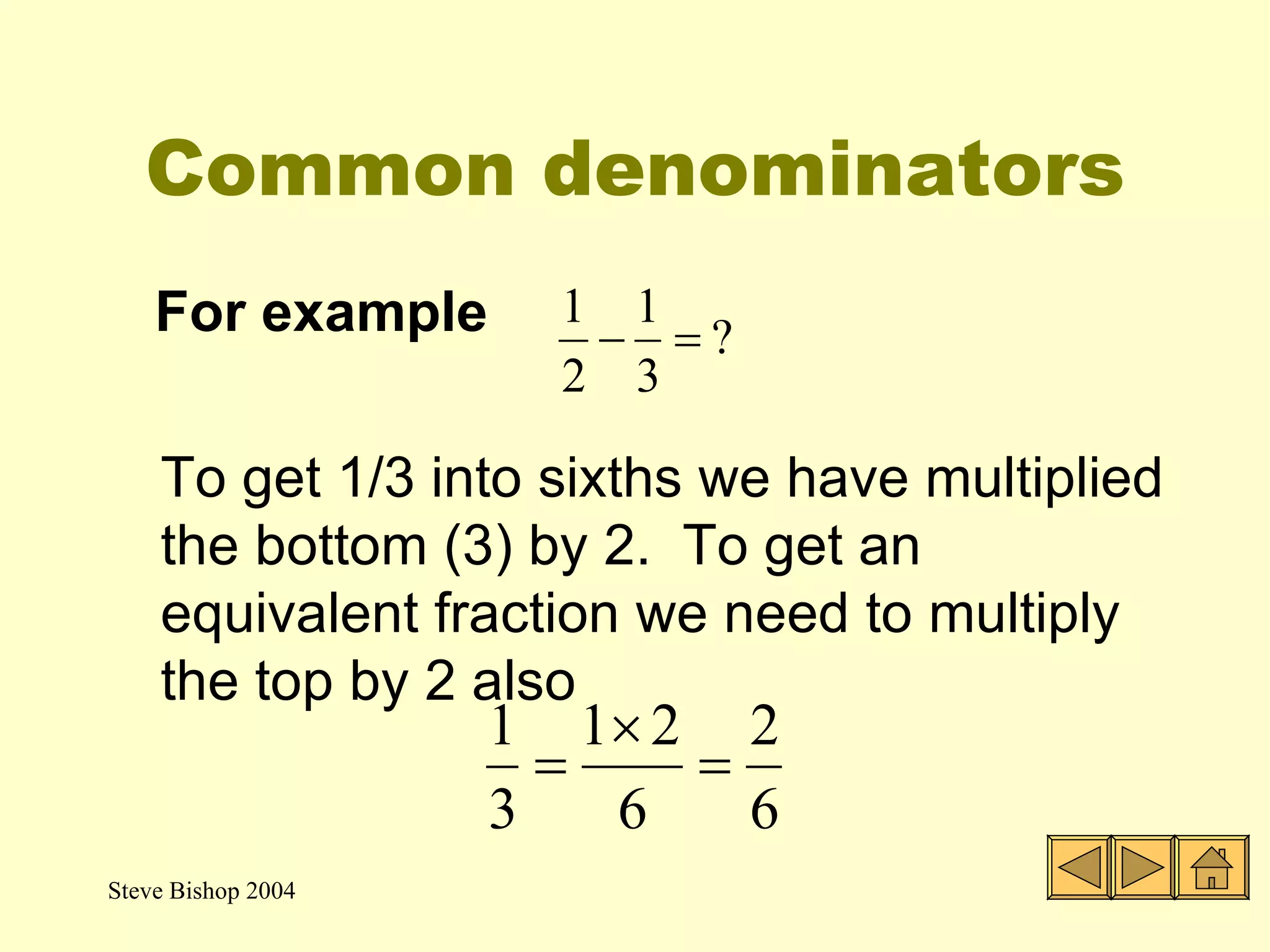
Common denominators For example  To get 1/3 into sixths we have multiplied the bottom (3) by 2.  To get an equivalent fraction we need to multiply the top by 2 also
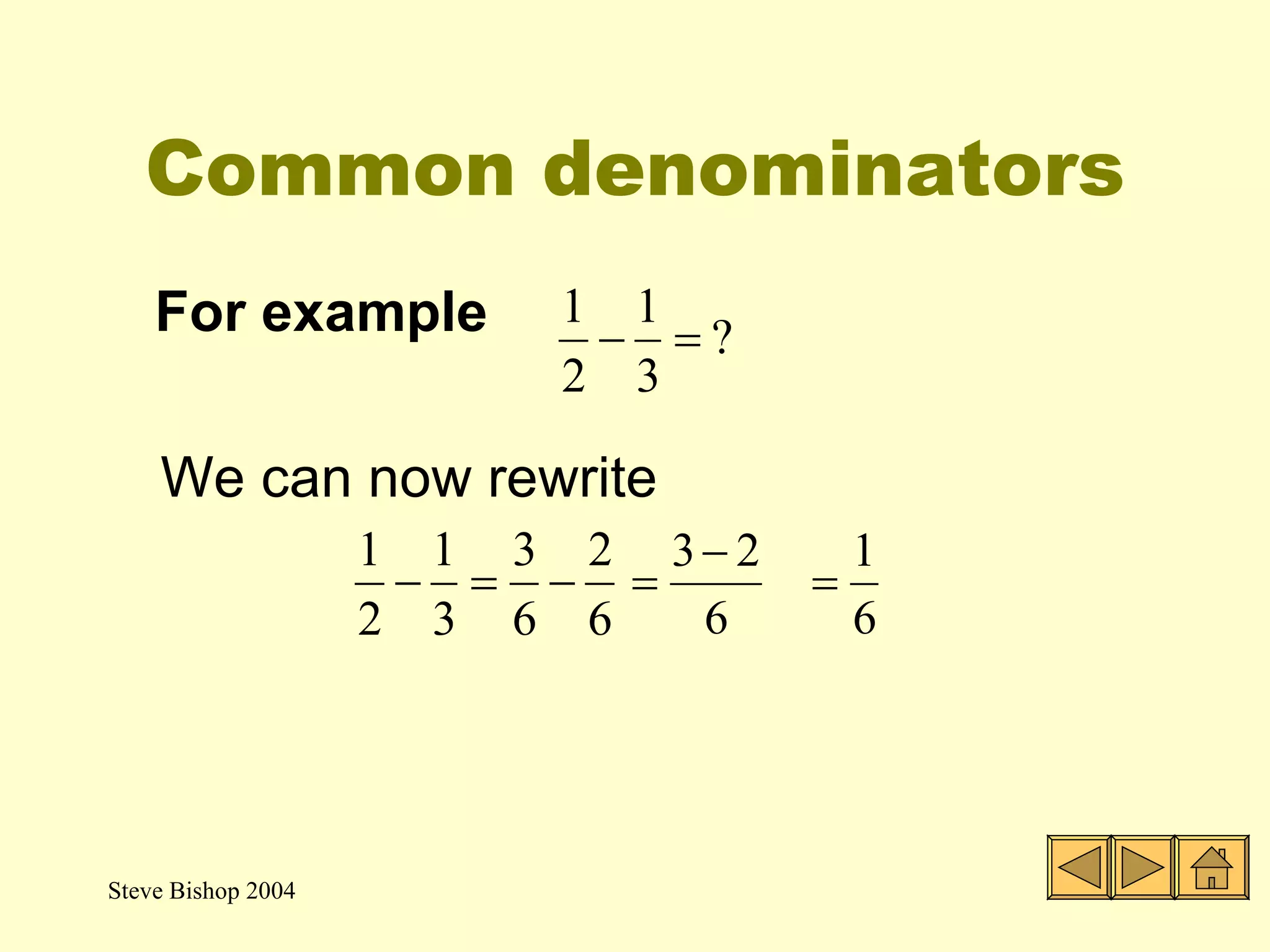
Common denominators For example  We can now rewrite
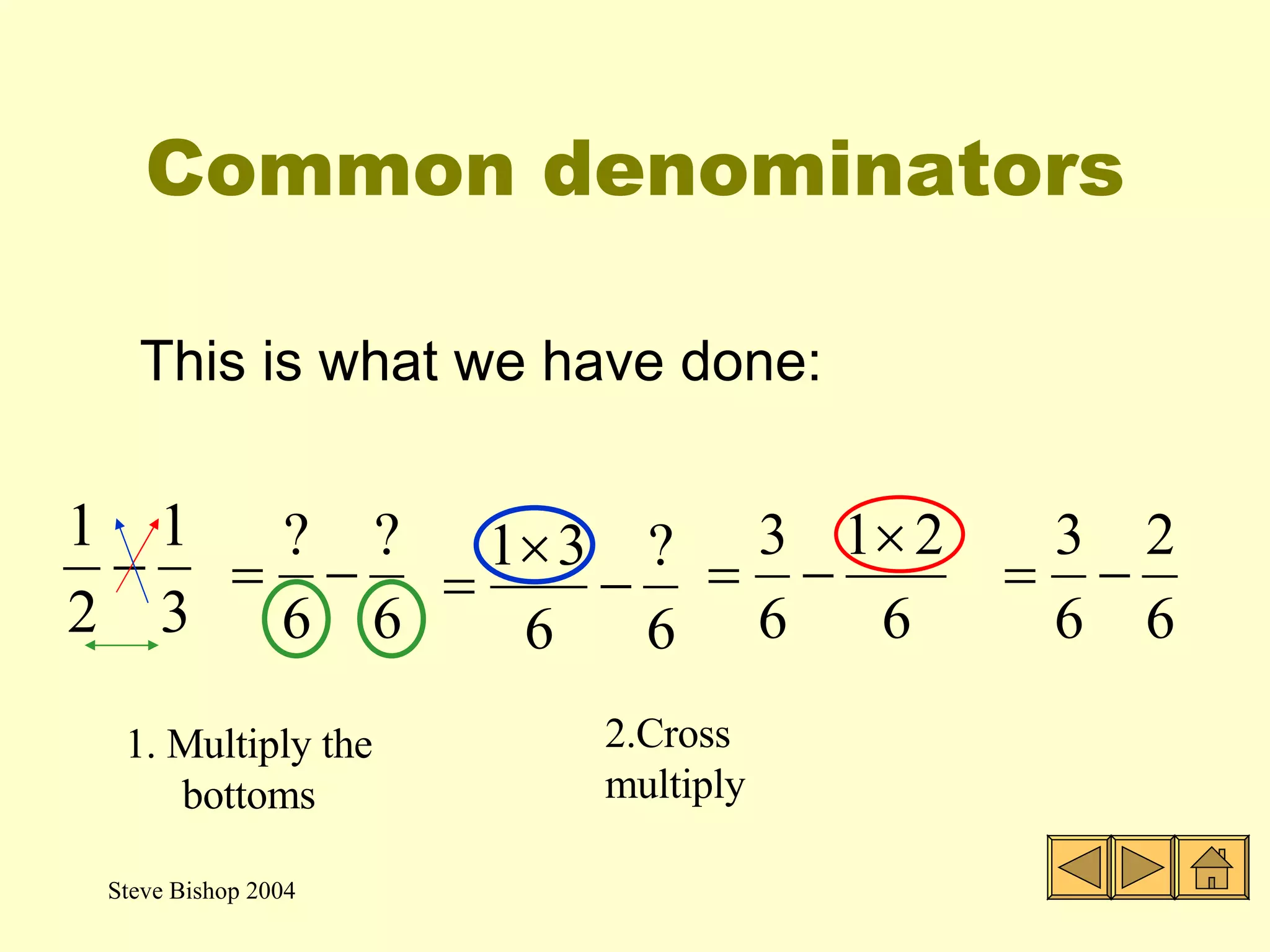
Common denominators This is what we have done: 1. Multiply the bottoms 2.Cross multiply
Now try these Click on the mouse to reveal the answers. 1 .    2 . 3 .  4 .
For further info   Go to: BBC Bitesize Maths Revision site by clicking here:

Fractions - the four rules

  • 1.
    FRACTIONS This presentationwill help you to add, subtract, multiply and divide fractions. Left click on the mouse to reveal the next section
  • 2.
    To learn about:Adding fractions click Subtracting fractions click Dividing fractions click Multiplying fractions click
  • 3.
    Adding fractions Toadd fractions together the denominator (the bottom bit) must be the same. Example
  • 4.
    Now try theseClick on the mouse to reveal the answers. 1 . 2 . 3 . 4 .
  • 5.
    Subtracting fractions Tosubtract fractions the denominator (the bottom bit) must be the same. Example
  • 6.
    Now try theseClick on the mouse to reveal the answers. 1 . 2 . 3 . 4 .
  • 7.
    Multiplying fractions Tomultiply fractions we multiply the tops and multiply the bottoms Top x Top Bottom x Bottom
  • 8.
  • 9.
    Now try theseClick on the mouse to reveal the answers. 1 . 2 . 3 . 4 .
  • 10.
    Dividing fractions Onceyou know a simple trick, dividing is as easy as multiplying! Turn the second fraction upside down Change the divide to multiply Then multiply!
  • 11.
    Dividing fractions Turnthe second fraction upside down Example Change the divide into a multiply Then multiply
  • 12.
    Now try theseClick on the mouse to reveal the answers. 1 . 2 . 3 . 4 .
  • 13.
    Common denominators Toadd or subtract fractions together the denominator (the bottom bit) must be the same. So, sometimes we have to change the bottoms to make them the same. In “maths-speak” we say we must get common denominators
  • 14.
    Common denominators Toget a common denominator we have to: 1. Multiply the bottoms together. 2. Then multiply the top bit by the correct number to get an equivalent fraction
  • 15.
    Common denominators Forexample Multiply the bottoms together
  • 16.
    Common denominators Forexample 2. Write the two fractions as sixths
  • 17.
    Common denominators Forexample To get ½ into sixths we have multiplied the bottom (2) by 3. To get an equivalent fraction we need to multiply the top by 3 also
  • 18.
    Common denominators Forexample To get 1/3 into sixths we have multiplied the bottom (3) by 2. To get an equivalent fraction we need to multiply the top by 2 also
  • 19.
    Common denominators Forexample We can now rewrite
  • 20.
    Common denominators Thisis what we have done: 1. Multiply the bottoms 2.Cross multiply
  • 21.
    Now try theseClick on the mouse to reveal the answers. 1 . 2 . 3 . 4 .
  • 22.
    For further info Go to: BBC Bitesize Maths Revision site by clicking here: