How do youadd or subtract fractions when the denominators are
different?
First of all, you need to make the denominators equivalent.
There are two ways you can do this.
6.
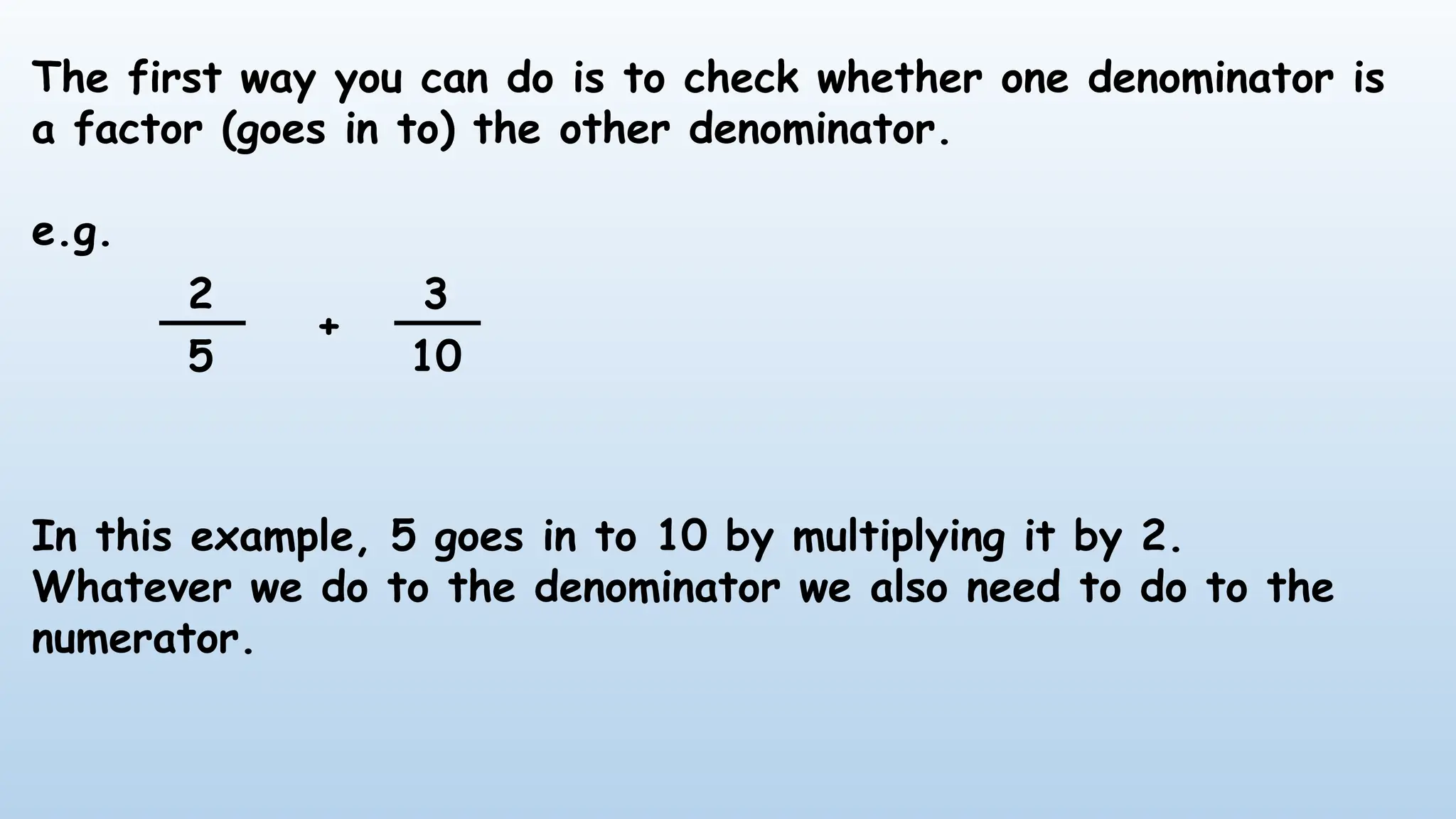
The first wayyou can do is to check whether one denominator is
a factor (goes in to) the other denominator.
e.g.
In this example, 5 goes in to 10 by multiplying it by 2.
Whatever we do to the denominator we also need to do to the
numerator.
2
5
3
10
+
7.
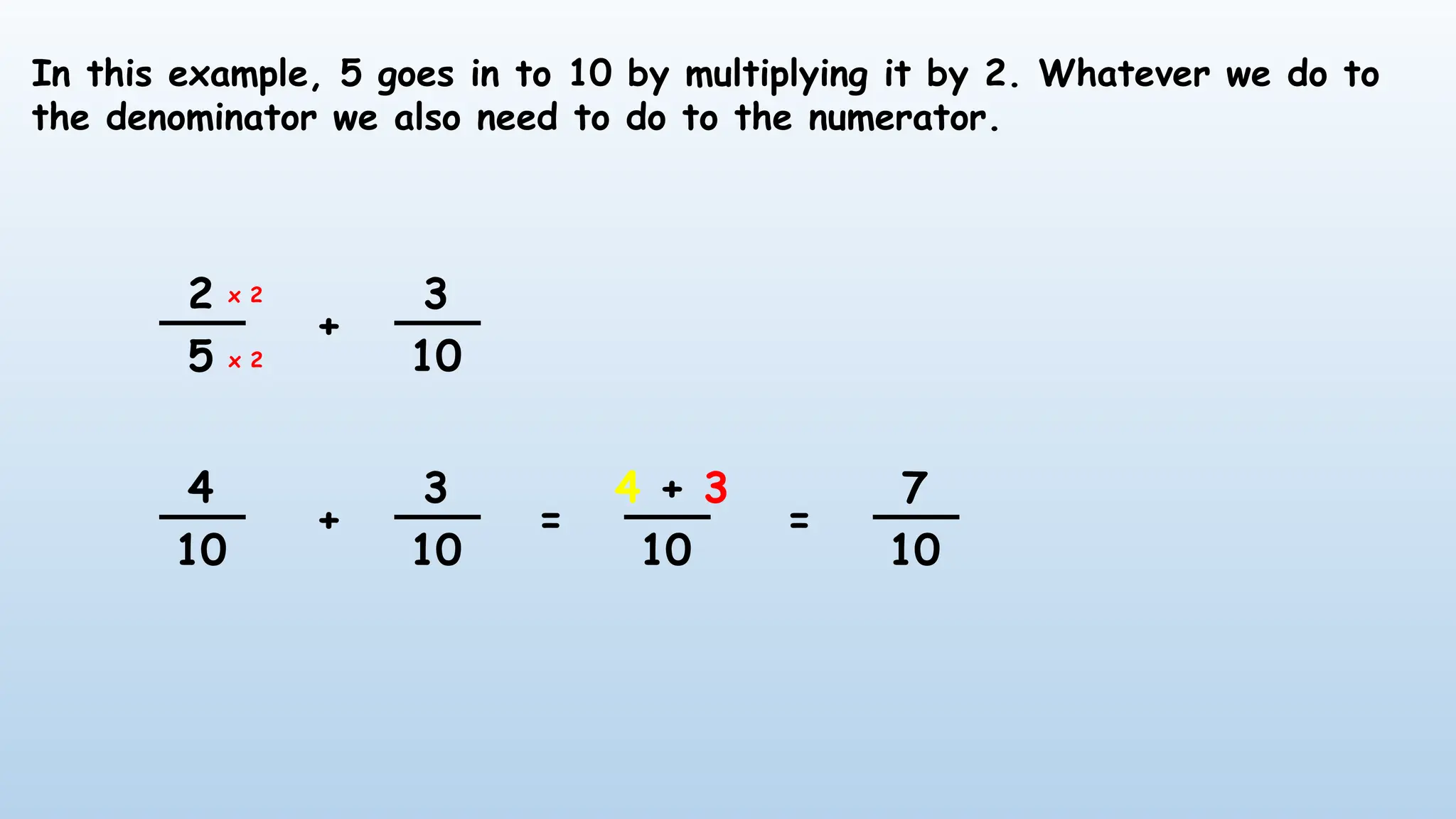
In this example,5 goes in to 10 by multiplying it by 2. Whatever we do to
the denominator we also need to do to the numerator.
2
5
3
10
+
x 2
x 2
4
10
3
10
+ =
4 + 3
10
=
7
10
8.
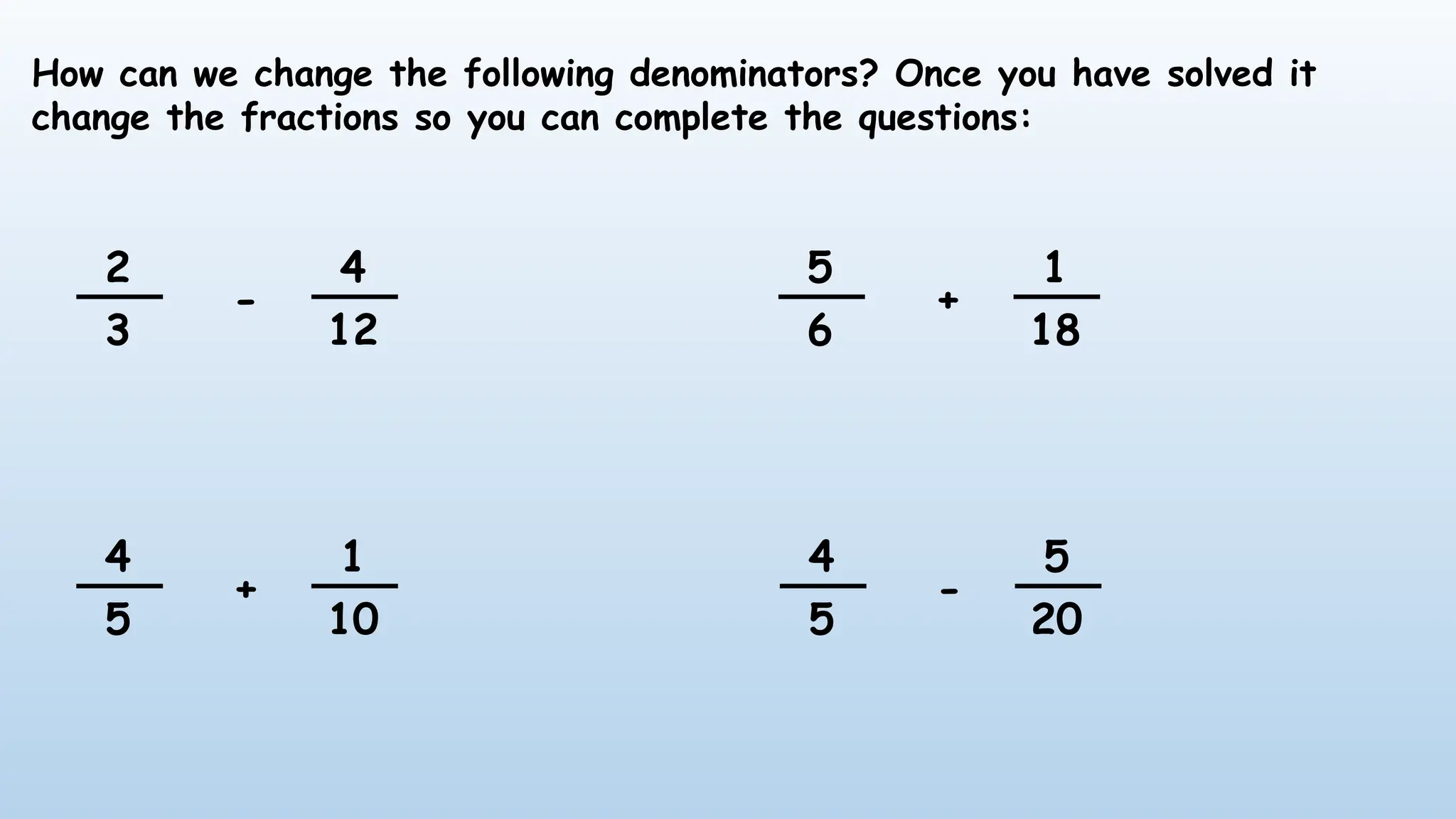
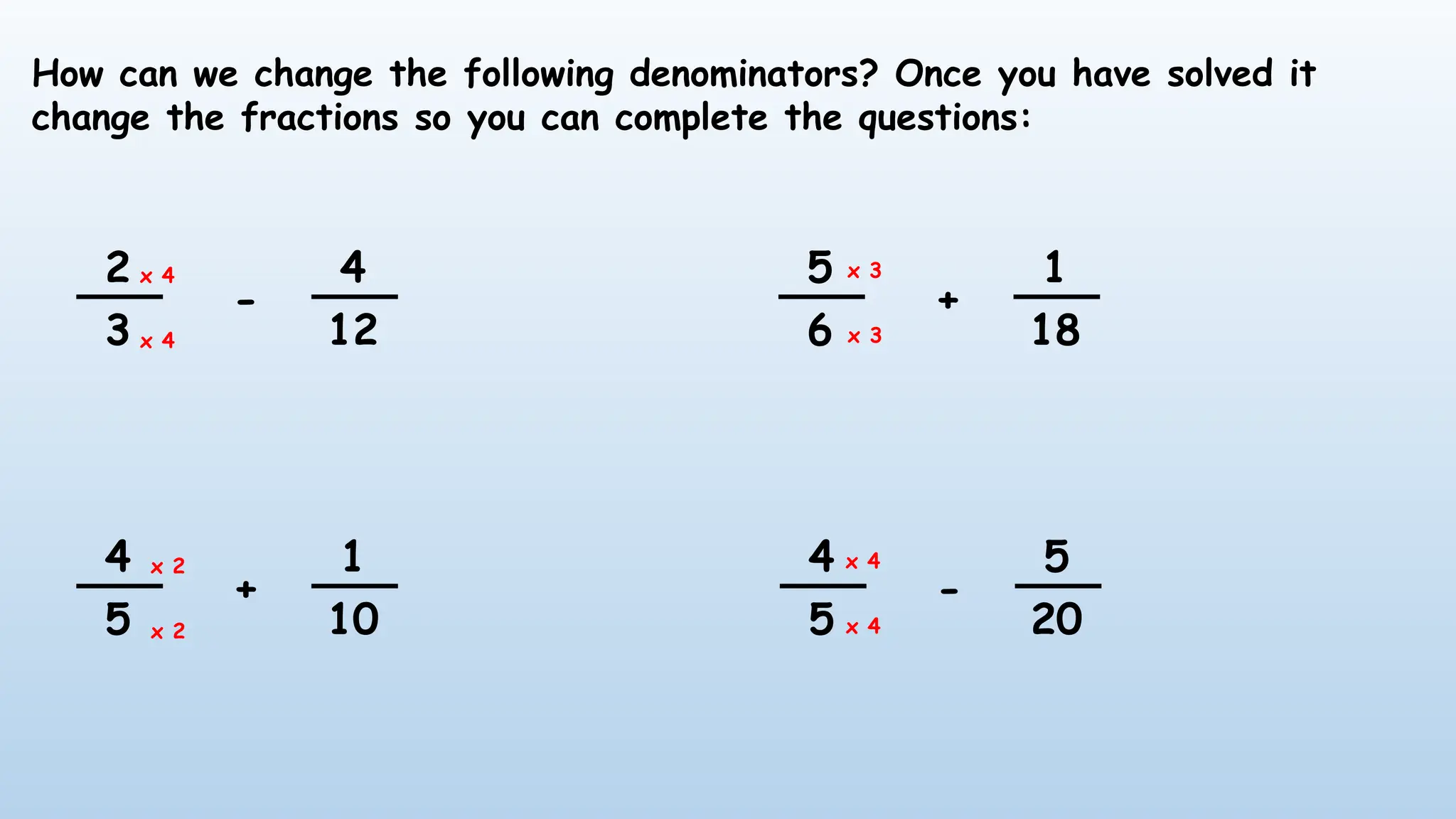
How can wechange the following denominators? Once you have solved it
change the fractions so you can complete the questions:
2
3
4
12
-
4
5
1
10
+
4
5
5
20
-
5
6
1
18
+
9.
How can wechange the following denominators? Once you have solved it
change the fractions so you can complete the questions:
2
3
4
12
-
4
5
1
10
+
4
5
5
20
-
5
6
1
18
+
x 4
x 4
x 2
x 2
x 3
x 3
x 4
x 4
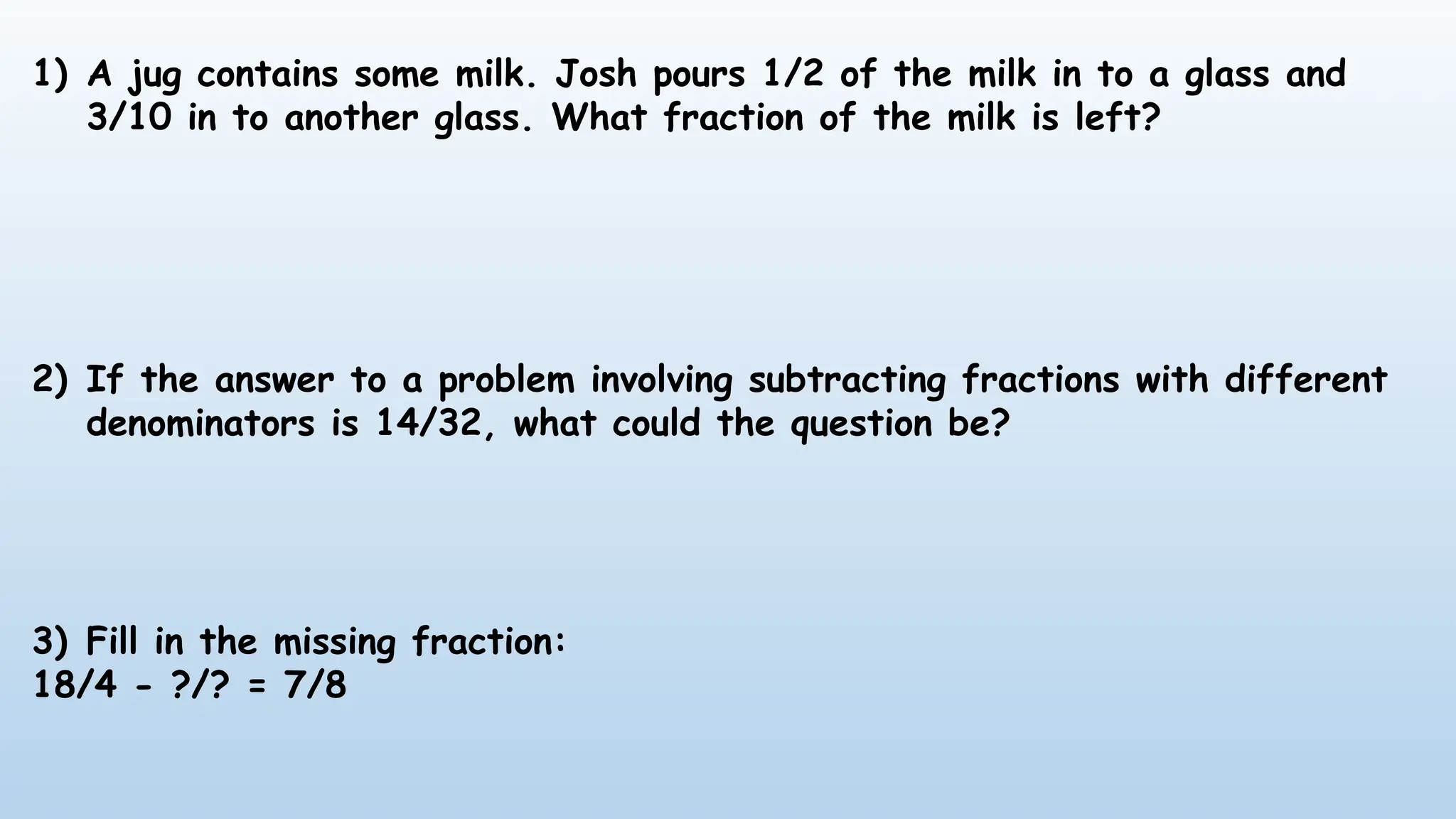
1) A jugcontains some milk. Josh pours 1/2 of the milk in to a glass and
3/10 in to another glass. What fraction of the milk is left?
2) If the answer to a problem involving subtracting fractions with different
denominators is 14/32, what could the question be?
3) Fill in the missing fraction:
18/4 - ?/? = 7/8
13.
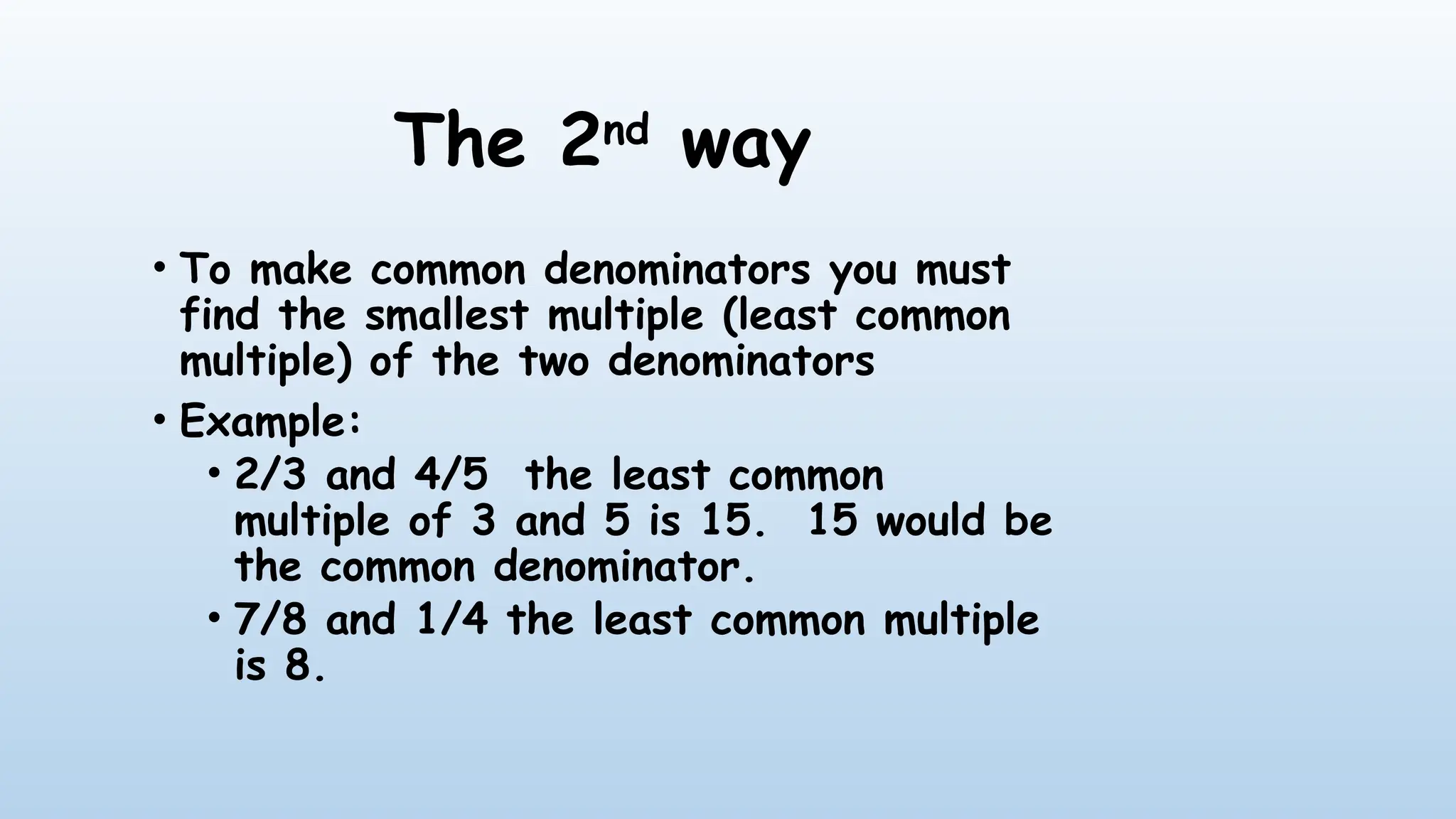
The 2nd
way
• Tomake common denominators you must
find the smallest multiple (least common
multiple) of the two denominators
• Example:
• 2/3 and 4/5 the least common
multiple of 3 and 5 is 15. 15 would be
the common denominator.
• 7/8 and 1/4 the least common multiple
is 8.
14.
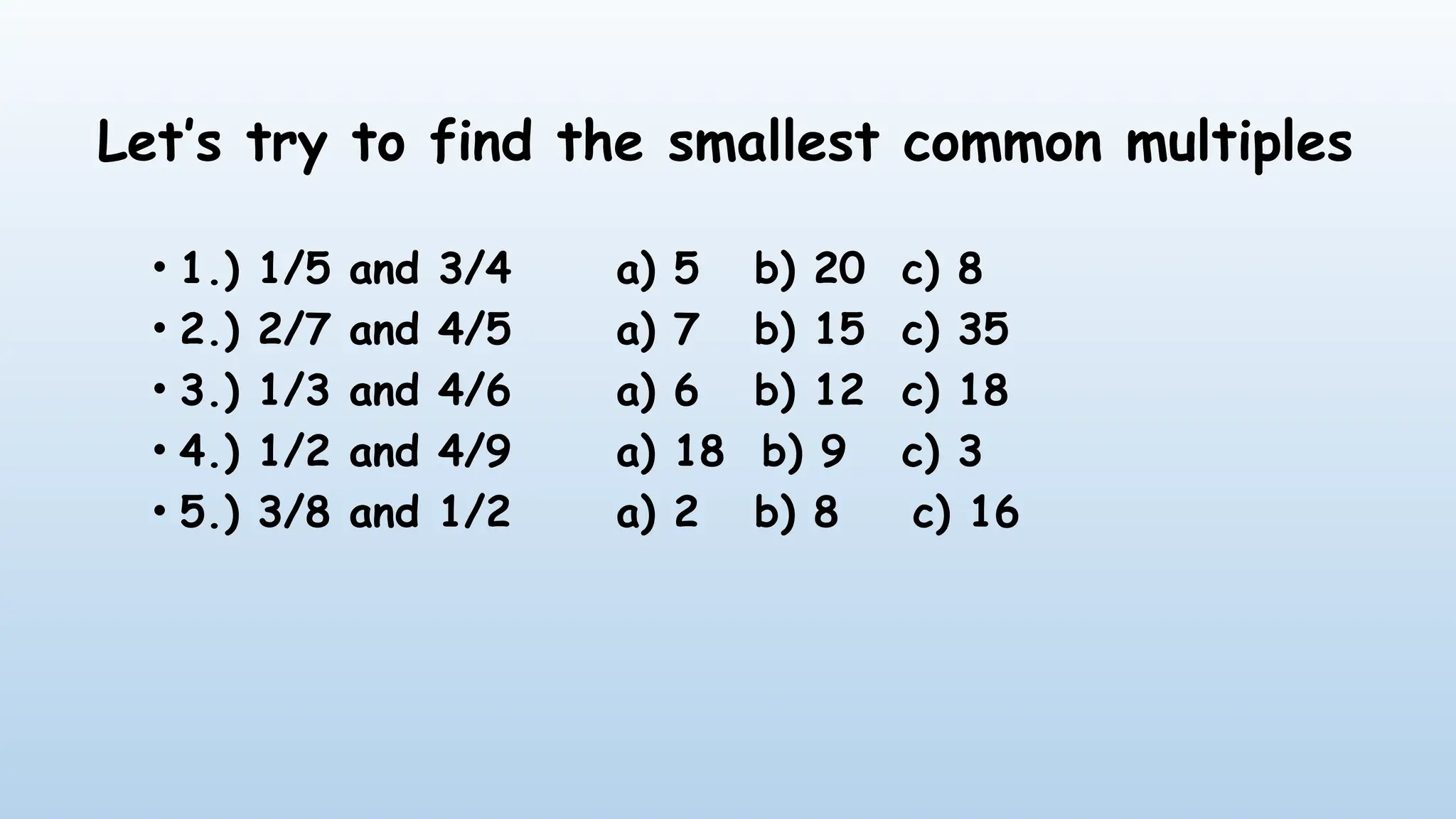
Let’s try tofind the smallest common multiples
• 1.) 1/5 and 3/4 a) 5 b) 20 c) 8
• 2.) 2/7 and 4/5 a) 7 b) 15 c) 35
• 3.) 1/3 and 4/6 a) 6 b) 12 c) 18
• 4.) 1/2 and 4/9 a) 18 b) 9 c) 3
• 5.) 3/8 and 1/2 a) 2 b) 8 c) 16
15.
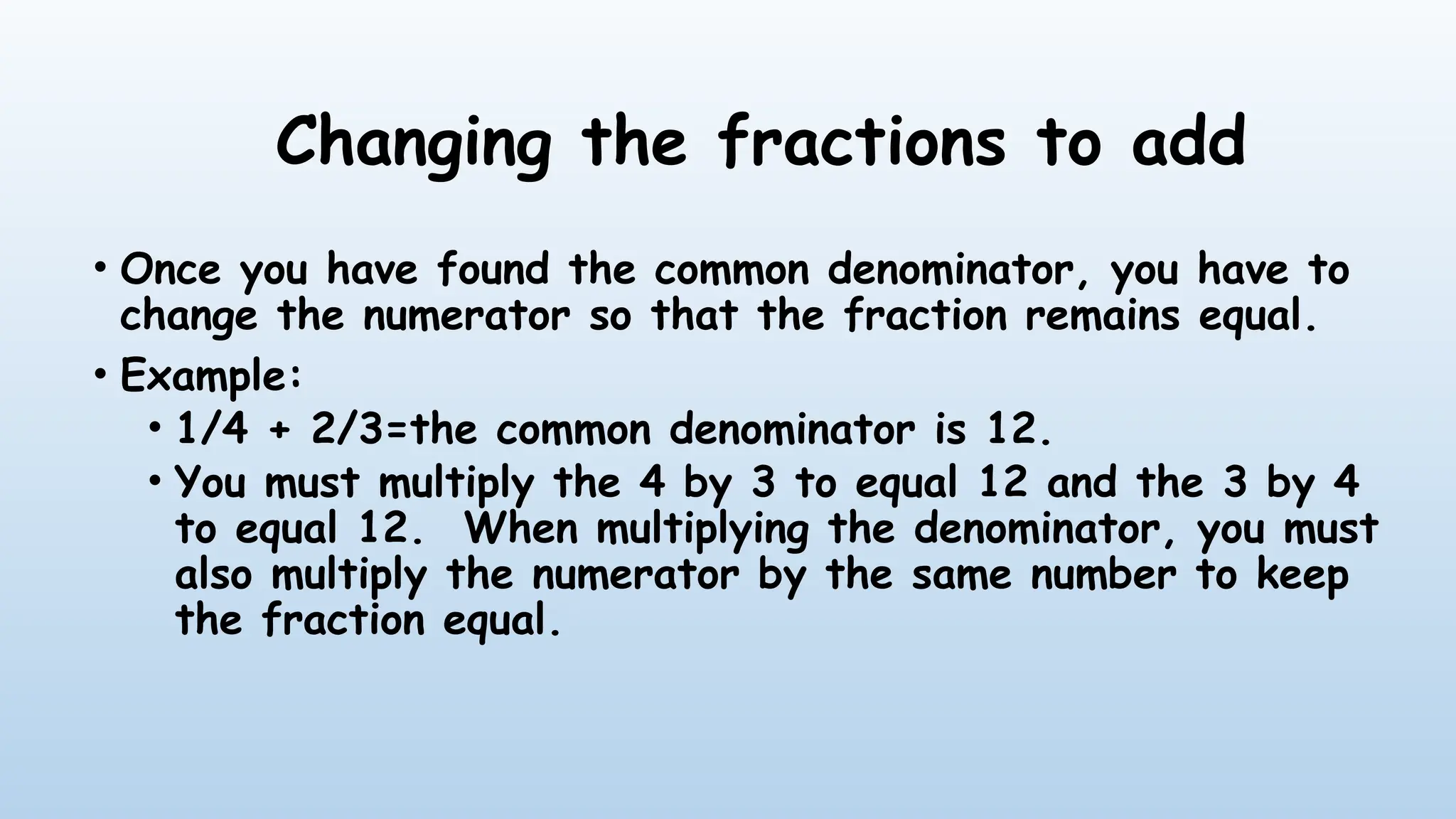
Changing the fractionsto add
• Once you have found the common denominator, you have to
change the numerator so that the fraction remains equal.
• Example:
• 1/4 + 2/3=the common denominator is 12.
• You must multiply the 4 by 3 to equal 12 and the 3 by 4
to equal 12. When multiplying the denominator, you must
also multiply the numerator by the same number to keep
the fraction equal.
16.
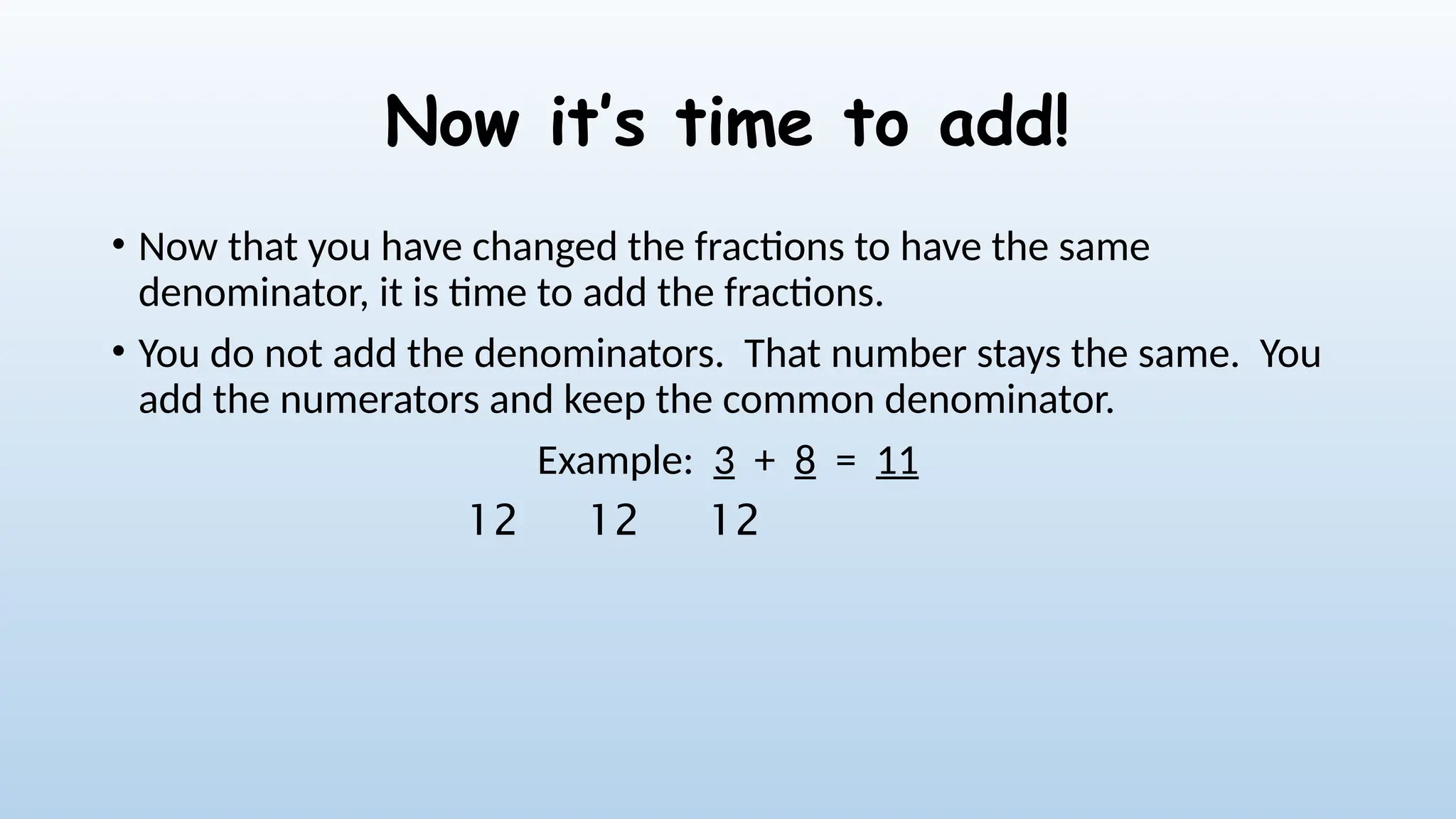
Now it’s timeto add!
• Now that you have changed the fractions to have the same
denominator, it is time to add the fractions.
• You do not add the denominators. That number stays the same. You
add the numerators and keep the common denominator.
Example: 3 + 8 = 11
12
12
12