FRACTIONS
55/60
Rules of fraction
This presentation will help you to:
• add
• subtract
• multiply and
• divide fractions
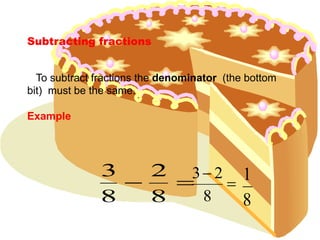
Subtracting fractions
To subtract fractions the denominator (the bottom
bit) must be the same.
Example

8
2
8
3


8
23
8
1
Multiplying fractions
To multiply fractions we multiply the
tops and multiply the bottoms
Top x Top
________________
Bottom x Bottom
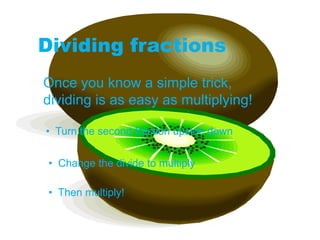
Dividing fractions
Once you know a simple trick,
dividing is as easy as multiplying!
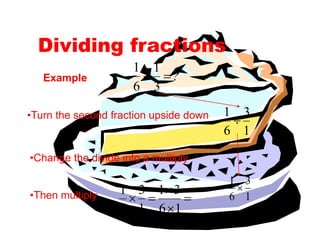
• Turn the second fraction upside down
• Change the divide to multiply
• Then multiply!
Dividing fractions
•Turn the second fraction upside down
Example ?
3
1
6
1
1
3
6
1

•Change the divide into a multiply
1
3
6
1

•Then multiply 



16
31
1
3
6
1
Common denominators
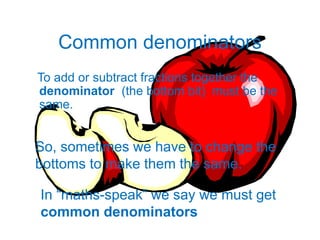
To add or subtract fractions together the
denominator (the bottom bit) must be the
same.
So, sometimes we have to change the
bottoms to make them the same.
In “maths-speak” we say we must get
common denominators
Common denominators
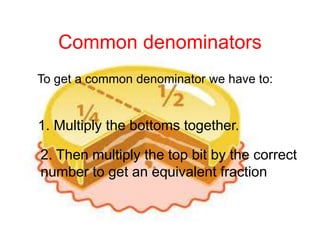
To get a common denominator we have to:
1. Multiply the bottoms together.
2. Then multiply the top bit by the correct
number to get an equivalent fraction
Common denominators
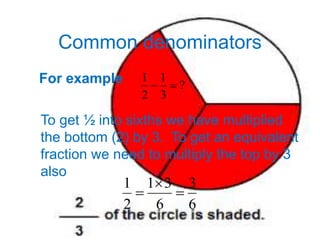
For example ?
3
1
2
1

To get ½ into sixths we have multiplied
the bottom (2) by 3. To get an equivalent
fraction we need to multiply the top by 3
also
6
3
6
31
2
1



Common denominators
For example ?
3
1
2
1

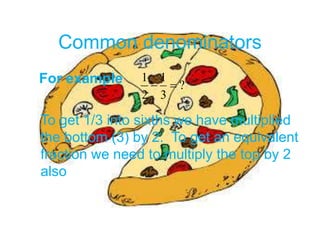
To get 1/3 into sixths we have multiplied
the bottom (3) by 2. To get an equivalent
fraction we need to multiply the top by 2
also
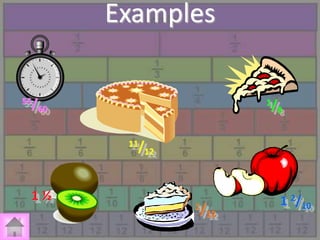
1 2/101/12
1/8
1 ½
11/12
55/60
Examples

fractions

  • 1.
  • 2.
    55/60 Rules of fraction Thispresentation will help you to: • add • subtract • multiply and • divide fractions
  • 3.
    Subtracting fractions To subtractfractions the denominator (the bottom bit) must be the same. Example  8 2 8 3   8 23 8 1
  • 4.
    Multiplying fractions To multiplyfractions we multiply the tops and multiply the bottoms Top x Top ________________ Bottom x Bottom
  • 5.
    Dividing fractions Once youknow a simple trick, dividing is as easy as multiplying! • Turn the second fraction upside down • Change the divide to multiply • Then multiply!
  • 6.
    Dividing fractions •Turn thesecond fraction upside down Example ? 3 1 6 1 1 3 6 1  •Change the divide into a multiply 1 3 6 1  •Then multiply     16 31 1 3 6 1
  • 7.
    Common denominators To addor subtract fractions together the denominator (the bottom bit) must be the same. So, sometimes we have to change the bottoms to make them the same. In “maths-speak” we say we must get common denominators
  • 8.
    Common denominators To geta common denominator we have to: 1. Multiply the bottoms together. 2. Then multiply the top bit by the correct number to get an equivalent fraction
  • 9.
    Common denominators For example? 3 1 2 1  To get ½ into sixths we have multiplied the bottom (2) by 3. To get an equivalent fraction we need to multiply the top by 3 also 6 3 6 31 2 1   
  • 10.
    Common denominators For example? 3 1 2 1  To get 1/3 into sixths we have multiplied the bottom (3) by 2. To get an equivalent fraction we need to multiply the top by 2 also
  • 11.