Basic concepts and how to
measure price volatility


Presented by:

 Carlos Martins-Filho
   University of Colorado, Boulder
   International Food Policy Research Institute


                                                               www.agrodep.org
    AGRODEP Workshop on Analytical Tools for Food Prices
    and Price Volatility

    June 6-7, 2011 • Dakar, Senegal

    Please check the latest version of this presentation on:
    http://www.agrodep.org/first-annual-workshop
Basic concepts and how to measure price
                volatility

              Carlos Martins-Filho

       University of Colorado, Boulder and IFPRI


         AGRODEP - Dakar, Senegal
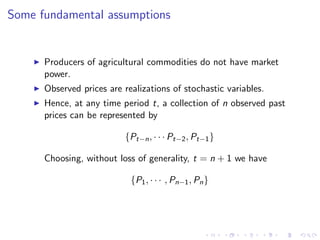
Some fundamental assumptions


      Producers of agricultural commodities do not have market
      power.
      Observed prices are realizations of stochastic variables.
      Hence, at any time period t, a collection of n observed past
      prices can be represented by

                          {Pt−n , · · · Pt−2 , Pt−1 }

      Choosing, without loss of generality, t = n + 1 we have

                            {P1 , · · · , Pn−1 , Pn }
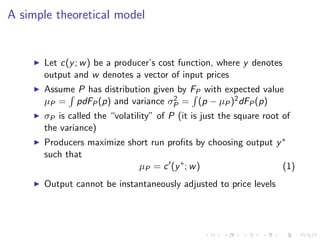
A simple theoretical model


      Let c(y ; w ) be a producer’s cost function, where y denotes
      output and w denotes a vector of input prices
      Assume P has distribution given by FP with expected value
      µP = pdFP (p) and variance σP = (p − µP )2 dFP (p)
                                     2

      σP is called the “volatility” of P (it is just the square root of
      the variance)
      Producers maximize short run profits by choosing output y ∗
      such that
                            µP = c (y ∗ ; w )                  (1)
      Output cannot be instantaneously adjusted to price levels
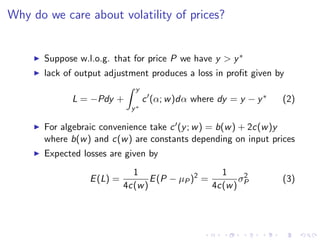
Why do we care about volatility of prices?


       Suppose w.l.o.g. that for price P we have y > y ∗
       lack of output adjustment produces a loss in profit given by
                              y
             L = −Pdy +           c (α; w )dα where dy = y − y ∗   (2)
                             y∗

       For algebraic convenience take c (y ; w ) = b(w ) + 2c(w )y
       where b(w ) and c(w ) are constants depending on input prices
       Expected losses are given by
                              1                     1
                  E (L) =          E (P − µP )2 =       σ2         (3)
                            4c(w )                4c(w ) P
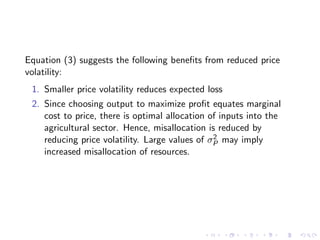
Equation (3) suggests the following benefits from reduced price
volatility:
 1. Smaller price volatility reduces expected loss
 2. Since choosing output to maximize profit equates marginal
    cost to price, there is optimal allocation of inputs into the
    agricultural sector. Hence, misallocation is reduced by
                                                2
    reducing price volatility. Large values of σP may imply
    increased misallocation of resources.
Some basic questions regarding statistical modeling of
prices


       Do the stochastic variables P1 , P2 , · · · , Pn have the same
       distribution?
       Does knowledge of the value of Pn−1 help us forecast or
       predict Pn ?
       Can we construct statistical models that help us understand
       the evolution of prices through time?
Returns

      Because prices can be measured in different units, it will be
      convenient to adopt an unit free measure.
      Assuming that Pt ∈ (0, ∞) the returns over 1 period are
      normally measured in one of the following ways:
                                   −Pt−1
          1. Net returns: Rt = PtPt−1 ∈ (−1, ∞)
          2. Gross returns: At = 1 + Rt ∈ (0, ∞)
          3. log returns: rt = log (1 + Rt ) = logPt − logPt−1 ∈ (−∞, ∞).
      Note that:
          1. if prices do not change from period t − 1 to period t all of
             these measures of return take the value zero.
          2. if there is a large change from period t − 1 to period t then all
             of these measures of return take on large values.
          3. “High prices” and “high price variability” are very different
             concepts that do not preclude each other.
A simple model
        Suppose {rt }t=1,2,··· is an independent and identically
        distributed sequence of returns and assume
                                       Pt
                           rt = log        ∼ N(µ, σ 2 )
                                      Pt−1
        or
                                  rt = µ + σut
        where {ut }t=1,2,··· forms an independent sequence with
        ut ∼ N(0, 1).
        µ is called the expected value of rt and σ 2 is called the
        variance of rt . Take the square root to obtain volatility.
        It is easy to show that under this assumption on log-returns

                E (log Pt ) = log P0 + tµ and V (log Pt ) = tσ 2

   where P0 is an “initial” value for price.
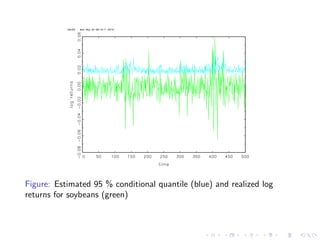
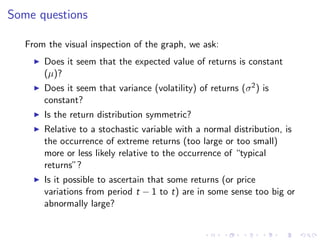
Figure: Estimated 95 % conditional quantile (blue) and realized log
returns for soybeans (green)
Some questions

   From the visual inspection of the graph, we ask:
       Does it seem that the expected value of returns is constant
       (µ)?
       Does it seem that variance (volatility) of returns (σ 2 ) is
       constant?
       Is the return distribution symmetric?
       Relative to a stochastic variable with a normal distribution, is
       the occurrence of extreme returns (too large or too small)
       more or less likely relative to the occurrence of “typical
       returns”?
       Is it possible to ascertain that some returns (or price
       variations from period t − 1 to t) are in some sense too big or
       abnormally large?
Some popular models


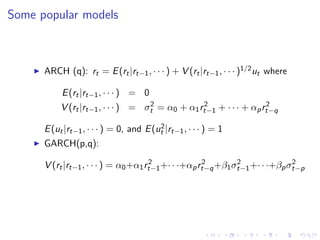
      ARCH (q): rt = E (rt |rt−1 , · · · ) + V (rt |rt−1 , · · · )1/2 ut where

           E (rt |rt−1 , · · · ) = 0
                                    2            2                 2
           V (rt |rt−1 , · · · ) = σt = α0 + α1 rt−1 + · · · + αp rt−q
                                         2
      E (ut |rt−1 , · · · ) = 0, and E (ut |rt−1 , · · · ) = 1
      GARCH(p,q):
                                      2              2        2              2
      V (rt |rt−1 , · · · ) = α0 +α1 rt−1 +· · ·+αp rt−q +β1 σt−1 +· · ·+βp σt−p
A more sophisticated statistical model

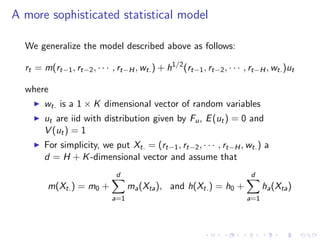
  We generalize the model described above as follows:

  rt = m(rt−1 , rt−2 , · · · , rt−H , wt. ) + h1/2 (rt−1 , rt−2 , · · · , rt−H , wt. )ut

  where
        wt. is a 1 × K dimensional vector of random variables
        ut are iid with distribution given by Fu , E (ut ) = 0 and
        V (ut ) = 1
        For simplicity, we put Xt. = (rt−1 , rt−2 , · · · , rt−H , wt. ) a
        d = H + K -dimensional vector and assume that
                               d                                          d
         m(Xt. ) = m0 +            ma (Xta ), and h(Xt. ) = h0 +              ha (Xta )
                             a=1                                        a=1
A more sophisticated statistical model


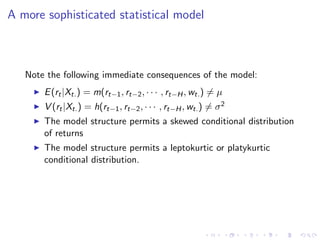
   Note the following immediate consequences of the model:
       E (rt |Xt. ) = m(rt−1 , rt−2 , · · · , rt−H , wt. ) = µ
       V (rt |Xt. ) = h(rt−1 , rt−2 , · · · , rt−H , wt. ) = σ 2
       The model structure permits a skewed conditional distribution
       of returns
       The model structure permits a leptokurtic or platykurtic
       conditional distribution.
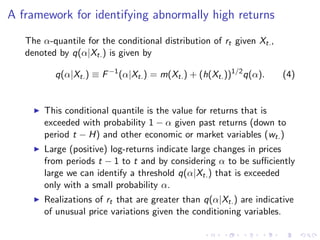
A framework for identifying abnormally high returns
   The α-quantile for the conditional distribution of rt given Xt. ,
   denoted by q(α|Xt. ) is given by

          q(α|Xt. ) ≡ F −1 (α|Xt. ) = m(Xt. ) + (h(Xt. ))1/2 q(α).     (4)


        This conditional quantile is the value for returns that is
        exceeded with probability 1 − α given past returns (down to
        period t − H) and other economic or market variables (wt. )
        Large (positive) log-returns indicate large changes in prices
        from periods t − 1 to t and by considering α to be sufficiently
        large we can identify a threshold q(α|Xt. ) that is exceeded
        only with a small probability α.
        Realizations of rt that are greater than q(α|Xt. ) are indicative
        of unusual price variations given the conditioning variables.
Estimation

                                                   ˆ
       First, m and h are estimated by m(Xt. ) and h(Xt. ) given the
                                             ˆ
       sample {(rt , Xt1 , · · · , Xtd )}n
                                         t=1
                                             rt −m(Xt. )
                                                 ˆ
       Second, standardized residuals εt =
                                      ˆ       ˆ
                                              h(Xt. )1/2
                                                           are used in
       conjunction with extreme value theory to estimate q(α).
   The exceedances of any random variable ( ) over a specified
   nonstochastic threshhold u, i.e, Z = − u can be suitably
   approximated by a generalized pareto distribution - GPD (with
   location parameter equal to zero) given by,
                                             −1/ψ
                                       x
               G (x; β, ψ) = 1 − 1 + ψ              ,x ∈ D               (5)
                                       β

   where D = [0, ∞) if ψ ≥ 0 and D = [0, −β/ψ] if ψ < 0.
Estimation


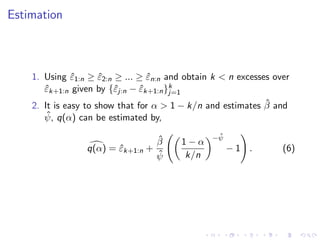
    1. Using ε1:n ≥ ε2:n ≥ ... ≥ εn:n and obtain k < n excesses over
               ˆ      ˆ           ˆ
       εk+1:n given by {ˆj:n − εk+1:n }k
       ˆ                 ε      ˆ      j=1
                                                              ˆ
    2. It is easy to show that for α > 1 − k/n and estimates β and
        ˆ q(α) can be estimated by,
       ψ,
                                                 ˆ
                                                −ψ
                                   ˆ
                                   β     1−α
                 q(α) = εk+1:n +
                        ˆ                            −1 .         (6)
                                   ˆ
                                   ψ      k/n
Empirical exercise

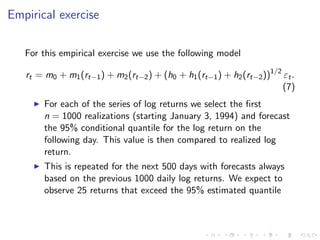
   For this empirical exercise we use the following model

   rt = m0 + m1 (rt−1 ) + m2 (rt−2 ) + (h0 + h1 (rt−1 ) + h2 (rt−2 ))1/2 εt .
                                                                         (7)
        For each of the series of log returns we select the first
        n = 1000 realizations (starting January 3, 1994) and forecast
        the 95% conditional quantile for the log return on the
        following day. This value is then compared to realized log
        return.
        This is repeated for the next 500 days with forecasts always
        based on the previous 1000 daily log returns. We expect to
        observe 25 returns that exceed the 95% estimated quantile
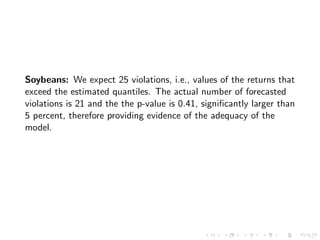
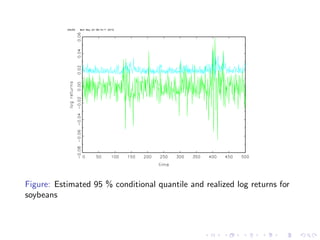
Soybeans: We expect 25 violations, i.e., values of the returns that
exceed the estimated quantiles. The actual number of forecasted
violations is 21 and the the p-value is 0.41, significantly larger than
5 percent, therefore providing evidence of the adequacy of the
model.
Figure: Estimated 95 % conditional quantile and realized log returns for
soybeans
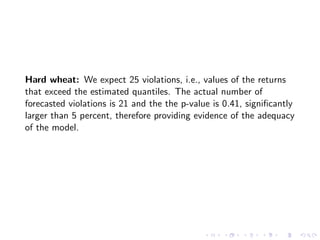
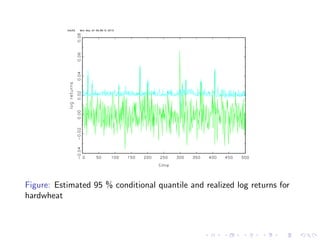
Hard wheat: We expect 25 violations, i.e., values of the returns
that exceed the estimated quantiles. The actual number of
forecasted violations is 21 and the the p-value is 0.41, significantly
larger than 5 percent, therefore providing evidence of the adequacy
of the model.
Figure: Estimated 95 % conditional quantile and realized log returns for
hardwheat
Daily results are available at:
     http://www.foodsecurityportal.org/
In particular:
     Policy Analysis Tools

Basic concepts and how to measure price volatility

  • 1.
    Basic concepts andhow to measure price volatility Presented by: Carlos Martins-Filho University of Colorado, Boulder International Food Policy Research Institute www.agrodep.org AGRODEP Workshop on Analytical Tools for Food Prices and Price Volatility June 6-7, 2011 • Dakar, Senegal Please check the latest version of this presentation on: http://www.agrodep.org/first-annual-workshop
  • 2.
    Basic concepts andhow to measure price volatility Carlos Martins-Filho University of Colorado, Boulder and IFPRI AGRODEP - Dakar, Senegal
  • 3.
    Some fundamental assumptions Producers of agricultural commodities do not have market power. Observed prices are realizations of stochastic variables. Hence, at any time period t, a collection of n observed past prices can be represented by {Pt−n , · · · Pt−2 , Pt−1 } Choosing, without loss of generality, t = n + 1 we have {P1 , · · · , Pn−1 , Pn }
  • 4.
    A simple theoreticalmodel Let c(y ; w ) be a producer’s cost function, where y denotes output and w denotes a vector of input prices Assume P has distribution given by FP with expected value µP = pdFP (p) and variance σP = (p − µP )2 dFP (p) 2 σP is called the “volatility” of P (it is just the square root of the variance) Producers maximize short run profits by choosing output y ∗ such that µP = c (y ∗ ; w ) (1) Output cannot be instantaneously adjusted to price levels
  • 5.
    Why do wecare about volatility of prices? Suppose w.l.o.g. that for price P we have y > y ∗ lack of output adjustment produces a loss in profit given by y L = −Pdy + c (α; w )dα where dy = y − y ∗ (2) y∗ For algebraic convenience take c (y ; w ) = b(w ) + 2c(w )y where b(w ) and c(w ) are constants depending on input prices Expected losses are given by 1 1 E (L) = E (P − µP )2 = σ2 (3) 4c(w ) 4c(w ) P
  • 6.
    Equation (3) suggeststhe following benefits from reduced price volatility: 1. Smaller price volatility reduces expected loss 2. Since choosing output to maximize profit equates marginal cost to price, there is optimal allocation of inputs into the agricultural sector. Hence, misallocation is reduced by 2 reducing price volatility. Large values of σP may imply increased misallocation of resources.
  • 7.
    Some basic questionsregarding statistical modeling of prices Do the stochastic variables P1 , P2 , · · · , Pn have the same distribution? Does knowledge of the value of Pn−1 help us forecast or predict Pn ? Can we construct statistical models that help us understand the evolution of prices through time?
  • 8.
    Returns Because prices can be measured in different units, it will be convenient to adopt an unit free measure. Assuming that Pt ∈ (0, ∞) the returns over 1 period are normally measured in one of the following ways: −Pt−1 1. Net returns: Rt = PtPt−1 ∈ (−1, ∞) 2. Gross returns: At = 1 + Rt ∈ (0, ∞) 3. log returns: rt = log (1 + Rt ) = logPt − logPt−1 ∈ (−∞, ∞). Note that: 1. if prices do not change from period t − 1 to period t all of these measures of return take the value zero. 2. if there is a large change from period t − 1 to period t then all of these measures of return take on large values. 3. “High prices” and “high price variability” are very different concepts that do not preclude each other.
  • 9.
    A simple model Suppose {rt }t=1,2,··· is an independent and identically distributed sequence of returns and assume Pt rt = log ∼ N(µ, σ 2 ) Pt−1 or rt = µ + σut where {ut }t=1,2,··· forms an independent sequence with ut ∼ N(0, 1). µ is called the expected value of rt and σ 2 is called the variance of rt . Take the square root to obtain volatility. It is easy to show that under this assumption on log-returns E (log Pt ) = log P0 + tµ and V (log Pt ) = tσ 2 where P0 is an “initial” value for price.
  • 10.
    Figure: Estimated 95% conditional quantile (blue) and realized log returns for soybeans (green)
  • 11.
    Some questions From the visual inspection of the graph, we ask: Does it seem that the expected value of returns is constant (µ)? Does it seem that variance (volatility) of returns (σ 2 ) is constant? Is the return distribution symmetric? Relative to a stochastic variable with a normal distribution, is the occurrence of extreme returns (too large or too small) more or less likely relative to the occurrence of “typical returns”? Is it possible to ascertain that some returns (or price variations from period t − 1 to t) are in some sense too big or abnormally large?
  • 12.
    Some popular models ARCH (q): rt = E (rt |rt−1 , · · · ) + V (rt |rt−1 , · · · )1/2 ut where E (rt |rt−1 , · · · ) = 0 2 2 2 V (rt |rt−1 , · · · ) = σt = α0 + α1 rt−1 + · · · + αp rt−q 2 E (ut |rt−1 , · · · ) = 0, and E (ut |rt−1 , · · · ) = 1 GARCH(p,q): 2 2 2 2 V (rt |rt−1 , · · · ) = α0 +α1 rt−1 +· · ·+αp rt−q +β1 σt−1 +· · ·+βp σt−p
  • 13.
    A more sophisticatedstatistical model We generalize the model described above as follows: rt = m(rt−1 , rt−2 , · · · , rt−H , wt. ) + h1/2 (rt−1 , rt−2 , · · · , rt−H , wt. )ut where wt. is a 1 × K dimensional vector of random variables ut are iid with distribution given by Fu , E (ut ) = 0 and V (ut ) = 1 For simplicity, we put Xt. = (rt−1 , rt−2 , · · · , rt−H , wt. ) a d = H + K -dimensional vector and assume that d d m(Xt. ) = m0 + ma (Xta ), and h(Xt. ) = h0 + ha (Xta ) a=1 a=1
  • 14.
    A more sophisticatedstatistical model Note the following immediate consequences of the model: E (rt |Xt. ) = m(rt−1 , rt−2 , · · · , rt−H , wt. ) = µ V (rt |Xt. ) = h(rt−1 , rt−2 , · · · , rt−H , wt. ) = σ 2 The model structure permits a skewed conditional distribution of returns The model structure permits a leptokurtic or platykurtic conditional distribution.
  • 15.
    A framework foridentifying abnormally high returns The α-quantile for the conditional distribution of rt given Xt. , denoted by q(α|Xt. ) is given by q(α|Xt. ) ≡ F −1 (α|Xt. ) = m(Xt. ) + (h(Xt. ))1/2 q(α). (4) This conditional quantile is the value for returns that is exceeded with probability 1 − α given past returns (down to period t − H) and other economic or market variables (wt. ) Large (positive) log-returns indicate large changes in prices from periods t − 1 to t and by considering α to be sufficiently large we can identify a threshold q(α|Xt. ) that is exceeded only with a small probability α. Realizations of rt that are greater than q(α|Xt. ) are indicative of unusual price variations given the conditioning variables.
  • 16.
    Estimation ˆ First, m and h are estimated by m(Xt. ) and h(Xt. ) given the ˆ sample {(rt , Xt1 , · · · , Xtd )}n t=1 rt −m(Xt. ) ˆ Second, standardized residuals εt = ˆ ˆ h(Xt. )1/2 are used in conjunction with extreme value theory to estimate q(α). The exceedances of any random variable ( ) over a specified nonstochastic threshhold u, i.e, Z = − u can be suitably approximated by a generalized pareto distribution - GPD (with location parameter equal to zero) given by, −1/ψ x G (x; β, ψ) = 1 − 1 + ψ ,x ∈ D (5) β where D = [0, ∞) if ψ ≥ 0 and D = [0, −β/ψ] if ψ < 0.
  • 17.
    Estimation 1. Using ε1:n ≥ ε2:n ≥ ... ≥ εn:n and obtain k < n excesses over ˆ ˆ ˆ εk+1:n given by {ˆj:n − εk+1:n }k ˆ ε ˆ j=1 ˆ 2. It is easy to show that for α > 1 − k/n and estimates β and ˆ q(α) can be estimated by, ψ, ˆ −ψ ˆ β 1−α q(α) = εk+1:n + ˆ −1 . (6) ˆ ψ k/n
  • 18.
    Empirical exercise For this empirical exercise we use the following model rt = m0 + m1 (rt−1 ) + m2 (rt−2 ) + (h0 + h1 (rt−1 ) + h2 (rt−2 ))1/2 εt . (7) For each of the series of log returns we select the first n = 1000 realizations (starting January 3, 1994) and forecast the 95% conditional quantile for the log return on the following day. This value is then compared to realized log return. This is repeated for the next 500 days with forecasts always based on the previous 1000 daily log returns. We expect to observe 25 returns that exceed the 95% estimated quantile
  • 19.
    Soybeans: We expect25 violations, i.e., values of the returns that exceed the estimated quantiles. The actual number of forecasted violations is 21 and the the p-value is 0.41, significantly larger than 5 percent, therefore providing evidence of the adequacy of the model.
  • 20.
    Figure: Estimated 95% conditional quantile and realized log returns for soybeans
  • 21.
    Hard wheat: Weexpect 25 violations, i.e., values of the returns that exceed the estimated quantiles. The actual number of forecasted violations is 21 and the the p-value is 0.41, significantly larger than 5 percent, therefore providing evidence of the adequacy of the model.
  • 22.
    Figure: Estimated 95% conditional quantile and realized log returns for hardwheat
  • 23.
    Daily results areavailable at: http://www.foodsecurityportal.org/ In particular: Policy Analysis Tools