Simulating the Impact of Climate
Change and Adaptation
Strategies on Farm
Productivity and Income:
A Bioeconomic Analysis


Presented by:
 Ismael Fofana
        International Food Policy
        Research Institute - Dakar


                                                               www.agrodep.org
     AGRODEP Workshop on Analytical Tools for Climate Change
     Analysis

     June 6-7, 2011 • Dakar, Senegal

    Please check the latest version of this presentation on:
    http://www.agrodep.org/first-annual-workshop
Simulating the Impact
of Climate Change and
Adaptation Strategies
 on Farm Productivity
    and Income: A
Bioeconomic Analysis


            Ismaël Fofana

   International Food Policy
          Research Institute
    West and Central Africa

            Dakar, Senegal
1.
1 Issue and objective

2. Methodology
   - Biophysical Model
    - Economic Model
    - Climate Scenarios

3. Results
1. Issue and objective
•   Our
    O r climate is changing more and more
                   changing;
    evidences on rising temperature, sea-levels,
    frequency and severity of droughts and floods …
                                           floods,

•   Agricultural
    A i lt l sector i hi hl climate sensitive
                 t is highly li t       iti

• Climate defines production areas for crops

• Climate’s effect on yield is important
1. Issue and objective (cont.)

Objective

• Better understand the impact of climate change
  on farmers and agricultural p
                  g           production

•   Help to properly anticipate and adapt farming to
    optimize food production

• Analysis at the farm level is a crucial step before
  moving into a large and general analysis
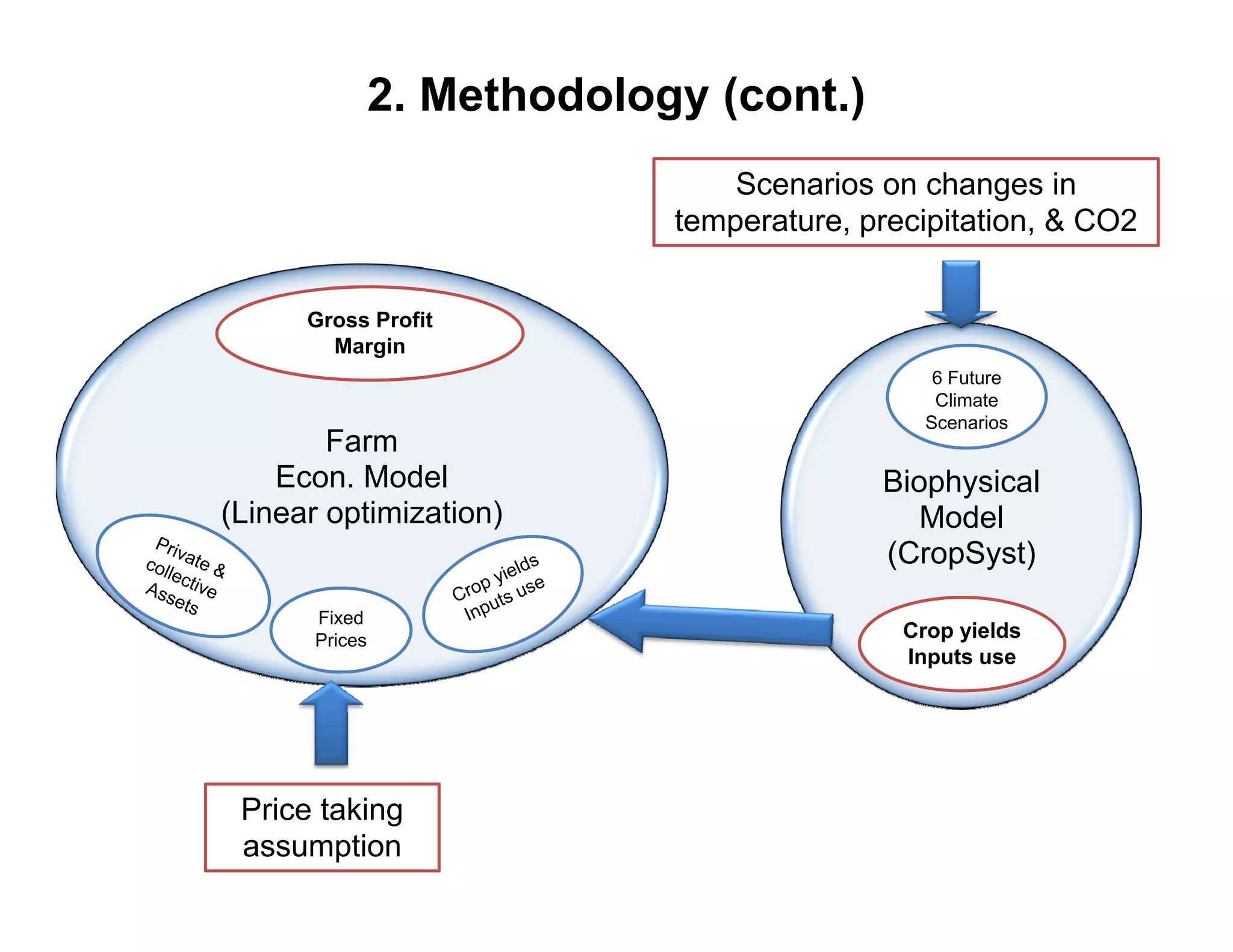
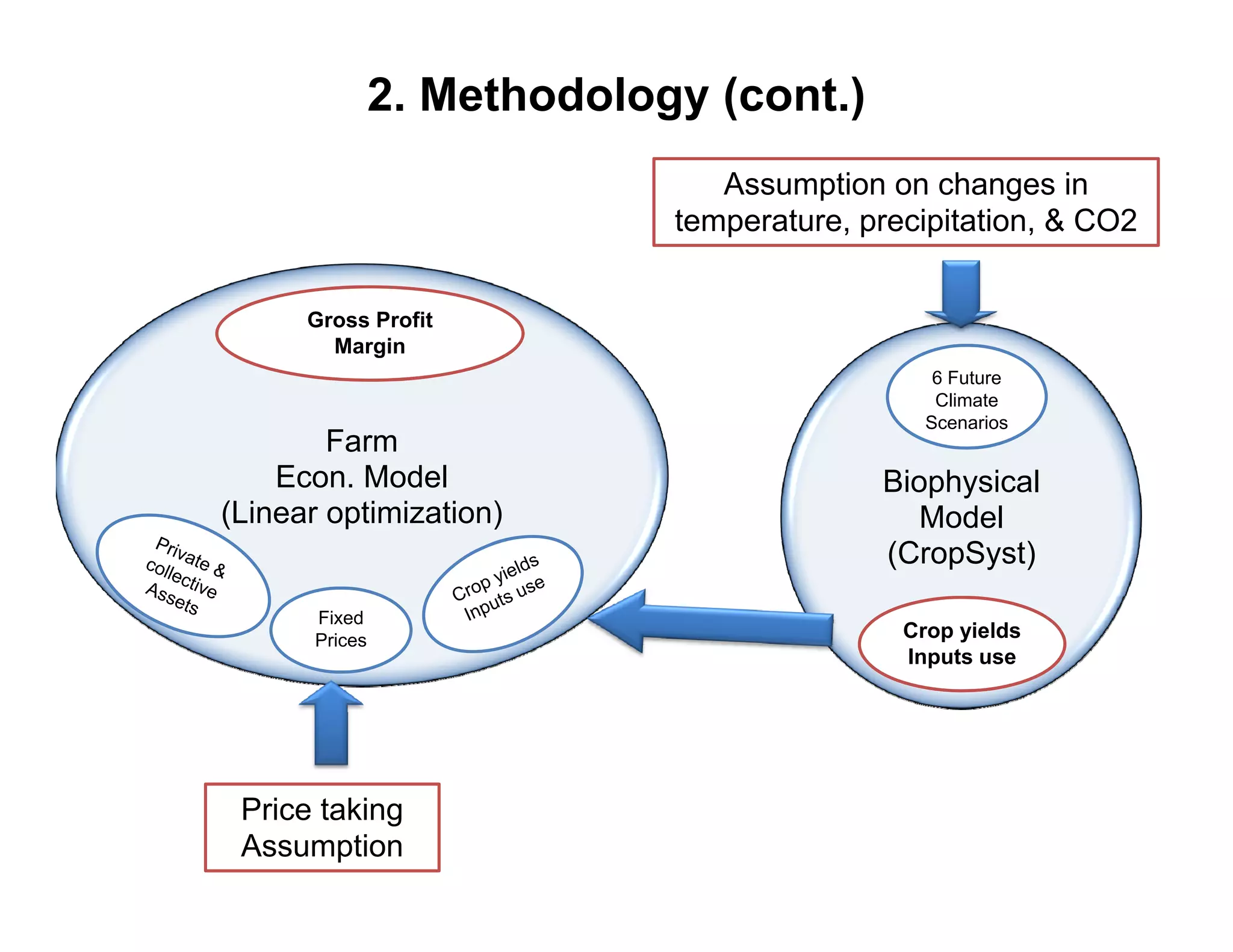
2. Methodology (cont.)
                                 S
                                 Scenarios on changes i
                                        i       h        in
                             temperature, precipitation, & CO2


      Gross Profit
        Margin
                                                6 Future
                                                Climate
                                               Scenarios
                                               S      i
        Farm
    Econ. Model                            Biophysical
(Linear optimization)                         Model
                                           (CropSyst)
       Fixed
       Prices                                Crop yields
                                             Inputs use


 Price taking
 assumption
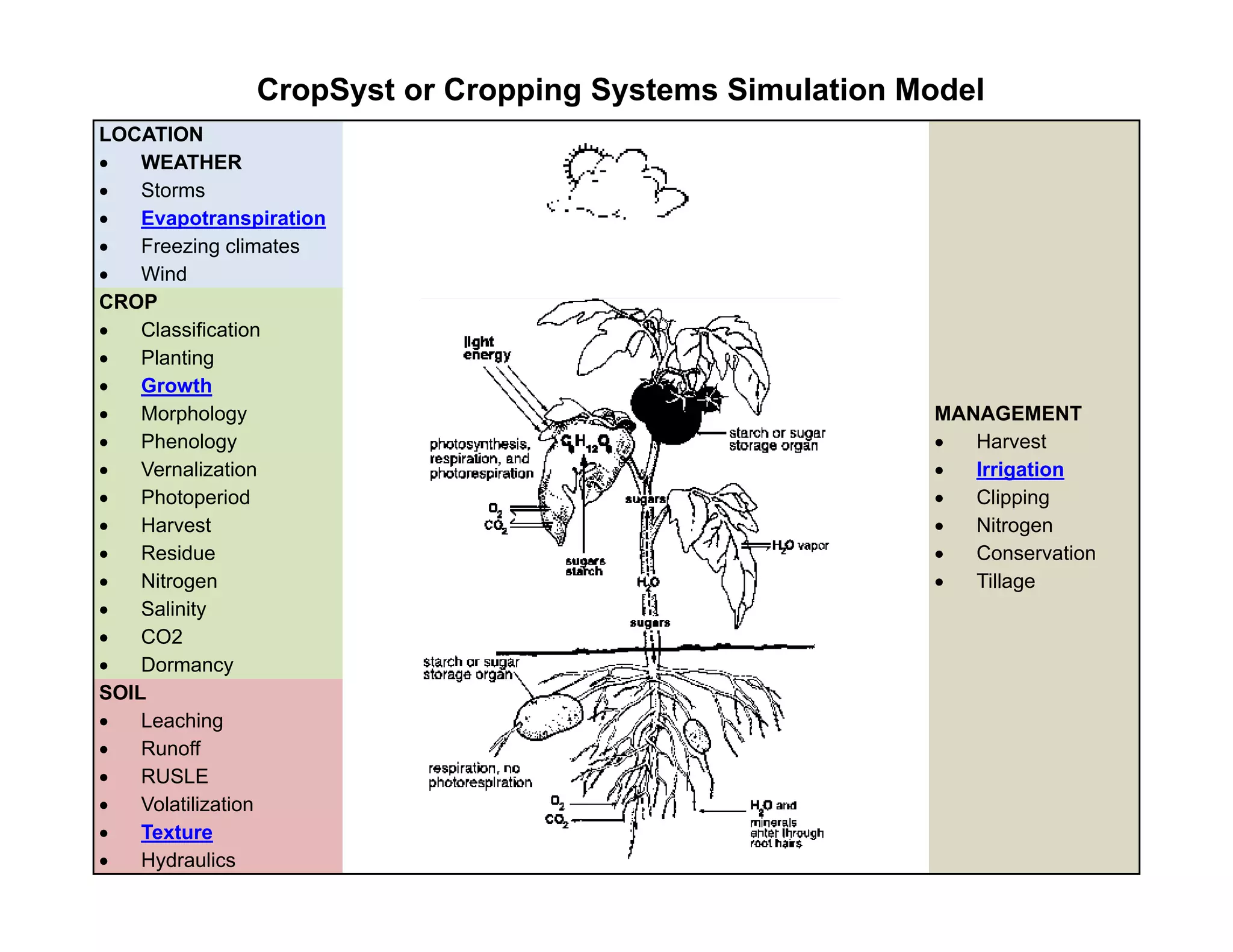
CropSyst or Cropping Systems Simulation Model
LOCATION
   WEATHER
   Storms
   Evapotranspiration
   Freezing climates
   Wind
CROP
   Classification
   Planting
   Growth
   Morphology                                          MANAGEMENT
   Phenology                                             Harvest
   Vernalization                                         Irrigation
   Photoperiod                                           Clipping
   Harvest                                               Nitrogen
                                                                 g
   Residue                                               Conservation
   Nitrogen                                              Tillage
   Salinity
   CO2
   Dormancy
SOIL
   Leaching
   Runoff
   RUSLE
   Volatilization
   Texture
   Hydraulics
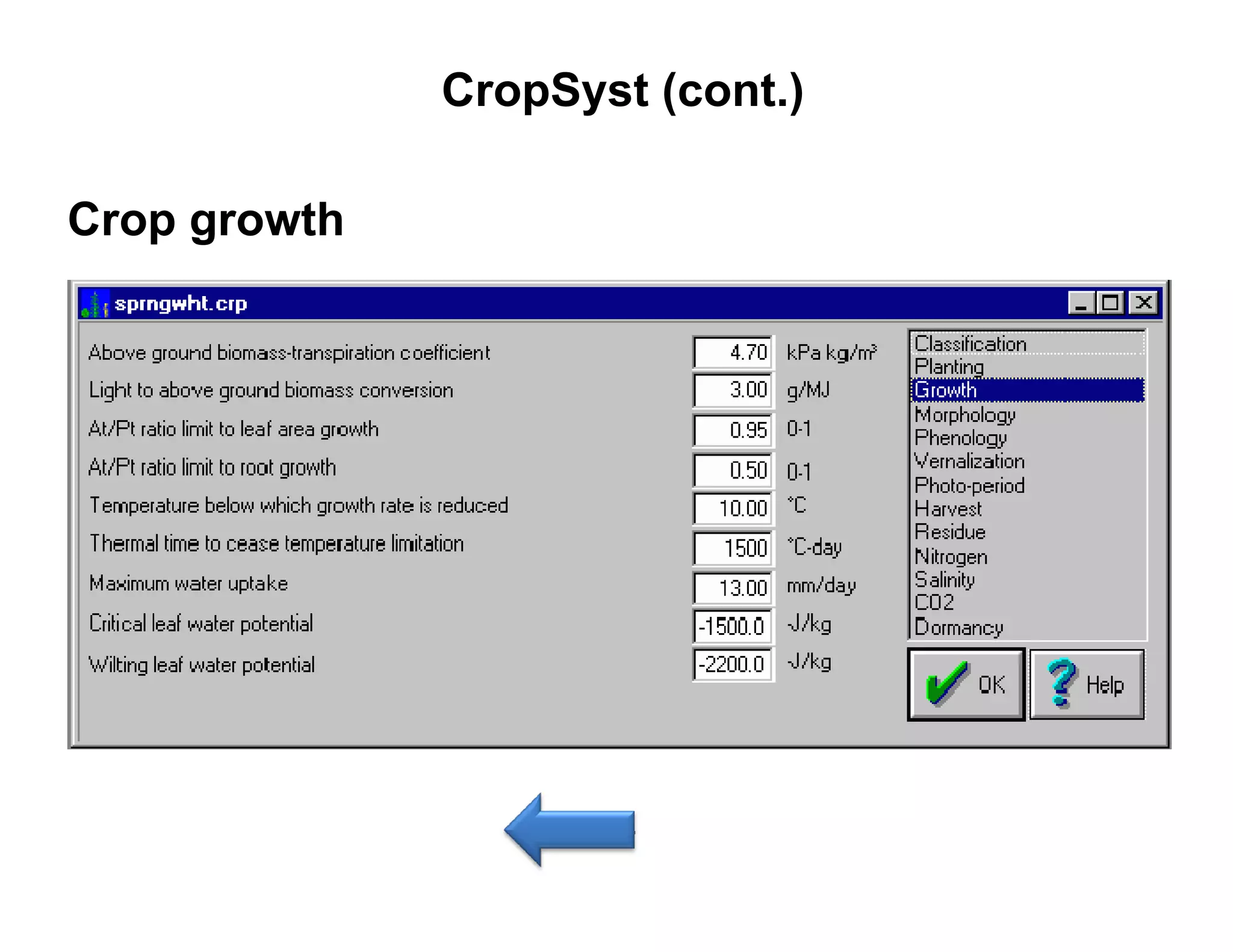
CropSyst (cont.)

Crop growth
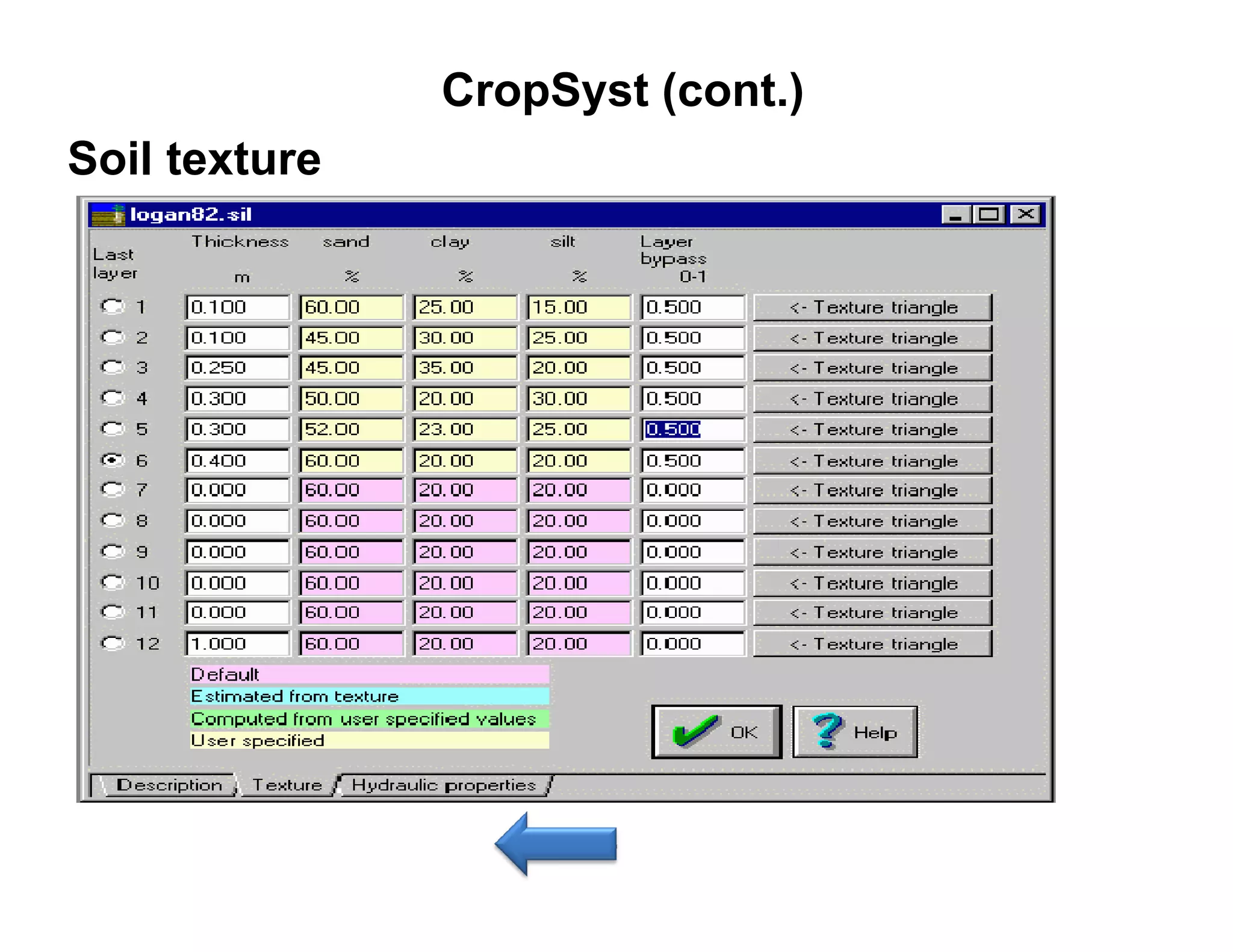
CropSyst (cont.)
Soil texture
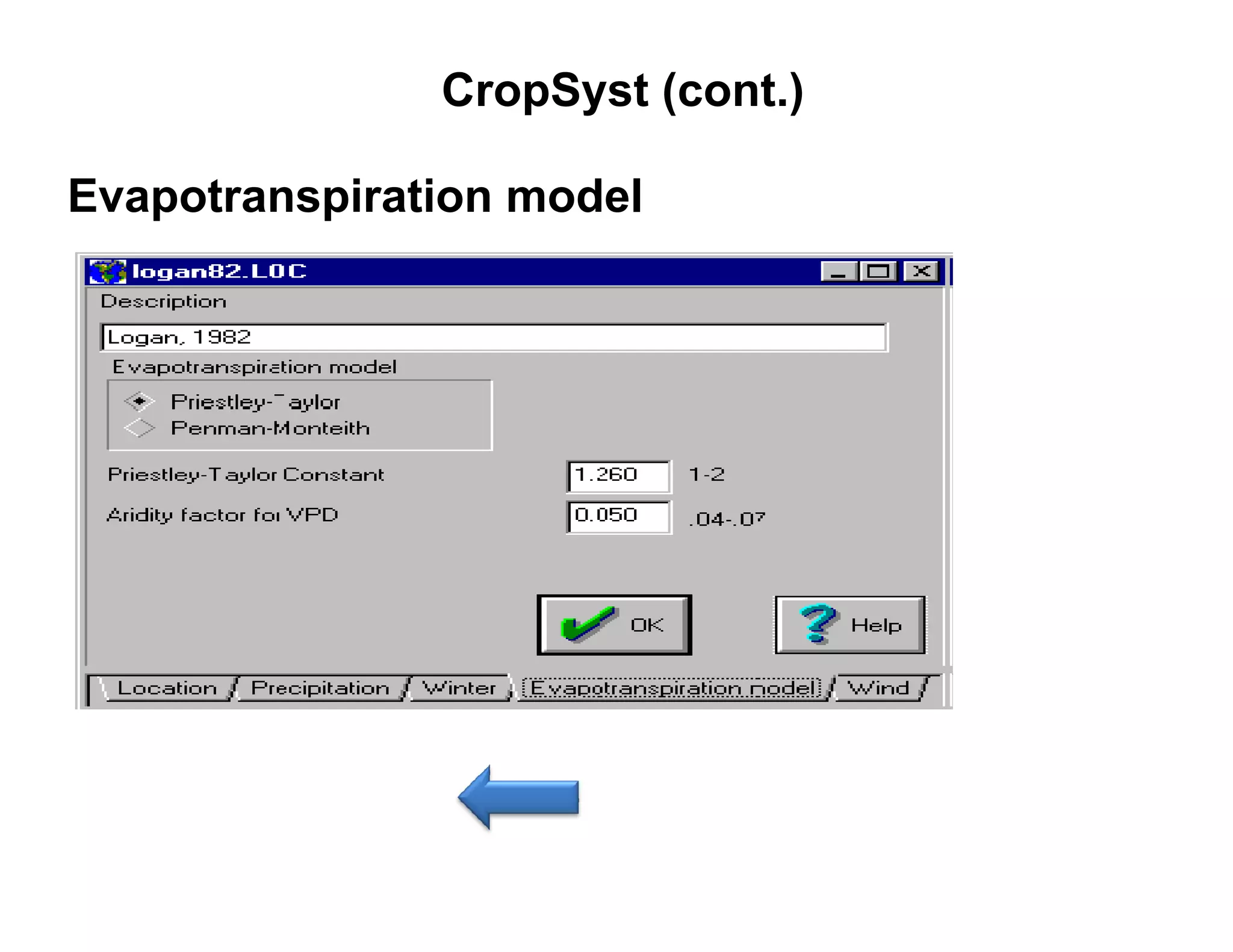
CropSyst (cont.)

Evapotranspiration model
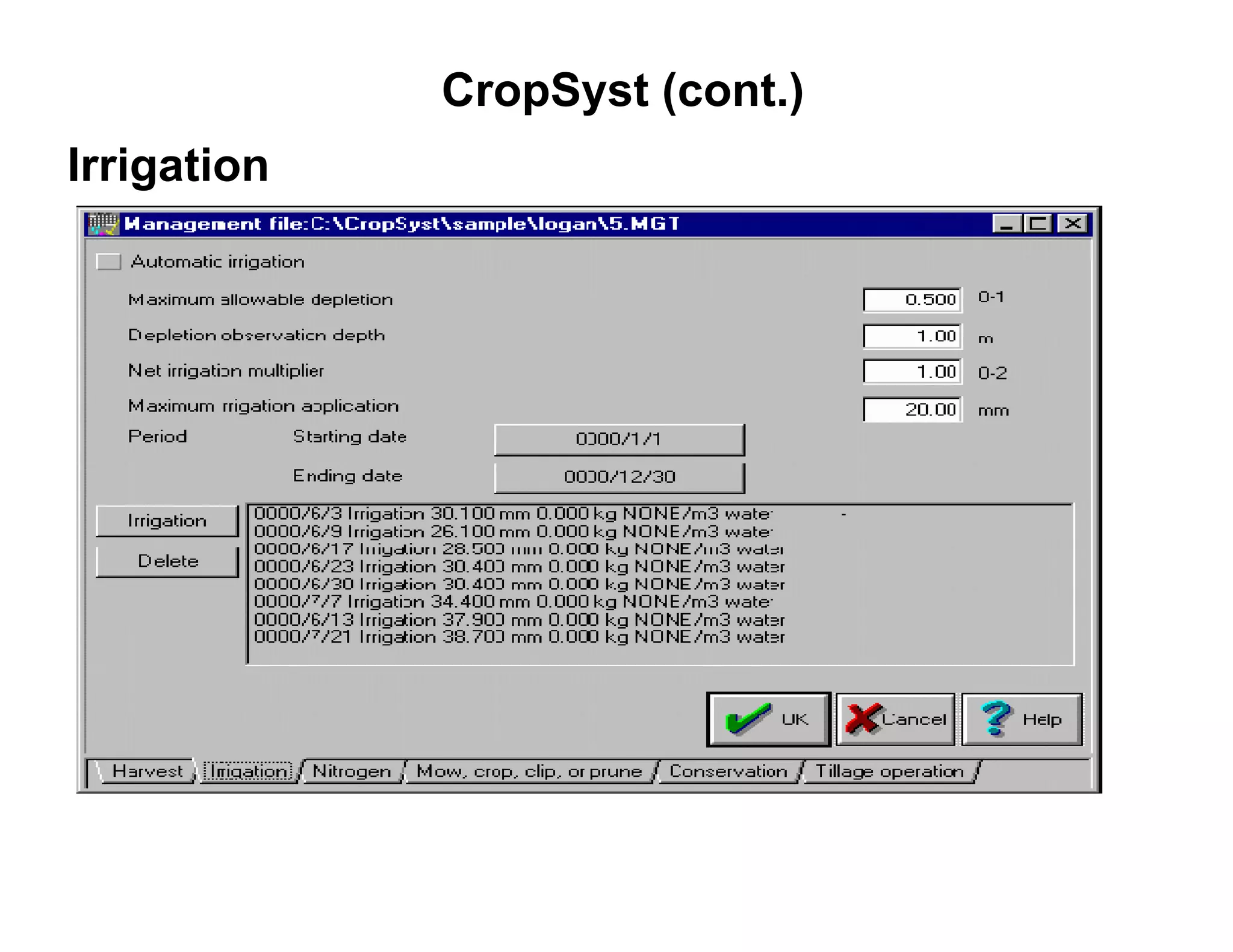
CropSyst (cont.)
Irrigation
CropSyst (cont.)


                                                  Hard wheat
                                                   (RL 39% + IL 16%)
                                                 [Crop+Location+Soil+Manage]


     Fodder
     barley                         SIMULATION CONTROLE
        (RL 2%)                            Rotation                                           Soft wheat
[Crop+Location+Soil+Manage]
                                          Soil profile                                              (RL 4%)
                                           Residue                                          [Crop+Location+Soil+Manage]

                                           Nitrogen
                                            Runoff
  Fava beans
                                             CO2
         (RL 2%)
 [Crop+Location+Soil+Manage]
                                          Validation

                                                                                    Oat hay
                               Chi k
                               Chickpeas                                                (IL 8%)
                                                                               [Crop+Location+Soil+Manage]
                                  (RL 1%)
                          [Crop+Location+Soil+Manage]
CropSyst (cont.)

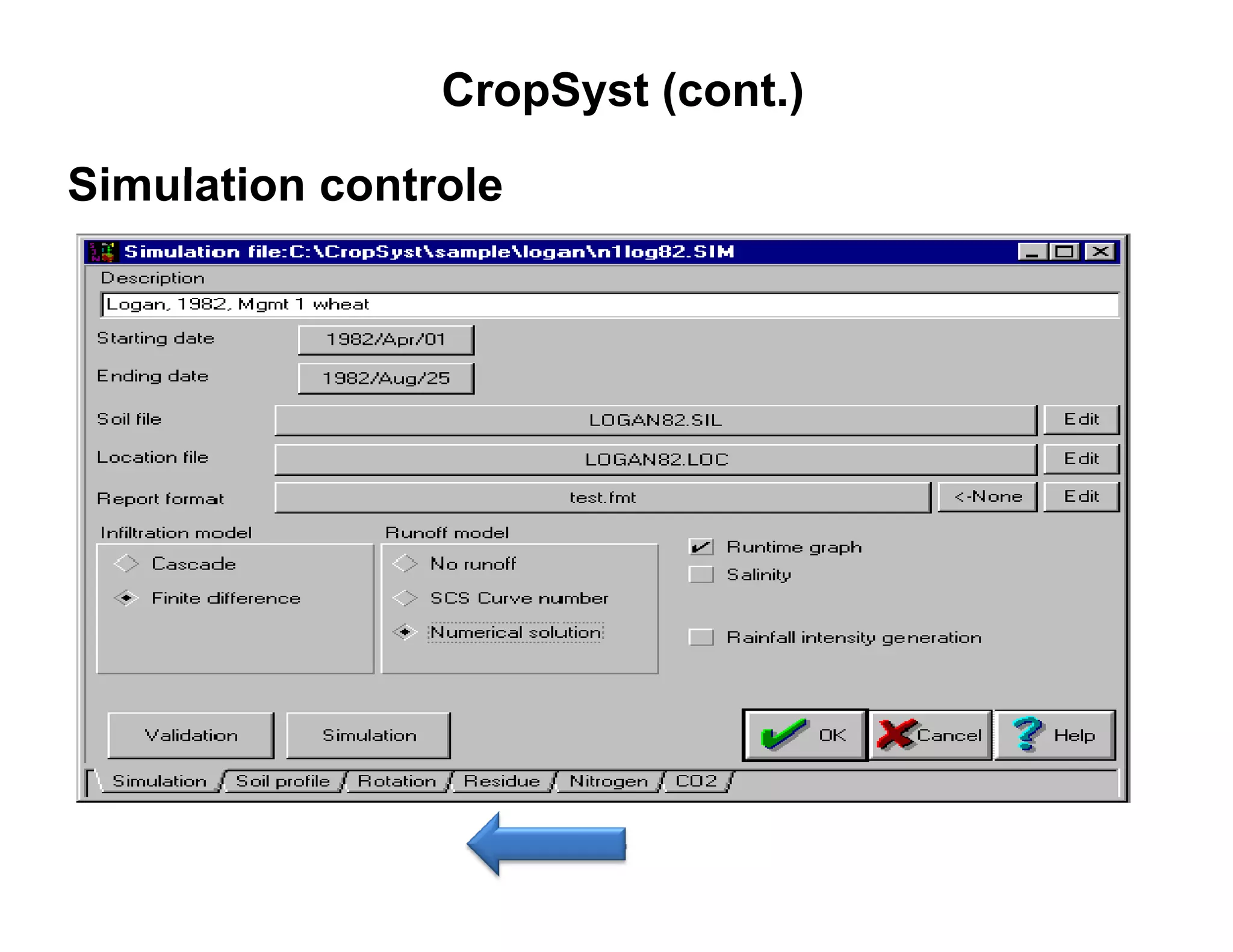
Simulation
Sim lation controle
CropSyst (cont.)

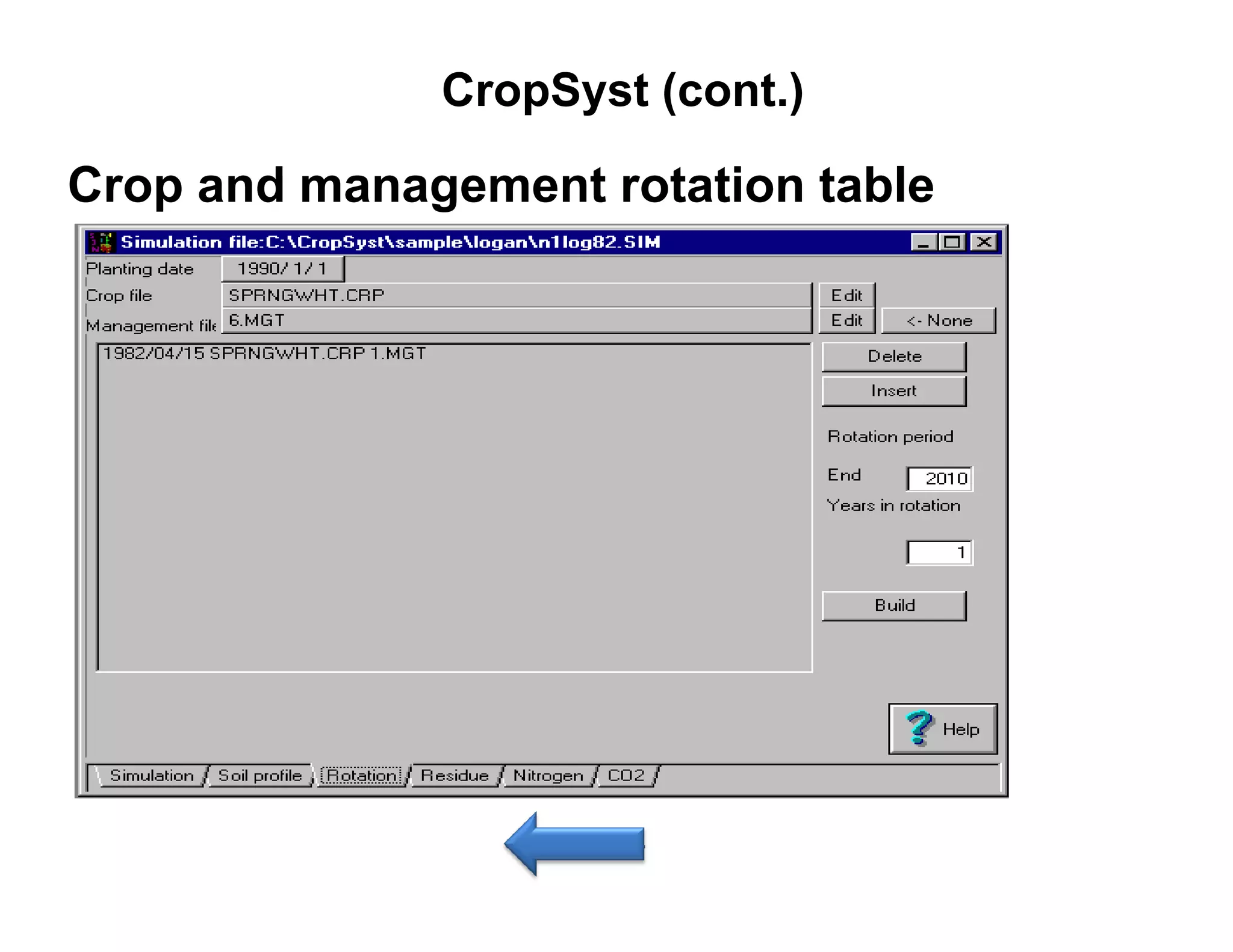
Crop and management rotation table
CropSyst (cont.)

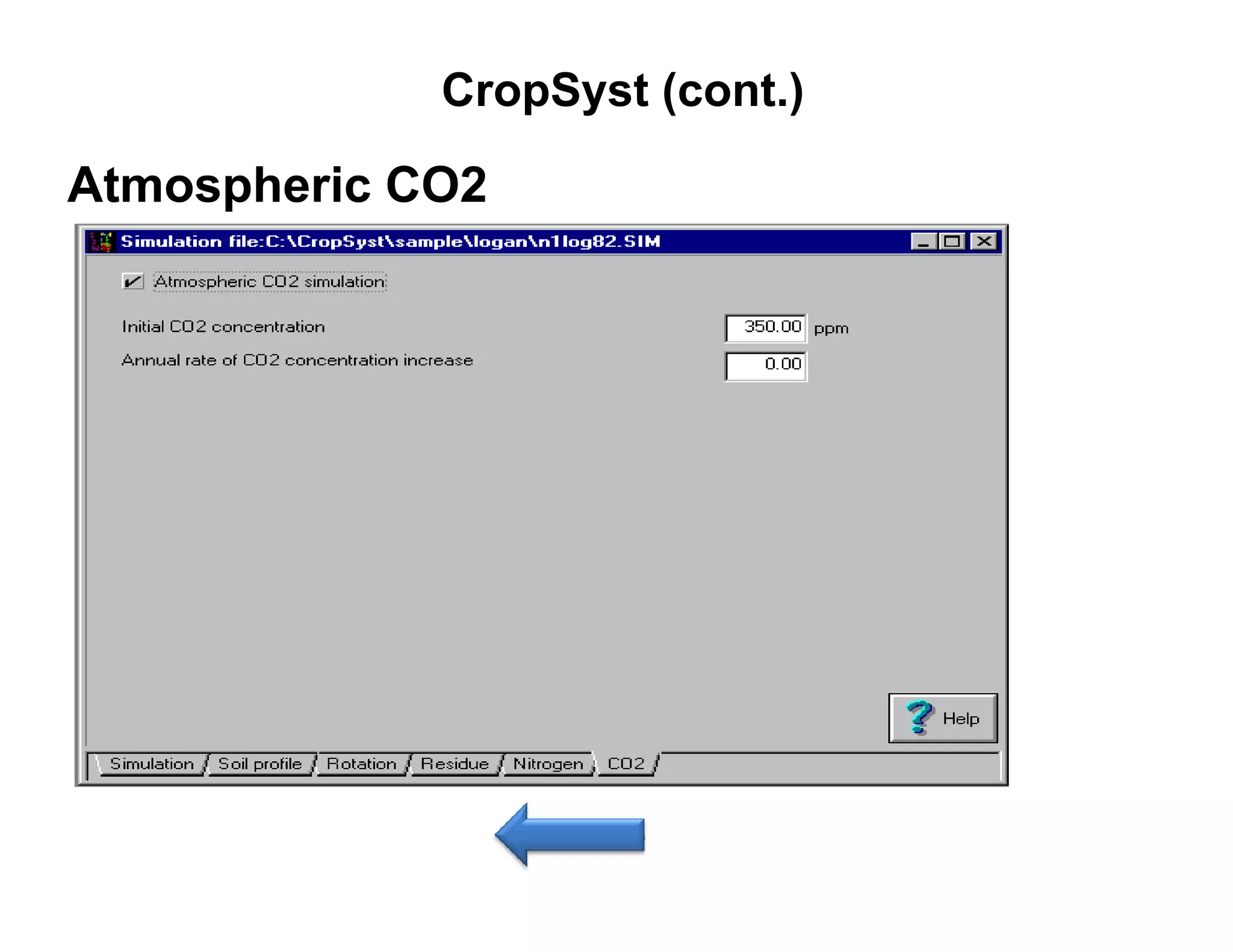
Atmospheric CO2
CropSyst (cont.)
Runtime graphic display
 u t e g ap c d sp ay
            Atmospheric conditions graph
           • Average daily temperature
           • Actual evapotranspiration
 Growth    • Potential evapotranspiration
  stage    • Precipitation             Atmospheric conditions graph
 graph     • Runoff                   • Plant height
           • Actual transpiration     • Biomass
           • Potential transpiration • Leaf area index
                                     •   Green area index
                                     •   Total stress
                                     •   Nitrogen stress
                                     •   Light stress
                                           g
                                     •   Water stress
 Harvest
                                     •   Temperature stress
  Totals
 Display                               Plant 
                                       Pl t          Plant Available 
                                                     Pl t A il bl
                                     Available       Nitrogen graph
                                    Water graph   [ammonium & nitrate]
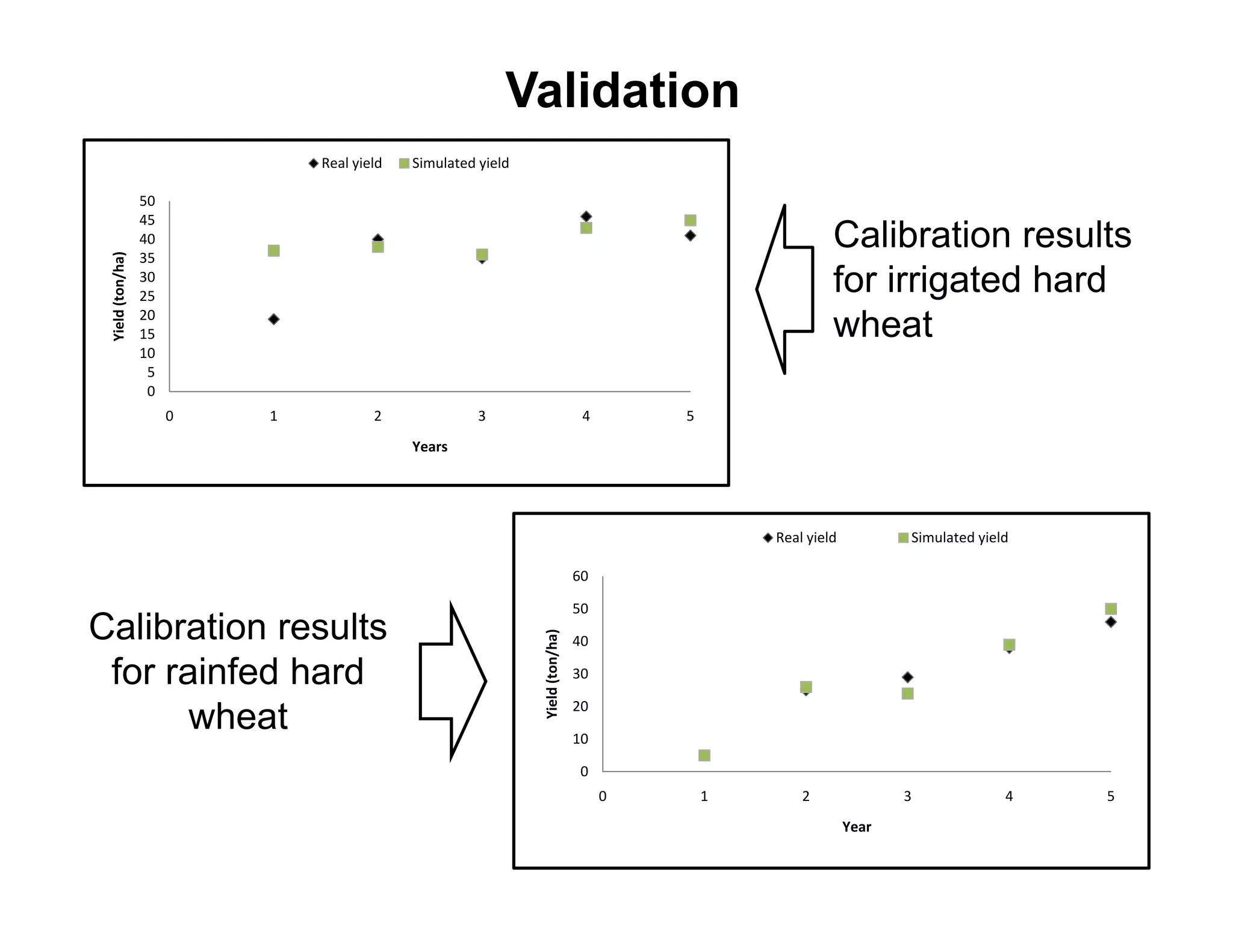
Validation
                               Real yield   Simulated yield

                  50
                  45
                  40
                  35
                                                                                                         Calibration results
 Yield (ton/ha)


                  30
                  25
                                                                                                         for irrigated hard
                                                                                                                 g
                  20
                  15                                                                                     wheat
                  10
                   5
                   0
                       0   1           2              3                         4       5
                                            Years


                                                                                                Real yield
                                                                                                Real yield          Simulated yield
                                                                                                                    Simulated yield

                                                                               60

                                                                               50
Calibration results
                                                                        /ha)


                                                                               40
                                                              Yield (ton/


 for rainfed hard                                                              30


       wheat                                                                   20

                                                                               10

                                                                                0
                                                                                    0       1       2               3             4   5
                                                                                                             Year
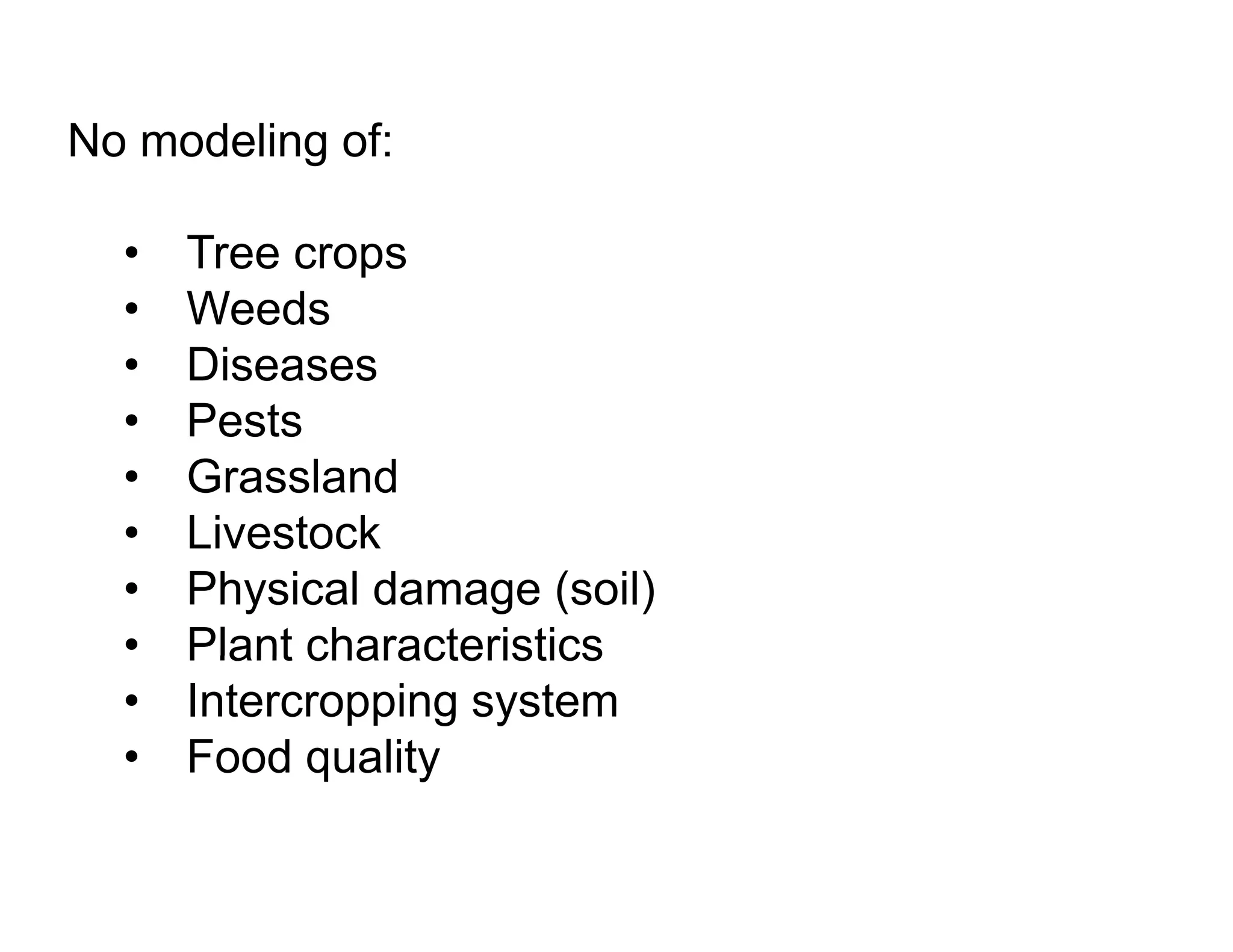
No modeling of:

  •   Tree crops
  •   Weeds
      W d
  •   Diseases
  •   Pests
  •   Grassland
  •   Livestock
  •   Physical damage (soil)
  •   Plant characteristics
  •   Intercropping system
  •   Food quality
            q    y
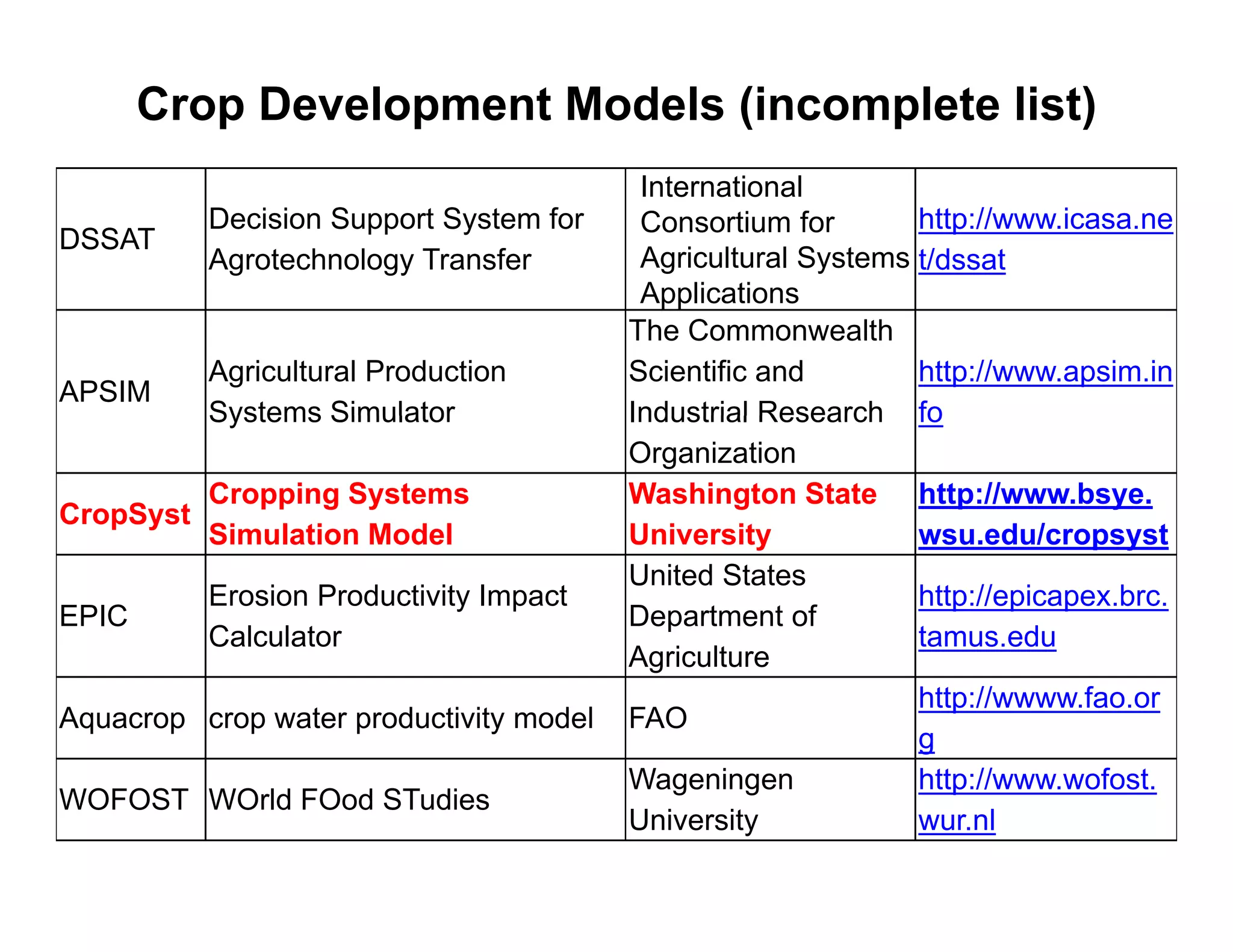
Crop Development Models (incomplete list)
                                          International
                                          I        i   l
          Decision Support System for     Consortium for       http://www.icasa.ne
DSSAT
          Agrotechnology Transfer         Agricultural Systems t/dssat
                                          Applications
                                         The Commonwealth
          Agricultural Production        Scientific and        http://www.apsim.in
APSIM
          Systems Simulator              Industrial Research fo
                                         Organization
         Cropping Systems                Washington State http://www.bsye.
CropSyst
         Simulation Model                University            wsu.edu/cropsyst
                                                               wsu edu/cropsyst
                                         United States
          Erosion Productivity Impact                          http://epicapex.brc.
EPIC                                     Department of
          Calculator                                           tamus.edu
                                         Agriculture
                                                               http://wwww.fao.or
Aquacrop crop water productivity model   FAO
                                                               g
                                         Wageningen            http://www.wofost.
                                                               http://www wofost
WOFOST WOrld FOod STudies
                                         University            wur.nl
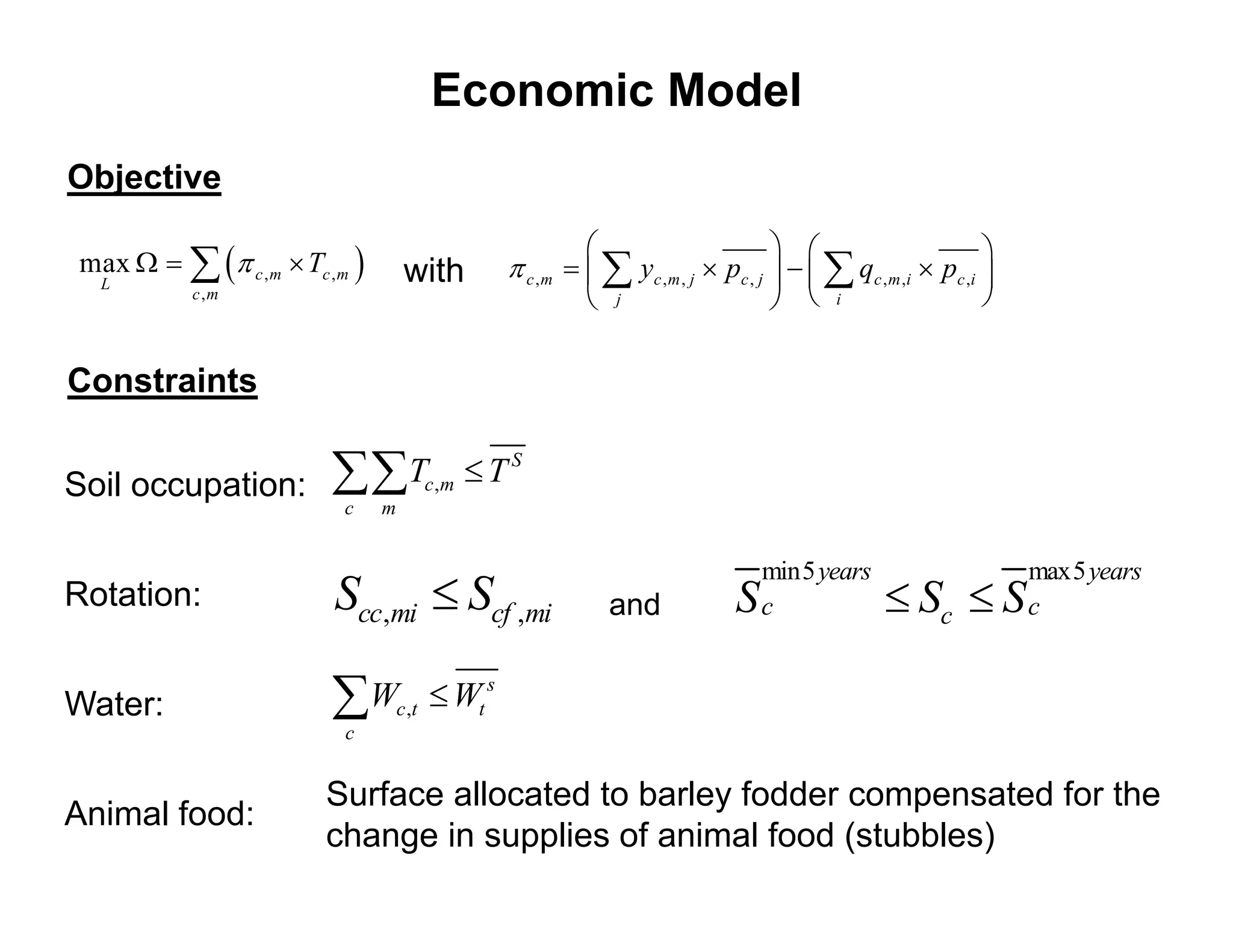
Economic Model
Objective
                                                                                                      
max     c , m  Tc , m        with    c , m    y c , m , j  pc , j     qc , m , i  pc , i 
  L
           c ,m
                                                        j                          i                  


Constraints


Soil occupation:  Tc,m  T S
                          c     m


                                                                             min5 years                       max5 years
Rotation:                Scc,mi  Scf ,mi                and             S   c               Sc  S          c


Water:                    Wc ,t  Wt s
                           c


                         Surface allocated to barley fodder compensated for the
Animal food:
                         change in supplies of animal food (stubbles)
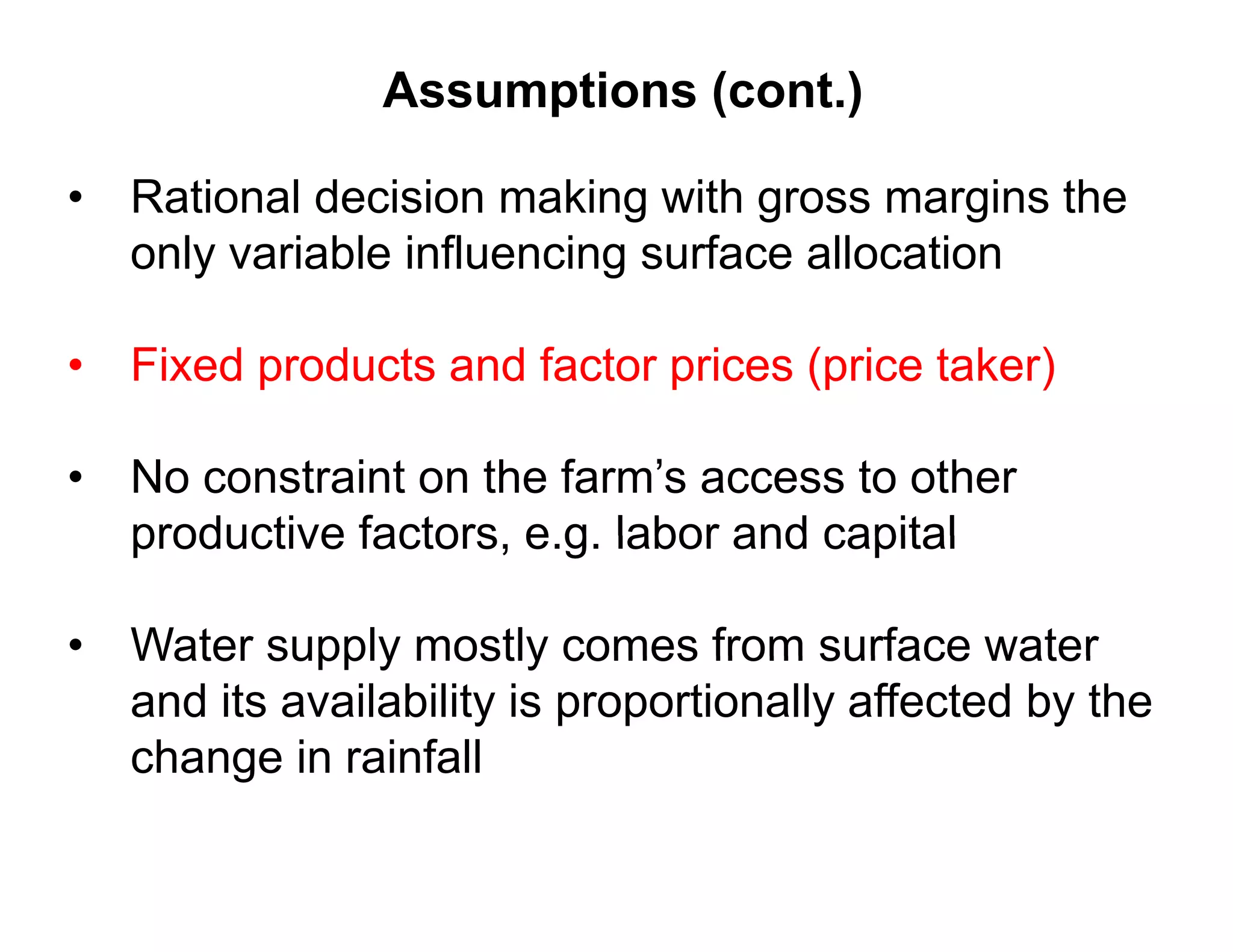
Assumptions (cont.)

• Rational decision making with gross margins the
  only variable influencing surface allocation

• Fixed products and factor prices (price taker)

• No constraint on the farm’s access to other
  productive factors e g labor and capital
             factors, e.g.

•   Water supply mostly comes from surface water
    and its availability is proportionally affected by the
    change in rainfall
         g
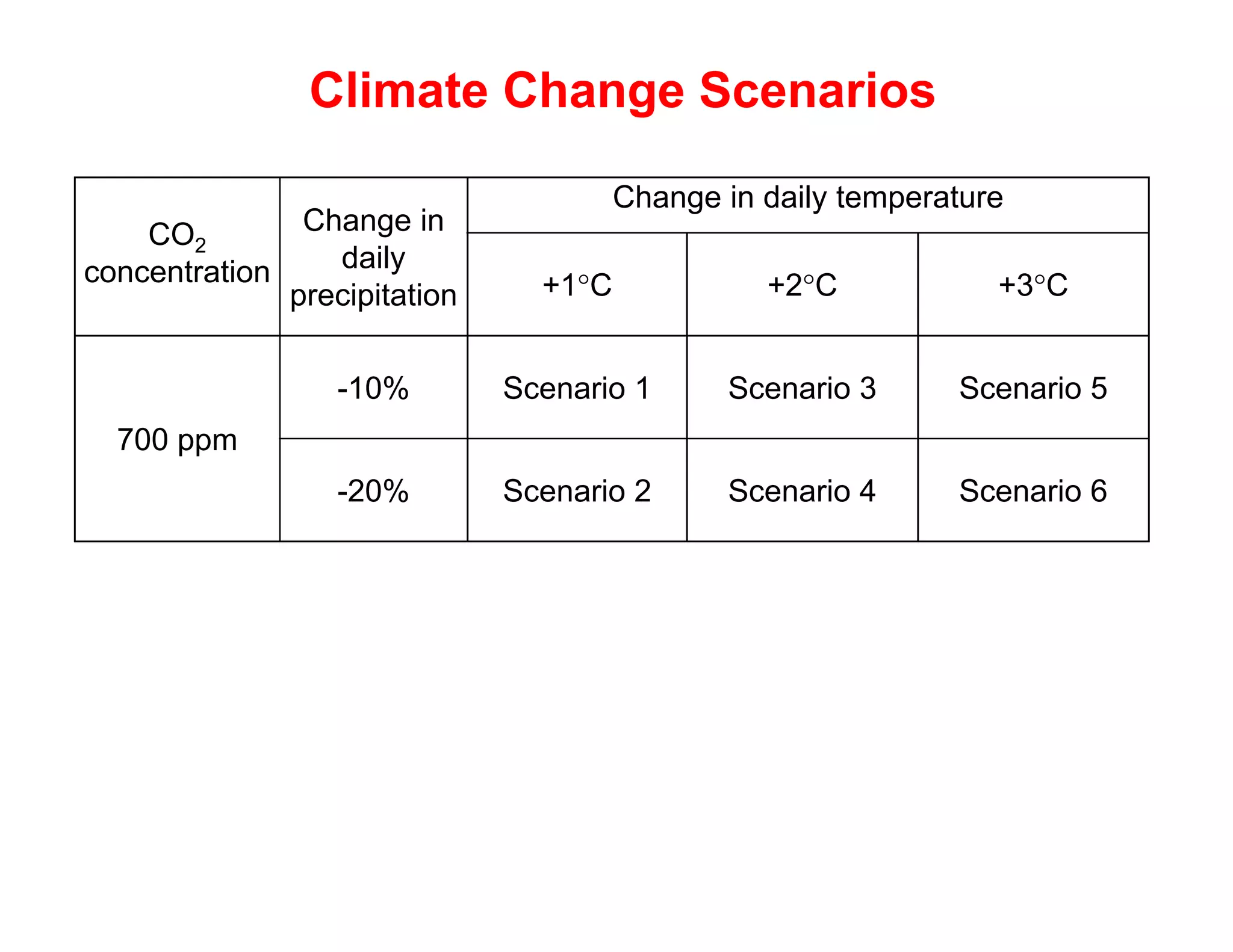
Climate Change Scenarios

                                         Change in daily temperature
    CO2          Change in
concentration      daily
                precipitation     +1°C
                                     C             +2°C
                                                      C            +3°C
                                                                    3C


                   -10%         Scenario 1      Scenario 3      Scenario 5
  700 ppm
                   -20%         Scenario 2      Scenario 4      Scenario 6
2. Methodology (cont.)
                                A
                                Assumption on changes i
                                        ti       h        in
                             temperature, precipitation, & CO2


      Gross Profit
        Margin
                                                6 Future
                                                Climate
                                               Scenarios
                                               S      i
        Farm
    Econ. Model                            Biophysical
(Linear optimization)                         Model
                                           (CropSyst)
       Fixed
       Prices                                Crop yields
                                             Inputs use


 Price taking
 Assumption
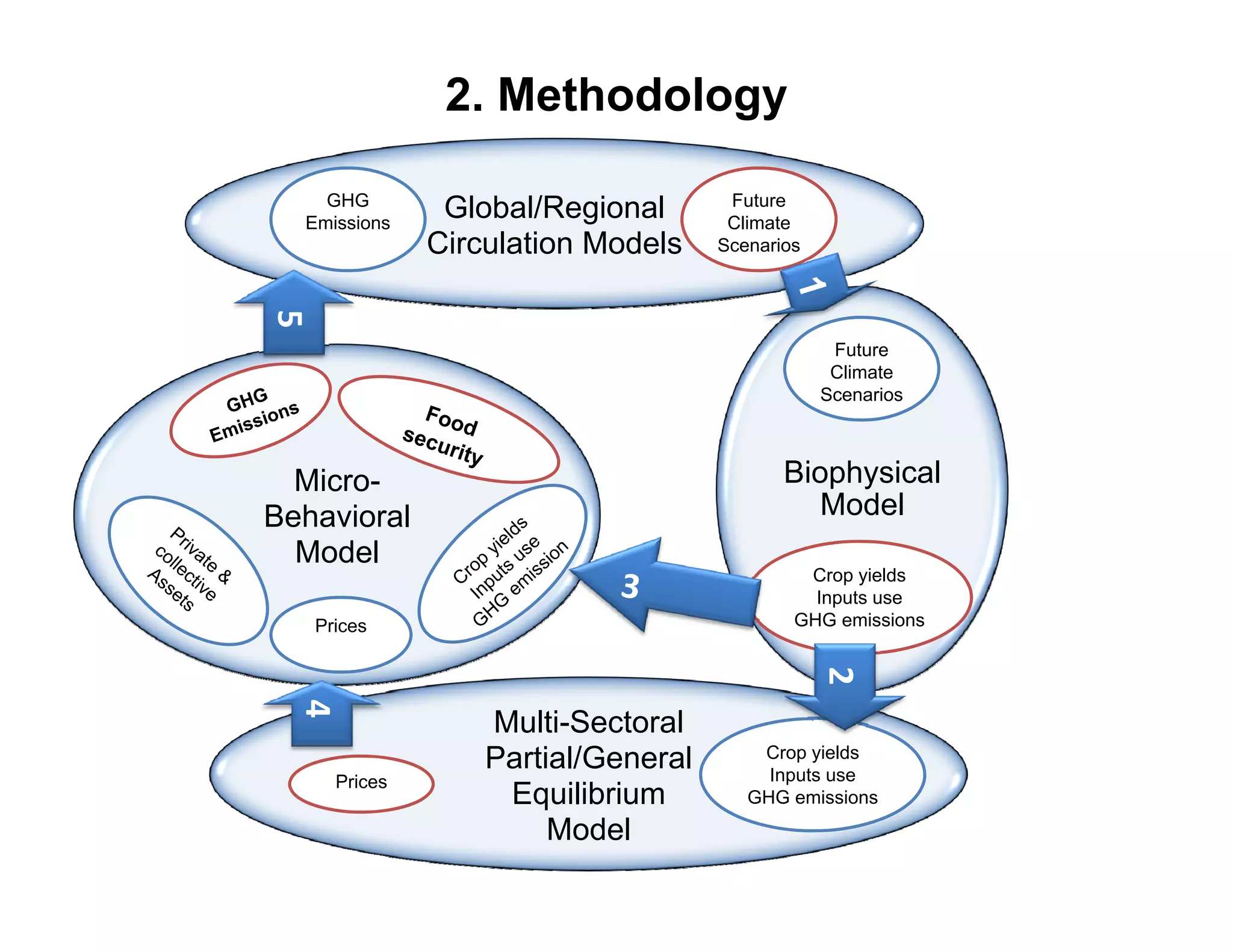
2. Methodology

    GHG
  Emissions
                Global/Regional       Future
                                      Climate
               Circulation Models    Scenarios
5

                                                  Future
                                                  Climate
                                                 Scenarios


  Micro-                                    Biophysical
Behavioral                                     Model
  Model
                                              Crop yields
                                               Inputs use
    Prices                                   GHG emissions


                                                 2
  4


                   Multi-Sectoral
                   Partial/General       Crop yields
                                          Inputs use
      Pi
      Prices
                    Equilibrium         GHG emissions
                        Model
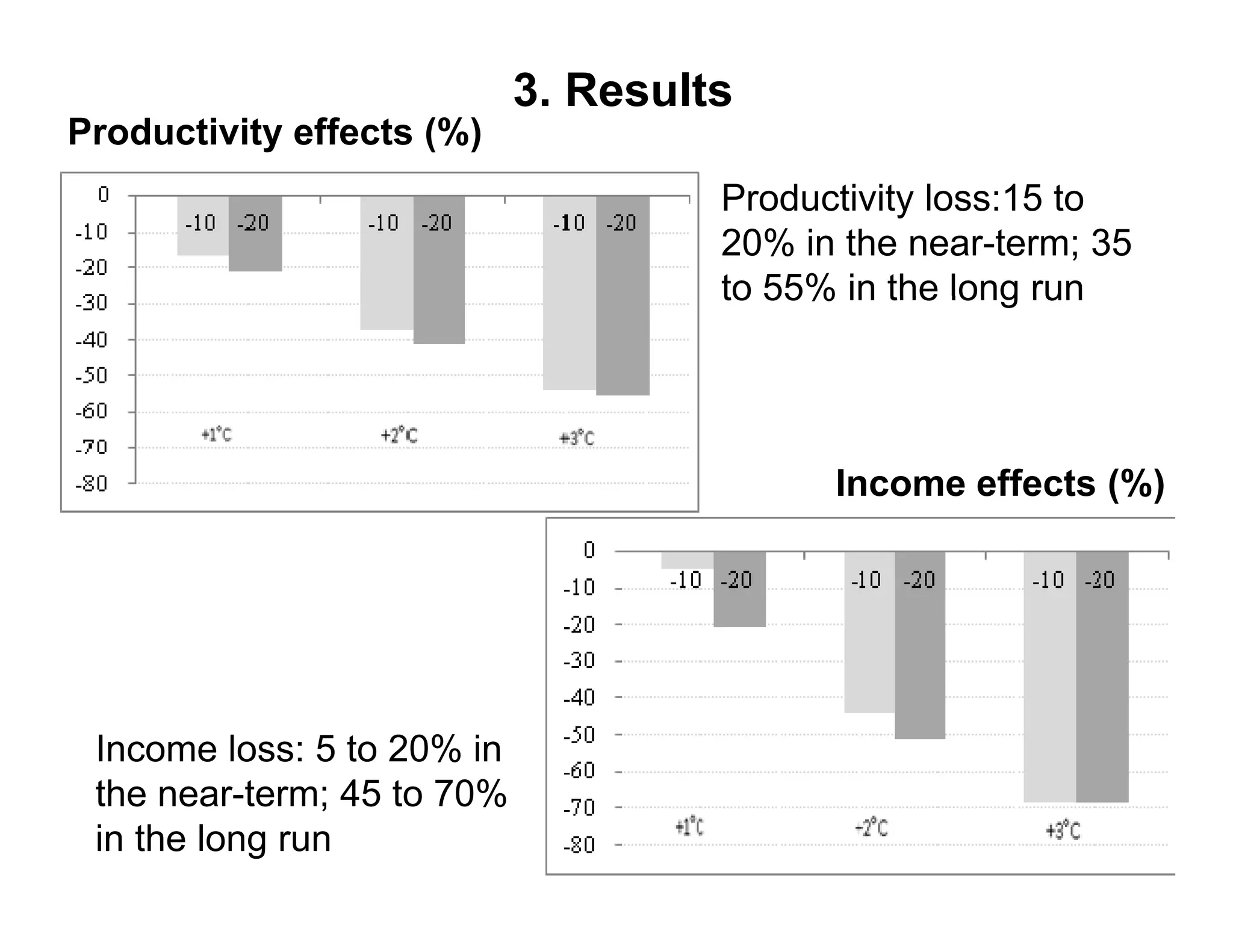
3. Results
Productivity effects (%)
                                     Productivity loss:15 to
                                     20% in the near-term; 35
                                     to 55% in the long run


                                           Income effects (%)


 Income loss: 5 to 20% in
 the near-term; 45 to 70%
 in the long run
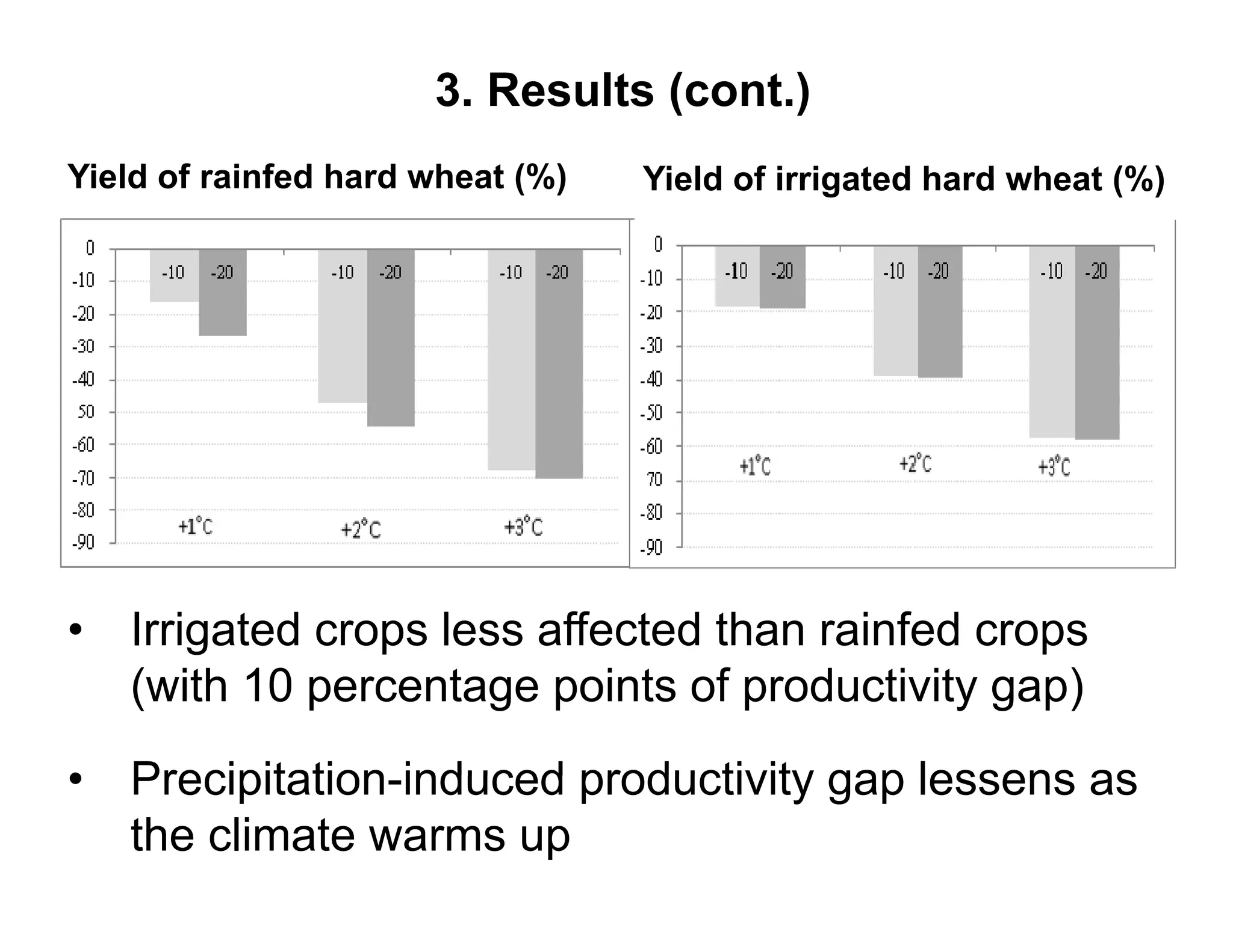
3. Results (cont.)
Yield of rainfed hard wheat (%)   Yield of irrigated hard wheat (%)


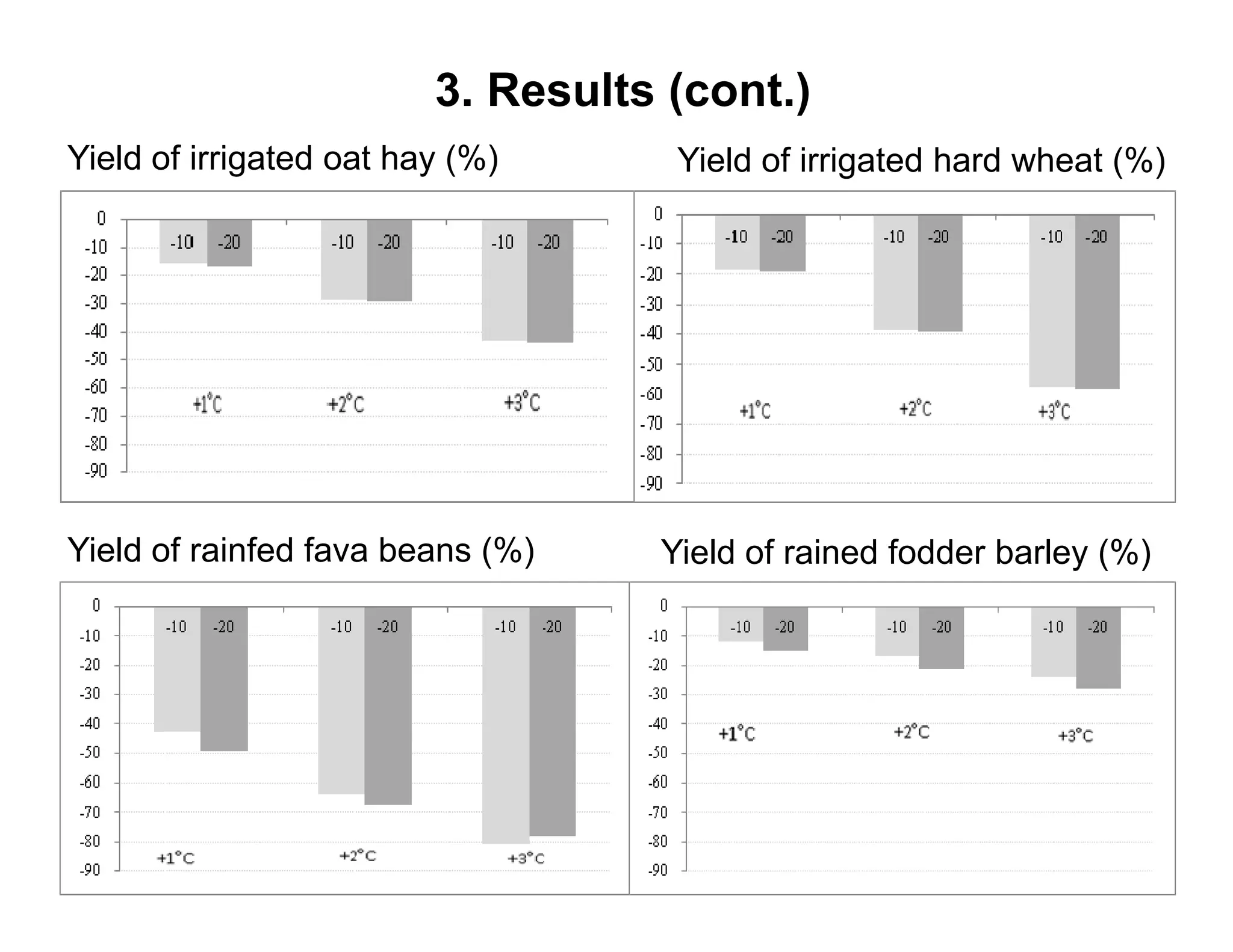
• Irrigated crops less affected than rainfed crops
  (with 10 percentage points of productivity gap)

•   Precipitation-induced
    Precipitation induced productivity gap lessens as
    the climate warms up
3. Results (cont.)
Yield of irrigated oat hay ( )
             g           y (%)      Yield of irrigated hard wheat ( )
                                                 g                (%)


Yield of rainfed fava beans (%)    Yield of rained fodder barley (%)
3. Results (cont.)
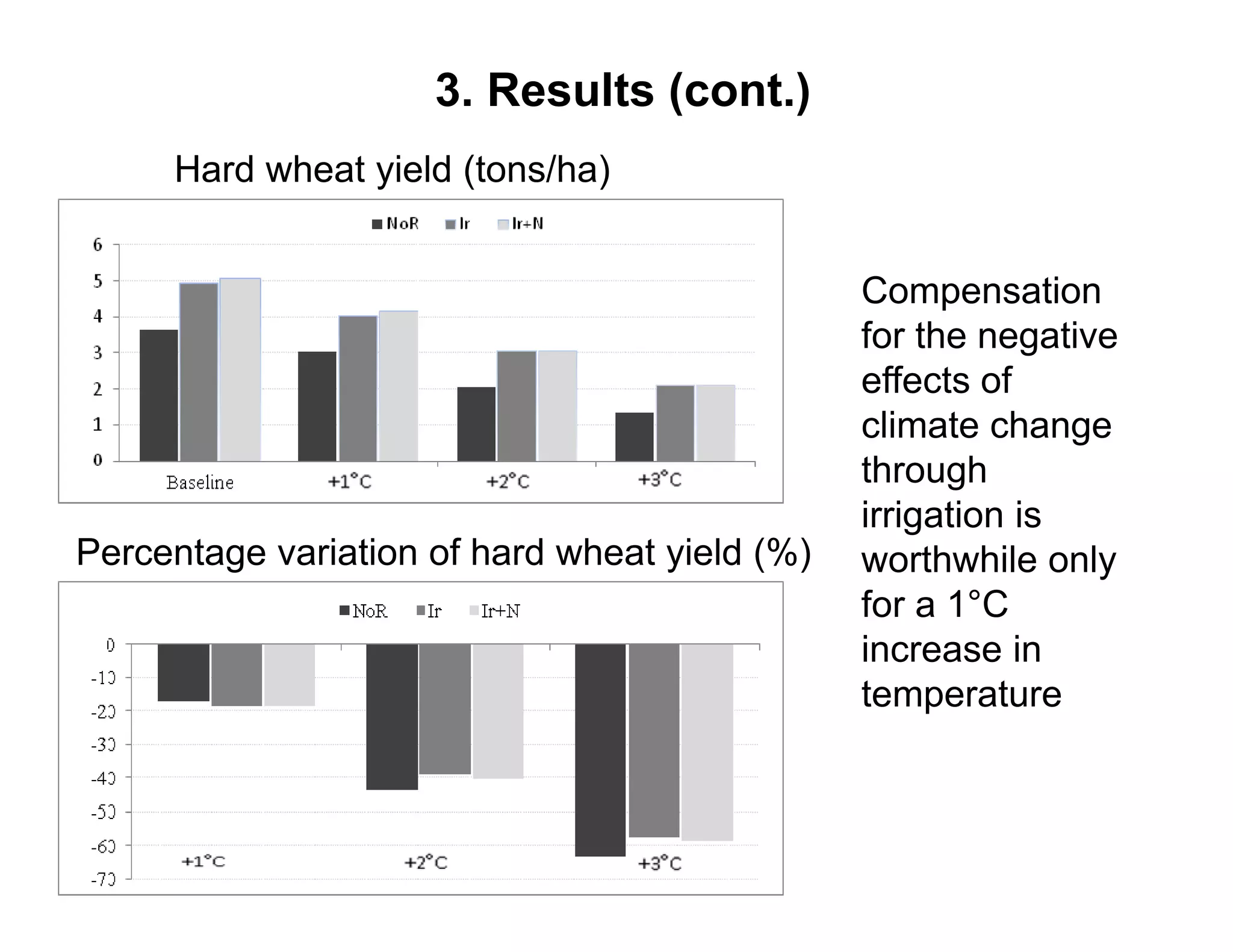
     Hard wheat yield (tons/ha)


                                               Compensation
                                               for the negative
                                               effects of
                                               climate change
                                                 li t h
                                               through
                                               irrigation is
Percentage variation of hard wheat yield (%)   worthwhile only
                                               for a 1°C
                                               increase in
                                               temperature
Summary
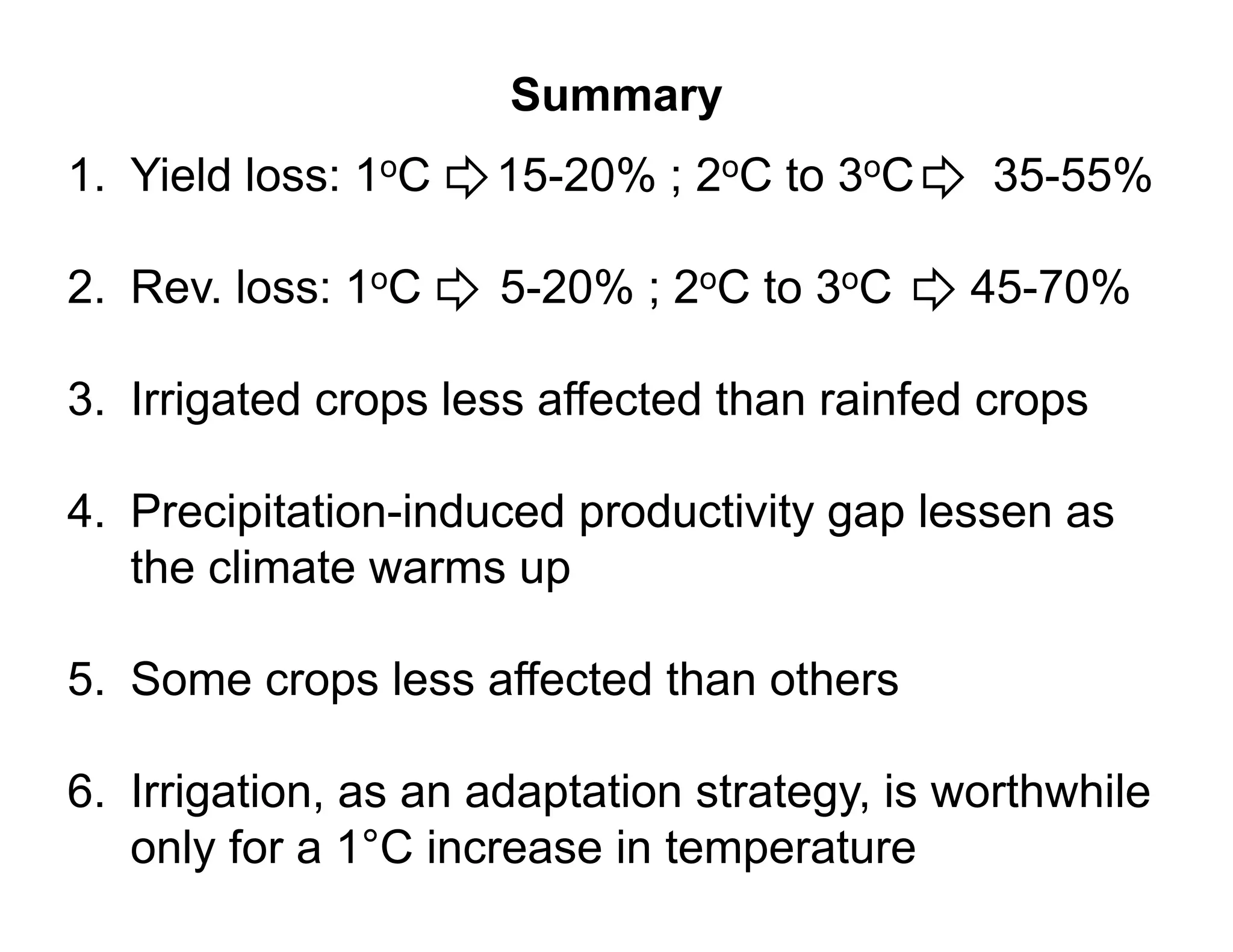
1.
1 Yield loss: 1oC    15 20% ; 2oC to 3oC
                     15-20%                   35 55%
                                              35-55%

2. Rev.
2 Rev loss: 1oC      5-20% ; 2oC to 3oC
                     5 20%                   45-70%
                                             45 70%

3. Irrigated crops less affected than rainfed crops
       g        p                                p

4. Precipitation-induced productivity gap lessen as
         p               p          yg p
   the climate warms up

5. Some crops less affected than others

6. Irrigation, as an adaptation strategy, i worthwhile
6 I i ti              d t ti     t t      is   th hil
   only for a 1°C increase in temperature
Thank you for your attention

    More information at

       www.ifpri.org

     www.agrodep.org
          g    p g

Simulating the Impact of Climate Change and Adaptation Strategies on Farm Productivity and Income: A Bioeconomic Analysis

  • 1.
    Simulating the Impactof Climate Change and Adaptation Strategies on Farm Productivity and Income: A Bioeconomic Analysis Presented by: Ismael Fofana International Food Policy Research Institute - Dakar www.agrodep.org AGRODEP Workshop on Analytical Tools for Climate Change Analysis June 6-7, 2011 • Dakar, Senegal Please check the latest version of this presentation on: http://www.agrodep.org/first-annual-workshop
  • 2.
    Simulating the Impact ofClimate Change and Adaptation Strategies on Farm Productivity and Income: A Bioeconomic Analysis Ismaël Fofana International Food Policy Research Institute West and Central Africa Dakar, Senegal
  • 3.
    1. 1 Issue andobjective 2. Methodology - Biophysical Model - Economic Model - Climate Scenarios 3. Results
  • 4.
    1. Issue andobjective • Our O r climate is changing more and more changing; evidences on rising temperature, sea-levels, frequency and severity of droughts and floods … floods, • Agricultural A i lt l sector i hi hl climate sensitive t is highly li t iti • Climate defines production areas for crops • Climate’s effect on yield is important
  • 5.
    1. Issue andobjective (cont.) Objective • Better understand the impact of climate change on farmers and agricultural p g production • Help to properly anticipate and adapt farming to optimize food production • Analysis at the farm level is a crucial step before moving into a large and general analysis
  • 6.
    2. Methodology (cont.) S Scenarios on changes i i h in temperature, precipitation, & CO2 Gross Profit Margin 6 Future Climate Scenarios S i Farm Econ. Model Biophysical (Linear optimization) Model (CropSyst) Fixed Prices Crop yields Inputs use Price taking assumption
  • 7.
    CropSyst or CroppingSystems Simulation Model LOCATION  WEATHER  Storms  Evapotranspiration  Freezing climates  Wind CROP  Classification  Planting  Growth  Morphology MANAGEMENT  Phenology  Harvest  Vernalization  Irrigation  Photoperiod  Clipping  Harvest  Nitrogen g  Residue  Conservation  Nitrogen  Tillage  Salinity  CO2  Dormancy SOIL  Leaching  Runoff  RUSLE  Volatilization  Texture  Hydraulics
  • 8.
  • 9.
  • 10.
  • 11.
  • 12.
    CropSyst (cont.) Hard wheat (RL 39% + IL 16%) [Crop+Location+Soil+Manage] Fodder barley SIMULATION CONTROLE (RL 2%) Rotation Soft wheat [Crop+Location+Soil+Manage] Soil profile (RL 4%) Residue [Crop+Location+Soil+Manage] Nitrogen Runoff Fava beans CO2 (RL 2%) [Crop+Location+Soil+Manage] Validation Oat hay Chi k Chickpeas (IL 8%) [Crop+Location+Soil+Manage] (RL 1%) [Crop+Location+Soil+Manage]
  • 13.
  • 14.
    CropSyst (cont.) Crop andmanagement rotation table
  • 15.
  • 16.
    CropSyst (cont.) Runtime graphicdisplay u t e g ap c d sp ay Atmospheric conditions graph • Average daily temperature • Actual evapotranspiration Growth • Potential evapotranspiration stage • Precipitation Atmospheric conditions graph graph • Runoff • Plant height • Actual transpiration • Biomass • Potential transpiration • Leaf area index • Green area index • Total stress • Nitrogen stress • Light stress g • Water stress Harvest • Temperature stress Totals Display Plant  Pl t Plant Available  Pl t A il bl Available  Nitrogen graph Water graph [ammonium & nitrate]
  • 17.
    Validation Real yield Simulated yield 50 45 40 35 Calibration results Yield (ton/ha) 30 25 for irrigated hard g 20 15 wheat 10 5 0 0 1 2 3 4 5 Years Real yield Real yield Simulated yield Simulated yield 60 50 Calibration results /ha) 40 Yield (ton/ for rainfed hard 30 wheat 20 10 0 0 1 2 3 4 5 Year
  • 18.
    No modeling of: • Tree crops • Weeds W d • Diseases • Pests • Grassland • Livestock • Physical damage (soil) • Plant characteristics • Intercropping system • Food quality q y
  • 19.
    Crop Development Models(incomplete list) International I i l Decision Support System for Consortium for http://www.icasa.ne DSSAT Agrotechnology Transfer Agricultural Systems t/dssat Applications The Commonwealth Agricultural Production Scientific and http://www.apsim.in APSIM Systems Simulator Industrial Research fo Organization Cropping Systems Washington State http://www.bsye. CropSyst Simulation Model University wsu.edu/cropsyst wsu edu/cropsyst United States Erosion Productivity Impact http://epicapex.brc. EPIC Department of Calculator tamus.edu Agriculture http://wwww.fao.or Aquacrop crop water productivity model FAO g Wageningen http://www.wofost. http://www wofost WOFOST WOrld FOod STudies University wur.nl
  • 20.
    Economic Model Objective     max     c , m  Tc , m  with  c , m    y c , m , j  pc , j     qc , m , i  pc , i  L c ,m  j   i  Constraints Soil occupation:  Tc,m  T S c m min5 years max5 years Rotation: Scc,mi  Scf ,mi and S c  Sc  S c Water:  Wc ,t  Wt s c Surface allocated to barley fodder compensated for the Animal food: change in supplies of animal food (stubbles)
  • 21.
    Assumptions (cont.) • Rationaldecision making with gross margins the only variable influencing surface allocation • Fixed products and factor prices (price taker) • No constraint on the farm’s access to other productive factors e g labor and capital factors, e.g. • Water supply mostly comes from surface water and its availability is proportionally affected by the change in rainfall g
  • 22.
    Climate Change Scenarios Change in daily temperature CO2 Change in concentration daily precipitation +1°C C +2°C C +3°C 3C -10% Scenario 1 Scenario 3 Scenario 5 700 ppm -20% Scenario 2 Scenario 4 Scenario 6
  • 23.
    2. Methodology (cont.) A Assumption on changes i ti h in temperature, precipitation, & CO2 Gross Profit Margin 6 Future Climate Scenarios S i Farm Econ. Model Biophysical (Linear optimization) Model (CropSyst) Fixed Prices Crop yields Inputs use Price taking Assumption
  • 24.
    2. Methodology GHG Emissions Global/Regional Future Climate Circulation Models Scenarios 5 Future Climate Scenarios Micro- Biophysical Behavioral Model Model Crop yields Inputs use Prices GHG emissions 2 4 Multi-Sectoral Partial/General Crop yields Inputs use Pi Prices Equilibrium GHG emissions Model
  • 25.
    3. Results Productivity effects(%) Productivity loss:15 to 20% in the near-term; 35 to 55% in the long run Income effects (%) Income loss: 5 to 20% in the near-term; 45 to 70% in the long run
  • 26.
    3. Results (cont.) Yieldof rainfed hard wheat (%) Yield of irrigated hard wheat (%) • Irrigated crops less affected than rainfed crops (with 10 percentage points of productivity gap) • Precipitation-induced Precipitation induced productivity gap lessens as the climate warms up
  • 27.
    3. Results (cont.) Yieldof irrigated oat hay ( ) g y (%) Yield of irrigated hard wheat ( ) g (%) Yield of rainfed fava beans (%) Yield of rained fodder barley (%)
  • 28.
    3. Results (cont.) Hard wheat yield (tons/ha) Compensation for the negative effects of climate change li t h through irrigation is Percentage variation of hard wheat yield (%) worthwhile only for a 1°C increase in temperature
  • 29.
    Summary 1. 1 Yield loss:1oC 15 20% ; 2oC to 3oC 15-20% 35 55% 35-55% 2. Rev. 2 Rev loss: 1oC 5-20% ; 2oC to 3oC 5 20% 45-70% 45 70% 3. Irrigated crops less affected than rainfed crops g p p 4. Precipitation-induced productivity gap lessen as p p yg p the climate warms up 5. Some crops less affected than others 6. Irrigation, as an adaptation strategy, i worthwhile 6 I i ti d t ti t t is th hil only for a 1°C increase in temperature
  • 30.
    Thank you foryour attention More information at www.ifpri.org www.agrodep.org g p g