1 / 13


        2010-03-15


                Ref. AT, PLA 297, p.307 (2002).
                                     (QMKEK3), KEK


    .
.
Introduction        2 / 13


        Weak values (Aharonov, Albert and Vaidman 1988)


        For a quantum ensemble specified by

                             |ψ      at t = t       (preparation)
                                                                    ,
                              ψ | at t = t        (postselection)

        the weak value of the observable A at time t ∈ [t , t ], is defined as follows:
                                         ˆ

                                            ψ (t)| A |ψ (t)
                                                   ˆ
                                  W[A, t] ≡
                                    ˆ
                                             ψ (t)|ψ (t)

        where U(t , t ) is the time evolution operator, ψ (t)| ≡ ψ |U(t , t) and
               ˆ                                                    ˆ
        |ψ (t) ≡ U(t, t )|ψ .
                 ˆ


    .
.
Main result        3 / 13


        An extension of Ehrenfest theorem for weak values

        When the classical trajectory (qt , pt ) that contribute to the stationary
        phase evaluation of the path integral representation of Feynman kernel

                                         i        t
                                ψ |exp −              H(t)dt |ψ
                                                      ˆ
                                    ←    h
                                         ¯    t

        is unique, the semiclassical evaluation of weak value is

                              ˆ
                            W[A, t] = A(qt , pt ) + O(h).
                                                      ¯


        N.B. The resultant semiclassical weak value can be regarded as classical
        one, because neither quantum interference nor quantum entanglement is
        involved.

    .
.
Examples            4 / 13


        Quantum-classical correspondence for complex-valued
        trajectories

        In the classical limit h → 0, the weak values obey classical theory, i.e.,
                               ¯

                            (W[ˆ, t], W[ˆ, t]) = (qt , pt ) + O(h)
                               q        p                       ¯
                       obserbable quantities        classical trajectory

        This quantum-classical correspondence is applicable to both real-valued
        and complex-valued trajectories without discrimination.


        Thus, the complex-valued trajectories that appear in semiclassical method
        to describe classically forbidden time evolution (e.g. tunnelling and
        nonadiabatic transitions) are not the artifact of the approximate theory,
        but are observable by weak measurements.


    .
.
Examples           5 / 13


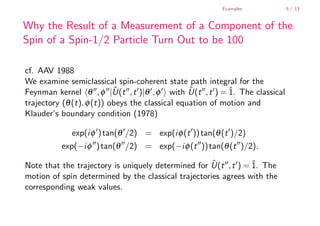
        Why the Result of a Measurement of a Component of the
        Spin of a Spin-1/2 Particle Turn Out to be 100

        cf. AAV 1988
        We examine semiclassical spin-coherent state path integral for the
        Feynman kernel θ , φ |U(t , t )|θ , φ with U(t , t ) = ˆ The classical
                                   ˆ                     ˆ          1.
        trajectory (θ (t), φ (t)) obeys the classical equation of motion and
        Klauder’s boundary condition (1978)

                     exp(i φ ) tan(θ /2) = exp(i φ (t )) tan(θ (t )/2)
                  exp(−i φ ) tan(θ /2) = exp(−i φ (t )) tan(θ (t )/2).
                                                             ˆ
        Note that the trajectory is uniquely determined for U(t , t ) = ˆ The
                                                                        1.
        motion of spin determined by the classical trajectories agrees with the
        corresponding weak values.


    .
.
Examples           6 / 13


        AAV 1988 examined the following quantum ensemble

                       θ = π /2, φ = π |, t    ,    |θ = 2α , φ = 0 , t

        where |θ , φ is a spin-coherent state, (θ , φ ) specifies the orientation of the
        spin and α ∈ [0, π /2].
             W[σx ] = −1: This is due to the final state θ = π /2, φ = π |.
                ˆ
             W[σy ] = −i tan(α + π ):
                ˆ                  4
             an example of complex-valued weak value.
             W[σz ] = (cos α + sin α )/(cos α − sin α ):
                ˆ
             real-valued, but its magnitude is “anomalous”, i.e. greater than 1


        The semiclassical prescription provides the exact result of AAV 1988.


    .
.
Summary          7 / 13


        Summary


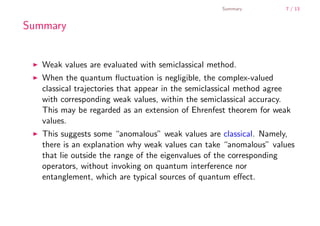
           Weak values are evaluated with semiclassical method.
           When the quantum fluctuation is negligible, the complex-valued
           classical trajectories that appear in the semiclassical method agree
           with corresponding weak values, within the semiclassical accuracy.
           This may be regarded as an extension of Ehrenfest theorem for weak
           values.
           This suggests some “anomalous” weak values are classical. Namely,
           there is an explanation why weak values can take “anomalous” values
           that lie outside the range of the eigenvalues of the corresponding
           operators, without invoking on quantum interference nor
           entanglement, which are typical sources of quantum effect.


    .
.
Semiclassical evaluation   8 / 13


        A generating functional


        With
                                                  t
                           ˆ ≡ ψ |exp − i
                 Z (ζ (·), A)                         H(t) − Aζ (t) dt |ψ ,
                                                      ˆ      ˆ
                                   ←    h
                                        ¯     t

        an exact formula for the weak value is

                                           δ ln Z (ζ (·), A)
                                                          ˆ
                           W[A, t] = − i h
                             ˆ           ¯
                                                δ ζ (t)
                                                                ζ (·)≡0

        Feynman path integral representation of Z will be evaluated by
        semiclassical method.


    .
.
Semiclassical evaluation   9 / 13


        Single-trajectory assumption

        In the stationary phase evaluation of Z , it is assumed that interferences
        among the contributions from classical trajectories do not appear, i.e.,
        there appears only one classical trajectory, which is denoted by (qt , pt ).
        Namely, Z is assumed to be in the following form

                                      Z     E exp(iF /h)
                                                      ¯

        where E and F is an amplitude factor and classical action. This implies

                                             δF
                                 ˆ
                               W[A, t] =                       + O(h).
                                                                   ¯
                                           δ ζ (t)   ζ (·)≡0

        Now it is straightforward to obtain the main result.


    .
.
Semiclassical evaluation   10 / 13


        The limitation of the present result

        The single-trajectory assumption fails once there appears the quantum
        interference among multiple classical trajectories. As a result, it become
        impossible to observe each individual trajectory.

        The scenario of the breakdown
         1. In short time scales (until so-called Ehrenfest time), the
            single-trajectory assumption is valid.
         2. As the system evolves, the influence of caustics, which are the
            bifurcation points of classical trajectories, become significant. The
            caustics induces the divergence of semiclassical amplitude factor E .
                                                                2
            Accordingly, the “weak variance” W A − W[A]
                                                      ˆ       ˆ    = O(h) diverges.
                                                                         ¯
         3. After the anomalous fluctuation of the weak variance, the interference
            among classical trajectories become prominent in general.


    .
.
Motivation      11 / 13


        Ehrenfest’s theorem


        The (conventional) expectation values E [·] of quantum system obey the
        equations that resemble classical ones:

                  d            ∂H             d              ∂H
                     E [ˆ] = E
                        q         (ˆ, p ) ,
                                   q ˆ           E [ˆ] = E −
                                                    p           (ˆ, p )
                                                                 q ˆ
                  dt           ∂p             dt             ∂q

        When the quantum fluctuation is small, this provides a quantum-classical
        correspondence.


    .
.
Motivation          12 / 13


        Complex-valued classical trajectories in the semiclassical
        method

                                                        Ψ(x)              V(x)
        The complex extensions of phase space or
        time enable the semiclassical method to                          Complex Trajectory

        describe classically-forbidden phenomena       Real Trajectory

        (e.g. tunnelling).
                                                                                        x

        Mathematical origin: e.g., complex saddle points of Feynman path
        integrals
                              e iS[x(·)]/h Dx(·)
                                         ¯
                                                   ∑ Ak e iS[xk (·)]/h
                                                                     ¯
                                                   k

        where xk (·) satisfies the classical eq. of motion.


    .
.
Motivation        13 / 13


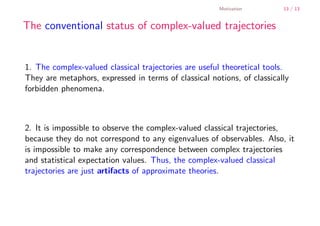
        The conventional status of complex-valued trajectories


        1. The complex-valued classical trajectories are useful theoretical tools.
        They are metaphors, expressed in terms of classical notions, of classically
        forbidden phenomena.


        2. It is impossible to observe the complex-valued classical trajectories,
        because they do not correspond to any eigenvalues of observables. Also, it
        is impossible to make any correspondence between complex trajectories
        and statistical expectation values. Thus, the complex-valued classical
        trajectories are just artifacts of approximate theories.


    .
.

弱値の半古典論

  • 1.
    1 / 13 2010-03-15 Ref. AT, PLA 297, p.307 (2002). (QMKEK3), KEK . .
  • 2.
    Introduction 2 / 13 Weak values (Aharonov, Albert and Vaidman 1988) For a quantum ensemble specified by |ψ at t = t (preparation) , ψ | at t = t (postselection) the weak value of the observable A at time t ∈ [t , t ], is defined as follows: ˆ ψ (t)| A |ψ (t) ˆ W[A, t] ≡ ˆ ψ (t)|ψ (t) where U(t , t ) is the time evolution operator, ψ (t)| ≡ ψ |U(t , t) and ˆ ˆ |ψ (t) ≡ U(t, t )|ψ . ˆ . .
  • 3.
    Main result 3 / 13 An extension of Ehrenfest theorem for weak values When the classical trajectory (qt , pt ) that contribute to the stationary phase evaluation of the path integral representation of Feynman kernel i t ψ |exp − H(t)dt |ψ ˆ ← h ¯ t is unique, the semiclassical evaluation of weak value is ˆ W[A, t] = A(qt , pt ) + O(h). ¯ N.B. The resultant semiclassical weak value can be regarded as classical one, because neither quantum interference nor quantum entanglement is involved. . .
  • 4.
    Examples 4 / 13 Quantum-classical correspondence for complex-valued trajectories In the classical limit h → 0, the weak values obey classical theory, i.e., ¯ (W[ˆ, t], W[ˆ, t]) = (qt , pt ) + O(h) q p ¯ obserbable quantities classical trajectory This quantum-classical correspondence is applicable to both real-valued and complex-valued trajectories without discrimination. Thus, the complex-valued trajectories that appear in semiclassical method to describe classically forbidden time evolution (e.g. tunnelling and nonadiabatic transitions) are not the artifact of the approximate theory, but are observable by weak measurements. . .
  • 5.
    Examples 5 / 13 Why the Result of a Measurement of a Component of the Spin of a Spin-1/2 Particle Turn Out to be 100 cf. AAV 1988 We examine semiclassical spin-coherent state path integral for the Feynman kernel θ , φ |U(t , t )|θ , φ with U(t , t ) = ˆ The classical ˆ ˆ 1. trajectory (θ (t), φ (t)) obeys the classical equation of motion and Klauder’s boundary condition (1978) exp(i φ ) tan(θ /2) = exp(i φ (t )) tan(θ (t )/2) exp(−i φ ) tan(θ /2) = exp(−i φ (t )) tan(θ (t )/2). ˆ Note that the trajectory is uniquely determined for U(t , t ) = ˆ The 1. motion of spin determined by the classical trajectories agrees with the corresponding weak values. . .
  • 6.
    Examples 6 / 13 AAV 1988 examined the following quantum ensemble θ = π /2, φ = π |, t , |θ = 2α , φ = 0 , t where |θ , φ is a spin-coherent state, (θ , φ ) specifies the orientation of the spin and α ∈ [0, π /2]. W[σx ] = −1: This is due to the final state θ = π /2, φ = π |. ˆ W[σy ] = −i tan(α + π ): ˆ 4 an example of complex-valued weak value. W[σz ] = (cos α + sin α )/(cos α − sin α ): ˆ real-valued, but its magnitude is “anomalous”, i.e. greater than 1 The semiclassical prescription provides the exact result of AAV 1988. . .
  • 7.
    Summary 7 / 13 Summary Weak values are evaluated with semiclassical method. When the quantum fluctuation is negligible, the complex-valued classical trajectories that appear in the semiclassical method agree with corresponding weak values, within the semiclassical accuracy. This may be regarded as an extension of Ehrenfest theorem for weak values. This suggests some “anomalous” weak values are classical. Namely, there is an explanation why weak values can take “anomalous” values that lie outside the range of the eigenvalues of the corresponding operators, without invoking on quantum interference nor entanglement, which are typical sources of quantum effect. . .
  • 8.
    Semiclassical evaluation 8 / 13 A generating functional With t ˆ ≡ ψ |exp − i Z (ζ (·), A) H(t) − Aζ (t) dt |ψ , ˆ ˆ ← h ¯ t an exact formula for the weak value is δ ln Z (ζ (·), A) ˆ W[A, t] = − i h ˆ ¯ δ ζ (t) ζ (·)≡0 Feynman path integral representation of Z will be evaluated by semiclassical method. . .
  • 9.
    Semiclassical evaluation 9 / 13 Single-trajectory assumption In the stationary phase evaluation of Z , it is assumed that interferences among the contributions from classical trajectories do not appear, i.e., there appears only one classical trajectory, which is denoted by (qt , pt ). Namely, Z is assumed to be in the following form Z E exp(iF /h) ¯ where E and F is an amplitude factor and classical action. This implies δF ˆ W[A, t] = + O(h). ¯ δ ζ (t) ζ (·)≡0 Now it is straightforward to obtain the main result. . .
  • 10.
    Semiclassical evaluation 10 / 13 The limitation of the present result The single-trajectory assumption fails once there appears the quantum interference among multiple classical trajectories. As a result, it become impossible to observe each individual trajectory. The scenario of the breakdown 1. In short time scales (until so-called Ehrenfest time), the single-trajectory assumption is valid. 2. As the system evolves, the influence of caustics, which are the bifurcation points of classical trajectories, become significant. The caustics induces the divergence of semiclassical amplitude factor E . 2 Accordingly, the “weak variance” W A − W[A] ˆ ˆ = O(h) diverges. ¯ 3. After the anomalous fluctuation of the weak variance, the interference among classical trajectories become prominent in general. . .
  • 11.
    Motivation 11 / 13 Ehrenfest’s theorem The (conventional) expectation values E [·] of quantum system obey the equations that resemble classical ones: d ∂H d ∂H E [ˆ] = E q (ˆ, p ) , q ˆ E [ˆ] = E − p (ˆ, p ) q ˆ dt ∂p dt ∂q When the quantum fluctuation is small, this provides a quantum-classical correspondence. . .
  • 12.
    Motivation 12 / 13 Complex-valued classical trajectories in the semiclassical method Ψ(x) V(x) The complex extensions of phase space or time enable the semiclassical method to Complex Trajectory describe classically-forbidden phenomena Real Trajectory (e.g. tunnelling). x Mathematical origin: e.g., complex saddle points of Feynman path integrals e iS[x(·)]/h Dx(·) ¯ ∑ Ak e iS[xk (·)]/h ¯ k where xk (·) satisfies the classical eq. of motion. . .
  • 13.
    Motivation 13 / 13 The conventional status of complex-valued trajectories 1. The complex-valued classical trajectories are useful theoretical tools. They are metaphors, expressed in terms of classical notions, of classically forbidden phenomena. 2. It is impossible to observe the complex-valued classical trajectories, because they do not correspond to any eigenvalues of observables. Also, it is impossible to make any correspondence between complex trajectories and statistical expectation values. Thus, the complex-valued classical trajectories are just artifacts of approximate theories. . .