Master of Economics in Banking and Finance
Statistical Methods for Financial Institutions
Exam, july 2005
Session 1
Duration : 3 hours
No document permitted
The text has three independent exercises.
Exercice I
In this exercise, we consider a stock market where N stocks can be bought or sold each day
in the morning (closing price of day t identical to opening price of day t + 1). Let Pit be the
daily price of stock i (beginning day t + 1), Rit its daily arithmetic returns between t and
t + 1, that is during day t + 1. The stocks don’t pay any dividend. p will be an N-stock
portfolio, Vit the daily values of stock i in p (beginning of day t + 1), and wit the propotion
of portfolio’s value invested in stock i during day t + 1.
1) (a) A daily stock’s return is the relative variation of its price during the day. Why?
Show that the arithmetic return Rpt of the portfolio is a linear combination of the stocks’
returns Rit. If Vit is known at the beginning of day t + 1, and Rit are random variables
with means µi, variances σ2
i , and covariances σij (σii = σ2
i ), compute the expected value and
variance of porfolio’s value Vp t+1 at t + 1. Give the result in vector and matrix notation,
with
µ = (µi)1≤i≤N , Σ = (σij)1≤i≤N
1≤j≤N
.
(b) Suppose that (Rit)1≤i≤N is a N-normal vector with density N(µ, Σ) (µ is a N-
vector, Σ is a N × N-matrix). What is the practical meaning of µ and Σ? Compute the
conditional probability density function of portfolio’s value Vp t+1 given Vit, its expected
return and variance. Plot the graph of the density.
(c) Explain briefly why calculations presented above are not true anymore if returns
are not arithmetic but continuous. How can this difficulty be solved?
2) In this question, we suppose that the (Rit)1≤i≤N are iid for any t, with normal prob-
ability distribution 1) (b). The Appendix A shows a sample of 32 daily prices for N = 4
stocks A, B, C, D, and some statistics and useful intermediate calculations.
(a) Explain how ˆµ and ˆΣ have been computed. Compute missing data in the appendix
(identified with a bullet) and give estimates of parameters
µA, µB, µC, µD, σAB, σAC, . . ..
What are the statistical properties of those estimates? Compute 95% confidence intervals
for the parameters (µA, µB, µC, µD). Comment the results. Plot the graph of the density
of portfolio’s value at the end of some day when $10ms is invested at the beginning of the
day with equal proportion in each stock. What is the expected value and volatility of the
portfolio’s value at the end of the day?
(b) Define and comment the significance of the value at risk VaR of a portfolio with
confidence level α. At the beginning of the day following the last sample day, a portfolio
1
manager has invested in a portfolio of stocks, nA = 1000 shares A, nB = 10000 shares B,
nC = 800 shares C, nD = 5000 shares D. Compute the probability distribution of portfolio’s
value and its VaR with confidence level 95% at the end of the day.
Hint. Prove the formula:
V aR = Vt(−µp + σpξα)
where ξα is the α-quantile of a normal distribution N(0, 1).
(c) Let ˆΣ be the sample return variance-covariance matrix given in Appendix A. Using
the matrix relation:
ˆΣ = T T where T =
⎛
⎝
0.009993 0.000000 0.000000 0.000000
0.008364 0.022194 0.000000 0.000000
0.010289 −0.007475 0.011823 0.000000
0.009393 0.013495 0.006275 0.004150
⎞
⎠
explain how to simulate 100 future daily values of the portfolio with a Monte Carlo method,
using Excel spreadsheet. Proportions of portfolio’s value invested in the four stocks will
change in the daily simulations. Why? How the Monte Carlo VaR at confidence level 95%
could be obtained from the simulated values?
Hint. Excel has a function INVERSE.NORMAL which computes the inverse of the standard
normal distribution function.
Exercice II
In this exercise, A is a stock who pays no dividend, all options have A as underlying asset,
and interest rates are all equal and constant with value r.
1) An investor is long on stock A, whose price on the stock market is S0.
(a) The investor sells a european call option on A with maturity T, exercise price K,
and premium C. What is the P&L at maturity for the portfolio including the stock and the
option? Plot its graph as a function of the stock price ST at maturity. Compute the break
even point (value of the stock for which the P&L is zero). Explain why selling the call can
be considered as a hedging strategy.
(b) The investor buys a european put option on A with maturity T, exercise price K,
and premium P . What is the P&L at maturity for the portfolio including the stock and the
option? Plot its graph as a function of the stock price ST at maturity. Compute the break
even point (value of the stock for which the P&L is zero). Explain why buying the put can
be considered as a hedging strategy. Compare with (a).
2) In this question, we want to value a derivative with the binomial model. Explain how
to value a derivative whose terminal payoff is g(ST ) at maturity T (no cashflow between 0
and T) with a 2-period binomial model (T = 2). What is g for a european call (resp. put)?
Is the result still valid if g(S2) is replaced by g(S0, S1, S2) (path dependent payoff)? Do the
results extend to any T?
Hint. Define the binomial model and explain how the no arbitrage condition defines the risk
neutral probability and the value of the derivative at 0. Compute the derivative’s value using
the parameters (S0, K, interest rate r,. . . ).
3) A lookback call on A with maturity T is a european style option who can be exercised
only at T in cash. At maturity the seller pays the buyer:
CT = ST − min{St : 0 ≤ t ≤ T},
where St is the stock price at date t and min{Su : 0 ≤ u ≤ t} the smallest stock price
between 0 and T. To be simple, we suppose that the minimum is computed weekly as
2
min{S0, S1, . . ., Sn}, where n is the number of weeks until maturity T. Appendix B shows
binomial trees for weekly data and results to value a european call and a lookback call.
(a) Explain how values have been calculated on A price dynamics tree. What is its
main property? Compute the missing values, in particular the european and lookback call
values at 0.
Hint. Explain the calculations.
(b) Is the premium of a lookback call always greater than the premium of a european
call with the same characteristics?
(c) What has to be changed to compute the value of a lookback put?
Exercice III
1) Present the main concepts of factor models and their basic hypothesis, and the dif-
ferences between the Capital Asset Pricing Model (CAPM), and the Asset Princing Theory
(APT).
Hint. This question should not exceed two pages.
2) Three risky assets and a risk free asset are traded on a financial market. A mutual
fund manager holds a risky assets portfolio p. Return and risk performance are measured
against a benchmark I (index). Let:
wp =
⎛
⎜
⎜
⎝
0
0.2
0.5
0.3
⎞
⎟
⎟
⎠ wI =
⎛
⎜
⎜
⎝
0
0.4
0.1
0.5
⎞
⎟
⎟
⎠
the proportion of portfolio’s and benchmark’s values invested in the four assets. A 2-factors
model has been adjusted to past data:
R1t = 0.12 + 1.5 f1t + 0.20 f2t + ε1t, σ(ε1t) = 0.03
R2t = 0.10 + 1.2 f1t − 0.50 f2t + ε2t, σ(ε2t) = 0.01
R3t = 0.15 − 0.4 f1t + 1.00 f2t + ε3t, σ(ε3t) = 0.05.
(a) Plot the three risky assets, porfolio p, and benchmark I in the common factors
space.
(b) Compute risky assets returns variance-covariance matrix. What is its rank?
(c) Compute: systematic risks, specific risks, and covariance of portfolios p and I.
(d) Compute the tracking error of portfolio p with respect to I. Give its dividing into
systematic and specific tracking risk.
3
Appendix A
In this appendix, calculations have been prepared with Excel. Results are presented with
rounding errors. Missing data are indentified with a bullet and must be computed.
price return %
day A B C D A B C D
0 140.00 82.00 48.00 237.00
1 140.26 88.89 47.01 249.21 0.1878 8.3987 −2.0595 5.1527
2 139.40 87.46 46.85 247.62 −0.6127 −1.6034 −0.3451 −0.6377
3 139.07 88.43 47.32 253.03 −0.2363 1.1103 1.0110 2.1818
4 139.57 89.50 47.47 256.21 0.3589 1.2049 0.3100 1.2574
5 138.89 85.57 47.88 247.35 −0.4875 −4.3839 0.8724 −3.4561
6 138.25 85.93 46.81 245.06 −0.4633 0.4202 −2.2459 −0.9271
7 140.61 88.72 48.16 253.31 1.7051 3.2464 2.8958 3.3688
8 140.51 87.47 47.79 249.95 −0.0693 −1.4152 −0.7846 −1.3269
9 141.53 86.07 48.78 248.14 0.7267 −1.6024 2.0744 −0.7244
10 143.48 84.10 50.52 248.62 1.3770 −2.2882 3.5681 0.1905
11 143.05 83.58 49.83 244.41 • • −1.3632 −1.6909
12 143.32 82.25 49.66 240.09 0.1890 −1.5894 −0.3383 −1.7698
13 141.97 80.21 50.45 239.31 −0.9416 −2.4799 1.5930 −0.3231
14 143.16 81.74 49.73 243.15 0.8415 1.9012 −1.4325 1.6067
15 146.53 83.20 50.33 247.37 2.3497 1.7864 1.2180 1.7342
16 146.89 83.31 49.38 245.59 0.2518 0.1289 −1.8867 −0.7197
17 148.96 84.70 49.32 246.52 1.4057 1.6703 −0.1239 0.3773
18 150.88 85.50 49.82 248.40 1.2910 0.9504 1.0121 0.7632
19 149.39 84.40 50.00 245.46 −0.9900 −1.2873 0.3500 −1.1852
20 149.74 86.07 49.80 249.52 0.2334 1.9748 −0.4024 1.6553
21 146.05 84.67 48.42 244.39 −2.4611 −1.6209 −2.7658 −2.0569
22 143.25 84.93 • • −1.9142 0.2983 −3.7929 −0.9235
23 143.09 86.74 45.78 244.20 −0.1142 2.1302 −1.7165 0.8570
24 145.17 88.11 46.79 249.68 1.4545 1.5802 2.1901 2.2418
25 144.91 88.62 46.34 248.77 −0.1786 0.5917 −0.9597 −0.3628
26 146.38 90.66 46.15 251.03 1.0151 2.2898 −0.4048 0.9072
27 146.67 92.10 47.06 256.05 0.1960 1.5912 1.9676 1.9982
28 147.91 92.59 48.24 260.30 0.8475 0.5280 2.5121 1.6607
29 148.13 95.79 47.71 265.63 0.1459 3.4557 −1.0887 2.0492
30 148.44 96.40 47.34 265.63 0.2109 0.6440 −0.7867 −0.0023
31 148.37 93.43 47.63 259.81 −0.0494 −3.0787 0.6116 −2.1905
If ˆµ = 4-vector of mean daily returns, ˆΣ = 4 × 4-matrix of covariances, ˆΩ = 4 × 4-matrix of
correlations:
ˆµ =
⎛
⎜
⎜
⎝
0.001925
0.004497
−0.000100
0.003131
⎞
⎟
⎟
⎠
ˆΣ =
⎛
⎜
⎜
⎝
0.00009986 0.00008359 0.00010282 0.00009387
0.00008359 0.00056252 −0.00007983 0.00037807
0.00010282 −0.00007983 0.00030152 0.00006997
0.00009387 0.00037807 0.00006997 0.00032694
⎞
⎟
⎟
⎠
ˆΩ =
⎛
⎜
⎜
⎝
• • • •
• • • •
• • • •
• • • •
⎞
⎟
⎟
⎠
⎛
⎜
⎜
⎝
0.25
0.25
0.25
0.25
⎞
⎟
⎟
⎠
ˆΣ
⎛
⎜
⎜
⎝
0.25
0.25
0.25
0.25
⎞
⎟
⎟
⎠ = 1.61710−4
⎛
⎜
⎜
⎝
0.06
0.39
0.02
0.54
⎞
⎟
⎟
⎠
ˆΣ
⎛
⎜
⎜
⎝
0.06
0.39
0.06
0.54
⎞
⎟
⎟
⎠ = 3.45810−4
4
Appendix B
Numerical results have been rounded to the second decimal.
Missing data are identified with a bullet • .
Duration of the elementary period: 1 week.
Weekly periodic interest rate: 0.1%
Stock price dynamics
„
„
„
„
„
„
&
&
&&






&
&
&&
¨
¨¨¨
r
rrr
¨
¨
¨¨
r
rrr
r
r
rr
¨
¨
¨¨
r
r
rr
¨¨
¨¨
100, 00
104, 00
96, 00
108, 16
99, 84
99, 84
92, 16
112, 49
103, 83
103, 83
95, 85
103, 83
95, 85
95, 85
88, 47
European call price dynamics
„
„
„
„
„
„
&
&
&&






&
&
&&
¨
¨¨¨
r
rrr
¨
¨
¨¨
r
rrr
r
r
rr
¨
¨
¨¨
r
r
rr
¨¨
¨¨
•
•
1.00
•
1, 96
•
•
•
•
•
•
•
•
•
•
Lookback call price dynamics
„
„
„
„
„
„
&
&
&&






&
&
&&
¨
¨
¨¨
r
r
rr
¨
¨
¨¨
r
r
rr
r
rrr
¨
¨¨¨
rr
rr
¨
¨
¨¨
•
•
•
•
2, 04
•
1, 89
•
•
3, 99
•
•
•
•
0, 00
5
Master of Economics in Banking and Finance
Academic year 2005-2006
Statistical Methods for Financial Institutions
Program for the exam
The test will have a duration of three hours, with several exercises relating to the course and
the assignments. Some will be direct applications of subjects studied in the assignments or
during the lectures, some will be on subjects that have’t been directly tackled during the
lectures (on the slides or not). In some of these exercises, students will have to use a
handheld calculator (with elementary mathematical operations and functions; pocket
computers with large memory capabilities are not allowed). No document will be allowed
during the exam. Complex formulas will be given in the text or in an appendix. To help
students prepare the exam, this document shows the page numbers they should particularly
look at in the copy-of-slides document (and their own notes). Lee’s book is a natural
complement.
Prerequisite
- Basic analysis.
- Basic algebra and linear algebra.
- Elementary probability theory and statistics.
Chapter 1 : Probability and market risk
- Return the basics p1-11.
- Value at risk p12-15.
- Monte Carlo simulation p 20-27.
Chapter 2 : Options and martingale measure
- Options p 54-58.
- Arbitrage p 58-60.
- Option valuation and martingale measure p 61-71
Chapter 3 : Risk and return in portfolio management
- Optimum portfolio p 76-83.
- Factor models p 87-90.
Chapter 4 : Scoring methods
- Discriminant analysis and scoring p 98-100.
february, 27, 2006
Alain BUTERY
Master of Economics in Banking and Finance
Statistical Methods for Financial Institutions
Exam, march 2004
Duration : 3 hours
No document permitted
The text has four independent exercises.
Exercice I
This exercice is about elementary statistical properties of stock index returns.
Let St be a sample of monthly values of some stock index (for example the S&P500).
1) (a) The return in month t is defined by:
Rt =
St − St−1
St−1
or rt = log (St) − log (St−1).
Explain in what aspects the two definitions differ or are similar. Is one better than the other?
(b) Suppose that St−1 is known at the beginning of month t and St is a random
variable. Compute the probability density function of St if Rt (resp. rt) is a random variable
with probability density function N(µ, σ2
). What is the practical meaning of µ and σ?
(c) The two parameters µ, σ are obtained from a statistical study:
µ = 0.01, σ = 0.025.
Plot the probability density function of St if Rt (resp. rt) has probability density function
N(0.01, 0.0252
). At the beginning of month t, the index has value 1000. For each of the two
definitions of return, compute a < b such that at the end of the month, the index has a value
in the interval [a, b] with probability 95%.
2) A sample of T + 1 monthly index values St is collected and the T returns computed.
Suppose that the returns rt are iid with expected value µ and variance σ2
. Let
ˆµ =
1
T
X
1≤t≤T
rt
be the sample mean return on the index.
(a) Compute the expected value and standard deviation of ˆµ. What are the statistical
properties of ˆµ when T is large? ˆµ can be used as an estimator of µ, why?
(b) The monthly data collected are summarized in the table below.
Statistical data on monthly index returns
# returns sample mean
sample standard
deviation
100 0.01 0.025
Explain how the sample standard deviation has been computed from the sample values rt.
Compute an estimation of µ and a 95% confidence interval.
(c) An investor invest $10ms in a mutual fund that replicates the index, for a 100
months period. Using the sample data of question (b), compute the expected value and
1
standard deviation of the value of the investment at the end of the period. What is its
probability distribution?
Hint. Use reasonable approximations.
Exercice II
Warning. The four questions of the exercice are in a natural order, but question 4 is a nu-
merical application which can be treated independently.
The price of a stock is observed at regular intervals 0, 1, 2, . . . , t, . . .. At each date t, the stock
price St can only take two values from its current value St−1 at t − 1 and:
P(St = d st−1|S0 = s0, S1 = s1, . . . , St−1 = st−1) = P(St = d st−1|St−1 = st−1)
= 1 − p
P(St = u st−1|S0 = s0, S1 = s1, . . . , St−1 = st−1) = P(St = u st−1|St−1 = st−1)
= p
Conditionnal distribution of St given St−1 = s
value St d s u s
probability 1 − p p
The parameters u, d, p are constants which satisfy the conditions of the Cox & Rubinstein
binomial model:
r = interest rate, R = 1 + r, R−T
= 1
RT
p = R−d
u−d , 0 < d < 1 < u, d < R < u.
1) What is the meaning of u and d? Represent the dynamic of the stock with a tree
diagram and compute the conditional probability distribution of S3 given S0 = s0. Generalise
to St for any t.
2) Give the definition of a conditional probabilility distribution.
(a) Compute E(St|S0 = s), var(St|S0 = s).
Hint. Begin with t = 1, 2.
E(St+h|St = s), var(St+h|St = s) has same values as E(Sh|S0 = s), var(Sh|S0 = s) (the
conditional expected value of the stock value depends on h only, not on t). Why?
(b) Let ˜St = R−t
St be the discounted value of the stock price at date t. Show that
(martingale property):
E( ˜St+h| ˜St) = ˜St.
3) Let Rt = St−St−1
St−1
be the return of the stock on period [t−1, t]. Compute the conditional
probability distribution of Rt given St−1 = s, and show that the returns are independent.
Compute E(Rt | St−1 = s), var(Rt | St−1 = s). How does these moments depend on u and
d? Comment.
4) Recall that a call option with strike price K is a financial contract between a buyer
and a seller. The buyer pays immediately (at date 0) a premium (or option price) C0 to the
seller. The seller has the obligation to pay to the buyer an amount V ∗
at a future date, the
2
expiry date T, that depends on the value of the stock ST :
V ∗
=
½
ST − K if ST > K
0 if ST ≤ K
= (ST − K)+
Option theory says that the fair price of the option at date 0 is the discounted expected
value of its value V ∗
at T, computed with the probability p defined above:
C0 = R−T
E(V ∗
|S0 = s)
= R−T
X
0≤k≤T
(s uk
dT −k
− K)+
µ
T
k

pk
(1 − p)T−k
and more generally, the option price at any date t ≤ T when St = s is:
Ct = R−(T −t)
E(V ∗
|St = s)
In this question, T = 3 and the numerical values of the parameters of the Cox & Rubinstein
binomial model are:
exercice price K = 90
expiry date T = 3 (months)
stock price S0 = 100
u (per month) = 1.05
d (per month) = 0.94
interest rate r (per month) = 1%.
Draw the binomial tree for these numerical values. Compute the probability distributions of
the random variables S1, S2, S3, R1, R2, R3, and V ∗
. Compute the fair values Ct of the
call at each date t = 0, 1, 2, 3. Comment.
Exercice III
At date 0, an investor has to invest $100ms between the two dates 0 and 1 in a portfolio
containing two stocks A and B. Let:
pAi, pBi = price of stock A and B at date i, i = 0, 1
Vpi = value of portfolio p at date i, i = 0, 1
RA, RB = return of stock A and B between dates 0, 1
Rp = return of portfolio p between dates 0, 1
µA, µB, µp = expected return of stock A, B, and portfolio p
σA, σB, σp = standard deviation of returns of stock A, B and portfolio p
ρ = correlation between stock A and B returns
ωp = proportion of wealth in portfolio p invested in stock A
1 − ωp = proportion of wealth in portfolio p invested in stock B
RA and RB are random variables, with:
µA = 0.1, µB = 0.2, σA = 0.2, σB = 0.4, ρ = −0.4.
1) Let p be a portfolio with a proportion of wealth ωp invested in stock A.
(a) What are the definition, the main properties and the signification of a correlation
coefficient? Does the numerical value of the correlation coefficient above signals a strong
correlation between the stock returns?
(b) Give the expression of the expected value µp and variance σ2
p of the portfolio’s
3
return as a function of ωp. Plot σp (abcissa) against µp (ordinate) when ωp takes values from
−∞ to +∞.
(c) Show that the standard deviation of the return of any portfolio long on both A
and B (0 ≤ ωp ≤ 1) is at most equal to the sum of the standard deviations of the returns of
the two stocks (Markowitz’s portfolio risk diversification property).
2) (a) Compute the value of ωmin for the portfolio pmin with the smallest variance.
What is the amount invested in each stock in this portfolio? What is the expected value and
standard deviation of the value of this portfolio at date 1?
(b) The investor wants a portfolio with a standard deviation of return 0.3. For what
amounts invested in stock A and B does this happens? What is the expected return of this
portfolio? Comment.
3) Solve the two questions above with matrix calculus. In particular, compute the variance
covariance matrix Σ and show that:
σ2
p = λ0
Σλ
where:
λ =
µ
ωp
1 − ωp

What is the efficient frontier? Under what condition on ρ has the matrix Σ an inverse?
Exercice IV
1) Present the main concepts and ideas of scoring with discriminant analysis.
Hint. This question is non quantitative. The proposed answers should not go beyond two
pages. Graphics are welcomed.
2) A variable (quantity) x is computed from company accounts drawn in some data base.
Companies are classified into two groups: failing labelled D, and non failing labelled ND.
Values of x obtained from group D are considered as values of a random variable X with
conditional probability density function fD, and those obtained from group ND are considered
as values of random variable X with conditional probability density function fND. A value of
x has a probability pD of being computed from the accounts of a company in group D (prior
probability of group D). It has a probability pND of being computed from the accounts of a
company in group ND (prior probability of group ND).
(a) Compute the (non conditional) probability density distribution f of X. Suppose
fD and fND are normal densities with the same standard deviation σ and means µD < µND.
Plot the graphs of the three densities f, fD, fND.
Hint. Use the relation:
P(X ∈ [x, x + dx]) = P(X ∈ [x, x + dx] | D)P(D) + P(X ∈ [x, x + dx] | ND)P(ND).
(explain the formula).
(b) Compute the conditional probabilities of each group given the value (X = x)
(posterior probability of groups D and ND). How does the result simplifies when fD and fND
are normal densites with the same standard deviation σ and means µD < µND. How is it
used to assign the values of x in a sample to group D or ND? Comment.
4
Master of Economics in Banking and Finance
Statistical Methods for Financial Institutions
Exam, june 2006
Session 1
Duration : 3 hours
No document permitted, handheld calculator permitted
Pocket computers with large memory not allowed
The text has four independent exercises and an appendix.
Exercice I
In this exercise, we consider a financial market where four assets i = 0, 1, 2, 3, can be bought
or sold: three stocks i = 1, 2, 3, who don’t pay any dividend, and a risk-free asset i = 0
with interest rate r. Let Sit be the price of asset i at date t = 0, 1, and Ri = (Si1 − Si0)/Si0
its return between 0 and 1, R0 = r. At date 0, Si1, i = 1, 2, 3, are random variables. What
is the value of S01? ni is the number of units of asset i in a portfolio p of initial value V0 and
final value V1. To avoid mathematical complications, ni is not constrainted to be integer and
might have a fractional part.
1) (a) Let wi be the propotion of portfolio’s value invested in asset i at date 0. Compute
portfolio’s return as a funtion of ni and as a function of wi. Can the wi be computed from the
ni and vice versa? What is the meaning of ni < 0 or wi < 0 (give an answer for i = 1, 2, 3,
on the one hand, for i = 0 on the other)? Is there some relation satisfied by the ni (resp.
wi)?
(b) In this question,
n0 = 1000, n1 = 100, n2 = 2000, n3 = −500, S00 = 1, S10 = 150, S20 = 100, S30 = 80.
What is the portfolio space? Give the unique decomposition in the portfolio space of portfolio
p into the risk-free asset 0 and a risky portfolio ˜p of assets 1, 2, 3.
2) A 2-factors model has been adjusted to past stock returns:
R1 = 0.12 + 1.5 f1 + 0.20 f2 + ε1, var(ε1) = 0.03
R2 = 0.10 + 1.2 f1 − 0.50 f2 + ε2, var(ε2) = 0.01
R3 = 0.15 − 0.4 f1 + 1.00 f2 + ε3, var(ε3) = 0.05
with the standard hypothesis for k = 1, 2, and i, j = 1, 2, 3
E(fk) = E(εi) = 0, cov(fk, εi) = cov(εj, εi) = 0, j = i, var(fk) = 1,
and return on the risk-free asset r = 6%.
(a) Explain the meaning of the elements in the stock returns model and its specific
feature. The variance-covariance matrix Σ of the 3 stock returns can be written:
Σ = BB + D
1
where B and D are two 3 × 3-matrices. After computation:
Σ =
⎛
⎝
2.32 1.70 −0.40
1.70 • •
−0.40 • 1.21
⎞
⎠
Compute the spreads E(Ri) − r, i = 1, 2, 3, and give a financial interpretation of those
values. Compute matrices B and D and the missing values • in matrix Σ. What is the the
variance-covariance matrix of the assets’ return Ri, i = 0, 1, 2, 3?
(b) Compute the return variance of porfolio p defined in question 1) (b) and give its
dividing into systematic and specific risk. Plot the four assets and and porfolio p defined in
question 1) in the risk-return plane. How would efficient portfolios be represented in the risk-
return plane (no explicit computations are needed, only graph)? Is p an efficient portfolio?
Comment.
(c) Plot the three stocks and the risky part ˜p of porfolio p defined in question 1) in
the common-factor space. Explain why the risk-free part of portfolio p plays no role in the
common-factor space representation.
(d) Compute at date 0 a portfolio p∗
with value 10 ms, expected return 11%, and
minimum systematic variance. Is this portfolio unique? Efficient?
Hint. Compute the composition n∗
i , i = 0, 1, 2, 3, of p∗
.
⎛
⎝
1, 5 1, 2 −0.4
0, 2 −0, 5 1.0
1.0 1.0 1.0
⎞
⎠
−1
=
⎛
⎝
0, 9554 1, 0191 −0, 6369
−0, 5096 −1, 2102 1, 0064
−0, 4459 0, 1911 0, 6306
⎞
⎠
(e) In that question, common and specific factors are normal. Calculate a confidence
interval for the return of the portfolio p defined in question 1) around its expected value, with
confidence level 95%. Plot the graph of the density function of the return and the confidence
interval. Compute the Value at Risk of the portfolio.
Exercice II
An investor has 1 share of Carrefour stock, a retail company listed on Euronext (a Pan
European stock and derivative exchange). 17th march 2006 Carrefour shares are quoted
43.50. The investor anticipate a decline of Carrefour’s share price. To hedge the risk, he
buys a Carrefour european put option with maturity september 2006 and exercise price 45.
The option has price 3.10.
1) (a) Give the definitions of a european and american put option. How many put would
the investor buy if he held 1000 shares?
(b) Define and compute the intrinsic and time value of Carrefour’s put. Explain their
significance.
2) (a) Represent the three line graphs of P&L at put’s september maturity T as functions
of Carrefour’s stock price ST , for the stock, the put and the portfolio comprised of stock plus
put. Comment.
(b) Compute the break-even point for the stock plus put portfolio and its maximum
loss. Explain how the option reduces the risk of the investor on Carrefour’s stock position.
Give an alternative strategy to reduce the risk.
3) In this question, Carrefour’s stock price ST at option’s maturity T is a log-normal
random variable such that log (ST ) has density function N(43.50, 3). What is the significance
of the parameters 43.50 and 3? Let PT and VT be the prices at maturity T of the put and
the portfolio stock plus put. Compute the distribution functions G and H of PT and VT , and
2
represent them graphically. Is it possible to compute the density functions of PT and VT ?
Comment on the results.
Exercice III
1) Define the binomial model with one period, prove the formula for the value of a put
with exercise price K and write it as an expected value.
Hint. Prove the formula with a no arbitrage argument and use the following notations:
S0 : value of the stock at date 0
S1 : value of the stock at maturity T = 1, S1 = d S0 or u S0
r : interest rate, R = 1 + r
p : R−d
u−d (risk-neutral probability).
Explain the significance of u, d, p and why 0 < p < 1.
2) How can the one-period model be extended to an n-period model?
Exercice IV
1) Present the basic concepts and ideas of discriminant analysis and scoring methods.
How is discriminant analysis used for scoring ?
Hint. The proposed answers should be around one or two pages, not more. Graphics are
welcomed.
2) For a population of firms, there is a prior probability p = 0.04 that a given firm is
defaulting, and 1 − p = 0.96 that it is non-defaulting. Moreover, using financial analysis and
financial ratios, firms are classified into three credit groups: high, medium, low. The table
below gives the conditional probabilities for a firm to belong to a credit group given it is
defaulting or not.
Credit group high medium low
non-defaulting 0.75 0.23 0.02
defaulting 0.04 0.15 0.81
Compute the posterior probability that a firm defaults given that it’s credit is high (resp.me-
dium, low). Is it possible to conclude that financial analysis is efficient in detecting firm’s
default for the given population?
3
Appendix
Normal distribution
The density f and distribution function F of the normal distribution N(µ, σ) are:
f(x) =
1
σ
√
2π
e− 1
2 ( x−µ
σ )2
, F (x) =
x
−∞
1
σ
√
2π
e− 1
2 ( y−µ
σ )2
dy.
Bayes’ formula
If Ak, 1 ≤ k ≤ K, are K exhaustive and mutually exclusive events:
P (Ak|A) =
P (A|Ak)P (Ak)
1≤i≤K P (A|Ai)P (Ai)
where P (A|B) =
P (A ∩ B)
P (B)
.
4
Master of Economics in Banking and Finance
Statistical Methods for Financial Institutions
Exam, 4 May 2008
Session 1
Duration : 3 hours
No document permitted, handheld calculator permitted
Pocket computers with large memory or laptop not allowed
The text has two independent exercises and two appendices.
Exercice I
An investor holds a portfolio with weekly values Vt > 0 at date t. The weekly continuous
return between t and t + 1 is defined by:
Rc
t = ln(
Vt+1
Vt
), ln = log e.
In that exercise, Rc
t is considered as a random variable with normal distribution N(µ, σ2
),
Rc
t independent of Vt.
1) What is the difference between a simple return and a continuous return? What is the
logic behind the definition of a contiuous return and why is it used in financial models? In
financial modelling Rc
t is considered as a random variable; explain why.
2) (a) Give the definition of the conditional distribution function FV of Vt+1 given Vt and
prove that
FV (x) =
0 : x ≤ 0
φ(ln(x/Vt)−µ
σ ) : x > 0
where φ is the distribution function of the N(0, 1) standard normal distribution. Infer the
conditional density function fV of Vt+1 given Vt. What is the name commonly given to this
probability distribution?
Hint. See formulas in Appendix (A).
(b) What is the statistical meaning of paramters µ and σ2
? Risk and return are popular
concepts in portfolio management; how are they represented by the parameters of the model.
Comment.
3) Appendix (B) includes a table with a sample of weekly portfolio’s return for 30 past
weeks (second column) and some numerical and statistical results. Give estimators ˆµ and ˆσ2
of parameters µ and σ2
and list their properties. Compute estimates for parameters µ and σ
and a confidence interval for parameter µ. Represent the graph of the density function fV (x)
and distribution function FV (x).
4) The investor wants to compute a Value at Risk (VaR) for his portfolio.
(a) Define the VaR of a portfolio and explain why it is used by financial institutions
as a measure of risk.
(b) Give and prove the formula for the parametric weekly VaR of the portfolio at date
t for horizon t + 1 when Rc
t ; N(µ, σ2
).
Hint. Show that the α-quantile qα of the conditional distribution of Vt+1 given Vt is:
qα = Vteµ+σ ξα
1
where ξα = α-quantile of the standard normal distribution.
Numerical application.
Using estimates of µ and σ obtained in question 3), compute the numerical parametric weekly
VaR for the period [t, t + 1] of a $10 millions portfolio at date t. Suggest a value for the
2-weekly VaR at date t for horizon t + 2, and more generally a formula for the h-weekly VaR
at date t for horizon t + h. Give a justification for the formula used. Comment.
(c) Explain the main points for the computation of the weekly historical VaR. What
is a tilted value? Compute the missing values in the table of Appendix (B) and the historical
weekly VaR for the period [t, t + 1] of a $10 millions portfolio at date t, at confidence level
95%. Compare with the parametric VaR. Is one result better than the other?
Exercice II
An investor invests at date 0 a total amount M euros into three assets: N in loans to financial
intitutions of short duration T, long n shares of a stock with price St at date t and long n
european put. The underlying asset of the put is the stock, the maturity date T, the exercise
price K and the price Pt at date t. No dividend is paid by the stock during the life of the
option. T is smaller than one year and the proportional money market interest rate is r.
1) Give a definition for the put option and prove that the P&L of the portfolio between
dates 0 and T is
P&L = NrT + n [max{ST , K} − S0 − P0],
and give a global graphical view of the P&L.
Numerical application.
On 1 April 2008, date 0, the investor invests N = 10 millions euros in loans at money
market interest rate 4.50%, buys n = 100 000 shares of luxury Group LVMH at price S0 =
71 euros and buys n = 100 000 LVMH european put at price P0 = 5.5. Each put has
maturity T=September 2008 (in 171 days), exercise price K = 72 and 1 share LVMH as
underlying asset. No dividend is paid during the life of the option. Portfolio’s value VT and
its components at date T are fonctions of LVMH stock price ST at date T. Represent on
two different graphs, on the one hand the P&L and on the other portfolio’s value VT and its
components. Make explicit the characteristic values (minimum values, breakeven points,... ).
Comment.
Hint. For the graphs, represent the values for a rescaled portfolio obtained by dividing each
element in the portfolio by 100 000, so that the depicted portfolio includes 1 stock and 1 put.
2) (a) Prove that the simple return R on the portfolio between 0 and T is a linear combi-
nation of the interest rate r, the simple return RS on the stock and the simple return RP on
the put. Write the simple return on the portfolio as a function only of the interest rate and
the simple return on the stock. This function is non-linear, why? Prove that the portfolio
has a minimum simple return, whatever the value of the stock at T.
(b) Compute the linear combination, the non-linear function introduced in (a) and the
minimum return for the numerical application in question 1). Comment.
(c) Holding to the data in the numerical application in question 1), the table below
represents results at date T for six different possible LVMH stock prices ST .
Stock price ST Portfolio value VT Profit & loss P&L Portfolio return R
66.00 17 413 750 −236250 −1.34%
69.00 • • •
72.00 17 413 750 • •
75.00 • • 0.36%
78.00 18 013 750 363750 •
81.00 18 313 750 663750 3.76%
2
Compute the missing values (identified by a bullet •). For what value of LVMH stock price
at date T is the return zero?
3) The investor wants to compute a fair value for the LVMH put introduced in question
1) with a binomial model.
(a) Describe briefly the main concepts of the binomial model and how it can be used
for option pricing. What are the words martingale measure used for?
(b) Most of the numerical values needed for the computation of the put’s price are
given below in a standard binomial model setting with 4 periods. Explain how the risk
neutral probability can be computed from the binomial dynamic of the stock price. Explain
the significance of the values at the nodes of the binomial tree and how they have been
computed. Calculate the missing values. Why is the value of the put given by the binomial
model different from the market value?
(c) Explain what is a replicating strategy and why it is an important concept from a
practical point of view. Compute the details of the replicating strategy for the put when the
path of LVMH stock is two successive down moves followed by two successive up moves.
Numerical values are rounded up to 2 or 4 decimals.
A bullet • represents a missing value.
Interest rate for an elementary period: 0.5%.
Risk neutral probability: 0.08
¨
¨¨
¨
¨
¨¨
¨
¨
¨¨
¨
¨
¨¨
¨
¨
¨¨
¨
¨
¨¨
r
r
rr
r
r
rr
r
r
rr
r
r
rr
r
r
rr
r
rr
¨
¨
¨
¨¨
¨
¨
¨¨
¨
¨
¨¨
¨
¨
¨¨¨
r
r
rr
r
r
rr
r
r
rr
r
r
rr
rr¨¨
¨
¨
¨¨
¨
¨
¨¨
¨¨
r
rr
r
r
rr
r
r
rrr
¨
¨
¨¨
¨¨
r
rr
r
rr
71.0000
(7.32)
[−0.2254 | 23.33]
104.0150
(•)
[0.0000 | 0.00]
68.5150
(8.00)
[−0.2551 | 25.48]
152.3820
(•)
[• | •]
100.3745
(0.00)
[0.0000 | 0.00]
•
(•)
[• | •]
223.2396
(0.00)
[0.0000 | 0.00]
147.0486
(0.00)
[0.0000 | 0.00]
(96.8614)
(0.00)
[0.0000 | 0.0000]
(63.8029)
(•)
[−0.3270 | 30.41]
327.0460
(0.00)
215.4262
(0.00)
141.9019
(•)
93.4712
(•)
61.5698
(•)
Binomial tree for the stock and put dynamic, exercise price: 72
Notations for data at nodes
top data s s is the stock price
(x) x is the price of the put
a is the number of shares in the replicating strategy
(a > 0: long, a < 0: short)
[a | b]
b is the amount lended or borrowed
(b > 0: lended, b < 0: borrowed)
3
APPENDIX A
Exercice I
The density f and distribution function F of the normal distribution N(m, σ) are:
f(x) =
1
σ
√
2π
e− 1
2 ( x−m
σ )2
, F(x) =
x
−∞
1
σ
√
2π
e− 1
2 ( y−m
σ )2
dy.
If φ is the distribution function of the N(0, 1) standard normal distribution:
x 1.645 1.960 2.326 2.576
φ(x) 0.950 0.975 0.990 0.995
APPENDIX B
Exercice I
beginning
week
portfolio
return
portfolio
tilted value
portfolio
gain
t Rc
t Vt+1
0 −0.05015876 9510784.22 −489215.78
1 0.02658622 10269427.89 269427.89
2 −0.04601120 9550312.66 −449687.34
3 −0.00593426 9940833.16 −59166.84
4 0.06595120 10681745.94 681745.94
5 −0.00196806 9980338.80 −19661.20
6 0.02642683 10267791.19 267791.19
7 0.00200207 10020040.78 20040.78
8 0.05746734 10591506.82 591506.82
9 0.04951658 10507630.11 507630.11
10 0.02349129 10237693.83 237693.83
11 0.06803140 10703989.22 703989.22
12 −0.02672553 9736284.37 −263715.63
13 0.02589974 10262380.55 262380.55
14 0.02359017 • 238706.19
15 −0.05176374 9495531.85 −504468.15
16 −0.01747214 9826796.17 −173203.83
17 −0.03526855 9653461.37 −346538.63
18 −0.02570689 9746207.18 −253792.82
19 −0.00030294 9996971.09 −3028.91
20 −0.02664818 9737037.45 −262962.55
21 −0.01718228 9829644.93 •
22 0.02051837 10207303.23 207303.23
23 0.00537533 10053898.07 53898.07
24 0.02305655 10233244.09 233244.09
25 0.00424749 10042565.26 42565.26
26 −0.01769018 9824653.69 −175346.31
27 −0.00777607 9922540.85 −77459.15
28 0.01519214 10153081.32 153081.32
29 0.04929003 10505249.86 505249.86
• represents a missing value
1≤t≤30
Rc
t = 0.15603402,
1≤t≤30
(Rc
t − ˆµ)2
= 0.03242347
4

Exam binder 1

  • 1.
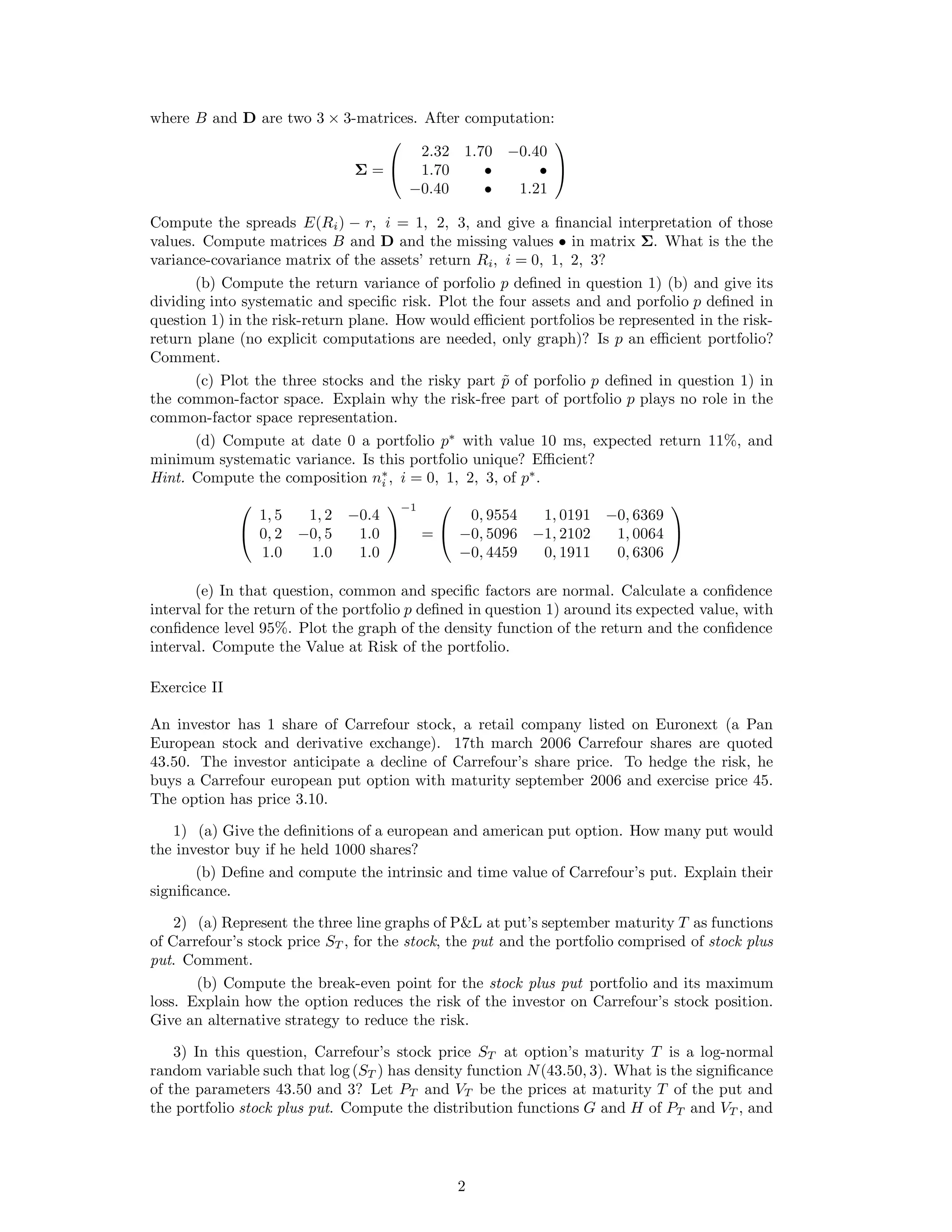
    Master of Economicsin Banking and Finance Statistical Methods for Financial Institutions Exam, july 2005 Session 1 Duration : 3 hours No document permitted The text has three independent exercises. Exercice I In this exercise, we consider a stock market where N stocks can be bought or sold each day in the morning (closing price of day t identical to opening price of day t + 1). Let Pit be the daily price of stock i (beginning day t + 1), Rit its daily arithmetic returns between t and t + 1, that is during day t + 1. The stocks don’t pay any dividend. p will be an N-stock portfolio, Vit the daily values of stock i in p (beginning of day t + 1), and wit the propotion of portfolio’s value invested in stock i during day t + 1. 1) (a) A daily stock’s return is the relative variation of its price during the day. Why? Show that the arithmetic return Rpt of the portfolio is a linear combination of the stocks’ returns Rit. If Vit is known at the beginning of day t + 1, and Rit are random variables with means µi, variances σ2 i , and covariances σij (σii = σ2 i ), compute the expected value and variance of porfolio’s value Vp t+1 at t + 1. Give the result in vector and matrix notation, with µ = (µi)1≤i≤N , Σ = (σij)1≤i≤N 1≤j≤N . (b) Suppose that (Rit)1≤i≤N is a N-normal vector with density N(µ, Σ) (µ is a N- vector, Σ is a N × N-matrix). What is the practical meaning of µ and Σ? Compute the conditional probability density function of portfolio’s value Vp t+1 given Vit, its expected return and variance. Plot the graph of the density. (c) Explain briefly why calculations presented above are not true anymore if returns are not arithmetic but continuous. How can this difficulty be solved? 2) In this question, we suppose that the (Rit)1≤i≤N are iid for any t, with normal prob- ability distribution 1) (b). The Appendix A shows a sample of 32 daily prices for N = 4 stocks A, B, C, D, and some statistics and useful intermediate calculations. (a) Explain how ˆµ and ˆΣ have been computed. Compute missing data in the appendix (identified with a bullet) and give estimates of parameters µA, µB, µC, µD, σAB, σAC, . . .. What are the statistical properties of those estimates? Compute 95% confidence intervals for the parameters (µA, µB, µC, µD). Comment the results. Plot the graph of the density of portfolio’s value at the end of some day when $10ms is invested at the beginning of the day with equal proportion in each stock. What is the expected value and volatility of the portfolio’s value at the end of the day? (b) Define and comment the significance of the value at risk VaR of a portfolio with confidence level α. At the beginning of the day following the last sample day, a portfolio 1
  • 2.
    manager has investedin a portfolio of stocks, nA = 1000 shares A, nB = 10000 shares B, nC = 800 shares C, nD = 5000 shares D. Compute the probability distribution of portfolio’s value and its VaR with confidence level 95% at the end of the day. Hint. Prove the formula: V aR = Vt(−µp + σpξα) where ξα is the α-quantile of a normal distribution N(0, 1). (c) Let ˆΣ be the sample return variance-covariance matrix given in Appendix A. Using the matrix relation: ˆΣ = T T where T = ⎛ ⎝ 0.009993 0.000000 0.000000 0.000000 0.008364 0.022194 0.000000 0.000000 0.010289 −0.007475 0.011823 0.000000 0.009393 0.013495 0.006275 0.004150 ⎞ ⎠ explain how to simulate 100 future daily values of the portfolio with a Monte Carlo method, using Excel spreadsheet. Proportions of portfolio’s value invested in the four stocks will change in the daily simulations. Why? How the Monte Carlo VaR at confidence level 95% could be obtained from the simulated values? Hint. Excel has a function INVERSE.NORMAL which computes the inverse of the standard normal distribution function. Exercice II In this exercise, A is a stock who pays no dividend, all options have A as underlying asset, and interest rates are all equal and constant with value r. 1) An investor is long on stock A, whose price on the stock market is S0. (a) The investor sells a european call option on A with maturity T, exercise price K, and premium C. What is the P&L at maturity for the portfolio including the stock and the option? Plot its graph as a function of the stock price ST at maturity. Compute the break even point (value of the stock for which the P&L is zero). Explain why selling the call can be considered as a hedging strategy. (b) The investor buys a european put option on A with maturity T, exercise price K, and premium P . What is the P&L at maturity for the portfolio including the stock and the option? Plot its graph as a function of the stock price ST at maturity. Compute the break even point (value of the stock for which the P&L is zero). Explain why buying the put can be considered as a hedging strategy. Compare with (a). 2) In this question, we want to value a derivative with the binomial model. Explain how to value a derivative whose terminal payoff is g(ST ) at maturity T (no cashflow between 0 and T) with a 2-period binomial model (T = 2). What is g for a european call (resp. put)? Is the result still valid if g(S2) is replaced by g(S0, S1, S2) (path dependent payoff)? Do the results extend to any T? Hint. Define the binomial model and explain how the no arbitrage condition defines the risk neutral probability and the value of the derivative at 0. Compute the derivative’s value using the parameters (S0, K, interest rate r,. . . ). 3) A lookback call on A with maturity T is a european style option who can be exercised only at T in cash. At maturity the seller pays the buyer: CT = ST − min{St : 0 ≤ t ≤ T}, where St is the stock price at date t and min{Su : 0 ≤ u ≤ t} the smallest stock price between 0 and T. To be simple, we suppose that the minimum is computed weekly as 2
  • 3.
    min{S0, S1, .. ., Sn}, where n is the number of weeks until maturity T. Appendix B shows binomial trees for weekly data and results to value a european call and a lookback call. (a) Explain how values have been calculated on A price dynamics tree. What is its main property? Compute the missing values, in particular the european and lookback call values at 0. Hint. Explain the calculations. (b) Is the premium of a lookback call always greater than the premium of a european call with the same characteristics? (c) What has to be changed to compute the value of a lookback put? Exercice III 1) Present the main concepts of factor models and their basic hypothesis, and the dif- ferences between the Capital Asset Pricing Model (CAPM), and the Asset Princing Theory (APT). Hint. This question should not exceed two pages. 2) Three risky assets and a risk free asset are traded on a financial market. A mutual fund manager holds a risky assets portfolio p. Return and risk performance are measured against a benchmark I (index). Let: wp = ⎛ ⎜ ⎜ ⎝ 0 0.2 0.5 0.3 ⎞ ⎟ ⎟ ⎠ wI = ⎛ ⎜ ⎜ ⎝ 0 0.4 0.1 0.5 ⎞ ⎟ ⎟ ⎠ the proportion of portfolio’s and benchmark’s values invested in the four assets. A 2-factors model has been adjusted to past data: R1t = 0.12 + 1.5 f1t + 0.20 f2t + ε1t, σ(ε1t) = 0.03 R2t = 0.10 + 1.2 f1t − 0.50 f2t + ε2t, σ(ε2t) = 0.01 R3t = 0.15 − 0.4 f1t + 1.00 f2t + ε3t, σ(ε3t) = 0.05. (a) Plot the three risky assets, porfolio p, and benchmark I in the common factors space. (b) Compute risky assets returns variance-covariance matrix. What is its rank? (c) Compute: systematic risks, specific risks, and covariance of portfolios p and I. (d) Compute the tracking error of portfolio p with respect to I. Give its dividing into systematic and specific tracking risk. 3
  • 4.
    Appendix A In thisappendix, calculations have been prepared with Excel. Results are presented with rounding errors. Missing data are indentified with a bullet and must be computed. price return % day A B C D A B C D 0 140.00 82.00 48.00 237.00 1 140.26 88.89 47.01 249.21 0.1878 8.3987 −2.0595 5.1527 2 139.40 87.46 46.85 247.62 −0.6127 −1.6034 −0.3451 −0.6377 3 139.07 88.43 47.32 253.03 −0.2363 1.1103 1.0110 2.1818 4 139.57 89.50 47.47 256.21 0.3589 1.2049 0.3100 1.2574 5 138.89 85.57 47.88 247.35 −0.4875 −4.3839 0.8724 −3.4561 6 138.25 85.93 46.81 245.06 −0.4633 0.4202 −2.2459 −0.9271 7 140.61 88.72 48.16 253.31 1.7051 3.2464 2.8958 3.3688 8 140.51 87.47 47.79 249.95 −0.0693 −1.4152 −0.7846 −1.3269 9 141.53 86.07 48.78 248.14 0.7267 −1.6024 2.0744 −0.7244 10 143.48 84.10 50.52 248.62 1.3770 −2.2882 3.5681 0.1905 11 143.05 83.58 49.83 244.41 • • −1.3632 −1.6909 12 143.32 82.25 49.66 240.09 0.1890 −1.5894 −0.3383 −1.7698 13 141.97 80.21 50.45 239.31 −0.9416 −2.4799 1.5930 −0.3231 14 143.16 81.74 49.73 243.15 0.8415 1.9012 −1.4325 1.6067 15 146.53 83.20 50.33 247.37 2.3497 1.7864 1.2180 1.7342 16 146.89 83.31 49.38 245.59 0.2518 0.1289 −1.8867 −0.7197 17 148.96 84.70 49.32 246.52 1.4057 1.6703 −0.1239 0.3773 18 150.88 85.50 49.82 248.40 1.2910 0.9504 1.0121 0.7632 19 149.39 84.40 50.00 245.46 −0.9900 −1.2873 0.3500 −1.1852 20 149.74 86.07 49.80 249.52 0.2334 1.9748 −0.4024 1.6553 21 146.05 84.67 48.42 244.39 −2.4611 −1.6209 −2.7658 −2.0569 22 143.25 84.93 • • −1.9142 0.2983 −3.7929 −0.9235 23 143.09 86.74 45.78 244.20 −0.1142 2.1302 −1.7165 0.8570 24 145.17 88.11 46.79 249.68 1.4545 1.5802 2.1901 2.2418 25 144.91 88.62 46.34 248.77 −0.1786 0.5917 −0.9597 −0.3628 26 146.38 90.66 46.15 251.03 1.0151 2.2898 −0.4048 0.9072 27 146.67 92.10 47.06 256.05 0.1960 1.5912 1.9676 1.9982 28 147.91 92.59 48.24 260.30 0.8475 0.5280 2.5121 1.6607 29 148.13 95.79 47.71 265.63 0.1459 3.4557 −1.0887 2.0492 30 148.44 96.40 47.34 265.63 0.2109 0.6440 −0.7867 −0.0023 31 148.37 93.43 47.63 259.81 −0.0494 −3.0787 0.6116 −2.1905 If ˆµ = 4-vector of mean daily returns, ˆΣ = 4 × 4-matrix of covariances, ˆΩ = 4 × 4-matrix of correlations: ˆµ = ⎛ ⎜ ⎜ ⎝ 0.001925 0.004497 −0.000100 0.003131 ⎞ ⎟ ⎟ ⎠ ˆΣ = ⎛ ⎜ ⎜ ⎝ 0.00009986 0.00008359 0.00010282 0.00009387 0.00008359 0.00056252 −0.00007983 0.00037807 0.00010282 −0.00007983 0.00030152 0.00006997 0.00009387 0.00037807 0.00006997 0.00032694 ⎞ ⎟ ⎟ ⎠ ˆΩ = ⎛ ⎜ ⎜ ⎝ • • • • • • • • • • • • • • • • ⎞ ⎟ ⎟ ⎠ ⎛ ⎜ ⎜ ⎝ 0.25 0.25 0.25 0.25 ⎞ ⎟ ⎟ ⎠ ˆΣ ⎛ ⎜ ⎜ ⎝ 0.25 0.25 0.25 0.25 ⎞ ⎟ ⎟ ⎠ = 1.61710−4 ⎛ ⎜ ⎜ ⎝ 0.06 0.39 0.02 0.54 ⎞ ⎟ ⎟ ⎠ ˆΣ ⎛ ⎜ ⎜ ⎝ 0.06 0.39 0.06 0.54 ⎞ ⎟ ⎟ ⎠ = 3.45810−4 4
  • 5.
    Appendix B Numerical resultshave been rounded to the second decimal. Missing data are identified with a bullet • . Duration of the elementary period: 1 week. Weekly periodic interest rate: 0.1% Stock price dynamics „ „ „ „ „ „ & & &&       & & && ¨ ¨¨¨ r rrr ¨ ¨ ¨¨ r rrr r r rr ¨ ¨ ¨¨ r r rr ¨¨ ¨¨ 100, 00 104, 00 96, 00 108, 16 99, 84 99, 84 92, 16 112, 49 103, 83 103, 83 95, 85 103, 83 95, 85 95, 85 88, 47 European call price dynamics „ „ „ „ „ „ & & &&       & & && ¨ ¨¨¨ r rrr ¨ ¨ ¨¨ r rrr r r rr ¨ ¨ ¨¨ r r rr ¨¨ ¨¨ • • 1.00 • 1, 96 • • • • • • • • • • Lookback call price dynamics „ „ „ „ „ „ & & &&       & & && ¨ ¨ ¨¨ r r rr ¨ ¨ ¨¨ r r rr r rrr ¨ ¨¨¨ rr rr ¨ ¨ ¨¨ • • • • 2, 04 • 1, 89 • • 3, 99 • • • • 0, 00 5
  • 6.
    Master of Economicsin Banking and Finance Academic year 2005-2006 Statistical Methods for Financial Institutions Program for the exam The test will have a duration of three hours, with several exercises relating to the course and the assignments. Some will be direct applications of subjects studied in the assignments or during the lectures, some will be on subjects that have’t been directly tackled during the lectures (on the slides or not). In some of these exercises, students will have to use a handheld calculator (with elementary mathematical operations and functions; pocket computers with large memory capabilities are not allowed). No document will be allowed during the exam. Complex formulas will be given in the text or in an appendix. To help students prepare the exam, this document shows the page numbers they should particularly look at in the copy-of-slides document (and their own notes). Lee’s book is a natural complement. Prerequisite - Basic analysis. - Basic algebra and linear algebra. - Elementary probability theory and statistics. Chapter 1 : Probability and market risk - Return the basics p1-11. - Value at risk p12-15. - Monte Carlo simulation p 20-27. Chapter 2 : Options and martingale measure - Options p 54-58. - Arbitrage p 58-60. - Option valuation and martingale measure p 61-71 Chapter 3 : Risk and return in portfolio management - Optimum portfolio p 76-83. - Factor models p 87-90. Chapter 4 : Scoring methods
  • 7.
    - Discriminant analysisand scoring p 98-100. february, 27, 2006 Alain BUTERY
  • 8.
    Master of Economicsin Banking and Finance Statistical Methods for Financial Institutions Exam, march 2004 Duration : 3 hours No document permitted The text has four independent exercises. Exercice I This exercice is about elementary statistical properties of stock index returns. Let St be a sample of monthly values of some stock index (for example the S&P500). 1) (a) The return in month t is defined by: Rt = St − St−1 St−1 or rt = log (St) − log (St−1). Explain in what aspects the two definitions differ or are similar. Is one better than the other? (b) Suppose that St−1 is known at the beginning of month t and St is a random variable. Compute the probability density function of St if Rt (resp. rt) is a random variable with probability density function N(µ, σ2 ). What is the practical meaning of µ and σ? (c) The two parameters µ, σ are obtained from a statistical study: µ = 0.01, σ = 0.025. Plot the probability density function of St if Rt (resp. rt) has probability density function N(0.01, 0.0252 ). At the beginning of month t, the index has value 1000. For each of the two definitions of return, compute a < b such that at the end of the month, the index has a value in the interval [a, b] with probability 95%. 2) A sample of T + 1 monthly index values St is collected and the T returns computed. Suppose that the returns rt are iid with expected value µ and variance σ2 . Let ˆµ = 1 T X 1≤t≤T rt be the sample mean return on the index. (a) Compute the expected value and standard deviation of ˆµ. What are the statistical properties of ˆµ when T is large? ˆµ can be used as an estimator of µ, why? (b) The monthly data collected are summarized in the table below. Statistical data on monthly index returns # returns sample mean sample standard deviation 100 0.01 0.025 Explain how the sample standard deviation has been computed from the sample values rt. Compute an estimation of µ and a 95% confidence interval. (c) An investor invest $10ms in a mutual fund that replicates the index, for a 100 months period. Using the sample data of question (b), compute the expected value and 1
  • 9.
    standard deviation ofthe value of the investment at the end of the period. What is its probability distribution? Hint. Use reasonable approximations. Exercice II Warning. The four questions of the exercice are in a natural order, but question 4 is a nu- merical application which can be treated independently. The price of a stock is observed at regular intervals 0, 1, 2, . . . , t, . . .. At each date t, the stock price St can only take two values from its current value St−1 at t − 1 and: P(St = d st−1|S0 = s0, S1 = s1, . . . , St−1 = st−1) = P(St = d st−1|St−1 = st−1) = 1 − p P(St = u st−1|S0 = s0, S1 = s1, . . . , St−1 = st−1) = P(St = u st−1|St−1 = st−1) = p Conditionnal distribution of St given St−1 = s value St d s u s probability 1 − p p The parameters u, d, p are constants which satisfy the conditions of the Cox & Rubinstein binomial model: r = interest rate, R = 1 + r, R−T = 1 RT p = R−d u−d , 0 < d < 1 < u, d < R < u. 1) What is the meaning of u and d? Represent the dynamic of the stock with a tree diagram and compute the conditional probability distribution of S3 given S0 = s0. Generalise to St for any t. 2) Give the definition of a conditional probabilility distribution. (a) Compute E(St|S0 = s), var(St|S0 = s). Hint. Begin with t = 1, 2. E(St+h|St = s), var(St+h|St = s) has same values as E(Sh|S0 = s), var(Sh|S0 = s) (the conditional expected value of the stock value depends on h only, not on t). Why? (b) Let ˜St = R−t St be the discounted value of the stock price at date t. Show that (martingale property): E( ˜St+h| ˜St) = ˜St. 3) Let Rt = St−St−1 St−1 be the return of the stock on period [t−1, t]. Compute the conditional probability distribution of Rt given St−1 = s, and show that the returns are independent. Compute E(Rt | St−1 = s), var(Rt | St−1 = s). How does these moments depend on u and d? Comment. 4) Recall that a call option with strike price K is a financial contract between a buyer and a seller. The buyer pays immediately (at date 0) a premium (or option price) C0 to the seller. The seller has the obligation to pay to the buyer an amount V ∗ at a future date, the 2
  • 10.
    expiry date T,that depends on the value of the stock ST : V ∗ = ½ ST − K if ST > K 0 if ST ≤ K = (ST − K)+ Option theory says that the fair price of the option at date 0 is the discounted expected value of its value V ∗ at T, computed with the probability p defined above: C0 = R−T E(V ∗ |S0 = s) = R−T X 0≤k≤T (s uk dT −k − K)+ µ T k ¶ pk (1 − p)T−k and more generally, the option price at any date t ≤ T when St = s is: Ct = R−(T −t) E(V ∗ |St = s) In this question, T = 3 and the numerical values of the parameters of the Cox & Rubinstein binomial model are: exercice price K = 90 expiry date T = 3 (months) stock price S0 = 100 u (per month) = 1.05 d (per month) = 0.94 interest rate r (per month) = 1%. Draw the binomial tree for these numerical values. Compute the probability distributions of the random variables S1, S2, S3, R1, R2, R3, and V ∗ . Compute the fair values Ct of the call at each date t = 0, 1, 2, 3. Comment. Exercice III At date 0, an investor has to invest $100ms between the two dates 0 and 1 in a portfolio containing two stocks A and B. Let: pAi, pBi = price of stock A and B at date i, i = 0, 1 Vpi = value of portfolio p at date i, i = 0, 1 RA, RB = return of stock A and B between dates 0, 1 Rp = return of portfolio p between dates 0, 1 µA, µB, µp = expected return of stock A, B, and portfolio p σA, σB, σp = standard deviation of returns of stock A, B and portfolio p ρ = correlation between stock A and B returns ωp = proportion of wealth in portfolio p invested in stock A 1 − ωp = proportion of wealth in portfolio p invested in stock B RA and RB are random variables, with: µA = 0.1, µB = 0.2, σA = 0.2, σB = 0.4, ρ = −0.4. 1) Let p be a portfolio with a proportion of wealth ωp invested in stock A. (a) What are the definition, the main properties and the signification of a correlation coefficient? Does the numerical value of the correlation coefficient above signals a strong correlation between the stock returns? (b) Give the expression of the expected value µp and variance σ2 p of the portfolio’s 3
  • 11.
    return as afunction of ωp. Plot σp (abcissa) against µp (ordinate) when ωp takes values from −∞ to +∞. (c) Show that the standard deviation of the return of any portfolio long on both A and B (0 ≤ ωp ≤ 1) is at most equal to the sum of the standard deviations of the returns of the two stocks (Markowitz’s portfolio risk diversification property). 2) (a) Compute the value of ωmin for the portfolio pmin with the smallest variance. What is the amount invested in each stock in this portfolio? What is the expected value and standard deviation of the value of this portfolio at date 1? (b) The investor wants a portfolio with a standard deviation of return 0.3. For what amounts invested in stock A and B does this happens? What is the expected return of this portfolio? Comment. 3) Solve the two questions above with matrix calculus. In particular, compute the variance covariance matrix Σ and show that: σ2 p = λ0 Σλ where: λ = µ ωp 1 − ωp ¶ What is the efficient frontier? Under what condition on ρ has the matrix Σ an inverse? Exercice IV 1) Present the main concepts and ideas of scoring with discriminant analysis. Hint. This question is non quantitative. The proposed answers should not go beyond two pages. Graphics are welcomed. 2) A variable (quantity) x is computed from company accounts drawn in some data base. Companies are classified into two groups: failing labelled D, and non failing labelled ND. Values of x obtained from group D are considered as values of a random variable X with conditional probability density function fD, and those obtained from group ND are considered as values of random variable X with conditional probability density function fND. A value of x has a probability pD of being computed from the accounts of a company in group D (prior probability of group D). It has a probability pND of being computed from the accounts of a company in group ND (prior probability of group ND). (a) Compute the (non conditional) probability density distribution f of X. Suppose fD and fND are normal densities with the same standard deviation σ and means µD < µND. Plot the graphs of the three densities f, fD, fND. Hint. Use the relation: P(X ∈ [x, x + dx]) = P(X ∈ [x, x + dx] | D)P(D) + P(X ∈ [x, x + dx] | ND)P(ND). (explain the formula). (b) Compute the conditional probabilities of each group given the value (X = x) (posterior probability of groups D and ND). How does the result simplifies when fD and fND are normal densites with the same standard deviation σ and means µD < µND. How is it used to assign the values of x in a sample to group D or ND? Comment. 4
  • 12.
    Master of Economicsin Banking and Finance Statistical Methods for Financial Institutions Exam, june 2006 Session 1 Duration : 3 hours No document permitted, handheld calculator permitted Pocket computers with large memory not allowed The text has four independent exercises and an appendix. Exercice I In this exercise, we consider a financial market where four assets i = 0, 1, 2, 3, can be bought or sold: three stocks i = 1, 2, 3, who don’t pay any dividend, and a risk-free asset i = 0 with interest rate r. Let Sit be the price of asset i at date t = 0, 1, and Ri = (Si1 − Si0)/Si0 its return between 0 and 1, R0 = r. At date 0, Si1, i = 1, 2, 3, are random variables. What is the value of S01? ni is the number of units of asset i in a portfolio p of initial value V0 and final value V1. To avoid mathematical complications, ni is not constrainted to be integer and might have a fractional part. 1) (a) Let wi be the propotion of portfolio’s value invested in asset i at date 0. Compute portfolio’s return as a funtion of ni and as a function of wi. Can the wi be computed from the ni and vice versa? What is the meaning of ni < 0 or wi < 0 (give an answer for i = 1, 2, 3, on the one hand, for i = 0 on the other)? Is there some relation satisfied by the ni (resp. wi)? (b) In this question, n0 = 1000, n1 = 100, n2 = 2000, n3 = −500, S00 = 1, S10 = 150, S20 = 100, S30 = 80. What is the portfolio space? Give the unique decomposition in the portfolio space of portfolio p into the risk-free asset 0 and a risky portfolio ˜p of assets 1, 2, 3. 2) A 2-factors model has been adjusted to past stock returns: R1 = 0.12 + 1.5 f1 + 0.20 f2 + ε1, var(ε1) = 0.03 R2 = 0.10 + 1.2 f1 − 0.50 f2 + ε2, var(ε2) = 0.01 R3 = 0.15 − 0.4 f1 + 1.00 f2 + ε3, var(ε3) = 0.05 with the standard hypothesis for k = 1, 2, and i, j = 1, 2, 3 E(fk) = E(εi) = 0, cov(fk, εi) = cov(εj, εi) = 0, j = i, var(fk) = 1, and return on the risk-free asset r = 6%. (a) Explain the meaning of the elements in the stock returns model and its specific feature. The variance-covariance matrix Σ of the 3 stock returns can be written: Σ = BB + D 1
  • 13.
    where B andD are two 3 × 3-matrices. After computation: Σ = ⎛ ⎝ 2.32 1.70 −0.40 1.70 • • −0.40 • 1.21 ⎞ ⎠ Compute the spreads E(Ri) − r, i = 1, 2, 3, and give a financial interpretation of those values. Compute matrices B and D and the missing values • in matrix Σ. What is the the variance-covariance matrix of the assets’ return Ri, i = 0, 1, 2, 3? (b) Compute the return variance of porfolio p defined in question 1) (b) and give its dividing into systematic and specific risk. Plot the four assets and and porfolio p defined in question 1) in the risk-return plane. How would efficient portfolios be represented in the risk- return plane (no explicit computations are needed, only graph)? Is p an efficient portfolio? Comment. (c) Plot the three stocks and the risky part ˜p of porfolio p defined in question 1) in the common-factor space. Explain why the risk-free part of portfolio p plays no role in the common-factor space representation. (d) Compute at date 0 a portfolio p∗ with value 10 ms, expected return 11%, and minimum systematic variance. Is this portfolio unique? Efficient? Hint. Compute the composition n∗ i , i = 0, 1, 2, 3, of p∗ . ⎛ ⎝ 1, 5 1, 2 −0.4 0, 2 −0, 5 1.0 1.0 1.0 1.0 ⎞ ⎠ −1 = ⎛ ⎝ 0, 9554 1, 0191 −0, 6369 −0, 5096 −1, 2102 1, 0064 −0, 4459 0, 1911 0, 6306 ⎞ ⎠ (e) In that question, common and specific factors are normal. Calculate a confidence interval for the return of the portfolio p defined in question 1) around its expected value, with confidence level 95%. Plot the graph of the density function of the return and the confidence interval. Compute the Value at Risk of the portfolio. Exercice II An investor has 1 share of Carrefour stock, a retail company listed on Euronext (a Pan European stock and derivative exchange). 17th march 2006 Carrefour shares are quoted 43.50. The investor anticipate a decline of Carrefour’s share price. To hedge the risk, he buys a Carrefour european put option with maturity september 2006 and exercise price 45. The option has price 3.10. 1) (a) Give the definitions of a european and american put option. How many put would the investor buy if he held 1000 shares? (b) Define and compute the intrinsic and time value of Carrefour’s put. Explain their significance. 2) (a) Represent the three line graphs of P&L at put’s september maturity T as functions of Carrefour’s stock price ST , for the stock, the put and the portfolio comprised of stock plus put. Comment. (b) Compute the break-even point for the stock plus put portfolio and its maximum loss. Explain how the option reduces the risk of the investor on Carrefour’s stock position. Give an alternative strategy to reduce the risk. 3) In this question, Carrefour’s stock price ST at option’s maturity T is a log-normal random variable such that log (ST ) has density function N(43.50, 3). What is the significance of the parameters 43.50 and 3? Let PT and VT be the prices at maturity T of the put and the portfolio stock plus put. Compute the distribution functions G and H of PT and VT , and 2
  • 14.
    represent them graphically.Is it possible to compute the density functions of PT and VT ? Comment on the results. Exercice III 1) Define the binomial model with one period, prove the formula for the value of a put with exercise price K and write it as an expected value. Hint. Prove the formula with a no arbitrage argument and use the following notations: S0 : value of the stock at date 0 S1 : value of the stock at maturity T = 1, S1 = d S0 or u S0 r : interest rate, R = 1 + r p : R−d u−d (risk-neutral probability). Explain the significance of u, d, p and why 0 < p < 1. 2) How can the one-period model be extended to an n-period model? Exercice IV 1) Present the basic concepts and ideas of discriminant analysis and scoring methods. How is discriminant analysis used for scoring ? Hint. The proposed answers should be around one or two pages, not more. Graphics are welcomed. 2) For a population of firms, there is a prior probability p = 0.04 that a given firm is defaulting, and 1 − p = 0.96 that it is non-defaulting. Moreover, using financial analysis and financial ratios, firms are classified into three credit groups: high, medium, low. The table below gives the conditional probabilities for a firm to belong to a credit group given it is defaulting or not. Credit group high medium low non-defaulting 0.75 0.23 0.02 defaulting 0.04 0.15 0.81 Compute the posterior probability that a firm defaults given that it’s credit is high (resp.me- dium, low). Is it possible to conclude that financial analysis is efficient in detecting firm’s default for the given population? 3
  • 15.
    Appendix Normal distribution The densityf and distribution function F of the normal distribution N(µ, σ) are: f(x) = 1 σ √ 2π e− 1 2 ( x−µ σ )2 , F (x) = x −∞ 1 σ √ 2π e− 1 2 ( y−µ σ )2 dy. Bayes’ formula If Ak, 1 ≤ k ≤ K, are K exhaustive and mutually exclusive events: P (Ak|A) = P (A|Ak)P (Ak) 1≤i≤K P (A|Ai)P (Ai) where P (A|B) = P (A ∩ B) P (B) . 4
  • 16.
    Master of Economicsin Banking and Finance Statistical Methods for Financial Institutions Exam, 4 May 2008 Session 1 Duration : 3 hours No document permitted, handheld calculator permitted Pocket computers with large memory or laptop not allowed The text has two independent exercises and two appendices. Exercice I An investor holds a portfolio with weekly values Vt > 0 at date t. The weekly continuous return between t and t + 1 is defined by: Rc t = ln( Vt+1 Vt ), ln = log e. In that exercise, Rc t is considered as a random variable with normal distribution N(µ, σ2 ), Rc t independent of Vt. 1) What is the difference between a simple return and a continuous return? What is the logic behind the definition of a contiuous return and why is it used in financial models? In financial modelling Rc t is considered as a random variable; explain why. 2) (a) Give the definition of the conditional distribution function FV of Vt+1 given Vt and prove that FV (x) = 0 : x ≤ 0 φ(ln(x/Vt)−µ σ ) : x > 0 where φ is the distribution function of the N(0, 1) standard normal distribution. Infer the conditional density function fV of Vt+1 given Vt. What is the name commonly given to this probability distribution? Hint. See formulas in Appendix (A). (b) What is the statistical meaning of paramters µ and σ2 ? Risk and return are popular concepts in portfolio management; how are they represented by the parameters of the model. Comment. 3) Appendix (B) includes a table with a sample of weekly portfolio’s return for 30 past weeks (second column) and some numerical and statistical results. Give estimators ˆµ and ˆσ2 of parameters µ and σ2 and list their properties. Compute estimates for parameters µ and σ and a confidence interval for parameter µ. Represent the graph of the density function fV (x) and distribution function FV (x). 4) The investor wants to compute a Value at Risk (VaR) for his portfolio. (a) Define the VaR of a portfolio and explain why it is used by financial institutions as a measure of risk. (b) Give and prove the formula for the parametric weekly VaR of the portfolio at date t for horizon t + 1 when Rc t ; N(µ, σ2 ). Hint. Show that the α-quantile qα of the conditional distribution of Vt+1 given Vt is: qα = Vteµ+σ ξα 1
  • 17.
    where ξα =α-quantile of the standard normal distribution. Numerical application. Using estimates of µ and σ obtained in question 3), compute the numerical parametric weekly VaR for the period [t, t + 1] of a $10 millions portfolio at date t. Suggest a value for the 2-weekly VaR at date t for horizon t + 2, and more generally a formula for the h-weekly VaR at date t for horizon t + h. Give a justification for the formula used. Comment. (c) Explain the main points for the computation of the weekly historical VaR. What is a tilted value? Compute the missing values in the table of Appendix (B) and the historical weekly VaR for the period [t, t + 1] of a $10 millions portfolio at date t, at confidence level 95%. Compare with the parametric VaR. Is one result better than the other? Exercice II An investor invests at date 0 a total amount M euros into three assets: N in loans to financial intitutions of short duration T, long n shares of a stock with price St at date t and long n european put. The underlying asset of the put is the stock, the maturity date T, the exercise price K and the price Pt at date t. No dividend is paid by the stock during the life of the option. T is smaller than one year and the proportional money market interest rate is r. 1) Give a definition for the put option and prove that the P&L of the portfolio between dates 0 and T is P&L = NrT + n [max{ST , K} − S0 − P0], and give a global graphical view of the P&L. Numerical application. On 1 April 2008, date 0, the investor invests N = 10 millions euros in loans at money market interest rate 4.50%, buys n = 100 000 shares of luxury Group LVMH at price S0 = 71 euros and buys n = 100 000 LVMH european put at price P0 = 5.5. Each put has maturity T=September 2008 (in 171 days), exercise price K = 72 and 1 share LVMH as underlying asset. No dividend is paid during the life of the option. Portfolio’s value VT and its components at date T are fonctions of LVMH stock price ST at date T. Represent on two different graphs, on the one hand the P&L and on the other portfolio’s value VT and its components. Make explicit the characteristic values (minimum values, breakeven points,... ). Comment. Hint. For the graphs, represent the values for a rescaled portfolio obtained by dividing each element in the portfolio by 100 000, so that the depicted portfolio includes 1 stock and 1 put. 2) (a) Prove that the simple return R on the portfolio between 0 and T is a linear combi- nation of the interest rate r, the simple return RS on the stock and the simple return RP on the put. Write the simple return on the portfolio as a function only of the interest rate and the simple return on the stock. This function is non-linear, why? Prove that the portfolio has a minimum simple return, whatever the value of the stock at T. (b) Compute the linear combination, the non-linear function introduced in (a) and the minimum return for the numerical application in question 1). Comment. (c) Holding to the data in the numerical application in question 1), the table below represents results at date T for six different possible LVMH stock prices ST . Stock price ST Portfolio value VT Profit & loss P&L Portfolio return R 66.00 17 413 750 −236250 −1.34% 69.00 • • • 72.00 17 413 750 • • 75.00 • • 0.36% 78.00 18 013 750 363750 • 81.00 18 313 750 663750 3.76% 2
  • 18.
    Compute the missingvalues (identified by a bullet •). For what value of LVMH stock price at date T is the return zero? 3) The investor wants to compute a fair value for the LVMH put introduced in question 1) with a binomial model. (a) Describe briefly the main concepts of the binomial model and how it can be used for option pricing. What are the words martingale measure used for? (b) Most of the numerical values needed for the computation of the put’s price are given below in a standard binomial model setting with 4 periods. Explain how the risk neutral probability can be computed from the binomial dynamic of the stock price. Explain the significance of the values at the nodes of the binomial tree and how they have been computed. Calculate the missing values. Why is the value of the put given by the binomial model different from the market value? (c) Explain what is a replicating strategy and why it is an important concept from a practical point of view. Compute the details of the replicating strategy for the put when the path of LVMH stock is two successive down moves followed by two successive up moves. Numerical values are rounded up to 2 or 4 decimals. A bullet • represents a missing value. Interest rate for an elementary period: 0.5%. Risk neutral probability: 0.08 ¨ ¨¨ ¨ ¨ ¨¨ ¨ ¨ ¨¨ ¨ ¨ ¨¨ ¨ ¨ ¨¨ ¨ ¨ ¨¨ r r rr r r rr r r rr r r rr r r rr r rr ¨ ¨ ¨ ¨¨ ¨ ¨ ¨¨ ¨ ¨ ¨¨ ¨ ¨ ¨¨¨ r r rr r r rr r r rr r r rr rr¨¨ ¨ ¨ ¨¨ ¨ ¨ ¨¨ ¨¨ r rr r r rr r r rrr ¨ ¨ ¨¨ ¨¨ r rr r rr 71.0000 (7.32) [−0.2254 | 23.33] 104.0150 (•) [0.0000 | 0.00] 68.5150 (8.00) [−0.2551 | 25.48] 152.3820 (•) [• | •] 100.3745 (0.00) [0.0000 | 0.00] • (•) [• | •] 223.2396 (0.00) [0.0000 | 0.00] 147.0486 (0.00) [0.0000 | 0.00] (96.8614) (0.00) [0.0000 | 0.0000] (63.8029) (•) [−0.3270 | 30.41] 327.0460 (0.00) 215.4262 (0.00) 141.9019 (•) 93.4712 (•) 61.5698 (•) Binomial tree for the stock and put dynamic, exercise price: 72 Notations for data at nodes top data s s is the stock price (x) x is the price of the put a is the number of shares in the replicating strategy (a > 0: long, a < 0: short) [a | b] b is the amount lended or borrowed (b > 0: lended, b < 0: borrowed) 3
  • 19.
    APPENDIX A Exercice I Thedensity f and distribution function F of the normal distribution N(m, σ) are: f(x) = 1 σ √ 2π e− 1 2 ( x−m σ )2 , F(x) = x −∞ 1 σ √ 2π e− 1 2 ( y−m σ )2 dy. If φ is the distribution function of the N(0, 1) standard normal distribution: x 1.645 1.960 2.326 2.576 φ(x) 0.950 0.975 0.990 0.995 APPENDIX B Exercice I beginning week portfolio return portfolio tilted value portfolio gain t Rc t Vt+1 0 −0.05015876 9510784.22 −489215.78 1 0.02658622 10269427.89 269427.89 2 −0.04601120 9550312.66 −449687.34 3 −0.00593426 9940833.16 −59166.84 4 0.06595120 10681745.94 681745.94 5 −0.00196806 9980338.80 −19661.20 6 0.02642683 10267791.19 267791.19 7 0.00200207 10020040.78 20040.78 8 0.05746734 10591506.82 591506.82 9 0.04951658 10507630.11 507630.11 10 0.02349129 10237693.83 237693.83 11 0.06803140 10703989.22 703989.22 12 −0.02672553 9736284.37 −263715.63 13 0.02589974 10262380.55 262380.55 14 0.02359017 • 238706.19 15 −0.05176374 9495531.85 −504468.15 16 −0.01747214 9826796.17 −173203.83 17 −0.03526855 9653461.37 −346538.63 18 −0.02570689 9746207.18 −253792.82 19 −0.00030294 9996971.09 −3028.91 20 −0.02664818 9737037.45 −262962.55 21 −0.01718228 9829644.93 • 22 0.02051837 10207303.23 207303.23 23 0.00537533 10053898.07 53898.07 24 0.02305655 10233244.09 233244.09 25 0.00424749 10042565.26 42565.26 26 −0.01769018 9824653.69 −175346.31 27 −0.00777607 9922540.85 −77459.15 28 0.01519214 10153081.32 153081.32 29 0.04929003 10505249.86 505249.86 • represents a missing value 1≤t≤30 Rc t = 0.15603402, 1≤t≤30 (Rc t − ˆµ)2 = 0.03242347 4