Climate Change
and Agriculture:
Change in Yields
     in a global CGE
           MIRAGE-CC
 Presented by:

         David Laborde Debucquet


                                                             www.agrodep.org
                                IFPRI
    AGRODEP Workshop on Analytical Tools for Climate
    Change Analysis

    June 6-7, 2011 • Dakar, Senegal
  Please check the latest version of this presentation on:
     http://agrodep.cgxchange.org/first-annual-workshop
Climate Change and Agriculture:
Change in Yields in a global CGE
               MIRAGE-CC
         David Laborde

       d.laborde@cgiar.org
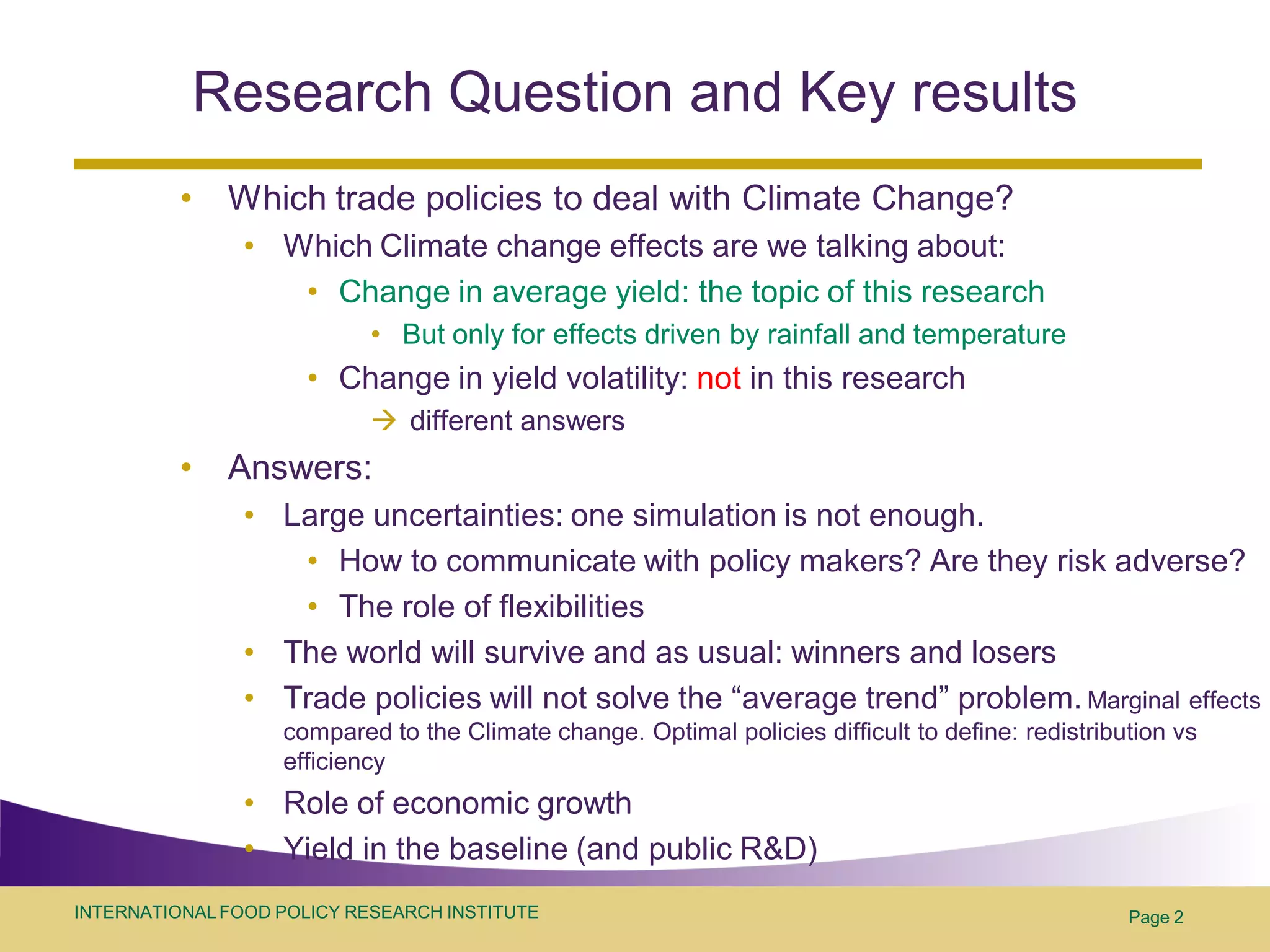
Research Question and Key results
          •   Which trade policies to deal with Climate Change?
                • Which Climate change effects are we talking about:
                   • Change in average yield: the topic of this research
                            • But only for effects driven by rainfall and temperature
                      • Change in yield volatility: not in this research
                             different answers
          •   Answers:
                • Large uncertainties: one simulation is not enough.
                   • How to communicate with policy makers? Are they risk adverse?
                   • The role of flexibilities
                • The world will survive and as usual: winners and losers
                • Trade policies will not solve the “average trend” problem. Marginal effects
                   compared to the Climate change. Optimal policies difficult to define: redistribution vs
                   efficiency
                • Role of economic growth
                • Yield in the baseline (and public R&D)
INTERNATIONAL FOOD POLICY RESEARCH INSTITUTE                                                       Page 2
Methodology

                 • GCM results [4 models x 3 baselines=12 scenarios]
                 • IMPACT Hydrology model
Climate Change   • Changes in temperature and rainfall by Food Production Units


                 • IMPACT DSSAT modelling (5 representative crops)
                 • Changes in Yield due to Climate Change evolution (temperature and rainfall for rainfed
  Exogenous        agriculture, temperature for irrigated agriculture)
Yield Response
due to Climage
    Change


                 • MIRAGE simulations: economic and demographic baselines with alternative trade policy
                   options
 Economic        • Endogenous economic response of yields
  results        • Results in terms of different economic indicators


INTERNATIONAL FOOD POLICY RESEARCH INSTITUTE                                                                Page 3
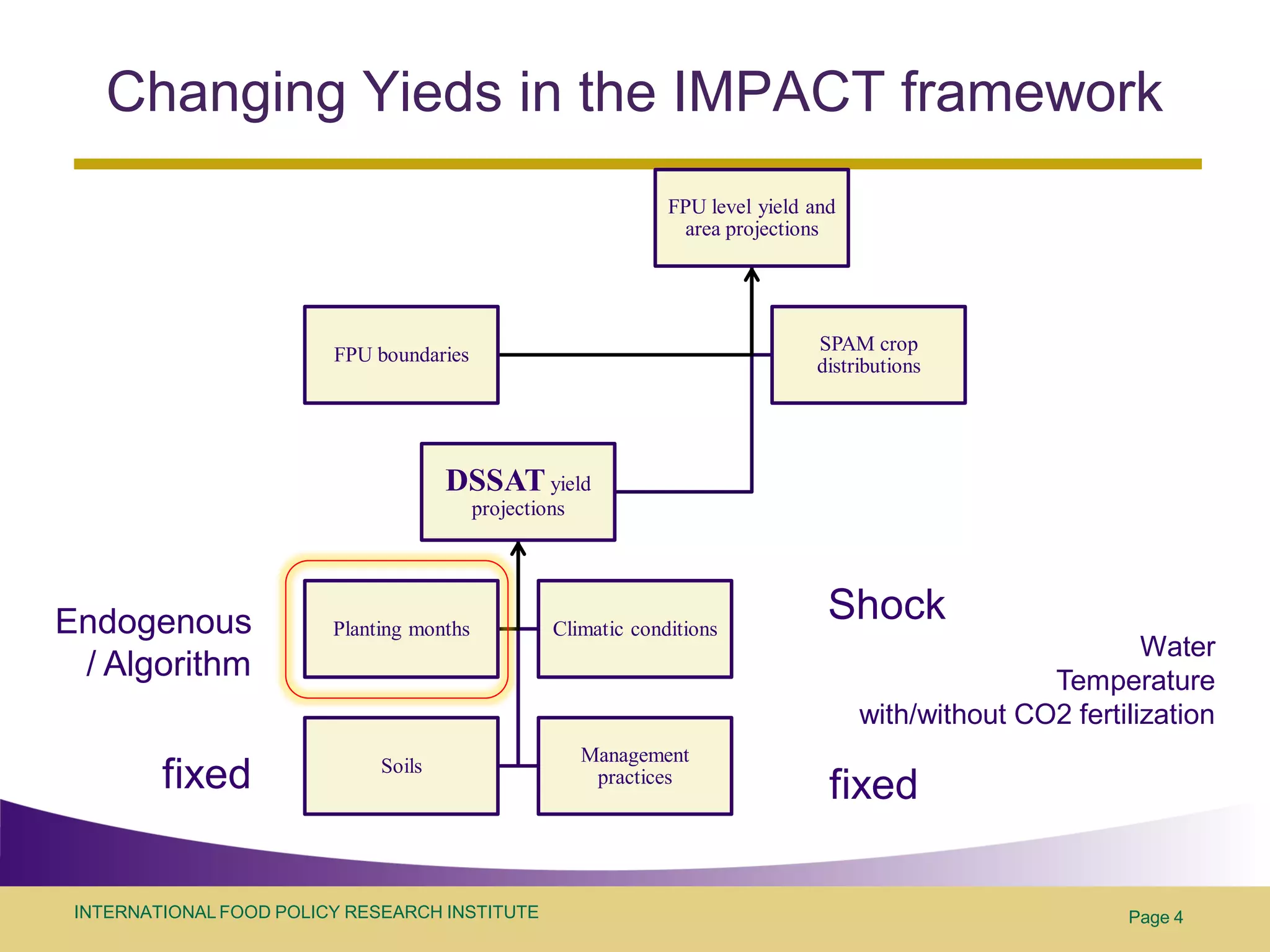
Changing Yieds in the IMPACT framework
                                                                 FPU level yield and
                                                                   area projections


                                                                                 SPAM crop
                         FPU boundaries
                                                                                 distributions


                                      DSSAT yield
                                           projections


Endogenous               Planting months            Climatic conditions
                                                                                   Shock
                                                                                                               Water
 / Algorithm                                                                                          Temperature
                                                                                       with/without CO2 fertilization
                                                         Management
         fixed                Soils
                                                          practices
                                                                                   fixed

 INTERNATIONAL FOOD POLICY RESEARCH INSTITUTE                                                                Page 4
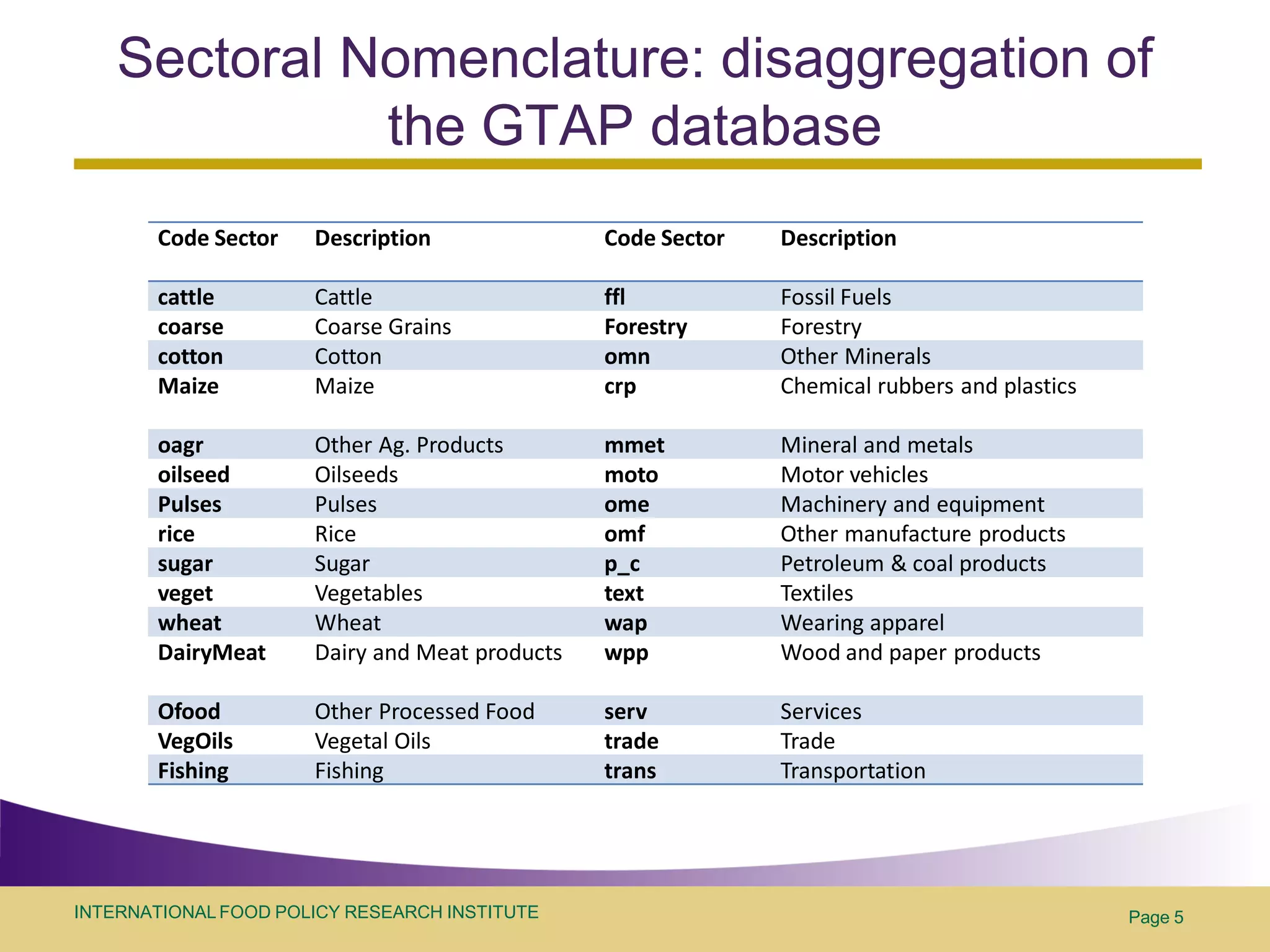
Sectoral Nomenclature: disaggregation of
              the GTAP database
       Code Sector    Description               Code Sector   Description

       cattle         Cattle                    ffl           Fossil Fuels
       coarse         Coarse Grains             Forestry      Forestry
       cotton         Cotton                    omn           Other Minerals
       Maize          Maize                     crp           Chemical rubbers and plastics

       oagr           Other Ag. Products        mmet          Mineral and metals
       oilseed        Oilseeds                  moto          Motor vehicles
       Pulses         Pulses                    ome           Machinery and equipment
       rice           Rice                      omf           Other manufacture products
       sugar          Sugar                     p_c           Petroleum & coal products
       veget          Vegetables                text          Textiles
       wheat          Wheat                     wap           Wearing apparel
       DairyMeat      Dairy and Meat products   wpp           Wood and paper products

       Ofood          Other Processed Food      serv          Services
       VegOils        Vegetal Oils              trade         Trade
       Fishing        Fishing                   trans         Transportation


INTERNATIONAL FOOD POLICY RESEARCH INSTITUTE                                                  Page 5
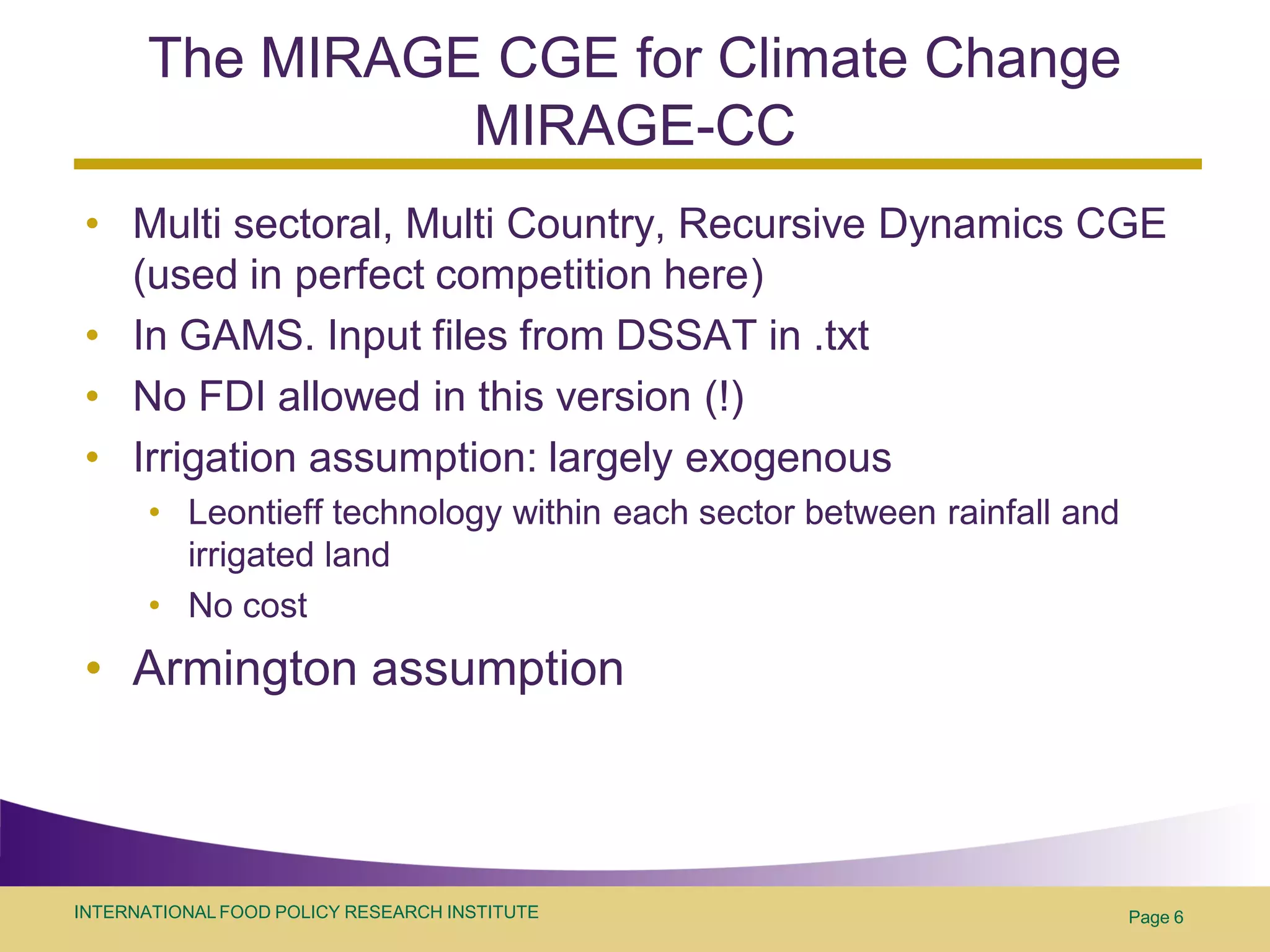
The MIRAGE CGE for Climate Change
                MIRAGE-CC
 • Multi sectoral, Multi Country, Recursive Dynamics CGE
   (used in perfect competition here)
 • In GAMS. Input files from DSSAT in .txt
 • No FDI allowed in this version (!)
 • Irrigation assumption: largely exogenous
       • Leontieff technology within each sector between rainfall and
         irrigated land
       • No cost
 • Armington assumption


INTERNATIONAL FOOD POLICY RESEARCH INSTITUTE                            Page 6
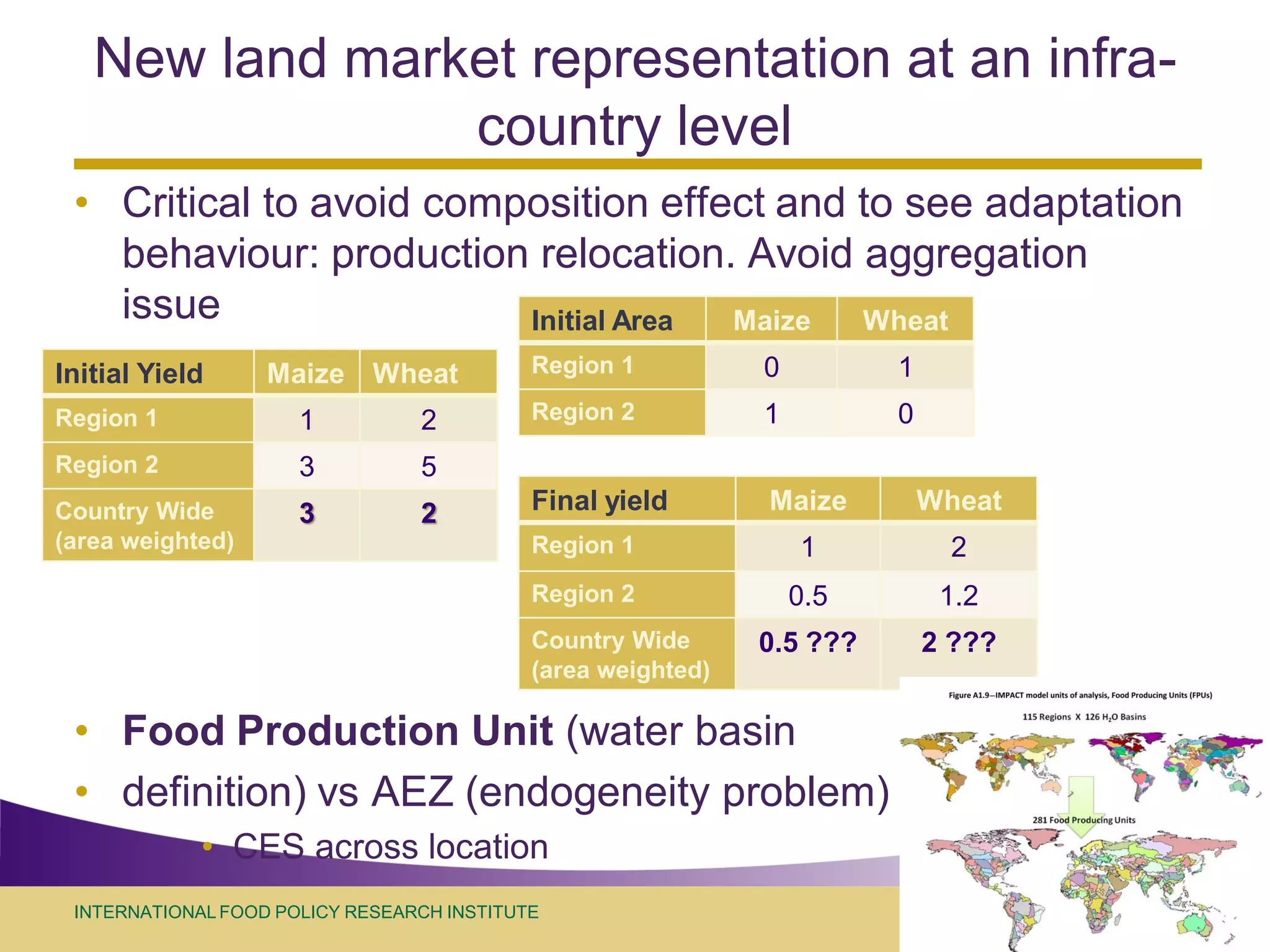
New land market representation at an infra-
                country level
 • Critical to avoid composition effect and to see adaptation
   behaviour: production relocation. Avoid aggregation
   issue                 Initial Area Maize Wheat
Initial Yield      Maize Wheat              Region 1          0         1
Region 1              1          2          Region 2          1         0
Region 2              3          5
Country Wide          3          2          Final yield       Maize         Wheat
(area weighted)                             Region 1              1           2
                                            Region 2              0.5        1.2
                                            Country Wide      0.5 ???       2 ???
                                            (area weighted)

 • Food Production Unit (water basin
 • definition) vs AEZ (endogeneity problem)
             • CES across location
 INTERNATIONAL FOOD POLICY RESEARCH INSTITUTE                                       Page 7
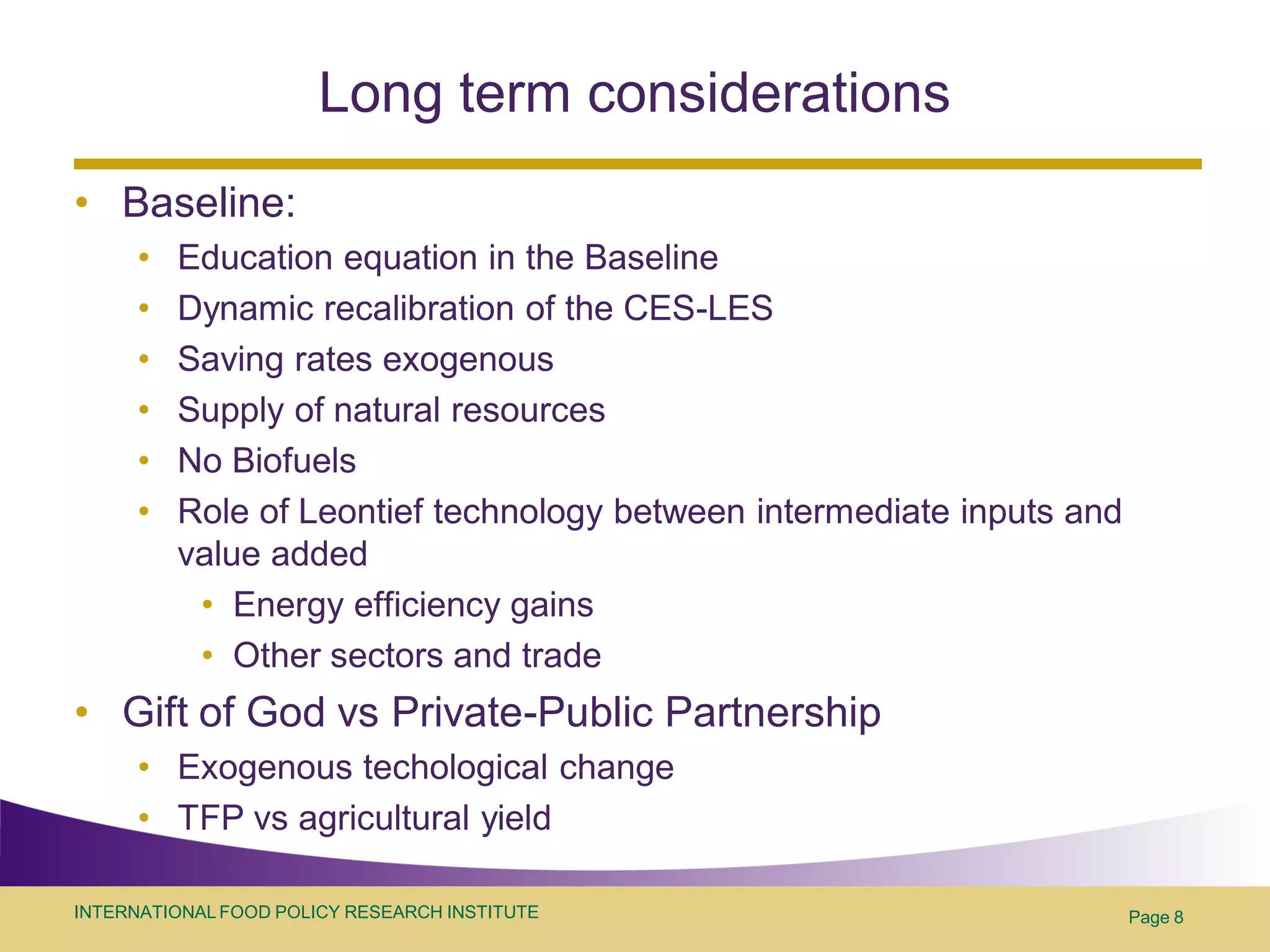
Long term considerations
• Baseline:
      •   Education equation in the Baseline
      •   Dynamic recalibration of the CES-LES
      •   Saving rates exogenous
      •   Supply of natural resources
      •   No Biofuels
      •   Role of Leontief technology between intermediate inputs and
          value added
           • Energy efficiency gains
           • Other sectors and trade
• Gift of God vs Private-Public Partnership
      • Exogenous techological change
      • TFP vs agricultural yield

INTERNATIONAL FOOD POLICY RESEARCH INSTITUTE                            Page 8
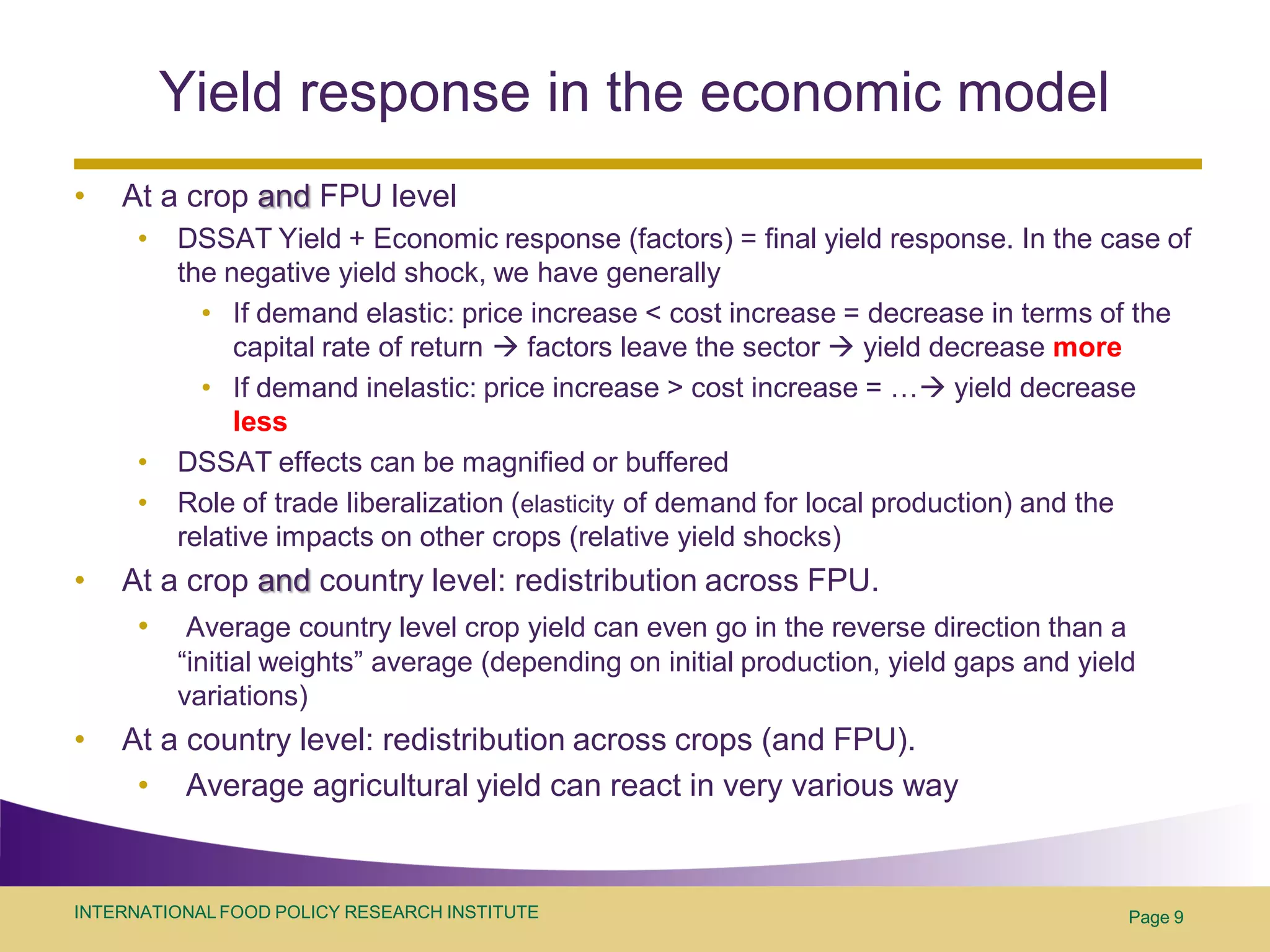
Yield response in the economic model
•   At a crop and FPU level
      •   DSSAT Yield + Economic response (factors) = final yield response. In the case of
          the negative yield shock, we have generally
            • If demand elastic: price increase < cost increase = decrease in terms of the
               capital rate of return  factors leave the sector  yield decrease more
            • If demand inelastic: price increase > cost increase = … yield decrease
               less
      •   DSSAT effects can be magnified or buffered
      •   Role of trade liberalization (elasticity of demand for local production) and the
          relative impacts on other crops (relative yield shocks)
•   At a crop and country level: redistribution across FPU.
     • Average country level crop yield can even go in the reverse direction than a
          “initial weights” average (depending on initial production, yield gaps and yield
          variations)
•   At a country level: redistribution across crops (and FPU).
     • Average agricultural yield can react in very various way


INTERNATIONAL FOOD POLICY RESEARCH INSTITUTE                                             Page 9
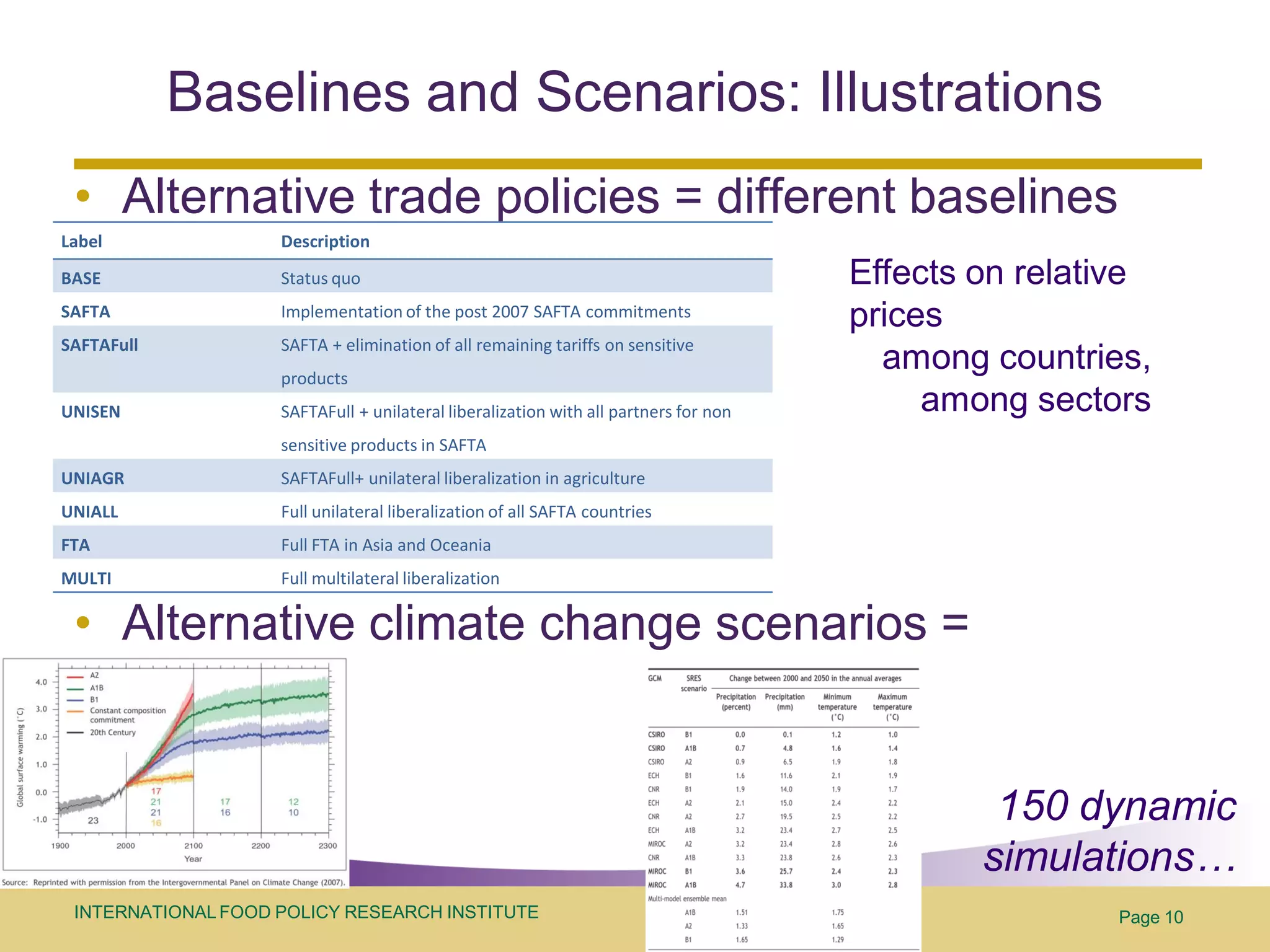
Baselines and Scenarios: Illustrations
 • Alternative trade policies = different baselines
Label               Description
BASE                Status quo                                                        Effects on relative
SAFTA               Implementation of the post 2007 SAFTA commitments                 prices
SAFTAFull           SAFTA + elimination of all remaining tariffs on sensitive
                    products
                                                                                        among countries,
UNISEN              SAFTAFull + unilateral liberalization with all partners for non        among sectors
                    sensitive products in SAFTA
UNIAGR              SAFTAFull+ unilateral liberalization in agriculture
UNIALL              Full unilateral liberalization of all SAFTA countries
FTA                 Full FTA in Asia and Oceania
MULTI               Full multilateral liberalization

 • Alternative climate change scenarios =


                                                                                               150 dynamic
                                                                                              simulations…
 INTERNATIONAL FOOD POLICY RESEARCH INSTITUTE                                                         Page 10
CROP MODEL RESULTS


INTERNATIONAL FOOD POLICY RESEARCH INSTITUTE   Page 11
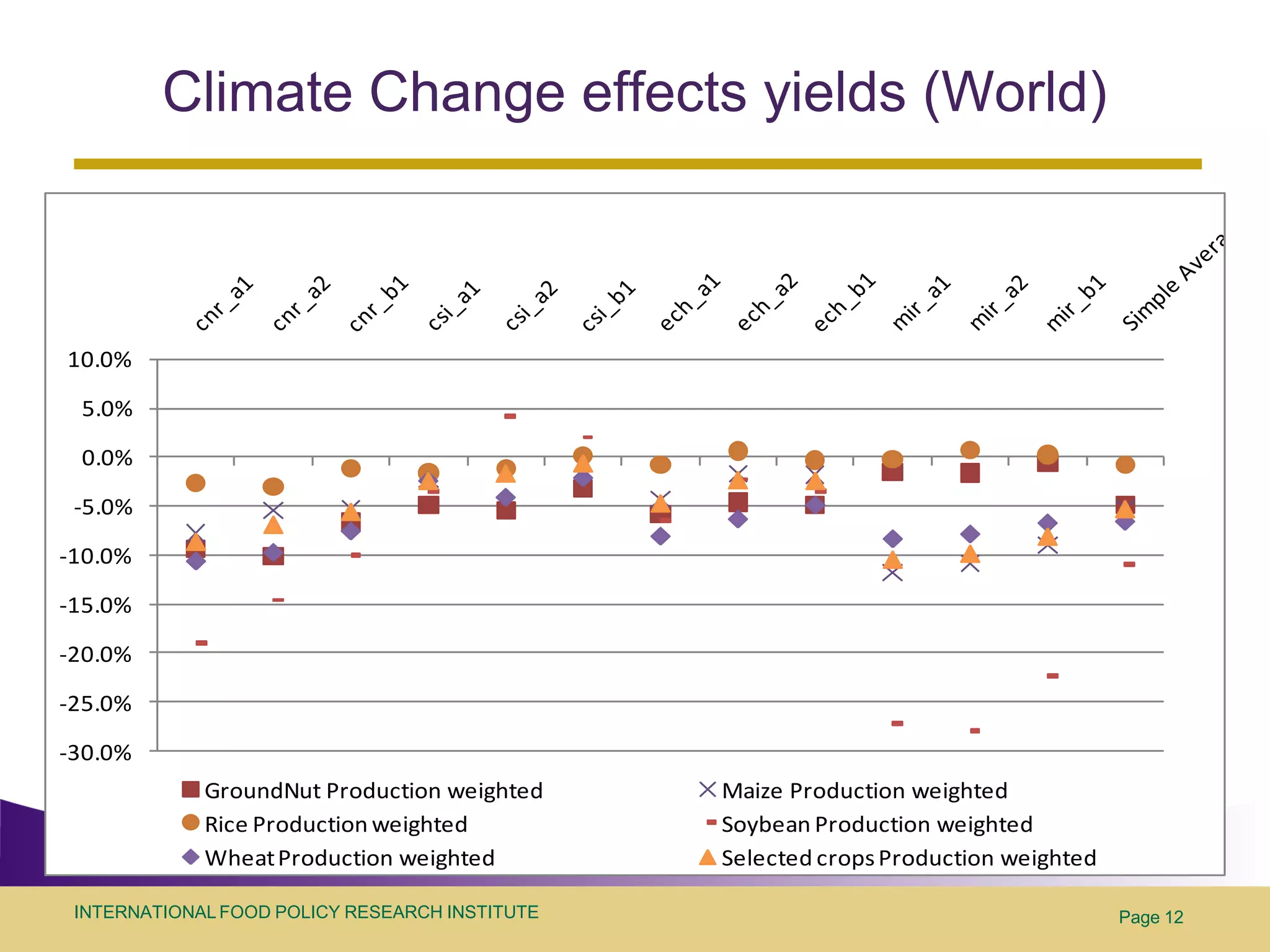
Climate Change effects yields (World)


10.0%

 5.0%

 0.0%

 -5.0%

-10.0%

-15.0%

-20.0%

-25.0%

-30.0%
             GroundNut Production weighted      Maize Production weighted
             Rice Production weighted           Soybean Production weighted
             Wheat Production weighted          Selected crops Production weighted

 INTERNATIONAL FOOD POLICY RESEARCH INSTITUTE                                        Page 12
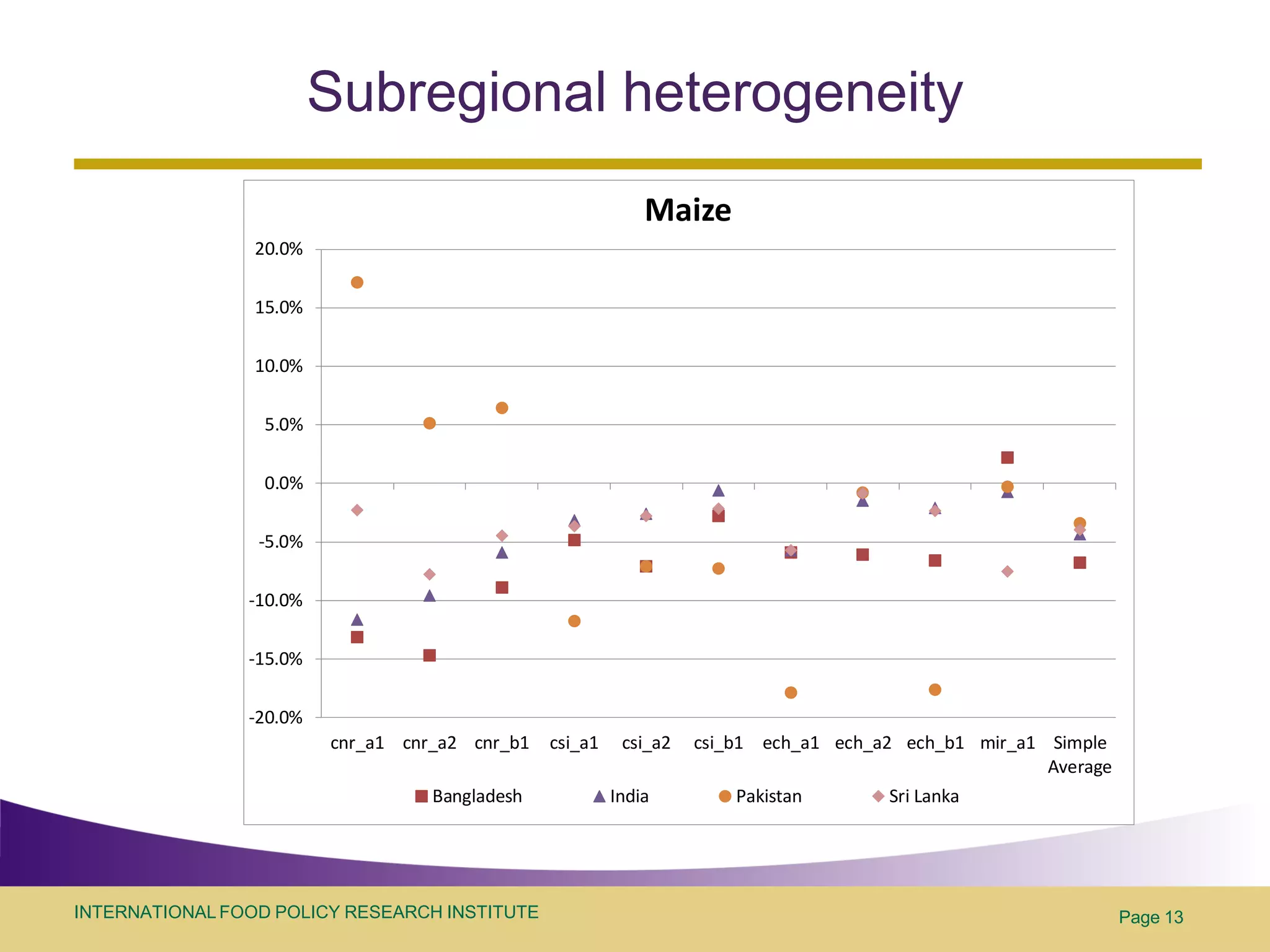
Subregional heterogeneity
                                                             Maize
                 20.0%

                 15.0%

                 10.0%

                  5.0%

                  0.0%

                 -5.0%

                -10.0%

                -15.0%

                -20.0%
                         cnr_a1 cnr_a2 cnr_b1   csi_a1    csi_a2   csi_b1 ech_a1 ech_a2 ech_b1 mir_a1 Simple
                                                                                                      Average
                                   Bangladesh            India          Pakistan       Sri Lanka


INTERNATIONAL FOOD POLICY RESEARCH INSTITUTE                                                                    Page 13
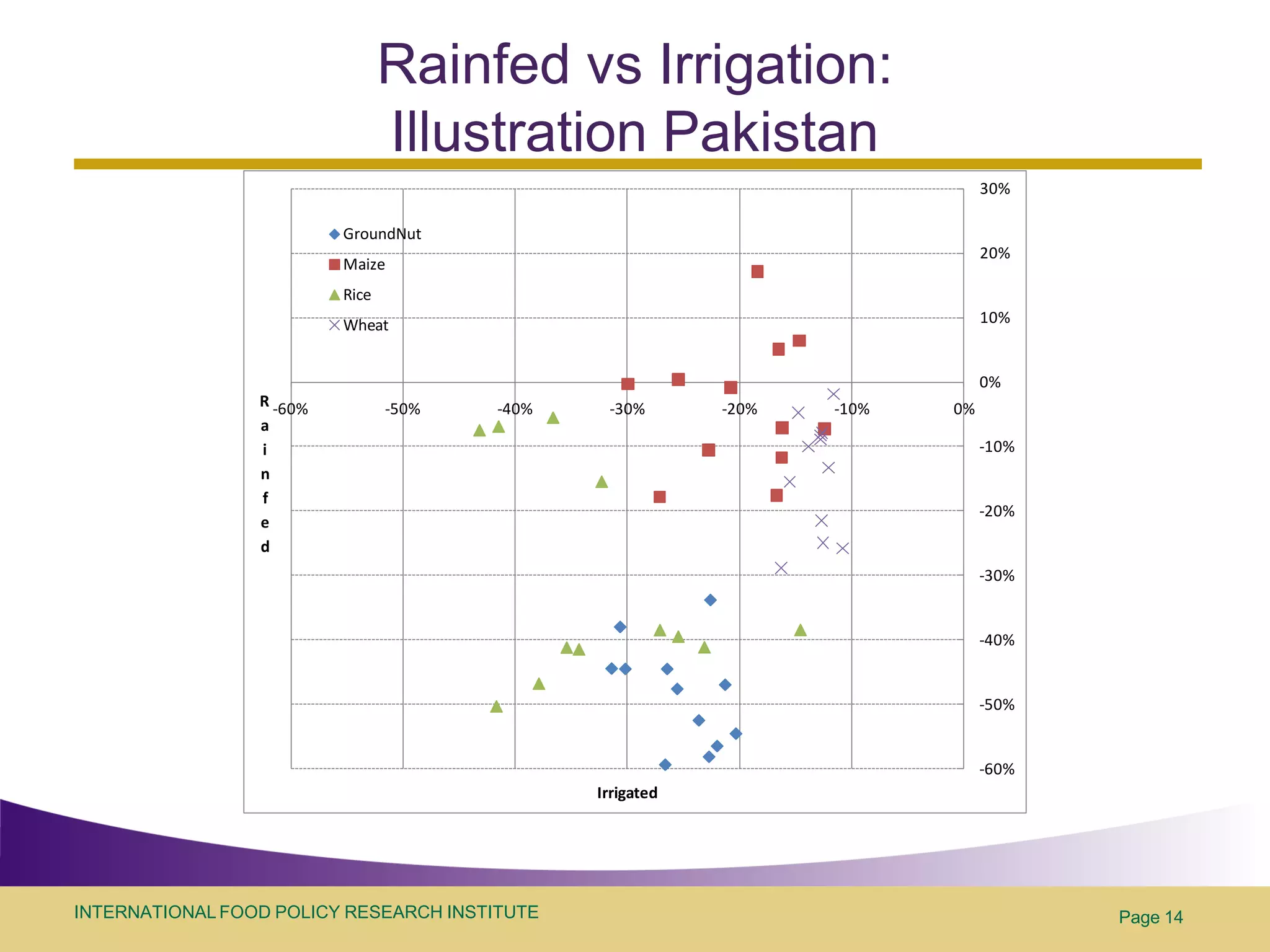
Rainfed vs Irrigation:
                                 Illustration Pakistan
                                                                              30%

                          GroundNut
                                                                              20%
                          Maize
                          Rice
                          Wheat                                               10%


                                                                              0%
                 R -60%          -50%   -40%    -30%       -20%   -10%   0%
                 a
                 i                                                            -10%
                 n
                 f
                                                                              -20%
                 e
                 d
                                                                              -30%


                                                                              -40%


                                                                              -50%


                                                                              -60%
                                               Irrigated


INTERNATIONAL FOOD POLICY RESEARCH INSTITUTE                                         Page 14
CGE RESULTS


INTERNATIONAL FOOD POLICY RESEARCH INSTITUTE   Page 15
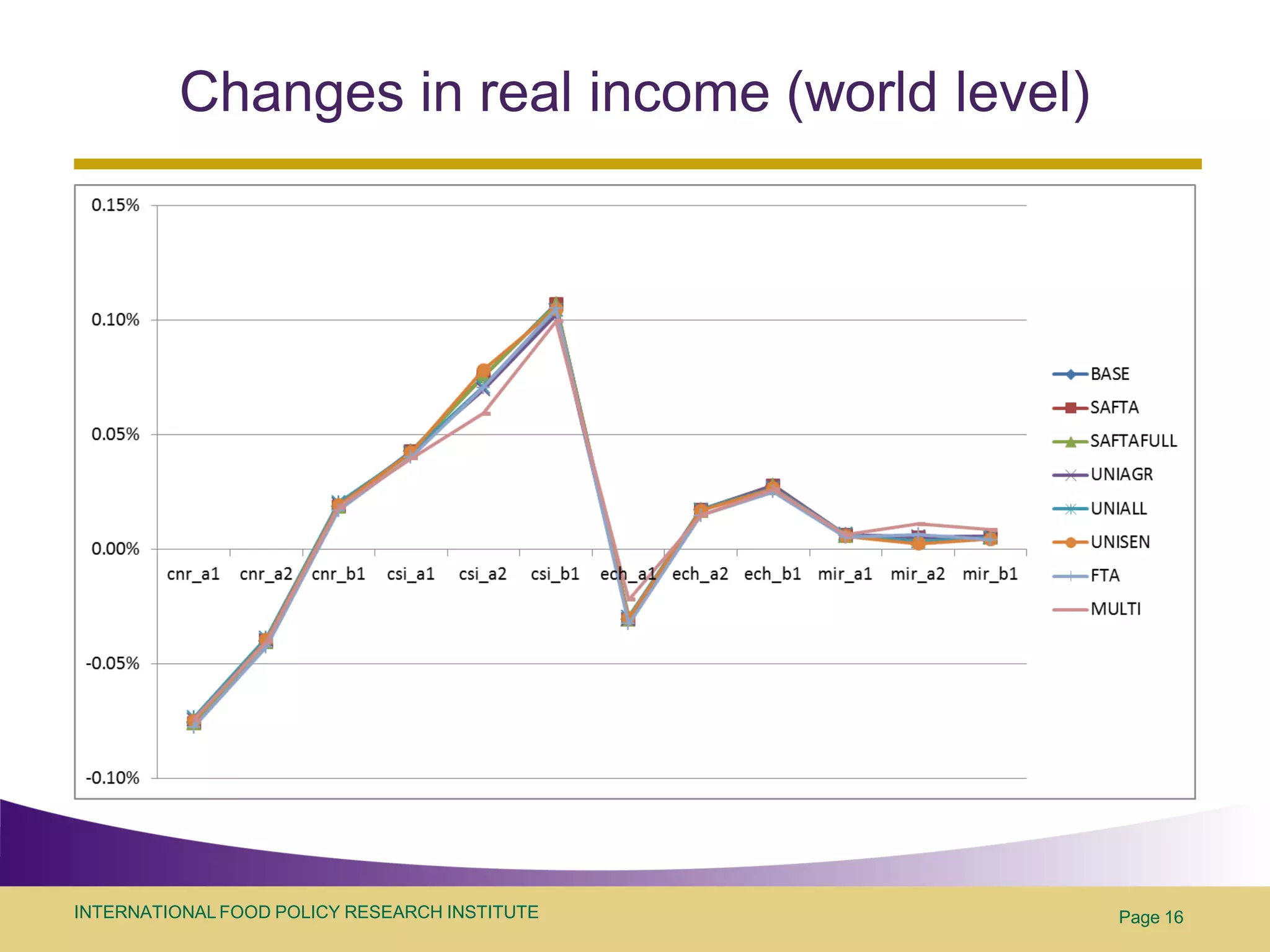
Changes in real income (world level)


INTERNATIONAL FOOD POLICY RESEARCH INSTITUTE    Page 16
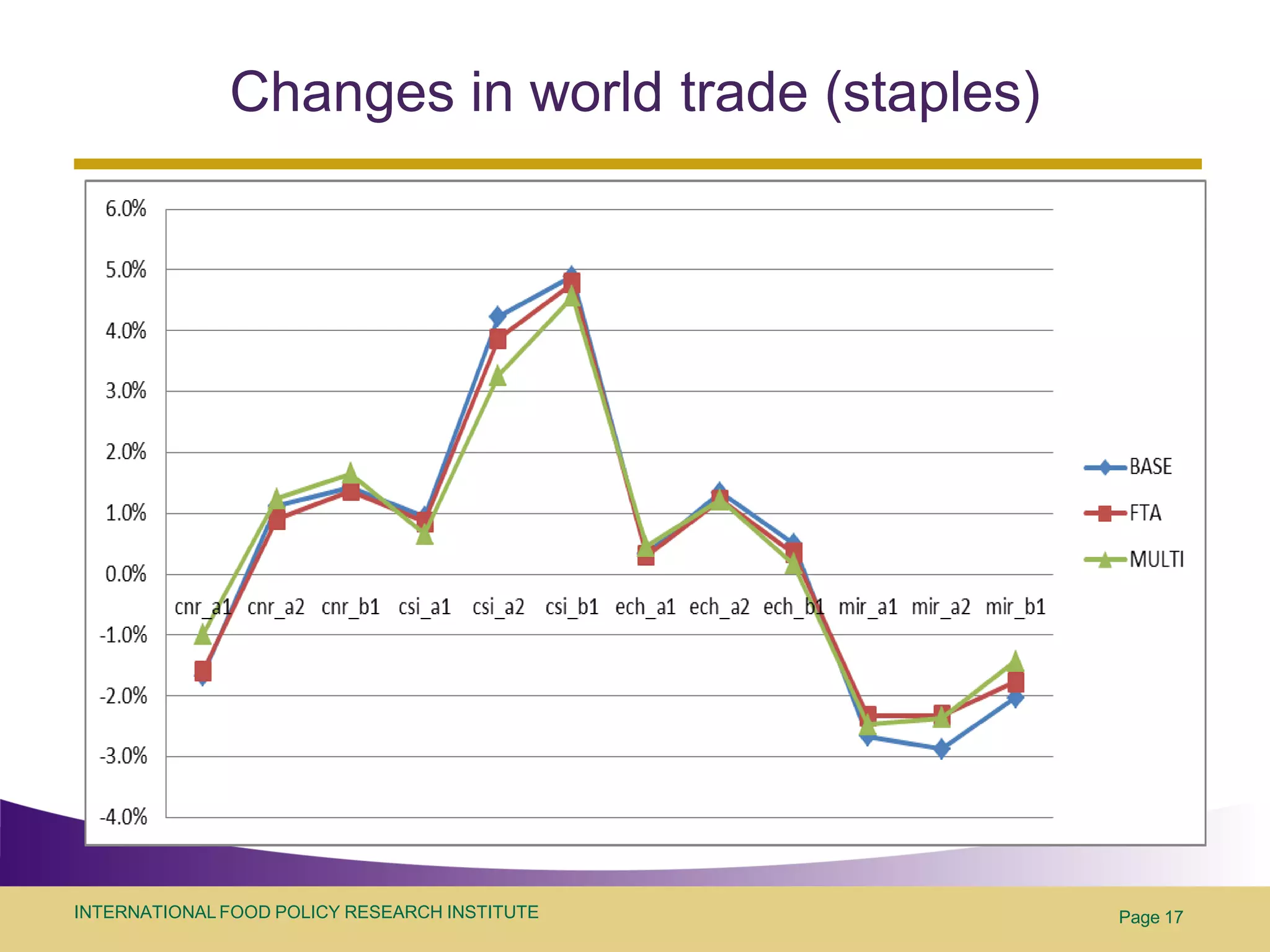
Changes in world trade (staples)


INTERNATIONAL FOOD POLICY RESEARCH INSTITUTE     Page 17
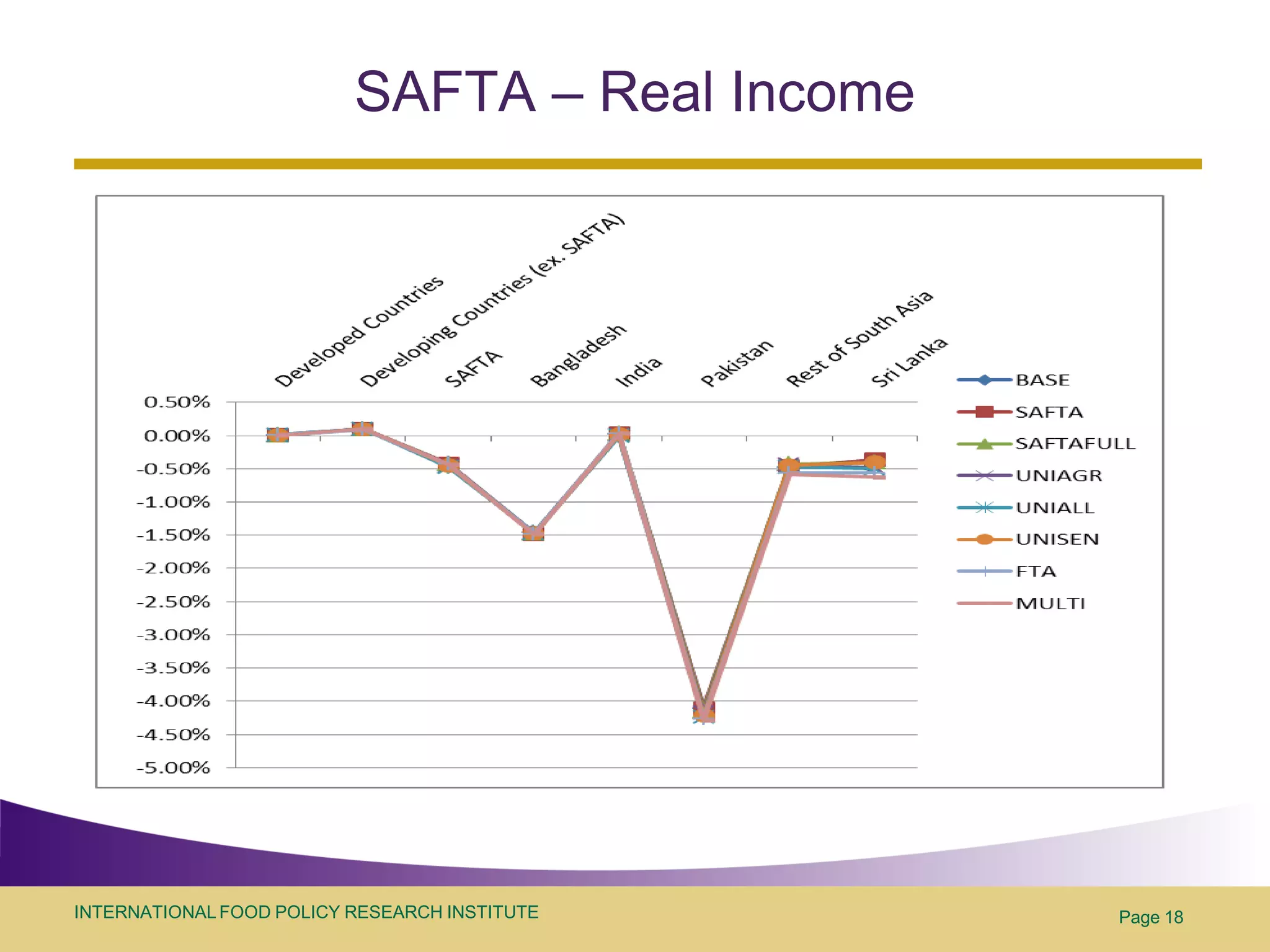
SAFTA – Real Income


INTERNATIONAL FOOD POLICY RESEARCH INSTITUTE    Page 18
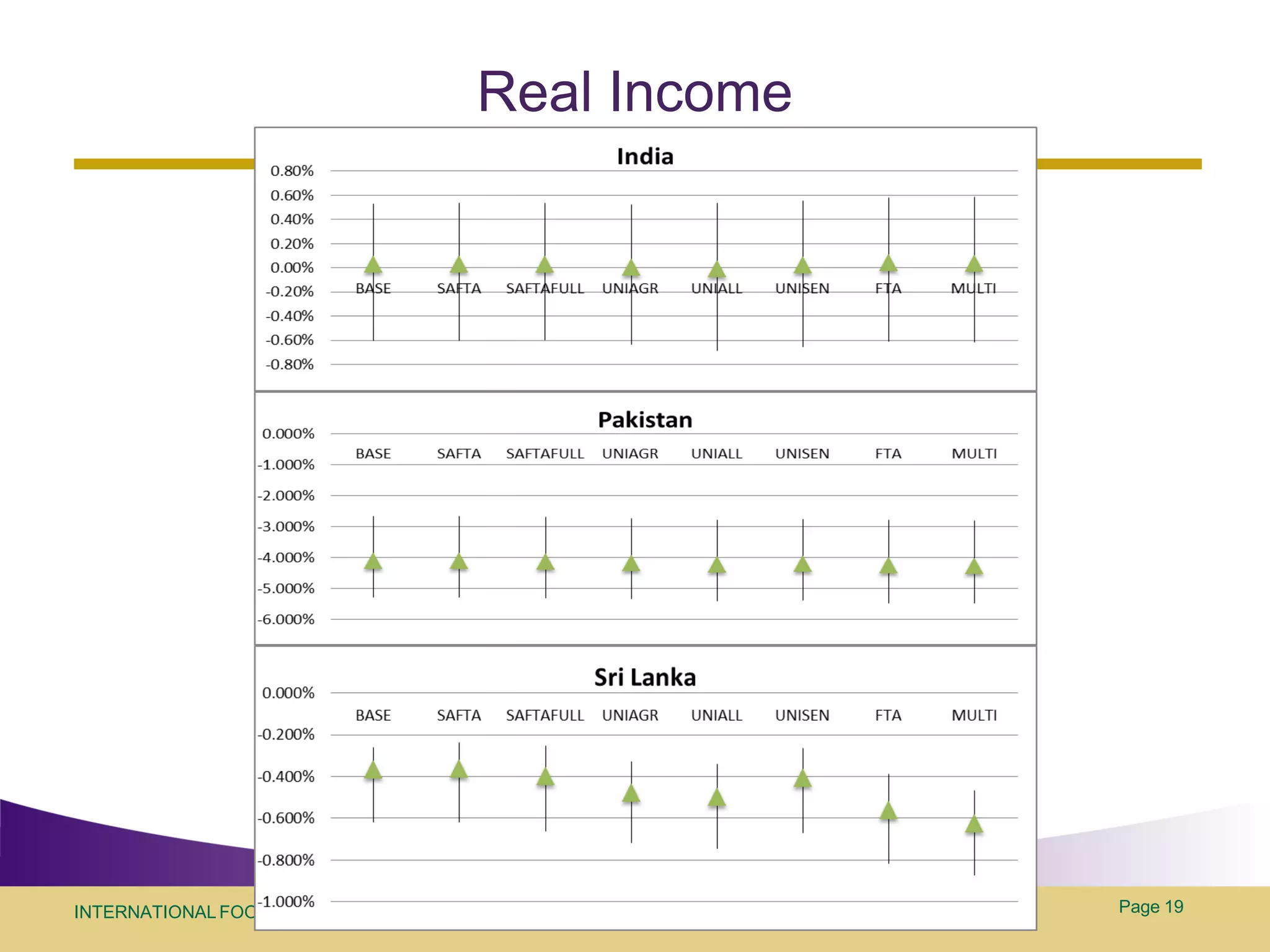
Real Income


INTERNATIONAL FOOD POLICY RESEARCH INSTITUTE        Page 19
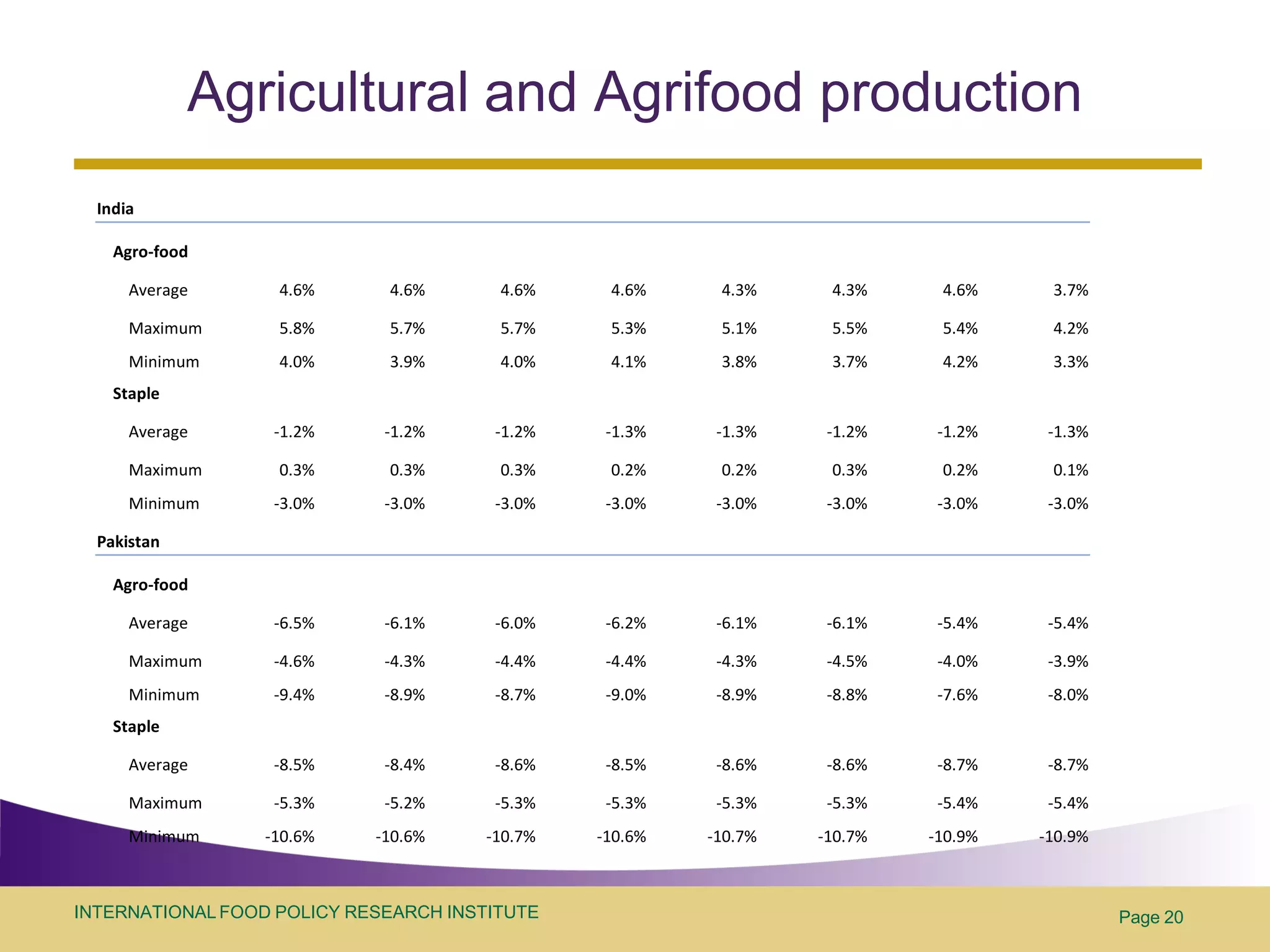
Agricultural and Agrifood production
  India

    Agro-food

      Average      4.6%      4.6%       4.6%    4.6%     4.3%     4.3%     4.6%     3.7%

      Maximum      5.8%      5.7%       5.7%    5.3%     5.1%     5.5%     5.4%     4.2%
      Minimum      4.0%      3.9%       4.0%    4.1%     3.8%     3.7%     4.2%     3.3%
    Staple

      Average      -1.2%     -1.2%     -1.2%    -1.3%    -1.3%    -1.2%    -1.2%    -1.3%

      Maximum      0.3%      0.3%       0.3%    0.2%     0.2%     0.3%     0.2%     0.1%
      Minimum      -3.0%     -3.0%     -3.0%    -3.0%    -3.0%    -3.0%    -3.0%    -3.0%

  Pakistan

    Agro-food

      Average      -6.5%     -6.1%     -6.0%    -6.2%    -6.1%    -6.1%    -5.4%    -5.4%

      Maximum      -4.6%     -4.3%     -4.4%    -4.4%    -4.3%    -4.5%    -4.0%    -3.9%
      Minimum      -9.4%     -8.9%     -8.7%    -9.0%    -8.9%    -8.8%    -7.6%    -8.0%
    Staple

      Average      -8.5%     -8.4%     -8.6%    -8.5%    -8.6%    -8.6%    -8.7%    -8.7%

      Maximum      -5.3%     -5.2%     -5.3%    -5.3%    -5.3%    -5.3%    -5.4%    -5.4%
      Minimum     -10.6%    -10.6%    -10.7%   -10.6%   -10.7%   -10.7%   -10.9%   -10.9%


INTERNATIONAL FOOD POLICY RESEARCH INSTITUTE                                                Page 20
Agricultural and Agrifood production
  India

    Agro-food

      Average      4.6%      4.6%       4.6%    4.6%     4.3%     4.3%     4.6%     3.7%

      Maximum      5.8%      5.7%       5.7%    5.3%     5.1%     5.5%     5.4%     4.2%
      Minimum      4.0%      3.9%       4.0%    4.1%     3.8%     3.7%     4.2%     3.3%
    Staple

      Average      -1.2%     -1.2%     -1.2%    -1.3%    -1.3%    -1.2%    -1.2%    -1.3%

      Maximum      0.3%      0.3%       0.3%    0.2%     0.2%     0.3%     0.2%     0.1%
      Minimum      -3.0%     -3.0%     -3.0%    -3.0%    -3.0%    -3.0%    -3.0%    -3.0%

  Pakistan

    Agro-food

      Average      -6.5%     -6.1%     -6.0%    -6.2%    -6.1%    -6.1%    -5.4%    -5.4%

      Maximum      -4.6%     -4.3%     -4.4%    -4.4%    -4.3%    -4.5%    -4.0%    -3.9%
      Minimum      -9.4%     -8.9%     -8.7%    -9.0%    -8.9%    -8.8%    -7.6%    -8.0%
    Staple

      Average      -8.5%     -8.4%     -8.6%    -8.5%    -8.6%    -8.6%    -8.7%    -8.7%

      Maximum      -5.3%     -5.2%     -5.3%    -5.3%    -5.3%    -5.3%    -5.4%    -5.4%
      Minimum     -10.6%    -10.6%    -10.7%   -10.6%   -10.7%   -10.7%   -10.9%   -10.9%


INTERNATIONAL FOOD POLICY RESEARCH INSTITUTE                                                Page 21
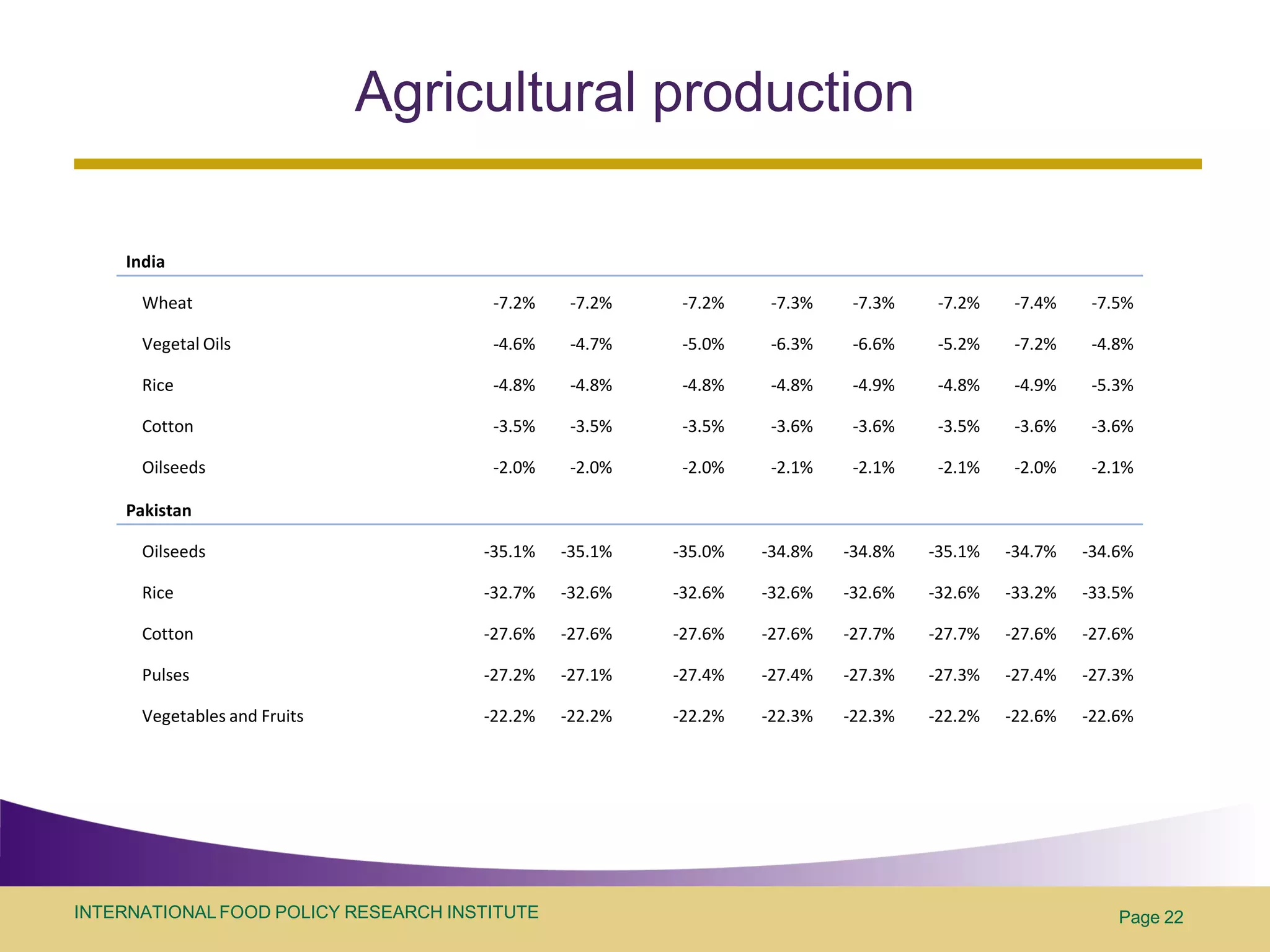
Agricultural production

    India

      Wheat                            -7.2%    -7.2%    -7.2%    -7.3%    -7.3%    -7.2%    -7.4%    -7.5%

      Vegetal Oils                     -4.6%    -4.7%    -5.0%    -6.3%    -6.6%    -5.2%    -7.2%    -4.8%

      Rice                             -4.8%    -4.8%    -4.8%    -4.8%    -4.9%    -4.8%    -4.9%    -5.3%

      Cotton                           -3.5%    -3.5%    -3.5%    -3.6%    -3.6%    -3.5%    -3.6%    -3.6%

      Oilseeds                         -2.0%    -2.0%    -2.0%    -2.1%    -2.1%    -2.1%    -2.0%    -2.1%

    Pakistan

      Oilseeds                        -35.1%   -35.1%   -35.0%   -34.8%   -34.8%   -35.1%   -34.7%   -34.6%

      Rice                            -32.7%   -32.6%   -32.6%   -32.6%   -32.6%   -32.6%   -33.2%   -33.5%

      Cotton                          -27.6%   -27.6%   -27.6%   -27.6%   -27.7%   -27.7%   -27.6%   -27.6%

      Pulses                          -27.2%   -27.1%   -27.4%   -27.4%   -27.3%   -27.3%   -27.4%   -27.3%

      Vegetables and Fruits           -22.2%   -22.2%   -22.2%   -22.3%   -22.3%   -22.2%   -22.6%   -22.6%


INTERNATIONAL FOOD POLICY RESEARCH INSTITUTE                                                             Page 22
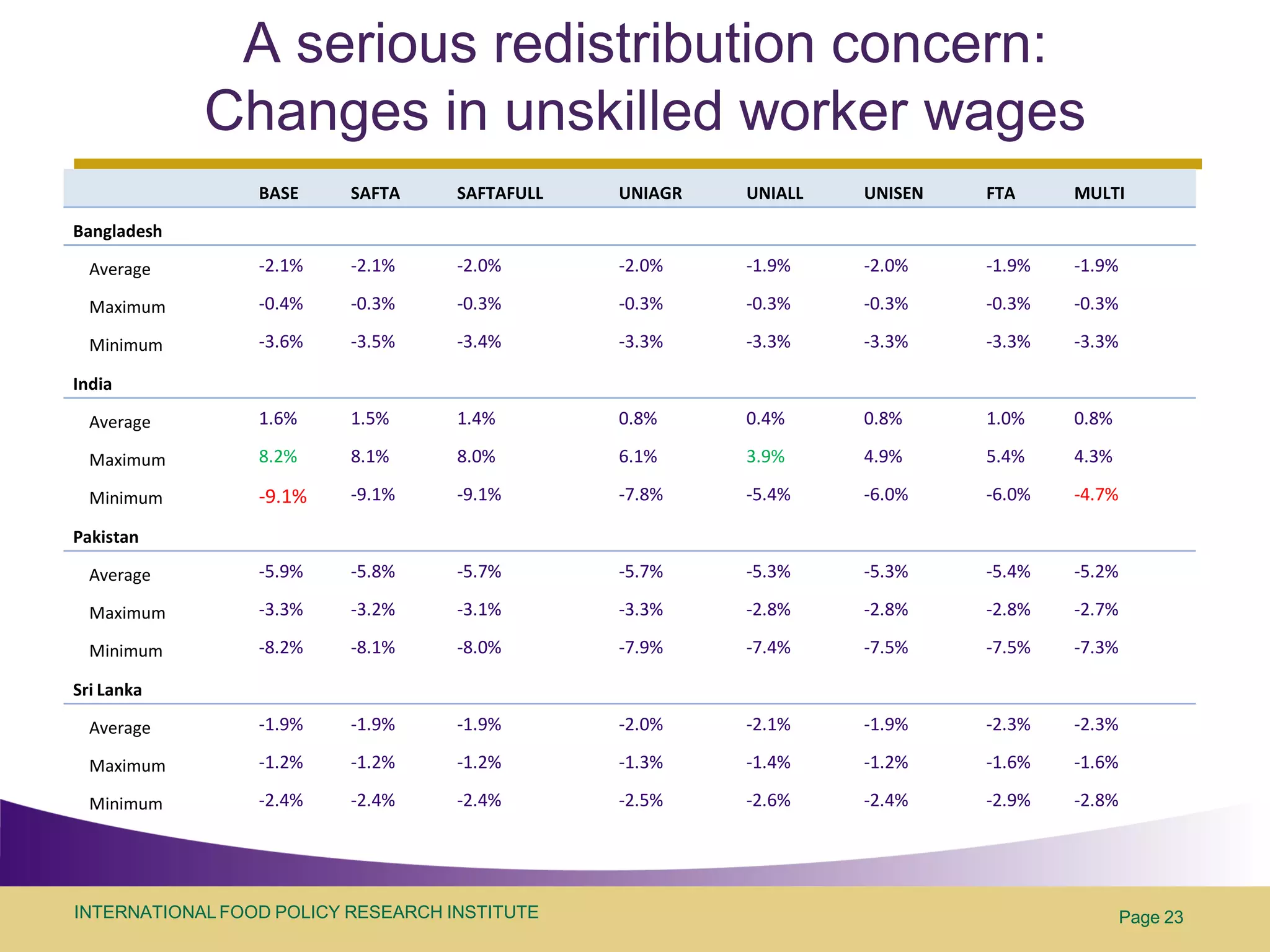
A serious redistribution concern:
             Changes in unskilled worker wages
                 BASE     SAFTA     SAFTAFULL   UNIAGR   UNIALL   UNISEN   FTA     MULTI

Bangladesh

  Average        -2.1%    -2.1%     -2.0%       -2.0%    -1.9%    -2.0%    -1.9%   -1.9%

  Maximum        -0.4%    -0.3%     -0.3%       -0.3%    -0.3%    -0.3%    -0.3%   -0.3%

  Minimum        -3.6%    -3.5%     -3.4%       -3.3%    -3.3%    -3.3%    -3.3%   -3.3%

India

  Average        1.6%     1.5%      1.4%        0.8%     0.4%     0.8%     1.0%    0.8%

  Maximum        8.2%     8.1%      8.0%        6.1%     3.9%     4.9%     5.4%    4.3%

  Minimum        -9.1%    -9.1%     -9.1%       -7.8%    -5.4%    -6.0%    -6.0%   -4.7%

Pakistan

  Average        -5.9%    -5.8%     -5.7%       -5.7%    -5.3%    -5.3%    -5.4%   -5.2%

  Maximum        -3.3%    -3.2%     -3.1%       -3.3%    -2.8%    -2.8%    -2.8%   -2.7%

  Minimum        -8.2%    -8.1%     -8.0%       -7.9%    -7.4%    -7.5%    -7.5%   -7.3%

Sri Lanka

  Average        -1.9%    -1.9%     -1.9%       -2.0%    -2.1%    -1.9%    -2.3%   -2.3%

  Maximum        -1.2%    -1.2%     -1.2%       -1.3%    -1.4%    -1.2%    -1.6%   -1.6%

  Minimum        -2.4%    -2.4%     -2.4%       -2.5%    -2.6%    -2.4%    -2.9%   -2.8%


INTERNATIONAL FOOD POLICY RESEARCH INSTITUTE                                               Page 23
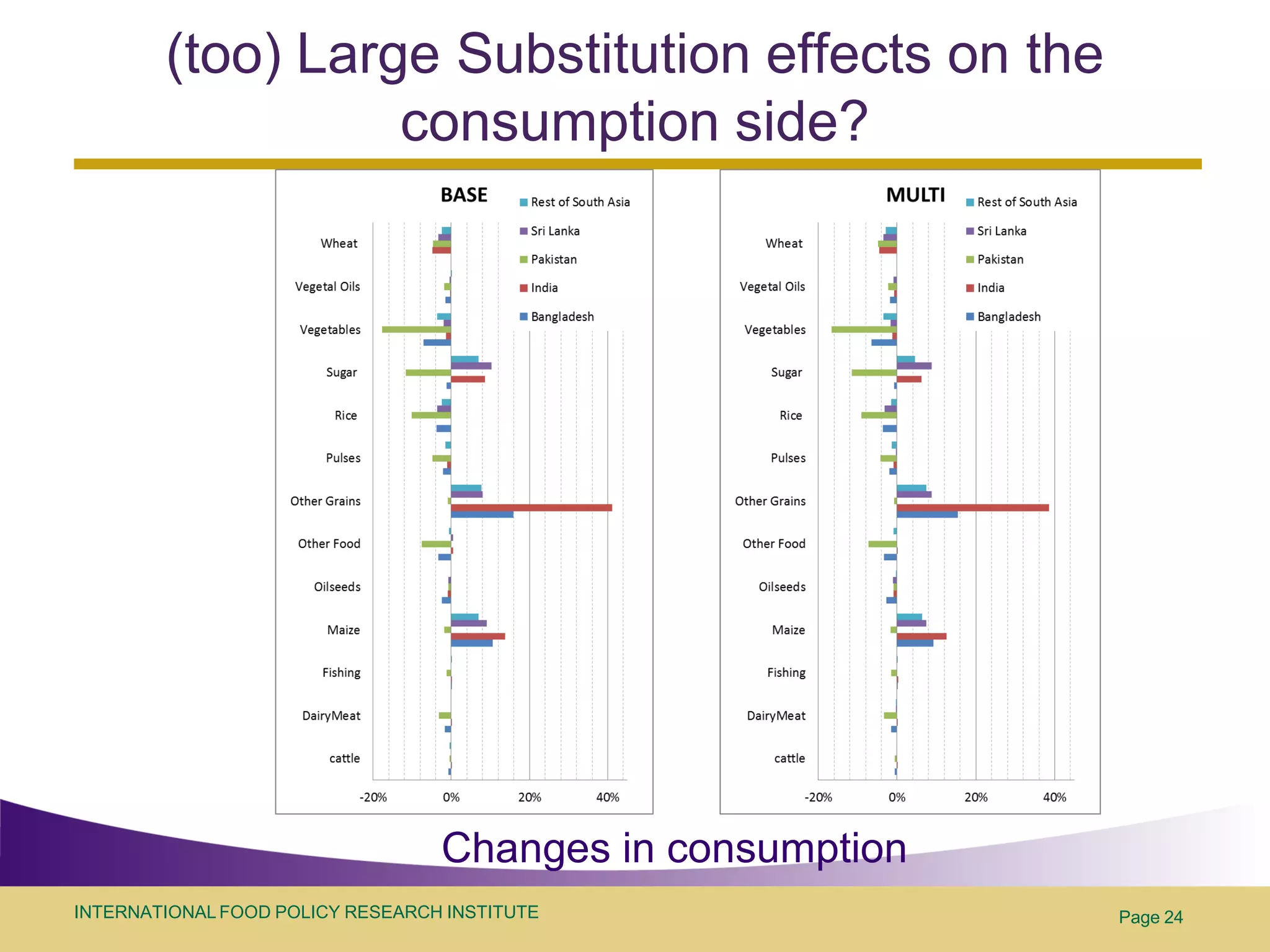
(too) Large Substitution effects on the
                  consumption side?


                                  Changes in consumption
INTERNATIONAL FOOD POLICY RESEARCH INSTITUTE               Page 24
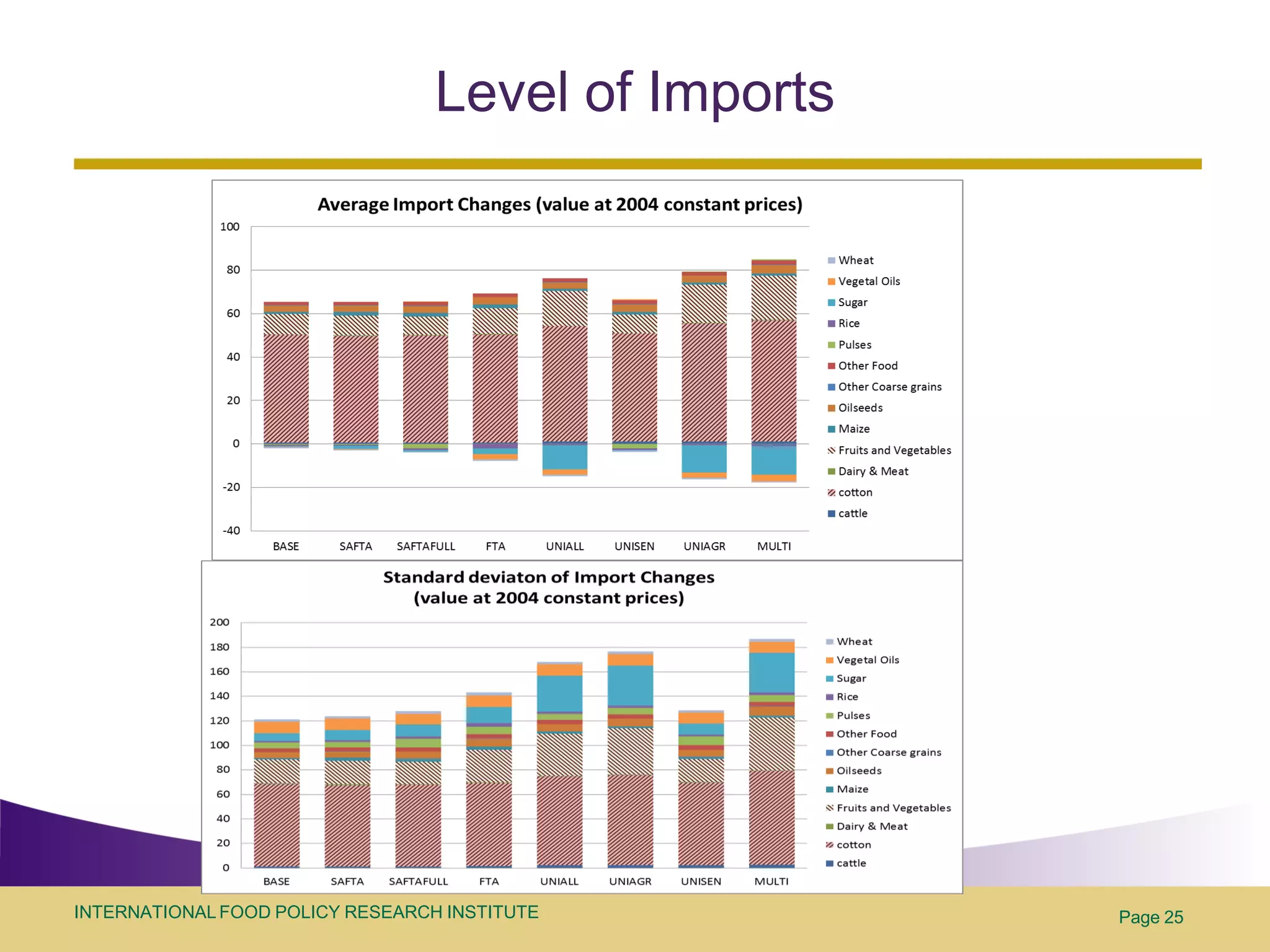
Level of Imports


INTERNATIONAL FOOD POLICY RESEARCH INSTITUTE         Page 25
Concluding remarks
•   The Trade policy landscape has limited macroeconomic effects of
    Climate Change consequences on average yield
      • Larger role on distribution (poor people): needs to investigate the issue
        deeper, in particular with better demand modeling: integration of the
        MIRAGE-Climate Change and the MIRAGE-Household disaggregation
        modele
•   Large Uncertainties
      •   Promote economic growth (endogenous investments) and role of FDI?
      •   Flexibilities for farmers to change crops
      •   Flexibilities to relocate production: infrastructure
      •   Caution with any large sunk costs (R&D in one crop…)
•   Improved work on irrigation


INTERNATIONAL FOOD POLICY RESEARCH INSTITUTE                                 Page 26

Climate Change and Agriculture: Change in Yields in a global CGE MIRAGE-CC

  • 1.
    Climate Change and Agriculture: Changein Yields in a global CGE MIRAGE-CC Presented by: David Laborde Debucquet www.agrodep.org IFPRI AGRODEP Workshop on Analytical Tools for Climate Change Analysis June 6-7, 2011 • Dakar, Senegal Please check the latest version of this presentation on: http://agrodep.cgxchange.org/first-annual-workshop
  • 2.
    Climate Change andAgriculture: Change in Yields in a global CGE MIRAGE-CC David Laborde d.laborde@cgiar.org
  • 3.
    Research Question andKey results • Which trade policies to deal with Climate Change? • Which Climate change effects are we talking about: • Change in average yield: the topic of this research • But only for effects driven by rainfall and temperature • Change in yield volatility: not in this research  different answers • Answers: • Large uncertainties: one simulation is not enough. • How to communicate with policy makers? Are they risk adverse? • The role of flexibilities • The world will survive and as usual: winners and losers • Trade policies will not solve the “average trend” problem. Marginal effects compared to the Climate change. Optimal policies difficult to define: redistribution vs efficiency • Role of economic growth • Yield in the baseline (and public R&D) INTERNATIONAL FOOD POLICY RESEARCH INSTITUTE Page 2
  • 4.
    Methodology • GCM results [4 models x 3 baselines=12 scenarios] • IMPACT Hydrology model Climate Change • Changes in temperature and rainfall by Food Production Units • IMPACT DSSAT modelling (5 representative crops) • Changes in Yield due to Climate Change evolution (temperature and rainfall for rainfed Exogenous agriculture, temperature for irrigated agriculture) Yield Response due to Climage Change • MIRAGE simulations: economic and demographic baselines with alternative trade policy options Economic • Endogenous economic response of yields results • Results in terms of different economic indicators INTERNATIONAL FOOD POLICY RESEARCH INSTITUTE Page 3
  • 5.
    Changing Yieds inthe IMPACT framework FPU level yield and area projections SPAM crop FPU boundaries distributions DSSAT yield projections Endogenous Planting months Climatic conditions Shock Water / Algorithm Temperature with/without CO2 fertilization Management fixed Soils practices fixed INTERNATIONAL FOOD POLICY RESEARCH INSTITUTE Page 4
  • 6.
    Sectoral Nomenclature: disaggregationof the GTAP database Code Sector Description Code Sector Description cattle Cattle ffl Fossil Fuels coarse Coarse Grains Forestry Forestry cotton Cotton omn Other Minerals Maize Maize crp Chemical rubbers and plastics oagr Other Ag. Products mmet Mineral and metals oilseed Oilseeds moto Motor vehicles Pulses Pulses ome Machinery and equipment rice Rice omf Other manufacture products sugar Sugar p_c Petroleum & coal products veget Vegetables text Textiles wheat Wheat wap Wearing apparel DairyMeat Dairy and Meat products wpp Wood and paper products Ofood Other Processed Food serv Services VegOils Vegetal Oils trade Trade Fishing Fishing trans Transportation INTERNATIONAL FOOD POLICY RESEARCH INSTITUTE Page 5
  • 7.
    The MIRAGE CGEfor Climate Change MIRAGE-CC • Multi sectoral, Multi Country, Recursive Dynamics CGE (used in perfect competition here) • In GAMS. Input files from DSSAT in .txt • No FDI allowed in this version (!) • Irrigation assumption: largely exogenous • Leontieff technology within each sector between rainfall and irrigated land • No cost • Armington assumption INTERNATIONAL FOOD POLICY RESEARCH INSTITUTE Page 6
  • 8.
    New land marketrepresentation at an infra- country level • Critical to avoid composition effect and to see adaptation behaviour: production relocation. Avoid aggregation issue Initial Area Maize Wheat Initial Yield Maize Wheat Region 1 0 1 Region 1 1 2 Region 2 1 0 Region 2 3 5 Country Wide 3 2 Final yield Maize Wheat (area weighted) Region 1 1 2 Region 2 0.5 1.2 Country Wide 0.5 ??? 2 ??? (area weighted) • Food Production Unit (water basin • definition) vs AEZ (endogeneity problem) • CES across location INTERNATIONAL FOOD POLICY RESEARCH INSTITUTE Page 7
  • 9.
    Long term considerations •Baseline: • Education equation in the Baseline • Dynamic recalibration of the CES-LES • Saving rates exogenous • Supply of natural resources • No Biofuels • Role of Leontief technology between intermediate inputs and value added • Energy efficiency gains • Other sectors and trade • Gift of God vs Private-Public Partnership • Exogenous techological change • TFP vs agricultural yield INTERNATIONAL FOOD POLICY RESEARCH INSTITUTE Page 8
  • 10.
    Yield response inthe economic model • At a crop and FPU level • DSSAT Yield + Economic response (factors) = final yield response. In the case of the negative yield shock, we have generally • If demand elastic: price increase < cost increase = decrease in terms of the capital rate of return  factors leave the sector  yield decrease more • If demand inelastic: price increase > cost increase = … yield decrease less • DSSAT effects can be magnified or buffered • Role of trade liberalization (elasticity of demand for local production) and the relative impacts on other crops (relative yield shocks) • At a crop and country level: redistribution across FPU. • Average country level crop yield can even go in the reverse direction than a “initial weights” average (depending on initial production, yield gaps and yield variations) • At a country level: redistribution across crops (and FPU). • Average agricultural yield can react in very various way INTERNATIONAL FOOD POLICY RESEARCH INSTITUTE Page 9
  • 11.
    Baselines and Scenarios:Illustrations • Alternative trade policies = different baselines Label Description BASE Status quo Effects on relative SAFTA Implementation of the post 2007 SAFTA commitments prices SAFTAFull SAFTA + elimination of all remaining tariffs on sensitive products among countries, UNISEN SAFTAFull + unilateral liberalization with all partners for non among sectors sensitive products in SAFTA UNIAGR SAFTAFull+ unilateral liberalization in agriculture UNIALL Full unilateral liberalization of all SAFTA countries FTA Full FTA in Asia and Oceania MULTI Full multilateral liberalization • Alternative climate change scenarios = 150 dynamic simulations… INTERNATIONAL FOOD POLICY RESEARCH INSTITUTE Page 10
  • 12.
    CROP MODEL RESULTS INTERNATIONALFOOD POLICY RESEARCH INSTITUTE Page 11
  • 13.
    Climate Change effectsyields (World) 10.0% 5.0% 0.0% -5.0% -10.0% -15.0% -20.0% -25.0% -30.0% GroundNut Production weighted Maize Production weighted Rice Production weighted Soybean Production weighted Wheat Production weighted Selected crops Production weighted INTERNATIONAL FOOD POLICY RESEARCH INSTITUTE Page 12
  • 14.
    Subregional heterogeneity Maize 20.0% 15.0% 10.0% 5.0% 0.0% -5.0% -10.0% -15.0% -20.0% cnr_a1 cnr_a2 cnr_b1 csi_a1 csi_a2 csi_b1 ech_a1 ech_a2 ech_b1 mir_a1 Simple Average Bangladesh India Pakistan Sri Lanka INTERNATIONAL FOOD POLICY RESEARCH INSTITUTE Page 13
  • 15.
    Rainfed vs Irrigation: Illustration Pakistan 30% GroundNut 20% Maize Rice Wheat 10% 0% R -60% -50% -40% -30% -20% -10% 0% a i -10% n f -20% e d -30% -40% -50% -60% Irrigated INTERNATIONAL FOOD POLICY RESEARCH INSTITUTE Page 14
  • 16.
    CGE RESULTS INTERNATIONAL FOODPOLICY RESEARCH INSTITUTE Page 15
  • 17.
    Changes in realincome (world level) INTERNATIONAL FOOD POLICY RESEARCH INSTITUTE Page 16
  • 18.
    Changes in worldtrade (staples) INTERNATIONAL FOOD POLICY RESEARCH INSTITUTE Page 17
  • 19.
    SAFTA – RealIncome INTERNATIONAL FOOD POLICY RESEARCH INSTITUTE Page 18
  • 20.
    Real Income INTERNATIONAL FOODPOLICY RESEARCH INSTITUTE Page 19
  • 21.
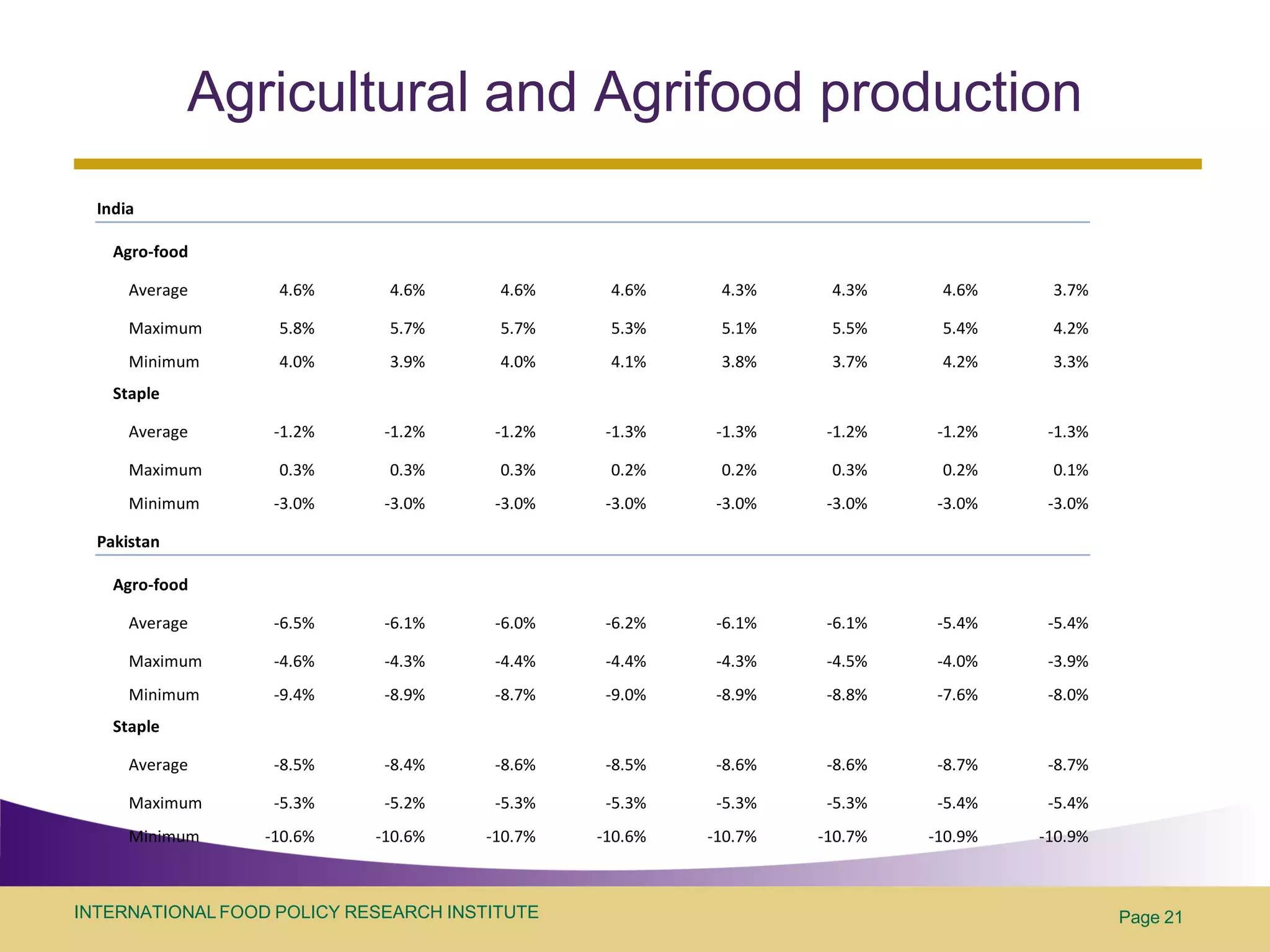
    Agricultural and Agrifoodproduction India Agro-food Average 4.6% 4.6% 4.6% 4.6% 4.3% 4.3% 4.6% 3.7% Maximum 5.8% 5.7% 5.7% 5.3% 5.1% 5.5% 5.4% 4.2% Minimum 4.0% 3.9% 4.0% 4.1% 3.8% 3.7% 4.2% 3.3% Staple Average -1.2% -1.2% -1.2% -1.3% -1.3% -1.2% -1.2% -1.3% Maximum 0.3% 0.3% 0.3% 0.2% 0.2% 0.3% 0.2% 0.1% Minimum -3.0% -3.0% -3.0% -3.0% -3.0% -3.0% -3.0% -3.0% Pakistan Agro-food Average -6.5% -6.1% -6.0% -6.2% -6.1% -6.1% -5.4% -5.4% Maximum -4.6% -4.3% -4.4% -4.4% -4.3% -4.5% -4.0% -3.9% Minimum -9.4% -8.9% -8.7% -9.0% -8.9% -8.8% -7.6% -8.0% Staple Average -8.5% -8.4% -8.6% -8.5% -8.6% -8.6% -8.7% -8.7% Maximum -5.3% -5.2% -5.3% -5.3% -5.3% -5.3% -5.4% -5.4% Minimum -10.6% -10.6% -10.7% -10.6% -10.7% -10.7% -10.9% -10.9% INTERNATIONAL FOOD POLICY RESEARCH INSTITUTE Page 20
  • 22.
    Agricultural and Agrifoodproduction India Agro-food Average 4.6% 4.6% 4.6% 4.6% 4.3% 4.3% 4.6% 3.7% Maximum 5.8% 5.7% 5.7% 5.3% 5.1% 5.5% 5.4% 4.2% Minimum 4.0% 3.9% 4.0% 4.1% 3.8% 3.7% 4.2% 3.3% Staple Average -1.2% -1.2% -1.2% -1.3% -1.3% -1.2% -1.2% -1.3% Maximum 0.3% 0.3% 0.3% 0.2% 0.2% 0.3% 0.2% 0.1% Minimum -3.0% -3.0% -3.0% -3.0% -3.0% -3.0% -3.0% -3.0% Pakistan Agro-food Average -6.5% -6.1% -6.0% -6.2% -6.1% -6.1% -5.4% -5.4% Maximum -4.6% -4.3% -4.4% -4.4% -4.3% -4.5% -4.0% -3.9% Minimum -9.4% -8.9% -8.7% -9.0% -8.9% -8.8% -7.6% -8.0% Staple Average -8.5% -8.4% -8.6% -8.5% -8.6% -8.6% -8.7% -8.7% Maximum -5.3% -5.2% -5.3% -5.3% -5.3% -5.3% -5.4% -5.4% Minimum -10.6% -10.6% -10.7% -10.6% -10.7% -10.7% -10.9% -10.9% INTERNATIONAL FOOD POLICY RESEARCH INSTITUTE Page 21
  • 23.
    Agricultural production India Wheat -7.2% -7.2% -7.2% -7.3% -7.3% -7.2% -7.4% -7.5% Vegetal Oils -4.6% -4.7% -5.0% -6.3% -6.6% -5.2% -7.2% -4.8% Rice -4.8% -4.8% -4.8% -4.8% -4.9% -4.8% -4.9% -5.3% Cotton -3.5% -3.5% -3.5% -3.6% -3.6% -3.5% -3.6% -3.6% Oilseeds -2.0% -2.0% -2.0% -2.1% -2.1% -2.1% -2.0% -2.1% Pakistan Oilseeds -35.1% -35.1% -35.0% -34.8% -34.8% -35.1% -34.7% -34.6% Rice -32.7% -32.6% -32.6% -32.6% -32.6% -32.6% -33.2% -33.5% Cotton -27.6% -27.6% -27.6% -27.6% -27.7% -27.7% -27.6% -27.6% Pulses -27.2% -27.1% -27.4% -27.4% -27.3% -27.3% -27.4% -27.3% Vegetables and Fruits -22.2% -22.2% -22.2% -22.3% -22.3% -22.2% -22.6% -22.6% INTERNATIONAL FOOD POLICY RESEARCH INSTITUTE Page 22
  • 24.
    A serious redistributionconcern: Changes in unskilled worker wages BASE SAFTA SAFTAFULL UNIAGR UNIALL UNISEN FTA MULTI Bangladesh Average -2.1% -2.1% -2.0% -2.0% -1.9% -2.0% -1.9% -1.9% Maximum -0.4% -0.3% -0.3% -0.3% -0.3% -0.3% -0.3% -0.3% Minimum -3.6% -3.5% -3.4% -3.3% -3.3% -3.3% -3.3% -3.3% India Average 1.6% 1.5% 1.4% 0.8% 0.4% 0.8% 1.0% 0.8% Maximum 8.2% 8.1% 8.0% 6.1% 3.9% 4.9% 5.4% 4.3% Minimum -9.1% -9.1% -9.1% -7.8% -5.4% -6.0% -6.0% -4.7% Pakistan Average -5.9% -5.8% -5.7% -5.7% -5.3% -5.3% -5.4% -5.2% Maximum -3.3% -3.2% -3.1% -3.3% -2.8% -2.8% -2.8% -2.7% Minimum -8.2% -8.1% -8.0% -7.9% -7.4% -7.5% -7.5% -7.3% Sri Lanka Average -1.9% -1.9% -1.9% -2.0% -2.1% -1.9% -2.3% -2.3% Maximum -1.2% -1.2% -1.2% -1.3% -1.4% -1.2% -1.6% -1.6% Minimum -2.4% -2.4% -2.4% -2.5% -2.6% -2.4% -2.9% -2.8% INTERNATIONAL FOOD POLICY RESEARCH INSTITUTE Page 23
  • 25.
    (too) Large Substitutioneffects on the consumption side? Changes in consumption INTERNATIONAL FOOD POLICY RESEARCH INSTITUTE Page 24
  • 26.
    Level of Imports INTERNATIONALFOOD POLICY RESEARCH INSTITUTE Page 25
  • 27.
    Concluding remarks • The Trade policy landscape has limited macroeconomic effects of Climate Change consequences on average yield • Larger role on distribution (poor people): needs to investigate the issue deeper, in particular with better demand modeling: integration of the MIRAGE-Climate Change and the MIRAGE-Household disaggregation modele • Large Uncertainties • Promote economic growth (endogenous investments) and role of FDI? • Flexibilities for farmers to change crops • Flexibilities to relocate production: infrastructure • Caution with any large sunk costs (R&D in one crop…) • Improved work on irrigation INTERNATIONAL FOOD POLICY RESEARCH INSTITUTE Page 26