Long Run Investment: Opportunities and Frictions

                        Paolo Guasoni

             Boston University and Dublin City University


                    July 2-6, 2012
           CoLab Mathematics Summer School
Outline


• Long Run and Stochastic Investment Opportunities
• High-water Marks and Hedge Fund Fees
• Transaction Costs
• Price Impact
• Open Problems
Long Run and Stochastic Investment Opportunities


                                                   One

    Long Run and Stochastic Investment Opportunities
                                          Based on
                        Portfolios and Risk Premia for the Long Run
                                    with Scott Robertson
Long Run and Stochastic Investment Opportunities


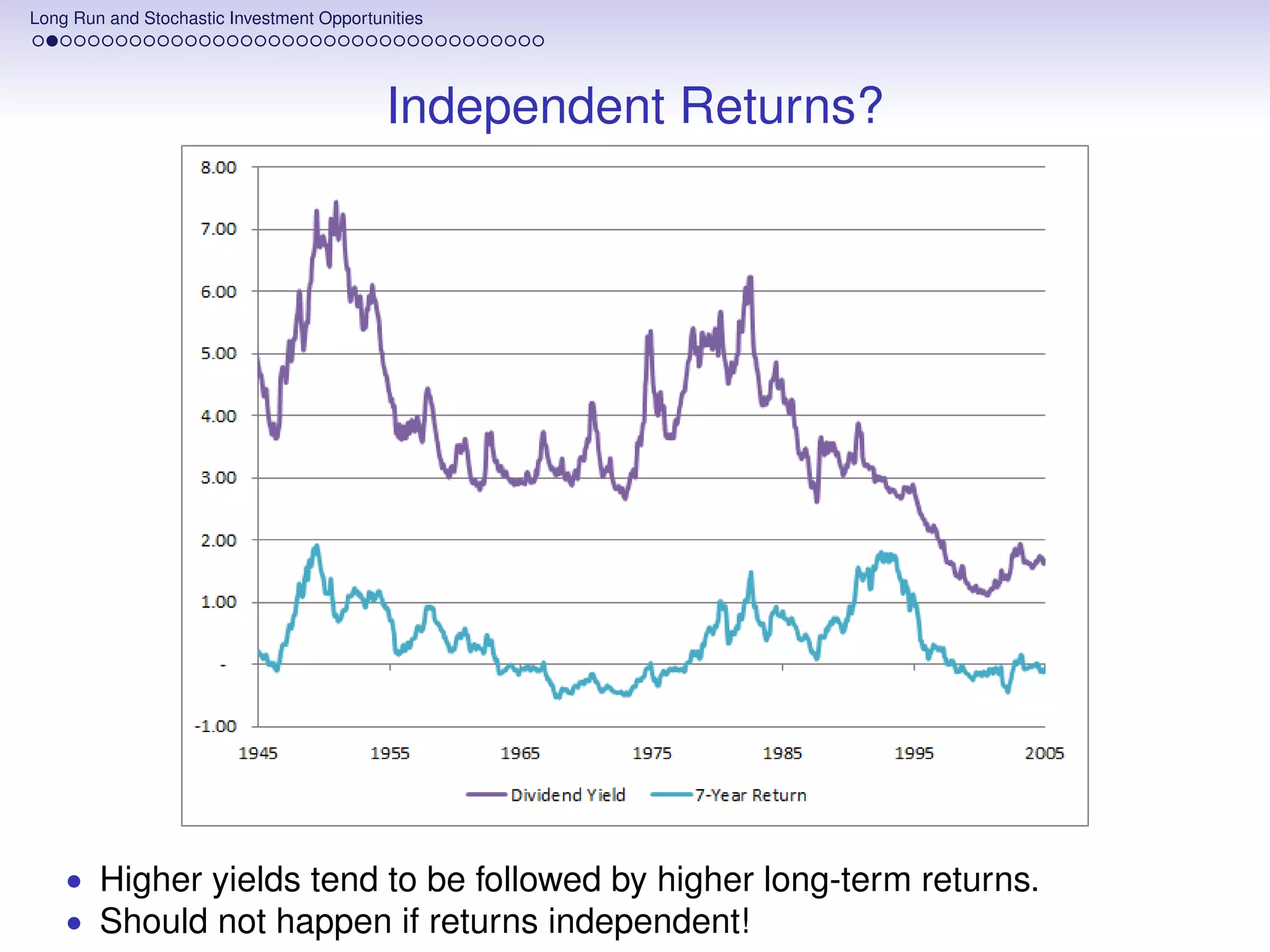
                                           Independent Returns?


    • Higher yields tend to be followed by higher long-term returns.
    • Should not happen if returns independent!
Long Run and Stochastic Investment Opportunities


                                               Utility Maximization
    • Basic portfolio choice problem: maximize utility from terminal wealth:
                                                              π
                                                     max E[U(XT )]
                                                      π

    • Easy for logarithmic utility U(x) = log x.
        Myopic portfolio π = Σ−1 µ optimal. Numeraire argument.
    •   Portfolio does not depend on horizon (even random!), and on the
        dynamics of the the state variable, but only its current value.
    •   But logarithmic utility leads to counterfactual predictions.
        And implies that unhedgeable risk premia η are all zero.
    •   Power utility U(x) = x 1−γ /(1 − γ) is more flexible.
        Portfolio no longer myopic. Risk premia η nonzero, and depend on γ.
    •   Power utility far less tractable.
        Joint dependence on horizon and state variable dynamics.
    •   Explicit solutions few and cumbersome.
    •   Goal: keep dependence from state variable dynamics, lose from horizon.
    •   Tool: assume long horizon.
Long Run and Stochastic Investment Opportunities


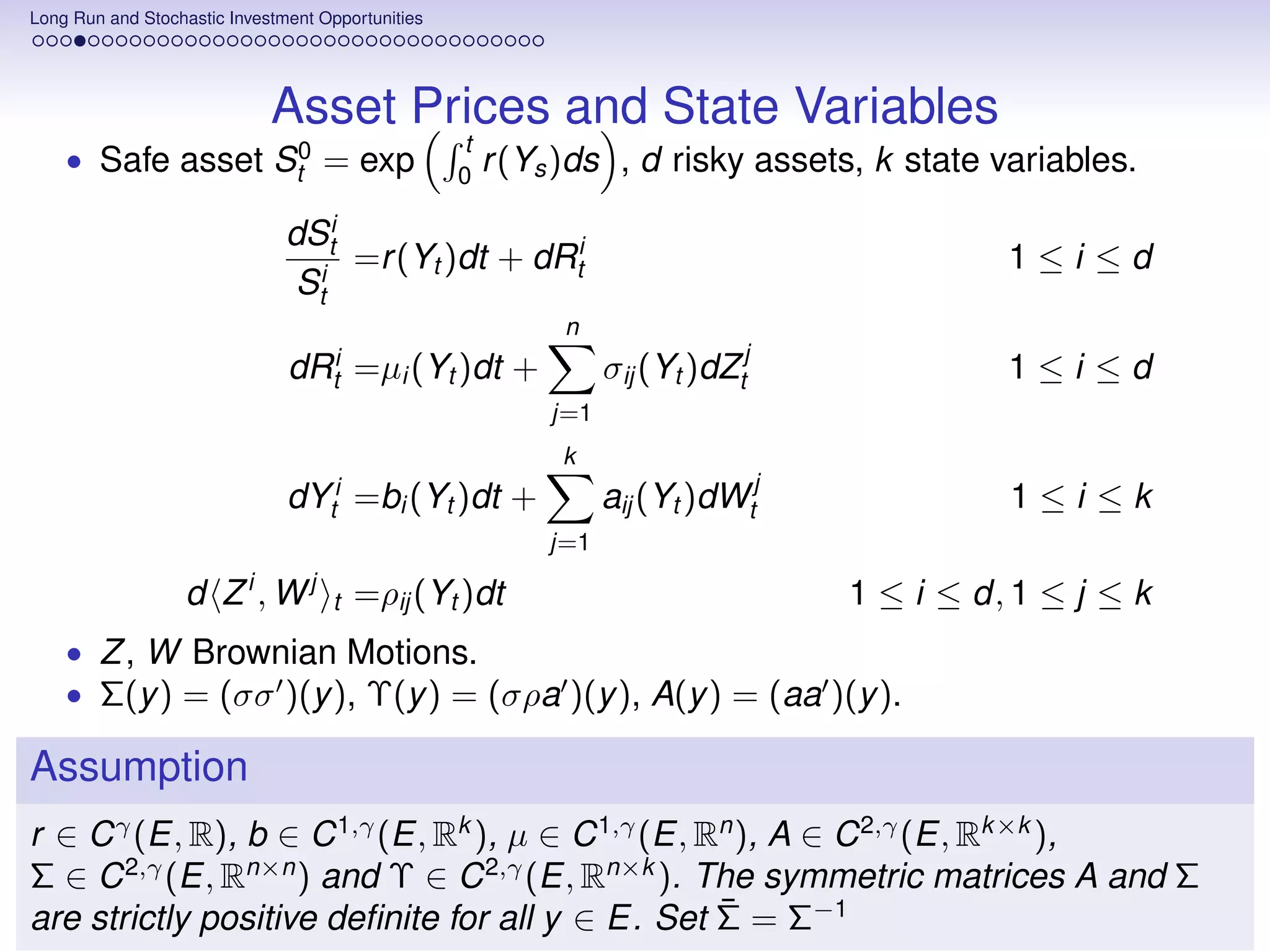
                             Asset Prices and State Variables
                                                   t
    • Safe asset St0 = exp                         0
                                                       r (Ys )ds , d risky assets, k state variables.

                               dSti
                                    =r (Yt )dt + dRti                                      1≤i ≤d
                                Sti
                                                            n
                               dRti     =µi (Yt )dt +            σij (Yt )dZtj             1≤i ≤d
                                                           j=1
                                                            k
                               dYti =bi (Yt )dt +                aij (Yt )dWtj              1≤i ≤k
                                                           j=1

                   d Zi, Wj         t   =ρij (Yt )dt                             1 ≤ i ≤ d, 1 ≤ j ≤ k
    • Z , W Brownian Motions.
    • Σ(y ) = (σσ )(y ), Υ(y ) = (σρa )(y ), A(y ) = (aa )(y ).

Assumption
r ∈ C γ (E, R), b ∈ C 1,γ (E, Rk ), µ ∈ C 1,γ (E, Rn ), A ∈ C 2,γ (E, Rk ×k ),
Σ ∈ C 2,γ (E, Rn×n ) and Υ ∈ C 2,γ (E, Rn×k ). The symmetric matrices A and Σ
                                                   ¯
are strictly positive definite for all y ∈ E. Set Σ = Σ−1
Long Run and Stochastic Investment Opportunities


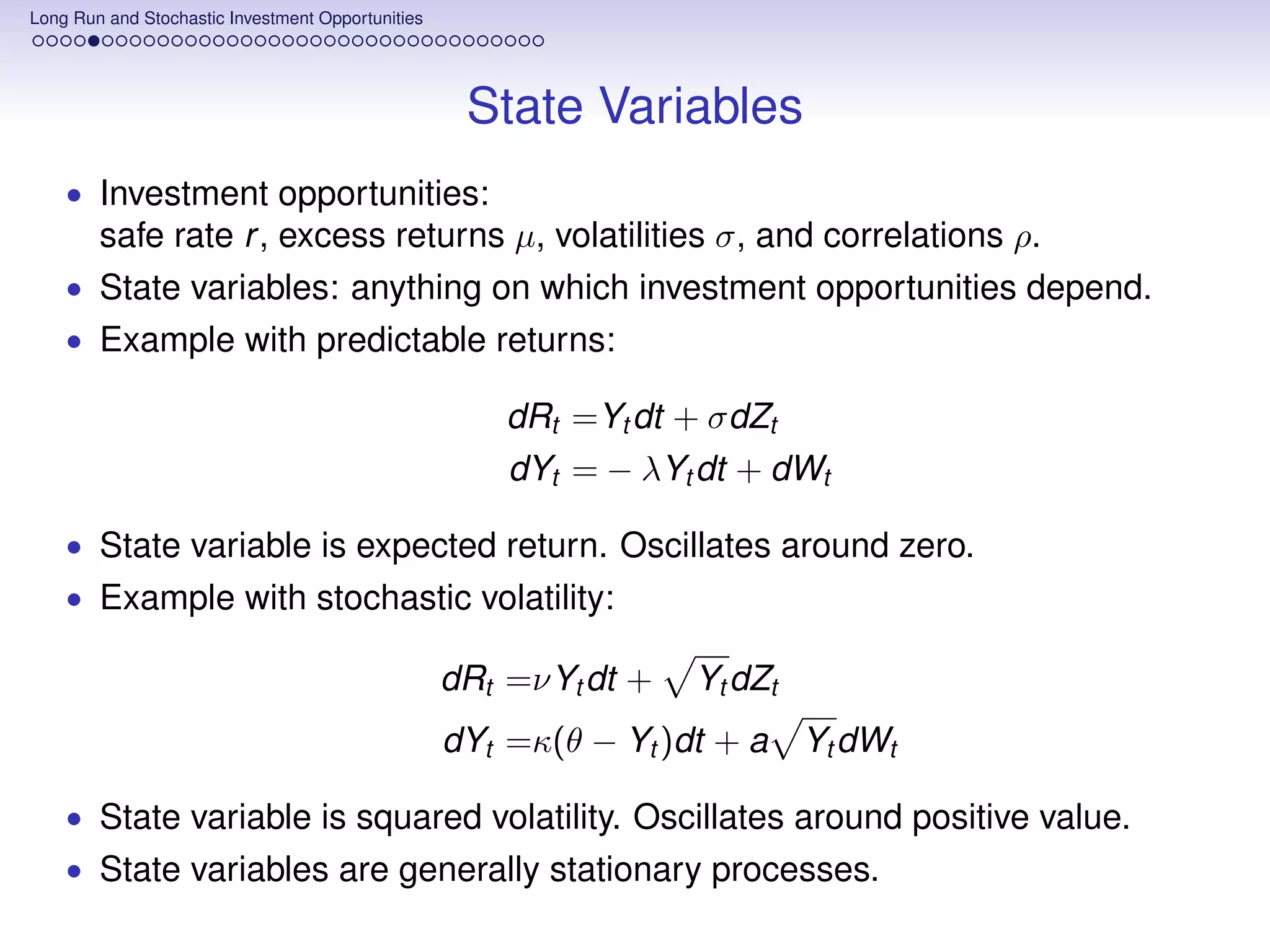
                                                    State Variables
    • Investment opportunities:
        safe rate r , excess returns µ, volatilities σ, and correlations ρ.
    • State variables: anything on which investment opportunities depend.
    • Example with predictable returns:

                                                       dRt =Yt dt + σdZt
                                                       dYt = − λYt dt + dWt

    • State variable is expected return. Oscillates around zero.
    • Example with stochastic volatility:

                                                   dRt =νYt dt +   Yt dZt
                                                   dYt =κ(θ − Yt )dt + a    Yt dWt

    • State variable is squared volatility. Oscillates around positive value.
    • State variables are generally stationary processes.
Long Run and Stochastic Investment Opportunities


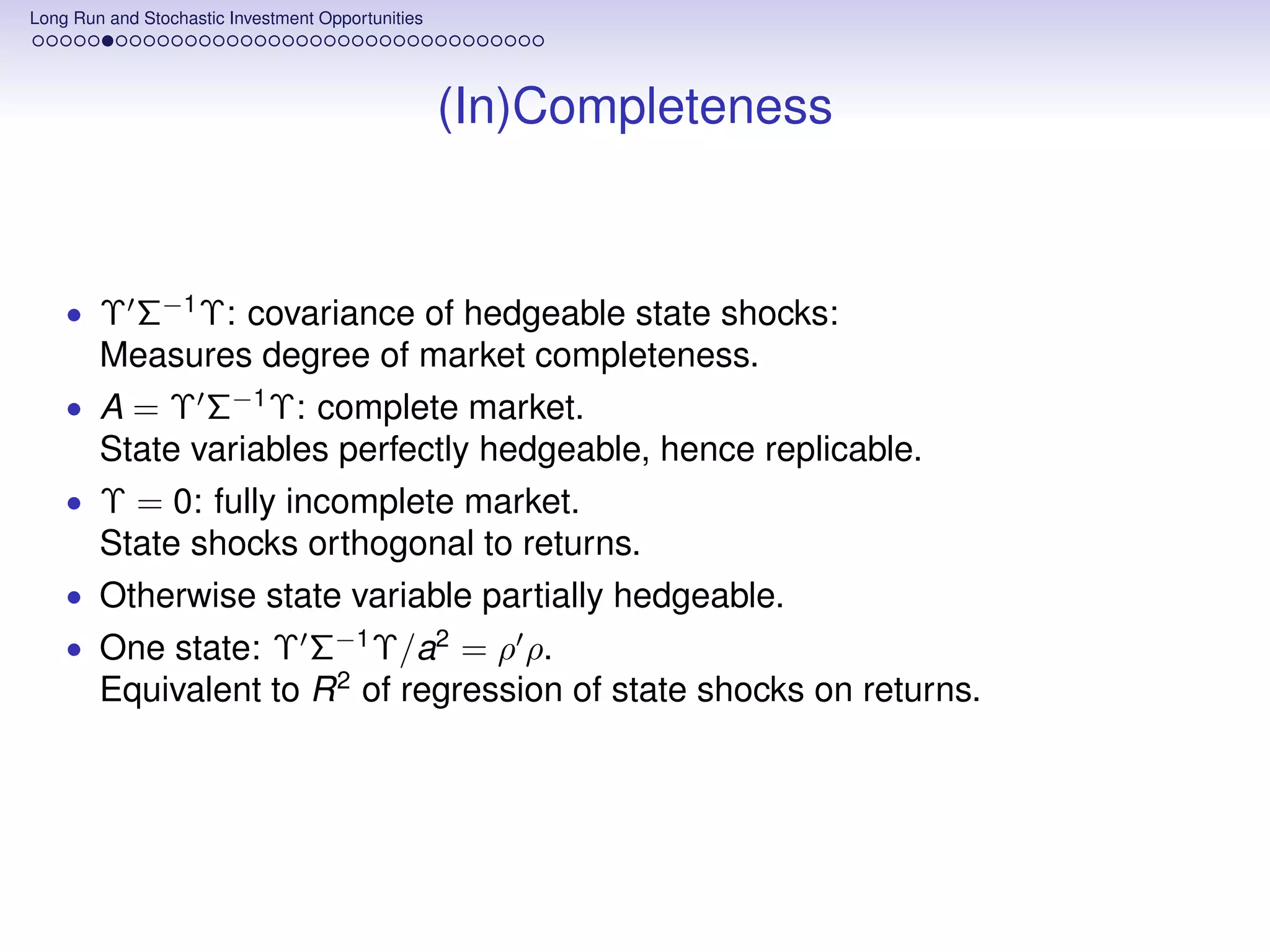
                                                   (In)Completeness


    • Υ Σ−1 Υ: covariance of hedgeable state shocks:
        Measures degree of market completeness.
    • A = Υ Σ−1 Υ: complete market.
        State variables perfectly hedgeable, hence replicable.
    • Υ = 0: fully incomplete market.
        State shocks orthogonal to returns.
    • Otherwise state variable partially hedgeable.
    • One state: Υ Σ−1 Υ/a2 = ρ ρ.
        Equivalent to R 2 of regression of state shocks on returns.
Long Run and Stochastic Investment Opportunities


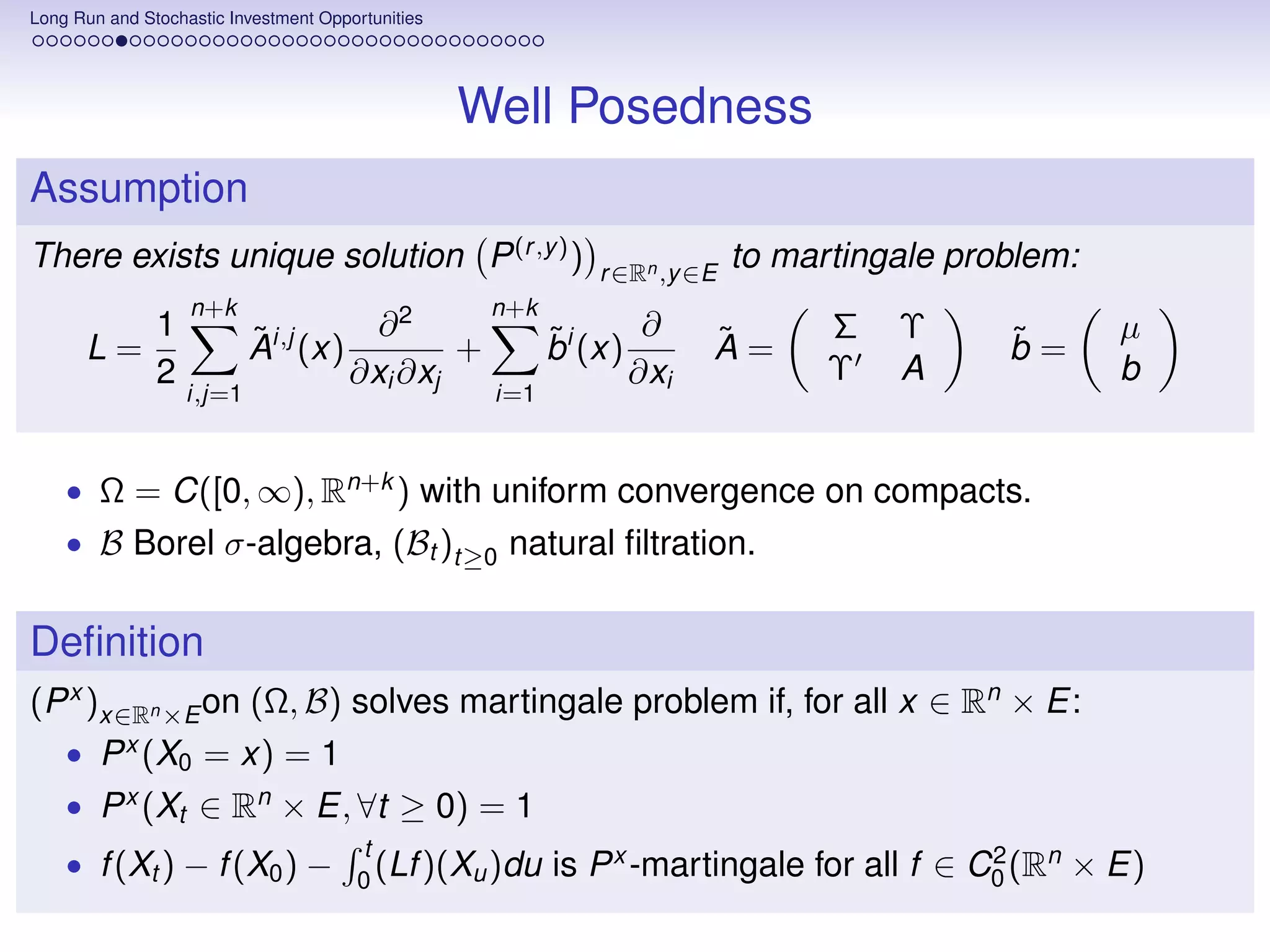
                                                   Well Posedness
Assumption
There exists unique solution P (r ,y ) )                      r ∈Rn ,y ∈E
                                                                            to martingale problem:
                   n+k                              n+k
               1           ˜          ∂2                  ˜       ∂     ˜         Σ   Υ      ˜       µ
      L=                   Ai,j (x)         +             bi (x)        A=                   b=
               2                    ∂xi ∂xj                      ∂xi              Υ   A              b
                   i,j=1                            i=1


    • Ω = C([0, ∞), Rn+k ) with uniform convergence on compacts.
    • B Borel σ-algebra, (Bt )t≥0 natural filtration.


Definition
(P x )x∈Rn ×E on (Ω, B) solves martingale problem if, for all x ∈ Rn × E:
    • P x (X0 = x) = 1
    • P x (Xt ∈ Rn × E, ∀t ≥ 0) = 1
                                       t
    • f (Xt ) − f (X0 ) −              0
                                         (Lf )(Xu )du     is P x -martingale for all f ∈ C0 (Rn × E)
                                                                                          2
Long Run and Stochastic Investment Opportunities


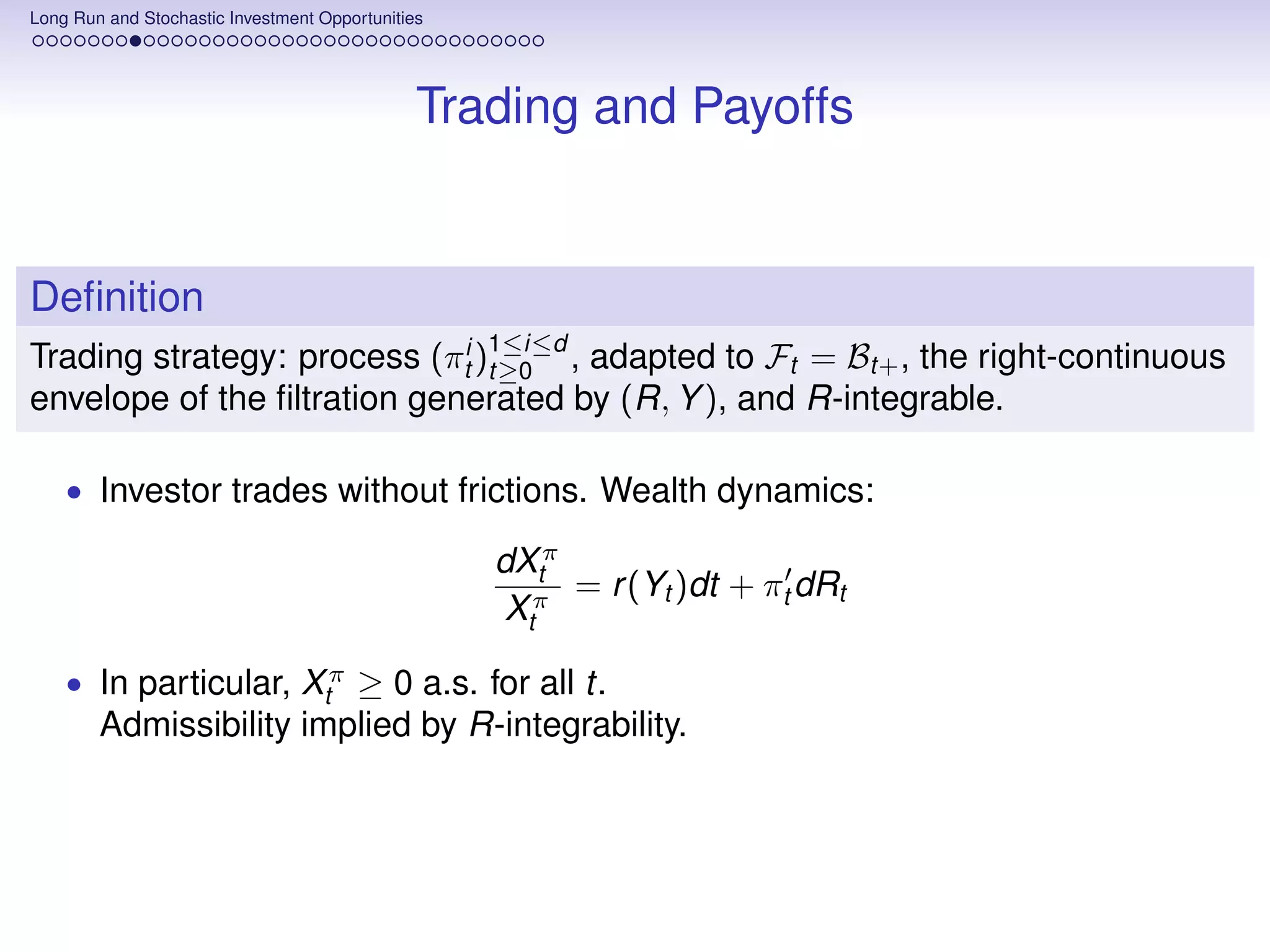
                                               Trading and Payoffs


Definition
Trading strategy: process (πti )1≤i≤d , adapted to Ft = Bt+ , the right-continuous
                                t≥0
envelope of the filtration generated by (R, Y ), and R-integrable.

    • Investor trades without frictions. Wealth dynamics:

                                                   dXtπ
                                                        = r (Yt )dt + πt dRt
                                                    Xtπ

    • In particular, Xtπ ≥ 0 a.s. for all t.
        Admissibility implied by R-integrability.
Long Run and Stochastic Investment Opportunities


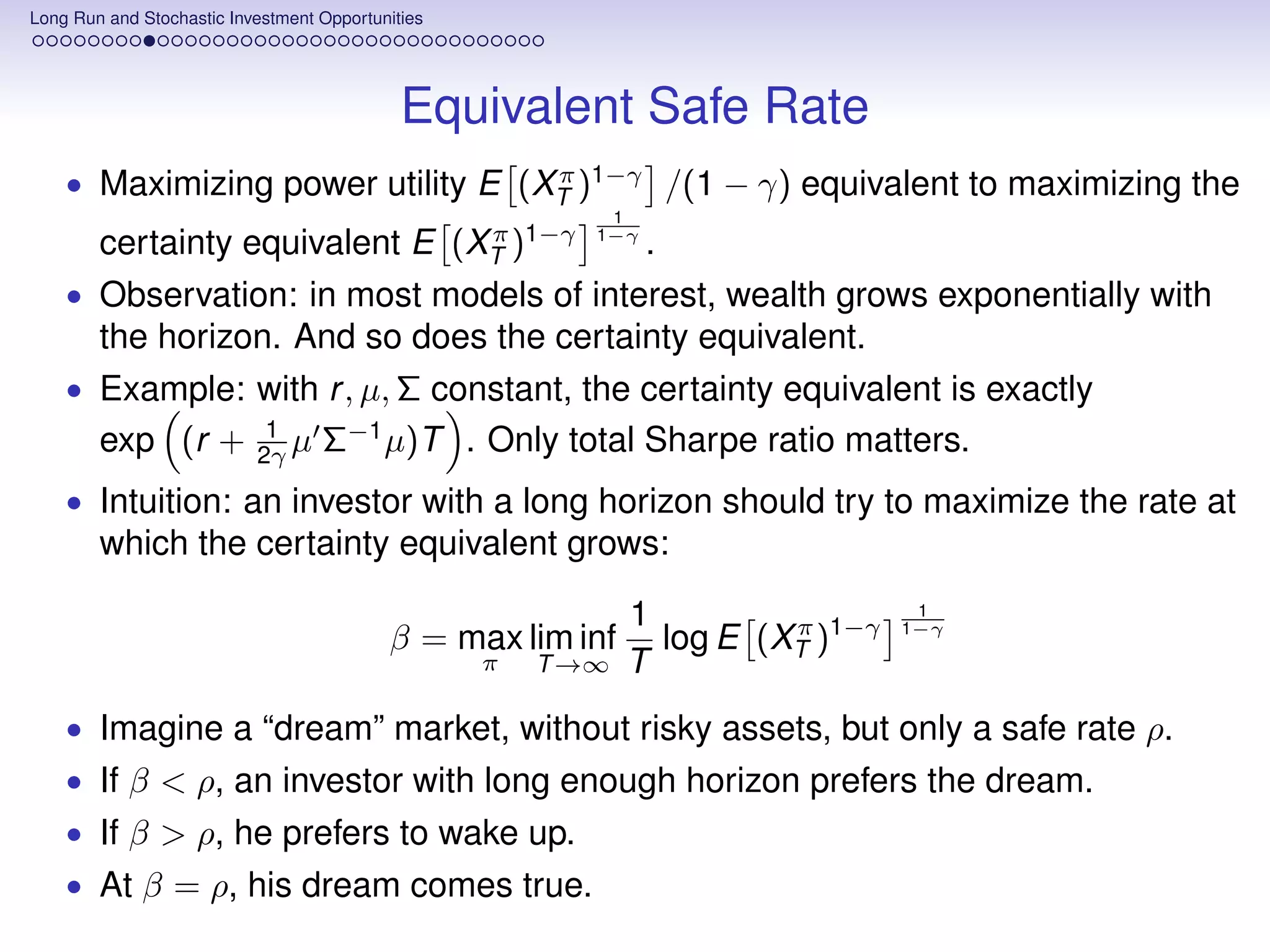
                                             Equivalent Safe Rate
    • Maximizing power utility E (XT )1−γ /(1 − γ) equivalent to maximizing the
                                   π
                                                           1
        certainty equivalent E (XT )1−γ
                                 π                        1−γ
                                                                .
    • Observation: in most models of interest, wealth grows exponentially with
        the horizon. And so does the certainty equivalent.
    • Example: with r , µ, Σ constant, the certainty equivalent is exactly
                            1
        exp (r +           2γ µ    Σ−1 µ)T . Only total Sharpe ratio matters.
    • Intuition: an investor with a long horizon should try to maximize the rate at
        which the certainty equivalent grows:

                                                              1                   1
                                           β = max lim inf      log E (XT )1−γ
                                                                        π        1−γ

                                                   π   T →∞   T
    • Imagine a “dream” market, without risky assets, but only a safe rate ρ.
    • If β < ρ, an investor with long enough horizon prefers the dream.
    • If β > ρ, he prefers to wake up.
    • At β = ρ, his dream comes true.
Long Run and Stochastic Investment Opportunities


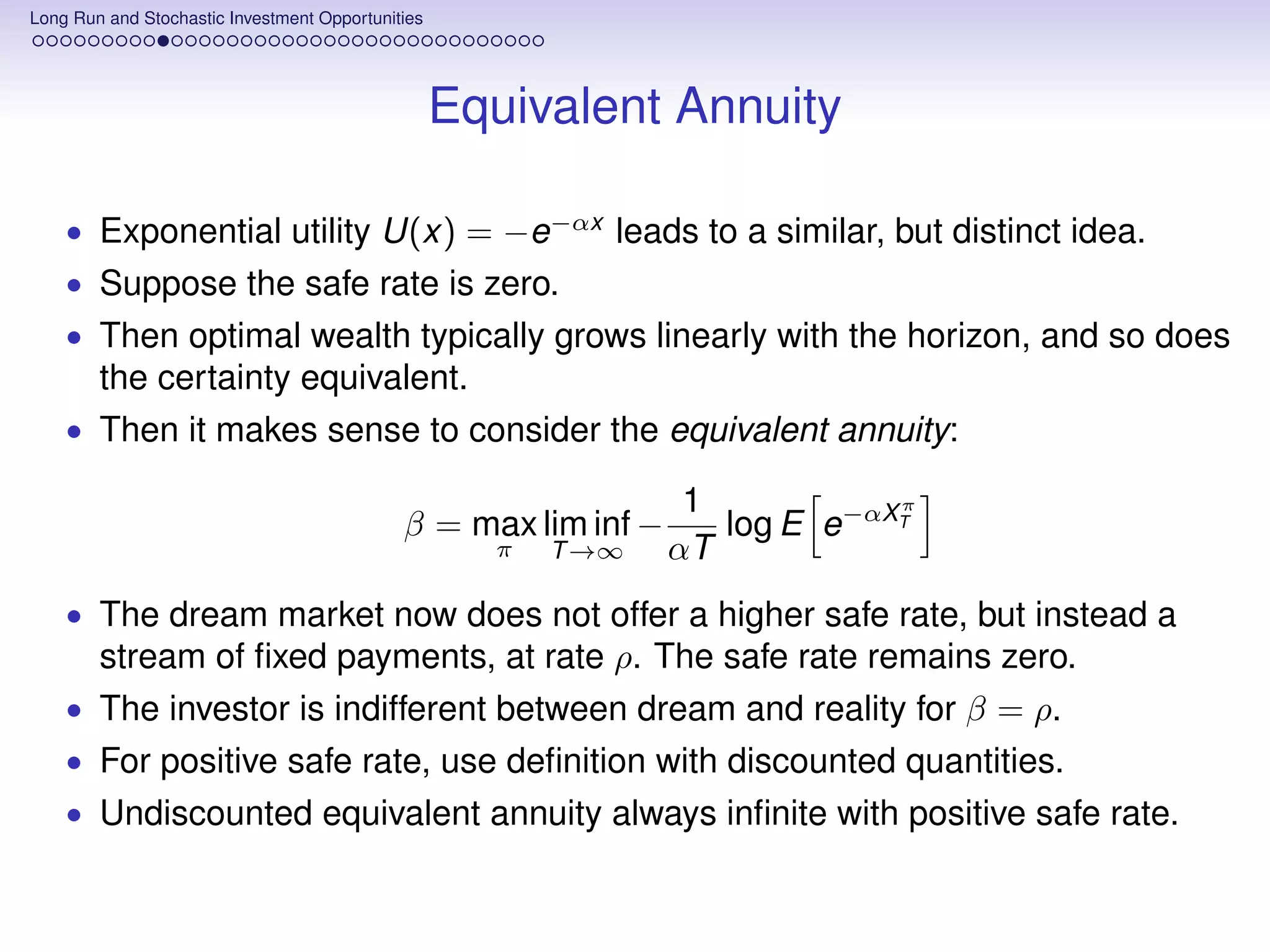
                                                   Equivalent Annuity

    • Exponential utility U(x) = −e−αx leads to a similar, but distinct idea.
    • Suppose the safe rate is zero.
    • Then optimal wealth typically grows linearly with the horizon, and so does
        the certainty equivalent.
    • Then it makes sense to consider the equivalent annuity:

                                                                  1           π
                                             β = max lim inf −      log E e−αXT
                                                     π   T →∞    αT
    • The dream market now does not offer a higher safe rate, but instead a
        stream of fixed payments, at rate ρ. The safe rate remains zero.
    • The investor is indifferent between dream and reality for β = ρ.
    • For positive safe rate, use definition with discounted quantities.
    • Undiscounted equivalent annuity always infinite with positive safe rate.
Long Run and Stochastic Investment Opportunities


                                                   Solution Strategy


    • Duality Bound.
    • Stationary HJB equation and finite-horizon bounds.
    • Criteria for long-run optimality.
Long Run and Stochastic Investment Opportunities


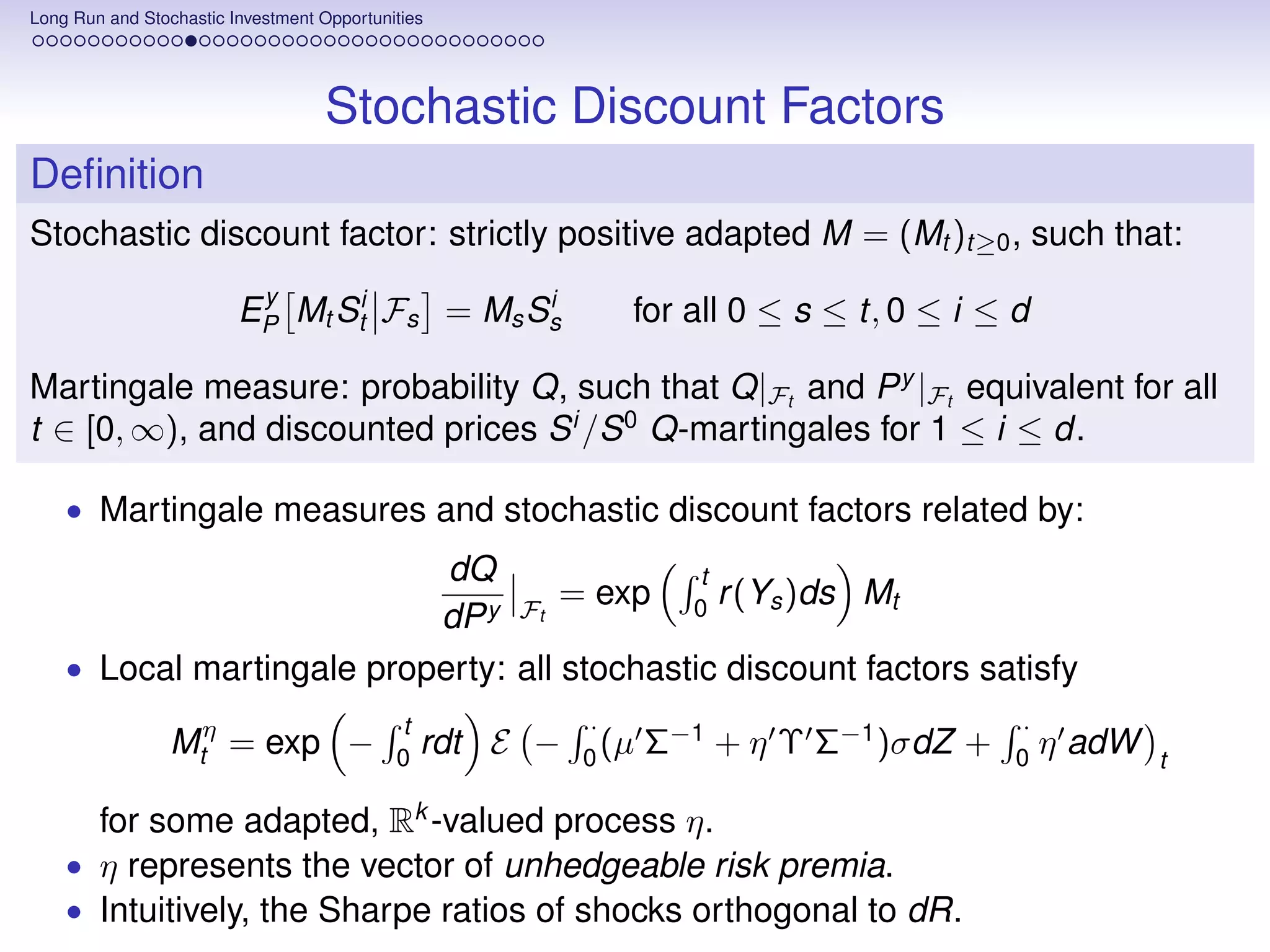
                                    Stochastic Discount Factors
Definition
Stochastic discount factor: strictly positive adapted M = (Mt )t≥0 , such that:
                          y
                         EP Mt Sti Fs = Ms Ss
                                            i
                                                             for all 0 ≤ s ≤ t, 0 ≤ i ≤ d

Martingale measure: probability Q, such that Q|Ft and P y |Ft equivalent for all
t ∈ [0, ∞), and discounted prices S i /S 0 Q-martingales for 1 ≤ i ≤ d.

    • Martingale measures and stochastic discount factors related by:
                            dQ                t
                                     = exp 0 r (Ys )ds Mt
                           dP y Ft
    • Local martingale property: all stochastic discount factors satisfy
                                            t             ·                             ·
                 Mtη = exp −                0
                                                rdt E −   0
                                                            (µ   Σ−1 + η Υ Σ−1 )σdZ +   0
                                                                                            η adW   t

      for some adapted, Rk -valued process η.
    • η represents the vector of unhedgeable risk premia.
    • Intuitively, the Sharpe ratios of shocks orthogonal to dR.
Long Run and Stochastic Investment Opportunities


                                                     Duality Bound
                                              π          η
    • For any payoff X =    and any discount factor M = MT , E[XM] ≤ x.
                                             XT
      Because XM is a local martingale.
    • Duality bound for power utility:
                                                                                   γ
                                                              1
                                                                                  1−γ
                                                   E X 1−γ   1−γ
                                                                   ≤ xE M 1−1/γ

    • Proof: exercise with Hölder’s inequality.
    • Duality bound for exponential utility:

                                    1               x   1   M        M
                                −     log E e−αX ≤     + E      log
                                    α              E[M] α  E[M]     E[M]
    • Proof: Jensen inequality under risk-neutral densities.
    • Both bounds true for any X and for any M.
      Pass to sup over X and inf over M.
    • Note how α disappears from the right-hand side.
    • Both bounds in terms of certainty equivalents.
    • As T → ∞, bounds for equivalent safe rate and annuity follow.
Long Run and Stochastic Investment Opportunities


                                              Long Run Optimality
Definition (Power Utility)
An admissible portfolio π is long run optimal if it solves:
                                    1                    1
                        max lim inf log E (XT )1−γ 1−γ
                                                π
                         π    T →∞ T

The risk premia η are long run optimal if they solve:
                                                                 γ
                                  1           η                 1−γ
                      min lim sup log E (MT )1−1/γ
                        η   T →∞ T

Pair (π, η) long run optimal if both conditions hold, and limits coincide.

    • Easier to show that (π, η) long run optimal together.
    • Each η is an upper bound for all π and vice versa.

Definition (Exponential Utility)
Portfolio π and risk premia η long run optimal if they solve:
                       1             π                        η     η
          max lim inf − log E e−αXT                      1
                                            min lim sup T E MT log MT
            π  T →∞    T                     η     T →∞
Long Run and Stochastic Investment Opportunities


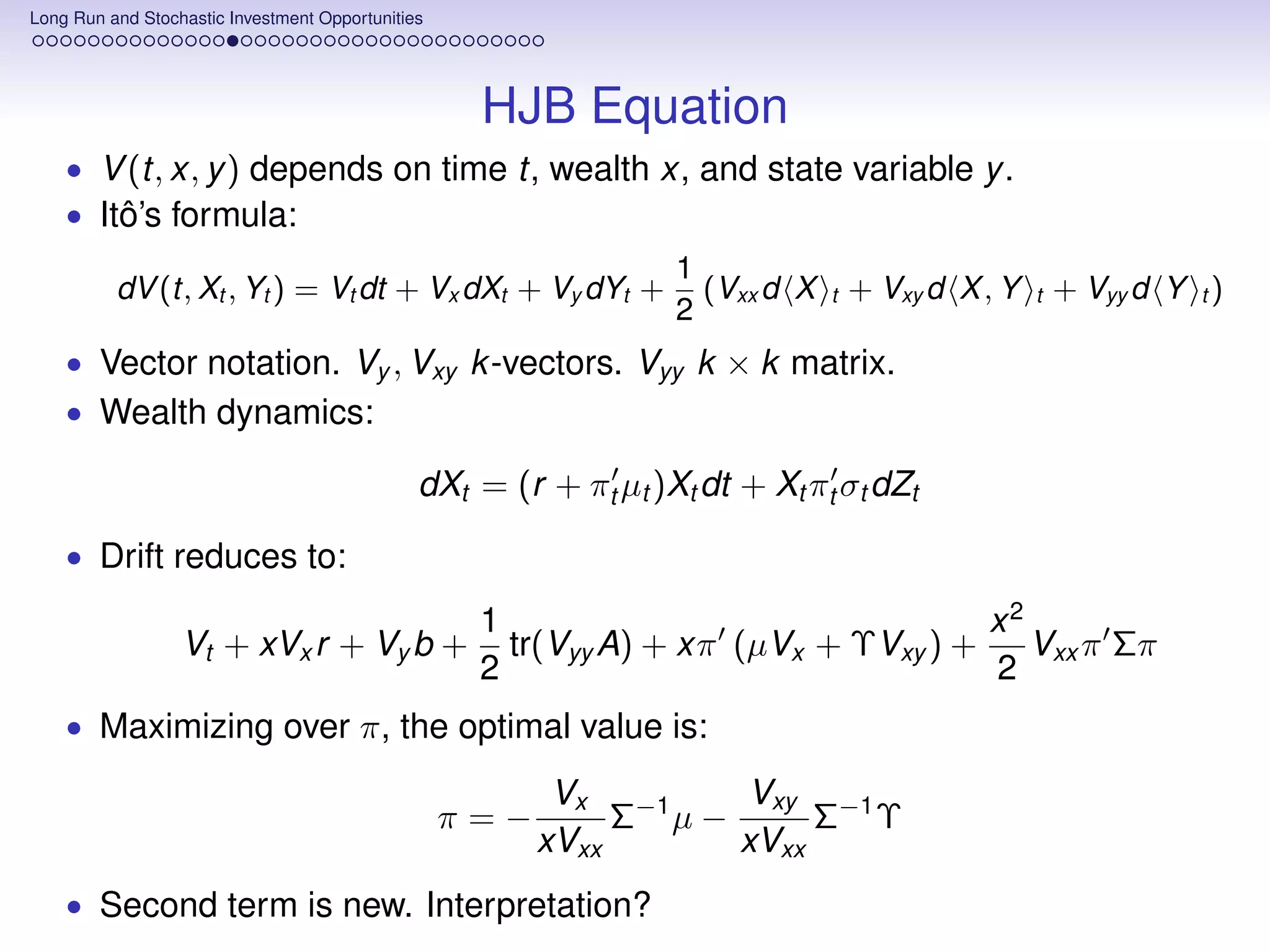
                                                    HJB Equation
    • V (t, x, y ) depends on time t, wealth x, and state variable y .
    • Itô’s formula:
                                                                  1
          dV (t, Xt , Yt ) = Vt dt + Vx dXt + Vy dYt +              (Vxx d X   t   + Vxy d X , Y   t   + Vyy d Y t )
                                                                  2
    • Vector notation. Vy , Vxy k -vectors. Vyy k × k matrix.
    • Wealth dynamics:

                                               dXt = (r + πt µt )Xt dt + Xt πt σt dZt

    • Drift reduces to:

                                                    1                               x2
                  Vt + xVx r + Vy b +                 tr(Vyy A) + xπ (µVx + ΥVxy ) + Vxx π Σπ
                                                    2                               2
    • Maximizing over π, the optimal value is:

                                                          Vx −1    Vxy −1
                                                   π=−        Σ µ−      Σ Υ
                                                         xVxx      xVxx
    • Second term is new. Interpretation?
Long Run and Stochastic Investment Opportunities


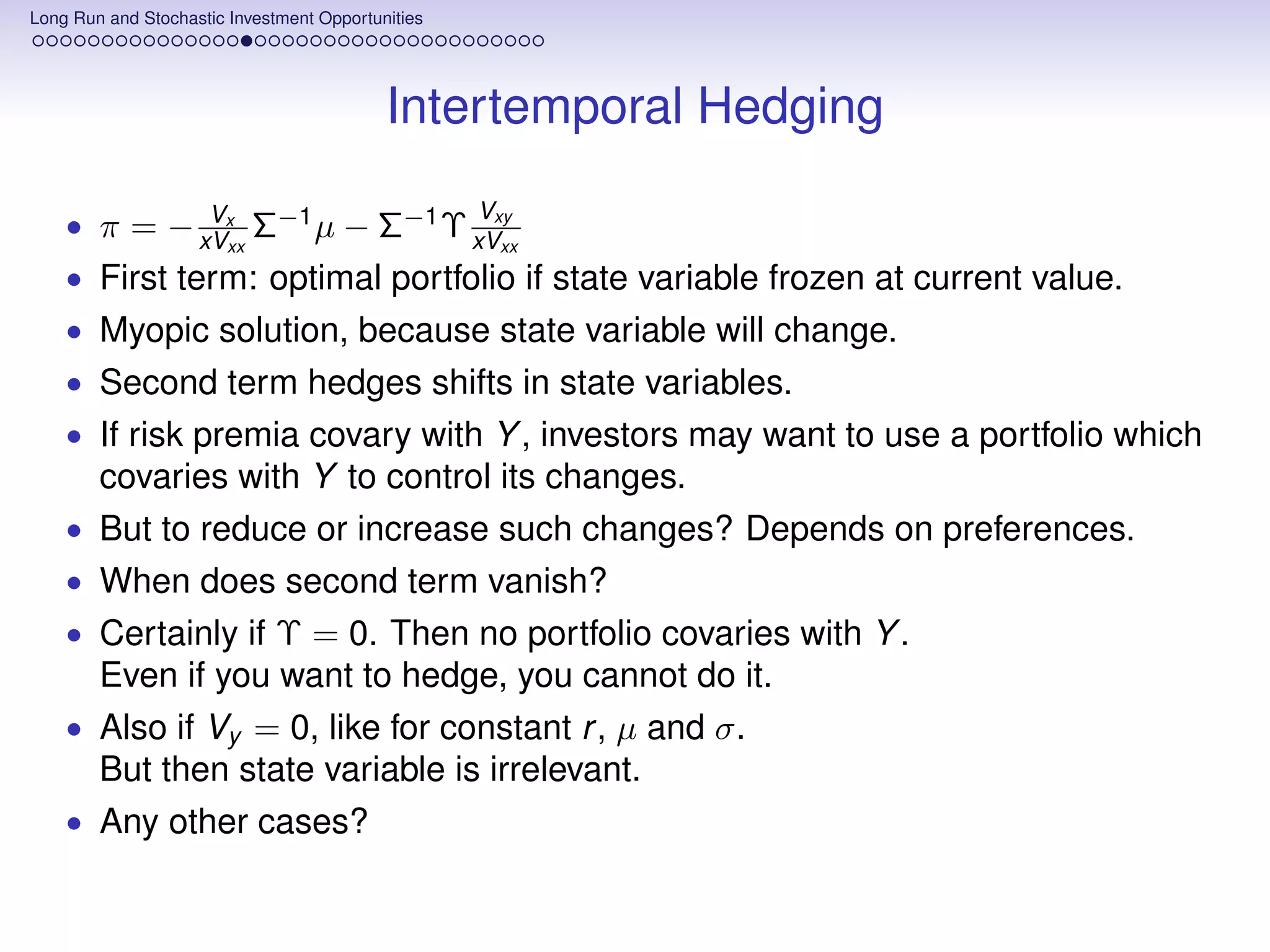
                                           Intertemporal Hedging
             V                                     V
    • π = − xVx Σ−1 µ − Σ−1 Υ xVxy
               xx                xx

    • First term: optimal portfolio if state variable frozen at current value.
    • Myopic solution, because state variable will change.
    • Second term hedges shifts in state variables.
    • If risk premia covary with Y , investors may want to use a portfolio which
        covaries with Y to control its changes.
    • But to reduce or increase such changes? Depends on preferences.
    • When does second term vanish?
    • Certainly if Υ = 0. Then no portfolio covaries with Y .
        Even if you want to hedge, you cannot do it.
    • Also if Vy = 0, like for constant r , µ and σ.
        But then state variable is irrelevant.
    • Any other cases?
Long Run and Stochastic Investment Opportunities


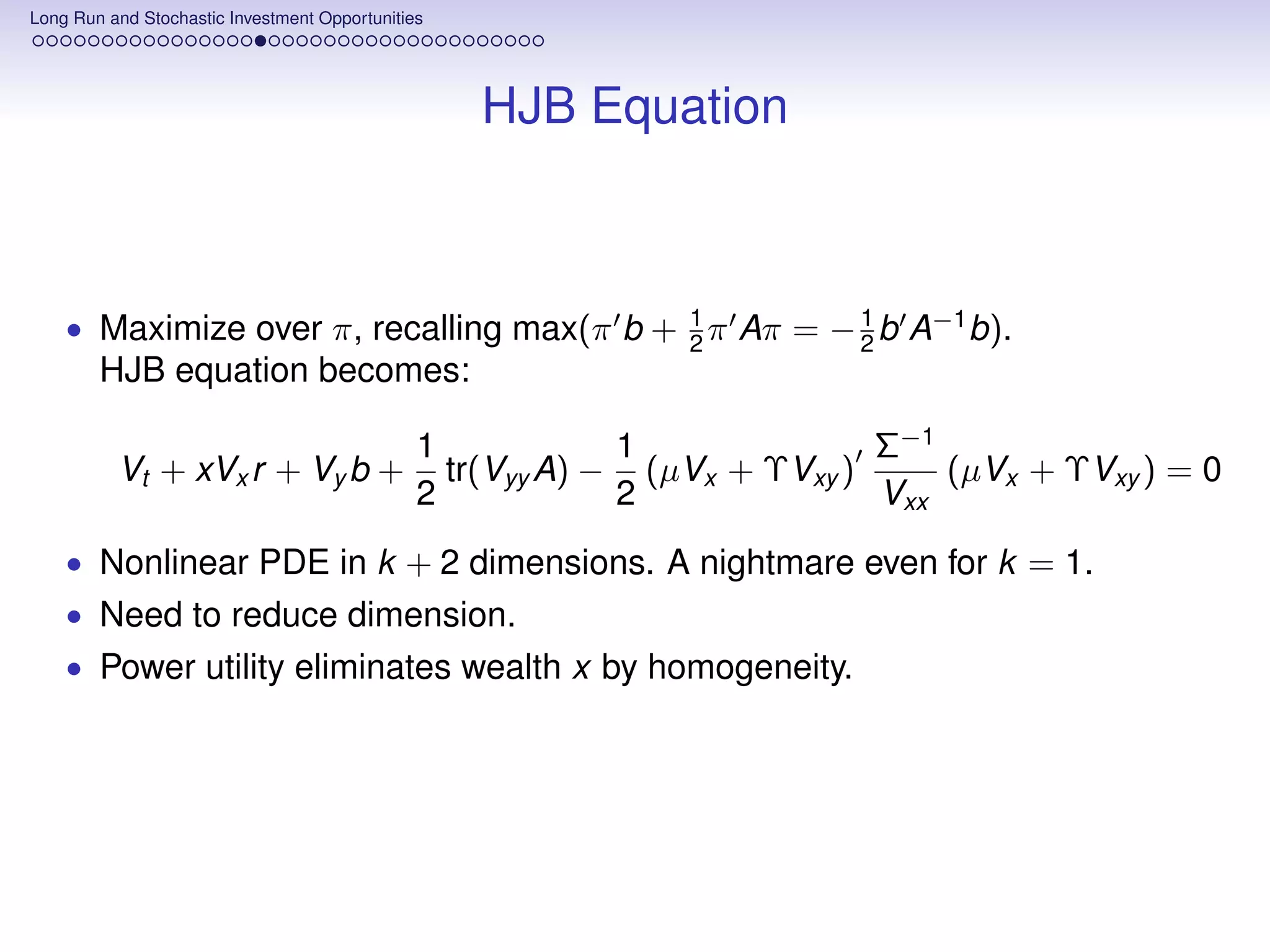
                                                   HJB Equation


    • Maximize over π, recalling max(π b + 2 π Aπ = − 1 b A−1 b).
                                           1
                                                      2
        HJB equation becomes:

                                               1            1              Σ−1
          Vt + xVx r + Vy b +                    tr(Vyy A) − (µVx + ΥVxy )     (µVx + ΥVxy ) = 0
                                               2            2              Vxx
    • Nonlinear PDE in k + 2 dimensions. A nightmare even for k = 1.
    • Need to reduce dimension.
    • Power utility eliminates wealth x by homogeneity.
Long Run and Stochastic Investment Opportunities


                                                   Homogeneity
    • For power utility, V (t, x, y ) =                 x 1−γ
                                                        1−γ v (t, y ).

                                x 1−γ
                     Vt =             vt           Vx = x −γ v             Vxx = −γx −γ−1 v
                                1−γ
                                                          x 1−γ                    x 1−γ
                   Vxy = x −γ vy                   Vy =         vy         Vyy =         vyy
                                                          1−γ                      1−γ
    • Optimal portfolio becomes:

                                                        1 −1   1      vy
                                                   π=     Σ µ + Σ−1 Υ
                                                        γ      γ      v
    • Plugging in, HJB equation becomes:

                                            1                 1−γ
            vt + (1 − γ) r +                  µ Σ−1 µ v + b +     Υ Σ−1 µ vy
                                           2γ                  γ
                                                                     1             1 − γ vy Υ Σ−1 Υvy
                                                                 +     tr(vyy A) +                    =0
                                                                     2               γ        2v
    • Nonlinear PDE in k + 1 variables. Still hard to deal with.
Long Run and Stochastic Investment Opportunities


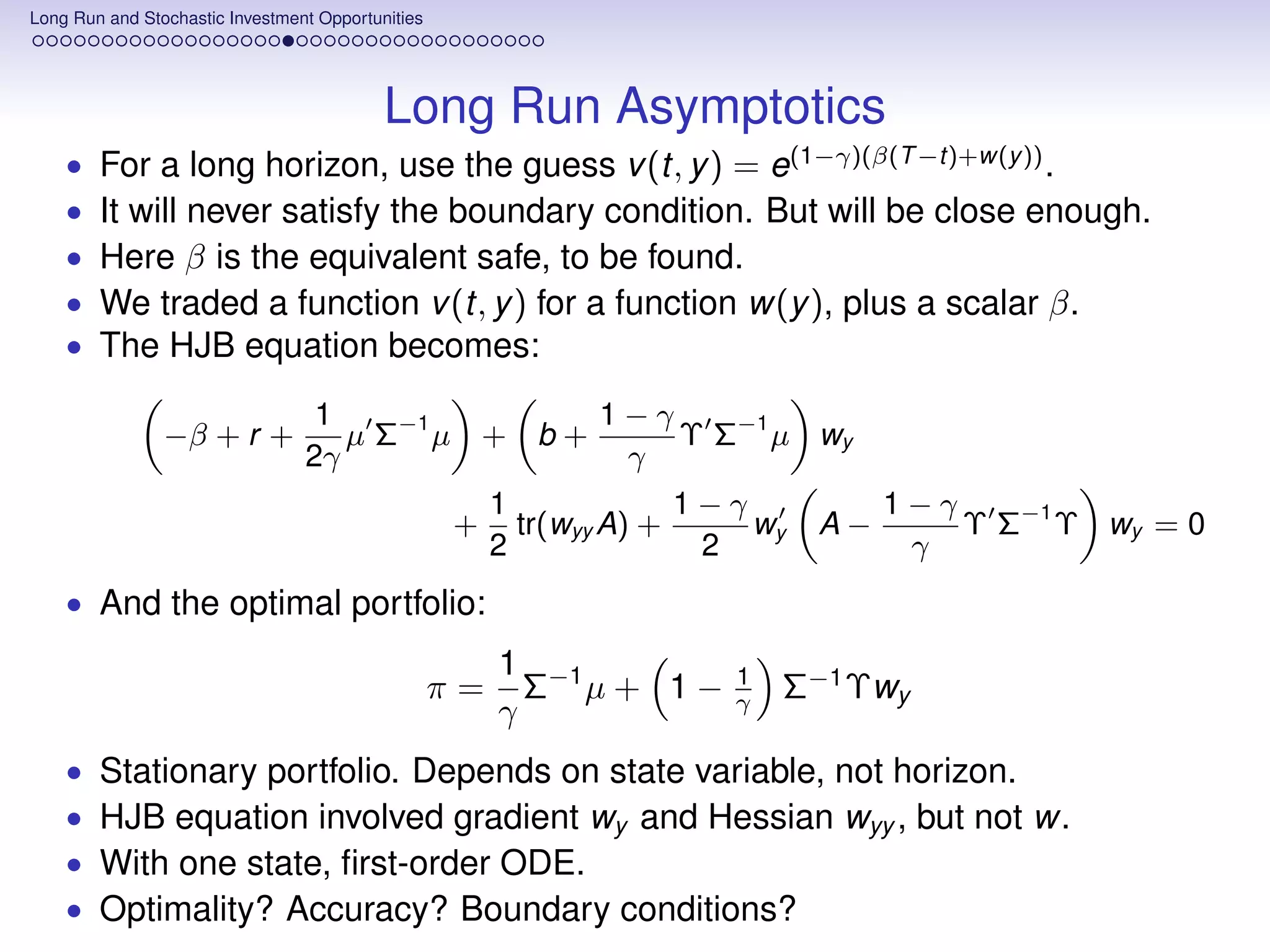
                                           Long Run Asymptotics
    •   For a long horizon, use the guess v (t, y ) = e(1−γ)(β(T −t)+w(y )) .
    •   It will never satisfy the boundary condition. But will be close enough.
    •   Here β is the equivalent safe, to be found.
    •   We traded a function v (t, y ) for a function w(y ), plus a scalar β.
    •   The HJB equation becomes:
                                  1               1−γ
                −β + r +            µ Σ−1 µ + b +     Υ Σ−1 µ wy
                                 2γ                γ
                                                        1             1−γ           1−γ
                                                   +      tr(wyy A) +     wy   A−       Υ Σ−1 Υ wy = 0
                                                        2              2             γ
    • And the optimal portfolio:
                                                        1 −1            1
                                                   π=     Σ µ+ 1−       γ   Σ−1 Υwy
                                                        γ
    •   Stationary portfolio. Depends on state variable, not horizon.
    •   HJB equation involved gradient wy and Hessian wyy , but not w.
    •   With one state, first-order ODE.
    •   Optimality? Accuracy? Boundary conditions?
Long Run and Stochastic Investment Opportunities


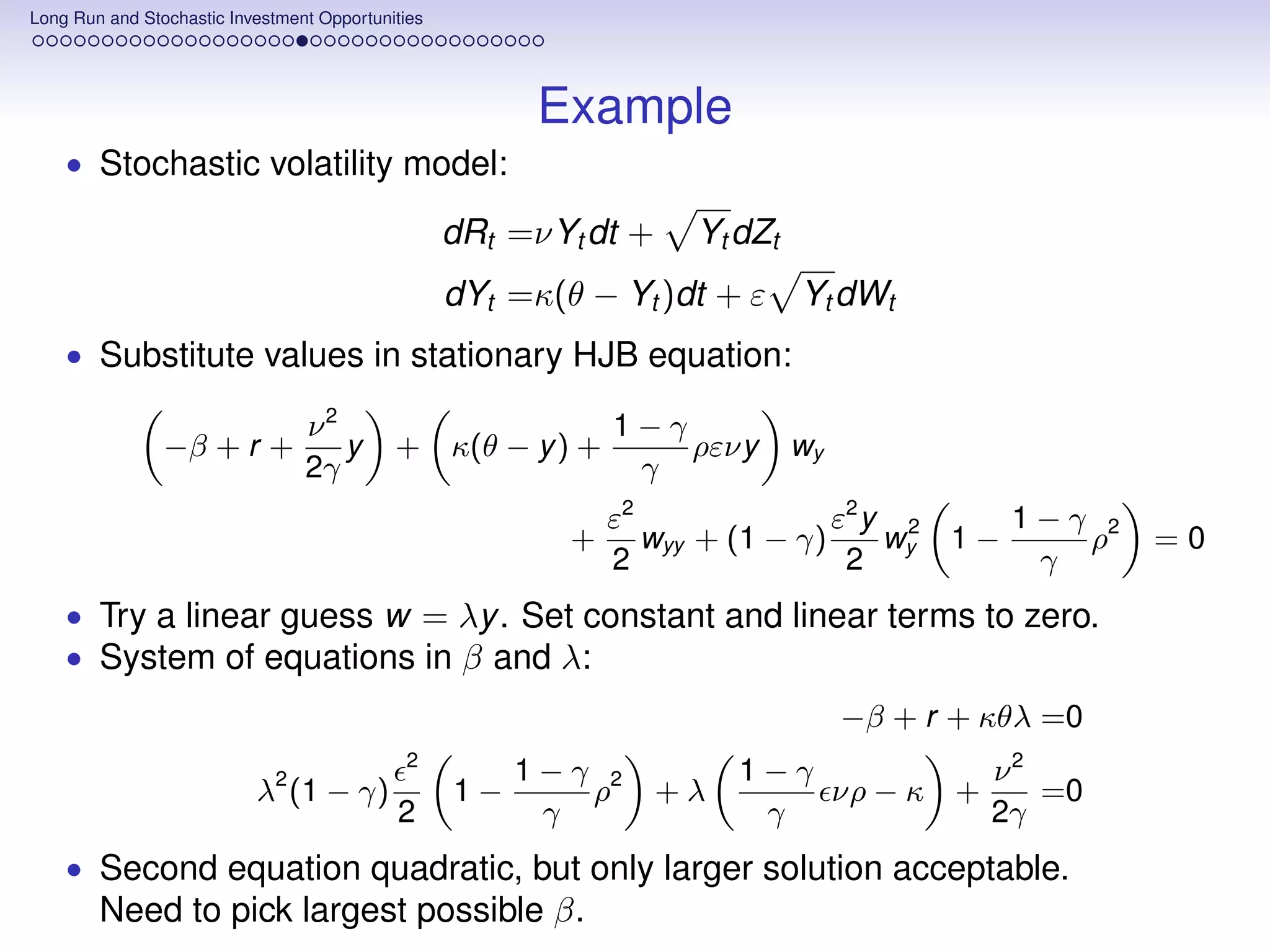
                                                         Example
    • Stochastic volatility model:

                                                   dRt =νYt dt +    Yt dZt
                                                   dYt =κ(θ − Yt )dt + ε     Yt dWt
    • Substitute values in stationary HJB equation:

                                 ν2                            1−γ
                −β + r +            y       + κ(θ − y ) +          ρενy      wy
                                 2γ                             γ
                                                               ε2               ε2 y 2     1−γ 2
                                                           +      wyy + (1 − γ)     wy 1 −    ρ     =0
                                                               2                 2          γ
    • Try a linear guess w = λy . Set constant and linear terms to zero.
    • System of equations in β and λ:
                                                                                  −β + r + κθλ =0
                                             2
                                                        1−γ 2           1−γ          ν2
                           λ2 (1 − γ)              1−      ρ       +λ       νρ − κ +    =0
                                            2            γ               γ           2γ
    • Second equation quadratic, but only larger solution acceptable.
        Need to pick largest possible β.
Long Run and Stochastic Investment Opportunities


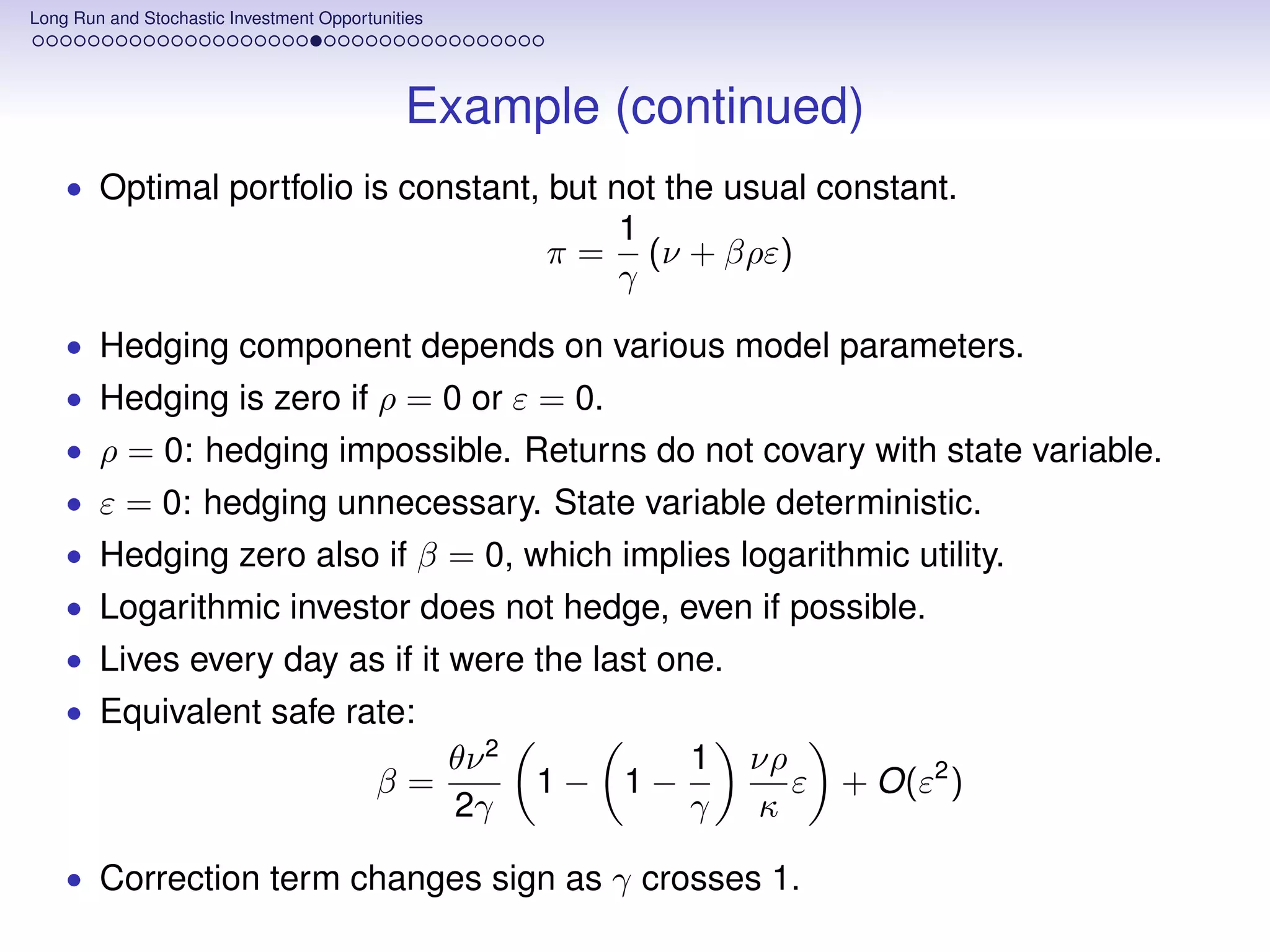
                                             Example (continued)
    • Optimal portfolio is constant, but not the usual constant.
                                                               1
                                                          π=     (ν + βρε)
                                                               γ
    • Hedging component depends on various model parameters.
    • Hedging is zero if ρ = 0 or ε = 0.
    • ρ = 0: hedging impossible. Returns do not covary with state variable.
    • ε = 0: hedging unnecessary. State variable deterministic.
    • Hedging zero also if β = 0, which implies logarithmic utility.
    • Logarithmic investor does not hedge, even if possible.
    • Lives every day as if it were the last one.
    • Equivalent safe rate:
                                                   θν 2            1   νρ
                                          β=              1− 1−           ε + O(ε2 )
                                                   2γ              γ   κ

    • Correction term changes sign as γ crosses 1.
Long Run and Stochastic Investment Opportunities


                                              Martingale Measure
    • Many martingale measures. With incomplete market, local martingale
        condition does not identify a single measure.
    • For any arbitrary k -valued ηt , the process:
                                                       ·                                           ·
                            Mt = E −                       (µ Σ−1 + η Υ Σ−1 )σdZ +                     η adW
                                                   0                                           0                  t

        is a local martingale such that MR is also a local martingale.
                            π
    • Recall that MT = yU (XT ).
    • If local martingale M is a martingale, it defines a stochastic discount factor.
                 1 −1
    • π=         γΣ   (µ        + Υ(1 − γ)wy ) yields:
                                                                              T                          T
                                                                                     µ− 1 π Σπ)dt−γ
                            U (XT ) = (XT )−γ =x −γ e−γ
                                π       π                                    0
                                                                                (π      2               0
                                                                                                             π σdZt

                                                                     T
                                                                            +(1−γ)wy Υ )Σ−1 σdZt +        T
                                                              =e−   0
                                                                       (µ                                0
                                                                                                            (... )dt


    • Mathing the two expressions, we guess η = (1 − γ)wy .
Long Run and Stochastic Investment Opportunities


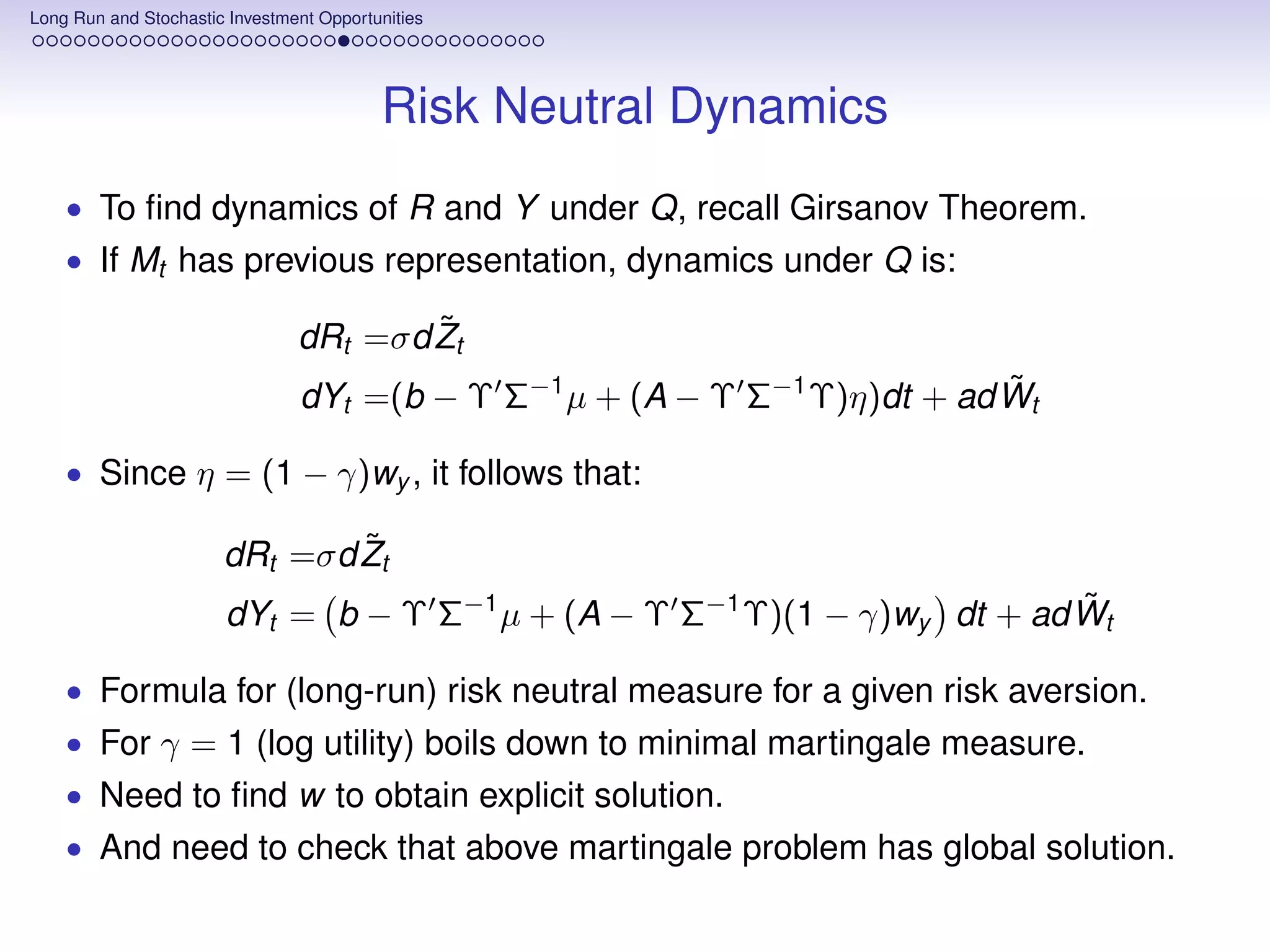
                                          Risk Neutral Dynamics
    • To find dynamics of R and Y under Q, recall Girsanov Theorem.
    • If Mt has previous representation, dynamics under Q is:

                                        ˜
                                dRt =σd Zt
                                                                           ˜
                                dYt =(b − Υ Σ−1 µ + (A − Υ Σ−1 Υ)η)dt + ad Wt

    • Since η = (1 − γ)wy , it follows that:

                               ˜
                       dRt =σd Zt
                                                                          ˜
                       dYt = b − Υ Σ−1 µ + (A − Υ Σ−1 Υ)(1 − γ)wy dt + ad Wt

    • Formula for (long-run) risk neutral measure for a given risk aversion.
    • For γ = 1 (log utility) boils down to minimal martingale measure.
    • Need to find w to obtain explicit solution.
    • And need to check that above martingale problem has global solution.
Long Run and Stochastic Investment Opportunities


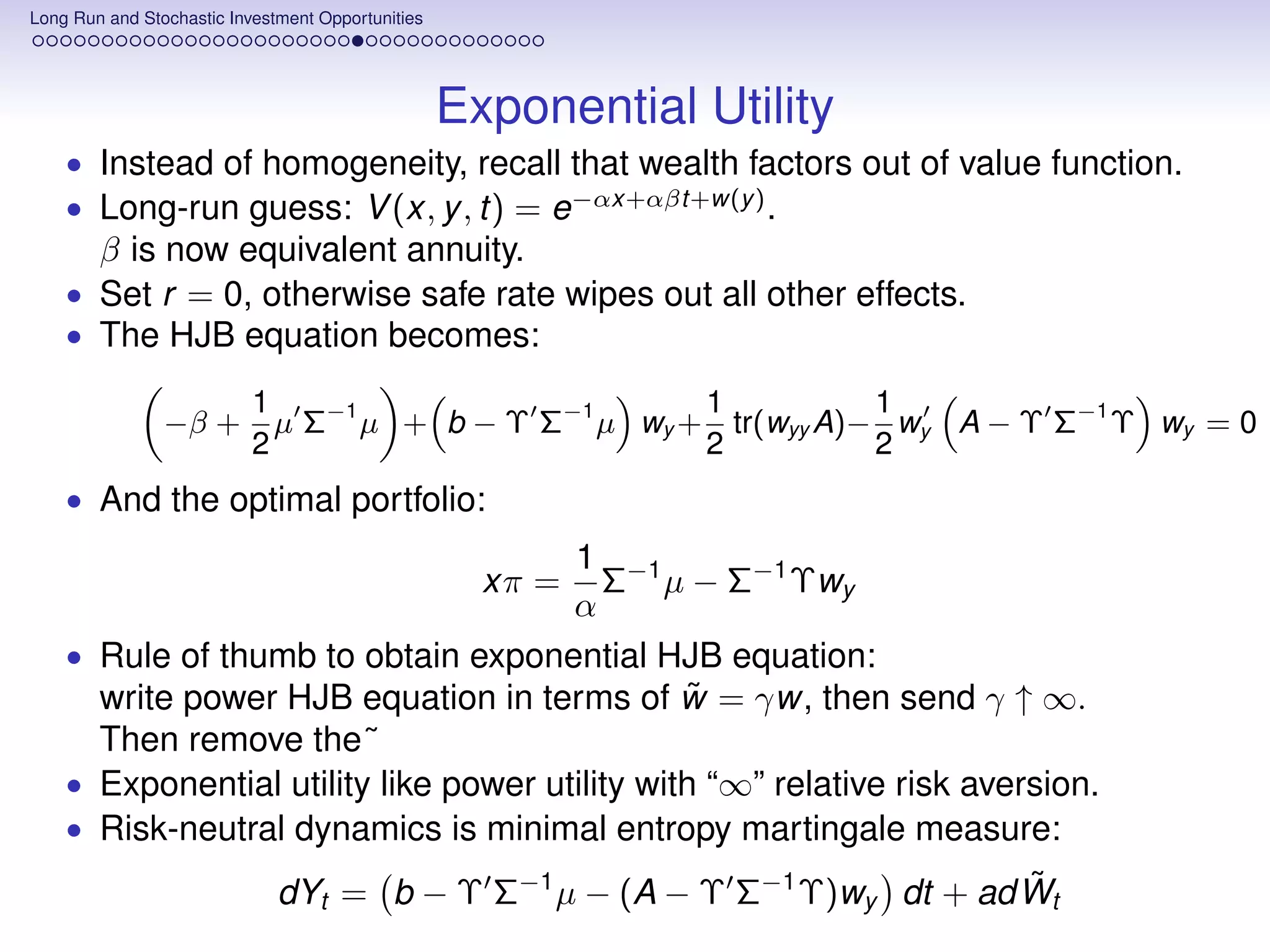
                                                   Exponential Utility
    • Instead of homogeneity, recall that wealth factors out of value function.
    • Long-run guess: V (x, y , t) = e−αx+αβt+w(y ) .
        β is now equivalent annuity.
    • Set r = 0, otherwise safe rate wipes out all other effects.
    • The HJB equation becomes:

                           1                           1          1
                −β +         µ Σ−1 µ + b − Υ Σ−1 µ wy + tr(wyy A)− wy A − Υ Σ−1 Υ wy = 0
                           2                           2          2
    • And the optimal portfolio:
                                       1 −1
                                          Σ µ − Σ−1 Υwy
                                                     xπ =
                                       α
    • Rule of thumb to obtain exponential HJB equation:
                                                ˜
      write power HJB equation in terms of w = γw, then send γ ↑ ∞.
      Then remove the˜
    • Exponential utility like power utility with “∞” relative risk aversion.
    • Risk-neutral dynamics is minimal entropy martingale measure:
                                                                          ˜
                              dYt = b − Υ Σ−1 µ − (A − Υ Σ−1 Υ)wy dt + ad Wt
Long Run and Stochastic Investment Opportunities


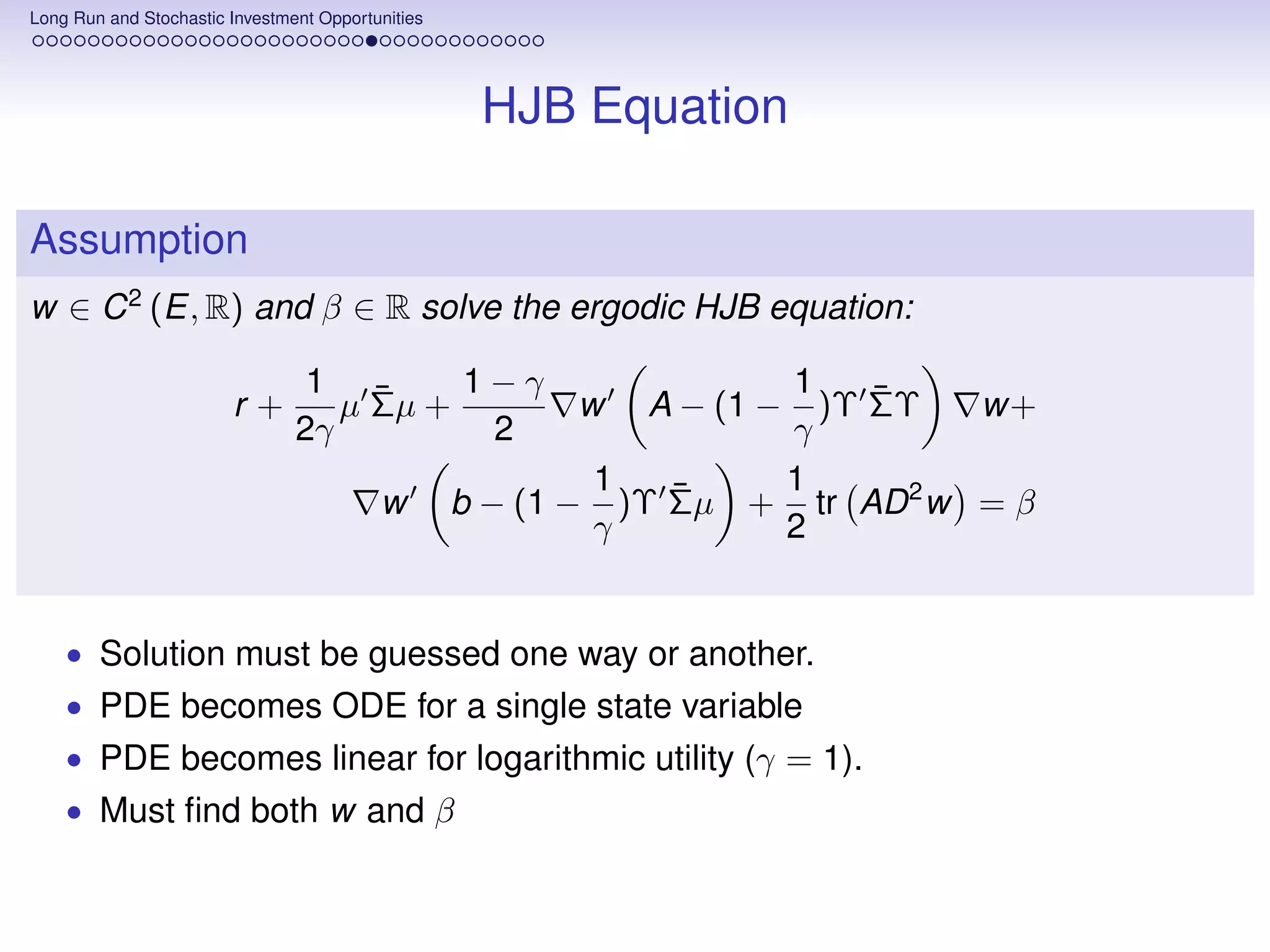
                                                    HJB Equation

Assumption
w ∈ C 2 (E, R) and β ∈ R solve the ergodic HJB equation:

                                 1 ¯      1−γ                      1    ¯
                        r+         µ Σµ +                w   A − (1 −)Υ ΣΥ    w+
                                2γ         2                       γ
                                                           1   ¯   1
                                          w        b − (1 − )Υ Σµ + tr AD 2 w = β
                                                           γ       2


    • Solution must be guessed one way or another.
    • PDE becomes ODE for a single state variable
    • PDE becomes linear for logarithmic utility (γ = 1).
    • Must find both w and β
Long Run and Stochastic Investment Opportunities


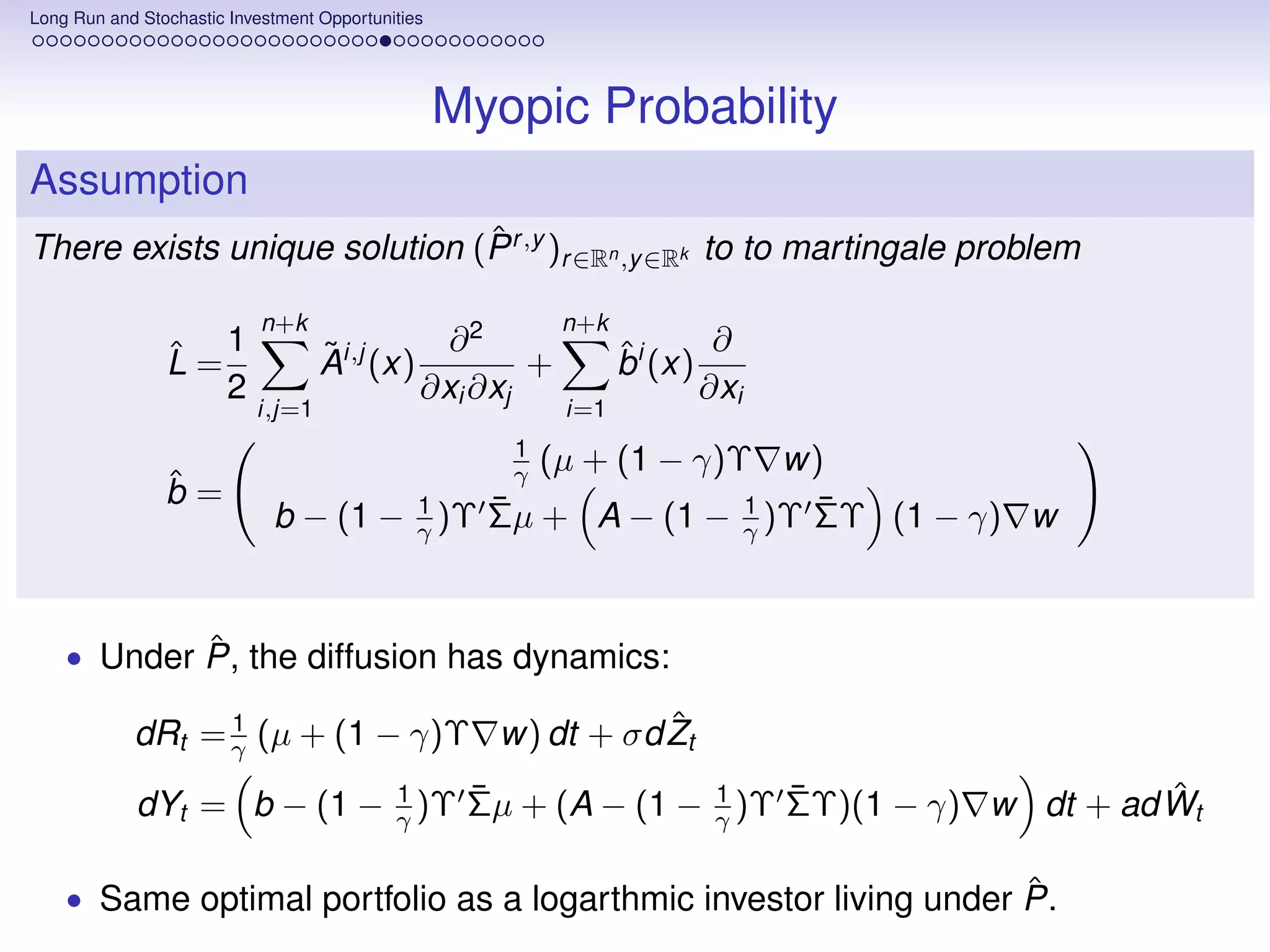
                                                   Myopic Probability
Assumption
                              ˆ
There exists unique solution (P r ,y )r ∈Rn ,y ∈Rk to to martingale problem

                            n+k                            n+k
                ˆ 1                ˜          ∂2                 ˆ       ∂
                L=                 Ai,j (x)         +            bi (x)
                   2                        ∂xi ∂xj                     ∂xi
                           i,j=1                           i=1
                                                       1
                                                       γ (µ + (1 − γ)Υ w)
                ˆ
                b=
                             b − (1 −          1      ¯               1  ¯
                                                      Σµ + A − (1 − γ )Υ ΣΥ (1 − γ) w
                                               γ )Υ


            ˆ
    • Under P, the diffusion has dynamics:

                  1                          ˆ
            dRt = γ (µ + (1 − γ)Υ w) dt + σd Zt
                           1    ¯              1    ¯                    ˆ
            dYt = b − (1 − γ )Υ Σµ + (A − (1 − γ )Υ ΣΥ)(1 − γ) w dt + ad Wt

                                                                   ˆ
    • Same optimal portfolio as a logarthmic investor living under P.
Long Run and Stochastic Investment Opportunities


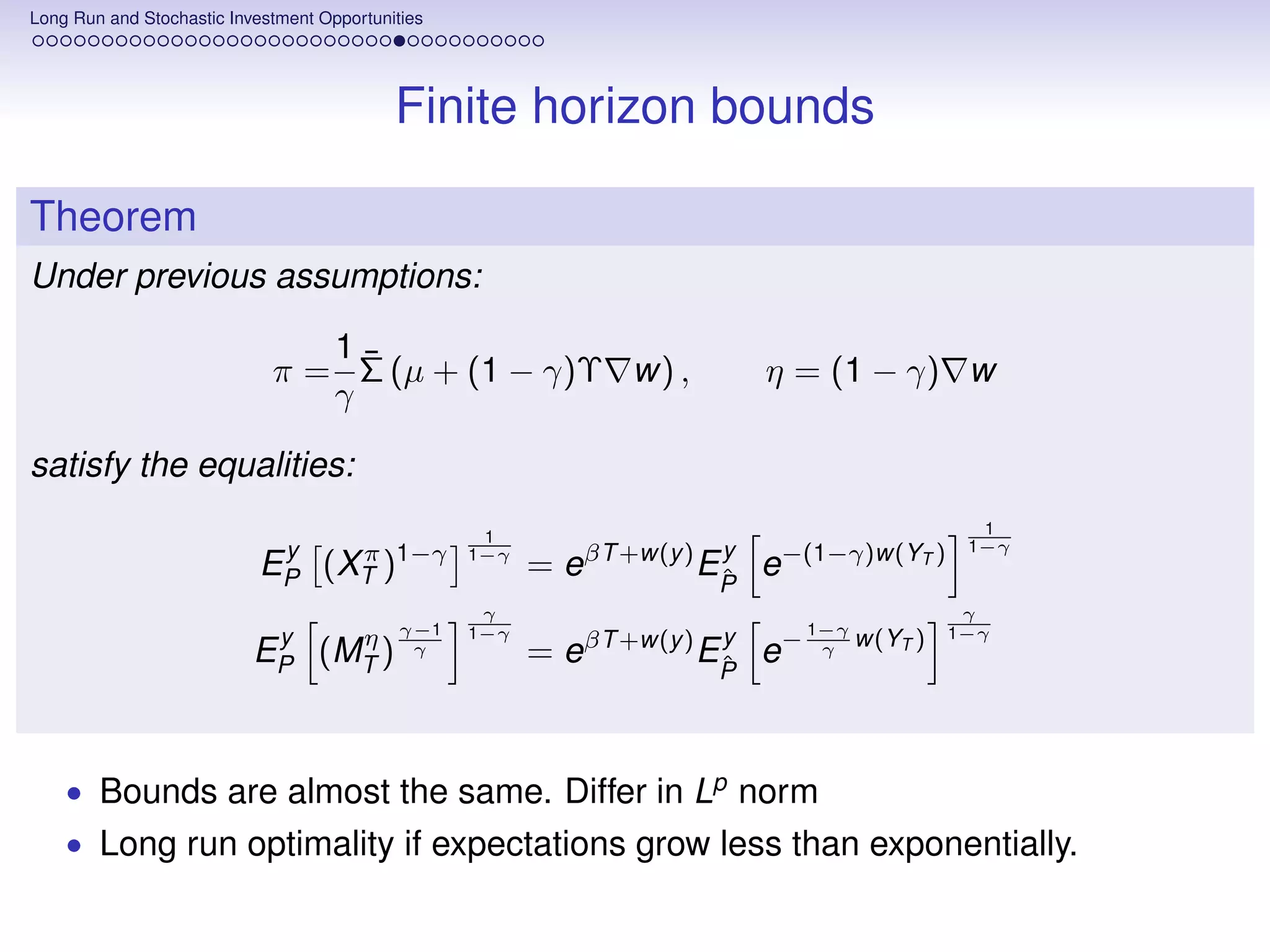
                                            Finite horizon bounds

Theorem
Under previous assumptions:

                                1¯
                             π = Σ (µ + (1 − γ)Υ w) ,                    η = (1 − γ) w
                                γ

satisfy the equalities:
                                                    1                                          1
                            y                                          y                      1−γ
                           EP (XT )1−γ
                                π                  1−γ
                                                         = eβT +w(y ) EP e−(1−γ)w(YT )
                                                                       ˆ
                                                    γ                                         γ
                                             γ−1   1−γ                        1−γ            1−γ
                            y                                          y
                                η
                           EP (MT )           γ          = eβT +w(y ) EP e−
                                                                       ˆ
                                                                               γ    w(YT )


    • Bounds are almost the same. Differ in Lp norm
    • Long run optimality if expectations grow less than exponentially.
Long Run and Stochastic Investment Opportunities


                                      Path to Long Run solution

    • Find candidate pair w, β that solves HJB equation.
    • Different β lead to to different solutions w.
    • Must find w corresponding to the lowest β that has a solution.
    • Using w, check that myopic probabiity is well defined.
                                             ˆ
        Y does not explode under dynamics of P.
    • Then finite horizon bounds hold.
    • To obtain long run optimality, show that:

                                                        1       y  1−γ
                                               lim sup    log EP e− γ w(YT ) = 0
                                                                ˆ
                                                 T →∞  T
                                                      1       y
                                             lim sup log EP e−(1−γ)w(YT ) = 0
                                                              ˆ
                                               T →∞   T
Long Run and Stochastic Investment Opportunities


                                       Proof of wealth bound (1)
                                                             ˆ
                                                            dP
                                                            dP |Ft ,   which equals to E(M), where:
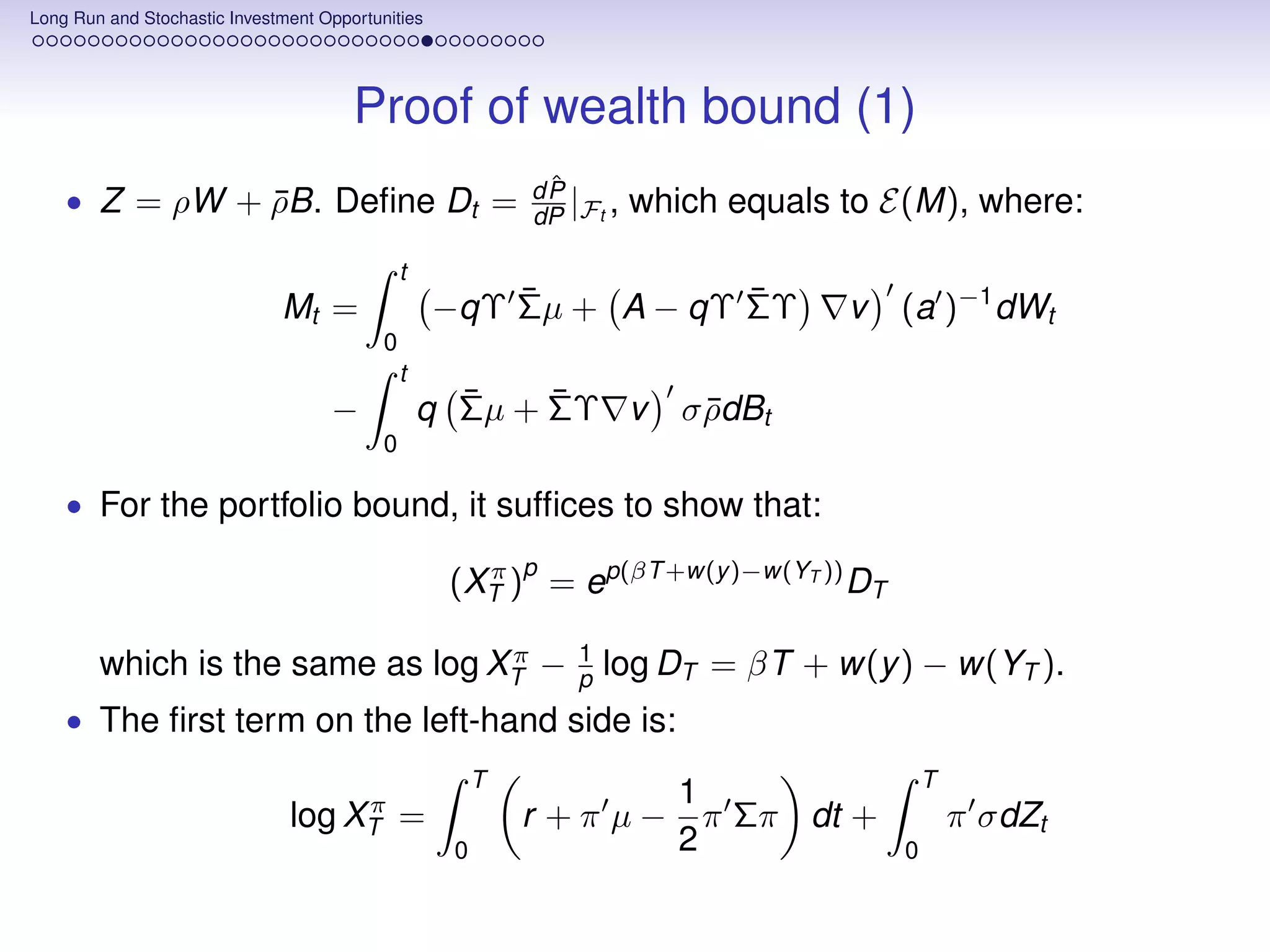
    • Z = ρW + ρB. Define Dt =
               ¯
                                               t
                              Mt =                     ¯           ¯
                                                   −qΥ Σµ + A − qΥ ΣΥ               v   (a )−1 dWt
                                           0
                                               t
                                    −                ¯    ¯
                                                   q Σµ + ΣΥ v            σ ρdBt
                                                                            ¯
                                           0

    • For the portfolio bound, it suffices to show that:
                                                            p
                                                    (XT ) = ep(βT +w(y )−w(YT )) DT
                                                      π


                                  π                             1
        which is the same as log XT −                           p   log DT = βT + w(y ) − w(YT ).
    • The first term on the left-hand side is:
                                                        T                                   T
                                    π                                     1
                               log XT =                     r +π µ−         π Σπ dt +           π σdZt
                                                    0                     2             0
Long Run and Stochastic Investment Opportunities


                                       Proof of wealth bound (2)
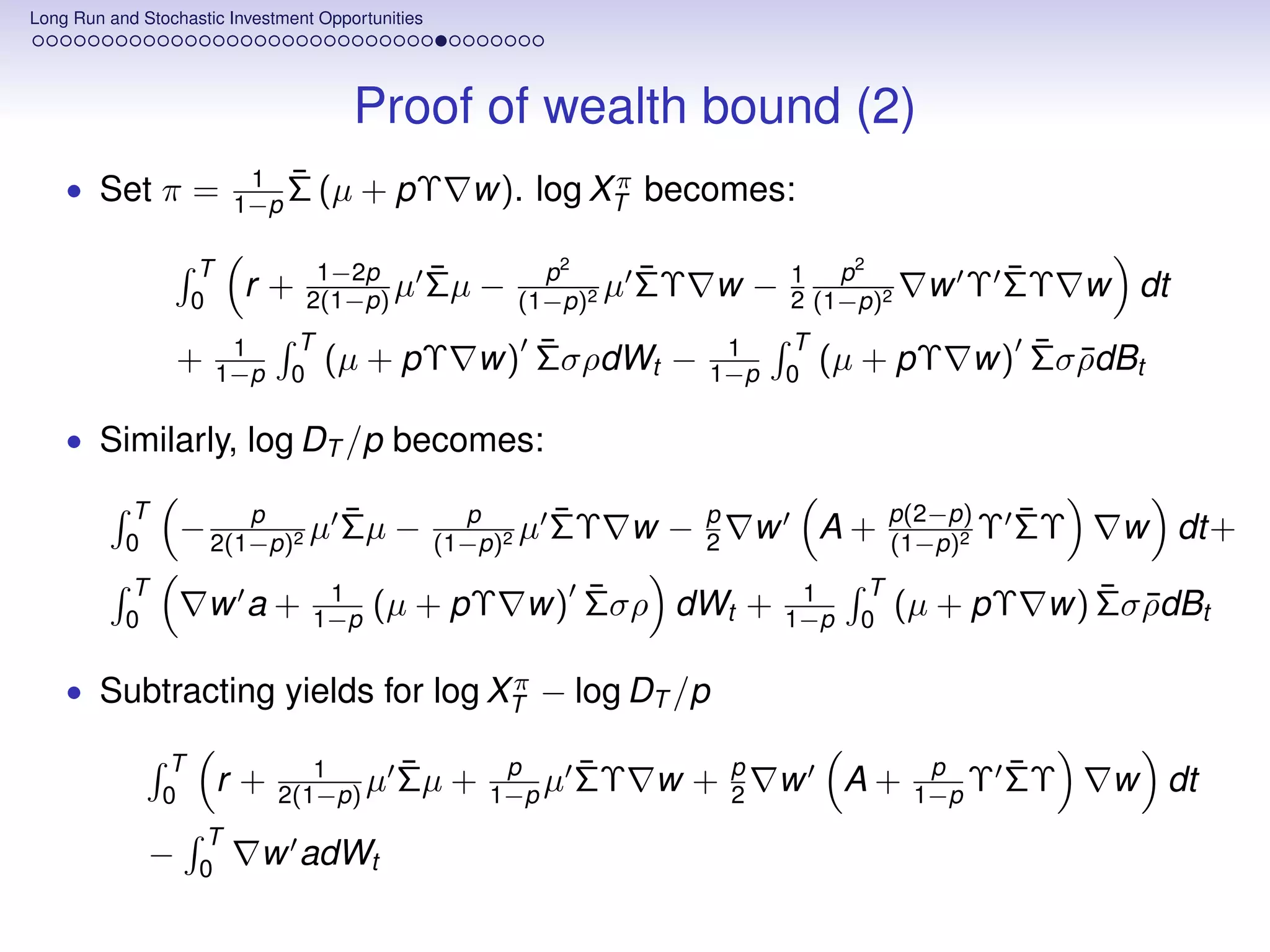
    • Set π =             1 ¯                         π
                         1−p Σ (µ       + pΥ w). log XT becomes:

                    T             1−2p             ¯        p2       ¯             1 p
                                                                                        2
                                                                                                   ¯
                    0
                          r+     2(1−p) µ          Σµ −   (1−p)2
                                                                 µ   ΣΥ w −        2 (1−p)2    w Υ ΣΥ w dt
                         1     T              ¯                          1         T              ¯ ¯
                   +    1−p    0
                                   (µ + pΥ w) ΣσρdWt −                  1−p        0
                                                                                       (µ + pΥ w) Σσ ρdBt

    • Similarly, log DT /p becomes:

           T            p      ¯                     p        ¯        p                     p(2−p)     ¯
           0
                   − 2(1−p)2 µ Σµ −                (1−p)2
                                                          µ   ΣΥ w −   2       w       A+    (1−p)2
                                                                                                    Υ   ΣΥ   w dt+
           T                       1                ¯                               1    T               ¯ ¯
           0
                       w a+       1−p    (µ + pΥ w) Σσρ dWt +                      1−p   0
                                                                                              (µ + pΥ w) Σσ ρdBt

                                  π
    • Subtracting yields for log XT − log DT /p

                T                1          ¯           p      ¯           p                    p       ¯
                0
                        r+    2(1−p) µ      Σµ +       1−p µ   ΣΥ w +      2   w         A+    1−p Υ    ΣΥ   w dt
                    T
               −    0
                            w adWt
Long Run and Stochastic Investment Opportunities


                                       Proof of wealth bound (3)


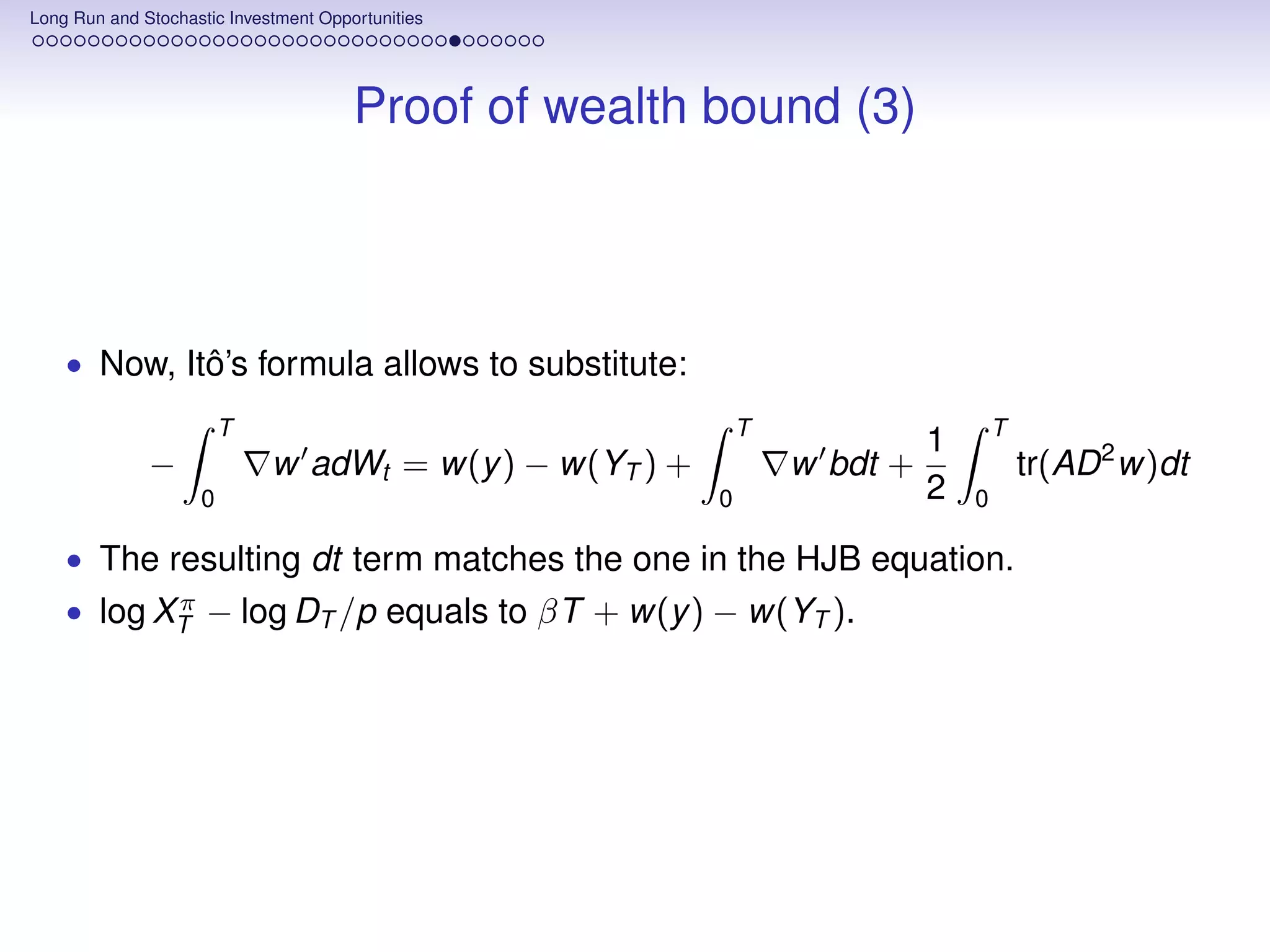
    • Now, Itô’s formula allows to substitute:
                        T                                    T                     T
                                                                           1
              −              w adWt = w(y ) − w(YT ) +           w bdt +               tr(AD 2 w)dt
                    0                                    0                 2   0

    • The resulting dt term matches the one in the HJB equation.
           π
    • log XT − log DT /p equals to βT + w(y ) − w(YT ).
Long Run and Stochastic Investment Opportunities


                                   Proof of martingale bound (1)

    • For the discount factor bound, it suffices to show that:

                                1          η             1               1
                               p−1    log MT −           p   log DT =   1−p   (βT + w(y ) − w(YT ))

                            1           η
    • The term             p−1     log MT equals to:

           1       T          1   ¯                 p2                 ¯
          1−p      0
                          r + 2 µ Σµ +              2        w   A − Υ ΣΥ           w dt+
           1       T                        ¯                                            1    T              ¯ ¯
          p−1      0
                         p w a − (µ + pΥ w) Σσρ dWt +                                   1−p   0
                                                                                                  (µ + pΥ w) Σσ ρdBt

                               1                                  1         η       1
    • Subtracting              p   log DT yields for             p−1   log MT −     p   log DT :

           1       T                  1            ¯          p      ¯          p                   p      ¯
          1−p      0
                          r+       2(1−p) µ        Σµ +      1−p µ   ΣΥ w +     2       w     A+   1−p Υ   ΣΥ   w dt
                1       T
          −    1−p      0
                                w adWt
Long Run and Stochastic Investment Opportunities


                                 Proof of martingale bound (2)


                                          T
    • Replacing again                     0
                                                   w adWt with Itô’s formula yields:

                                   1        T              1       ¯       p    ¯
                                  1−p       0
                                              (r    +   2(1−p) µ   Σµ + ( 1−p µ ΣΥ + b ) w+
                                  1                       p               p      ¯
                                  2   tr(AD 2 w) +        2   w     A+   1−p Υ   ΣΥ   w)dt
                                         1
                                   +    1−p (w(y )       − w(YT ))

    • And the integral equals                         1
                                                     1−p βT   by the HJB equation.
Long Run and Stochastic Investment Opportunities


                                                   Exponential Utility
Theorem
If r = 0 and w solves equation:
     1 ¯      1             ¯                                          ¯      1
       µ Σµ −    w A − Υ ΣΥ                             w+   w   b − Υ Σµ +     tr AD 2 w = β
     2        2                                                               2
and myopic dynamics is well posed:
                       ˆ
              dRt =σd Zt
                             ¯        ¯             ˆ
              dYt = b − Υ Σµ − (A − Υ ΣΥ) w dt + ad Wt

Then for the portfolio and risk premia (π, η) given by:
                          1
                     xπ = Σ−1 µ − Σ−1 Υ w           η=− w
                          α
finite-horizon bounds hold as:
               1      y       π           1     y
             − log EP e−α(XT −x) =βT + log EP ew(y )−w(YT )
                                                ˆ
               α                          α
                   1 y η                  1 y
                     EP [M log M η ] =βT + EP [w(y ) − w(YT )]
                   2                      α ˆ
Long Run and Stochastic Investment Opportunities


                                             Long-Run Optimality

Theorem
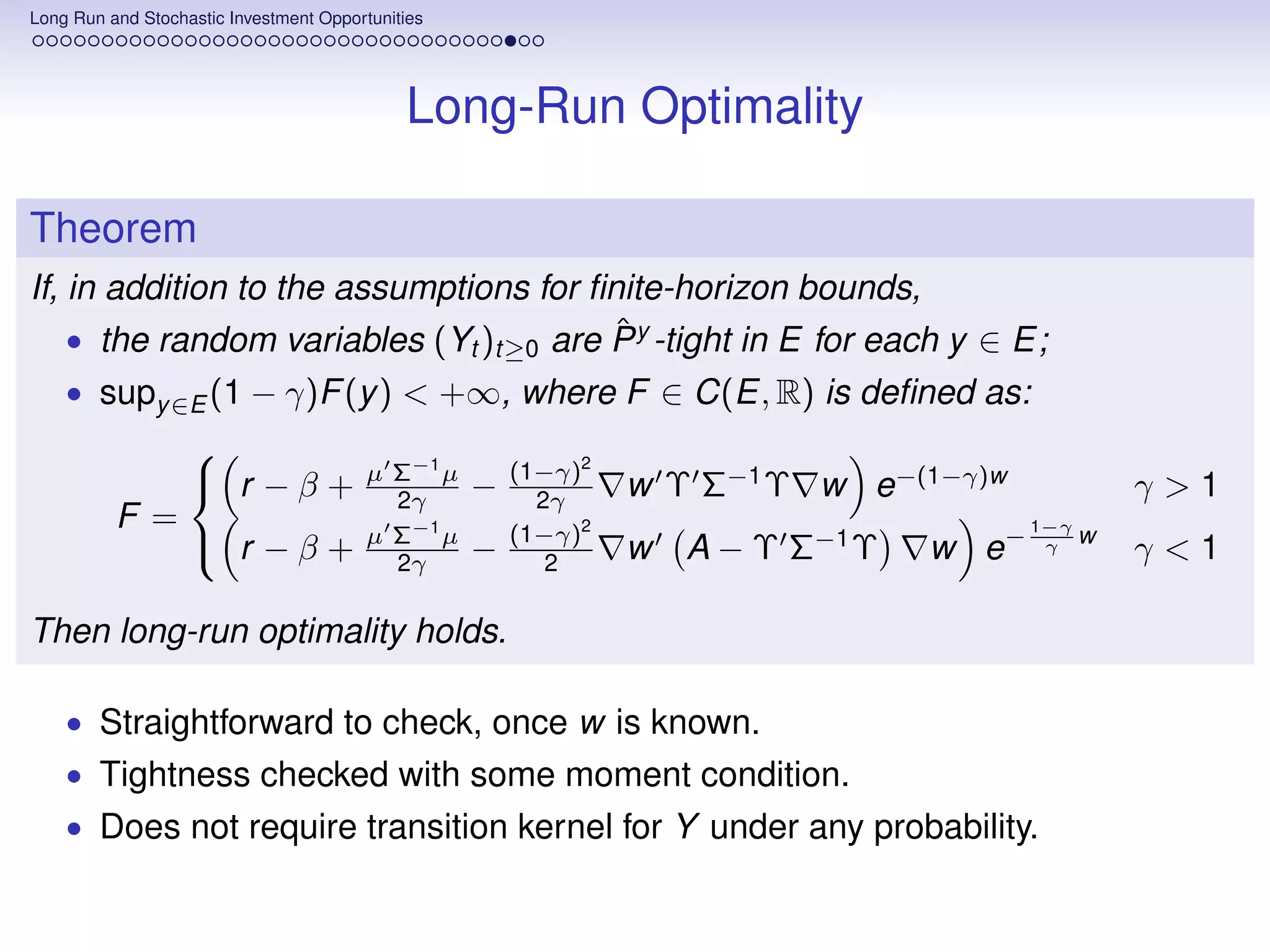
If, in addition to the assumptions for finite-horizon bounds,
                                        ˆ
    • the random variables (Yt )t≥0 are P y -tight in E for each y ∈ E;
    • supy ∈E (1 − γ)F (y ) < +∞, where F ∈ C(E, R) is defined as:
                   
                                         µ Σ−1 µ       (1−γ)2
                    r −β+
                                           2γ      −     2γ     w Υ Σ−1 Υ w e−(1−γ)w              γ>1
          F =                            µ Σ−1 µ       (1−γ)2                           − 1−γ w
                    r −β+
                                           2γ      −      2     w   A − Υ Σ−1 Υ   w e      γ      γ<1

Then long-run optimality holds.

    • Straightforward to check, once w is known.
    • Tightness checked with some moment condition.
    • Does not require transition kernel for Y under any probability.
Long Run and Stochastic Investment Opportunities


                             Proof of Long-Run Optimality (1)
    • By the duality bound:

                                    1       1      y   η    1   1−p y
                0 ≤ lim inf                   log EP (MT )q   log EP [(XT )p ]
                                                                      −   π
                         T →∞       p       T               T
                               1       y   η    1−p              1          y
                    ≤ lim sup    log EP (MT )q        − lim inf      log EP [(XT )p ]
                                                                                 π
                        T →∞  pT                          T →∞ pT

                              1−p        y     1                      1        y
                    = lim sup       log EP e− 1−p v (YT ) − lim inf
                                         ˆ                               log EP e−v (YT )
                                                                               ˆ
                        T →∞   pT                             T →∞ pT

    • For p < 0 enough to show lower bound

                                                   1      y        1
                                        lim inf      log EP exp − 1−p v (YT )
                                                          ˆ                        ≥0
                                         T →∞      T
        and upper bound:
                                                        1        y
                                        lim supT →∞     T   log EP [exp (−v (YT ))] ≤ 0
                                                                 ˆ

    • Lower bound follows from tightness.
Long Run and Stochastic Investment Opportunities


                                Proof of Long-Run Optimality (2)
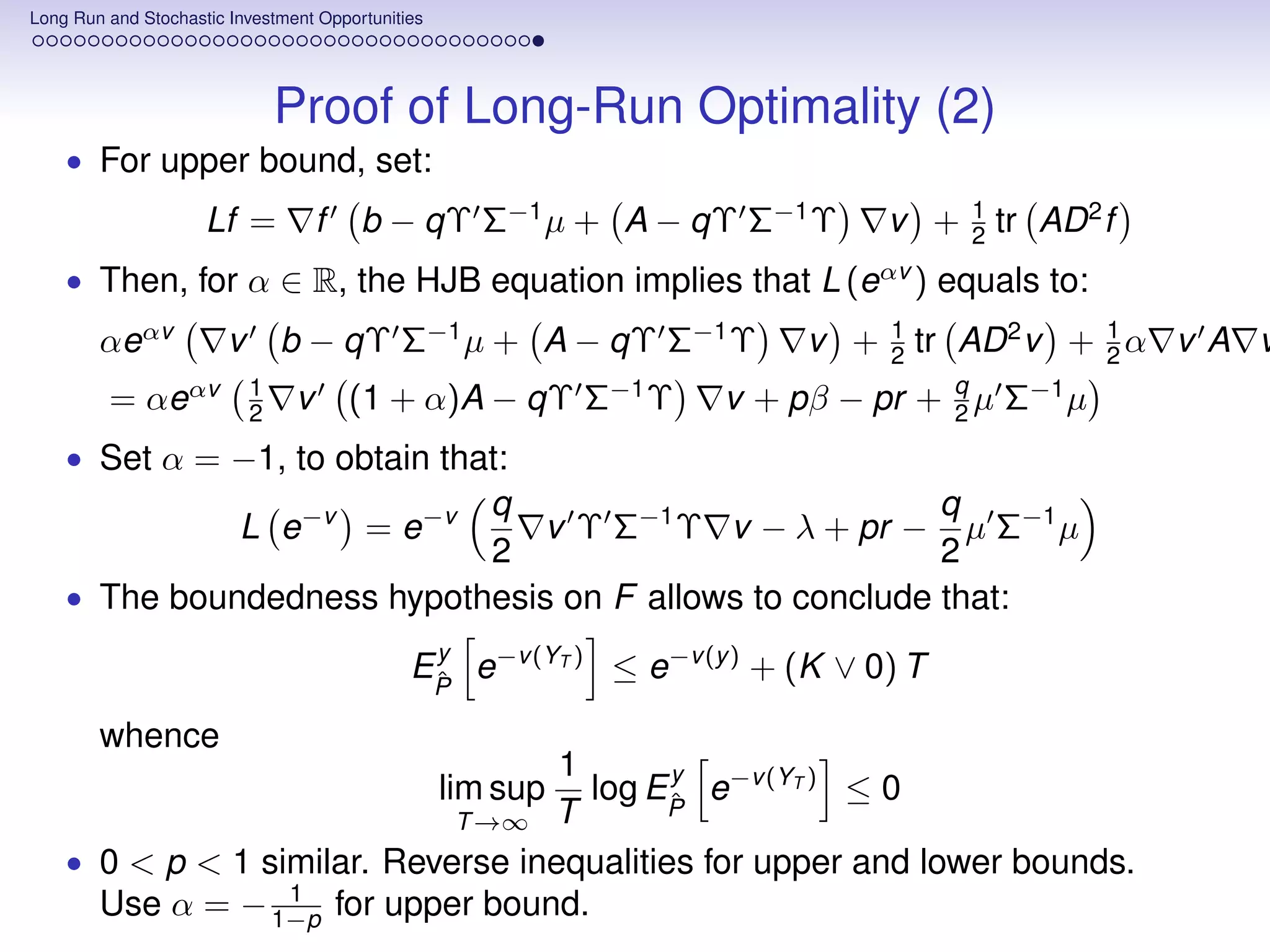
    • For upper bound, set:
                                                                                      1
                     Lf =           f   b − qΥ Σ−1 µ + A − qΥ Σ−1 Υ            v +    2   tr AD 2 f
    • Then, for α ∈ R, the HJB equation implies that L (eαv ) equals to:
                                                                               1
        αeαv            v       b − qΥ Σ−1 µ + A − qΥ Σ−1 Υ              v +   2   tr AD 2 v + 1 α v A v
                                                                                               2
         = αeαv             1
                            2   v       (1 + α)A − qΥ Σ−1 Υ        v + pβ − pr + q µ Σ−1 µ
                                                                                 2
    • Set α = −1, to obtain that:
                            q                            q
                         L e−v = e−v
                                v Υ Σ−1 Υ v − λ + pr − µ Σ−1 µ
                            2                            2
    • The boundedness hypothesis on F allows to conclude that:
                                               y
                                              EP e−v (YT ) ≤ e−v (y ) + (K ∨ 0) T
                                               ˆ

        whence
                                    1       y
                                      log EP e−v (YT ) ≤ 0
                                            ˆ      lim sup
                             T →∞  T
    • 0 < p < 1 similar. Reverse inequalities for upper and lower bounds.
                  1
      Use α = − 1−p for upper bound.
High-water Marks and Hedge Fund Fees


                                       Two

                 High-water Marks and Hedge Fund Fees
                             Based on
      The Incentives of Hedge Fund Fees and High-Water Marks
                           with Jan Obłoj
High-water Marks and Hedge Fund Fees


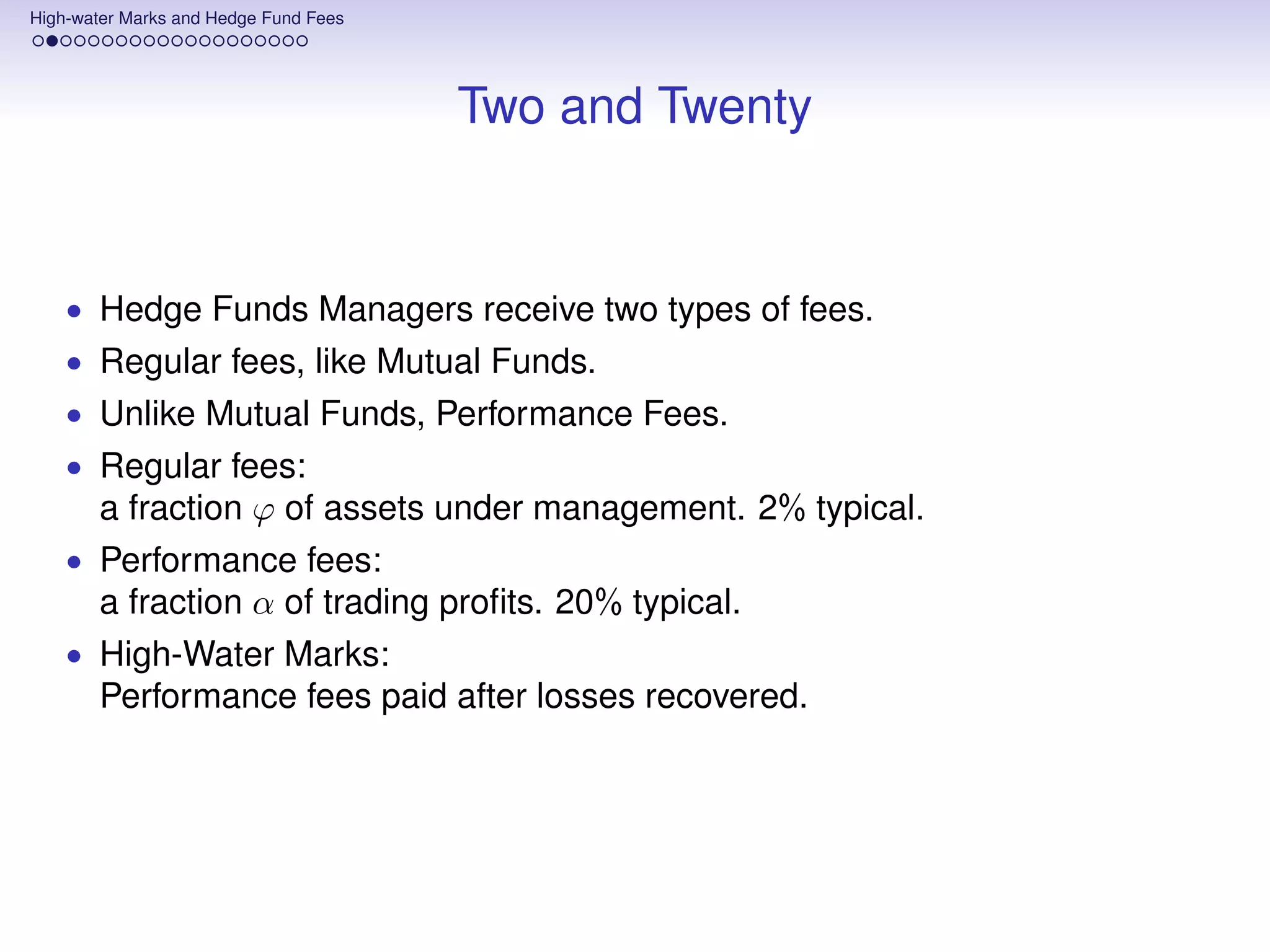
                                       Two and Twenty


    • Hedge Funds Managers receive two types of fees.
    • Regular fees, like Mutual Funds.
    • Unlike Mutual Funds, Performance Fees.
    • Regular fees:
       a fraction ϕ of assets under management. 2% typical.
    • Performance fees:
       a fraction α of trading profits. 20% typical.
    • High-Water Marks:
       Performance fees paid after losses recovered.
High-water Marks and Hedge Fund Fees


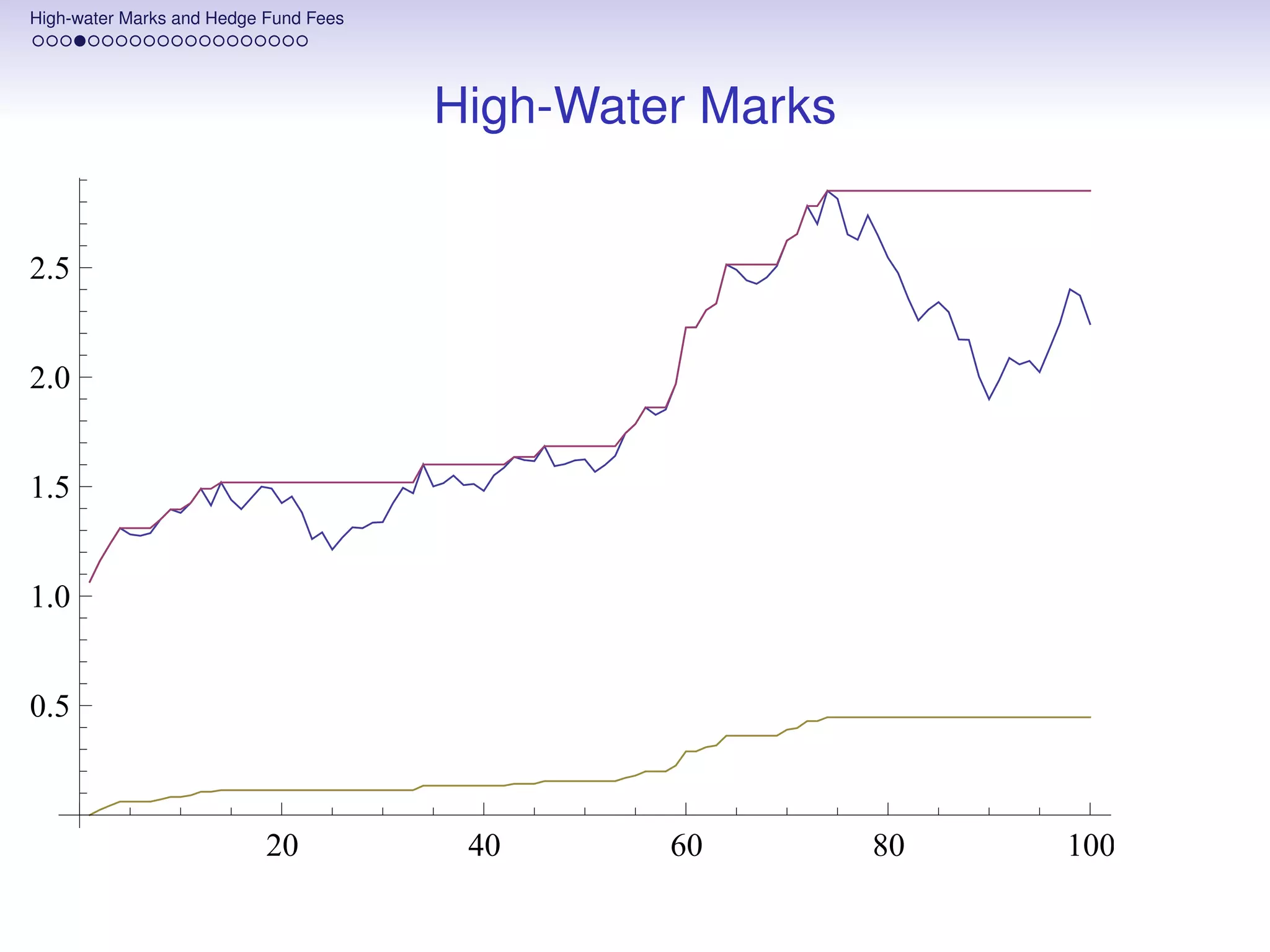
                                         High-Water Marks

                           Time        Gross   Net   High-Water Mark   Fees
                              0          100   100               100      0
                              1          110   108               108      2
                              2          100   100               108      2
                              3          118   116               116      4

    • Fund assets grow from 100 to 110.
       The manager is paid 2, leaving 108 to the fund.
    • Fund drops from 108 to 100.
       No fees paid, nor past fees reimbursed.
    • Fund recovers from 100 to 118.
       Fees paid only on increase from 108 to 118.
       Manager receives 2.
High-water Marks and Hedge Fund Fees


                                       High-Water Marks


2.5


2.0


1.5


1.0


0.5


                           20           40      60        80   100
High-water Marks and Hedge Fund Fees


                                       Risk Shifting?


    • Manager shares investors’ profits, not losses.
       Does manager take more risk to increase profits?
    • Option Pricing Intuition:
      Manager has a call option on the fund value.
      Option value increases with volatility. More risk is better.
    • Static, Complete Market Fallacy:
      Manager has multiple call options.
    • High-Water Mark: future strikes depend on past actions.
    • Option unhedgeable: cannot short (your!) hedge fund.
High-water Marks and Hedge Fund Fees


                                       Questions


    • Portfolio:
       Effect of fees and risk-aversion?
    • Welfare:
       Effect on investors and managers?
    • High-Water Mark Contracts:
       consistent with any investor’s objective?
High-water Marks and Hedge Fund Fees


                                       Answers


    • Goetzmann, Ingersoll and Ross (2003):
       Risk-neutral value of management contract (future fees).
       Exogenous portfolio and fund flows.
    • High-Water Mark contract worth 10% to 20% of fund.
    • Panageas and Westerfield (2009):
       Exogenous risky and risk-free asset.
       Optimal portfolio for a risk-neutral manager.
       Fees cannot be invested in fund.
    • Constant risky/risk-free ratio optimal.
       Merton proportion does not depend on fee size.
       Same solution for manager with Hindy-Huang utility.
High-water Marks and Hedge Fund Fees


                                             This Model

    • Manager with Power Utility and Long Horizon.
       Exogenous risky and risk-free asset.
       Fees cannot be invested in fund.
    • Optimal Portfolio:

                                             1 µ
                                       π=
                                            γ ∗ σ2
                                       γ ∗ =(1 − α)γ + α
                                        γ =Manager’s Risk Aversion
                                       α =Performance Fee (e.g. 20%)

    • Manager behaves as if owned fund, but were more myopic (γ ∗ weighted
       average of γ and 1).
    • Performance fees α matter. Regular fees ϕ don’t.
High-water Marks and Hedge Fund Fees


                              Three Problems, One Solution


    • Power utility, long horizon. No regular fees.
           1   Manager maximizes utility of performance fees.
               Risk Aversion γ.
           2   Investor maximizes utility of wealth. Pays no fees.
               Risk Aversion γ ∗ = (1 − α)γ + α.
           3   Investor maximizes utility of wealth. Pays no fees.
               Risk Aversion γ. Maximum Drawdown 1 − α.
    • Same optimal portfolio:

                                                   1 µ
                                              π=
                                                   γ ∗ σ2
High-water Marks and Hedge Fund Fees


                                       Price Dynamics


       dSt
           = (r + µ)dt + σdWt                                           (Risky Asset)
        St
                                         dSt              α     ∗
        dXt = (r − ϕ)Xt dt + Xt πt        St   − rdt −   1−α dXt              (Fund)
                                 α
        dFt = rFt dt + ϕXt dt +    dX ∗                                        (Fees)
                                1−α t
        Xt∗ = max Xs                                                (High-Water Mark)
                   0≤s≤t


    • One safe and one risky asset.
    • Gain split into α for the manager and 1 − α for the fund.
    • Performance fee is α/(1 − α) of fund increase.
High-water Marks and Hedge Fund Fees


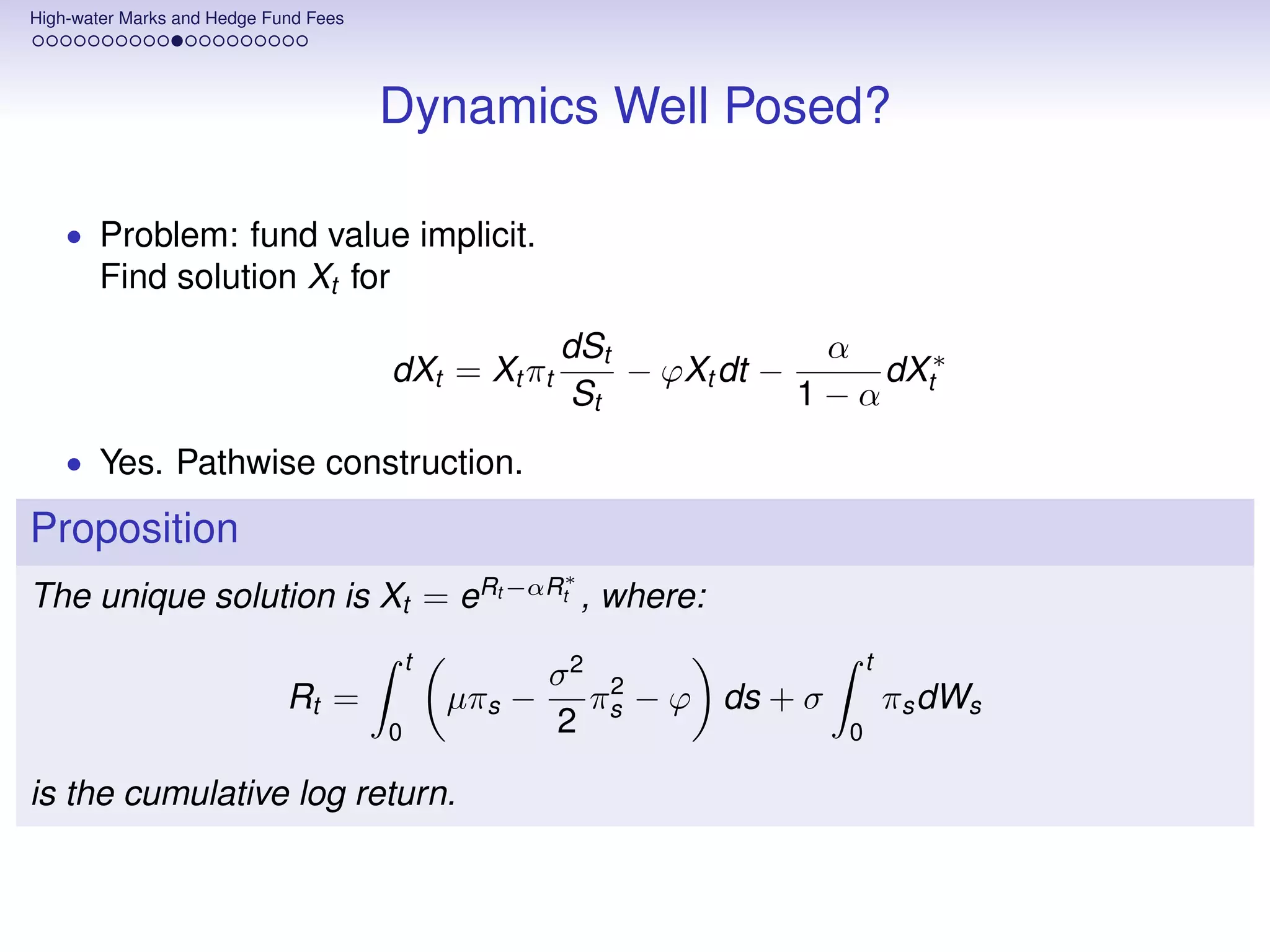
                                       Dynamics Well Posed?

    • Problem: fund value implicit.
       Find solution Xt for
                                                       dSt             α
                                       dXt = Xt πt         − ϕXt dt −    dX ∗
                                                       St             1−α t
    • Yes. Pathwise construction.

Proposition
                                                       ∗
The unique solution is Xt = eRt −αRt , where:
                                           t                                t
                                                       σ2 2
                             Rt =              µπs −     π − ϕ ds + σ           πs dWs
                                       0               2 s              0

is the cumulative log return.
High-water Marks and Hedge Fund Fees


                                       Fund Value Explicit

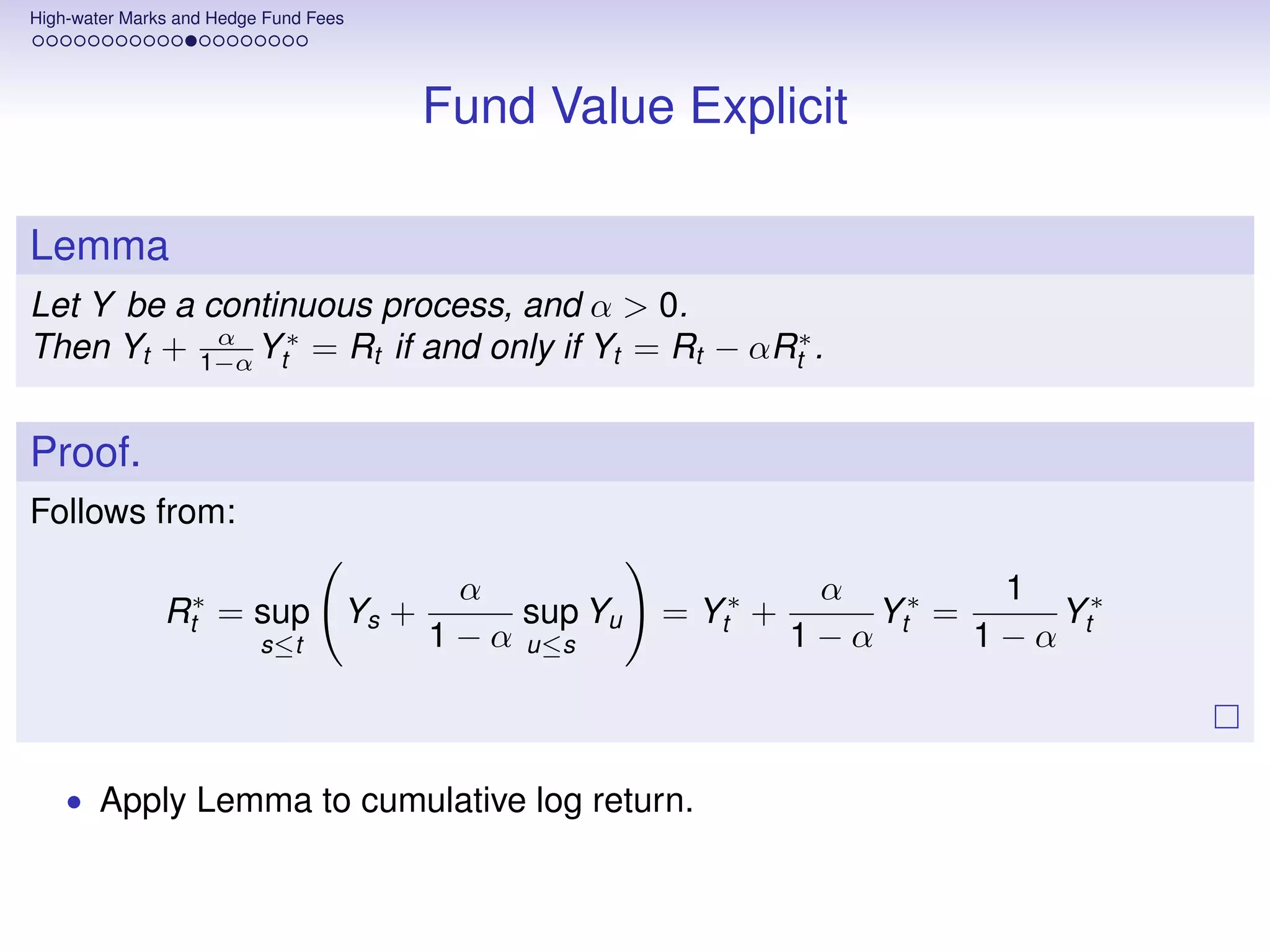
Lemma
Let Y be a continuous process, and α > 0.
Then Yt + 1−α Yt∗ = Rt if and only if Yt = Rt − αRt∗ .
            α


Proof.
Follows from:

                                         α                       α         1
               Rt∗ = sup Ys +                sup Yu   = Yt∗ +       Yt∗ =    Y∗
                          s≤t          1 − α u≤s                1−α       1−α t


    • Apply Lemma to cumulative log return.
High-water Marks and Hedge Fund Fees


                                           Long Horizon


    • The manager chooses the portfolio π which maximizes expected power
       utility from fees at a long horizon.
    • Maximizes the long-run objective:

                                                       1        p
                                         max lim         log E[FT ] = β
                                           π   T →∞   pT
    • Dumas and Luciano (1991), Grossman and Vila (1992), Grossman and
       Zhou (1993), Cvitanic and Karatzas (1995). Risk-Sensitive Control:
       Bielecki and Pliska (1999) and many others.
                          2
                      1 µ
    • β=r+            γ 2σ 2    for Merton problem with risk-aversion γ = 1 − p.
High-water Marks and Hedge Fund Fees


                                                Solving It
    • Set r = 0 and ϕ = 0 to simplify notation.
    • Cumulative fees are a fraction of the increase in the fund:
                                                    α
                                            Ft =      (X ∗ − X0 )
                                                              ∗
                                                   1−α t
    • Thus, the manager’s objective is equivalent to:

                                                      1         ∗
                                          max lim       log E[(XT )p ]
                                            π   T →∞ pT

    • Finite-horizon value function:

                                  1
              V (x, z, t) = sup E[XT p |Xt = x, Xt∗ = z]
                                         ∗
                                π p
                                                  1
              dV (Xt , Xt∗ , t) = Vt dt + Vx dXt + Vxx d X       t   + Vz dXt∗
                                                  2
                                                                                 2
               = Vt dt + Vz −           α
                                       1−α Vx   dXt∗ + Vx Xt (πt µ − ϕ)dt + Vxx σ πt2 Xt2 dt
                                                                                2
High-water Marks and Hedge Fund Fees


                                       Dynamic Programming
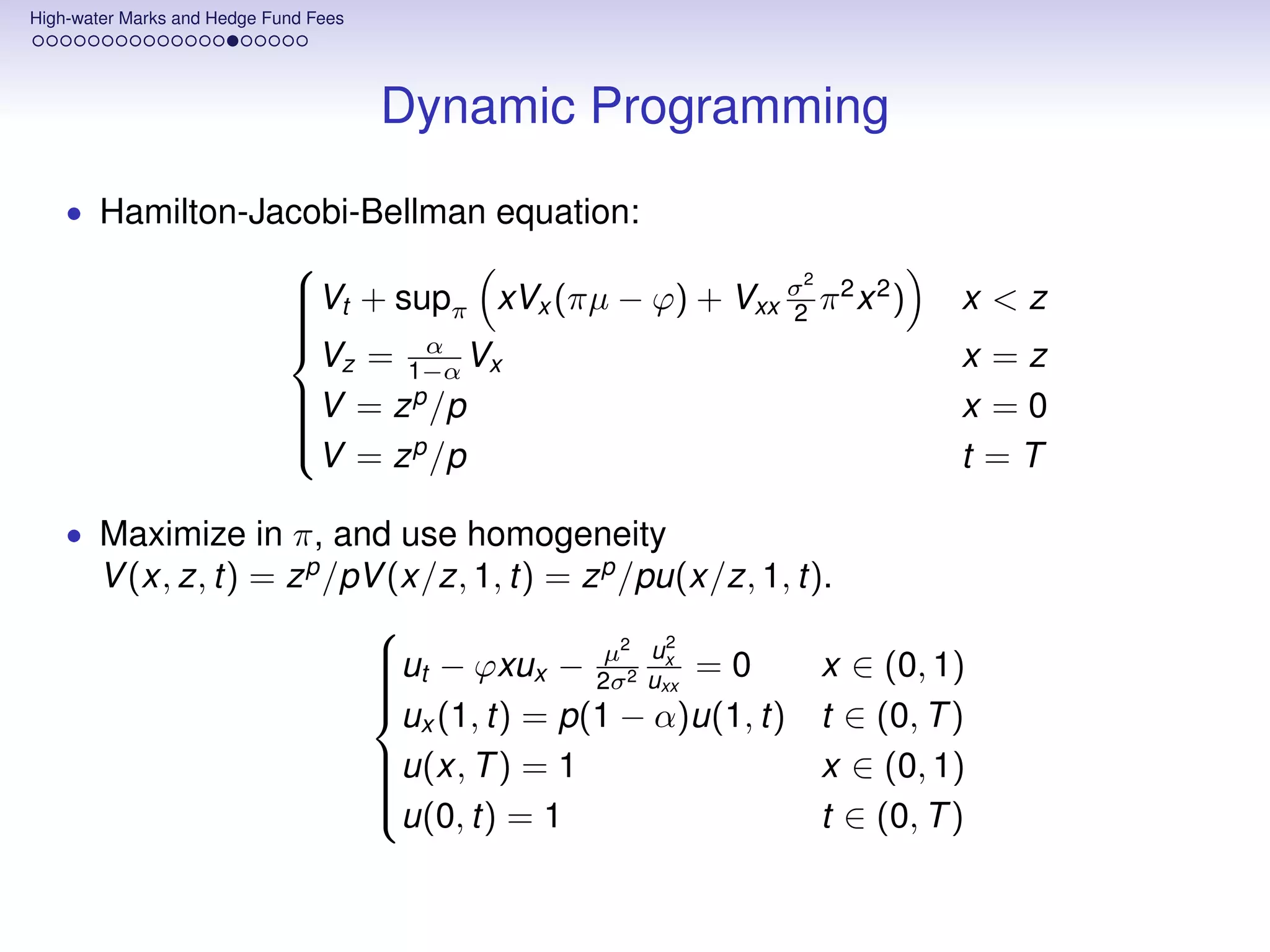
    • Hamilton-Jacobi-Bellman equation:
                                                           2
                             Vt + supπ xVx (πµ − ϕ) + Vxx σ π 2 x 2 )   x <z
                             
                                                          2
                             
                                      α
                               Vz = 1−α Vx                               x =z
                             
                                     p
                             V = z /p
                             
                                                                        x =0
                             
                               V = z p /p                                t =T
                             

    • Maximize in π, and use homogeneity
       V (x, z, t) = z p /pV (x/z, 1, t) = z p /pu(x/z, 1, t).
                                                 2
                            ut − ϕxux − µ22 ux = 0          x ∈ (0, 1)
                                            2σ uxx
                            
                            
                            
                              ux (1, t) = p(1 − α)u(1, t) t ∈ (0, T )
                            

                            u(x, T ) = 1
                            
                                                            x ∈ (0, 1)
                            
                            u(0, t) = 1                     t ∈ (0, T )
High-water Marks and Hedge Fund Fees


                                       Long-Run Heuristics


    • Long-run limit.
       Guess a solution of the form u(t, x) = ce−pβt w(x), forgetting the terminal
       condition:                               2
                                            µ2 wx
                         −pβw − ϕxwx − 2σ2 wxx = 0 for x < 1
                         wx (1) = p(1 − α)w(1)
    • This equation is time-homogeneous, but β is unknown.
    • Any β with a solution w is an upper bound on the rate λ.
    • Candidate long-run value function:
       the solution w with the lowest β.
                                            1−α    µ2
    • w(x) = x p(1−α) , for β =          (1−α)γ+α 2σ 2   − ϕ(1 − α).
High-water Marks and Hedge Fund Fees


                                                  Verification

Theorem
                   µ2              1    1
If ϕ − r <        2σ 2
                         min      γ∗ , γ∗2   , then for any portfolio π:

                      1         π p                                     1 µ2
                lim     log E (FT ) ≤ max (1 − α)                                + r − ϕ ,r
                T ↑∞ pT                                                 γ ∗ 2σ 2
                                                                             2
                                                             α           1 µ
Under the nondegeneracy condition ϕ +                       1−α r   <   γ∗ 2σ 2 ,   the unique optimal
                    µ
solution is π = γ1∗ σ2 .
            ˆ

    • Martingale argument. No HJB equation needed.
    • Show upper bound for any portfolio π (delicate).
    • Check equality for guessed solution (easy).
High-water Marks and Hedge Fund Fees


                                                  Upper Bound (1)
    • Take p > 0 (p < 0 symmetric).
    • For any portfolio π:

                                                       T σ2 2              T         ˜
                                              RT = −       π dt
                                                       0 2 t
                                                                   +       0
                                                                               σπt d Wt

      ˜
    • Wt = Wt + µ/σt risk-neutral Brownian Motion
    • Explicit representation:

                                                           ∗                        ∗     µ    ˜     µ2
                          E[(XT )p ] = E[ep(1−α)RT ] = EQ ep(1−α)RT e σ WT − 2σ2 T
                              π


    • For δ > 1, Hölder’s inequality:
                                                                                                                 δ−1
                                                                                     δ         µ ˜     µ2         δ
                                        µ2
                                                                                               σ WT − 2σ 2
                                µ ˜                                    1                                     T
                     ∗                                             ∗
                                σ WT − 2σ 2   T
              p(1−α)RT                                     δp(1−α)RT   δ            δ−1
   EQ e                     e                     ≤ EQ e                   EQ e

                                                                                    1     µ2
    • Second term exponential normal moment. Just e δ−1 2σ2 T .
High-water Marks and Hedge Fund Fees


                                             Upper Bound (2)
                                             ∗
    • Estimate EQ eδp(1−α)RT .
    • Mt = eRt strictly positive continuous local martingale.
       Converges to zero as t ↑ ∞.
    • Fact:
       inverse of lifetime supremum (M∞ )−1 uniform on [0, 1].
                                      ∗

    • Thus, for δp(1 − α) < 1:

                                                 ∗            ∗           1
                           EQ eδp(1−α)RT ≤ EQ eδp(1−α)R∞ =
                                                                    1 − δp(1 − α)

    • In summary, for 1 < δ <                       1
                                                 p(1−α) :


                                             1         π p      1      µ2
                                       lim     log E (FT ) ≤
                                       T ↑∞ pT               p(δ − 1) 2σ 2

    • Thesis follows as δ →                     1
                                             p(1−α) .
High-water Marks and Hedge Fund Fees


                        High-Water Marks and Drawdowns
    • Imagine fund’s assets Xt and manager’s fees Ft in the same account
       Ct = Xt + Ft .
                                                                       dSt
                                                 dCt = (Ct − Ft )πt
                                                                        St
    • Fees Ft proportional to high-water mark Xt∗ :
                                                          α
                                                  Ft =      (X ∗ − X0 )
                                                                    ∗
                                                         1−α t
    • Account increase dCt∗ as fund increase plus fees increase:
                                   t                         t
                                                                  α             1
        Ct∗ − C0 =
               ∗                          ∗
                                       (dXs + dFs ) =                      ∗
                                                                     + 1 dXs =    (X ∗ − X0 )
                               0                         0       1−α           1−α t
    • Obvious bound Ct ≥ Ft yields:

                                                    Ct ≥ α(Ct∗ − X0 )
    • X0 negligible as t ↑ ∞. Approximate drawdown constraint.

                                                         Ct ≥ αCt∗
Transaction Costs


                             Three

                      Transaction Costs
                             Based on
   Transaction Costs, Trading Volume, and the Liquidity Premium
      with Stefan Gerhold, Johannes Muhle-Karbe, and Walter
                          Schachermayer
Transaction Costs


                                      Model


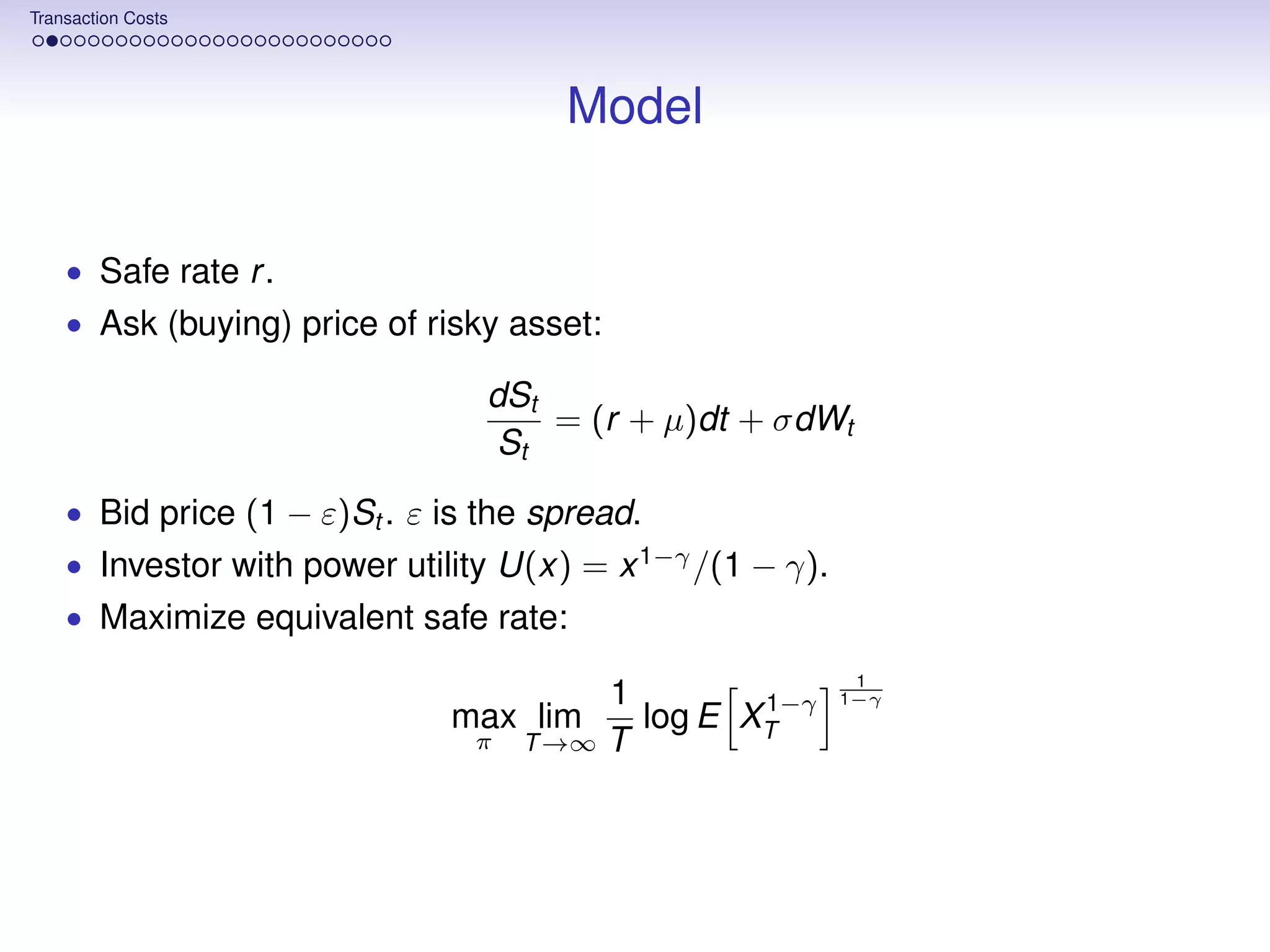
    • Safe rate r .
    • Ask (buying) price of risky asset:

                                 dSt
                                     = (r + µ)dt + σdWt
                                 St
    • Bid price (1 − ε)St . ε is the spread.
    • Investor with power utility U(x) = x 1−γ /(1 − γ).
    • Maximize equivalent safe rate:
                                                            1
                                         1        1−γ      1−γ
                              max lim      log E XT
                                π   T →∞ T
Transaction Costs


                              Wealth Dynamics
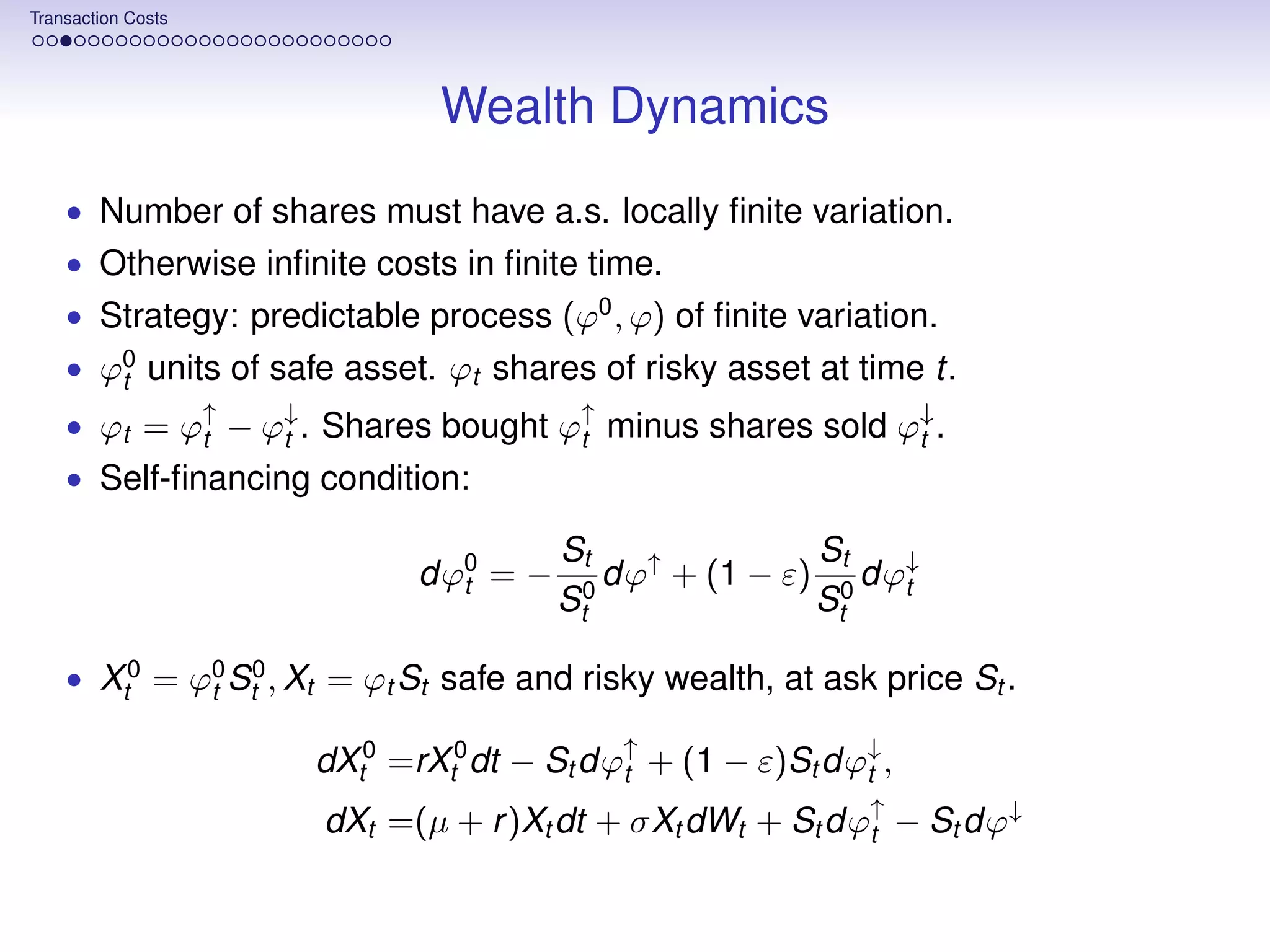
    • Number of shares must have a.s. locally finite variation.
    • Otherwise infinite costs in finite time.
    • Strategy: predictable process (ϕ0 , ϕ) of finite variation.
    • ϕ0 units of safe asset. ϕt shares of risky asset at time t.
       t
    • ϕt = ϕ↑ − ϕ↓ . Shares bought ϕ↑ minus shares sold ϕ↓ .
            t    t                  t                    t
    • Self-financing condition:

                                       St               St
                             dϕ0 = −
                               t           dϕ↑ + (1 − ε) 0 dϕ↓
                                                             t
                                       St0              St

    • Xt0 = ϕ0 St0 , Xt = ϕt St safe and risky wealth, at ask price St .
             t

                     dXt0 =rXt0 dt − St dϕ↑ + (1 − ε)St dϕ↓ ,
                                          t               t

                      dXt =(µ + r )Xt dt + σXt dWt + St dϕ↑ − St dϕ↓
                                                          t
Transaction Costs


                                    Control Argument

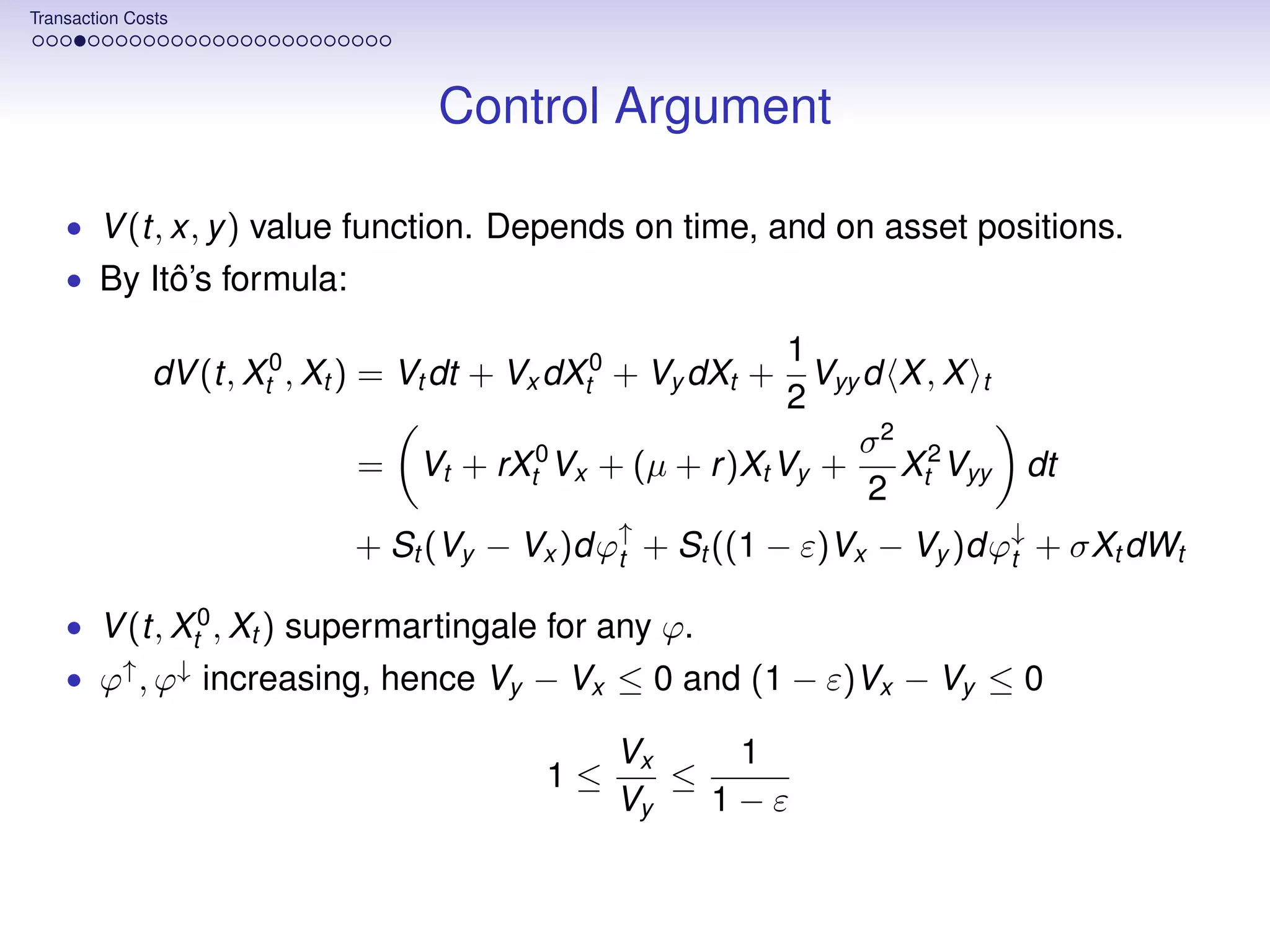
    • V (t, x, y ) value function. Depends on time, and on asset positions.
    • By Itô’s formula:

                                                             1
               dV (t, Xt0 , Xt ) = Vt dt + Vx dXt0 + Vy dXt +  Vyy d X , X t
                                                             2
                                                                  σ2 2
                              =   Vt + rXt0 Vx + (µ + r )Xt Vy +     X Vyy     dt
                                                                   2 t
                             + St (Vy − Vx )dϕ↑ + St ((1 − ε)Vx − Vy )dϕ↓ + σXt dWt
                                              t                         t

    • V (t, Xt0 , Xt ) supermartingale for any ϕ.
    • ϕ↑ , ϕ↓ increasing, hence Vy − Vx ≤ 0 and (1 − ε)Vx − Vy ≤ 0

                                                 Vx    1
                                            1≤      ≤
                                                 Vy   1−ε
Transaction Costs


                                           No Trade Region

                          Vx        1
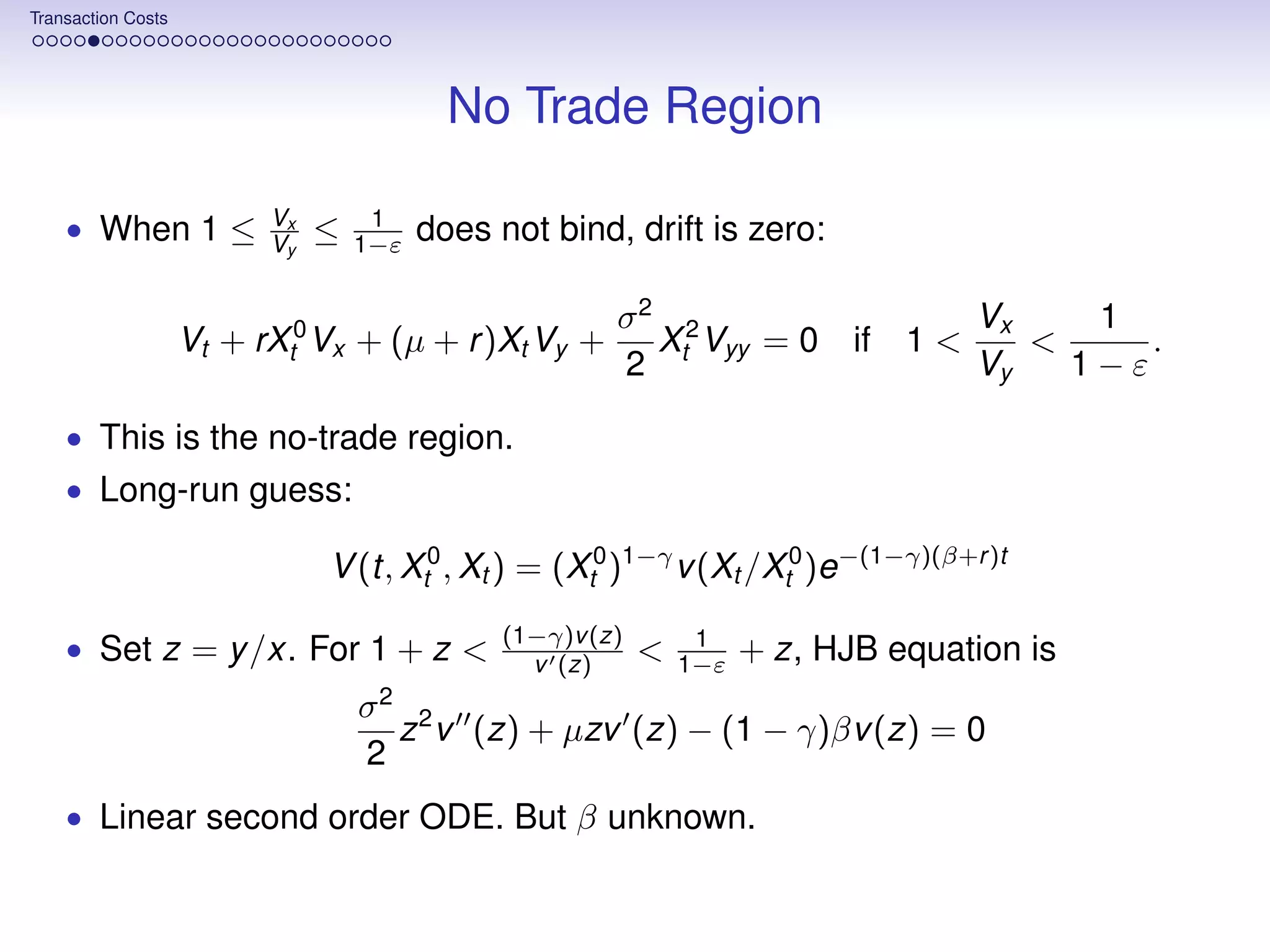
    • When 1 ≤            Vy   ≤   1−ε   does not bind, drift is zero:

                                                        σ2 2                          Vx    1
                    Vt + rXt0 Vx + (µ + r )Xt Vy +        X Vyy = 0          if 1 <      <     .
                                                        2 t                           Vy   1−ε

    • This is the no-trade region.
    • Long-run guess:

                               V (t, Xt0 , Xt ) = (Xt0 )1−γ v (Xt /Xt0 )e−(1−γ)(β+r )t
                                               (1−γ)v (z)        1
    • Set z = y /x. For 1 + z <                  v (z)      <   1−ε   + z, HJB equation is
                                    2
                                   σ 2
                                     z v (z) + µzv (z) − (1 − γ)βv (z) = 0
                                   2
    • Linear second order ODE. But β unknown.
Transaction Costs


                                   Smooth Pasting
                             (1−γ)v (z)        1
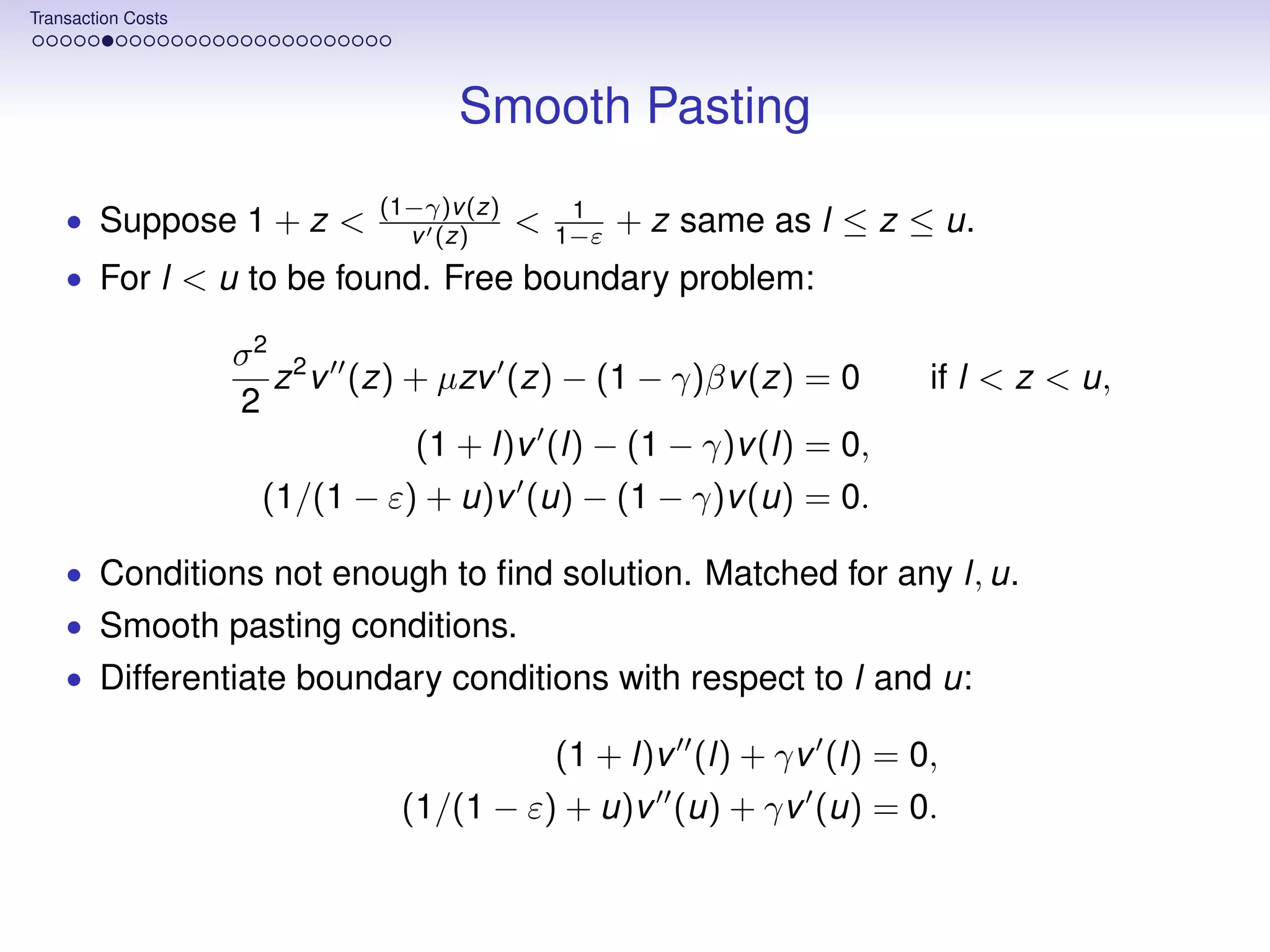
    • Suppose 1 + z <          v (z)      <   1−ε   + z same as l ≤ z ≤ u.
    • For l < u to be found. Free boundary problem:

                    σ2 2
                      z v (z) + µzv (z) − (1 − γ)βv (z) = 0            if l < z < u,
                    2
                              (1 + l)v (l) − (1 − γ)v (l) = 0,
                     (1/(1 − ε) + u)v (u) − (1 − γ)v (u) = 0.

    • Conditions not enough to find solution. Matched for any l, u.
    • Smooth pasting conditions.
    • Differentiate boundary conditions with respect to l and u:

                                         (1 + l)v (l) + γv (l) = 0,
                               (1/(1 − ε) + u)v (u) + γv (u) = 0.
Transaction Costs


                            Solution Procedure


    • Unknown: trading boundaries l, u and rate β.
    • Strategy: find l, u in terms of β.
    • Free boundary problem becomes fixed boundary problem.
    • Find unique β that solves this problem.
Transaction Costs


                              Trading Boundaries

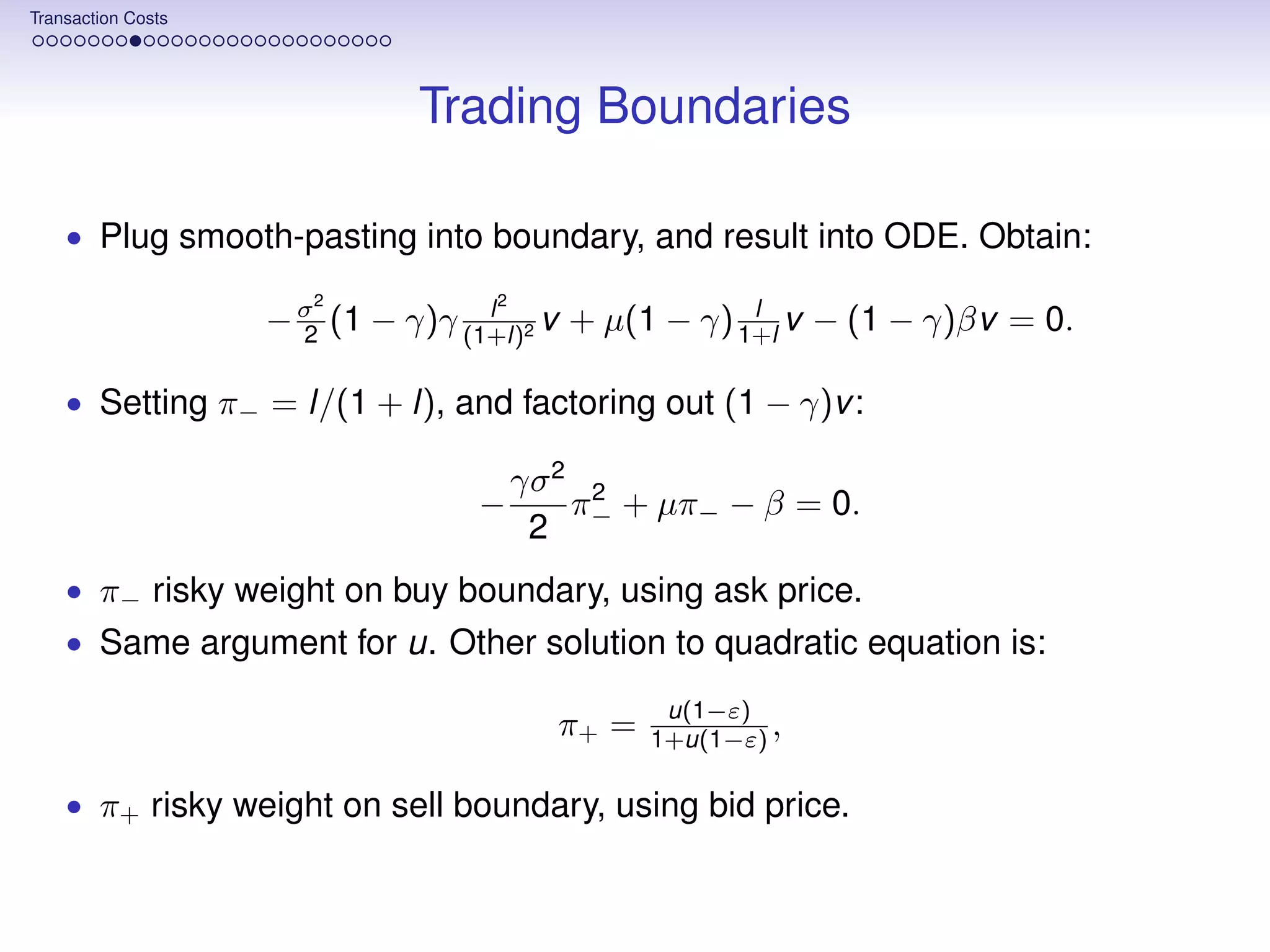
    • Plug smooth-pasting into boundary, and result into ODE. Obtain:
                       2           2
                                   l                  l
                    − σ (1 − γ)γ (1+l)2 v + µ(1 − γ) 1+l v − (1 − γ)βv = 0.
                      2

    • Setting π− = l/(1 + l), and factoring out (1 − γ)v :

                                       γσ 2 2
                                  −        π + µπ− − β = 0.
                                        2 −
    • π− risky weight on buy boundary, using ask price.
    • Same argument for u. Other solution to quadratic equation is:

                                                 u(1−ε)
                                         π+ =   1+u(1−ε) ,

    • π+ risky weight on sell boundary, using bid price.
Transaction Costs


                                              Gap

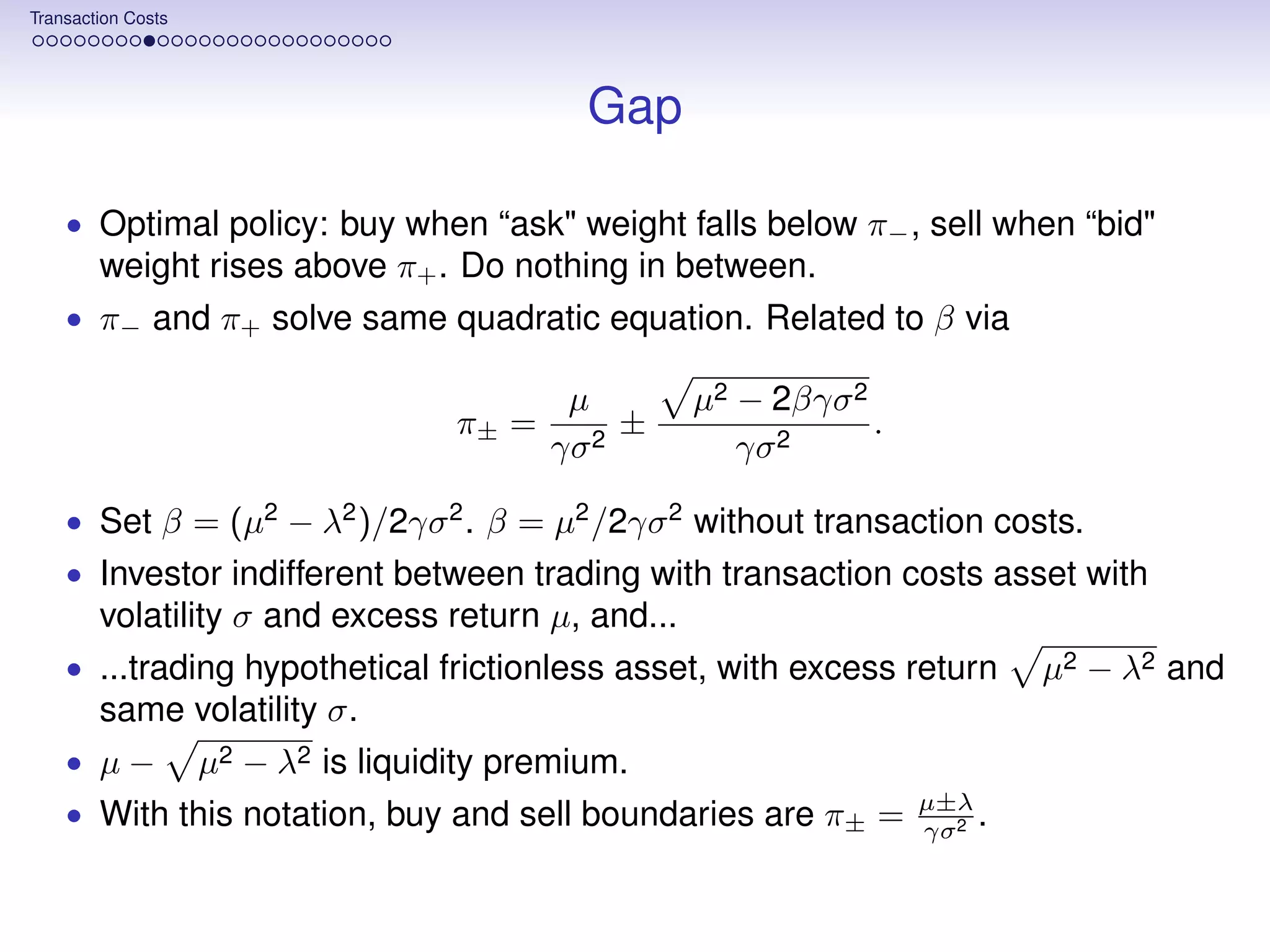
    • Optimal policy: buy when “ask" weight falls below π− , sell when “bid"
        weight rises above π+ . Do nothing in between.
    • π− and π+ solve same quadratic equation. Related to β via

                                             µ       µ2 − 2βγσ 2
                                     π± =        ±               .
                                            γσ 2        γσ 2

    • Set β = (µ2 − λ2 )/2γσ 2 . β = µ2 /2γσ 2 without transaction costs.
    • Investor indifferent between trading with transaction costs asset with
        volatility σ and excess return µ, and...
    • ...trading hypothetical frictionless asset, with excess return          µ2 − λ2 and
        same volatility σ.
    • µ−            µ2 − λ2 is liquidity premium.
                                                                     µ±λ
    • With this notation, buy and sell boundaries are π± =           γσ 2
                                                                          .
Transaction Costs


                    Symmetric Trading Boundaries


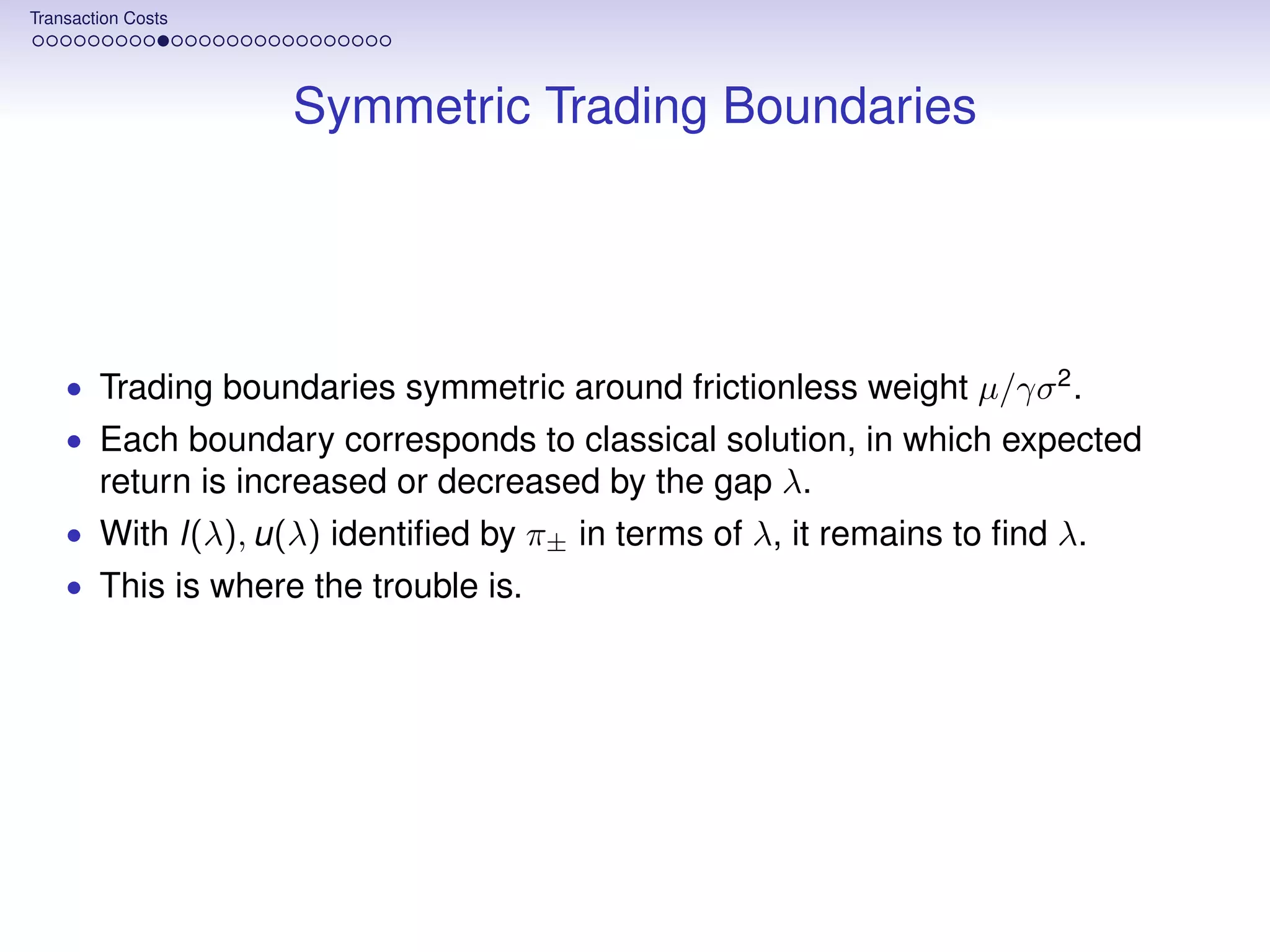
    • Trading boundaries symmetric around frictionless weight µ/γσ 2 .
    • Each boundary corresponds to classical solution, in which expected
        return is increased or decreased by the gap λ.
    • With l(λ), u(λ) identified by π± in terms of λ, it remains to find λ.
    • This is where the trouble is.
Transaction Costs


                                         First Order ODE
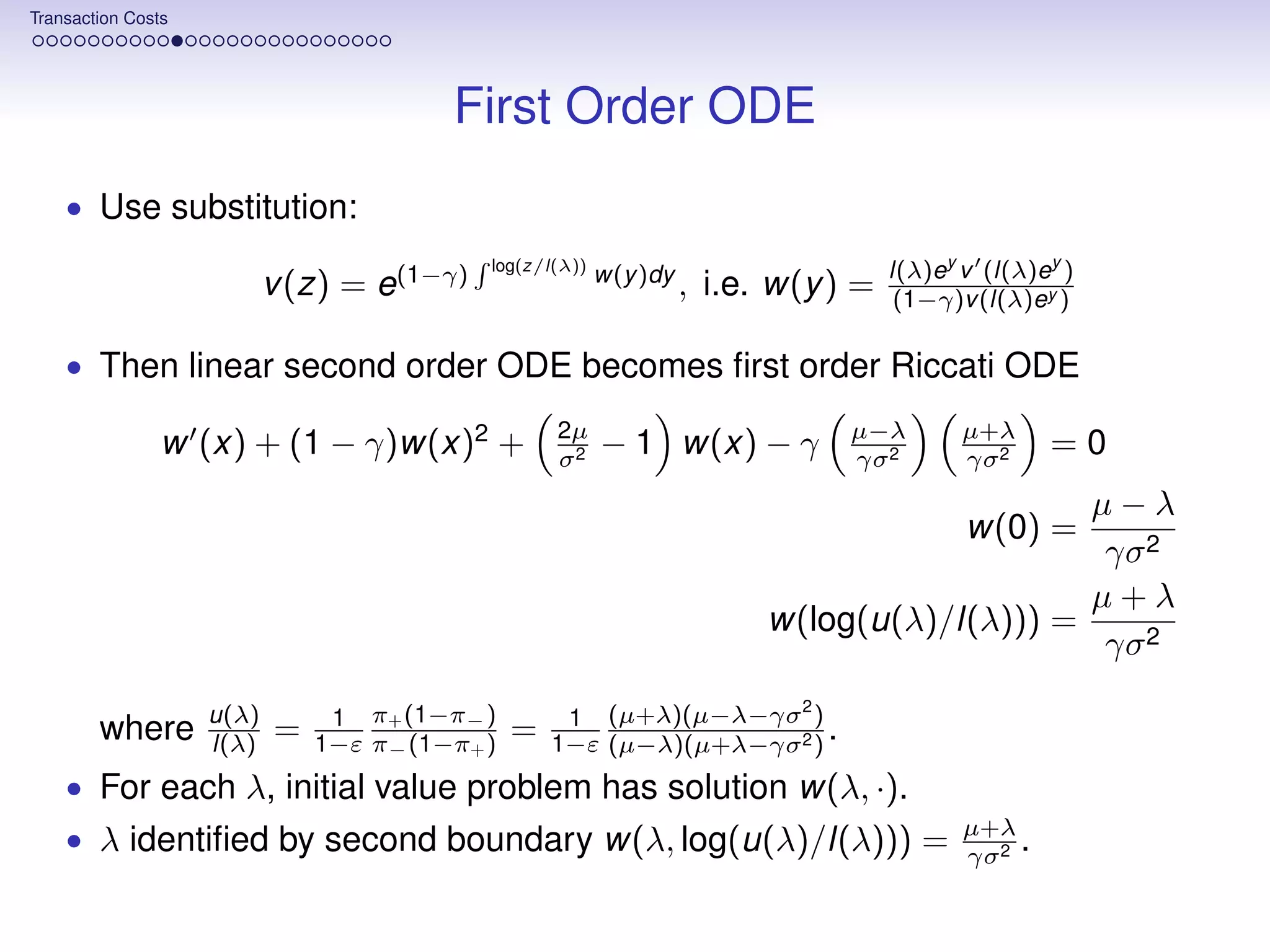
    • Use substitution:
                                            log(z/l(λ))
                                                          w(y )dy                    l(λ)ey v (l(λ)ey )
                           v (z) = e(1−γ)                           , i.e. w(y ) =    (1−γ)v (l(λ)ey )

    • Then linear second order ODE becomes first order Riccati ODE

                                                    2µ                          µ−λ         µ+λ
                w (x) + (1 − γ)w(x)2 +              σ2
                                                          − 1 w(x) − γ          γσ 2        γσ 2
                                                                                                     =0
                                                                                              µ−λ
                                                                                            w(0) =
                                                                                              γσ 2
                                                                                              µ+λ
                                                                          w(log(u(λ)/l(λ))) =
                                                                                              γσ 2
                                                                     2
                    u(λ)        1 π+ (1−π− )         1 (µ+λ)(µ−λ−γσ )
        where       l(λ)   =   1−ε π− (1−π+ )   =   1−ε (µ−λ)(µ+λ−γσ 2 ) .
    • For each λ, initial value problem has solution w(λ, ·).
                                                                                            µ+λ
    • λ identified by second boundary w(λ, log(u(λ)/l(λ))) =                                 γσ 2
                                                                                                 .
Transaction Costs


                                         Explicit Solutions


    • First, solve ODE for w(x, λ). Solution (for positive discriminant):

                                         a(λ) tan[tan−1 ( b(λ) ) + a(λ)x] + ( σ2 − 2 )
                                                          a(λ)
                                                                              µ    1
                             w(λ, x) =                                                             ,
                                                                γ−1

        where

                                         2   2
                                                                2
                                         −λ
                    a(λ) =     (γ − 1) µγσ4 −      1
                                                   2   −   µ
                                                           σ2
                                                                    , b(λ) =   1
                                                                               2   −   µ
                                                                                       σ2
                                                                                            + (γ − 1) µ−λ .
                                                                                                      γσ 2


    • Similar expressions for zero and negaive discriminants.
Transaction Costs


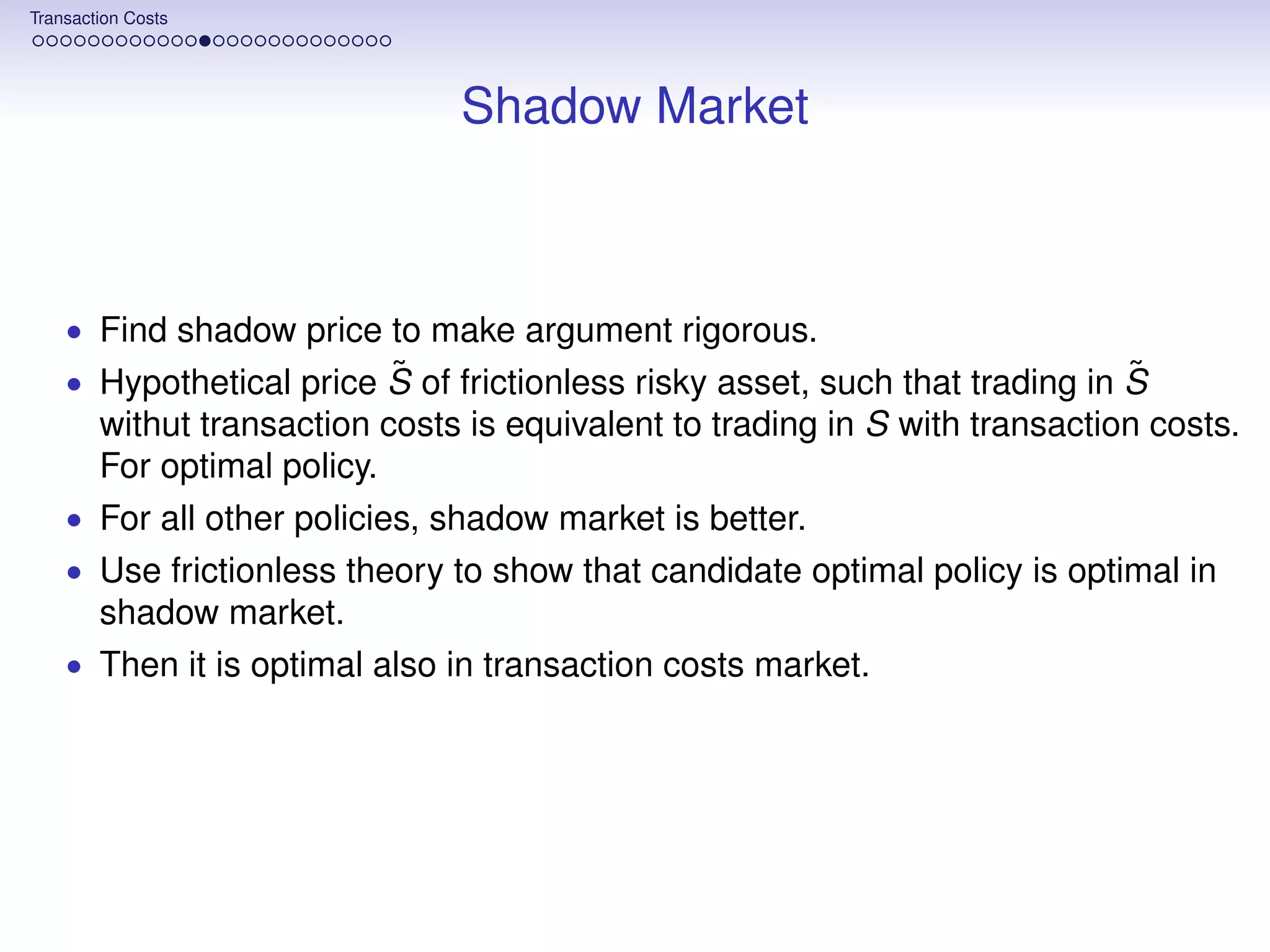
                                Shadow Market


    • Find shadow price to make argument rigorous.
                         ˜                                                   ˜
    • Hypothetical price S of frictionless risky asset, such that trading in S
        withut transaction costs is equivalent to trading in S with transaction costs.
        For optimal policy.
    • For all other policies, shadow market is better.
    • Use frictionless theory to show that candidate optimal policy is optimal in
        shadow market.
    • Then it is optimal also in transaction costs market.
Transaction Costs


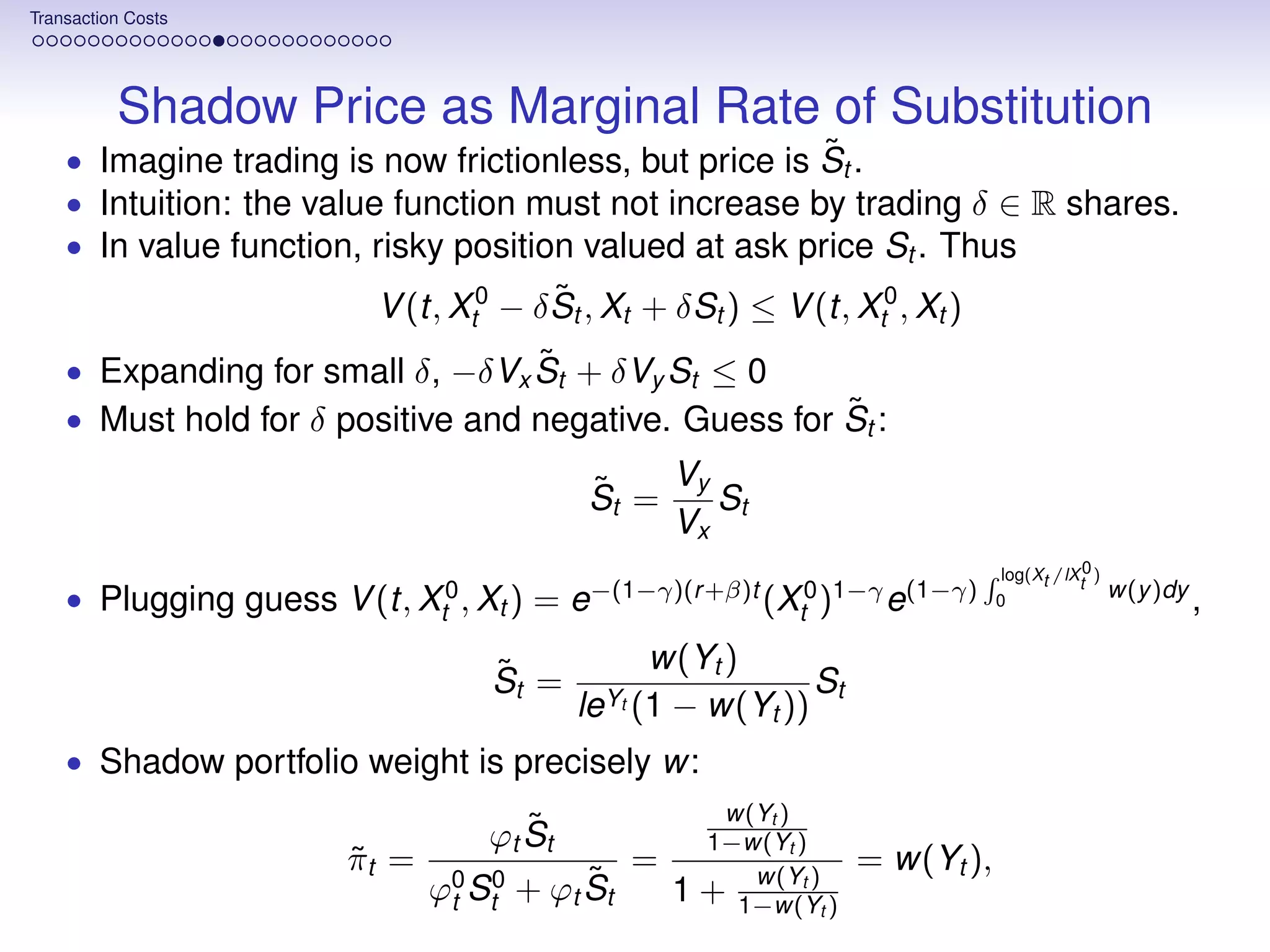
          Shadow Price as Marginal Rate of Substitution
                                                        ˜
    • Imagine trading is now frictionless, but price is St .
    • Intuition: the value function must not increase by trading δ ∈ R shares.
    • In value function, risky position valued at ask price St . Thus
                                        ˜
                          V (t, Xt0 − δ St , Xt + δSt ) ≤ V (t, Xt0 , Xt )
                                   ˜
    • Expanding for small δ, −δVx St + δVy St ≤ 0
                                                       ˜
    • Must hold for δ positive and negative. Guess for St :

                                           ˜    Vy
                                           St =    St
                                                Vx
                                                                                   log(Xt /lXt0 )
    • Plugging guess V (t, Xt0 , Xt ) = e−(1−γ)(r +β)t (Xt0 )1−γ e(1−γ)           0
                                                                                                    w(y )dy
                                                                                                              ,

                                   ˜            w(Yt )
                                   St =                    St
                                           leYt (1
                                                 − w(Yt ))
    • Shadow portfolio weight is precisely w:
                                                          w(Yt )
                                      ˜
                                   ϕt St                 1−w(Yt )
                        πt =
                        ˜                       =                     = w(Yt ),
                                           ˜
                               ϕ0 St0 + ϕt St        1      w(Yt )
                                                         + 1−w(Yt )
                                t
Transaction Costs


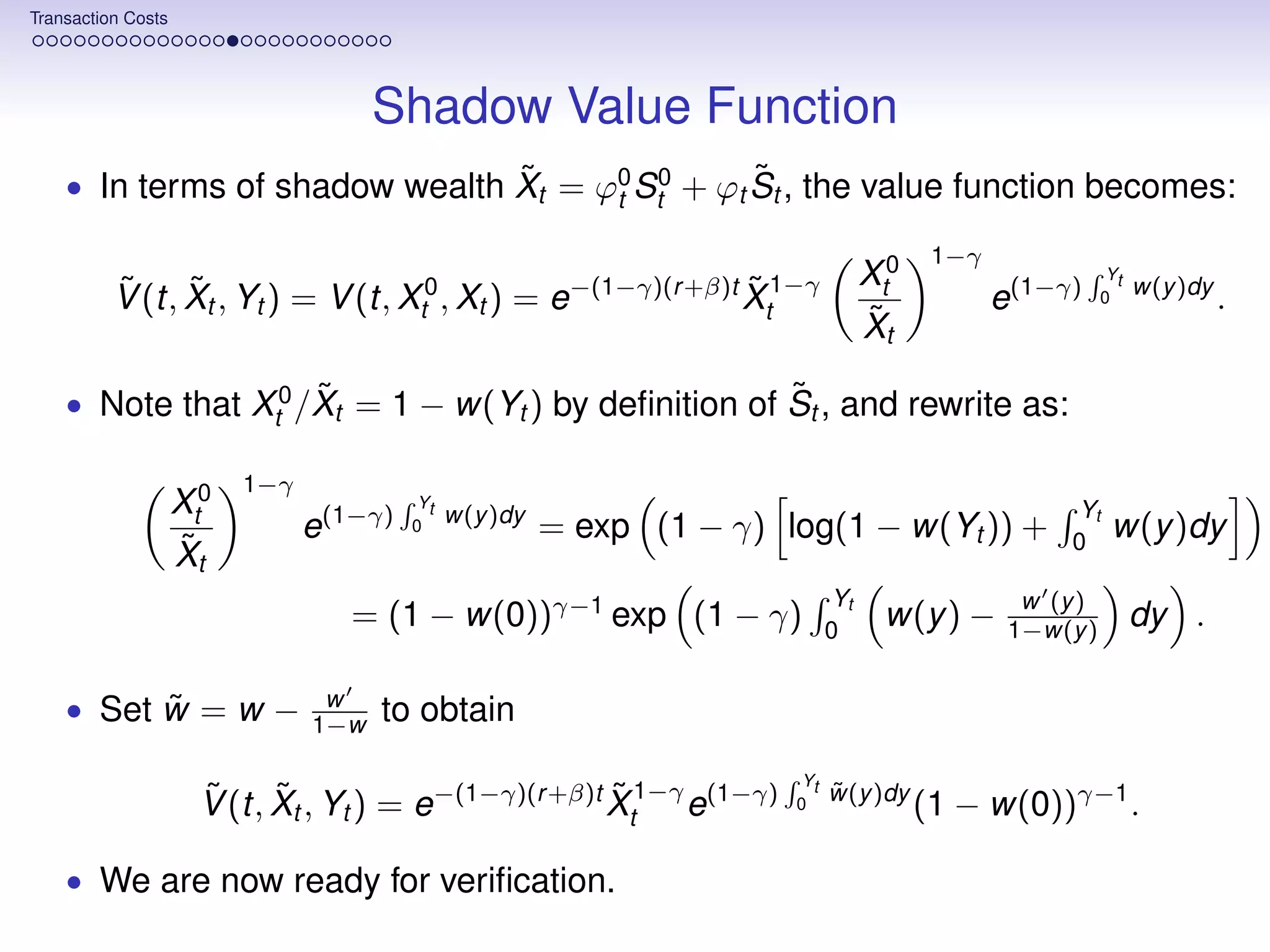
                                      Shadow Value Function
                                ˜                ˜
    • In terms of shadow wealth Xt = ϕ0 St0 + ϕt St , the value function becomes:
                                      t

                                                                                          1−γ
                                                                                   Xt0                      Yt
          V (t, Xt , Yt ) = V (t, Xt0 , Xt ) = e−(1−γ)(r +β)t Xt1−γ
          ˜ ˜                                                 ˜                                 e(1−γ)     0
                                                                                                                 w(y )dy
                                                                                                                           .
                                                                                   ˜
                                                                                   Xt
                     ˜                               ˜
    • Note that Xt0 /Xt = 1 − w(Yt ) by definition of St , and rewrite as:

                          1−γ
                    Xt0                   Yt
                                               w(y )dy                                                Yt
                                e(1−γ)   0               = exp (1 − γ) log(1 − w(Yt )) +              0
                                                                                                            w(y )dy
                    ˜
                    Xt
                                                                              Yt                  w (y )
                                   = (1 − w(0))γ−1 exp (1 − γ)                0
                                                                                    w(y ) −      1−w(y )         dy .

          ˜
    • Set w = w −                w
                                1−w   to obtain
                                                                         Yt
                      V (t, Xt , Yt ) = e−(1−γ)(r +β)t Xt1−γ e(1−γ)
                      ˜ ˜                              ˜                0
                                                                              ˜
                                                                              w(y )dy
                                                                                         (1 − w(0))γ−1 .

    • We are now ready for verification.
Transaction Costs


                          Construction of Shadow Price
    • So far, a string of guesses. Now construction.
    • Define Yt as reflected diffusion on [0, log(u/l)]:

                    dYt = (µ − σ 2 /2)dt + σdWt + dLt − dUt ,      Y0 ∈ [0, log(u/l)],


Lemma
                ˜          w(Y )
The dynamics of S = S leY (1−w(Y )) is given by

                            ˜      ˜
                          d S(Yt )/S(Yt ) = (˜(Yt ) + r ) dt + σ (Yt )dWt ,
                                             µ                 ˜

where µ(·) and σ (·) are defined as
      ˜        ˜

                 σ 2 w (y )          w (y )                                         σw (y )
µ(y ) =
˜                                            − (1 − γ)w(y ) ,        σ (y ) =
                                                                     ˜                           .
              w(y )(1 − w(y ))     1 − w(y )                                    w(y )(1 − w(y ))

                ˜
And the process S takes values within the bid-ask spread [(1 − ε)S, S].
Transaction Costs


                                    Finite-horizon Bound

Theorem
                  ˜
The shadow payoff XT of the portfolio π = w(Yt ) and the shadow discount
                                      ˜
                · µ
                  ˜                               y
                                         ˜
factor MT = E(− 0 σ dWt )T satisfy (with q (y ) =
                  ˜
                                                    ˜
                                                    w(z)dz):

                             ˜ 1−γ =e(1−γ)βT E e(1−γ)(q (Y0 )−q (YT )) ,
                           E XT              ˆ        ˜       ˜

                                  1
                                        γ                                           γ
                               1− γ                           1     ˜       ˜
                         E MT               =e(1−γ)βT E e( γ −1)(q (Y0 )−q (YT ))
                                                      ˆ                                 .

      ˆ                                                              ˆ
where E[·] is the expectation with respect to the myopic probability P:

                     ˆ              T                                   T                   2
                    dP                      µ
                                            ˜             1                     µ
                                                                                ˜
                       = exp            −     + σ π dWt −
                                                ˜˜                          −     + σπ
                                                                                    ˜˜          dt   .
                    dP          0           σ
                                            ˜             2         0           σ
                                                                                ˜
Transaction Costs


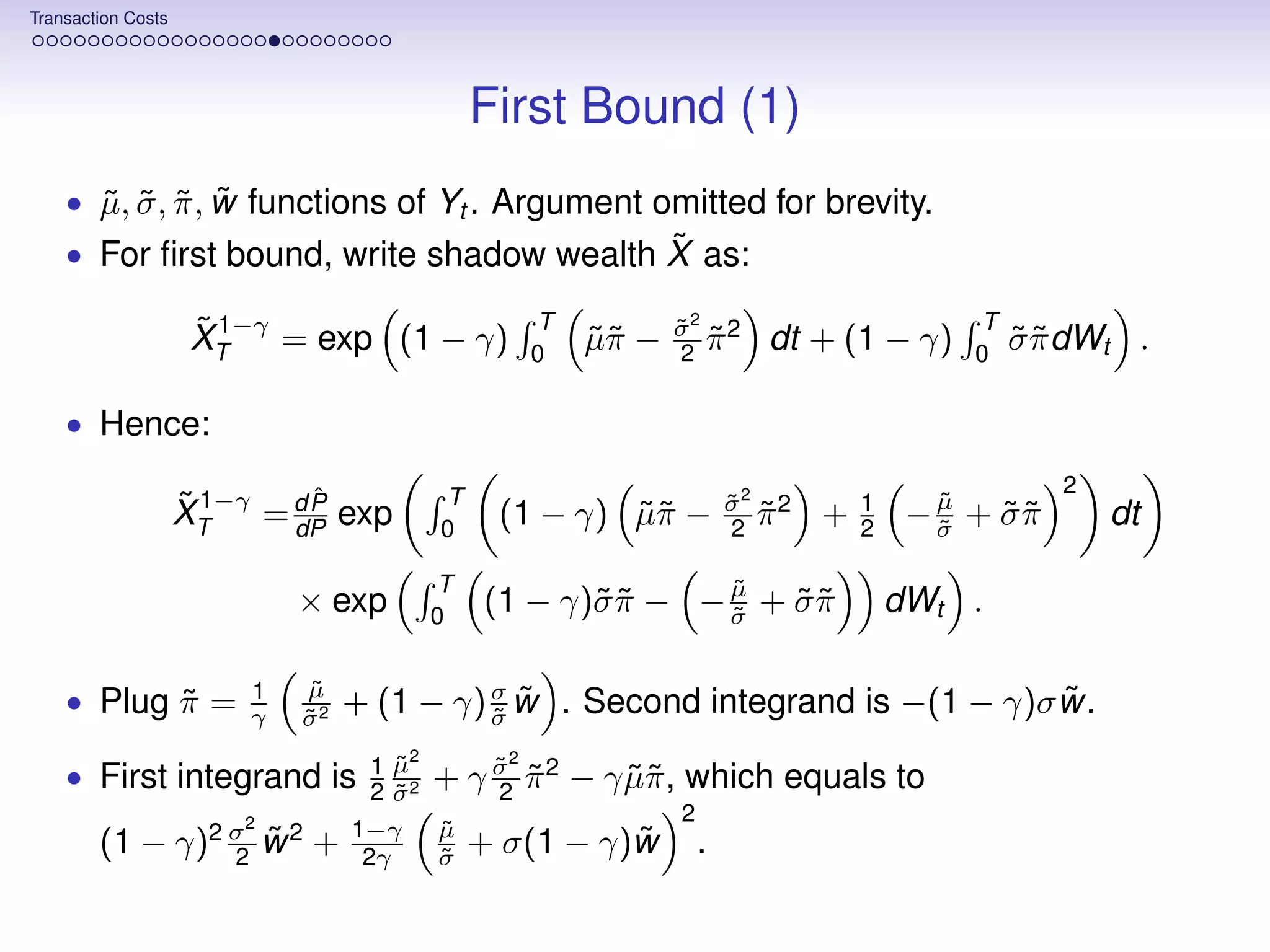
                                              First Bound (1)
      ˜ ˜ ˜ ˜
    • µ, σ , π , w functions of Yt . Argument omitted for brevity.
                                          ˜
    • For first bound, write shadow wealth X as:

                     ˜ 1−γ = exp (1 − γ)            T          σ2 2
                                                               ˜                           T
                     XT                             0
                                                        µπ −
                                                        ˜˜     2 π
                                                                 ˜       dt + (1 − γ)      0
                                                                                               σ π dWt .
                                                                                               ˜˜

    • Hence:

                              ˆ           T                                                       2
                    ˜ 1−γ = d P exp                                    σ2 2
                                                                       ˜          1      µ
                                                                                         ˜
                    XT      dP            0
                                               (1 − γ) µπ −
                                                       ˜˜              2 π
                                                                         ˜    +   2    − σ + σπ
                                                                                         ˜   ˜˜       dt
                                          T                  µ
                                                             ˜
                             × exp        0
                                              (1 − γ)˜ π − − σ + σ π
                                                     σ˜      ˜   ˜˜                   dWt .

                         1   µ
                             ˜
    • Plug π =
           ˜             γ   σ2
                             ˜
                                  + (1 − γ) σ w . Second integrand is −(1 − γ)σ w.
                                            σ
                                            ˜
                                              ˜                                 ˜
                                   1µ˜2         2
    • First integrand is           2 σ2
                                     ˜
                                          + γ σ π 2 − γ µπ , which equals to
                                              ˜
                                              2 ˜       ˜˜
                        2                                      2
                                  1−γ     µ
                                          ˜
        (1 − γ)2 σ w 2 +
                 2
                   ˜               2γ     σ
                                          ˜
                                                        ˜
                                              + σ(1 − γ)w          .
Transaction Costs


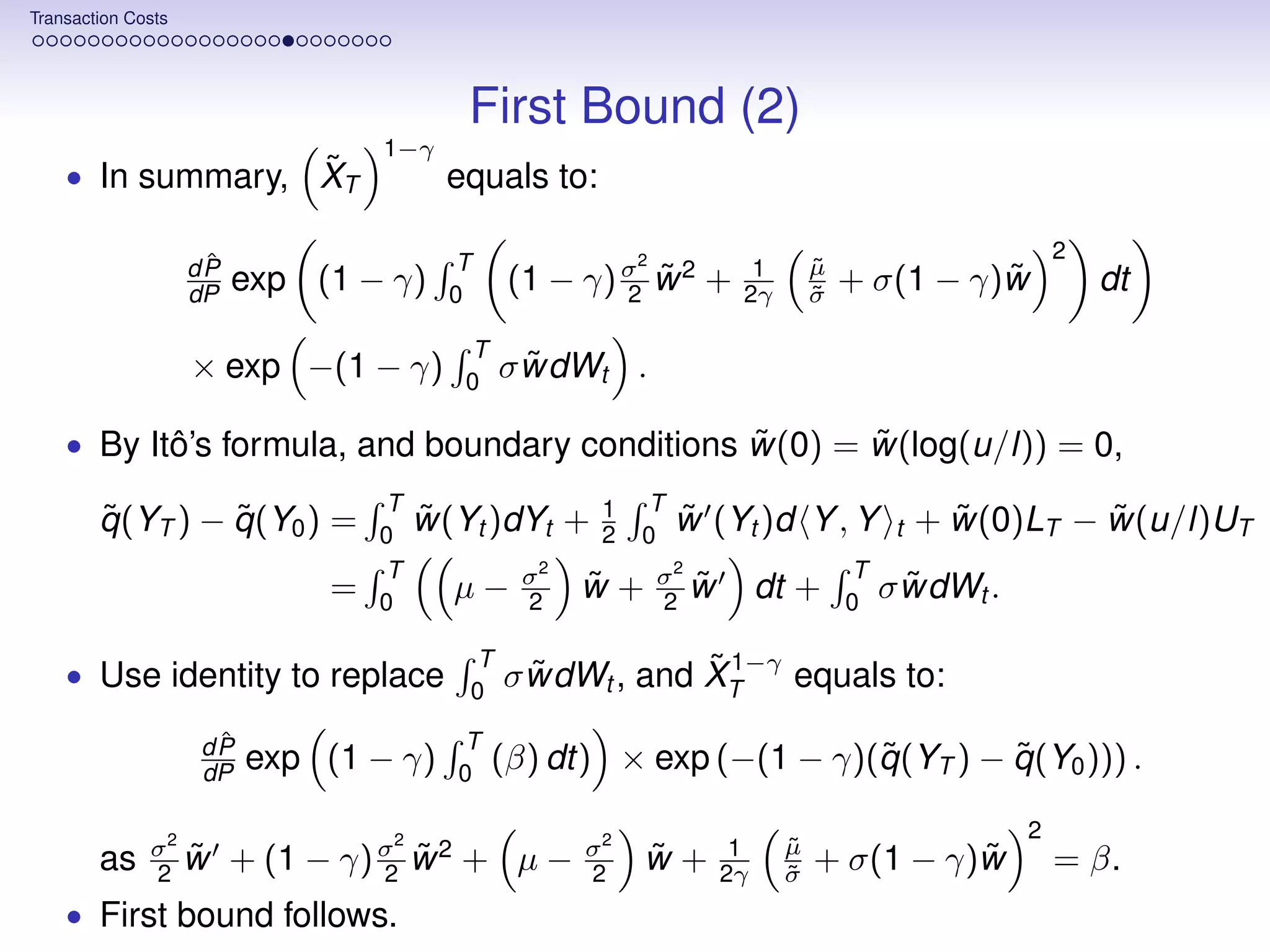
                                          First Bound (2)
                                   1−γ
                  ˜
    • In summary, XT                     equals to:

                     ˆ                   T                2                                            2
                    dP                                                  1       µ
                                                                                ˜
                    dP   exp (1 − γ)     0
                                               (1 − γ) σ w 2 +
                                                       2
                                                         ˜             2γ       σ
                                                                                ˜
                                                                                              ˜
                                                                                    + σ(1 − γ)w            dt
                                          T
                    × exp −(1 − γ)        0
                                                ˜
                                              σ wdWt .

                                                ˜      ˜
    • By Itô’s formula, and boundary conditions w(0) = w(log(u/l)) = 0,
                                   T                  1   T
        ˜         ˜
        q (YT ) − q (Y0 ) =        0
                                       ˜
                                       w(Yt )dYt +    2   0
                                                              ˜
                                                              w (Yt )d Y , Y             t     ˜        ˜
                                                                                             + w(0)LT − w(u/l)UT
                                   T            σ2            2
                                                              σ                     T
                               =   0
                                         µ−     2
                                                     ˜
                                                     w+       2
                                                                  ˜
                                                                  w        dt +     0
                                                                                          ˜
                                                                                        σ wdWt .
                                          T                ˜ 1−γ equals to:
    • Use identity to replace             0
                                                ˜
                                              σ wdWt , and XT
                     ˆ
                    dP                   T
                    dP   exp (1 − γ)     0
                                                                      ˜         ˜
                                              (β) dt) × exp (−(1 − γ)(q (YT ) − q (Y0 ))) .
                                                                                                   2
              σ2 ˜                 2
                                                     σ2                1    µ
                                                                            ˜
        as    2 w        + (1 − γ) σ w 2 + µ −
                                   2
                                     ˜               2
                                                          ˜
                                                          w+          2γ    σ
                                                                            ˜
                                                                                          ˜
                                                                                + σ(1 − γ)w            = β.
    • First bound follows.
Transaction Costs


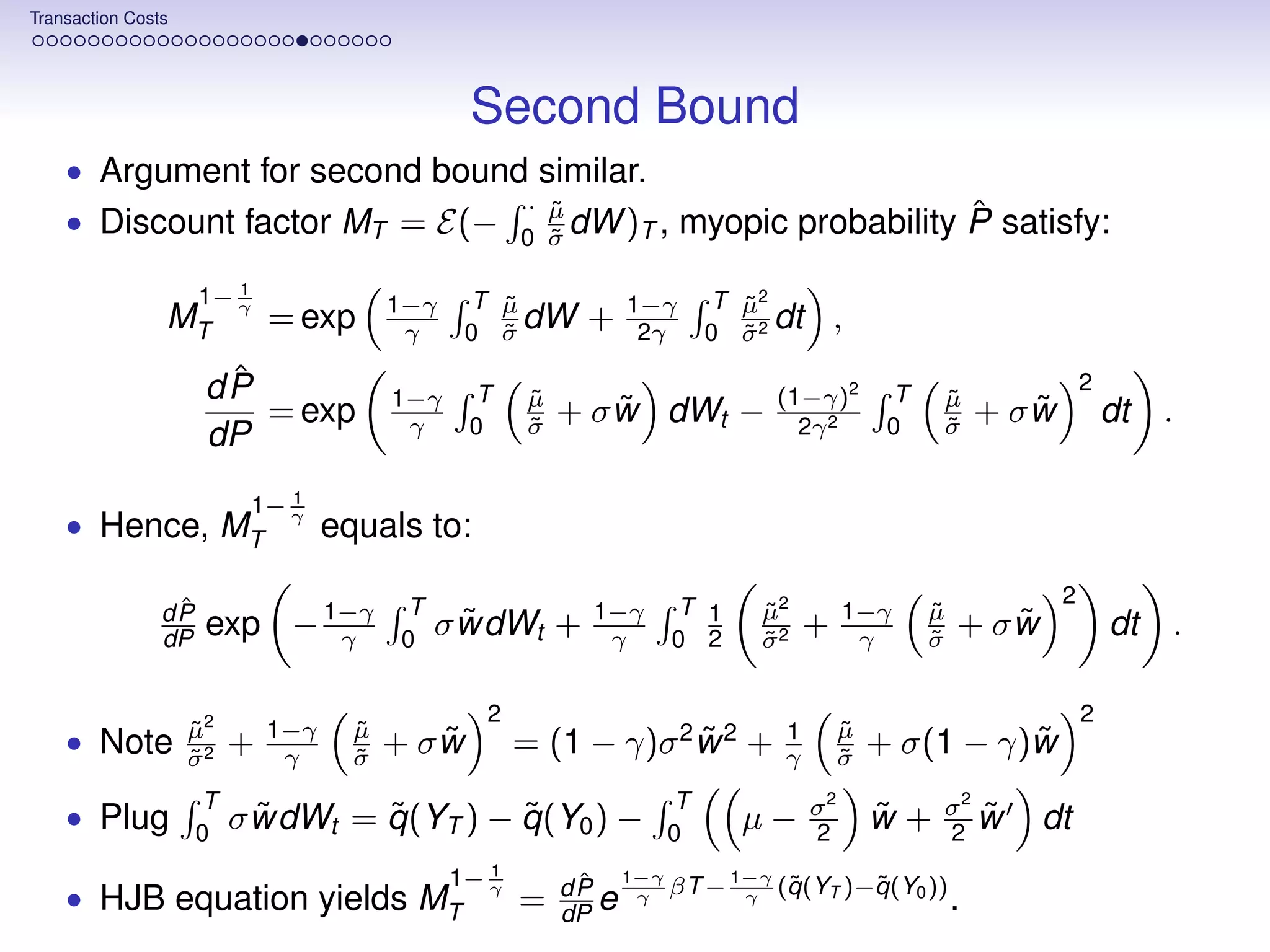
                                                Second Bound
    • Argument for second bound similar.
                                                      · µ
                                                        ˜                                  ˆ
    • Discount factor MT = E(−                          ˜ dW )T ,
                                                      0 σ
                                                                        myopic probability P satisfy:
                        1
                     1− γ                1−γ    T µ
                                                  ˜               1−γ       T µ2
                                                                              ˜
                MT           = exp        γ       ˜ dW
                                                0 σ
                                                            +      2γ       0 σ2
                                                                              ˜
                                                                                 dt       ,
                      ˆ
                     dP                  1−γ    T      µ
                                                       ˜                          (1−γ)2        T   µ
                                                                                                    ˜
                                                                                                                       2
                        = exp             γ     0      σ
                                                       ˜
                                                               ˜
                                                           + σ w dWt −              2γ 2        0   σ
                                                                                                    ˜
                                                                                                               ˜
                                                                                                            + σw           dt .
                     dP
                               1
                            1− γ
    • Hence, MT                    equals to:
                                                                                                                   2
                 ˆ                       T                              T 1     µ2
                dP
                dP   exp − 1−γ
                            γ            0
                                               ˜
                                             σ wdWt +        1−γ
                                                              γ         0 2
                                                                                ˜
                                                                                σ2
                                                                                ˜
                                                                                      +    1−γ
                                                                                            γ
                                                                                                    µ
                                                                                                    ˜
                                                                                                    σ
                                                                                                    ˜
                                                                                                           ˜
                                                                                                        + σw               dt .

                                                 2                                                                     2
                    µ2
                    ˜        1−γ     µ
                                     ˜                                            1        µ
                                                                                           ˜
    • Note          σ2
                    ˜
                         +    γ      σ
                                     ˜
                                            ˜
                                         + σw         = (1 − γ)σ 2 w 2 +
                                                                   ˜              γ        σ
                                                                                           ˜
                                                                                                         ˜
                                                                                               + σ(1 − γ)w
                     T                                                  T             σ2            σ2 ˜
    • Plug           0
                           ˜      ˜         ˜
                         σ wdWt = q (YT ) − q (Y0 ) −                   0
                                                                              µ−      2
                                                                                               ˜
                                                                                               w+   2 w        dt
                                                  1
                                               1− γ         ˆ
                                                           dP
                                                                  1−γ
                                                                        βT − 1−γ (q (YT )−q (Y0 ))
                                                                                  ˜       ˜
    • HJB equation yields MT                          =    dP e
                                                                   γ          γ                         .
Transaction Costs


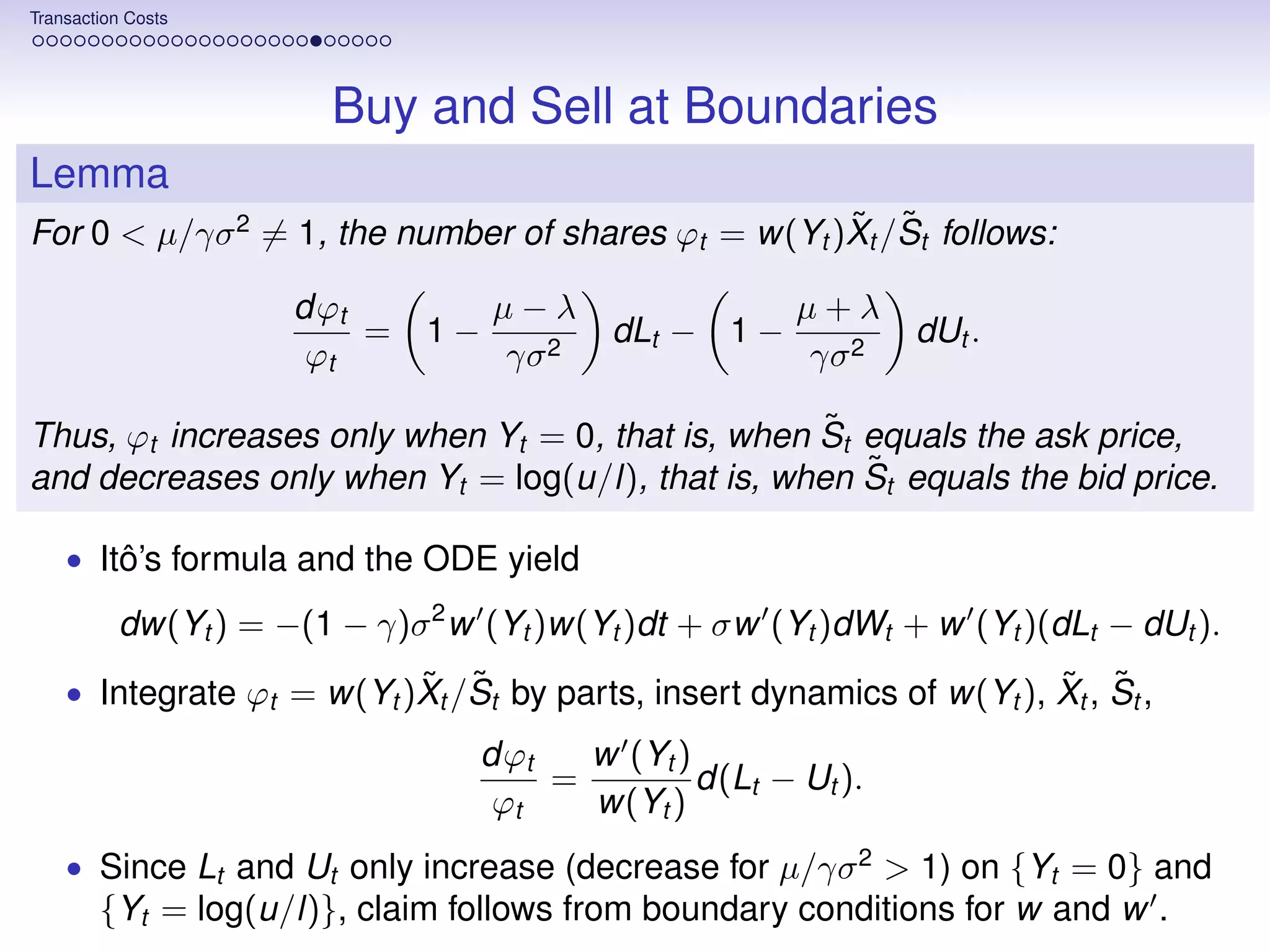
                        Buy and Sell at Boundaries
Lemma
                                                    ˜ ˜
For 0 < µ/γσ 2 = 1, the number of shares ϕt = w(Yt )Xt /St follows:

                     dϕt           µ−λ                 µ+λ
                         =    1−           dLt − 1 −           dUt .
                      ϕt           γσ 2                γσ 2

                                                   ˜
Thus, ϕt increases only when Yt = 0, that is, when St equals the ask price,
                                                      ˜
and decreases only when Yt = log(u/l), that is, when St equals the bid price.

    • Itô’s formula and the ODE yield

          dw(Yt ) = −(1 − γ)σ 2 w (Yt )w(Yt )dt + σw (Yt )dWt + w (Yt )(dLt − dUt ).
                           ˜ ˜                                         ˜ ˜
    • Integrate ϕt = w(Yt )Xt /St by parts, insert dynamics of w(Yt ), Xt , St ,

                                  dϕt   w (Yt )
                                      =         d(Lt − Ut ).
                                   ϕt   w(Yt )
    • Since Lt and Ut only increase (decrease for µ/γσ 2 > 1) on {Yt = 0} and
        {Yt = log(u/l)}, claim follows from boundary conditions for w and w .
Transaction Costs


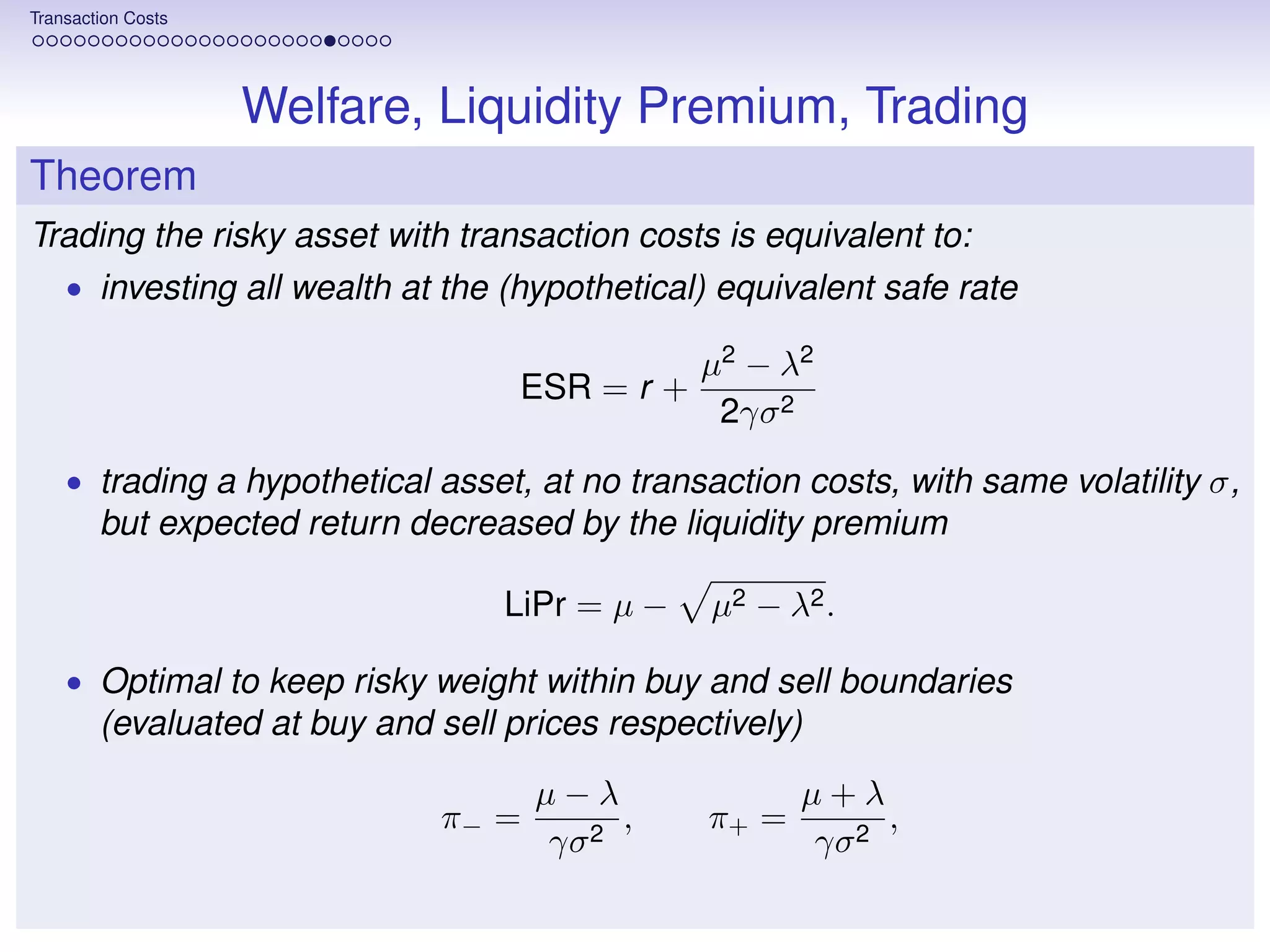
                    Welfare, Liquidity Premium, Trading
Theorem
Trading the risky asset with transaction costs is equivalent to:
    • investing all wealth at the (hypothetical) equivalent safe rate

                                                µ2 − λ2
                                    ESR = r +
                                                 2γσ 2
    • trading a hypothetical asset, at no transaction costs, with same volatility σ,
        but expected return decreased by the liquidity premium

                                   LiPr = µ −   µ2 − λ2 .

    • Optimal to keep risky weight within buy and sell boundaries
        (evaluated at buy and sell prices respectively)

                                     µ−λ               µ+λ
                              π− =        ,     π+ =        ,
                                     γσ 2              γσ 2
Transaction Costs


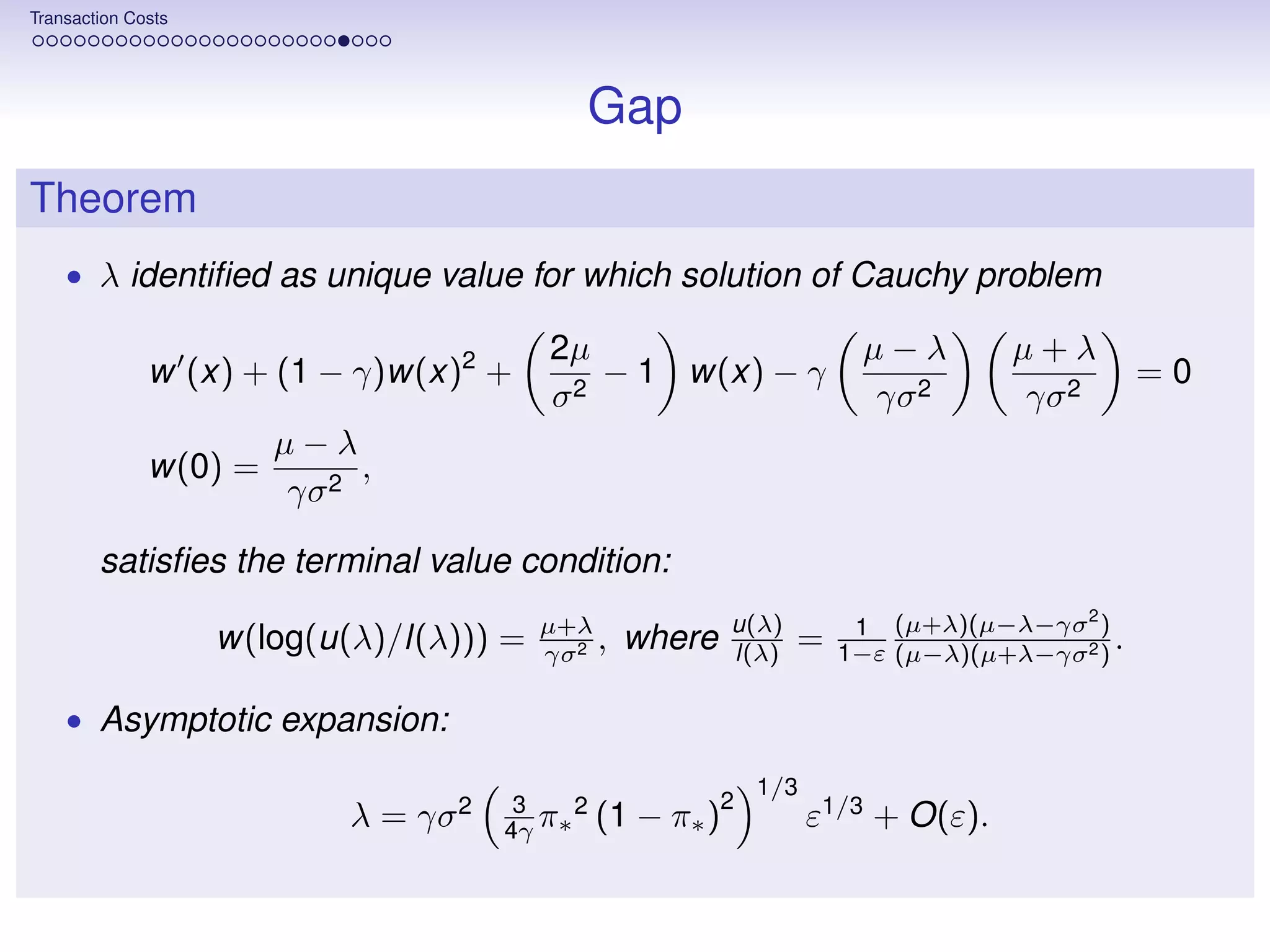
                                              Gap
Theorem
    • λ identified as unique value for which solution of Cauchy problem

                                          2µ                              µ−λ         µ+λ
              w (x) + (1 − γ)w(x)2 +         − 1 w(x) − γ                                         =0
                                          σ2                              γσ 2        γσ 2
                       µ−λ
              w(0) =        ,
                       γσ 2

        satisfies the terminal value condition:
                                                                                          2
                                          µ+λ                u(λ)         1 (µ+λ)(µ−λ−γσ )
                    w(log(u(λ)/l(λ))) =   γσ 2
                                               ,   where     l(λ)   =    1−ε (µ−λ)(µ+λ−γσ 2 ) .

    • Asymptotic expansion:

                                                                 1/3
                                        3                    2
                            λ = γσ 2   4γ π∗
                                             2
                                                 (1 − π∗ )             ε1/3 + O(ε).
Transaction Costs


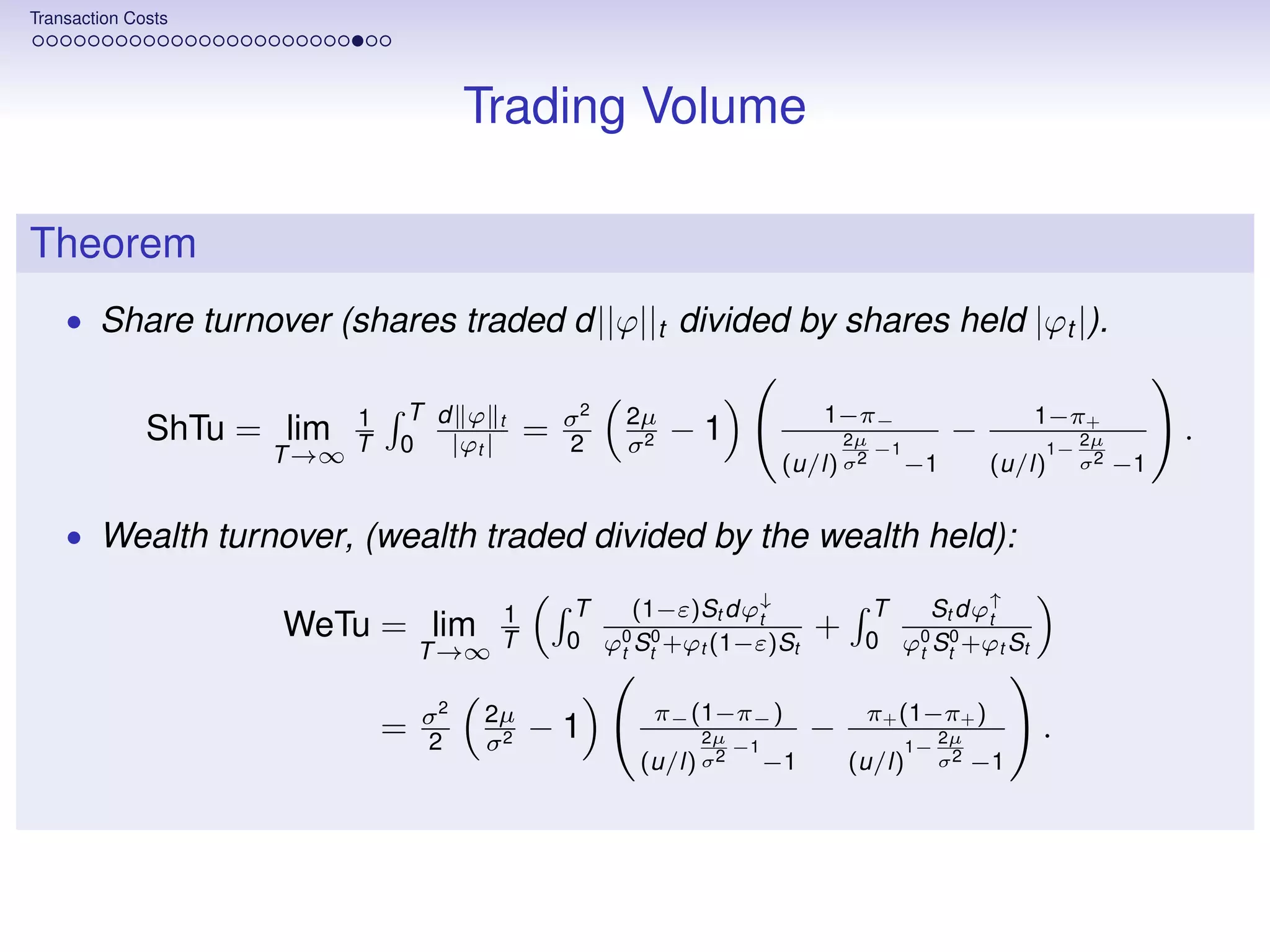
                                      Trading Volume

Theorem
    • Share turnover (shares traded d||ϕ||t divided by shares held |ϕt |).


                         1   T d ϕ t           σ2   2µ                    1−π−                         1−π+
              ShTu = lim        |ϕt |      =        σ2
                                                         −1                   2µ              −             2µ        .
                    T →∞ T   0                 2
                                                                      (u/l) σ2
                                                                                   −1
                                                                                        −1
                                                                                                       1−
                                                                                                   (u/l)    σ2   −1


    • Wealth turnover, (wealth traded divided by the wealth held):

                                      1        T    (1−ε)St dϕ↓                T    St dϕ↑
                     WeTu = lim                                t
                                               0 ϕ0 St0 +ϕt (1−ε)St
                                                                          +              t
                                                                               0 ϕ0 St0 +ϕt St
                                 T →∞ T           t                               t


                                 σ2   2µ              π− (1−π− )               π+ (1−π+ )
                             =   2    σ2
                                           −1             2µ
                                                                −1
                                                                          −             1−
                                                                                             2µ        .
                                                     (u/l) σ2        −1       (u/l)          σ2   −1
Transaction Costs


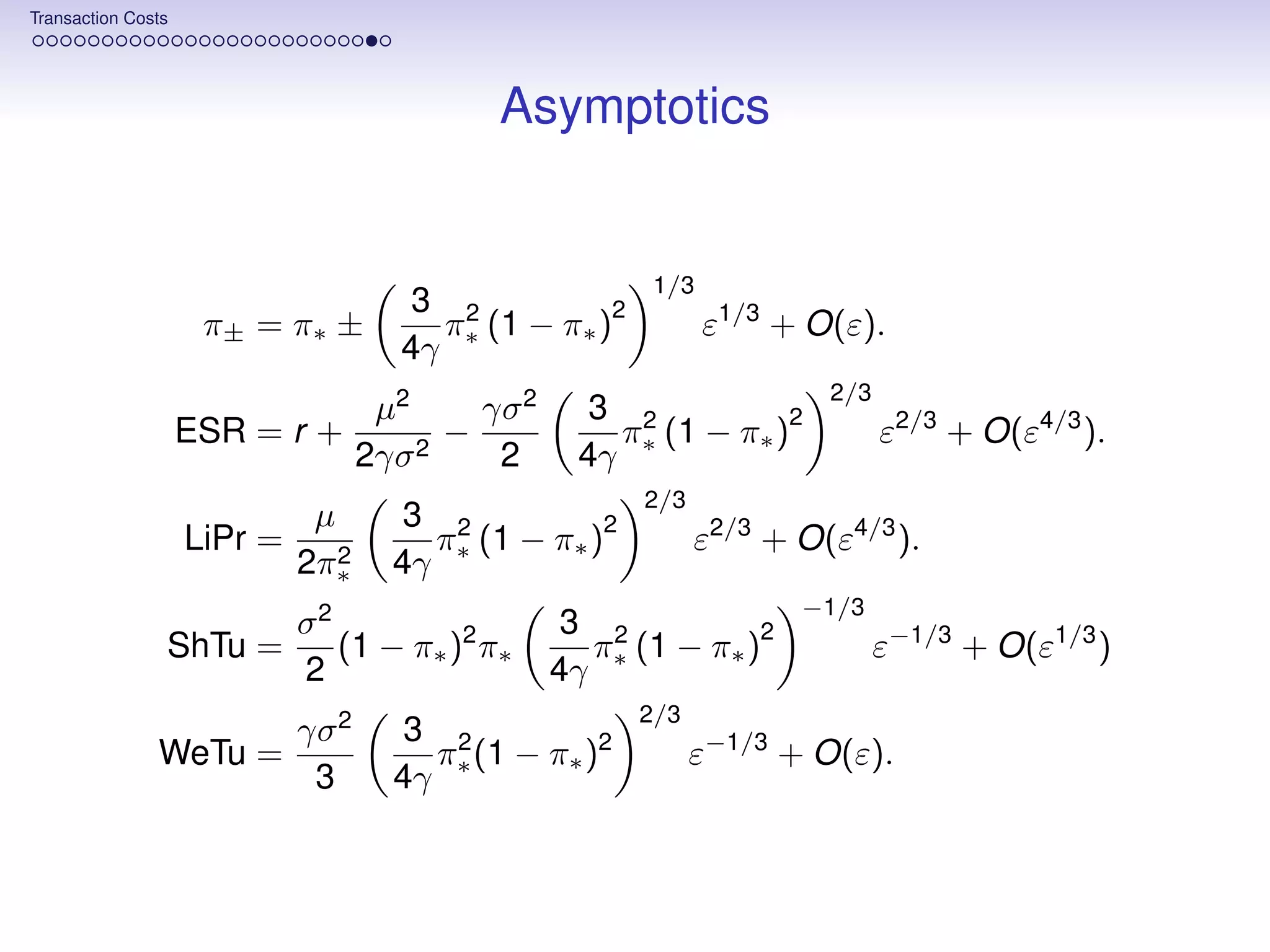
                                             Asymptotics


                                                         1/3
                                        3 2         2
                     π± = π∗ ±           π (1 − π∗ )           ε1/3 + O(ε).
                                       4γ ∗
                                                                       2/3
                                     µ2     γσ 2     3 2         2
                    ESR = r +             −           π (1 − π∗ )            ε2/3 + O(ε4/3 ).
                                    2γσ 2    2      4γ ∗
                                                        2/3
                              µ        3 2         2
                    LiPr =              π (1 − π∗ )           ε2/3 + O(ε4/3 ).
                             2π∗2     4γ ∗
                                                                     −1/3
                             σ2                     3 2         2
                ShTu =          (1 − π∗ )2 π∗        π (1 − π∗ )             ε−1/3 + O(ε1/3 )
                             2                     4γ ∗
                                                        2/3
                             γσ 2      3 2
               WeTu =                   π (1 − π∗ )2          ε−1/3 + O(ε).
                              3       4γ ∗
Transaction Costs


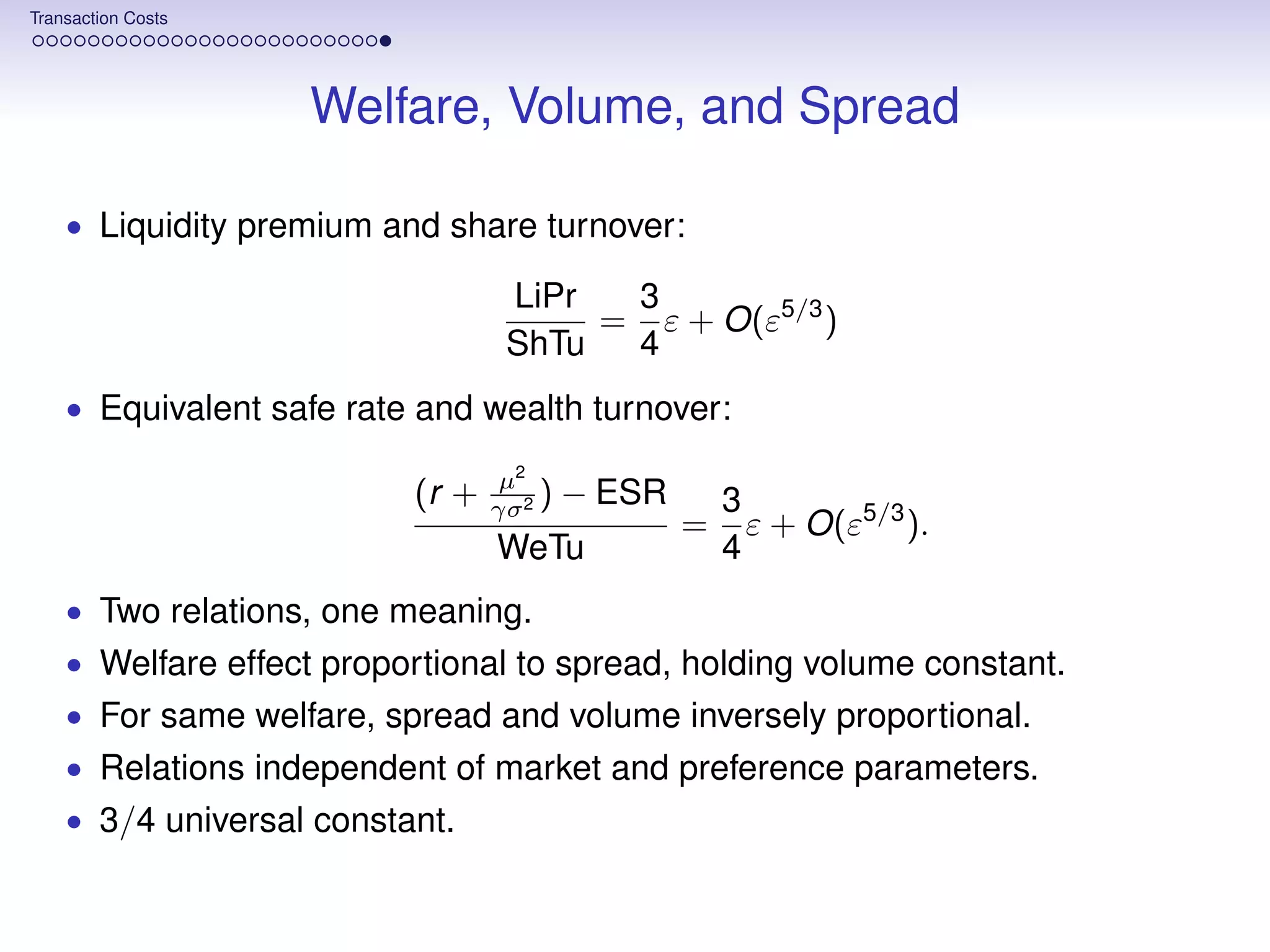
                    Welfare, Volume, and Spread

    • Liquidity premium and share turnover:

                                  LiPr  3
                                       = ε + O(ε5/3 )
                                  ShTu  4
    • Equivalent safe rate and wealth turnover:

                                  µ2
                          (r +   γσ 2
                                      )   − ESR       3
                                                  =     ε + O(ε5/3 ).
                                 WeTu                 4
    • Two relations, one meaning.
    • Welfare effect proportional to spread, holding volume constant.
    • For same welfare, spread and volume inversely proportional.
    • Relations independent of market and preference parameters.
    • 3/4 universal constant.
Price Impact


                       Four

                   Price Impact
                     Based on
               Dynamic Trading Volume
                 with Marko Weber
Price Impact


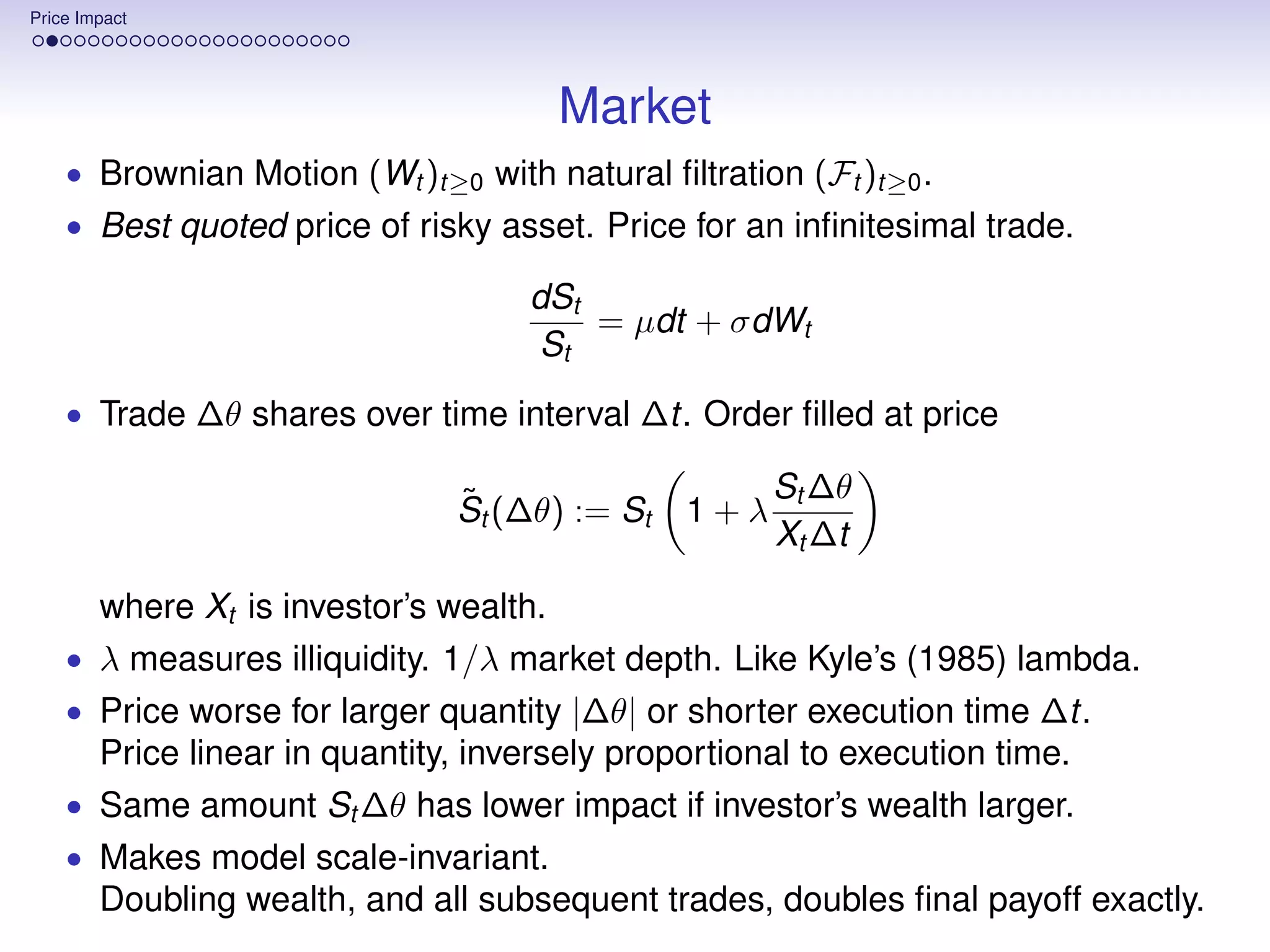
                                         Market
    • Brownian Motion (Wt )t≥0 with natural filtration (Ft )t≥0 .
    • Best quoted price of risky asset. Price for an infinitesimal trade.

                                     dSt
                                         = µdt + σdWt
                                     St
    • Trade ∆θ shares over time interval ∆t. Order filled at price

                                ˜                     St ∆θ
                                St (∆θ) := St   1+λ
                                                      Xt ∆t

        where Xt is investor’s wealth.
    • λ measures illiquidity. 1/λ market depth. Like Kyle’s (1985) lambda.
    • Price worse for larger quantity |∆θ| or shorter execution time ∆t.
        Price linear in quantity, inversely proportional to execution time.
    • Same amount St ∆θ has lower impact if investor’s wealth larger.
    • Makes model scale-invariant.
        Doubling wealth, and all subsequent trades, doubles final payoff exactly.
Price Impact


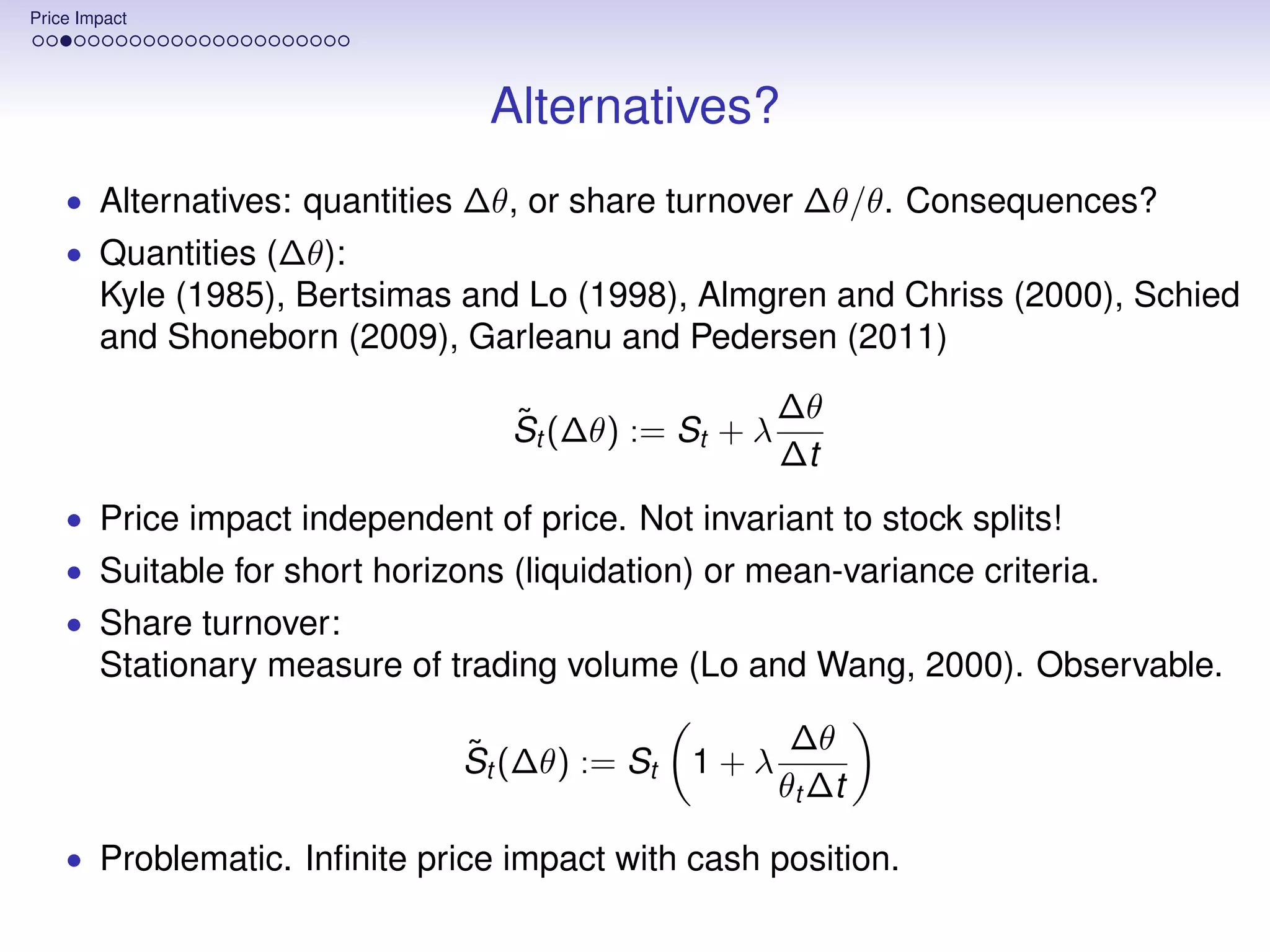
                                Alternatives?
    • Alternatives: quantities ∆θ, or share turnover ∆θ/θ. Consequences?
    • Quantities (∆θ):
        Kyle (1985), Bertsimas and Lo (1998), Almgren and Chriss (2000), Schied
        and Shoneborn (2009), Garleanu and Pedersen (2011)

                                  ˜                 ∆θ
                                  St (∆θ) := St + λ
                                                    ∆t
    • Price impact independent of price. Not invariant to stock splits!
    • Suitable for short horizons (liquidation) or mean-variance criteria.
    • Share turnover:
        Stationary measure of trading volume (Lo and Wang, 2000). Observable.

                              ˜                      ∆θ
                              St (∆θ) := St   1+λ
                                                    θt ∆t

    • Problematic. Infinite price impact with cash position.
Price Impact


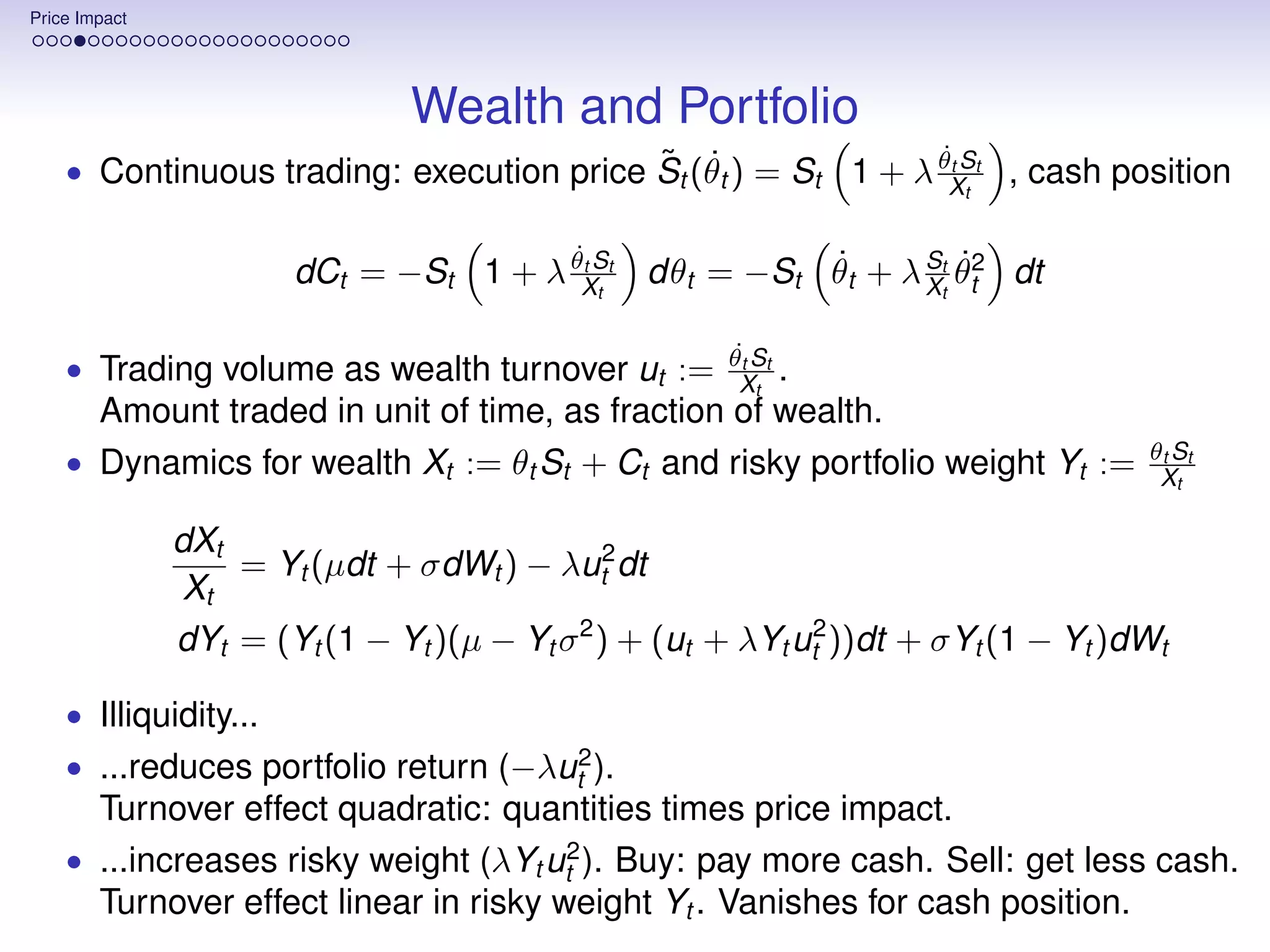
                                Wealth and Portfolio
                                          ˜ ˙                  ˙t
    • Continuous trading: execution price St (θt ) = St 1 + λ θXSt , cash position
                                                                  t


                                        ˙t            ˙          ˙
                       dCt = −St 1 + λ θXSt dθt = −St θt + λ Stt θt2 dt
                                           t                 X

                                                        ˙
                                                       θt St
    • Trading volume as wealth turnover ut :=       .    Xt
      Amount traded in unit of time, as fraction of wealth.
                                                                                     θt St
    • Dynamics for wealth Xt := θt St + Ct and risky portfolio weight Yt :=           Xt

               dXt
                   = Yt (µdt + σdWt ) − λut2 dt
               Xt
               dYt = (Yt (1 − Yt )(µ − Yt σ 2 ) + (ut + λYt ut2 ))dt + σYt (1 − Yt )dWt

    • Illiquidity...
    • ...reduces portfolio return (−λut2 ).
      Turnover effect quadratic: quantities times price impact.
    • ...increases risky weight (λYt ut2 ). Buy: pay more cash. Sell: get less cash.
      Turnover effect linear in risky weight Yt . Vanishes for cash position.
Price Impact


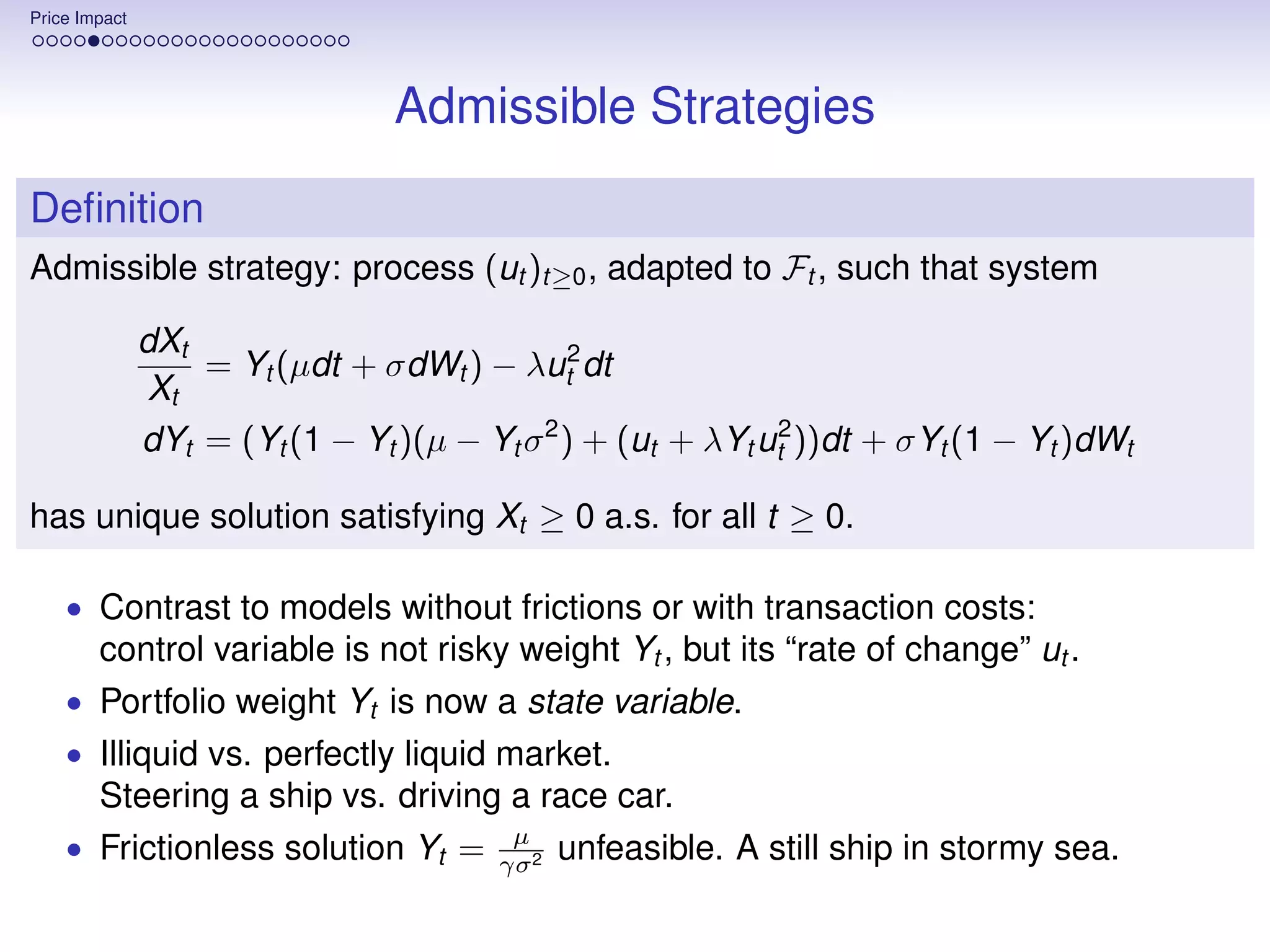
                                 Admissible Strategies
Definition
Admissible strategy: process (ut )t≥0 , adapted to Ft , such that system

               dXt
                   = Yt (µdt + σdWt ) − λut2 dt
                Xt
               dYt = (Yt (1 − Yt )(µ − Yt σ 2 ) + (ut + λYt ut2 ))dt + σYt (1 − Yt )dWt

has unique solution satisfying Xt ≥ 0 a.s. for all t ≥ 0.

    • Contrast to models without frictions or with transaction costs:
        control variable is not risky weight Yt , but its “rate of change” ut .
    • Portfolio weight Yt is now a state variable.
    • Illiquid vs. perfectly liquid market.
        Steering a ship vs. driving a race car.
                                          µ
    • Frictionless solution Yt =         γσ 2
                                                unfeasible. A still ship in stormy sea.
Price Impact


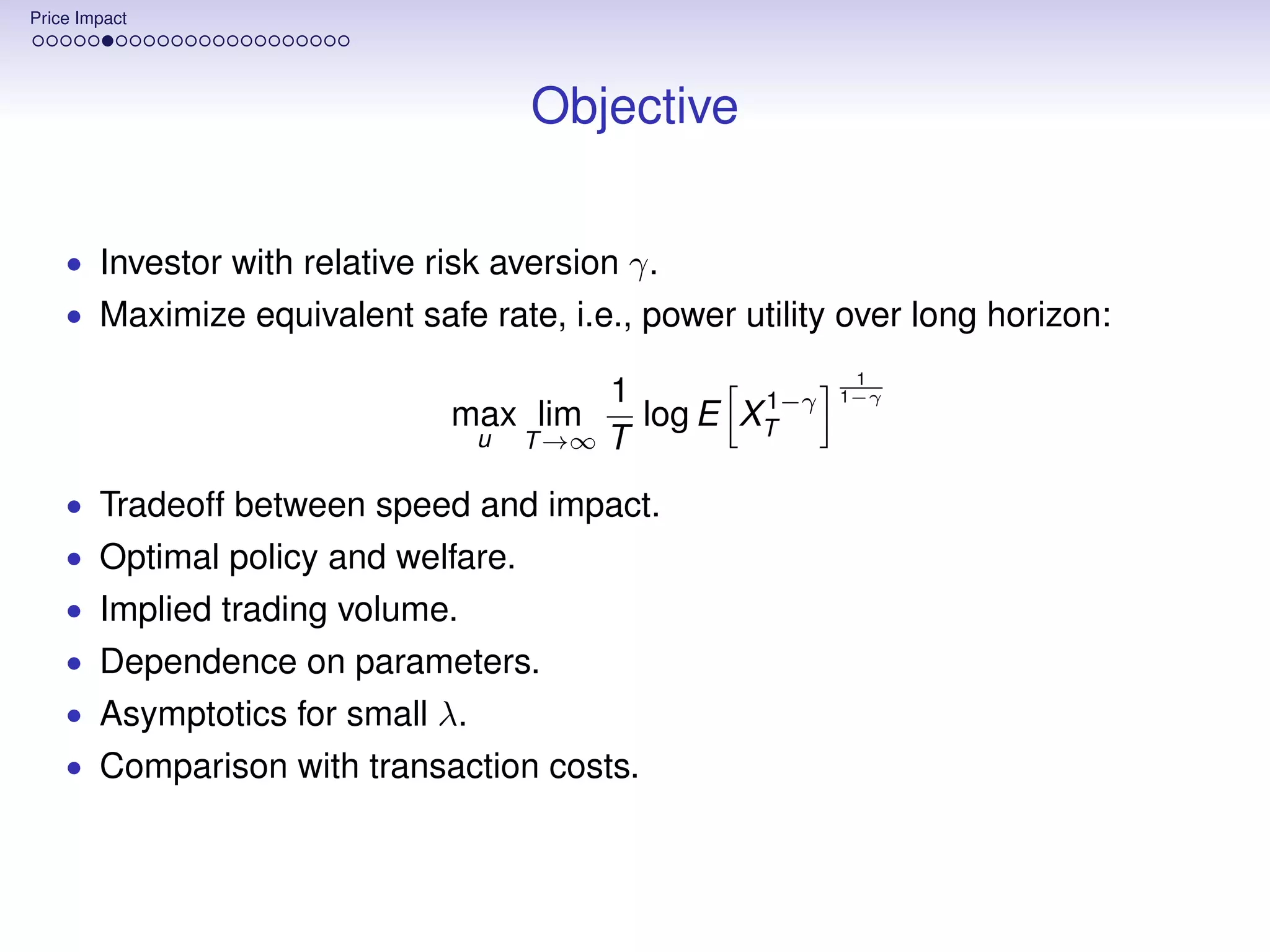
                                     Objective

    • Investor with relative risk aversion γ.
    • Maximize equivalent safe rate, i.e., power utility over long horizon:
                                                          1
                                          1        1−γ   1−γ
                              max lim       log E XT
                                 u   T →∞ T

    • Tradeoff between speed and impact.
    • Optimal policy and welfare.
    • Implied trading volume.
    • Dependence on parameters.
    • Asymptotics for small λ.
    • Comparison with transaction costs.
Price Impact


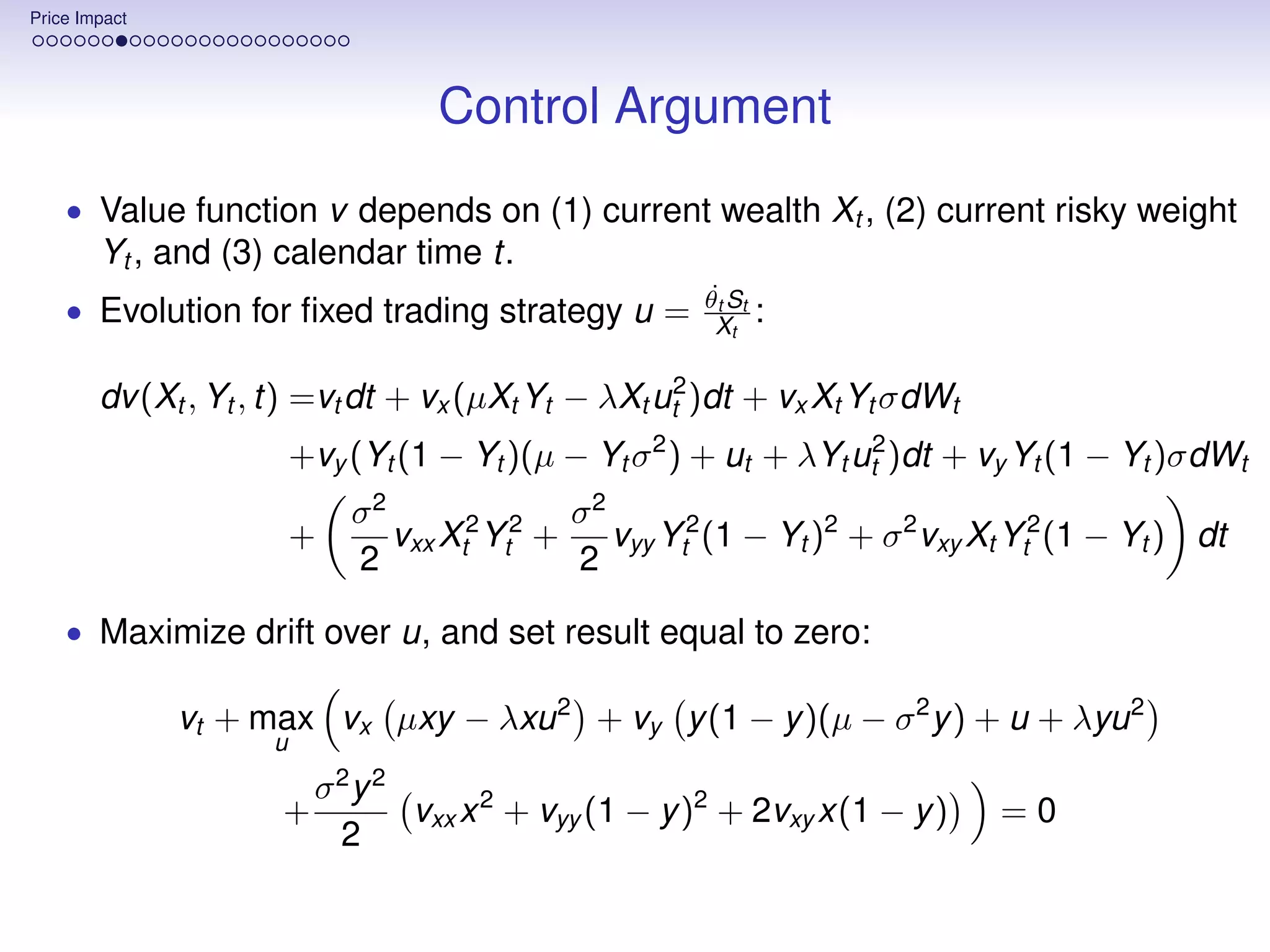
                                    Control Argument
    • Value function v depends on (1) current wealth Xt , (2) current risky weight
        Yt , and (3) calendar time t.
                                                         ˙
                                                        θt St
    • Evolution for fixed trading strategy u =             Xt    :

        dv (Xt , Yt , t) =vt dt + vx (µXt Yt − λXt ut2 )dt + vx Xt Yt σdWt
                         +vy (Yt (1 − Yt )(µ − Yt σ 2 ) + ut + λYt ut2 )dt + vy Yt (1 − Yt )σdWt
                             σ2               σ2
                         +      vxx Xt2 Yt2 +    vyy Yt2 (1 − Yt )2 + σ 2 vxy Xt Yt2 (1 − Yt ) dt
                             2                2

    • Maximize drift over u, and set result equal to zero:

               vt + max vx µxy − λxu 2 + vy y (1 − y )(µ − σ 2 y ) + u + λyu 2
                     u
                          σ2 y 2
                      +          vxx x 2 + vyy (1 − y )2 + 2vxy x(1 − y )      =0
                           2
Price Impact


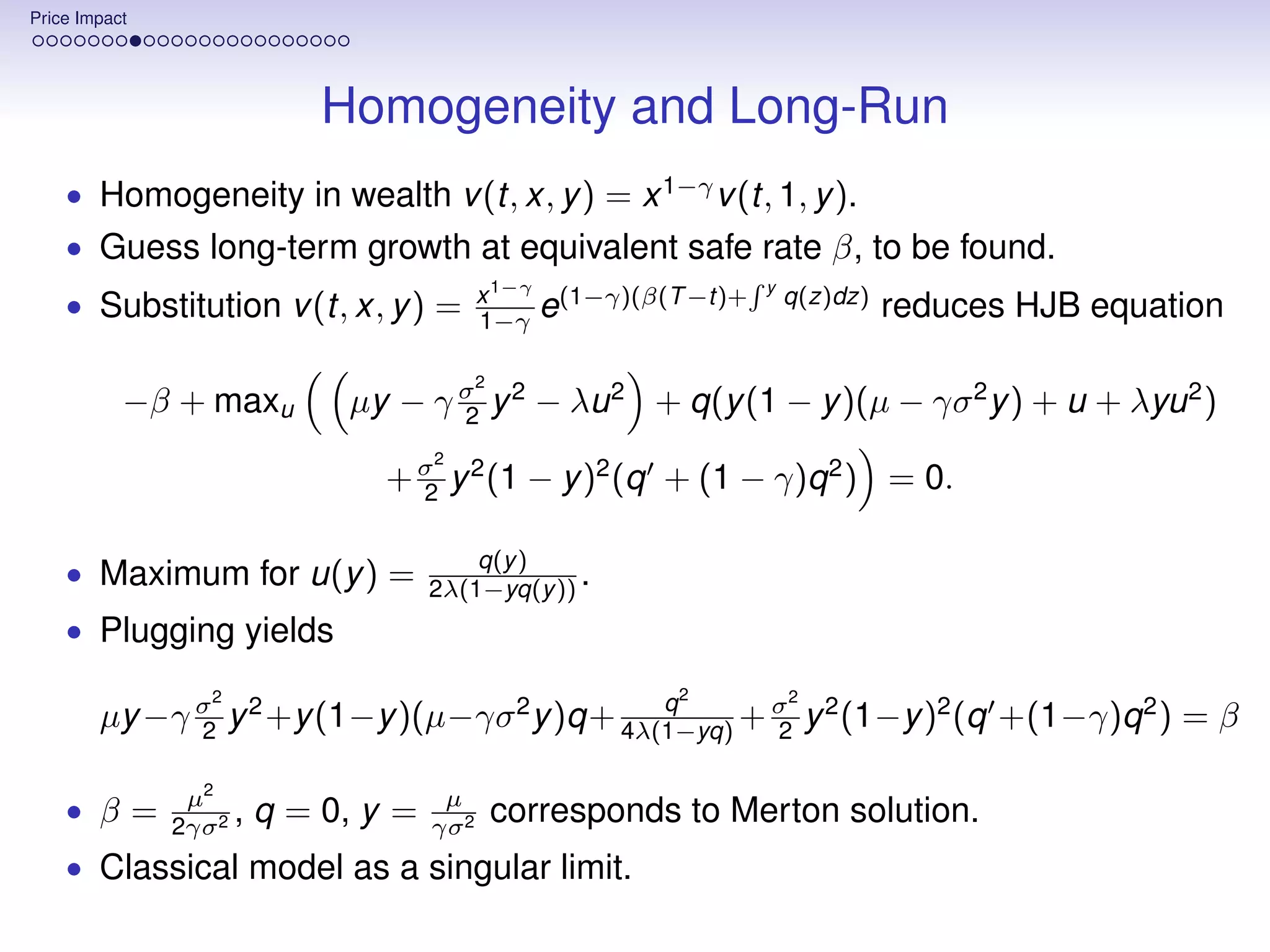
                             Homogeneity and Long-Run
    • Homogeneity in wealth v (t, x, y ) = x 1−γ v (t, 1, y ).
    • Guess long-term growth at equivalent safe rate β, to be found.
    • Substitution v (t, x, y ) =            x 1−γ (1−γ)(β(T −t)+   y
                                                                        q(z)dz)
                                             1−γ e                                reduces HJB equation

                                             2
           −β + maxu          µy − γ σ y 2 − λu 2 + q(y (1 − y )(µ − γσ 2 y ) + u + λyu 2 )
                                     2
                                      2
                                 + σ y 2 (1 − y )2 (q + (1 − γ)q 2 ) = 0.
                                   2

                                          q(y )
    • Maximum for u(y ) =             2λ(1−yq(y )) .
    • Plugging yields
                  2                                         2           2
                                              q
        µy −γ σ y 2 +y (1−y )(µ−γσ 2 y )q+ 4λ(1−yq) + σ y 2 (1−y )2 (q +(1−γ)q 2 ) = β
              2                                       2

                µ2                     µ
    • β=       2γσ 2
                     ,   q = 0, y =   γσ 2
                                                 corresponds to Merton solution.
    • Classical model as a singular limit.
Price Impact


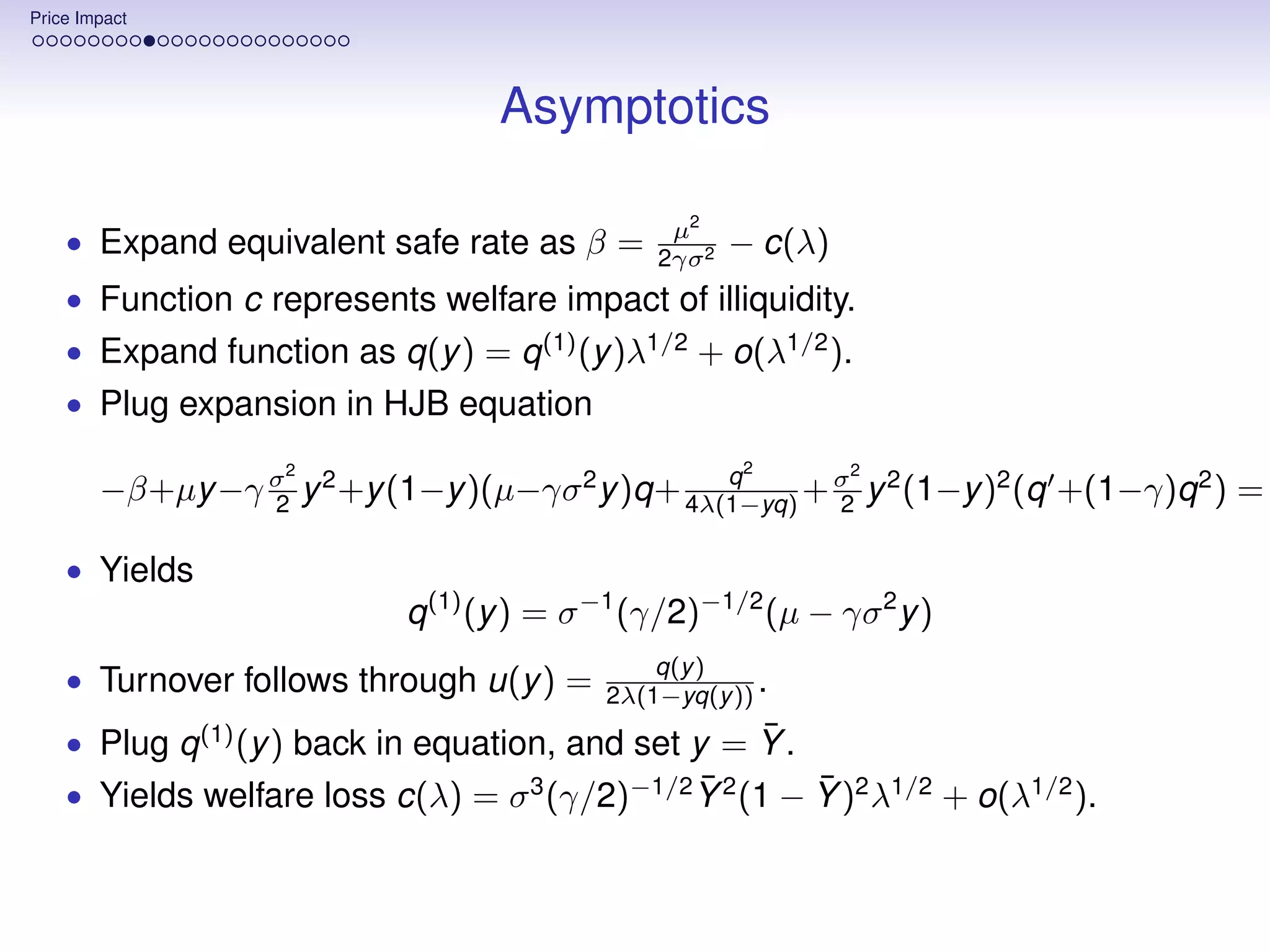
                                   Asymptotics

                                                µ2
    • Expand equivalent safe rate as β =       2γσ 2
                                                       − c(λ)
    • Function c represents welfare impact of illiquidity.
    • Expand function as q(y ) = q (1) (y )λ1/2 + o(λ1/2 ).
    • Plug expansion in HJB equation
                    2                                  2        2
                                                 q
        −β+µy −γ σ y 2 +y (1−y )(µ−γσ 2 y )q+ 4λ(1−yq) + σ y 2 (1−y )2 (q +(1−γ)q 2 ) =
                 2                                       2

    • Yields
                            q (1) (y ) = σ −1 (γ/2)−1/2 (µ − γσ 2 y )
                                               q(y )
    • Turnover follows through u(y ) =     2λ(1−yq(y )) .
                                                    ¯
    • Plug q (1) (y ) back in equation, and set y = Y .
                                               ¯        ¯
    • Yields welfare loss c(λ) = σ 3 (γ/2)−1/2 Y 2 (1 − Y )2 λ1/2 + o(λ1/2 ).
Price Impact


                                   Issues


    • How to make argument rigorous?
    • Heuristics yield ODE, but no boundary conditions!
    • Relation between ODE and optimization problem?
Price Impact


                                         Verification
Theorem
      µ
If   γσ 2
            ∈ (0, 1), then the optimal wealth turnover and equivalent safe rate are:

                                  1   q(y )
                      ˆ
                      u (y ) =                                      ˆ
                                                              ESRγ (u ) = β
                                 2λ 1 − yq(y )
                       2
               µ
where β ∈ (0, 2γσ2 ) and q : [0, 1] → R are the unique pair that solves the ODE

                  2                                2      2
                                         q
−β+µy −γ σ y 2 +y (1−y )(µ−γσ 2 y )q+ 4λ(1−yq) + σ y 2 (1−y )2 (q +(1−γ)q 2 ) = 0
         2                                       2

            √
and q(0) = 2 λβ, q(1) = λd −                λd(λd − 2), where d = −γσ 2 − 2β + 2µ.

     • A license to solve an ODE, of Abel type.
     • Function q and scalar β not explicit.
     • Asymptotic expansion for λ near zero?
Price Impact


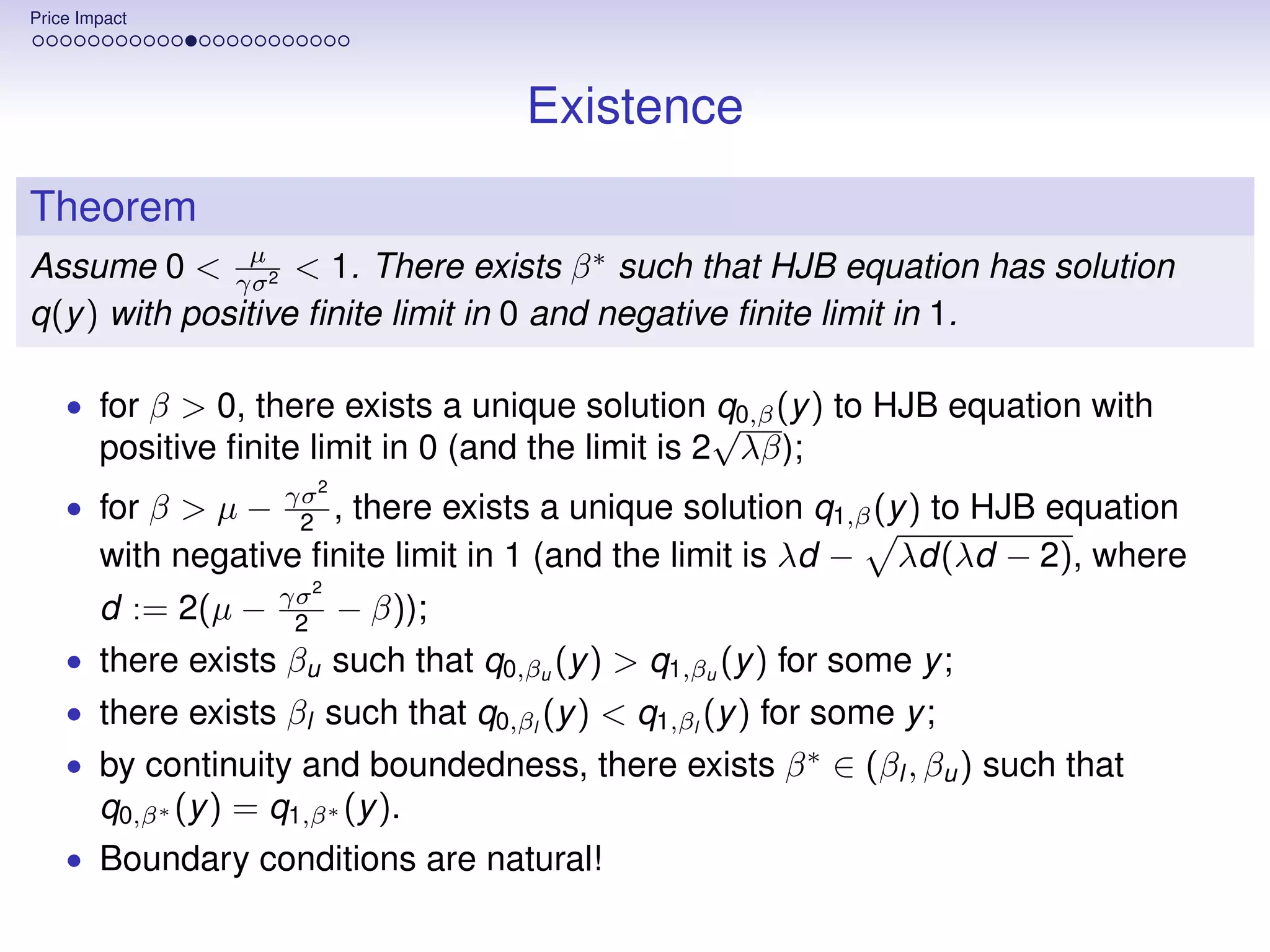
                                       Existence
Theorem
                µ
Assume 0 < γσ2 < 1. There exists β ∗ such that HJB equation has solution
q(y ) with positive finite limit in 0 and negative finite limit in 1.

    • for β > 0, there exists a unique solution q0,β (y ) to HJB equation with
                                               √
        positive finite limit in 0 (and the limit is 2 λβ);
                       γσ 2
    • for β > µ −       2 ,
                         there exists a unique solution q1,β (y ) to HJB equation
        with negative finite limit in 1 (and the limit is λd − λd(λd − 2), where
                       γσ 2
        d := 2(µ −      2     − β));
    • there exists βu such that q0,βu (y ) > q1,βu (y ) for some y ;
    • there exists βl such that q0,βl (y ) < q1,βl (y ) for some y ;
    • by continuity and boundedness, there exists β ∗ ∈ (βl , βu ) such that
        q0,β ∗ (y ) = q1,β ∗ (y ).
    • Boundary conditions are natural!
Price Impact


                                       Finite Horizon Bound (1)
Lemma
                  y                                    ˆ
Define Q(y ) =       q(z)dz. There exists a probability P, equivalent to P, such
that the terminal wealth XT of any admissible strategy satisfies:
                                   1−γ         1                                               1
                                E[XT ] 1−γ ≤ eβT +Q(y ) EP [e−(1−γ)Q(YT ) ] 1−γ
                                                         ˆ                                                               (1)

and equality holds for the optimal strategy.
                        ˆ
    • Define probability P as:
          ˆ
         dP                 T       (1−γ)2 Ys (1+q(Ys )(1−Ys ))2 σ 2
                                            2
                                                                               T
         dP
               = exp       0
                                −                 2
                                                                     ds   +   0
                                                                                 (1   − γ)Ys (1 + q(Ys )(1 − Ys ))σdWs

    • It suffices to check that
                                                     1           ˆ
                                                                dP
                                       log XT −     1−γ
                                                          log   dP
                                                                     ≤ βT − Q(YT ) + Q(y ) .
    • By self-financing condition, and Itô formula:
                             T                                                                        Yt2 (1−Yt )2 σ 2
Q(YT ) − Q(y ) =            0
                                    q(Yt )(Yt (1 − Yt )(µ − Yt σ 2 ) + ut + λYt ut2 ) + q (Yt )              2
                                                                                                                         dt
                                T
                       +            q(Yt )Yt (1 − Yt )σdWt
                            0
Price Impact


                                                Finite Horizon Bound (2)
    • Also,
                                                            T                                                     T
                                                                                     Yt2 σ 2
                                     log XT =                   Yt µ − λut2 −                    dt +                 Yt σdWt .
                                                        0                              2                      0

                                                                             1            ˆ
    • Plugging equalities into log XT −                                     1−γ    log d P , and using HJB equation:
                                                                                       dP

                T                             Yt2 σ 2       σ 2 (1−γ)Yt2 (1+q(Yt )(1−Yt ))2           T
               0
                    µYt − λut2 −                 2
                                                        +                  2
                                                                                            dt   −   0
                                                                                                          q(Yt )Yt (1 − Yt )σdWt ≤
                     T                                                        2                               σ2
           ≤        0
                            β − q(Yt )(Yt (1 − Yt )(µ − Yt σ ) + ut +                       λYt ut2 )     +   2
                                                                                                                 q    (Yt )Yt2 (1 − Yt )2 dt
                        T
          −                 q(Yt )Yt (1 − Yt )σdWt .
                    0

    • Stochastic integrals on both sides are equal. Enough to prove that:

                                       2
                             2   2         (1−γ)y 2 (1+q(y )(1−y ))2                                                                       2
   y µ−λu 2 − y 2 + σ
                σ
                                                      2
                                                                        ≤ β−q(y )(y (1−y )(µ−y σ 2 )+u+λyu 2 )−q (y ) y                        (1−y
                                                                                                                                                  2

    • But this is just the HJB equation rearranged. Equality with optimal control.
Price Impact


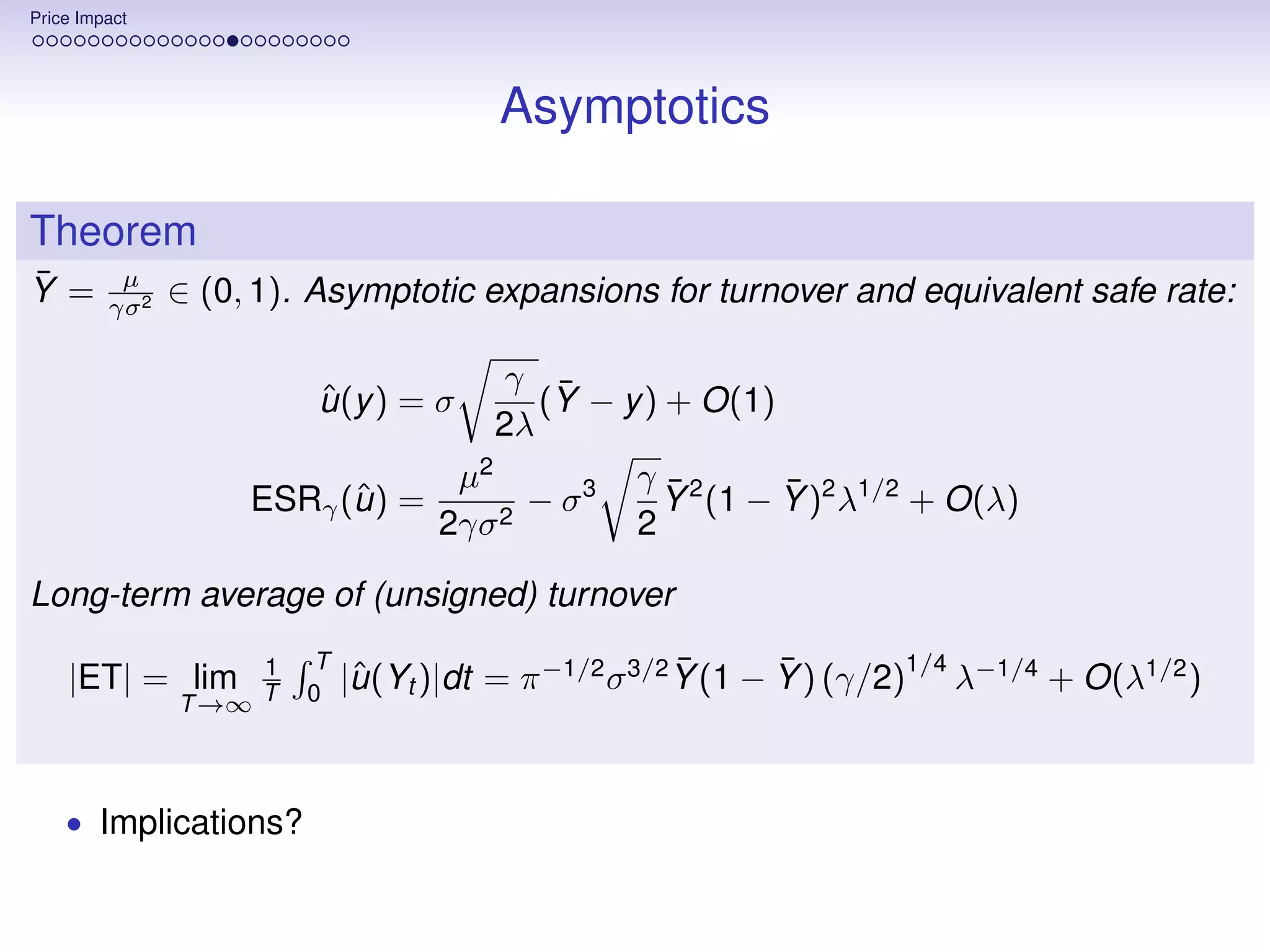
                                        Asymptotics

Theorem
¯
Y =       µ
                ∈ (0, 1). Asymptotic expansions for turnover and equivalent safe rate:
         γσ 2


                                      γ ¯
                         ˆ
                         u (y ) = σ     (Y − y ) + O(1)
                                     2λ
                                  µ2          γ ¯2      ¯
                           ˆ
                     ESRγ (u ) =     2
                                       − σ3     Y (1 − Y )2 λ1/2 + O(λ)
                                 2γσ          2

Long-term average of (unsigned) turnover
                     1   T                              ¯      ¯        1/4
    |ET| = lim               |u (Yt )|dt = π −1/2 σ 3/2 Y (1 − Y ) (γ/2) λ−1/4 + O(λ1/2 )
                              ˆ
                T →∞ T   0


    • Implications?
Price Impact


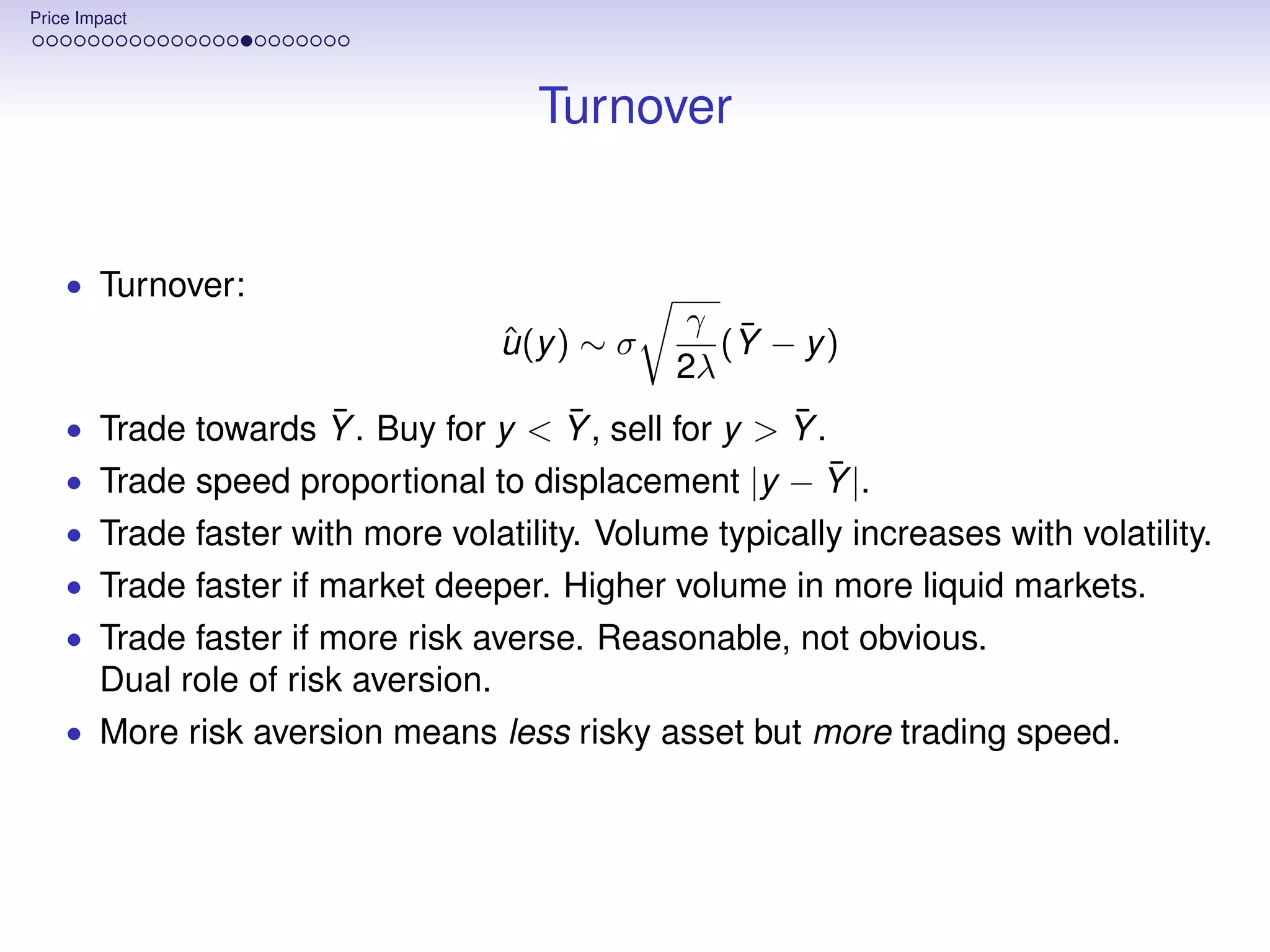
                                        Turnover


    • Turnover:
                                                    γ ¯
                                      ˆ
                                      u (y ) ∼ σ      (Y − y )
                                                   2λ
                    ¯               ¯                ¯
    • Trade towards Y . Buy for y < Y , sell for y > Y .
                                                    ¯
    • Trade speed proportional to displacement |y − Y |.
    • Trade faster with more volatility. Volume typically increases with volatility.
    • Trade faster if market deeper. Higher volume in more liquid markets.
    • Trade faster if more risk averse. Reasonable, not obvious.
        Dual role of risk aversion.
    • More risk aversion means less risky asset but more trading speed.
Price Impact


                                           Trading Volume
    • Wealth turnover approximately Ornstein-Uhlenbeck:

                                   γ 2 ¯2      ¯                              γ ¯      ¯
                 ˆ
               d ut = σ              (σ Y (1 − Y )(1 − γ) − ut )dt − σ 2
                                                            ˆ                   Y (1 − Y )dWt
                                  2λ                                         2λ
    • In the following sense:


Theorem
            ˆ
The process ut has asymptotic moments:
                              T
                    1                             ¯        ¯
  ET := lim                       u (Yt )dt = σ 2 Y 2 (1 − Y )(1 − γ) + o(1) ,
                                  ˆ
               T →∞ T     0
            1 T                           1 ¯         ¯
  VT := lim       (u (Yt ) − ET)2 dt = σ 3 Y 2 (1 − Y )2 (γ/2)1/2 λ1/2 + o(λ1/2 ) ,
                   ˆ
       T →∞ T 0                           2
            1                     ¯         ¯
  QT := lim   E[ u (Y ) T ] = σ 4 Y 2 (1 − Y )2 (γ/2)λ−1 + o(λ−1 )
                 ˆ
       T →∞ T
Price Impact


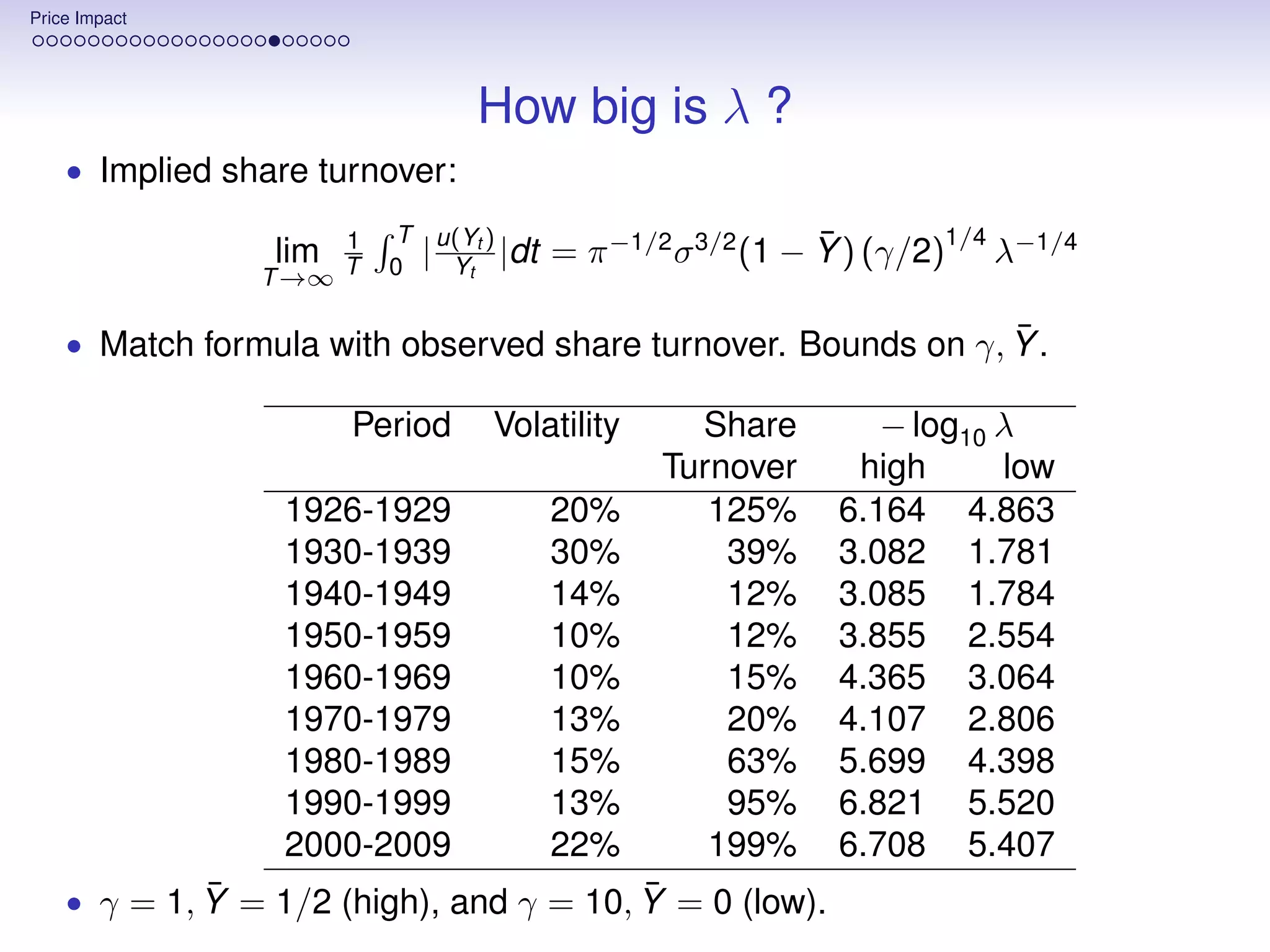
                                 How big is λ ?
    • Implied share turnover:
                         T                                            1/4
                 lim 1       | u(Yt ) |dt = π −1/2 σ 3/2 (1 − Y ) (γ/2)
                                                              ¯             λ−1/4
                T →∞ T   0      Yt

                                                               ¯
    • Match formula with observed share turnover. Bounds on γ, Y .

                      Period      Volatility      Share          − log10 λ
                                                Turnover       high      low
                  1926-1929            20%         125%       6.164 4.863
                  1930-1939            30%          39%       3.082 1.781
                  1940-1949            14%          12%       3.085 1.784
                  1950-1959            10%          12%       3.855 2.554
                  1960-1969            10%          15%       4.365 3.064
                  1970-1979            13%          20%       4.107 2.806
                  1980-1989            15%          63%       5.699 4.398
                  1990-1999            13%          95%       6.821 5.520
                  2000-2009            22%         199%       6.708 5.407
             ¯                           ¯
    • γ = 1, Y = 1/2 (high), and γ = 10, Y = 0 (low).
Price Impact


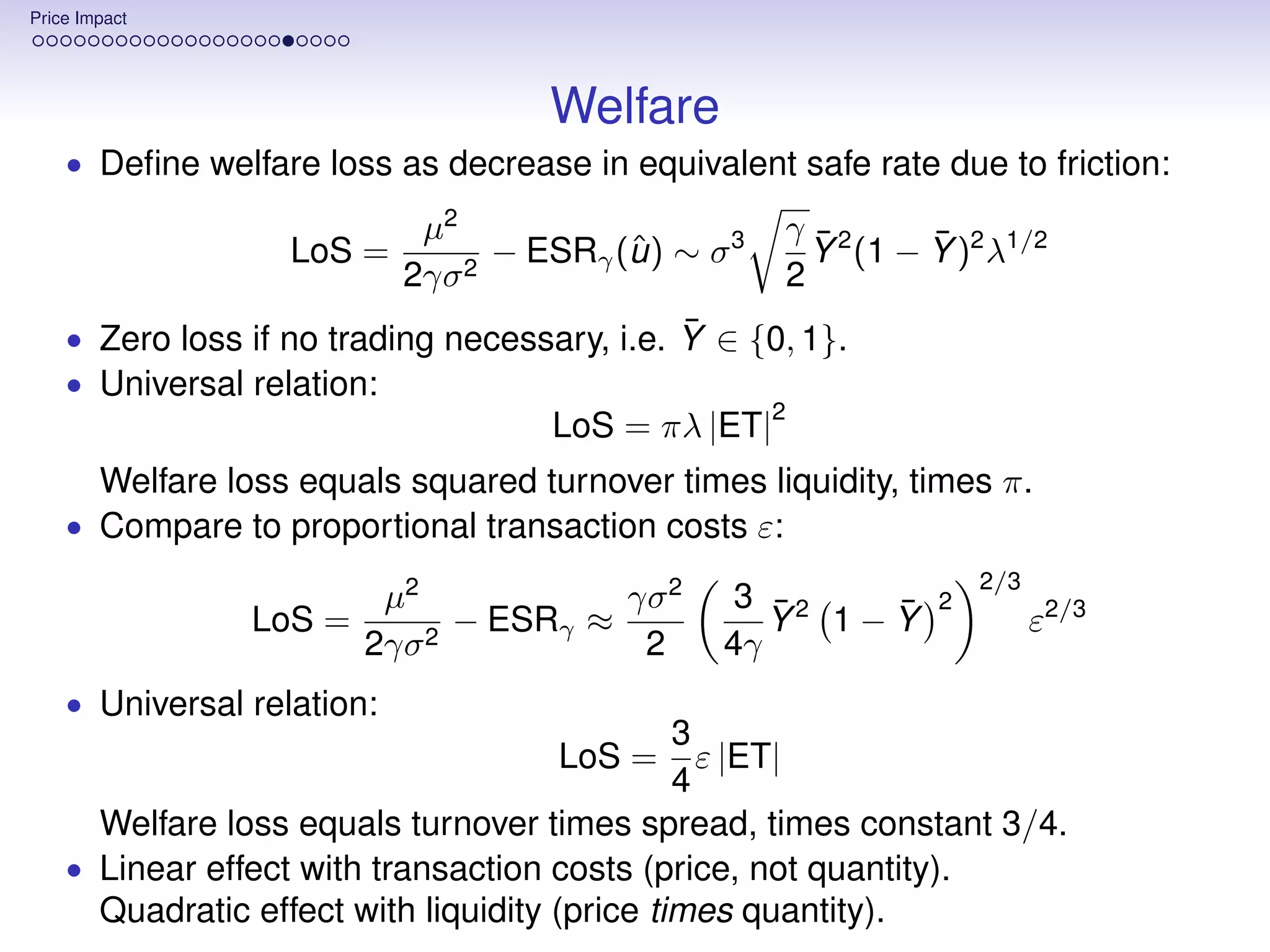
                                     Welfare
    • Define welfare loss as decrease in equivalent safe rate due to friction:

                             µ2                       γ ¯2     ¯
                    LoS =         − ESRγ (u ) ∼ σ 3
                                          ˆ             Y (1 − Y )2 λ1/2
                            2γσ 2                     2
                                              ¯
    • Zero loss if no trading necessary, i.e. Y ∈ {0, 1}.
    • Universal relation:
                                                      2
                                      LoS = πλ |ET|
        Welfare loss equals squared turnover times liquidity, times π.
    • Compare to proportional transaction costs ε:
                                                                    2/3
                           µ2            γσ 2     3 ¯2  ¯       2
                  LoS =         − ESRγ ≈            Y 1−Y                 ε2/3
                          2γσ 2           2      4γ
    • Universal relation:
                                               3
                                      LoS =      ε |ET|
                                               4
      Welfare loss equals turnover times spread, times constant 3/4.
    • Linear effect with transaction costs (price, not quantity).
      Quadratic effect with liquidity (price times quantity).
Price Impact


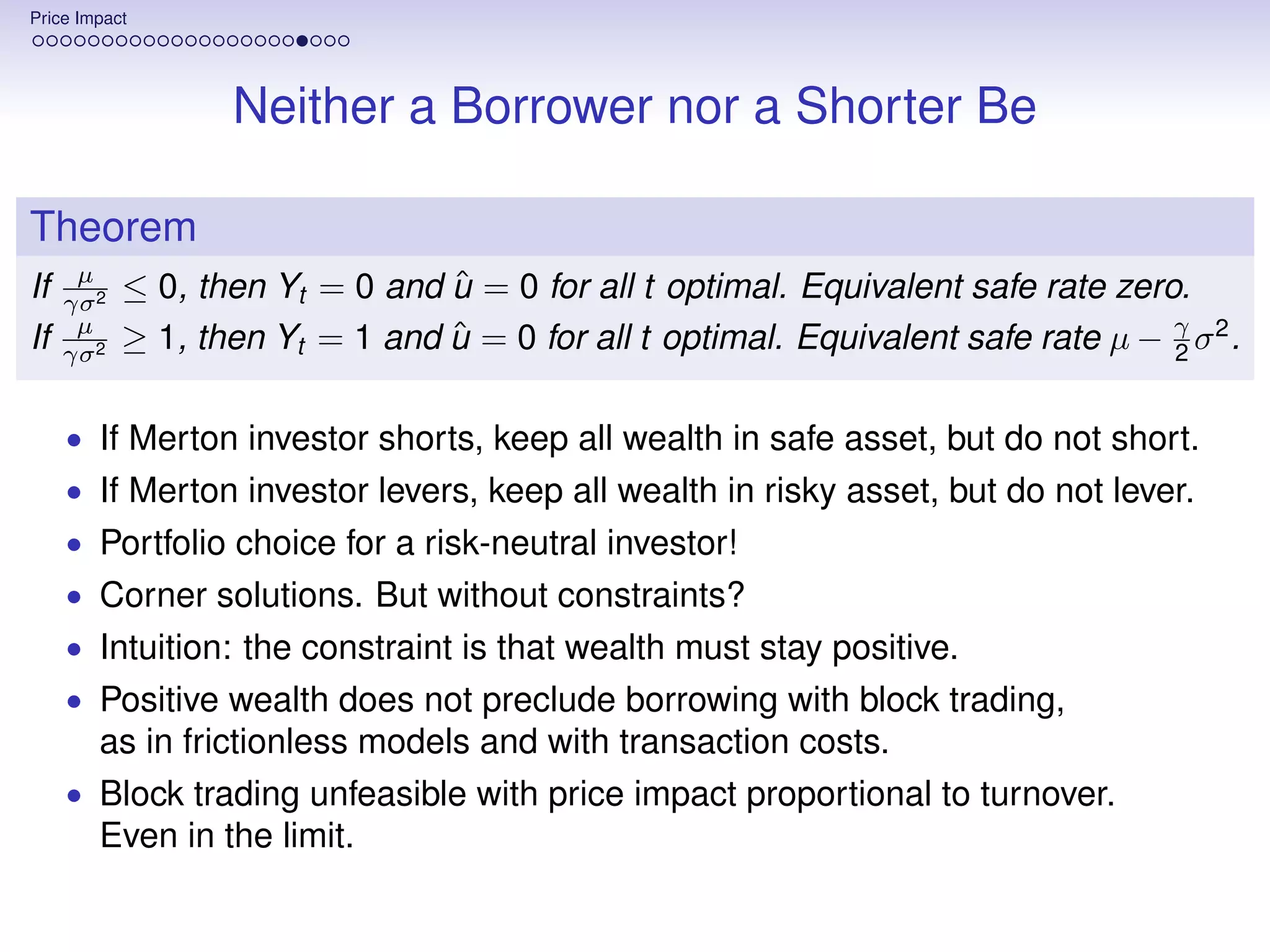
                   Neither a Borrower nor a Shorter Be

Theorem
      µ
If   γσ 2
                                 ˆ
            ≤ 0, then Yt = 0 and u = 0 for all t optimal. Equivalent safe rate zero.
      µ
If   γσ 2
            ≥ 1, then Yt = 1 and u = 0 for all t optimal. Equivalent safe rate µ − γ σ 2 .
                                 ˆ                                                 2


     • If Merton investor shorts, keep all wealth in safe asset, but do not short.
     • If Merton investor levers, keep all wealth in risky asset, but do not lever.
     • Portfolio choice for a risk-neutral investor!
     • Corner solutions. But without constraints?
     • Intuition: the constraint is that wealth must stay positive.
     • Positive wealth does not preclude borrowing with block trading,
        as in frictionless models and with transaction costs.
     • Block trading unfeasible with price impact proportional to turnover.
        Even in the limit.
Price Impact


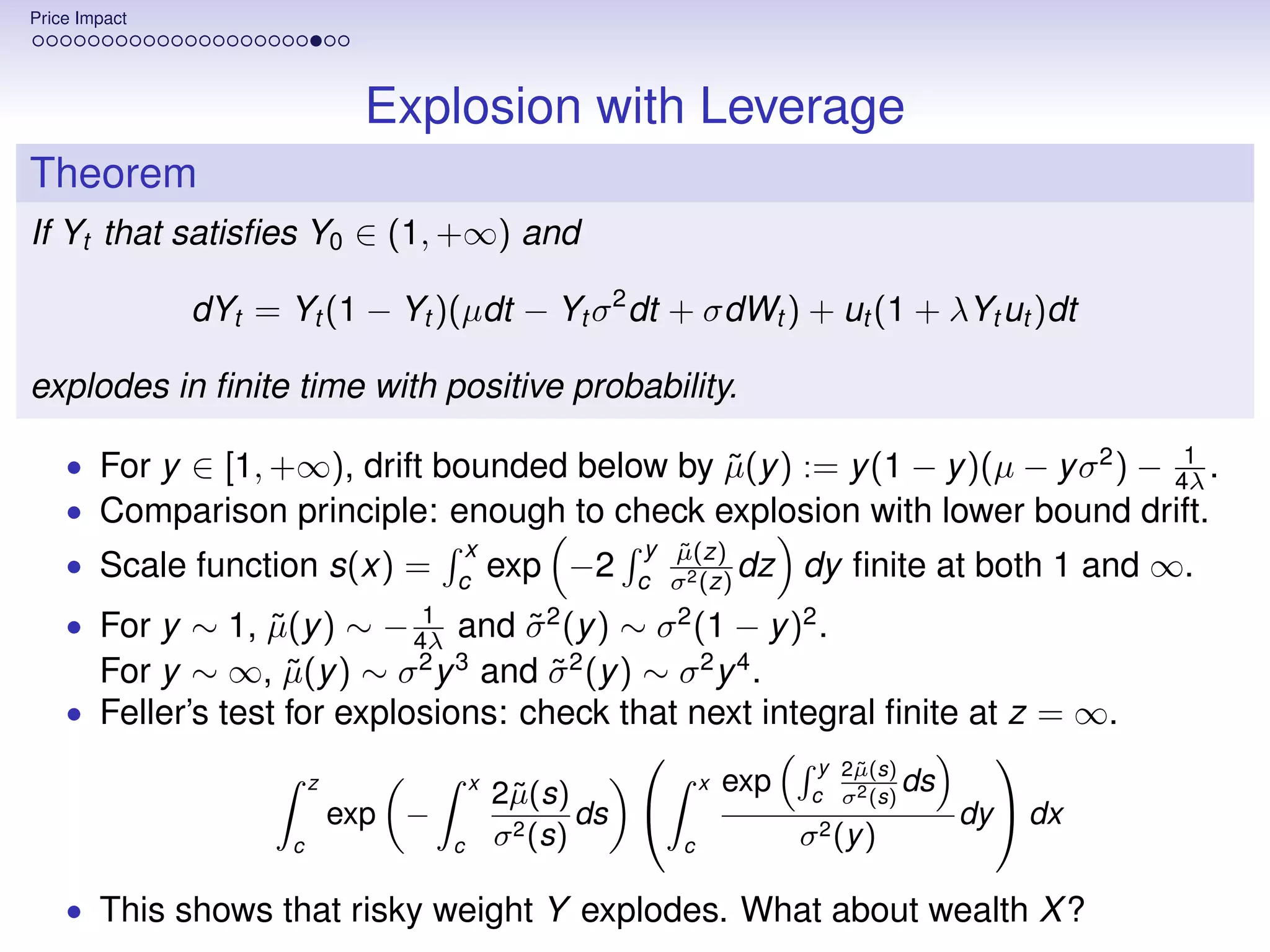
                               Explosion with Leverage
Theorem
If Yt that satisfies Y0 ∈ (1, +∞) and

               dYt = Yt (1 − Yt )(µdt − Yt σ 2 dt + σdWt ) + ut (1 + λYt ut )dt

explodes in finite time with positive probability.
                                                                                 1
    • For y ∈ [1, +∞), drift bounded below by µ(y ) := y (1 − y )(µ − y σ 2 ) − 4λ .
                                              ˜
    • Comparison principle: enough to check explosion with lower bound drift.
                                       x                 y µ(z)
                                                           ˜
    • Scale function s(x) =           c
                                              exp −2    c σ 2 (z)
                                                                  dz       dy finite at both 1 and ∞.
                                   1
    • For y ∼ 1, µ(y ) ∼
                 ˜                  σ (y ) ∼ σ (1 − y )2 .
                                − 4λ and
                                    ˜            2         2

      For y ∼ ∞, µ(y ) ∼ σ y and σ 2 (y ) ∼ σ 2 y 4 .
                    ˜             2 3
                                      ˜
    • Feller’s test for explosions: check that next integral finite at z = ∞.
                                                                             y 2µ(s)
                                                                               ˜
                                                                                             
                          z               x
                                              2˜(s)
                                               µ                 x   exp    c σ 2 (s)
                                                                                      ds
                              exp −                   ds                                  dy  dx
                      c               c       σ 2 (s)        c             σ 2 (y )

    • This shows that risky weight Y explodes. What about wealth X ?
Price Impact


                                                Bankruptcy
    • τ explosion time for Yt . Show that Xτ (ω) = 0 on ω ∈ {τ < +∞}.
    • By contradiction, suppose Xt (ω) does not hit 0 on [0, τ (ω)].

                                                 T                              2             T
                                                      Yt µ−λut2 − σ Yt2 dt+σ                      Yt dWt
                                     XT = xe    0                  2                         0
                                                                                                              .
               τ                            τ σ2 2                          τ
    • If       0
                   Yt2 dt = ∞, then −           Y dt
                                            0 2 t
                                                             +              0
                                                                                Yt σdWt = −∞ by LLN.
               τ                                             ¯
                                                            dP                          τ σ2 2                        τ
    • If       0
                   Yt2 dt < ∞, define measure                dP      = exp −                 Y dt
                                                                                        0 2 t
                                                                                                                  +   0
                                                                                                                          Yt σdWt
                                                τ
    • In both cases, check that                 0
                                                      Yt µ −        λut2            dt = −∞.
                            St
    • 0 < (ω) <             Xt   (ω) < M(ω) on [0, τ (ω)], hence:
                                                                        T                        T
                        T                                                               2
           limT →τ     0
                            Yt µ − λut2 dt < lim Mµ                         θt dt − λ                θt2 dt
                                                                                                     ˙
                                                T →τ                0                        0
                                                                T                                       T
                                                                                                            θt dt
                                            =        lim            θt2 dt
                                                                    ˙                 Mµ lim           0
                                                                                                        T
                                                                                                                  −λ      2
                                                                                                                              = −∞.
                                                     T →τ   0                               T →τ            ˙
                                                                                                            θ2 dt
                                                                                                       0      t
Price Impact


                                          Optimality

                                            µ
    • Check that Yt ≡ 1 optimal if         γσ 2
                                                   > 1.
    • By Itô’s formula,
                                               T                                      T
                      1−γ
                     XT   = x 1−γ e(1−γ)      0    (Yt µ− 1 Yt2 σ2 −λut2 )dt+(1−γ)
                                                          2                          0
                                                                                          Yt σdWt
                                                                                                    .

    • and hence, for g(y , u) = y µ − 1 y 2 γσ 2 − λu 2 ,
                                      2

                                 1−γ                           T
                              E[XT ] = x 1−γ EP e
                                              ˆ               0
                                                                 (1−γ)g(Yt ,ut )dt
                                                                                     ,

                 ˆ
                dP            T                                  T
        where   dP   = exp{   0
                                  − 1 Yt2 (1 − γ)2 σ 2 dt +
                                    2                            0
                                                                     Yt (1 − γ)σdWt }.
    • g(y , u) on [0, 1] × R has maximum g(1, 0) = µ − 1 γσ 2 at (1, 0).
                                                       2
    • Since Yt ≡ 1 and ut ≡ 0 is admissible, it is also optimal.

UT Austin - Portugal Lectures on Portfolio Choice

  • 1.
    Long Run Investment:Opportunities and Frictions Paolo Guasoni Boston University and Dublin City University July 2-6, 2012 CoLab Mathematics Summer School
  • 2.
    Outline • Long Runand Stochastic Investment Opportunities • High-water Marks and Hedge Fund Fees • Transaction Costs • Price Impact • Open Problems
  • 3.
    Long Run andStochastic Investment Opportunities One Long Run and Stochastic Investment Opportunities Based on Portfolios and Risk Premia for the Long Run with Scott Robertson
  • 4.
    Long Run andStochastic Investment Opportunities Independent Returns? • Higher yields tend to be followed by higher long-term returns. • Should not happen if returns independent!
  • 5.
    Long Run andStochastic Investment Opportunities Utility Maximization • Basic portfolio choice problem: maximize utility from terminal wealth: π max E[U(XT )] π • Easy for logarithmic utility U(x) = log x. Myopic portfolio π = Σ−1 µ optimal. Numeraire argument. • Portfolio does not depend on horizon (even random!), and on the dynamics of the the state variable, but only its current value. • But logarithmic utility leads to counterfactual predictions. And implies that unhedgeable risk premia η are all zero. • Power utility U(x) = x 1−γ /(1 − γ) is more flexible. Portfolio no longer myopic. Risk premia η nonzero, and depend on γ. • Power utility far less tractable. Joint dependence on horizon and state variable dynamics. • Explicit solutions few and cumbersome. • Goal: keep dependence from state variable dynamics, lose from horizon. • Tool: assume long horizon.
  • 6.
    Long Run andStochastic Investment Opportunities Asset Prices and State Variables t • Safe asset St0 = exp 0 r (Ys )ds , d risky assets, k state variables. dSti =r (Yt )dt + dRti 1≤i ≤d Sti n dRti =µi (Yt )dt + σij (Yt )dZtj 1≤i ≤d j=1 k dYti =bi (Yt )dt + aij (Yt )dWtj 1≤i ≤k j=1 d Zi, Wj t =ρij (Yt )dt 1 ≤ i ≤ d, 1 ≤ j ≤ k • Z , W Brownian Motions. • Σ(y ) = (σσ )(y ), Υ(y ) = (σρa )(y ), A(y ) = (aa )(y ). Assumption r ∈ C γ (E, R), b ∈ C 1,γ (E, Rk ), µ ∈ C 1,γ (E, Rn ), A ∈ C 2,γ (E, Rk ×k ), Σ ∈ C 2,γ (E, Rn×n ) and Υ ∈ C 2,γ (E, Rn×k ). The symmetric matrices A and Σ ¯ are strictly positive definite for all y ∈ E. Set Σ = Σ−1
  • 7.
    Long Run andStochastic Investment Opportunities State Variables • Investment opportunities: safe rate r , excess returns µ, volatilities σ, and correlations ρ. • State variables: anything on which investment opportunities depend. • Example with predictable returns: dRt =Yt dt + σdZt dYt = − λYt dt + dWt • State variable is expected return. Oscillates around zero. • Example with stochastic volatility: dRt =νYt dt + Yt dZt dYt =κ(θ − Yt )dt + a Yt dWt • State variable is squared volatility. Oscillates around positive value. • State variables are generally stationary processes.
  • 8.
    Long Run andStochastic Investment Opportunities (In)Completeness • Υ Σ−1 Υ: covariance of hedgeable state shocks: Measures degree of market completeness. • A = Υ Σ−1 Υ: complete market. State variables perfectly hedgeable, hence replicable. • Υ = 0: fully incomplete market. State shocks orthogonal to returns. • Otherwise state variable partially hedgeable. • One state: Υ Σ−1 Υ/a2 = ρ ρ. Equivalent to R 2 of regression of state shocks on returns.
  • 9.
    Long Run andStochastic Investment Opportunities Well Posedness Assumption There exists unique solution P (r ,y ) ) r ∈Rn ,y ∈E to martingale problem: n+k n+k 1 ˜ ∂2 ˜ ∂ ˜ Σ Υ ˜ µ L= Ai,j (x) + bi (x) A= b= 2 ∂xi ∂xj ∂xi Υ A b i,j=1 i=1 • Ω = C([0, ∞), Rn+k ) with uniform convergence on compacts. • B Borel σ-algebra, (Bt )t≥0 natural filtration. Definition (P x )x∈Rn ×E on (Ω, B) solves martingale problem if, for all x ∈ Rn × E: • P x (X0 = x) = 1 • P x (Xt ∈ Rn × E, ∀t ≥ 0) = 1 t • f (Xt ) − f (X0 ) − 0 (Lf )(Xu )du is P x -martingale for all f ∈ C0 (Rn × E) 2
  • 10.
    Long Run andStochastic Investment Opportunities Trading and Payoffs Definition Trading strategy: process (πti )1≤i≤d , adapted to Ft = Bt+ , the right-continuous t≥0 envelope of the filtration generated by (R, Y ), and R-integrable. • Investor trades without frictions. Wealth dynamics: dXtπ = r (Yt )dt + πt dRt Xtπ • In particular, Xtπ ≥ 0 a.s. for all t. Admissibility implied by R-integrability.
  • 11.
    Long Run andStochastic Investment Opportunities Equivalent Safe Rate • Maximizing power utility E (XT )1−γ /(1 − γ) equivalent to maximizing the π 1 certainty equivalent E (XT )1−γ π 1−γ . • Observation: in most models of interest, wealth grows exponentially with the horizon. And so does the certainty equivalent. • Example: with r , µ, Σ constant, the certainty equivalent is exactly 1 exp (r + 2γ µ Σ−1 µ)T . Only total Sharpe ratio matters. • Intuition: an investor with a long horizon should try to maximize the rate at which the certainty equivalent grows: 1 1 β = max lim inf log E (XT )1−γ π 1−γ π T →∞ T • Imagine a “dream” market, without risky assets, but only a safe rate ρ. • If β < ρ, an investor with long enough horizon prefers the dream. • If β > ρ, he prefers to wake up. • At β = ρ, his dream comes true.
  • 12.
    Long Run andStochastic Investment Opportunities Equivalent Annuity • Exponential utility U(x) = −e−αx leads to a similar, but distinct idea. • Suppose the safe rate is zero. • Then optimal wealth typically grows linearly with the horizon, and so does the certainty equivalent. • Then it makes sense to consider the equivalent annuity: 1 π β = max lim inf − log E e−αXT π T →∞ αT • The dream market now does not offer a higher safe rate, but instead a stream of fixed payments, at rate ρ. The safe rate remains zero. • The investor is indifferent between dream and reality for β = ρ. • For positive safe rate, use definition with discounted quantities. • Undiscounted equivalent annuity always infinite with positive safe rate.
  • 13.
    Long Run andStochastic Investment Opportunities Solution Strategy • Duality Bound. • Stationary HJB equation and finite-horizon bounds. • Criteria for long-run optimality.
  • 14.
    Long Run andStochastic Investment Opportunities Stochastic Discount Factors Definition Stochastic discount factor: strictly positive adapted M = (Mt )t≥0 , such that: y EP Mt Sti Fs = Ms Ss i for all 0 ≤ s ≤ t, 0 ≤ i ≤ d Martingale measure: probability Q, such that Q|Ft and P y |Ft equivalent for all t ∈ [0, ∞), and discounted prices S i /S 0 Q-martingales for 1 ≤ i ≤ d. • Martingale measures and stochastic discount factors related by: dQ t = exp 0 r (Ys )ds Mt dP y Ft • Local martingale property: all stochastic discount factors satisfy t · · Mtη = exp − 0 rdt E − 0 (µ Σ−1 + η Υ Σ−1 )σdZ + 0 η adW t for some adapted, Rk -valued process η. • η represents the vector of unhedgeable risk premia. • Intuitively, the Sharpe ratios of shocks orthogonal to dR.
  • 15.
    Long Run andStochastic Investment Opportunities Duality Bound π η • For any payoff X = and any discount factor M = MT , E[XM] ≤ x. XT Because XM is a local martingale. • Duality bound for power utility: γ 1 1−γ E X 1−γ 1−γ ≤ xE M 1−1/γ • Proof: exercise with Hölder’s inequality. • Duality bound for exponential utility: 1 x 1 M M − log E e−αX ≤ + E log α E[M] α E[M] E[M] • Proof: Jensen inequality under risk-neutral densities. • Both bounds true for any X and for any M. Pass to sup over X and inf over M. • Note how α disappears from the right-hand side. • Both bounds in terms of certainty equivalents. • As T → ∞, bounds for equivalent safe rate and annuity follow.
  • 16.
    Long Run andStochastic Investment Opportunities Long Run Optimality Definition (Power Utility) An admissible portfolio π is long run optimal if it solves: 1 1 max lim inf log E (XT )1−γ 1−γ π π T →∞ T The risk premia η are long run optimal if they solve: γ 1 η 1−γ min lim sup log E (MT )1−1/γ η T →∞ T Pair (π, η) long run optimal if both conditions hold, and limits coincide. • Easier to show that (π, η) long run optimal together. • Each η is an upper bound for all π and vice versa. Definition (Exponential Utility) Portfolio π and risk premia η long run optimal if they solve: 1 π η η max lim inf − log E e−αXT 1 min lim sup T E MT log MT π T →∞ T η T →∞
  • 17.
    Long Run andStochastic Investment Opportunities HJB Equation • V (t, x, y ) depends on time t, wealth x, and state variable y . • Itô’s formula: 1 dV (t, Xt , Yt ) = Vt dt + Vx dXt + Vy dYt + (Vxx d X t + Vxy d X , Y t + Vyy d Y t ) 2 • Vector notation. Vy , Vxy k -vectors. Vyy k × k matrix. • Wealth dynamics: dXt = (r + πt µt )Xt dt + Xt πt σt dZt • Drift reduces to: 1 x2 Vt + xVx r + Vy b + tr(Vyy A) + xπ (µVx + ΥVxy ) + Vxx π Σπ 2 2 • Maximizing over π, the optimal value is: Vx −1 Vxy −1 π=− Σ µ− Σ Υ xVxx xVxx • Second term is new. Interpretation?
  • 18.
    Long Run andStochastic Investment Opportunities Intertemporal Hedging V V • π = − xVx Σ−1 µ − Σ−1 Υ xVxy xx xx • First term: optimal portfolio if state variable frozen at current value. • Myopic solution, because state variable will change. • Second term hedges shifts in state variables. • If risk premia covary with Y , investors may want to use a portfolio which covaries with Y to control its changes. • But to reduce or increase such changes? Depends on preferences. • When does second term vanish? • Certainly if Υ = 0. Then no portfolio covaries with Y . Even if you want to hedge, you cannot do it. • Also if Vy = 0, like for constant r , µ and σ. But then state variable is irrelevant. • Any other cases?
  • 19.
    Long Run andStochastic Investment Opportunities HJB Equation • Maximize over π, recalling max(π b + 2 π Aπ = − 1 b A−1 b). 1 2 HJB equation becomes: 1 1 Σ−1 Vt + xVx r + Vy b + tr(Vyy A) − (µVx + ΥVxy ) (µVx + ΥVxy ) = 0 2 2 Vxx • Nonlinear PDE in k + 2 dimensions. A nightmare even for k = 1. • Need to reduce dimension. • Power utility eliminates wealth x by homogeneity.
  • 20.
    Long Run andStochastic Investment Opportunities Homogeneity • For power utility, V (t, x, y ) = x 1−γ 1−γ v (t, y ). x 1−γ Vt = vt Vx = x −γ v Vxx = −γx −γ−1 v 1−γ x 1−γ x 1−γ Vxy = x −γ vy Vy = vy Vyy = vyy 1−γ 1−γ • Optimal portfolio becomes: 1 −1 1 vy π= Σ µ + Σ−1 Υ γ γ v • Plugging in, HJB equation becomes: 1 1−γ vt + (1 − γ) r + µ Σ−1 µ v + b + Υ Σ−1 µ vy 2γ γ 1 1 − γ vy Υ Σ−1 Υvy + tr(vyy A) + =0 2 γ 2v • Nonlinear PDE in k + 1 variables. Still hard to deal with.
  • 21.
    Long Run andStochastic Investment Opportunities Long Run Asymptotics • For a long horizon, use the guess v (t, y ) = e(1−γ)(β(T −t)+w(y )) . • It will never satisfy the boundary condition. But will be close enough. • Here β is the equivalent safe, to be found. • We traded a function v (t, y ) for a function w(y ), plus a scalar β. • The HJB equation becomes: 1 1−γ −β + r + µ Σ−1 µ + b + Υ Σ−1 µ wy 2γ γ 1 1−γ 1−γ + tr(wyy A) + wy A− Υ Σ−1 Υ wy = 0 2 2 γ • And the optimal portfolio: 1 −1 1 π= Σ µ+ 1− γ Σ−1 Υwy γ • Stationary portfolio. Depends on state variable, not horizon. • HJB equation involved gradient wy and Hessian wyy , but not w. • With one state, first-order ODE. • Optimality? Accuracy? Boundary conditions?
  • 22.
    Long Run andStochastic Investment Opportunities Example • Stochastic volatility model: dRt =νYt dt + Yt dZt dYt =κ(θ − Yt )dt + ε Yt dWt • Substitute values in stationary HJB equation: ν2 1−γ −β + r + y + κ(θ − y ) + ρενy wy 2γ γ ε2 ε2 y 2 1−γ 2 + wyy + (1 − γ) wy 1 − ρ =0 2 2 γ • Try a linear guess w = λy . Set constant and linear terms to zero. • System of equations in β and λ: −β + r + κθλ =0 2 1−γ 2 1−γ ν2 λ2 (1 − γ) 1− ρ +λ νρ − κ + =0 2 γ γ 2γ • Second equation quadratic, but only larger solution acceptable. Need to pick largest possible β.
  • 23.
    Long Run andStochastic Investment Opportunities Example (continued) • Optimal portfolio is constant, but not the usual constant. 1 π= (ν + βρε) γ • Hedging component depends on various model parameters. • Hedging is zero if ρ = 0 or ε = 0. • ρ = 0: hedging impossible. Returns do not covary with state variable. • ε = 0: hedging unnecessary. State variable deterministic. • Hedging zero also if β = 0, which implies logarithmic utility. • Logarithmic investor does not hedge, even if possible. • Lives every day as if it were the last one. • Equivalent safe rate: θν 2 1 νρ β= 1− 1− ε + O(ε2 ) 2γ γ κ • Correction term changes sign as γ crosses 1.
  • 24.
    Long Run andStochastic Investment Opportunities Martingale Measure • Many martingale measures. With incomplete market, local martingale condition does not identify a single measure. • For any arbitrary k -valued ηt , the process: · · Mt = E − (µ Σ−1 + η Υ Σ−1 )σdZ + η adW 0 0 t is a local martingale such that MR is also a local martingale. π • Recall that MT = yU (XT ). • If local martingale M is a martingale, it defines a stochastic discount factor. 1 −1 • π= γΣ (µ + Υ(1 − γ)wy ) yields: T T µ− 1 π Σπ)dt−γ U (XT ) = (XT )−γ =x −γ e−γ π π 0 (π 2 0 π σdZt T +(1−γ)wy Υ )Σ−1 σdZt + T =e− 0 (µ 0 (... )dt • Mathing the two expressions, we guess η = (1 − γ)wy .
  • 25.
    Long Run andStochastic Investment Opportunities Risk Neutral Dynamics • To find dynamics of R and Y under Q, recall Girsanov Theorem. • If Mt has previous representation, dynamics under Q is: ˜ dRt =σd Zt ˜ dYt =(b − Υ Σ−1 µ + (A − Υ Σ−1 Υ)η)dt + ad Wt • Since η = (1 − γ)wy , it follows that: ˜ dRt =σd Zt ˜ dYt = b − Υ Σ−1 µ + (A − Υ Σ−1 Υ)(1 − γ)wy dt + ad Wt • Formula for (long-run) risk neutral measure for a given risk aversion. • For γ = 1 (log utility) boils down to minimal martingale measure. • Need to find w to obtain explicit solution. • And need to check that above martingale problem has global solution.
  • 26.
    Long Run andStochastic Investment Opportunities Exponential Utility • Instead of homogeneity, recall that wealth factors out of value function. • Long-run guess: V (x, y , t) = e−αx+αβt+w(y ) . β is now equivalent annuity. • Set r = 0, otherwise safe rate wipes out all other effects. • The HJB equation becomes: 1 1 1 −β + µ Σ−1 µ + b − Υ Σ−1 µ wy + tr(wyy A)− wy A − Υ Σ−1 Υ wy = 0 2 2 2 • And the optimal portfolio: 1 −1 Σ µ − Σ−1 Υwy xπ = α • Rule of thumb to obtain exponential HJB equation: ˜ write power HJB equation in terms of w = γw, then send γ ↑ ∞. Then remove the˜ • Exponential utility like power utility with “∞” relative risk aversion. • Risk-neutral dynamics is minimal entropy martingale measure: ˜ dYt = b − Υ Σ−1 µ − (A − Υ Σ−1 Υ)wy dt + ad Wt
  • 27.
    Long Run andStochastic Investment Opportunities HJB Equation Assumption w ∈ C 2 (E, R) and β ∈ R solve the ergodic HJB equation: 1 ¯ 1−γ 1 ¯ r+ µ Σµ + w A − (1 −)Υ ΣΥ w+ 2γ 2 γ 1 ¯ 1 w b − (1 − )Υ Σµ + tr AD 2 w = β γ 2 • Solution must be guessed one way or another. • PDE becomes ODE for a single state variable • PDE becomes linear for logarithmic utility (γ = 1). • Must find both w and β
  • 28.
    Long Run andStochastic Investment Opportunities Myopic Probability Assumption ˆ There exists unique solution (P r ,y )r ∈Rn ,y ∈Rk to to martingale problem n+k n+k ˆ 1 ˜ ∂2 ˆ ∂ L= Ai,j (x) + bi (x) 2 ∂xi ∂xj ∂xi i,j=1 i=1 1 γ (µ + (1 − γ)Υ w) ˆ b= b − (1 − 1 ¯ 1 ¯ Σµ + A − (1 − γ )Υ ΣΥ (1 − γ) w γ )Υ ˆ • Under P, the diffusion has dynamics: 1 ˆ dRt = γ (µ + (1 − γ)Υ w) dt + σd Zt 1 ¯ 1 ¯ ˆ dYt = b − (1 − γ )Υ Σµ + (A − (1 − γ )Υ ΣΥ)(1 − γ) w dt + ad Wt ˆ • Same optimal portfolio as a logarthmic investor living under P.
  • 29.
    Long Run andStochastic Investment Opportunities Finite horizon bounds Theorem Under previous assumptions: 1¯ π = Σ (µ + (1 − γ)Υ w) , η = (1 − γ) w γ satisfy the equalities: 1 1 y y 1−γ EP (XT )1−γ π 1−γ = eβT +w(y ) EP e−(1−γ)w(YT ) ˆ γ γ γ−1 1−γ 1−γ 1−γ y y η EP (MT ) γ = eβT +w(y ) EP e− ˆ γ w(YT ) • Bounds are almost the same. Differ in Lp norm • Long run optimality if expectations grow less than exponentially.
  • 30.
    Long Run andStochastic Investment Opportunities Path to Long Run solution • Find candidate pair w, β that solves HJB equation. • Different β lead to to different solutions w. • Must find w corresponding to the lowest β that has a solution. • Using w, check that myopic probabiity is well defined. ˆ Y does not explode under dynamics of P. • Then finite horizon bounds hold. • To obtain long run optimality, show that: 1 y 1−γ lim sup log EP e− γ w(YT ) = 0 ˆ T →∞ T 1 y lim sup log EP e−(1−γ)w(YT ) = 0 ˆ T →∞ T
  • 31.
    Long Run andStochastic Investment Opportunities Proof of wealth bound (1) ˆ dP dP |Ft , which equals to E(M), where: • Z = ρW + ρB. Define Dt = ¯ t Mt = ¯ ¯ −qΥ Σµ + A − qΥ ΣΥ v (a )−1 dWt 0 t − ¯ ¯ q Σµ + ΣΥ v σ ρdBt ¯ 0 • For the portfolio bound, it suffices to show that: p (XT ) = ep(βT +w(y )−w(YT )) DT π π 1 which is the same as log XT − p log DT = βT + w(y ) − w(YT ). • The first term on the left-hand side is: T T π 1 log XT = r +π µ− π Σπ dt + π σdZt 0 2 0
  • 32.
    Long Run andStochastic Investment Opportunities Proof of wealth bound (2) • Set π = 1 ¯ π 1−p Σ (µ + pΥ w). log XT becomes: T 1−2p ¯ p2 ¯ 1 p 2 ¯ 0 r+ 2(1−p) µ Σµ − (1−p)2 µ ΣΥ w − 2 (1−p)2 w Υ ΣΥ w dt 1 T ¯ 1 T ¯ ¯ + 1−p 0 (µ + pΥ w) ΣσρdWt − 1−p 0 (µ + pΥ w) Σσ ρdBt • Similarly, log DT /p becomes: T p ¯ p ¯ p p(2−p) ¯ 0 − 2(1−p)2 µ Σµ − (1−p)2 µ ΣΥ w − 2 w A+ (1−p)2 Υ ΣΥ w dt+ T 1 ¯ 1 T ¯ ¯ 0 w a+ 1−p (µ + pΥ w) Σσρ dWt + 1−p 0 (µ + pΥ w) Σσ ρdBt π • Subtracting yields for log XT − log DT /p T 1 ¯ p ¯ p p ¯ 0 r+ 2(1−p) µ Σµ + 1−p µ ΣΥ w + 2 w A+ 1−p Υ ΣΥ w dt T − 0 w adWt
  • 33.
    Long Run andStochastic Investment Opportunities Proof of wealth bound (3) • Now, Itô’s formula allows to substitute: T T T 1 − w adWt = w(y ) − w(YT ) + w bdt + tr(AD 2 w)dt 0 0 2 0 • The resulting dt term matches the one in the HJB equation. π • log XT − log DT /p equals to βT + w(y ) − w(YT ).
  • 34.
    Long Run andStochastic Investment Opportunities Proof of martingale bound (1) • For the discount factor bound, it suffices to show that: 1 η 1 1 p−1 log MT − p log DT = 1−p (βT + w(y ) − w(YT )) 1 η • The term p−1 log MT equals to: 1 T 1 ¯ p2 ¯ 1−p 0 r + 2 µ Σµ + 2 w A − Υ ΣΥ w dt+ 1 T ¯ 1 T ¯ ¯ p−1 0 p w a − (µ + pΥ w) Σσρ dWt + 1−p 0 (µ + pΥ w) Σσ ρdBt 1 1 η 1 • Subtracting p log DT yields for p−1 log MT − p log DT : 1 T 1 ¯ p ¯ p p ¯ 1−p 0 r+ 2(1−p) µ Σµ + 1−p µ ΣΥ w + 2 w A+ 1−p Υ ΣΥ w dt 1 T − 1−p 0 w adWt
  • 35.
    Long Run andStochastic Investment Opportunities Proof of martingale bound (2) T • Replacing again 0 w adWt with Itô’s formula yields: 1 T 1 ¯ p ¯ 1−p 0 (r + 2(1−p) µ Σµ + ( 1−p µ ΣΥ + b ) w+ 1 p p ¯ 2 tr(AD 2 w) + 2 w A+ 1−p Υ ΣΥ w)dt 1 + 1−p (w(y ) − w(YT )) • And the integral equals 1 1−p βT by the HJB equation.
  • 36.
    Long Run andStochastic Investment Opportunities Exponential Utility Theorem If r = 0 and w solves equation: 1 ¯ 1 ¯ ¯ 1 µ Σµ − w A − Υ ΣΥ w+ w b − Υ Σµ + tr AD 2 w = β 2 2 2 and myopic dynamics is well posed: ˆ dRt =σd Zt ¯ ¯ ˆ dYt = b − Υ Σµ − (A − Υ ΣΥ) w dt + ad Wt Then for the portfolio and risk premia (π, η) given by: 1 xπ = Σ−1 µ − Σ−1 Υ w η=− w α finite-horizon bounds hold as: 1 y π 1 y − log EP e−α(XT −x) =βT + log EP ew(y )−w(YT ) ˆ α α 1 y η 1 y EP [M log M η ] =βT + EP [w(y ) − w(YT )] 2 α ˆ
  • 37.
    Long Run andStochastic Investment Opportunities Long-Run Optimality Theorem If, in addition to the assumptions for finite-horizon bounds, ˆ • the random variables (Yt )t≥0 are P y -tight in E for each y ∈ E; • supy ∈E (1 − γ)F (y ) < +∞, where F ∈ C(E, R) is defined as:  µ Σ−1 µ (1−γ)2  r −β+ 2γ − 2γ w Υ Σ−1 Υ w e−(1−γ)w γ>1 F = µ Σ−1 µ (1−γ)2 − 1−γ w  r −β+ 2γ − 2 w A − Υ Σ−1 Υ w e γ γ<1 Then long-run optimality holds. • Straightforward to check, once w is known. • Tightness checked with some moment condition. • Does not require transition kernel for Y under any probability.
  • 38.
    Long Run andStochastic Investment Opportunities Proof of Long-Run Optimality (1) • By the duality bound: 1 1 y η 1 1−p y 0 ≤ lim inf log EP (MT )q log EP [(XT )p ] − π T →∞ p T T 1 y η 1−p 1 y ≤ lim sup log EP (MT )q − lim inf log EP [(XT )p ] π T →∞ pT T →∞ pT 1−p y 1 1 y = lim sup log EP e− 1−p v (YT ) − lim inf ˆ log EP e−v (YT ) ˆ T →∞ pT T →∞ pT • For p < 0 enough to show lower bound 1 y 1 lim inf log EP exp − 1−p v (YT ) ˆ ≥0 T →∞ T and upper bound: 1 y lim supT →∞ T log EP [exp (−v (YT ))] ≤ 0 ˆ • Lower bound follows from tightness.
  • 39.
    Long Run andStochastic Investment Opportunities Proof of Long-Run Optimality (2) • For upper bound, set: 1 Lf = f b − qΥ Σ−1 µ + A − qΥ Σ−1 Υ v + 2 tr AD 2 f • Then, for α ∈ R, the HJB equation implies that L (eαv ) equals to: 1 αeαv v b − qΥ Σ−1 µ + A − qΥ Σ−1 Υ v + 2 tr AD 2 v + 1 α v A v 2 = αeαv 1 2 v (1 + α)A − qΥ Σ−1 Υ v + pβ − pr + q µ Σ−1 µ 2 • Set α = −1, to obtain that: q q L e−v = e−v v Υ Σ−1 Υ v − λ + pr − µ Σ−1 µ 2 2 • The boundedness hypothesis on F allows to conclude that: y EP e−v (YT ) ≤ e−v (y ) + (K ∨ 0) T ˆ whence 1 y log EP e−v (YT ) ≤ 0 ˆ lim sup T →∞ T • 0 < p < 1 similar. Reverse inequalities for upper and lower bounds. 1 Use α = − 1−p for upper bound.
  • 40.
    High-water Marks andHedge Fund Fees Two High-water Marks and Hedge Fund Fees Based on The Incentives of Hedge Fund Fees and High-Water Marks with Jan Obłoj
  • 41.
    High-water Marks andHedge Fund Fees Two and Twenty • Hedge Funds Managers receive two types of fees. • Regular fees, like Mutual Funds. • Unlike Mutual Funds, Performance Fees. • Regular fees: a fraction ϕ of assets under management. 2% typical. • Performance fees: a fraction α of trading profits. 20% typical. • High-Water Marks: Performance fees paid after losses recovered.
  • 42.
    High-water Marks andHedge Fund Fees High-Water Marks Time Gross Net High-Water Mark Fees 0 100 100 100 0 1 110 108 108 2 2 100 100 108 2 3 118 116 116 4 • Fund assets grow from 100 to 110. The manager is paid 2, leaving 108 to the fund. • Fund drops from 108 to 100. No fees paid, nor past fees reimbursed. • Fund recovers from 100 to 118. Fees paid only on increase from 108 to 118. Manager receives 2.
  • 43.
    High-water Marks andHedge Fund Fees High-Water Marks 2.5 2.0 1.5 1.0 0.5 20 40 60 80 100
  • 44.
    High-water Marks andHedge Fund Fees Risk Shifting? • Manager shares investors’ profits, not losses. Does manager take more risk to increase profits? • Option Pricing Intuition: Manager has a call option on the fund value. Option value increases with volatility. More risk is better. • Static, Complete Market Fallacy: Manager has multiple call options. • High-Water Mark: future strikes depend on past actions. • Option unhedgeable: cannot short (your!) hedge fund.
  • 45.
    High-water Marks andHedge Fund Fees Questions • Portfolio: Effect of fees and risk-aversion? • Welfare: Effect on investors and managers? • High-Water Mark Contracts: consistent with any investor’s objective?
  • 46.
    High-water Marks andHedge Fund Fees Answers • Goetzmann, Ingersoll and Ross (2003): Risk-neutral value of management contract (future fees). Exogenous portfolio and fund flows. • High-Water Mark contract worth 10% to 20% of fund. • Panageas and Westerfield (2009): Exogenous risky and risk-free asset. Optimal portfolio for a risk-neutral manager. Fees cannot be invested in fund. • Constant risky/risk-free ratio optimal. Merton proportion does not depend on fee size. Same solution for manager with Hindy-Huang utility.
  • 47.
    High-water Marks andHedge Fund Fees This Model • Manager with Power Utility and Long Horizon. Exogenous risky and risk-free asset. Fees cannot be invested in fund. • Optimal Portfolio: 1 µ π= γ ∗ σ2 γ ∗ =(1 − α)γ + α γ =Manager’s Risk Aversion α =Performance Fee (e.g. 20%) • Manager behaves as if owned fund, but were more myopic (γ ∗ weighted average of γ and 1). • Performance fees α matter. Regular fees ϕ don’t.
  • 48.
    High-water Marks andHedge Fund Fees Three Problems, One Solution • Power utility, long horizon. No regular fees. 1 Manager maximizes utility of performance fees. Risk Aversion γ. 2 Investor maximizes utility of wealth. Pays no fees. Risk Aversion γ ∗ = (1 − α)γ + α. 3 Investor maximizes utility of wealth. Pays no fees. Risk Aversion γ. Maximum Drawdown 1 − α. • Same optimal portfolio: 1 µ π= γ ∗ σ2
  • 49.
    High-water Marks andHedge Fund Fees Price Dynamics dSt = (r + µ)dt + σdWt (Risky Asset) St dSt α ∗ dXt = (r − ϕ)Xt dt + Xt πt St − rdt − 1−α dXt (Fund) α dFt = rFt dt + ϕXt dt + dX ∗ (Fees) 1−α t Xt∗ = max Xs (High-Water Mark) 0≤s≤t • One safe and one risky asset. • Gain split into α for the manager and 1 − α for the fund. • Performance fee is α/(1 − α) of fund increase.
  • 50.
    High-water Marks andHedge Fund Fees Dynamics Well Posed? • Problem: fund value implicit. Find solution Xt for dSt α dXt = Xt πt − ϕXt dt − dX ∗ St 1−α t • Yes. Pathwise construction. Proposition ∗ The unique solution is Xt = eRt −αRt , where: t t σ2 2 Rt = µπs − π − ϕ ds + σ πs dWs 0 2 s 0 is the cumulative log return.
  • 51.
    High-water Marks andHedge Fund Fees Fund Value Explicit Lemma Let Y be a continuous process, and α > 0. Then Yt + 1−α Yt∗ = Rt if and only if Yt = Rt − αRt∗ . α Proof. Follows from: α α 1 Rt∗ = sup Ys + sup Yu = Yt∗ + Yt∗ = Y∗ s≤t 1 − α u≤s 1−α 1−α t • Apply Lemma to cumulative log return.
  • 52.
    High-water Marks andHedge Fund Fees Long Horizon • The manager chooses the portfolio π which maximizes expected power utility from fees at a long horizon. • Maximizes the long-run objective: 1 p max lim log E[FT ] = β π T →∞ pT • Dumas and Luciano (1991), Grossman and Vila (1992), Grossman and Zhou (1993), Cvitanic and Karatzas (1995). Risk-Sensitive Control: Bielecki and Pliska (1999) and many others. 2 1 µ • β=r+ γ 2σ 2 for Merton problem with risk-aversion γ = 1 − p.
  • 53.
    High-water Marks andHedge Fund Fees Solving It • Set r = 0 and ϕ = 0 to simplify notation. • Cumulative fees are a fraction of the increase in the fund: α Ft = (X ∗ − X0 ) ∗ 1−α t • Thus, the manager’s objective is equivalent to: 1 ∗ max lim log E[(XT )p ] π T →∞ pT • Finite-horizon value function: 1 V (x, z, t) = sup E[XT p |Xt = x, Xt∗ = z] ∗ π p 1 dV (Xt , Xt∗ , t) = Vt dt + Vx dXt + Vxx d X t + Vz dXt∗ 2 2 = Vt dt + Vz − α 1−α Vx dXt∗ + Vx Xt (πt µ − ϕ)dt + Vxx σ πt2 Xt2 dt 2
  • 54.
    High-water Marks andHedge Fund Fees Dynamic Programming • Hamilton-Jacobi-Bellman equation:  2 Vt + supπ xVx (πµ − ϕ) + Vxx σ π 2 x 2 ) x <z   2  α Vz = 1−α Vx x =z  p V = z /p   x =0  V = z p /p t =T  • Maximize in π, and use homogeneity V (x, z, t) = z p /pV (x/z, 1, t) = z p /pu(x/z, 1, t).  2 ut − ϕxux − µ22 ux = 0 x ∈ (0, 1) 2σ uxx    ux (1, t) = p(1 − α)u(1, t) t ∈ (0, T )  u(x, T ) = 1   x ∈ (0, 1)  u(0, t) = 1 t ∈ (0, T )
  • 55.
    High-water Marks andHedge Fund Fees Long-Run Heuristics • Long-run limit. Guess a solution of the form u(t, x) = ce−pβt w(x), forgetting the terminal condition: 2 µ2 wx −pβw − ϕxwx − 2σ2 wxx = 0 for x < 1 wx (1) = p(1 − α)w(1) • This equation is time-homogeneous, but β is unknown. • Any β with a solution w is an upper bound on the rate λ. • Candidate long-run value function: the solution w with the lowest β. 1−α µ2 • w(x) = x p(1−α) , for β = (1−α)γ+α 2σ 2 − ϕ(1 − α).
  • 56.
    High-water Marks andHedge Fund Fees Verification Theorem µ2 1 1 If ϕ − r < 2σ 2 min γ∗ , γ∗2 , then for any portfolio π: 1 π p 1 µ2 lim log E (FT ) ≤ max (1 − α) + r − ϕ ,r T ↑∞ pT γ ∗ 2σ 2 2 α 1 µ Under the nondegeneracy condition ϕ + 1−α r < γ∗ 2σ 2 , the unique optimal µ solution is π = γ1∗ σ2 . ˆ • Martingale argument. No HJB equation needed. • Show upper bound for any portfolio π (delicate). • Check equality for guessed solution (easy).
  • 57.
    High-water Marks andHedge Fund Fees Upper Bound (1) • Take p > 0 (p < 0 symmetric). • For any portfolio π: T σ2 2 T ˜ RT = − π dt 0 2 t + 0 σπt d Wt ˜ • Wt = Wt + µ/σt risk-neutral Brownian Motion • Explicit representation: ∗ ∗ µ ˜ µ2 E[(XT )p ] = E[ep(1−α)RT ] = EQ ep(1−α)RT e σ WT − 2σ2 T π • For δ > 1, Hölder’s inequality: δ−1 δ µ ˜ µ2 δ µ2 σ WT − 2σ 2 µ ˜ 1 T ∗ ∗ σ WT − 2σ 2 T p(1−α)RT δp(1−α)RT δ δ−1 EQ e e ≤ EQ e EQ e 1 µ2 • Second term exponential normal moment. Just e δ−1 2σ2 T .
  • 58.
    High-water Marks andHedge Fund Fees Upper Bound (2) ∗ • Estimate EQ eδp(1−α)RT . • Mt = eRt strictly positive continuous local martingale. Converges to zero as t ↑ ∞. • Fact: inverse of lifetime supremum (M∞ )−1 uniform on [0, 1]. ∗ • Thus, for δp(1 − α) < 1: ∗ ∗ 1 EQ eδp(1−α)RT ≤ EQ eδp(1−α)R∞ = 1 − δp(1 − α) • In summary, for 1 < δ < 1 p(1−α) : 1 π p 1 µ2 lim log E (FT ) ≤ T ↑∞ pT p(δ − 1) 2σ 2 • Thesis follows as δ → 1 p(1−α) .
  • 59.
    High-water Marks andHedge Fund Fees High-Water Marks and Drawdowns • Imagine fund’s assets Xt and manager’s fees Ft in the same account Ct = Xt + Ft . dSt dCt = (Ct − Ft )πt St • Fees Ft proportional to high-water mark Xt∗ : α Ft = (X ∗ − X0 ) ∗ 1−α t • Account increase dCt∗ as fund increase plus fees increase: t t α 1 Ct∗ − C0 = ∗ ∗ (dXs + dFs ) = ∗ + 1 dXs = (X ∗ − X0 ) 0 0 1−α 1−α t • Obvious bound Ct ≥ Ft yields: Ct ≥ α(Ct∗ − X0 ) • X0 negligible as t ↑ ∞. Approximate drawdown constraint. Ct ≥ αCt∗
  • 60.
    Transaction Costs Three Transaction Costs Based on Transaction Costs, Trading Volume, and the Liquidity Premium with Stefan Gerhold, Johannes Muhle-Karbe, and Walter Schachermayer
  • 61.
    Transaction Costs Model • Safe rate r . • Ask (buying) price of risky asset: dSt = (r + µ)dt + σdWt St • Bid price (1 − ε)St . ε is the spread. • Investor with power utility U(x) = x 1−γ /(1 − γ). • Maximize equivalent safe rate: 1 1 1−γ 1−γ max lim log E XT π T →∞ T
  • 62.
    Transaction Costs Wealth Dynamics • Number of shares must have a.s. locally finite variation. • Otherwise infinite costs in finite time. • Strategy: predictable process (ϕ0 , ϕ) of finite variation. • ϕ0 units of safe asset. ϕt shares of risky asset at time t. t • ϕt = ϕ↑ − ϕ↓ . Shares bought ϕ↑ minus shares sold ϕ↓ . t t t t • Self-financing condition: St St dϕ0 = − t dϕ↑ + (1 − ε) 0 dϕ↓ t St0 St • Xt0 = ϕ0 St0 , Xt = ϕt St safe and risky wealth, at ask price St . t dXt0 =rXt0 dt − St dϕ↑ + (1 − ε)St dϕ↓ , t t dXt =(µ + r )Xt dt + σXt dWt + St dϕ↑ − St dϕ↓ t
  • 63.
    Transaction Costs Control Argument • V (t, x, y ) value function. Depends on time, and on asset positions. • By Itô’s formula: 1 dV (t, Xt0 , Xt ) = Vt dt + Vx dXt0 + Vy dXt + Vyy d X , X t 2 σ2 2 = Vt + rXt0 Vx + (µ + r )Xt Vy + X Vyy dt 2 t + St (Vy − Vx )dϕ↑ + St ((1 − ε)Vx − Vy )dϕ↓ + σXt dWt t t • V (t, Xt0 , Xt ) supermartingale for any ϕ. • ϕ↑ , ϕ↓ increasing, hence Vy − Vx ≤ 0 and (1 − ε)Vx − Vy ≤ 0 Vx 1 1≤ ≤ Vy 1−ε
  • 64.
    Transaction Costs No Trade Region Vx 1 • When 1 ≤ Vy ≤ 1−ε does not bind, drift is zero: σ2 2 Vx 1 Vt + rXt0 Vx + (µ + r )Xt Vy + X Vyy = 0 if 1 < < . 2 t Vy 1−ε • This is the no-trade region. • Long-run guess: V (t, Xt0 , Xt ) = (Xt0 )1−γ v (Xt /Xt0 )e−(1−γ)(β+r )t (1−γ)v (z) 1 • Set z = y /x. For 1 + z < v (z) < 1−ε + z, HJB equation is 2 σ 2 z v (z) + µzv (z) − (1 − γ)βv (z) = 0 2 • Linear second order ODE. But β unknown.
  • 65.
    Transaction Costs Smooth Pasting (1−γ)v (z) 1 • Suppose 1 + z < v (z) < 1−ε + z same as l ≤ z ≤ u. • For l < u to be found. Free boundary problem: σ2 2 z v (z) + µzv (z) − (1 − γ)βv (z) = 0 if l < z < u, 2 (1 + l)v (l) − (1 − γ)v (l) = 0, (1/(1 − ε) + u)v (u) − (1 − γ)v (u) = 0. • Conditions not enough to find solution. Matched for any l, u. • Smooth pasting conditions. • Differentiate boundary conditions with respect to l and u: (1 + l)v (l) + γv (l) = 0, (1/(1 − ε) + u)v (u) + γv (u) = 0.
  • 66.
    Transaction Costs Solution Procedure • Unknown: trading boundaries l, u and rate β. • Strategy: find l, u in terms of β. • Free boundary problem becomes fixed boundary problem. • Find unique β that solves this problem.
  • 67.
    Transaction Costs Trading Boundaries • Plug smooth-pasting into boundary, and result into ODE. Obtain: 2 2 l l − σ (1 − γ)γ (1+l)2 v + µ(1 − γ) 1+l v − (1 − γ)βv = 0. 2 • Setting π− = l/(1 + l), and factoring out (1 − γ)v : γσ 2 2 − π + µπ− − β = 0. 2 − • π− risky weight on buy boundary, using ask price. • Same argument for u. Other solution to quadratic equation is: u(1−ε) π+ = 1+u(1−ε) , • π+ risky weight on sell boundary, using bid price.
  • 68.
    Transaction Costs Gap • Optimal policy: buy when “ask" weight falls below π− , sell when “bid" weight rises above π+ . Do nothing in between. • π− and π+ solve same quadratic equation. Related to β via µ µ2 − 2βγσ 2 π± = ± . γσ 2 γσ 2 • Set β = (µ2 − λ2 )/2γσ 2 . β = µ2 /2γσ 2 without transaction costs. • Investor indifferent between trading with transaction costs asset with volatility σ and excess return µ, and... • ...trading hypothetical frictionless asset, with excess return µ2 − λ2 and same volatility σ. • µ− µ2 − λ2 is liquidity premium. µ±λ • With this notation, buy and sell boundaries are π± = γσ 2 .
  • 69.
    Transaction Costs Symmetric Trading Boundaries • Trading boundaries symmetric around frictionless weight µ/γσ 2 . • Each boundary corresponds to classical solution, in which expected return is increased or decreased by the gap λ. • With l(λ), u(λ) identified by π± in terms of λ, it remains to find λ. • This is where the trouble is.
  • 70.
    Transaction Costs First Order ODE • Use substitution: log(z/l(λ)) w(y )dy l(λ)ey v (l(λ)ey ) v (z) = e(1−γ) , i.e. w(y ) = (1−γ)v (l(λ)ey ) • Then linear second order ODE becomes first order Riccati ODE 2µ µ−λ µ+λ w (x) + (1 − γ)w(x)2 + σ2 − 1 w(x) − γ γσ 2 γσ 2 =0 µ−λ w(0) = γσ 2 µ+λ w(log(u(λ)/l(λ))) = γσ 2 2 u(λ) 1 π+ (1−π− ) 1 (µ+λ)(µ−λ−γσ ) where l(λ) = 1−ε π− (1−π+ ) = 1−ε (µ−λ)(µ+λ−γσ 2 ) . • For each λ, initial value problem has solution w(λ, ·). µ+λ • λ identified by second boundary w(λ, log(u(λ)/l(λ))) = γσ 2 .
  • 71.
    Transaction Costs Explicit Solutions • First, solve ODE for w(x, λ). Solution (for positive discriminant): a(λ) tan[tan−1 ( b(λ) ) + a(λ)x] + ( σ2 − 2 ) a(λ) µ 1 w(λ, x) = , γ−1 where 2 2 2 −λ a(λ) = (γ − 1) µγσ4 − 1 2 − µ σ2 , b(λ) = 1 2 − µ σ2 + (γ − 1) µ−λ . γσ 2 • Similar expressions for zero and negaive discriminants.
  • 72.
    Transaction Costs Shadow Market • Find shadow price to make argument rigorous. ˜ ˜ • Hypothetical price S of frictionless risky asset, such that trading in S withut transaction costs is equivalent to trading in S with transaction costs. For optimal policy. • For all other policies, shadow market is better. • Use frictionless theory to show that candidate optimal policy is optimal in shadow market. • Then it is optimal also in transaction costs market.
  • 73.
    Transaction Costs Shadow Price as Marginal Rate of Substitution ˜ • Imagine trading is now frictionless, but price is St . • Intuition: the value function must not increase by trading δ ∈ R shares. • In value function, risky position valued at ask price St . Thus ˜ V (t, Xt0 − δ St , Xt + δSt ) ≤ V (t, Xt0 , Xt ) ˜ • Expanding for small δ, −δVx St + δVy St ≤ 0 ˜ • Must hold for δ positive and negative. Guess for St : ˜ Vy St = St Vx log(Xt /lXt0 ) • Plugging guess V (t, Xt0 , Xt ) = e−(1−γ)(r +β)t (Xt0 )1−γ e(1−γ) 0 w(y )dy , ˜ w(Yt ) St = St leYt (1 − w(Yt )) • Shadow portfolio weight is precisely w: w(Yt ) ˜ ϕt St 1−w(Yt ) πt = ˜ = = w(Yt ), ˜ ϕ0 St0 + ϕt St 1 w(Yt ) + 1−w(Yt ) t
  • 74.
    Transaction Costs Shadow Value Function ˜ ˜ • In terms of shadow wealth Xt = ϕ0 St0 + ϕt St , the value function becomes: t 1−γ Xt0 Yt V (t, Xt , Yt ) = V (t, Xt0 , Xt ) = e−(1−γ)(r +β)t Xt1−γ ˜ ˜ ˜ e(1−γ) 0 w(y )dy . ˜ Xt ˜ ˜ • Note that Xt0 /Xt = 1 − w(Yt ) by definition of St , and rewrite as: 1−γ Xt0 Yt w(y )dy Yt e(1−γ) 0 = exp (1 − γ) log(1 − w(Yt )) + 0 w(y )dy ˜ Xt Yt w (y ) = (1 − w(0))γ−1 exp (1 − γ) 0 w(y ) − 1−w(y ) dy . ˜ • Set w = w − w 1−w to obtain Yt V (t, Xt , Yt ) = e−(1−γ)(r +β)t Xt1−γ e(1−γ) ˜ ˜ ˜ 0 ˜ w(y )dy (1 − w(0))γ−1 . • We are now ready for verification.
  • 75.
    Transaction Costs Construction of Shadow Price • So far, a string of guesses. Now construction. • Define Yt as reflected diffusion on [0, log(u/l)]: dYt = (µ − σ 2 /2)dt + σdWt + dLt − dUt , Y0 ∈ [0, log(u/l)], Lemma ˜ w(Y ) The dynamics of S = S leY (1−w(Y )) is given by ˜ ˜ d S(Yt )/S(Yt ) = (˜(Yt ) + r ) dt + σ (Yt )dWt , µ ˜ where µ(·) and σ (·) are defined as ˜ ˜ σ 2 w (y ) w (y ) σw (y ) µ(y ) = ˜ − (1 − γ)w(y ) , σ (y ) = ˜ . w(y )(1 − w(y )) 1 − w(y ) w(y )(1 − w(y )) ˜ And the process S takes values within the bid-ask spread [(1 − ε)S, S].
  • 76.
    Transaction Costs Finite-horizon Bound Theorem ˜ The shadow payoff XT of the portfolio π = w(Yt ) and the shadow discount ˜ · µ ˜ y ˜ factor MT = E(− 0 σ dWt )T satisfy (with q (y ) = ˜ ˜ w(z)dz): ˜ 1−γ =e(1−γ)βT E e(1−γ)(q (Y0 )−q (YT )) , E XT ˆ ˜ ˜ 1 γ γ 1− γ 1 ˜ ˜ E MT =e(1−γ)βT E e( γ −1)(q (Y0 )−q (YT )) ˆ . ˆ ˆ where E[·] is the expectation with respect to the myopic probability P: ˆ T T 2 dP µ ˜ 1 µ ˜ = exp − + σ π dWt − ˜˜ − + σπ ˜˜ dt . dP 0 σ ˜ 2 0 σ ˜
  • 77.
    Transaction Costs First Bound (1) ˜ ˜ ˜ ˜ • µ, σ , π , w functions of Yt . Argument omitted for brevity. ˜ • For first bound, write shadow wealth X as: ˜ 1−γ = exp (1 − γ) T σ2 2 ˜ T XT 0 µπ − ˜˜ 2 π ˜ dt + (1 − γ) 0 σ π dWt . ˜˜ • Hence: ˆ T 2 ˜ 1−γ = d P exp σ2 2 ˜ 1 µ ˜ XT dP 0 (1 − γ) µπ − ˜˜ 2 π ˜ + 2 − σ + σπ ˜ ˜˜ dt T µ ˜ × exp 0 (1 − γ)˜ π − − σ + σ π σ˜ ˜ ˜˜ dWt . 1 µ ˜ • Plug π = ˜ γ σ2 ˜ + (1 − γ) σ w . Second integrand is −(1 − γ)σ w. σ ˜ ˜ ˜ 1µ˜2 2 • First integrand is 2 σ2 ˜ + γ σ π 2 − γ µπ , which equals to ˜ 2 ˜ ˜˜ 2 2 1−γ µ ˜ (1 − γ)2 σ w 2 + 2 ˜ 2γ σ ˜ ˜ + σ(1 − γ)w .
  • 78.
    Transaction Costs First Bound (2) 1−γ ˜ • In summary, XT equals to: ˆ T 2 2 dP 1 µ ˜ dP exp (1 − γ) 0 (1 − γ) σ w 2 + 2 ˜ 2γ σ ˜ ˜ + σ(1 − γ)w dt T × exp −(1 − γ) 0 ˜ σ wdWt . ˜ ˜ • By Itô’s formula, and boundary conditions w(0) = w(log(u/l)) = 0, T 1 T ˜ ˜ q (YT ) − q (Y0 ) = 0 ˜ w(Yt )dYt + 2 0 ˜ w (Yt )d Y , Y t ˜ ˜ + w(0)LT − w(u/l)UT T σ2 2 σ T = 0 µ− 2 ˜ w+ 2 ˜ w dt + 0 ˜ σ wdWt . T ˜ 1−γ equals to: • Use identity to replace 0 ˜ σ wdWt , and XT ˆ dP T dP exp (1 − γ) 0 ˜ ˜ (β) dt) × exp (−(1 − γ)(q (YT ) − q (Y0 ))) . 2 σ2 ˜ 2 σ2 1 µ ˜ as 2 w + (1 − γ) σ w 2 + µ − 2 ˜ 2 ˜ w+ 2γ σ ˜ ˜ + σ(1 − γ)w = β. • First bound follows.
  • 79.
    Transaction Costs Second Bound • Argument for second bound similar. · µ ˜ ˆ • Discount factor MT = E(− ˜ dW )T , 0 σ myopic probability P satisfy: 1 1− γ 1−γ T µ ˜ 1−γ T µ2 ˜ MT = exp γ ˜ dW 0 σ + 2γ 0 σ2 ˜ dt , ˆ dP 1−γ T µ ˜ (1−γ)2 T µ ˜ 2 = exp γ 0 σ ˜ ˜ + σ w dWt − 2γ 2 0 σ ˜ ˜ + σw dt . dP 1 1− γ • Hence, MT equals to: 2 ˆ T T 1 µ2 dP dP exp − 1−γ γ 0 ˜ σ wdWt + 1−γ γ 0 2 ˜ σ2 ˜ + 1−γ γ µ ˜ σ ˜ ˜ + σw dt . 2 2 µ2 ˜ 1−γ µ ˜ 1 µ ˜ • Note σ2 ˜ + γ σ ˜ ˜ + σw = (1 − γ)σ 2 w 2 + ˜ γ σ ˜ ˜ + σ(1 − γ)w T T σ2 σ2 ˜ • Plug 0 ˜ ˜ ˜ σ wdWt = q (YT ) − q (Y0 ) − 0 µ− 2 ˜ w+ 2 w dt 1 1− γ ˆ dP 1−γ βT − 1−γ (q (YT )−q (Y0 )) ˜ ˜ • HJB equation yields MT = dP e γ γ .
  • 80.
    Transaction Costs Buy and Sell at Boundaries Lemma ˜ ˜ For 0 < µ/γσ 2 = 1, the number of shares ϕt = w(Yt )Xt /St follows: dϕt µ−λ µ+λ = 1− dLt − 1 − dUt . ϕt γσ 2 γσ 2 ˜ Thus, ϕt increases only when Yt = 0, that is, when St equals the ask price, ˜ and decreases only when Yt = log(u/l), that is, when St equals the bid price. • Itô’s formula and the ODE yield dw(Yt ) = −(1 − γ)σ 2 w (Yt )w(Yt )dt + σw (Yt )dWt + w (Yt )(dLt − dUt ). ˜ ˜ ˜ ˜ • Integrate ϕt = w(Yt )Xt /St by parts, insert dynamics of w(Yt ), Xt , St , dϕt w (Yt ) = d(Lt − Ut ). ϕt w(Yt ) • Since Lt and Ut only increase (decrease for µ/γσ 2 > 1) on {Yt = 0} and {Yt = log(u/l)}, claim follows from boundary conditions for w and w .
  • 81.
    Transaction Costs Welfare, Liquidity Premium, Trading Theorem Trading the risky asset with transaction costs is equivalent to: • investing all wealth at the (hypothetical) equivalent safe rate µ2 − λ2 ESR = r + 2γσ 2 • trading a hypothetical asset, at no transaction costs, with same volatility σ, but expected return decreased by the liquidity premium LiPr = µ − µ2 − λ2 . • Optimal to keep risky weight within buy and sell boundaries (evaluated at buy and sell prices respectively) µ−λ µ+λ π− = , π+ = , γσ 2 γσ 2
  • 82.
    Transaction Costs Gap Theorem • λ identified as unique value for which solution of Cauchy problem 2µ µ−λ µ+λ w (x) + (1 − γ)w(x)2 + − 1 w(x) − γ =0 σ2 γσ 2 γσ 2 µ−λ w(0) = , γσ 2 satisfies the terminal value condition: 2 µ+λ u(λ) 1 (µ+λ)(µ−λ−γσ ) w(log(u(λ)/l(λ))) = γσ 2 , where l(λ) = 1−ε (µ−λ)(µ+λ−γσ 2 ) . • Asymptotic expansion: 1/3 3 2 λ = γσ 2 4γ π∗ 2 (1 − π∗ ) ε1/3 + O(ε).
  • 83.
    Transaction Costs Trading Volume Theorem • Share turnover (shares traded d||ϕ||t divided by shares held |ϕt |). 1 T d ϕ t σ2 2µ 1−π− 1−π+ ShTu = lim |ϕt | = σ2 −1 2µ − 2µ . T →∞ T 0 2 (u/l) σ2 −1 −1 1− (u/l) σ2 −1 • Wealth turnover, (wealth traded divided by the wealth held): 1 T (1−ε)St dϕ↓ T St dϕ↑ WeTu = lim t 0 ϕ0 St0 +ϕt (1−ε)St + t 0 ϕ0 St0 +ϕt St T →∞ T t t σ2 2µ π− (1−π− ) π+ (1−π+ ) = 2 σ2 −1 2µ −1 − 1− 2µ . (u/l) σ2 −1 (u/l) σ2 −1
  • 84.
    Transaction Costs Asymptotics 1/3 3 2 2 π± = π∗ ± π (1 − π∗ ) ε1/3 + O(ε). 4γ ∗ 2/3 µ2 γσ 2 3 2 2 ESR = r + − π (1 − π∗ ) ε2/3 + O(ε4/3 ). 2γσ 2 2 4γ ∗ 2/3 µ 3 2 2 LiPr = π (1 − π∗ ) ε2/3 + O(ε4/3 ). 2π∗2 4γ ∗ −1/3 σ2 3 2 2 ShTu = (1 − π∗ )2 π∗ π (1 − π∗ ) ε−1/3 + O(ε1/3 ) 2 4γ ∗ 2/3 γσ 2 3 2 WeTu = π (1 − π∗ )2 ε−1/3 + O(ε). 3 4γ ∗
  • 85.
    Transaction Costs Welfare, Volume, and Spread • Liquidity premium and share turnover: LiPr 3 = ε + O(ε5/3 ) ShTu 4 • Equivalent safe rate and wealth turnover: µ2 (r + γσ 2 ) − ESR 3 = ε + O(ε5/3 ). WeTu 4 • Two relations, one meaning. • Welfare effect proportional to spread, holding volume constant. • For same welfare, spread and volume inversely proportional. • Relations independent of market and preference parameters. • 3/4 universal constant.
  • 86.
    Price Impact Four Price Impact Based on Dynamic Trading Volume with Marko Weber
  • 87.
    Price Impact Market • Brownian Motion (Wt )t≥0 with natural filtration (Ft )t≥0 . • Best quoted price of risky asset. Price for an infinitesimal trade. dSt = µdt + σdWt St • Trade ∆θ shares over time interval ∆t. Order filled at price ˜ St ∆θ St (∆θ) := St 1+λ Xt ∆t where Xt is investor’s wealth. • λ measures illiquidity. 1/λ market depth. Like Kyle’s (1985) lambda. • Price worse for larger quantity |∆θ| or shorter execution time ∆t. Price linear in quantity, inversely proportional to execution time. • Same amount St ∆θ has lower impact if investor’s wealth larger. • Makes model scale-invariant. Doubling wealth, and all subsequent trades, doubles final payoff exactly.
  • 88.
    Price Impact Alternatives? • Alternatives: quantities ∆θ, or share turnover ∆θ/θ. Consequences? • Quantities (∆θ): Kyle (1985), Bertsimas and Lo (1998), Almgren and Chriss (2000), Schied and Shoneborn (2009), Garleanu and Pedersen (2011) ˜ ∆θ St (∆θ) := St + λ ∆t • Price impact independent of price. Not invariant to stock splits! • Suitable for short horizons (liquidation) or mean-variance criteria. • Share turnover: Stationary measure of trading volume (Lo and Wang, 2000). Observable. ˜ ∆θ St (∆θ) := St 1+λ θt ∆t • Problematic. Infinite price impact with cash position.
  • 89.
    Price Impact Wealth and Portfolio ˜ ˙ ˙t • Continuous trading: execution price St (θt ) = St 1 + λ θXSt , cash position t ˙t ˙ ˙ dCt = −St 1 + λ θXSt dθt = −St θt + λ Stt θt2 dt t X ˙ θt St • Trading volume as wealth turnover ut := . Xt Amount traded in unit of time, as fraction of wealth. θt St • Dynamics for wealth Xt := θt St + Ct and risky portfolio weight Yt := Xt dXt = Yt (µdt + σdWt ) − λut2 dt Xt dYt = (Yt (1 − Yt )(µ − Yt σ 2 ) + (ut + λYt ut2 ))dt + σYt (1 − Yt )dWt • Illiquidity... • ...reduces portfolio return (−λut2 ). Turnover effect quadratic: quantities times price impact. • ...increases risky weight (λYt ut2 ). Buy: pay more cash. Sell: get less cash. Turnover effect linear in risky weight Yt . Vanishes for cash position.
  • 90.
    Price Impact Admissible Strategies Definition Admissible strategy: process (ut )t≥0 , adapted to Ft , such that system dXt = Yt (µdt + σdWt ) − λut2 dt Xt dYt = (Yt (1 − Yt )(µ − Yt σ 2 ) + (ut + λYt ut2 ))dt + σYt (1 − Yt )dWt has unique solution satisfying Xt ≥ 0 a.s. for all t ≥ 0. • Contrast to models without frictions or with transaction costs: control variable is not risky weight Yt , but its “rate of change” ut . • Portfolio weight Yt is now a state variable. • Illiquid vs. perfectly liquid market. Steering a ship vs. driving a race car. µ • Frictionless solution Yt = γσ 2 unfeasible. A still ship in stormy sea.
  • 91.
    Price Impact Objective • Investor with relative risk aversion γ. • Maximize equivalent safe rate, i.e., power utility over long horizon: 1 1 1−γ 1−γ max lim log E XT u T →∞ T • Tradeoff between speed and impact. • Optimal policy and welfare. • Implied trading volume. • Dependence on parameters. • Asymptotics for small λ. • Comparison with transaction costs.
  • 92.
    Price Impact Control Argument • Value function v depends on (1) current wealth Xt , (2) current risky weight Yt , and (3) calendar time t. ˙ θt St • Evolution for fixed trading strategy u = Xt : dv (Xt , Yt , t) =vt dt + vx (µXt Yt − λXt ut2 )dt + vx Xt Yt σdWt +vy (Yt (1 − Yt )(µ − Yt σ 2 ) + ut + λYt ut2 )dt + vy Yt (1 − Yt )σdWt σ2 σ2 + vxx Xt2 Yt2 + vyy Yt2 (1 − Yt )2 + σ 2 vxy Xt Yt2 (1 − Yt ) dt 2 2 • Maximize drift over u, and set result equal to zero: vt + max vx µxy − λxu 2 + vy y (1 − y )(µ − σ 2 y ) + u + λyu 2 u σ2 y 2 + vxx x 2 + vyy (1 − y )2 + 2vxy x(1 − y ) =0 2
  • 93.
    Price Impact Homogeneity and Long-Run • Homogeneity in wealth v (t, x, y ) = x 1−γ v (t, 1, y ). • Guess long-term growth at equivalent safe rate β, to be found. • Substitution v (t, x, y ) = x 1−γ (1−γ)(β(T −t)+ y q(z)dz) 1−γ e reduces HJB equation 2 −β + maxu µy − γ σ y 2 − λu 2 + q(y (1 − y )(µ − γσ 2 y ) + u + λyu 2 ) 2 2 + σ y 2 (1 − y )2 (q + (1 − γ)q 2 ) = 0. 2 q(y ) • Maximum for u(y ) = 2λ(1−yq(y )) . • Plugging yields 2 2 2 q µy −γ σ y 2 +y (1−y )(µ−γσ 2 y )q+ 4λ(1−yq) + σ y 2 (1−y )2 (q +(1−γ)q 2 ) = β 2 2 µ2 µ • β= 2γσ 2 , q = 0, y = γσ 2 corresponds to Merton solution. • Classical model as a singular limit.
  • 94.
    Price Impact Asymptotics µ2 • Expand equivalent safe rate as β = 2γσ 2 − c(λ) • Function c represents welfare impact of illiquidity. • Expand function as q(y ) = q (1) (y )λ1/2 + o(λ1/2 ). • Plug expansion in HJB equation 2 2 2 q −β+µy −γ σ y 2 +y (1−y )(µ−γσ 2 y )q+ 4λ(1−yq) + σ y 2 (1−y )2 (q +(1−γ)q 2 ) = 2 2 • Yields q (1) (y ) = σ −1 (γ/2)−1/2 (µ − γσ 2 y ) q(y ) • Turnover follows through u(y ) = 2λ(1−yq(y )) . ¯ • Plug q (1) (y ) back in equation, and set y = Y . ¯ ¯ • Yields welfare loss c(λ) = σ 3 (γ/2)−1/2 Y 2 (1 − Y )2 λ1/2 + o(λ1/2 ).
  • 95.
    Price Impact Issues • How to make argument rigorous? • Heuristics yield ODE, but no boundary conditions! • Relation between ODE and optimization problem?
  • 96.
    Price Impact Verification Theorem µ If γσ 2 ∈ (0, 1), then the optimal wealth turnover and equivalent safe rate are: 1 q(y ) ˆ u (y ) = ˆ ESRγ (u ) = β 2λ 1 − yq(y ) 2 µ where β ∈ (0, 2γσ2 ) and q : [0, 1] → R are the unique pair that solves the ODE 2 2 2 q −β+µy −γ σ y 2 +y (1−y )(µ−γσ 2 y )q+ 4λ(1−yq) + σ y 2 (1−y )2 (q +(1−γ)q 2 ) = 0 2 2 √ and q(0) = 2 λβ, q(1) = λd − λd(λd − 2), where d = −γσ 2 − 2β + 2µ. • A license to solve an ODE, of Abel type. • Function q and scalar β not explicit. • Asymptotic expansion for λ near zero?
  • 97.
    Price Impact Existence Theorem µ Assume 0 < γσ2 < 1. There exists β ∗ such that HJB equation has solution q(y ) with positive finite limit in 0 and negative finite limit in 1. • for β > 0, there exists a unique solution q0,β (y ) to HJB equation with √ positive finite limit in 0 (and the limit is 2 λβ); γσ 2 • for β > µ − 2 , there exists a unique solution q1,β (y ) to HJB equation with negative finite limit in 1 (and the limit is λd − λd(λd − 2), where γσ 2 d := 2(µ − 2 − β)); • there exists βu such that q0,βu (y ) > q1,βu (y ) for some y ; • there exists βl such that q0,βl (y ) < q1,βl (y ) for some y ; • by continuity and boundedness, there exists β ∗ ∈ (βl , βu ) such that q0,β ∗ (y ) = q1,β ∗ (y ). • Boundary conditions are natural!
  • 98.
    Price Impact Finite Horizon Bound (1) Lemma y ˆ Define Q(y ) = q(z)dz. There exists a probability P, equivalent to P, such that the terminal wealth XT of any admissible strategy satisfies: 1−γ 1 1 E[XT ] 1−γ ≤ eβT +Q(y ) EP [e−(1−γ)Q(YT ) ] 1−γ ˆ (1) and equality holds for the optimal strategy. ˆ • Define probability P as: ˆ dP T (1−γ)2 Ys (1+q(Ys )(1−Ys ))2 σ 2 2 T dP = exp 0 − 2 ds + 0 (1 − γ)Ys (1 + q(Ys )(1 − Ys ))σdWs • It suffices to check that 1 ˆ dP log XT − 1−γ log dP ≤ βT − Q(YT ) + Q(y ) . • By self-financing condition, and Itô formula: T Yt2 (1−Yt )2 σ 2 Q(YT ) − Q(y ) = 0 q(Yt )(Yt (1 − Yt )(µ − Yt σ 2 ) + ut + λYt ut2 ) + q (Yt ) 2 dt T + q(Yt )Yt (1 − Yt )σdWt 0
  • 99.
    Price Impact Finite Horizon Bound (2) • Also, T T Yt2 σ 2 log XT = Yt µ − λut2 − dt + Yt σdWt . 0 2 0 1 ˆ • Plugging equalities into log XT − 1−γ log d P , and using HJB equation: dP T Yt2 σ 2 σ 2 (1−γ)Yt2 (1+q(Yt )(1−Yt ))2 T 0 µYt − λut2 − 2 + 2 dt − 0 q(Yt )Yt (1 − Yt )σdWt ≤ T 2 σ2 ≤ 0 β − q(Yt )(Yt (1 − Yt )(µ − Yt σ ) + ut + λYt ut2 ) + 2 q (Yt )Yt2 (1 − Yt )2 dt T − q(Yt )Yt (1 − Yt )σdWt . 0 • Stochastic integrals on both sides are equal. Enough to prove that: 2 2 2 (1−γ)y 2 (1+q(y )(1−y ))2 2 y µ−λu 2 − y 2 + σ σ 2 ≤ β−q(y )(y (1−y )(µ−y σ 2 )+u+λyu 2 )−q (y ) y (1−y 2 • But this is just the HJB equation rearranged. Equality with optimal control.
  • 100.
    Price Impact Asymptotics Theorem ¯ Y = µ ∈ (0, 1). Asymptotic expansions for turnover and equivalent safe rate: γσ 2 γ ¯ ˆ u (y ) = σ (Y − y ) + O(1) 2λ µ2 γ ¯2 ¯ ˆ ESRγ (u ) = 2 − σ3 Y (1 − Y )2 λ1/2 + O(λ) 2γσ 2 Long-term average of (unsigned) turnover 1 T ¯ ¯ 1/4 |ET| = lim |u (Yt )|dt = π −1/2 σ 3/2 Y (1 − Y ) (γ/2) λ−1/4 + O(λ1/2 ) ˆ T →∞ T 0 • Implications?
  • 101.
    Price Impact Turnover • Turnover: γ ¯ ˆ u (y ) ∼ σ (Y − y ) 2λ ¯ ¯ ¯ • Trade towards Y . Buy for y < Y , sell for y > Y . ¯ • Trade speed proportional to displacement |y − Y |. • Trade faster with more volatility. Volume typically increases with volatility. • Trade faster if market deeper. Higher volume in more liquid markets. • Trade faster if more risk averse. Reasonable, not obvious. Dual role of risk aversion. • More risk aversion means less risky asset but more trading speed.
  • 102.
    Price Impact Trading Volume • Wealth turnover approximately Ornstein-Uhlenbeck: γ 2 ¯2 ¯ γ ¯ ¯ ˆ d ut = σ (σ Y (1 − Y )(1 − γ) − ut )dt − σ 2 ˆ Y (1 − Y )dWt 2λ 2λ • In the following sense: Theorem ˆ The process ut has asymptotic moments: T 1 ¯ ¯ ET := lim u (Yt )dt = σ 2 Y 2 (1 − Y )(1 − γ) + o(1) , ˆ T →∞ T 0 1 T 1 ¯ ¯ VT := lim (u (Yt ) − ET)2 dt = σ 3 Y 2 (1 − Y )2 (γ/2)1/2 λ1/2 + o(λ1/2 ) , ˆ T →∞ T 0 2 1 ¯ ¯ QT := lim E[ u (Y ) T ] = σ 4 Y 2 (1 − Y )2 (γ/2)λ−1 + o(λ−1 ) ˆ T →∞ T
  • 103.
    Price Impact How big is λ ? • Implied share turnover: T 1/4 lim 1 | u(Yt ) |dt = π −1/2 σ 3/2 (1 − Y ) (γ/2) ¯ λ−1/4 T →∞ T 0 Yt ¯ • Match formula with observed share turnover. Bounds on γ, Y . Period Volatility Share − log10 λ Turnover high low 1926-1929 20% 125% 6.164 4.863 1930-1939 30% 39% 3.082 1.781 1940-1949 14% 12% 3.085 1.784 1950-1959 10% 12% 3.855 2.554 1960-1969 10% 15% 4.365 3.064 1970-1979 13% 20% 4.107 2.806 1980-1989 15% 63% 5.699 4.398 1990-1999 13% 95% 6.821 5.520 2000-2009 22% 199% 6.708 5.407 ¯ ¯ • γ = 1, Y = 1/2 (high), and γ = 10, Y = 0 (low).
  • 104.
    Price Impact Welfare • Define welfare loss as decrease in equivalent safe rate due to friction: µ2 γ ¯2 ¯ LoS = − ESRγ (u ) ∼ σ 3 ˆ Y (1 − Y )2 λ1/2 2γσ 2 2 ¯ • Zero loss if no trading necessary, i.e. Y ∈ {0, 1}. • Universal relation: 2 LoS = πλ |ET| Welfare loss equals squared turnover times liquidity, times π. • Compare to proportional transaction costs ε: 2/3 µ2 γσ 2 3 ¯2 ¯ 2 LoS = − ESRγ ≈ Y 1−Y ε2/3 2γσ 2 2 4γ • Universal relation: 3 LoS = ε |ET| 4 Welfare loss equals turnover times spread, times constant 3/4. • Linear effect with transaction costs (price, not quantity). Quadratic effect with liquidity (price times quantity).
  • 105.
    Price Impact Neither a Borrower nor a Shorter Be Theorem µ If γσ 2 ˆ ≤ 0, then Yt = 0 and u = 0 for all t optimal. Equivalent safe rate zero. µ If γσ 2 ≥ 1, then Yt = 1 and u = 0 for all t optimal. Equivalent safe rate µ − γ σ 2 . ˆ 2 • If Merton investor shorts, keep all wealth in safe asset, but do not short. • If Merton investor levers, keep all wealth in risky asset, but do not lever. • Portfolio choice for a risk-neutral investor! • Corner solutions. But without constraints? • Intuition: the constraint is that wealth must stay positive. • Positive wealth does not preclude borrowing with block trading, as in frictionless models and with transaction costs. • Block trading unfeasible with price impact proportional to turnover. Even in the limit.
  • 106.
    Price Impact Explosion with Leverage Theorem If Yt that satisfies Y0 ∈ (1, +∞) and dYt = Yt (1 − Yt )(µdt − Yt σ 2 dt + σdWt ) + ut (1 + λYt ut )dt explodes in finite time with positive probability. 1 • For y ∈ [1, +∞), drift bounded below by µ(y ) := y (1 − y )(µ − y σ 2 ) − 4λ . ˜ • Comparison principle: enough to check explosion with lower bound drift. x y µ(z) ˜ • Scale function s(x) = c exp −2 c σ 2 (z) dz dy finite at both 1 and ∞. 1 • For y ∼ 1, µ(y ) ∼ ˜ σ (y ) ∼ σ (1 − y )2 . − 4λ and ˜ 2 2 For y ∼ ∞, µ(y ) ∼ σ y and σ 2 (y ) ∼ σ 2 y 4 . ˜ 2 3 ˜ • Feller’s test for explosions: check that next integral finite at z = ∞. y 2µ(s)  ˜  z x 2˜(s) µ x exp c σ 2 (s) ds exp − ds  dy  dx c c σ 2 (s) c σ 2 (y ) • This shows that risky weight Y explodes. What about wealth X ?
  • 107.
    Price Impact Bankruptcy • τ explosion time for Yt . Show that Xτ (ω) = 0 on ω ∈ {τ < +∞}. • By contradiction, suppose Xt (ω) does not hit 0 on [0, τ (ω)]. T 2 T Yt µ−λut2 − σ Yt2 dt+σ Yt dWt XT = xe 0 2 0 . τ τ σ2 2 τ • If 0 Yt2 dt = ∞, then − Y dt 0 2 t + 0 Yt σdWt = −∞ by LLN. τ ¯ dP τ σ2 2 τ • If 0 Yt2 dt < ∞, define measure dP = exp − Y dt 0 2 t + 0 Yt σdWt τ • In both cases, check that 0 Yt µ − λut2 dt = −∞. St • 0 < (ω) < Xt (ω) < M(ω) on [0, τ (ω)], hence: T T T 2 limT →τ 0 Yt µ − λut2 dt < lim Mµ θt dt − λ θt2 dt ˙ T →τ 0 0 T T θt dt = lim θt2 dt ˙ Mµ lim 0 T −λ 2 = −∞. T →τ 0 T →τ ˙ θ2 dt 0 t
  • 108.
    Price Impact Optimality µ • Check that Yt ≡ 1 optimal if γσ 2 > 1. • By Itô’s formula, T T 1−γ XT = x 1−γ e(1−γ) 0 (Yt µ− 1 Yt2 σ2 −λut2 )dt+(1−γ) 2 0 Yt σdWt . • and hence, for g(y , u) = y µ − 1 y 2 γσ 2 − λu 2 , 2 1−γ T E[XT ] = x 1−γ EP e ˆ 0 (1−γ)g(Yt ,ut )dt , ˆ dP T T where dP = exp{ 0 − 1 Yt2 (1 − γ)2 σ 2 dt + 2 0 Yt (1 − γ)σdWt }. • g(y , u) on [0, 1] × R has maximum g(1, 0) = µ − 1 γσ 2 at (1, 0). 2 • Since Yt ≡ 1 and ut ≡ 0 is admissible, it is also optimal.