Unit 8: Understand the TV and film Industries Unit 1.3: How Media Texts are constructed in relation to their audiences
Things you need to know… How the industry thinks about its audiences. How products are tailored to audiences. How the industry represents its audience, other social groups or social issues of interest to its audience.
Why are audiences important? Without them - why would media texts be created? Size & reaction measure success. People who buy provide income for  production companies. Advertising.
Disney ‘ High School Musical’ Movie – DVD-stage show – ice show CD - Stationary – Karaoke  Sticker Album – lunch boxes  Dance Mat – Dolls – clothing Sing a long showings - competitions
BBC Programmes / brands often have off shoots educational magazine series / comics  audio books – books  DVDs  Toys – ie Tellytubbies  / tweenies –
How the industry thinks about its audiences.
Target audiences Media producers and institutions view audiences as an ‘imaginary entity’, a mass rather than individuals.  They will however have a ‘typical’ audience member in mind.  (len Ang: 1991)
Doreen Typical listener Age, likes, dislikes, habits, household, husband. Educated & intelligent Half listens Does not necessarily understand long words or discussions. Make sure understands and is engaged with. Talk to personally, as if known.
Imaginary Entity Subjectives used to help define the social position of the audience member: Self image Gender  Age group Family Class Nation Ethnicity Education Politics Religion Location (geographical & local)
Mode of Address The way in which a text will address or speak to its audience.
DEMOGRAPHICS Grade Class Description  A Upper Middle Higher managerial, administrative or professional. [Doctors / lawyers] B Middle  Intermediate managerial, administrative or professional. [teachers ]  C1 Lower Middle Supervisory or clerical, junior managerial, administrative or professional. [office / Nurses] C2 Skilled Working Skilled manual workers. [White collar] D Working  Semi-skilled and unskilled manual workers. [blue collar] E Lowest level of substance  Casual workers, unemployed, state pensioners, students.
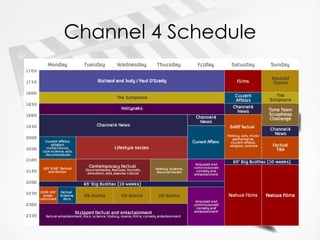
Television Scheduling  Breakfast  Daytime  Teatime Primetime Grave yard
Channel 4 Schedule
Audience Theories Hypodermic needle effect. Two step flow Uses & Gratifications Reception Theory Effects debate
Hypodermic Needle Effect Suggests media is capable of ‘mass manipulation’ Audience believe what they see Gullible audience: War of the world s (1938 radio broadcast) April fools – BBC Panorama spaghetti tree!!!
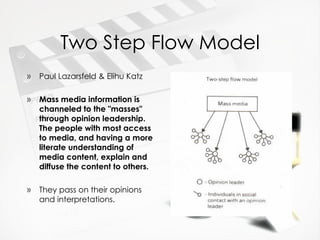
Two Step Flow Model Paul Lazarsfeld & Elihu Katz Mass media information is channeled to the "masses" through opinion leadership. The people with most access to media, and having a more literate understanding of media content, explain and diffuse the content to others. They pass on their opinions and interpretations.
Uses & Gratifications Jay G. Blumler and Elihu Katz   Audience has a set of needs that are met by the media. Diversion Surveilance Personal identity Personal relationship
Reception Analysis Text is not passively  accepted - audience interpret  meaning based on individual cultural background or life experience. Programme is encoded by the producer and decoded by the audience. Opositional / negotiated readings Stuart Hall – CCCS (Centre for Contemporary Cultural Studies, Birmingham)
Effects Debate ‘ Moral Panic’ [Stan Cohen 1972] Mods & Rockers 1960s “ mass response to a group, person or an attitude that becomes defined as a threat to society” Threat identified – panic created through press & other media.
Video Nasties Jamie Bulger Murder Case 1993 Childs Play 3 BBFC consider influence as well as content. Bowling For Columbine Internet – You tube videos
Counting Audiences Film: Figures based on box office receipts. [tickets sold, then DVDs bought/ rented [Subtract production costs to find profit = success] Print: Circulation [copies read] Audit Bureau of Circulation  www.abc.org.uk   Radio / TV: Viewing figures.  Sample of population, viewing/listening habits monitored for 7 days. Broadcast Audience Research Board  www.barb.co.uk   Radio Joint Audience Research  www.rajar.co.uk
Key Audience Studies The Nationwide Audience Ien Ang’s Dallas Study
The Nationwide Audience David Morley, 1980 BBC Nationwide programme Broadly based on Gramscian model of hegemonic power. Draws on semiotics – argued that audiences worked at decoding media texts. http://www.aber.ac.uk/media/Modules/TF33120/morleynw.html
Dominant / Hegemonic: Reader recognises and agrees with preferred reading. Oppositional: Reader recognises but rejects preferred reading (for cultural/political/ideological reasons) Negotiated: Reader accepts, rejects or refines elements of the programme due to previously held views
Ien Ang’s Dallas Study 1985 Reactions to and reasons for watching ‘Dallas’ 3 response types: Ideology of mass culture: Watched because it was high profile piece of US popular culture Ironic/detached position:  watch because wanted to see what other people were watching, even though knew it was ‘bad’ Ideology of popularism:  got pleasure from watching even though knew it was ‘trash’
Representation  Do the media suggest to large audiences that  x  or  y  character is typical of that group, and  therefore that the whole group should be viewed in certain ways?
Stereotypes Negative / Positive Coronation Street / Eastenders Cultures  - corner shop owners Sean – Camp Battersby family.  Hugh Grant: Notting Hill, 4 Weddings & a Funeral, Love Actually.

Audience

  • 1.
    Unit 8: Understandthe TV and film Industries Unit 1.3: How Media Texts are constructed in relation to their audiences
  • 2.
    Things you needto know… How the industry thinks about its audiences. How products are tailored to audiences. How the industry represents its audience, other social groups or social issues of interest to its audience.
  • 3.
    Why are audiencesimportant? Without them - why would media texts be created? Size & reaction measure success. People who buy provide income for production companies. Advertising.
  • 4.
    Disney ‘ HighSchool Musical’ Movie – DVD-stage show – ice show CD - Stationary – Karaoke Sticker Album – lunch boxes Dance Mat – Dolls – clothing Sing a long showings - competitions
  • 5.
    BBC Programmes /brands often have off shoots educational magazine series / comics audio books – books DVDs Toys – ie Tellytubbies / tweenies –
  • 6.
    How the industrythinks about its audiences.
  • 7.
    Target audiences Mediaproducers and institutions view audiences as an ‘imaginary entity’, a mass rather than individuals. They will however have a ‘typical’ audience member in mind. (len Ang: 1991)
  • 8.
    Doreen Typical listenerAge, likes, dislikes, habits, household, husband. Educated & intelligent Half listens Does not necessarily understand long words or discussions. Make sure understands and is engaged with. Talk to personally, as if known.
  • 9.
    Imaginary Entity Subjectivesused to help define the social position of the audience member: Self image Gender Age group Family Class Nation Ethnicity Education Politics Religion Location (geographical & local)
  • 10.
    Mode of AddressThe way in which a text will address or speak to its audience.
  • 11.
    DEMOGRAPHICS Grade ClassDescription A Upper Middle Higher managerial, administrative or professional. [Doctors / lawyers] B Middle Intermediate managerial, administrative or professional. [teachers ] C1 Lower Middle Supervisory or clerical, junior managerial, administrative or professional. [office / Nurses] C2 Skilled Working Skilled manual workers. [White collar] D Working Semi-skilled and unskilled manual workers. [blue collar] E Lowest level of substance Casual workers, unemployed, state pensioners, students.
  • 12.
    Television Scheduling Breakfast Daytime Teatime Primetime Grave yard
  • 13.
  • 14.
    Audience Theories Hypodermicneedle effect. Two step flow Uses & Gratifications Reception Theory Effects debate
  • 15.
    Hypodermic Needle EffectSuggests media is capable of ‘mass manipulation’ Audience believe what they see Gullible audience: War of the world s (1938 radio broadcast) April fools – BBC Panorama spaghetti tree!!!
  • 16.
    Two Step FlowModel Paul Lazarsfeld & Elihu Katz Mass media information is channeled to the "masses" through opinion leadership. The people with most access to media, and having a more literate understanding of media content, explain and diffuse the content to others. They pass on their opinions and interpretations.
  • 17.
    Uses & GratificationsJay G. Blumler and Elihu Katz Audience has a set of needs that are met by the media. Diversion Surveilance Personal identity Personal relationship
  • 18.
    Reception Analysis Textis not passively accepted - audience interpret meaning based on individual cultural background or life experience. Programme is encoded by the producer and decoded by the audience. Opositional / negotiated readings Stuart Hall – CCCS (Centre for Contemporary Cultural Studies, Birmingham)
  • 19.
    Effects Debate ‘Moral Panic’ [Stan Cohen 1972] Mods & Rockers 1960s “ mass response to a group, person or an attitude that becomes defined as a threat to society” Threat identified – panic created through press & other media.
  • 20.
    Video Nasties JamieBulger Murder Case 1993 Childs Play 3 BBFC consider influence as well as content. Bowling For Columbine Internet – You tube videos
  • 21.
    Counting Audiences Film:Figures based on box office receipts. [tickets sold, then DVDs bought/ rented [Subtract production costs to find profit = success] Print: Circulation [copies read] Audit Bureau of Circulation www.abc.org.uk Radio / TV: Viewing figures. Sample of population, viewing/listening habits monitored for 7 days. Broadcast Audience Research Board www.barb.co.uk Radio Joint Audience Research www.rajar.co.uk
  • 22.
    Key Audience StudiesThe Nationwide Audience Ien Ang’s Dallas Study
  • 23.
    The Nationwide AudienceDavid Morley, 1980 BBC Nationwide programme Broadly based on Gramscian model of hegemonic power. Draws on semiotics – argued that audiences worked at decoding media texts. http://www.aber.ac.uk/media/Modules/TF33120/morleynw.html
  • 24.
    Dominant / Hegemonic:Reader recognises and agrees with preferred reading. Oppositional: Reader recognises but rejects preferred reading (for cultural/political/ideological reasons) Negotiated: Reader accepts, rejects or refines elements of the programme due to previously held views
  • 25.
    Ien Ang’s DallasStudy 1985 Reactions to and reasons for watching ‘Dallas’ 3 response types: Ideology of mass culture: Watched because it was high profile piece of US popular culture Ironic/detached position: watch because wanted to see what other people were watching, even though knew it was ‘bad’ Ideology of popularism: got pleasure from watching even though knew it was ‘trash’
  • 26.
    Representation Dothe media suggest to large audiences that x or y character is typical of that group, and therefore that the whole group should be viewed in certain ways?
  • 27.
    Stereotypes Negative /Positive Coronation Street / Eastenders Cultures - corner shop owners Sean – Camp Battersby family. Hugh Grant: Notting Hill, 4 Weddings & a Funeral, Love Actually.

Editor's Notes

  • #8 Ien Ang; desperately seeking the audience, 1991
  • #9 Presenters at Independent local radio were told to have an imaginary person.
  • #10 Devised by Hartley (1982, understanding news) Last 4 added by Fiske (television culture 1987)
  • #26 Put an advert in a women’s magazine in Holland . Got 42 responses. Out of these answers identified 3 types of response.