Media Terminologies: Definition & Calculation By Prof Indrani Sen SIMC 20/7/11
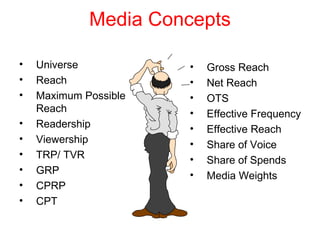
Media Concepts Universe Reach Maximum Possible Reach Readership Viewership TRP/ TVR GRP CPRP CPT Gross Reach Net Reach OTS Effective Frequency Effective Reach Share of Voice Share of Spends Media Weights
The universe The Total/Actual  number of people in a defined target audience
MPR Maximum Possible Reach Maximum % of Target Audience reached by any particular medium
Print Reach Readership of a particular Press Vehicle as % of Target Audience who read any  print vehicle Or  % of Target Audience/ Universe reached by any particular print vehicle
Gross Reach It is mathematically equal to the number of insertions/ spots per vehicle multiplied by the reach in numbers of that particular vehicle Hence this may count each individual more than once
Net Reach  It is equal to the total number of individuals reached after eliminating duplication
OTS : Opportunities To See Equals Gross Reach in numbers divided by Net Reach Reach in numbers OTS =  Gross Reach (‘000s)     Net Reach (‘000s)
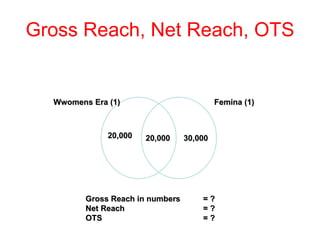
Gross Reach, Net Reach, OTS Wwomens Era (1) Femina (1) 20,000 20,000 30,000 Gross Reach in numbers  = ? Net Reach = ? OTS = ?
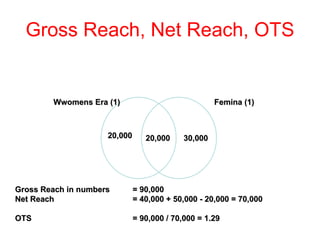
Gross Reach, Net Reach, OTS Wwomens Era (1) Femina (1) 20,000 20,000 30,000 Gross Reach in numbers  = 90,000 Net Reach = 40,000 + 50,000 - 20,000 = 70,000 OTS = 90,000 / 70,000 = 1.29
CPT Cost per every thousand Target Audience reached
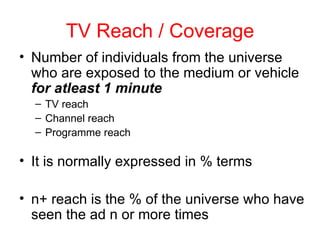
TV Reach / Coverage Number of individuals from the universe who are exposed to the medium or vehicle  for atleast 1 minute TV reach Channel reach Programme reach It is normally expressed in % terms n+ reach is the % of the universe who have seen the ad n or more times
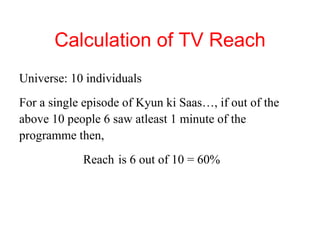
Calculation of TV Reach Universe: 10 individuals For a single episode of Kyun ki Saas…, if out of the above 10 people 6 saw atleast 1 minute of the programme then, Reach  is 6 out of 10 = 60%
Variations of the TV Reach  Gross Reach Net Reach Cumulative Reach
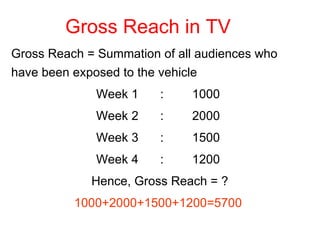
Gross Reach in TV Gross Reach = Summation of all audiences who have been exposed to the vehicle Week 1 : 1000 Week 2 : 2000 Week 3 : 1500 Week 4 : 1200 Hence, Gross Reach = ? 1000+2000+1500+1200=5700
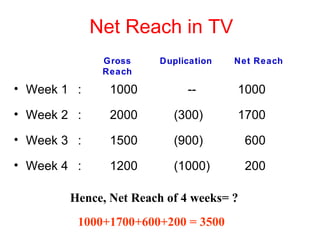
Net Reach in TV Week 1 : 1000   -- 1000 Week 2 : 2000 (300) 1700 Week 3 : 1500 (900)   600 Week 4 : 1200 (1000)   200 1000+1700+600+200 = 3500   Hence, Net Reach of 4 weeks= ? Net Reach Duplication Gross Reach
Cumulative Net Reach Principle : Audiences accumulate over time The number of individuals within the TG who are exposed to the medium/vehicle over a certain period of time
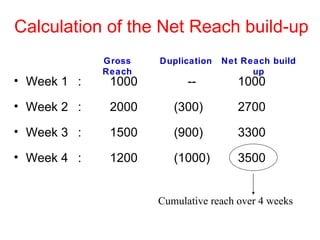
Calculation of the Net Reach build-up Week 1 : 1000   -- 1000 Week 2 : 2000 (300) 2700 Week 3 : 1500 (900) 3300 Week 4 : 1200 (1000) 3500  Cumulative reach over 4 weeks Net Reach build up Duplication Gross Reach
Opportunities to see in TV OTS describes the number of times on an average a viewer sees the ad
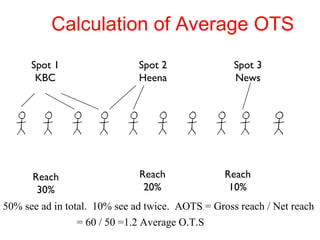
Calculation of Average OTS Spot 1 KBC Spot 2 Heena Spot 3 News 50% see ad in total.  10% see ad twice.  AOTS = Gross reach / Net reach  = 60 / 50 =1.2 Average O.T.S Reach 30% Reach 20% Reach 10%
Average Time Spent Principle : Different individuals within the TG spend different amount of time on a vehicle Two concepts  : Average Time Spent Per Universe Average Time Spent Per Viewer
Average Time Spent Per Viewer Total time spent by all viewers / Reach Average Time Spent Per Universe Takes into account both viewers and non-viewers Principle : Different vehicles have differing reach  Total Time Spent / Universe
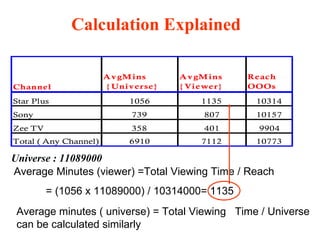
Universe : 11089000 Calculation Explained Average Minutes (viewer) =Total Viewing Time / Reach  = (1056 x 11089000) / 10314000= 1135 Average minutes ( universe) = Total Viewing  Time / Universe can be calculated similarly
Is there a term that encompasses both Reach and Time Spent ? Yes, it is TVR or TV Viewrership Rating
TRP has been replaced by TVR TRP: % of Target Audience in a particular market who have viewed any particular episode of a TV programme (0nly Reach) TVR:  % of Target Audience in a particular market who have viewed any particular episode of a TV programme for at least one minute  (Reach x Time Spent)
TVRs v/s Reach
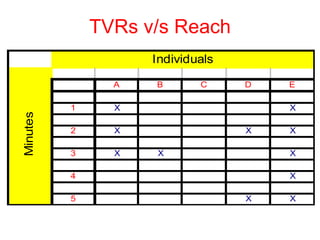
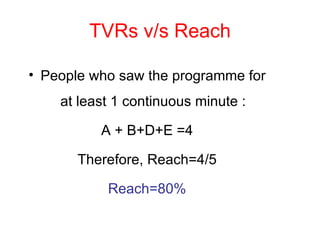
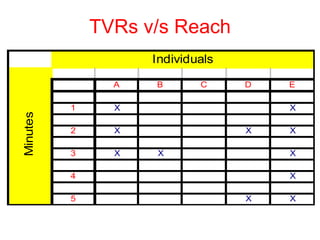
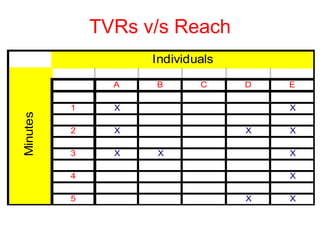
TVRs v/s Reach People who saw the programme for at least 1 continuous minute : A + B+D+E =4 Therefore, Reach=4/5 Reach=80%
TVRs v/s Reach
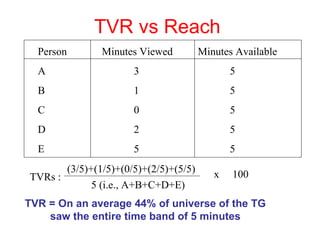
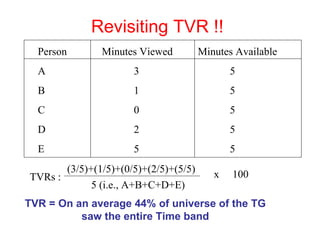
TVR vs Reach Person Minutes Viewed Minutes Available A 3 5 B 1 5 C 0 5 D 2 5 E 5 5 5 (i.e., A+B+C+D+E) x 100 TVR = On an average 44% of universe of the TG saw the entire time band of 5 minutes TVRs : (3/5)+(1/5)+(0/5)+(2/5)+(5/5)
TVRs v/s Reach
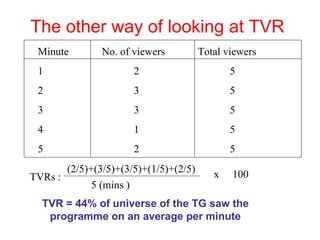
The other way of looking at TVR Minute No. of viewers  Total viewers 1 2 5 2 3 5 3 3 5 4 1 5 5 2 5 5 (mins ) x 100 TVR = 44% of universe of the TG saw the programme on an average per minute TVRs : (2/5)+(3/5)+(3/5)+(1/5)+(2/5)
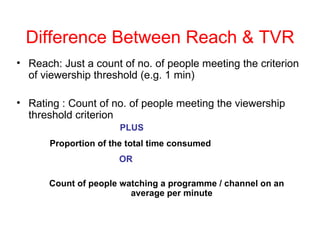
Difference Between Reach & TVR Reach: Just a count of no. of people meeting the criterion of viewership threshold (e.g. 1 min) Rating : Count of no. of people meeting the viewership threshold criterion    PLUS   Proportion of the total time consumed   OR Count of people watching a programme / channel on an average per minute
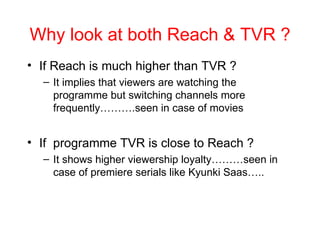
Why look at both Reach & TVR ? If Reach is much higher than TVR ? It implies that viewers are watching the programme but switching channels more frequently……….seen in case of movies If  programme TVR is close to Reach ? It shows higher viewership loyalty………seen in case of premiere serials like Kyunki Saas…..
What is Channel Share ? What percentage of total viewing time a particular channel is watched  Indicates how much a channel is watched Higher the channel share greater the probability of commercials been seen in the channel
Revisiting TVR !! Person Minutes Viewed Minutes Available A 3 5 B 1 5 C 0 5 D 2 5 E 5 5 5 (i.e., A+B+C+D+E) x 100 TVR = On an average 44% of universe of the TG saw the entire Time band TVRs : (3/5)+(1/5)+(0/5)+(2/5)+(5/5)
The other way of looking at channel share We have seen TVR of a channel  = Total viewing time / ( Total universe X Total duration )  TVR of Star Plus = S  TVR of all channels = T Channel Share of Star Plus = S / T = Total viewing time of Star Plus / Total viewing time  of all channels ( total universe & total duration being common factor cancels out ) Channel Share also indicator of  how TVR of Star Plus compares with respect to total TVR of all channels
Gross Rating Points (GRPs) The sum of all ratings (TVR) achieved in a campaign GRP levels are generally measured and reported on a 4 week basis It is a measure of the media plan’s thrust
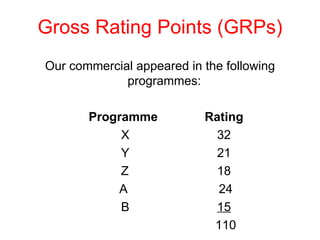
Our commercial appeared in the following programmes:  Programme Rating X   32 Y   21 Z   18 A    24 B   15   110 Gross Rating Points (GRPs)
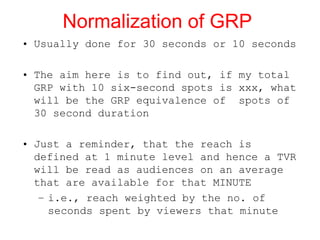
Normalization of GRP Usually done for 30 seconds or 10 seconds  The aim here is to find out, if my total GRP with 10 six-second spots is xxx, what will be the GRP equivalence of  spots of 30 second duration  Just a reminder, that the reach is defined at 1 minute level and hence a TVR will be read as audiences on an average that are available for that MINUTE i.e., reach weighted by the no. of seconds spent by viewers that minute
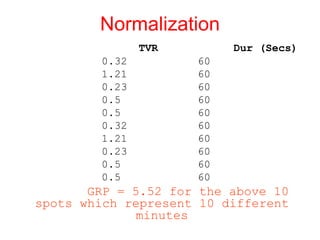
Normalization     TVR   Dur (Secs) 0.32 60 1.21 60 0.23 60 0.5 60 0.5 60 0.32 60 1.21 60 0.23 60 0.5 60 0.5 60   GRP = 5.52 for the above 10 spots which represent 10 different minutes
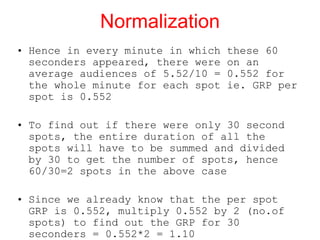
Normalization Hence in every minute in which these 60 seconders appeared, there were on an average audiences of 5.52/10 = 0.552 for the whole minute for each spot ie. GRP per spot is 0.552 To find out if there were only 30 second spots, the entire duration of all the spots will have to be summed and divided by 30 to get the number of spots, hence 60/30=2 spots in the above case Since we already know that the per spot GRP is 0.552, multiply 0.552 by 2 (no.of spots) to find out the GRP for 30 seconders = 0.552*2 = 1.10
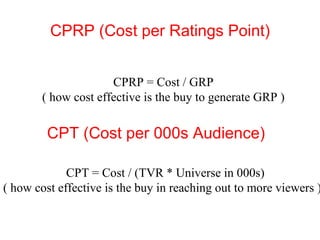
CPRP (Cost per Ratings Point) CPRP = Cost / GRP  ( how cost effective is the buy to generate GRP )  CPT (Cost per 000s Audience) CPT = Cost / (TVR * Universe in 000s)  ( how cost effective is the buy in reaching out to more viewers )
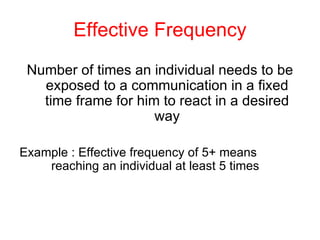
Effective Frequency Number of times an individual needs to be exposed to a communication in a fixed time frame for him to react in a desired way Example : Effective frequency of 5+ means  reaching an individual at least 5 times
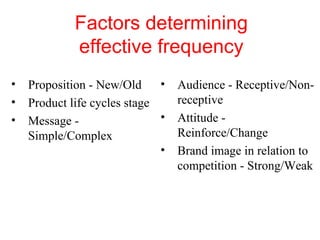
Factors determining effective frequency Proposition - New/Old Product life cycles stage Message - Simple/Complex Audience - Receptive/Non-receptive Attitude - Reinforce/Change Brand image in relation to competition - Strong/Weak
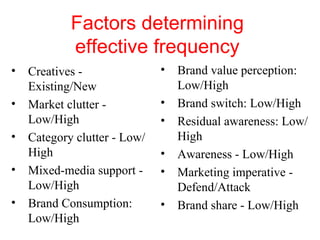
Factors determining effective frequency Creatives - Existing/New Market clutter - Low/High Category clutter - Low/High Mixed-media support - Low/High Brand Consumption: Low/High Brand value perception: Low/High Brand switch: Low/High Residual awareness: Low/High Awareness - Low/High Marketing imperative - Defend/Attack Brand share - Low/High
Effective Reach % of Target Audience who have been reached at least Effective Frequency number of times Example : If 50% have been reached at least 5  times, then 50% is the Effective Reach at 5+
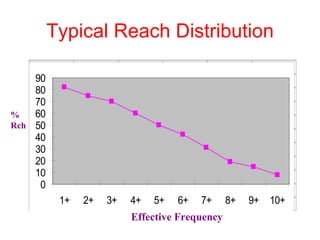
Typical Reach Distribution Effective Frequency % Rch
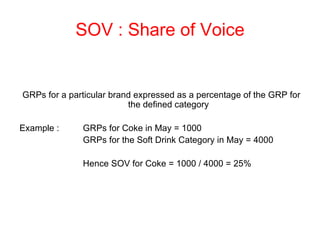
SOV : Share of Voice GRPs for a particular brand expressed as a percentage of the GRP for the defined category Example : GRPs for Coke in May = 1000 GRPs for the Soft Drink Category in May = 4000 Hence SOV for Coke = 1000 / 4000 = 25%
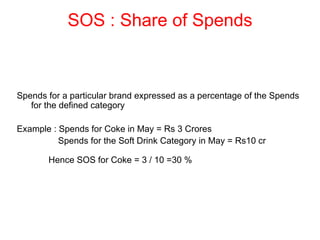
SOS : Share of Spends Spends for a particular brand expressed as a percentage of the Spends for the defined category Example : Spends for Coke in May = Rs 3 Crores   Spends for the Soft Drink Category in May = Rs10 cr  Hence SOS for Coke = 3 / 10 =30 %
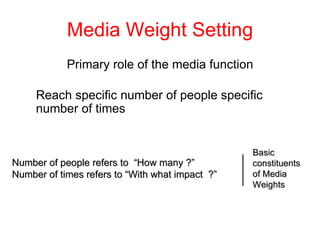
Media Weight Setting Primary role of the media function Reach specific number of people specific number of times Number of people refers to  “How many ?” Number of times refers to “With what impact  ?”  Basic  constituents of Media  Weights
Thank You.

Media concepts

  • 1.
    Media Terminologies: Definition& Calculation By Prof Indrani Sen SIMC 20/7/11
  • 2.
    Media Concepts UniverseReach Maximum Possible Reach Readership Viewership TRP/ TVR GRP CPRP CPT Gross Reach Net Reach OTS Effective Frequency Effective Reach Share of Voice Share of Spends Media Weights
  • 3.
    The universe TheTotal/Actual number of people in a defined target audience
  • 4.
    MPR Maximum PossibleReach Maximum % of Target Audience reached by any particular medium
  • 5.
    Print Reach Readershipof a particular Press Vehicle as % of Target Audience who read any print vehicle Or % of Target Audience/ Universe reached by any particular print vehicle
  • 6.
    Gross Reach Itis mathematically equal to the number of insertions/ spots per vehicle multiplied by the reach in numbers of that particular vehicle Hence this may count each individual more than once
  • 7.
    Net Reach It is equal to the total number of individuals reached after eliminating duplication
  • 8.
    OTS : OpportunitiesTo See Equals Gross Reach in numbers divided by Net Reach Reach in numbers OTS = Gross Reach (‘000s) Net Reach (‘000s)
  • 9.
    Gross Reach, NetReach, OTS Wwomens Era (1) Femina (1) 20,000 20,000 30,000 Gross Reach in numbers = ? Net Reach = ? OTS = ?
  • 10.
    Gross Reach, NetReach, OTS Wwomens Era (1) Femina (1) 20,000 20,000 30,000 Gross Reach in numbers = 90,000 Net Reach = 40,000 + 50,000 - 20,000 = 70,000 OTS = 90,000 / 70,000 = 1.29
  • 11.
    CPT Cost perevery thousand Target Audience reached
  • 12.
    TV Reach /Coverage Number of individuals from the universe who are exposed to the medium or vehicle for atleast 1 minute TV reach Channel reach Programme reach It is normally expressed in % terms n+ reach is the % of the universe who have seen the ad n or more times
  • 13.
    Calculation of TVReach Universe: 10 individuals For a single episode of Kyun ki Saas…, if out of the above 10 people 6 saw atleast 1 minute of the programme then, Reach is 6 out of 10 = 60%
  • 14.
    Variations of theTV Reach Gross Reach Net Reach Cumulative Reach
  • 15.
    Gross Reach inTV Gross Reach = Summation of all audiences who have been exposed to the vehicle Week 1 : 1000 Week 2 : 2000 Week 3 : 1500 Week 4 : 1200 Hence, Gross Reach = ? 1000+2000+1500+1200=5700
  • 16.
    Net Reach inTV Week 1 : 1000 -- 1000 Week 2 : 2000 (300) 1700 Week 3 : 1500 (900) 600 Week 4 : 1200 (1000) 200 1000+1700+600+200 = 3500 Hence, Net Reach of 4 weeks= ? Net Reach Duplication Gross Reach
  • 17.
    Cumulative Net ReachPrinciple : Audiences accumulate over time The number of individuals within the TG who are exposed to the medium/vehicle over a certain period of time
  • 18.
    Calculation of theNet Reach build-up Week 1 : 1000 -- 1000 Week 2 : 2000 (300) 2700 Week 3 : 1500 (900) 3300 Week 4 : 1200 (1000) 3500 Cumulative reach over 4 weeks Net Reach build up Duplication Gross Reach
  • 19.
    Opportunities to seein TV OTS describes the number of times on an average a viewer sees the ad
  • 20.
    Calculation of AverageOTS Spot 1 KBC Spot 2 Heena Spot 3 News 50% see ad in total. 10% see ad twice. AOTS = Gross reach / Net reach = 60 / 50 =1.2 Average O.T.S Reach 30% Reach 20% Reach 10%
  • 21.
    Average Time SpentPrinciple : Different individuals within the TG spend different amount of time on a vehicle Two concepts : Average Time Spent Per Universe Average Time Spent Per Viewer
  • 22.
    Average Time SpentPer Viewer Total time spent by all viewers / Reach Average Time Spent Per Universe Takes into account both viewers and non-viewers Principle : Different vehicles have differing reach Total Time Spent / Universe
  • 23.
    Universe : 11089000Calculation Explained Average Minutes (viewer) =Total Viewing Time / Reach = (1056 x 11089000) / 10314000= 1135 Average minutes ( universe) = Total Viewing Time / Universe can be calculated similarly
  • 24.
    Is there aterm that encompasses both Reach and Time Spent ? Yes, it is TVR or TV Viewrership Rating
  • 25.
    TRP has beenreplaced by TVR TRP: % of Target Audience in a particular market who have viewed any particular episode of a TV programme (0nly Reach) TVR: % of Target Audience in a particular market who have viewed any particular episode of a TV programme for at least one minute (Reach x Time Spent)
  • 26.
  • 27.
    TVRs v/s ReachPeople who saw the programme for at least 1 continuous minute : A + B+D+E =4 Therefore, Reach=4/5 Reach=80%
  • 28.
  • 29.
    TVR vs ReachPerson Minutes Viewed Minutes Available A 3 5 B 1 5 C 0 5 D 2 5 E 5 5 5 (i.e., A+B+C+D+E) x 100 TVR = On an average 44% of universe of the TG saw the entire time band of 5 minutes TVRs : (3/5)+(1/5)+(0/5)+(2/5)+(5/5)
  • 30.
  • 31.
    The other wayof looking at TVR Minute No. of viewers Total viewers 1 2 5 2 3 5 3 3 5 4 1 5 5 2 5 5 (mins ) x 100 TVR = 44% of universe of the TG saw the programme on an average per minute TVRs : (2/5)+(3/5)+(3/5)+(1/5)+(2/5)
  • 32.
    Difference Between Reach& TVR Reach: Just a count of no. of people meeting the criterion of viewership threshold (e.g. 1 min) Rating : Count of no. of people meeting the viewership threshold criterion PLUS Proportion of the total time consumed OR Count of people watching a programme / channel on an average per minute
  • 33.
    Why look atboth Reach & TVR ? If Reach is much higher than TVR ? It implies that viewers are watching the programme but switching channels more frequently……….seen in case of movies If programme TVR is close to Reach ? It shows higher viewership loyalty………seen in case of premiere serials like Kyunki Saas…..
  • 34.
    What is ChannelShare ? What percentage of total viewing time a particular channel is watched Indicates how much a channel is watched Higher the channel share greater the probability of commercials been seen in the channel
  • 35.
    Revisiting TVR !!Person Minutes Viewed Minutes Available A 3 5 B 1 5 C 0 5 D 2 5 E 5 5 5 (i.e., A+B+C+D+E) x 100 TVR = On an average 44% of universe of the TG saw the entire Time band TVRs : (3/5)+(1/5)+(0/5)+(2/5)+(5/5)
  • 36.
    The other wayof looking at channel share We have seen TVR of a channel = Total viewing time / ( Total universe X Total duration ) TVR of Star Plus = S TVR of all channels = T Channel Share of Star Plus = S / T = Total viewing time of Star Plus / Total viewing time of all channels ( total universe & total duration being common factor cancels out ) Channel Share also indicator of how TVR of Star Plus compares with respect to total TVR of all channels
  • 37.
    Gross Rating Points(GRPs) The sum of all ratings (TVR) achieved in a campaign GRP levels are generally measured and reported on a 4 week basis It is a measure of the media plan’s thrust
  • 38.
    Our commercial appearedin the following programmes: Programme Rating X 32 Y 21 Z 18 A 24 B 15 110 Gross Rating Points (GRPs)
  • 39.
    Normalization of GRPUsually done for 30 seconds or 10 seconds The aim here is to find out, if my total GRP with 10 six-second spots is xxx, what will be the GRP equivalence of spots of 30 second duration Just a reminder, that the reach is defined at 1 minute level and hence a TVR will be read as audiences on an average that are available for that MINUTE i.e., reach weighted by the no. of seconds spent by viewers that minute
  • 40.
    Normalization TVR Dur (Secs) 0.32 60 1.21 60 0.23 60 0.5 60 0.5 60 0.32 60 1.21 60 0.23 60 0.5 60 0.5 60 GRP = 5.52 for the above 10 spots which represent 10 different minutes
  • 41.
    Normalization Hence inevery minute in which these 60 seconders appeared, there were on an average audiences of 5.52/10 = 0.552 for the whole minute for each spot ie. GRP per spot is 0.552 To find out if there were only 30 second spots, the entire duration of all the spots will have to be summed and divided by 30 to get the number of spots, hence 60/30=2 spots in the above case Since we already know that the per spot GRP is 0.552, multiply 0.552 by 2 (no.of spots) to find out the GRP for 30 seconders = 0.552*2 = 1.10
  • 42.
    CPRP (Cost perRatings Point) CPRP = Cost / GRP ( how cost effective is the buy to generate GRP ) CPT (Cost per 000s Audience) CPT = Cost / (TVR * Universe in 000s) ( how cost effective is the buy in reaching out to more viewers )
  • 43.
    Effective Frequency Numberof times an individual needs to be exposed to a communication in a fixed time frame for him to react in a desired way Example : Effective frequency of 5+ means reaching an individual at least 5 times
  • 44.
    Factors determining effectivefrequency Proposition - New/Old Product life cycles stage Message - Simple/Complex Audience - Receptive/Non-receptive Attitude - Reinforce/Change Brand image in relation to competition - Strong/Weak
  • 45.
    Factors determining effectivefrequency Creatives - Existing/New Market clutter - Low/High Category clutter - Low/High Mixed-media support - Low/High Brand Consumption: Low/High Brand value perception: Low/High Brand switch: Low/High Residual awareness: Low/High Awareness - Low/High Marketing imperative - Defend/Attack Brand share - Low/High
  • 46.
    Effective Reach %of Target Audience who have been reached at least Effective Frequency number of times Example : If 50% have been reached at least 5 times, then 50% is the Effective Reach at 5+
  • 47.
    Typical Reach DistributionEffective Frequency % Rch
  • 48.
    SOV : Shareof Voice GRPs for a particular brand expressed as a percentage of the GRP for the defined category Example : GRPs for Coke in May = 1000 GRPs for the Soft Drink Category in May = 4000 Hence SOV for Coke = 1000 / 4000 = 25%
  • 49.
    SOS : Shareof Spends Spends for a particular brand expressed as a percentage of the Spends for the defined category Example : Spends for Coke in May = Rs 3 Crores Spends for the Soft Drink Category in May = Rs10 cr Hence SOS for Coke = 3 / 10 =30 %
  • 50.
    Media Weight SettingPrimary role of the media function Reach specific number of people specific number of times Number of people refers to “How many ?” Number of times refers to “With what impact ?” Basic constituents of Media Weights
  • 51.