Four Classes of
Macromolecules
Notes Booklet: Inside Panels
Biological Importance, Dietary Sources,
Functional Groups
Carbohydrates
• Biological Importance
• Very abundant in nature
• Preferred energy source for most organisms
• Photosynthesis directly produces glucose
• Cellulose is the most abundant terrestrial biomolecule
• Energy is extracted from glucose during cellular respiration
• Make up cell walls
• plants, bacteria, fungi, algae
• Make up exoskeletons
• arthropods, insects
Carbohydrates
Dietary Sources
• Fruits, honey, milk
• Vegetables, grains
Functional Groups
• Hydroxyl (-OH)
Lipids
• Biological Importance
• Long term energy storage
• A gram of fat stores twice as much energy as a gram of starch
• Lots of C-H bonds (high-energy bonds)
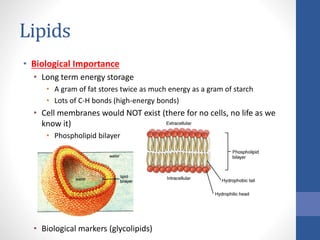
• Cell membranes would NOT exist (there for no cells, no life as we
know it)
• Phospholipid bilayer
• Biological markers (glycolipids)
Lipids
Dietary Sources
• Animal fats
• Plants: nuts, seeds (oils)
Functional Groups
• Hydroxyl (-OH)
• Phosphate (-PO4)
• Carbonyl (-C=O)
Proteins
• Biological Importance
• Determine the structure and function
of cells!
• Do the WORK of cells
• Every living cell contains 100s – 1000s of proteins
• ~50% the dry mass of a cell is protein!
• Every dynamic function of a living thing depends on proteins
• Regulate metabolism
• Biomarkers (glycoproteins)
• Human proteome
• Over 19,000 proteins identified
• Expected # of human proteins = 250,000 – one million!
Proteins
Dietary Sources
• Animals
• Plants
Functional Groups
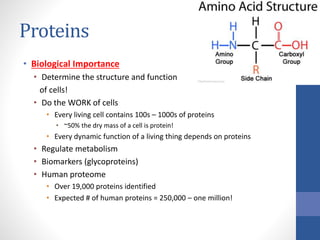
• Amino (-NH2)
• Carboxyl (-COOH)
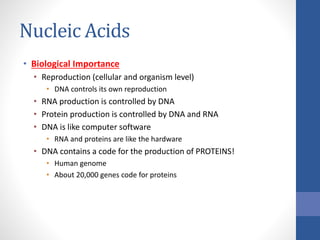
Nucleic Acids
• Biological Importance
• Reproduction (cellular and organism level)
• DNA controls its own reproduction
• RNA production is controlled by DNA
• Protein production is controlled by DNA and RNA
• DNA is like computer software
• RNA and proteins are like the hardware
• DNA contains a code for the production of PROTEINS!
• Human genome
• About 20,000 genes code for proteins
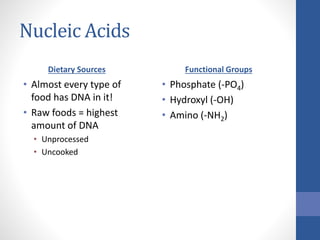
Nucleic Acids
Dietary Sources
• Almost every type of
food has DNA in it!
• Raw foods = highest
amount of DNA
• Unprocessed
• Uncooked
Functional Groups
• Phosphate (-PO4)
• Hydroxyl (-OH)
• Amino (-NH2)
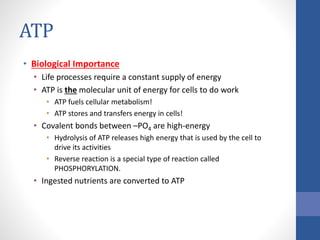
ATP
• Biological Importance
• Life processes require a constant supply of energy
• ATP is the molecular unit of energy for cells to do work
• ATP fuels cellular metabolism!
• ATP stores and transfers energy in cells!
• Covalent bonds between –PO4 are high-energy
• Hydrolysis of ATP releases high energy that is used by the cell to
drive its activities
• Reverse reaction is a special type of reaction called
PHOSPHORYLATION.
• Ingested nutrients are converted to ATP
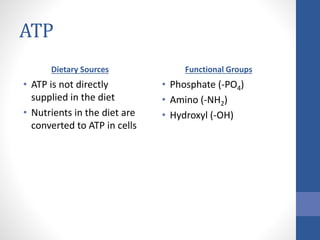
ATP
Dietary Sources
• ATP is not directly
supplied in the diet
• Nutrients in the diet are
converted to ATP in cells
Functional Groups
• Phosphate (-PO4)
• Amino (-NH2)
• Hydroxyl (-OH)

Four classes of macromolecules

  • 1.
    Four Classes of Macromolecules NotesBooklet: Inside Panels Biological Importance, Dietary Sources, Functional Groups
  • 2.
    Carbohydrates • Biological Importance •Very abundant in nature • Preferred energy source for most organisms • Photosynthesis directly produces glucose • Cellulose is the most abundant terrestrial biomolecule • Energy is extracted from glucose during cellular respiration • Make up cell walls • plants, bacteria, fungi, algae • Make up exoskeletons • arthropods, insects
  • 3.
    Carbohydrates Dietary Sources • Fruits,honey, milk • Vegetables, grains Functional Groups • Hydroxyl (-OH)
  • 4.
    Lipids • Biological Importance •Long term energy storage • A gram of fat stores twice as much energy as a gram of starch • Lots of C-H bonds (high-energy bonds) • Cell membranes would NOT exist (there for no cells, no life as we know it) • Phospholipid bilayer • Biological markers (glycolipids)
  • 5.
    Lipids Dietary Sources • Animalfats • Plants: nuts, seeds (oils) Functional Groups • Hydroxyl (-OH) • Phosphate (-PO4) • Carbonyl (-C=O)
  • 6.
    Proteins • Biological Importance •Determine the structure and function of cells! • Do the WORK of cells • Every living cell contains 100s – 1000s of proteins • ~50% the dry mass of a cell is protein! • Every dynamic function of a living thing depends on proteins • Regulate metabolism • Biomarkers (glycoproteins) • Human proteome • Over 19,000 proteins identified • Expected # of human proteins = 250,000 – one million!
  • 7.
    Proteins Dietary Sources • Animals •Plants Functional Groups • Amino (-NH2) • Carboxyl (-COOH)
  • 8.
    Nucleic Acids • BiologicalImportance • Reproduction (cellular and organism level) • DNA controls its own reproduction • RNA production is controlled by DNA • Protein production is controlled by DNA and RNA • DNA is like computer software • RNA and proteins are like the hardware • DNA contains a code for the production of PROTEINS! • Human genome • About 20,000 genes code for proteins
  • 9.
    Nucleic Acids Dietary Sources •Almost every type of food has DNA in it! • Raw foods = highest amount of DNA • Unprocessed • Uncooked Functional Groups • Phosphate (-PO4) • Hydroxyl (-OH) • Amino (-NH2)
  • 10.
    ATP • Biological Importance •Life processes require a constant supply of energy • ATP is the molecular unit of energy for cells to do work • ATP fuels cellular metabolism! • ATP stores and transfers energy in cells! • Covalent bonds between –PO4 are high-energy • Hydrolysis of ATP releases high energy that is used by the cell to drive its activities • Reverse reaction is a special type of reaction called PHOSPHORYLATION. • Ingested nutrients are converted to ATP
  • 11.
    ATP Dietary Sources • ATPis not directly supplied in the diet • Nutrients in the diet are converted to ATP in cells Functional Groups • Phosphate (-PO4) • Amino (-NH2) • Hydroxyl (-OH)