Biochemistry Chemistry Comes to Life
Energy Types: How do these relate to living systems? Chemical energy Electrical energy Mechanical energy Radiant energy How do these relate to the ideas of potential and kinetic energy?
Chemical bonds Ionic  Covalent Hydrogen bonds
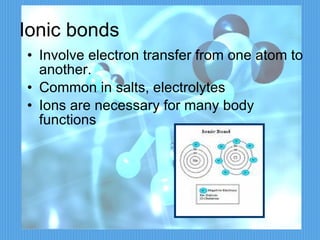
Ionic bonds Involve electron transfer from one atom to another. Common in salts, electrolytes Ions are necessary for many body functions
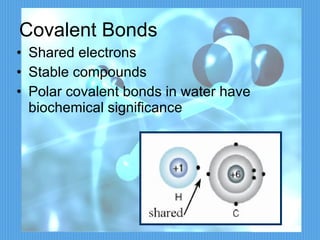
Covalent Bonds Shared electrons Stable compounds Polar covalent bonds in water have biochemical significance
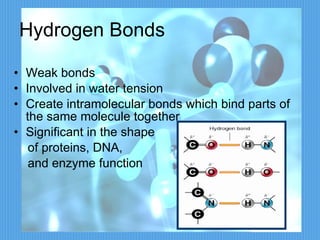
Hydrogen Bonds Weak bonds Involved in water tension Create intramolecular bonds which bind parts of the same molecule together Significant in the shape  of proteins, DNA, and enzyme function
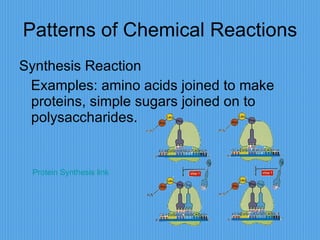
Patterns of Chemical Reactions Synthesis Reaction Examples: amino acids joined to make proteins, simple sugars joined on to polysaccharides. Protein Synthesis link
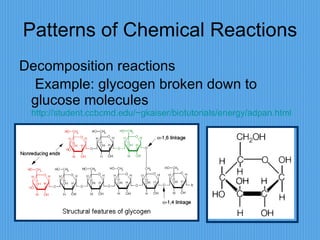
Patterns of Chemical Reactions Decomposition reactions Example: glycogen broken down to glucose molecules  http://student.ccbcmd.edu/~gkaiser/biotutorials/energy/adpan.html
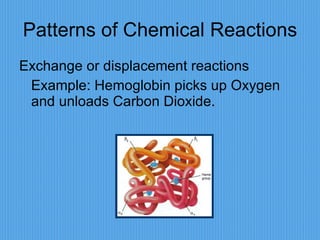
Patterns of Chemical Reactions Exchange or displacement reactions Example: Hemoglobin picks up Oxygen and unloads Carbon Dioxide.
Significant inorganic molecules Water Salts Acids and Bases
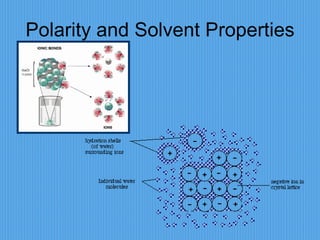
Biological significance of water High Heat Capacity Prevents sudden changes in body temp. Polarity and Solvent Properties Salts, O 2 , CO 2,  dissolved in blood; lubricant molecules Chemical Reactivity Reactant in digestion; hydrolysis Cushioning properties CSF, amniotic fluid
Polarity and Solvent Properties
Organic Macromolecules Carbohydrates Lipids Proteins Nucleic Acids ATP
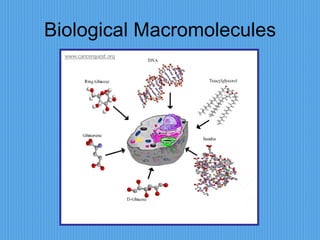
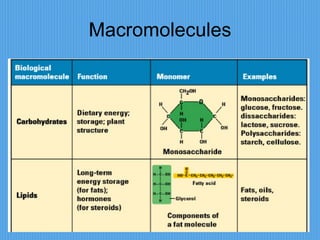
Biological Macromolecules
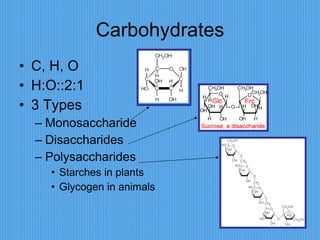
Carbohydrates C, H, O H:O::2:1 3 Types Monosaccharide Disaccharides Polysaccharides Starches in plants Glycogen in animals
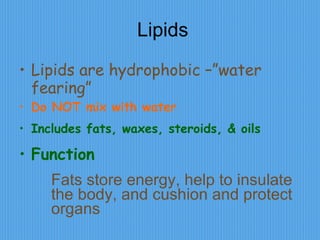
Lipids Lipids are hydrophobic –”water fearing” Do NOT mix with water Includes fats, waxes, steroids, & oils Function Fats store energy, help to insulate  the body, and cushion and protect  organs
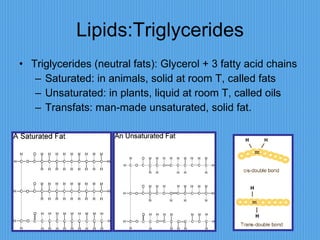
Lipids:Triglycerides Triglycerides (neutral fats): Glycerol + 3 fatty acid chains Saturated: in animals, solid at room T, called fats Unsaturated: in plants, liquid at room T, called oils Transfats: man-made unsaturated, solid fat.
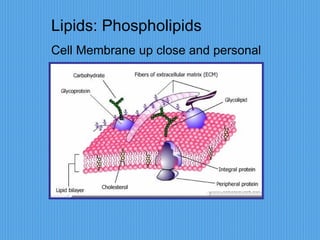
Lipids: Phospholipids Cell Membrane up close and personal
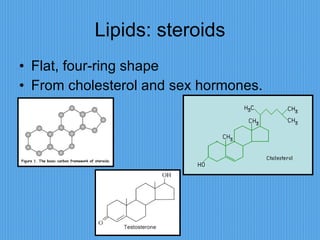
Lipids: steroids Flat, four-ring shape From cholesterol and sex hormones.
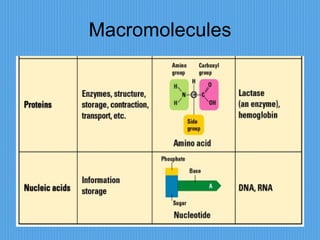
Proteins Proteins are polymers made of monomers called amino acids All proteins are made of 20 different amino acids linked in different orders Proteins are used to build cells, act as hormones & enzymes, and do much of the work in a cell
Proteins C,H,O,N and sometimes S Made up of chains of amino acids Structural proteins: muscle, keratin, collagen; make up 50% of organic matter Functional proteins Antibodies Hormones Transport protein: hemoglobin Enzymes: biological catalysts http://www.lewport.wnyric.org/jwanamaker/animations/Enzyme%20activity.html
Nucleic Acids Store hereditary information Contain information for making all the body’s proteins Two types exist --- DNA & RNA
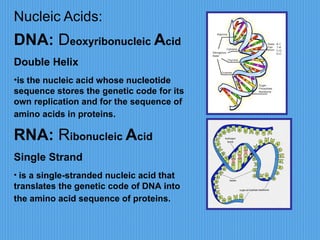
Nucleic   Acids: DNA:  D eoxyribonucleic  A cid   Double Helix is the nucleic acid whose nucleotide sequence stores the genetic code for its own replication and for the sequence of amino acids in proteins.     RNA:  R ibonucleic  A cid   Single Strand is a single-stranded nucleic acid that translates the genetic code of DNA into the amino acid sequence of proteins.
Macromolecules
Macromolecules
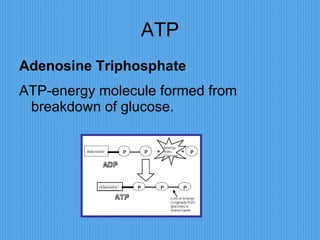
ATP Adenosine Triphosphate   ATP-energy molecule formed from breakdown of glucose.
ATP 1.  ATP  ( adenosine triphosphate ) is a nucleotide of adenosine composed of ribose and adenine.  2. Derives its name from  three phosphates  attached to the five-carbon portion of the molecule.  3.  ATP is a high-energy molecule  because the last two unstable phosphate bonds are easily broken.  4. Usually in cells, a  terminal phosphate bond is hydrolyzed , leaving  ADP (adenosine diphosphate ).  5. ATP is used in cells to supply energy for energy-requiring processes (e.g., synthetic reactions); whenever a cell carries out an activity or builds molecules, it "spends" ATP.  

Chapter2 biochemistry

  • 1.
  • 2.
    Energy Types: Howdo these relate to living systems? Chemical energy Electrical energy Mechanical energy Radiant energy How do these relate to the ideas of potential and kinetic energy?
  • 3.
    Chemical bonds Ionic Covalent Hydrogen bonds
  • 4.
    Ionic bonds Involveelectron transfer from one atom to another. Common in salts, electrolytes Ions are necessary for many body functions
  • 5.
    Covalent Bonds Sharedelectrons Stable compounds Polar covalent bonds in water have biochemical significance
  • 6.
    Hydrogen Bonds Weakbonds Involved in water tension Create intramolecular bonds which bind parts of the same molecule together Significant in the shape of proteins, DNA, and enzyme function
  • 7.
    Patterns of ChemicalReactions Synthesis Reaction Examples: amino acids joined to make proteins, simple sugars joined on to polysaccharides. Protein Synthesis link
  • 8.
    Patterns of ChemicalReactions Decomposition reactions Example: glycogen broken down to glucose molecules http://student.ccbcmd.edu/~gkaiser/biotutorials/energy/adpan.html
  • 9.
    Patterns of ChemicalReactions Exchange or displacement reactions Example: Hemoglobin picks up Oxygen and unloads Carbon Dioxide.
  • 10.
    Significant inorganic moleculesWater Salts Acids and Bases
  • 11.
    Biological significance ofwater High Heat Capacity Prevents sudden changes in body temp. Polarity and Solvent Properties Salts, O 2 , CO 2, dissolved in blood; lubricant molecules Chemical Reactivity Reactant in digestion; hydrolysis Cushioning properties CSF, amniotic fluid
  • 12.
  • 13.
    Organic Macromolecules CarbohydratesLipids Proteins Nucleic Acids ATP
  • 14.
  • 15.
    Carbohydrates C, H,O H:O::2:1 3 Types Monosaccharide Disaccharides Polysaccharides Starches in plants Glycogen in animals
  • 16.
    Lipids Lipids arehydrophobic –”water fearing” Do NOT mix with water Includes fats, waxes, steroids, & oils Function Fats store energy, help to insulate the body, and cushion and protect organs
  • 17.
    Lipids:Triglycerides Triglycerides (neutralfats): Glycerol + 3 fatty acid chains Saturated: in animals, solid at room T, called fats Unsaturated: in plants, liquid at room T, called oils Transfats: man-made unsaturated, solid fat.
  • 18.
    Lipids: Phospholipids CellMembrane up close and personal
  • 19.
    Lipids: steroids Flat,four-ring shape From cholesterol and sex hormones.
  • 20.
    Proteins Proteins arepolymers made of monomers called amino acids All proteins are made of 20 different amino acids linked in different orders Proteins are used to build cells, act as hormones & enzymes, and do much of the work in a cell
  • 21.
    Proteins C,H,O,N andsometimes S Made up of chains of amino acids Structural proteins: muscle, keratin, collagen; make up 50% of organic matter Functional proteins Antibodies Hormones Transport protein: hemoglobin Enzymes: biological catalysts http://www.lewport.wnyric.org/jwanamaker/animations/Enzyme%20activity.html
  • 22.
    Nucleic Acids Storehereditary information Contain information for making all the body’s proteins Two types exist --- DNA & RNA
  • 23.
    Nucleic Acids: DNA: D eoxyribonucleic A cid Double Helix is the nucleic acid whose nucleotide sequence stores the genetic code for its own replication and for the sequence of amino acids in proteins.   RNA: R ibonucleic A cid Single Strand is a single-stranded nucleic acid that translates the genetic code of DNA into the amino acid sequence of proteins.
  • 24.
  • 25.
  • 26.
    ATP Adenosine Triphosphate ATP-energy molecule formed from breakdown of glucose.
  • 27.
    ATP 1. ATP ( adenosine triphosphate ) is a nucleotide of adenosine composed of ribose and adenine. 2. Derives its name from three phosphates attached to the five-carbon portion of the molecule. 3. ATP is a high-energy molecule because the last two unstable phosphate bonds are easily broken. 4. Usually in cells, a terminal phosphate bond is hydrolyzed , leaving ADP (adenosine diphosphate ). 5. ATP is used in cells to supply energy for energy-requiring processes (e.g., synthetic reactions); whenever a cell carries out an activity or builds molecules, it "spends" ATP.  

Editor's Notes

  • #13 Salts dissolve in water in blood and are significant in many reactions. Na and K essential for nerve action; Fe in hemoglobin.
  • #20 Cholesterol important in cell membranes, exists in large quantities in the brain, is the base for the formation of sex hormones. Is made naturally by the body, but is also ingested as we eat meat.