Foundations of Totalitarianism
Totalitarianism Form of government that theoretically permits no individual freedom and seeks to subordinate all aspects of an individual's life to the authority of the government Mussolini coined the term “totalitario” "All within the state, none outside the state, none against the state."
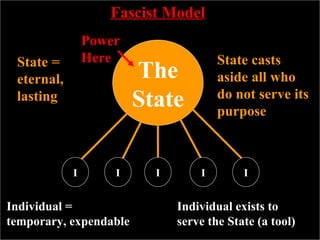
The State Fascist Model State = eternal, lasting State casts aside all who do not serve its purpose Individual = temporary, expendable Individual exists to serve the State (a tool) I I I I I Power Here
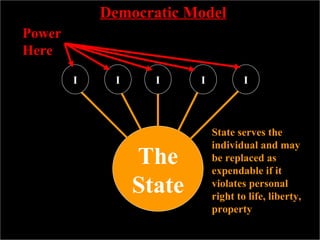
I I I I I Democratic Model Individual is most important State serves the individual and may be replaced as expendable if it violates personal right to life, liberty, property The State Power Here
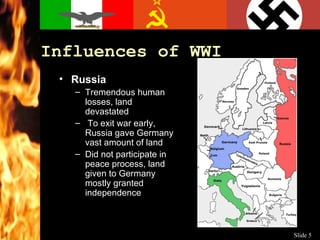
Influences of WWI  Russia Tremendous human losses, land devastated To exit war early, Russia gave Germany vast amount of land Did not participate in peace process, land given to Germany mostly granted independence
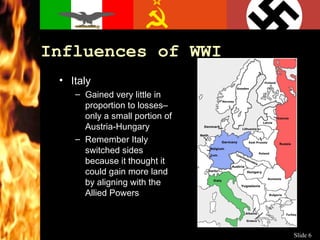
Influences of WWI Italy Gained very little in proportion to losses– only a small portion of Austria-Hungary Remember Italy switched sides because it thought it could gain more land by aligning with the Allied Powers
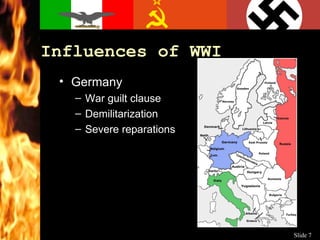
Influences of WWI Germany War guilt clause Demilitarization Severe reparations
Influences of WWI The “Total War” ideology behind WWI led to the idea that individuals must make sacrifices and strict government control is necessary for victory
Why Europe in the 1920’s and 1930’s? Countries had no tradition of self-government before WWI – the new self-government was forced upon nations not ready for it 1930’s saw a world wide depression, making struggling democracies face more problems
Characteristics of Totalitarian Regimes Support does not come instantaneously – gradually increases with use of modern communication and transportation A  "permanent revolution" occurring – nation is always pursuing a special goal
Characteristics of Totalitarian Regimes Replaces all political institutions with new ones and erases all legal, social, and political traditions. Directed violence controlled by the government becomes an important tool
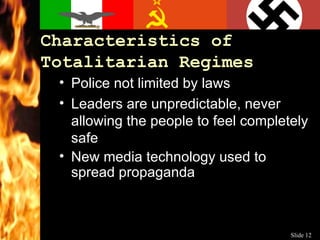
Characteristics of Totalitarian Regimes Police not limited by laws Leaders are unpredictable, never allowing the people to feel completely safe New media technology used to spread propaganda
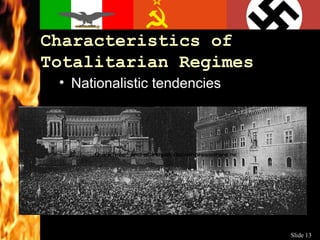
Characteristics of Totalitarian Regimes Nationalistic tendencies
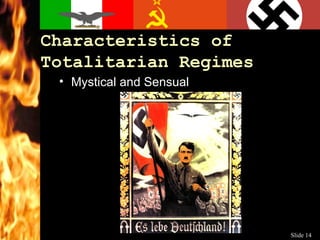
Characteristics of Totalitarian Regimes Mystical and Sensual
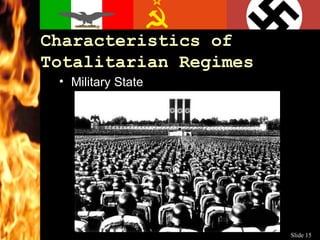
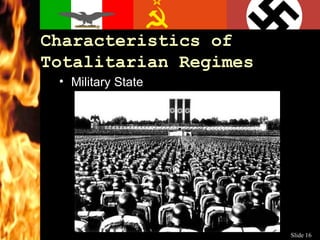
Characteristics of Totalitarian Regimes Military State
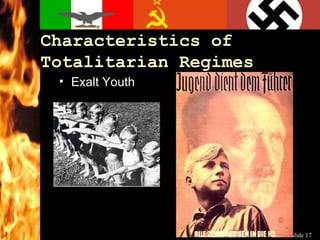
Characteristics of Totalitarian Regimes Exalt Youth
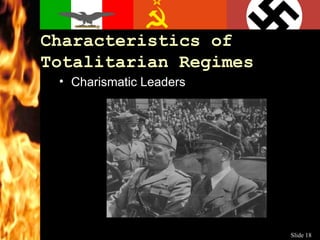
Characteristics of Totalitarian Regimes Charismatic Leaders
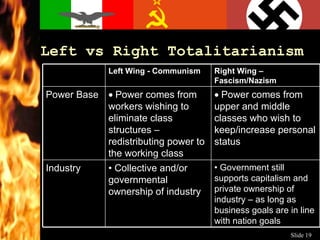
Left vs Right Totalitarianism •  Government still supports capitalism and private ownership of industry – as long as business goals are in line with nation goals •  Collective and/or governmental ownership of industry Industry  Power comes from upper and middle classes who wish to keep/increase personal status  Power comes from workers wishing to eliminate class structures – redistributing power to the working class Power Base Right Wing – Fascism/Nazism Left Wing - Communism
Left vs Right Totalitarianism Not as violent, usually relies upon existing upper and middle classes for support Previous institutions kept, but altered to fit new needs Violent overthrow of previous regime Old institutions replaced with a completely new system of government Type of Change Industrialized nations with a substantial middle class Countries with limited development / industrialization Location Right Wing – Fascism/Nazism Left Wing - Communism

Foundations of Totalitarianism

  • 1.
  • 2.
    Totalitarianism Form ofgovernment that theoretically permits no individual freedom and seeks to subordinate all aspects of an individual's life to the authority of the government Mussolini coined the term “totalitario” "All within the state, none outside the state, none against the state."
  • 3.
    The State FascistModel State = eternal, lasting State casts aside all who do not serve its purpose Individual = temporary, expendable Individual exists to serve the State (a tool) I I I I I Power Here
  • 4.
    I I II I Democratic Model Individual is most important State serves the individual and may be replaced as expendable if it violates personal right to life, liberty, property The State Power Here
  • 5.
    Influences of WWI Russia Tremendous human losses, land devastated To exit war early, Russia gave Germany vast amount of land Did not participate in peace process, land given to Germany mostly granted independence
  • 6.
    Influences of WWIItaly Gained very little in proportion to losses– only a small portion of Austria-Hungary Remember Italy switched sides because it thought it could gain more land by aligning with the Allied Powers
  • 7.
    Influences of WWIGermany War guilt clause Demilitarization Severe reparations
  • 8.
    Influences of WWIThe “Total War” ideology behind WWI led to the idea that individuals must make sacrifices and strict government control is necessary for victory
  • 9.
    Why Europe inthe 1920’s and 1930’s? Countries had no tradition of self-government before WWI – the new self-government was forced upon nations not ready for it 1930’s saw a world wide depression, making struggling democracies face more problems
  • 10.
    Characteristics of TotalitarianRegimes Support does not come instantaneously – gradually increases with use of modern communication and transportation A "permanent revolution" occurring – nation is always pursuing a special goal
  • 11.
    Characteristics of TotalitarianRegimes Replaces all political institutions with new ones and erases all legal, social, and political traditions. Directed violence controlled by the government becomes an important tool
  • 12.
    Characteristics of TotalitarianRegimes Police not limited by laws Leaders are unpredictable, never allowing the people to feel completely safe New media technology used to spread propaganda
  • 13.
    Characteristics of TotalitarianRegimes Nationalistic tendencies
  • 14.
    Characteristics of TotalitarianRegimes Mystical and Sensual
  • 15.
    Characteristics of TotalitarianRegimes Military State
  • 16.
    Characteristics of TotalitarianRegimes Military State
  • 17.
  • 18.
    Characteristics of TotalitarianRegimes Charismatic Leaders
  • 19.
    Left vs RightTotalitarianism • Government still supports capitalism and private ownership of industry – as long as business goals are in line with nation goals • Collective and/or governmental ownership of industry Industry  Power comes from upper and middle classes who wish to keep/increase personal status  Power comes from workers wishing to eliminate class structures – redistributing power to the working class Power Base Right Wing – Fascism/Nazism Left Wing - Communism
  • 20.
    Left vs RightTotalitarianism Not as violent, usually relies upon existing upper and middle classes for support Previous institutions kept, but altered to fit new needs Violent overthrow of previous regime Old institutions replaced with a completely new system of government Type of Change Industrialized nations with a substantial middle class Countries with limited development / industrialization Location Right Wing – Fascism/Nazism Left Wing - Communism