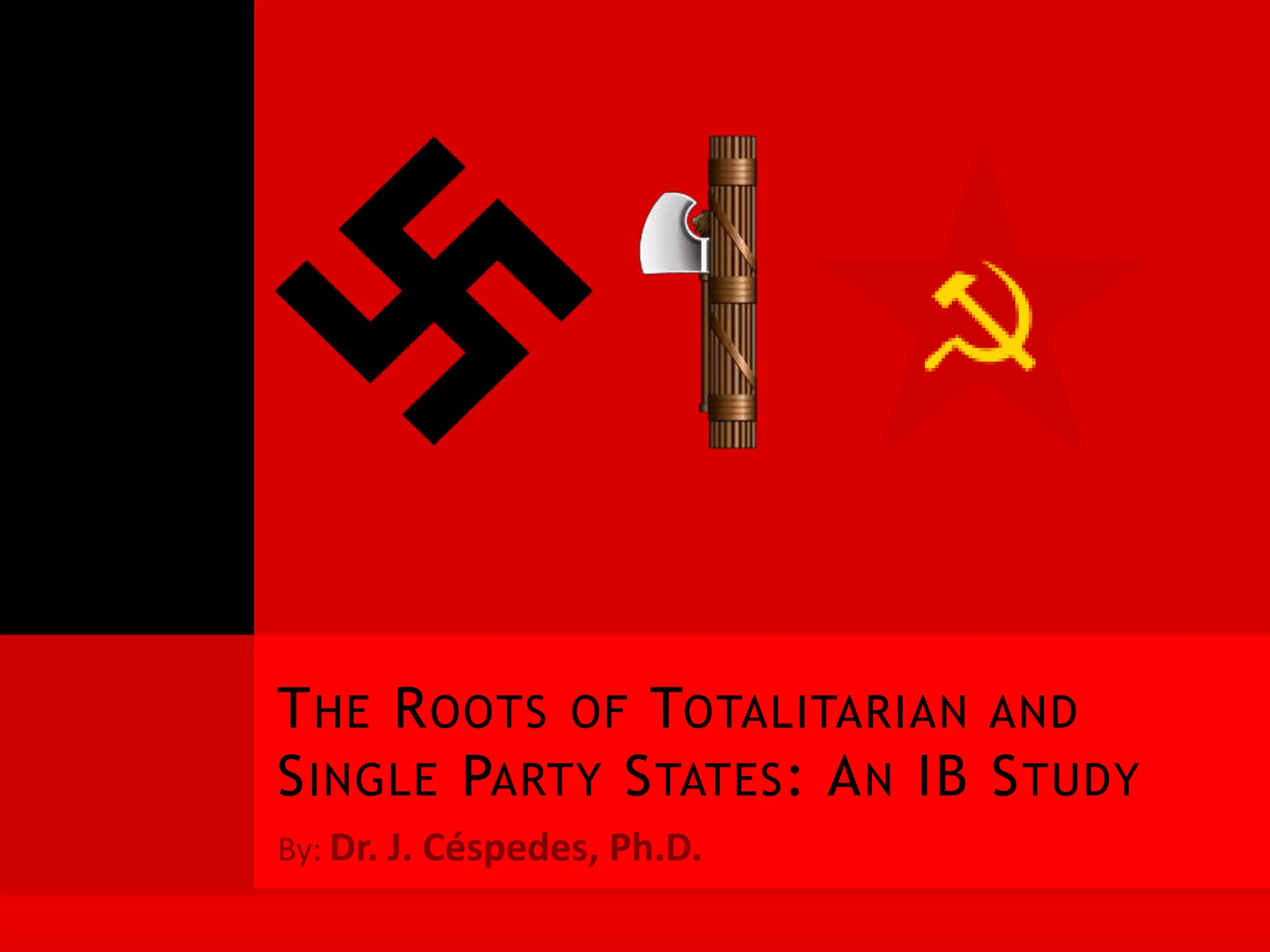
T HE R OOTS OF TOTALITARIAN AND
S INGLE PARTY S TATES : A N IB S TUDY
   For centuries mankind has
    known pitiless, violent, and
    murderous rulers.

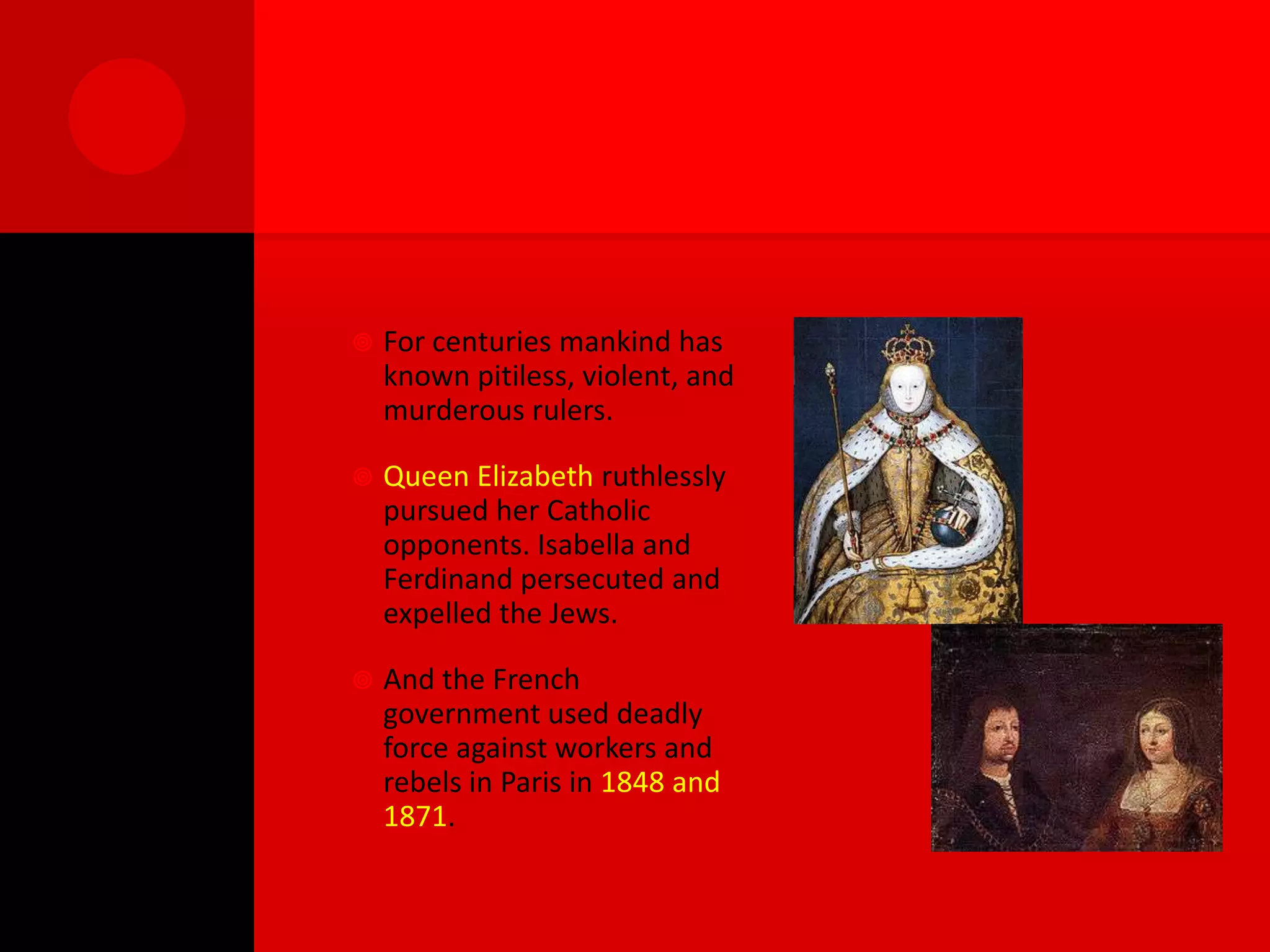
   Queen Elizabeth ruthlessly
    pursued her Catholic
    opponents. Isabella and
    Ferdinand persecuted and
    expelled the Jews.

   And the French
    government used deadly
    force against workers and
    rebels in Paris in 1848 and
    1871.
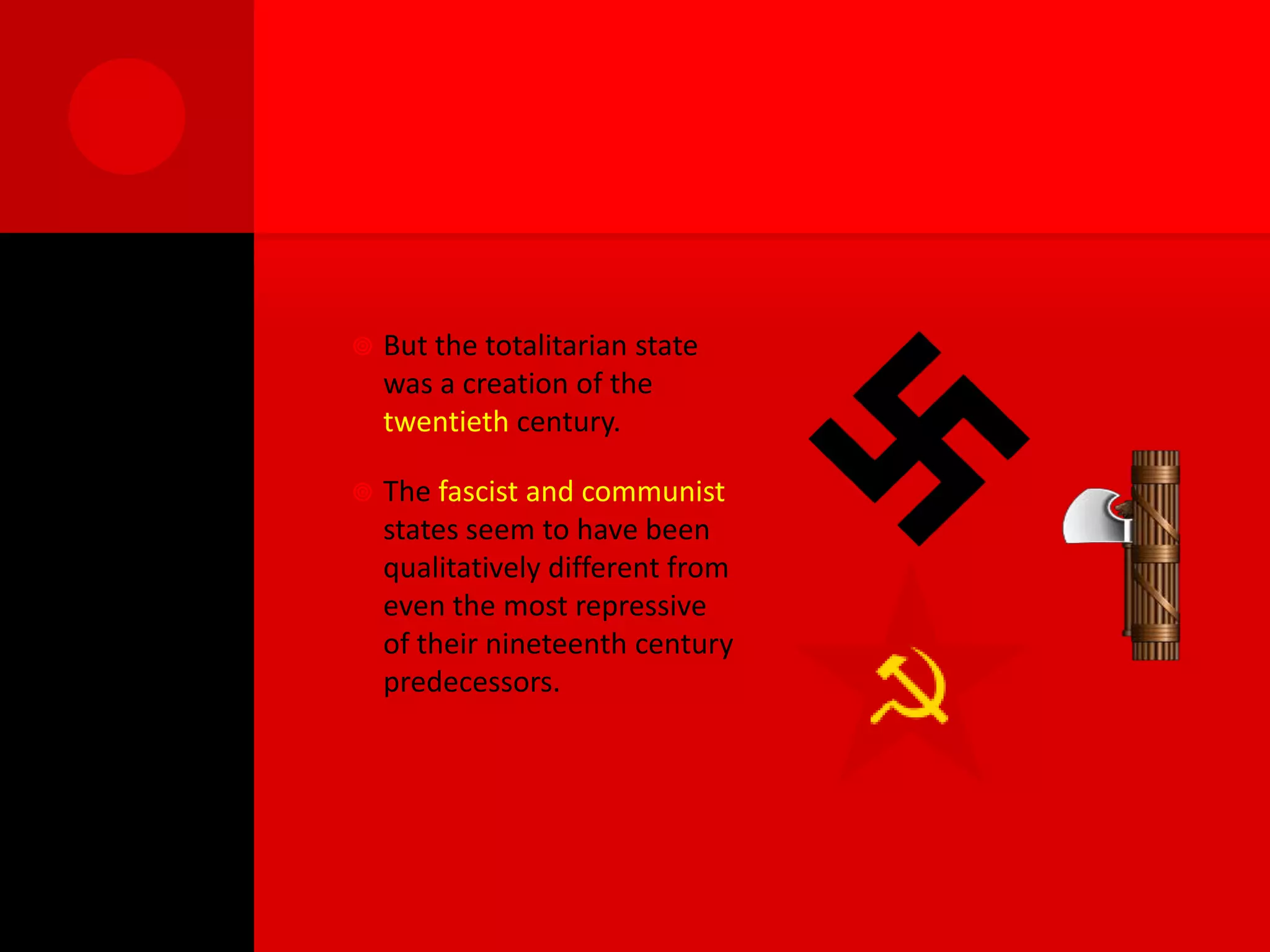
   But the totalitarian state
    was a creation of the
    twentieth century.

   The fascist and communist
    states seem to have been
    qualitatively different from
    even the most repressive
    of their nineteenth century
    predecessors.
D EFINITIONS :


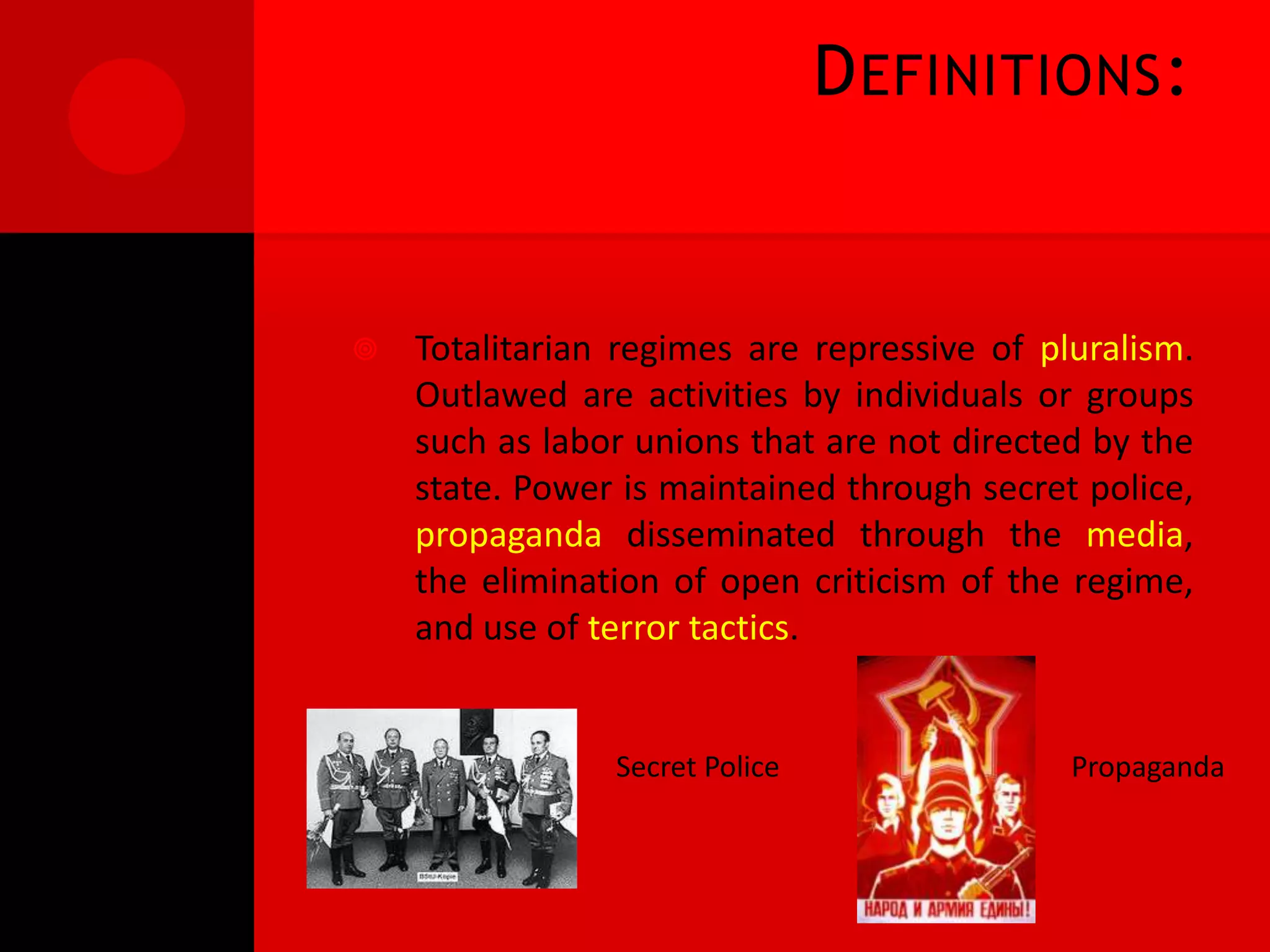
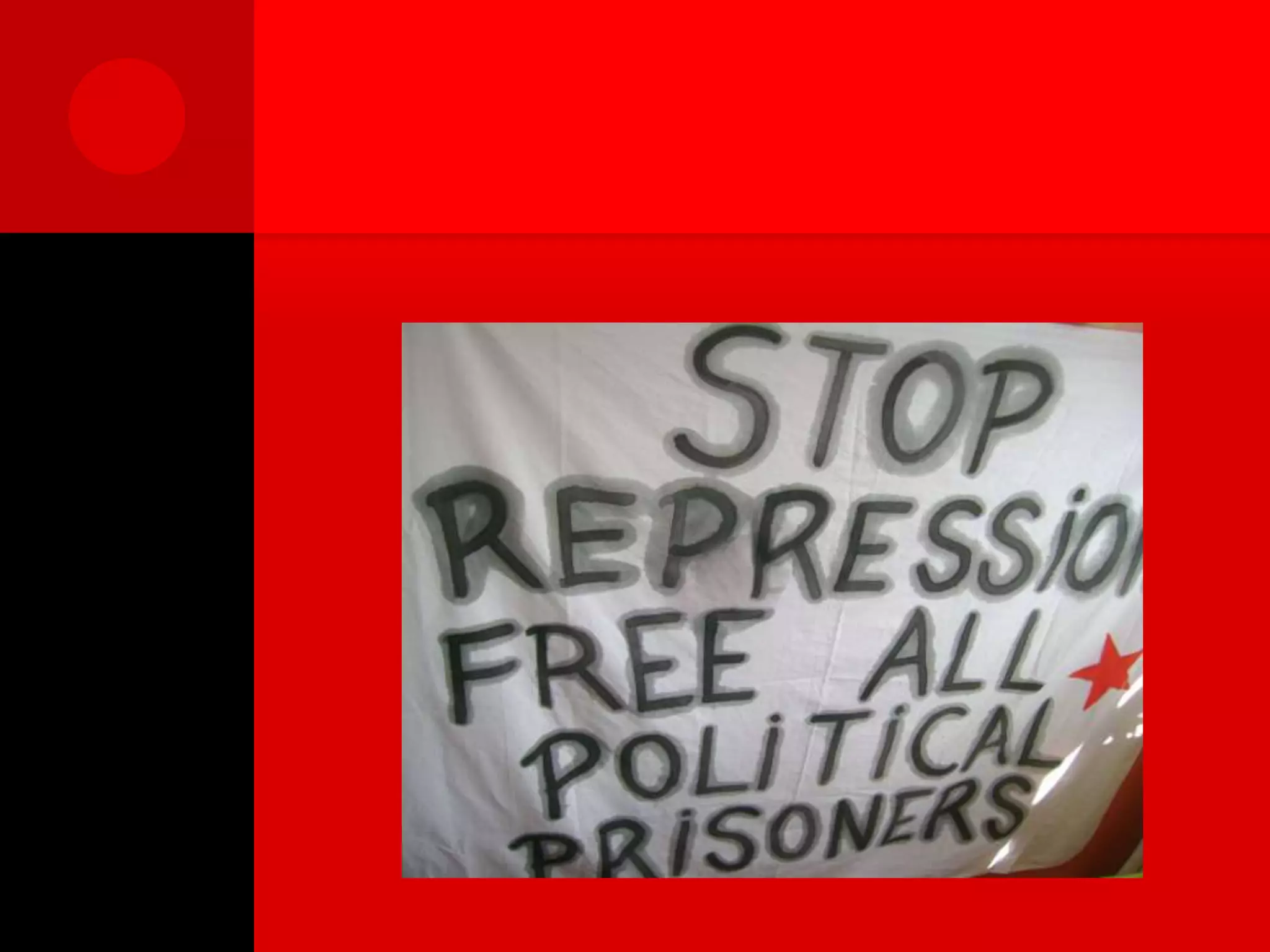
   Totalitarian regimes are repressive of pluralism.
    Outlawed are activities by individuals or groups
    such as labor unions that are not directed by the
    state. Power is maintained through secret police,
    propaganda disseminated through the media,
    the elimination of open criticism of the regime,
    and use of terror tactics.


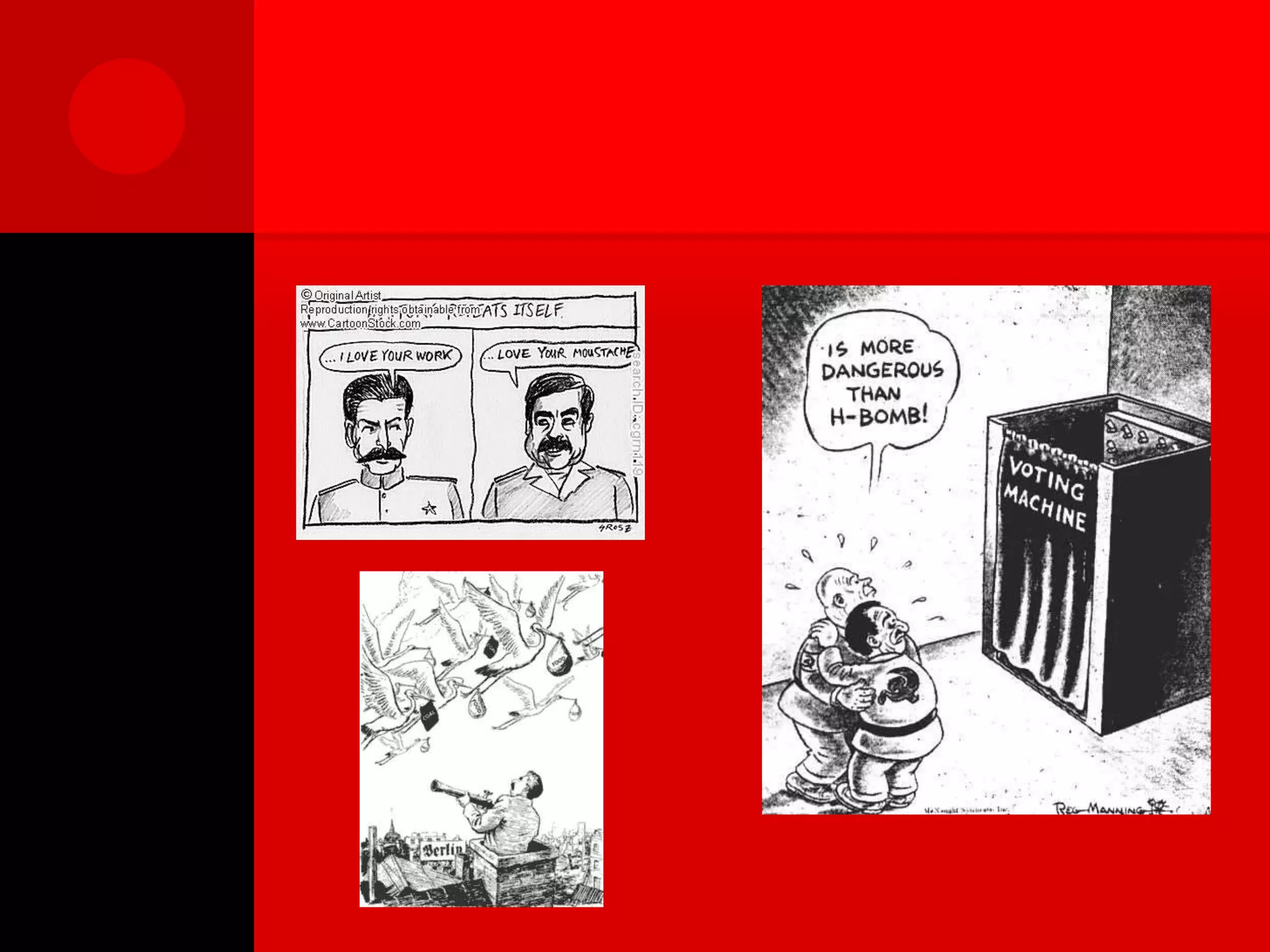
                Secret Police                Propaganda
   Internal and external threats are created to
    foster unity through fear.

   Totalitarian governments intend on changing the
    basic structure of society.
   In totalitarian systems, the ruling ideology
    requires that every aspect of an individual's life
    become subordinated to the state, including
    occupation, income, and religion.

   The concepts of "the state" and "the people"
    become merged.

   This is also called the carceral state — a prison-
    like state.
   Authoritarian regimes control many aspects of
    citizen’s lives, especially politics, coupled with the
    use of force.

   Unlike totalitarian regimes, there is no desire or
    ideological justification the state’s control, and
    the state will generally ignore the actions of an
    individual unless it is perceived to be directly
    challenging the state.
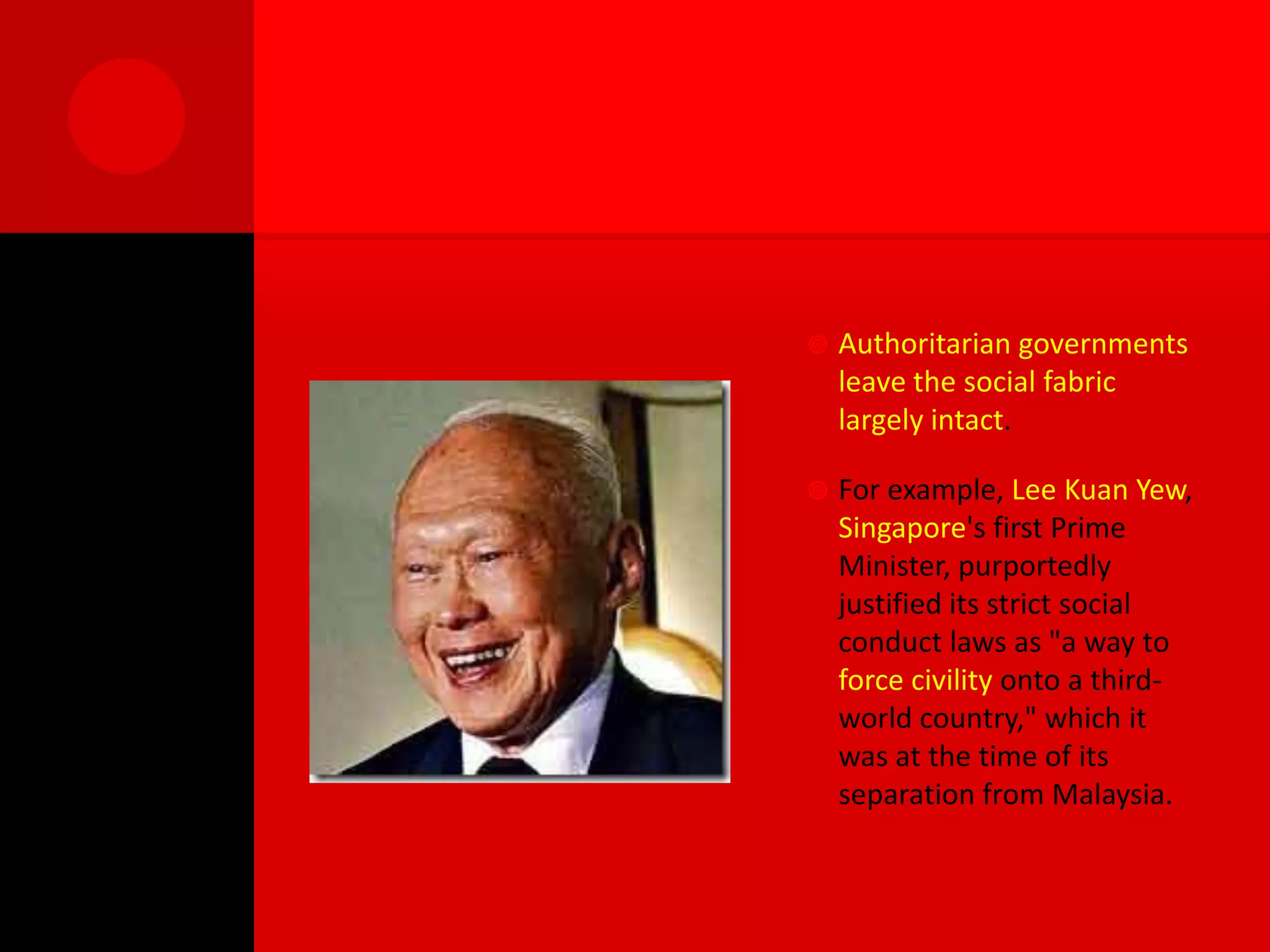
   Authoritarian governments
    leave the social fabric
    largely intact.

   For example, Lee Kuan Yew,
    Singapore's first Prime
    Minister, purportedly
    justified its strict social
    conduct laws as "a way to
    force civility onto a third-
    world country," which it
    was at the time of its
    separation from Malaysia.
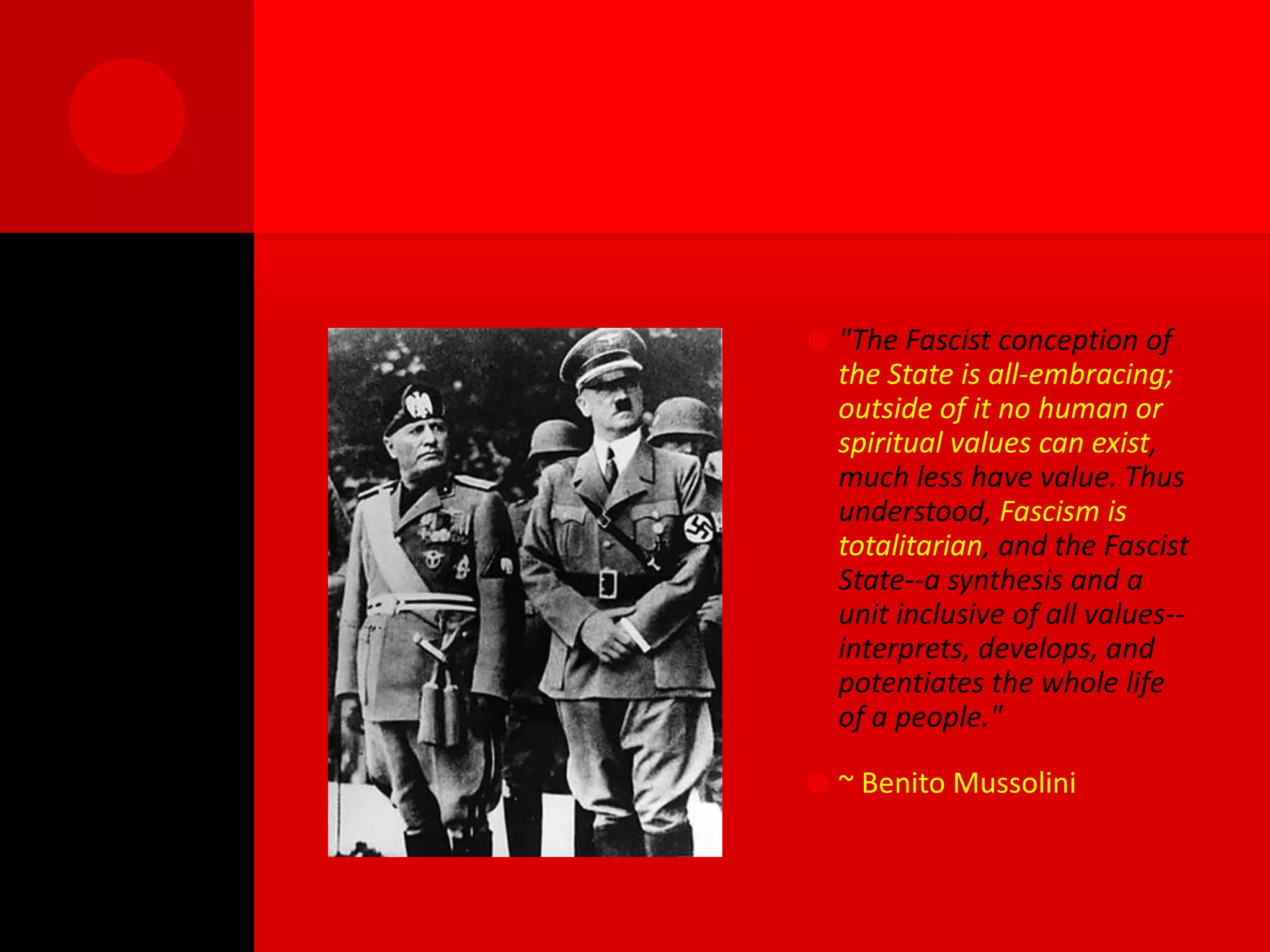
   "The Fascist conception of
    the State is all-embracing;
    outside of it no human or
    spiritual values can exist,
    much less have value. Thus
    understood, Fascism is
    totalitarian, and the Fascist
    State--a synthesis and a
    unit inclusive of all values--
    interprets, develops, and
    potentiates the whole life
    of a people."

   ~ Benito Mussolini
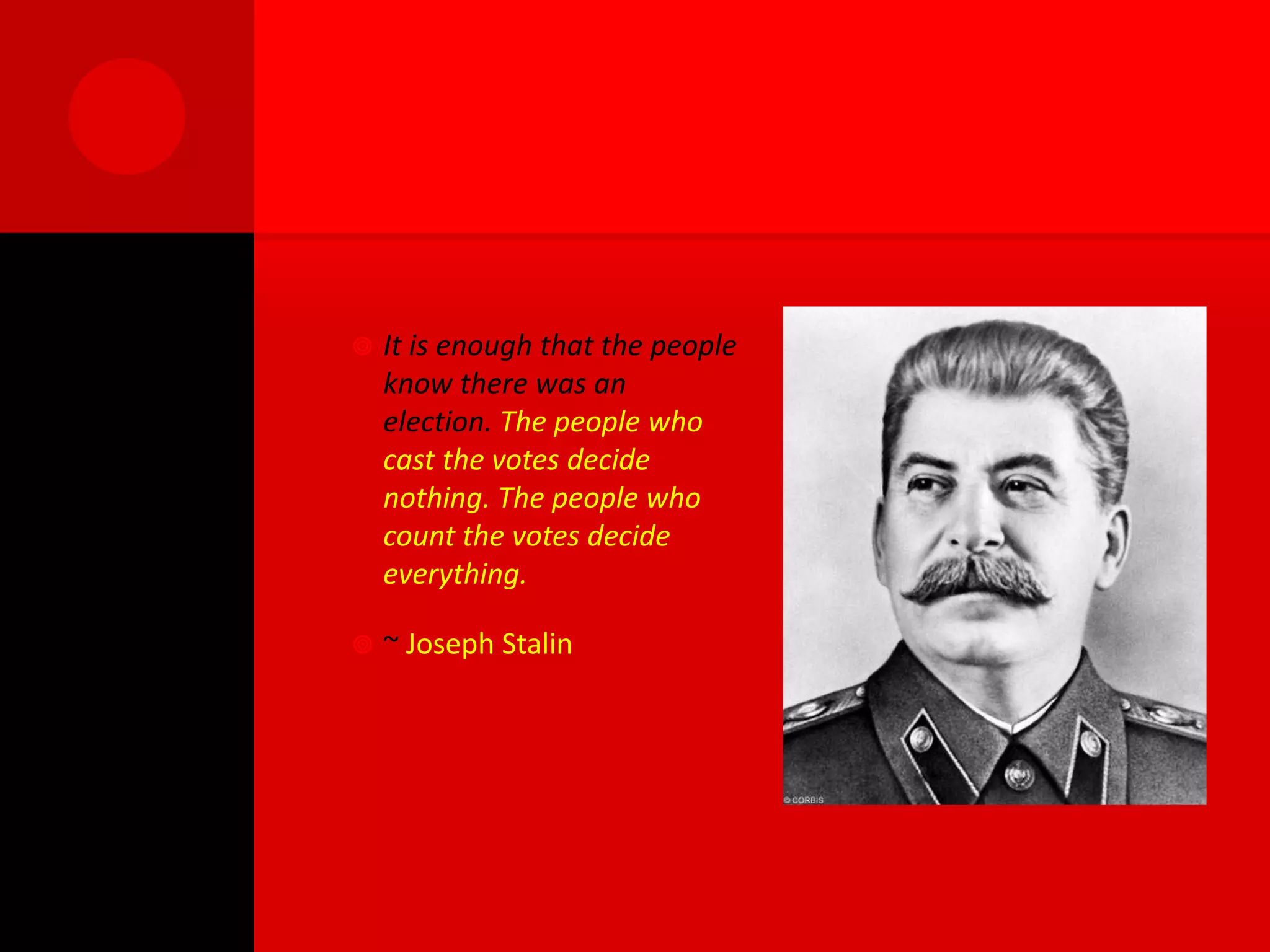
   It is enough that the people
    know there was an
    election. The people who
    cast the votes decide
    nothing. The people who
    count the votes decide
    everything.

   ~ Joseph Stalin
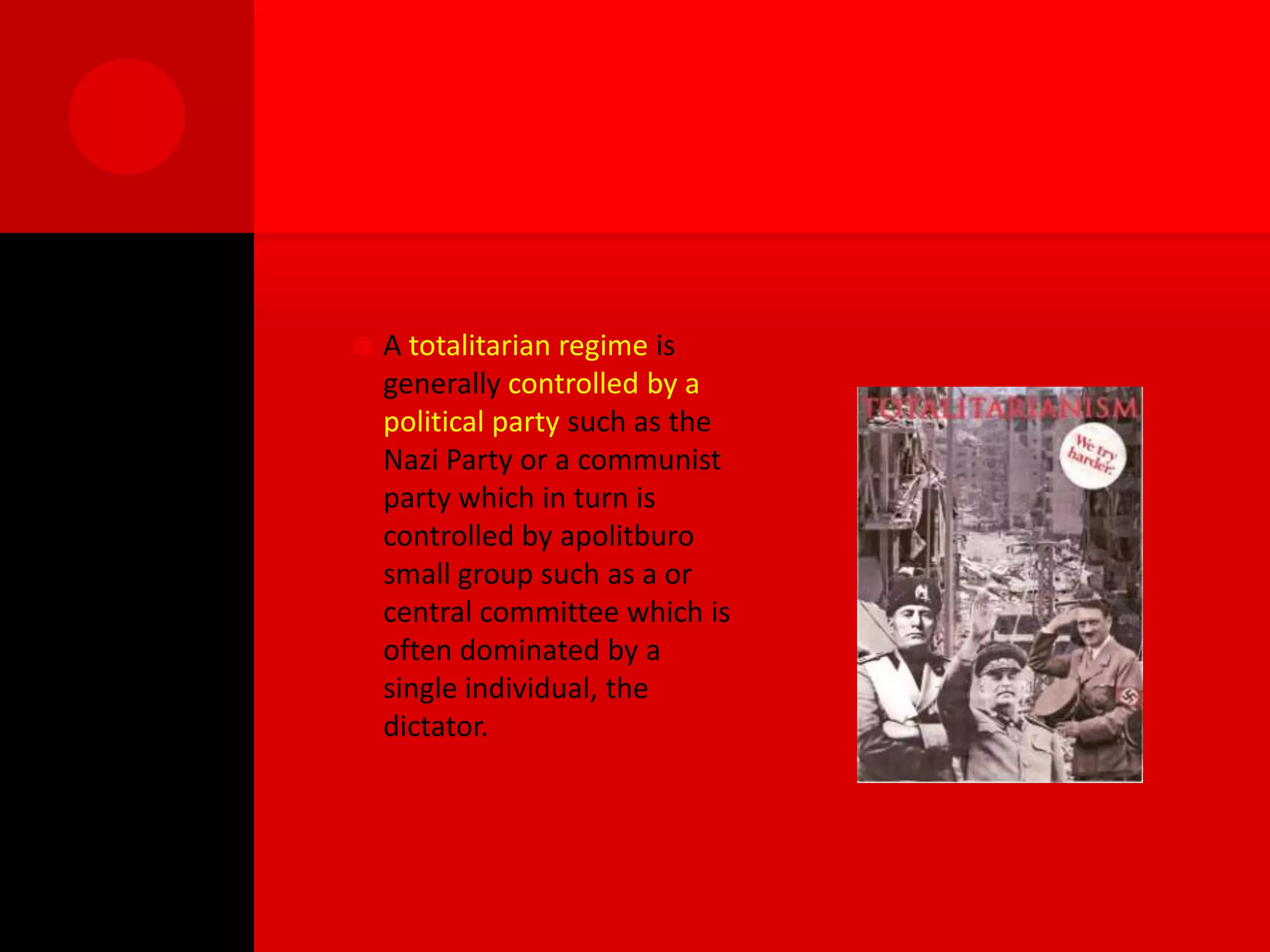
   A totalitarian regime is
    generally controlled by a
    political party such as the
    Nazi Party or a communist
    party which in turn is
    controlled by apolitburo
    small group such as a or
    central committee which is
    often dominated by a
    single individual, the
    dictator.
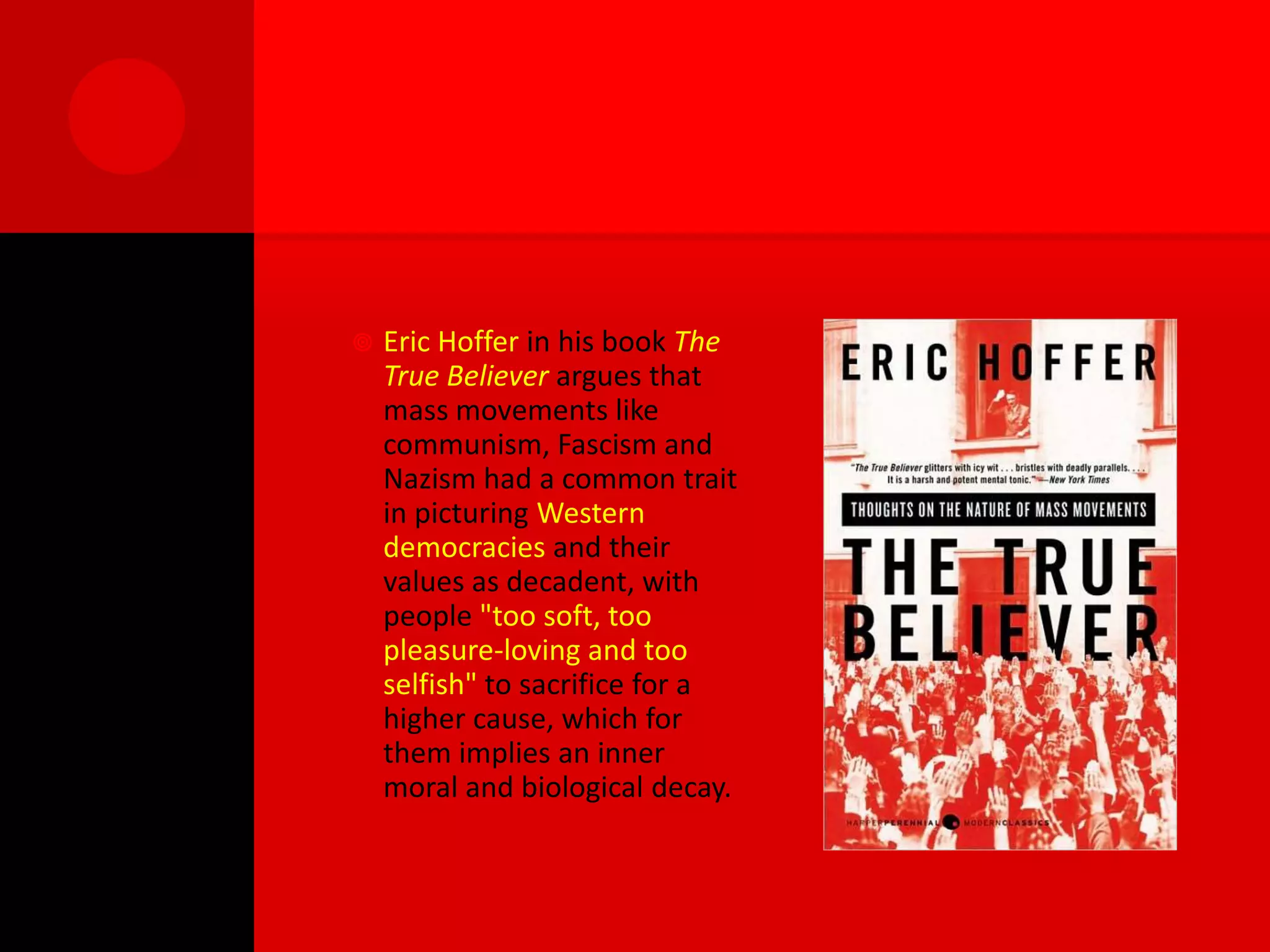
   Eric Hoffer in his book The
    True Believer argues that
    mass movements like
    communism, Fascism and
    Nazism had a common trait
    in picturing Western
    democracies and their
    values as decadent, with
    people "too soft, too
    pleasure-loving and too
    selfish" to sacrifice for a
    higher cause, which for
    them implies an inner
    moral and biological decay.
   He further claims that those movements offered
    the prospect of a glorious future to frustrated
    people, enabling them to find a refuge from the
    lack of personal accomplishments in their
    individual existence. The individual is then
    assimilated into a compact collective body and
    "fact-proof screens from reality" are established.
O RIGIN   OF       C ONCEPT

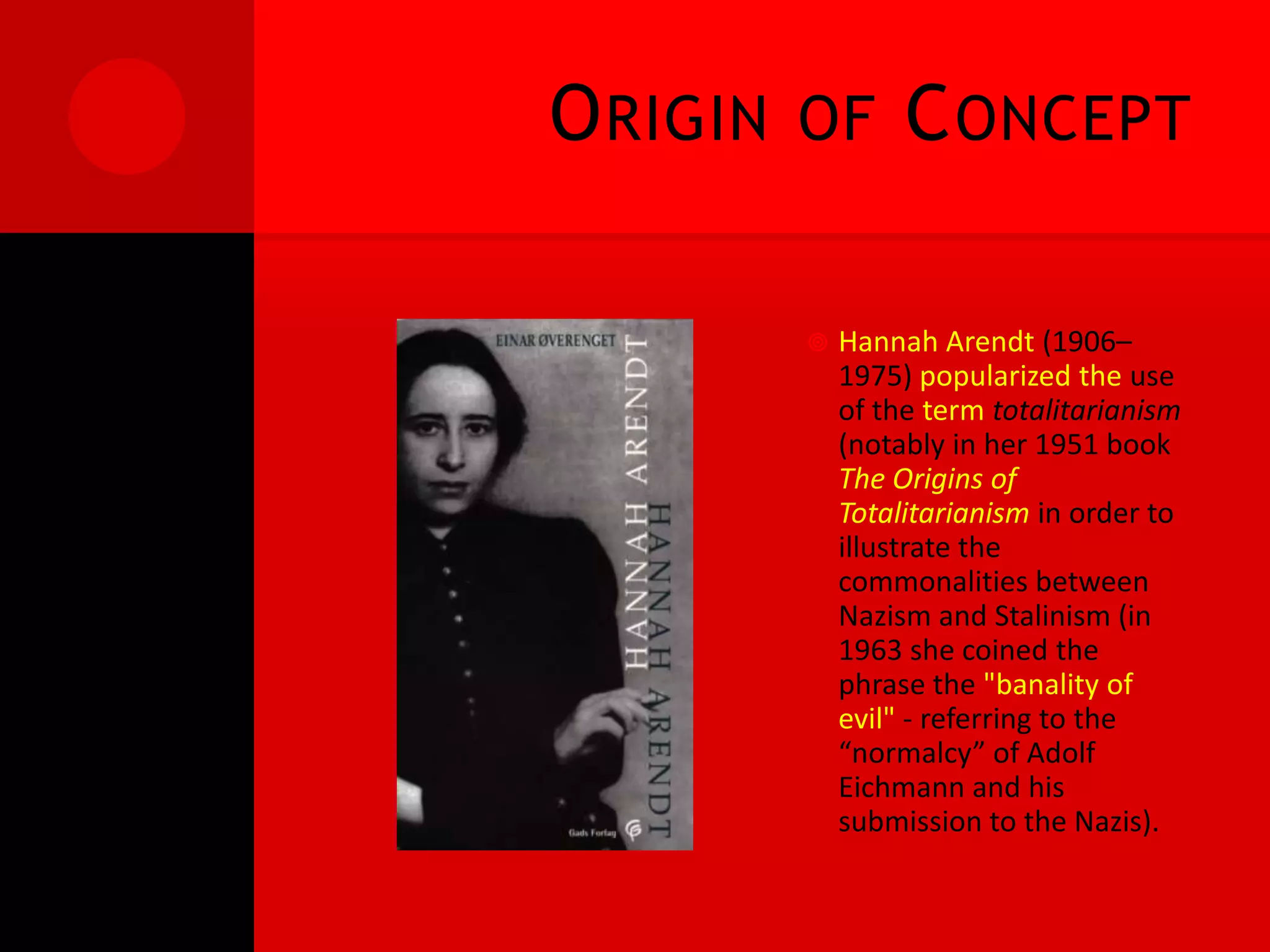
             Hannah Arendt (1906–
              1975) popularized the use
              of the term totalitarianism
              (notably in her 1951 book
              The Origins of
              Totalitarianism in order to
              illustrate the
              commonalities between
              Nazism and Stalinism (in
              1963 she coined the
              phrase the "banality of
              evil" - referring to the
              “normalcy” of Adolf
              Eichmann and his
              submission to the Nazis).
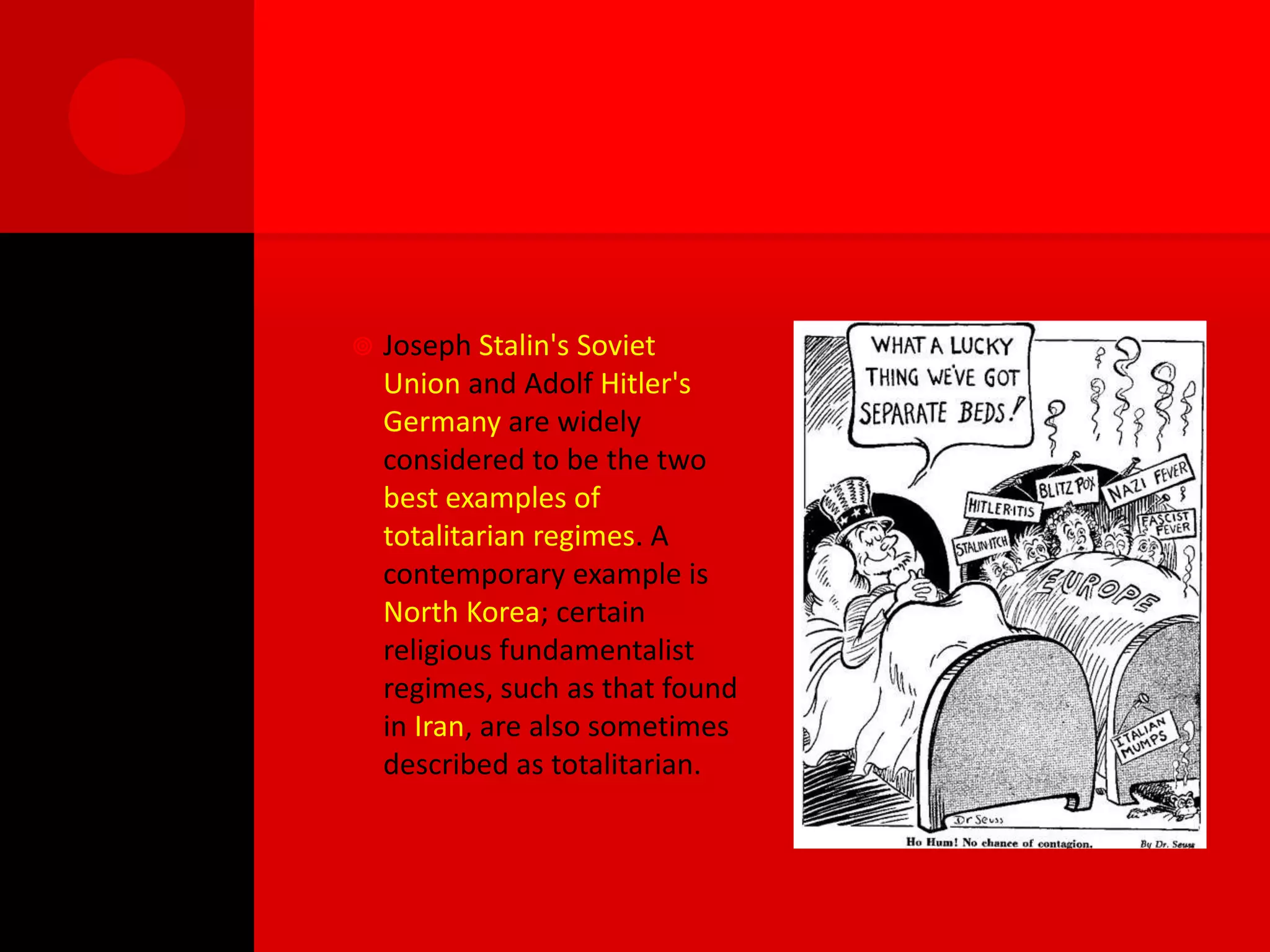
   Joseph Stalin's Soviet
    Union and Adolf Hitler's
    Germany are widely
    considered to be the two
    best examples of
    totalitarian regimes. A
    contemporary example is
    North Korea; certain
    religious fundamentalist
    regimes, such as that found
    in Iran, are also sometimes
    described as totalitarian.
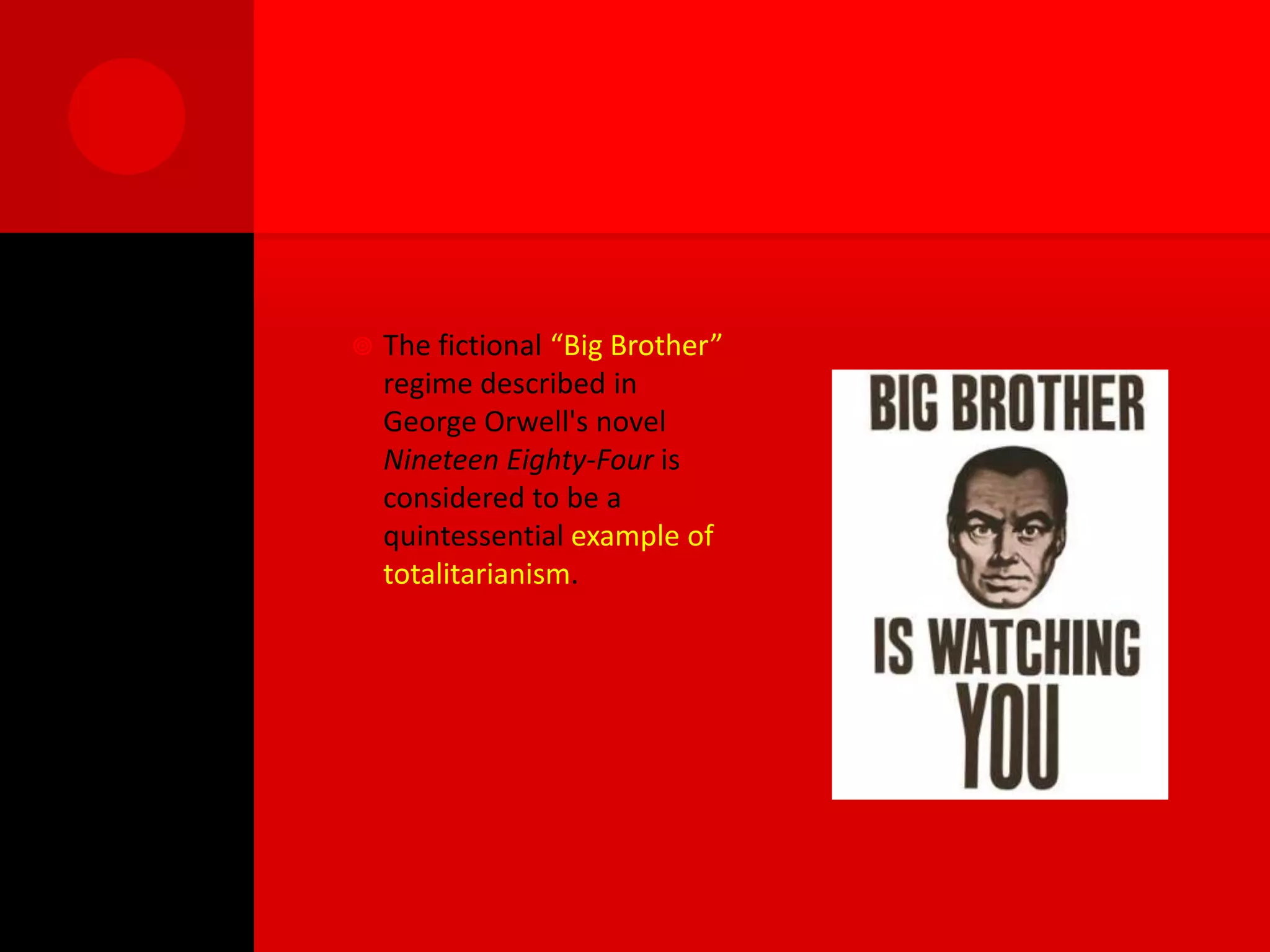
   The fictional “Big Brother”
    regime described in
    George Orwell's novel
    Nineteen Eighty-Four is
    considered to be a
    quintessential example of
    totalitarianism.
   Most political scientists believe totalitarian
    regimes were rare before the 20th century
    because neither technological means nor
    ideological justifications existed for controlling
    large numbers of people.
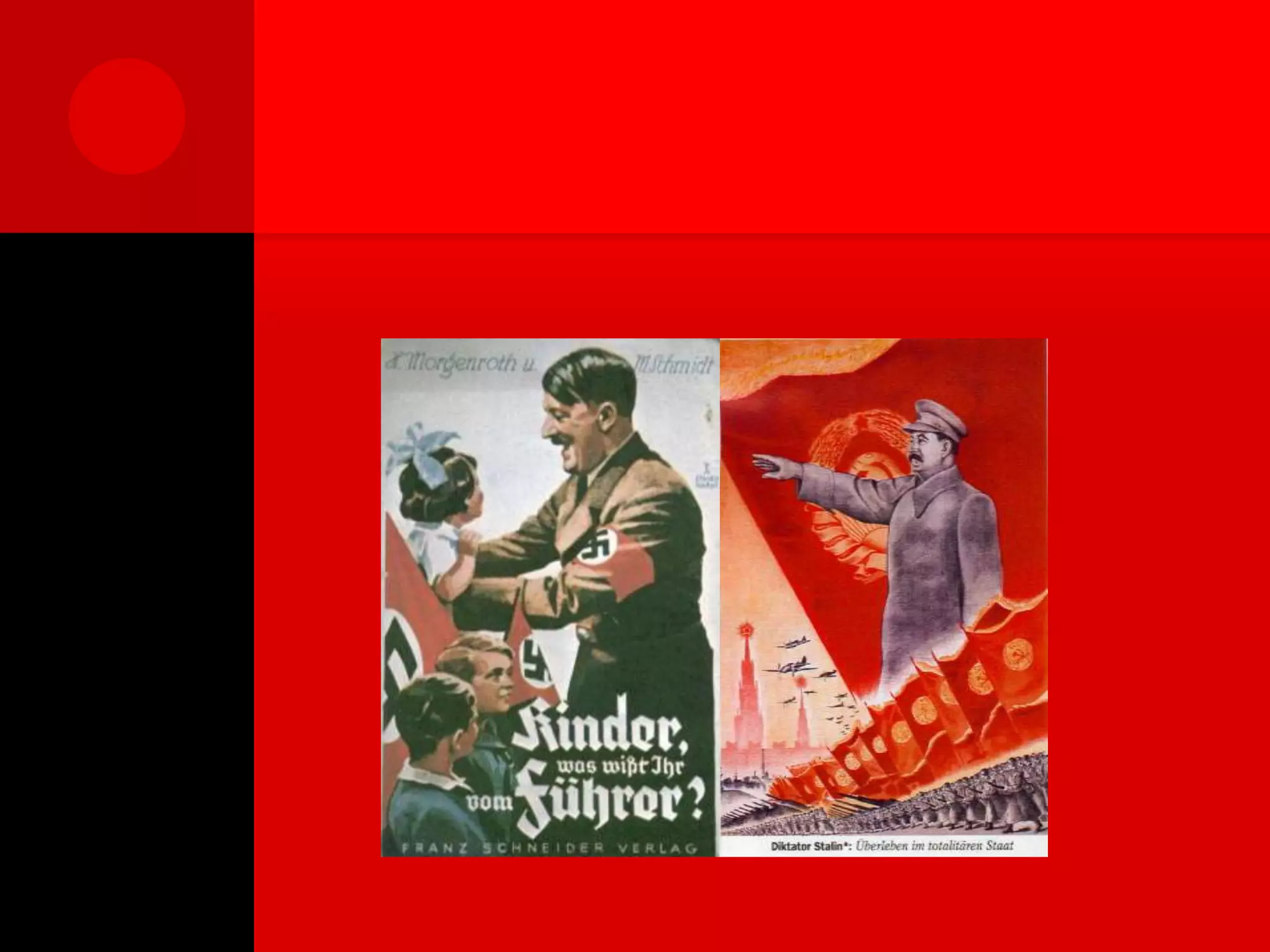
   Today, however, television, radio, and other mass
    media make it relatively easy for totalitarian
    regimes to make their presence felt, often
    through campaigns of propaganda or the
    creation of a vast personality cult.
   The terms totalitarian democracy and totalitarian
    republic have also been used to classify a
    different style of totalitarian rule. In these
    regimes, the government is generally popular (at
    least at the beginning), and the ideological
    justification of the state comes on behalf of the
    people. Hitler's democratically-elected Nazi
    regime is often used as an example of a
    totalitarian democracy.
   Although Hitler’s totalitarian Germany came into
    being through a slow and gradual decrease in
    rights, most totalitarian regimes are born as a
    result of a revolution which replaces what is
    generally regarded as an ineffective government.
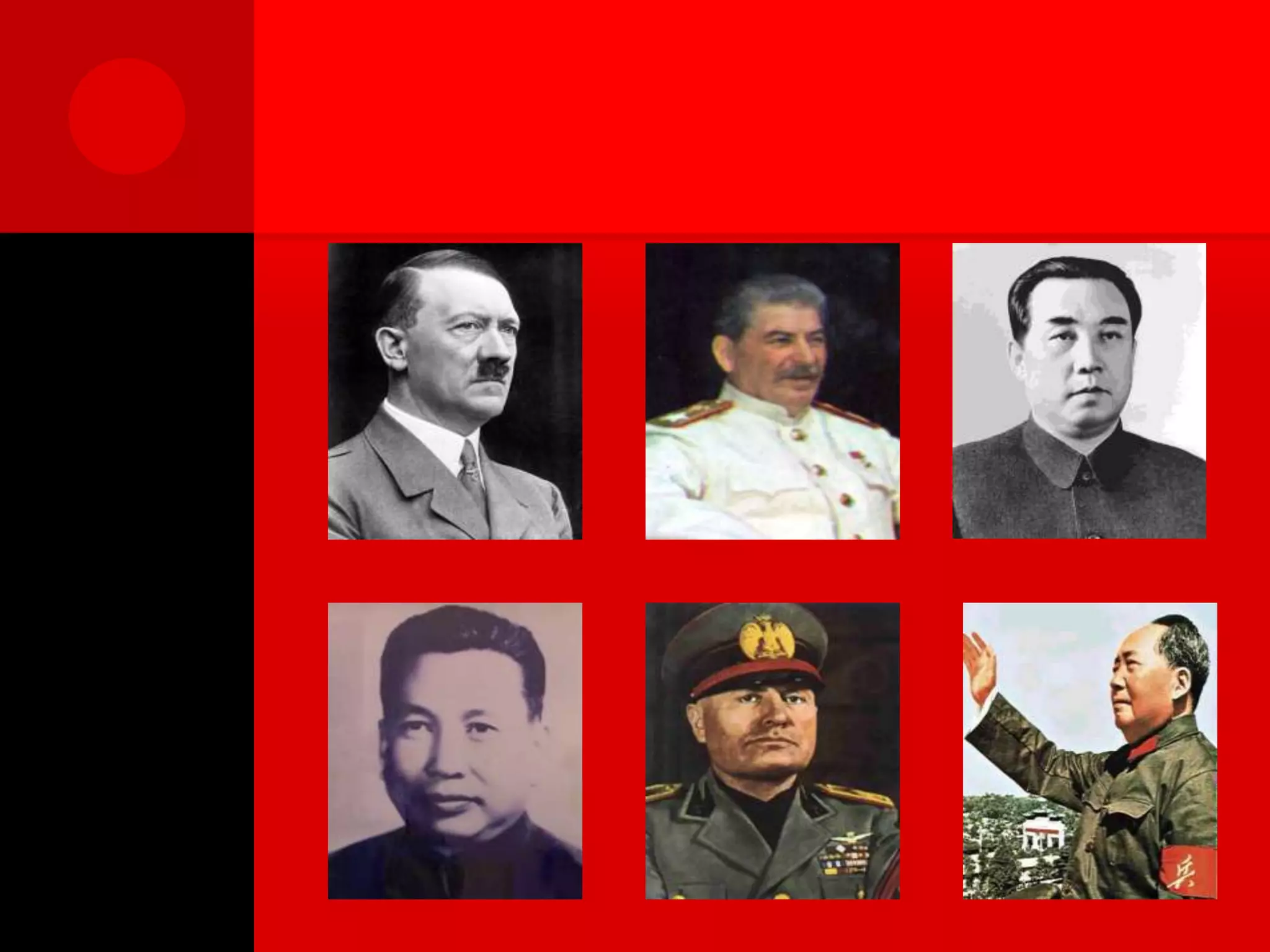
   It has been argued that totalitarianism requires a
    cult of personality around a charismatic "great
    leader" who is glorified as the legitimizer of the
    regime (ex.: Hitler, Stalin, Mao, Mussolini, Pol
    Pot, and Kim Il-Sung).
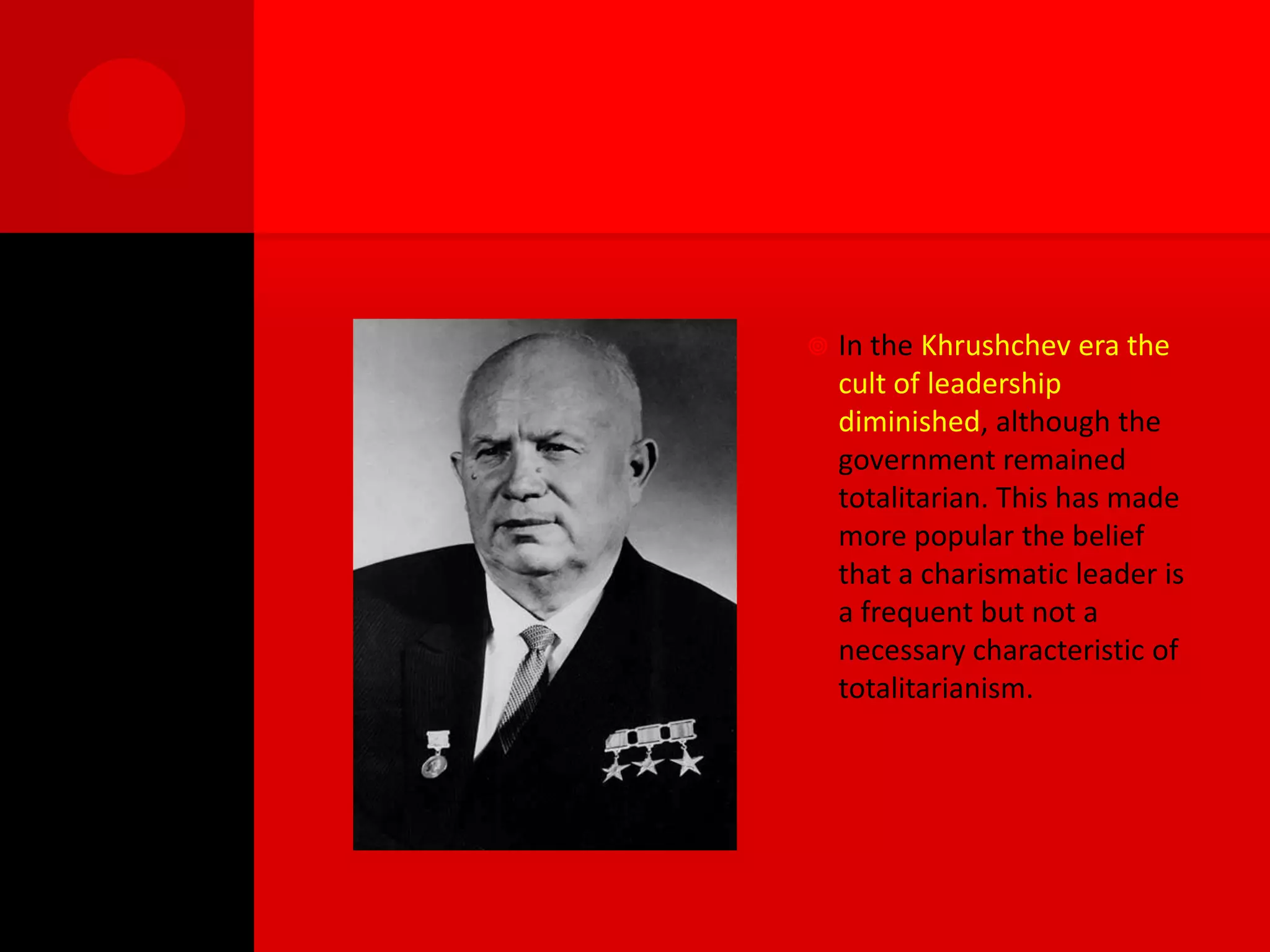
   In the Khrushchev era the
    cult of leadership
    diminished, although the
    government remained
    totalitarian. This has made
    more popular the belief
    that a charismatic leader is
    a frequent but not a
    necessary characteristic of
    totalitarianism.
C HARACTERISTICS OF THE S OVIET
U NION
P OLITICAL S YSTEM

   Single party rule combined with a (supposedly)
    democratically elected but centralized
    government. In practice, the government
    consisted of a hierarchical structure which with
    the aid of a secret police enforced decisions
    made by a small group of members of the ruling
    party (Politburo).
E CONOMIC S YSTEM

   All property and economic organizations were
    owned and controlled by the state which
    administered them according to plans developed
    by a central planning bureaucracy. Economic
    planners focused on development of heavy
    industry and defense industries. Consumer goods
    had a low priority. Imports were strictly
    controlled especially in the area of consumer
    goods and food.
L EGAL S YSTEM

   A large secret police organization monitored
    public activities closely; substantial efforts were
    made to discover expressions of dissent
    especially by government employees and
    Communist Party members and their families
    using a network of informers.
   Control over dissent was achieved through
    imprisonment, commitment to mental hospitals,
    and especially during establishment of the
    regime by death. During the first decades of the
    regime an extensive system of labor camps was
    maintained, the Gulag. The judicial system was
    controlled by the Party. Travel was tightly
    controlled with borders closed to both entrance
    and exit.
I DEOLOGY

   Education and political discourse proceeded on
    the assumption that it was possible to mold
    people into an ideal Soviet man or woman. The
    validity of all ideas, were evaluated in terms of
    adherence to the ideology of Marxism-Leninism
    as interpreted by the Communist Party of the
    Soviet Union.
R USSIAN D OMINATION

   Despite the formal organization of the Soviet
    Union as a federation of republics, control was
    highly centralized in central institutions
    dominated by Russians. Russian language and
    culture predominated in education and public
    discourse. Nationalities which resisted were
    subject to repression which in the early years of
    the regime included mass imprisonment and
    deportation.
C ONTROL            OF I NFORMATION


   All publications and media were censored, use of
    copying machines and imports of written
    material tightly controlled, foreign electronic
    media jammed. Access to government
    documents and press archives was strictly
    limited.
F OREIGN A FFAIRS

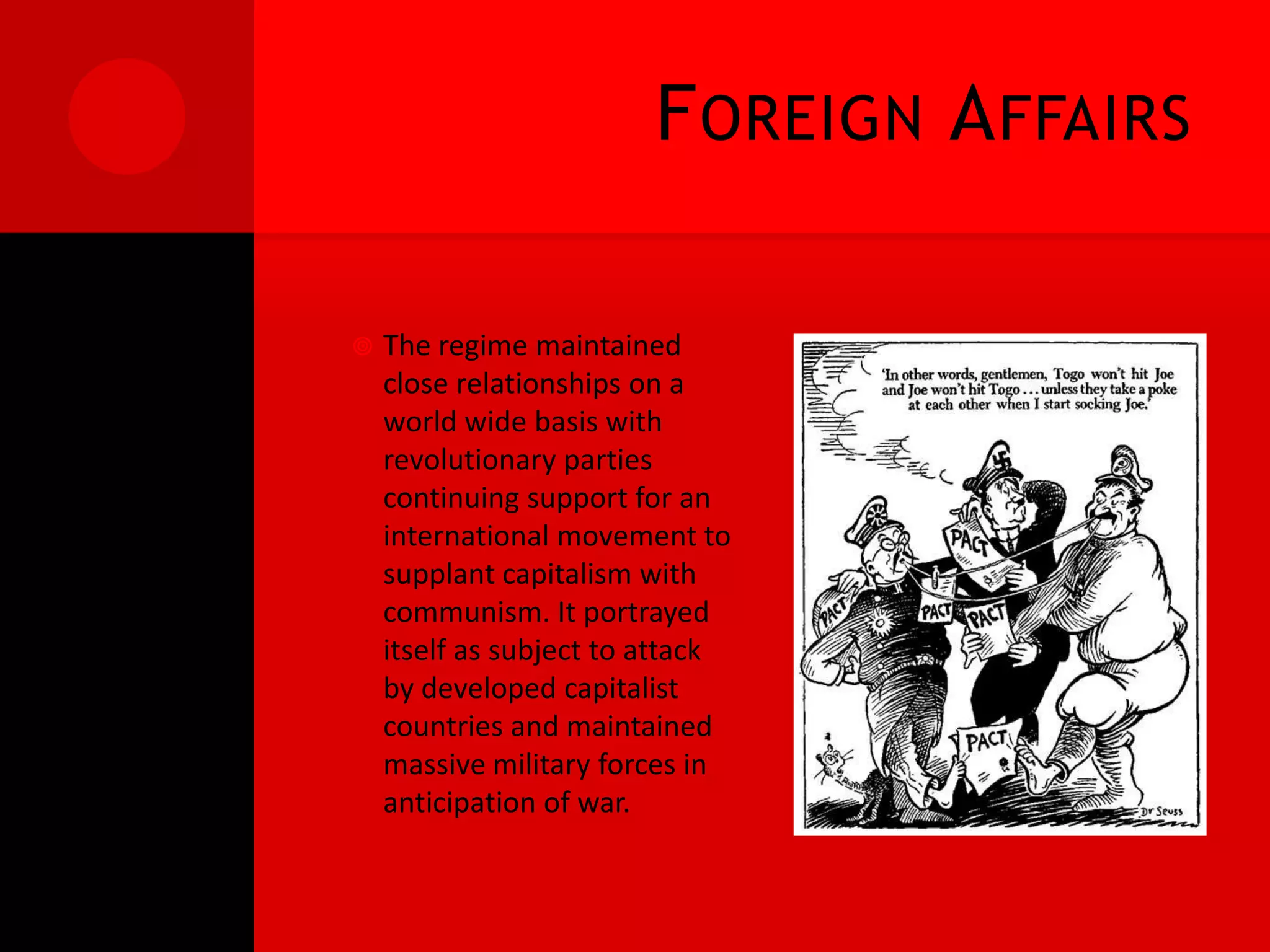
   The regime maintained
    close relationships on a
    world wide basis with
    revolutionary parties
    continuing support for an
    international movement to
    supplant capitalism with
    communism. It portrayed
    itself as subject to attack
    by developed capitalist
    countries and maintained
    massive military forces in
    anticipation of war.
P ROBLEMS OF I DENTIFICATION AND
 D ISTINCTION : S TALINISM , N AZISM
             AND TOTALITARIANISM

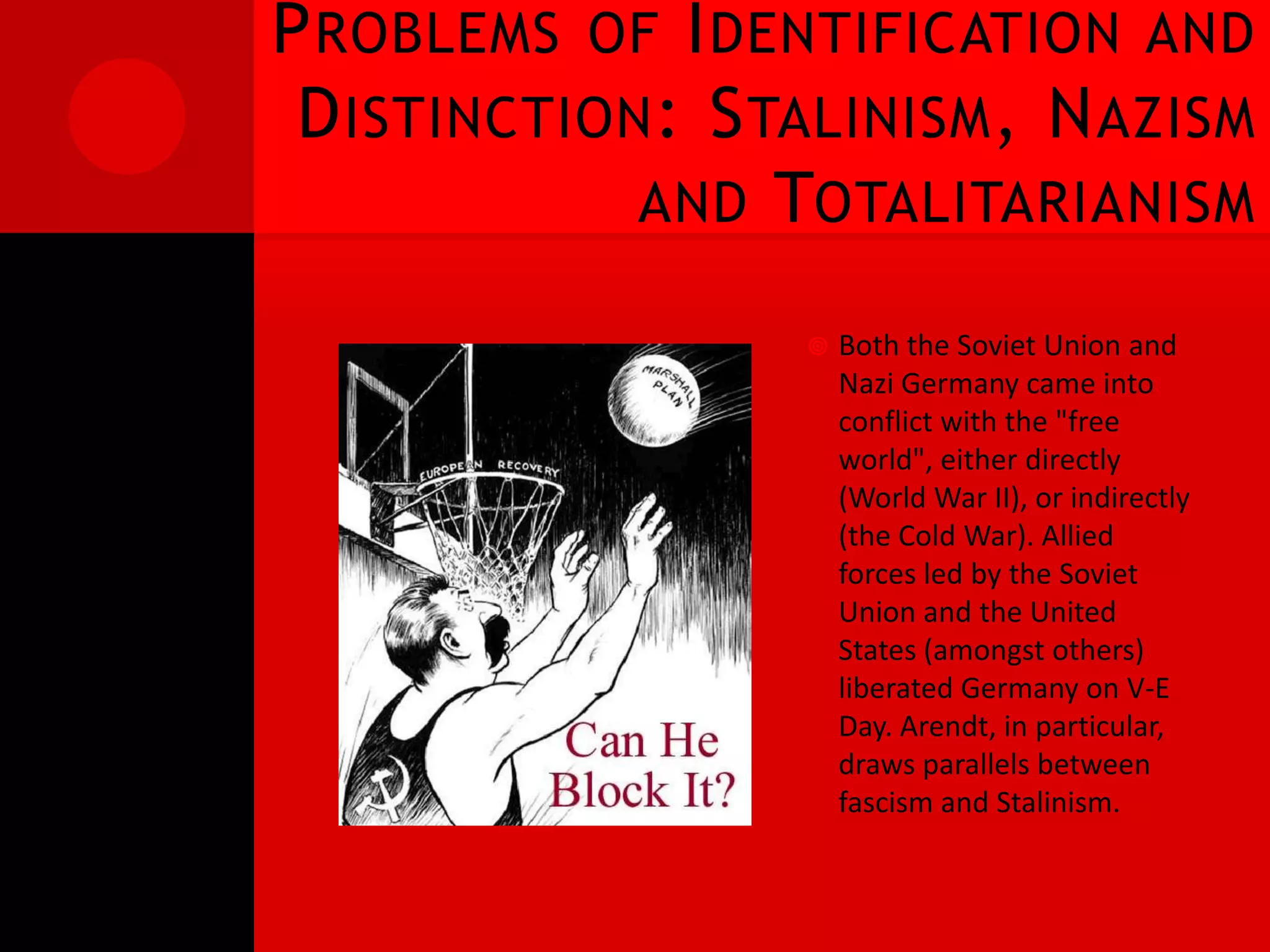
                      Both the Soviet Union and
                       Nazi Germany came into
                       conflict with the "free
                       world", either directly
                       (World War II), or indirectly
                       (the Cold War). Allied
                       forces led by the Soviet
                       Union and the United
                       States (amongst others)
                       liberated Germany on V-E
                       Day. Arendt, in particular,
                       draws parallels between
                       fascism and Stalinism.
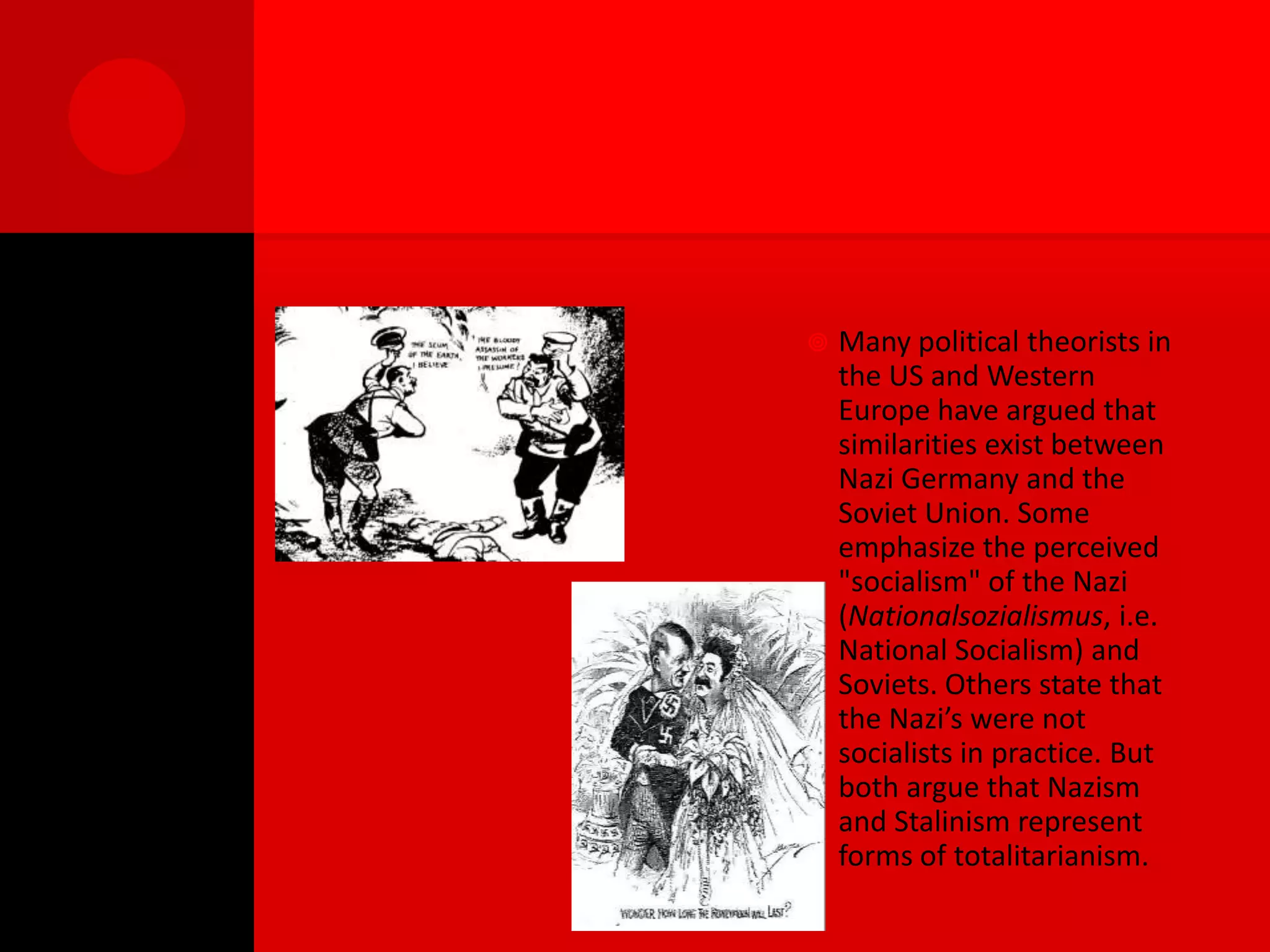
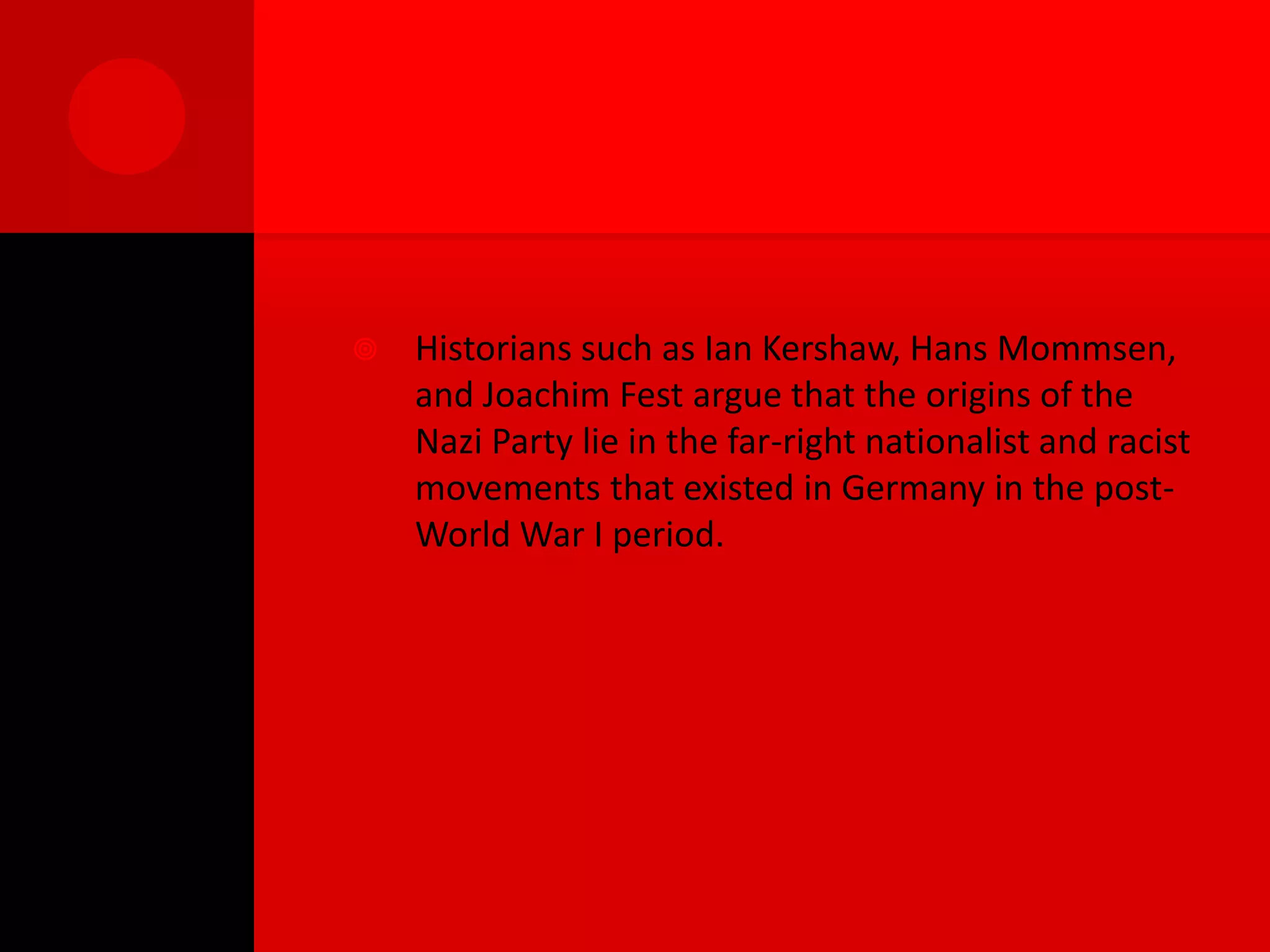
   Many political theorists in
    the US and Western
    Europe have argued that
    similarities exist between
    Nazi Germany and the
    Soviet Union. Some
    emphasize the perceived
    "socialism" of the Nazi
    (Nationalsozialismus, i.e.
    National Socialism) and
    Soviets. Others state that
    the Nazi’s were not
    socialists in practice. But
    both argue that Nazism
    and Stalinism represent
    forms of totalitarianism.
   Historians such as Ian Kershaw, Hans Mommsen,
    and Joachim Fest argue that the origins of the
    Nazi Party lie in the far-right nationalist and racist
    movements that existed in Germany in the post-
    World War I period.
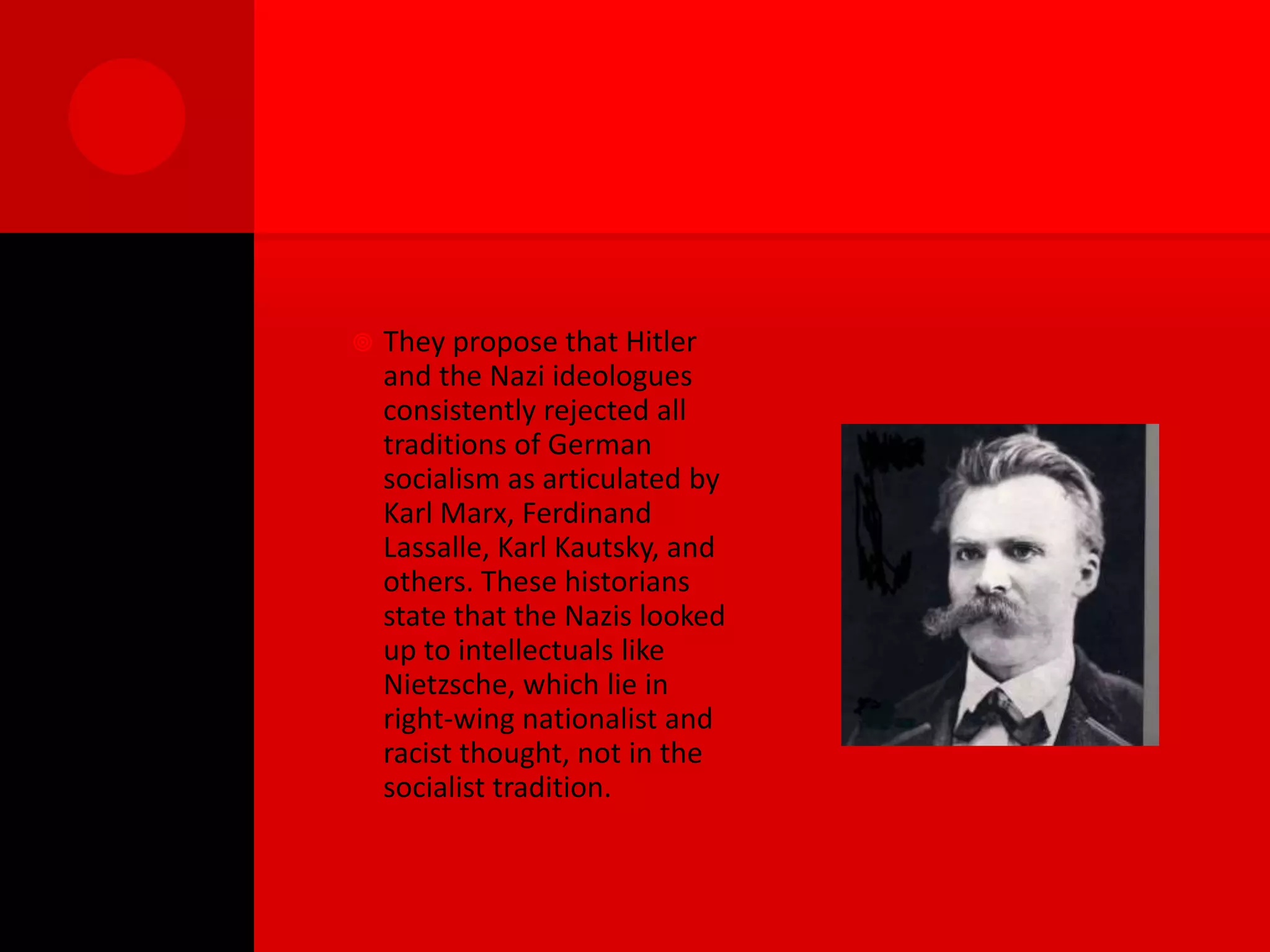
   They propose that Hitler
    and the Nazi ideologues
    consistently rejected all
    traditions of German
    socialism as articulated by
    Karl Marx, Ferdinand
    Lassalle, Karl Kautsky, and
    others. These historians
    state that the Nazis looked
    up to intellectuals like
    Nietzsche, which lie in
    right-wing nationalist and
    racist thought, not in the
    socialist tradition.
   Further, the Nazis rejected and reviled the French
    and 1848 Revolutions. They also saw these
    revolutions as part of a Jewish conspiracy.
   Much of this debate ultimately revolves around
    the meaning of the term socialism, making
    argument as much about semantics as about
    actual substantive differences.
   Politically, National Socialism was a variety of
    fascism that incorporated elements from left-
    wing and right-wing ideologies, but, in practice,
    was a form of far right politics (Fritzsche, Peter.
    1998. Germans into Nazis. Cambridge, Mass.:
    Harvard University Press; Eatwell, Roger, Fascism,
    A History, Viking/Penguin, 1996, pp.xvii-xxiv, 21,
    26–31, 114–140, 352. Griffin, Roger. 2000.
    "Revolution from the Right: Fascism," chapter in
    David Parker (ed.) Revolutions and the
    Revolutionary Tradition in the West 1560-1991,
    Routledge, London).
S OURCES
   Arendt, Hannah. The Origins of Totalitarianism (1958, new ed. 1966)

   John A. Armstrong, The Politics of Totalitarianism (New York: Random House,
    1961)

   Borkenau, Franz. The Totalitarian Enemy, London, Faber and Faber 1940

   Bracher, Karl Dietrich. “The Disputed Concept of Totalitarianism,” pages 11–
    33 from Totalitarianism Reconsidered edited by Ernest A. Menze (Port
    Washington, N.Y. / London: Kennikat Press, 1981), ISBN 0804692688.

   Friedrich, Carl, and Brzezinski , Z. K., Totalitarian Dictatorship and Autocracy
    (2nd edn 1967)

   Gleason, Abbott. Totalitarianism : The Inner History Of The Cold War, New
    York: Oxford University Press, (1995), ISBN 0195050177

   Kirkpatrick, Jeane. Dictatorships and Double Standards: Rationalism and
    reason in politics (1982)

   Laquer, Walter. The Fate of the Revolution Interpretations of Soviet History
    From 1917 to the Present, London: Collier Books, (1987) ISBN 0-02-034080-X.
   Linz, Juan and Stepan, Alfred. Problems Of Democratic Transition And
    Consolidation: Southern Europe, South America, And Post-Communist Europe,
    Baltimore: Johns Hopkins University Press, (1996), ISBN 0801851572.

   Murray, Ewan. Shut Up: Tale of Totalitarianism (2005)

   Payne, Stanley. A History of Fascism (Routledge, 1996)

   Pipes, Richard (1995), Russia Under the Bolshevik Regime, New York: Vintage
    Books, Random House Inc., ISBN 0-394-50242-6.

   Sartori, Giovanni. The Theory of Democracy Revisited (Chatham, N.J: Chatham
    House, 1987)

   Saur, Wolfgang. "National Socialism: totalitarianism or fascism?" pages 404-
    424 from The American Historical Review, Volume 73, Issue #2, December
    1967.

   Schapiro, Leonard. Totalitarianism (London: The Pall Mall Press, 1972)

   Žižek, Slavoj. Did Somebody Say Totalitarianism? (London: Verso, 2001)

   Keller, Marcello Sorce. “Why is Music so Ideological, Why Do Totalitarian
    States Take It So Seriously: A Personal View from History, and the Social
    Sciences”, Journal of Musicological Research, XXVI (2007), no. 2-3, pp. 91–
    122

The Roots of Totalitarian and single party states ht

  • 1.
    T HE ROOTS OF TOTALITARIAN AND S INGLE PARTY S TATES : A N IB S TUDY
  • 2.
    For centuries mankind has known pitiless, violent, and murderous rulers.  Queen Elizabeth ruthlessly pursued her Catholic opponents. Isabella and Ferdinand persecuted and expelled the Jews.  And the French government used deadly force against workers and rebels in Paris in 1848 and 1871.
  • 3.
    But the totalitarian state was a creation of the twentieth century.  The fascist and communist states seem to have been qualitatively different from even the most repressive of their nineteenth century predecessors.
  • 4.
    D EFINITIONS :  Totalitarian regimes are repressive of pluralism. Outlawed are activities by individuals or groups such as labor unions that are not directed by the state. Power is maintained through secret police, propaganda disseminated through the media, the elimination of open criticism of the regime, and use of terror tactics. Secret Police Propaganda
  • 5.
    Internal and external threats are created to foster unity through fear.  Totalitarian governments intend on changing the basic structure of society.
  • 6.
    In totalitarian systems, the ruling ideology requires that every aspect of an individual's life become subordinated to the state, including occupation, income, and religion.  The concepts of "the state" and "the people" become merged.  This is also called the carceral state — a prison- like state.
  • 7.
    Authoritarian regimes control many aspects of citizen’s lives, especially politics, coupled with the use of force.  Unlike totalitarian regimes, there is no desire or ideological justification the state’s control, and the state will generally ignore the actions of an individual unless it is perceived to be directly challenging the state.
  • 9.
    Authoritarian governments leave the social fabric largely intact.  For example, Lee Kuan Yew, Singapore's first Prime Minister, purportedly justified its strict social conduct laws as "a way to force civility onto a third- world country," which it was at the time of its separation from Malaysia.
  • 10.
    "The Fascist conception of the State is all-embracing; outside of it no human or spiritual values can exist, much less have value. Thus understood, Fascism is totalitarian, and the Fascist State--a synthesis and a unit inclusive of all values-- interprets, develops, and potentiates the whole life of a people."  ~ Benito Mussolini
  • 11.
    It is enough that the people know there was an election. The people who cast the votes decide nothing. The people who count the votes decide everything.  ~ Joseph Stalin
  • 12.
    A totalitarian regime is generally controlled by a political party such as the Nazi Party or a communist party which in turn is controlled by apolitburo small group such as a or central committee which is often dominated by a single individual, the dictator.
  • 13.
    Eric Hoffer in his book The True Believer argues that mass movements like communism, Fascism and Nazism had a common trait in picturing Western democracies and their values as decadent, with people "too soft, too pleasure-loving and too selfish" to sacrifice for a higher cause, which for them implies an inner moral and biological decay.
  • 14.
    He further claims that those movements offered the prospect of a glorious future to frustrated people, enabling them to find a refuge from the lack of personal accomplishments in their individual existence. The individual is then assimilated into a compact collective body and "fact-proof screens from reality" are established.
  • 15.
    O RIGIN OF C ONCEPT  Hannah Arendt (1906– 1975) popularized the use of the term totalitarianism (notably in her 1951 book The Origins of Totalitarianism in order to illustrate the commonalities between Nazism and Stalinism (in 1963 she coined the phrase the "banality of evil" - referring to the “normalcy” of Adolf Eichmann and his submission to the Nazis).
  • 16.
    Joseph Stalin's Soviet Union and Adolf Hitler's Germany are widely considered to be the two best examples of totalitarian regimes. A contemporary example is North Korea; certain religious fundamentalist regimes, such as that found in Iran, are also sometimes described as totalitarian.
  • 17.
    The fictional “Big Brother” regime described in George Orwell's novel Nineteen Eighty-Four is considered to be a quintessential example of totalitarianism.
  • 18.
    Most political scientists believe totalitarian regimes were rare before the 20th century because neither technological means nor ideological justifications existed for controlling large numbers of people.
  • 19.
    Today, however, television, radio, and other mass media make it relatively easy for totalitarian regimes to make their presence felt, often through campaigns of propaganda or the creation of a vast personality cult.
  • 21.
    The terms totalitarian democracy and totalitarian republic have also been used to classify a different style of totalitarian rule. In these regimes, the government is generally popular (at least at the beginning), and the ideological justification of the state comes on behalf of the people. Hitler's democratically-elected Nazi regime is often used as an example of a totalitarian democracy.
  • 22.
    Although Hitler’s totalitarian Germany came into being through a slow and gradual decrease in rights, most totalitarian regimes are born as a result of a revolution which replaces what is generally regarded as an ineffective government.
  • 23.
    It has been argued that totalitarianism requires a cult of personality around a charismatic "great leader" who is glorified as the legitimizer of the regime (ex.: Hitler, Stalin, Mao, Mussolini, Pol Pot, and Kim Il-Sung).
  • 25.
    In the Khrushchev era the cult of leadership diminished, although the government remained totalitarian. This has made more popular the belief that a charismatic leader is a frequent but not a necessary characteristic of totalitarianism.
  • 26.
    C HARACTERISTICS OFTHE S OVIET U NION
  • 27.
    P OLITICAL SYSTEM  Single party rule combined with a (supposedly) democratically elected but centralized government. In practice, the government consisted of a hierarchical structure which with the aid of a secret police enforced decisions made by a small group of members of the ruling party (Politburo).
  • 28.
    E CONOMIC SYSTEM  All property and economic organizations were owned and controlled by the state which administered them according to plans developed by a central planning bureaucracy. Economic planners focused on development of heavy industry and defense industries. Consumer goods had a low priority. Imports were strictly controlled especially in the area of consumer goods and food.
  • 29.
    L EGAL SYSTEM  A large secret police organization monitored public activities closely; substantial efforts were made to discover expressions of dissent especially by government employees and Communist Party members and their families using a network of informers.
  • 30.
    Control over dissent was achieved through imprisonment, commitment to mental hospitals, and especially during establishment of the regime by death. During the first decades of the regime an extensive system of labor camps was maintained, the Gulag. The judicial system was controlled by the Party. Travel was tightly controlled with borders closed to both entrance and exit.
  • 32.
    I DEOLOGY  Education and political discourse proceeded on the assumption that it was possible to mold people into an ideal Soviet man or woman. The validity of all ideas, were evaluated in terms of adherence to the ideology of Marxism-Leninism as interpreted by the Communist Party of the Soviet Union.
  • 33.
    R USSIAN DOMINATION  Despite the formal organization of the Soviet Union as a federation of republics, control was highly centralized in central institutions dominated by Russians. Russian language and culture predominated in education and public discourse. Nationalities which resisted were subject to repression which in the early years of the regime included mass imprisonment and deportation.
  • 34.
    C ONTROL OF I NFORMATION  All publications and media were censored, use of copying machines and imports of written material tightly controlled, foreign electronic media jammed. Access to government documents and press archives was strictly limited.
  • 35.
    F OREIGN AFFAIRS  The regime maintained close relationships on a world wide basis with revolutionary parties continuing support for an international movement to supplant capitalism with communism. It portrayed itself as subject to attack by developed capitalist countries and maintained massive military forces in anticipation of war.
  • 36.
    P ROBLEMS OFI DENTIFICATION AND D ISTINCTION : S TALINISM , N AZISM AND TOTALITARIANISM  Both the Soviet Union and Nazi Germany came into conflict with the "free world", either directly (World War II), or indirectly (the Cold War). Allied forces led by the Soviet Union and the United States (amongst others) liberated Germany on V-E Day. Arendt, in particular, draws parallels between fascism and Stalinism.
  • 37.
    Many political theorists in the US and Western Europe have argued that similarities exist between Nazi Germany and the Soviet Union. Some emphasize the perceived "socialism" of the Nazi (Nationalsozialismus, i.e. National Socialism) and Soviets. Others state that the Nazi’s were not socialists in practice. But both argue that Nazism and Stalinism represent forms of totalitarianism.
  • 38.
    Historians such as Ian Kershaw, Hans Mommsen, and Joachim Fest argue that the origins of the Nazi Party lie in the far-right nationalist and racist movements that existed in Germany in the post- World War I period.
  • 39.
    They propose that Hitler and the Nazi ideologues consistently rejected all traditions of German socialism as articulated by Karl Marx, Ferdinand Lassalle, Karl Kautsky, and others. These historians state that the Nazis looked up to intellectuals like Nietzsche, which lie in right-wing nationalist and racist thought, not in the socialist tradition.
  • 40.
    Further, the Nazis rejected and reviled the French and 1848 Revolutions. They also saw these revolutions as part of a Jewish conspiracy.
  • 41.
    Much of this debate ultimately revolves around the meaning of the term socialism, making argument as much about semantics as about actual substantive differences.
  • 42.
    Politically, National Socialism was a variety of fascism that incorporated elements from left- wing and right-wing ideologies, but, in practice, was a form of far right politics (Fritzsche, Peter. 1998. Germans into Nazis. Cambridge, Mass.: Harvard University Press; Eatwell, Roger, Fascism, A History, Viking/Penguin, 1996, pp.xvii-xxiv, 21, 26–31, 114–140, 352. Griffin, Roger. 2000. "Revolution from the Right: Fascism," chapter in David Parker (ed.) Revolutions and the Revolutionary Tradition in the West 1560-1991, Routledge, London).
  • 43.
    S OURCES  Arendt, Hannah. The Origins of Totalitarianism (1958, new ed. 1966)  John A. Armstrong, The Politics of Totalitarianism (New York: Random House, 1961)  Borkenau, Franz. The Totalitarian Enemy, London, Faber and Faber 1940  Bracher, Karl Dietrich. “The Disputed Concept of Totalitarianism,” pages 11– 33 from Totalitarianism Reconsidered edited by Ernest A. Menze (Port Washington, N.Y. / London: Kennikat Press, 1981), ISBN 0804692688.  Friedrich, Carl, and Brzezinski , Z. K., Totalitarian Dictatorship and Autocracy (2nd edn 1967)  Gleason, Abbott. Totalitarianism : The Inner History Of The Cold War, New York: Oxford University Press, (1995), ISBN 0195050177  Kirkpatrick, Jeane. Dictatorships and Double Standards: Rationalism and reason in politics (1982)  Laquer, Walter. The Fate of the Revolution Interpretations of Soviet History From 1917 to the Present, London: Collier Books, (1987) ISBN 0-02-034080-X.
  • 44.
    Linz, Juan and Stepan, Alfred. Problems Of Democratic Transition And Consolidation: Southern Europe, South America, And Post-Communist Europe, Baltimore: Johns Hopkins University Press, (1996), ISBN 0801851572.  Murray, Ewan. Shut Up: Tale of Totalitarianism (2005)  Payne, Stanley. A History of Fascism (Routledge, 1996)  Pipes, Richard (1995), Russia Under the Bolshevik Regime, New York: Vintage Books, Random House Inc., ISBN 0-394-50242-6.  Sartori, Giovanni. The Theory of Democracy Revisited (Chatham, N.J: Chatham House, 1987)  Saur, Wolfgang. "National Socialism: totalitarianism or fascism?" pages 404- 424 from The American Historical Review, Volume 73, Issue #2, December 1967.  Schapiro, Leonard. Totalitarianism (London: The Pall Mall Press, 1972)  Žižek, Slavoj. Did Somebody Say Totalitarianism? (London: Verso, 2001)  Keller, Marcello Sorce. “Why is Music so Ideological, Why Do Totalitarian States Take It So Seriously: A Personal View from History, and the Social Sciences”, Journal of Musicological Research, XXVI (2007), no. 2-3, pp. 91– 122