Prepared by:
Ludovina C.
Calcaña
What is reading
comprehension?
“Comprehension refers to the ability to
understand written words. It is different from
the ability to recognize words. Recognizing
words on a page but not knowing what they
mean does not fulfill the purpose or goal of
reading, which is comprehension. Imagine, for
example, that a teacher gives a child a passage
to read.
What is Reading
Comprehension?
The child can read the entire passage, but he or
she knows nothing when asked to explain what
was read. Comprehension adds meaning to what
is read. Reading comprehension occurs when
words on a page are not just mere words but
thoughts and ideas. Comprehension makes
reading enjoyable, fun, and informative. It is
needed to succeed in school, work, and life in
general.”
https://www.aces.edu/blog/topics/home-family-urban/the-importance-of-reading-comprehension/?cn-
reloaded=1
Teach the Seven
Strategies of Highly
Effective Readers
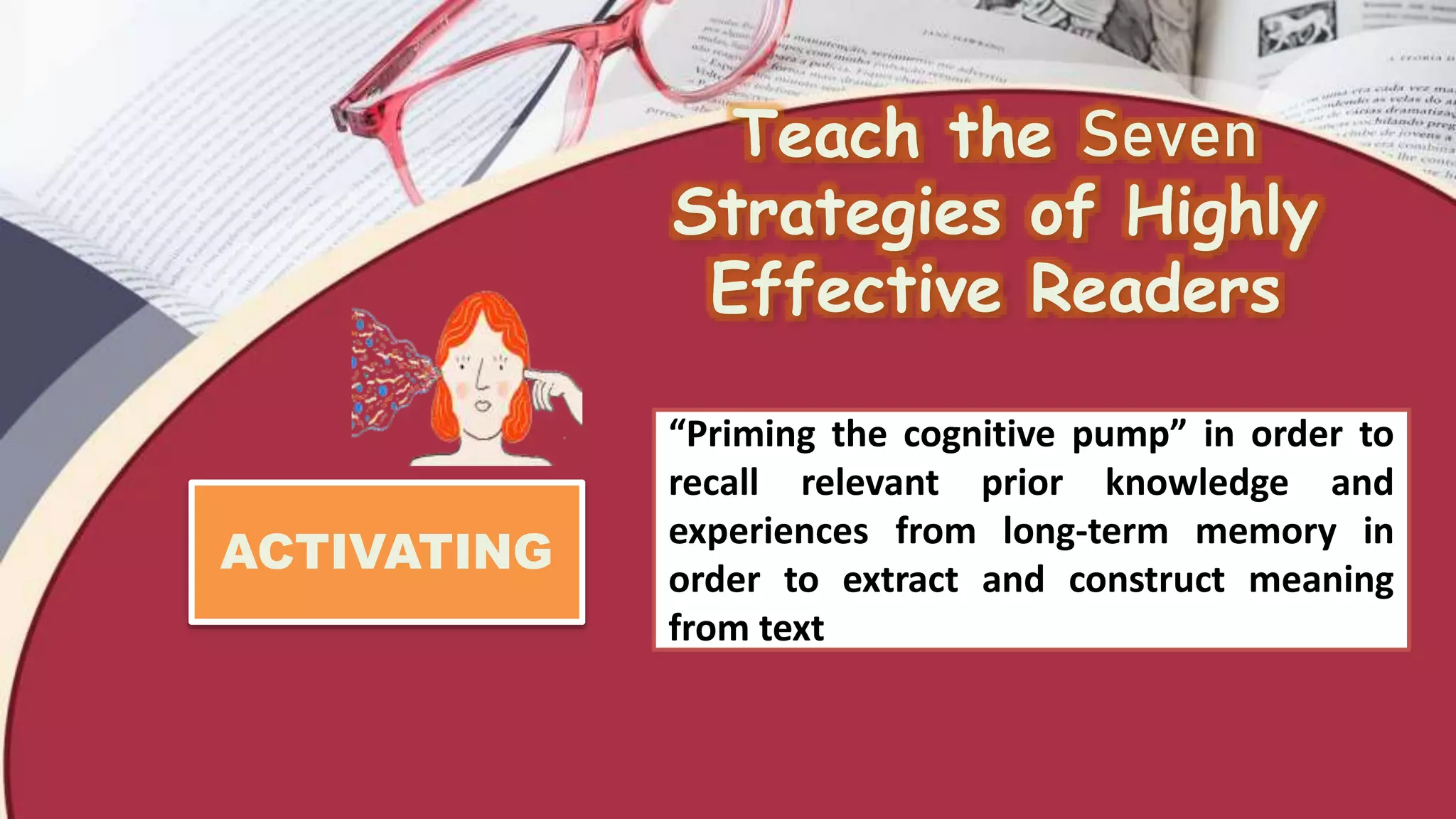
ACTIVATING
“Priming the cognitive pump” in order to
recall relevant prior knowledge and
experiences from long-term memory in
order to extract and construct meaning
from text
Teach the Seven
Strategies of Highly
Effective Readers
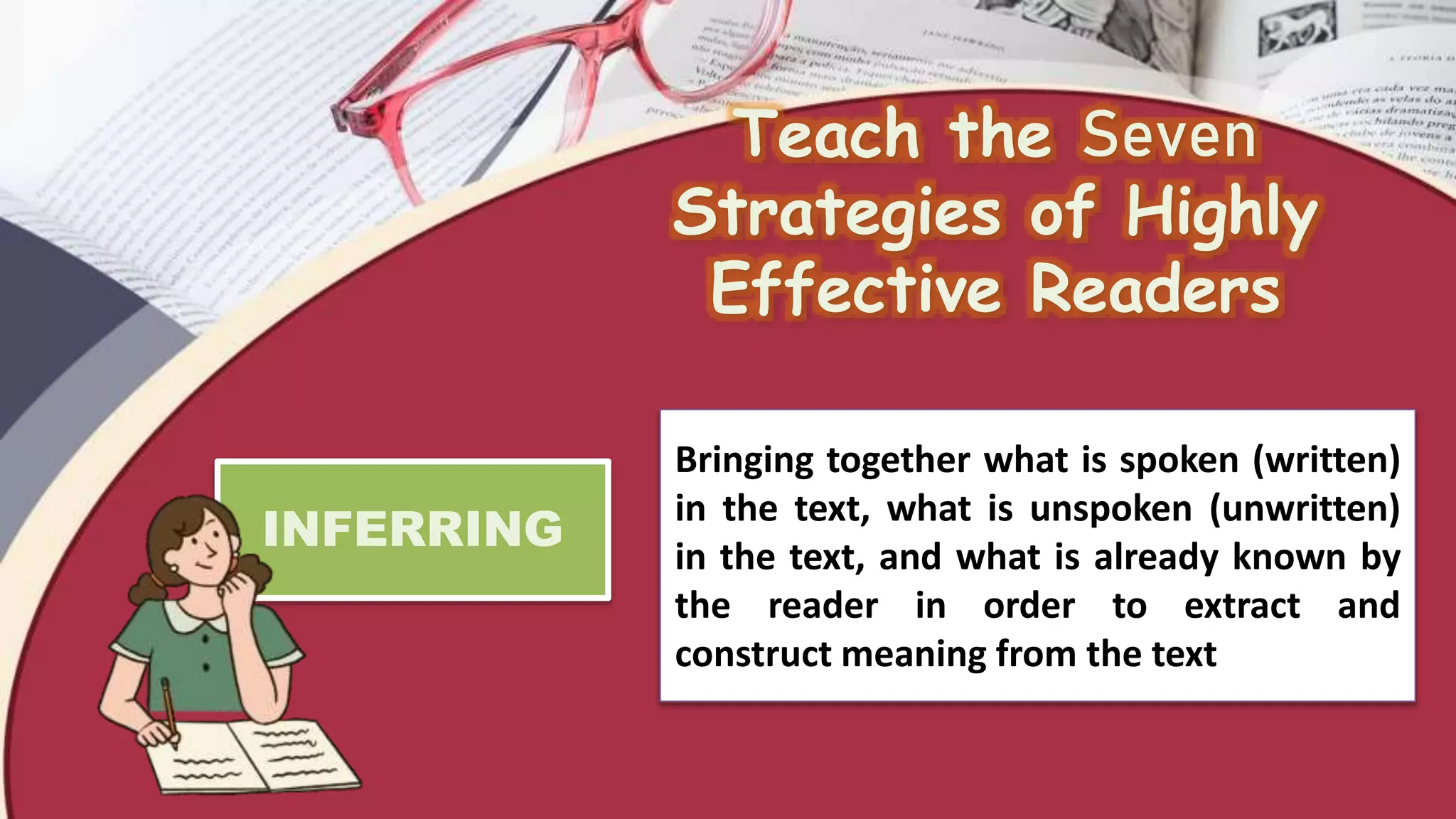
INFERRING
Bringing together what is spoken (written)
in the text, what is unspoken (unwritten)
in the text, and what is already known by
the reader in order to extract and
construct meaning from the text
Teach the Seven
Strategies of Highly
Effective Readers
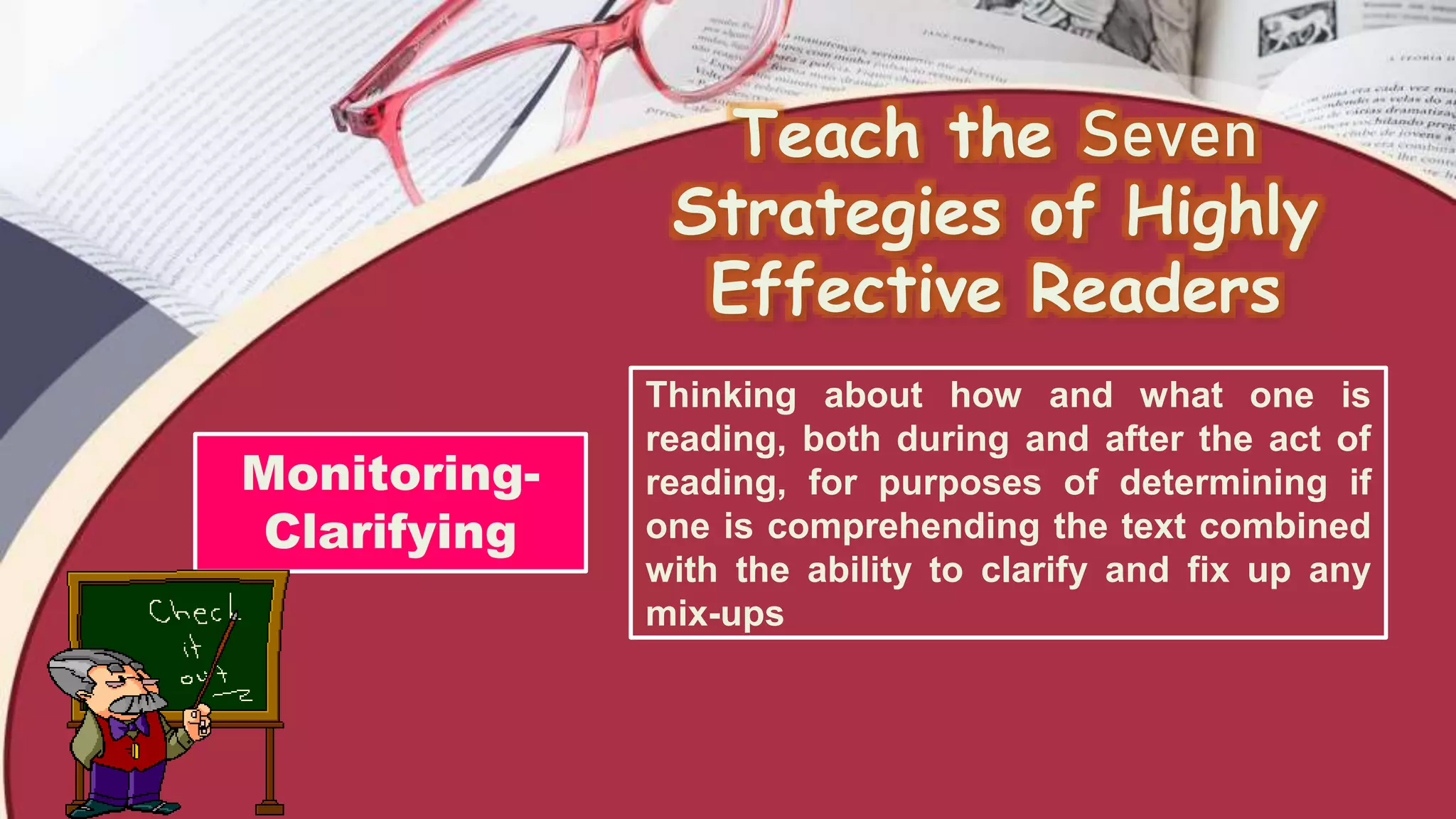
Monitoring-
Clarifying
Thinking about how and what one is
reading, both during and after the act of
reading, for purposes of determining if
one is comprehending the text combined
with the ability to clarify and fix up any
mix-ups
Teach the Seven
Strategies of Highly
Effective Readers
Engaging in learning dialogues with text
(authors), peers, and teachers through
self-questioning, question generation, and
question answering
QUESTIONING
Teach the Seven
Strategies of Highly
Effective Readers
SEARCHING-
SELECTING
Searching a variety of sources in order to
select appropriate information to answer
questions, define words and terms, clarify
misunderstandings, solve problems, or
gather information
Teach the Seven
Strategies of Highly
Effective Readers
Restating the meaning of text in one’s own
words — different words from those used
in the original text
SUMMARIZING
Teach the Seven
Strategies of Highly
Effective Readers
Constructing a mental image or graphic
organizer for the purpose of extracting
and constructing meaning from the text
Visualizing-
Organizing
Teaching Reading During the Pandemic
Marlon P. Labastida - The Philippine Star
November 10, 2021 | 12:00am
Point of View
“With these school closures, learners are
experiencing what UNICEF terms “learning
loss.” Personally, the blended learning that the
Department of Education is adapting does not
suffice in augmenting the learning needs of our
students. Learning motivation is consistently
deteriorating; skills development has been
superficially delivered and, most unfortunate,
reading abilities of our learners are at risk of
continuous decline.”
“As per Policy Analysis for California
Education (PACE), school activities
hampered by COVID-19 have resulted in 30
percent decrease in the oral reading fluency
of learners. This also implies that low
performing schools are falling even farther
behind. I presume this research result from
PACE is applicable, too, in the Philippines.”
“I remember one of our Literacy
professors in UP saying that there are
reading skills which are difficult to
teach through the modular approach.
One of those skills is decoding or the
ability to apply the letter-sound
relationships to translate print into
speech. If learners, especially in
Kindergarten, are not extensively
taught phonics, which is the initial
stage of teaching decoding, it would
be hard for them to learn decoding
later, hence detrimentally affecting
their comprehension skills.”
“Modules do not teach sounds;
someone who is capable of teaching
phonics should sound it out to a child.
In teaching beginning reading the
modular way, we still need someone
who is live, someone who will carefully
plan and prepare reading activities. We
need someone who is at least a
reader. In short, modules alone will not
help the child learn how to read.”
“Last thing and I guess the most major
contributing factor to the minimal effectiveness
of modules to teach reading is that our learning
facilitators and parents did not receive any
seminars or trainings to capacitate them to
teach reading to their children. That’s what we
lack the most. We forget the teaching readiness
of our parents. We have a handful of trainings
for our teachers, but none for our learning
facilitators.”
“Teaching reading is a laborious and a
back-breaking task. Reading is not a single
topic. Reading is composed of five big
components, namely: phonics, phonemic
awareness, fluency, vocabulary and
comprehension. Thus, it is only through
introducing these components to our
learning facilitators that they get to
familiarize and somehow acquire
background knowledge in teaching
reading.”
“Beyond everything, I want to underscore that
every good pedagogy is backed by a positive
personality. This means no matter how trained
you are in teaching or how competent you are
as a learning facilitator, if you are not patient
and understanding with your child, your
teaching-learning activity with him/her will not
be fruitful in the end.”
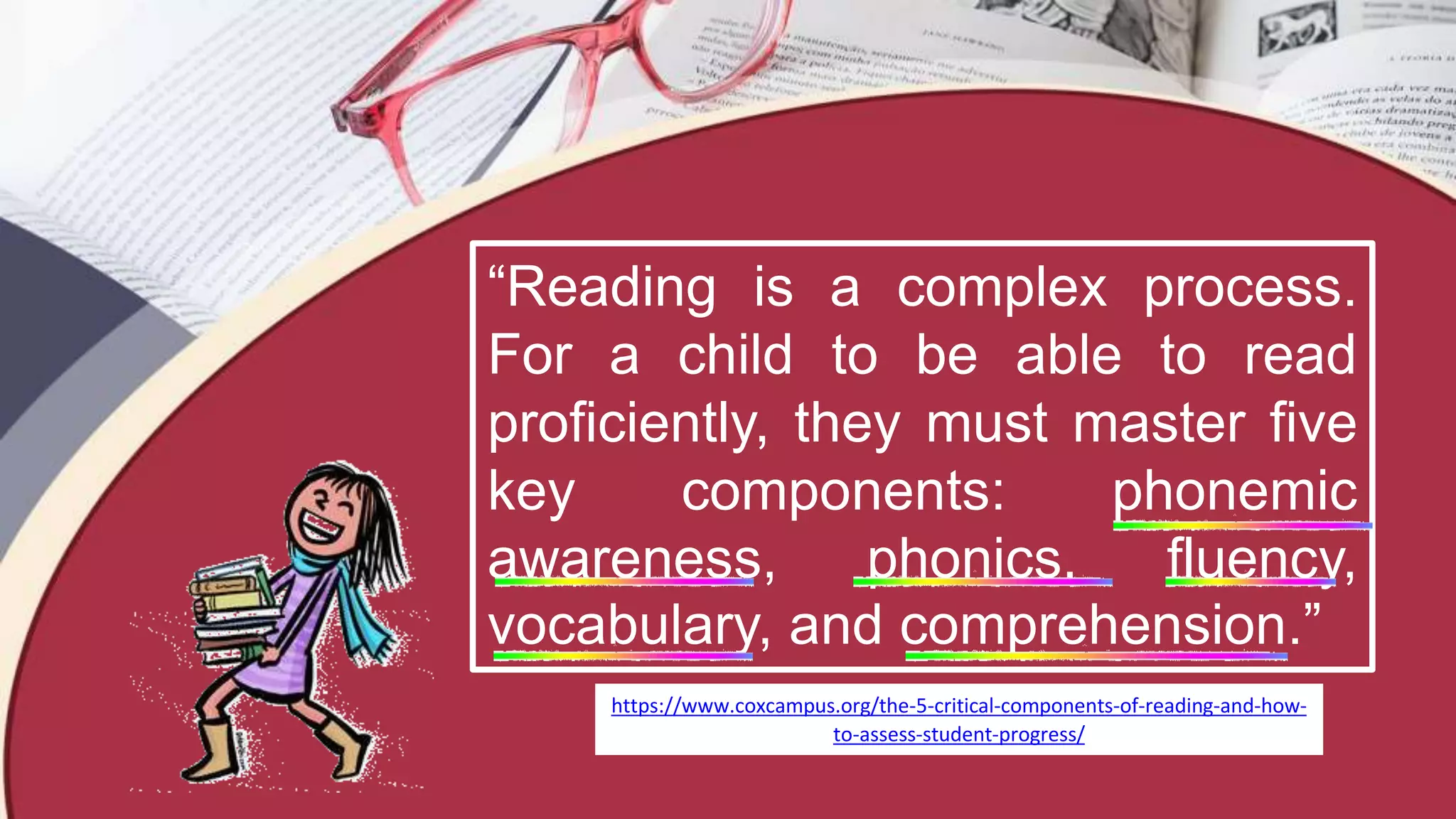
“Reading is a complex process.
For a child to be able to read
proficiently, they must master five
key components: phonemic
awareness, phonics, fluency,
vocabulary, and comprehension.”
https://www.coxcampus.org/the-5-critical-components-of-reading-and-how-
to-assess-student-progress/
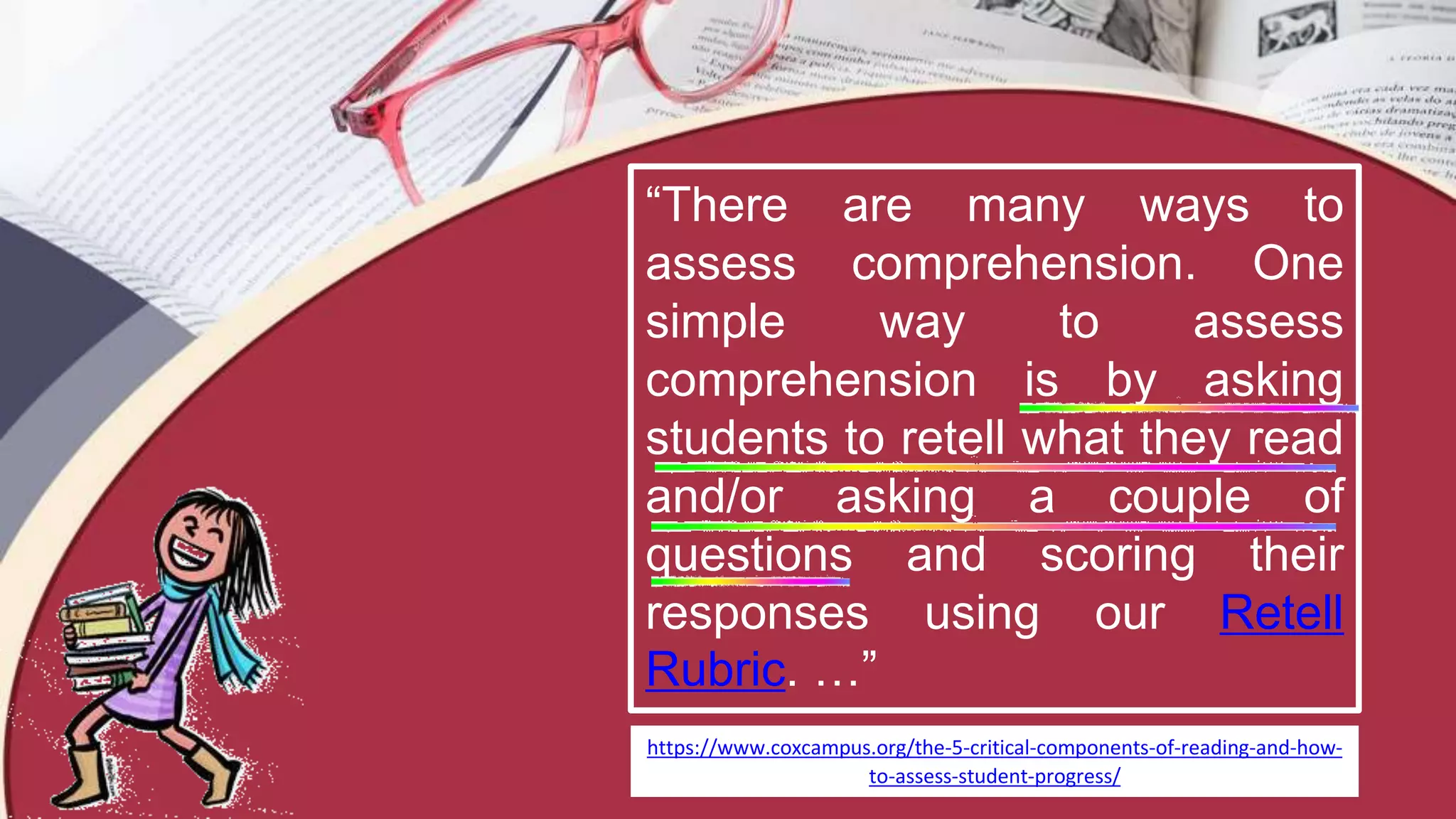
“There are many ways to
assess comprehension. One
simple way to assess
comprehension is by asking
students to retell what they read
and/or asking a couple of
questions and scoring their
responses using our Retell
Rubric. …”
https://www.coxcampus.org/the-5-critical-components-of-reading-and-how-
to-assess-student-progress/
How to Assess and Teach Reading
Comprehension
By Kris Bales
https://www.thoughtco.com/reading-comprehension-4163099
Methods of Assessing Reading
Comprehension
One method is to use a formal
assessment,… with reading
passages followed by questions
about the passage.
Another method is to use informal
assessments. Ask students to tell you about
what they read or retell the story or event in
their own words. Put students in discussion
groups and listen to what they have to say
about the book, watching for areas of confusion
and students who are not participating.
Ask students for a written response to
the text, such as journaling, identifying their
favorite scene, or listing the top 3 to 5 facts
they learned from the text.
How Students Can Improve Reading
Comprehension Skills
“The first, most basic step is to improve
overall reading skills. Help students select
books about topics that interest them and
encourage them to read at least 20 minutes
each day.”
“Remind students to get an
overview of what they’ll be
reading by first reading chapter
titles and subheadings.
Conversely, students can also
benefit from skimming over the
material after they’ve read it.”
“Next, encourage students to
stop every so often and
summarize what they’ve read,
either mentally or aloud with a
reading buddy. They may want
to make notes or use a graphic
organizer to record their
thoughts.”
“Students should also take steps
to improve their vocabulary.
One way to do so without
disrupting the flow of reading is
to jot down unfamiliar words
and look them up after they’ve
finished their reading time.”
Addressing Reading Comprehension Difficulties in
Printed Modular Distance Learning: A Case Study
https://doi.org/10.32996/ijels.2021.3.10.1
Authors
• Junilyn Tingson JHS Faculty, DepEd, Mandaue City
Division, Cebu, Philippines
The study showed that teachers managed to
ascertain or find out students' reading
comprehension difficulties through assessment
scores or task outputs then verified through the
background of the students from their previous
English teachers. Moreover, teachers guide the
students who adopt PMDL in improving their
reading comprehension skills by keeping open
communication and close collaboration with
the parents or guardians and providing
reinforcement activities.
Reading Comprehension.pptx

Reading Comprehension.pptx

  • 1.
  • 2.
    What is reading comprehension? “Comprehensionrefers to the ability to understand written words. It is different from the ability to recognize words. Recognizing words on a page but not knowing what they mean does not fulfill the purpose or goal of reading, which is comprehension. Imagine, for example, that a teacher gives a child a passage to read.
  • 3.
    What is Reading Comprehension? Thechild can read the entire passage, but he or she knows nothing when asked to explain what was read. Comprehension adds meaning to what is read. Reading comprehension occurs when words on a page are not just mere words but thoughts and ideas. Comprehension makes reading enjoyable, fun, and informative. It is needed to succeed in school, work, and life in general.” https://www.aces.edu/blog/topics/home-family-urban/the-importance-of-reading-comprehension/?cn- reloaded=1
  • 4.
    Teach the Seven Strategiesof Highly Effective Readers ACTIVATING “Priming the cognitive pump” in order to recall relevant prior knowledge and experiences from long-term memory in order to extract and construct meaning from text
  • 5.
    Teach the Seven Strategiesof Highly Effective Readers INFERRING Bringing together what is spoken (written) in the text, what is unspoken (unwritten) in the text, and what is already known by the reader in order to extract and construct meaning from the text
  • 6.
    Teach the Seven Strategiesof Highly Effective Readers Monitoring- Clarifying Thinking about how and what one is reading, both during and after the act of reading, for purposes of determining if one is comprehending the text combined with the ability to clarify and fix up any mix-ups
  • 7.
    Teach the Seven Strategiesof Highly Effective Readers Engaging in learning dialogues with text (authors), peers, and teachers through self-questioning, question generation, and question answering QUESTIONING
  • 8.
    Teach the Seven Strategiesof Highly Effective Readers SEARCHING- SELECTING Searching a variety of sources in order to select appropriate information to answer questions, define words and terms, clarify misunderstandings, solve problems, or gather information
  • 9.
    Teach the Seven Strategiesof Highly Effective Readers Restating the meaning of text in one’s own words — different words from those used in the original text SUMMARIZING
  • 10.
    Teach the Seven Strategiesof Highly Effective Readers Constructing a mental image or graphic organizer for the purpose of extracting and constructing meaning from the text Visualizing- Organizing
  • 11.
    Teaching Reading Duringthe Pandemic Marlon P. Labastida - The Philippine Star November 10, 2021 | 12:00am Point of View
  • 12.
    “With these schoolclosures, learners are experiencing what UNICEF terms “learning loss.” Personally, the blended learning that the Department of Education is adapting does not suffice in augmenting the learning needs of our students. Learning motivation is consistently deteriorating; skills development has been superficially delivered and, most unfortunate, reading abilities of our learners are at risk of continuous decline.”
  • 13.
    “As per PolicyAnalysis for California Education (PACE), school activities hampered by COVID-19 have resulted in 30 percent decrease in the oral reading fluency of learners. This also implies that low performing schools are falling even farther behind. I presume this research result from PACE is applicable, too, in the Philippines.”
  • 14.
    “I remember oneof our Literacy professors in UP saying that there are reading skills which are difficult to teach through the modular approach. One of those skills is decoding or the ability to apply the letter-sound relationships to translate print into speech. If learners, especially in Kindergarten, are not extensively taught phonics, which is the initial stage of teaching decoding, it would be hard for them to learn decoding later, hence detrimentally affecting their comprehension skills.”
  • 15.
    “Modules do notteach sounds; someone who is capable of teaching phonics should sound it out to a child. In teaching beginning reading the modular way, we still need someone who is live, someone who will carefully plan and prepare reading activities. We need someone who is at least a reader. In short, modules alone will not help the child learn how to read.”
  • 16.
    “Last thing andI guess the most major contributing factor to the minimal effectiveness of modules to teach reading is that our learning facilitators and parents did not receive any seminars or trainings to capacitate them to teach reading to their children. That’s what we lack the most. We forget the teaching readiness of our parents. We have a handful of trainings for our teachers, but none for our learning facilitators.”
  • 17.
    “Teaching reading isa laborious and a back-breaking task. Reading is not a single topic. Reading is composed of five big components, namely: phonics, phonemic awareness, fluency, vocabulary and comprehension. Thus, it is only through introducing these components to our learning facilitators that they get to familiarize and somehow acquire background knowledge in teaching reading.”
  • 18.
    “Beyond everything, Iwant to underscore that every good pedagogy is backed by a positive personality. This means no matter how trained you are in teaching or how competent you are as a learning facilitator, if you are not patient and understanding with your child, your teaching-learning activity with him/her will not be fruitful in the end.”
  • 19.
    “Reading is acomplex process. For a child to be able to read proficiently, they must master five key components: phonemic awareness, phonics, fluency, vocabulary, and comprehension.” https://www.coxcampus.org/the-5-critical-components-of-reading-and-how- to-assess-student-progress/
  • 20.
    “There are manyways to assess comprehension. One simple way to assess comprehension is by asking students to retell what they read and/or asking a couple of questions and scoring their responses using our Retell Rubric. …” https://www.coxcampus.org/the-5-critical-components-of-reading-and-how- to-assess-student-progress/
  • 21.
    How to Assessand Teach Reading Comprehension By Kris Bales https://www.thoughtco.com/reading-comprehension-4163099
  • 22.
    Methods of AssessingReading Comprehension One method is to use a formal assessment,… with reading passages followed by questions about the passage.
  • 23.
    Another method isto use informal assessments. Ask students to tell you about what they read or retell the story or event in their own words. Put students in discussion groups and listen to what they have to say about the book, watching for areas of confusion and students who are not participating. Ask students for a written response to the text, such as journaling, identifying their favorite scene, or listing the top 3 to 5 facts they learned from the text.
  • 24.
    How Students CanImprove Reading Comprehension Skills “The first, most basic step is to improve overall reading skills. Help students select books about topics that interest them and encourage them to read at least 20 minutes each day.”
  • 25.
    “Remind students toget an overview of what they’ll be reading by first reading chapter titles and subheadings. Conversely, students can also benefit from skimming over the material after they’ve read it.”
  • 26.
    “Next, encourage studentsto stop every so often and summarize what they’ve read, either mentally or aloud with a reading buddy. They may want to make notes or use a graphic organizer to record their thoughts.”
  • 27.
    “Students should alsotake steps to improve their vocabulary. One way to do so without disrupting the flow of reading is to jot down unfamiliar words and look them up after they’ve finished their reading time.”
  • 28.
    Addressing Reading ComprehensionDifficulties in Printed Modular Distance Learning: A Case Study https://doi.org/10.32996/ijels.2021.3.10.1 Authors • Junilyn Tingson JHS Faculty, DepEd, Mandaue City Division, Cebu, Philippines
  • 29.
    The study showedthat teachers managed to ascertain or find out students' reading comprehension difficulties through assessment scores or task outputs then verified through the background of the students from their previous English teachers. Moreover, teachers guide the students who adopt PMDL in improving their reading comprehension skills by keeping open communication and close collaboration with the parents or guardians and providing reinforcement activities.