Engaging
Toddlers in Active
Early Learning
Stephanie C. Prato
Director of Play to Learn Services
sprato@fflib.org
FFL Early Literacy Webinar Series, in partnership with CLRC
Kristen Hanmer
Cataloging & Processing Manager
khanmer@fflib.org
Background
• What is Early Literacy?
• Developmental Stages
• Every Child Ready to Read
• Talk & Sing
• Read & Write
• Play
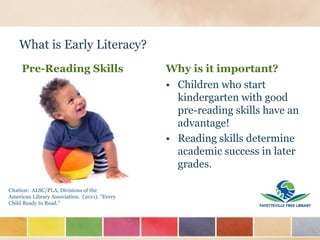
What is Early Literacy?
Why is it important?
• Children who start
kindergarten with good
pre-reading skills have an
advantage!
• Reading skills determine
academic success in later
grades.
Citation: ALSC/PLA, Divisions of the
American Library Association. (2011). “Every
Child Ready to Read.”
Pre-Reading Skills
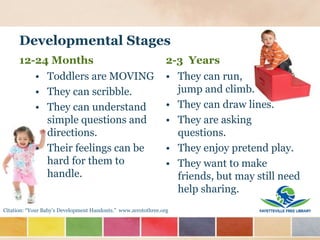
Developmental Stages
12-24 Months 2-3 Years
Citation: “Your Baby’s Development Handouts.” www.zerotothree.org
• Toddlers are MOVING
• They can scribble.
• They can understand
simple questions and
directions.
• Their feelings can be
hard for them to
handle.
• They can run,
jump and climb.
• They can draw lines.
• They are asking
questions.
• They enjoy pretend play.
• They want to make
friends, but may still need
help sharing.
Every Child Ready to Read (ECRR)
• Print Awareness
• Letter Knowledge
• Phonological Awareness
• Vocabulary
• Narrative Skills
• Print Motivation
Six Skills Framework
• Focus on parent
education through
workshops
• Involves two sets of skills:
decoding &
comprehension
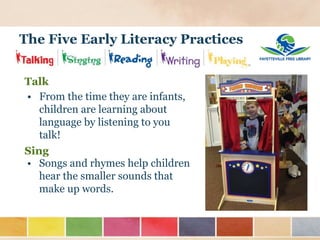
The Five Early Literacy Practices
Talk
Sing
• From the time they are infants,
children are learning about
language by listening to you
talk!
• Songs and rhymes help children
hear the smaller sounds that
make up words.
The Five Early Literacy Practices
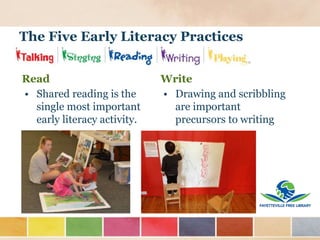
Read Write
• Shared reading is the
single most important
early literacy activity.
• Drawing and scribbling
are important
precursors to writing
The Five Early Literacy Practices
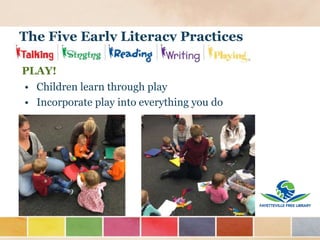
PLAY!
• Children learn through play
• Incorporate play into everything you do
Fayetteville Free Library (FFL)
Collections & Space
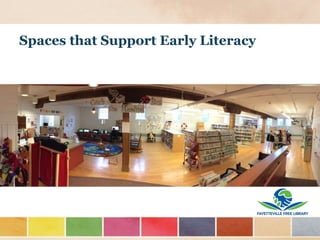
• Spaces that Support Early Literacy
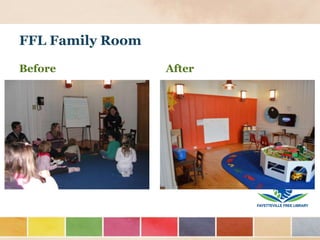
• FFL Family Room
• Board Books & Picture books
Spaces that Support Early Literacy
FFL Family Room
Before After
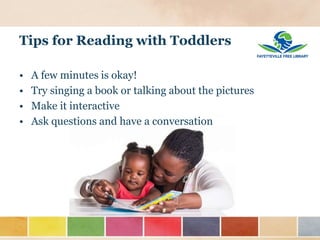
Tips for Reading with Toddlers
• A few minutes is okay!
• Try singing a book or talking about the pictures
• Make it interactive
• Ask questions and have a conversation
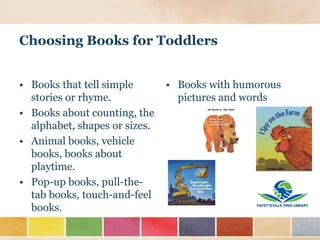
Choosing Books for Toddlers
• Books with humorous
pictures and words
• Books that tell simple
stories or rhyme.
• Books about counting, the
alphabet, shapes or sizes.
• Animal books, vehicle
books, books about
playtime.
• Pop-up books, pull-the-
tab books, touch-and-feel
books.
for more
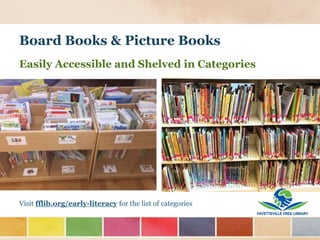
Board Books & Picture Books
Easily Accessible and Shelved in Categories
Visit fflib.org/early-literacy for the list of categories
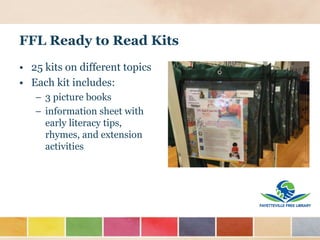
FFL Ready to Read Kits
• 25 kits on different topics
• Each kit includes:
– 3 picture books
– information sheet with
early literacy tips,
rhymes, and extension
activities
Fayetteville Free Library (FFL)
Programs
• First Steps
• Music and Movement: Toddler &
Preschool Edition
• Art Lab
• Smartplay
• Siblings welcome!
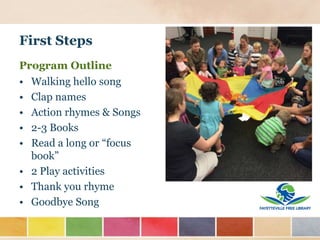
First Steps
Program Outline
• Walking hello song
• Clap names
• Action rhymes & Songs
• 2-3 Books
• Read a long or “focus
book”
• 2 Play activities
• Thank you rhyme
• Goodbye Song
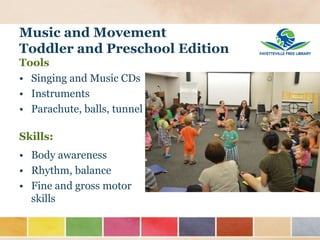
Music and Movement
Toddler and Preschool Edition
Tools
• Singing and Music CDs
• Instruments
• Parachute, balls, tunnel
• Body awareness
• Rhythm, balance
• Fine and gross motor
skills
Skills:
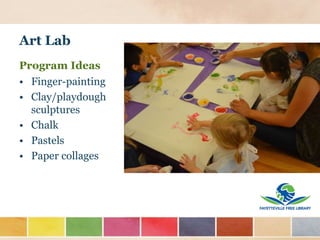
Art Lab
Program Ideas
• Finger-painting
• Clay/playdough
sculptures
• Chalk
• Pastels
• Paper collages
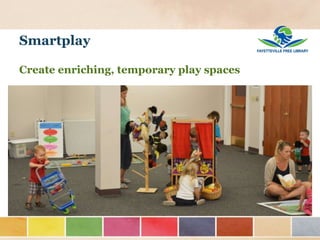
Smartplay
Create enriching, temporary play spaces
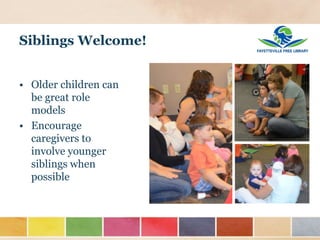
Siblings Welcome!
• Older children can
be great role
models
• Encourage
caregivers to
involve younger
siblings when
possible
References and Resources
ALSC/PLA, Divisions of the American Library Association. (2011). “Every Child Ready to
Read.”
Diamant-Cohen, B. and Ghoting, S. (2010). The Early Literacy Kit: A Handbook and Tip
Cards. American Library Association.
ZERO TO THREE: National Center for Infants, Toddlers and Families. (2014). “Tips for
Choosing Books with Babies and Toddlers.” zerotothree.org
ZERO TO THREE: National Center for Infants, Toddlers and Families. (2014). “Tips for
Sharing Books with Babies and Toddlers.” zerotothree.org
ZERO TO THREE: National Center for Infants, Toddlers and Families. (2014). “Your Baby’s
Development.” (Handouts). zerotothree.org
ZERO TO THREE. (2008). Getting ready to read: Helping your child become a confident
reader and writing starting from birth. Retrieved from www.zerotothree.org/child-
development/early-language-literacy/cradlingliteracy_ready2read_8-14-09.pdf
Thank You!Do you have any questions?
Fayetteville Free Library
Homepage: www.fflib.org
FAQs for Librarians: www.fflib.org/makerfaqs
Early Literacy: www.fflib.org/early-literacy
Making! www.fflib.org/make
Twitter: @fayettevillelib
Facebook: facebook.com/fayfreelibrary
Susan Considine
Executive Director
Fayetteville Free Library
sconsidine@fflib.org
@sconsidine

Engaging Toddlers in Active Early Learning

  • 1.
    Engaging Toddlers in Active EarlyLearning Stephanie C. Prato Director of Play to Learn Services sprato@fflib.org FFL Early Literacy Webinar Series, in partnership with CLRC Kristen Hanmer Cataloging & Processing Manager khanmer@fflib.org
  • 2.
    Background • What isEarly Literacy? • Developmental Stages • Every Child Ready to Read • Talk & Sing • Read & Write • Play
  • 3.
    What is EarlyLiteracy? Why is it important? • Children who start kindergarten with good pre-reading skills have an advantage! • Reading skills determine academic success in later grades. Citation: ALSC/PLA, Divisions of the American Library Association. (2011). “Every Child Ready to Read.” Pre-Reading Skills
  • 4.
    Developmental Stages 12-24 Months2-3 Years Citation: “Your Baby’s Development Handouts.” www.zerotothree.org • Toddlers are MOVING • They can scribble. • They can understand simple questions and directions. • Their feelings can be hard for them to handle. • They can run, jump and climb. • They can draw lines. • They are asking questions. • They enjoy pretend play. • They want to make friends, but may still need help sharing.
  • 5.
    Every Child Readyto Read (ECRR) • Print Awareness • Letter Knowledge • Phonological Awareness • Vocabulary • Narrative Skills • Print Motivation Six Skills Framework • Focus on parent education through workshops • Involves two sets of skills: decoding & comprehension
  • 6.
    The Five EarlyLiteracy Practices Talk Sing • From the time they are infants, children are learning about language by listening to you talk! • Songs and rhymes help children hear the smaller sounds that make up words.
  • 7.
    The Five EarlyLiteracy Practices Read Write • Shared reading is the single most important early literacy activity. • Drawing and scribbling are important precursors to writing
  • 8.
    The Five EarlyLiteracy Practices PLAY! • Children learn through play • Incorporate play into everything you do
  • 9.
    Fayetteville Free Library(FFL) Collections & Space • Spaces that Support Early Literacy • FFL Family Room • Board Books & Picture books
  • 10.
    Spaces that SupportEarly Literacy
  • 11.
  • 12.
    Tips for Readingwith Toddlers • A few minutes is okay! • Try singing a book or talking about the pictures • Make it interactive • Ask questions and have a conversation
  • 13.
    Choosing Books forToddlers • Books with humorous pictures and words • Books that tell simple stories or rhyme. • Books about counting, the alphabet, shapes or sizes. • Animal books, vehicle books, books about playtime. • Pop-up books, pull-the- tab books, touch-and-feel books.
  • 14.
    for more Board Books& Picture Books Easily Accessible and Shelved in Categories Visit fflib.org/early-literacy for the list of categories
  • 15.
    FFL Ready toRead Kits • 25 kits on different topics • Each kit includes: – 3 picture books – information sheet with early literacy tips, rhymes, and extension activities
  • 16.
    Fayetteville Free Library(FFL) Programs • First Steps • Music and Movement: Toddler & Preschool Edition • Art Lab • Smartplay • Siblings welcome!
  • 17.
    First Steps Program Outline •Walking hello song • Clap names • Action rhymes & Songs • 2-3 Books • Read a long or “focus book” • 2 Play activities • Thank you rhyme • Goodbye Song
  • 18.
    Music and Movement Toddlerand Preschool Edition Tools • Singing and Music CDs • Instruments • Parachute, balls, tunnel • Body awareness • Rhythm, balance • Fine and gross motor skills Skills:
  • 19.
    Art Lab Program Ideas •Finger-painting • Clay/playdough sculptures • Chalk • Pastels • Paper collages
  • 20.
  • 21.
    Siblings Welcome! • Olderchildren can be great role models • Encourage caregivers to involve younger siblings when possible
  • 22.
    References and Resources ALSC/PLA,Divisions of the American Library Association. (2011). “Every Child Ready to Read.” Diamant-Cohen, B. and Ghoting, S. (2010). The Early Literacy Kit: A Handbook and Tip Cards. American Library Association. ZERO TO THREE: National Center for Infants, Toddlers and Families. (2014). “Tips for Choosing Books with Babies and Toddlers.” zerotothree.org ZERO TO THREE: National Center for Infants, Toddlers and Families. (2014). “Tips for Sharing Books with Babies and Toddlers.” zerotothree.org ZERO TO THREE: National Center for Infants, Toddlers and Families. (2014). “Your Baby’s Development.” (Handouts). zerotothree.org ZERO TO THREE. (2008). Getting ready to read: Helping your child become a confident reader and writing starting from birth. Retrieved from www.zerotothree.org/child- development/early-language-literacy/cradlingliteracy_ready2read_8-14-09.pdf
  • 23.
    Thank You!Do youhave any questions? Fayetteville Free Library Homepage: www.fflib.org FAQs for Librarians: www.fflib.org/makerfaqs Early Literacy: www.fflib.org/early-literacy Making! www.fflib.org/make Twitter: @fayettevillelib Facebook: facebook.com/fayfreelibrary Susan Considine Executive Director Fayetteville Free Library sconsidine@fflib.org @sconsidine