Course: Electronic Devices
paper code: EC301
Course Coordinator: Arpan Deyasi
Department of Electronics and Communication Engineering
RCC Institute of Information Technology
Kolkata, India
9/17/2020 1Arpan Deyasi, RCCIIT, India
Topic: Optical Transmitter
Optical Transmitter
converts electrical signal into optical signal
Optical
Transmitter
I hν
Types: LASER
[Light Amplification by Stimulated Emission of Radiation]
LED
[Light Emitting Diode]
9/17/2020 2Arpan Deyasi, RCCIIT, India
Bulk LASER
Semiconductor LASER
Quantum LASER
Different types of LASER
9/17/2020 3Arpan Deyasi, RCCIIT, India
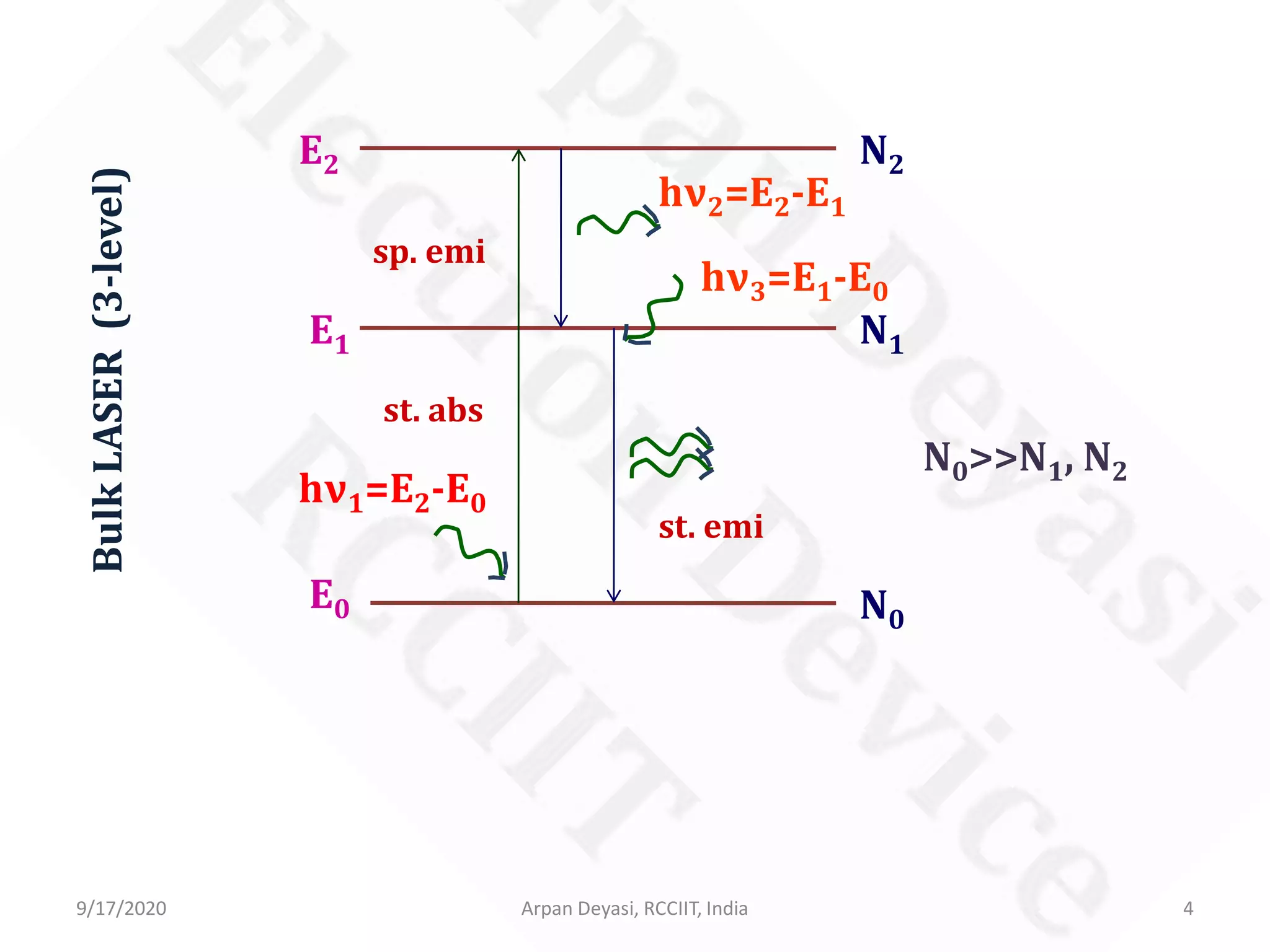
BulkLASER(3-level)
N0
N1
N2
E0
E1
E2
sp. emi
st. emi
N0>>N1, N2
hν1=E2-E0
st. abs
hν2=E2-E1
hν3=E1-E0
9/17/2020 4Arpan Deyasi, RCCIIT, India
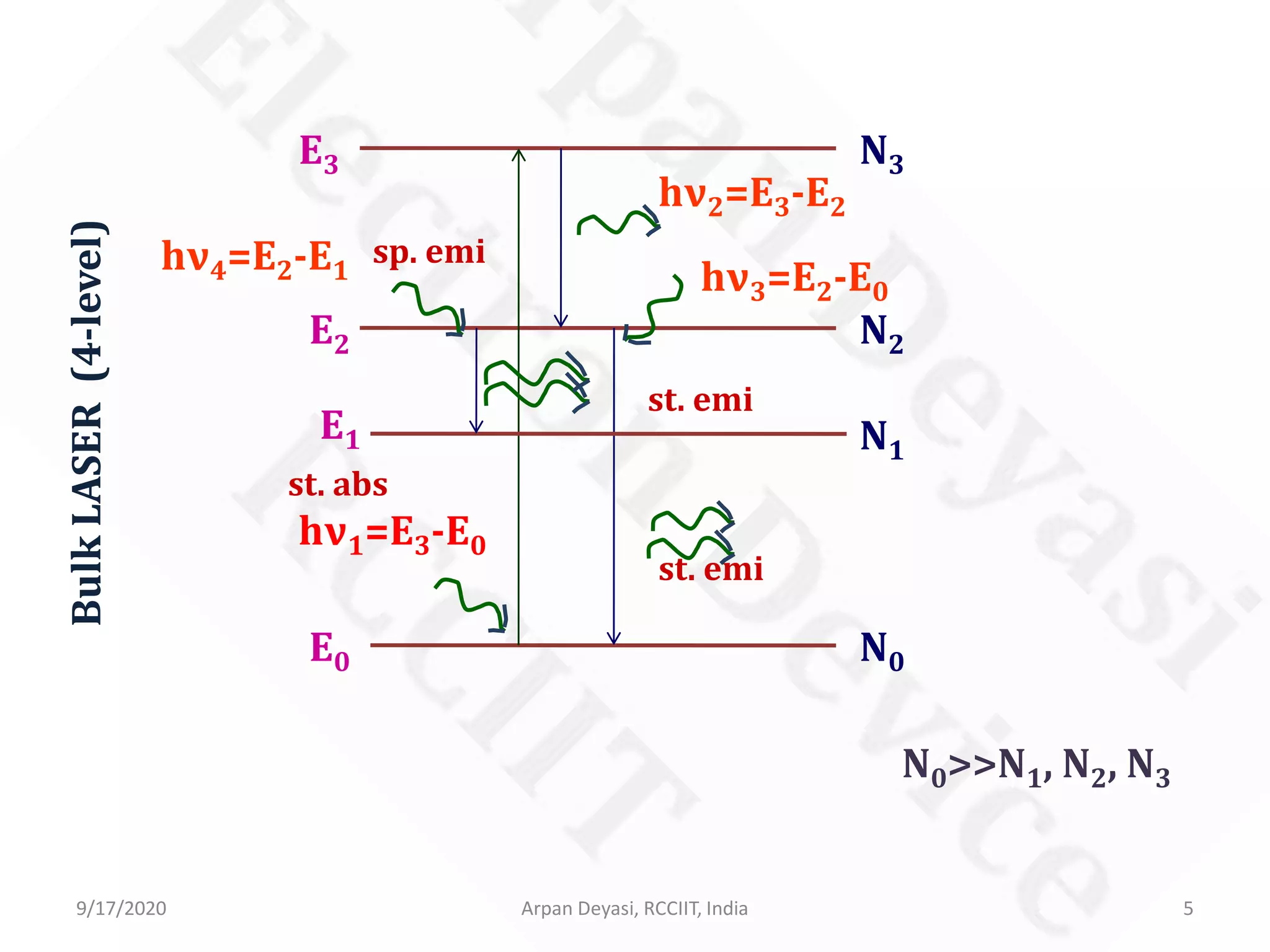
BulkLASER(4-level)
N0
N2
N3
E0
E2
E3
sp. emi
st. emi
N0>>N1, N2, N3
hν1=E3-E0
st. abs
hν2=E3-E2
hν3=E2-E0
N1
st. emi
hν4=E2-E1
E1
9/17/2020 5Arpan Deyasi, RCCIIT, India
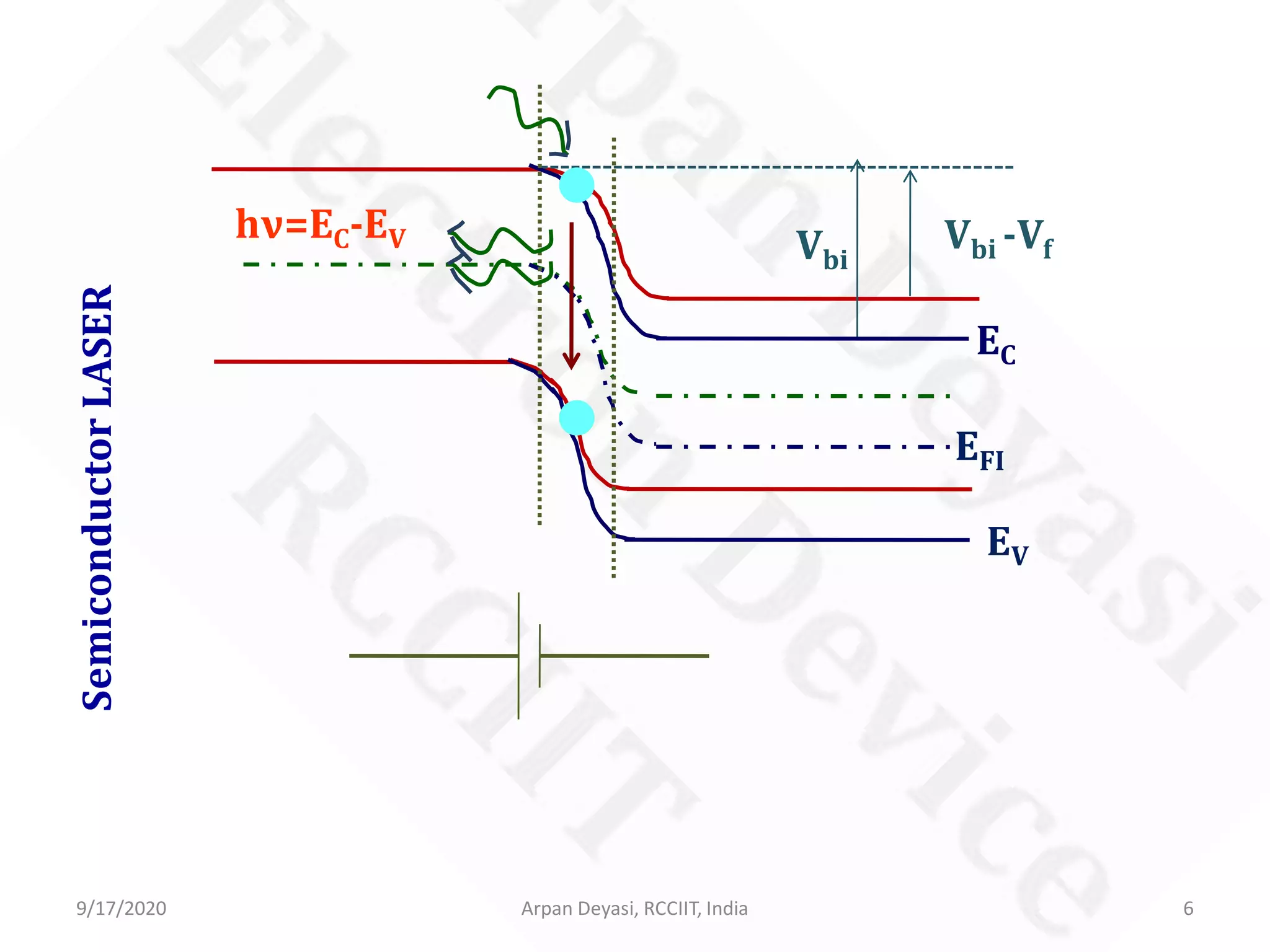
SemiconductorLASER
Vbi
9/17/2020 6Arpan Deyasi, RCCIIT, India
EC
EFI
EV
Vbi -Vf
hν=EC-EV
Semiconductor LASER
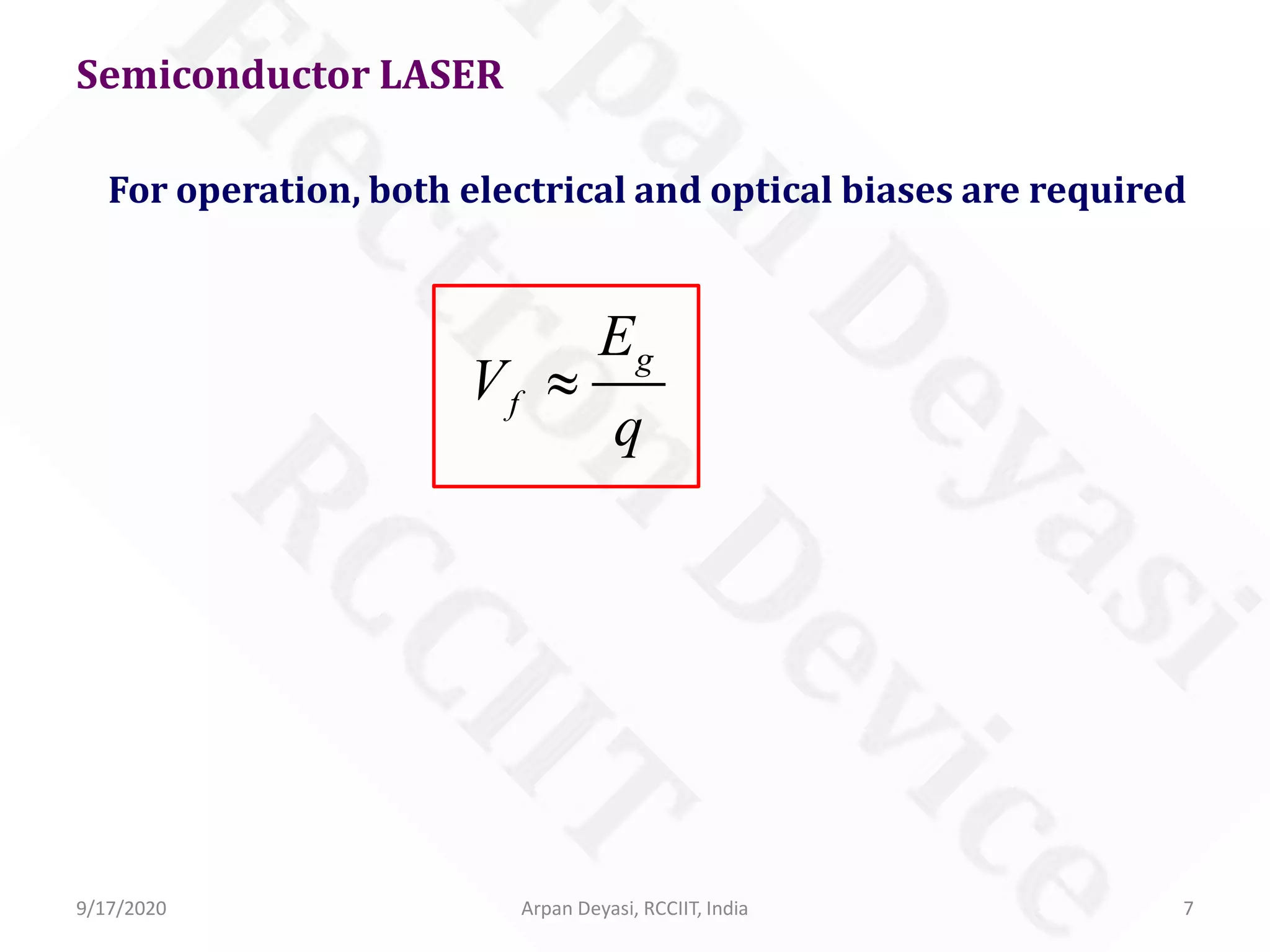
For operation, both electrical and optical biases are required
g
f
E
V
q
≈
9/17/2020 7Arpan Deyasi, RCCIIT, India
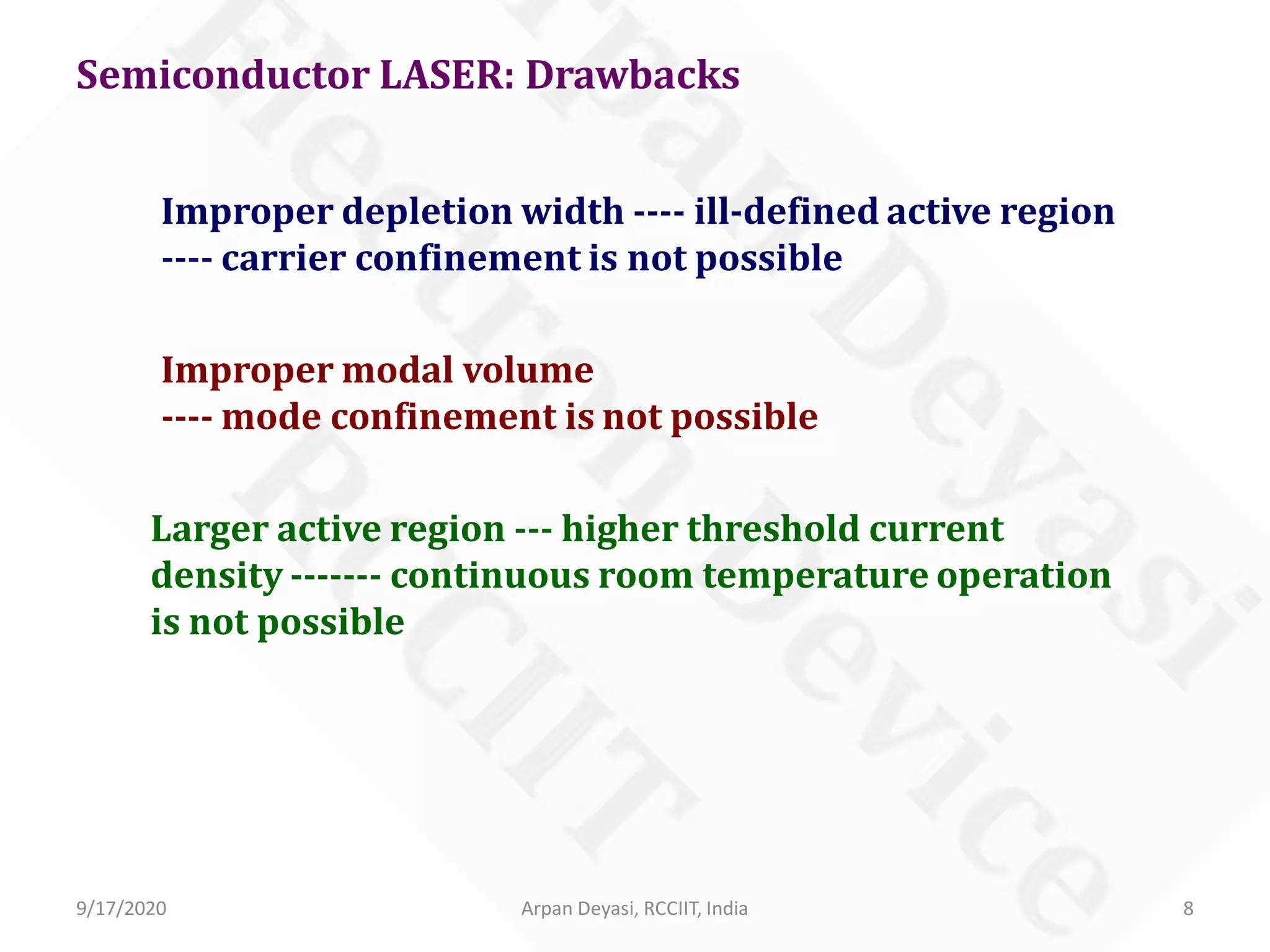
Semiconductor LASER: Drawbacks
Improper depletion width ---- ill-defined active region
---- carrier confinement is not possible
Improper modal volume
---- mode confinement is not possible
Larger active region --- higher threshold current
density ------- continuous room temperature operation
is not possible
9/17/2020 8Arpan Deyasi, RCCIIT, India
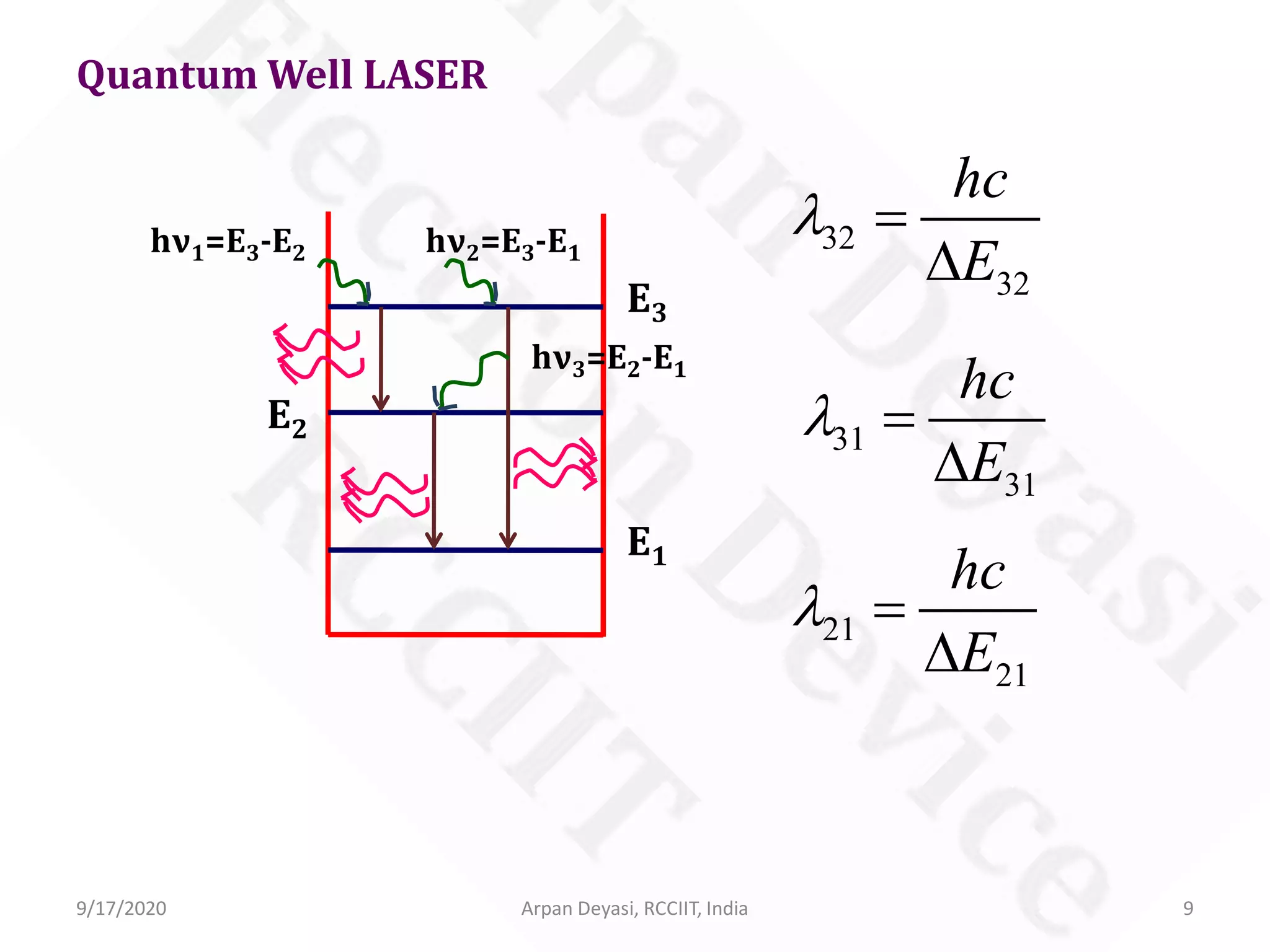
Quantum Well LASER
E1
E2
E3
hν1=E3-E2
hν3=E2-E1
hν2=E3-E1
32
32
hc
E
λ =
∆
31
31
hc
E
λ =
∆
21
21
hc
E
λ =
∆
9/17/2020 9Arpan Deyasi, RCCIIT, India
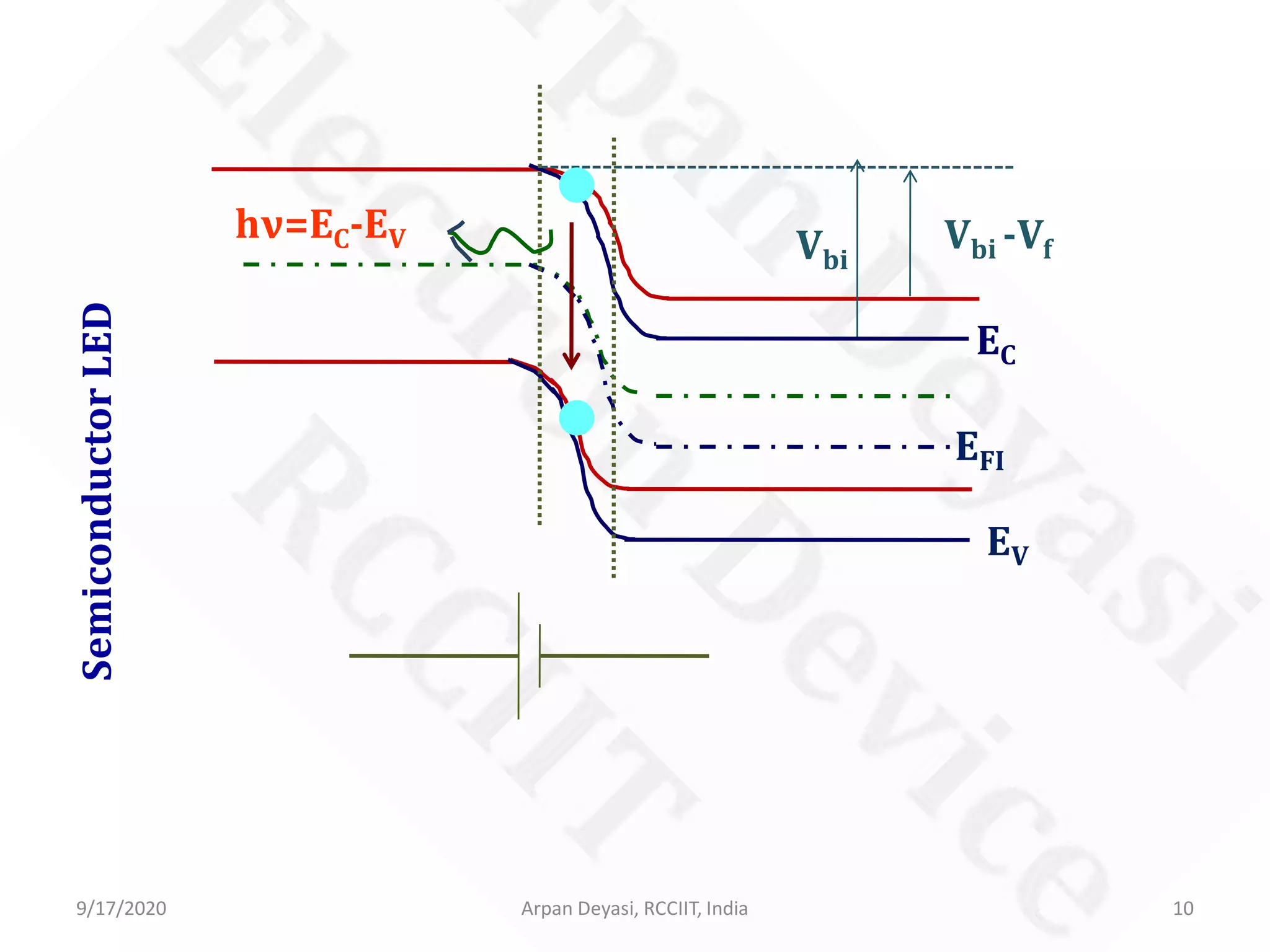
SemiconductorLED
Vbi
9/17/2020 10Arpan Deyasi, RCCIIT, India
EC
EFI
EV
Vbi -Vf
hν=EC-EV
9/17/2020 Arpan Deyasi, RCCIIT, India 11
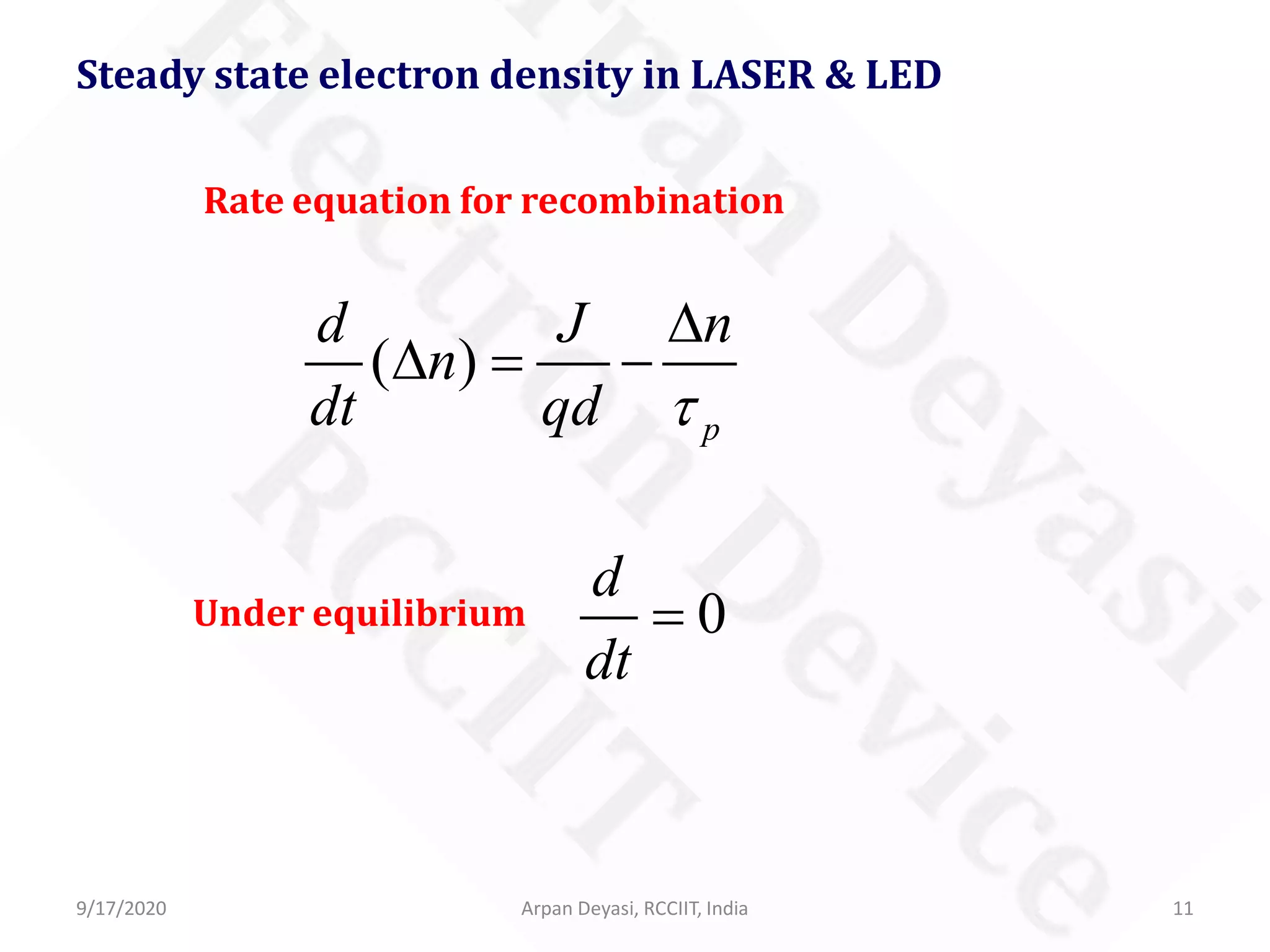
Steady state electron density in LASER & LED
( )
p
d J n
n
dt qd τ
∆
∆ = −
Rate equation for recombination
Under equilibrium 0
d
dt
=
9/17/2020 Arpan Deyasi, RCCIIT, India 12
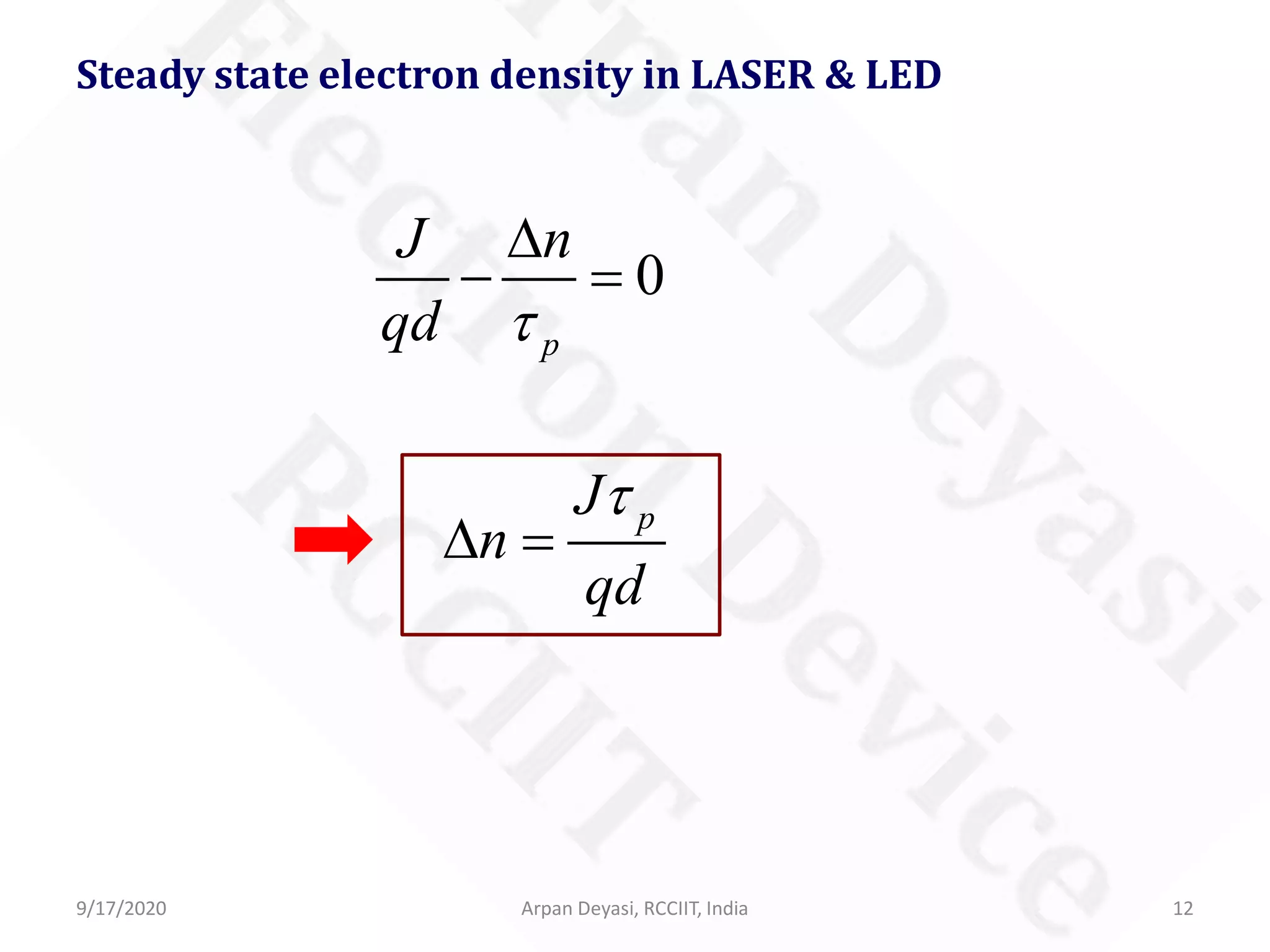
Steady state electron density in LASER & LED
0
p
J n
qd τ
∆
− =
pJ
n
qd
τ
∆ =
9/17/2020 Arpan Deyasi, RCCIIT, India 13
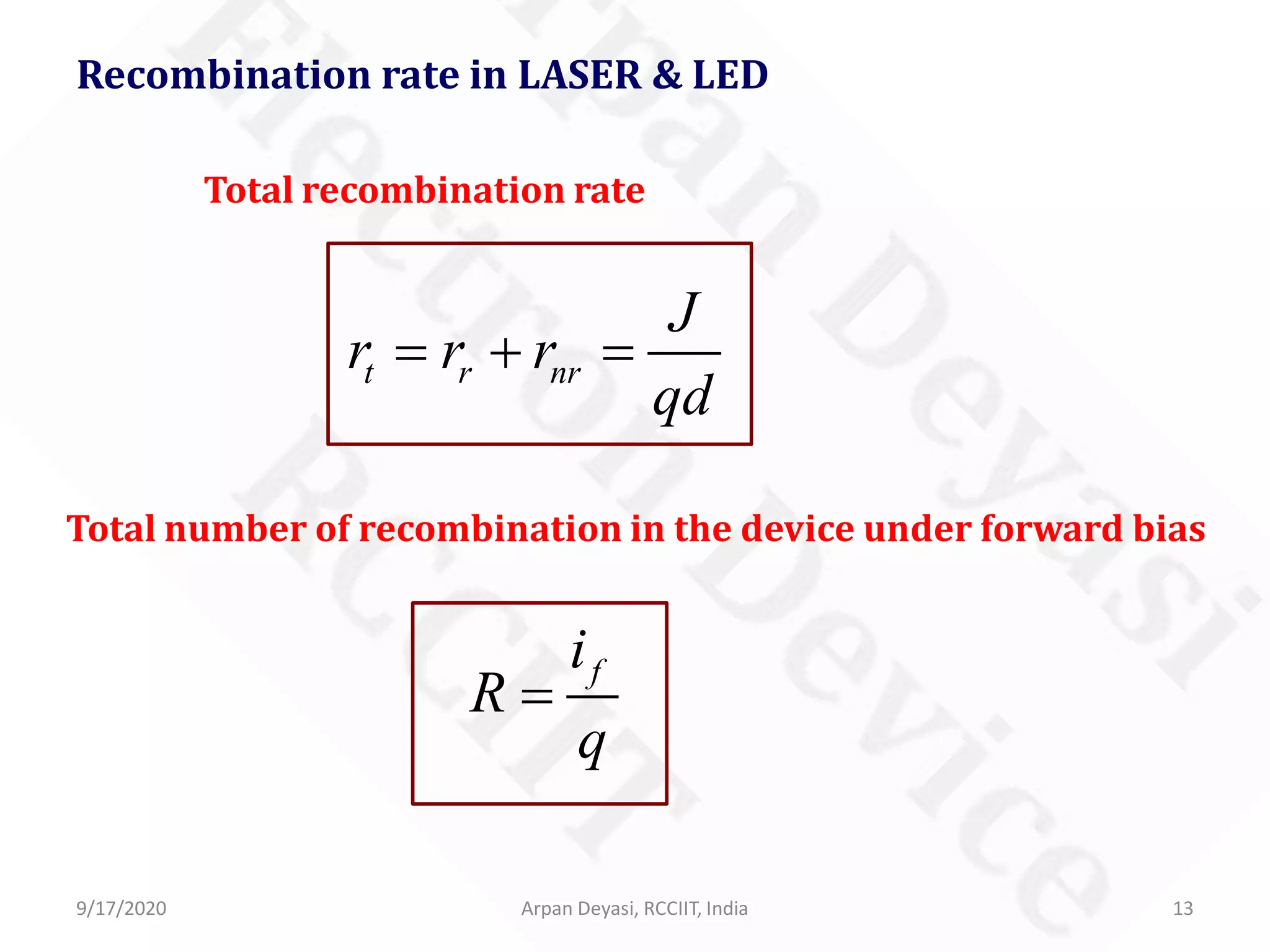
Recombination rate in LASER & LED
t r nr
J
r r r
qd
= + =
Total recombination rate
Total number of recombination in the device under forward bias
fi
R
q
=
9/17/2020 Arpan Deyasi, RCCIIT, India 14
Internal Quantum Efficiency in LASER & LED
Internal Quantum Efficiency =
Number of photons generated inside the device
Number of electrons injected
9/17/2020 Arpan Deyasi, RCCIIT, India 15
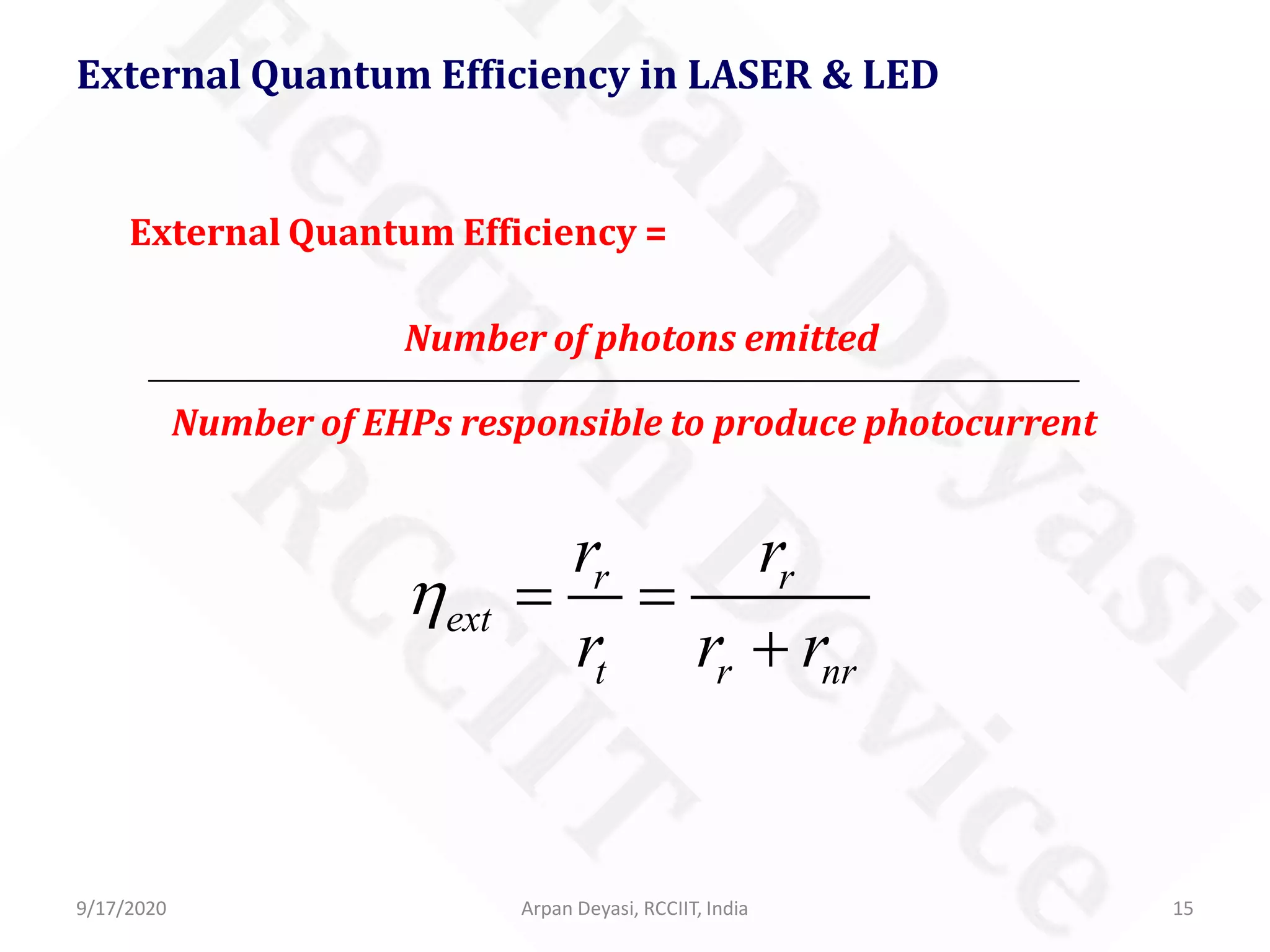
External Quantum Efficiency in LASER & LED
External Quantum Efficiency =
Number of photons emitted
Number of EHPs responsible to produce photocurrent
r r
ext
t r nr
r r
r r r
η = =
+
9/17/2020 Arpan Deyasi, RCCIIT, India 16
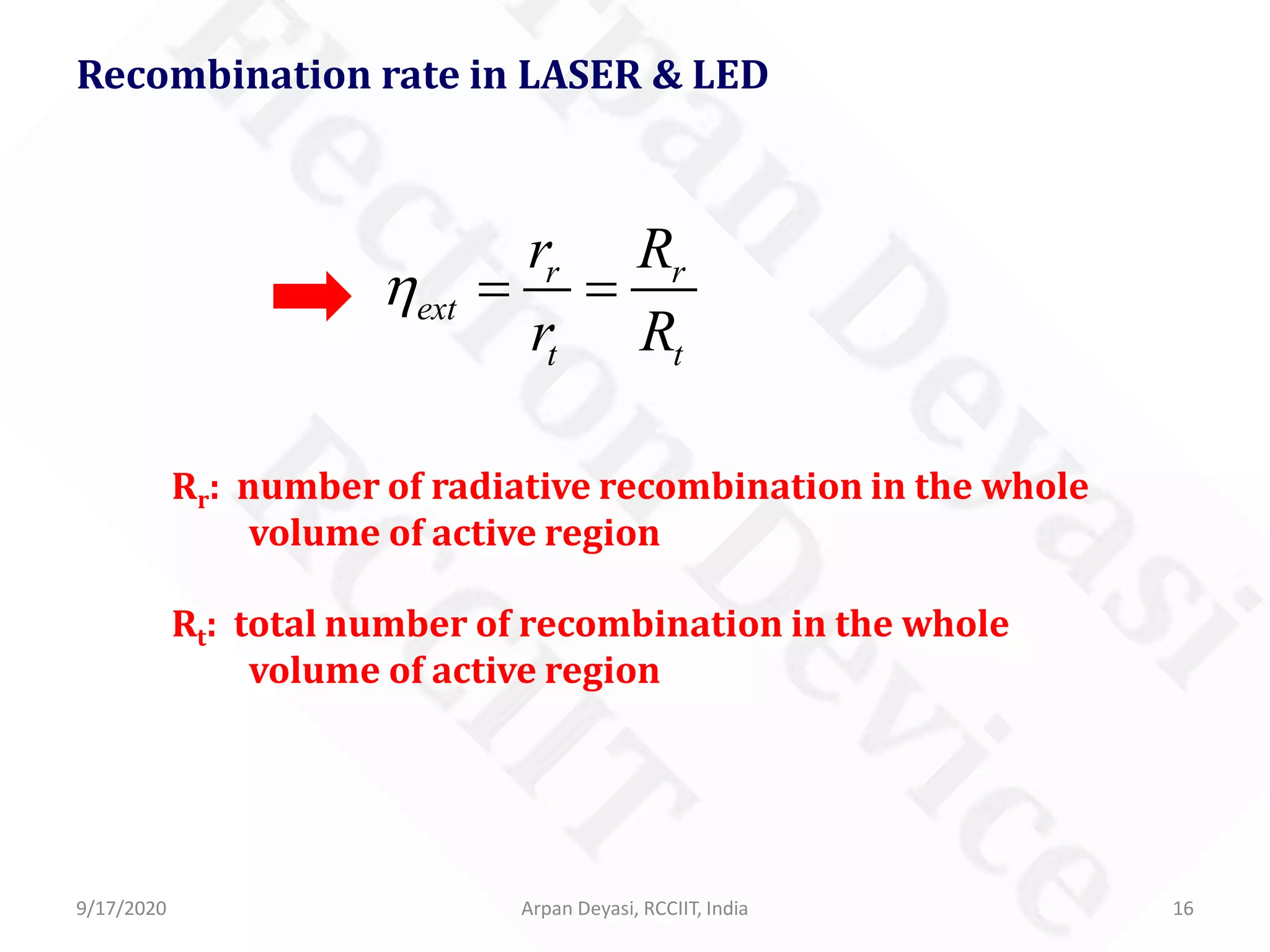
Recombination rate in LASER & LED
r r
ext
t t
r R
r R
η = =
Rr: number of radiative recombination in the whole
volume of active region
Rt: total number of recombination in the whole
volume of active region
9/17/2020 Arpan Deyasi, RCCIIT, India 17
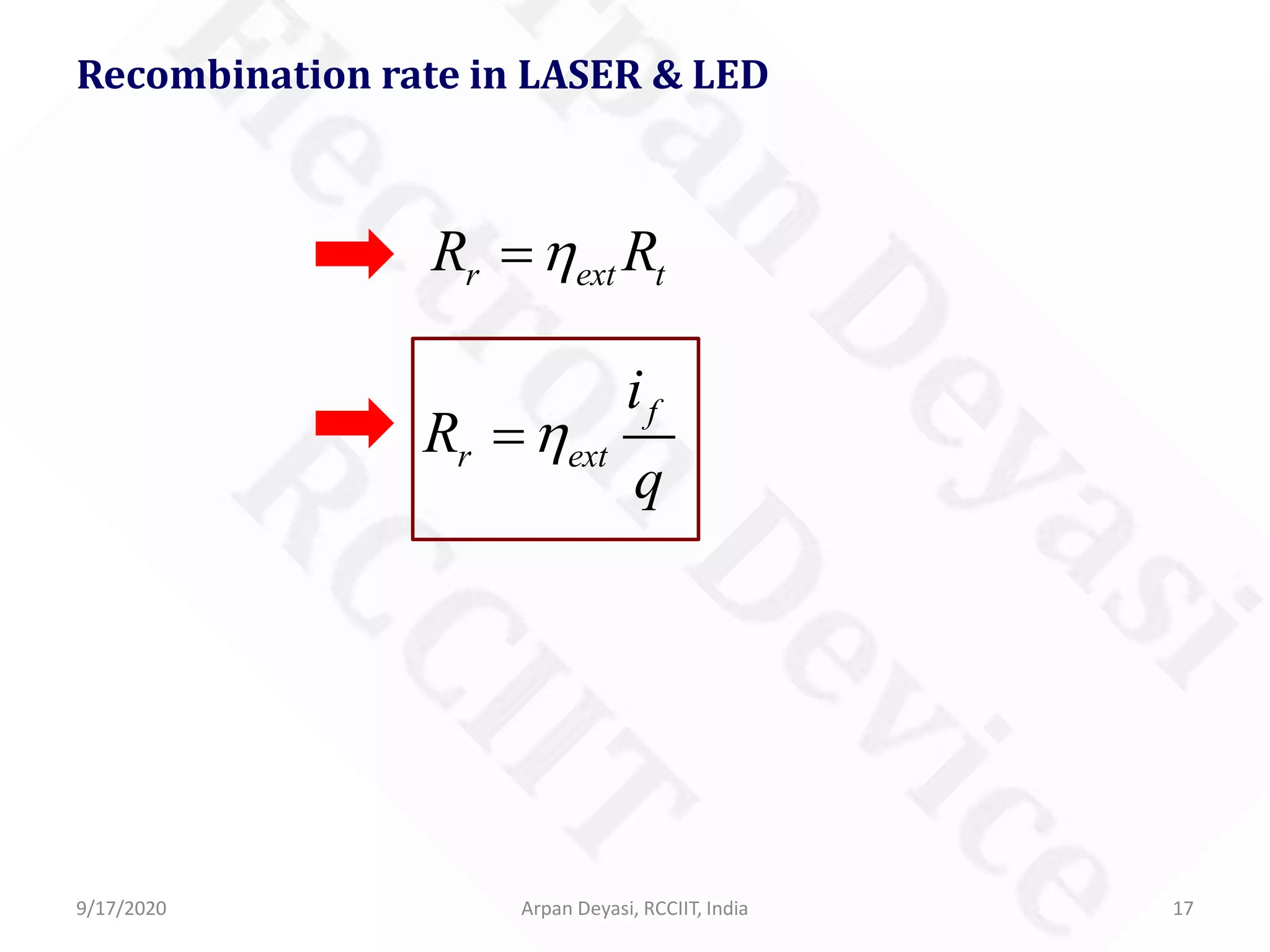
Recombination rate in LASER & LED
r ext tR Rη=
f
r ext
i
R
q
η=
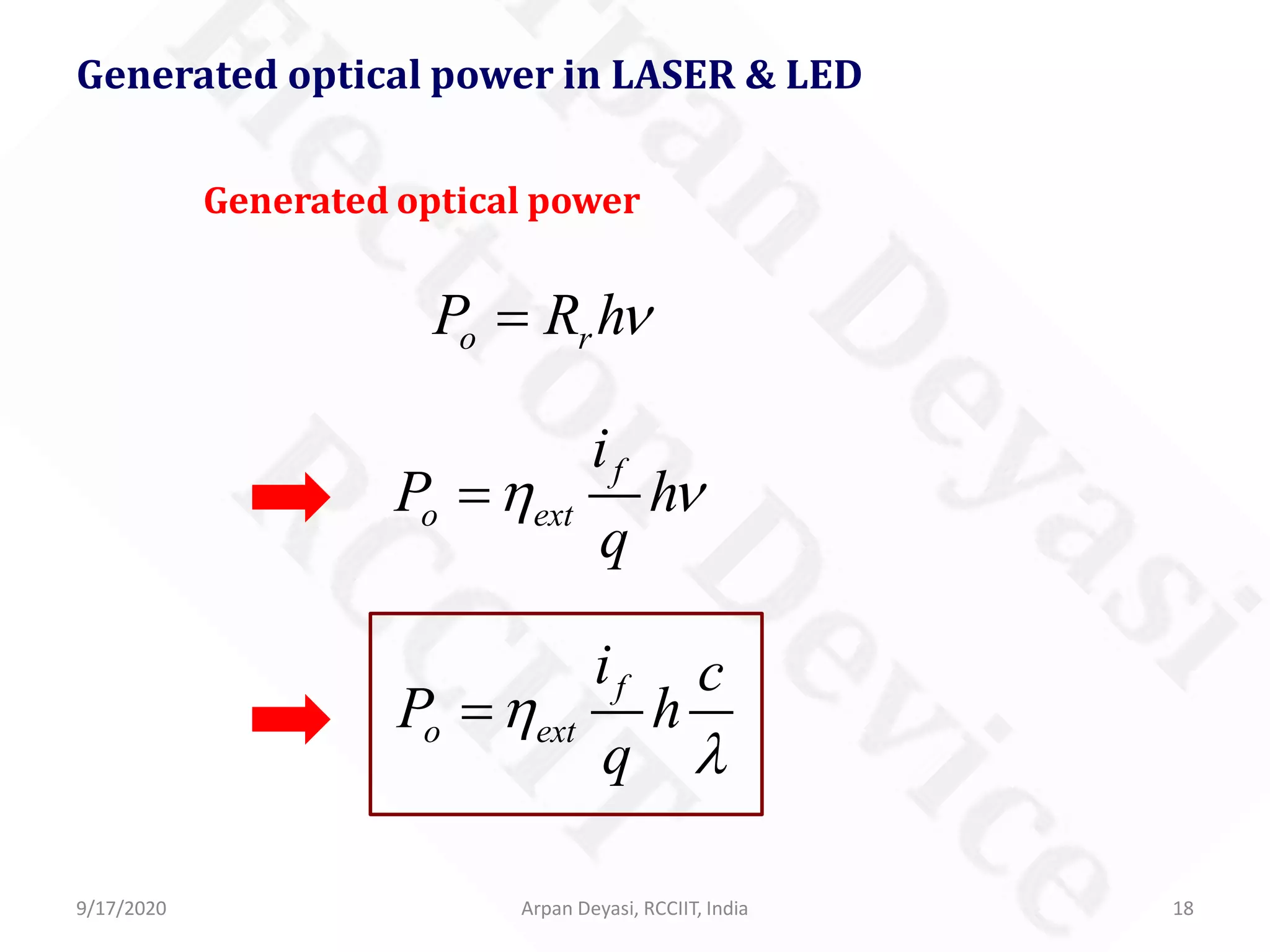
Generated optical power
o rP R hν=
9/17/2020 18Arpan Deyasi, RCCIIT, India
Generated optical power in LASER & LED
f
o ext
i
P h
q
η ν=
f
o ext
i c
P h
q
η
λ
=
Output power
0 1.24
f exti
P
η
λ
=
9/17/2020 19Arpan Deyasi, RCCIIT, India
Generated optical power in LASER & LED
Responsivity --- ratio of emitted optical power
to injection current
1.24 ext
R
η
λ
=
9/17/2020 20Arpan Deyasi, RCCIIT, India
Responsivity in LASER & LED
0
f
P
R
i
=
Difference between LASER and LED
Parameter LASER LED
Working Principle Stimulated
Emission
Spontaneous
emission
Driving Current Lower
(~ 5 -40 mA)
Higher
(~ 50-100 mA)
Nature of emitted light Coherent,
monochromatic
Incoherent,
polychromatic
Power to light
Conversion Efficiency
Approx 80 % Approx 20 %
Numerical Aperture Extremely low large
9/17/2020 21Arpan Deyasi, RCCIIT, India
9/17/2020 Arpan Deyasi, RCCIIT, India 22
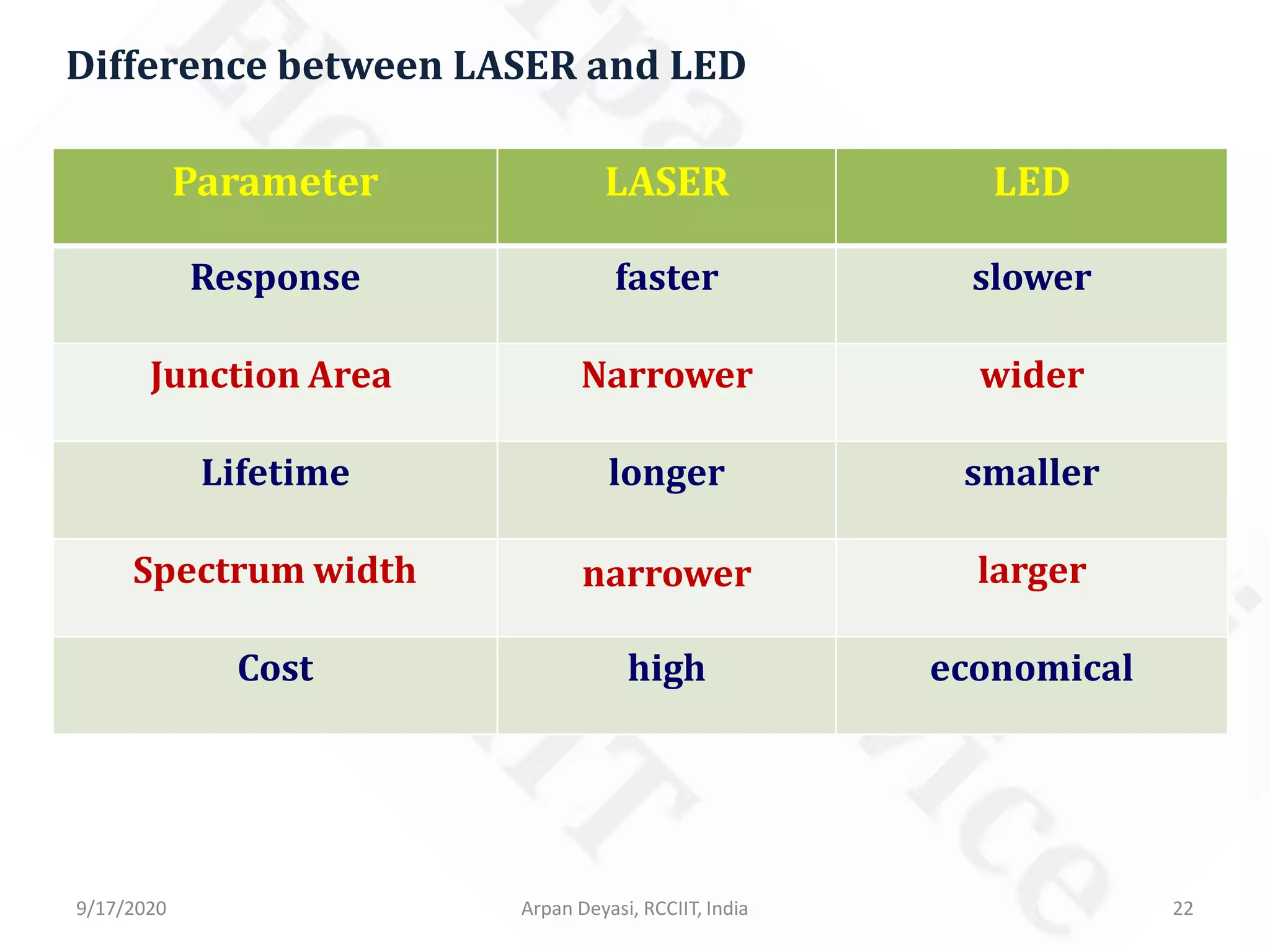
Difference between LASER and LED
Parameter LASER LED
Response faster slower
Junction Area Narrower wider
Lifetime longer smaller
Spectrum width narrower larger
Cost high economical

Foundation of optical transmitter

  • 1.
    Course: Electronic Devices papercode: EC301 Course Coordinator: Arpan Deyasi Department of Electronics and Communication Engineering RCC Institute of Information Technology Kolkata, India 9/17/2020 1Arpan Deyasi, RCCIIT, India Topic: Optical Transmitter
  • 2.
    Optical Transmitter converts electricalsignal into optical signal Optical Transmitter I hν Types: LASER [Light Amplification by Stimulated Emission of Radiation] LED [Light Emitting Diode] 9/17/2020 2Arpan Deyasi, RCCIIT, India
  • 3.
    Bulk LASER Semiconductor LASER QuantumLASER Different types of LASER 9/17/2020 3Arpan Deyasi, RCCIIT, India
  • 4.
    BulkLASER(3-level) N0 N1 N2 E0 E1 E2 sp. emi st. emi N0>>N1,N2 hν1=E2-E0 st. abs hν2=E2-E1 hν3=E1-E0 9/17/2020 4Arpan Deyasi, RCCIIT, India
  • 5.
    BulkLASER(4-level) N0 N2 N3 E0 E2 E3 sp. emi st. emi N0>>N1,N2, N3 hν1=E3-E0 st. abs hν2=E3-E2 hν3=E2-E0 N1 st. emi hν4=E2-E1 E1 9/17/2020 5Arpan Deyasi, RCCIIT, India
  • 6.
    SemiconductorLASER Vbi 9/17/2020 6Arpan Deyasi,RCCIIT, India EC EFI EV Vbi -Vf hν=EC-EV
  • 7.
    Semiconductor LASER For operation,both electrical and optical biases are required g f E V q ≈ 9/17/2020 7Arpan Deyasi, RCCIIT, India
  • 8.
    Semiconductor LASER: Drawbacks Improperdepletion width ---- ill-defined active region ---- carrier confinement is not possible Improper modal volume ---- mode confinement is not possible Larger active region --- higher threshold current density ------- continuous room temperature operation is not possible 9/17/2020 8Arpan Deyasi, RCCIIT, India
  • 9.
    Quantum Well LASER E1 E2 E3 hν1=E3-E2 hν3=E2-E1 hν2=E3-E1 32 32 hc E λ= ∆ 31 31 hc E λ = ∆ 21 21 hc E λ = ∆ 9/17/2020 9Arpan Deyasi, RCCIIT, India
  • 10.
    SemiconductorLED Vbi 9/17/2020 10Arpan Deyasi,RCCIIT, India EC EFI EV Vbi -Vf hν=EC-EV
  • 11.
    9/17/2020 Arpan Deyasi,RCCIIT, India 11 Steady state electron density in LASER & LED ( ) p d J n n dt qd τ ∆ ∆ = − Rate equation for recombination Under equilibrium 0 d dt =
  • 12.
    9/17/2020 Arpan Deyasi,RCCIIT, India 12 Steady state electron density in LASER & LED 0 p J n qd τ ∆ − = pJ n qd τ ∆ =
  • 13.
    9/17/2020 Arpan Deyasi,RCCIIT, India 13 Recombination rate in LASER & LED t r nr J r r r qd = + = Total recombination rate Total number of recombination in the device under forward bias fi R q =
  • 14.
    9/17/2020 Arpan Deyasi,RCCIIT, India 14 Internal Quantum Efficiency in LASER & LED Internal Quantum Efficiency = Number of photons generated inside the device Number of electrons injected
  • 15.
    9/17/2020 Arpan Deyasi,RCCIIT, India 15 External Quantum Efficiency in LASER & LED External Quantum Efficiency = Number of photons emitted Number of EHPs responsible to produce photocurrent r r ext t r nr r r r r r η = = +
  • 16.
    9/17/2020 Arpan Deyasi,RCCIIT, India 16 Recombination rate in LASER & LED r r ext t t r R r R η = = Rr: number of radiative recombination in the whole volume of active region Rt: total number of recombination in the whole volume of active region
  • 17.
    9/17/2020 Arpan Deyasi,RCCIIT, India 17 Recombination rate in LASER & LED r ext tR Rη= f r ext i R q η=
  • 18.
    Generated optical power orP R hν= 9/17/2020 18Arpan Deyasi, RCCIIT, India Generated optical power in LASER & LED f o ext i P h q η ν= f o ext i c P h q η λ =
  • 19.
    Output power 0 1.24 fexti P η λ = 9/17/2020 19Arpan Deyasi, RCCIIT, India Generated optical power in LASER & LED
  • 20.
    Responsivity --- ratioof emitted optical power to injection current 1.24 ext R η λ = 9/17/2020 20Arpan Deyasi, RCCIIT, India Responsivity in LASER & LED 0 f P R i =
  • 21.
    Difference between LASERand LED Parameter LASER LED Working Principle Stimulated Emission Spontaneous emission Driving Current Lower (~ 5 -40 mA) Higher (~ 50-100 mA) Nature of emitted light Coherent, monochromatic Incoherent, polychromatic Power to light Conversion Efficiency Approx 80 % Approx 20 % Numerical Aperture Extremely low large 9/17/2020 21Arpan Deyasi, RCCIIT, India
  • 22.
    9/17/2020 Arpan Deyasi,RCCIIT, India 22 Difference between LASER and LED Parameter LASER LED Response faster slower Junction Area Narrower wider Lifetime longer smaller Spectrum width narrower larger Cost high economical