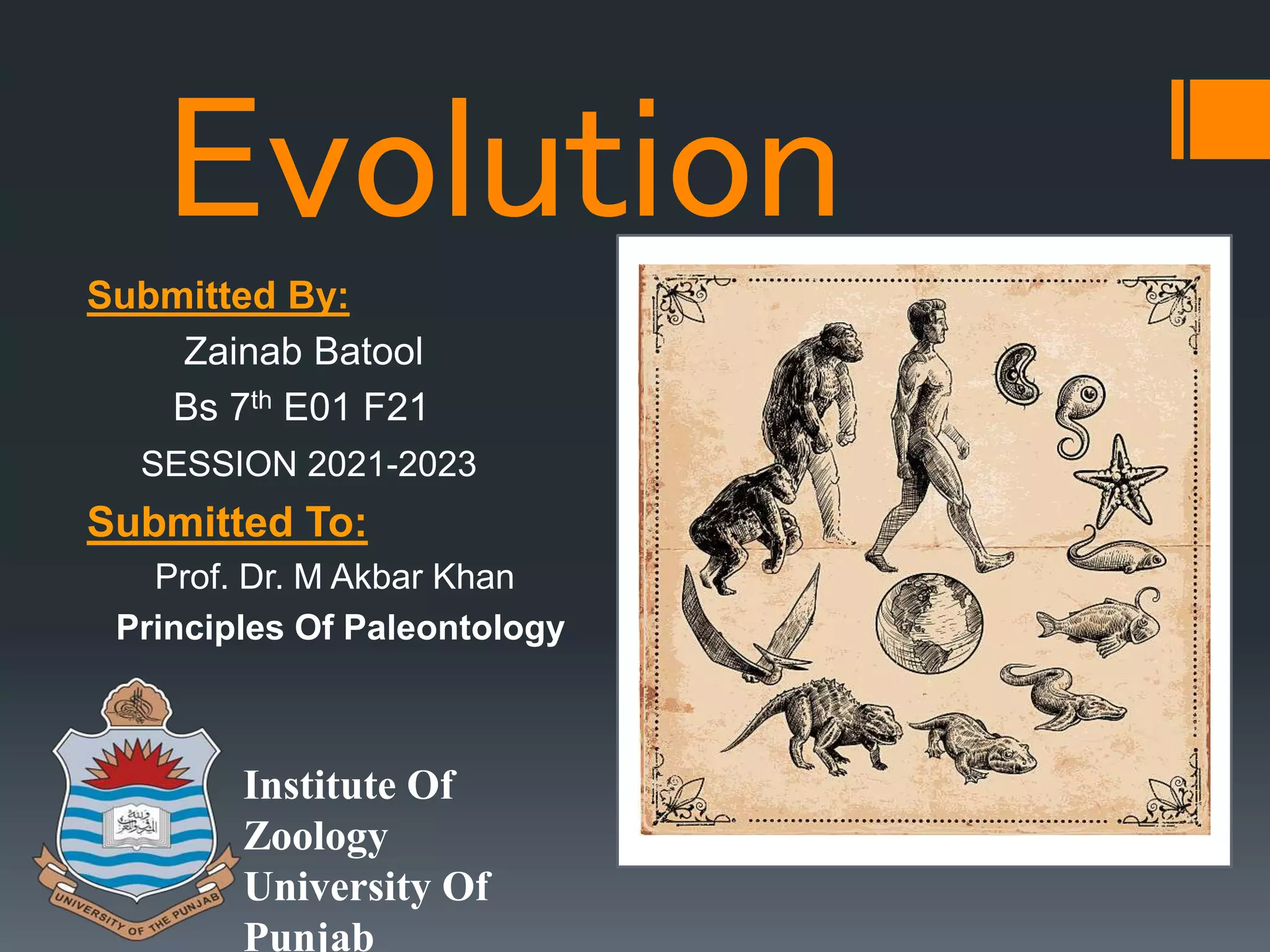
Evolution
Submitted By:
Zainab Batool
Bs 7th E01 F21
SESSION 2021-2023
Submitted To:
Prof. Dr. M Akbar Khan
Principles Of Paleontology
Institute Of
Zoology
University Of
Punjab
Content
Evolution
Lamarck’s Theory of Evolution
Darwin’s Theory of Evolution
Natural Selection
Artificial Selection
Evidence of Evolution
Misconceptions
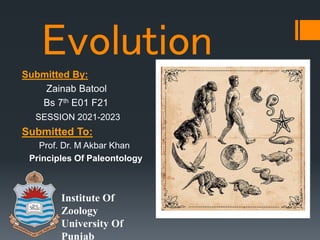
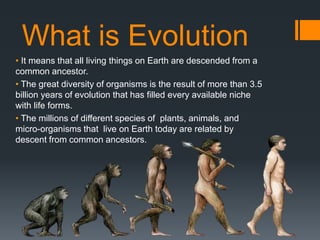
What is Evolution
• It means that all living things on Earth are descended from a
common ancestor.
• The great diversity of organisms is the result of more than 3.5
billion years of evolution that has filled every available niche
with life forms.
• The millions of different species of plants, animals, and
micro-organisms that live on Earth today are related by
descent from common ancestors.
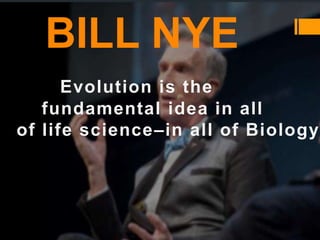
BILL NYE
Evolution is the
fundamental idea in all
of life science–in all of Biology
Lamarck's Theory
Organisms constantly strive to improve themselves
by changing.
Changes are adaptations to environment acquired
in an organism's lifetime.
A structure is modified or changed by use or
disuse.
The modification is inherited to the offspring.
Inheritance of acquired characteristics.
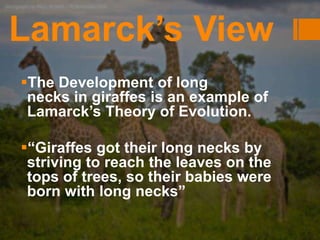
Lamarck’s View
The Development of long
necks in giraffes is an example of
Lamarck’s Theory of Evolution.
“Giraffes got their long necks by
striving to reach the leaves on the
tops of trees, so their babies were
born with long necks”
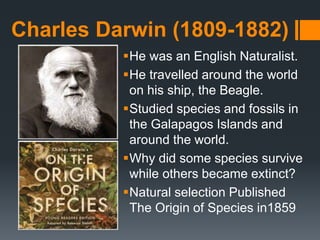
Charles Darwin (1809-1882)
He was an English Naturalist.
He travelled around the world
on his ship, the Beagle.
Studied species and fossils in
the Galapagos Islands and
around the world.
Why did some species survive
while others became extinct?
Natural selection Published
The Origin of Species in1859
Darwin’s Theory
Darwin's theory of evolution has four main parts:
Organisms have changed over time, and the ones
living today are different from those that lived in the
past.
 Change is gradual and slow, taking place over a
long time. This was supported by the fossil record.
 All organisms come from common ancestors by a
process of branching.
The mechanism of evolutionary change is natural
selection.
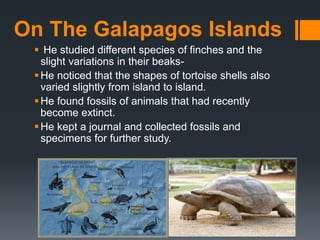
On The Galapagos Islands
 He studied different species of finches and the
slight variations in their beaks-
He noticed that the shapes of tortoise shells also
varied slightly from island to island.
He found fossils of animals that had recently
become extinct.
He kept a journal and collected fossils and
specimens for further study.
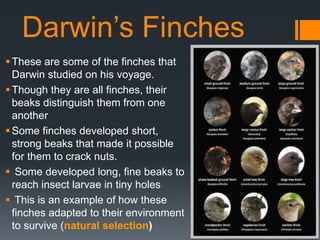
Darwin’s Finches
These are some of the finches that
Darwin studied on his voyage.
Though they are all finches, their
beaks distinguish them from one
another
Some finches developed short,
strong beaks that made it possible
for them to crack nuts.
 Some developed long, fine beaks to
reach insect larvae in tiny holes
 This is an example of how these
finches adapted to their environment
to survive (natural selection)
Natural Selection
Evolution.pptx

Evolution.pptx

  • 1.
    Evolution Submitted By: Zainab Batool Bs7th E01 F21 SESSION 2021-2023 Submitted To: Prof. Dr. M Akbar Khan Principles Of Paleontology Institute Of Zoology University Of Punjab
  • 2.
    Content Evolution Lamarck’s Theory ofEvolution Darwin’s Theory of Evolution Natural Selection Artificial Selection Evidence of Evolution Misconceptions
  • 3.
    What is Evolution •It means that all living things on Earth are descended from a common ancestor. • The great diversity of organisms is the result of more than 3.5 billion years of evolution that has filled every available niche with life forms. • The millions of different species of plants, animals, and micro-organisms that live on Earth today are related by descent from common ancestors.
  • 4.
    BILL NYE Evolution isthe fundamental idea in all of life science–in all of Biology
  • 5.
    Lamarck's Theory Organisms constantlystrive to improve themselves by changing. Changes are adaptations to environment acquired in an organism's lifetime. A structure is modified or changed by use or disuse. The modification is inherited to the offspring. Inheritance of acquired characteristics.
  • 6.
    Lamarck’s View The Developmentof long necks in giraffes is an example of Lamarck’s Theory of Evolution. “Giraffes got their long necks by striving to reach the leaves on the tops of trees, so their babies were born with long necks”
  • 7.
    Charles Darwin (1809-1882) Hewas an English Naturalist. He travelled around the world on his ship, the Beagle. Studied species and fossils in the Galapagos Islands and around the world. Why did some species survive while others became extinct? Natural selection Published The Origin of Species in1859
  • 8.
    Darwin’s Theory Darwin's theoryof evolution has four main parts: Organisms have changed over time, and the ones living today are different from those that lived in the past.  Change is gradual and slow, taking place over a long time. This was supported by the fossil record.  All organisms come from common ancestors by a process of branching. The mechanism of evolutionary change is natural selection.
  • 9.
    On The GalapagosIslands  He studied different species of finches and the slight variations in their beaks- He noticed that the shapes of tortoise shells also varied slightly from island to island. He found fossils of animals that had recently become extinct. He kept a journal and collected fossils and specimens for further study.
  • 10.
    Darwin’s Finches These aresome of the finches that Darwin studied on his voyage. Though they are all finches, their beaks distinguish them from one another Some finches developed short, strong beaks that made it possible for them to crack nuts.  Some developed long, fine beaks to reach insect larvae in tiny holes  This is an example of how these finches adapted to their environment to survive (natural selection)
  • 11.