FORMULATION
OF COURSE
OBJECTIVES
Presented by,
Snehal S. Athawale
School of Social Sciences
Ph.D (Agri. Economics) 1st Year
COURSE CODE
EXT-603
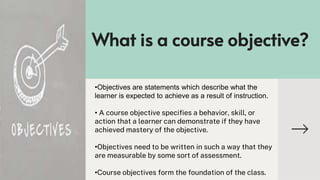
What is a course objective?
•Objectives are statements which describe what the
learner is expected to achieve as a result of instruction.
• A course objective specifies a behavior, skill, or
action that a learner can demonstrate if they have
achieved mastery of the objective.
•Objectives need to be written in such a way that they
are measurable by some sort of assessment.
•Course objectives form the foundation of the class.
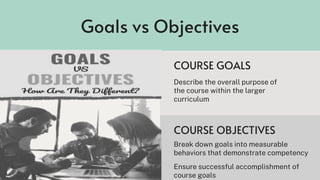
Goals vs Objectives
Describe the overall purpose of
the course within the larger
curriculum
Break down goals into measurable
behaviors that demonstrate competency
Ensure successful accomplishment of
course goals
COURSE GOALS
COURSE OBJECTIVES
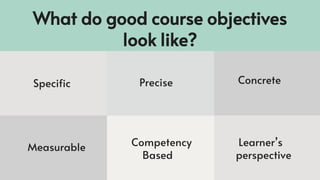
What do good course objectives
look like?
Specific Precise Concrete
Measurable Competency
Based
Learner’s
perspective
What is a learning objective?
1. A learning objective is a clearly written statement that
specifies what the learner should be able to do after he
completes the course.
2. The learning objective describes what the learner will be
able to do after completing the course.
3. The conditions under which the learner will perform the
task
4. The criteria for evaluating learner performance
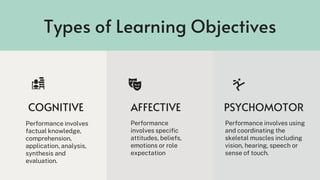
Performance involves using
and coordinating the
skeletal muscles including
vision, hearing, speech or
sense of touch.
PSYCHOMOTOR
Performance
involves specific
attitudes, beliefs,
emotions or role
expectation
Performance involves
factual knowledge,
comprehension,
application, analysis,
synthesis and
evaluation.
AFFECTIVE
COGNITIVE
Types of Learning Objectives
With what
requirements?
What are the standards
of acceptable
performance?
Who are the
learner?
Condition of
performance
Degree/criteria
Audience
What will the
learner be able to
do?
Observable
Behavior
Components
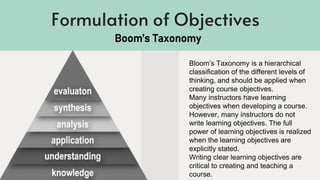
Formulation of Objectives
Bloom’s Taxonomy is a hierarchical
classification of the different levels of
thinking, and should be applied when
creating course objectives.
Many instructors have learning
objectives when developing a course.
However, many instructors do not
write learning objectives. The full
power of learning objectives is realized
when the learning objectives are
explicitly stated.
Writing clear learning objectives are
critical to creating and teaching a
course.
Boom’s Taxonomy
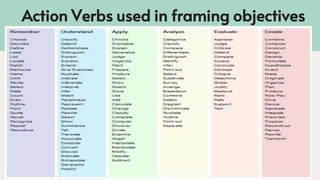
Action Verbs used in framing objectives
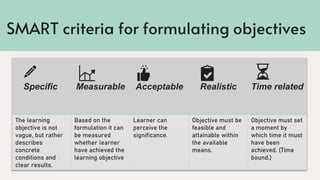
SMART criteria for formulating objectives
Specific Measurable Acceptable Realistic Time related
The learning
objective is not
vague, but rather
describes
concrete
conditions and
clear results.
Based on the
formulation it can
be measured
whether learner
have achieved the
learning objective
Learner can
perceive the
significance.
Objective must be
feasible and
attainable within
the available
means.
Objective must set
a moment by
which time it must
have been
achieved. (Time
bound.)
REFERENCES
Bloom, B. (1984). The taxonomy of educational objectives:-- Cognitive Domain. NY: Longman
.
Chapter 3. Diagnosis, Formulation of Objectives and Selection of Content and Learning
Experiences. (n.d.). Retrieved February 07, 2018 from
http://shodhganga.inflibnet.ac.in/bitstream/10603/48993/6/06_chapter%203.pdf
Kapur, Radhika. (2018). Formulation of Objectives in Curriculum Development.
https://www.researchgate.net/publication/323694981_Formulation_of_Objectives_in_Curriculum_Development
Skilbeck, M. (1971). Preparing Curriculum Objectives. The Vocational Aspect of Education.
XXIII, (54), 1-7. Retrieved February 08, 2018 from
http://www.tandfonline.com/doi/pdf/10.1080/03057877180000011
—Stephen Covey
The Seven Habits of Highly Effective
People
“Begin with
the end in
mind”

Formulation of Course objective.pptx

  • 1.
    FORMULATION OF COURSE OBJECTIVES Presented by, SnehalS. Athawale School of Social Sciences Ph.D (Agri. Economics) 1st Year COURSE CODE EXT-603
  • 2.
    What is acourse objective? •Objectives are statements which describe what the learner is expected to achieve as a result of instruction. • A course objective specifies a behavior, skill, or action that a learner can demonstrate if they have achieved mastery of the objective. •Objectives need to be written in such a way that they are measurable by some sort of assessment. •Course objectives form the foundation of the class.
  • 3.
    Goals vs Objectives Describethe overall purpose of the course within the larger curriculum Break down goals into measurable behaviors that demonstrate competency Ensure successful accomplishment of course goals COURSE GOALS COURSE OBJECTIVES
  • 4.
    What do goodcourse objectives look like? Specific Precise Concrete Measurable Competency Based Learner’s perspective
  • 5.
    What is alearning objective? 1. A learning objective is a clearly written statement that specifies what the learner should be able to do after he completes the course. 2. The learning objective describes what the learner will be able to do after completing the course. 3. The conditions under which the learner will perform the task 4. The criteria for evaluating learner performance
  • 6.
    Performance involves using andcoordinating the skeletal muscles including vision, hearing, speech or sense of touch. PSYCHOMOTOR Performance involves specific attitudes, beliefs, emotions or role expectation Performance involves factual knowledge, comprehension, application, analysis, synthesis and evaluation. AFFECTIVE COGNITIVE Types of Learning Objectives
  • 7.
    With what requirements? What arethe standards of acceptable performance? Who are the learner? Condition of performance Degree/criteria Audience What will the learner be able to do? Observable Behavior Components
  • 8.
    Formulation of Objectives Bloom’sTaxonomy is a hierarchical classification of the different levels of thinking, and should be applied when creating course objectives. Many instructors have learning objectives when developing a course. However, many instructors do not write learning objectives. The full power of learning objectives is realized when the learning objectives are explicitly stated. Writing clear learning objectives are critical to creating and teaching a course. Boom’s Taxonomy
  • 9.
    Action Verbs usedin framing objectives
  • 10.
    SMART criteria forformulating objectives Specific Measurable Acceptable Realistic Time related The learning objective is not vague, but rather describes concrete conditions and clear results. Based on the formulation it can be measured whether learner have achieved the learning objective Learner can perceive the significance. Objective must be feasible and attainable within the available means. Objective must set a moment by which time it must have been achieved. (Time bound.)
  • 11.
    REFERENCES Bloom, B. (1984).The taxonomy of educational objectives:-- Cognitive Domain. NY: Longman . Chapter 3. Diagnosis, Formulation of Objectives and Selection of Content and Learning Experiences. (n.d.). Retrieved February 07, 2018 from http://shodhganga.inflibnet.ac.in/bitstream/10603/48993/6/06_chapter%203.pdf Kapur, Radhika. (2018). Formulation of Objectives in Curriculum Development. https://www.researchgate.net/publication/323694981_Formulation_of_Objectives_in_Curriculum_Development Skilbeck, M. (1971). Preparing Curriculum Objectives. The Vocational Aspect of Education. XXIII, (54), 1-7. Retrieved February 08, 2018 from http://www.tandfonline.com/doi/pdf/10.1080/03057877180000011
  • 12.
    —Stephen Covey The SevenHabits of Highly Effective People “Begin with the end in mind”