555
Session- 2017-2018
Submitted To:-
Mr. S.K. Tiwari
Submitted By:-
Mayank Kashyap
Class: 12 th
https://www.slideshare.net/naveenjayan/physics-investigatory-project-46371553AA
Mrs. Kavita Pandey Mr.
S.K Tiwari,
s
Signature of
External Examiner
Signature of
Physics Teacher
Signature of Principal
Alternating current (AC),
Types of Periodic Waveform
The most common periodic signal waveforms that are used in Electrical and
Electronic Engineering are the Sinusoidal Waveforms. However, an alternating
AC waveform may not always take the shape of a smooth shape based around
the trigonometric sine or cosine function. AC waveforms can also take the
shape of either Complex Waves, Square Waves or Triangular Waves.
Some Definitions Regarding Alternating
Voltage and Current:
1. Periodic Time: The time taken for an AC Waveform to
complete one full pattern from its positive half to its negative half and
back to its zero baseline again is called a Cycle and one complete cycle
contains both a positive half-cycle and a negative half-cycle. The time
taken by the waveform to complete one full cycle is called the Periodic
Time of the waveform, and is given the symbol “T”.
2. Frequency:The number of complete cycles that are produced
within one second (cycles/second) is called the Frequency, symbol ƒ of the
alternating waveform. Frequency is measured in Hertz, (Hz) named after
the German physicist Heinrich Hertz.
Then we can see that a relationship exists between cycles (oscillations),
periodic time and frequency (cycles per second), so if there are ƒ
number of cycles in one second, each individual cycle must take 1/ƒ
seconds to complete. The frequency of the domestic alternating current
is 50 cycles/second or 50Hz.
3. Amplitude: As well as knowing either the periodic time or the
frequency of the alternating quantity, another important parameter of
the AC waveform is Amplitude, better known as its Maximum or Peak
value represented by the terms, Vmax for voltage or Imax for current.
The peak value is the greatest value of either voltage or current that the
waveform reaches during each half cycle measured from the zero
baseline. Unlike a DC voltage or current which has a steady state that can
be measured or calculated using Ohm’s Law, an alternating quantity is
constantly changing its value over time.
For pure sinusoidal waveforms this peak value will always be the same
for both half cycles (+Vm = -Vm) but for non-sinusoidal or complex
waveforms the maximum peak value can be very different for each half
cycle. Sometimes, alternating waveforms are given a peak-to-peak, Vp-p
value and this is simply the distance or the sum in voltage between the
maximum peak value, +Vmax and the minimum peak value, -Vmax
during one complete cycle.
Root-Mean-square (RMS) Value of Alternating Current
The term “RMS” stands for “Root-Mean-Squared”. Most books define this as the
“amount of AC power that produces the same heating effect as an equivalent DC
power”, or something similar along these lines, but an RMS value is more than
just that. The RMS value is the square root of the mean (average) value of the
squared function of the instantaneous values. The symbols used for defining an
RMS value are VRMS or IRMS.
The root mean squared, RMS value of a sinusoid is not the same as the average of
all the instantaneous values. The ratio of the RMS value of voltage to the
maximum value of voltage is the same as the ratio of the RMS value of current to
the maximum value of current. Most multi-meters, either voltmeters or ammeters,
measure RMS value assuming a pure sinusoidal waveform. For finding the RMS
value of non-sinusoidal waveform a “True RMS Multimeter” is required.
The RMS value of a sinusoidal waveform gives the same heating effect as a DC
current of the same value. That is if a direct current, I passes through a resistance
of R ohms, the DC power consumed by the resistor as heat will therefore be I
2
R
watts. Then if an alternating current, i = Im.sinθ flows through the same resistance,
the AC power converted into heat will be: I
2
rms.R watts.
We calculated the RMS Voltage of a sinusoidal waveform. The RMS voltage of a
sinusoid or complex waveform can be determined by two basic methods:-
Graphical Method – which can be used to find the RMS value of any non-
sinusoidal time-varying waveform by drawing a number of mid-ordinates onto
the waveform.
Analytical Method – is a mathematical procedure for finding the effective
or RMS value of any periodic voltage or current using calculus.
 RMS Voltage Graphical Method:-
Whilst the method of calculation is the same for both halves of an AC waveform, for
this example we will consider only the positive half cycle. The effective or rms value
of a waveform can be found with a reasonable amount of accuracy by taking equally
spaced instantaneous values along the waveform.
Each mid-ordinate value of a waveform (the voltage waveform in this case) is
multiplied by itself (squared) and added to the next. This method gives us the
“square” or Squared part of the RMS voltage expression. Next this squared value is
divided by the number of mid-ordinates used to give us the Mean part of the RMS
voltage expression, and in our simple example above the number of mid-ordinates
used was twelve (12). Finally, the square root of the previous result is found to give us
the Root part of the RMS voltage.
Then we can define the term used to describe an rms voltage (VRMS) as being “the
square root of the mean of the square of the mid-ordinates of the voltage waveform”
and this is given as:
 RMS Voltage Analytical Method:-
The graphical method above is a very good way of finding the effective or RMS
voltage, (or current) of an alternating waveform that is not symmetrical or sinusoidal
in nature. In other words the waveform shape resembles that of a complex waveform.
However, when dealing with pure sinusoidal waveforms we can make life a little bit
easier for ourselves by using an analytical or mathematical way of finding the RMS
value.
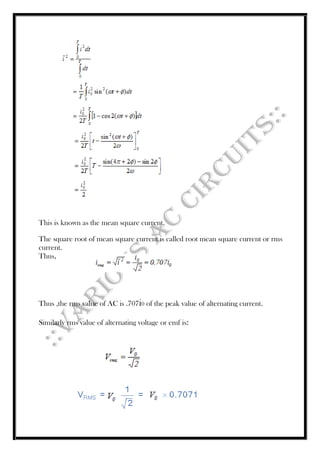
A periodic sinusoidal voltage is constant. i is instantaneous value of current and it is
defined as: i=i0sin ωt with a period of T. Then we can calculate the root-mean-
square (rms) value of a sinusoidal voltage (V(t)) as:
This is known as the mean square current.
The square root of mean square current is called root mean square current or rms
current.
Thus,
Thus ,the rms value of AC is .707i0 of the peak value of alternating current.
Similarly rms value of alternating voltage or emf is:
Average (Mean) Value of Alternating Current:-
The process used to find the Average Voltage of an alternating waveform is very
similar to that for finding its RMS value, the difference this time is that the
instantaneous values are not squared and we do not find the square root of the
summed mean.
The average voltage (or current) of a periodic waveform whether it is a sine
wave, square wave or triangular waveform is defined as: “the quotient of the
area under the waveform with respect to time”. In other words, the averaging of
all the instantaneous values along time axis with time being one full period, (T).
When dealing with alternating voltages (or currents), the term Average value is
generally taken over one complete cycle, whereas the term Mean value is used for
one half of the periodic cycle.
The average value of a whole sinusoidal waveform over one complete cycle is zero
as the two halves cancel each other out, so the average value is taken over half a
cycle. The average value of a sine wave of voltage or current is 0.637 times the
peak value, (Vp or Ip. This mathematical relationship between the average values
applies to both AC current and AC voltage.
Sometimes it is required to be able to calculate the value of the direct voltage
or current output from a rectifier or pulse type circuit such as a PWM motor
circuit because the voltage or current, although not reversing, is changing
continuously. Since there are no phase reversals the average value is used and the
RMS (root-mean-square) value is unimportant for this type of application.
The main differences between an RMS Voltage and an Average Voltage, is that
the mean value of a periodic wave is the average of all the instantaneous areas
taken under the curve over a given period of the waveform, and in the case of a
sinusoidal quantity, this period is taken as one-half of the cycle of the wave. For
convenience the positive half cycle is generally used.
Average Current Analytical Method:
The average value can be taken mathematically by taking the approximation of
the area under the curve at various intervals to the distance or length of the
base and this can be done using triangles or rectangles as shown.
By approximating the areas of the rectangles under the curve, we can obtain a
rough idea of the actual area of each one. By adding together all these areas the
average value can be found. If an infinite number of smaller thinner rectangles
were used, the more accurate would be the final result as it approaches 2/π.
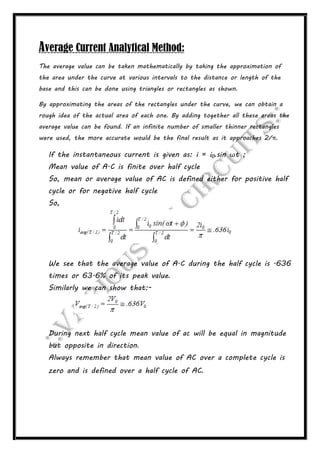
If the instantaneous current is given as: i = i0.sin ωt ;
Mean value of A.C is finite over half cycle
So, mean or average value of AC is defined either for positive half
cycle or for negative half cycle
So,
We see that the average value of A.C during the half cycle is .636
times or 63.6% of its peak value.
Similarly we can show that:-
During next half cycle mean value of ac will be equal in magnitude
but opposite in direction.
Always remember that mean value of AC over a complete cycle is
zero and is defined over a half cycle of AC.
Phasors and Phasor Diagrams:
The terms “lead” and “lag” as well as “in-phase” and “out-of-phase” were used to
indicate the relationship of one waveform to the other with the generalized sinusoidal
expression given as: A(t) = Am sin(ωt ± Φ) representing the sinusoid in the time-
domain form.
But when presented mathematically in this way it is sometimes difficult to visualize
this angular or phasor difference between two or more sinusoidal waveforms. One
way to overcome this problem is to represent the sinusoids graphically within the
spacial or phasor-domain form by using Phasor Diagrams, and this is achieved by the
rotating vector method.
Basically a rotating vector, simply called a “Phasor” is a scaled line whose length
represents an AC quantity that has both magnitude (“peak amplitude”) and direction
(“phase”) which is “frozen” at some point in time.
A phasor is a vector that has an arrow head at one end which signifies partly the
maximum value of the vector quantity (V or I) and partly the end of the vector that
rotates.
Generally, vectors are assumed to pivot at one end around a fixed zero point known
as the “point of origin” while the arrowed end representing the quantity, freely rotates
in an anti-clockwise direction at an angular velocity, ( ω ) of one full revolution for
every cycle. This anti-clockwise rotation of the vector is considered to be a positive
rotation. Likewise, a clockwise rotation is considered to be a negative rotation.
Although the both the terms vectors and phasors are used to describe a rotating line
that itself has both magnitude and direction, the main difference between the two is
that a vectors magnitude is the “peak value” of the sinusoid while a phasors
magnitude is the “rms value” of the sinusoid. In both cases the phase angle and
direction remains the same.
The phase of an alternating quantity at any instant in time can be represented by a
phasor diagram, so phasor diagrams can be thought of as “functions of time”. A
complete sine wave can be constructed by a single vector rotating at an angular
velocity of ω = 2πƒ, where ƒ is the frequency of the waveform. Then a Phasor is a
quantity that has both “Magnitude” and “Direction”. A diagram representing
alternating current and alternating voltage (of same frequency) as rotating vectors
(Phasors) with the phase angle between them is called a phasor diagram.
Generally, when constructing a phasor diagram, angular velocity of a sine wave is
always assumed to be: ω in rad/s.
Different types of AC circuits:-
In an alternating current circuit the phase difference between the current I and
the voltage V depends upon the type of the circuit. We shall first study simple
circuits containing only one element (resistor, inductor or capacitor) and then
circuits containing combinations of these basic circuit elements.
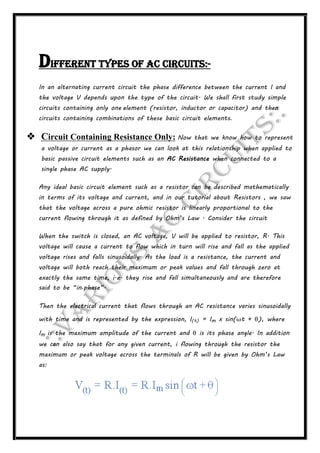
 Circuit Containing Resistance Only: Now that we know how to represent
a voltage or current as a phasor we can look at this relationship when applied to
basic passive circuit elements such as an AC Resistance when connected to a
single phase AC supply.
Any ideal basic circuit element such as a resistor can be described mathematically
in terms of its voltage and current, and in our tutorial about Resistors , we saw
that the voltage across a pure ohmic resistor is linearly proportional to the
current flowing through it as defined by Ohm’s Law . Consider the circuit
When the switch is closed, an AC voltage, V will be applied to resistor, R. This
voltage will cause a current to flow which in turn will rise and fall as the applied
voltage rises and falls sinusoidally. As the load is a resistance, the current and
voltage will both reach their maximum or peak values and fall through zero at
exactly the same time, i.e. they rise and fall simultaneously and are therefore
said to be “in-phase”.
Then the electrical current that flows through an AC resistance varies sinusoidally
with time and is represented by the expression, I(t) = Im x sin(ωt + θ), where
Im is the maximum amplitude of the current and θ is its phase angle. In addition
we can also say that for any given current, i flowing through the resistor the
maximum or peak voltage across the terminals of R will be given by Ohm’s Law
as:
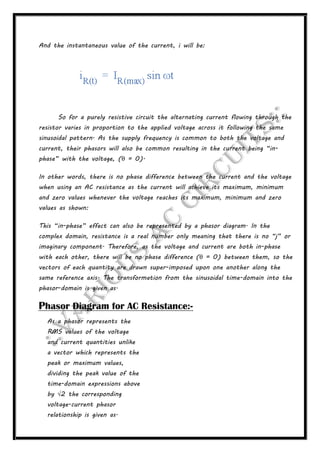
And the instantaneous value of the current, i will be:
So for a purely resistive circuit the alternating current flowing through the
resistor varies in proportion to the applied voltage across it following the same
sinusoidal pattern. As the supply frequency is common to both the voltage and
current, their phasors will also be common resulting in the current being “in-
phase” with the voltage, (θ = 0).
In other words, there is no phase difference between the current and the voltage
when using an AC resistance as the current will achieve its maximum, minimum
and zero values whenever the voltage reaches its maximum, minimum and zero
values as shown:
This “in-phase” effect can also be represented by a phasor diagram. In the
complex domain, resistance is a real number only meaning that there is no “j” or
imaginary component. Therefore, as the voltage and current are both in-phase
with each other, there will be no phase difference (θ = 0) between them, so the
vectors of each quantity are drawn super-imposed upon one another along the
same reference axis. The transformation from the sinusoidal time-domain into the
phasor-domain is given as.
Phasor Diagram for AC Resistance:-
As a phasor represents the
RMS values of the voltage
and current quantities unlike
a vector which represents the
peak or maximum values,
dividing the peak value of the
time-domain expressions above
by √2 the corresponding
voltage-current phasor
relationship is given as.
Circuit containing Inductance only: In an alternating current circuit which
contains an AC Inductance, the flow of current through an inductor behaves very
differently to that of a steady state DC voltage. Now in an AC circuit, the
opposition to the current flowing through the coils windings not only depends
upon the inductance of the coil but also the frequency of the applied voltage
waveform as it varies from its positive to negative values.
The actual opposition to the current flowing through a coil in an AC circuit is
determined by the AC Resistance of the coil with this AC resistance being
represented by a complex number. But to distinguish a DC resistance value from
an AC resistance value, which is also known as Impedance, the term Reactance is
used.
Like resistance, reactance is measured in Ohm’s but is given the symbol “X” to
distinguish it from a purely resistive “R” value and as the component in question
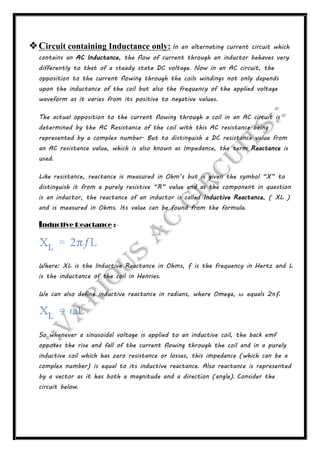
is an inductor, the reactance of an inductor is called Inductive Reactance, ( XL )
and is measured in Ohms. Its value can be found from the formula.
Inductive Reactance :-
Where: XL is the Inductive Reactance in Ohms, ƒ is the frequency in Hertz and L
is the inductance of the coil in Henries.
We can also define inductive reactance in radians, where Omega, ω equals 2πƒ.
So whenever a sinusoidal voltage is applied to an inductive coil, the back emf
opposes the rise and fall of the current flowing through the coil and in a purely
inductive coil which has zero resistance or losses, this impedance (which can be a
complex number) is equal to its inductive reactance. Also reactance is represented
by a vector as it has both a magnitude and a direction (angle). Consider the
circuit below.
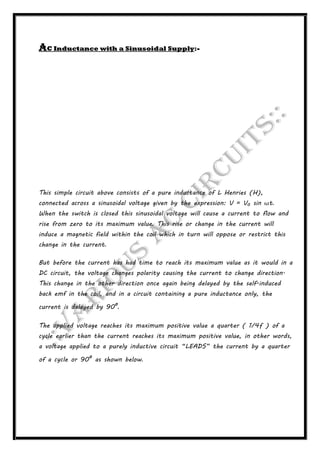
AC Inductance with a Sinusoidal Supply:-
This simple circuit above consists of a pure inductance of L Henries (H),
connected across a sinusoidal voltage given by the expression: V = V0 sin ωt.
When the switch is closed this sinusoidal voltage will cause a current to flow and
rise from zero to its maximum value. This rise or change in the current will
induce a magnetic field within the coil which in turn will oppose or restrict this
change in the current.
But before the current has had time to reach its maximum value as it would in a
DC circuit, the voltage changes polarity causing the current to change direction.
This change in the other direction once again being delayed by the self-induced
back emf in the coil, and in a circuit containing a pure inductance only, the
current is delayed by 90
o
.
The applied voltage reaches its maximum positive value a quarter ( 1/4ƒ ) of a
cycle earlier than the current reaches its maximum positive value, in other words,
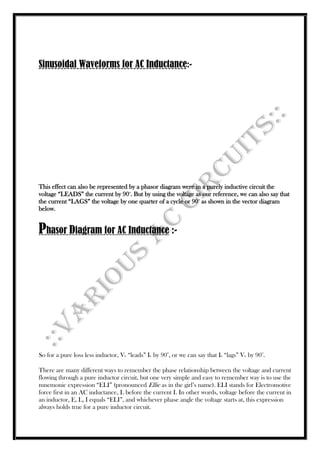
a voltage applied to a purely inductive circuit “LEADS” the current by a quarter
of a cycle or 90
o
as shown below.
Sinusoidal Waveforms for AC Inductance:-
This effect can also be represented by a phasor diagram were in a purely inductive circuit the
voltage “LEADS” the current by 90o
. But by using the voltage as our reference, we can also say that
the current “LAGS” the voltage by one quarter of a cycle or 90o
as shown in the vector diagram
below.
Phasor Diagram for AC Inductance :-
So for a pure loss less inductor, VL “leads” IL by 90
o
, or we can say that IL “lags” VL by 90
o
.
There are many different ways to remember the phase relationship between the voltage and current
flowing through a pure inductor circuit, but one very simple and easy to remember way is to use the
mnemonic expression “ELI” (pronounced Ellie as in the girl’s name). ELI stands for Electromotive
force first in an AC inductance, L before the current I. In other words, voltage before the current in
an inductor, E, L, I equals “ELI”, and whichever phase angle the voltage starts at, this expression
always holds true for a pure inductor circuit.
The Effect of Frequency on Inductive Reactance:-
When a 50Hz supply is connected across a suitable AC Inductance, the current
will be delayed by 90o
as described previously and will obtain a peak value of I
amps before the voltage reverses polarity at the end of each half cycle, i.e. the
current rises up to its maximum value in “T secs”.
If we now apply a 100Hz supply of the same peak voltage to the coil, the
current will still be delayed by 90o
but its maximum value will be lower than the
50Hz value because the time it requires to reach its maximum value has been
reduced due to the increase in frequency because now it only has “1/2 T secs” to
reach its peak value. Also, the rate of change of the flux within the coil has also
increased due to the increase in frequency.
Then from the above equation for inductive reactance, it can be seen that if
either the Frequency OR the Inductance is increased the overall inductive
reactance value of the coil would also increase. As the frequency increases and
approaches infinity, the inductors reactance and therefore its impedance would
also increase towards infinity acting like an open circuit.
Likewise, as the frequency approaches zero or DC, the inductors reactance would
also decrease to zero, acting like a short circuit. This means then that inductive
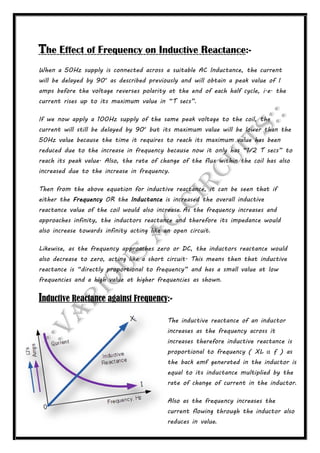
reactance is “directly proportional to frequency” and has a small value at low
frequencies and a high value at higher frequencies as shown.
Inductive Reactance against Frequency:-
The inductive reactance of an inductor
increases as the frequency across it
increases therefore inductive reactance is
proportional to frequency ( XL α ƒ ) as
the back emf generated in the inductor is
equal to its inductance multiplied by the
rate of change of current in the inductor.
Also as the frequency increases the
current flowing through the inductor also
reduces in value.
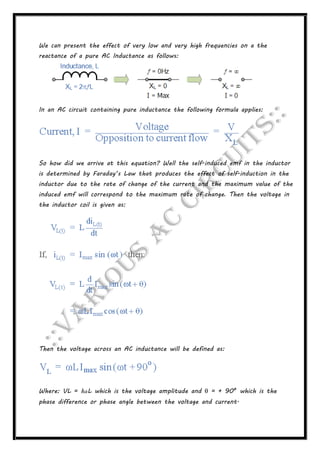
We can present the effect of very low and very high frequencies on a the
reactance of a pure AC Inductance as follows:
In an AC circuit containing pure inductance the following formula applies:
So how did we arrive at this equation? Well the self-induced emf in the inductor
is determined by Faraday’s Law that produces the effect of self-induction in the
inductor due to the rate of change of the current and the maximum value of the
induced emf will correspond to the maximum rate of change. Then the voltage in
the inductor coil is given as:
Then the voltage across an AC inductance will be defined as:
Where: VL = IωL which is the voltage amplitude and θ = + 90o
which is the
phase difference or phase angle between the voltage and current.
 AC through a Series R + L Circuit :-
We have seen above that the current flowing through a purely inductive coil lags the
voltage by 90o and when we say a purely inductive coil we mean one that has no
ohmic resistance and therefore, no I2R losses. But in the real world, it is impossible
to have a purely AC Inductance only.
All electrical coils, relays, solenoids and transformers will have a certain amount of
resistance no matter how small associated with the coil turns of wire being used. This
is because copper wire has resistivity. Then we can consider our inductive coil as
being one that has a resistance, R in series with an inductance, L producing what can
be loosely called an “impure inductance”.
If the coil has some “internal” resistance then we need to represent the total
impedance of the coil as a resistance in series with an inductance and in an AC circuit
that contains both inductance, L and resistance, R the voltage, V across the
combination will be the phasor sum of the two component voltages, VR and VL.
This means then that the current flowing through the coil will still lag the voltage, but
by an amount less than 90o depending upon the values of VR and VL, the phasor
sum. The new angle between the voltage and the current waveforms gives us their
Phase Difference which as we know is the phase angle of the circuit given the Greek
symbol phi, Φ.
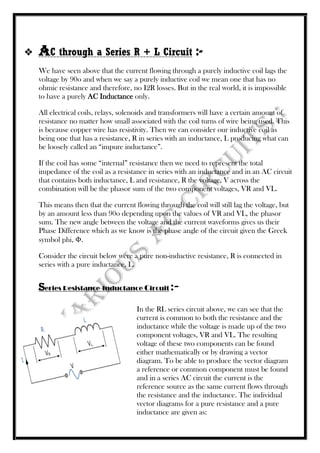
Consider the circuit below were a pure non-inductive resistance, R is connected in
series with a pure inductance, L.
Series Resistance-Inductance Circuit :-
In the RL series circuit above, we can see that the
current is common to both the resistance and the
inductance while the voltage is made up of the two
component voltages, VR and VL. The resulting
voltage of these two components can be found
either mathematically or by drawing a vector
diagram. To be able to produce the vector diagram
a reference or common component must be found
and in a series AC circuit the current is the
reference source as the same current flows through
the resistance and the inductance. The individual
vector diagrams for a pure resistance and a pure
inductance are given as:
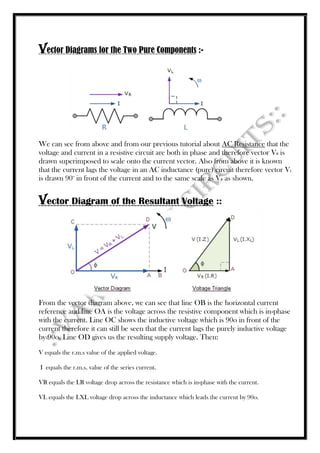
Vector Diagrams for the Two Pure Components :-
We can see from above and from our previous tutorial about AC Resistance that the
voltage and current in a resistive circuit are both in phase and therefore vector VR is
drawn superimposed to scale onto the current vector. Also from above it is known
that the current lags the voltage in an AC inductance (pure) circuit therefore vector VL
is drawn 90o
in front of the current and to the same scale as VR as shown.
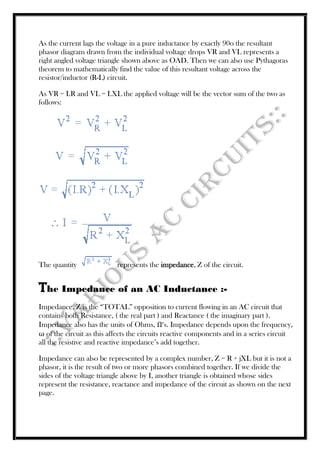
Vector Diagram of the Resultant Voltage ::
From the vector diagram above, we can see that line OB is the horizontal current
reference and line OA is the voltage across the resistive component which is in-phase
with the current. Line OC shows the inductive voltage which is 90o in front of the
current therefore it can still be seen that the current lags the purely inductive voltage
by 90o. Line OD gives us the resulting supply voltage. Then:
V equals the r.m.s value of the applied voltage.
I equals the r.m.s. value of the series current.
VR equals the I.R voltage drop across the resistance which is in-phase with the current.
VL equals the I.XL voltage drop across the inductance which leads the current by 90o.
As the current lags the voltage in a pure inductance by exactly 90o the resultant
phasor diagram drawn from the individual voltage drops VR and VL represents a
right angled voltage triangle shown above as OAD. Then we can also use Pythagoras
theorem to mathematically find the value of this resultant voltage across the
resistor/inductor (R-L) circuit.
As VR = I.R and VL = I.XL the applied voltage will be the vector sum of the two as
follows:
The quantity represents the impedance, Z of the circuit.
The Impedance of an AC Inductance :-
Impedance, Z is the “TOTAL” opposition to current flowing in an AC circuit that
contains both Resistance, ( the real part ) and Reactance ( the imaginary part ).
Impedance also has the units of Ohms, Ω‘s. Impedance depends upon the frequency,
ω of the circuit as this affects the circuits reactive components and in a series circuit
all the resistive and reactive impedance’s add together.
Impedance can also be represented by a complex number, Z = R + jXL but it is not a
phasor, it is the result of two or more phasors combined together. If we divide the
sides of the voltage triangle above by I, another triangle is obtained whose sides
represent the resistance, reactance and impedance of the circuit as shown on the next
page.
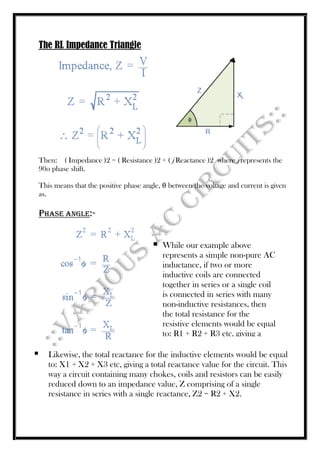
The RL Impedance Triangle
Then: ( Impedance )2 = ( Resistance )2 + ( j Reactance )2 where j represents the
90o phase shift.
This means that the positive phase angle, θ between the voltage and current is given
as.
Phase Angle:-
 Likewise, the total reactance for the inductive elements would be equal
to: X1 + X2 + X3 etc, giving a total reactance value for the circuit. This
way a circuit containing many chokes, coils and resistors can be easily
reduced down to an impedance value, Z comprising of a single
resistance in series with a single reactance, Z2 = R2 + X2.
 While our example above
represents a simple non-pure AC
inductance, if two or more
inductive coils are connected
together in series or a single coil
is connected in series with many
non-inductive resistances, then
the total resistance for the
resistive elements would be equal
to: R1 + R2 + R3 etc, giving a
total resistive value for the circuit.
 Circuit Containing Capacitance Only: In a pure AC Capacitance
circuit, the voltage and current are both “out-of-phase” with the
current leading the voltage by 90o
and we can remember this by
using the mnemonic expression “ICE”. The AC resistive value of a
capacitor called impedance, (Z) is related to frequency with the
reactive value of a capacitor called “capacitive reactance”, XC. In an
AC Capacitance circuit, this capacitive reactance value is equal to
1/( 2πƒC ) or 1/( jωC ).
Thus far we have seen that the relationship between voltage and
current is not the same and changes in all three pure passive
components. In the Resistance the phase angle is 0o
, in the
Inductance it is +90o
while in the Capacitance it is -90o
.
A pure capacitor will maintain this charge indefinitely on its plates
even if the DC supply voltage is removed. However, in a sinusoidal
voltage circuit which contains “AC Capacitance”, the capacitor will
alternately charge and discharge at a rate determined by the
frequency of the supply. Then capacitors in AC circuits are constantly
charging and discharging respectively.
When an alternating sinusoidal voltage is applied to the plates of an
AC capacitor, the capacitor is charged firstly in one direction and
then in the opposite direction changing polarity at the same rate as
the AC supply voltage. This instantaneous change in voltage across the
capacitor is opposed by the fact that it takes a certain amount of
time to deposit (or release) this charge onto the plates and is given
by V = Q/C. Consider the circuit below.
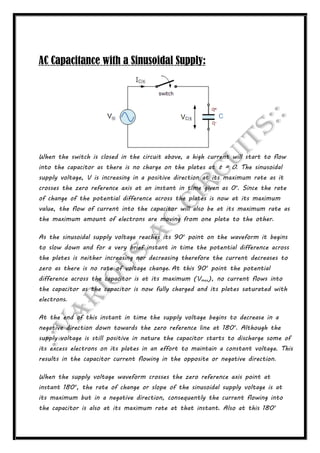
AC Capacitance with a Sinusoidal Supply:
When the switch is closed in the circuit above, a high current will start to flow
into the capacitor as there is no charge on the plates at t = 0. The sinusoidal
supply voltage, V is increasing in a positive direction at its maximum rate as it
crosses the zero reference axis at an instant in time given as 0o
. Since the rate
of change of the potential difference across the plates is now at its maximum
value, the flow of current into the capacitor will also be at its maximum rate as
the maximum amount of electrons are moving from one plate to the other.
As the sinusoidal supply voltage reaches its 90o
point on the waveform it begins
to slow down and for a very brief instant in time the potential difference across
the plates is neither increasing nor decreasing therefore the current decreases to
zero as there is no rate of voltage change. At this 90o
point the potential
difference across the capacitor is at its maximum (Vmax), no current flows into
the capacitor as the capacitor is now fully charged and its plates saturated with
electrons.
At the end of this instant in time the supply voltage begins to decrease in a
negative direction down towards the zero reference line at 180o
. Although the
supply voltage is still positive in nature the capacitor starts to discharge some of
its excess electrons on its plates in an effort to maintain a constant voltage. This
results in the capacitor current flowing in the opposite or negative direction.
When the supply voltage waveform crosses the zero reference axis point at
instant 180o
, the rate of change or slope of the sinusoidal supply voltage is at
its maximum but in a negative direction, consequently the current flowing into
the capacitor is also at its maximum rate at that instant. Also at this 180o
point the potential difference across the plates is zero as the amount of charge
is equally distributed between the two plates.
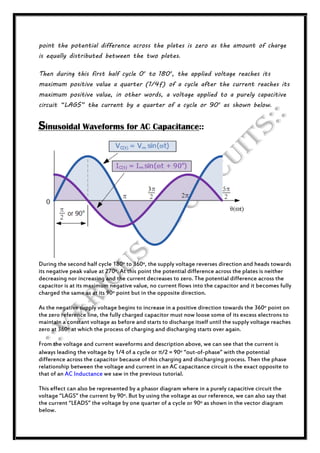
Then during this first half cycle 0o
to 180o
, the applied voltage reaches its
maximum positive value a quarter (1/4ƒ) of a cycle after the current reaches its
maximum positive value, in other words, a voltage applied to a purely capacitive
circuit “LAGS” the current by a quarter of a cycle or 90o
as shown below.
Sinusoidal Waveforms for AC Capacitance::
During the second half cycle 180o to 360o, the supply voltage reverses direction and heads towards
its negative peak value at 270o. At this point the potential difference across the plates is neither
decreasing nor increasing and the current decreases to zero. The potential difference across the
capacitor is at its maximum negative value, no current flows into the capacitor and it becomes fully
charged the same as at its 90o point but in the opposite direction.
As the negative supply voltage begins to increase in a positive direction towards the 360o point on
the zero reference line, the fully charged capacitor must now loose some of its excess electrons to
maintain a constant voltage as before and starts to discharge itself until the supply voltage reaches
zero at 360o at which the process of charging and discharging starts over again.
From the voltage and current waveforms and description above, we can see that the current is
always leading the voltage by 1/4 of a cycle or π/2 = 90o “out-of-phase” with the potential
difference across the capacitor because of this charging and discharging process. Then the phase
relationship between the voltage and current in an AC capacitance circuit is the exact opposite to
that of an AC Inductance we saw in the previous tutorial.
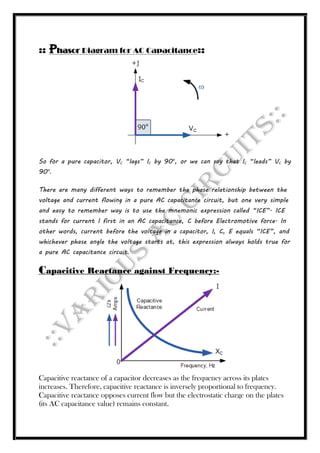
This effect can also be represented by a phasor diagram where in a purely capacitive circuit the
voltage “LAGS” the current by 90o. But by using the voltage as our reference, we can also say that
the current “LEADS” the voltage by one quarter of a cycle or 90o as shown in the vector diagram
below.
:: Phasor Diagram for AC Capacitance::
So for a pure capacitor, VC “lags” IC by 90o
, or we can say that IC “leads” VC by
90o
.
There are many different ways to remember the phase relationship between the
voltage and current flowing in a pure AC capacitance circuit, but one very simple
and easy to remember way is to use the mnemonic expression called “ICE”. ICE
stands for current I first in an AC capacitance, C before Electromotive force. In
other words, current before the voltage in a capacitor, I, C, E equals “ICE”, and
whichever phase angle the voltage starts at, this expression always holds true for
a pure AC capacitance circuit.
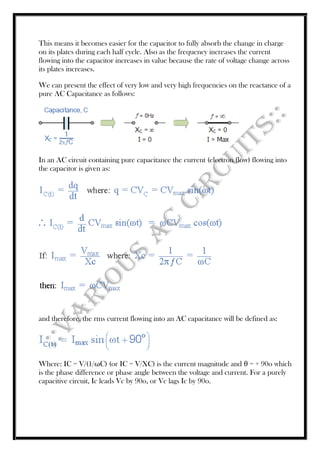
Capacitive Reactance against Frequency:-
Capacitive reactance of a capacitor decreases as the frequency across its plates
increases. Therefore, capacitive reactance is inversely proportional to frequency.
Capacitive reactance opposes current flow but the electrostatic charge on the plates
(its AC capacitance value) remains constant.
This means it becomes easier for the capacitor to fully absorb the change in charge
on its plates during each half cycle. Also as the frequency increases the current
flowing into the capacitor increases in value because the rate of voltage change across
its plates increases.
We can present the effect of very low and very high frequencies on the reactance of a
pure AC Capacitance as follows:
In an AC circuit containing pure capacitance the current (electron flow) flowing into
the capacitor is given as:
and therefore, the rms current flowing into an AC capacitance will be defined as:
Where: IC = V/(1/ωC) (or IC = V/XC) is the current magnitude and θ = + 90o which
is the phase difference or phase angle between the voltage and current. For a purely
capacitive circuit, Ic leads Vc by 90o, or Vc lags Ic by 90o.
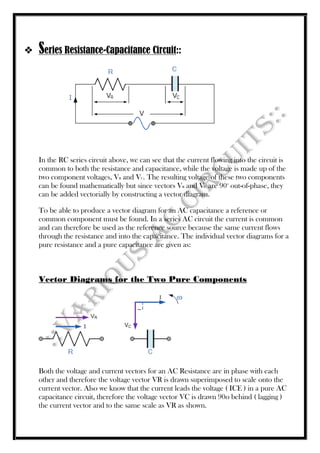
 Series Resistance-Capacitance Circuit::
In the RC series circuit above, we can see that the current flowing into the circuit is
common to both the resistance and capacitance, while the voltage is made up of the
two component voltages, VR and VC. The resulting voltage of these two components
can be found mathematically but since vectors VR and VC are 90o
out-of-phase, they
can be added vectorially by constructing a vector diagram.
To be able to produce a vector diagram for an AC capacitance a reference or
common component must be found. In a series AC circuit the current is common
and can therefore be used as the reference source because the same current flows
through the resistance and into the capacitance. The individual vector diagrams for a
pure resistance and a pure capacitance are given as:
Vector Diagrams for the Two Pure Components
Both the voltage and current vectors for an AC Resistance are in phase with each
other and therefore the voltage vector VR is drawn superimposed to scale onto the
current vector. Also we know that the current leads the voltage ( ICE ) in a pure AC
capacitance circuit, therefore the voltage vector VC is drawn 90o behind ( lagging )
the current vector and to the same scale as VR as shown.
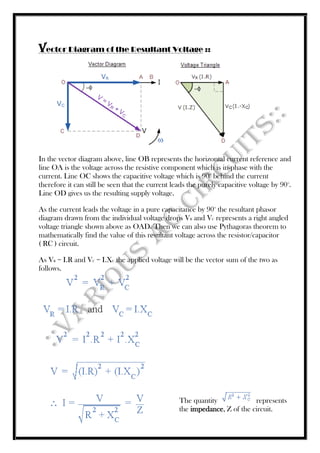
Vector Diagram of the Resultant Voltage ::
In the vector diagram above, line OB represents the horizontal current reference and
line OA is the voltage across the resistive component which is in-phase with the
current. Line OC shows the capacitive voltage which is 90o
behind the current
therefore it can still be seen that the current leads the purely capacitive voltage by 90o
.
Line OD gives us the resulting supply voltage.
As the current leads the voltage in a pure capacitance by 90o
the resultant phasor
diagram drawn from the individual voltage drops VR and VC represents a right angled
voltage triangle shown above as OAD. Then we can also use Pythagoras theorem to
mathematically find the value of this resultant voltage across the resistor/capacitor
( RC ) circuit.
As VR = I.R and VC = I.XC the applied voltage will be the vector sum of the two as
follows.
The quantity represents
the impedance, Z of the circuit.
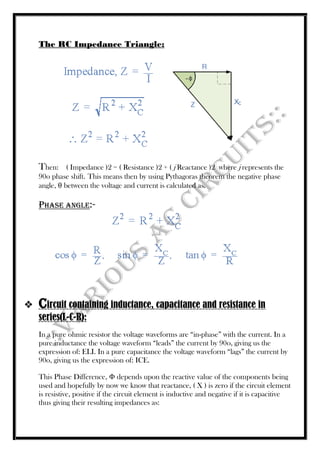
The RC Impedance Triangle:
Then: ( Impedance )2 = ( Resistance )2 + ( j Reactance )2 where j represents the
90o phase shift. This means then by using Pythagoras theorem the negative phase
angle, θ between the voltage and current is calculated as.
Phase Angle:-
 Circuit containing inductance, capacitance and resistance in
series(L-C-R):
In a pure ohmic resistor the voltage waveforms are “in-phase” with the current. In a
pure inductance the voltage waveform “leads” the current by 90o, giving us the
expression of: ELI. In a pure capacitance the voltage waveform “lags” the current by
90o, giving us the expression of: ICE.
This Phase Difference, Φ depends upon the reactive value of the components being
used and hopefully by now we know that reactance, ( X ) is zero if the circuit element
is resistive, positive if the circuit element is inductive and negative if it is capacitive
thus giving their resulting impedances as:
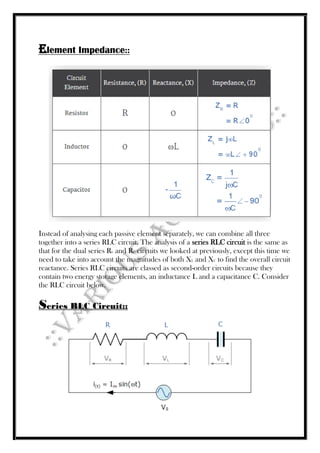
Element Impedance::
Instead of analysing each passive element separately, we can combine all three
together into a series RLC circuit. The analysis of a series RLC circuit is the same as
that for the dual series RL and RC circuits we looked at previously, except this time we
need to take into account the magnitudes of both XL and XC to find the overall circuit
reactance. Series RLC circuits are classed as second-order circuits because they
contain two energy storage elements, an inductance L and a capacitance C. Consider
the RLC circuit below.
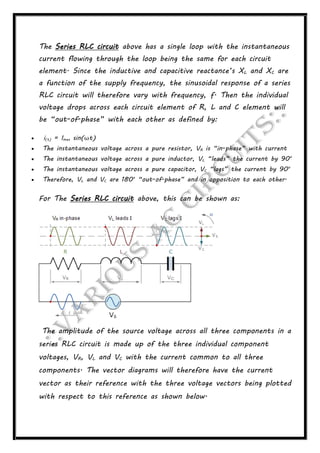
Series RLC Circuit::
The Series RLC circuit above has a single loop with the instantaneous
current flowing through the loop being the same for each circuit
element. Since the inductive and capacitive reactance’s XL and XC are
a function of the supply frequency, the sinusoidal response of a series
RLC circuit will therefore vary with frequency, ƒ. Then the individual
voltage drops across each circuit element of R, L and C element will
be “out-of-phase” with each other as defined by:
 i(t) = Imax sin(ωt)
 The instantaneous voltage across a pure resistor, VR is “in-phase” with current
 The instantaneous voltage across a pure inductor, VL “leads” the current by 90o
 The instantaneous voltage across a pure capacitor, VC “lags” the current by 90o
 Therefore, VL and VC are 180o
“out-of-phase” and in opposition to each other.
For The Series RLC circuit above, this can be shown as:
The amplitude of the source voltage across all three components in a
series RLC circuit is made up of the three individual component
voltages, VR, VL and VC with the current common to all three
components. The vector diagrams will therefore have the current
vector as their reference with the three voltage vectors being plotted
with respect to this reference as shown below.
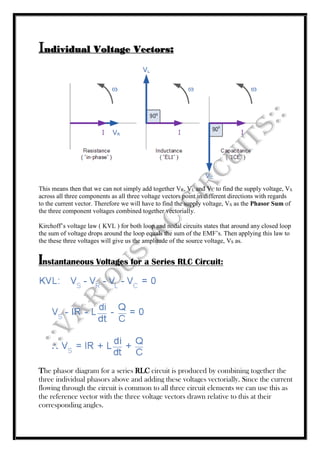
Individual Voltage Vectors:
This means then that we can not simply add together VR, VL and VC to find the supply voltage, VS
across all three components as all three voltage vectors point in different directions with regards
to the current vector. Therefore we will have to find the supply voltage, VS as the Phasor Sum of
the three component voltages combined together vectorially.
Kirchoff’s voltage law ( KVL ) for both loop and nodal circuits states that around any closed loop
the sum of voltage drops around the loop equals the sum of the EMF’s. Then applying this law to
the these three voltages will give us the amplitude of the source voltage, VS as.
Instantaneous Voltages for a Series RLC Circuit:
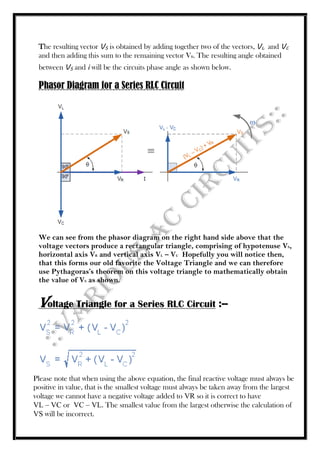
The phasor diagram for a series RLC circuit is produced by combining together the
three individual phasors above and adding these voltages vectorially. Since the current
flowing through the circuit is common to all three circuit elements we can use this as
the reference vector with the three voltage vectors drawn relative to this at their
corresponding angles.
The resulting vector VS is obtained by adding together two of the vectors, VL and VC
and then adding this sum to the remaining vector VR. The resulting angle obtained
between VS and i will be the circuits phase angle as shown below.
Phasor Diagram for a Series RLC Circuit
We can see from the phasor diagram on the right hand side above that the
voltage vectors produce a rectangular triangle, comprising of hypotenuse VS,
horizontal axis VR and vertical axis VL – VC Hopefully you will notice then,
that this forms our old favorite the Voltage Triangle and we can therefore
use Pythagoras’s theorem on this voltage triangle to mathematically obtain
the value of VS as shown.
Voltage Triangle for a Series RLC Circuit :--
Please note that when using the above equation, the final reactive voltage must always be
positive in value, that is the smallest voltage must always be taken away from the largest
voltage we cannot have a negative voltage added to VR so it is correct to have
VL – VC or VC – VL. The smallest value from the largest otherwise the calculation of
VS will be incorrect.
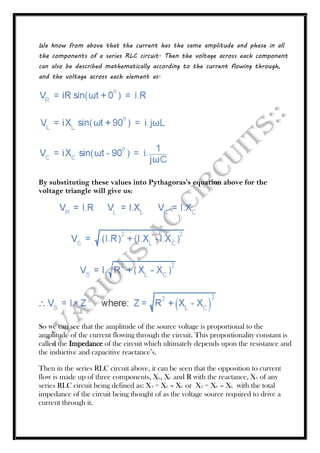
We know from above that the current has the same amplitude and phase in all
the components of a series RLC circuit. Then the voltage across each component
can also be described mathematically according to the current flowing through,
and the voltage across each element as.
By substituting these values into Pythagoras’s equation above for the
voltage triangle will give us:
So we can see that the amplitude of the source voltage is proportional to the
amplitude of the current flowing through the circuit. This proportionality constant is
called the Impedance of the circuit which ultimately depends upon the resistance and
the inductive and capacitive reactance’s.
Then in the series RLC circuit above, it can be seen that the opposition to current
flow is made up of three components, XL, XC and R with the reactance, XT of any
series RLC circuit being defined as: XT = XL – XC or XT = XC – XL with the total
impedance of the circuit being thought of as the voltage source required to drive a
current through it.
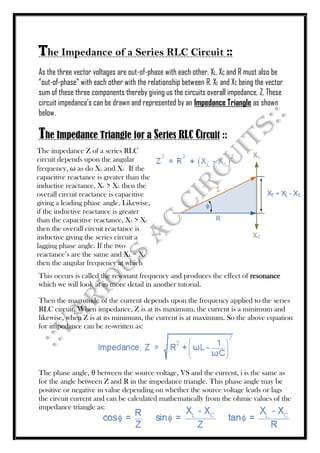
The Impedance of a Series RLC Circuit ::
As the three vector voltages are out-of-phase with each other, XL, XC and R must also be
“out-of-phase” with each other with the relationship between R, XL and XC being the vector
sum of these three components thereby giving us the circuits overall impedance, Z. These
circuit impedance’s can be drawn and represented by an Impedance Triangle as shown
below.
The Impedance Triangle for a Series RLC Circuit ::
This occurs is called the resonant frequency and produces the effect of resonance
which we will look at in more detail in another tutorial.
Then the magnitude of the current depends upon the frequency applied to the series
RLC circuit. When impedance, Z is at its maximum, the current is a minimum and
likewise, when Z is at its minimum, the current is at maximum. So the above equation
for impedance can be re-written as:
The phase angle, θ between the source voltage, VS and the current, i is the same as
for the angle between Z and R in the impedance triangle. This phase angle may be
positive or negative in value depending on whether the source voltage leads or lags
the circuit current and can be calculated mathematically from the ohmic values of the
impedance triangle as:
The impedance Z of a series RLC
circuit depends upon the angular
frequency, ω as do XL and XC If the
capacitive reactance is greater than the
inductive reactance, XC > XL then the
overall circuit reactance is capacitive
giving a leading phase angle. Likewise,
if the inductive reactance is greater
than the capacitive reactance, XL > XC
then the overall circuit reactance is
inductive giving the series circuit a
lagging phase angle. If the two
reactance’s are the same and XL = XC
then the angular frequency at which
1. Certificate
2. Acknowledgement
3. Introduction
4. Types Of Periodic Waveform
5. Some Definitions Regarding Alternating Voltage
and Current.
6. Root-Mean-Square(RMS) Value Of Alternating
7. Average Value Of Alternating Current
8. Phasors And Phasor Diagrams
9. Different Types Of Ac Circuits
10. Bibliography
1. Help from
internet
2. Help from
library
3. Help from
teachers
Websites:
http://www.electronics-tutorials.ws/
http://physicscatalyst.com/
https://en.wikipedia.org/

Alternating Current -12 isc 2017 ( investigatory Project)

  • 1.
    555 Session- 2017-2018 Submitted To:- Mr.S.K. Tiwari Submitted By:- Mayank Kashyap Class: 12 th
  • 3.
  • 4.
    s Signature of External Examiner Signatureof Physics Teacher Signature of Principal
  • 5.
  • 6.
    Types of PeriodicWaveform The most common periodic signal waveforms that are used in Electrical and Electronic Engineering are the Sinusoidal Waveforms. However, an alternating AC waveform may not always take the shape of a smooth shape based around the trigonometric sine or cosine function. AC waveforms can also take the shape of either Complex Waves, Square Waves or Triangular Waves. Some Definitions Regarding Alternating Voltage and Current: 1. Periodic Time: The time taken for an AC Waveform to complete one full pattern from its positive half to its negative half and back to its zero baseline again is called a Cycle and one complete cycle contains both a positive half-cycle and a negative half-cycle. The time taken by the waveform to complete one full cycle is called the Periodic Time of the waveform, and is given the symbol “T”. 2. Frequency:The number of complete cycles that are produced within one second (cycles/second) is called the Frequency, symbol ƒ of the alternating waveform. Frequency is measured in Hertz, (Hz) named after the German physicist Heinrich Hertz. Then we can see that a relationship exists between cycles (oscillations), periodic time and frequency (cycles per second), so if there are ƒ number of cycles in one second, each individual cycle must take 1/ƒ seconds to complete. The frequency of the domestic alternating current is 50 cycles/second or 50Hz. 3. Amplitude: As well as knowing either the periodic time or the frequency of the alternating quantity, another important parameter of the AC waveform is Amplitude, better known as its Maximum or Peak value represented by the terms, Vmax for voltage or Imax for current. The peak value is the greatest value of either voltage or current that the waveform reaches during each half cycle measured from the zero baseline. Unlike a DC voltage or current which has a steady state that can be measured or calculated using Ohm’s Law, an alternating quantity is constantly changing its value over time.
  • 7.
    For pure sinusoidalwaveforms this peak value will always be the same for both half cycles (+Vm = -Vm) but for non-sinusoidal or complex waveforms the maximum peak value can be very different for each half cycle. Sometimes, alternating waveforms are given a peak-to-peak, Vp-p value and this is simply the distance or the sum in voltage between the maximum peak value, +Vmax and the minimum peak value, -Vmax during one complete cycle. Root-Mean-square (RMS) Value of Alternating Current The term “RMS” stands for “Root-Mean-Squared”. Most books define this as the “amount of AC power that produces the same heating effect as an equivalent DC power”, or something similar along these lines, but an RMS value is more than just that. The RMS value is the square root of the mean (average) value of the squared function of the instantaneous values. The symbols used for defining an RMS value are VRMS or IRMS. The root mean squared, RMS value of a sinusoid is not the same as the average of all the instantaneous values. The ratio of the RMS value of voltage to the maximum value of voltage is the same as the ratio of the RMS value of current to the maximum value of current. Most multi-meters, either voltmeters or ammeters, measure RMS value assuming a pure sinusoidal waveform. For finding the RMS value of non-sinusoidal waveform a “True RMS Multimeter” is required. The RMS value of a sinusoidal waveform gives the same heating effect as a DC current of the same value. That is if a direct current, I passes through a resistance of R ohms, the DC power consumed by the resistor as heat will therefore be I 2 R watts. Then if an alternating current, i = Im.sinθ flows through the same resistance, the AC power converted into heat will be: I 2 rms.R watts. We calculated the RMS Voltage of a sinusoidal waveform. The RMS voltage of a sinusoid or complex waveform can be determined by two basic methods:- Graphical Method – which can be used to find the RMS value of any non- sinusoidal time-varying waveform by drawing a number of mid-ordinates onto the waveform. Analytical Method – is a mathematical procedure for finding the effective or RMS value of any periodic voltage or current using calculus.
  • 8.
     RMS VoltageGraphical Method:- Whilst the method of calculation is the same for both halves of an AC waveform, for this example we will consider only the positive half cycle. The effective or rms value of a waveform can be found with a reasonable amount of accuracy by taking equally spaced instantaneous values along the waveform. Each mid-ordinate value of a waveform (the voltage waveform in this case) is multiplied by itself (squared) and added to the next. This method gives us the “square” or Squared part of the RMS voltage expression. Next this squared value is divided by the number of mid-ordinates used to give us the Mean part of the RMS voltage expression, and in our simple example above the number of mid-ordinates used was twelve (12). Finally, the square root of the previous result is found to give us the Root part of the RMS voltage. Then we can define the term used to describe an rms voltage (VRMS) as being “the square root of the mean of the square of the mid-ordinates of the voltage waveform” and this is given as:  RMS Voltage Analytical Method:- The graphical method above is a very good way of finding the effective or RMS voltage, (or current) of an alternating waveform that is not symmetrical or sinusoidal in nature. In other words the waveform shape resembles that of a complex waveform. However, when dealing with pure sinusoidal waveforms we can make life a little bit easier for ourselves by using an analytical or mathematical way of finding the RMS value. A periodic sinusoidal voltage is constant. i is instantaneous value of current and it is defined as: i=i0sin ωt with a period of T. Then we can calculate the root-mean- square (rms) value of a sinusoidal voltage (V(t)) as:
  • 9.
    This is knownas the mean square current. The square root of mean square current is called root mean square current or rms current. Thus, Thus ,the rms value of AC is .707i0 of the peak value of alternating current. Similarly rms value of alternating voltage or emf is:
  • 10.
    Average (Mean) Valueof Alternating Current:- The process used to find the Average Voltage of an alternating waveform is very similar to that for finding its RMS value, the difference this time is that the instantaneous values are not squared and we do not find the square root of the summed mean. The average voltage (or current) of a periodic waveform whether it is a sine wave, square wave or triangular waveform is defined as: “the quotient of the area under the waveform with respect to time”. In other words, the averaging of all the instantaneous values along time axis with time being one full period, (T). When dealing with alternating voltages (or currents), the term Average value is generally taken over one complete cycle, whereas the term Mean value is used for one half of the periodic cycle. The average value of a whole sinusoidal waveform over one complete cycle is zero as the two halves cancel each other out, so the average value is taken over half a cycle. The average value of a sine wave of voltage or current is 0.637 times the peak value, (Vp or Ip. This mathematical relationship between the average values applies to both AC current and AC voltage. Sometimes it is required to be able to calculate the value of the direct voltage or current output from a rectifier or pulse type circuit such as a PWM motor circuit because the voltage or current, although not reversing, is changing continuously. Since there are no phase reversals the average value is used and the RMS (root-mean-square) value is unimportant for this type of application. The main differences between an RMS Voltage and an Average Voltage, is that the mean value of a periodic wave is the average of all the instantaneous areas taken under the curve over a given period of the waveform, and in the case of a sinusoidal quantity, this period is taken as one-half of the cycle of the wave. For convenience the positive half cycle is generally used.
  • 11.
    Average Current AnalyticalMethod: The average value can be taken mathematically by taking the approximation of the area under the curve at various intervals to the distance or length of the base and this can be done using triangles or rectangles as shown. By approximating the areas of the rectangles under the curve, we can obtain a rough idea of the actual area of each one. By adding together all these areas the average value can be found. If an infinite number of smaller thinner rectangles were used, the more accurate would be the final result as it approaches 2/π. If the instantaneous current is given as: i = i0.sin ωt ; Mean value of A.C is finite over half cycle So, mean or average value of AC is defined either for positive half cycle or for negative half cycle So, We see that the average value of A.C during the half cycle is .636 times or 63.6% of its peak value. Similarly we can show that:- During next half cycle mean value of ac will be equal in magnitude but opposite in direction. Always remember that mean value of AC over a complete cycle is zero and is defined over a half cycle of AC.
  • 12.
    Phasors and PhasorDiagrams: The terms “lead” and “lag” as well as “in-phase” and “out-of-phase” were used to indicate the relationship of one waveform to the other with the generalized sinusoidal expression given as: A(t) = Am sin(ωt ± Φ) representing the sinusoid in the time- domain form. But when presented mathematically in this way it is sometimes difficult to visualize this angular or phasor difference between two or more sinusoidal waveforms. One way to overcome this problem is to represent the sinusoids graphically within the spacial or phasor-domain form by using Phasor Diagrams, and this is achieved by the rotating vector method. Basically a rotating vector, simply called a “Phasor” is a scaled line whose length represents an AC quantity that has both magnitude (“peak amplitude”) and direction (“phase”) which is “frozen” at some point in time. A phasor is a vector that has an arrow head at one end which signifies partly the maximum value of the vector quantity (V or I) and partly the end of the vector that rotates. Generally, vectors are assumed to pivot at one end around a fixed zero point known as the “point of origin” while the arrowed end representing the quantity, freely rotates in an anti-clockwise direction at an angular velocity, ( ω ) of one full revolution for every cycle. This anti-clockwise rotation of the vector is considered to be a positive rotation. Likewise, a clockwise rotation is considered to be a negative rotation. Although the both the terms vectors and phasors are used to describe a rotating line that itself has both magnitude and direction, the main difference between the two is that a vectors magnitude is the “peak value” of the sinusoid while a phasors magnitude is the “rms value” of the sinusoid. In both cases the phase angle and direction remains the same. The phase of an alternating quantity at any instant in time can be represented by a phasor diagram, so phasor diagrams can be thought of as “functions of time”. A complete sine wave can be constructed by a single vector rotating at an angular velocity of ω = 2πƒ, where ƒ is the frequency of the waveform. Then a Phasor is a quantity that has both “Magnitude” and “Direction”. A diagram representing alternating current and alternating voltage (of same frequency) as rotating vectors (Phasors) with the phase angle between them is called a phasor diagram. Generally, when constructing a phasor diagram, angular velocity of a sine wave is always assumed to be: ω in rad/s.
  • 13.
    Different types ofAC circuits:- In an alternating current circuit the phase difference between the current I and the voltage V depends upon the type of the circuit. We shall first study simple circuits containing only one element (resistor, inductor or capacitor) and then circuits containing combinations of these basic circuit elements.  Circuit Containing Resistance Only: Now that we know how to represent a voltage or current as a phasor we can look at this relationship when applied to basic passive circuit elements such as an AC Resistance when connected to a single phase AC supply. Any ideal basic circuit element such as a resistor can be described mathematically in terms of its voltage and current, and in our tutorial about Resistors , we saw that the voltage across a pure ohmic resistor is linearly proportional to the current flowing through it as defined by Ohm’s Law . Consider the circuit When the switch is closed, an AC voltage, V will be applied to resistor, R. This voltage will cause a current to flow which in turn will rise and fall as the applied voltage rises and falls sinusoidally. As the load is a resistance, the current and voltage will both reach their maximum or peak values and fall through zero at exactly the same time, i.e. they rise and fall simultaneously and are therefore said to be “in-phase”. Then the electrical current that flows through an AC resistance varies sinusoidally with time and is represented by the expression, I(t) = Im x sin(ωt + θ), where Im is the maximum amplitude of the current and θ is its phase angle. In addition we can also say that for any given current, i flowing through the resistor the maximum or peak voltage across the terminals of R will be given by Ohm’s Law as:
  • 14.
    And the instantaneousvalue of the current, i will be: So for a purely resistive circuit the alternating current flowing through the resistor varies in proportion to the applied voltage across it following the same sinusoidal pattern. As the supply frequency is common to both the voltage and current, their phasors will also be common resulting in the current being “in- phase” with the voltage, (θ = 0). In other words, there is no phase difference between the current and the voltage when using an AC resistance as the current will achieve its maximum, minimum and zero values whenever the voltage reaches its maximum, minimum and zero values as shown: This “in-phase” effect can also be represented by a phasor diagram. In the complex domain, resistance is a real number only meaning that there is no “j” or imaginary component. Therefore, as the voltage and current are both in-phase with each other, there will be no phase difference (θ = 0) between them, so the vectors of each quantity are drawn super-imposed upon one another along the same reference axis. The transformation from the sinusoidal time-domain into the phasor-domain is given as. Phasor Diagram for AC Resistance:- As a phasor represents the RMS values of the voltage and current quantities unlike a vector which represents the peak or maximum values, dividing the peak value of the time-domain expressions above by √2 the corresponding voltage-current phasor relationship is given as.
  • 15.
    Circuit containing Inductanceonly: In an alternating current circuit which contains an AC Inductance, the flow of current through an inductor behaves very differently to that of a steady state DC voltage. Now in an AC circuit, the opposition to the current flowing through the coils windings not only depends upon the inductance of the coil but also the frequency of the applied voltage waveform as it varies from its positive to negative values. The actual opposition to the current flowing through a coil in an AC circuit is determined by the AC Resistance of the coil with this AC resistance being represented by a complex number. But to distinguish a DC resistance value from an AC resistance value, which is also known as Impedance, the term Reactance is used. Like resistance, reactance is measured in Ohm’s but is given the symbol “X” to distinguish it from a purely resistive “R” value and as the component in question is an inductor, the reactance of an inductor is called Inductive Reactance, ( XL ) and is measured in Ohms. Its value can be found from the formula. Inductive Reactance :- Where: XL is the Inductive Reactance in Ohms, ƒ is the frequency in Hertz and L is the inductance of the coil in Henries. We can also define inductive reactance in radians, where Omega, ω equals 2πƒ. So whenever a sinusoidal voltage is applied to an inductive coil, the back emf opposes the rise and fall of the current flowing through the coil and in a purely inductive coil which has zero resistance or losses, this impedance (which can be a complex number) is equal to its inductive reactance. Also reactance is represented by a vector as it has both a magnitude and a direction (angle). Consider the circuit below.
  • 16.
    AC Inductance witha Sinusoidal Supply:- This simple circuit above consists of a pure inductance of L Henries (H), connected across a sinusoidal voltage given by the expression: V = V0 sin ωt. When the switch is closed this sinusoidal voltage will cause a current to flow and rise from zero to its maximum value. This rise or change in the current will induce a magnetic field within the coil which in turn will oppose or restrict this change in the current. But before the current has had time to reach its maximum value as it would in a DC circuit, the voltage changes polarity causing the current to change direction. This change in the other direction once again being delayed by the self-induced back emf in the coil, and in a circuit containing a pure inductance only, the current is delayed by 90 o . The applied voltage reaches its maximum positive value a quarter ( 1/4ƒ ) of a cycle earlier than the current reaches its maximum positive value, in other words, a voltage applied to a purely inductive circuit “LEADS” the current by a quarter of a cycle or 90 o as shown below.
  • 17.
    Sinusoidal Waveforms forAC Inductance:- This effect can also be represented by a phasor diagram were in a purely inductive circuit the voltage “LEADS” the current by 90o . But by using the voltage as our reference, we can also say that the current “LAGS” the voltage by one quarter of a cycle or 90o as shown in the vector diagram below. Phasor Diagram for AC Inductance :- So for a pure loss less inductor, VL “leads” IL by 90 o , or we can say that IL “lags” VL by 90 o . There are many different ways to remember the phase relationship between the voltage and current flowing through a pure inductor circuit, but one very simple and easy to remember way is to use the mnemonic expression “ELI” (pronounced Ellie as in the girl’s name). ELI stands for Electromotive force first in an AC inductance, L before the current I. In other words, voltage before the current in an inductor, E, L, I equals “ELI”, and whichever phase angle the voltage starts at, this expression always holds true for a pure inductor circuit.
  • 18.
    The Effect ofFrequency on Inductive Reactance:- When a 50Hz supply is connected across a suitable AC Inductance, the current will be delayed by 90o as described previously and will obtain a peak value of I amps before the voltage reverses polarity at the end of each half cycle, i.e. the current rises up to its maximum value in “T secs”. If we now apply a 100Hz supply of the same peak voltage to the coil, the current will still be delayed by 90o but its maximum value will be lower than the 50Hz value because the time it requires to reach its maximum value has been reduced due to the increase in frequency because now it only has “1/2 T secs” to reach its peak value. Also, the rate of change of the flux within the coil has also increased due to the increase in frequency. Then from the above equation for inductive reactance, it can be seen that if either the Frequency OR the Inductance is increased the overall inductive reactance value of the coil would also increase. As the frequency increases and approaches infinity, the inductors reactance and therefore its impedance would also increase towards infinity acting like an open circuit. Likewise, as the frequency approaches zero or DC, the inductors reactance would also decrease to zero, acting like a short circuit. This means then that inductive reactance is “directly proportional to frequency” and has a small value at low frequencies and a high value at higher frequencies as shown. Inductive Reactance against Frequency:- The inductive reactance of an inductor increases as the frequency across it increases therefore inductive reactance is proportional to frequency ( XL α ƒ ) as the back emf generated in the inductor is equal to its inductance multiplied by the rate of change of current in the inductor. Also as the frequency increases the current flowing through the inductor also reduces in value.
  • 19.
    We can presentthe effect of very low and very high frequencies on a the reactance of a pure AC Inductance as follows: In an AC circuit containing pure inductance the following formula applies: So how did we arrive at this equation? Well the self-induced emf in the inductor is determined by Faraday’s Law that produces the effect of self-induction in the inductor due to the rate of change of the current and the maximum value of the induced emf will correspond to the maximum rate of change. Then the voltage in the inductor coil is given as: Then the voltage across an AC inductance will be defined as: Where: VL = IωL which is the voltage amplitude and θ = + 90o which is the phase difference or phase angle between the voltage and current.
  • 20.
     AC througha Series R + L Circuit :- We have seen above that the current flowing through a purely inductive coil lags the voltage by 90o and when we say a purely inductive coil we mean one that has no ohmic resistance and therefore, no I2R losses. But in the real world, it is impossible to have a purely AC Inductance only. All electrical coils, relays, solenoids and transformers will have a certain amount of resistance no matter how small associated with the coil turns of wire being used. This is because copper wire has resistivity. Then we can consider our inductive coil as being one that has a resistance, R in series with an inductance, L producing what can be loosely called an “impure inductance”. If the coil has some “internal” resistance then we need to represent the total impedance of the coil as a resistance in series with an inductance and in an AC circuit that contains both inductance, L and resistance, R the voltage, V across the combination will be the phasor sum of the two component voltages, VR and VL. This means then that the current flowing through the coil will still lag the voltage, but by an amount less than 90o depending upon the values of VR and VL, the phasor sum. The new angle between the voltage and the current waveforms gives us their Phase Difference which as we know is the phase angle of the circuit given the Greek symbol phi, Φ. Consider the circuit below were a pure non-inductive resistance, R is connected in series with a pure inductance, L. Series Resistance-Inductance Circuit :- In the RL series circuit above, we can see that the current is common to both the resistance and the inductance while the voltage is made up of the two component voltages, VR and VL. The resulting voltage of these two components can be found either mathematically or by drawing a vector diagram. To be able to produce the vector diagram a reference or common component must be found and in a series AC circuit the current is the reference source as the same current flows through the resistance and the inductance. The individual vector diagrams for a pure resistance and a pure inductance are given as:
  • 21.
    Vector Diagrams forthe Two Pure Components :- We can see from above and from our previous tutorial about AC Resistance that the voltage and current in a resistive circuit are both in phase and therefore vector VR is drawn superimposed to scale onto the current vector. Also from above it is known that the current lags the voltage in an AC inductance (pure) circuit therefore vector VL is drawn 90o in front of the current and to the same scale as VR as shown. Vector Diagram of the Resultant Voltage :: From the vector diagram above, we can see that line OB is the horizontal current reference and line OA is the voltage across the resistive component which is in-phase with the current. Line OC shows the inductive voltage which is 90o in front of the current therefore it can still be seen that the current lags the purely inductive voltage by 90o. Line OD gives us the resulting supply voltage. Then: V equals the r.m.s value of the applied voltage. I equals the r.m.s. value of the series current. VR equals the I.R voltage drop across the resistance which is in-phase with the current. VL equals the I.XL voltage drop across the inductance which leads the current by 90o.
  • 22.
    As the currentlags the voltage in a pure inductance by exactly 90o the resultant phasor diagram drawn from the individual voltage drops VR and VL represents a right angled voltage triangle shown above as OAD. Then we can also use Pythagoras theorem to mathematically find the value of this resultant voltage across the resistor/inductor (R-L) circuit. As VR = I.R and VL = I.XL the applied voltage will be the vector sum of the two as follows: The quantity represents the impedance, Z of the circuit. The Impedance of an AC Inductance :- Impedance, Z is the “TOTAL” opposition to current flowing in an AC circuit that contains both Resistance, ( the real part ) and Reactance ( the imaginary part ). Impedance also has the units of Ohms, Ω‘s. Impedance depends upon the frequency, ω of the circuit as this affects the circuits reactive components and in a series circuit all the resistive and reactive impedance’s add together. Impedance can also be represented by a complex number, Z = R + jXL but it is not a phasor, it is the result of two or more phasors combined together. If we divide the sides of the voltage triangle above by I, another triangle is obtained whose sides represent the resistance, reactance and impedance of the circuit as shown on the next page.
  • 23.
    The RL ImpedanceTriangle Then: ( Impedance )2 = ( Resistance )2 + ( j Reactance )2 where j represents the 90o phase shift. This means that the positive phase angle, θ between the voltage and current is given as. Phase Angle:-  Likewise, the total reactance for the inductive elements would be equal to: X1 + X2 + X3 etc, giving a total reactance value for the circuit. This way a circuit containing many chokes, coils and resistors can be easily reduced down to an impedance value, Z comprising of a single resistance in series with a single reactance, Z2 = R2 + X2.  While our example above represents a simple non-pure AC inductance, if two or more inductive coils are connected together in series or a single coil is connected in series with many non-inductive resistances, then the total resistance for the resistive elements would be equal to: R1 + R2 + R3 etc, giving a total resistive value for the circuit.
  • 24.
     Circuit ContainingCapacitance Only: In a pure AC Capacitance circuit, the voltage and current are both “out-of-phase” with the current leading the voltage by 90o and we can remember this by using the mnemonic expression “ICE”. The AC resistive value of a capacitor called impedance, (Z) is related to frequency with the reactive value of a capacitor called “capacitive reactance”, XC. In an AC Capacitance circuit, this capacitive reactance value is equal to 1/( 2πƒC ) or 1/( jωC ). Thus far we have seen that the relationship between voltage and current is not the same and changes in all three pure passive components. In the Resistance the phase angle is 0o , in the Inductance it is +90o while in the Capacitance it is -90o . A pure capacitor will maintain this charge indefinitely on its plates even if the DC supply voltage is removed. However, in a sinusoidal voltage circuit which contains “AC Capacitance”, the capacitor will alternately charge and discharge at a rate determined by the frequency of the supply. Then capacitors in AC circuits are constantly charging and discharging respectively. When an alternating sinusoidal voltage is applied to the plates of an AC capacitor, the capacitor is charged firstly in one direction and then in the opposite direction changing polarity at the same rate as the AC supply voltage. This instantaneous change in voltage across the capacitor is opposed by the fact that it takes a certain amount of time to deposit (or release) this charge onto the plates and is given by V = Q/C. Consider the circuit below.
  • 25.
    AC Capacitance witha Sinusoidal Supply: When the switch is closed in the circuit above, a high current will start to flow into the capacitor as there is no charge on the plates at t = 0. The sinusoidal supply voltage, V is increasing in a positive direction at its maximum rate as it crosses the zero reference axis at an instant in time given as 0o . Since the rate of change of the potential difference across the plates is now at its maximum value, the flow of current into the capacitor will also be at its maximum rate as the maximum amount of electrons are moving from one plate to the other. As the sinusoidal supply voltage reaches its 90o point on the waveform it begins to slow down and for a very brief instant in time the potential difference across the plates is neither increasing nor decreasing therefore the current decreases to zero as there is no rate of voltage change. At this 90o point the potential difference across the capacitor is at its maximum (Vmax), no current flows into the capacitor as the capacitor is now fully charged and its plates saturated with electrons. At the end of this instant in time the supply voltage begins to decrease in a negative direction down towards the zero reference line at 180o . Although the supply voltage is still positive in nature the capacitor starts to discharge some of its excess electrons on its plates in an effort to maintain a constant voltage. This results in the capacitor current flowing in the opposite or negative direction. When the supply voltage waveform crosses the zero reference axis point at instant 180o , the rate of change or slope of the sinusoidal supply voltage is at its maximum but in a negative direction, consequently the current flowing into the capacitor is also at its maximum rate at that instant. Also at this 180o
  • 26.
    point the potentialdifference across the plates is zero as the amount of charge is equally distributed between the two plates. Then during this first half cycle 0o to 180o , the applied voltage reaches its maximum positive value a quarter (1/4ƒ) of a cycle after the current reaches its maximum positive value, in other words, a voltage applied to a purely capacitive circuit “LAGS” the current by a quarter of a cycle or 90o as shown below. Sinusoidal Waveforms for AC Capacitance:: During the second half cycle 180o to 360o, the supply voltage reverses direction and heads towards its negative peak value at 270o. At this point the potential difference across the plates is neither decreasing nor increasing and the current decreases to zero. The potential difference across the capacitor is at its maximum negative value, no current flows into the capacitor and it becomes fully charged the same as at its 90o point but in the opposite direction. As the negative supply voltage begins to increase in a positive direction towards the 360o point on the zero reference line, the fully charged capacitor must now loose some of its excess electrons to maintain a constant voltage as before and starts to discharge itself until the supply voltage reaches zero at 360o at which the process of charging and discharging starts over again. From the voltage and current waveforms and description above, we can see that the current is always leading the voltage by 1/4 of a cycle or π/2 = 90o “out-of-phase” with the potential difference across the capacitor because of this charging and discharging process. Then the phase relationship between the voltage and current in an AC capacitance circuit is the exact opposite to that of an AC Inductance we saw in the previous tutorial. This effect can also be represented by a phasor diagram where in a purely capacitive circuit the voltage “LAGS” the current by 90o. But by using the voltage as our reference, we can also say that the current “LEADS” the voltage by one quarter of a cycle or 90o as shown in the vector diagram below.
  • 27.
    :: Phasor Diagramfor AC Capacitance:: So for a pure capacitor, VC “lags” IC by 90o , or we can say that IC “leads” VC by 90o . There are many different ways to remember the phase relationship between the voltage and current flowing in a pure AC capacitance circuit, but one very simple and easy to remember way is to use the mnemonic expression called “ICE”. ICE stands for current I first in an AC capacitance, C before Electromotive force. In other words, current before the voltage in a capacitor, I, C, E equals “ICE”, and whichever phase angle the voltage starts at, this expression always holds true for a pure AC capacitance circuit. Capacitive Reactance against Frequency:- Capacitive reactance of a capacitor decreases as the frequency across its plates increases. Therefore, capacitive reactance is inversely proportional to frequency. Capacitive reactance opposes current flow but the electrostatic charge on the plates (its AC capacitance value) remains constant.
  • 28.
    This means itbecomes easier for the capacitor to fully absorb the change in charge on its plates during each half cycle. Also as the frequency increases the current flowing into the capacitor increases in value because the rate of voltage change across its plates increases. We can present the effect of very low and very high frequencies on the reactance of a pure AC Capacitance as follows: In an AC circuit containing pure capacitance the current (electron flow) flowing into the capacitor is given as: and therefore, the rms current flowing into an AC capacitance will be defined as: Where: IC = V/(1/ωC) (or IC = V/XC) is the current magnitude and θ = + 90o which is the phase difference or phase angle between the voltage and current. For a purely capacitive circuit, Ic leads Vc by 90o, or Vc lags Ic by 90o.
  • 29.
     Series Resistance-CapacitanceCircuit:: In the RC series circuit above, we can see that the current flowing into the circuit is common to both the resistance and capacitance, while the voltage is made up of the two component voltages, VR and VC. The resulting voltage of these two components can be found mathematically but since vectors VR and VC are 90o out-of-phase, they can be added vectorially by constructing a vector diagram. To be able to produce a vector diagram for an AC capacitance a reference or common component must be found. In a series AC circuit the current is common and can therefore be used as the reference source because the same current flows through the resistance and into the capacitance. The individual vector diagrams for a pure resistance and a pure capacitance are given as: Vector Diagrams for the Two Pure Components Both the voltage and current vectors for an AC Resistance are in phase with each other and therefore the voltage vector VR is drawn superimposed to scale onto the current vector. Also we know that the current leads the voltage ( ICE ) in a pure AC capacitance circuit, therefore the voltage vector VC is drawn 90o behind ( lagging ) the current vector and to the same scale as VR as shown.
  • 30.
    Vector Diagram ofthe Resultant Voltage :: In the vector diagram above, line OB represents the horizontal current reference and line OA is the voltage across the resistive component which is in-phase with the current. Line OC shows the capacitive voltage which is 90o behind the current therefore it can still be seen that the current leads the purely capacitive voltage by 90o . Line OD gives us the resulting supply voltage. As the current leads the voltage in a pure capacitance by 90o the resultant phasor diagram drawn from the individual voltage drops VR and VC represents a right angled voltage triangle shown above as OAD. Then we can also use Pythagoras theorem to mathematically find the value of this resultant voltage across the resistor/capacitor ( RC ) circuit. As VR = I.R and VC = I.XC the applied voltage will be the vector sum of the two as follows. The quantity represents the impedance, Z of the circuit.
  • 31.
    The RC ImpedanceTriangle: Then: ( Impedance )2 = ( Resistance )2 + ( j Reactance )2 where j represents the 90o phase shift. This means then by using Pythagoras theorem the negative phase angle, θ between the voltage and current is calculated as. Phase Angle:-  Circuit containing inductance, capacitance and resistance in series(L-C-R): In a pure ohmic resistor the voltage waveforms are “in-phase” with the current. In a pure inductance the voltage waveform “leads” the current by 90o, giving us the expression of: ELI. In a pure capacitance the voltage waveform “lags” the current by 90o, giving us the expression of: ICE. This Phase Difference, Φ depends upon the reactive value of the components being used and hopefully by now we know that reactance, ( X ) is zero if the circuit element is resistive, positive if the circuit element is inductive and negative if it is capacitive thus giving their resulting impedances as:
  • 32.
    Element Impedance:: Instead ofanalysing each passive element separately, we can combine all three together into a series RLC circuit. The analysis of a series RLC circuit is the same as that for the dual series RL and RC circuits we looked at previously, except this time we need to take into account the magnitudes of both XL and XC to find the overall circuit reactance. Series RLC circuits are classed as second-order circuits because they contain two energy storage elements, an inductance L and a capacitance C. Consider the RLC circuit below. Series RLC Circuit::
  • 33.
    The Series RLCcircuit above has a single loop with the instantaneous current flowing through the loop being the same for each circuit element. Since the inductive and capacitive reactance’s XL and XC are a function of the supply frequency, the sinusoidal response of a series RLC circuit will therefore vary with frequency, ƒ. Then the individual voltage drops across each circuit element of R, L and C element will be “out-of-phase” with each other as defined by:  i(t) = Imax sin(ωt)  The instantaneous voltage across a pure resistor, VR is “in-phase” with current  The instantaneous voltage across a pure inductor, VL “leads” the current by 90o  The instantaneous voltage across a pure capacitor, VC “lags” the current by 90o  Therefore, VL and VC are 180o “out-of-phase” and in opposition to each other. For The Series RLC circuit above, this can be shown as: The amplitude of the source voltage across all three components in a series RLC circuit is made up of the three individual component voltages, VR, VL and VC with the current common to all three components. The vector diagrams will therefore have the current vector as their reference with the three voltage vectors being plotted with respect to this reference as shown below.
  • 34.
    Individual Voltage Vectors: Thismeans then that we can not simply add together VR, VL and VC to find the supply voltage, VS across all three components as all three voltage vectors point in different directions with regards to the current vector. Therefore we will have to find the supply voltage, VS as the Phasor Sum of the three component voltages combined together vectorially. Kirchoff’s voltage law ( KVL ) for both loop and nodal circuits states that around any closed loop the sum of voltage drops around the loop equals the sum of the EMF’s. Then applying this law to the these three voltages will give us the amplitude of the source voltage, VS as. Instantaneous Voltages for a Series RLC Circuit: The phasor diagram for a series RLC circuit is produced by combining together the three individual phasors above and adding these voltages vectorially. Since the current flowing through the circuit is common to all three circuit elements we can use this as the reference vector with the three voltage vectors drawn relative to this at their corresponding angles.
  • 35.
    The resulting vectorVS is obtained by adding together two of the vectors, VL and VC and then adding this sum to the remaining vector VR. The resulting angle obtained between VS and i will be the circuits phase angle as shown below. Phasor Diagram for a Series RLC Circuit We can see from the phasor diagram on the right hand side above that the voltage vectors produce a rectangular triangle, comprising of hypotenuse VS, horizontal axis VR and vertical axis VL – VC Hopefully you will notice then, that this forms our old favorite the Voltage Triangle and we can therefore use Pythagoras’s theorem on this voltage triangle to mathematically obtain the value of VS as shown. Voltage Triangle for a Series RLC Circuit :-- Please note that when using the above equation, the final reactive voltage must always be positive in value, that is the smallest voltage must always be taken away from the largest voltage we cannot have a negative voltage added to VR so it is correct to have VL – VC or VC – VL. The smallest value from the largest otherwise the calculation of VS will be incorrect.
  • 36.
    We know fromabove that the current has the same amplitude and phase in all the components of a series RLC circuit. Then the voltage across each component can also be described mathematically according to the current flowing through, and the voltage across each element as. By substituting these values into Pythagoras’s equation above for the voltage triangle will give us: So we can see that the amplitude of the source voltage is proportional to the amplitude of the current flowing through the circuit. This proportionality constant is called the Impedance of the circuit which ultimately depends upon the resistance and the inductive and capacitive reactance’s. Then in the series RLC circuit above, it can be seen that the opposition to current flow is made up of three components, XL, XC and R with the reactance, XT of any series RLC circuit being defined as: XT = XL – XC or XT = XC – XL with the total impedance of the circuit being thought of as the voltage source required to drive a current through it.
  • 37.
    The Impedance ofa Series RLC Circuit :: As the three vector voltages are out-of-phase with each other, XL, XC and R must also be “out-of-phase” with each other with the relationship between R, XL and XC being the vector sum of these three components thereby giving us the circuits overall impedance, Z. These circuit impedance’s can be drawn and represented by an Impedance Triangle as shown below. The Impedance Triangle for a Series RLC Circuit :: This occurs is called the resonant frequency and produces the effect of resonance which we will look at in more detail in another tutorial. Then the magnitude of the current depends upon the frequency applied to the series RLC circuit. When impedance, Z is at its maximum, the current is a minimum and likewise, when Z is at its minimum, the current is at maximum. So the above equation for impedance can be re-written as: The phase angle, θ between the source voltage, VS and the current, i is the same as for the angle between Z and R in the impedance triangle. This phase angle may be positive or negative in value depending on whether the source voltage leads or lags the circuit current and can be calculated mathematically from the ohmic values of the impedance triangle as: The impedance Z of a series RLC circuit depends upon the angular frequency, ω as do XL and XC If the capacitive reactance is greater than the inductive reactance, XC > XL then the overall circuit reactance is capacitive giving a leading phase angle. Likewise, if the inductive reactance is greater than the capacitive reactance, XL > XC then the overall circuit reactance is inductive giving the series circuit a lagging phase angle. If the two reactance’s are the same and XL = XC then the angular frequency at which
  • 38.
    1. Certificate 2. Acknowledgement 3.Introduction 4. Types Of Periodic Waveform 5. Some Definitions Regarding Alternating Voltage and Current. 6. Root-Mean-Square(RMS) Value Of Alternating 7. Average Value Of Alternating Current 8. Phasors And Phasor Diagrams 9. Different Types Of Ac Circuits 10. Bibliography
  • 39.
    1. Help from internet 2.Help from library 3. Help from teachers Websites: http://www.electronics-tutorials.ws/ http://physicscatalyst.com/ https://en.wikipedia.org/