PREVIOUS YEAR
QUESTION
PAPERS
CLASS 12
PHYSICS
Chapter Wise,Topic
Wise Solved Papers
(from 2014 to 2023)
Electric Charges and Fields
1. ELECTRIC CHARGE
Objective Qs (1 mark)
1. An isolated point charge particle produces an electric field 𝐸𝐸
�⃗ at a point 3 m away from it. The
distance of the point at which the field is
𝐸𝐸
�⃗
4
will be:
(a) 2 m
(b) 3 m
(c) 4 m
(d) 6 m
[CBSE 2023]
2. Beams of electrons and protons move parallel to each other in the same direction. They:
(a) attract each other
(b) repel each other
(c) neither attract nor repel
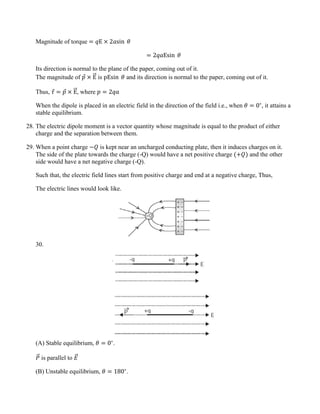
(d) force of attraction or repulsion depends upon speed of beams
[CBSE 2023]
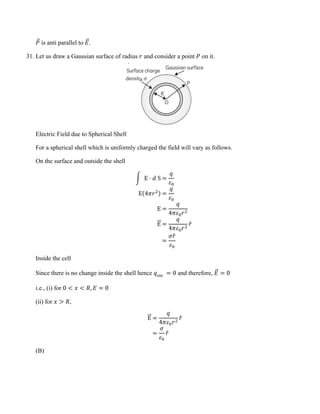
3. Two point charges placed in a medium of dielectric constant 5 are at a distance 𝑟𝑟 between them,
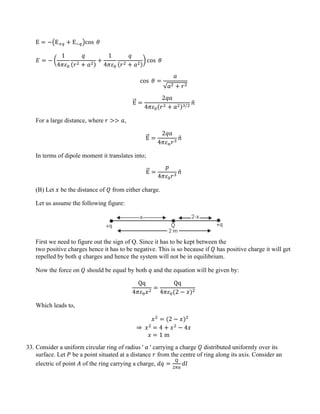
experience an electrostatic force ' 𝐹𝐹 '. The electrostatic force between them in vacuum at the same
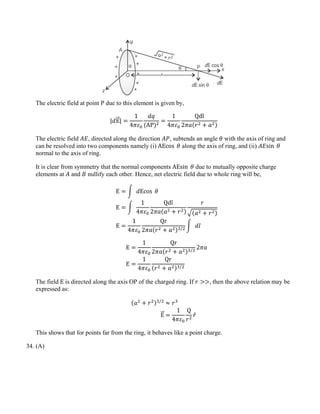
distance 𝑟𝑟 will be:
(a) 5 F
(b) F
(c)
𝐹𝐹
2
(d)
𝐹𝐹
5
[CBSE SQP Term-1 2021]
4. In an experiment three microscopic latex spheres are sprayed into a chamber and became charged
with charges +3𝑒𝑒, +5𝑒𝑒 and −3𝑒𝑒 respectively. All the three spheres came in contact
simultaneously for a moment and got separated. Which one of the following are possible values
for the final charge on the spheres?
(a) +5𝑒𝑒, −1𝑒𝑒, +5𝑒𝑒
(b) +6𝑒𝑒, +6𝑒𝑒, −7𝑒𝑒
(c) −4𝑒𝑒, +3.5𝑒𝑒, +5.5𝑒𝑒
(d) +5𝑒𝑒, −8𝑒𝑒, +7𝑒𝑒
[CBSE Term-1 2021]
CHAPTER - 1
5. An object has charge of 1C and gains 5.0 × 10¹⁸
electrons. The net charge of the object becomes:
(a) −0.80C
(b) +0.80C
(c) +4.80C
(d) +0.20C
[CBSE Term-1 2021]
6. Three charges 𝑞𝑞, −𝑞𝑞 and 𝑞𝑞0 are placed as shown in figure. The magnitude of the net force on the
charge 𝑞𝑞0 at point 𝑂𝑂 is �𝑘𝑘 =
1
(4𝜋𝜋𝜀𝜀0)
�.
(a) 0
(b)
2𝑘𝑘𝑘𝑘𝑞𝑞0
𝑎𝑎2
(c)
√2𝑘𝑘𝑘𝑘𝑞𝑞0
𝑎𝑎2
(d)
1
√2
𝑘𝑘𝑘𝑘𝑞𝑞0
𝑎𝑎2
[CBSE Term-1 2021]
7. Four objects 𝑊𝑊, 𝑋𝑋, 𝑌𝑌 and 𝑍𝑍 each with charge +𝑞𝑞 are held fixed at four points of a square of side 𝑑𝑑
as shown in the figure. Object 𝑋𝑋 and 𝑍𝑍 are on the midpoints of the sides of the square. The
electrostatic force exerted by object 𝑊𝑊 on object 𝑋𝑋 is 𝐹𝐹. Then the magnitude of the force exerted
by object 𝑊𝑊 on Z is:
(a)
𝐹𝐹
7
(b)
𝐹𝐹
5
(c)
𝐹𝐹
3
(d)
𝐹𝐹
2
[CBSE Term-1 2021]
8. A negatively charged object 𝑋𝑋 is repelled by another charged object 𝑌𝑌. However, an object 𝑍𝑍 is
attracted to object 𝑌𝑌. Which of the following is the most possibility for the object 𝑍𝑍 ?
(a) positively charged only
(b) negatively charged only
(c) neutral or positively charged
(d) neutral or negatively charged
[CBSE Term - 1 2021]
For Question 9, two statements are given one labelled Assertion (A) and other labelled Reason
(R). Select the correct answer to these questions from the options as given below.
(a) If both Assertion and Reason are true and Reason is correct explanation of Assertion.
(b) If both Assertion and Reason are true but Reason is not the correct explanation of Assertion.
(c) If Assertion is true but Reason is false.
(d) If both Assertion and Reason are false.
9. Assertion (A): Work done in moving a charge around a closed path, in an electric field is always
zero.
Reason (R): Electrostatic force is a conservative force.
[CBSE 2023]
Very Short & Short Qs (1-3 mark)
10. If the electric flux entering and leaving a closed surface in air are 𝜙𝜙1 and 𝜙𝜙2 respectively, the net
electric charge enclosed within the surface is
[CBSE 2020]
11. Two identical point charges, 𝑞𝑞 each, are kept 2 m apart in air. A third point charge 𝑄𝑄 of unknown
magnitude and sign is placed on the line joining the charges such that the system remains in
equilibrium. Find the position and nature of 𝑄𝑄.
[CBSE 2019]
12. Two identical conducting balls 𝐴𝐴 and 𝐵𝐵 have charges −𝑄𝑄 and +3𝑄𝑄 respectively. They are
brought in contact with each other and then separated by a distance 𝑑𝑑 apart. Find the nature of
Coulomb force between them.
[CBSE 2019]
13. What is the electric flux through a cube of side 1 cm which encloses an electric dipole?
[CBSE 2015]
14. Two balls of equal positive charge 𝑞𝑞 Coulombs are suspended by two insulating strings of equal
length. What would be the effect on the force when a plastic sheet is inserted between the two?
[CBSE 2014]
2. ELECTRIC FIELD AND ELECTRIC DIPOLE
Objective Qs (1 mark)
15. An electric dipole placed in an electric field of intensity 2 × 10⁵
N/C at an angle of 30∘
experiences a torque equal to 4Nm. The charge on the dipole of dipole length 2 cm is:
(a) 7𝜇𝜇C
(b) 8mC
(c) 2mC
(d) 5mC
[CBSE SQP 2023]
16. Two point charges +8𝑞𝑞 and −2𝑞𝑞 are located at 𝑥𝑥 = 0 and 𝑥𝑥 = 𝐿𝐿 respectively.
The point on 𝑥𝑥-axis at which net electric field is zero due to these charges is:
(a) 8 L
(b) 4 L
(c) 2 L
(d) L
[CBSE SQP Term-1 2021]
17. The electric potential 𝑉𝑉 at any point (𝑥𝑥, 𝑦𝑦, 𝑧𝑧) is given by 𝑉𝑉 = 3𝑥𝑥2
where 𝑥𝑥 is in metres and 𝑉𝑉 in
volts. The electric field at the point (1 m, 0.2 m) is:
(a) 6 V/m along (−𝑥𝑥)-axis
(b) 6 V/m along (+𝑥𝑥)-axis
(c) 1.5 V/m along (−𝑥𝑥)-axis
(d) 1.5 V/m along (+𝑥𝑥)-axis
[CBSE Term-1 2021]
18. Which of the diagrams correctly represents the electric field between two charged plates if a
neutral conductor is placed in between the plates?
(a)
(b)
(c)
(d)
[CBSE Term-1 2021]
19. The magnitude of electric field due to a point charge 2𝑞𝑞, at distance 𝑟𝑟 is 𝐸𝐸. Then the magnitude of
electric field due to a uniformly charged thin spherical shell of radius 𝑅𝑅 with total charge 𝑞𝑞 at a
distance
𝑟𝑟
2
(𝑟𝑟 >> 𝑅𝑅) will be:
(a)
𝐸𝐸
4
(b) 0
(c) 2E
(d) 4E
[CBSE Term-1 2021]
20. 𝐴𝐴 + 3.0nC charge 𝑄𝑄 is initially at rest at a distance of 𝑟𝑟1 = 10 cm from a +5.0nC charge fixed at
the origin. The charge 𝑄𝑄 is moved away from 𝑞𝑞 to a new position at 𝑟𝑟2 = 15 cm. In this process
work done by the field is:
(a) 1.29 × 10⁻⁵
J
(b) 3.6 × 10⁵
J
(c) −4.5 × 10⁻⁷
J
(d) 4.5 × 10⁻⁷
J
[CBSE Term-1 2021]
21. Four charges −𝑞𝑞, −𝑞𝑞, +𝑞𝑞 and +𝑞𝑞 are placed at the corners of a square of side 2 L is shown in
figure. The electric potential at point 𝐴𝐴 midway between the two charges +𝑞𝑞 and +𝑞𝑞 is:
(a)
1
4𝜋𝜋𝜀𝜀0
2𝑞𝑞
𝐿𝐿
�1 −
1
√5
�
(b)
1
4𝜋𝜋𝜀𝜀0
2𝑞𝑞
𝐿𝐿
�1 +
1
√5
�
(c)
1
4𝜋𝜋𝜀𝜀0
𝑞𝑞
𝐿𝐿
�1 −
1
√5
�
(d) zero
[CBSE Term-1 2021]
22. An electric dipole placed in a non-uniform electric field can experience:
(a) torque but not force
(b) force but not torque
(c) always a force and a torque
(d) neither a force nor a torque
[CBSE SQP 2020]
For Question 23, two statements are given one labelled Assertion (A) and other labelled Reason
(R). Select the correct answer to these questions from the options as given below.
(a) If both Assertion and Reason are true and Reason is correct explanation of Assertion.
(b) If both Assertion and Reason are true but Reason is not the correct explanation of Assertion.
(c) If Assertion is true but Reason is false.
(d) If both Assertion and Reason are false.
23. Assertion (A): 𝐴𝐴 negative charge in an electric field moves along the direction of the electric field.
Reason (R): On a negative charge a force acts in the direction of the electric field.
[CBSE Term-1 2021]
Very Short & Short Qs (1-3 marks)
24. Two charged conducting spheres of radii 𝑎𝑎 and 𝑏𝑏 are connected to each other by a wire. Find the
ratio of the electric fields at their surfaces.
25. (A) A uniformly charged large plane sheet has charge density 𝜎𝜎 = �
1
18𝜋𝜋
� × 10−15
C/m2
. Find the
electric field at point 𝐴𝐴 which is 50 cm from the sheet.
Consider a straight line with three points 𝑃𝑃, 𝑄𝑄 and 𝑅𝑅, placed 50 cm from the charged sheet on the
right side as shown in the figure. At which of these points, does the magnitude of the electric field
due to the sheet remain the same as that at point 𝐴𝐴 and why?
(B) Two small identical conducting spheres carrying charge 10𝜇𝜇C and −20𝜇𝜇C when separated by
a distance of 𝑟𝑟, experience a force 𝐹𝐹 each. If they are brought in contact and then separated to a
distance of
𝑟𝑟
2
, what is the new force between them in terms of F?
[CBSE 2021]
26. Two point charges of +1𝜇𝜇C and +4𝜇𝜇C are kept 30 cm apart. How far from the +1𝜇𝜇C charge on
the line joining the two charge, will the net electric field be zero?
[CBSE 2020]
27. Derive the expression for the torque acting on an electric dipole, when it is held in a uniform
electric field. Identify the orientation of the dipole in the electric field, in which it attains a stable
equilibrium.
[CBSE 2020] OR
If dipole were kept in a uniform external electric field 𝐸𝐸0, diagrammatically represent the position
of the dipole in stable and unstable equilibrium and write the expression for the torque acting on
the dipole in both the cases.
[CBSE 2017] OR
Deduce the expression for the torque acting on a dipole of dipole moment 𝑝𝑝 in the presence of a
uniform electric field 𝐸𝐸.
[CBSE 2014]
28. Define electric dipole moment. Is it a vector or scalar quantity?
[CBSE 2019]
29. Draw the pattern of electric field lines, when a point charge −𝑄𝑄 is kept near an uncharged
conducting plate.
[CBSE 2019]
30. Depict the orientation of the dipole in (A) stable, (B) unstable equilibrium in a uniform electric
field.
[CBSE 2017]
31. (A) Using Gauss law, derive expression for electric field due to a spherical shell of uniform
charge distribution 𝜎𝜎 and radius 𝑅𝑅 at a point lying at a distance 𝑥𝑥 from the centre of shell, such
that
(i) 0 < 𝑥𝑥 < 𝑅𝑅, and
(ii) 𝑥𝑥 > 𝑅𝑅.
(B) An electric field is uniform and acts along +𝑥𝑥 direction in the region of positive 𝑥𝑥. It is also
uniform with the same magnitude but acts in −𝑥𝑥 direction in the region of negative 𝑥𝑥. The value
of the field is 𝐸𝐸 = 200 N/C for 𝑥𝑥 > 0 and 𝐸𝐸 = −200 N/C for 𝑥𝑥 < 0. A right circular cylinder of
length 20 cm and radius 5 cm has its centre at the origin and its axis along the 𝑥𝑥-axis so that one
flat face is at 𝑥𝑥 = +10 cm and the other is at 𝑥𝑥 = −10 cm.
Find:
(i) The net outward flux through the cylinder.
(ii) The net charge present inside the cylinder.
32. (A) Derive an expression for the electric field at any point on the equatorial line of an electric
dipole.
(B) Two identical point charges, 𝑞𝑞 each are kept 2 m apart in air. A third point charge 𝑄𝑄 of
unknown magnitude and sign is placed on the line joining the charged such that the system
remains in equilibrium. Find the position and nature of 𝑄𝑄.
[CBSE 2019]
33. A charge is distributed uniformly over a ring of radius ' 𝑎𝑎 '. Obtain an expression for the electric
intensity 𝐸𝐸 at a point on the axis of the ring. Hence, show that for points at large distances from
the ring, it behaves like a point charge.
[CBSE 2016]
Numerical Qs (1-5 marks)
34. A hollow cylindrical box of length 1 m and area of cross-section 25 cm2
is placed in a three
dimensional coordinate system as shown in the figure. The electric field in the region is given by
𝐸𝐸 = 50𝑥𝑥𝚤𝚤
ˆ, where, 𝐸𝐸 is in NC−1
and 𝑥𝑥 is in metre.
Find:
(A) net flux through the cylinder and
(B) charge enclosed by the cylinder.
[CBSE 2014]
3. ELECTRIC FLUX AND GAUSS'S THEOREM
Objective Qs (1 mark)
35. A cylinder of radius 𝑅𝑅 and length 𝐿𝐿 is placed in a uniform electric field 𝐸𝐸 parallel to the cylinder
axis. The total flux for the surface of the cylinder is given by:
(a) zero
(b) +1
(c) -1
(d) can be zero or +1
[CBSE 2022]
36. A square surface of side 𝐿𝐿 meters is in the plane of paper. 𝐸𝐸 is limited only to the lower half of the
square surface as shown in the figure. Electric field 𝐸𝐸 is in 𝑉𝑉/𝑚𝑚. The electric flux (SI units)
associated with the surface is:
(a) EL2
(b)
EL2
2𝜀𝜀0
(c)
EL2
2
(d) zero
[Delhi Gov. SQP 2022]
37. A square sheet of side ' 𝑎𝑎 ' is lying parallel to 𝑋𝑋𝑋𝑋-plane at 𝑧𝑧 = 𝑎𝑎. The electric field in the region is
𝐸𝐸
�⃗ = 𝑐𝑐𝑧𝑧2
𝑘𝑘
ˆ. The electric flux through the sheet is:
(a) 𝑎𝑎4
𝑐𝑐
(c)
1
3
𝑎𝑎4
𝑐𝑐
(b)
1
8
𝑎𝑎3
𝑐𝑐
(d) 𝜃𝜃
[CBSE Term-1 2021]
38. Which statement is true for Gauss's law:
(a) All the charges whether inside or outside the Gaussian surface contribute to the electric flux.
(b) Electric flux depends upon the geometry of the Gaussian surface
(c) Gauss's theorem can be applied to nonuniform electric field
(d) The electric field over the Gaussian surface remains continuous and uniform at every point.
[CBSE SQP Term-1 2021]
39. Two parallel large thin metal sheets have equal surface densities 26.4 × 10⁻¹²
c/m2
of opposite
signs. The electric field between these sheets is:
(a) 1.5 N/C
(b) 1.5 × 10⁻¹⁶
N/C
(c) 3 × 10⁻¹⁰
N/C
(d) 3 N/C
[CBSE SQP Term-1 2021]
40. If the net electric flux through a closed surface is zero then we can infer that:
(a) no net charge is enclosed by the surface
(b) uniform electric field exists within the surface
(c) electric potential varies from point to point inside the surface
(d) charge is present inside the surface
[CBSE SQP 2020]
Very Short & Short Qs 1-3 marks
41. (A) Use Gauss law to obtain an expression for the electric field due to an infinitely long thin
straight wire with uniform linear charge density 𝜆𝜆.
(B) An infinitely long positively charged straight wire has a linear charge density 𝜆𝜆, An electron is
revolving in a circle with a constant speed 𝑣𝑣 such that the wire passes through the centre, and is
perpendicular to the plane, of the circle. Find the kinetic energy of the electron in terms of
magnitudes of its charge and linear charge density 𝜆𝜆 on the wire.
(C) Draw a graph of kinetic energy as a function of linear charge density 𝜆𝜆.
[CBSE 2023]
42. (A) Consider two identical point charges located at points (0,0) and (𝑎𝑎, 0).
(i) is there a point on the line joining them at which the electric field is zero?
(ii) Is there a point on the line joining them at which the electric potential is zero?
Justify your answers for each case.
(B) State the significance of negative value of electrostatic potential energy of a system of
charges.
Three charges are placed at the corners of an equilateral triangle 𝐴𝐴𝐴𝐴𝐴𝐴 of side 2.0 m as shown in
figure. Calculate the electric potential energy of the system of three charges.
[CBSE 2023]
43. Electric flux through a spherical surface shown in the figure, is
[CBSE 2020]
44. Two charges of magnitudes −2𝑄𝑄 and +𝑄𝑄 are located at points (𝑎𝑎, 0) and (4𝑎𝑎, 0) respectively.
what is the electric flux due to these charges through a sphere of radius 3𝑎𝑎 with its centre at the
origin?
[CBSE 2016]
45. How does the electric flux due to a point charge enclosed by a spherical Gaussian surface altered
when its radius is increased?
[CBSE 2016]
46. Given a uniform electric field 𝐸𝐸
�⃗ = 5 × 10³
𝚤𝚤
ˆ N/C, find the flux of this field through a square of
10 cm on a side whose plane is parallel to the 𝑦𝑦 − 𝑧𝑧 plane. What could be the flux through the
same square if the plane makes 30∘
angle with the 𝑥𝑥-axis?
[CBSE 2014]
47. 𝑆𝑆1 and 𝑆𝑆2 are two hollow concentric thin spherical shells enclosing charges 𝑄𝑄 and 2𝑄𝑄 respectively
as shown in figure.
(A) What is the ratio of the electric flux through 𝑆𝑆1 and 𝑆𝑆2 ?
(B) How will the electric flux through the shell 𝑆𝑆1 change, if a medium of dielectric constant 5 is
introduced in the space inside 𝑆𝑆1 in place of air?
[CBSE 2014]
Long Qs (4-5 marks)
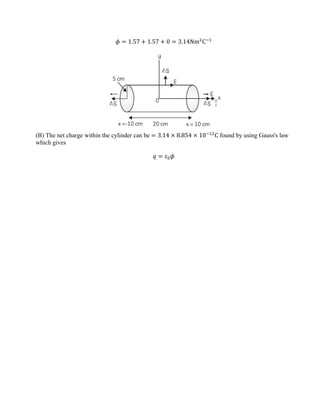
48. An electric field is uniform and acts along +𝑥𝑥 direction in the region of positive 𝑥𝑥. It is also
uniform with the same magnitude but acts in −𝑥𝑥 direction in the region of negative 𝑥𝑥. The value
of the field is 𝐸𝐸 = 200 N/C for 𝑥𝑥 > 0 and 𝐸𝐸 = −200 N/C for 𝑥𝑥 < 0. A right circular cylinder of
length 20 cm and radius 5 cm has its center at the origin and its axis along the 𝑥𝑥-axis so that one
flat face is at 𝑥𝑥 = +10 cm and the other is at 𝑥𝑥 = −10 cm. Find: (A) The net outward flux
through the cylinder. (B) The net charge present inside the cylinder.
[CBSE 2020]
PYQ WITH
SOLUTIONS
CLASS 12
PHYSICS
SOLUTIONS
1. ELECTRIC CHARGE
1. (d) 6 m
Explanation:
E =
𝑘𝑞
𝑟2
E =
𝑘𝑞
9
E =
E
4
=
𝑘𝑞
9 × 4
𝑘𝑞
𝑟2
=
𝑘𝑞
36
𝑟2
= 36
𝑟 = 6
2. (b) repel each other
Explanation: Electrons are negatively charged and the protons are positively charged. Hence the
currents carried by them are in opposite direction. Hence, they will repel each other.
3. (a) 5𝐹
Explanation:
K = 5
F =
1
4𝜋𝜀0 K
Q1Q2
𝑟2
Force between the charges in the air is.
F′
=
1
4𝜋𝜀0
Q1Q2
𝑟2
= KF
= 5 F
4. (b) +6𝑒, +6𝑒, −7𝑒
Explanation: Sum of three charges before they come in contact is +5𝑒. Therefore, after contact, the
sum of charges will remain the same.
CHAPTER - 1
5. (d) +0.20C
Explanation: As the electrons are gained, we get,
𝑄 = 𝑛𝑒
= 5.0 × 1018
× 1.6 × 10−19
= 0.80C
But, the charge of 1C gains electrons therefore,
1𝐶 − 0.8𝐶 = 0.20𝐶
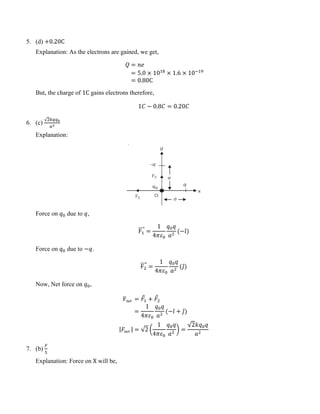
6. (c)
√2𝑘𝑞𝑞0
𝑎2
Explanation:
Force on 𝑞0 due to 𝑞,
F1
����⃗ =
1
4𝜋𝜀0
𝑞0𝑞
𝑎2
(−𝚤
ˆ)
Force on 𝑞0 due to −𝑞.
F2
����⃗ =
1
4𝜋𝜀0
𝑞0𝑞
𝑎2
(𝚥
ˆ)
Now, Net force on 𝑞0,
Fnet = 𝐹
⃗1 + 𝐹
⃗2
=
1
4𝜋𝜀0
𝑞0𝑞
𝑎2
(−𝚤
ˆ + 𝚥
ˆ)
|𝐹net | = √2 �
1
4𝜋𝜀0
𝑞0𝑞
𝑎2
� =
√2𝑘𝑞0𝑞
𝑎2
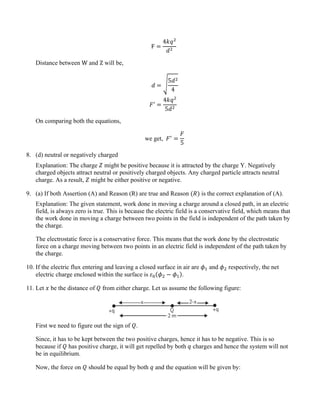
7. (b)
𝐹
5
Explanation: Force on X will be,
F =
4𝑘𝑞2
𝑑2
Distance between W and Z will be,
𝑑 = �
5𝑑2
4
𝐹′
=
4𝑘𝑞2
5𝑑2
On comparing both the equations,
we get, 𝐹′
=
𝐹
5
8. (d) neutral or negatively charged
Explanation: The charge 𝑍 might be positive because it is attracted by the charge Y. Negatively
charged objects attract neutral or positively charged objects. Any charged particle attracts neutral
charge. As a result, 𝑍 might be either positive or negative.
9. (a) If both Assertion (A) and Reason (R) are true and Reason (𝑅) is the correct explanation of (A).
Explanation: The given statement, work done in moving a charge around a closed path, in an electric
field, is always zero is true. This is because the electric field is a conservative field, which means that
the work done in moving a charge between two points in the field is independent of the path taken by
the charge.
The electrostatic force is a conservative force. This means that the work done by the electrostatic
force on a charge moving between two points in an electric field is independent of the path taken by
the charge.
10. If the electric flux entering and leaving a closed surface in air are 𝜙1 and 𝜙2 respectively, the net
electric charge enclosed within the surface is 𝜀0(𝜙2 − 𝜙1).
11. Let 𝑥 be the distance of 𝑄 from either charge. Let us assume the following figure:
First we need to figure out the sign of 𝑄.
Since, it has to be kept between the two positive charges, hence it has to be negative. This is so
because if 𝑄 has positive charge, it will get repelled by both 𝑞 charges and hence the system will not
be in equilibrium.
Now, the force on 𝑄 should be equal by both 𝑞 and the equation will be given by:
Qq
4𝜋𝜀0𝑥2
=
Qq
4𝜋𝜀0(2 − 𝑥)2
Which leads to,
𝑥2
= (2 − 𝑥)2
⇒ 𝑥2
= 4 + 𝑥2
− 4𝑥
𝑥 = 1 m
12. The force between them is repulsive in nature.
As the two balls are brought in contact with each other, they exchange their charges till they both
attain the same charge which is,
−𝑄+3𝑄
2
= +𝑄.
Since, both acquire the same charge +𝑄,
Hence, they repel each other.
13. Since electric dipole is made up of ±𝑞
∴ 𝑞in = 0
∴ flux = 0
14. The two balls will come closer to each other. As we know, force between the two objects can be
written as:
F =
1
4𝜋𝜀0
𝑞2
𝑟2
If a plastic sheet is inserted between the two objects, then the equation will become:
F =
1
4𝜋𝜀0 K
𝑞2
𝑟2
Where, 𝐾 is the dielectric constant of the material which tends to reduce the force between the two
balls. Hence, they will move a little towards each other.
2. ELECTRIC FIELD AND ELECTRIC DIPOLE
15. (c) 2𝑚𝐶
𝑞 =
𝜏
[(2𝑎)Esin 𝜃]
=
4
2 × 10−2 × 2 × 105sin 30∘
= 2 × 10⁻³
C = 2mC
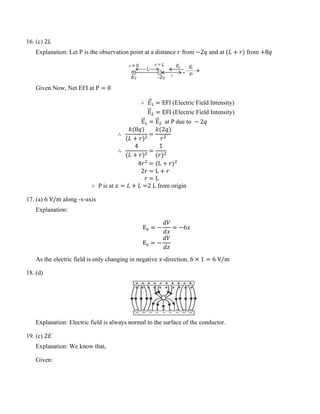
16. (c) 2𝐿
Explanation: Let P is the observation point at a distance 𝑟 from −2𝑞 and at (𝐿 + 𝑟) from +8𝑞
Given Now, Net EFI at P = 0
∴ 𝐸
�⃗1 = EFI (Electric Field Intensity)
E
�
�⃗2 = EFI (Electric Field Intensity)
E
�
�⃗1 = E
�
�⃗2 at P due to − 2𝑞
∴
𝑘(8𝑞)
(𝐿 + 𝑟)2
=
𝑘(2𝑞)
𝑟2
∴
4
(𝐿 + 𝑟)2
=
1
(𝑟)2
4𝑟2
= (L + 𝑟)2
2𝑟 = L + 𝑟
𝑟 = L
∴ P is at 𝑥 = 𝐿 + 𝐿 =2 L from origin
17. (a) 6 V/m along -x-axis
Explanation:
Ex = −
𝑑𝑉
𝑑𝑥
= −6𝑥
Ez = −
𝑑𝑉
𝑑𝑧
As the electric field is only changing in negative 𝑥-direction, 6 × 1 = 6 V/m
18. (d)
Explanation: Electric field is always normal to the surface of the conductor.
19. (c) 2𝐸
Explanation: We know that,
Given:
E = 𝑘
𝑞
𝑟2
𝑞 = 2𝑞
𝑟 = 𝑟
then
E = 𝑘
2𝑞
𝑟2
According to question, If,
then
𝑞 = 𝑞
𝑟 =
𝑟
2
E′
= 𝑘
𝑞
�
𝑟
2
�
2
E′
= 𝑘
4𝑞
𝑟2
E′
= 2𝑘
2𝑞
𝑟2
E′
= 2E
= 2E
[From eq. (ii)]
20. (d) 4.5 × 10⁻⁷
J
Explanation:
W = 𝑞[ΔV]
= 𝑞 �
𝑘Q
𝑟1
−
𝑘Q
𝑟2
�
= 𝑞𝑘Q �
1
𝑟1
−
1
𝑟2
�
Putting the values in the formula, we get 4.5 × 10⁻⁷
J.
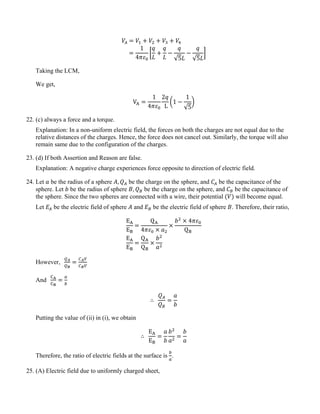
21. (a)
1
4𝜋𝜀0
2𝑞
𝐿
�1 −
1
√5
�
Explanation:
𝑉𝐴 = 𝑉1 + 𝑉2 + 𝑉3 + 𝑉4
=
1
4𝜋𝜀0
�
𝑞
𝐿
+
𝑞
𝐿
−
𝑞
√5𝐿
−
𝑞
√5𝐿
�
Taking the LCM,
We get,
VA =
1
4𝜋𝜀0
2𝑞
L
�1 −
1
√5
�
22. (c) always a force and a torque.
Explanation: In a non-uniform electric field, the forces on both the charges are not equal due to the
relative distances of the charges. Hence, the force does not cancel out. Similarly, the torque will also
remain same due to the configuration of the charges.
23. (d) If both Assertion and Reason are false.
Explanation: A negative charge experiences force opposite to direction of electric field.
24. Let 𝑎 be the radius of a sphere 𝐴, 𝑄𝐴 be the charge on the sphere, and 𝐶𝐴 be the capacitance of the
sphere. Let 𝑏 be the radius of sphere 𝐵, 𝑄𝐵 be the charge on the sphere, and 𝐶𝐵 be the capacitance of
the sphere. Since the two spheres are connected with a wire, their potential (𝑉) will become equal.
Let 𝐸𝐴 be the electric field of sphere 𝐴 and 𝐸𝐵 be the electric field of sphere 𝐵. Therefore, their ratio,
EA
EB
=
QA
4𝜋𝜀0 × 𝑎2
×
𝑏2
× 4𝜋𝜀0
QB
EA
EB
=
QA
QB
×
𝑏2
𝑎2
However,
𝑄𝐴
𝑄𝐵
=
𝐶𝐴𝑉
𝐶𝐵𝑉
And
CA
CB
=
𝑎
𝑏
∴
𝑄𝐴
𝑄𝐵
=
𝑎
𝑏
Putting the value of (ii) in (i), we obtain
∴
EA
EB
=
𝑎
𝑏
𝑏2
𝑎2
=
𝑏
𝑎
Therefore, the ratio of electric fields at the surface is
𝑏
𝑎
.
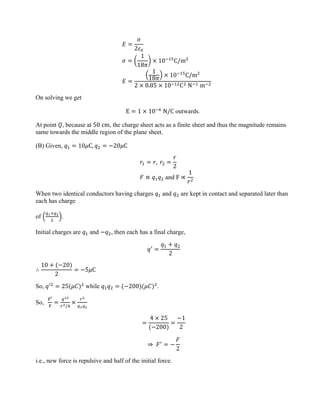
25. (A) Electric field due to uniformly charged sheet,
𝐸 =
𝜎
2𝜀0
𝜎 = �
1
18𝜋
� × 10−15
C/m2
𝐸 =
�
1
18𝜋
� × 10−15
C/m2
2 × 8.85 × 10−12C2 N−1 m−2
On solving we get
E = 1 × 10⁻⁶
N/C outwards.
At point 𝑄, because at 50 cm, the charge sheet acts as a finite sheet and thus the magnitude remains
same towards the middle region of the plane sheet.
(B) Given, 𝑞1 = 10𝜇C, 𝑞2 = −20𝜇C
𝑟1 = 𝑟, 𝑟2 =
𝑟
2
𝐹 ∝ 𝑞1𝑞2 and F ∝
1
𝑟2
When two identical conductors having charges 𝑞1 and 𝑞2 are kept in contact and separated later than
each has charge
of �
𝑞1+𝑞2
2
�.
Initial charges are 𝑞1 and −𝑞2, then each has a final charge,
𝑞′
=
𝑞1 + 𝑞2
2
∴
10 + (−20)
2
= −5𝜇C
So, 𝑞′2
= 25(𝜇𝐶)2
while 𝑞1𝑞2 = (−200)(𝜇𝐶)2
.
So,
F′
F
=
𝑞12
𝑟2/4
×
𝑟2
𝑞1𝑞2
=
4 × 25
(−200)
=
−1
2
⇒ 𝐹′
= −
𝐹
2
i.e., new force is repulsive and half of the initial force.
26. Given,
Two charge
𝑞1 = +1𝜇C
𝑞𝑝 = 1𝜇C
𝑞2 = 4𝜇C
𝑑 = 30 cm = 3 m
Let point 𝑃( where, 𝑓1𝜇C = 0� is at distance 𝑟 form 𝑞1 [ref. image]
F1 + F2 = 0
𝑘
𝑞1 × 𝑞𝑝
𝑟2
− 𝑘
𝑞2𝑞𝑝
(3 − 𝑟)2
= 0
𝑞1
𝑟2
=
𝑞2
(3 − 𝑟)2
�
3 − 𝑟
𝑟
�
2
=
𝑞2
𝑞1
=
4
1
= 4
�
3 − 𝑟
𝑟
�
2
= 4 or
3 − 𝑟
𝑟
= 2
3 − 𝑟
𝑟
= +2
𝑟 = .1 m = 10 cm
27. Consider a permanent dipole, of dipole moment 𝑝
⃗ in a uniform external field E
�
�⃗, as shown in figure.
There is a force 𝑞𝐸
�⃗ on 𝑞 and a force −𝑞𝐸
�⃗ on −𝑞.
The net force on the dipole is zero since 𝐸
�⃗ is uniform.
Magnitude of torque = 𝑞E × 2𝑎sin 𝜃
= 2𝑞𝑎Esin 𝜃
Its direction is normal to the plane of the paper, coming out of it.
The magnitude of 𝑝
⃗ × E
�
�⃗ is pEsin 𝜃 and its direction is normal to the paper, coming out of it.
Thus, 𝜏
⃗ = 𝑝
⃗ × E
�
�⃗, where 𝑝 = 2𝑞𝑎
When the dipole is placed in an electric field in the direction of the field i.e., when 𝜃 = 0∘
, it attains a
stable equilibrium.
28. The electric dipole moment is a vector quantity whose magnitude is equal to the product of either
charge and the separation between them.
29. When a point charge −𝑄 is kept near an uncharged conducting plate, then it induces charges on it.
The side of the plate towards the charge (-Q) would have a net positive charge (+𝑄) and the other
side would have a net negative charge (-Q).
Such that, the electric field lines start from positive charge and end at a negative charge, Thus,
The electric lines would look like.
30.
(A) Stable equilibrium, 𝜃 = 0∘
.
𝑃
�⃗ is parallel to 𝐸
�⃗
(B) Unstable equilibrium, 𝜃 = 180∘
.
𝑃
�⃗ is anti parallel to 𝐸
�⃗.
31. Let us draw a Gaussian surface of radius 𝑟 and consider a point 𝑃 on it.
Electric Field due to Spherical Shell
For a spherical shell which is uniformly charged the field will vary as follows.
On the surface and outside the shell
� E ⋅ 𝑑 S =
𝑞
𝜀0
E(4𝜋𝑟2) =
𝑞
𝜀0
E =
𝑞
4𝜋𝜀0𝑟2
E
�
�⃗ =
𝑞
4𝜋𝜀0𝑟2
𝑟
ˆ
=
𝜎𝑟
ˆ
𝜀0
Inside the cell
Since there is no change inside the shell hence 𝑞enc = 0 and therefore, 𝐸
�⃗ = 0
i.e., (i) for 0 < 𝑥 < 𝑅, 𝐸 = 0
(ii) for 𝑥 > 𝑅,
E
�
�⃗ =
𝑞
4𝜋𝜀0𝑟2
𝑟
ˆ
=
𝜎
𝜀0
𝑟
ˆ
(B)
(i) The net outward flux through the cylinder,
𝑓 = 𝐸𝐴 + 𝐸𝐴 = 2𝐸𝐴
= 2 × 200 × 3.14 × (0.05)2
[∵ A = 𝜋𝑟2]
= 400 × 3.14 × 25 × 10−4
= 3.14NC−1
m2
(ii) The net charge inside the cylinder
𝑞 = 𝑒0𝑓 [ By using Gauss' law ]
= 8.854 × 10−12
× 3.14
= 2.78 × 10⁻¹¹
C.
32. (A)
Field on an Equatorial Point
The field at the point 𝑃 is given by,
E = −�E+𝑞 + E−𝑞�cos 𝜃
𝐸 = − �
1
4𝜋𝜀0
𝑞
(𝑟2 + 𝑎2)
+
1
4𝜋𝜀0
𝑞
(𝑟2 + 𝑎2)
� cos 𝜃
cos 𝜃 =
𝑎
√𝑎2 + 𝑟2
E
�
�⃗ =
2𝑞𝑎
4𝜋𝜀0(𝑟2 + 𝑎2)3/2
𝑛
ˆ
For a large distance, where 𝑟 >> 𝑎,
E
�
�⃗ =
2𝑞𝑎
4𝜋𝜀𝑛𝑟3
𝑛
ˆ
In terms of dipole moment it translates into;
E
�
�⃗ =
𝑝
4𝜋𝜀0𝑟3
𝑛
ˆ
(B) Let 𝑥 be the distance of 𝑄 from either charge.
Let us assume the following figure:
First we need to figure out the sign of Q. Since it has to be kept between the
two positive charges hence it has to be negative. This is so because if 𝑄 has positive charge it will get
repelled by both 𝑞 charges and hence the system will not be in equilibrium.
Now the force on 𝑄 should be equal by both 𝑞 and the equation will be given by:
Qq
4𝜋𝜀0𝑥2
=
Qq
4𝜋𝜀0(2 − 𝑥)2
Which leads to,
𝑥2
= (2 − 𝑥)2
⇒ 𝑥2
= 4 + 𝑥2
− 4𝑥
𝑥 = 1 m
33. Consider a uniform circular ring of radius ' 𝑎 ' carrying a charge 𝑄 distributed uniformly over its
surface. Let 𝑃 be a point situated at a distance 𝑟 from the centre of ring along its axis. Consider an
electric of point 𝐴 of the ring carrying a charge, 𝑑𝑞 =
Q
2𝜋𝑎
𝑑𝑙
The electric field at point P due to this element is given by,
|𝑑E
�
�⃗| =
1
4𝜋𝜀0
𝑑𝑞
(AP)2
=
1
4𝜋𝜀0
Qdl
2𝜋𝑎(𝑟2 + 𝑎2)
The electric field 𝐴𝐸, directed along the direction 𝐴𝑃, subtends an angle 𝜃 with the axis of ring and
can be resolved into two components namely (i) AEcos 𝜃 along the axis of ring, and (ii) 𝐴𝐸sin 𝜃
normal to the axis of ring.
It is clear from symmetry that the normal components AEsin 𝜃 due to mutually opposite charge
elements at 𝐴 and 𝐵 nullify each other. Hence, net electric field due to whole ring will be,
E = � 𝑑Ecos 𝜃
E = �
1
4𝜋𝜀0
Qdl
2𝜋𝑎(𝑎2 + 𝑟2)
𝑟
�(𝑎2 + 𝑟2)
E =
1
4𝜋𝜀0
Qr
2𝜋𝑎(𝑟2 + 𝑎2)3/2
� 𝑑𝑙
E =
1
4𝜋𝜀0
Qr
2𝜋𝑎(𝑟2 + 𝑎2)3/2
2𝜋𝑎
E =
1
4𝜋𝜀0
Qr
(𝑟2 + 𝑎2)3/2
The field E is directed along the axis OP of the charged ring. If 𝑟 >>, then the above relation may be
expressed as:
(𝑎2
+ 𝑟2)3/2
≈ 𝑟3
E
�
�⃗ =
1
4𝜋𝜀0
Q
𝑟2
𝑟
ˆ
This shows that for points far from the ring, it behaves like a point charge.
34. (A)
As the electric field is only along the 𝑥-axis, so flux will pass only through the cross-section of
cylinder.
Magnitude of electric field at cross-section A,
EA = 50 × 1 = 50NC−1
Magnitude of electric field at cross - section B, The corresponding electric fluxes are,
𝜙A = EA ⋅ ΔS
= 50 × 25 × 10−4
× cos 180∘
= −0.125 N − m2
C−1
𝜙B = EB ⋅ ΔS
= 100 × 25 × 10−4
× cos 0∘
= 0.25 N − m2
C−1
and 𝜙B = EB ⋅ ΔS
So, the net flux through the cylinder,
𝜙 = 𝜙𝐴 + 𝜙𝐵 = −0.125 + 0.25
= 0.1 N m2
C−1
(B) Using Gauss's law,
∮ E. 𝑑𝑠 =
𝑞
𝜀0
[∴ ∮ E. 𝑑𝑠 = 𝜙]
0.1 =
𝑞
8.85 × 10⁻¹²
𝑞 = 8.85 × 0.125 × 10−12
= 0.885 × 10⁻¹²
C
3. ELECTRIC FLUX AND GAUSS'S THEOREM
35. (a) zero
Explanation: As per the question
Flux through the curved surface is zero as the electric field does not cross it. The flux through the flat
face is also zero as total incoming and outgoing flux is zero.
36. (d) zero
Explanation: Electric flux,
𝜙𝐸 = � 𝐸
�⃗ ⋅ 𝑑𝑆
⃗
= � 𝐸𝑑𝑆cos 𝜃 [∵ 𝜃 = 90∘]
= � 𝐸𝑑𝑆cos 90∘
= 0
The lines are parallel to the surface.
37. (a) 𝑎4
𝑐
Explanation: Given that: 𝑧 = 𝑎
𝜙 = 𝑐𝑧2
𝑑𝑥𝑑𝑦𝑘
ˆ
= 𝑐𝑧2
𝑑𝑥𝑑𝑦𝑘
ˆ
= 𝑐𝑧2
�
𝑧
0
𝑑𝑥 �
𝑧
0
𝑑𝑦
= 𝑐𝑧2
[𝑥]0
𝑧
[𝑦]0
𝑧
= 𝑐𝑧2
[𝑧][𝑧]
= 𝑐𝑧4
= 𝑐𝑎4
[∵ 𝑧 = 𝑎]
38. (d) The electric field over the Gaussian surface remains continuous and uniform at every point.
Explanation: From Gauss's law of electrostatics, we know that only charges contain within the
Gaussian surface contribute to the flux. Also, we know the electric flux depends only on total charge
and nature of medium and has nothing to do with geometry. Further more Gauss's theorem is
applicable to the case of uniform electric field as that will allow the formation of a symmetrical
Gaussian surface. Hence, option (a), (b), (c) are also false. Turns out that electric field remains
continuous at every point over a Gaussian surface.
39. (d) 3 N/C
Surface charge density,
Surface charge density, 𝜎 = 26.4 × 10⁻¹²
Cm−2
E =
𝜎
2𝜀0
+
𝜎
2𝜀0
=
2𝜎
2𝜀0
=
𝜎
𝜀0
=
26.4 × 10⁻¹²
8.85 × 10⁻¹²
C
C
= 3
N
C
40. (a) No net charge is enclosed by the surface.
Explanation: As per Gauss's law the electric flux through a surface is proportional to the net charge
enclosed by the surface. Hence, if the flux is zero, it means the total charge inside is also zero.
41. (A)
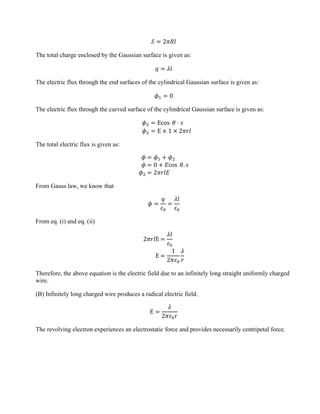
The wire is considered to be a cylindrical Gaussian surface. This is because to determine the electric
field 𝐸 at point 𝑃, Gauss law is used.
The surface area of the curved part is given as:
𝑆 = 2𝜋𝑅𝑙
The total charge enclosed by the Gaussian surface is given as:
𝑞 = 𝜆𝑙
The electric flux through the end surfaces of the cylindrical Gaussian surface is given as:
𝜙1 = 0
The electric flux through the curved surface of the cylindrical Gaussian surface is given as:
𝜙2 = Ecos 𝜃 ⋅ 𝑠
𝜙2 = E × 1 × 2𝜋𝑟𝑙
The total electric flux is given as:
𝜙 = 𝜙1 + 𝜙2
𝜙 = 0 + 𝐸cos 𝜃. 𝑠
𝜙2 = 2𝜋𝑟𝑙𝐸
From Gauss law, we know that
𝜙 =
𝑞
𝜀0
=
𝜆𝑙
𝜀0
From eq. (i) and eq. (ii)
2𝜋𝑟𝑙E =
𝜆𝑙
𝜀0
E =
1
2𝜋𝜀0
𝜆
𝑟
Therefore, the above equation is the electric field due to an infinitely long straight uniformly charged
wire.
(B) Infinitely long charged wire produces a radical electric field.
E =
𝜆
2𝜋𝜀0𝑟
The revolving electron experiences an electrostatic force and provides necessarily centripetal force.
𝑒E =
𝑚𝑣2
𝑟
𝑒. 𝜆
2𝜋𝜀0𝑟
=
𝑚𝑣2
𝑟
⇒ 𝑚𝑣2
=
𝑒𝜆
2𝜋𝜀0
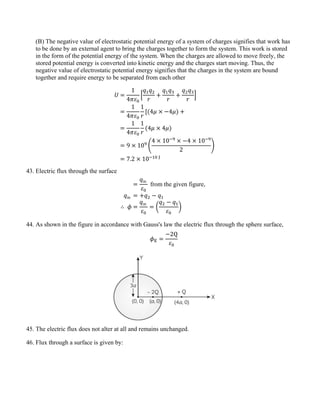
Kinetic energy of the electron,
𝐾 =
1
2
𝑚𝑣2
=
𝑒𝜆
2𝜋𝜀0
42. (A) (i) Yes, there is a point on the line joining the two charges at which the electric field is zero. This
point is called the midpoint between the two charges, which is located at (0, 𝑎 − 0). At this point, the
electric fields due to the two charges are equal in magnitude but opposite in direction, so they cancel
out each other resulting in zero net electric field.
(ii) To find the point on the line joining the charges at which the electric potential is zero, we need to
find the point where the potential due to one charge is equal in magnitude but opposite in sign to the
potential due to the other charge. This occurs when the distance from each charge to the point is
proportional to the magnitude of the charge. Let the potential at a point ( 𝑥, 0) due to the charge at
(0,0) be 𝑉1, and the potential due to the charge at (𝑎, 0) be 𝑉2. Then, we have:
V1 =
𝑘𝑞
𝑟1
=
𝑘𝑞
(𝑥)
𝑉2 =
𝑘𝑞
𝑟2
=
𝑘𝑞
(𝑎 − 𝑥)
Where 𝑘 is the Coulomb constant, 𝑞 is the magnitude of each charge, 𝑟1 and 𝑟2 are the distances from
each charge to the point (𝑥, 0). To find the point at which 𝑉1 = −𝑉2, we solve for 𝑥 :
𝑘𝑞
𝑥
=
−𝑘𝑞
(𝑎 − 𝑥)
𝑥 =
𝑎
2
Therefore, the point on the line joining the charges at which the electric potential is zero is the
midpoint between the charges. Which is the same point as the one where the electric field is zero.
(B) The negative value of electrostatic potential energy of a system of charges signifies that work has
to be done by an external agent to bring the charges together to form the system. This work is stored
in the form of the potential energy of the system. When the charges are allowed to move freely, the
stored potential energy is converted into kinetic energy and the charges start moving. Thus, the
negative value of electrostatic potential energy signifies that the charges in the system are bound
together and require energy to be separated from each other
𝑈 =
1
4𝜋𝜀0
�
𝑞1𝑞2
𝑟
+
𝑞1𝑞3
𝑟
+
𝑞2𝑞3
𝑟
�
=
1
4𝜋𝜀0
1
𝑟
[(4𝜇 × −4𝜇) +
=
1
4𝜋𝜀0
1
𝑟
(4𝜇 × 4𝜇)
= 9 × 10⁹
�
4 × 10⁻⁹
× −4 × 10⁻⁹
2
�
= 7.2 × 10⁻¹⁰ J
43. Electric flux through the surface
=
𝑞in
𝜀0
from the given figure,
𝑞in = +𝑞2 − 𝑞1
∴ 𝜙 =
𝑞in
𝜀0
= �
𝑞2 − 𝑞1
𝜀0
�
44. As shown in the figure in accordance with Gauss's law the electric flux through the sphere surface,
𝜙E =
−2Q
𝜀0
45. The electric flux does not alter at all and remains unchanged.
46. Flux through a surface is given by:
Area is
𝜙 = E
�
�⃗. 𝑑𝑆
⃗
𝑆 = 0.1 × 0.1 = 0.01 m2
𝜙 = EScos 90∘
= 5 × 103
× 0.01
= 50 N m2
C−1
When the square makes an angle of 30∘
with the 𝑥-axis, angle made by the normal with electric field
is 90∘
− 30∘
= 60∘
Hence, 𝜙 = EScos (60∘) = 25 N m2
C−1
47. (A) According to Gauss's law, electric flux through spherical shell 𝑆1 :
𝜙1 =
𝑄
𝜀0
and flux through outer shell 𝑆2,
𝜙2 =
𝑄 + 2𝑄
𝜀0
=
3𝑄
𝜀0
⇒
𝜙1
𝜙2
=
1
3
(B) When a medium of dielectric constant 𝐾 = 5 is introduced in the space inside the shell 𝑆1 in
place of air, flux through 𝑆1 will be modified to:
𝜙1 =
𝑄
𝜀0
=
1
𝐾𝜀0
𝑄1 ==
𝜙1
𝐾
=
𝜙1
5
i.e., flux will be reduced to
1
5
.
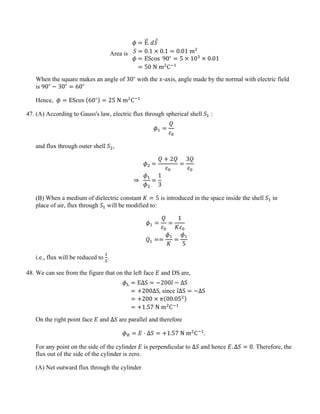
48. We can see from the figure that on the left face 𝐸 and DS are,
𝜙L = EΔS = −200𝚤
ˆ − ΔS
= +200ΔS, since 𝚤
ˆΔS = −ΔS
= +200 × 𝜋(00.052)
= +1.57 N m2
C−1
On the right point face 𝐸 and Δ𝑆 are parallel and therefore
𝜙𝑅 = 𝐸 ⋅ Δ𝑆 = +1.57 N m2
C−1
.
For any point on the side of the cylinder 𝐸 is perpendicular to Δ𝑆 and hence 𝐸. Δ𝑆 = 0. Therefore, the
flux out of the side of the cylinder is zero.
(A) Net outward flux through the cylinder
𝜙 = 1.57 + 1.57 + 0 = 3.14Nm2
C−1
(B) The net charge within the cylinder can be = 3.14 × 8.854 × 10−12
C found by using Gauss's law
which gives
𝑞 = 𝜀0𝜙
PREVIOUS YEAR
QUESTION
PAPERS
CLASS 12
PHYSICS
Electrostatic Potential and Capacitance
1. ELECTROSTATIC POTENTIAL
Objective Qs (1 mark)
1. Which of the following is NOT the property of equipotential surface?
(a) They do not cross each other.
(b) The rate of change of potential with distance on them is zero.
(c) For a uniform electric field they are concentric spheres.
(d) They can be imaginary spheres.
[CBSE SQP 2023]
2. Equipotential surfaces:
(a) are closer in regions of large electric fields compared to regions of lower electric fields.
(b) will be more crowded near sharp edges of a conductor.
(c) will never be equally spaced.
(d) both (a) and (b) are correct.
[Delhi Gov. SQP 2022]
3. The electric potential on the axis of an electric dipole at a distance ' 𝑟𝑟 ' from it's centre is 𝑉𝑉. Then
the potential at a point at the same distance on its equatorial line will be:
(a) 2𝑉𝑉
(c)
𝑉𝑉
2
(b) −𝑉𝑉
(d) Zero
[CBSE SQP 2022]
4. If a unit positive charge is taken from one point to another over an equipotential surface:
(a) work is done on the charge
(b) work is done by the charge
(c) work done is constant
(d) no work is done [Delhi Gov. SQP 2022]
5. The electric potential 𝑉𝑉 as a function of distance 𝑋𝑋 is shown in the figure.
CLICK HERE FOR
SOLUTIONS
CHAPTER 2
The graph of the magnitude of electric field intensity 𝐸𝐸 as a function of 𝑋𝑋 is:
(a)
(b)
(c)
(d)
[CBSE SQP 2022]
6. The electric potential 𝑉𝑉 at any point (𝑥𝑥, 𝑦𝑦, 𝑧𝑧) is given by 𝑉𝑉 = 3𝑥𝑥2
where 𝑥𝑥 is in metres and 𝑉𝑉 in
volts The electric field at the point (1 m, 0.2 m) is:
(a) 6 V/m along (−𝑥𝑥)-axis
(b) 6 V/m along (+𝑥𝑥)-axis
(c) 1.5 V/m along (−𝑥𝑥)-axis
(d) 1.5 V/m along (+𝑥𝑥)-axis
CLICK HERE FOR
SOLUTIONS
[CBSE Term-1 2021]
7. An electric dipole of moment 𝑝𝑝 is placed parallel to the uniform electric field. The amount of
work done in rotating the dipole by 90∘
is:
(a) 2𝑝𝑝𝑝𝑝
(b) 𝑝𝑝𝑝𝑝
(c)
𝑝𝑝𝑝𝑝
2
(d) zero
[CBSE SQP Term-1 2021]
8. Three charges 2𝑞𝑞, −𝑞𝑞 and - 𝑞𝑞 lie at vertices of a triangle. The value of 𝐸𝐸 and 𝑉𝑉 at centroid of
triangle will be:
(a) E ≠ 0 and V ≠ 0
(b) 𝐸𝐸 = 0 and 𝑉𝑉 = 0
(c) E ≠ 0 and V = 0
(d) 𝐸𝐸 = 0 and 𝑉𝑉 ≠ 0
[CBSE SQP Term-1 2021]
9. A solid spherical conductor has charge +𝑄𝑄 and radius 𝑅𝑅. It is surrounded by a solid spherical
shell with charge −𝑄𝑄, inner radius 2R, and outer radius 3R.
Which of the following statements is true?
(a) The electric potential has a maximum magnitude at C and the electric field has a maximum
magnitude at A.
(b) The electric potential has a maximum magnitude at 𝐷𝐷 and the electric field has a maximum
magnitude at 𝐵𝐵.
(c) The electric potential at 𝐴𝐴 is zero and the electric field has a maximum magnitude at D.
(d) Both the electric potential and electric field achieve a maximum magnitude at 𝐵𝐵.
[CBSE SQP Term-1 2021]
10. Two charges 14𝜇𝜇C and −4𝜇𝜇C are placed at (−12 cm, 0,0) and (12 cm, 0,0) in an external electric
field, E = �
B
𝑟𝑟2�, where B = 1.2 × 10⁶
N/cm2
and 𝑟𝑟 is in metres.
CLICK HERE FOR
SOLUTIONS
The electrostatic potential energy of the configuration is:
(a) 97.9 J
(b) 102.1 J
(c) 2.1 J
(d) −97.9 J
[CBSE Term-1 2021]
11. Equipotentials at a large distance from a collection of charges whose total sum is not zero are:
(a) spheres
(b) planes
(c) ellipsoids
(d) paraboloids
[CBSE Term-1 2021]
12. Four charges −𝑞𝑞, −𝑞𝑞, +𝑞𝑞 and +𝑞𝑞 are placed at the corners of a square of side 2 L is shown in
figure. The electric potential at point 𝐴𝐴 midway between the two charges +𝑞𝑞 and +𝑞𝑞 is:
(a)
1
4𝜋𝜋𝜀𝜀0
2𝑞𝑞
L
�1 −
1
√5
� (b)
1
4𝜋𝜋𝜀𝜀0
2𝑞𝑞
L
�1 +
1
√5
�
(c)
1
4𝜋𝜋𝜀𝜀0
𝑞𝑞
𝐿𝐿
�1 −
1
√5
� (d) zero
[CBSE Term-1 2021]
For Questions 13-14, two statements are given -one labelled Assertion (A) and other labelled
Reason (R). Select the correct answer to these questions from the options as given below.
(a) If both Assertion and Reason are true and Reason is correct explanation of Assertion.
(b) If both Assertion and Reason are true but Reason is not the correct explanation of Assertion.
(c) If Assertion is true but Reason is false.
(d) If both Assertion and Reason are false.
13. Assertion (A): An electron has a higher potential energy when it is at a location associated with a
more negative value of potential, and a low potential energy when at a location associated with a
more positive potential.
Reason (R): Electrons move from a region of higher potential to region of lower potential.
[CBSE SQP 2023]
CLICK HERE FOR
SOLUTIONS
14. Assertion (A): Work done in moving a charge around a closed path, in an electric field is always
zero.
Reason (R): Electrostatic force is a conservative force.
[CBSE 2023]
15. An experiment was set up with the circuit diagram shown in figure.
Given that 𝑅𝑅1 = 10Ω, 𝑅𝑅2 = 𝑅𝑅3 = 5Ω, 𝑟𝑟 = 0Ω and 𝐸𝐸 = 5 V
(A) The points with the same potential are:
(a) b, c, d
(b) f, h, j
(c) 𝑑𝑑, 𝑒𝑒, 𝑓𝑓
(d) 𝑎𝑎, 𝑏𝑏, 𝑗𝑗
(B) The current through branch bg is:
(a) 1 A
(b)
1
3
A
(c)
1
2
A
(d)
2
3
A
(C) The power dissipated in 𝑅𝑅1 is:
(a) 2 W
(b) 2.5 W
(c) 3 W
(d) 4.5 W
(D) The potential difference across 𝑅𝑅3 is:
(a) 1.5 V
(b) 2 V
(c) 2.5 V
(d) 3 V
[CBSE Term-2 2021]
Very Short & Short Qs (1-3 marks)
CLICK HERE FOR
SOLUTIONS
16. Charges (+𝑞𝑞) and (−𝑞𝑞) are placed at the points 𝐴𝐴 and 𝐵𝐵 respectively, which are at distance 2 L
apart. 𝐶𝐶 is the midpoint between 𝐴𝐴 and 𝐵𝐵. What is the work done in moving a charge +𝑄𝑄 along
the semicircle CRD.
[CBSE SQP 2023]
17. Two charges 5 × 10⁻⁸
C and −3 × 10⁻⁸
C are located 16 cm apart. At what point 𝑃𝑃 ( 𝑃𝑃 lies
somewhere in between the charges) on the line joining the two charges is the electric potential
zero? Take the potential at infinity to be zero.
[Delhi Gov. SQP 2022]
18. The physical quantity having SI unit NC−1
m is
[CBSE 2020]
19. Find the expression for the potential energy of a system of two point charges 𝑞𝑞1 and 𝑞𝑞2 located at
system 𝑟𝑟1 and 𝑟𝑟2, respectively in an external electric field 𝐸𝐸.
[CBSE 2020]
20. (A) Two point charges +𝑄𝑄1 and −𝑄𝑄2 are placed 𝑟𝑟 distance apart. Obtain the expression for the
amount of work done to place a third charge 𝑄𝑄3 at the midpoint of the line joining the two
charges.
(B) At what distance from charge +𝑄𝑄1 on the line joining the two charges (in terms of 𝑄𝑄1, 𝑄𝑄2 and
𝑟𝑟 ) will this work done be zero.
[CBSE 2020]
21. A cube of side 20 cm is kept in a region as shown in the figure. An electric field 𝐸𝐸 exists in the
region such that the potential at a point is given by 𝑉𝑉 = 10𝑥𝑥 + 5, where 𝑉𝑉 is in volt and 𝑥𝑥 is in 𝑚𝑚.
Find the:
(A) electric field E and,
(B) total electric flux through the cube
[CBSE 2020]
CLICK HERE FOR
SOLUTIONS
22. Write two important characteristics of equipotential surfaces.
[CBSE 2020]
23. Draw equipotential surfaces due to an isolated point charge (−𝑞𝑞) and depict the electric field lines
[CBSE 2020]
24. (A) Draw the equipotential surfaces corresponding to a uniform electric field in the 𝑧𝑧-direction.
(B) Derive an expression for the electric potential at any point along the axial line of an electric
dipole.
25. (A) Three point charges 𝑞𝑞, −4𝑞𝑞 and 2𝑞𝑞 are placed at the vertices of an equilateral triangle 𝐴𝐴𝐴𝐴𝐴𝐴 of
side 𝑙𝑙 as shown in the figure. Obtain an expression for the magnitude of the resultant electric force
acting on the charge 𝑞𝑞.
(B) Find out the amount of the work done to separate the charges at infinite distance.
[CBSE 2018]
26. Four point charges 𝑄𝑄, 𝑞𝑞, 𝑄𝑄 and 𝑞𝑞 are placed at the corners of a square of side 𝑎𝑎 as shown in figure.
Find the:
(A) resultant electric force on a charge 𝑄𝑄, and
(B) potential energy of this system.
[CBSE 2018]
27. Derive the expression for the electric potential due to an electric dipole at a point on its axial line.
[CBSE 2017]
28. Define an equipotential surface. Draw equipotential surfaces:
(A) in the case of a single point charge and
(B) in a constant electric field in Z - direction. Why the equipotential surface about a single charge
are not equidistant?
(C) Can electric field exist tangential to an equipotential surface? Give reason.
CLICK HERE FOR
SOLUTIONS
[CBSE 2016]
29. Figure shows the field lines on a positive charge. Is the work done by the field in moving a small
positive charge from 𝑄𝑄 to 𝑃𝑃 positive or negative? Give reason.
[CBSE 2014]
30. Two closely spaced equipotential surfaces 𝐴𝐴 and 𝐵𝐵 with potentials 𝑉𝑉 and 𝑉𝑉 + 𝛿𝛿𝛿𝛿, (where 𝛿𝛿V is
the change in V, are kept 𝛿𝛿𝛿𝛿 distance apart as shown in the figure. Deduce the relation between the
electric field and the potential gradient between them. Write the two important conclusions
concerning the relation between the electric field and electric potentials.
[CBSE 2014]
31. Two point charges 𝑞𝑞 and −2𝑞𝑞 are kept 𝑑𝑑 distance apart. Find the location of the point relative to
charge 𝑞𝑞 at which potential due to this system of charges is zero. [CBSE 2014]
2. ELECTROSTATIC OF CONDUCTORS, DIELECTRICS AND CAPACITANCE
Objective Qs (1 mark)
32. When a dielectric material is introduced between the plates of a charged condenser, then electric
field between the plates:
(a) decreases
(b) remains constant
(c) increases
(d) first increases then decreases
[Delhi Gov. SQP 2022]
33.
CLICK HERE FOR
SOLUTIONS
In the given figure equivalent capacitances of the given combination of five capacitors is:
(a) 4𝜇𝜇F
(b) 10𝜇𝜇F
(c) 8𝜇𝜇F
(d) 120𝜇𝜇F
[Delhi Gov. SQP 2022]
34. When air is replaced by a dielectric medium of dielectric constant 𝐾𝐾 the force of attraction
between two charges 𝑄𝑄1 and 𝑄𝑄2 separated by a finite distance 𝑑𝑑 :
(a) decreases 𝐾𝐾 times
(b) increases 𝐾𝐾 times
(c) remains unchanged
(d) decreases 2𝐾𝐾 time [Delhi Gov. SQP 2022]
35. Two parallel plate capacitors 𝑋𝑋 and 𝑌𝑌, have the same area of plates and same separation between
plates. 𝑋𝑋 has air and 𝑌𝑌 with dielectric of constant 2 , between its plates. They are connected in
series to a battery of 12 V. The ratio of electrostatic energy stored in 𝑋𝑋 and 𝑌𝑌 is:
(a) 4: 1
(b) 1: 4
(c) 2: 1
(d) 1: 2
[CBSE SQP Term-1 2021]
36. A capacitor plates are charged by a battery with ' V ' volts. After charging battery is disconnected
and a dielectric slab with dielectric constant ' 𝐾𝐾 ' is inserted between its plates, the potential across
the plates of a capacitor will become:
(a) zero
(b)
𝑉𝑉
2
(c)
V
K
(d) KV
[CBSE SQP Term-1 2021]
37. A car battery is charged by a 12 V supply, and energy stored in it is 7.20 × 10⁵
J. The charge
passed through the battery is:
(a) 6.0 × 10⁴
C
(b) 5.8 × 10³
J
(c) 8.64 × 10⁶
J
(d) 1.6 × 10⁵
C
[CBSE Term-1 2021]
CLICK HERE FOR
SOLUTIONS
38. A variable capacitor is connected to a 200 V battary. If its capacitance is changed from 2𝜇𝜇F to
𝑋𝑋𝑋𝑋F, the decrease in energy of the capacitor is 2 × 10⁻²
J. The value of 𝑋𝑋 is:
(a) 1𝜇𝜇F
(b) 2𝜇𝜇F
(c) 3𝜇𝜇F
(d) 4𝜇𝜇F
[CBSE Term-1 2021]
Very Short & Short Qs (1 - 3 marks)
39. Two charged conducting spheres of radii 𝑎𝑎 and 𝑏𝑏 are connected to each other by a wire. Find the
ratio of the electric fields at their surfaces.
[CBSE 2020]
40. A parallel plate capacitor (A) of capacitance 𝐶𝐶 is charged by a battery to voltage 𝑉𝑉. The battery is
disconnected and an uncharged capacitor (B) of capacitance 2𝐶𝐶 is connected across 𝐴𝐴. Find the
ratio of:
(A) final charges on 𝐴𝐴 and 𝐵𝐵.
(B) total electrostatic energy stored in A and 𝐵𝐵 finally and that stored in A initially.
[CBSE 2023]
41. (A) Draw equipotential surfaces for (i) an electric dipole and (ii) two identical positive charges
places near each other.
(B) In a parallel plate capacitor with air between the plates each plate has an area of 6 × 10⁻³
m2
and the separation between the plates is 3 mm.
(i) Calculate the capacitance of the capacitor.
(ii) If the capacitor is connected to 100 V supply, what would be the charge on each plate?
(iii) How would charge on the plate be affected if a 3 mm thick mica sheet of 𝐾𝐾 = 6 is inserted
between the plates while the voltage supply remains connected?
[CBSE SQP 2022]
42. The space between the plates of a parallel plate capacitor is completely filled in two ways. In the
first case, it is filled with a slab of dielectric constant 𝐾𝐾. In the second case, it is filled with two
slabs of equal thickness and dielectric constants 𝐾𝐾1 and 𝐾𝐾2 respectively as shown in the figure.
The capacitance of the capacitor is same in the two cases. Obtain the relationship between 𝐾𝐾,𝐾𝐾1
and 𝐾𝐾2.
CLICK HERE FOR
SOLUTIONS
[CBSE 2020]
43. When a parallel plate capacitor is connected across a dc battery, explain briefly how the capacitor
gets charged.
[CBSE 2019]
44. A parallel plate capacitor is charged by a battery to a potential difference 𝑉𝑉. It is disconnected
form battery and then connected to another uncharged capacitor of the same capacitance.
Calculate the ratio of the energy stored in the combination to the initial energy on the single
capacitor.
[CBSE 2019]
45. (A) Derive an expression for the capacitance of a parallel plate capacitor with air present between
the two plates.
(B) Obtain the equivalent capacitance of the network shown in figure. For a 300 V supply,
determine the charge on each capacitor.
[CBSE SQP 2023]
46. A parallel plate capacitor of capacitance ' 𝐶𝐶 ' is charged to ' 𝑉𝑉 ' volts by a battery. After some time
the battery is disconnected and the distance between the plates is doubled. Now a slab of dielectric
constant, 1 ≤ 𝑘𝑘 < 2, is introduced to fill the space between the plates. How will the following be
affected?
(A) The electric field between the plates of the capacitor
(B) The energy stored in the capacitor
(C) Justify your answer by writing the necessary expressions.
CLICK HERE FOR
SOLUTIONS
[CBSE 2019]
47. Derive an expression for the energy stored in a parallel plate capacitor. On charging a parallel
plate capacitor to a potential V, the spacing between the plates is halved and a dielectric medium
of 𝜀𝜀𝑟𝑟 = 10 is introduced between the plates. Explain, using suitable expression, how the (A)
capacitance, (B) electric field.
[CBSE 2018]
48. An infinitely large thin plane sheet has a uniform surface charge density +𝜎𝜎. Obtain the
expression for the amount of work done in bringing a point charge 𝑞𝑞 from infinity to a point,
distant 𝑟𝑟, in front of the charged plane sheet.
[CBSE 2017]
49. (A) Explain, using suitable diagrams, the difference in the behaviour of a (i) conductor and (ii)
dielectric in the presence of external electric field. Define the terms polarisation of a dielectric and
write its relation with susceptibility.
(B) A thin metallic spherical shell of radius 𝑅𝑅 carries a charge 𝑄𝑄 on its surface. A point charge
𝑄𝑄
2
is placed at its centre 𝐶𝐶 and an other charge +2𝑄𝑄 is placed outside the shell at a distance 𝑥𝑥 from
the centre as shown in the figure. Find (i) the force on the charge at the centre of shell and at the
point 𝐴𝐴, (ii) the electric flux through the shell.
[CBSE 2015]
50. Two capacitors of unknown capacitances 𝐶𝐶1 and 𝐶𝐶2 are connected first in series and then in
parallel across a battery of 100 V. If the energy stored in the two combinations is 0.045 J and
0.25 J respectively, then determine the value of 𝐶𝐶1 and 𝐶𝐶2. Also, calculate the charge on each
capacitor in parallel combination.
[CBSE 2015]
Numerical Qs (1 - 5 marks)
51. In the figure given below, find the
(A) equivalent capacitance of the network between points 𝐴𝐴 and 𝐵𝐵.
Given: 𝐶𝐶1 = 𝐶𝐶5 = 4𝜇𝜇, 𝐹𝐹, 𝐶𝐶2 = 𝐶𝐶3 = 𝐶𝐶4 = 2𝜇𝜇𝜇𝜇.
(B) maximum charge supplied by the battery, and
(C) total energy stored in the network.
CLICK HERE FOR
SOLUTIONS
[CBSE 2020]
52. Two identical capacitors of 12pF each are connected in series across a battery of 50 V. How
much electrostatic energy is stored in the combination? If these were connected in parallel across
the same battery, how much energy will be stored in the combination now? Also find the charge
drawn from the battery in each case.
[CBSE 2017]
53. (A) Find equivalent capacitance between 𝐴𝐴 and 𝐵𝐵 in the combination given below. Each capacitor
is of 2𝜇𝜇F capacitance.
(B) If a dc source of 7 V is connected across 𝐴𝐴𝐴𝐴, how much charge is drawn from the source and
what is the energy stored in the network?
[CBSE 2017]
CLICK HERE FOR
SOLUTIONS
PREVIOUS YEAR
QUESTION
PAPERS
CLASS 12
PHYSICS
Current Electricity
1. ELECTRIC CURRENT
Objective Qs (1 mark)
1. A steady current of 8 mA flows through a wire. The number of electrons passing though a cross-
section of the wire in 10 s is:
(a) 4.0 × 10¹⁶
(b) 5.0 × 10¹⁷
(c) 1.6 × 10¹⁶
(d) 1.0 × 10¹⁷
[CBSE 2023]
2. A conductor of 10Ω is connected across an 6 V ideal source. The power supplied by the source to
the conductor is:
(a) 1.8 W
(b) 2.4 W
(c) 3.6 W
(d) 7.2 W
[CBSE 2023]
3. A potential difference of 200 V is maintained across a conductor of resistance 100Ω. The number
of electrons passing through it in 1 s is:
(a) 1.25 × 10¹⁹
(b) 2.5 × 10¹⁸
(c) 1.25 × 10¹⁰
(d) 2.5 × 10¹⁶
[CBSE 2023]
4. The specific resistance of a rod of copper as compared to that of thin wire of copper is:
(a) less
(b) more
(c) same
(d) depends upon the length and area of cross-section of the wire
[Delhi Gov. SQP 2022]
5. The temperature (𝑇𝑇) dependence of resistivity of material 𝐴𝐴 and material 𝐵𝐵 is represented by fig
(i) and fig (ii) respectively.
Identify material A and material B.
CLICK HERE FOR
SOLUTIONS
CHAPTER 3
fig. (i)
fig. (ii)
(a) material 𝐴𝐴 is copper and material 𝐵𝐵 is germanium.
(b) material 𝐴𝐴 is germanium and material 𝐵𝐵 is copper.
(c) material 𝐴𝐴 is nichrome and material 𝐵𝐵 is germanium.
(d) material 𝐴𝐴 is copper and material 𝐵𝐵 is nichrome.
[CBSE SQP 2022]
6. By increasing the temperature, the specific resistance of a conductor and a semiconductor:
(a) increases for both.
(b) decreases for both.
(c) increases for a conductor and decreases for a semiconductor.
(d) decreases for a conductor and increases for a semiconductor.
[CBSE SQP Term-1 2021]
7. An electric current is passed through a circuit containing two wires of same material, connected in
parallel. If the lengths and radii of the wires are in the ratio of 3: 2 and 2: 3, then the ratio of the
current passing through the wire will be:
(a) 2: 3
(b) 3: 2
(c) 8: 27
(d) 27: 8
[CBSE SQP Term-1 2021]
8. A constant voltage is applied between the two ends of a uniform metallic wire, heat ' H ' is
developed in it. If another wire of the same
material, double the radius and twice the length as compared to original wire is used then the heat
developed in it will be:
CLICK HERE FOR
SOLUTIONS
(a)
H
2
(b) H
(c) 2H
(d) 4H
[CBSE SQP Term-1 2021]
9. If the potential difference 𝑉𝑉 applied across a conductor is increased to 2 V with its temperature
kept constant, the drift velocity of the free electrons in a conductor will:
(a) remain the same
(b) become half of its previous value
(c) be double of its initial value
(d) become zero [CBSE Term-1 SQP 2021]
10. A battery is connected to the conductor of non-uniform cross-section area. The quantities or
quantity which remains constant is:
(a) electric field only
(b) drift speed and electric field
(c) electric field and current
(d) current only
[CBSE SQP Term-1 2021]
11. A straight line plot showing the terminal potential difference (𝑉𝑉) of a cell as a function of current
(I) drawn from it, is shown in the figure. The internal resistance of the cell would be:
(a) 2.8Ohms
(b) 1.4Ohms
(c) 1.2Ohms
(d) Zero
[CBSE SQP Term-1 2021]
12. Which of the following has negative temperature coefficient of resistivity?
CLICK HERE FOR
SOLUTIONS
(a) Metal
(b) Metal and semiconductor
(c) Semiconductor
(d) Metal and alloy
[CBSE Term-1 2021]
13. Calculate the number of units of electricity used if a bulb of 100 W is kept on for 5 hours.
(a) 1 unit
(b) 0.1 unit
(c) 5 unit
(d) 0.5 unit
[CBSE 2020]
14. The ratio of current density and electric field is called:
(a) resistivity
(b) conductivity
(c) drift velocity
(d) mobility.
OR
In a current carrying conductor, the ratio of the electric field and the current density at a point is
called:
(a) resistivity
(b) conductivity
(c) resistance
(d) mobility
[CBSE 2020]
15. The resistance of a metal wire increase with increasing temperature on account of:
(a) decrease in free electron density
(b) decrease in relaxation time
(c) increase in mean free path
(d) increase in the mass of electron
[CBSE 2020]
16. The electric power consumed by a 220 V 100 W bulb when operated at 110 V is:
(a) 25 W
(b) 30 W
(c) 35 W
(d) 45 W
[CBSE 2020]
CLICK HERE FOR
SOLUTIONS
17. In a 𝑑𝑑𝑑𝑑 circuit the direction of current inside the battery and outside the battery respectively are:
(a) positive to negative terminal and negative to positive terminal
(b) positive to negative terminal and postive is negative terminal
(c) negative to positive terminal and positive to negative terminal
(d) negative to positive terminal and negative to positive terminal
[CBSE 2020]
Very Short & Short Qs (1 - 3 marks)
18. Define resistivity of a conductor, plot a graph showing the variation of resistivity with
temperature for a metallic conductor.
[Delhi Gov. SQP 2022]
19. A copper wire of non-uniform area of cross section is connected to a 𝑑𝑑. 𝑐𝑐. battery. The physical
quantity which remains constant along the wire is?
[CBSE 2020]
20. Define the term 'mobility' of charge carriers in a current carrying conductor. Obtain the relation
for mobility in terms of relaxation time.
[CBSE 2020]
21. Differentiate between electrical resistance and resistivity of a conductor. [CBSE 2020]
22. How is the drift velocity in a conductor affected with the rise in temperature?
[CBSE 2019]
23. Show, on a plot, variation of resistivity of:
(i) a conductor, and
(ii) a typical semiconductor as a function of temperature.
Using the expression for the resistivity in terms of number density and relaxation time between
the collisions, explain how resistivity in the case of a conductor increases while it decreases in a
semiconductor, with the rise of temperature.
[CBSE 2019]
24. (A) The graph between resistance (R) and temperature (T) for Hg is shown in the figure. Explain
the behavior Hg near 4𝑘𝑘.
CLICK HERE FOR
SOLUTIONS
(B) In which region of the graph shown in the figure is the resistance negative and why?
[CBSE 2019]
25. Draw a graph showing the variation of current versus voltage in an electrolyte when an external
resistance is also connected:
[CBSE 2019]
26. (A) Define the term 'conductivity' of a metallic wire. Write its SI unit.
(B) Using the concept of free electrons in a conductor, derive the expression for the conductivity
of a wire in terms of number density and relaxation time. Hence, obtain the relation between
current density and the applied electric field 𝐸𝐸.
[CBSE 2018]
27. Graph showing the variation of current versus voltage for a material Gas is shown in the figure.
Identify the region of:
(A) negative resistance
(B) where Ohm's law is obeyed.
[CBSE 2015]
CLICK HERE FOR
SOLUTIONS
28. I-V graph for a metallic wire at two different temperatures, 𝑇𝑇1 and 𝑇𝑇2 is as shown in the figure.
Which of the two temperatures is lower and why?
[CBSE 2015]
29. A potential difference 𝑉𝑉 is applied across the ends of copper wire of length 𝑙𝑙 and diameter 𝐷𝐷.
What is the effect on drift velocity of electrons if:
(A) 𝑉𝑉 is halved?
(B) 𝑙𝑙 is doubled?
(C) D is halved?
[CBSE 2015]
30. Using the concept of drift velocity of charge carriers in a conductor, deduce the relationship
between current density and resistivity of the conductor.
[CBSE 2015]
31. In the two electric circuits shown in the figure, determine the readings of ideal ammeter (A) and
the ideal voltmeter (V).
[CBSE 2015]
32. (A) Deduce the relation between current flowing through a conductor and drift velocity 𝑣𝑣
⃗𝑑𝑑 of the
electrons.
(B) Figure shows a plot of current ' 𝑠𝑠 ' flowing through the cross-section of a wire versus the time '
𝑡𝑡 '. Use the plot to find the charge flowing in 10sec through the wire.
[CBSE 2015]
CLICK HERE FOR
SOLUTIONS
33. Show variation of resistivity of copper as a function of temperature in a graph.
[CBSE 2014]
34. Define the term drift velocity of charge carriers in a conductor and write its relationship with the
current flowing through it.
[CBSE 2014]
Long Qs (4 & 5 marks)
35. Explain the term drift velocity of electrons in a conductor. Hence, obtain the expression for the
current through a conductor in terms of drift velocity.
[CBSE SQP 2022]
36. (A) Derive an expression for drift velocity of electrons in a conductor. Hence deduce Ohm's law.
(B) A wire whose cross-sectional area is increasing linearly from its one end to the other is
connected across a battery of 𝑉𝑉 volts. Which of the following quantities remain constant in the
wire?
(a) drift speed
(b) current density
(c) electric current
(d) electric field
[CBSE 2017]
Numerical Qs (1-5 marks)
37. Estimate the average drift speed of conduction electrons in a copper wire of cross-sectional area
1.0 × 10⁻⁷
m2
carrying a current of 1.5 A. Assume the density of conduction electrons to be
9 × 1028
m−3
.
[CBSE 2014]
CLICK HERE FOR
SOLUTIONS
2. CELL, EMF AND INTERNAL RESISTANCE
Objective Qs
38. A cell of emf E is connected across an external resistance 𝑅𝑅. When current ' l ' is drawn from the
cell, the potential difference across the electrodes of the cell drops to V. The internal resistance ' 𝑟𝑟
' of the cell is:
(a) �
𝐸𝐸−𝑉𝑉
𝐸𝐸
� 𝑅𝑅
(b) �
𝐸𝐸−𝑉𝑉
𝑅𝑅
�
(c) �
(𝐸𝐸−𝑉𝑉)
𝑙𝑙
� 𝑅𝑅
(d) �
𝐸𝐸−𝑉𝑉
𝑉𝑉
� 𝑅𝑅
[CBSE 2023]
39. The storage battery of a car has an emf 12 volt. If the internal resistance of the battery is 0.4ohm
the maximum current that can be drawn from the battery will be:
(a) 15 A
(b) 30 A
(c) 12 A
(d) 20 A
[Delhi Gov. 2022]
40. Kirchoff's first rule Σ𝐼𝐼 = 0 and second rule ΣIR = ΣE (where the symbols have their usual
meanings) are respectively based on:
(a) conservation of momentum and conservation of charge.
(b) conservation of energy, conservation of charge.
(c) conservation of charge, conservation of momentum.
(d) conservation of charge, conservation of energy.
[CBSE Term-1 2021]
41. Two sources of equal emf are connected in series. This combination is, in turn connected to an
external resistance 𝑅𝑅. The internal resistance of two sources are 𝑟𝑟1 and 𝑟𝑟2 (𝑟𝑟2 > 𝑟𝑟1). If the
potential difference across the source of internal resistance 𝑟𝑟2 is zero, then R equal to:
(a)
𝑟𝑟1−𝑟𝑟2
𝑟𝑟2−𝑟𝑟1
(b) 𝑟𝑟2 − 𝑟𝑟1
(c)
𝑟𝑟1𝑟𝑟2
𝑟𝑟2−𝑟𝑟1
(d)
𝑟𝑟1+𝑟𝑟2
𝑟𝑟1𝑟𝑟2
[CBSE Term-1 2021]
42. We use alloys for making standard resistors because they have:
(a) low temperature coeffcient of resistivity and high specific resistance
(b) high temperature coeffcient of resistivity and low specific resistance
(c) low temperature coeffcient of resistivity and low specific resistance
(d) high temperature coeffcient of resistivity and high specific resistance.
[CBSE Term-1 2021]
43. Three resistors having values 𝑅𝑅1, 𝑅𝑅2 and 𝑅𝑅3 are connected in series to a battery. Suppose 𝑅𝑅1
carries a current of 2.0 A, 𝑅𝑅2 has a resistance of 3.0ohms, and 𝑅𝑅3 dissipates 6.0 watts of power.
Then the voltage across 𝑅𝑅3 is:
(a) 1 V
(b) 2 V
(c) 3 V
(d) 4 V
[CBSE Term-1 2021]
44. A cell of internal resistance 𝑟𝑟 connected across an external resistance 𝑅𝑅 can supply maximum
current when:
(a) 𝑅𝑅 = 𝑟𝑟
(b) 𝑅𝑅 > 𝑟𝑟
(c) 𝑅𝑅 =
𝑟𝑟
2
(d) 𝑅𝑅 = 0
[CBSE 2020]
For Question 45, two statements are given -one labelled Assertion (A) and other labelled Reason
(R). Select the correct answer to these questions from the options as given below.
(a) If both Assertion and Reason are true and Reason is the correct explanation of Assertion.
(b) If both Assertion and Reason are true but Reason is not the correct explanation of Assertion.
(c) If Assertion is true but Reason is false.
(d) If Assertion and Reason are false.
45. Assertion (A): Kirchhoff's junction rule is based on conservation of charge.
Reason (R): A resistor obeys Ohm's law while a diode does not.
[Delhi Gov. SQP 2022]
Very Short & Short Qs (1 -3 marks)
46. Two cells of emf 𝐸𝐸1 and 𝐸𝐸2 and internal resistances 𝑟𝑟1 and 𝑟𝑟2 are connected in parallel, with their
terminals of the same polarity connected together. Obtain an expression for the equivalent emf of
the combination.
[CBSE 2023]
47. A variable resistor 𝑅𝑅 is connected across a cell of emf 𝐸𝐸 and internal resistance 𝑟𝑟.
(A) Draw the circuit diagram.
CLICK HERE FOR
SOLUTIONS
(B) Plot the graph showing variation of potential drop across 𝑅𝑅 as function of 𝑅𝑅.
(C) At what value of 𝑅𝑅 current in circuit will be maximum.
48. (A) Two cells of emf 𝐸𝐸1 and 𝐸𝐸2 have their internal resistances 𝑟𝑟1 and 𝑟𝑟2, respectively. Deduce an
expression for the equivalent emf and internal resistance of their parallel combination when
connected across an external resistance R. Assume that the two cells are supporting each other.
(B) In case the two cells are identical, each of emf 𝐸𝐸 = 5 V and internal resistance 𝑟𝑟 = 2Ω,
calculate voltage across the external resistance 𝑅𝑅 = 10Ω.
[CBSE 2020]
49. Derive an expression of balance for Wheat stone bridge.
[CBSE 2020]
50. Under what condition will the current in a wire be the same when connected in series and in
parallel of 𝑛𝑛 identical cells each having internal resistance 𝑟𝑟 and external resistance R ?
[CBSE 2019]
51. Using Kirchhoff's rules, calculate the current through the 40Ω and 20Ω resistors in the following
circuit.
[CBSE 2019]
52. Two bulbs are rated (𝑃𝑃1, 𝑉𝑉) and (𝑃𝑃2, 𝑉𝑉). If they are connected (𝐴𝐴) in series and (𝐵𝐵) in parallel
across a supply V, find the power dissipated in the two combinations is terms of 𝑃𝑃1 and P2 :
[CBSE 2017]
53. Calculate the current drawn from the battery by the network of resistors shown in the figure.
[CBSE 2015]
54. Use Kirchhoff's rules to obtain conditions for the balance condition in a Wheatstone bridge.
CLICK HERE FOR
SOLUTIONS
[CBSE 2015]
55. A cell of emf E and internal resistance 𝑟𝑟 is connected across a variable resistor 𝑅𝑅. Plot a graph
showing variation of terminal voltage 𝑉𝑉 of the cell versus the current 𝐼𝐼. Using the
plot, show how the emf of the cell and its internal resistance can be determined.
[CBSE 2014]
56. (A) Distinguish between emf (e) and terminal voltage (V) of a cell having internal resistance ' 𝑟𝑟 '.
(B) Draw a plot showing the variation of terminal voltage (V) us the current (l) drawn from the
cell. Using this plot, how does one determine the internal resistance of the cell?
[CBSE 2014]
57. In the electric network shown in the figure, use Kirchhoff's rules to calculate the power consumed
by the resistance 𝑅𝑅 = 4Ω.
[CBSE 2014]
Long Qs (4 & 5 marks)
58. (A) What is a Wheatstone bridge?
(B) When is the bridge said to be balanced?
(C) Find out the magnitude of resistance 𝑋𝑋 in the circuit shown in figure. When no current flows
through the 5Ω resistance.
[Delhi Gov. SQP 2022]
59. (A) State the two Kirchhoff's rules used in the analysis of electric circuits and explain them.
(B) Derive the equation of the balanced state in a wheats tone bridge using Kirchhoff's laws.
[CBSE SQP 2020]
CLICK HERE FOR
SOLUTIONS
60. (A) State the two Kirchhoff's laws. Explain briefly how these rules are justified.
(B) The current is drawn from a cell of emf 𝐸𝐸 and internal resistance 𝑟𝑟 connected to the network
of resistors each of resistance 𝑟𝑟 as shown in the figure. Obtain the expression for (a) the current
drawn from the cell and cb ) the power consumed in the network.
[CBSE 2017]
Numerical Qs (1-5 marks)
61. (A) The emf of a cell is always greater than its terminal voltage. Why? Give reason.
(B) Two electric bulbs 𝑃𝑃 and 𝑄𝑄 have their resistances in the ratio of 1: 2. They are connected in
series a battery. Find the ratio of the power dissipation in these bulbs.
(C) Use Kirchhoff's rules to write the expressions for the currents 𝐼𝐼1, 𝐼𝐼2 and 𝐼𝐼3 in the circuit
diagram shown below.
[Delhi Gov. SQP 2022]
62. A 10 V cell of negligible internal resistance is connected in parallel across a battery of emf 200 V
and internal resistance 38Ω as shown in the figure. Find the value of current in the circuit.
[CBSE 2018]
CLICK HERE FOR
SOLUTIONS
63. (A) The potential difference applied across a given resistor is altered so that the heat produced per
second increases by a factor of 9. By what factor does the applied potential difference change?
(B) In the figure shown, an ammeter 𝐴𝐴 and a resistor of 4Ω are connected to the terminals of the
source. The emf of the source is 12 V having the internal resistance of 2Ω.
Calculate the voltmeter and ammeter readings.
[CBSE 2017]
64. The plot of the variation of potential difference across a combination of three identical cells in
series, versus current is shown below. What is the emf and internal resistance of each cell?
[CBSE 2016]
65. Two cells of emfs 1.5 V and 2.0 V having internal resistances 0.2Ω, and 0.3Ω, respectively are
connected in parallel. Calculate the emf and internal resistance of the equivalent cell.
[CBSE 2016]
66. A battery of emf 12 V and internal resistance 2Ω is connected to a 4Ω resistor as shown in the
figure.
(A) Show that a voltmeter when placed across the cell and across the resistor, in turn, gives the
same reading.
(B) To record the voltage and the current in the circuit, why is voltmeter placed in parallel and
ammeter in series in the circuit?
[CBSE 2016]
CLICK HERE FOR
SOLUTIONS
67. Use Kirchhoff's rules to determine the potential difference between the points 𝐴𝐴 and 𝐷𝐷 when no
current flows in the arm 𝐵𝐵𝐵𝐵 of the electric network shown in the figure.
[CBSE 2015]
CLICK HERE FOR
SOLUTIONS
PREVIOUS YEAR
QUESTION
PAPERS
CLASS 12
PHYSICS
Moving Charges and Magnetism
1. MOTION AND FORCE IN A MAGNETIC FIELD
Objective Qs (1 mark)
1. An electron is moving along positive 𝑥𝑥-axis in a magnetic field which is parallel to the positive 𝑦𝑦-
axis. In what direction will the magnetic force be acting on the electron?
(a) Along −𝑥𝑥 axis
(b) Along −𝑧𝑧 axis
(c) Along +𝑧𝑧 axis
(d) Along −𝑦𝑦 axis
[CBSE SQP 2023]
2. An ammeter of resistance 0.81Ohm reads up to 1 A. The value of the required shunt to increase
the range to 10 A is:
(a) 0.9Ohm
(b) 0.09Ohm
(c) 0.03Ohm
(d) 0.3Ohm
[CBSE SQP 2023]
3. An electron with angular momentum 𝐿𝐿 moving around the nucleus has a magnetic moment given
by:
(a)
𝑒𝑒𝑒𝑒
2𝑚𝑚
(b)
𝑒𝑒𝑒𝑒
3𝑚𝑚
(c)
𝑒𝑒𝑒𝑒
4𝑚𝑚
(d)
𝑒𝑒𝑒𝑒
𝑚𝑚
[CBSE SQP 2023]
4. Two wires carrying currents 𝐼𝐼1 and 𝐼𝐼2 lie, one slightly above the other in a horizontal plane as
shown in figure.
The region of vertically upward strongest magnetic field is:
(a) I
CLICK HERE FOR
SOLUTIONS
CHAPTER 4
(b) II
(c) III
(d) IV
[CBSE Term-1 2021]
5. A current carrying wire kept in a uniform magnetic field will experience a maximum force when
it is:
(a) perpendicular to the magnetic field
(b) parallel to the magnetic field
(c) at an angle of 45∘
to the magnetic field
(d) at an angle of 60∘
to the magnetic field
[CBSE Term-1 2021]
6. A straight conducting rod of length 𝑙𝑙 and mass 𝑚𝑚 is suspended in a horizontal plane by a pair of
flexible strings in a magnetic field of magnitude 𝐵𝐵. To remove the tension in the supporting
strings, the magnitude of the current in the wire is:
(a)
𝑚𝑚𝑚𝑚𝑚𝑚
𝑙𝑙
(b)
𝑚𝑚𝑚𝑚𝑚𝑚
B
(c)
𝑚𝑚𝑚𝑚
𝑙𝑙𝑙𝑙
(d)
lB
𝑚𝑚𝑚𝑚
[CBSE Term-1 2021]
7. An electron is released from rest in a region of uniform electric and magnetic fields acting parallel
to each other. The electron will:
(a) move in a straight line
(b) move in circle
(c) remain stationary
(d) move in a helical path
[CBSE 2020]
8. A charge particle after being accelerated through a potential difference 𝑉𝑉 enters in a uniform
magnetic field and moves in a circle
of radius 𝑟𝑟. If V is doubled, the radius of the circle will become:
(a) 2𝑟𝑟
(b) √2𝑟𝑟
(c) 4𝑟𝑟
(d)
𝑟𝑟
√2
[CBSE 2020]
CLICK HERE FOR
SOLUTIONS
9. The time period of a charged particle undergoing a circular motion in a uniform magnetic field is
independent of:
(a) speed of the particle
(b) mass of the particle
(c) charge of the particle
(d) magnetic field of the particle
[CBSE 2020]
For Question 10, two statements are given one labelled Assertion (A) and other labelled Reason
(R). Select the correct answer to these questions from the options as given below.
(a) If both Assertion and Reason are true and Reason is correct explanation of Assertion.
(b) If both Assertion and Reason are true but Reason is not the correct explanation of Assertion.
(c) If Assertion is true but Reason is false.
(d) If both Assertion and Reason are false.
10. Assertion (A): 𝐴𝐴 wire bent into an irregular shape with the points 𝑃𝑃 and 𝑄𝑄 fixed. If a current 𝐼𝐼 is
passed through the wire, then the area enclosed by the irregular portion of the wire increases.
Reason (R): Opposite currents carrying wires repel each other.
[Delhi Gov. SQP 2022]
Very Short & Short Qs (1-3 marks)
11. The given figure shows a long straight wire of a circular cross-section (radius 𝑎𝑎 ) carrying steady
current I. The current I is uniformly distributed across this cross-section. Calculate the magnetic
field in the region:
(A) 𝑟𝑟 < 𝑎𝑎 and (B)
(B) 𝑟𝑟 > 𝑎𝑎
CLICK HERE FOR
SOLUTIONS
[CBSE SQP 2023]
12. An electron with charge −𝑒𝑒 and mass 𝑚𝑚 travels at a speed 𝑣𝑣 in a plane perpendicular to a
magnetic field of magnitude 𝐵𝐵. The electron follows a circular path of radius 𝑅𝑅. In a time, 𝑡𝑡, the
electron travels halfway around the circle. What is the amount of work done by the magnetic
field?
[CBSE 2021]
13. An electron moves along +𝑥𝑥 direction. It enters into a region of uniform magnetic field 𝐵𝐵 directed
along −𝑧𝑧 direction as shown in figure. Draw the shape of trajectory followed by the electron after
entering the field.
[CBSE 2020]
14. An 𝛼𝛼-particle is accelerated through a potential difference of 10kV and moves along 𝑥𝑥-axis. It
enters in a region of uniform magnetic field B = 2 × 10⁻³
T acting along 𝑦𝑦-axis. Find the radius
of its path. (Take mass of 𝛼𝛼-particle = 6.4 × 10⁻²⁷
kg ) [CBSE 2020]
15. A proton, a deuteron and an alpha particle, are accelerated through the same potential difference
and then subjected to a uniform magnetic field, perpendicular to the direction of their motions.
Compare (A) their kinetic energies, and ( 𝐵𝐵 ) if the radius of the circular path described by proton
is 5 cm, determine the radii of the paths described by deuteron and alpha particle.
[CBSE 2019]
16. A charged particle 𝑞𝑞 is moving in the presence of a magnetic field 𝐵𝐵 which is inclined to an angle
30∘
with the direction of the motion of the particle. Draw the presence of the field and explain
how the particle describes this path. [CBSE 2019]
17. An 𝛼𝛼-particle and a proton of the same kinetic energy are in turn allowed to pass through a
magnetic Field B, acting normal to the direction of motion of the particles.
CLICK HERE FOR
SOLUTIONS
Calculate the ratio of radii of the circular paths described by them.
[CBSE 2019]
18. A proton is accelerated through a potential difference 𝑉𝑉, subjected to a uniform magnetic field
acting normal to the velocity of the proton. If the potential difference is doubled, how will the
radius of the circular path described by the proton in the magnetic field change?
[CBSE 2019]
19. A proton and an electron travelling along parallel paths enter a region of uniform magnetic field,
acting perpendicular to their paths. Which of them will move in a circular path with higher
frequency? [CBSE 2018]
20. (A) Write the expression for the force vector 𝐹𝐹 acting on a particle of mass 𝑚𝑚 and charge 𝑞𝑞
moving with velocity vector V in a magnetic field vector B. Under what conditions will it move in
(i) a circular path and (ii) a helical path?
(B) Show that the kinetic energy of the particle moving in magnetic field remains constant.
[CBSE 2017]
21. Find the condition under which the charged particles moving with different speeds in the presence
of electric and magnetic field vectors can be used to select charged particles of a particular speed?
[CBSE 2017]
22. (A) A point charge 𝑞𝑞 moving with the speed 𝑈𝑈 enters a uniform magnetic field 𝐵𝐵
�⃗ that is acting
into the plane of paper as shown, which is the path followed by the charge 𝑞𝑞 and in which plane
does it move?
(B) How does the path followed by the charge get affected if its velocity has a component parallel
to 𝐵𝐵
�⃗ ?
(C) If an electric field 𝐸𝐸
�⃗ is also applied such that the particle continues moving along the original
straight line path, what should be the magnitude and direction of the electric field 𝐸𝐸
�⃗ ?
[CBSE 2016]
23. A uniform magnetic field 𝐵𝐵 is set up along the positive 𝑥𝑥-axis. A particle of charge ' 𝑞𝑞 ' and mass '
𝑚𝑚 ' moving with a velocity 𝑣𝑣 enters the field at the origin in 𝑥𝑥 − 𝑦𝑦 plane such that it has velocity
components both along and perpendicular to the magnetic field 𝐵𝐵. Trace, giving reason, the
CLICK HERE FOR
SOLUTIONS
trajectory followed by the particle. Find out the expression for the distance moved by the particle
along the magnetic field in one rotation. [CBSE 2015]
24. A straight wire of mass 200 g and length 1.5 𝑚𝑚 carries a current of 2 A. It is suspended in mid-air
by a uniform horizontal magnetic field B. What is the magnitude of the magnetic field?
[CBSE 2015]
25. Write the expression, in a vector form, for the Lorentz magnetic force 𝐹𝐹 due to a charge moving
with velocity 𝑣𝑣 in a magnetic field 𝐵𝐵. What is the direction of the magnetic force?
[CBSE 2014]
26. Write the condition under which an electron will move undeflected in the presence of crossed
electric and magnetic fields.
[CBSE 2014]
27. Define one tesla using the expression for the magnetic force acting on a particle of charge 𝑞𝑞 '
moving with velocity 𝑣𝑣 in a magnetic field B.
[CBSE 2014]
2. MAGNETIC FIELD DUE TO A CURRENT ELEMENT
Objective Qs (1 mark)
28. A long straight wire of radius a carries a steady current I. The current is uniformly distributed
across its area of cross-section.
The ratio of magnitude of magnetic field 𝐵𝐵
�⃗1, at
𝑎𝑎
2
and 𝐵𝐵
�⃗2 at distance 2𝑎𝑎 is:
(a)
1
2
(b) 1
(c) 2
(d) 4
[CBSE 2023]
29. A long straight wire of circular cross-section of radius a carries a steady current I. The current is
uniformly distributed across its cross section. The ratio of the magnitudes of magnetic field at a
CLICK HERE FOR
SOLUTIONS
point distant
𝑎𝑎
2
above the surface of wire to that at a point distant
𝑎𝑎
2
below its surface is:
(a) 4: 1
(b) 1: 1
(c) 4: 3
(d) 3: 4
[CBSE SQP 2022]
30. Two wires of the same length are shaped into a square of side ' 𝑎𝑎 ' and a circle with radius ' 𝑟𝑟 '. If
they carry same current, the ratio of their magnetic moment is:
(a) 2: 𝜋𝜋
(b) 𝜋𝜋: 2
(c) 𝜋𝜋: 4
(d) 4: 𝜋𝜋
[CBSE Term-1 SQP 2021]
31. The magnetic field at the centre of a current carrying circular loop of radius 𝑅𝑅, is 𝐵𝐵1. The
magnetic field at a point on its axis at a distance 𝑅𝑅 from the centre of the loop is 𝐵𝐵2. Then the ratio
�
𝐵𝐵1
𝐵𝐵2
� is:
(a) 2√2
(b)
1
√2
(c) √2
(d) 2
[CBSE Term-1 2021]
Very Short & Short Qs (1-3 marks)
32. Two identical loops 𝑃𝑃 and 𝑄𝑄 of radius 5 cm each are lying perpendicular to each other with a
common center. Find the magnitude and direction of the net magnetic field if they are carrying
3 A and 4 A each.
[CBSE 2023]
33. A closely wound solenoid of 2000 turns and area of cross-section 1.6 × 10⁻⁴
m2
, carrying a
current of 4.0 A, is suspended through its center allowing it to turn in a horizontal plane. What is
the magnetic moment associated with the solenoid?
[Delhi Gov. SQP 2022]
CLICK HERE FOR
SOLUTIONS
34. Two long straight parallel conductors carrying currents 𝐼𝐼1 and 𝐼𝐼2 are separated by a distance 𝑑𝑑. If
the currents are flowing in the same direction, show how the magnetic field produced by one
exerts an attractive force on the other. Obtain the expression for this force and hence define 1
ampere.
[CBSE SQP 2022]
35. Two long straight parallel wires A and B separated by a distance, 𝑑𝑑 carry equal current I flowing
in same direction as shown in the figure:
(A) Find the magnetic field at a point 𝑃𝑃 situated between them at a distance from one wire.
(B) Show graphically the variation of the magnetic field with distance 𝑥𝑥 For 0 < 𝑥𝑥.
[CBSE 2020]
36. A circular loop of radius 𝑅𝑅 carries a current 𝐼𝐼. Obtain an expression for the magnetic field at a
point on its axis at a distance 𝑥𝑥 from its centre.
[CBSE 2020]
OR
Write, using Biot-Savart law, the expression for the magnetic field 𝐵𝐵 due to an element dI
carrying current 𝑙𝑙 at a distance 𝑟𝑟 from it in a vector form.
Hence derive the expression for the magnetic field due to a current carrying loop of radius 𝑅𝑅 at a
point 𝑃𝑃 distant 𝑥𝑥 from its centre along the axis of the loop.
[CBSE 2015]
37. A long straight wire 𝐴𝐴𝐴𝐴 carries a current of 4 A. A proton P travels at 4 × 10⁶
ms−1
parallel to
the wire 0.2 m from it and in a direction opposite to the current as shown in the figure. Calculate
the force which the magnetic field due to the current carrying wire exerts on the proton. Also
specify its direction.
[CBSE 2019]
CLICK HERE FOR
SOLUTIONS
CLICK HERE FOR
SOLUTIONS
38. (A) State Biot-Savart's law and express this law in the vector form.
(B) Two identical circular coils, 𝑃𝑃 and 𝑄𝑄 each of radius 𝑅𝑅, carrying currents 1 A and √3 𝐴𝐴
respectively, are placed concentrically and perpendicular to each other lying in the 𝑋𝑋𝑋𝑋 and 𝑌𝑌𝑌𝑌
planes. Find the magnitude and direction of the net magnetic field at the centre of the coils.
[CBSE 2017]
39. Two small identical circular loops, marked (1) and (2), carrying equal currents, are placed with
the geometrical axes perpendicular each other as shown on figure. Find the magnitude and
direction of the net magnetic field produced at the point 𝑂𝑂.
[CBSE 2017, 14]
40. State Biot-Savart's law, giving the mathematical expression for it.
Use this law to derive the expression for the magnetic field due to a circular coil carrying current
at a point along its axis.
How does a circular coil carrying current behave as a magnet?
[CBSE 2016]
41. Use Biot-Savart law to derive the expression for the magnetic field on the axis of a current
carrying circular loop of radius 𝑅𝑅.
Draw the magnetic field lines due to a circular wire carrying current I. [CBSE 2016]
42. Write any two important points of Similarities and differences each between Coulomb's law
for the electrostatic field and Biot-Savart's for the magnetic Field. Use Biot-savart's law to find the
expression for the magnetic field due to a circular loop of radius R carrying current I at its centre.
[CBSE 2015]
43. Explain how Biot-Savart law enables one to express the Ampere's circuital law in the integral
form, viz.
∮ B.dl = 𝜇𝜇0l
where, 𝐼𝐼 is the total current passing through the surface.
[CBSE 2015]
CLICK HERE FOR
SOLUTIONS
44. An observation to the left of a solenoid of 𝑁𝑁 turns each of cross-section areas A observes that a
steady current I flows in the clockwise direction. Depict the magnetic field lines due to the
solenoid specifying its polarity and show that it acts as a bar magnet of magnetic moment, 𝑚𝑚 =
NIA.
[CBSE 2015]
45. Draw the magnetic field lines due to a current passing through a long solenoid. Use Ampere's
circuital law, to obtain the expression for the magnetic field due to the current 𝐼𝐼 in a long solenoid
having n number of turns per unit length.
[CBSE 2014]
46. Briefly explain why and how a galvanometer is converted into an ammeter. [CBSE 2014]
Long Qs (4-5 marks)
47. State Biot - Savart law in vector form expressing the magnetic field due to an element vector (𝑑𝑑𝑑𝑑)
carrying current 𝐼𝐼 at a distance vector 𝑟𝑟 from the element.
[CBSE 2014]
3. OTHER MAGNETIC EFFECTS
Objective Qs (1 mark)
48. Two concentric and coplanar circular loops 𝑃𝑃 and 𝑄𝑄 have their radii in the ratio 2:3. Loop 𝑄𝑄
carries a current 9 A in the anticlockwise direction. For the magnetic field to be zero at the
common centre, loop P must carry: (a) 3 A in clockwise direction
(b) 9 A in clockwise direction
(c) 6 A in anti-clockwise direction
(d) 6 A in the clockwise direction.
[CBSE SQP 2022]
49. A square coil of the side 10 cm consists of 20 turns and carries a current of 12 A, the
coil is suspended vertically and normal to the plane of the coil and makes an angle of 30 degree
with the direction of uniform horizontal magnetic field of magnitude 0.80 Tesla. The magnitude
of torque experienced by the coil is:
(a) 2.96Nm
(b) 3.45Nm
CLICK HERE FOR
SOLUTIONS
(c) 5Nm
(d) 0.96Nm
[Delhi Gov. 2022]
50. If an ammeter is to be used in place of a voltmeter, then we must connect with the ammeter a:
(a) low resistance in parallel
(b) high resistance in parallel
(c) high resistance in series
(d) low resistance in series
[CBSE Term - 1 2021]
51. The magnetic dipole moment of a current carrying coil does not depend upon:
(a) number of turns of the coil.
(b) cross-sectional area of the coil.
(c) current flowing in the coil.
(d) material of the turns of the coil.
[CBSE 2020]
For Questions 52 to 53, two statements are given -one labelled Assertion (A) and other labelled
Reason (R). Select the correct answer to these questions from the options as given below.
(a) If both Assertion and Reason are true and Reason is correct explanation of Assertion.
(b) If both Assertion and Reason are true but Reason is not the correct explanation of Assertion.
(c) If Assertion is true but Reason is false.
(d) If both Assertion and Reason are false.
52. Assertion (A): When radius of a circular wire carrying current is doubled, its magnetic moment
becomes four times.
Reason (R): The magnetic moment of a current carrying loop is directly proportional to area of
the loop.
[CBSE Term - 1 2021]
53. Assertion (A): Higher the range, lower is the resistance of ammeter.
Reason (R): To increase the range of an ammeter, additional shunt is added in series to it.
[CBSE Term - 1 2021]
Very Short & Short Qs 1-3 marks
CLICK HERE FOR
SOLUTIONS
54. Explain with the help of a diagram how a moving coil galvanometer can be converted into an
ammeter? [Delhi Gov. SQP 2022]
55. (A) Derive an expression for the force per unit length between two infinitely long straight parallel
current carrying wires hence define one ampere.
(B) Two parallel very long straight wire carrying a current of 5 A each are kept at a separation of
1 m. If the currents are in the same direction. What will be the force per unit length (in N/m )
between them?
[Delhi Gov. SQP 2022]
56. (A) Derive an expression for torque acting on a rectangular current carrying loop kept in a
uniform magnetic field B. Indicate the direction of torque acting on the loop.
(B) A square coil of side 10 cm consists of 20 turns and carries a current of 12A. The coil is
suspended vertically and the normal to the plane of the coil makes an angle of 30 degree with the
direction of a uniform horizontal magnetic field of magnitude 0.80 T. What is the magnitude of
torque experienced by the coil?
[Delhi Gov. SQP 2022]
57. Two straight infinitely long wires are fixed in space so that the current in the left wire is 2 A and
directed out of the plane of the page and the current in the right wire is 3 A and directed into the
plane of the page. In which region (s) is/are there a point on the 𝑥𝑥-axis, at which the magnetic
field is equal to zero due to these currents carrying wires? Justify your answer.
[CBSE 2021]
58. A square-shaped current carrying loop MNOP is placed near a straight long current carrying wire
𝐴𝐴𝐴𝐴 as shown in fig. The wire and the loop lie in the same plane. If the loop experiences a net
force 𝐹𝐹 towards the wire, find the magnitude of the force on the side NO of the loop.
[CBSE 2020]
59. Define the term 'current sensitivity' of a moving coil galvanometer.
[CBSE 2020]
CLICK HERE FOR
SOLUTIONS
60. An ammeter of resistance 0.8Ω can measure a current up to 1.0 A. Find the value of shunt
resistance required to convert this ammeter to measure a current up to 5.0 A.
[CBSE 2020]
61. (A) Write an expression of magnetic moment associated with a current (I) carrying circular coil of
radius 𝑟𝑟 having 𝑛𝑛 turns.
(B) Consider the above mentioned coil placed in YZ plane with its centre at the origin. Derive
expression for the value of magnetic field due to it at point (𝑥𝑥, 0,0)
[CBSE 2020]
62. Derive the expression for the torque acting on the rectangular current carrying coil of a
galvanometer. Why is the magnetic field made radial?
[CBSE 2020] OR
Obtain the expression for the deflecting torque acting on the current carrying rectangular coil of a
galvanometer in a uniform magnetic field. Why is a radial magnetic field employed in the moving
coil galvanometer?
[CBSE 2020]
63. Two infinitely long straight wire 𝐴𝐴1 and 𝐴𝐴2 carrying currents 𝐼𝐼 and 2𝑙𝑙 flowing in the same
direction are kept ' 𝑑𝑑 ' distance apart. Where should a third straight wire 𝐴𝐴3 carrying current 1.5 be
placed between 𝐴𝐴1 and 𝐴𝐴2 so that it experiences no net force due to 𝐴𝐴1 and 𝐴𝐴2 ? Does the net
force acting on 𝐴𝐴3 depend on the current flowing through it?
[CBSE 2019]
64. (A) State the underlying principle of a moving coil galvanometer.
(B) Give two reasons to explain why a galvanometer cannot as such be used to measure the value
of the current in a given circuit.
(C) Define the terms:
(i) voltage sensitivity and
(ii) current sensitivity of a galvanometer.
[CBSE 2019, 17]
65. (A) Derive the expression for the torque acting on a current carrying loop placed in a magnetic
field.
(B) Explain the significance of a radial magnetic field when a current carrying coil is kept in it.
[CBSE 2019]
66. Two long straight parallel conductors carry steady current 𝐼𝐼1 and 𝐼𝐼2 separated by a distance 𝑑𝑑. If
the currents are flowing in the same direction, show how the magnetic field set up if one produces
an attractive force on the other. Obtain the expression for this force. Hence define one ampere.
CLICK HERE FOR
SOLUTIONS
[CBSE 2016]
67. A square loop of side 20 cm carrying current of 1 A is kept near an infinite long straight wire
carrying a current of 2 A in the same plane as shown in the figure.
Calculate the magnitude and direction of the net force exerted on the loop due to the current
carrying conductor.
[CBSE 2015]
68. A square shaped plane coil of area 100 cm2
turns carries a steady current of 5 A. It is placed in a
uniform magnetic field of 0.2 T acting perpendicular to the plane of the coil. Calculate the torque
on the coil when its plane makes an angle of 60∘
with the direction of the field. In which
oscillation will the coil be in stable equilibrium?
[CBSE 2015]
69. (A) Two long straight parallel conductors ' 𝑎𝑎 ' and ' 𝑏𝑏 ', carrying steady currents 𝐼𝐼𝑎𝑎 and 𝐼𝐼𝑏𝑏 are
separated by a distance 𝑑𝑑. Write the magnitude and direction of the magnetic field produced by
the conductor ' 𝑎𝑎 ' at the points along the conductor ' 𝑏𝑏 '. If the currents are flowing in the same
direction, what is the nature and magnitude of the force between the two conductors?
(B) Show with the help of a diagram how the force between the two conductors would change
when the current in them, flow in the opposite directions.
[CBSE 2014]
Long Qs (4-5 marks)
70. Using the concept of force between two infinitely long parallel current carrying conductors,
define one ampere of current.
[CBSE 2014]
CLICK HERE FOR
SOLUTIONS
PREVIOUS YEAR
QUESTION
PAPERS
CLASS 12
PHYSICS
Magnetism and Matter
1. THE BAR MAGNET, MAGNETIC DIPOLE AND GAUSS'S LAW
Objective Qs (1 mark)
1. A magnetic dipole moment of a bar magnet is a vector quantity directed:
(a) upward at perpendicular bisector to the line joining to north pole and south pole
(b) from North pole to South pole
(c) downward at perpendicular bisector to the line joining to north pole and south pole
(d) from South pole to North pole
[Delhi Gov. SQP 2022]
Very Short & Short Qs (𝟏𝟏 − 𝟑𝟑 marks)
2. A small compass needle of magnetic moment ' M ' and moment of inertia ' I ' is free to oscillate in
a magnetic field 'B'. It is slightly disturbed from its equilibrium position and then released. Show
that it executes simple harmonic motion. Hence, write the expression for its time period.
[CBSE 2023]
3. State Gauss's law for magnetism. Explain its significance.
[CBSE 2023]
4. Write the four important properties of the magnetic field lines due to a bar magnet.
[CBSE 2023]
Numerical Qs (1 - 5 marks)
5. A bar magnet of magnetic moment 6JT−1
is aligned at 60∘
with uniform external magnetic field
of 0.44 T. Calculate:
(A) the work done is turning the magnet to align its magnetic moment:
(i) normal to the magnetic field.
(ii) opposite to the magnetic field
(B) the torque on the magnet in the final orientation in case (ii).
[CBSE 2023]
CLICK HERE FOR
SOLUTIONS
CHAPTER 5
2. MAGNETIC PROPERTIES OF MATERIALS
Objective Qs (1 mark)
6. If the magnetizing field on a ferromagnetic material is increased, its permeability:
(a) decreases
(b) increases
(c) remains unchanged
(d) first decreases and then increases
[CBSE SQP 2022]
7. The susceptibility of a magnetic material is −4.2 × 10⁻⁶
. The material is:
(a) ferromagnetic
(b) paramagnetic
(c) diamagnetic
(d) none of the above
[Delhi Gov. SQP 2022]
Very Short & Short Qs (1-3 marks)
8. A uniform magnetic field gets modified as shown in figure when two specimens (i) and (ii) are
placed in it.
(i)
(ii)
(A) Identify the specimen (i) and (ii).
(B) How is the magnetic susceptibility of specimen (i) different from that of specimen (ii)?
[CBSE SQP 2022]
9. Relative permeability of a material 𝜇𝜇𝑟𝑟 = 0.5. Identify the nature of the magnetic material and
write its relation to magnetic susceptibility.
[CBSE 2020]
[CBSE SQP 2022]
CLICK HERE FOR
SOLUTIONS
10. A deuteron and an alpha particle having same momentum are in turn allowed to pass through a
magnetic field 𝐵𝐵
�⃗, acting normal to the direction of motion of the particles. Calculate the ratio of
the radii of the circular paths described by them.
[CBSE 2019]
11. (A) Define the term magnetic susceptibility and write its relation in terms of relative magnetic
permeability.
(B) Two magnetic materials A and B have relative magnetic permeabilities of 0.96 and 500.
ldentify the magnetic materials 𝐴𝐴 and 𝐵𝐵.
[CBSE 2018]
12. Write two properties of a material suitable for making (A) a permanent magnet, and (B) an
electromagnet.
[CBSE 2017]
13. How will you distinguish a diamagnetic substance from a paramagnetic substance in respect of
their behaviour in a uniform and non-uniform field?
[CBSE 2016]
CLICK HERE FOR
SOLUTIONS
PREVIOUS YEAR
QUESTION
PAPERS
CLASS 12
PHYSICS
Electromagnetic Induction
1. THE BASICS OF ELECTROMAGNETISM
Objective Qs (1 mark)
1. Below figure shows planar loops of different shapes moving out or into a region of magnetic field
which is directed normal to the plane of the loop away from the reader. The direction of induced
current in each loop using Lenz's law will be:
(i) (ii)
(a) (i) badcb; (ii) bcab
(b) (i) bcdab; (ii) bacb
(c) (i) bcdab; (ii) bcab
(d) (i) badcb; (ii) bacb
[Delhi Gov. SQP 2022]
2. The Magnetic flux (𝜙𝜙) linked with a coil is related to its area (𝑆𝑆) as :
(a) 𝜙𝜙 ∝ S
(b) 𝜙𝜙 ∝ 𝑆𝑆3
(c) 𝜙𝜙 ∝ 𝑆𝑆2/3
(d) 𝜙𝜙 ∝ S−3/2
[Delhi Gov. SQP 2022]
3. A rectangular, a square, a circular and an elliptical loop, all in the (𝑥𝑥 − 𝑦𝑦) plane, are moving out
of a uniform magnetic field with a constant velocity 𝑣𝑣
⃗ = 𝑣𝑣𝚤𝚤
ˆ. The magnetic field is directed along
the negative z-axis direction. The induced emf, during the passage of these loops, out of the field
region, will not remain constant for:
(a) any of the four loops
(b) the circular and elliptical loops (c) the rectangular, circular and elliptical loops
(d) only the elliptical loops
[CBSE SQP 2022]
CLICK HERE FOR
SOLUTIONS
CHAPTER 6
4. The magnetic flux linked with the coil (in Weber) is given by the equation:
𝜙𝜙 = 5𝑡𝑡2
+ 3𝑡𝑡 + 16
The induced EMF in the coil at time, 𝑡𝑡 = 4 will be:
(a) −27 V
(b) −43 V
(c) −108 V
(d) 210 V
[CBSE SQP Term-1 2021]
5. A conducting square loop of side ' 𝐿𝐿 ' and resistance ' 𝑅𝑅 ' moves in its plane with the uniform
velocity ' 𝑣𝑣 ' perpendicular to one of its sides. A magnetic induction ' 𝐵𝐵 ' constant in time and
space pointing perpendicular and into the plane of the loop exists everywhere as shown in the
figure. The current induced in the loop is:
(a)
BL𝑣𝑣
R
Clockwise
(b)
BLv
R
Anticlockwise
(c)
2𝐵𝐵𝐵𝐵𝐵𝐵
𝑅𝑅
Anticlockwise
(d) Zero
[CBSE SQP Term-1 2021]
6. A coil of area 100 cm2
is kept at an angle of 30∘
with a magnetic field of 10−1
T. The magnetic
field is reduced to zero in 10−4
s. The induced emf in the coil is:
(a) 5√3 V
(b) 50√3 V
(c) 5.0 V
(d) 50.0 V
[CBSE Term-1 2021]
Very Short & Short Qs (1-3 marks)
7. Figure shows a rectangular conductor PQRS in which the conductor PQ is free to move in a
uniform magnetic field 𝐵𝐵 perpendicular to the plane of the paper. The field extends from 𝑥𝑥 = 0 to
𝑥𝑥 = 𝑏𝑏 and is zero for 𝑥𝑥 > 𝑏𝑏. Assume that only the arm PQ possesses resistance 𝑟𝑟. When the arm
𝑃𝑃𝑃𝑃 pulled outward from 𝑥𝑥 = 0 to 𝑥𝑥 = 2𝑏𝑏 and then moved backward to 𝑥𝑥 = 0 with constant speed
CLICK HERE FOR
SOLUTIONS
𝑣𝑣, obtain the expression for the flux and induced emf. Sketch the variations of these quantities
with distance 0 < 𝑥𝑥 < 2𝑏𝑏.
[CBSE 2023]
8. The closed loop PQRS of wire is moved into a uniform magnetic field at right angles to the plane
of the paper as shown in the figure. Predict the direction of the induced current in the loop.
[Delhi Gov. SQP 2022]
9. (A) A rectangular loop and a circular loop are moving out of a uniform magnetic field region as
shown in the figure below, to a field-free region with a constant velocity 𝑣𝑣. In which loop do you
expect the induced emf to be constant during the passage out of the field region? The field is
normal to the loops. Justify.
(B) Predict the polarity of the capacitor in the situation described by figure below:
[Delhi Gov. SQP 2022]
10. A coil wire enclosing an area 100 cm2
is placed with its plane making an angle 60∘
with the
magnetic field of strength 10−1
T. What is the flux through the coil? If magnetic field is reduced
to zero in 10−3
s, then find the induced emf?
[CBSE 2021]
CLICK HERE FOR
SOLUTIONS
11. What is the impedance of a capacitor of capacitance 𝐶𝐶 in an AC circuit using source of frequency
𝑛𝑛 Hz ?
[CBSE 2020]
12. Plot a graph showing the variation of induced emf with the rate of change of current flowing
through a coil. [CBSE 2020]
13. A conducting rod of length 𝑙𝑙 is kept parallel to a uniform magnetic field 𝐵𝐵
�⃗. It is moved along the
magnetic field with a velocity 𝑣𝑣
⃗
What is the value of emf induced in the conductor?
[CBSE 2020]
14. A metallic rod 𝑃𝑃𝑃𝑃 of length 𝑙𝑙 is rotated with an angular velocity 𝜔𝜔 about an axis passing through
its mid-point (𝑂𝑂) and perpendicular to the plane of the paper, in uniform magnetic field 𝐵𝐵, as
shown in the figure. What is the potential difference developed between the two ends of the rod, 𝑃𝑃
and 𝑄𝑄 ?
[CBSE 2020]
15. When a conducting loop of resistance 10Ω and area 10 cm2
is removed from an external
magnetic field acting normally, the variation of induced current-I in the loop with time 𝑡𝑡 is as
shown in the figure.
Find the
(A) total charge passed through the loop.
(B) change in magnetic flux through the loop.
(C) magnitude of the field applied.
[CBSE 2020]
16. A long straight current carrying wire normally passes through the center of circular loop if the
current through the wire increase, will there be an induced emf in the loop?
CLICK HERE FOR
SOLUTIONS
[CBSE 2017]
17. A metallic rod of length 𝑙𝑙 is rotated with frequency 𝑣𝑣 with one end hinged at the centre and the
other end at the circumference of a circular metallic ring of radius 𝑟𝑟, about an axis passing
through the centre and perpendicular to the plane of the ring. A constant and uniform magnetic
field B parallel to the axis is present everywhere. Using Lorentz force, explain how emf is
induced between the centre and the metallic ring and hence obtain the expression for it.
[CBSE 2017]
18. The electric current flowing in a wire in the direction from 𝐵𝐵 to 𝐴𝐴 is decreasing. Find out the
direction of the induced current in the metallic loop kept above the wire as shown.
[CBSE 2014]
19. A flexible wire of irregular shape, abcd, as shown in the figure, turns into a circular shape when
placed in a region of magnetic field which is directed normal to the plane of the loop away from
the reader. Predict the direction of the induced current in the wire.
[CBSE 2014]
20. A rectangular loop PQMN with movable arm 𝑃𝑃𝑃𝑃 of length 10 cm and resistance 2ohm is placed
in a uniform magnetic field of 0.1 T acting perpendicular to the plane of the loop as is shown in
the figure. The resistances of the arms MN, NP and 𝑀𝑀𝑀𝑀 are negligible. Calculate the (𝐴𝐴) emf
induced in the arm 𝑃𝑃𝑃𝑃 and (B) current inducted in the loop when arm PQ is moved with velocity
20 m/s.
[CBSE 2014]
CLICK HERE FOR
SOLUTIONS
Long Qs (4 – 5 marks)
21. A conductor of length 'I' is rotated about one of its ends at a constant angular speed ' 𝜔𝜔 ' in a plane
perpendicular to a uniform magnetic field B. Plot graphs to show variations of the emf induced
across the ends of the conductor with (i) angular speed 𝜔𝜔 and (ii) length of the conductor I.
[CBSE 2020]
22. A conducting rod 𝑃𝑃𝑃𝑃 of length 20 cm and resistance 0.1Ω rests on two smooth parallel rails of
negligible resistance 𝐴𝐴𝐴𝐴′
and 𝐶𝐶′
. It can slide on the rails and the arrangement is positioned
between the poles of a permanent magnet producing uniform magnetic field 𝐵𝐵 = 0.4 T. The rails,
the rod and the magnetic field are in three mutually perpendicular directions as shown in the
figure. If the ends 𝐴𝐴 and 𝐶𝐶 of the rails are short circuited, find the
(A) external force required to move the rod with uniform velocity 𝑣𝑣 = 10 cm/s, and
(B) power required to do so.
[CBSE 2020]
23. Describe a simple experiment (or activity) to show that the polarity of emf induced in a coil is
always such that it tends to produce a current which opposes the changes of magnetic flux that
produces it. [CBSE 2014]
24. State Lenz's law. Give one example to illustrate this law. "The Lenz's law is a consequence of the
principle of conservation of energy." Justify this statement.
[CBSE 2014]
Numerical Qs (1 – 5 marks)
25. The magnetic field through a circular loop of wire, 12 cm in radius and 8.5Ω resistance, changes
with time as shown in the figure. The magnetic field is perpendicular to the plane of the loop.
Calculate the current induced in the loop and plot a graph showing induced current as a function
of time.
CLICK HERE FOR
SOLUTIONS
[CBSE SQP 2022]
26. A long solenoid with 15 turns per cm has a small loop of area 2.0 cm placed inside the solenoid
normal to its axis. If the current carried by the solenoid changes steadily from 2.0 A to 4.0 A in
0.1 s, what is the induced emf in the loop while the current is changing?
[CBSE 2016]
2. INDUCTANCE
Objective Qs (1 mark)
27. Two coils are placed close to each other. The mutual inductance of the pair of coils depends upon
the:
(a) rate at which current change in the two coils
(b) relative position and orientation of the coils
(c) rate at which voltage induced across two coils
(d) currents in the two coils
[CBSE SQP Term-1 2021]
28. A constant current is flowing through a Solenoid. An iron rod is inserted in the solenoid along its
axis. Which of the following quantities will not increase?
(a) The magnetic field at the centre
(b) The magnetic flux linked with the solenoid
(c) The rate of heating
(d) The self-inductance of the solenoid
[CBSE Term-1 2021]
29. The self-inductance of a solenoid of 600 turns is 108mH. The self-inductance of a coil having 500
turns with the same length, the same radius and the same medium will be:
(a) 95mH
(b) 90mH
(c) 85mH
(d) 75mH
[CBSE Term-1 2021]
Case Based Qs (4-5 marks)
30. The large-scale transmission and distribution of electrical energy over long distances is done with
the use of transformers. The voltage output of the generator is stepped-up. It is then transmitted
over long distances to an area sub-station near the consumers. There the voltage is stepped down.
CLICK HERE FOR
SOLUTIONS
It is further stepped down at distributing sub-stations and utility poles before a power supply of
240 V reaches our homes.
Step-up Step-down
transformer transformer
Transmission line
Long Distance Power Transmissions
(A) Which of the following statement is true?
(a) Energy is created when a transformer steps up the voltage
(b) A transformer is designed to convert an 𝐴𝐴𝐴𝐴 voltage to 𝐷𝐷𝐷𝐷 voltage
(c) Step-up transformer increases the power for transmission
(d) Step-down transformer decreases the AC voltage
(B) If the secondary coil has a greater number of turns than the primary:
(a) the voltage is stepped-up �V𝑠𝑠 > V𝑝𝑝� and arrangement is called a step-up transformer
(b) the voltage is stepped-down �V𝑠𝑠 < V𝑝𝑝� and arrangement is called a stepdown transformer
(c) the current is stepped-up �𝐼𝐼𝑠𝑠 > 𝐼𝐼𝑝𝑝� and arrangement is called a step-up transformer
(d) the current is stepped-down �𝐼𝐼𝑠𝑠 < 𝐼𝐼𝑝𝑝� and arrangement is called a stepdown transformer
(C) We need to step-up the voltage for power transmission, so that:
(a) the current is reduced and consequently, the 𝐼𝐼2
𝑅𝑅 loss is cut down
(b) the voltage is increased, the power losses are also increased
(c) the power is increased before transmission is done
(d) the voltage is decreased so
𝑉𝑉2
𝑅𝑅
losses are reduced
(D) A power transmission line feeds input power at 2300 V to a step down transformer with its
primary windings having 4000 turns. The number of turns in the secondary in order to get output
power at 230 V are:
(a) 4
CLICK HERE FOR
SOLUTIONS
(b) 40
(c) 400
(d) 4000
[CBSE SQP Term-1 2021]
Very Short & Short Qs (1-3 marks)
31. How does the mutual inductance of a pair of coil change when:
(A) distance of the coil is decrease, and
(B) number of turns in the coil decreased?
[CBSE 2023]
32. A solenoid with N loops of wire tightly wrapped around an iron-core is carrying an electric
current I. If the current through this solenoid is reduced to half, then what change would you
expect in inductance 𝐿𝐿 of the solenoid?
[CBSE 2021]
33. A rectangular loop which was initially inside the region of uniform and time independent
magnetic field, is pulled out with constant velocity as shown in the figure.
(A) Sketch the variation of magnetic flux, the induced current, and power dissipated as Joule heat
as function of time.
(B) If instead of rectangular loop, circular loop is pulled out, do you expect the same value of
induced current? Justify your answer. Sketch the variation of flux in this
[CBSE 2021]
34. Draw the graph showing variation of the value of the induced emf as a function of rate of change
of current flowing through an ideal inductor.
[CBSE 2020]
35. The number of turns of a solenoid are doubled without changing its length and area of cross-
section. The self-inductance of the solenoid will become...........times.
[CBSE 2020]
36. The magnetic flux linked with a coil changes by 2 × 10⁻²
wb when the current changes by
0.01 A. the self inductance of the coil is
[CBSE 2020]
37. (A) Define mutual inductance and write its S.I. unit.
CLICK HERE
FOR
SOLUTIONS
(B) A square loop of side ' 𝑎𝑎 ' carrying a current 𝐼𝐼2 is kept at distance 𝑥𝑥 from an infinitely long
straight wire carrying a current 𝐼𝐼1 as shown in the figure. Obtain the expression for the resultant
force acting on the loop.
[CBSE 2019]
38. (A) The current through two inductors, of self-inductance 12mH and 30mH respectively, is
increasing with time at the same rate. Draw graphs showing the variation of the:
(i) emf induced with the rate of change of current in each inductance,
(ii) energy stored in each inductor with the current flowing through it.
(B) Compare the energy stored in the coils if the power dissipated is the same.
[CBSE 2017]
39. Define self-inductance of a coil. Obtain the expression for the energy stored in an inductor 𝐿𝐿
connected across a source of emf.
[CBSE 2017]
40. Define mutual inductance between a pair of coils. Derive an expression for the mutual inductance
of two long coaxial solenoids of same length wound one over the other.
[CBSE 2017]
OR
Define the term 'mutual inductance' between the two coils. Obtain the expression for mutual
inductance of a pair of long coaxial solenoids each of length 𝑙𝑙 and radii 𝑟𝑟1 and 𝑟𝑟2(𝑟𝑟2 ≫ 𝑟𝑟1). Total
number of turns in the two solenoids are 𝑁𝑁1 and 𝑁𝑁2 respectively.
[CBSE 2014]
41. Define self-inductance of a coil. Obtain the expression for the energy stored in an inductor 𝐿𝐿
connected across a source of emf.
[CBSE 2017]
OR
CLICK HERE
FOR
SOLUTIONS
Define the term self-inductance of a solenoid. Obtain the expression for the magnetic energy
stored in an inductor of self-inductance 𝐿𝐿 to build up a current I through it.
[CBSE 2014]
42. Two concentric circular coils, one of small radius 𝑟𝑟 and the other of large radius 𝑅𝑅, such the 𝑅𝑅 >
𝑟𝑟, are placed coaxially with centres coinciding. Obtain the mutual inductance of the arrangement.
[CBSE 2016]
43. A pair of adjacent coil has a mutual inductance of 1.5H. If the current in one coil changes from 0
to 20 A in 0.5sec, what is the change of flux linkage with the other coil?
[CBSE 2016]
44. An inductor 𝐿𝐿 of inductance 𝑋𝑋𝐿𝐿 is connected in series with a bulb 𝐵𝐵 and an ac source.
How would brightness of the bulb change when (A) number of turn in the inductor is reduced, (B)
an iron rod is inserted in the inductor and (C) a capacitor of reactance 𝑋𝑋𝐶𝐶 = 𝑋𝑋𝐿𝐿 is inserted in series
in the circuit. Justify your answer in each case.
[CBSE 2015]
45. The current flowing in the two coils of selfinductance 𝐿𝐿1 = 16mH and 𝐿𝐿2 = 12mH are increasing
at the same rate. If the power supplied to the two coils are equals, find the ratio of
(A) induced voltage
(B) the currents
(C) the energies stored in the two coils at a given instant.
[CBSE 2014]
Long Qs (4-5 marks)
46. Two concentric circular loops of radius 1 cm and 20 cm are placed coaxially. (i) Find mutual
inductance of the arrangement. (ii) If the current passed through the outer loop is changed at a rate
of 5 A/ms, find the emf induced in the inner loop. Assume the magnetic field on the inner loop to
be uniform.
[CBSE 2020]
47. (A) Draw a schematic diagram of an ac generator. Explain its working and obtain the expression
for the instantaneous value of the emf in terms of the magnetic field 𝐵𝐵, number of turns N of the
coil of area 𝐴𝐴 rotating with angular frequency 𝜔𝜔. Show how an alternating emf is generated by a
loop of write rotating in a magnetic field.
(B) A circular coil of radius 10 cm and 20 turns is rotated about its vertical diameter with angular
speed of 50 rad 𝑠𝑠−1
in a uniform horizontal magnetic field of 3.0 × 10⁻²
T.
(i) calculate the maximum and average emf induced in the coil.
CLICK HERE
FOR
SOLUTIONS
(ii) It the coil forms a closed loop of resistance 10𝜔𝜔, calculate the maximum current in the coil
and the average power loss due to Joule heating.
[CBSE 2019]
48. Explain the meaning of the term mutual inductance. Consider two concentric circular coils, one of
radius 𝑟𝑟1 and the other of radius 𝑟𝑟2(𝑟𝑟1 < 𝑟𝑟2) placed co-axially with centers coinciding with each
other. Obtain the expression for the mutual inductance of the arrangement.
[CBSE 2016]
49. The current flowing through an inductor of self inductance 𝐿𝐿 is continuously increasing plot a
graph showing the variation of :
(A) Magnetic flux versus the current
(B) Induced emf versus
𝑑𝑑𝑑𝑑
𝑑𝑑𝑑𝑑
(C) Magnetic potential energy stored versus the current
[CBSE 2014]
Numerical Qs (1 – 5 marks)
50. A pair of adjacent coils has a mutual inductance of 1.5H. If the current in one coil changes from 0
to 20 A in 0.5 s, what is the change of flux linkage with the other coil?
[Delhi Gov. SQP 2022]
51. An iron core solenoid has self-inductance 2.8 H. When the core is removed the self-inductance
become 2mH. What is the relative permeability of the core used?
[CBSE 2017]
52. Draw a labelled diagram of an AC generator. Obtain the expression for the emf induced in the
rotating coil of N turns each of cross-sectional area 𝐴𝐴, in the presence of a magnetic field 𝐵𝐵
�⃗.
[CBSE 2017]
CLICK HERE FOR
SOLUTIONS
PREVIOUS YEAR
QUESTION
PAPERS
CLASS 12
PHYSICS
Alternating Current
1. ALTERNATING CURRENT AND AC CIRCUITS
Objective Qs (1 mark)
1. If the frequency of an A.C is made 4 times of its initial value, the inductive reactance will
be:
(a) 2 times
(b) 3 times
(c) 4 times
(d) Unchanged
[Delhi Gov. SQP 2022]
2. Which of the following graphs represents the correct variation of capacitive reactance 𝑋𝑋𝐶𝐶
with frequency 𝑣𝑣 ?
(a)
(b)
(c)
CLICK HERE FOR
SOLUTIONS
CHAPTER 7
(d)
[Delhi Gov. SQP 2022, CBSE 2015]
3. Which of the following graphs represent the variation of current (I) with frequency (𝑓𝑓) in
an AC circuit containing a pure capacitor?
(a)
(b)
(c)
(d)
CLICK HERE FOR
SOLUTIONS
[CBSE SQP Term-1 2021]
4. The instantaneous values of emf and the current in a series ac circuit are:
𝐸𝐸 = 𝐸𝐸0Sin 𝜔𝜔𝜔𝜔 and 𝐼𝐼 = 𝐼𝐼0sin �𝜔𝜔𝜔𝜔 +
𝜋𝜋
3
�
respectively, then it is:
(a) necessarily a RL circuit
(b) necessarily a RC circuit
(c) necessarily a LCR circuit
(d) can be RC or LCR circuit
[CBSE SQP Term-1 2021]
5. The rms current in a circuit connected to a 50 Hz AC source is 15 A. The value of the
current in the circuit �
1
600
� s after the instant the current is zero, is:
(a)
15
√2
A
(b) 15√2 A
(c)
√2
15
A
(d) 8 A
[CBSE Term-1 2021]
6. A 300Ω resistor and a capacitor of �
25
𝜋𝜋
� 𝜇𝜇F are connected in series to a 200 V − 50 HzAC
source. The current in the circuit is:
(a) 0.1 A
(b) 0.4 A
(c) 0.6 A
(d) 0.8 A
[CBSE Term-1 2021]
Very Short & Short Qs 1-3 marks
7. A series 𝑅𝑅𝑅𝑅 circuit with 𝑅𝑅 = 10Ω and 𝐿𝐿 = �
100
𝜋𝜋
� mH is connected to an ac source of
voltage 𝑉𝑉 = 141sin(100𝜋𝜋𝜋𝜋), where 𝑉𝑉 is in volts and 𝑡𝑡 is in seconds. Calculate
CLICK HERE FOR
SOLUTIONS
(A) impedance of the circuit
(B) phase angle, and
(C) voltage drop across the inductor
[CBSE 2023]
8. An ac voltage V = V0sin 𝜔𝜔t is applied across a pure inductor of inductance 𝐿𝐿. Find an
expression for the current flowing in the circuit and show mathematically that the current
flowing through it lags behind the applied voltage by a phase angle of
𝜋𝜋
2
. Also draw graphs
of 𝑉𝑉 and I versus 𝜔𝜔𝜔𝜔 for the circuit.
[CBSE SQP 2022]
9. An a.c. source generating a voltage 𝜀𝜀 = 𝜀𝜀0sin 𝜔𝜔𝜔𝜔 is connected to a capacitor of
capacitance C. Find the expression for the current I flowing through it. Plot a graph of 𝜀𝜀
and I versus 𝜔𝜔𝜔𝜔 to show that the current is ahead of the voltage by
𝜋𝜋
2
.
[CBSE SQP 2022]
10. The power factor of an A.C. circuit is 0.5. What is phase difference between voltage and
current in the circuit?
[CBSE 2016]
11. Plot a graph showing variation of capacitive reactance with the change in frequency of AC
source.
[CBSE 2015]
12. Define capacitor reactance. Write its S.I. units.
[CBSE 2015]
13. A source of A.C. voltage 𝑉𝑉 = 𝑉𝑉
𝑚𝑚sin 𝜔𝜔𝜔𝜔 is connected to a series combination of a capacitor
𝐶𝐶 and a resistor R. Draw the phasor diagram and use it to obtain the expression for:
(A) impedance of the circuit, and
(B) phase angle.
[CBSE 2015]
14. Why is the use of 𝐴𝐴𝐴𝐴 voltage preferred over DC voltage? Give two reasons. [CBSE 2014]
15. Show that the current leads the voltage in phase by
𝜋𝜋
2
in an AC circuit containing an ideal
capacitor.
[CBSE 2014]
Long Qs (4-5 marks)
CLICK HERE FOR
SOLUTIONS
16. A device 𝑋𝑋 is connected across an A.C. source of voltage 𝑉𝑉 = 𝑉𝑉0sin 𝜔𝜔𝜔𝜔. The current
through 𝑋𝑋 is given by 𝐼𝐼 = 𝐼𝐼0sin �𝜔𝜔𝜔𝜔 +
𝜋𝜋
2
�.
(A) Identify the device 𝑋𝑋 and write the expression for its reactance.
(B) Draw graphs showing variation of voltage and current with time over cycle of A.C. for
X.
(C) How does the reactance of the device 𝑋𝑋 vary with frequency of the A.C.? Show this
graphically.
(D) Draw the phasor diagram for the device x.
[CBSE 2018]
17. A device ' 𝑋𝑋 ' is connected to an A.C. source 𝑉𝑉 = 𝑉𝑉
𝑚𝑚sin 𝜔𝜔𝜔𝜔. The variation of voltage,
current and power in one cycle is shown in the given graph:
(A) Identify the device ' 𝑋𝑋 '.
(B) Which of the curve A, B and C represent the voltage, current and the power consumed
in the circuit? Justify your answer.
(C) How does its impedance vary with frequency of the A.C. source? Show graphically.
(D) Obtain an expression for the current in the circuit and its phase relation with A.C.
voltage.
[CBSE 2017]
2. LCR CIRCUIT AND AC DEVICES
Objective Qs (1 mark)
18. If the reading of the voltmeter 𝑉𝑉1 is 40 V, then the reading of voltmeter 𝑉𝑉2 is:
CLICK HERE FOR
SOLUTIONS
(a) 30 V
(b) 58 V
(c) 29 V
(d) 15 V
[CBSE SQP 2022]
19. The impedance of a series LCR circuit is:
(a) 𝑅𝑅 + 𝑋𝑋𝐿𝐿 + 𝑋𝑋𝐶𝐶
(b) �
1
XC
2 +
1
XL
2 + R2
(c) �X𝐿𝐿
2
− XC
2
+ R2
(d) �𝑅𝑅2 + (𝑋𝑋𝐿𝐿 − 𝑋𝑋𝐶𝐶)2
[CBSE Term-1 2021]
20. When an alternating voltage 𝐸𝐸 = 𝐸𝐸0 sin 𝜔𝜔𝜔𝜔 is applied to a circuit a current I = I0sin
�𝜔𝜔𝜔𝜔 +
𝜋𝜋
2
� flows through it. The average power dissipated in the circuit is:
(a) 𝐸𝐸𝑟𝑟𝑟𝑟𝑟𝑟𝐼𝐼𝑟𝑟𝑟𝑟𝑟𝑟
(b) E0I0
(c)
E0I0
√2
(d) zero
[CBSE Term-1 2021]
21. In a circuit the phase difference between the alternating current and the source voltage is
𝜋𝜋
2
.
Which of the following can be the element (s) of the circuit?
(a) only C
(b) only L
(c) L and R
(d) L or C
[CBSE Term-1 2021]
22. A circuit is connected to an AC source of variable frequency. As the frequency of the
source is increased, the current first increases and then decreases. Which of the following
combinations of element is likely to comprise the circuit?
(a) L, C and R
(b) L and C
CLICK HERE FOR
SOLUTIONS
(c) L and R
(d) R and 𝐶𝐶
[CBSE Term-1 2021]
23. The voltage across a resistor, an inductor and a capacitor connected in series to an AC
source are 20 V, 15 V and 30 V, respectively. The resultant voltage in the circuit is
(a) 5 V
(b) 20 V
(c) 25 V
(d) 65 V
[CBSE Term - 1 2021]
24. A 15Ω resistor, an 80mH inductor and a capacitor of capacitance 𝐶𝐶 are connected in series
with a 50 Hz𝐴𝐴𝐴𝐴 source. If the source voltage and current in the circuit are in phase then
the value of capacitance is:
(a) 100𝜇𝜇F
(b) 127𝜇𝜇F
(c) 142𝜇𝜇F
(d) 160𝜇𝜇F
[CBSE Term - 1 2021]
25. A sinusoidal voltage of peak value 283 V and frequency 50 Hz is applied to a series 𝐿𝐿𝐿𝐿𝐿𝐿
circuit in which 𝑅𝑅 = 3Ω, 𝐿𝐿 = 25.48mH, and 𝐶𝐶 = 796𝜇𝜇F, then the power dissipated at the
resonant condition will be:
(a) 39.70 kW
(b) 26.70 kW
(c) 13.35 kW
(d) Zero
[CBSE SQP Term-1 2021]
26. A 20 volt 𝐴𝐴𝐴𝐴 is applied to a circuit consisting of a resistance and a coil with negligible
resistance. If the voltage across the resistance is 12 volt, the voltage across the coil is:
(a) 16 V
(b) 10 V
(c) 8 V
(d) 6 V
[CBSE SQP Term-1 2021]
27. If both the number of turns and core length of an inductor is doubled keeping other factors
constant, then its self-inductance will be:
(a) Unaffected
(b) Doubled
(c) Halved
(d) Quadrupled
[CBSE SQP Term-1 2021]
28. The power factor of LCR circuit at resonance is:
(a) 0.707
CLICK HERE FOR
SOLUTIONS
(b) 1
(c) Zero
(d) 0.5
[CBSE 2020]
29. The selectivity of a series LCR AC circuit is large, when:
(a) 𝐿𝐿 is large and 𝑅𝑅 is large
(b) 𝐿𝐿 is small and 𝑅𝑅 is small
(c) 𝐿𝐿 is large and 𝑅𝑅 is small
(d) L = R
[CBSE 2020]
For Question 30, two statements are given -one labelled Assertion (A) and other labelled
Reason (R). Select the correct answer to these questions from the options as given below.
(a) If both Assertion and Reason are true and Reason is correct explanation of Assertion.
(b) If both Assertion and Reason are true but Reason is not the correct explanation of
Assertion.
(c) If Assertion is true but Reason is false.
(d) If both Assertion and Reason are false.
30. Assertion (A): A step-up transformer cannot be used as a step-down transformer.
Reason (R): A transformer works only in one direction.
[CBSE Term-1 2021]
Case Based Qs (4-5 marks)
31. For many purposes, it is necessary to change (or transform) an alternating voltage from
one to another of greater or smaller value. This is done with a device called a transformer.
Fig (i)
CLICK HERE FOR
SOLUTIONS
Fig (ii)
When an alternating voltage is applied to the primary, the resulting current produces an
alternating magnetic flux which links the secondary and induces an emf in it. The value of
this emf depends on the number of turns in the secondary. We consider an ideal
transformer in which the primary has negligible resistance and all the flux in the core links
both primary and secondary windings.
(A) A step-down transformer increases
(a) Voltage
(b) Current
(c) Power
(d) Frequency
(B) A step-up transformer has number of turns on primary winding and number of turns on
secondary winding.
(a) less, more
(b) more, less
(c) less, less
(d) more-more
(C) If the primary coil of a transformer has 100 turns and the secondary has 200 turns,
𝑁𝑁𝑠𝑠
𝑁𝑁𝑝𝑝
= 2. Thus, a 220 V input at 10 A will step-up:
(a) to 220 V output at 20 A
(b) to 440 V output at 10 A
(c) to 440 V output at 5 A
(d) to 110 V output at 10 A
(D) A transformer is used to reduce the main supply of 220 V to 22 V. If the currents in
the primary and secondary are 2 A and 15 A respectively, then the efficiency of the
transformer is:
(a) 65%
(b) 75%
(c) 80%
(d) 90%
(E) A transformer works on the principle of
(a) Converter
(b) Inverter
CLICK HERE FOR
SOLUTIONS
(c) Mutual inductance
(d) Self-inductance
[Delhi Gov. SQP 2022]
Very Short & Short Qs (1-3 marks)
32. Explain three energy losses in the transformer.
[Delhi Gov. SQP 2022]
33. A resistor 𝑅𝑅 and an inductor 𝐿𝐿 are connected in series to a source of voltage 𝑉𝑉 = 𝑉𝑉0sin 𝜔𝜔𝜔𝜔.
The voltage is found to lead current in phase by
𝜋𝜋
4
. If the inductor is replaced by a
capacitor 𝐶𝐶, the voltage lags behind the current by
𝜋𝜋
4
. When 𝐿𝐿, 𝐶𝐶 and 𝑅𝑅 are connected in
series with the same source, find the:
(A) average power dissipated
(B) Instantaneous current in the circuit.
[CBSE 2020]
34. A series combination of an inductor 𝐿𝐿, capacitor 𝐶𝐶 and a resistor 𝑅𝑅, are connected across
an 𝐴𝐴𝐴𝐴 source of emf of peak value 𝐸𝐸0 and angular frequency 𝜔𝜔. Plot a graph to show
variation of impedance of the circuit with angular frequency.
[CBSE 2020]
35. (A) Explain the term 'sharpness of resonance' in AC circuit.
(B) In a series 𝐿𝐿𝐿𝐿𝐿𝐿 circuit, 𝑉𝑉𝐿𝐿 = 𝑉𝑉𝐶𝐶 ≠ 𝑉𝑉𝑅𝑅. What is the value of power factor for this
circuit?
[CBSE 2020]
36. The figure shows the graphical variation of the reactance of a capacitor with frequency of
𝐴𝐴𝐴𝐴 source.
CLICK HERE FOR
SOLUTIONS
(A) Find the capacitance of the capacitor.
(B) An ideal inductor has the same reactance at 100 Hz frequency as the capacitor has at
the same frequency. Find the value of inductance of the inductor.
(C) Draw the graph showing the variation of the reactance of this inductor with frequency.
[CBSE 2020]
37. A power transmission line feeds input power at 2200 V to a step down transformer with its
primary windings having 3000 turns.
Find the number of turns in the secondary winding to get the power output at 220 V.
[CBSE 2017]
38. Why does current in a steady state not flow in a capacitor connected across a battery?
However momentary current does flow during charging or discharging of the capacitor.
Explain.
[CBSE 2017]
39. Define quality factor of resonance in series LCR circuit. What is its SI unit? [CBSE 2016]
40. An inductor 𝐿𝐿 of reactance 𝑋𝑋𝐿𝐿 is connected in series with a bulb 𝐵𝐵 to an A.C. source as
shown in the figure.
Briefly explain how does the brightness of the bulb change, when:
(A) number of turns of the inductor is reduced?
(B) a capacitor of reactance 𝑋𝑋𝐶𝐶 = 𝑋𝑋𝐿𝐿 is included in series in the same circuit?
(C) an iron rod is inserted inside the inductor?
[CBSE 2016]
41. A capacitor of unknown capacitance, a resistor of 100Ω and an inductor of self inductance
𝐿𝐿 = �
4
𝜋𝜋2� are connected in series to an AC source of 200 V and 50 Hz. Calculate the value
of the capacitance and impedance of the circuit when the current is in phase with the
voltage. Calculate the power dissipated in the circuit.
[CBSE 2016]
42. (A) Determine the value of phase difference between the current and the voltage in the
given series LCR circuit.
CLICK HERE FOR
SOLUTIONS
(B) Calculate the value of additional capacitor which may be joined suitable to the
capacitor 𝐶𝐶 that would make the power factor of the circuit unity.
[CBSE 2015]
43. The figure shows a series LCR circuit connected to a variable frequency 250 𝑉𝑉 source
with 𝐿𝐿 = 50mH, 𝐶𝐶 = 80𝜇𝜇F and R = 40Ω.
Determine
(A) The source frequency which derives the circuit in resonance.
(B) The quality factor (Q) of the circuit.
[CBSE 2014]
44. In a series LCR circuit, obtain the conditions under which
(A) The impedance of the circuit is minimum
(B) Wattless current flows in the circuit.
[CBSE 2014]
45. A capacitor ' 𝐶𝐶 ', a variable resistor ' 𝑅𝑅 ' and a bulb ' 𝐵𝐵 ' are connected in series to the A.C.
mains in circuit as shown in fig. The bulb glows with some brightness. How will the glow
of the bulb change if (A) a dielectric slab is introduced between the plates of the capacitor
and keeping resistance 𝑅𝑅 to be the same; (𝐵𝐵) the resistance 𝑅𝑅 is increased keeping the
same capacitance?
CLICK HERE FOR
SOLUTIONS
[CBSE 2014]
46. Show diagrammatically two different arrangements used for winding the primary and
secondary coils in a transformer.
Assuming the transformer to be an ideal one, write expressions for the ratio of its;
(A) output voltage to input voltage.
(B) output current to input current in terms of the number of turns in the primary and
secondary coils.
[CBSE 2014]
Long Qs (4-5 marks)
47. (A) Show that an ideal inductor does not dissipate power in an AC circuit.
(B) The variation of inductive reactance (𝑋𝑋𝐿𝐿) of an inductor with frequency (𝑓𝑓) of the AC
source of 100 V and variable frequency is shown in the figure.
(i) Calculate the self-inductance of the inductor.
(ii) When the inductor is used in series with a capacitor of unknown value and a resistor of
10Ω at 300 s−1
, maximum power dissipation occurs in the circuit. Calculate the
capacitance of the capacitor.
[CBSE 2020]
48. A series LCR circuit is connected to an A.C. source having voltage 𝑉𝑉 = 𝑉𝑉
𝑚𝑚sin 𝜔𝜔𝜔𝜔. Derive
the expression for the instantaneous current I and its phase relationship to the applied
voltage. Obtain the condition for resonance to occur. Define 'power factor'. State the
conditions under which it is (A) maximum, (B) minimum.
[CBSE 2019]
49. (A) In a series LCR circuit connected across an 𝐴𝐴𝐴𝐴 source of variable frequency, obtain
the expression for its impedance and draw a plot showing its variation with frequency of
the AC source.
(B) What is the phase difference between the voltages across inductor and the capacitor at
resonance in the LCR circuit?
CLICK HERE FOR
SOLUTIONS
(C) When an inductor is connected to 200 V DC voltage a current of 1 A flows through it.
When the same inductor is connected to a 200 V, 50 Hz AC source, only 0.5 A current
flows. Explain, why? Also calculate the self-inductance of the inductor.
[CBSE 2019]
50. The teachers of Geeta's school took the students on a study trip to a power generating
station, located nearly 200 km away from the city. The teacher explained that electrical
energy is transmitted over such a long distance to their city, in the form of alternating
current (AC) raised to a high voltage. At the receiving end in the city, the voltage is
reduced to operate the devices. As a result, the power loss is reduced. Geeta listened to the
teacher and asked questions about how the AC is converted to a higher or lower voltage.
(A) Name the device used to change the alternating voltage to a higher or lower value.
State one cause for power dissipation in this device.
(B) Explain with an example, how power loss is reduced if the energy is transmitted over
long distances as an alternating current rather than a direct current.
(C) Write two values each shown by the teachers and Geeta.
[CBSE 2018]
51. (A) Draw a labelled diagram of an 𝐴𝐴𝐴𝐴 generator. Obtain the expression for the emf
induced in the rotating coil of N turns each of cross-sectional area 𝐴𝐴, in the presence of a
magnetic field 𝐵𝐵
�⃗.
(B) A horizontal conducting rod 10 m long extending from east to west is falling with a
speed 5.0 ms−1
at right angles to the horizontal component of the Earth's magnetic field,
0.3 × 10⁻⁴
Wb m−2
. Find the instantaneous value of the emf induced in the rod.
[CBSE 2017]
52. (A) Explain with the help of a labelled diagram, the principle and working of a
transformer. Deduce the expression for its working principle.
(B) Name any four causes of energy loss in an actual transformer. [CBSE 2016, 14]
53. A 2𝜇𝜇F capacitor, 100Ω resistor and 8H inductor are connected in series with an 𝐴𝐴𝐴𝐴
source.
(A) What should be the frequency of the source such that current drawn in the circuit is
maximum? What is the frequency called?
(B) If the peak value of emf of the source is 200 V, find the maximum current.
(C) Define the term 'Sharpness of resonance'. Under what condition, does a circuit become
more selective?
[CBSE 2016]
54. The primary coil of an ideal step up transformer has 100 turns and the transformation ratio
is also 100 . The input voltage and power are respectively 220 V and 1100 W. Calculate
(A) number of turns in secondary
CLICK HERE FOR
SOLUTIONS
(B) current in primary
(C) voltage across secondary
(D) current in secondary
(E) power in secondary
[CBSE 2016]
55. A group of students while coming from the school noticed a box marked "Danger H.T.
2200 V" at a substation in the main street. They did not understand the utility of a such a
high voltage, while they argued, the supply was only 220 V. They asked their teacher this
question the next day. The teacher thought it to be an important question and therefore
explained to the whole class.
Answer the following questions:
(A) What device is used to bring the high voltage down to low voltage of A.C. current and
what is the principle of its working?
(B) Is it possible to use this device for bringing down the high DC voltage to the low
voltage? Explain.
(C) Write the values displayed by the students and the teacher.
[CBSE 2015]
CLICK HERE FOR
SOLUTIONS
PREVIOUS YEAR
QUESTION
PAPERS
CLASS 12
PHYSICS
Electromagnetic Waves
1. DISPLACEMENT CURRENT AND ELECTROMAGNETIC WAVES
Objective Qs (1 mark)
1. Which of the following statement is NOT true about the properties of electromagnetic waves?
(a) These waves do not require any material medium for their propagation
(b) Both electric and magnetic field vectors attain the maxima and minima at the same time
(c) The energy in electromagnetic wave is divided equally between electric and magnetic fields
(d) Both electric and magnetic field vectors are parallel to each other
[CBSE SQP 2022]
2. Choose the wave relevant to aircraft navigation:
(a) ultraviolet
(b) infrared
(c) microwave
(d) visible light
[Delhi Gov. SQP 2022]
3. Which of the following law was modified by Maxwell by introducing the displacement current?
(a) Gauss's law
(b) Ampere's circuital law
(c) Biot-Savart's law
(d) None of the above
[Delhi Gov. SQP 2022]
4. Which of the following EMW has the highest frequency?
(a) X-ray
(b) Ultraviolet rays
(c) Infrared rays
(d) Gamma rays
[Delhi Gov. SQP 2022]
5. Displacement current exists only when:
(a) electric field is changing.
(b) magnetic field is changing.
CLICK HERE FOR
SOLUTIONS
CHAPTER 8
(c) electric field is not changing.
(d) magnetic field is not changing.
[CBSE 2020]
6. A welder wears special glasses to protect his eyes mostly from the harmful effect of:
(a) very intense visible light
(b) infrared radiation
(c) ultraviolet rays
(d) microwaves
[CBSE 2020]
7. Electromagnetic waves used as a diagnostic tool in medicine are:
(a) X-rays
(b) ultraviolet rays
(c) infrared radiation
(d) ultrasonic waves
[CBSE 2020]
Very Short & Short Qs (1-3 marks)
8. Electromagnetic waves with wavelength
(A) 𝜆𝜆1 is suitable for radar systems used in aircraft navigation.
(B) 𝜆𝜆2 is used to kill germs in water purifiers.
(C) 𝜆𝜆3 is used to improve visibility in runways during fog and mist conditions.
Identify and name the part of the electromagnetic spectrum to which these radiations belong. Also
arrange these wavelengths in ascending order of their magnitude.
[CBSE SQP 2022]
9. Name the electromagnetic waves which are referred to as heat waves. Write two applications of
these waves.
[Delhi Gov. SQP 2022]
10. Give the ratio of velocity of the two light waves of wavelengths 4000Å and 8000Å travelling in
vacuum.
[CBSE 2021]
11. Mention one use of part of electromagnetic spectrum to which a wavelength of 21 cm (emitted by
hydrogen in interstellar space) belongs.
[CBSE 2021]
CLICK HERE FOR
SOLUTIONS
12. How displacement current is produced between the plates of a parallel plate capacitor during
charging?
[CBSE 2020]
13. Depict the field's diagram of an electromagnetic wave propagating along positive X-axis with its
electric field along Y-axis.
[CBSE 2020]
14. Write an expression for the speed of light in a material medium of relative permittivity 𝜀𝜀𝑟𝑟 and
relative magnetic permeability 𝜇𝜇𝑟𝑟.
[CBSE 2020]
15. Illustrate by giving suitable examples, how you can show that electromagnetic waves carry both
energy and momentum.
[CBSE 2019]
16. The small ozone layer on top of the stratosphere is crucial for human survival. Why?
[CBSE 2019]
17. (A) Identify the part of the electromagnetic spectrum used in (i) radar, and (ii) eye surgery. Write
their frequency range.
(B) Prove that the average energy density of the oscillating electric field is equal to that of the
oscillating magnetic field.
[CBSE 2019]
18. Name the electromagnetic radiations used for (A) water purification, and (B) eye surgery.
[CBSE 2018, 14]
19. In which directions do the electric and magnetic field vectors oscillate in an electromagnetic wave
propagating along the 𝑥𝑥-axis?
[CBSE 2017]
20. In which directions do the electric and magnetic field vectors oscillate in an electromagnetic wave
propagating along the X-axis?
[CBSE 2017]
21. Identify the electromagnetic wave whose wavelength vary as:
(A) 10−12
m < 𝜆𝜆 < 10−8
m
(B) 10−3
m < 𝜆𝜆 < 10−1
m
Write one use for each.
[CBSE 2017]
CLICK HERE FOR
SOLUTIONS
22. Why does current in a steady state not flow in a capacitor connected across a battery? However
momentary current does flow during charging or discharging of the capacitor. Explain.
[CBSE 2017]
23. In which situation is there a displacement current but no conduction current?
[CBSE 2016]
24. The charging current for a capacitor is 0.25 A. What is the displacement current across its plates?
[CBSE 2016]
25. Why microwaves are considered suitable for radar systems used in aircraft navigation?
[CBSE 2016]
26. (A) An electromagnetic wave is travelling in a medium with velocity 𝑣𝑣 in 𝑥𝑥-axis. Draw a sketch
showing the propagation of the electromagnetic wave, indicating the direction of the oscillating
electric and magnetic fields.
(B) How are the magnitude of electric and magnetic field in electromagnetic wave related to the
velocity of the E.M. waves?
[CBSE 2016]
27. State two properties of electromagnetic waves. How can we show that em waves carry
momentum?
[CBSE 2016]
28. Write Maxwell's generalization of Ampere's Circuital law. Show that in the process of changing a
capacitor, the current produced within the plates of the capacitor is
𝑖𝑖 = 𝜀𝜀0
𝑑𝑑𝜙𝜙𝐸𝐸
𝑑𝑑𝑑𝑑
where 𝜙𝜙𝐸𝐸 is the electric flux produced during charging of the capacitor plates. [CBSE 2016]
29. How are electromagnetic waves produced by oscillating charges? Draw a sketch of linearly
polarized electromagnetic waves propagating in the 𝑧𝑧-direction. Indicate the directions of the
oscillating electric and magnetic field.
[CBSE 2016]
30. (A) Which segment of electromagnetic waves has highest frequency? How are these waves
produced? Give one use of these waves.
(B) Which electromagnetic waves lie near the high frequency end visible part of electromagnetic
spectrum? Give its one use. In what way this component of light has harmful effects on human?
[CBSE 2016]
31. (A) Why is the thin ozone layer on top of the stratosphere crucial for human survival? Identify to
which part of electromagnetic spectrum does this radiation belong and write one important
application of the radiation.
CLICK HERE FOR
SOLUTIONS
(B) Why are infrared waves referred to as heat waves? How are they produced? What role do they
play in maintaining the earth's warmth through the green house effect?
[CBSE 2015]
32. A Name the parts of the electromagnetic spectrum which is
(A) suitable for radar systems used in aircraft navigation.
(B) used to treat muscular strain.
(C) used as a diagnostic tool in medicine.
Write in brief, how these waves can be produced.
[CBSE 2015]
33. Answer the following questions:
(A) Show, by giving a simple example, how electromagnetic waves carry energy and momentum.
(B) How are microwaves produced? Why is it necessary in microwaves oven to select the
frequency of microwaves to match the resonant frequency of water molecules?
(C) Write two important uses of infrared waves.
[CBSE 2014]
Long Qs (4 – 5 marks)
34. How does Ampere-Maxwell law explain the flow of current through a capacitor when it is being
charged by a battery? Write the expression for the displacement current in terms of the rate of
change of electric flux.
[CBSE 2017, 14]
CLICK HERE FOR
SOLUTIONS
PREVIOUS YEAR
QUESTION
PAPERS
CLASS 12
PHYSICS
Ray Optics and Optical Instruments
1. INTRODUCTION TO RAY OPTICS
Objective Qs (1 mark)
1. A ray of light of wavelength 600 nm propagates from air into a medium. If its wavelength
in the medium becomes 400 nm, the refractive index of the medium is:
(a) 1.4
(b) 1.5
(c) 1.6
(d) 1.8
[CBSE 2023]
2. An object is placed at 10 cm in front of a concave mirror of radius of curvature 15 cm.
The position of the image is:
(a) 15 cm
(b) −30 cm
(c) −25 cm
(d) 5 cm
[Delhi Gov. SQP 2022]
For Questions 3-4, two statements are given -one labelled Assertion (A) and other labelled
Reason (R). Select the correct answer to these questions from the options as given below.
(a) If both Assertion and Reason are true and Reason is correct explanation of Assertion.
(b) If both Assertion and Reason are true but Reason is not the correct explanation of
Assertion.
(c) If Assertion is true but Reason is false.
(d) If both Assertion and Reason are false.
3. Assertion (A): Propagation of light through an optical fibre is due to total internal
reflection taking place at the core-cladding interface.
Reason (R): Refractive index of the material of the cladding of the optical fibre is greater
than that of the core.
[CBSE SQP 2023]
4. Assertion (A): A convex mirror cannot form real images.
Reason (R): Convex mirror converges the parallel rays that are incident on it.
[CBSE SQP 2020]
CLICK HERE FOR
SOLUTIONS
CHAPTER 9
Case Based Qs 4-5 marks
5. A ray of light travels from a denser to a rarer medium. After refraction, it bends away from
the normal. When we keep increasing the angle of incidence, the angle of refraction also
increases till the refracted ray grazes along the interface of two media. The angle of
incidence for which it happens is called critical angle. If the angle of incidence is
increased further the ray will not emerge and it will be reflected back in the denser
medium. This phenomenon is called total internal reflection of light.
(A) A ray of light travels from a medium into water at an angle of incidence of 18∘
. The
refractive index of the medium is more than that of water and the critical angle for the
interface between the two media is 20∘
. Which one of the following figures best represents
the correct path of the ray of light?
(B) A point source of light is placed at the bottom of a tank filled with water, of refractive
index, 𝜇𝜇, to a depth 𝑑𝑑. The area of the surface of water through which light from the
source can emerge is:
(a)
𝜋𝜋𝑑𝑑2
2(𝜇𝜇2−1)
(b)
𝜋𝜋𝑑𝑑2
(𝜇𝜇2−1)
(c)
𝜋𝜋𝑑𝑑2
√2�𝜇𝜇2−1
(d)
2𝜋𝜋𝑑𝑑2
�𝜇𝜇2−1
(C) For which of the following media, with respect to air, the value of critical angle is
maximum?
(a) Crown glass
(b) Flint glass
(c) Water
(d) Diamond
(D) The critical angle for a pair of two media 𝐴𝐴 and 𝐵𝐵 of refractive indices 2.0 and 1.0
respectively is:
(a) 0∘
(b) 30∘
(c) 45∘
(d) 60∘
CLICK HERE FOR
SOLUTIONS
(E) The critical angle of pair of a medium and air is 30∘
. The speed of light in the medium
is:
(a) 1 × 10⁸
ms−1
(b) 1.5 × 10⁸
ms−1
(c) 2.2 × 10⁸
ms−1
(d) 2.8 × 10⁸
ms−1
[CBSE Term-2 2022]
Very Short & Short Qs (1-3 marks)
6. A triangular prism of refracting angle 60∘
is made of a transparent material of refractive
index
2
√3
. A ray of light is incident normally on the face 𝐾𝐾𝐾𝐾 as shown in the figure.
Trace the path of the ray as it passes through the prism and calculate the angle of
emergence and angle of deviation.
[CBSE 2019]
7. Under what conditions does the phenomenon of total internal reflection take place? Draw
a ray diagram showing how a ray of light deviates by 90∘
after passing through a right
angled isosceles prism.
[CBSE 2019]
8. State with the help of a ray diagram, the working principle of optical fibers. Write one
important use of optical fibers. [CBSE 2019]
9. (A) With the help of a ray diagram, show how a concave mirror is used to obtain an erect
and magnified image of an object.
(B) Using the above ray diagram, obtain the mirror formula and the expression for linear
magnification.
[CBSE 2018]
10. The figure shows a ray of light falling normally on the face 𝐴𝐴𝐴𝐴 of an equilateral glass
prism having refractive index
3
2
, placed in water of refractive index
4
3
. Will this ray suffer
total internal reflection on striking the face AC? Justify your answer.
CLICK HERE FOR
SOLUTIONS
[CBSE 2018]
11. 𝐴𝐴 ray 𝑃𝑃𝑃𝑃 incident normally on the refracting face 𝐵𝐵𝐵𝐵 is refracted in the prism 𝐵𝐵𝐵𝐵𝐵𝐵 made
of material of refractive index 1.5. Complete the path of ray through the prism. From
which face will the ray emerge? Justify your answer.
[CBSE 2016]
12. (A) Calculate the distance of an object of height ℎ from a concave mirror of radius of
curvature 20 cm, so as to obtain a real image of magnification 2. Find the location of
image also.
(B) Using mirror formula, explain why does a convex mirror always produce a virtual
image.
[CBSE 2016]
13. When an object is placed between 𝑓𝑓 and 2𝑓𝑓 of a concave mirror, would the image formed
be (i) real or virtual, and (ii) diminished or magnified?
[CBSE 2015]
14. Use the mirror equation to show that an object placed between 𝑓𝑓 and 2𝑓𝑓 of a concave
mirror produces a real image beyond 2𝑓𝑓.
[CBSE 2015]
15. How does the refractive index of a transparent medium depend on the wavelength of
incident light used? Velocity of light in glass is 2 × 10⁸
m/s and in air is 3 × 10⁸
m/s. If
the ray of light passes from glass to air, calculate the value of critical angle.
[CBSE 2015]
16. (A) A mobile phone lies along the principal axis of a concave mirror. Show with the help
of a suitable diagram, the formation of its image. Explain why magnification is not
uniform?
(B) Suppose the lower half of the concave mirror's reflecting surface is covered with an
opaque material. What effect will this have on the image of the object? Explain.
CLICK HERE FOR
SOLUTIONS
[CBSE 2014]
17. Two monochromatic rays of light are incident normally on the face 𝐴𝐴𝐴𝐴 of an isosceles
right angled prism 𝐴𝐴𝐴𝐴𝐴𝐴. The refractive indices of the glass prism for the two rays ' 1 ' and '
2 ' are respectively 1.35 and 1.45. Trace the path of these rays after entering through the
prism.
[CBSE 2014]
18. Two object 𝑃𝑃 and 𝑄𝑄 when placed at different positions in front of a concave mirror of
focal length 20 cm, form real images of equal size. Size of object 𝑃𝑃 is three times the size
of object 𝑄𝑄. If the distance of 𝑃𝑃 is 50 cm from the mirror, find the distance of 𝑄𝑄 from the
mirror.
[CBSE 2020]
19. An object is kept 20 cm in front of a concave mirror having radius of curvature 60 cm.
Find the nature and position of the image formed.
[CBSE 2020]
2. REFRACTION AT SPHERICAL SURFACE AND BY LENSES
Objective Qs (1 mark)
20. A biconcave lens of power 𝑃𝑃 vertically splits into two identical plano-concave parts. The
power of each part will be:
(a) 2P
(b)
𝑃𝑃
2
(c) P
(d)
𝑃𝑃
√2
[CBSE 2020]
Case Based Qs (4 - 5 marks)
21. Read the following paragraph and answer the questions that follow.
CLICK HERE FOR
SOLUTIONS
A convex or converging lens is thicker at the centre than at the edges. It converges a beam
of light on refraction through it. It has a real focus. Convex lens is of three types: Double
convex lens, Plano convex lens and Concavo-convex lens.
Concave lens is thinner at the centre than at the edges. It diverges a beam of light on
refraction through it. It has a virtual focus. Concave lenses are of three types: Double
concave lens, Plano concave lens and Convexo-concave lens.
When two thin lenses of focal lengths 𝑓𝑓1 and 𝑓𝑓2 are placed in contact with each other along
their common principal axis, then the two lens system is regarded as a single lens of focal
length 𝑓𝑓 and
1
𝑓𝑓
=
1
𝑓𝑓1
+
1
𝑓𝑓2
If several thin lenses of focal length 𝑓𝑓1, 𝑓𝑓2, … . 𝑓𝑓𝑛𝑛 are placed in contact, then the effective
focal length of the combination is given by
1
𝑓𝑓
=
1
𝑓𝑓1
+
1
𝑓𝑓2
+ ⋯ . . +
1
𝑓𝑓𝑛𝑛
and in terms of power, we can write
𝑃𝑃 = 𝑃𝑃1 + 𝑃𝑃2 + ⋯ . +𝑃𝑃𝑛𝑛
The value of focal length and power of a lens must be used with proper sign consideration.
(A) Two thin lenses are kept coaxially in contact with each other and the focal length of
the combination is 80 cm. If the focal length of one lens is 20 cm, the focal length of the
other would be:
(a) −26.7 cm
(b) 60 cm
(c) 80 cm
(d) 30 cm
(B) A spherical air bubble is embedded in a piece of glass. For a ray of light passing
through the bubble, it behaves like a:
(a) converging lens
(b) diverging lens
(c) mirror
(d) thin plane sheet of glass
(C) Lens generally used in magnifying glass is:
(a) single concave lens
(b) single convex lens
(c) combination of convex lens of lower power and concave lens of lower focal length
CLICK HERE FOR
SOLUTIONS
(d) Planoconcave lens
(D) The magnification of an image by a convex lens is positive only when the object is
placed:
(a) at its focus 𝐹𝐹
(b) between F and 2 F
(c) at 2 F
(d) between F and optical centre
(E) A convex lens of 20 cm focal length forms a real image which is three times
magnified. The distance of the object from the lens is:
(a) 13.33 cm
(b) 14 cm
(c) 26.66 cm
(d) 25 cm
[CBSE SQP 2023]
Very Short & Short Qs (1-3 marks)
22. Show that the least possible distance between an object and its real image in a convex lens
is 4𝑓𝑓, where 𝑓𝑓 is the focal length of the lens.
[CBSE SQP 2023]
23. The focal length of a convex lens made of glass of refractive index (1.5) is 20 cm. What
will be its new focal length when placed in a medium of refractive index 1.25 ? Is focal
length positive or negative? What does it signify?
[CBSE SQP Term-2 2022]
24. A biconvex lens made of a transparent material of refractive index 1.25 is immersed in
water of refractive index 1.33. Will the lens behave as a converging or a diverging lens?
Give reason.
[CBSE SQP 2022, CBSE 2014]
25. (A) An object is placed in front of a converging lens. Obtain the conditions under which
the magnification produced by the lens is (i) negative, and (ii) positive.
(B) A point object is placed at 𝑂𝑂 in front of a glass sphere as shown in the figure. Show
the formation of image by the sphere.
[CBSE Term - 2 2022]
CLICK HERE FOR
SOLUTIONS
26. An equiconvex lens forms a two times enlarged real image when an object is kept 16 cm
from it. The lens in cut into two identical plano-convex lenses. If the object is again kept
16 cm in front of one of these lenses, then find the nature and position of the image
formed. [CBSE Term- 2 2022]
27. A beam of light converges at a point P. Draw ray diagrams to show where the beam will
converge if:
(A) a convex lens, and
(B) a concave lens is kept in the path of the beam.
[CBSE 2019]
28. A symmetric biconvex lens of radius of curvature 𝑅𝑅 and made of glass of refractive index
1.5 , is placed on a layer of liquid placed on top of a plane mirror as shown in the figure.
An optical needle with its tip on the principal axis of the lens is moved along the axis until
its real, inverted image coincides with the needle itself. The distance of the needle from
the lens is measured to be 𝑥𝑥. On removing the liquid layer and repeating the experiment,
the distance is found to be 𝑦𝑦. Obtain the expression for the refractive index of the liquid in
terms of 𝑥𝑥 and 𝑦𝑦.
[CBSE 2018]
Long Qs (4-5 marks)
29. (A) Draw a ray diagram for the formation of image of a point object by a thin double
convex lens having radii of curvature 𝑅𝑅1 and 𝑅𝑅2. Hence derive lens maker's formula.
(B) A converging lens has a focal length of 10 cm in air. It is made of a material of
refractive index 1.6. If it is immersed in a liquid of refractive index 1.3, find its new focal
length.
[CBSE SQP 2023]
30. A point object in air is placed symmetrically at a distance of 60 cm in front of a concave
spherical surface of refractive index 1.5. If the radius of curvature of the surface is 20 cm,
find the position of the image formed.
[CBSE 2023]
31. (A) Define SI unit of power of a lens.
(B) A plane convex lens is made of glass of refractive index 1.5. The radius of curvature
of the convex surface is 25 cm.
(i) Calculate the focal length of the lens.
CLICK HERE FOR
SOLUTIONS
(ii) If an object is placed 50 cm is front of the lens, find the nature and position of the
image formed.
[CBSE Term-2 2022]
32. (A) Two thin lenses are placed coaxially in contact. Obtain the expression for the focal
length of this combination in terms of the focal lengths of the two lenses.
(B) A converging lens of refractive index 1.5 has a power 10D. When it is completely
immersed in liquid, it behaves as a diverging lens of focal length 50 cm. Find the
refractive index of the liquid.
[CBSE 2020]
33. A screen is placed 80 cm from an object. The image of the object on the screen is formed
by a convex lens placed between them at two different location separated by a distance
20 cm. Determine the focal length of the lens.
[CBSE 2020]
34. Three lenses of focal length +10 cm, −10 cm and +30 cm are arranged coaxially as in
the figure given below. Find the position of the final image formed by the combination.
[CBSE 2019]
35. (A) A point object ' 𝑂𝑂 ' is kept in a medium of refractive index 𝑛𝑛 in front of a convex
spherical surface of radius of curvature 𝑅𝑅 which separates the second medium of refractive
index 𝑛𝑛2 from the first one as shown in the figure. Draw the ray diagram showing the
image formation and deduce the relationship between the object distance and the image
distance in terms of 𝑛𝑛1, 𝑛𝑛2 and 𝑅𝑅.
(B) When the image formed above acts as a virtual object for a concave spherical surface
separating the medium 𝑛𝑛2 from 𝑛𝑛1(𝑛𝑛2 > 𝑛𝑛1) draw this ray diagram and write the (similar
to (𝐴𝐴)) relation. Hence, obtain the expression for the Lens Maker's formula.
[CBSE 2015]
Numerical Qs (𝟏𝟏 − 𝟓𝟓 marks)
CLICK HERE FOR
SOLUTIONS
36. Calculate the radius of curvature of an equi-concave lens of refractive index 1.5, when it is
kept in a medium of refractive index 1.4, to have a power of - 5D?
[CBSE 2019]
37. (A) Monochromatic light of wavelength 589 nm is incident from air on a water surface. If
𝜇𝜇 for water is 1.33, find the wavelength, frequency and speed of the refracted light.
(B) A double convex lens is made of a glass of refractive index 1.55, with both faces of
the same radius of curvature. Find the radius of curvature required, if the focal length is
20 cm.
[CBSE 2017]
38. An equiconvex lens of focal length 𝑓𝑓 is cut into two identical plane convex lenses. How
will the power of each part be related to the focal length of the original lens? A double
convex lens of +5𝐷𝐷 is made of glass of refractive index 1.55 with both faces of equal radii
of curvature. Find the value of its radius of curvature.
[CBSE 2015]
39. In the following diagram, an object 𝑂𝑂 is placed 15 cm in front of a convex lens 𝐿𝐿1 of focal
length 20 cm and the final image is formed at I at a distance of 80 cm from the second
lens 𝐿𝐿2. Find the focal length of the lens L2.
[CBSE 2015]
40. A convex lens is placed in contact with a plane mirror. A point object at a distance of
20 cm on the axis of this combination has its image coinciding with itself. What is the
focal length of the lens?
[CBSE 2014]
41. A convex lens of focal length 20 cm is placed co-axially with a concave mirror of focal
length 10 cm at a distance of 50 cm apart from each other. A beam of light coming
parallel to the principal axis is incident on the convex lens. Find the position of the final
image formed by this combination. Draw the ray diagram showing the formation of the
image.
[CBSE 2014]
42. A ray of light falls on a transparent sphere with centre 𝐶𝐶 as shown in the figure. The ray
emerges from the sphere parallel to the line 𝐴𝐴𝐴𝐴. Find the angle of refraction of 𝐴𝐴 if the
refractive index of material of sphere is √3.
CLICK HERE FOR
SOLUTIONS
[CBSE 2014]
3. PRISM AND OPTICAL INSTRUMENTS
Case Based Qs (4 – 5 marks)
43. A number of optical devices and instruments have been designed and developed such as
periscope, binoculars, microscopes and telescopes utilising the reflecting and refracting
properties of mirrors, lenses and prisms. Most of them are in common use. Our knowledge
about the formation of images by the mirrors and lenses is the basic requirement for
understanding the working of these devices.
(A) Why the image formed at infinity is often considered most suitable for viewing?
Explain.
(B) In modern microscopes multi-component lenses are used for both the objective and the
eyepiece. Why?
(C) Write two points of difference between a compound microscope and an astronomical
telescope.
(D) Write two distinct advantages of a reflecting type telescope over a refracting type
telescope.
[CBSE SQP 2022, CBSE 2018]
Very Short & Short Qs (1-3 marks)
44. In an astronomical telescope in normal adjustment a straight black line of length L is
drawn on the objective lens. The eyepiece forms a real image of this line whose length is 𝑙𝑙.
What is the angular magnification of the telescope?
[CBSE SQP 2023]
45. A ray of monochromatic light passes through an equilateral glass prism in such a way that
the angle of incidence is equal to the angle of emergence and each of these angles is 3/4
times the angle of the prism. Determine the angle of deviation and the refractive index of
the glass prism.
[CBSE SQP 2023]
46. A ray of light is incident on a glass prism of refractive index 𝜇𝜇 and refracting angle 𝐴𝐴. If it
just suffers total internal reflection at the other face, obtain a relation between the angle of
incidence, angle of prism and critical angle.
[CBSE 2023]
CLICK HERE FOR
SOLUTIONS
47. Two prisms 𝐴𝐴𝐴𝐴𝐴𝐴 and 𝐷𝐷𝐷𝐷𝐷𝐷 are arranged as shown in figure. The critical angle for the two
prisms with respect to air are 41.1∘
and 45∘
, respectively. Trace the path of the ray
through the combination.
[CBSE Term - 2 2022]
48. An astronomical telescope may be a refracting type or a reflecting type. Which of the two
produces image of better quality? Justify your answer.
[CBSE 2020]
49. Draw the ray diagram of an astronomical telescope showing image formation in the
normal adjustment position. Write the expression for its magnifying power.
[CBSE 2019]
50. A ray of light incident on the face 𝐴𝐴𝐴𝐴 of an isosceles triangular prism makes an angle of
incidence (i) and deviates by angle 𝐵𝐵 as shown in the figure. Show that in the position of
minimum deviation ∠𝛽𝛽 = ∠𝛼𝛼. Also find out the condition when the refracted ray 𝑄𝑄𝑄𝑄
suffers total internal reflection.
[CBSE 2019]
51. (A) When a convex lens of focal length 30 cm is in contact with a concave lens of focal
length 20 cm, find out if the system is converging or diverging.
(B) Obtain the expression for the angle of incidence of a ray of light which is incident on
the face of a prism of refracting angle 𝐴𝐴 so that it suffers total internal reflection at the
other face. (Given the refractive index of the glass of the prism is 𝜇𝜇 ).
[CBSE 2019]
CLICK HERE FOR
SOLUTIONS
52. How does the angle of minimum deviation of a glass prism vary, if the incident violet light
is replaced by red light? Give reason.
[CBSE 2017]
53. Define the magnifying power of a compound microscope when the final image is formed
at infinity. Why must both the objective and the eyepiece of a compound microscope has
short focal length? Explain.
[CBSE 2017]
54. You are given the following three lenses. Which two lenses will you use as an eyepiece
and as an objective to construct an astronomical telescope? Give reason.
Lenses Power (P) Aperture (A)
L1 3 D 8 cm
L2 6 D 1 cm
L3 16D 1 cm
[CBSE 2017]
55. Figure shows a ray of light passing through a prism. If the refracted ray 𝑄𝑄𝑄𝑄 is parallel to
the base BC, show that
(A) 𝑟𝑟1 = 𝑟𝑟2 =
𝐴𝐴
2
, and
(B) Angle of minimum deviation, 𝛿𝛿𝑚𝑚 = 2𝑖𝑖 − A
[CBSE 2014]
56. Draw a schematic diagram of refracting telescope. Write its two important limitations.
[CBSE 2014]
Long Qs
4-5 marks
CLICK HERE FOR
SOLUTIONS
57. (A) Draw the ray diagram showing the refraction of ray of light through glass prism.
Derive the expression for the refractive index 𝜇𝜇 of the material of prism in terms of the
angle of prism 𝐴𝐴 and angle of minimum deviation 𝛿𝛿𝑚𝑚.
(B) A ray of light 𝑃𝑃𝑃𝑃 enters an isosceles right angled prism 𝐴𝐴𝐴𝐴𝐴𝐴 of refractive index 1.5 as
shown in the figure.
(i) Trace the path of the ray through the prism.
(ii) What will be the effect on the path of the ray, if the refractive index of the prism is 1.4
?
[CBSE 2020]
58. Calculate the angle of emergence (e) of the ray of light incident normally on the face 𝐴𝐴𝐴𝐴
of a glass prism 𝐴𝐴𝐴𝐴𝐴𝐴 of refractive index √3. How will the angle of emergence change
qualitatively, if the ray of light emerges from the prism into a liquid of refractive index 1.3
instead of air?
[CBSE 2020]
59. (A) A ray ' 𝑃𝑃𝑃𝑃 ' of light is incident on the face 𝐴𝐴𝐴𝐴 of a glass prism 𝐴𝐴𝐴𝐴𝐴𝐴 (as shown in the
figure) and emerges out of the face 𝐴𝐴𝐴𝐴. Trace the path of the ray. Show that ∠𝑖𝑖 + ∠𝑒𝑒 =
∠𝐴𝐴 + ∠𝛿𝛿. When 𝛿𝛿 and 𝑒𝑒 denote the angle of deviation and angle of emergence
respectively.
CLICK HERE FOR
SOLUTIONS
Plot a graph showing the variation of the angle of deviation as a function of angle of
incidence. State the condition under which ∠𝛿𝛿 is minimum.
(B) Find out the relation between the refractive index (𝜇𝜇) of the glass prism and ∠A for
the case when the angle of prism (𝐴𝐴) is equal to the angle of minimum deviation (𝛿𝛿𝑚𝑚).
Hence, obtain the value of the refractive index for angle of prism 𝐴𝐴 = 60∘
.
[CBSE 2015]
Numerical Qs (1-5 marks)
60. A concave mirror of focal length 12 cm forms a three times magnified virtual image of an
object. Find the distance of the object from the mirror.
[CBSE 2023]
61. A ray is incident on a prism of refractive index √2 at point 𝑀𝑀 such that it grazes along NC
after emerging from the prism as shown in the figure. Find
(A) The critical angle of the prism
(B) The angle of refraction at face 𝐴𝐴𝐴𝐴
[CBSE Term - 2 2022]
62. What is the difference in the construction of an astronomical telescope and a compound
microscope? The focal lengths of the objective and eyepiece of a compound microscope
are 1.25 cm and 5.0 cm, respectively. Find the position of the object relative to the
objective in order to obtain an angular magnification of 30 when the final image is formed
at the near point.
[CBSE 2020, 15]
63. An equilateral glass prism has a refractive index 1.6 in air. Calculate the angle of
minimum deviation of the prism, when kept in a medium of refractive index
4√2
5
.
[CBSE 2019]
64. (A) A ray of light incident on face 𝐴𝐴𝐴𝐴 of an equilateral glass prism, shows minimum
deviation of 30∘
. Calculate the speed of light through the prism.
CLICK HERE FOR
SOLUTIONS
(B) Find the angle of incidence at face 𝐴𝐴𝐴𝐴 so that the emergent ray grazes along the face
𝐴𝐴𝐴𝐴.
[CBSE 2017]
65. A small telescope has an objective lens of focal length 150 cm and eye-piece of focal
length 5 cm. What is the magnifying power of the telescope for viewing distant objects in
normal adjustment?
If this telescope is used to view a 100 m tall tower 3 km away, what is the height of the
image of the tower formed by the objective lens?
[CBSE 2015]
66. (A) A giant refracting telescope has an objective lens of focal length 15 m. If an eye-piece
of focal length 1.0 cm is used. What is the angular magnification of the telescope?
(B) If this telescope is used to view the moon. What is the diameter of the image of the
moon formed by the objective lens? The diameter of the moon is 3.48 × 10⁶
m and the
radius of lunar orbit is 3.8 × 10⁸
m.
[CBSE 2015]
67. The total magnification produced by a compound microscope is 20. The magnification
produced by the eye piece is 5. The microscope is focused on a certain object. The
distance between the objective and eye-piece is observed to be 14 cm. If least distance of
distinct vision is 20 cm, calculate the focal length of the objective and the eye-piece.
[CBSE 2014]
68. The sum of focal lengths of the two lenses of a refracting telescope is 105 cm. The focal
length of one lens is 20 times that of the other. Determine the total magnification of the
telescope when the final image is formed at infinity.
[CBSE 2014]
CLICK HERE FOR
SOLUTIONS
PREVIOUS YEAR
QUESTION
PAPERS
CLASS 12
PHYSICS
Wave Optics
1. HUYGEN'S PRINCIPLE
Objective Qs (1 mark)
1. A ray of monochromatic light propagating in air, is incident on the surface of water. Which of the
following will be the same for the reflected and refracted rays?
(a) Energy carried
(b) Speed
(c) Frequency
(d) Wavelength
[CBSE 2023]
Very Short & Short Qs (1-3 marks)
2. Define wavefront of a travelling wave. Using Huygens principle, obtain the law of refraction at a
plane interface when light passes from a rarer to a denser medium.
[CBSE Term-2 2022, 2020]
3. Define wavefront. Draw the shape of refracted wavefront when the plane incident wave
undergoes refraction from optically denser medium to rarer medium. Hence prove Snell's law of
refraction.
[CBSE SQP Term-2 2022]
4. Explain the following, giving reasons:
(A) When monochromatic light is incident on a surface separating two media, the reflected and
refracted light both have the same frequency as the incident frequency. Explain why?
(B) When light travels from a rarer to a denser medium, the speed decreases. Does the reduction
in speed imply a reduction in the energy carried by the light wave?
(C) In the wave picture of light, intensity of light is determined by the square of the amplitude of
the wave. What determines the intensity of light in the photon picture of light.
[Delhi Gov. SQP Term-2 2022]
5. (A) What type of wave front will emerge from:
(i) point source
(ii) distant light source
(B) What are coherent sources of light?
CLICK HERE FOR
SOLUTIONS
CHAPTER 10
(C) Monochromatic light of wavelength 589 nm is incident from air on a water surface. What is
the wavelength and speed of reflected light?
[Delhi Gov. SQP Term-2 2022]
6. Define the term, "refractive index" of a medium. Verify Snell's law of refraction when a plane
wave front is propagating from a denser to a rarer medium.
[CBSE 2019]
7. State huygen's principle. Consider a plane wavefront incident on a thin convex lens. Draw a
proper diagram to show how the incident wavefront traverses through the lens and after refraction
focusses on the focal point of the lens, giving the shape of the emergent wavefront.
[CBSE 2016]
8. A plane wavefront propagating in a medium of refractive index 𝜇𝜇1 is incident on a plane surface
making the angle of incidence 𝑖𝑖 as shown in the figure.
It enters into a medium of refraction of refractive index 𝜇𝜇2(𝜇𝜇2 − 𝜇𝜇1). Use Huygen's construction
of secondary wavelets to trace the propagation of the refracted wavefront. Hence verify snell's law
of refraction.
[CBSE 2015]
9. Define the term 'coherent sources' which are required to produce interference pattern in Young's
double slit experiment.
[CBSE 2014]
Long Os 4-5 marks
Long Qs (4 - 5 marks)
10. (A) State Huygen's principle. With the help of a diagram, show how a plane wave is reflected
from a surface. Hence verify the law of reflection.
[CBSE, 2023, 20, 19, 17]
11. (A) Define a wavefront. How is it different from a ray?
(B) Depict the shape of a wavefront in each of the following case:
(i) Light diverging from point source.
(ii) Light emerging out of a convex lens when a point source is placed at its focus.
CLICK HERE FOR
SOLUTIONS
(C) Using Huygen's construction of secondary wavelets, draw a diagram showing the passage of a
plane wavefront from a denser into a rarer medium.
[CBSE 2015]
2. INTERFERENCE OF LIGHT WAVES
Objective Qs (1 mark)
12. In a Young's double slit experiment, the path difference at a certain point on the screen between
two interfering waves is
1
8
th of the wavelength. The ratio of intensity at this point to that at the
centre of a bright fringe is close to:
(a) 0.80
(b) 0.74
(c) 0.94
(d) 0.85
[CBSE SQP 2022]
13. The shape of the interference fringes in Young's double slit experiment when D (distance between
slit and screen) is very large as compared to fringe width is nearly:
(a) straight line
(b) parabolic
(c) circular
(d) hyperbolic
[CBSE 2020]
For Questions 14-15, two statements are given -one labelled Assertion (A) and other labelled
Reason (R). Select the correct answer to these questions from the options as given below.
(a) If both Assertion and Reason are true and Reason is correct explanation of Assertion.
(b) It both Assertion and Reason are true but Reason is not the correct explanation of Assertion.
(c) If Assertion is true but Reason is false.
(d) If both Assertion and Reason are false.
14. Assertion (A): In Young's double slit experiment all fringes are of equal width.
Reason (R): The fringe width depends upon wavelength of light (𝜆𝜆) used, distance of screen from
plane of slits (D) and slits separation (d). [CBSE 2023]
15. Assertion (A): In an interference pattern observed in Young's double slit experiment, if the
separation (d) between coherent sources as well as the distance (D) of the screen from the
coherent sources both are reduced to 1/3rd
then new fringe width remains the same.
Reason ( 𝑅𝑅 ): Fringe width is proportional to �
𝑑𝑑
𝐷𝐷
�. [CBSE SQP 2022]
CLICK HERE FOR
SOLUTIONS
Very Short & Short Qs (1-3 marks)
16. A narrow slit is illuminated by a parallel beam of monochromatic light of wavelength 𝜆𝜆 equal to
6000Å and the angular width of the central maximum in the resulting diffraction pattern is
measured. When the slit is next illuminated by light of wavelength 𝜆𝜆′
, the angular width decreases
by 30%. Calculate the value of the wavelength 𝜆𝜆′
.
[CBSE SQP 2022]
17. Two slits are made one milli metre apart and the screen is placed one metre away.
What is the fringe separation when blue green light of wavelength 500 nm is used?
[Delhi Gov. SQP Term-2 2022]
18. How will the interference pattern in Young's double-slit experiment be affected if.
(A) The screen is moved away from the plane of the slits.
(B) The source slit is moved away from the plane of the slits.
(C) The phase difference between the light waves emanating from the two slits 𝑆𝑆1 and 𝑆𝑆2 changes
from 0 to 𝜋𝜋 and remains constant.
[CBSE Term-2 2022]
19. A slit of width 0.6 mm is illuminated by a beam of light consisting of two wavelengths 600 nm
and 480 nm. The diffraction pattern is observed on a screen 1.0 m from the slit. Find:
(A) The distance of the second bright fringe from the central maximum pertaining to light of
600 nm.
(B) The least distance from the central maximum at which bright fringes due to both the
wavelengths coincide.
[CBSE Term-2 2022]
20. (A) Why are coherent sources necessary to produce a sustained interference pattern?
(B) Why does the intensity of a secondary maximum become less as compared to the central
maximum?
(C) In a double-slit experiment, the distance between slits is increased ten times whereas their
distance from the screen is halved. What is the fringe width?
[Delhi Gov. SQP Term-2 2022]
21. A beam of light consisting of two wavelength 600 nm and 500 nm is used in a Young's double
slit experiment. The slit separation is 1.0 mm and the screen is kept 0.60 m away from the plane
of the slits. Calculate:
(A) the distance of the second bright fringe from the central maximum for wavelength 500 nm,
and
CLICK HERE FOR
SOLUTIONS
(B) the least distance from the central maximum where the bright fringes due to both the
wavelength coincide.
[CBSE Term-2 2022]
22. Briefly explain how bright and dark fringes are formed on the screen in Young's double slit
experiment. Hence derive the expression for the fringe width. [CBSE Term - 2 2022]
23. How can you differentiate whether a pattern is produced by a single slit or double slits? Derive the
expression for the angular position of (i) bright, and (ii) dark fringes produced in a single slit
diffraction.
[CBSE Term - 2 2022]
24. Two waves from two coherent sources 𝑆𝑆 and 𝑆𝑆′
superimpose at 𝑋𝑋 as shown in figure. If 𝑋𝑋 is a
point on the second minima and SX - SX' is 4.5 cm. Calculate the wavelength of the waves.
[CBSE 2021]
25. What should be the width of each slit to obtain 𝑛𝑛 maxima of double slit pattern within the central
maxima of single slit pattern?
[CBSE 2021]
26. Draw the graph showing intensity distribution of fringes with phase angle due to diffraction
through single slit.
[CBSE 2021]
27. In young's double slit experiment, the path difference between two interfering waves at a point on
the screen is 5/2, being wavelength of the light used. The ............. dark fringe will lie at this
point.
[CBSE 2020]
28. If one of the slits in Young's double slit experiment is fully closed, the new pattern has .........
central maximum in angular size.
[CBSE 2020]
29. Write the conditions on path difference under which (𝐴𝐴) constructive (𝐵𝐵) destructive interference
occur in Young's double experiment.
[CBSE 2020]
30. In a single slit diffraction experiment, the width of slit is increased. How will the (𝐴𝐴) size (B)
intensity of the central bright band be affected? Justify your answer.
[CBSE 2020]
CLICK HERE FOR
SOLUTIONS
31. Describe any two characteristic features which distinguish between interference and diffraction
phenomena. Derive the expression for the intensity at a point of the interference pattern in
Young's double slit experiment.
[CBSE 2019]
OR
Compare the interference pattern observed in Young's double slit experiment with single slit
diffraction pattern, pointing out three distinguishing features.
[CBSE 2016]
32. (A) If one of two identical slits producing interference in Young's experiment is covered with
glass, so that the light intensity passing through it is reduced to 50%, find the ratio of the
maximum and minimum intensity of the fringe in the interference pattern.
(B) What kind of fringes do you expect to observe if white light is used instead of monochromatic
light?
[CBSE 2018]
33. Draw the intensity pattern for single slit diffraction and double slit interference. Hence, state two
differences between interference and diffraction patterns.
[CBSE 2017]
34. Answer the following questions:
(A) In a double slit experiment using light of wavelength of 600 nm, the angular width of the
fringe formed on a distant screen is 0.1∘
. Find the spacing between the two slits.
(B) Light of wavelength 5000Å propagating in air gets partly reflected from the surface of water.
How will the wavelengths and frequencies of the reflected and refracted light be affected?
[CBSE 2015]
35. Why cannot two independent monochromatic sources produce sustained interference pattern?
[CBSE 2015]
36. (A) The ratio of the widths of two slits in Young's double slit experiments is 4:1.
Evaluate the ratio of intensities at maxima and minima in the interference pattern.
(B) Does the appearance of bright and dark fringes in the interference pattern violate, in any ways,
conservation of energy? Explain.
[CBSE 2015]
37. For a single slit of width 𝑎𝑎, the first minimum of the interference pattern of a monochromatic light
of wavelength 𝜆𝜆 occurs at an angle of
𝜆𝜆
𝑎𝑎
. At the same angle of
𝜆𝜆
𝜔𝜔
, we get a maximum for two
narrow slits separated by a distance 𝑎𝑎. Explain.
[CBSE 2014]
CLICK HERE FOR
SOLUTIONS
Long Qs (4-5 marks)
38. (A) Why cannot the phenomenon of interference be observed by illuminating two pin holes with
two sodium lamps?
(B) Two monochromatic waves having displacements 𝑦𝑦1 = 𝑎𝑎cos 𝜔𝜔𝜔𝜔 and 𝑦𝑦2 = 𝑎𝑎cos(𝜔𝜔𝜔𝜔 + 𝜙𝜙)
from two coherent sources interfere to produce an interference pattern. Derive the expression for
the resultant intensity and obtain the conditions for constructive and destructive interference.
(C) Two wavelengths of sodium light of 590 nm and 596 nm are used in turn to study the
diffraction taking place at a single slit of aperture 2 × 10⁻⁶
m. If the distance between the slit and
the screen is 1.5 m, calculate the separation between the positions of the second maxima of
diffraction pattern obtained in the two cases.
[CBSE 2019]
39. In Young's double slit experiment, deduce the condition for (A) constructive, and (B) destructive
interference at a point on the screen. Draw the graph showing variation on intensity in the
interference pattern against position ' 𝑥𝑥 ' on the screen.
[CBSE 2016]
40. The ratio of the intensities at minima to the maxima in the Young's double slit experiment is
9: 25. Find the ratio of the widths of the two slits.
[CBSE 2014]
CLICK HERE FOR
SOLUTIONS
PREVIOUS YEAR
QUESTION
PAPERS
CLASS 12
PHYSICS
Dual Nature of Radiation and Matter
1. ELECTRON EMISSION AND PHOTOELECTRIC EFFECT
Objective Qs (1 mark)
1. A metallic plate exposed to white light emits electrons. For which of the following colours of
light, the stopping potential will be maximum?
(a) Blue
(b) Yellow
(c) Red
(d) Violet
[CBSE SQP 2023]
2. Which one of the following elements will require the highest energy to take out an electron from
them?
(a) Ge
(b) C
(c) Si
(d) Pb
[CBSE 2023]
3. A photon of wavelength 663 nm is incident on a metal surface. The work function of the metal is
1.50eV. The maximum kinetic energy of the emitted photo electrons is:
(a) 3.0 × 10⁻²⁰
J
(b) 6.0 × 10⁻²⁰
J
(c) 4.5 × 10⁻²⁰
J
(d) 9.0 × 10⁻²⁰
J
[CBSE 2023]
4. The work function for a metal surface is 4.14 eV. The threshold wavelength for this metal surface
is:
(a) 4125Å
(b) 2062.5Å
(c) 3000Å
(d) 6000Å
[CBSE SQP 2022]
5. A photocell connected in an electrical circuit is placed at a distance 𝑑𝑑 from a source of light. As a
result, I current flows in the circuit. What will be the current in the circuit when then the distance
is reduced to
𝑑𝑑
2
?
(a) I
(b) 21
CLICK HERE FOR
SOLUTIONS
CHAPTER 11
(c) 4I
(d)
1
2
[CBSE 2020]
6. If photons of frequency are incident on surfaces of metal A and B of threshold frequencies
𝑣𝑣
2
and
𝑣𝑣
3
respectively, the ratio of the maximum kinetic energy of electrons emitted from 𝐴𝐴 to that from 𝐵𝐵
is
(a) 2: 3
(b) 3: 4
(c) 1: 3
(d) √3: √2
[CBSE 2020]
7. The kinetic energy of a proton and that of 𝛼𝛼-particle are 4eV and 1eV, respectively. The ratio of
de-Broglie wavelengths associated with them, will be:
(a) 2: 1
(b) 1: 1
(c) 1: 2
(d) 4: 1
[CBSE 2020]
8. The graph showing the correct variation of linear momentum ( 𝑝𝑝 ) of a charge particle with its de-
Broglie wavelength is:
(a)
(b)
(c)
CLICK HERE FOR
SOLUTIONS
(d)
[CBSE 2020]
For Questions 9 to 10, two statements are given -one labelled Assertion (A) and other labelled
Reason (R). Select the correct answer to these questions from the options as given below.
(a) If both Assertion and Reason are true and Reason is correct explanation of Assertion.
(b) If both Assertion and Reason are true but Reason is not the correct explanation of Assertion.
(c) If Assertion is true but Reason is false.
(d) If both Assertion and Reason are false.
9. Assertion (A): For the radiation of a frequency greater than the threshold frequency, photoelectric
current is proportional to the intensity of the radiation.
Reason (R): Greater the number of energy quanta available, greater is the number of electrons
absorbing the energy quanta and greater is number of electrons coming out of the metal. [CBSE
SQP 2023]
10. Assertion (A): The photoelectrons produced by a monochromatic light beam incident on a metal
surface have a spread in their kinetic energies.
Reason (R): The energy of electrons emitted from inside the metal surface, is lost in collision with
the other atoms in the metal. [CBSE SQP 2022]
Very Short & Short Qs (1-3 marks)
11. Figure shows the variation of photoelectric current measured in a photo cell circuit as a function
of the potential difference between the plates of the photo cell when light beams A, B, C and D of
different wavelengths are incident on the photo cell. Examine the given figure and answer the
following questions:
CLICK HERE FOR
SOLUTIONS
Potential Difference
(A) Which light beam has the highest frequency and why?
(B) Which light beam has the longest wavelength and why?
(C) Which light beam ejects photoelectrons with maximum momentum and why?
[CBSE 2023]
12. What is the effect on threshold frequency and stopping potential on increasing the frequency of
incident beam of light? Justify your answer.
[CBSE 2023]
13. The wavelength 𝜆𝜆 of a photon and the de-Broglie wavelength of an electron of mass 𝑚𝑚 have the
same value. Show that the energy of the photon is
2𝜆𝜆𝜆𝜆𝜆𝜆
ℎ
times the kinetic energy of the electron,
where 𝑐𝑐 and ℎ have their usual meanings.
[CBSE SQP 2023]
14. Why it is the frequency and not the intensity of light source that determines whether emission of
photoelectrons will occur or not? Explain.
[CBSE Term-2 2022]
15. Explain, how does (A) photoelectric current and (B) kinetic energy of the photoelectrons emitted
in a photocell vary if the frequency of incident radiation is doubled, but keeping the intensity
same? Show the graphical variation in the above two cases.
[CBSE SQP Term-2 2022]
16. Photoelectric emission occurs when a surface is irradiated with the radiation of frequency (i) 𝑣𝑣1
and (ii) 𝑣𝑣2. The maximum kinetic energy of the electrons emitted in two cases are 𝐾𝐾 and 2𝐾𝐾
respectively. Obtain the expression for threshold frequency.
[CBSE Term - 2 2022]
17. Light of wavelength 2000Å falls on a metal surface of work function 4.2eV.
CLICK HERE FOR
SOLUTIONS
(A) What is the kinetic energy (in eV) of the fastest electrons emitted from the surface?
(B) What will be the change in the energy of the emitted electrons if the intensity of light with
same wavelength is doubled?
(C) If the same light falls on another surface of work function 6.5eV, what will be the energy of
emitted electrons?
[CBSE SQP Term-2 2022]
18. The graph shows the variation photocurrent for a photosensitive metal
(A) What does X and A on the horizontal axis represent?
(B) Draw this graph for three different values of frequencies of incident radiation 𝑣𝑣1, 𝑣𝑣2 and
𝑣𝑣3(𝑣𝑣3 > 𝑣𝑣2 > 𝑣𝑣1) for the same intensity.
(C) Draw this graph for three different values of intensities of incident radiation 𝐼𝐼1, 𝐼𝐼2 and
𝐼𝐼3(𝐼𝐼3 > 𝐼𝐼2 > 𝐼𝐼1) having the same frequency.
[CBSE SQP 2022, CBSE 2017]
19. The work function of a metal is 2.31eV. Photoelectric emission occurs when light of frequency
6.4 × 10¹⁴
Hz is incident on the metal surface. Calculate:
(A) the energy of the incident radiation,
(B) the maximum kinetic energy of the emitted electron, and
(C) the stopping potential of the surface.
[CBSE Term-2 2022]
20. If the frequency of light incident on the cathode of a photocell is increased, how will the
following be affected? Justify your answer.
(A) Energy of photoelectrons.
(B) Photocurrent.
[CBSE 2020]
21. Light of same wavelength is incident on three photosensitive surfaces A, B and C. The following
observations are recorded.
CLICK HERE FOR
SOLUTIONS
(I) From surface A, photoelectrons are not emitted.
(II) From surface B, photoelectrons are just emitted.
(III) From surface C, photoelectrons with some kinetic energy are emitted.
Compare the threshold frequencies of the three surfaces and justify your answer.
[CBSE SQP 2022, 2020]
22. Figure shows the stopping potential (𝑉𝑉0) for the photoelectron versus �
1
𝜆𝜆
� graph, for two metals 𝐴𝐴
and 𝐵𝐵, 𝜆𝜆 being the wavelength of incident light.
How is the value of Planck's constant determined from the graph? [CBSE 2020]
23. The maximum kinetic energy of the photoelectrons emitted is doubled when the wavelength of
light incident on the photosensitive surface changes from 𝜆𝜆1 to 𝜆𝜆2. Deduce expressions for the
threshold wavelength and work function for the metal surface in terms of 𝜆𝜆1 and 𝜆𝜆2.
[CBSE 2020]
24. Define the term 'Intensity' in photon picture of electromagnetic radiation.
[CBSE 2019, 2014]
25. Einstein used the particle theory of light to explain the photoelectric effect. Classical physics was
unable to explain the photoelectric effect. Einstein observed that low frequency light is unable to
cause ejection of electrons from the metal surface. Define the term "threshold frequency" in the
context of photoelectric emission.
[CBSE 2019]
26. Define the term "threshold frequency", in the context of photoelectric emission.
[CBSE 2019]
27. Define the term threshold frequency, in the context of photoelectric emission.
[CBSE 2019]
28. Define the terms.
(A) Threshold frequency, and
(B) Stopping potential in photoelectric effect
[CBSE 2019]
CLICK HERE FOR
SOLUTIONS
29. Why is wave theory of electromagnetic radiation not able to explain photoelectric effect? How
does photon picture resolve this problem?
[CBSE 2019, 16]
30. Plot a graph showing variation of de-Broglie wavelength (𝜆𝜆) associated with a charged particle of
a mass 𝑚𝑚, versus
1
√𝑉𝑉
, where 𝑉𝑉 is the potential difference through which the particle is accelerated.
How does this graph give us the information regarding the magnitude of the charge of the
particle?
[CBSE 2019]
31. Explain with the help of Einstein's photoelectric equation any two observed features in
photoelectric effect which cannot be explained by wave theory.
[CBSE 2019]
32. A proton and an electron have the same deBroglie wavelength 𝜆𝜆. Prove that the energy of the
proton is �
2𝑚𝑚𝑚𝑚𝑚𝑚
ℎ
� times the kinetic energy of electron.
[CBSE 2019]
33. The wavelength of light from the spectral emission line of sodium is 590 nm. Find the kinetic
energy at which the electron would have the same de-Broglie wavelength.
[CBSE 2019]
34. (A) Plot a graph showing the variation of De Broglie wavelength (𝜆𝜆) associated with a charged
particle of mass 𝑚𝑚 versus √𝑣𝑣, where 𝑉𝑉 is the accelerating potential.
(B) An electron, a proton and an alpha particle have the same kinetic energy. Which one has the
shortest wavelength?
[CBSE 2019]
35. Draw graphs showing variation of photoelectric current with applied voltage for two incident
radiations of equal frequency and different intensities. Mark the graph for the radiation of higher
intensity.
[CBSE 2018]
36. If light of wavelength 412.5 nm is incident on each of the metals given below, which of the
following will show photoelectric emission and why?
Metal Work Function (eV)
Na 1.92
K 2.15
Ca 3.20
Mo 4.17
CLICK HERE FOR
SOLUTIONS
[CBSE 2018]
37. Find the frequency of light which ejects electrons from a metal surface, fully stopped by a
retarding potential of 3.3 V. If photoelectric emission begins in this metal at a frequency of
8 × 10¹⁴
Hz, also calculate the work function (in eV) for this metal.
[CBSE 2018]
38. Monochromatic light of frequency 6.0 × 10¹⁴
Hz is produced by a laser. The power emitted is
2.0 × 10⁻³
W. Calculate the (i) energy of a photon in the light beam, and (ii) number of photons
emitted on an average by the source.
[CBSE 2018]
39. State Einstein's photoelectric equation explaining the symbols used.
Light of frequency 𝑣𝑣 is incident on a photosensitive surface. A graph of the square of the
maximum speed of the electrons (𝑣𝑣max
2 ) versus 𝑣𝑣 is obtained as shown in the figure. Using
Einstein's photoelectric equation, obtain expressions for
(A) Planck's constant and
(B) work function of the given photosensitive material in terms of parameters 𝑙𝑙, 𝑛𝑛 and mass of the
electron 𝑚𝑚.
[CBSE 2018]
40. Name the phenomenon which shows the quantum nature of electromagnetic radiation.
[CBSE 2017]
41. An 𝛼𝛼-particle and a proton are accelerated through the same potential difference. Find the ratio of
their de Broglie wavelengths.
[CBSE 2017]
42. Using photon picture of light, show how Einstein's photoelectric equation can be established.
[CBSE 2017]
43. (A) How does one explain the emission of electrons from a photosensitive surface with the help of
Einstein's photoelectric equation?
CLICK HERE FOR
SOLUTIONS
(B) The work function of the following metals is given: Na = 2.75eV, K = 2.3eV, 𝑚𝑚0 = 4.17eV
and Ni = 5.15eV. Which of these metals will not cause photoelectric emission for radiation of
wavelength 3300Å from a laser source placed 1 m away from these metals? What happens if the
laser source is brought nearer and placed 50 cm away?
[CBSE 2017]
44. (A) State two important features of Einstein's photoelectric equation.
(B) Radiation of frequency 1015
Hz is incident on two photosensitive surfaces 𝑃𝑃 and 𝑄𝑄.
There is no photoemission from surface P. Photoemission occurs from surface 𝑄𝑄 but
photoelectrons have zero kinetic energy. Explain these observations and find the value of work
function for surface 𝑄𝑄.
[CBSE 2017]
45. Plot a graph showing variation of de-Broglie wavelength 𝜆𝜆 versus
1
√𝑉𝑉
, where 𝑉𝑉 is accelerating
potential for two particles 𝐴𝐴 and 𝐵𝐵 carrying same charge but of masses 𝑚𝑚1, 𝑚𝑚2(𝑚𝑚1 > 𝑚𝑚2). Which
one of the two represents a particle of smaller mass and why?
[CBSE 2016]
46. In the wave picture of light, intensity of light is determined by the square of the amplitude of the
wave. What determines the intensity in the photon picture of light?
[CBSE 2016]
47. Sketch the graphs showing variation of stopping potential with frequency of incident radiations
for two photosensitive materials 𝐴𝐴 and 𝐵𝐵 having threshold frequencies 𝑣𝑣𝐴𝐴 > 𝑣𝑣𝐵𝐵.
(A) In which case is the stopping potential more and why?
(B) Does the slope of the graph depend on the nature of the material used? Explain.
[CBSE 2016]
48. Plot a graph showing the variation of photoelectric current with the intensity of light. The work
function for the following metals is given. Na: 2.75eV and Mo : 4.175 eV. Which of these will not
give photoelectron emission from a radiation of wavelength 3300Å from a laser beam? What
happens if the source of laser beam is brought closer?
[CBSE 2016]
49. The threshold frequency of a metal is 𝑓𝑓. When the light of frequency 2𝑓𝑓 is incident on the metal
plate, the maximum velocity of photoelectron is 𝑣𝑣1. When the frequency of incident radiation is
increased to 5𝑓𝑓, the maximum velocity of photoelectrons is 𝑣𝑣2. Find the ration 𝑣𝑣1: 𝑣𝑣2.
[CBSE 2016]
50. Draw a plot showing the variation of de-Broglie wavelength of electron as function of its KE.
[CBSE 2015]
51. A proton and an 𝛼𝛼-particle have the same de-Broglie wavelength. Determine the ratio of:
CLICK HERE FOR
SOLUTIONS
(A) their accelerating potentials
(B) their speeds.
[CBSE 2015]
52. Using the graph shown in the figure for stopping potential versus the incident frequency of
photons, calculate Planck's constant.
[CBSE 2015]
53. A beam of monochromatic radiation is incident on a photosensitive surface. Answer the following
questions giving reasons.
(A) Do the emitted photoelectrons have the same kinetic energy?
(B) Does the kinetic energy of the emitted electrons depend on the intensity of radiation.
(C) On what factors does the number of emitted photoelectrons depend?
[CBSE 2015]
54. The graph shows the variation of stopping potential with frequency of incident radiation for two
photosensitive metals A and B. Which one of the two has higher value of work function? Justify
your answer.
CLICK HERE FOR
SOLUTIONS
[CBSE 2014]
55. In photoelectric effect, why should the photocurrent increase as the intensity of monochromatic
radiation incident on a photosensitive surface is increased? Explain.
[CBSE 2014]
56. Figure shows a plot of
1
√𝑣𝑣
, where V is the accelerating potential versus the de-Broglie wavelength
𝜆𝜆 in the case of two particles having same charge 𝑞𝑞 but different masses 𝑚𝑚1 and 𝑚𝑚2. Which line
(A or 𝐵𝐵 ) represents a particle of larger mass?
[CBSE 2014]
57. Write three basic properties of photons which are used to obtain Einstein's photoelectric equation.
Use this equation to draw a plot of maximum kinetic energy of the electrons emitted versus
frequency of incident radiation.
[CBSE 2014]
58. Two monochromatic radiations of frequencies 𝑣𝑣1 and 𝑣𝑣2(𝑣𝑣1 > 𝑣𝑣2) and having the same intensity
are in turns, incident on a photosensitive surface to cause photoelectric emission. Explain giving
reason in which case (A) more number of electrons will be emitted, and (B) maximum kinetic
energy of the emitted photoelectrons will be more.
[CBSE 2014]
59. A proton and a deuteron are accelerated through the same accelerating potential. Which one of the
two has:
(A) greater value of de-Broglie wavelength associated with it, and
(B) less momentum?
Give reasons to justify your answer.
[CBSE 2014]
Numerical Qs (1 - 5 marks)
60. An alpha particle is accelerated through a potential difference of 100 V. Calculate.
(A) The speed acquired by the alpha particle, and
(B) The de-Broglie wavelength associated with it.
(Take mass of alpha particle = 6.4 × 10⁻²⁷
kg)
CLICK HERE FOR
SOLUTIONS
[CBSE Term-2 2022]
61. What is the wavelength of a photon of energy 3.3 × 10⁻¹⁹
J ?
[CBSE 2020]
62. In the study of a photoelectric effect the graph between the stopping potential V and frequency 𝑣𝑣
of the incident radiation on two different metals 𝑃𝑃 and 𝑄𝑄 is shown below:
(A) Which one of the two metals has higher threshold frequency?
(B) Determine the work function of the metal which has greater value.
(C) Find the maximum kinetic energy of electron emitted by light of frequency 8 × 10¹⁴
Hz for
this metal. [CBSE 2017]
63. An electron microscope uses electrons accelerated by a voltage of 50kV. Determine the de-
Broglie wavelength associated with the electrons.
[CBSE 2014]
CLICK HERE FOR
SOLUTIONS
PREVIOUS YEAR
QUESTION
PAPERS
CLASS 12
PHYSICS
Atoms
1. PHYSICS OF THE ATOM
Objective Qs (1 mark)
1. When alpha particles are sent through a thin gold foil, most of them go straight through the foil,
because:
(a) alpha particles are positively charged.
(b) the mass of an alpha particle is more than the mass of an electron.
(c) most of the part of an atom is empty space.
(d) alpha particles move with high velocity.
[CBSE SQP 2023]
2. An electron with angular momentum L moving around the nucleus has a magnetic moment given
by:
(a)
𝑒𝑒𝑒𝑒
2𝑚𝑚
(b)
𝑒𝑒𝑒𝑒
3𝑚𝑚
(c)
𝑒𝑒 L
4𝑚𝑚
(d)
𝑒𝑒𝑒𝑒
𝑚𝑚
[CBSE SQP 2023]
3. The energy of an electron in 𝑛𝑛th
orbit of hydrogen atom is, 𝐸𝐸𝑛𝑛 = −
13.6
𝑛𝑛2 eV. The negative sign of
energy indicates that:
(a) electron is free to move.
(b) electron is bound to the nucleus.
(c) kinetic energy of electron is equal to potential energy of electron.
(d) atom is radiating energy.
[CBSE SQP 2023]
4. Specify the transition of electron in the wavelength of the line in the Bohr model of hydrogen
atom which gives rise to the spectral line of highest wavelength.
(a) 𝑛𝑛 = 3 to 𝑛𝑛 = 1
(b) 𝑛𝑛 = 3 to 𝑛𝑛 = 2
(c) 𝑛𝑛 = 4 to 𝑛𝑛 = 1
(d) 𝑛𝑛 = 4 to 𝑛𝑛 = 2
CLICK HERE FOR
SOLUTIONS
CHAPTER 12
[CBSE 2023]
5. The radius of the innermost electron orbit of a hydrogen atom is 5.3 × 10⁻¹¹
m. The radius of the
𝑛𝑛 = 3 orbit is:
(a) 1.01 × 10⁻¹⁰
m
(b) 1.59 × 10⁻¹⁰
m
(c) 2.12 × 10⁻¹⁰
m
(d) 4.77 × 10⁻¹⁰
m
[CBSE SQP 2022]
6. Which of the following statements is not correct according to Rutherford model?
(a) Most of the space inside an atom is empty.
(b) The electrons revolve around the nucleus under the influence of Coulomb force acting on
them.
(c) Most part of the mass of the atom and its positive charge are concentrated at its centre.
(d) The stability of atom was established by this model.
[CBSE 2020]
7. A photon beam of energy 12.1eV is incident on a hydrogen atom. The orbit to which electron of
H-atom be excited is:
(a) 2nd
(b) 3rd
(c) 4th
(d) 5 th
[CBSE 2020]
Very Short & Short Qs (1 - 3 marks)
8. The total energy of an electron in the first excited state of the hydrogen atom is about −3.4eV.
(A) What is the kinetic energy of the electron in this state?
(B) What is the potential energy of the electron in this state?
(C) Which of the answers above would change if the choice of the zero of potential energy is
changed?
[CBSE SQP 2023]
9. What is meant by ionisation energy? Write its value for hydrogen atom? [CBSE 2023]
10. The ground state energy of hydrogen atom is −13.6eV. If an electron makes a transition from an
energy level - 1.51eV to −3.4eV, calculate the wavelength of the spectral line emitted and name
the series of hydrogen spectrum to which it belongs. [CBSE 2023]
CLICK HERE FOR
SOLUTIONS
11. The short wavelength limit for the Lyman series of the hydrogen spectrum is 913.4Å. Calculate
the short wavelength limit for the Balmer series of the hydrogen spectrum.
[CBSE SQP 2022]
12. Name the spectral series for a hydrogen atom which lies in the visible region. Find the ratio of the
maximum to the minimum wavelengths of this series.
[CBSE Term - 2 2022]
13. Derive an expression for the frequency of radiation emitted when a hydrogen atom de-excites
from level 𝑛𝑛 to level (𝑛𝑛 − 1). Also show that for large values of 𝑛𝑛, this frequency equals to
classical frequency of revolution of an electron.
[CBSE SQP Term-2 2022]
14. Draw a graph showing the variation of number of particles scattered (N) with the scattering angle
𝜃𝜃 in Geiger-Marsden experiment. Why only a small fraction of the particles are scattered at 𝜃𝜃 >
90∘
?
[CBSE Term - 2 2022]
15. An electron in a hydrogen atom makes transitions from orbits of higher energies to orbits of lower
energies.
(A) When will such transitions result (i) Lyman, (ii) Balmer series?
(B) Find the ratio of the longest wavelength in Lyman series to the shortest wavelength in Balmer
series.
[CBSE Term - 2 2022]
16. What is the value of angular momentum of electron in the second orbit of Bohr's model of
Hydrogen atom?
[CBSE 2021]
17. According to Bohr's atomic model, the circumference of the electron orbit is always an
.................... multiple of de-Broglie wavelength.
[CBSE 2020]
18. Write shortcomings of Rutherford atomic model. Explain how these were overcome by the
postulates of Bohr's atomic model.
[CBSE 2020, 2015]
19. State Bohr's quantisation condition of angular momentum. Calculate the shortest wavelength of
the Brackett series and state to which part of the electromagnetic spectrum does it belong.
[CBSE 2019]
20. Draw a plot of 𝛼𝛼-particle scattering by a thin foil of gold to show the variation of the number of
the scattered particles with scattering angle. Describe briefly how the large angle scattering
explains the existence of the nucleus inside the atom, Explain with the help of impact parameter
CLICK HERE FOR
SOLUTIONS
picture, how Rutherford scattering serves a powerful way to determine and upper limit on the size
of the nucleus.
[CBSE 2019]
21. In Geiger-Marsden scattering experiment, the trajectory of 𝛼𝛼-particles in Coulomb's field of a
heavy nucleus is shown in the figure.
(A) What do ' 𝑏𝑏 ' and ' 𝜃𝜃 ' represent in the figure?
(B) What will be the value of ' 𝑏𝑏 ' for (i) 𝜃𝜃 = 0∘
, and (ii) 𝜃𝜃 = 180∘
?
[CBSE 2019]
22. Using Bohr's postulates, derive the expression for the orbital period of the electron moving in the
𝑛𝑛th
orbit of hydrogen atom.
[CBSE 2019]
23. Write Rydberg's formula for wavelengths of the spectral lines of the hydrogen spectrum. Mention
to which series in the emission spectrum of hydrogen, H𝛼𝛼 line belongs.
[CBSE 2019]
24. (A) The energy of hydrogen atom in an orbit is −1.51eV. What are kinetic and potential energies
of the electron in this orbit?
(B) The electron in a hydrogen atom is typically found at a distance of about 5.3 × 10⁻¹¹
m from
the nucleus which
has a diameter of about 1.0 × 10⁻¹⁵
m. Assuming the hydrogen atom to be a sphere of radius
5.3 × 10⁻¹¹
m, what fraction of its volume is occupied by the nucleus?
[CBSE 2018]
25. A hydrogen atom initially in the ground state absorbs a photon which excites it to the 𝑛𝑛 = 4 level.
Estimate the frequency of the photon.
[CBSE 2018]
26. State Bohr's postulate to define stable orbits in hydrogen atom. How does de-Broglie hypothesis
explain the stability of these orbits?
[CBSE 2018]
27. Define the distance of closest approach. An 𝛼𝛼-particle of kinetic energy ' 𝐾𝐾 ' is bombarded on a
thin gold foil. The distance of the closest approach is ' 𝑟𝑟 '. What will be the distance of closest
approach for an 𝛼𝛼-particle of double the kinetic energy?
[CBSE 2017]
CLICK HERE FOR
SOLUTIONS
28. Write two important limitations of Rutherford nuclear model of the atom.
[CBSE 2017]
29. Find out the wavelength of the electron orbiting in the ground state. [CBSE 2017]
30. State Bohr postulate of hydrogen atom that gives the relationship for the frequency of emitted
photon in a transition.
[CBSE 2016]
31. An electron jumps from fourth to first orbit in an atom. How many maximum number of spectral
lines can be emitted by the atom? To which series these lines correspond?
[CBSE 2016]
32. Calculate the de-Broglie wavelength of the electron orbiting in the 𝑛𝑛 = 2 state of hydrogen atom.
[CBSE 2016]
33. (A) State Bohr's quantisation condition for defining stationary orbits. How does de Broglie
hypothesis explain the stationary orbits?
(B) Find the relation between the three wavelengths 𝜆𝜆1, 𝜆𝜆2 and 𝜆𝜆3 from the energy level diagram
shown below.
[CBSE 2016]
34. Show that the radius of the orbit in hydrogen atom varies as 𝑛𝑛2
, where 𝑛𝑛 is the principal quantum
number of the atom.
[CBSE2015, 2014]
35. The figure shows energy level diagram of hydrogen atom.
(A) Find out the transition which results in the emission of a photon of wavelength 496 nm.
(B) Which transition corresponds to the emission of radiation of maximum wavelength? Justify
your answer.
[CBSE 2015]
CLICK HERE FOR
SOLUTIONS
36. Calculate the shortest wavelength in the Balmer series of hydrogen atom. In which region
(infrared, visible, ultraviolet) of hydrogen spectrum does this wavelength lie?
[CBSE 2015]
37. The kinetic energy of the electron orbiting in the first excited state of hydrogen atom is 3.4 eV.
Determine the de-Broglie wavelength associated with it.
[CBSE 2015]
38. Using Rutherford model of the atom, derive the expression for the total energy of the electron in
hydrogen atom. What is the significance of total negative energy possessed by the electron?
[CBSE 2014]
39. The total energy of an electron in the first excited state of the hydrogen atom is 3.4 eV. Find out
its (A) kinetic energy, and (B) potential energy in this state.
[CBSE 2014]
40. The value of ground state energy of hydrogen atom is −13.6eV.
(A) Find the energy required to move an electron from the ground state to the first excited state of
the atom.
(B) Determine (i) the kinetic energy, and (ii) orbital radius in the first excited state of the atom.
(Given the value of Bohr radius = 0.53Å)
[CBSE 2014]
Long Qs (4-5 marks)
41. In Rutherford scattering experiment, draw the trajectory traced by 𝛼𝛼-particles in the coulomb field
of target nucleus and explain how this led to estimate the size of the nucleus.
[CBSE 2015]
42. Using Bohr's postulates, derive the expression for the total energy of the electron in the stationary
state of the hydrogen atom.
[CBSE 2014]
43. Calculate the orbital period of the electron in the first excited state of hydrogen atom.
[CBSE 2019]
44. A 12.5eV electron beam is used to excite a gaseous hydrogen atom at room temperature.
Determine the wavelengths and the corresponding series of the lines emitted.
[CBSE 2017]
45. Find the wavelength of the electron orbiting in the first excited state in hydrogen atom.
[CBSE 2017]
CLICK HERE FOR
SOLUTIONS
46. A 12.9eV beam of electronic is used to bombard gaseous hydrogen at room temperature. Upto
which energy level the hydrogen atoms would be excited? Calculate the wavelength of the first
member of Paschen series and first member of Balmer series.
[CBSE 2014]
CLICK HERE FOR
SOLUTIONS
PREVIOUS YEAR
QUESTION
PAPERS
CLASS 12
PHYSICS
Nuclei
1. ATOMIC NUCLEI
Objective Qs
1. The curve of binding energy per nucleon as a function of atomic mass number has a sharp peak
for helium nucleus. The implies that helium nucleus is:
(a) radioactive
(b) unstable
(c) easily fissionable
(d) more stable nucleus than it neighbours
[CBSE 2023]
2. Which of the following statement about nuclear forces is not true?
(a) The nuclear force between two nucleons falls rapidly to zero as their distance is more than a
few femtometres.
(b) The nuclear force is much weaker than the Coulomb force.
(c) The force is attractive for distances larger than 0.8fm and repulsive if they are separated by
distances less than 0.8fm.
(d) The nuclear force between neutron-neutron, proton-neutron and proton-proton is
approximately the same.
[CBSE SQP 2022]
3. When two nuclei (𝐴𝐴 ≤ 10) fuse together to form a heavier nucleus, the:
(a) binding energy per nucleon increases.
(b) binding energy per nucleon decreases.
(c) binding energy per nucleon does not change.
(d) total binding energy decreases.
[CBSE 2020]
Very Short & Short Qs (1-3 marks)
36
CLICK HERE FOR
SOLUTIONS
CHAPTER 13
4. How is the size of a nucleus found experimentally? Write the relation between the radius and
mass number of a nucleus.
[CBSE 2023]
5. (A) James Chadwick, in 1932, studied the emission of neutral radiations when Beryllium nuclei
were bombarded with alpha particles. He concluded that emitted radiations were neutrons and not
photons. Explain.
(B) Two nuclei may have the same radius, even though they contain different number of protons
and neutrons. Explain.
[CBSE Term-2 2022]
6. (A) Give two differences between nuclear fission and nuclear fusion?
(B) Two nuclei have mass numbers in the ratio 2:5. What is the ratio of their nuclear densities?
[Delhi Gov. SQP Term-2 2022]
7. What is the nuclear radius of 125
Fe, if that of 27
Al is 3.6 fermi?
[CBSE SQP 2022]
8. The nuclear radius of 13
Al27 is 3.6 fermi. Find the nuclear radius of 29
Cu64.
[CBSE 2020]
9. Which physical quantity in a nuclear reaction is considered equivalent to the Q-value of the
reaction?
[CBSE 2020]
10. (A) State two distinguishing features of nuclear force.
(B) Draw a plot showing the variation of potential energy of a pair of nucleons as
a function of their separation. Mark the regions on the graph where the force is:
(i) attractive, and
(ii) repulsive.
[CBSE 2019]
11. Show that density of nucleus is independent of its mass number A. [CBSE Delhi 2019]
12. Four nuclei of an element undergo fusion to form a heavier nucleus, with release of energy.
Which of the two parent or the daughter nucleus would have higher binding energy per nucleon?
[CBSE 2018]
13. Explain the processes of nuclear fission and nuclear fusion by using the plot of binding energy per
nucleon �
𝐵𝐵𝐵𝐵
𝐴𝐴
� versus the mass number 𝐴𝐴.
[CBSE 2018]
36
CLICK HERE FOR
SOLUTIONS
14. Plot a graph showing the variation of binding energy per nucleon as a function of mass number.
Which property of nuclear force explains the approximate constancy of binding energy in the
range 30 < A < 170 ? How does one explain the release of energy in both the processes of
nuclear fission and fusion from the graph?
[CBSE 2017]
15. Define ionization energy. How would the ionization energy change when electron in hydrogen
atom is replaced by a particle of mass 200 times that of the electron but having the same charge?
[CBSE 2016]
16. If both the number of protons and neutrons in a nuclear reaction is conserved, in what way is mass
converted into energy (or vice versa)? Explain giving one example.
[CBSE 2015]
17. Complete the following nuclear reactions:
(A) 5 B10
+ 0n1
→ 2He4
+
(B) 42Mo94
+ 1H2
→ 43Te95
+
[CBSE 2015]
18. Distinguish between nuclear fission and fusion. Show how in both these processes energy is
released. Calculate the energy released in MeV in the deuterium-tritium fusion reaction:
1
2
H + 1
3
H → 2
4
He + 0
1
𝑛𝑛
𝑚𝑚( 1
2
H) = 2.014102u
𝑚𝑚( 1
3
H) = 3.016049u
𝑚𝑚( 2
4
He) = 4.002603u
𝑚𝑚𝑛𝑛 = 1.008665u
1u = 931.5MeV/c2
[CBSE 2015]
Long Qs 4-5 marks
19. Asha's mother read an article in the newspaper about a disaster that took place at Chernobyl. She
could not understand much from the article and asked a few questions from Asha regarding the
article. Asha tried to answer her mother's questions based on what she learnt in Class XII Physics.
(A) What was the installation at Chernobyl where the disaster took place? What, according to you,
was the cause of this disaster?
(B) Explain the process of release of energy in the installation at Chernobyl.
(C) What, according to you, were the values displayed by Asha and her mother?
[CBSE 2017]
36
CLICK HERE FOR
SOLUTIONS
Numerical Qs (1-5 marks)
20. A nucleus with mass number 𝐴𝐴 = 240 and
B.E.
𝐴𝐴
= 7.6MeV breaks into two fragments each of 𝐴𝐴 =
120 with
B.E.
𝐴𝐴
= 8.5MeV. Calculate the released energy. [CBSE 2016]
36
CLICK HERE FOR
SOLUTIONS
PREVIOUS YEAR
QUESTION
PAPERS
CLASS 12
PHYSICS
Semiconductor Electronics: Materials, Devices and Simple Circuits
1. ELECTRONIC DEVICES
Objective Qs (1 mark)
1. The formation of depletion region in a 𝑝𝑝 − 𝑛𝑛 junction diode is due to:
(a) movement of dopant atoms
(b) diffusion of both electrons and holes
(c) drift of electrons only
(d) drift of holes only
[CBSE 2023]
2. Which one of the following elements will require the highest energy to take out an electron from
them?
Pb, Ge, C and Si
(a) Ge
(b) C
(c) Si
(d) Pb
[CBSE 2023]
3. In an extrinsic semiconductor, the number density of holes is 4 × 10²⁰
m−3
. If the number
density of intrinsic carriers is 1.2 × 10¹⁵
m−3
, the number density of electrons in it is:
(a) 1.8 × 10⁹
m−3
(b) 2.4 × 10¹⁰
m−3
(c) 3.6 × 10⁹
m−3
(d) 3.2 × 10¹⁰
m−3
[CBSE 2023]
4. At equilibrium, in a 𝑝𝑝 − 𝑛𝑛 junction diode the net current is:
(a) due to diffusion of majority charge carriers.
(b) due to drift of minority charge carriers.
(c) zero as diffusion and drift currents are equal and opposite.
(d) zero as no charge carriers cross the junction.
[CBSE 2020]
5. In an 𝑛𝑛-type semiconductor, the donor energy level lies:
CLICK HERE FOR
SOLUTIONS
CHAPTER 14
(a) at the centre of the energy gap
(b) just below the conduction band
(c) just above the valance band
(d) In the conduction band.
[CBSE 2020]
For Question 6, two statements are given one labelled Assertion (A) and other labelled Reason
(R). Select the correct answer to these questions from the options as given below.
(a) If both Assertion and Reason are true and Reason is correct explanation of Assertion.
(b) It both Assertion and Reason are true but Reason is not the correct explanation of Assertion.
(c) If Assertion is true but Reason is false.
(d) If both Assertion and Reason are false.
6. Assertion (A): The electrical conductivity of a semiconductor increases on doping.
Reason (R): Doping always increases the number of electrons in the semiconductor.
[CBSE SQP 2022]
Case Based Qs (4 - 5 marks)
7. The circuit arrangement for studying the V-I characteristics of a diode, (i.e., the variation of
current as a function of applied voltage) are shown in Fig. (a) and (b).
The battery is connected to the diode through a potentiometer (or rheostat) so that the applied
voltage to the diode can be changed. For different values of voltages, the value of the current is
noted. A graph between 𝑉𝑉 and 𝐼𝐼 is obtained as in Fig.(c).
Note that in forward bias measurement, we use a milliammeter since the expected current is large
while a microammeter is used in reverse bias to measure the current.
You can see in fig (c) that in forward bias, the current first increases very slowly, almost
negligibly, till the voltage across the diode crosses a certain value. After the characteristic voltage,
the diode current increases significantly (exponentially), even for a very small increase in the
diode bias voltage. This voltage is called the threshold voltage or cut in voltage (0.2 V for
germanium diode and ∼ 0.7 V for silicon diode).
CLICK HERE FOR
SOLUTIONS
(b)
(c)
(A) The voltage at which forward bias current increases rapidly is called as:
(a) breakdown voltage
(b) forward voltage
(c) knee voltage
(d) voltage barrier
(B) The resistance of the semiconductor diode in forward bias:
CLICK HERE FOR
SOLUTIONS
(a) increases
(b) decreases
(c) sometimes increases
(d) none of these
(C) In a 𝑝𝑝 − 𝑛𝑛 junction the potential barrier is due to the charges on either side of the junction,
these charges are:
(a) majority carriers
(b) minority carriers
(c) both (i) and (ii)
(d) fixed donor and acceptor ions
(D) In an unbiased 𝑝𝑝 - 𝑛𝑛 junction:
(a) the junction current is due to minority carriers only
(b) the junction current at equilibrium is zero as equal but opposite carriers are crossing the
junction
(c) the junction current reduces with rise in temperature
(d) the junction current at equilibrium is zero as charges do not cross the junction
(E) From the I-V characteristics shown below, calculate the resistance of the diode at I = 15 mA
(a) 10Ω
(b) 12Ω
(c) 14Ω
(d) 15Ω
[Delhi Gov. SQP 2022]
Very Short & Short Qs (1-3 marks)
8. Draw energy band diagram for an 𝑛𝑛-type and 𝑝𝑝-type semiconductor at T > 0 K.
CLICK HERE FOR
SOLUTIONS
[CBSE 2023]
9. Answer the following giving reasons:
(A) A 𝑝𝑝 − 𝑛𝑛 junction diode is damaged by a strong current.
(B) Impurities are added in intrinsic semiconductors. [CBSE 2023]
10. (A) Write two differences between 𝑛𝑛-type and 𝑝𝑝-type semiconductor.
(B) What is depletion region in p − n junction? How does depletion layer act?
[Delhi Gov. SQP 2022]
11. In a pure semiconductor crystal of Si, if antimony is added then what type of extrinsic
semiconductor is obtained. Draw the energy band diagram of this extrinsic semiconductor so
formed.
[CBSE SQP Term-2 2022]
12. The figure shows a piece of pure semiconductor 𝑆𝑆 in series with a variable resistor 𝑅𝑅 and a source
of constant voltage 𝑉𝑉. Should the value of 𝑅𝑅 be increased or decreased to keep the reading of the
ammeter constant, when semiconductor 𝑆𝑆 is heated? Justify your answer.
[CBSE SQP 2022]
13. The graph of potential barrier versus width of depletion region for an unbiased diode is shown in
graph A. In comparison to A, graphs 𝐵𝐵 and 𝐶𝐶 are obtained after biasing the diode in different
ways. Identify the type of biasing in 𝐵𝐵 and 𝐶𝐶 and justify your answer.
'A'
[CBSE SQP 2022]
14. Name the extrinsic semiconductors formed when a pure germanium is doped with (A) a trivalent
and (B) pentavalent impurity. Draw the energy band diagrams of extrinsic semiconductors so
formed.
[CBSE Term-2022]
15. What is meant by energy band gap in a solid? Draw the energy band diagrams for a conductor, an
insulator and a semiconductor.
[CBSE Term - 2 2022]
CLICK HERE FOR
SOLUTIONS
16. Give two differences between a half wave rectifier and a full wave rectifier.
[CBSE Term - 2 2022]
17. Answer the following, giving reason:
(A) The resistance of a 𝑝𝑝 − 𝑛𝑛 junction is low when it is forward biased and it is reversed biased.
(B) Doping of intrinsic semiconductors is a necessity for making electronic devices.
[CBSE Term - 2 2022]
18. How does an increase in doping concentration affect the width of depletion layer of a p-n
junction diode?
[CBSE 2021, 20]
19. In a half wave rectification, what is the output frequency if input frequency is 25 Hz.
[CBSE 2021]
20. The ......., a property of materials C, Si and Ge depends upon the energy gap between their
conduction and valence bands. [CBSE 2020]
21. The ability of a junction diode to .......... an alternating voltage, is based on the fact that it allows
current to pass only when it is forward biased.
[CBSE 2020]
22. Draw V-I characteristics of a p-n junction diode. Explain, why the current under reverse bias is
almost independent of the applied voltage up to the critical voltage.
[CBSE 2020]
23. Identify the semiconductor diode whose V-I characteristics are as shown.
[CBSE 2019]
24. In the given fig, is the junction diode forward biased or reverse biased?
CLICK HERE FOR
SOLUTIONS
[CBSE 2017]
25. Define the terms 'depletion layer' and 'barrier potential' for a 𝑝𝑝 − 𝑛𝑛 junction. How does (A) an
increase in the doping concentration, and (B) biasing across the junction, affect the width of the
depletion layer?
[CBSE 2017]
26. Write the two processes that take place in the formation of a 𝑝𝑝 − 𝑛𝑛 junction. Explain with the help
of a diagram, the formation of depletion region and barrier potential in a 𝑝𝑝 - 𝑛𝑛 junction.
[CBSE 2017]
OR
Explain with the help of the diagram the formation of depletion region and barrier potential in a
𝑝𝑝 − 𝑛𝑛 junction.
[CBSE 2016]
OR
Write briefly the important processes that occur during the formation of 𝑝𝑝 − 𝑛𝑛 junction. With the
help of necessary diagram, explain the term barrier potential.
[CBSE 2015]
27. Explain with the help of a circuit diagram, the working of a 𝑝𝑝 − 𝑛𝑛 junction diode as a half-wave
rectifier.
[CBSE 2016, 14]
28. Distinguish between 'intrinsic' and 'extrinsic' semiconductors.
[CBSE 2015]
29. Distinguish between a metal and an insulator on the basis of energy band diagrams.
[CBSE 2014]
30. Draw a plot showing the variation of resistivity of a (i) conductor, and (ii) semiconductor, with
the increase in temperature.
[CBSE 2014]
CLICK HERE FOR
SOLUTIONS
Long Qs (4-5 marks)
31. Explain briefly, with the help of circuit diagram, how V-I characteristics of a 𝑝𝑝 − 𝑛𝑛 junction diode
are obtained in:
(A) forward bias, and
(B) reverse bias.
Draw the shapes of the characteristic curves obtained.
[CBSE 2018, 14]
CLICK HERE FOR
SOLUTIONS
JOIN OUR
WHATSAPP
GROUPS
FOR FREE EDUCATIONAL
RESOURCES
JOIN SCHOOL OF EDUCATORS WHATSAPP GROUPS
FOR FREE EDUCATIONAL RESOURCES
BENEFITS OF SOE WHATSAPP GROUPS
We are thrilled to introduce the School of Educators WhatsApp Group, a
platform designed exclusively for educators to enhance your teaching & Learning
experience and learning outcomes. Here are some of the key benefits you can
expect from joining our group:
Abundance of Content: Members gain access to an extensive repository of
educational materials tailored to their class level. This includes various formats such
as PDFs, Word files, PowerPoint presentations, lesson plans, worksheets, practical
tips, viva questions, reference books, smart content, curriculum details, syllabus,
marking schemes, exam patterns, and blueprints. This rich assortment of resources
enhances teaching and learning experiences.
Immediate Doubt Resolution: The group facilitates quick clarification of doubts.
Members can seek assistance by sending messages, and experts promptly respond
to queries. This real-time interaction fosters a supportive learning environment
where educators and students can exchange knowledge and address concerns
effectively.
Access to Previous Years' Question Papers and Topper Answers: The group
provides access to previous years' question papers (PYQ) and exemplary answer
scripts of toppers. This resource is invaluable for exam preparation, allowing
individuals to familiarize themselves with the exam format, gain insights into scoring
techniques, and enhance their performance in assessments.
Free and Unlimited Resources: Members enjoy the benefit of accessing an array of
educational resources without any cost restrictions. Whether its study materials,
teaching aids, or assessment tools, the group offers an abundance of resources
tailored to individual needs. This accessibility ensures that educators and students
have ample support in their academic endeavors without financial constraints.
Instant Access to Educational Content: SOE WhatsApp groups are a platform where
teachers can access a wide range of educational content instantly. This includes study
materials, notes, sample papers, reference materials, and relevant links shared by
group members and moderators.
Timely Updates and Reminders: SOE WhatsApp groups serve as a source of timely
updates and reminders about important dates, exam schedules, syllabus changes, and
academic events. Teachers can stay informed and well-prepared for upcoming
assessments and activities.
Interactive Learning Environment: Teachers can engage in discussions, ask questions,
and seek clarifications within the group, creating an interactive learning environment.
This fosters collaboration, peer learning, and knowledge sharing among group
members, enhancing understanding and retention of concepts.
Access to Expert Guidance: SOE WhatsApp groups are moderated by subject matter
experts, teachers, or experienced educators can benefit from their guidance,
expertise, and insights on various academic topics, exam strategies, and study
techniques.
Join the School of Educators WhatsApp Group today and unlock a world of resources,
support, and collaboration to take your teaching to new heights. To join, simply click
on the group links provided below or send a message to +91-95208-77777 expressing
your interest.
Together, let's empower ourselves & Our Students and
inspire the next generation of learners.
Best Regards,
Team
School of Educators
Join School of Educators WhatsApp Groups
You will get Pre- Board Papers PDF, Word file, PPT, Lesson Plan, Worksheet, practical
tips and Viva questions, reference books, smart content, curriculum, syllabus,
marking scheme, toppers answer scripts, revised exam pattern, revised syllabus,
Blue Print etc. here . Join Your Subject / Class WhatsApp Group.
Kindergarten to Class XII (For Teachers Only)
Class 1 Class 2 Class 3
Class 4 Class 5 Class 6
Class 7 Class 8 Class 9
Class 10 Class 11 (Science) Class 11 (Humanities)
Class 11 (Commerce)
Class 12 (Commerce)
Class 12 (Science) Class 12 (Humanities)
Kindergarten
Subject Wise Secondary and Senior Secondary Groups
(IX & X For Teachers Only)
Secondary Groups (IX & X)
Senior Secondary Groups (XI & XII For Teachers Only)
SST Mathematics Science
English Hindi-A IT Code-402
Physics Chemistry English
Mathematics
Economics
Biology
BST
Accountancy
History
Hindi-B Artificial Intelligence
Hindi Core Home Science Sanskrit
Psychology Political Science Painting
Vocal Music Comp. Science IP
Physical Education APP. Mathematics Legal Studies
Entrepreneurship French
Teachers Jobs
Principal’s Group IIT/NEET
Other Important Groups (For Teachers & Principal’s)
IT
Sociology Hindi Elective
Geography
Artificial Intelligence
Join School of Educators WhatsApp Groups
You will get Pre- Board Papers PDF, Word file, PPT, Lesson Plan, Worksheet, practical
tips and Viva questions, reference books, smart content, curriculum, syllabus,
marking scheme, toppers answer scripts, revised exam pattern, revised syllabus,
Blue Print etc. here . Join Your Subject / Class WhatsApp Group.
Kindergarten to Class XII (For Students Only)
Class 1 Class 2 Class 3
Class 4 Class 5 Class 6
Class 7 Class 8 Class 9
Class 10 Class 11 (Science) Class 11 (Humanities)
Class 11 (Commerce)
Class 12 (Commerce)
Class 12 (Science) Class 12 (Humanities)
Artificial Intelligence
(VI TO VIII)
Subject Wise Secondary and Senior Secondary Groups
(IX & X For Students Only)
Secondary Groups (IX & X)
Senior Secondary Groups (XI & XII For Students Only)
SST Mathematics Science
English Hindi IT Code
Physics Chemistry English
Mathematics
Economics
Biology
BST
Accountancy
History
Artificial Intelligence
Hindi Core Home Science Sanskrit
Psychology Political Science Painting
Music Comp. Science IP
Physical Education APP. Mathematics Legal Studies
Entrepreneurship French IT
Sociology Hindi Elective
Geography
IIT/NEET
AI CUET
To maximize the benefits of these WhatsApp groups, follow these guidelines:
1. Share your valuable resources with the group.
2. Help your fellow educators by answering their queries.
3. Watch and engage with shared videos in the group.
4. Distribute WhatsApp group resources among your students.
5. Encourage your colleagues to join these groups.
Additional notes:
1. Avoid posting messages between 9 PM and 7 AM.
2. After sharing resources with students, consider deleting outdated data if necessary.
3. It's a NO Nuisance groups, single nuisance and you will be removed.
No introductions.
No greetings or wish messages.
No personal chats or messages.
No spam. Or voice calls
Share and seek learning resources only.
Groups Rules & Regulations:
Please only share and request learning resources. For assistance,
contact the helpline via WhatsApp: +91-95208-77777.
Join Premium WhatsApp Groups
Ultimate Educational Resources!!
Join our premium groups and just Rs. 1000 and gain access to all our exclusive
materials for the entire academic year. Whether you're a student in Class IX, X, XI, or
XII, or a teacher for these grades, Artham Resources provides the ultimate tools to
enhance learning. Pay now to delve into a world of premium educational content!
Class 9 Class 10 Class 11
Click here for more details
📣 Don't Miss Out! Elevate your academic journey with top-notch study materials and secure
your path to top scores! Revolutionize your study routine and reach your academic goals with
our comprehensive resources. Join now and set yourself up for success! 📚🌟
Best Wishes,
Team
School of Educators & Artham Resources
Class 12
SKILL MODULES BEING OFFERED IN
MIDDLE SCHOOL
Artificial Intelligence Beauty & Wellness Design Thinking &
Innovation
Financial Literacy
Handicrafts Information Technology Marketing/Commercial
Application
Mass Media - Being Media
Literate
Travel & Tourism Coding Data Science (Class VIII
only)
Augmented Reality /
Virtual Reality
Digital Citizenship Life Cycle of Medicine &
Vaccine
Things you should know
about keeping Medicines
at home
What to do when Doctor
is not around
Humanity & Covid-19 Blue Pottery Pottery Block Printing
Food Food Preservation Baking Herbal Heritage
Khadi Mask Making Mass Media Making of a Graphic
Novel
Kashmiri
Embroidery
Embroidery Rockets Satellites
Application of
Satellites
Photography
SKILL SUBJECTS AT SECONDARY LEVEL (CLASSES IX – X)
Retail Information Technology
Security
Automotive
Introduction To Financial
Markets
Introduction To Tourism Beauty & Wellness Agriculture
Food Production Front Office Operations Banking & Insurance Marketing & Sales
Health Care Apparel Multi Media Multi Skill Foundation
Course
Artificial Intelligence
Physical Activity Trainer
Data Science Electronics & Hardware
(NEW)
Design Thinking & Innovation (NEW)
Foundation Skills For Sciences
(Pharmaceutical & Biotechnology)(NEW)
SKILL SUBJECTS AT SR. SEC. LEVEL
(CLASSES XI – XII)
Retail InformationTechnology Web Application Automotive
Financial Markets Management Tourism Beauty & Wellness Agriculture
Food Production Front Office Operations Banking Marketing
Health Care Insurance Horticulture Typography & Comp.
Application
Geospatial Technology Electrical Technology Electronic Technology Multi-Media
Taxation Cost Accounting Office Procedures &
Practices
Shorthand (English)
Shorthand (Hindi) Air-Conditioning &
Refrigeration
Medical Diagnostics Textile Design
Design Salesmanship Business
Administration
Food Nutrition &
Dietetics
Mass Media Studies Library & Information
Science
Fashion Studies Applied Mathematics
Yoga Early Childhood Care &
Education
Artificial Intelligence Data Science
Physical Activity
Trainer(new)
Land Transportation
Associate (NEW)
Electronics &
Hardware (NEW)
Design Thinking &
Innovation (NEW)
www.educatorsresource.in

Class 12 Physics CBSE PYQ Chapter Wise Topic Wise.pdf

  • 1.
    PREVIOUS YEAR QUESTION PAPERS CLASS 12 PHYSICS ChapterWise,Topic Wise Solved Papers (from 2014 to 2023)
  • 2.
    Electric Charges andFields 1. ELECTRIC CHARGE Objective Qs (1 mark) 1. An isolated point charge particle produces an electric field 𝐸𝐸 �⃗ at a point 3 m away from it. The distance of the point at which the field is 𝐸𝐸 �⃗ 4 will be: (a) 2 m (b) 3 m (c) 4 m (d) 6 m [CBSE 2023] 2. Beams of electrons and protons move parallel to each other in the same direction. They: (a) attract each other (b) repel each other (c) neither attract nor repel (d) force of attraction or repulsion depends upon speed of beams [CBSE 2023] 3. Two point charges placed in a medium of dielectric constant 5 are at a distance 𝑟𝑟 between them, experience an electrostatic force ' 𝐹𝐹 '. The electrostatic force between them in vacuum at the same distance 𝑟𝑟 will be: (a) 5 F (b) F (c) 𝐹𝐹 2 (d) 𝐹𝐹 5 [CBSE SQP Term-1 2021] 4. In an experiment three microscopic latex spheres are sprayed into a chamber and became charged with charges +3𝑒𝑒, +5𝑒𝑒 and −3𝑒𝑒 respectively. All the three spheres came in contact simultaneously for a moment and got separated. Which one of the following are possible values for the final charge on the spheres? (a) +5𝑒𝑒, −1𝑒𝑒, +5𝑒𝑒 (b) +6𝑒𝑒, +6𝑒𝑒, −7𝑒𝑒 (c) −4𝑒𝑒, +3.5𝑒𝑒, +5.5𝑒𝑒 (d) +5𝑒𝑒, −8𝑒𝑒, +7𝑒𝑒 [CBSE Term-1 2021] CHAPTER - 1
  • 3.
    5. An objecthas charge of 1C and gains 5.0 × 10¹⁸ electrons. The net charge of the object becomes: (a) −0.80C (b) +0.80C (c) +4.80C (d) +0.20C [CBSE Term-1 2021] 6. Three charges 𝑞𝑞, −𝑞𝑞 and 𝑞𝑞0 are placed as shown in figure. The magnitude of the net force on the charge 𝑞𝑞0 at point 𝑂𝑂 is �𝑘𝑘 = 1 (4𝜋𝜋𝜀𝜀0) �. (a) 0 (b) 2𝑘𝑘𝑘𝑘𝑞𝑞0 𝑎𝑎2 (c) √2𝑘𝑘𝑘𝑘𝑞𝑞0 𝑎𝑎2 (d) 1 √2 𝑘𝑘𝑘𝑘𝑞𝑞0 𝑎𝑎2 [CBSE Term-1 2021] 7. Four objects 𝑊𝑊, 𝑋𝑋, 𝑌𝑌 and 𝑍𝑍 each with charge +𝑞𝑞 are held fixed at four points of a square of side 𝑑𝑑 as shown in the figure. Object 𝑋𝑋 and 𝑍𝑍 are on the midpoints of the sides of the square. The electrostatic force exerted by object 𝑊𝑊 on object 𝑋𝑋 is 𝐹𝐹. Then the magnitude of the force exerted by object 𝑊𝑊 on Z is: (a) 𝐹𝐹 7 (b) 𝐹𝐹 5 (c) 𝐹𝐹 3 (d) 𝐹𝐹 2 [CBSE Term-1 2021]
  • 4.
    8. A negativelycharged object 𝑋𝑋 is repelled by another charged object 𝑌𝑌. However, an object 𝑍𝑍 is attracted to object 𝑌𝑌. Which of the following is the most possibility for the object 𝑍𝑍 ? (a) positively charged only (b) negatively charged only (c) neutral or positively charged (d) neutral or negatively charged [CBSE Term - 1 2021] For Question 9, two statements are given one labelled Assertion (A) and other labelled Reason (R). Select the correct answer to these questions from the options as given below. (a) If both Assertion and Reason are true and Reason is correct explanation of Assertion. (b) If both Assertion and Reason are true but Reason is not the correct explanation of Assertion. (c) If Assertion is true but Reason is false. (d) If both Assertion and Reason are false. 9. Assertion (A): Work done in moving a charge around a closed path, in an electric field is always zero. Reason (R): Electrostatic force is a conservative force. [CBSE 2023] Very Short & Short Qs (1-3 mark) 10. If the electric flux entering and leaving a closed surface in air are 𝜙𝜙1 and 𝜙𝜙2 respectively, the net electric charge enclosed within the surface is [CBSE 2020] 11. Two identical point charges, 𝑞𝑞 each, are kept 2 m apart in air. A third point charge 𝑄𝑄 of unknown magnitude and sign is placed on the line joining the charges such that the system remains in equilibrium. Find the position and nature of 𝑄𝑄. [CBSE 2019] 12. Two identical conducting balls 𝐴𝐴 and 𝐵𝐵 have charges −𝑄𝑄 and +3𝑄𝑄 respectively. They are brought in contact with each other and then separated by a distance 𝑑𝑑 apart. Find the nature of Coulomb force between them. [CBSE 2019] 13. What is the electric flux through a cube of side 1 cm which encloses an electric dipole? [CBSE 2015]
  • 5.
    14. Two ballsof equal positive charge 𝑞𝑞 Coulombs are suspended by two insulating strings of equal length. What would be the effect on the force when a plastic sheet is inserted between the two? [CBSE 2014] 2. ELECTRIC FIELD AND ELECTRIC DIPOLE Objective Qs (1 mark) 15. An electric dipole placed in an electric field of intensity 2 × 10⁵ N/C at an angle of 30∘ experiences a torque equal to 4Nm. The charge on the dipole of dipole length 2 cm is: (a) 7𝜇𝜇C (b) 8mC (c) 2mC (d) 5mC [CBSE SQP 2023] 16. Two point charges +8𝑞𝑞 and −2𝑞𝑞 are located at 𝑥𝑥 = 0 and 𝑥𝑥 = 𝐿𝐿 respectively. The point on 𝑥𝑥-axis at which net electric field is zero due to these charges is: (a) 8 L (b) 4 L (c) 2 L (d) L [CBSE SQP Term-1 2021] 17. The electric potential 𝑉𝑉 at any point (𝑥𝑥, 𝑦𝑦, 𝑧𝑧) is given by 𝑉𝑉 = 3𝑥𝑥2 where 𝑥𝑥 is in metres and 𝑉𝑉 in volts. The electric field at the point (1 m, 0.2 m) is: (a) 6 V/m along (−𝑥𝑥)-axis (b) 6 V/m along (+𝑥𝑥)-axis (c) 1.5 V/m along (−𝑥𝑥)-axis (d) 1.5 V/m along (+𝑥𝑥)-axis [CBSE Term-1 2021] 18. Which of the diagrams correctly represents the electric field between two charged plates if a neutral conductor is placed in between the plates? (a) (b)
  • 6.
    (c) (d) [CBSE Term-1 2021] 19.The magnitude of electric field due to a point charge 2𝑞𝑞, at distance 𝑟𝑟 is 𝐸𝐸. Then the magnitude of electric field due to a uniformly charged thin spherical shell of radius 𝑅𝑅 with total charge 𝑞𝑞 at a distance 𝑟𝑟 2 (𝑟𝑟 >> 𝑅𝑅) will be: (a) 𝐸𝐸 4 (b) 0 (c) 2E (d) 4E [CBSE Term-1 2021] 20. 𝐴𝐴 + 3.0nC charge 𝑄𝑄 is initially at rest at a distance of 𝑟𝑟1 = 10 cm from a +5.0nC charge fixed at the origin. The charge 𝑄𝑄 is moved away from 𝑞𝑞 to a new position at 𝑟𝑟2 = 15 cm. In this process work done by the field is: (a) 1.29 × 10⁻⁵ J (b) 3.6 × 10⁵ J (c) −4.5 × 10⁻⁷ J (d) 4.5 × 10⁻⁷ J [CBSE Term-1 2021] 21. Four charges −𝑞𝑞, −𝑞𝑞, +𝑞𝑞 and +𝑞𝑞 are placed at the corners of a square of side 2 L is shown in figure. The electric potential at point 𝐴𝐴 midway between the two charges +𝑞𝑞 and +𝑞𝑞 is:
  • 7.
    (a) 1 4𝜋𝜋𝜀𝜀0 2𝑞𝑞 𝐿𝐿 �1 − 1 √5 � (b) 1 4𝜋𝜋𝜀𝜀0 2𝑞𝑞 𝐿𝐿 �1 + 1 √5 � (c) 1 4𝜋𝜋𝜀𝜀0 𝑞𝑞 𝐿𝐿 �1− 1 √5 � (d) zero [CBSE Term-1 2021] 22. An electric dipole placed in a non-uniform electric field can experience: (a) torque but not force (b) force but not torque (c) always a force and a torque (d) neither a force nor a torque [CBSE SQP 2020] For Question 23, two statements are given one labelled Assertion (A) and other labelled Reason (R). Select the correct answer to these questions from the options as given below. (a) If both Assertion and Reason are true and Reason is correct explanation of Assertion. (b) If both Assertion and Reason are true but Reason is not the correct explanation of Assertion. (c) If Assertion is true but Reason is false. (d) If both Assertion and Reason are false. 23. Assertion (A): 𝐴𝐴 negative charge in an electric field moves along the direction of the electric field. Reason (R): On a negative charge a force acts in the direction of the electric field. [CBSE Term-1 2021] Very Short & Short Qs (1-3 marks) 24. Two charged conducting spheres of radii 𝑎𝑎 and 𝑏𝑏 are connected to each other by a wire. Find the ratio of the electric fields at their surfaces. 25. (A) A uniformly charged large plane sheet has charge density 𝜎𝜎 = � 1 18𝜋𝜋 � × 10−15 C/m2 . Find the electric field at point 𝐴𝐴 which is 50 cm from the sheet. Consider a straight line with three points 𝑃𝑃, 𝑄𝑄 and 𝑅𝑅, placed 50 cm from the charged sheet on the right side as shown in the figure. At which of these points, does the magnitude of the electric field due to the sheet remain the same as that at point 𝐴𝐴 and why?
  • 8.
    (B) Two smallidentical conducting spheres carrying charge 10𝜇𝜇C and −20𝜇𝜇C when separated by a distance of 𝑟𝑟, experience a force 𝐹𝐹 each. If they are brought in contact and then separated to a distance of 𝑟𝑟 2 , what is the new force between them in terms of F? [CBSE 2021] 26. Two point charges of +1𝜇𝜇C and +4𝜇𝜇C are kept 30 cm apart. How far from the +1𝜇𝜇C charge on the line joining the two charge, will the net electric field be zero? [CBSE 2020] 27. Derive the expression for the torque acting on an electric dipole, when it is held in a uniform electric field. Identify the orientation of the dipole in the electric field, in which it attains a stable equilibrium. [CBSE 2020] OR If dipole were kept in a uniform external electric field 𝐸𝐸0, diagrammatically represent the position of the dipole in stable and unstable equilibrium and write the expression for the torque acting on the dipole in both the cases. [CBSE 2017] OR Deduce the expression for the torque acting on a dipole of dipole moment 𝑝𝑝 in the presence of a uniform electric field 𝐸𝐸. [CBSE 2014] 28. Define electric dipole moment. Is it a vector or scalar quantity? [CBSE 2019] 29. Draw the pattern of electric field lines, when a point charge −𝑄𝑄 is kept near an uncharged conducting plate. [CBSE 2019] 30. Depict the orientation of the dipole in (A) stable, (B) unstable equilibrium in a uniform electric field. [CBSE 2017] 31. (A) Using Gauss law, derive expression for electric field due to a spherical shell of uniform charge distribution 𝜎𝜎 and radius 𝑅𝑅 at a point lying at a distance 𝑥𝑥 from the centre of shell, such that
  • 9.
    (i) 0 <𝑥𝑥 < 𝑅𝑅, and (ii) 𝑥𝑥 > 𝑅𝑅. (B) An electric field is uniform and acts along +𝑥𝑥 direction in the region of positive 𝑥𝑥. It is also uniform with the same magnitude but acts in −𝑥𝑥 direction in the region of negative 𝑥𝑥. The value of the field is 𝐸𝐸 = 200 N/C for 𝑥𝑥 > 0 and 𝐸𝐸 = −200 N/C for 𝑥𝑥 < 0. A right circular cylinder of length 20 cm and radius 5 cm has its centre at the origin and its axis along the 𝑥𝑥-axis so that one flat face is at 𝑥𝑥 = +10 cm and the other is at 𝑥𝑥 = −10 cm. Find: (i) The net outward flux through the cylinder. (ii) The net charge present inside the cylinder. 32. (A) Derive an expression for the electric field at any point on the equatorial line of an electric dipole. (B) Two identical point charges, 𝑞𝑞 each are kept 2 m apart in air. A third point charge 𝑄𝑄 of unknown magnitude and sign is placed on the line joining the charged such that the system remains in equilibrium. Find the position and nature of 𝑄𝑄. [CBSE 2019] 33. A charge is distributed uniformly over a ring of radius ' 𝑎𝑎 '. Obtain an expression for the electric intensity 𝐸𝐸 at a point on the axis of the ring. Hence, show that for points at large distances from the ring, it behaves like a point charge. [CBSE 2016] Numerical Qs (1-5 marks) 34. A hollow cylindrical box of length 1 m and area of cross-section 25 cm2 is placed in a three dimensional coordinate system as shown in the figure. The electric field in the region is given by 𝐸𝐸 = 50𝑥𝑥𝚤𝚤 ˆ, where, 𝐸𝐸 is in NC−1 and 𝑥𝑥 is in metre. Find: (A) net flux through the cylinder and (B) charge enclosed by the cylinder. [CBSE 2014] 3. ELECTRIC FLUX AND GAUSS'S THEOREM
  • 10.
    Objective Qs (1mark) 35. A cylinder of radius 𝑅𝑅 and length 𝐿𝐿 is placed in a uniform electric field 𝐸𝐸 parallel to the cylinder axis. The total flux for the surface of the cylinder is given by: (a) zero (b) +1 (c) -1 (d) can be zero or +1 [CBSE 2022] 36. A square surface of side 𝐿𝐿 meters is in the plane of paper. 𝐸𝐸 is limited only to the lower half of the square surface as shown in the figure. Electric field 𝐸𝐸 is in 𝑉𝑉/𝑚𝑚. The electric flux (SI units) associated with the surface is: (a) EL2 (b) EL2 2𝜀𝜀0 (c) EL2 2 (d) zero [Delhi Gov. SQP 2022] 37. A square sheet of side ' 𝑎𝑎 ' is lying parallel to 𝑋𝑋𝑋𝑋-plane at 𝑧𝑧 = 𝑎𝑎. The electric field in the region is 𝐸𝐸 �⃗ = 𝑐𝑐𝑧𝑧2 𝑘𝑘 ˆ. The electric flux through the sheet is: (a) 𝑎𝑎4 𝑐𝑐 (c) 1 3 𝑎𝑎4 𝑐𝑐 (b) 1 8 𝑎𝑎3 𝑐𝑐 (d) 𝜃𝜃 [CBSE Term-1 2021] 38. Which statement is true for Gauss's law: (a) All the charges whether inside or outside the Gaussian surface contribute to the electric flux. (b) Electric flux depends upon the geometry of the Gaussian surface (c) Gauss's theorem can be applied to nonuniform electric field (d) The electric field over the Gaussian surface remains continuous and uniform at every point. [CBSE SQP Term-1 2021] 39. Two parallel large thin metal sheets have equal surface densities 26.4 × 10⁻¹² c/m2 of opposite signs. The electric field between these sheets is: (a) 1.5 N/C
  • 11.
    (b) 1.5 ×10⁻¹⁶ N/C (c) 3 × 10⁻¹⁰ N/C (d) 3 N/C [CBSE SQP Term-1 2021] 40. If the net electric flux through a closed surface is zero then we can infer that: (a) no net charge is enclosed by the surface (b) uniform electric field exists within the surface (c) electric potential varies from point to point inside the surface (d) charge is present inside the surface [CBSE SQP 2020] Very Short & Short Qs 1-3 marks 41. (A) Use Gauss law to obtain an expression for the electric field due to an infinitely long thin straight wire with uniform linear charge density 𝜆𝜆. (B) An infinitely long positively charged straight wire has a linear charge density 𝜆𝜆, An electron is revolving in a circle with a constant speed 𝑣𝑣 such that the wire passes through the centre, and is perpendicular to the plane, of the circle. Find the kinetic energy of the electron in terms of magnitudes of its charge and linear charge density 𝜆𝜆 on the wire. (C) Draw a graph of kinetic energy as a function of linear charge density 𝜆𝜆. [CBSE 2023] 42. (A) Consider two identical point charges located at points (0,0) and (𝑎𝑎, 0). (i) is there a point on the line joining them at which the electric field is zero? (ii) Is there a point on the line joining them at which the electric potential is zero? Justify your answers for each case. (B) State the significance of negative value of electrostatic potential energy of a system of charges. Three charges are placed at the corners of an equilateral triangle 𝐴𝐴𝐴𝐴𝐴𝐴 of side 2.0 m as shown in figure. Calculate the electric potential energy of the system of three charges.
  • 12.
    [CBSE 2023] 43. Electricflux through a spherical surface shown in the figure, is [CBSE 2020] 44. Two charges of magnitudes −2𝑄𝑄 and +𝑄𝑄 are located at points (𝑎𝑎, 0) and (4𝑎𝑎, 0) respectively. what is the electric flux due to these charges through a sphere of radius 3𝑎𝑎 with its centre at the origin? [CBSE 2016] 45. How does the electric flux due to a point charge enclosed by a spherical Gaussian surface altered when its radius is increased? [CBSE 2016] 46. Given a uniform electric field 𝐸𝐸 �⃗ = 5 × 10³ 𝚤𝚤 ˆ N/C, find the flux of this field through a square of 10 cm on a side whose plane is parallel to the 𝑦𝑦 − 𝑧𝑧 plane. What could be the flux through the same square if the plane makes 30∘ angle with the 𝑥𝑥-axis? [CBSE 2014] 47. 𝑆𝑆1 and 𝑆𝑆2 are two hollow concentric thin spherical shells enclosing charges 𝑄𝑄 and 2𝑄𝑄 respectively as shown in figure. (A) What is the ratio of the electric flux through 𝑆𝑆1 and 𝑆𝑆2 ?
  • 13.
    (B) How willthe electric flux through the shell 𝑆𝑆1 change, if a medium of dielectric constant 5 is introduced in the space inside 𝑆𝑆1 in place of air? [CBSE 2014] Long Qs (4-5 marks) 48. An electric field is uniform and acts along +𝑥𝑥 direction in the region of positive 𝑥𝑥. It is also uniform with the same magnitude but acts in −𝑥𝑥 direction in the region of negative 𝑥𝑥. The value of the field is 𝐸𝐸 = 200 N/C for 𝑥𝑥 > 0 and 𝐸𝐸 = −200 N/C for 𝑥𝑥 < 0. A right circular cylinder of length 20 cm and radius 5 cm has its center at the origin and its axis along the 𝑥𝑥-axis so that one flat face is at 𝑥𝑥 = +10 cm and the other is at 𝑥𝑥 = −10 cm. Find: (A) The net outward flux through the cylinder. (B) The net charge present inside the cylinder. [CBSE 2020]
  • 14.
  • 15.
    SOLUTIONS 1. ELECTRIC CHARGE 1.(d) 6 m Explanation: E = 𝑘𝑞 𝑟2 E = 𝑘𝑞 9 E = E 4 = 𝑘𝑞 9 × 4 𝑘𝑞 𝑟2 = 𝑘𝑞 36 𝑟2 = 36 𝑟 = 6 2. (b) repel each other Explanation: Electrons are negatively charged and the protons are positively charged. Hence the currents carried by them are in opposite direction. Hence, they will repel each other. 3. (a) 5𝐹 Explanation: K = 5 F = 1 4𝜋𝜀0 K Q1Q2 𝑟2 Force between the charges in the air is. F′ = 1 4𝜋𝜀0 Q1Q2 𝑟2 = KF = 5 F 4. (b) +6𝑒, +6𝑒, −7𝑒 Explanation: Sum of three charges before they come in contact is +5𝑒. Therefore, after contact, the sum of charges will remain the same. CHAPTER - 1
  • 16.
    5. (d) +0.20C Explanation:As the electrons are gained, we get, 𝑄 = 𝑛𝑒 = 5.0 × 1018 × 1.6 × 10−19 = 0.80C But, the charge of 1C gains electrons therefore, 1𝐶 − 0.8𝐶 = 0.20𝐶 6. (c) √2𝑘𝑞𝑞0 𝑎2 Explanation: Force on 𝑞0 due to 𝑞, F1 ����⃗ = 1 4𝜋𝜀0 𝑞0𝑞 𝑎2 (−𝚤 ˆ) Force on 𝑞0 due to −𝑞. F2 ����⃗ = 1 4𝜋𝜀0 𝑞0𝑞 𝑎2 (𝚥 ˆ) Now, Net force on 𝑞0, Fnet = 𝐹 ⃗1 + 𝐹 ⃗2 = 1 4𝜋𝜀0 𝑞0𝑞 𝑎2 (−𝚤 ˆ + 𝚥 ˆ) |𝐹net | = √2 � 1 4𝜋𝜀0 𝑞0𝑞 𝑎2 � = √2𝑘𝑞0𝑞 𝑎2 7. (b) 𝐹 5 Explanation: Force on X will be,
  • 17.
    F = 4𝑘𝑞2 𝑑2 Distance betweenW and Z will be, 𝑑 = � 5𝑑2 4 𝐹′ = 4𝑘𝑞2 5𝑑2 On comparing both the equations, we get, 𝐹′ = 𝐹 5 8. (d) neutral or negatively charged Explanation: The charge 𝑍 might be positive because it is attracted by the charge Y. Negatively charged objects attract neutral or positively charged objects. Any charged particle attracts neutral charge. As a result, 𝑍 might be either positive or negative. 9. (a) If both Assertion (A) and Reason (R) are true and Reason (𝑅) is the correct explanation of (A). Explanation: The given statement, work done in moving a charge around a closed path, in an electric field, is always zero is true. This is because the electric field is a conservative field, which means that the work done in moving a charge between two points in the field is independent of the path taken by the charge. The electrostatic force is a conservative force. This means that the work done by the electrostatic force on a charge moving between two points in an electric field is independent of the path taken by the charge. 10. If the electric flux entering and leaving a closed surface in air are 𝜙1 and 𝜙2 respectively, the net electric charge enclosed within the surface is 𝜀0(𝜙2 − 𝜙1). 11. Let 𝑥 be the distance of 𝑄 from either charge. Let us assume the following figure: First we need to figure out the sign of 𝑄. Since, it has to be kept between the two positive charges, hence it has to be negative. This is so because if 𝑄 has positive charge, it will get repelled by both 𝑞 charges and hence the system will not be in equilibrium. Now, the force on 𝑄 should be equal by both 𝑞 and the equation will be given by:
  • 18.
    Qq 4𝜋𝜀0𝑥2 = Qq 4𝜋𝜀0(2 − 𝑥)2 Whichleads to, 𝑥2 = (2 − 𝑥)2 ⇒ 𝑥2 = 4 + 𝑥2 − 4𝑥 𝑥 = 1 m 12. The force between them is repulsive in nature. As the two balls are brought in contact with each other, they exchange their charges till they both attain the same charge which is, −𝑄+3𝑄 2 = +𝑄. Since, both acquire the same charge +𝑄, Hence, they repel each other. 13. Since electric dipole is made up of ±𝑞 ∴ 𝑞in = 0 ∴ flux = 0 14. The two balls will come closer to each other. As we know, force between the two objects can be written as: F = 1 4𝜋𝜀0 𝑞2 𝑟2 If a plastic sheet is inserted between the two objects, then the equation will become: F = 1 4𝜋𝜀0 K 𝑞2 𝑟2 Where, 𝐾 is the dielectric constant of the material which tends to reduce the force between the two balls. Hence, they will move a little towards each other. 2. ELECTRIC FIELD AND ELECTRIC DIPOLE 15. (c) 2𝑚𝐶 𝑞 = 𝜏 [(2𝑎)Esin 𝜃] = 4 2 × 10−2 × 2 × 105sin 30∘ = 2 × 10⁻³ C = 2mC
  • 19.
    16. (c) 2𝐿 Explanation:Let P is the observation point at a distance 𝑟 from −2𝑞 and at (𝐿 + 𝑟) from +8𝑞 Given Now, Net EFI at P = 0 ∴ 𝐸 �⃗1 = EFI (Electric Field Intensity) E � �⃗2 = EFI (Electric Field Intensity) E � �⃗1 = E � �⃗2 at P due to − 2𝑞 ∴ 𝑘(8𝑞) (𝐿 + 𝑟)2 = 𝑘(2𝑞) 𝑟2 ∴ 4 (𝐿 + 𝑟)2 = 1 (𝑟)2 4𝑟2 = (L + 𝑟)2 2𝑟 = L + 𝑟 𝑟 = L ∴ P is at 𝑥 = 𝐿 + 𝐿 =2 L from origin 17. (a) 6 V/m along -x-axis Explanation: Ex = − 𝑑𝑉 𝑑𝑥 = −6𝑥 Ez = − 𝑑𝑉 𝑑𝑧 As the electric field is only changing in negative 𝑥-direction, 6 × 1 = 6 V/m 18. (d) Explanation: Electric field is always normal to the surface of the conductor. 19. (c) 2𝐸 Explanation: We know that, Given:
  • 20.
    E = 𝑘 𝑞 𝑟2 𝑞= 2𝑞 𝑟 = 𝑟 then E = 𝑘 2𝑞 𝑟2 According to question, If, then 𝑞 = 𝑞 𝑟 = 𝑟 2 E′ = 𝑘 𝑞 � 𝑟 2 � 2 E′ = 𝑘 4𝑞 𝑟2 E′ = 2𝑘 2𝑞 𝑟2 E′ = 2E = 2E [From eq. (ii)] 20. (d) 4.5 × 10⁻⁷ J Explanation: W = 𝑞[ΔV] = 𝑞 � 𝑘Q 𝑟1 − 𝑘Q 𝑟2 � = 𝑞𝑘Q � 1 𝑟1 − 1 𝑟2 � Putting the values in the formula, we get 4.5 × 10⁻⁷ J. 21. (a) 1 4𝜋𝜀0 2𝑞 𝐿 �1 − 1 √5 � Explanation:
  • 21.
    𝑉𝐴 = 𝑉1+ 𝑉2 + 𝑉3 + 𝑉4 = 1 4𝜋𝜀0 � 𝑞 𝐿 + 𝑞 𝐿 − 𝑞 √5𝐿 − 𝑞 √5𝐿 � Taking the LCM, We get, VA = 1 4𝜋𝜀0 2𝑞 L �1 − 1 √5 � 22. (c) always a force and a torque. Explanation: In a non-uniform electric field, the forces on both the charges are not equal due to the relative distances of the charges. Hence, the force does not cancel out. Similarly, the torque will also remain same due to the configuration of the charges. 23. (d) If both Assertion and Reason are false. Explanation: A negative charge experiences force opposite to direction of electric field. 24. Let 𝑎 be the radius of a sphere 𝐴, 𝑄𝐴 be the charge on the sphere, and 𝐶𝐴 be the capacitance of the sphere. Let 𝑏 be the radius of sphere 𝐵, 𝑄𝐵 be the charge on the sphere, and 𝐶𝐵 be the capacitance of the sphere. Since the two spheres are connected with a wire, their potential (𝑉) will become equal. Let 𝐸𝐴 be the electric field of sphere 𝐴 and 𝐸𝐵 be the electric field of sphere 𝐵. Therefore, their ratio, EA EB = QA 4𝜋𝜀0 × 𝑎2 × 𝑏2 × 4𝜋𝜀0 QB EA EB = QA QB × 𝑏2 𝑎2 However, 𝑄𝐴 𝑄𝐵 = 𝐶𝐴𝑉 𝐶𝐵𝑉 And CA CB = 𝑎 𝑏 ∴ 𝑄𝐴 𝑄𝐵 = 𝑎 𝑏 Putting the value of (ii) in (i), we obtain ∴ EA EB = 𝑎 𝑏 𝑏2 𝑎2 = 𝑏 𝑎 Therefore, the ratio of electric fields at the surface is 𝑏 𝑎 . 25. (A) Electric field due to uniformly charged sheet,
  • 22.
    𝐸 = 𝜎 2𝜀0 𝜎 =� 1 18𝜋 � × 10−15 C/m2 𝐸 = � 1 18𝜋 � × 10−15 C/m2 2 × 8.85 × 10−12C2 N−1 m−2 On solving we get E = 1 × 10⁻⁶ N/C outwards. At point 𝑄, because at 50 cm, the charge sheet acts as a finite sheet and thus the magnitude remains same towards the middle region of the plane sheet. (B) Given, 𝑞1 = 10𝜇C, 𝑞2 = −20𝜇C 𝑟1 = 𝑟, 𝑟2 = 𝑟 2 𝐹 ∝ 𝑞1𝑞2 and F ∝ 1 𝑟2 When two identical conductors having charges 𝑞1 and 𝑞2 are kept in contact and separated later than each has charge of � 𝑞1+𝑞2 2 �. Initial charges are 𝑞1 and −𝑞2, then each has a final charge, 𝑞′ = 𝑞1 + 𝑞2 2 ∴ 10 + (−20) 2 = −5𝜇C So, 𝑞′2 = 25(𝜇𝐶)2 while 𝑞1𝑞2 = (−200)(𝜇𝐶)2 . So, F′ F = 𝑞12 𝑟2/4 × 𝑟2 𝑞1𝑞2 = 4 × 25 (−200) = −1 2 ⇒ 𝐹′ = − 𝐹 2 i.e., new force is repulsive and half of the initial force.
  • 23.
    26. Given, Two charge 𝑞1= +1𝜇C 𝑞𝑝 = 1𝜇C 𝑞2 = 4𝜇C 𝑑 = 30 cm = 3 m Let point 𝑃( where, 𝑓1𝜇C = 0� is at distance 𝑟 form 𝑞1 [ref. image] F1 + F2 = 0 𝑘 𝑞1 × 𝑞𝑝 𝑟2 − 𝑘 𝑞2𝑞𝑝 (3 − 𝑟)2 = 0 𝑞1 𝑟2 = 𝑞2 (3 − 𝑟)2 � 3 − 𝑟 𝑟 � 2 = 𝑞2 𝑞1 = 4 1 = 4 � 3 − 𝑟 𝑟 � 2 = 4 or 3 − 𝑟 𝑟 = 2 3 − 𝑟 𝑟 = +2 𝑟 = .1 m = 10 cm 27. Consider a permanent dipole, of dipole moment 𝑝 ⃗ in a uniform external field E � �⃗, as shown in figure. There is a force 𝑞𝐸 �⃗ on 𝑞 and a force −𝑞𝐸 �⃗ on −𝑞. The net force on the dipole is zero since 𝐸 �⃗ is uniform.
  • 24.
    Magnitude of torque= 𝑞E × 2𝑎sin 𝜃 = 2𝑞𝑎Esin 𝜃 Its direction is normal to the plane of the paper, coming out of it. The magnitude of 𝑝 ⃗ × E � �⃗ is pEsin 𝜃 and its direction is normal to the paper, coming out of it. Thus, 𝜏 ⃗ = 𝑝 ⃗ × E � �⃗, where 𝑝 = 2𝑞𝑎 When the dipole is placed in an electric field in the direction of the field i.e., when 𝜃 = 0∘ , it attains a stable equilibrium. 28. The electric dipole moment is a vector quantity whose magnitude is equal to the product of either charge and the separation between them. 29. When a point charge −𝑄 is kept near an uncharged conducting plate, then it induces charges on it. The side of the plate towards the charge (-Q) would have a net positive charge (+𝑄) and the other side would have a net negative charge (-Q). Such that, the electric field lines start from positive charge and end at a negative charge, Thus, The electric lines would look like. 30. (A) Stable equilibrium, 𝜃 = 0∘ . 𝑃 �⃗ is parallel to 𝐸 �⃗ (B) Unstable equilibrium, 𝜃 = 180∘ .
  • 25.
    𝑃 �⃗ is antiparallel to 𝐸 �⃗. 31. Let us draw a Gaussian surface of radius 𝑟 and consider a point 𝑃 on it. Electric Field due to Spherical Shell For a spherical shell which is uniformly charged the field will vary as follows. On the surface and outside the shell � E ⋅ 𝑑 S = 𝑞 𝜀0 E(4𝜋𝑟2) = 𝑞 𝜀0 E = 𝑞 4𝜋𝜀0𝑟2 E � �⃗ = 𝑞 4𝜋𝜀0𝑟2 𝑟 ˆ = 𝜎𝑟 ˆ 𝜀0 Inside the cell Since there is no change inside the shell hence 𝑞enc = 0 and therefore, 𝐸 �⃗ = 0 i.e., (i) for 0 < 𝑥 < 𝑅, 𝐸 = 0 (ii) for 𝑥 > 𝑅, E � �⃗ = 𝑞 4𝜋𝜀0𝑟2 𝑟 ˆ = 𝜎 𝜀0 𝑟 ˆ (B)
  • 26.
    (i) The netoutward flux through the cylinder, 𝑓 = 𝐸𝐴 + 𝐸𝐴 = 2𝐸𝐴 = 2 × 200 × 3.14 × (0.05)2 [∵ A = 𝜋𝑟2] = 400 × 3.14 × 25 × 10−4 = 3.14NC−1 m2 (ii) The net charge inside the cylinder 𝑞 = 𝑒0𝑓 [ By using Gauss' law ] = 8.854 × 10−12 × 3.14 = 2.78 × 10⁻¹¹ C. 32. (A) Field on an Equatorial Point The field at the point 𝑃 is given by,
  • 27.
    E = −�E+𝑞+ E−𝑞�cos 𝜃 𝐸 = − � 1 4𝜋𝜀0 𝑞 (𝑟2 + 𝑎2) + 1 4𝜋𝜀0 𝑞 (𝑟2 + 𝑎2) � cos 𝜃 cos 𝜃 = 𝑎 √𝑎2 + 𝑟2 E � �⃗ = 2𝑞𝑎 4𝜋𝜀0(𝑟2 + 𝑎2)3/2 𝑛 ˆ For a large distance, where 𝑟 >> 𝑎, E � �⃗ = 2𝑞𝑎 4𝜋𝜀𝑛𝑟3 𝑛 ˆ In terms of dipole moment it translates into; E � �⃗ = 𝑝 4𝜋𝜀0𝑟3 𝑛 ˆ (B) Let 𝑥 be the distance of 𝑄 from either charge. Let us assume the following figure: First we need to figure out the sign of Q. Since it has to be kept between the two positive charges hence it has to be negative. This is so because if 𝑄 has positive charge it will get repelled by both 𝑞 charges and hence the system will not be in equilibrium. Now the force on 𝑄 should be equal by both 𝑞 and the equation will be given by: Qq 4𝜋𝜀0𝑥2 = Qq 4𝜋𝜀0(2 − 𝑥)2 Which leads to, 𝑥2 = (2 − 𝑥)2 ⇒ 𝑥2 = 4 + 𝑥2 − 4𝑥 𝑥 = 1 m 33. Consider a uniform circular ring of radius ' 𝑎 ' carrying a charge 𝑄 distributed uniformly over its surface. Let 𝑃 be a point situated at a distance 𝑟 from the centre of ring along its axis. Consider an electric of point 𝐴 of the ring carrying a charge, 𝑑𝑞 = Q 2𝜋𝑎 𝑑𝑙
  • 28.
    The electric fieldat point P due to this element is given by, |𝑑E � �⃗| = 1 4𝜋𝜀0 𝑑𝑞 (AP)2 = 1 4𝜋𝜀0 Qdl 2𝜋𝑎(𝑟2 + 𝑎2) The electric field 𝐴𝐸, directed along the direction 𝐴𝑃, subtends an angle 𝜃 with the axis of ring and can be resolved into two components namely (i) AEcos 𝜃 along the axis of ring, and (ii) 𝐴𝐸sin 𝜃 normal to the axis of ring. It is clear from symmetry that the normal components AEsin 𝜃 due to mutually opposite charge elements at 𝐴 and 𝐵 nullify each other. Hence, net electric field due to whole ring will be, E = � 𝑑Ecos 𝜃 E = � 1 4𝜋𝜀0 Qdl 2𝜋𝑎(𝑎2 + 𝑟2) 𝑟 �(𝑎2 + 𝑟2) E = 1 4𝜋𝜀0 Qr 2𝜋𝑎(𝑟2 + 𝑎2)3/2 � 𝑑𝑙 E = 1 4𝜋𝜀0 Qr 2𝜋𝑎(𝑟2 + 𝑎2)3/2 2𝜋𝑎 E = 1 4𝜋𝜀0 Qr (𝑟2 + 𝑎2)3/2 The field E is directed along the axis OP of the charged ring. If 𝑟 >>, then the above relation may be expressed as: (𝑎2 + 𝑟2)3/2 ≈ 𝑟3 E � �⃗ = 1 4𝜋𝜀0 Q 𝑟2 𝑟 ˆ This shows that for points far from the ring, it behaves like a point charge. 34. (A)
  • 29.
    As the electricfield is only along the 𝑥-axis, so flux will pass only through the cross-section of cylinder. Magnitude of electric field at cross-section A, EA = 50 × 1 = 50NC−1 Magnitude of electric field at cross - section B, The corresponding electric fluxes are, 𝜙A = EA ⋅ ΔS = 50 × 25 × 10−4 × cos 180∘ = −0.125 N − m2 C−1 𝜙B = EB ⋅ ΔS = 100 × 25 × 10−4 × cos 0∘ = 0.25 N − m2 C−1 and 𝜙B = EB ⋅ ΔS So, the net flux through the cylinder, 𝜙 = 𝜙𝐴 + 𝜙𝐵 = −0.125 + 0.25 = 0.1 N m2 C−1 (B) Using Gauss's law, ∮ E. 𝑑𝑠 = 𝑞 𝜀0 [∴ ∮ E. 𝑑𝑠 = 𝜙] 0.1 = 𝑞 8.85 × 10⁻¹² 𝑞 = 8.85 × 0.125 × 10−12 = 0.885 × 10⁻¹² C 3. ELECTRIC FLUX AND GAUSS'S THEOREM 35. (a) zero Explanation: As per the question
  • 30.
    Flux through thecurved surface is zero as the electric field does not cross it. The flux through the flat face is also zero as total incoming and outgoing flux is zero. 36. (d) zero Explanation: Electric flux, 𝜙𝐸 = � 𝐸 �⃗ ⋅ 𝑑𝑆 ⃗ = � 𝐸𝑑𝑆cos 𝜃 [∵ 𝜃 = 90∘] = � 𝐸𝑑𝑆cos 90∘ = 0 The lines are parallel to the surface. 37. (a) 𝑎4 𝑐 Explanation: Given that: 𝑧 = 𝑎 𝜙 = 𝑐𝑧2 𝑑𝑥𝑑𝑦𝑘 ˆ = 𝑐𝑧2 𝑑𝑥𝑑𝑦𝑘 ˆ = 𝑐𝑧2 � 𝑧 0 𝑑𝑥 � 𝑧 0 𝑑𝑦 = 𝑐𝑧2 [𝑥]0 𝑧 [𝑦]0 𝑧 = 𝑐𝑧2 [𝑧][𝑧] = 𝑐𝑧4 = 𝑐𝑎4 [∵ 𝑧 = 𝑎] 38. (d) The electric field over the Gaussian surface remains continuous and uniform at every point. Explanation: From Gauss's law of electrostatics, we know that only charges contain within the Gaussian surface contribute to the flux. Also, we know the electric flux depends only on total charge and nature of medium and has nothing to do with geometry. Further more Gauss's theorem is applicable to the case of uniform electric field as that will allow the formation of a symmetrical Gaussian surface. Hence, option (a), (b), (c) are also false. Turns out that electric field remains continuous at every point over a Gaussian surface. 39. (d) 3 N/C Surface charge density,
  • 31.
    Surface charge density,𝜎 = 26.4 × 10⁻¹² Cm−2 E = 𝜎 2𝜀0 + 𝜎 2𝜀0 = 2𝜎 2𝜀0 = 𝜎 𝜀0 = 26.4 × 10⁻¹² 8.85 × 10⁻¹² C C = 3 N C 40. (a) No net charge is enclosed by the surface. Explanation: As per Gauss's law the electric flux through a surface is proportional to the net charge enclosed by the surface. Hence, if the flux is zero, it means the total charge inside is also zero. 41. (A) The wire is considered to be a cylindrical Gaussian surface. This is because to determine the electric field 𝐸 at point 𝑃, Gauss law is used. The surface area of the curved part is given as:
  • 32.
    𝑆 = 2𝜋𝑅𝑙 Thetotal charge enclosed by the Gaussian surface is given as: 𝑞 = 𝜆𝑙 The electric flux through the end surfaces of the cylindrical Gaussian surface is given as: 𝜙1 = 0 The electric flux through the curved surface of the cylindrical Gaussian surface is given as: 𝜙2 = Ecos 𝜃 ⋅ 𝑠 𝜙2 = E × 1 × 2𝜋𝑟𝑙 The total electric flux is given as: 𝜙 = 𝜙1 + 𝜙2 𝜙 = 0 + 𝐸cos 𝜃. 𝑠 𝜙2 = 2𝜋𝑟𝑙𝐸 From Gauss law, we know that 𝜙 = 𝑞 𝜀0 = 𝜆𝑙 𝜀0 From eq. (i) and eq. (ii) 2𝜋𝑟𝑙E = 𝜆𝑙 𝜀0 E = 1 2𝜋𝜀0 𝜆 𝑟 Therefore, the above equation is the electric field due to an infinitely long straight uniformly charged wire. (B) Infinitely long charged wire produces a radical electric field. E = 𝜆 2𝜋𝜀0𝑟 The revolving electron experiences an electrostatic force and provides necessarily centripetal force.
  • 33.
    𝑒E = 𝑚𝑣2 𝑟 𝑒. 𝜆 2𝜋𝜀0𝑟 = 𝑚𝑣2 𝑟 ⇒𝑚𝑣2 = 𝑒𝜆 2𝜋𝜀0 Kinetic energy of the electron, 𝐾 = 1 2 𝑚𝑣2 = 𝑒𝜆 2𝜋𝜀0 42. (A) (i) Yes, there is a point on the line joining the two charges at which the electric field is zero. This point is called the midpoint between the two charges, which is located at (0, 𝑎 − 0). At this point, the electric fields due to the two charges are equal in magnitude but opposite in direction, so they cancel out each other resulting in zero net electric field. (ii) To find the point on the line joining the charges at which the electric potential is zero, we need to find the point where the potential due to one charge is equal in magnitude but opposite in sign to the potential due to the other charge. This occurs when the distance from each charge to the point is proportional to the magnitude of the charge. Let the potential at a point ( 𝑥, 0) due to the charge at (0,0) be 𝑉1, and the potential due to the charge at (𝑎, 0) be 𝑉2. Then, we have: V1 = 𝑘𝑞 𝑟1 = 𝑘𝑞 (𝑥) 𝑉2 = 𝑘𝑞 𝑟2 = 𝑘𝑞 (𝑎 − 𝑥) Where 𝑘 is the Coulomb constant, 𝑞 is the magnitude of each charge, 𝑟1 and 𝑟2 are the distances from each charge to the point (𝑥, 0). To find the point at which 𝑉1 = −𝑉2, we solve for 𝑥 : 𝑘𝑞 𝑥 = −𝑘𝑞 (𝑎 − 𝑥) 𝑥 = 𝑎 2 Therefore, the point on the line joining the charges at which the electric potential is zero is the midpoint between the charges. Which is the same point as the one where the electric field is zero.
  • 34.
    (B) The negativevalue of electrostatic potential energy of a system of charges signifies that work has to be done by an external agent to bring the charges together to form the system. This work is stored in the form of the potential energy of the system. When the charges are allowed to move freely, the stored potential energy is converted into kinetic energy and the charges start moving. Thus, the negative value of electrostatic potential energy signifies that the charges in the system are bound together and require energy to be separated from each other 𝑈 = 1 4𝜋𝜀0 � 𝑞1𝑞2 𝑟 + 𝑞1𝑞3 𝑟 + 𝑞2𝑞3 𝑟 � = 1 4𝜋𝜀0 1 𝑟 [(4𝜇 × −4𝜇) + = 1 4𝜋𝜀0 1 𝑟 (4𝜇 × 4𝜇) = 9 × 10⁹ � 4 × 10⁻⁹ × −4 × 10⁻⁹ 2 � = 7.2 × 10⁻¹⁰ J 43. Electric flux through the surface = 𝑞in 𝜀0 from the given figure, 𝑞in = +𝑞2 − 𝑞1 ∴ 𝜙 = 𝑞in 𝜀0 = � 𝑞2 − 𝑞1 𝜀0 � 44. As shown in the figure in accordance with Gauss's law the electric flux through the sphere surface, 𝜙E = −2Q 𝜀0 45. The electric flux does not alter at all and remains unchanged. 46. Flux through a surface is given by:
  • 35.
    Area is 𝜙 =E � �⃗. 𝑑𝑆 ⃗ 𝑆 = 0.1 × 0.1 = 0.01 m2 𝜙 = EScos 90∘ = 5 × 103 × 0.01 = 50 N m2 C−1 When the square makes an angle of 30∘ with the 𝑥-axis, angle made by the normal with electric field is 90∘ − 30∘ = 60∘ Hence, 𝜙 = EScos (60∘) = 25 N m2 C−1 47. (A) According to Gauss's law, electric flux through spherical shell 𝑆1 : 𝜙1 = 𝑄 𝜀0 and flux through outer shell 𝑆2, 𝜙2 = 𝑄 + 2𝑄 𝜀0 = 3𝑄 𝜀0 ⇒ 𝜙1 𝜙2 = 1 3 (B) When a medium of dielectric constant 𝐾 = 5 is introduced in the space inside the shell 𝑆1 in place of air, flux through 𝑆1 will be modified to: 𝜙1 = 𝑄 𝜀0 = 1 𝐾𝜀0 𝑄1 == 𝜙1 𝐾 = 𝜙1 5 i.e., flux will be reduced to 1 5 . 48. We can see from the figure that on the left face 𝐸 and DS are, 𝜙L = EΔS = −200𝚤 ˆ − ΔS = +200ΔS, since 𝚤 ˆΔS = −ΔS = +200 × 𝜋(00.052) = +1.57 N m2 C−1 On the right point face 𝐸 and Δ𝑆 are parallel and therefore 𝜙𝑅 = 𝐸 ⋅ Δ𝑆 = +1.57 N m2 C−1 . For any point on the side of the cylinder 𝐸 is perpendicular to Δ𝑆 and hence 𝐸. Δ𝑆 = 0. Therefore, the flux out of the side of the cylinder is zero. (A) Net outward flux through the cylinder
  • 36.
    𝜙 = 1.57+ 1.57 + 0 = 3.14Nm2 C−1 (B) The net charge within the cylinder can be = 3.14 × 8.854 × 10−12 C found by using Gauss's law which gives 𝑞 = 𝜀0𝜙
  • 37.
  • 38.
    Electrostatic Potential andCapacitance 1. ELECTROSTATIC POTENTIAL Objective Qs (1 mark) 1. Which of the following is NOT the property of equipotential surface? (a) They do not cross each other. (b) The rate of change of potential with distance on them is zero. (c) For a uniform electric field they are concentric spheres. (d) They can be imaginary spheres. [CBSE SQP 2023] 2. Equipotential surfaces: (a) are closer in regions of large electric fields compared to regions of lower electric fields. (b) will be more crowded near sharp edges of a conductor. (c) will never be equally spaced. (d) both (a) and (b) are correct. [Delhi Gov. SQP 2022] 3. The electric potential on the axis of an electric dipole at a distance ' 𝑟𝑟 ' from it's centre is 𝑉𝑉. Then the potential at a point at the same distance on its equatorial line will be: (a) 2𝑉𝑉 (c) 𝑉𝑉 2 (b) −𝑉𝑉 (d) Zero [CBSE SQP 2022] 4. If a unit positive charge is taken from one point to another over an equipotential surface: (a) work is done on the charge (b) work is done by the charge (c) work done is constant (d) no work is done [Delhi Gov. SQP 2022] 5. The electric potential 𝑉𝑉 as a function of distance 𝑋𝑋 is shown in the figure. CLICK HERE FOR SOLUTIONS CHAPTER 2
  • 39.
    The graph ofthe magnitude of electric field intensity 𝐸𝐸 as a function of 𝑋𝑋 is: (a) (b) (c) (d) [CBSE SQP 2022] 6. The electric potential 𝑉𝑉 at any point (𝑥𝑥, 𝑦𝑦, 𝑧𝑧) is given by 𝑉𝑉 = 3𝑥𝑥2 where 𝑥𝑥 is in metres and 𝑉𝑉 in volts The electric field at the point (1 m, 0.2 m) is: (a) 6 V/m along (−𝑥𝑥)-axis (b) 6 V/m along (+𝑥𝑥)-axis (c) 1.5 V/m along (−𝑥𝑥)-axis (d) 1.5 V/m along (+𝑥𝑥)-axis CLICK HERE FOR SOLUTIONS
  • 40.
    [CBSE Term-1 2021] 7.An electric dipole of moment 𝑝𝑝 is placed parallel to the uniform electric field. The amount of work done in rotating the dipole by 90∘ is: (a) 2𝑝𝑝𝑝𝑝 (b) 𝑝𝑝𝑝𝑝 (c) 𝑝𝑝𝑝𝑝 2 (d) zero [CBSE SQP Term-1 2021] 8. Three charges 2𝑞𝑞, −𝑞𝑞 and - 𝑞𝑞 lie at vertices of a triangle. The value of 𝐸𝐸 and 𝑉𝑉 at centroid of triangle will be: (a) E ≠ 0 and V ≠ 0 (b) 𝐸𝐸 = 0 and 𝑉𝑉 = 0 (c) E ≠ 0 and V = 0 (d) 𝐸𝐸 = 0 and 𝑉𝑉 ≠ 0 [CBSE SQP Term-1 2021] 9. A solid spherical conductor has charge +𝑄𝑄 and radius 𝑅𝑅. It is surrounded by a solid spherical shell with charge −𝑄𝑄, inner radius 2R, and outer radius 3R. Which of the following statements is true? (a) The electric potential has a maximum magnitude at C and the electric field has a maximum magnitude at A. (b) The electric potential has a maximum magnitude at 𝐷𝐷 and the electric field has a maximum magnitude at 𝐵𝐵. (c) The electric potential at 𝐴𝐴 is zero and the electric field has a maximum magnitude at D. (d) Both the electric potential and electric field achieve a maximum magnitude at 𝐵𝐵. [CBSE SQP Term-1 2021] 10. Two charges 14𝜇𝜇C and −4𝜇𝜇C are placed at (−12 cm, 0,0) and (12 cm, 0,0) in an external electric field, E = � B 𝑟𝑟2�, where B = 1.2 × 10⁶ N/cm2 and 𝑟𝑟 is in metres. CLICK HERE FOR SOLUTIONS
  • 41.
    The electrostatic potentialenergy of the configuration is: (a) 97.9 J (b) 102.1 J (c) 2.1 J (d) −97.9 J [CBSE Term-1 2021] 11. Equipotentials at a large distance from a collection of charges whose total sum is not zero are: (a) spheres (b) planes (c) ellipsoids (d) paraboloids [CBSE Term-1 2021] 12. Four charges −𝑞𝑞, −𝑞𝑞, +𝑞𝑞 and +𝑞𝑞 are placed at the corners of a square of side 2 L is shown in figure. The electric potential at point 𝐴𝐴 midway between the two charges +𝑞𝑞 and +𝑞𝑞 is: (a) 1 4𝜋𝜋𝜀𝜀0 2𝑞𝑞 L �1 − 1 √5 � (b) 1 4𝜋𝜋𝜀𝜀0 2𝑞𝑞 L �1 + 1 √5 � (c) 1 4𝜋𝜋𝜀𝜀0 𝑞𝑞 𝐿𝐿 �1 − 1 √5 � (d) zero [CBSE Term-1 2021] For Questions 13-14, two statements are given -one labelled Assertion (A) and other labelled Reason (R). Select the correct answer to these questions from the options as given below. (a) If both Assertion and Reason are true and Reason is correct explanation of Assertion. (b) If both Assertion and Reason are true but Reason is not the correct explanation of Assertion. (c) If Assertion is true but Reason is false. (d) If both Assertion and Reason are false. 13. Assertion (A): An electron has a higher potential energy when it is at a location associated with a more negative value of potential, and a low potential energy when at a location associated with a more positive potential. Reason (R): Electrons move from a region of higher potential to region of lower potential. [CBSE SQP 2023] CLICK HERE FOR SOLUTIONS
  • 42.
    14. Assertion (A):Work done in moving a charge around a closed path, in an electric field is always zero. Reason (R): Electrostatic force is a conservative force. [CBSE 2023] 15. An experiment was set up with the circuit diagram shown in figure. Given that 𝑅𝑅1 = 10Ω, 𝑅𝑅2 = 𝑅𝑅3 = 5Ω, 𝑟𝑟 = 0Ω and 𝐸𝐸 = 5 V (A) The points with the same potential are: (a) b, c, d (b) f, h, j (c) 𝑑𝑑, 𝑒𝑒, 𝑓𝑓 (d) 𝑎𝑎, 𝑏𝑏, 𝑗𝑗 (B) The current through branch bg is: (a) 1 A (b) 1 3 A (c) 1 2 A (d) 2 3 A (C) The power dissipated in 𝑅𝑅1 is: (a) 2 W (b) 2.5 W (c) 3 W (d) 4.5 W (D) The potential difference across 𝑅𝑅3 is: (a) 1.5 V (b) 2 V (c) 2.5 V (d) 3 V [CBSE Term-2 2021] Very Short & Short Qs (1-3 marks) CLICK HERE FOR SOLUTIONS
  • 43.
    16. Charges (+𝑞𝑞)and (−𝑞𝑞) are placed at the points 𝐴𝐴 and 𝐵𝐵 respectively, which are at distance 2 L apart. 𝐶𝐶 is the midpoint between 𝐴𝐴 and 𝐵𝐵. What is the work done in moving a charge +𝑄𝑄 along the semicircle CRD. [CBSE SQP 2023] 17. Two charges 5 × 10⁻⁸ C and −3 × 10⁻⁸ C are located 16 cm apart. At what point 𝑃𝑃 ( 𝑃𝑃 lies somewhere in between the charges) on the line joining the two charges is the electric potential zero? Take the potential at infinity to be zero. [Delhi Gov. SQP 2022] 18. The physical quantity having SI unit NC−1 m is [CBSE 2020] 19. Find the expression for the potential energy of a system of two point charges 𝑞𝑞1 and 𝑞𝑞2 located at system 𝑟𝑟1 and 𝑟𝑟2, respectively in an external electric field 𝐸𝐸. [CBSE 2020] 20. (A) Two point charges +𝑄𝑄1 and −𝑄𝑄2 are placed 𝑟𝑟 distance apart. Obtain the expression for the amount of work done to place a third charge 𝑄𝑄3 at the midpoint of the line joining the two charges. (B) At what distance from charge +𝑄𝑄1 on the line joining the two charges (in terms of 𝑄𝑄1, 𝑄𝑄2 and 𝑟𝑟 ) will this work done be zero. [CBSE 2020] 21. A cube of side 20 cm is kept in a region as shown in the figure. An electric field 𝐸𝐸 exists in the region such that the potential at a point is given by 𝑉𝑉 = 10𝑥𝑥 + 5, where 𝑉𝑉 is in volt and 𝑥𝑥 is in 𝑚𝑚. Find the: (A) electric field E and, (B) total electric flux through the cube [CBSE 2020] CLICK HERE FOR SOLUTIONS
  • 44.
    22. Write twoimportant characteristics of equipotential surfaces. [CBSE 2020] 23. Draw equipotential surfaces due to an isolated point charge (−𝑞𝑞) and depict the electric field lines [CBSE 2020] 24. (A) Draw the equipotential surfaces corresponding to a uniform electric field in the 𝑧𝑧-direction. (B) Derive an expression for the electric potential at any point along the axial line of an electric dipole. 25. (A) Three point charges 𝑞𝑞, −4𝑞𝑞 and 2𝑞𝑞 are placed at the vertices of an equilateral triangle 𝐴𝐴𝐴𝐴𝐴𝐴 of side 𝑙𝑙 as shown in the figure. Obtain an expression for the magnitude of the resultant electric force acting on the charge 𝑞𝑞. (B) Find out the amount of the work done to separate the charges at infinite distance. [CBSE 2018] 26. Four point charges 𝑄𝑄, 𝑞𝑞, 𝑄𝑄 and 𝑞𝑞 are placed at the corners of a square of side 𝑎𝑎 as shown in figure. Find the: (A) resultant electric force on a charge 𝑄𝑄, and (B) potential energy of this system. [CBSE 2018] 27. Derive the expression for the electric potential due to an electric dipole at a point on its axial line. [CBSE 2017] 28. Define an equipotential surface. Draw equipotential surfaces: (A) in the case of a single point charge and (B) in a constant electric field in Z - direction. Why the equipotential surface about a single charge are not equidistant? (C) Can electric field exist tangential to an equipotential surface? Give reason. CLICK HERE FOR SOLUTIONS
  • 45.
    [CBSE 2016] 29. Figureshows the field lines on a positive charge. Is the work done by the field in moving a small positive charge from 𝑄𝑄 to 𝑃𝑃 positive or negative? Give reason. [CBSE 2014] 30. Two closely spaced equipotential surfaces 𝐴𝐴 and 𝐵𝐵 with potentials 𝑉𝑉 and 𝑉𝑉 + 𝛿𝛿𝛿𝛿, (where 𝛿𝛿V is the change in V, are kept 𝛿𝛿𝛿𝛿 distance apart as shown in the figure. Deduce the relation between the electric field and the potential gradient between them. Write the two important conclusions concerning the relation between the electric field and electric potentials. [CBSE 2014] 31. Two point charges 𝑞𝑞 and −2𝑞𝑞 are kept 𝑑𝑑 distance apart. Find the location of the point relative to charge 𝑞𝑞 at which potential due to this system of charges is zero. [CBSE 2014] 2. ELECTROSTATIC OF CONDUCTORS, DIELECTRICS AND CAPACITANCE Objective Qs (1 mark) 32. When a dielectric material is introduced between the plates of a charged condenser, then electric field between the plates: (a) decreases (b) remains constant (c) increases (d) first increases then decreases [Delhi Gov. SQP 2022] 33. CLICK HERE FOR SOLUTIONS
  • 46.
    In the givenfigure equivalent capacitances of the given combination of five capacitors is: (a) 4𝜇𝜇F (b) 10𝜇𝜇F (c) 8𝜇𝜇F (d) 120𝜇𝜇F [Delhi Gov. SQP 2022] 34. When air is replaced by a dielectric medium of dielectric constant 𝐾𝐾 the force of attraction between two charges 𝑄𝑄1 and 𝑄𝑄2 separated by a finite distance 𝑑𝑑 : (a) decreases 𝐾𝐾 times (b) increases 𝐾𝐾 times (c) remains unchanged (d) decreases 2𝐾𝐾 time [Delhi Gov. SQP 2022] 35. Two parallel plate capacitors 𝑋𝑋 and 𝑌𝑌, have the same area of plates and same separation between plates. 𝑋𝑋 has air and 𝑌𝑌 with dielectric of constant 2 , between its plates. They are connected in series to a battery of 12 V. The ratio of electrostatic energy stored in 𝑋𝑋 and 𝑌𝑌 is: (a) 4: 1 (b) 1: 4 (c) 2: 1 (d) 1: 2 [CBSE SQP Term-1 2021] 36. A capacitor plates are charged by a battery with ' V ' volts. After charging battery is disconnected and a dielectric slab with dielectric constant ' 𝐾𝐾 ' is inserted between its plates, the potential across the plates of a capacitor will become: (a) zero (b) 𝑉𝑉 2 (c) V K (d) KV [CBSE SQP Term-1 2021] 37. A car battery is charged by a 12 V supply, and energy stored in it is 7.20 × 10⁵ J. The charge passed through the battery is: (a) 6.0 × 10⁴ C (b) 5.8 × 10³ J (c) 8.64 × 10⁶ J (d) 1.6 × 10⁵ C [CBSE Term-1 2021] CLICK HERE FOR SOLUTIONS
  • 47.
    38. A variablecapacitor is connected to a 200 V battary. If its capacitance is changed from 2𝜇𝜇F to 𝑋𝑋𝑋𝑋F, the decrease in energy of the capacitor is 2 × 10⁻² J. The value of 𝑋𝑋 is: (a) 1𝜇𝜇F (b) 2𝜇𝜇F (c) 3𝜇𝜇F (d) 4𝜇𝜇F [CBSE Term-1 2021] Very Short & Short Qs (1 - 3 marks) 39. Two charged conducting spheres of radii 𝑎𝑎 and 𝑏𝑏 are connected to each other by a wire. Find the ratio of the electric fields at their surfaces. [CBSE 2020] 40. A parallel plate capacitor (A) of capacitance 𝐶𝐶 is charged by a battery to voltage 𝑉𝑉. The battery is disconnected and an uncharged capacitor (B) of capacitance 2𝐶𝐶 is connected across 𝐴𝐴. Find the ratio of: (A) final charges on 𝐴𝐴 and 𝐵𝐵. (B) total electrostatic energy stored in A and 𝐵𝐵 finally and that stored in A initially. [CBSE 2023] 41. (A) Draw equipotential surfaces for (i) an electric dipole and (ii) two identical positive charges places near each other. (B) In a parallel plate capacitor with air between the plates each plate has an area of 6 × 10⁻³ m2 and the separation between the plates is 3 mm. (i) Calculate the capacitance of the capacitor. (ii) If the capacitor is connected to 100 V supply, what would be the charge on each plate? (iii) How would charge on the plate be affected if a 3 mm thick mica sheet of 𝐾𝐾 = 6 is inserted between the plates while the voltage supply remains connected? [CBSE SQP 2022] 42. The space between the plates of a parallel plate capacitor is completely filled in two ways. In the first case, it is filled with a slab of dielectric constant 𝐾𝐾. In the second case, it is filled with two slabs of equal thickness and dielectric constants 𝐾𝐾1 and 𝐾𝐾2 respectively as shown in the figure. The capacitance of the capacitor is same in the two cases. Obtain the relationship between 𝐾𝐾,𝐾𝐾1 and 𝐾𝐾2. CLICK HERE FOR SOLUTIONS
  • 48.
    [CBSE 2020] 43. Whena parallel plate capacitor is connected across a dc battery, explain briefly how the capacitor gets charged. [CBSE 2019] 44. A parallel plate capacitor is charged by a battery to a potential difference 𝑉𝑉. It is disconnected form battery and then connected to another uncharged capacitor of the same capacitance. Calculate the ratio of the energy stored in the combination to the initial energy on the single capacitor. [CBSE 2019] 45. (A) Derive an expression for the capacitance of a parallel plate capacitor with air present between the two plates. (B) Obtain the equivalent capacitance of the network shown in figure. For a 300 V supply, determine the charge on each capacitor. [CBSE SQP 2023] 46. A parallel plate capacitor of capacitance ' 𝐶𝐶 ' is charged to ' 𝑉𝑉 ' volts by a battery. After some time the battery is disconnected and the distance between the plates is doubled. Now a slab of dielectric constant, 1 ≤ 𝑘𝑘 < 2, is introduced to fill the space between the plates. How will the following be affected? (A) The electric field between the plates of the capacitor (B) The energy stored in the capacitor (C) Justify your answer by writing the necessary expressions. CLICK HERE FOR SOLUTIONS
  • 49.
    [CBSE 2019] 47. Derivean expression for the energy stored in a parallel plate capacitor. On charging a parallel plate capacitor to a potential V, the spacing between the plates is halved and a dielectric medium of 𝜀𝜀𝑟𝑟 = 10 is introduced between the plates. Explain, using suitable expression, how the (A) capacitance, (B) electric field. [CBSE 2018] 48. An infinitely large thin plane sheet has a uniform surface charge density +𝜎𝜎. Obtain the expression for the amount of work done in bringing a point charge 𝑞𝑞 from infinity to a point, distant 𝑟𝑟, in front of the charged plane sheet. [CBSE 2017] 49. (A) Explain, using suitable diagrams, the difference in the behaviour of a (i) conductor and (ii) dielectric in the presence of external electric field. Define the terms polarisation of a dielectric and write its relation with susceptibility. (B) A thin metallic spherical shell of radius 𝑅𝑅 carries a charge 𝑄𝑄 on its surface. A point charge 𝑄𝑄 2 is placed at its centre 𝐶𝐶 and an other charge +2𝑄𝑄 is placed outside the shell at a distance 𝑥𝑥 from the centre as shown in the figure. Find (i) the force on the charge at the centre of shell and at the point 𝐴𝐴, (ii) the electric flux through the shell. [CBSE 2015] 50. Two capacitors of unknown capacitances 𝐶𝐶1 and 𝐶𝐶2 are connected first in series and then in parallel across a battery of 100 V. If the energy stored in the two combinations is 0.045 J and 0.25 J respectively, then determine the value of 𝐶𝐶1 and 𝐶𝐶2. Also, calculate the charge on each capacitor in parallel combination. [CBSE 2015] Numerical Qs (1 - 5 marks) 51. In the figure given below, find the (A) equivalent capacitance of the network between points 𝐴𝐴 and 𝐵𝐵. Given: 𝐶𝐶1 = 𝐶𝐶5 = 4𝜇𝜇, 𝐹𝐹, 𝐶𝐶2 = 𝐶𝐶3 = 𝐶𝐶4 = 2𝜇𝜇𝜇𝜇. (B) maximum charge supplied by the battery, and (C) total energy stored in the network. CLICK HERE FOR SOLUTIONS
  • 50.
    [CBSE 2020] 52. Twoidentical capacitors of 12pF each are connected in series across a battery of 50 V. How much electrostatic energy is stored in the combination? If these were connected in parallel across the same battery, how much energy will be stored in the combination now? Also find the charge drawn from the battery in each case. [CBSE 2017] 53. (A) Find equivalent capacitance between 𝐴𝐴 and 𝐵𝐵 in the combination given below. Each capacitor is of 2𝜇𝜇F capacitance. (B) If a dc source of 7 V is connected across 𝐴𝐴𝐴𝐴, how much charge is drawn from the source and what is the energy stored in the network? [CBSE 2017] CLICK HERE FOR SOLUTIONS
  • 51.
  • 52.
    Current Electricity 1. ELECTRICCURRENT Objective Qs (1 mark) 1. A steady current of 8 mA flows through a wire. The number of electrons passing though a cross- section of the wire in 10 s is: (a) 4.0 × 10¹⁶ (b) 5.0 × 10¹⁷ (c) 1.6 × 10¹⁶ (d) 1.0 × 10¹⁷ [CBSE 2023] 2. A conductor of 10Ω is connected across an 6 V ideal source. The power supplied by the source to the conductor is: (a) 1.8 W (b) 2.4 W (c) 3.6 W (d) 7.2 W [CBSE 2023] 3. A potential difference of 200 V is maintained across a conductor of resistance 100Ω. The number of electrons passing through it in 1 s is: (a) 1.25 × 10¹⁹ (b) 2.5 × 10¹⁸ (c) 1.25 × 10¹⁰ (d) 2.5 × 10¹⁶ [CBSE 2023] 4. The specific resistance of a rod of copper as compared to that of thin wire of copper is: (a) less (b) more (c) same (d) depends upon the length and area of cross-section of the wire [Delhi Gov. SQP 2022] 5. The temperature (𝑇𝑇) dependence of resistivity of material 𝐴𝐴 and material 𝐵𝐵 is represented by fig (i) and fig (ii) respectively. Identify material A and material B. CLICK HERE FOR SOLUTIONS CHAPTER 3
  • 53.
    fig. (i) fig. (ii) (a)material 𝐴𝐴 is copper and material 𝐵𝐵 is germanium. (b) material 𝐴𝐴 is germanium and material 𝐵𝐵 is copper. (c) material 𝐴𝐴 is nichrome and material 𝐵𝐵 is germanium. (d) material 𝐴𝐴 is copper and material 𝐵𝐵 is nichrome. [CBSE SQP 2022] 6. By increasing the temperature, the specific resistance of a conductor and a semiconductor: (a) increases for both. (b) decreases for both. (c) increases for a conductor and decreases for a semiconductor. (d) decreases for a conductor and increases for a semiconductor. [CBSE SQP Term-1 2021] 7. An electric current is passed through a circuit containing two wires of same material, connected in parallel. If the lengths and radii of the wires are in the ratio of 3: 2 and 2: 3, then the ratio of the current passing through the wire will be: (a) 2: 3 (b) 3: 2 (c) 8: 27 (d) 27: 8 [CBSE SQP Term-1 2021] 8. A constant voltage is applied between the two ends of a uniform metallic wire, heat ' H ' is developed in it. If another wire of the same material, double the radius and twice the length as compared to original wire is used then the heat developed in it will be: CLICK HERE FOR SOLUTIONS
  • 54.
    (a) H 2 (b) H (c) 2H (d)4H [CBSE SQP Term-1 2021] 9. If the potential difference 𝑉𝑉 applied across a conductor is increased to 2 V with its temperature kept constant, the drift velocity of the free electrons in a conductor will: (a) remain the same (b) become half of its previous value (c) be double of its initial value (d) become zero [CBSE Term-1 SQP 2021] 10. A battery is connected to the conductor of non-uniform cross-section area. The quantities or quantity which remains constant is: (a) electric field only (b) drift speed and electric field (c) electric field and current (d) current only [CBSE SQP Term-1 2021] 11. A straight line plot showing the terminal potential difference (𝑉𝑉) of a cell as a function of current (I) drawn from it, is shown in the figure. The internal resistance of the cell would be: (a) 2.8Ohms (b) 1.4Ohms (c) 1.2Ohms (d) Zero [CBSE SQP Term-1 2021] 12. Which of the following has negative temperature coefficient of resistivity? CLICK HERE FOR SOLUTIONS
  • 55.
    (a) Metal (b) Metaland semiconductor (c) Semiconductor (d) Metal and alloy [CBSE Term-1 2021] 13. Calculate the number of units of electricity used if a bulb of 100 W is kept on for 5 hours. (a) 1 unit (b) 0.1 unit (c) 5 unit (d) 0.5 unit [CBSE 2020] 14. The ratio of current density and electric field is called: (a) resistivity (b) conductivity (c) drift velocity (d) mobility. OR In a current carrying conductor, the ratio of the electric field and the current density at a point is called: (a) resistivity (b) conductivity (c) resistance (d) mobility [CBSE 2020] 15. The resistance of a metal wire increase with increasing temperature on account of: (a) decrease in free electron density (b) decrease in relaxation time (c) increase in mean free path (d) increase in the mass of electron [CBSE 2020] 16. The electric power consumed by a 220 V 100 W bulb when operated at 110 V is: (a) 25 W (b) 30 W (c) 35 W (d) 45 W [CBSE 2020] CLICK HERE FOR SOLUTIONS
  • 56.
    17. In a𝑑𝑑𝑑𝑑 circuit the direction of current inside the battery and outside the battery respectively are: (a) positive to negative terminal and negative to positive terminal (b) positive to negative terminal and postive is negative terminal (c) negative to positive terminal and positive to negative terminal (d) negative to positive terminal and negative to positive terminal [CBSE 2020] Very Short & Short Qs (1 - 3 marks) 18. Define resistivity of a conductor, plot a graph showing the variation of resistivity with temperature for a metallic conductor. [Delhi Gov. SQP 2022] 19. A copper wire of non-uniform area of cross section is connected to a 𝑑𝑑. 𝑐𝑐. battery. The physical quantity which remains constant along the wire is? [CBSE 2020] 20. Define the term 'mobility' of charge carriers in a current carrying conductor. Obtain the relation for mobility in terms of relaxation time. [CBSE 2020] 21. Differentiate between electrical resistance and resistivity of a conductor. [CBSE 2020] 22. How is the drift velocity in a conductor affected with the rise in temperature? [CBSE 2019] 23. Show, on a plot, variation of resistivity of: (i) a conductor, and (ii) a typical semiconductor as a function of temperature. Using the expression for the resistivity in terms of number density and relaxation time between the collisions, explain how resistivity in the case of a conductor increases while it decreases in a semiconductor, with the rise of temperature. [CBSE 2019] 24. (A) The graph between resistance (R) and temperature (T) for Hg is shown in the figure. Explain the behavior Hg near 4𝑘𝑘. CLICK HERE FOR SOLUTIONS
  • 57.
    (B) In whichregion of the graph shown in the figure is the resistance negative and why? [CBSE 2019] 25. Draw a graph showing the variation of current versus voltage in an electrolyte when an external resistance is also connected: [CBSE 2019] 26. (A) Define the term 'conductivity' of a metallic wire. Write its SI unit. (B) Using the concept of free electrons in a conductor, derive the expression for the conductivity of a wire in terms of number density and relaxation time. Hence, obtain the relation between current density and the applied electric field 𝐸𝐸. [CBSE 2018] 27. Graph showing the variation of current versus voltage for a material Gas is shown in the figure. Identify the region of: (A) negative resistance (B) where Ohm's law is obeyed. [CBSE 2015] CLICK HERE FOR SOLUTIONS
  • 58.
    28. I-V graphfor a metallic wire at two different temperatures, 𝑇𝑇1 and 𝑇𝑇2 is as shown in the figure. Which of the two temperatures is lower and why? [CBSE 2015] 29. A potential difference 𝑉𝑉 is applied across the ends of copper wire of length 𝑙𝑙 and diameter 𝐷𝐷. What is the effect on drift velocity of electrons if: (A) 𝑉𝑉 is halved? (B) 𝑙𝑙 is doubled? (C) D is halved? [CBSE 2015] 30. Using the concept of drift velocity of charge carriers in a conductor, deduce the relationship between current density and resistivity of the conductor. [CBSE 2015] 31. In the two electric circuits shown in the figure, determine the readings of ideal ammeter (A) and the ideal voltmeter (V). [CBSE 2015] 32. (A) Deduce the relation between current flowing through a conductor and drift velocity 𝑣𝑣 ⃗𝑑𝑑 of the electrons. (B) Figure shows a plot of current ' 𝑠𝑠 ' flowing through the cross-section of a wire versus the time ' 𝑡𝑡 '. Use the plot to find the charge flowing in 10sec through the wire. [CBSE 2015] CLICK HERE FOR SOLUTIONS
  • 59.
    33. Show variationof resistivity of copper as a function of temperature in a graph. [CBSE 2014] 34. Define the term drift velocity of charge carriers in a conductor and write its relationship with the current flowing through it. [CBSE 2014] Long Qs (4 & 5 marks) 35. Explain the term drift velocity of electrons in a conductor. Hence, obtain the expression for the current through a conductor in terms of drift velocity. [CBSE SQP 2022] 36. (A) Derive an expression for drift velocity of electrons in a conductor. Hence deduce Ohm's law. (B) A wire whose cross-sectional area is increasing linearly from its one end to the other is connected across a battery of 𝑉𝑉 volts. Which of the following quantities remain constant in the wire? (a) drift speed (b) current density (c) electric current (d) electric field [CBSE 2017] Numerical Qs (1-5 marks) 37. Estimate the average drift speed of conduction electrons in a copper wire of cross-sectional area 1.0 × 10⁻⁷ m2 carrying a current of 1.5 A. Assume the density of conduction electrons to be 9 × 1028 m−3 . [CBSE 2014] CLICK HERE FOR SOLUTIONS
  • 60.
    2. CELL, EMFAND INTERNAL RESISTANCE Objective Qs 38. A cell of emf E is connected across an external resistance 𝑅𝑅. When current ' l ' is drawn from the cell, the potential difference across the electrodes of the cell drops to V. The internal resistance ' 𝑟𝑟 ' of the cell is: (a) � 𝐸𝐸−𝑉𝑉 𝐸𝐸 � 𝑅𝑅 (b) � 𝐸𝐸−𝑉𝑉 𝑅𝑅 � (c) � (𝐸𝐸−𝑉𝑉) 𝑙𝑙 � 𝑅𝑅 (d) � 𝐸𝐸−𝑉𝑉 𝑉𝑉 � 𝑅𝑅 [CBSE 2023] 39. The storage battery of a car has an emf 12 volt. If the internal resistance of the battery is 0.4ohm the maximum current that can be drawn from the battery will be: (a) 15 A (b) 30 A (c) 12 A (d) 20 A [Delhi Gov. 2022] 40. Kirchoff's first rule Σ𝐼𝐼 = 0 and second rule ΣIR = ΣE (where the symbols have their usual meanings) are respectively based on: (a) conservation of momentum and conservation of charge. (b) conservation of energy, conservation of charge. (c) conservation of charge, conservation of momentum. (d) conservation of charge, conservation of energy. [CBSE Term-1 2021] 41. Two sources of equal emf are connected in series. This combination is, in turn connected to an external resistance 𝑅𝑅. The internal resistance of two sources are 𝑟𝑟1 and 𝑟𝑟2 (𝑟𝑟2 > 𝑟𝑟1). If the potential difference across the source of internal resistance 𝑟𝑟2 is zero, then R equal to: (a) 𝑟𝑟1−𝑟𝑟2 𝑟𝑟2−𝑟𝑟1 (b) 𝑟𝑟2 − 𝑟𝑟1 (c) 𝑟𝑟1𝑟𝑟2 𝑟𝑟2−𝑟𝑟1 (d) 𝑟𝑟1+𝑟𝑟2 𝑟𝑟1𝑟𝑟2 [CBSE Term-1 2021] 42. We use alloys for making standard resistors because they have: (a) low temperature coeffcient of resistivity and high specific resistance
  • 61.
    (b) high temperaturecoeffcient of resistivity and low specific resistance (c) low temperature coeffcient of resistivity and low specific resistance (d) high temperature coeffcient of resistivity and high specific resistance. [CBSE Term-1 2021] 43. Three resistors having values 𝑅𝑅1, 𝑅𝑅2 and 𝑅𝑅3 are connected in series to a battery. Suppose 𝑅𝑅1 carries a current of 2.0 A, 𝑅𝑅2 has a resistance of 3.0ohms, and 𝑅𝑅3 dissipates 6.0 watts of power. Then the voltage across 𝑅𝑅3 is: (a) 1 V (b) 2 V (c) 3 V (d) 4 V [CBSE Term-1 2021] 44. A cell of internal resistance 𝑟𝑟 connected across an external resistance 𝑅𝑅 can supply maximum current when: (a) 𝑅𝑅 = 𝑟𝑟 (b) 𝑅𝑅 > 𝑟𝑟 (c) 𝑅𝑅 = 𝑟𝑟 2 (d) 𝑅𝑅 = 0 [CBSE 2020] For Question 45, two statements are given -one labelled Assertion (A) and other labelled Reason (R). Select the correct answer to these questions from the options as given below. (a) If both Assertion and Reason are true and Reason is the correct explanation of Assertion. (b) If both Assertion and Reason are true but Reason is not the correct explanation of Assertion. (c) If Assertion is true but Reason is false. (d) If Assertion and Reason are false. 45. Assertion (A): Kirchhoff's junction rule is based on conservation of charge. Reason (R): A resistor obeys Ohm's law while a diode does not. [Delhi Gov. SQP 2022] Very Short & Short Qs (1 -3 marks) 46. Two cells of emf 𝐸𝐸1 and 𝐸𝐸2 and internal resistances 𝑟𝑟1 and 𝑟𝑟2 are connected in parallel, with their terminals of the same polarity connected together. Obtain an expression for the equivalent emf of the combination. [CBSE 2023] 47. A variable resistor 𝑅𝑅 is connected across a cell of emf 𝐸𝐸 and internal resistance 𝑟𝑟. (A) Draw the circuit diagram. CLICK HERE FOR SOLUTIONS
  • 62.
    (B) Plot thegraph showing variation of potential drop across 𝑅𝑅 as function of 𝑅𝑅. (C) At what value of 𝑅𝑅 current in circuit will be maximum. 48. (A) Two cells of emf 𝐸𝐸1 and 𝐸𝐸2 have their internal resistances 𝑟𝑟1 and 𝑟𝑟2, respectively. Deduce an expression for the equivalent emf and internal resistance of their parallel combination when connected across an external resistance R. Assume that the two cells are supporting each other. (B) In case the two cells are identical, each of emf 𝐸𝐸 = 5 V and internal resistance 𝑟𝑟 = 2Ω, calculate voltage across the external resistance 𝑅𝑅 = 10Ω. [CBSE 2020] 49. Derive an expression of balance for Wheat stone bridge. [CBSE 2020] 50. Under what condition will the current in a wire be the same when connected in series and in parallel of 𝑛𝑛 identical cells each having internal resistance 𝑟𝑟 and external resistance R ? [CBSE 2019] 51. Using Kirchhoff's rules, calculate the current through the 40Ω and 20Ω resistors in the following circuit. [CBSE 2019] 52. Two bulbs are rated (𝑃𝑃1, 𝑉𝑉) and (𝑃𝑃2, 𝑉𝑉). If they are connected (𝐴𝐴) in series and (𝐵𝐵) in parallel across a supply V, find the power dissipated in the two combinations is terms of 𝑃𝑃1 and P2 : [CBSE 2017] 53. Calculate the current drawn from the battery by the network of resistors shown in the figure. [CBSE 2015] 54. Use Kirchhoff's rules to obtain conditions for the balance condition in a Wheatstone bridge. CLICK HERE FOR SOLUTIONS
  • 63.
    [CBSE 2015] 55. Acell of emf E and internal resistance 𝑟𝑟 is connected across a variable resistor 𝑅𝑅. Plot a graph showing variation of terminal voltage 𝑉𝑉 of the cell versus the current 𝐼𝐼. Using the plot, show how the emf of the cell and its internal resistance can be determined. [CBSE 2014] 56. (A) Distinguish between emf (e) and terminal voltage (V) of a cell having internal resistance ' 𝑟𝑟 '. (B) Draw a plot showing the variation of terminal voltage (V) us the current (l) drawn from the cell. Using this plot, how does one determine the internal resistance of the cell? [CBSE 2014] 57. In the electric network shown in the figure, use Kirchhoff's rules to calculate the power consumed by the resistance 𝑅𝑅 = 4Ω. [CBSE 2014] Long Qs (4 & 5 marks) 58. (A) What is a Wheatstone bridge? (B) When is the bridge said to be balanced? (C) Find out the magnitude of resistance 𝑋𝑋 in the circuit shown in figure. When no current flows through the 5Ω resistance. [Delhi Gov. SQP 2022] 59. (A) State the two Kirchhoff's rules used in the analysis of electric circuits and explain them. (B) Derive the equation of the balanced state in a wheats tone bridge using Kirchhoff's laws. [CBSE SQP 2020] CLICK HERE FOR SOLUTIONS
  • 64.
    60. (A) Statethe two Kirchhoff's laws. Explain briefly how these rules are justified. (B) The current is drawn from a cell of emf 𝐸𝐸 and internal resistance 𝑟𝑟 connected to the network of resistors each of resistance 𝑟𝑟 as shown in the figure. Obtain the expression for (a) the current drawn from the cell and cb ) the power consumed in the network. [CBSE 2017] Numerical Qs (1-5 marks) 61. (A) The emf of a cell is always greater than its terminal voltage. Why? Give reason. (B) Two electric bulbs 𝑃𝑃 and 𝑄𝑄 have their resistances in the ratio of 1: 2. They are connected in series a battery. Find the ratio of the power dissipation in these bulbs. (C) Use Kirchhoff's rules to write the expressions for the currents 𝐼𝐼1, 𝐼𝐼2 and 𝐼𝐼3 in the circuit diagram shown below. [Delhi Gov. SQP 2022] 62. A 10 V cell of negligible internal resistance is connected in parallel across a battery of emf 200 V and internal resistance 38Ω as shown in the figure. Find the value of current in the circuit. [CBSE 2018] CLICK HERE FOR SOLUTIONS
  • 65.
    63. (A) Thepotential difference applied across a given resistor is altered so that the heat produced per second increases by a factor of 9. By what factor does the applied potential difference change? (B) In the figure shown, an ammeter 𝐴𝐴 and a resistor of 4Ω are connected to the terminals of the source. The emf of the source is 12 V having the internal resistance of 2Ω. Calculate the voltmeter and ammeter readings. [CBSE 2017] 64. The plot of the variation of potential difference across a combination of three identical cells in series, versus current is shown below. What is the emf and internal resistance of each cell? [CBSE 2016] 65. Two cells of emfs 1.5 V and 2.0 V having internal resistances 0.2Ω, and 0.3Ω, respectively are connected in parallel. Calculate the emf and internal resistance of the equivalent cell. [CBSE 2016] 66. A battery of emf 12 V and internal resistance 2Ω is connected to a 4Ω resistor as shown in the figure. (A) Show that a voltmeter when placed across the cell and across the resistor, in turn, gives the same reading. (B) To record the voltage and the current in the circuit, why is voltmeter placed in parallel and ammeter in series in the circuit? [CBSE 2016] CLICK HERE FOR SOLUTIONS
  • 66.
    67. Use Kirchhoff'srules to determine the potential difference between the points 𝐴𝐴 and 𝐷𝐷 when no current flows in the arm 𝐵𝐵𝐵𝐵 of the electric network shown in the figure. [CBSE 2015] CLICK HERE FOR SOLUTIONS
  • 67.
  • 68.
    Moving Charges andMagnetism 1. MOTION AND FORCE IN A MAGNETIC FIELD Objective Qs (1 mark) 1. An electron is moving along positive 𝑥𝑥-axis in a magnetic field which is parallel to the positive 𝑦𝑦- axis. In what direction will the magnetic force be acting on the electron? (a) Along −𝑥𝑥 axis (b) Along −𝑧𝑧 axis (c) Along +𝑧𝑧 axis (d) Along −𝑦𝑦 axis [CBSE SQP 2023] 2. An ammeter of resistance 0.81Ohm reads up to 1 A. The value of the required shunt to increase the range to 10 A is: (a) 0.9Ohm (b) 0.09Ohm (c) 0.03Ohm (d) 0.3Ohm [CBSE SQP 2023] 3. An electron with angular momentum 𝐿𝐿 moving around the nucleus has a magnetic moment given by: (a) 𝑒𝑒𝑒𝑒 2𝑚𝑚 (b) 𝑒𝑒𝑒𝑒 3𝑚𝑚 (c) 𝑒𝑒𝑒𝑒 4𝑚𝑚 (d) 𝑒𝑒𝑒𝑒 𝑚𝑚 [CBSE SQP 2023] 4. Two wires carrying currents 𝐼𝐼1 and 𝐼𝐼2 lie, one slightly above the other in a horizontal plane as shown in figure. The region of vertically upward strongest magnetic field is: (a) I CLICK HERE FOR SOLUTIONS CHAPTER 4
  • 69.
    (b) II (c) III (d)IV [CBSE Term-1 2021] 5. A current carrying wire kept in a uniform magnetic field will experience a maximum force when it is: (a) perpendicular to the magnetic field (b) parallel to the magnetic field (c) at an angle of 45∘ to the magnetic field (d) at an angle of 60∘ to the magnetic field [CBSE Term-1 2021] 6. A straight conducting rod of length 𝑙𝑙 and mass 𝑚𝑚 is suspended in a horizontal plane by a pair of flexible strings in a magnetic field of magnitude 𝐵𝐵. To remove the tension in the supporting strings, the magnitude of the current in the wire is: (a) 𝑚𝑚𝑚𝑚𝑚𝑚 𝑙𝑙 (b) 𝑚𝑚𝑚𝑚𝑚𝑚 B (c) 𝑚𝑚𝑚𝑚 𝑙𝑙𝑙𝑙 (d) lB 𝑚𝑚𝑚𝑚 [CBSE Term-1 2021] 7. An electron is released from rest in a region of uniform electric and magnetic fields acting parallel to each other. The electron will: (a) move in a straight line (b) move in circle (c) remain stationary (d) move in a helical path [CBSE 2020] 8. A charge particle after being accelerated through a potential difference 𝑉𝑉 enters in a uniform magnetic field and moves in a circle of radius 𝑟𝑟. If V is doubled, the radius of the circle will become: (a) 2𝑟𝑟 (b) √2𝑟𝑟 (c) 4𝑟𝑟 (d) 𝑟𝑟 √2 [CBSE 2020] CLICK HERE FOR SOLUTIONS
  • 70.
    9. The timeperiod of a charged particle undergoing a circular motion in a uniform magnetic field is independent of: (a) speed of the particle (b) mass of the particle (c) charge of the particle (d) magnetic field of the particle [CBSE 2020] For Question 10, two statements are given one labelled Assertion (A) and other labelled Reason (R). Select the correct answer to these questions from the options as given below. (a) If both Assertion and Reason are true and Reason is correct explanation of Assertion. (b) If both Assertion and Reason are true but Reason is not the correct explanation of Assertion. (c) If Assertion is true but Reason is false. (d) If both Assertion and Reason are false. 10. Assertion (A): 𝐴𝐴 wire bent into an irregular shape with the points 𝑃𝑃 and 𝑄𝑄 fixed. If a current 𝐼𝐼 is passed through the wire, then the area enclosed by the irregular portion of the wire increases. Reason (R): Opposite currents carrying wires repel each other. [Delhi Gov. SQP 2022] Very Short & Short Qs (1-3 marks) 11. The given figure shows a long straight wire of a circular cross-section (radius 𝑎𝑎 ) carrying steady current I. The current I is uniformly distributed across this cross-section. Calculate the magnetic field in the region: (A) 𝑟𝑟 < 𝑎𝑎 and (B) (B) 𝑟𝑟 > 𝑎𝑎 CLICK HERE FOR SOLUTIONS
  • 71.
    [CBSE SQP 2023] 12.An electron with charge −𝑒𝑒 and mass 𝑚𝑚 travels at a speed 𝑣𝑣 in a plane perpendicular to a magnetic field of magnitude 𝐵𝐵. The electron follows a circular path of radius 𝑅𝑅. In a time, 𝑡𝑡, the electron travels halfway around the circle. What is the amount of work done by the magnetic field? [CBSE 2021] 13. An electron moves along +𝑥𝑥 direction. It enters into a region of uniform magnetic field 𝐵𝐵 directed along −𝑧𝑧 direction as shown in figure. Draw the shape of trajectory followed by the electron after entering the field. [CBSE 2020] 14. An 𝛼𝛼-particle is accelerated through a potential difference of 10kV and moves along 𝑥𝑥-axis. It enters in a region of uniform magnetic field B = 2 × 10⁻³ T acting along 𝑦𝑦-axis. Find the radius of its path. (Take mass of 𝛼𝛼-particle = 6.4 × 10⁻²⁷ kg ) [CBSE 2020] 15. A proton, a deuteron and an alpha particle, are accelerated through the same potential difference and then subjected to a uniform magnetic field, perpendicular to the direction of their motions. Compare (A) their kinetic energies, and ( 𝐵𝐵 ) if the radius of the circular path described by proton is 5 cm, determine the radii of the paths described by deuteron and alpha particle. [CBSE 2019] 16. A charged particle 𝑞𝑞 is moving in the presence of a magnetic field 𝐵𝐵 which is inclined to an angle 30∘ with the direction of the motion of the particle. Draw the presence of the field and explain how the particle describes this path. [CBSE 2019] 17. An 𝛼𝛼-particle and a proton of the same kinetic energy are in turn allowed to pass through a magnetic Field B, acting normal to the direction of motion of the particles. CLICK HERE FOR SOLUTIONS
  • 72.
    Calculate the ratioof radii of the circular paths described by them. [CBSE 2019] 18. A proton is accelerated through a potential difference 𝑉𝑉, subjected to a uniform magnetic field acting normal to the velocity of the proton. If the potential difference is doubled, how will the radius of the circular path described by the proton in the magnetic field change? [CBSE 2019] 19. A proton and an electron travelling along parallel paths enter a region of uniform magnetic field, acting perpendicular to their paths. Which of them will move in a circular path with higher frequency? [CBSE 2018] 20. (A) Write the expression for the force vector 𝐹𝐹 acting on a particle of mass 𝑚𝑚 and charge 𝑞𝑞 moving with velocity vector V in a magnetic field vector B. Under what conditions will it move in (i) a circular path and (ii) a helical path? (B) Show that the kinetic energy of the particle moving in magnetic field remains constant. [CBSE 2017] 21. Find the condition under which the charged particles moving with different speeds in the presence of electric and magnetic field vectors can be used to select charged particles of a particular speed? [CBSE 2017] 22. (A) A point charge 𝑞𝑞 moving with the speed 𝑈𝑈 enters a uniform magnetic field 𝐵𝐵 �⃗ that is acting into the plane of paper as shown, which is the path followed by the charge 𝑞𝑞 and in which plane does it move? (B) How does the path followed by the charge get affected if its velocity has a component parallel to 𝐵𝐵 �⃗ ? (C) If an electric field 𝐸𝐸 �⃗ is also applied such that the particle continues moving along the original straight line path, what should be the magnitude and direction of the electric field 𝐸𝐸 �⃗ ? [CBSE 2016] 23. A uniform magnetic field 𝐵𝐵 is set up along the positive 𝑥𝑥-axis. A particle of charge ' 𝑞𝑞 ' and mass ' 𝑚𝑚 ' moving with a velocity 𝑣𝑣 enters the field at the origin in 𝑥𝑥 − 𝑦𝑦 plane such that it has velocity components both along and perpendicular to the magnetic field 𝐵𝐵. Trace, giving reason, the CLICK HERE FOR SOLUTIONS
  • 73.
    trajectory followed bythe particle. Find out the expression for the distance moved by the particle along the magnetic field in one rotation. [CBSE 2015] 24. A straight wire of mass 200 g and length 1.5 𝑚𝑚 carries a current of 2 A. It is suspended in mid-air by a uniform horizontal magnetic field B. What is the magnitude of the magnetic field? [CBSE 2015] 25. Write the expression, in a vector form, for the Lorentz magnetic force 𝐹𝐹 due to a charge moving with velocity 𝑣𝑣 in a magnetic field 𝐵𝐵. What is the direction of the magnetic force? [CBSE 2014] 26. Write the condition under which an electron will move undeflected in the presence of crossed electric and magnetic fields. [CBSE 2014] 27. Define one tesla using the expression for the magnetic force acting on a particle of charge 𝑞𝑞 ' moving with velocity 𝑣𝑣 in a magnetic field B. [CBSE 2014] 2. MAGNETIC FIELD DUE TO A CURRENT ELEMENT Objective Qs (1 mark) 28. A long straight wire of radius a carries a steady current I. The current is uniformly distributed across its area of cross-section. The ratio of magnitude of magnetic field 𝐵𝐵 �⃗1, at 𝑎𝑎 2 and 𝐵𝐵 �⃗2 at distance 2𝑎𝑎 is: (a) 1 2 (b) 1 (c) 2 (d) 4 [CBSE 2023] 29. A long straight wire of circular cross-section of radius a carries a steady current I. The current is uniformly distributed across its cross section. The ratio of the magnitudes of magnetic field at a CLICK HERE FOR SOLUTIONS
  • 74.
    point distant 𝑎𝑎 2 above thesurface of wire to that at a point distant 𝑎𝑎 2 below its surface is: (a) 4: 1 (b) 1: 1 (c) 4: 3 (d) 3: 4 [CBSE SQP 2022] 30. Two wires of the same length are shaped into a square of side ' 𝑎𝑎 ' and a circle with radius ' 𝑟𝑟 '. If they carry same current, the ratio of their magnetic moment is: (a) 2: 𝜋𝜋 (b) 𝜋𝜋: 2 (c) 𝜋𝜋: 4 (d) 4: 𝜋𝜋 [CBSE Term-1 SQP 2021] 31. The magnetic field at the centre of a current carrying circular loop of radius 𝑅𝑅, is 𝐵𝐵1. The magnetic field at a point on its axis at a distance 𝑅𝑅 from the centre of the loop is 𝐵𝐵2. Then the ratio � 𝐵𝐵1 𝐵𝐵2 � is: (a) 2√2 (b) 1 √2 (c) √2 (d) 2 [CBSE Term-1 2021] Very Short & Short Qs (1-3 marks) 32. Two identical loops 𝑃𝑃 and 𝑄𝑄 of radius 5 cm each are lying perpendicular to each other with a common center. Find the magnitude and direction of the net magnetic field if they are carrying 3 A and 4 A each. [CBSE 2023] 33. A closely wound solenoid of 2000 turns and area of cross-section 1.6 × 10⁻⁴ m2 , carrying a current of 4.0 A, is suspended through its center allowing it to turn in a horizontal plane. What is the magnetic moment associated with the solenoid? [Delhi Gov. SQP 2022] CLICK HERE FOR SOLUTIONS
  • 75.
    34. Two longstraight parallel conductors carrying currents 𝐼𝐼1 and 𝐼𝐼2 are separated by a distance 𝑑𝑑. If the currents are flowing in the same direction, show how the magnetic field produced by one exerts an attractive force on the other. Obtain the expression for this force and hence define 1 ampere. [CBSE SQP 2022] 35. Two long straight parallel wires A and B separated by a distance, 𝑑𝑑 carry equal current I flowing in same direction as shown in the figure: (A) Find the magnetic field at a point 𝑃𝑃 situated between them at a distance from one wire. (B) Show graphically the variation of the magnetic field with distance 𝑥𝑥 For 0 < 𝑥𝑥. [CBSE 2020] 36. A circular loop of radius 𝑅𝑅 carries a current 𝐼𝐼. Obtain an expression for the magnetic field at a point on its axis at a distance 𝑥𝑥 from its centre. [CBSE 2020] OR Write, using Biot-Savart law, the expression for the magnetic field 𝐵𝐵 due to an element dI carrying current 𝑙𝑙 at a distance 𝑟𝑟 from it in a vector form. Hence derive the expression for the magnetic field due to a current carrying loop of radius 𝑅𝑅 at a point 𝑃𝑃 distant 𝑥𝑥 from its centre along the axis of the loop. [CBSE 2015] 37. A long straight wire 𝐴𝐴𝐴𝐴 carries a current of 4 A. A proton P travels at 4 × 10⁶ ms−1 parallel to the wire 0.2 m from it and in a direction opposite to the current as shown in the figure. Calculate the force which the magnetic field due to the current carrying wire exerts on the proton. Also specify its direction. [CBSE 2019] CLICK HERE FOR SOLUTIONS CLICK HERE FOR SOLUTIONS
  • 76.
    38. (A) StateBiot-Savart's law and express this law in the vector form. (B) Two identical circular coils, 𝑃𝑃 and 𝑄𝑄 each of radius 𝑅𝑅, carrying currents 1 A and √3 𝐴𝐴 respectively, are placed concentrically and perpendicular to each other lying in the 𝑋𝑋𝑋𝑋 and 𝑌𝑌𝑌𝑌 planes. Find the magnitude and direction of the net magnetic field at the centre of the coils. [CBSE 2017] 39. Two small identical circular loops, marked (1) and (2), carrying equal currents, are placed with the geometrical axes perpendicular each other as shown on figure. Find the magnitude and direction of the net magnetic field produced at the point 𝑂𝑂. [CBSE 2017, 14] 40. State Biot-Savart's law, giving the mathematical expression for it. Use this law to derive the expression for the magnetic field due to a circular coil carrying current at a point along its axis. How does a circular coil carrying current behave as a magnet? [CBSE 2016] 41. Use Biot-Savart law to derive the expression for the magnetic field on the axis of a current carrying circular loop of radius 𝑅𝑅. Draw the magnetic field lines due to a circular wire carrying current I. [CBSE 2016] 42. Write any two important points of Similarities and differences each between Coulomb's law for the electrostatic field and Biot-Savart's for the magnetic Field. Use Biot-savart's law to find the expression for the magnetic field due to a circular loop of radius R carrying current I at its centre. [CBSE 2015] 43. Explain how Biot-Savart law enables one to express the Ampere's circuital law in the integral form, viz. ∮ B.dl = 𝜇𝜇0l where, 𝐼𝐼 is the total current passing through the surface. [CBSE 2015] CLICK HERE FOR SOLUTIONS
  • 77.
    44. An observationto the left of a solenoid of 𝑁𝑁 turns each of cross-section areas A observes that a steady current I flows in the clockwise direction. Depict the magnetic field lines due to the solenoid specifying its polarity and show that it acts as a bar magnet of magnetic moment, 𝑚𝑚 = NIA. [CBSE 2015] 45. Draw the magnetic field lines due to a current passing through a long solenoid. Use Ampere's circuital law, to obtain the expression for the magnetic field due to the current 𝐼𝐼 in a long solenoid having n number of turns per unit length. [CBSE 2014] 46. Briefly explain why and how a galvanometer is converted into an ammeter. [CBSE 2014] Long Qs (4-5 marks) 47. State Biot - Savart law in vector form expressing the magnetic field due to an element vector (𝑑𝑑𝑑𝑑) carrying current 𝐼𝐼 at a distance vector 𝑟𝑟 from the element. [CBSE 2014] 3. OTHER MAGNETIC EFFECTS Objective Qs (1 mark) 48. Two concentric and coplanar circular loops 𝑃𝑃 and 𝑄𝑄 have their radii in the ratio 2:3. Loop 𝑄𝑄 carries a current 9 A in the anticlockwise direction. For the magnetic field to be zero at the common centre, loop P must carry: (a) 3 A in clockwise direction (b) 9 A in clockwise direction (c) 6 A in anti-clockwise direction (d) 6 A in the clockwise direction. [CBSE SQP 2022] 49. A square coil of the side 10 cm consists of 20 turns and carries a current of 12 A, the coil is suspended vertically and normal to the plane of the coil and makes an angle of 30 degree with the direction of uniform horizontal magnetic field of magnitude 0.80 Tesla. The magnitude of torque experienced by the coil is: (a) 2.96Nm (b) 3.45Nm CLICK HERE FOR SOLUTIONS
  • 78.
    (c) 5Nm (d) 0.96Nm [DelhiGov. 2022] 50. If an ammeter is to be used in place of a voltmeter, then we must connect with the ammeter a: (a) low resistance in parallel (b) high resistance in parallel (c) high resistance in series (d) low resistance in series [CBSE Term - 1 2021] 51. The magnetic dipole moment of a current carrying coil does not depend upon: (a) number of turns of the coil. (b) cross-sectional area of the coil. (c) current flowing in the coil. (d) material of the turns of the coil. [CBSE 2020] For Questions 52 to 53, two statements are given -one labelled Assertion (A) and other labelled Reason (R). Select the correct answer to these questions from the options as given below. (a) If both Assertion and Reason are true and Reason is correct explanation of Assertion. (b) If both Assertion and Reason are true but Reason is not the correct explanation of Assertion. (c) If Assertion is true but Reason is false. (d) If both Assertion and Reason are false. 52. Assertion (A): When radius of a circular wire carrying current is doubled, its magnetic moment becomes four times. Reason (R): The magnetic moment of a current carrying loop is directly proportional to area of the loop. [CBSE Term - 1 2021] 53. Assertion (A): Higher the range, lower is the resistance of ammeter. Reason (R): To increase the range of an ammeter, additional shunt is added in series to it. [CBSE Term - 1 2021] Very Short & Short Qs 1-3 marks CLICK HERE FOR SOLUTIONS
  • 79.
    54. Explain withthe help of a diagram how a moving coil galvanometer can be converted into an ammeter? [Delhi Gov. SQP 2022] 55. (A) Derive an expression for the force per unit length between two infinitely long straight parallel current carrying wires hence define one ampere. (B) Two parallel very long straight wire carrying a current of 5 A each are kept at a separation of 1 m. If the currents are in the same direction. What will be the force per unit length (in N/m ) between them? [Delhi Gov. SQP 2022] 56. (A) Derive an expression for torque acting on a rectangular current carrying loop kept in a uniform magnetic field B. Indicate the direction of torque acting on the loop. (B) A square coil of side 10 cm consists of 20 turns and carries a current of 12A. The coil is suspended vertically and the normal to the plane of the coil makes an angle of 30 degree with the direction of a uniform horizontal magnetic field of magnitude 0.80 T. What is the magnitude of torque experienced by the coil? [Delhi Gov. SQP 2022] 57. Two straight infinitely long wires are fixed in space so that the current in the left wire is 2 A and directed out of the plane of the page and the current in the right wire is 3 A and directed into the plane of the page. In which region (s) is/are there a point on the 𝑥𝑥-axis, at which the magnetic field is equal to zero due to these currents carrying wires? Justify your answer. [CBSE 2021] 58. A square-shaped current carrying loop MNOP is placed near a straight long current carrying wire 𝐴𝐴𝐴𝐴 as shown in fig. The wire and the loop lie in the same plane. If the loop experiences a net force 𝐹𝐹 towards the wire, find the magnitude of the force on the side NO of the loop. [CBSE 2020] 59. Define the term 'current sensitivity' of a moving coil galvanometer. [CBSE 2020] CLICK HERE FOR SOLUTIONS
  • 80.
    60. An ammeterof resistance 0.8Ω can measure a current up to 1.0 A. Find the value of shunt resistance required to convert this ammeter to measure a current up to 5.0 A. [CBSE 2020] 61. (A) Write an expression of magnetic moment associated with a current (I) carrying circular coil of radius 𝑟𝑟 having 𝑛𝑛 turns. (B) Consider the above mentioned coil placed in YZ plane with its centre at the origin. Derive expression for the value of magnetic field due to it at point (𝑥𝑥, 0,0) [CBSE 2020] 62. Derive the expression for the torque acting on the rectangular current carrying coil of a galvanometer. Why is the magnetic field made radial? [CBSE 2020] OR Obtain the expression for the deflecting torque acting on the current carrying rectangular coil of a galvanometer in a uniform magnetic field. Why is a radial magnetic field employed in the moving coil galvanometer? [CBSE 2020] 63. Two infinitely long straight wire 𝐴𝐴1 and 𝐴𝐴2 carrying currents 𝐼𝐼 and 2𝑙𝑙 flowing in the same direction are kept ' 𝑑𝑑 ' distance apart. Where should a third straight wire 𝐴𝐴3 carrying current 1.5 be placed between 𝐴𝐴1 and 𝐴𝐴2 so that it experiences no net force due to 𝐴𝐴1 and 𝐴𝐴2 ? Does the net force acting on 𝐴𝐴3 depend on the current flowing through it? [CBSE 2019] 64. (A) State the underlying principle of a moving coil galvanometer. (B) Give two reasons to explain why a galvanometer cannot as such be used to measure the value of the current in a given circuit. (C) Define the terms: (i) voltage sensitivity and (ii) current sensitivity of a galvanometer. [CBSE 2019, 17] 65. (A) Derive the expression for the torque acting on a current carrying loop placed in a magnetic field. (B) Explain the significance of a radial magnetic field when a current carrying coil is kept in it. [CBSE 2019] 66. Two long straight parallel conductors carry steady current 𝐼𝐼1 and 𝐼𝐼2 separated by a distance 𝑑𝑑. If the currents are flowing in the same direction, show how the magnetic field set up if one produces an attractive force on the other. Obtain the expression for this force. Hence define one ampere. CLICK HERE FOR SOLUTIONS
  • 81.
    [CBSE 2016] 67. Asquare loop of side 20 cm carrying current of 1 A is kept near an infinite long straight wire carrying a current of 2 A in the same plane as shown in the figure. Calculate the magnitude and direction of the net force exerted on the loop due to the current carrying conductor. [CBSE 2015] 68. A square shaped plane coil of area 100 cm2 turns carries a steady current of 5 A. It is placed in a uniform magnetic field of 0.2 T acting perpendicular to the plane of the coil. Calculate the torque on the coil when its plane makes an angle of 60∘ with the direction of the field. In which oscillation will the coil be in stable equilibrium? [CBSE 2015] 69. (A) Two long straight parallel conductors ' 𝑎𝑎 ' and ' 𝑏𝑏 ', carrying steady currents 𝐼𝐼𝑎𝑎 and 𝐼𝐼𝑏𝑏 are separated by a distance 𝑑𝑑. Write the magnitude and direction of the magnetic field produced by the conductor ' 𝑎𝑎 ' at the points along the conductor ' 𝑏𝑏 '. If the currents are flowing in the same direction, what is the nature and magnitude of the force between the two conductors? (B) Show with the help of a diagram how the force between the two conductors would change when the current in them, flow in the opposite directions. [CBSE 2014] Long Qs (4-5 marks) 70. Using the concept of force between two infinitely long parallel current carrying conductors, define one ampere of current. [CBSE 2014] CLICK HERE FOR SOLUTIONS
  • 82.
  • 83.
    Magnetism and Matter 1.THE BAR MAGNET, MAGNETIC DIPOLE AND GAUSS'S LAW Objective Qs (1 mark) 1. A magnetic dipole moment of a bar magnet is a vector quantity directed: (a) upward at perpendicular bisector to the line joining to north pole and south pole (b) from North pole to South pole (c) downward at perpendicular bisector to the line joining to north pole and south pole (d) from South pole to North pole [Delhi Gov. SQP 2022] Very Short & Short Qs (𝟏𝟏 − 𝟑𝟑 marks) 2. A small compass needle of magnetic moment ' M ' and moment of inertia ' I ' is free to oscillate in a magnetic field 'B'. It is slightly disturbed from its equilibrium position and then released. Show that it executes simple harmonic motion. Hence, write the expression for its time period. [CBSE 2023] 3. State Gauss's law for magnetism. Explain its significance. [CBSE 2023] 4. Write the four important properties of the magnetic field lines due to a bar magnet. [CBSE 2023] Numerical Qs (1 - 5 marks) 5. A bar magnet of magnetic moment 6JT−1 is aligned at 60∘ with uniform external magnetic field of 0.44 T. Calculate: (A) the work done is turning the magnet to align its magnetic moment: (i) normal to the magnetic field. (ii) opposite to the magnetic field (B) the torque on the magnet in the final orientation in case (ii). [CBSE 2023] CLICK HERE FOR SOLUTIONS CHAPTER 5
  • 84.
    2. MAGNETIC PROPERTIESOF MATERIALS Objective Qs (1 mark) 6. If the magnetizing field on a ferromagnetic material is increased, its permeability: (a) decreases (b) increases (c) remains unchanged (d) first decreases and then increases [CBSE SQP 2022] 7. The susceptibility of a magnetic material is −4.2 × 10⁻⁶ . The material is: (a) ferromagnetic (b) paramagnetic (c) diamagnetic (d) none of the above [Delhi Gov. SQP 2022] Very Short & Short Qs (1-3 marks) 8. A uniform magnetic field gets modified as shown in figure when two specimens (i) and (ii) are placed in it. (i) (ii) (A) Identify the specimen (i) and (ii). (B) How is the magnetic susceptibility of specimen (i) different from that of specimen (ii)? [CBSE SQP 2022] 9. Relative permeability of a material 𝜇𝜇𝑟𝑟 = 0.5. Identify the nature of the magnetic material and write its relation to magnetic susceptibility. [CBSE 2020] [CBSE SQP 2022] CLICK HERE FOR SOLUTIONS
  • 85.
    10. A deuteronand an alpha particle having same momentum are in turn allowed to pass through a magnetic field 𝐵𝐵 �⃗, acting normal to the direction of motion of the particles. Calculate the ratio of the radii of the circular paths described by them. [CBSE 2019] 11. (A) Define the term magnetic susceptibility and write its relation in terms of relative magnetic permeability. (B) Two magnetic materials A and B have relative magnetic permeabilities of 0.96 and 500. ldentify the magnetic materials 𝐴𝐴 and 𝐵𝐵. [CBSE 2018] 12. Write two properties of a material suitable for making (A) a permanent magnet, and (B) an electromagnet. [CBSE 2017] 13. How will you distinguish a diamagnetic substance from a paramagnetic substance in respect of their behaviour in a uniform and non-uniform field? [CBSE 2016] CLICK HERE FOR SOLUTIONS
  • 86.
  • 87.
    Electromagnetic Induction 1. THEBASICS OF ELECTROMAGNETISM Objective Qs (1 mark) 1. Below figure shows planar loops of different shapes moving out or into a region of magnetic field which is directed normal to the plane of the loop away from the reader. The direction of induced current in each loop using Lenz's law will be: (i) (ii) (a) (i) badcb; (ii) bcab (b) (i) bcdab; (ii) bacb (c) (i) bcdab; (ii) bcab (d) (i) badcb; (ii) bacb [Delhi Gov. SQP 2022] 2. The Magnetic flux (𝜙𝜙) linked with a coil is related to its area (𝑆𝑆) as : (a) 𝜙𝜙 ∝ S (b) 𝜙𝜙 ∝ 𝑆𝑆3 (c) 𝜙𝜙 ∝ 𝑆𝑆2/3 (d) 𝜙𝜙 ∝ S−3/2 [Delhi Gov. SQP 2022] 3. A rectangular, a square, a circular and an elliptical loop, all in the (𝑥𝑥 − 𝑦𝑦) plane, are moving out of a uniform magnetic field with a constant velocity 𝑣𝑣 ⃗ = 𝑣𝑣𝚤𝚤 ˆ. The magnetic field is directed along the negative z-axis direction. The induced emf, during the passage of these loops, out of the field region, will not remain constant for: (a) any of the four loops (b) the circular and elliptical loops (c) the rectangular, circular and elliptical loops (d) only the elliptical loops [CBSE SQP 2022] CLICK HERE FOR SOLUTIONS CHAPTER 6
  • 88.
    4. The magneticflux linked with the coil (in Weber) is given by the equation: 𝜙𝜙 = 5𝑡𝑡2 + 3𝑡𝑡 + 16 The induced EMF in the coil at time, 𝑡𝑡 = 4 will be: (a) −27 V (b) −43 V (c) −108 V (d) 210 V [CBSE SQP Term-1 2021] 5. A conducting square loop of side ' 𝐿𝐿 ' and resistance ' 𝑅𝑅 ' moves in its plane with the uniform velocity ' 𝑣𝑣 ' perpendicular to one of its sides. A magnetic induction ' 𝐵𝐵 ' constant in time and space pointing perpendicular and into the plane of the loop exists everywhere as shown in the figure. The current induced in the loop is: (a) BL𝑣𝑣 R Clockwise (b) BLv R Anticlockwise (c) 2𝐵𝐵𝐵𝐵𝐵𝐵 𝑅𝑅 Anticlockwise (d) Zero [CBSE SQP Term-1 2021] 6. A coil of area 100 cm2 is kept at an angle of 30∘ with a magnetic field of 10−1 T. The magnetic field is reduced to zero in 10−4 s. The induced emf in the coil is: (a) 5√3 V (b) 50√3 V (c) 5.0 V (d) 50.0 V [CBSE Term-1 2021] Very Short & Short Qs (1-3 marks) 7. Figure shows a rectangular conductor PQRS in which the conductor PQ is free to move in a uniform magnetic field 𝐵𝐵 perpendicular to the plane of the paper. The field extends from 𝑥𝑥 = 0 to 𝑥𝑥 = 𝑏𝑏 and is zero for 𝑥𝑥 > 𝑏𝑏. Assume that only the arm PQ possesses resistance 𝑟𝑟. When the arm 𝑃𝑃𝑃𝑃 pulled outward from 𝑥𝑥 = 0 to 𝑥𝑥 = 2𝑏𝑏 and then moved backward to 𝑥𝑥 = 0 with constant speed CLICK HERE FOR SOLUTIONS
  • 89.
    𝑣𝑣, obtain theexpression for the flux and induced emf. Sketch the variations of these quantities with distance 0 < 𝑥𝑥 < 2𝑏𝑏. [CBSE 2023] 8. The closed loop PQRS of wire is moved into a uniform magnetic field at right angles to the plane of the paper as shown in the figure. Predict the direction of the induced current in the loop. [Delhi Gov. SQP 2022] 9. (A) A rectangular loop and a circular loop are moving out of a uniform magnetic field region as shown in the figure below, to a field-free region with a constant velocity 𝑣𝑣. In which loop do you expect the induced emf to be constant during the passage out of the field region? The field is normal to the loops. Justify. (B) Predict the polarity of the capacitor in the situation described by figure below: [Delhi Gov. SQP 2022] 10. A coil wire enclosing an area 100 cm2 is placed with its plane making an angle 60∘ with the magnetic field of strength 10−1 T. What is the flux through the coil? If magnetic field is reduced to zero in 10−3 s, then find the induced emf? [CBSE 2021] CLICK HERE FOR SOLUTIONS
  • 90.
    11. What isthe impedance of a capacitor of capacitance 𝐶𝐶 in an AC circuit using source of frequency 𝑛𝑛 Hz ? [CBSE 2020] 12. Plot a graph showing the variation of induced emf with the rate of change of current flowing through a coil. [CBSE 2020] 13. A conducting rod of length 𝑙𝑙 is kept parallel to a uniform magnetic field 𝐵𝐵 �⃗. It is moved along the magnetic field with a velocity 𝑣𝑣 ⃗ What is the value of emf induced in the conductor? [CBSE 2020] 14. A metallic rod 𝑃𝑃𝑃𝑃 of length 𝑙𝑙 is rotated with an angular velocity 𝜔𝜔 about an axis passing through its mid-point (𝑂𝑂) and perpendicular to the plane of the paper, in uniform magnetic field 𝐵𝐵, as shown in the figure. What is the potential difference developed between the two ends of the rod, 𝑃𝑃 and 𝑄𝑄 ? [CBSE 2020] 15. When a conducting loop of resistance 10Ω and area 10 cm2 is removed from an external magnetic field acting normally, the variation of induced current-I in the loop with time 𝑡𝑡 is as shown in the figure. Find the (A) total charge passed through the loop. (B) change in magnetic flux through the loop. (C) magnitude of the field applied. [CBSE 2020] 16. A long straight current carrying wire normally passes through the center of circular loop if the current through the wire increase, will there be an induced emf in the loop? CLICK HERE FOR SOLUTIONS
  • 91.
    [CBSE 2017] 17. Ametallic rod of length 𝑙𝑙 is rotated with frequency 𝑣𝑣 with one end hinged at the centre and the other end at the circumference of a circular metallic ring of radius 𝑟𝑟, about an axis passing through the centre and perpendicular to the plane of the ring. A constant and uniform magnetic field B parallel to the axis is present everywhere. Using Lorentz force, explain how emf is induced between the centre and the metallic ring and hence obtain the expression for it. [CBSE 2017] 18. The electric current flowing in a wire in the direction from 𝐵𝐵 to 𝐴𝐴 is decreasing. Find out the direction of the induced current in the metallic loop kept above the wire as shown. [CBSE 2014] 19. A flexible wire of irregular shape, abcd, as shown in the figure, turns into a circular shape when placed in a region of magnetic field which is directed normal to the plane of the loop away from the reader. Predict the direction of the induced current in the wire. [CBSE 2014] 20. A rectangular loop PQMN with movable arm 𝑃𝑃𝑃𝑃 of length 10 cm and resistance 2ohm is placed in a uniform magnetic field of 0.1 T acting perpendicular to the plane of the loop as is shown in the figure. The resistances of the arms MN, NP and 𝑀𝑀𝑀𝑀 are negligible. Calculate the (𝐴𝐴) emf induced in the arm 𝑃𝑃𝑃𝑃 and (B) current inducted in the loop when arm PQ is moved with velocity 20 m/s. [CBSE 2014] CLICK HERE FOR SOLUTIONS
  • 92.
    Long Qs (4– 5 marks) 21. A conductor of length 'I' is rotated about one of its ends at a constant angular speed ' 𝜔𝜔 ' in a plane perpendicular to a uniform magnetic field B. Plot graphs to show variations of the emf induced across the ends of the conductor with (i) angular speed 𝜔𝜔 and (ii) length of the conductor I. [CBSE 2020] 22. A conducting rod 𝑃𝑃𝑃𝑃 of length 20 cm and resistance 0.1Ω rests on two smooth parallel rails of negligible resistance 𝐴𝐴𝐴𝐴′ and 𝐶𝐶′ . It can slide on the rails and the arrangement is positioned between the poles of a permanent magnet producing uniform magnetic field 𝐵𝐵 = 0.4 T. The rails, the rod and the magnetic field are in three mutually perpendicular directions as shown in the figure. If the ends 𝐴𝐴 and 𝐶𝐶 of the rails are short circuited, find the (A) external force required to move the rod with uniform velocity 𝑣𝑣 = 10 cm/s, and (B) power required to do so. [CBSE 2020] 23. Describe a simple experiment (or activity) to show that the polarity of emf induced in a coil is always such that it tends to produce a current which opposes the changes of magnetic flux that produces it. [CBSE 2014] 24. State Lenz's law. Give one example to illustrate this law. "The Lenz's law is a consequence of the principle of conservation of energy." Justify this statement. [CBSE 2014] Numerical Qs (1 – 5 marks) 25. The magnetic field through a circular loop of wire, 12 cm in radius and 8.5Ω resistance, changes with time as shown in the figure. The magnetic field is perpendicular to the plane of the loop. Calculate the current induced in the loop and plot a graph showing induced current as a function of time. CLICK HERE FOR SOLUTIONS
  • 93.
    [CBSE SQP 2022] 26.A long solenoid with 15 turns per cm has a small loop of area 2.0 cm placed inside the solenoid normal to its axis. If the current carried by the solenoid changes steadily from 2.0 A to 4.0 A in 0.1 s, what is the induced emf in the loop while the current is changing? [CBSE 2016] 2. INDUCTANCE Objective Qs (1 mark) 27. Two coils are placed close to each other. The mutual inductance of the pair of coils depends upon the: (a) rate at which current change in the two coils (b) relative position and orientation of the coils (c) rate at which voltage induced across two coils (d) currents in the two coils [CBSE SQP Term-1 2021] 28. A constant current is flowing through a Solenoid. An iron rod is inserted in the solenoid along its axis. Which of the following quantities will not increase? (a) The magnetic field at the centre (b) The magnetic flux linked with the solenoid (c) The rate of heating (d) The self-inductance of the solenoid [CBSE Term-1 2021] 29. The self-inductance of a solenoid of 600 turns is 108mH. The self-inductance of a coil having 500 turns with the same length, the same radius and the same medium will be: (a) 95mH (b) 90mH (c) 85mH (d) 75mH [CBSE Term-1 2021] Case Based Qs (4-5 marks) 30. The large-scale transmission and distribution of electrical energy over long distances is done with the use of transformers. The voltage output of the generator is stepped-up. It is then transmitted over long distances to an area sub-station near the consumers. There the voltage is stepped down. CLICK HERE FOR SOLUTIONS
  • 94.
    It is furtherstepped down at distributing sub-stations and utility poles before a power supply of 240 V reaches our homes. Step-up Step-down transformer transformer Transmission line Long Distance Power Transmissions (A) Which of the following statement is true? (a) Energy is created when a transformer steps up the voltage (b) A transformer is designed to convert an 𝐴𝐴𝐴𝐴 voltage to 𝐷𝐷𝐷𝐷 voltage (c) Step-up transformer increases the power for transmission (d) Step-down transformer decreases the AC voltage (B) If the secondary coil has a greater number of turns than the primary: (a) the voltage is stepped-up �V𝑠𝑠 > V𝑝𝑝� and arrangement is called a step-up transformer (b) the voltage is stepped-down �V𝑠𝑠 < V𝑝𝑝� and arrangement is called a stepdown transformer (c) the current is stepped-up �𝐼𝐼𝑠𝑠 > 𝐼𝐼𝑝𝑝� and arrangement is called a step-up transformer (d) the current is stepped-down �𝐼𝐼𝑠𝑠 < 𝐼𝐼𝑝𝑝� and arrangement is called a stepdown transformer (C) We need to step-up the voltage for power transmission, so that: (a) the current is reduced and consequently, the 𝐼𝐼2 𝑅𝑅 loss is cut down (b) the voltage is increased, the power losses are also increased (c) the power is increased before transmission is done (d) the voltage is decreased so 𝑉𝑉2 𝑅𝑅 losses are reduced (D) A power transmission line feeds input power at 2300 V to a step down transformer with its primary windings having 4000 turns. The number of turns in the secondary in order to get output power at 230 V are: (a) 4 CLICK HERE FOR SOLUTIONS
  • 95.
    (b) 40 (c) 400 (d)4000 [CBSE SQP Term-1 2021] Very Short & Short Qs (1-3 marks) 31. How does the mutual inductance of a pair of coil change when: (A) distance of the coil is decrease, and (B) number of turns in the coil decreased? [CBSE 2023] 32. A solenoid with N loops of wire tightly wrapped around an iron-core is carrying an electric current I. If the current through this solenoid is reduced to half, then what change would you expect in inductance 𝐿𝐿 of the solenoid? [CBSE 2021] 33. A rectangular loop which was initially inside the region of uniform and time independent magnetic field, is pulled out with constant velocity as shown in the figure. (A) Sketch the variation of magnetic flux, the induced current, and power dissipated as Joule heat as function of time. (B) If instead of rectangular loop, circular loop is pulled out, do you expect the same value of induced current? Justify your answer. Sketch the variation of flux in this [CBSE 2021] 34. Draw the graph showing variation of the value of the induced emf as a function of rate of change of current flowing through an ideal inductor. [CBSE 2020] 35. The number of turns of a solenoid are doubled without changing its length and area of cross- section. The self-inductance of the solenoid will become...........times. [CBSE 2020] 36. The magnetic flux linked with a coil changes by 2 × 10⁻² wb when the current changes by 0.01 A. the self inductance of the coil is [CBSE 2020] 37. (A) Define mutual inductance and write its S.I. unit. CLICK HERE FOR SOLUTIONS
  • 96.
    (B) A squareloop of side ' 𝑎𝑎 ' carrying a current 𝐼𝐼2 is kept at distance 𝑥𝑥 from an infinitely long straight wire carrying a current 𝐼𝐼1 as shown in the figure. Obtain the expression for the resultant force acting on the loop. [CBSE 2019] 38. (A) The current through two inductors, of self-inductance 12mH and 30mH respectively, is increasing with time at the same rate. Draw graphs showing the variation of the: (i) emf induced with the rate of change of current in each inductance, (ii) energy stored in each inductor with the current flowing through it. (B) Compare the energy stored in the coils if the power dissipated is the same. [CBSE 2017] 39. Define self-inductance of a coil. Obtain the expression for the energy stored in an inductor 𝐿𝐿 connected across a source of emf. [CBSE 2017] 40. Define mutual inductance between a pair of coils. Derive an expression for the mutual inductance of two long coaxial solenoids of same length wound one over the other. [CBSE 2017] OR Define the term 'mutual inductance' between the two coils. Obtain the expression for mutual inductance of a pair of long coaxial solenoids each of length 𝑙𝑙 and radii 𝑟𝑟1 and 𝑟𝑟2(𝑟𝑟2 ≫ 𝑟𝑟1). Total number of turns in the two solenoids are 𝑁𝑁1 and 𝑁𝑁2 respectively. [CBSE 2014] 41. Define self-inductance of a coil. Obtain the expression for the energy stored in an inductor 𝐿𝐿 connected across a source of emf. [CBSE 2017] OR CLICK HERE FOR SOLUTIONS
  • 97.
    Define the termself-inductance of a solenoid. Obtain the expression for the magnetic energy stored in an inductor of self-inductance 𝐿𝐿 to build up a current I through it. [CBSE 2014] 42. Two concentric circular coils, one of small radius 𝑟𝑟 and the other of large radius 𝑅𝑅, such the 𝑅𝑅 > 𝑟𝑟, are placed coaxially with centres coinciding. Obtain the mutual inductance of the arrangement. [CBSE 2016] 43. A pair of adjacent coil has a mutual inductance of 1.5H. If the current in one coil changes from 0 to 20 A in 0.5sec, what is the change of flux linkage with the other coil? [CBSE 2016] 44. An inductor 𝐿𝐿 of inductance 𝑋𝑋𝐿𝐿 is connected in series with a bulb 𝐵𝐵 and an ac source. How would brightness of the bulb change when (A) number of turn in the inductor is reduced, (B) an iron rod is inserted in the inductor and (C) a capacitor of reactance 𝑋𝑋𝐶𝐶 = 𝑋𝑋𝐿𝐿 is inserted in series in the circuit. Justify your answer in each case. [CBSE 2015] 45. The current flowing in the two coils of selfinductance 𝐿𝐿1 = 16mH and 𝐿𝐿2 = 12mH are increasing at the same rate. If the power supplied to the two coils are equals, find the ratio of (A) induced voltage (B) the currents (C) the energies stored in the two coils at a given instant. [CBSE 2014] Long Qs (4-5 marks) 46. Two concentric circular loops of radius 1 cm and 20 cm are placed coaxially. (i) Find mutual inductance of the arrangement. (ii) If the current passed through the outer loop is changed at a rate of 5 A/ms, find the emf induced in the inner loop. Assume the magnetic field on the inner loop to be uniform. [CBSE 2020] 47. (A) Draw a schematic diagram of an ac generator. Explain its working and obtain the expression for the instantaneous value of the emf in terms of the magnetic field 𝐵𝐵, number of turns N of the coil of area 𝐴𝐴 rotating with angular frequency 𝜔𝜔. Show how an alternating emf is generated by a loop of write rotating in a magnetic field. (B) A circular coil of radius 10 cm and 20 turns is rotated about its vertical diameter with angular speed of 50 rad 𝑠𝑠−1 in a uniform horizontal magnetic field of 3.0 × 10⁻² T. (i) calculate the maximum and average emf induced in the coil. CLICK HERE FOR SOLUTIONS
  • 98.
    (ii) It thecoil forms a closed loop of resistance 10𝜔𝜔, calculate the maximum current in the coil and the average power loss due to Joule heating. [CBSE 2019] 48. Explain the meaning of the term mutual inductance. Consider two concentric circular coils, one of radius 𝑟𝑟1 and the other of radius 𝑟𝑟2(𝑟𝑟1 < 𝑟𝑟2) placed co-axially with centers coinciding with each other. Obtain the expression for the mutual inductance of the arrangement. [CBSE 2016] 49. The current flowing through an inductor of self inductance 𝐿𝐿 is continuously increasing plot a graph showing the variation of : (A) Magnetic flux versus the current (B) Induced emf versus 𝑑𝑑𝑑𝑑 𝑑𝑑𝑑𝑑 (C) Magnetic potential energy stored versus the current [CBSE 2014] Numerical Qs (1 – 5 marks) 50. A pair of adjacent coils has a mutual inductance of 1.5H. If the current in one coil changes from 0 to 20 A in 0.5 s, what is the change of flux linkage with the other coil? [Delhi Gov. SQP 2022] 51. An iron core solenoid has self-inductance 2.8 H. When the core is removed the self-inductance become 2mH. What is the relative permeability of the core used? [CBSE 2017] 52. Draw a labelled diagram of an AC generator. Obtain the expression for the emf induced in the rotating coil of N turns each of cross-sectional area 𝐴𝐴, in the presence of a magnetic field 𝐵𝐵 �⃗. [CBSE 2017] CLICK HERE FOR SOLUTIONS
  • 99.
  • 100.
    Alternating Current 1. ALTERNATINGCURRENT AND AC CIRCUITS Objective Qs (1 mark) 1. If the frequency of an A.C is made 4 times of its initial value, the inductive reactance will be: (a) 2 times (b) 3 times (c) 4 times (d) Unchanged [Delhi Gov. SQP 2022] 2. Which of the following graphs represents the correct variation of capacitive reactance 𝑋𝑋𝐶𝐶 with frequency 𝑣𝑣 ? (a) (b) (c) CLICK HERE FOR SOLUTIONS CHAPTER 7
  • 101.
    (d) [Delhi Gov. SQP2022, CBSE 2015] 3. Which of the following graphs represent the variation of current (I) with frequency (𝑓𝑓) in an AC circuit containing a pure capacitor? (a) (b) (c) (d) CLICK HERE FOR SOLUTIONS
  • 102.
    [CBSE SQP Term-12021] 4. The instantaneous values of emf and the current in a series ac circuit are: 𝐸𝐸 = 𝐸𝐸0Sin 𝜔𝜔𝜔𝜔 and 𝐼𝐼 = 𝐼𝐼0sin �𝜔𝜔𝜔𝜔 + 𝜋𝜋 3 � respectively, then it is: (a) necessarily a RL circuit (b) necessarily a RC circuit (c) necessarily a LCR circuit (d) can be RC or LCR circuit [CBSE SQP Term-1 2021] 5. The rms current in a circuit connected to a 50 Hz AC source is 15 A. The value of the current in the circuit � 1 600 � s after the instant the current is zero, is: (a) 15 √2 A (b) 15√2 A (c) √2 15 A (d) 8 A [CBSE Term-1 2021] 6. A 300Ω resistor and a capacitor of � 25 𝜋𝜋 � 𝜇𝜇F are connected in series to a 200 V − 50 HzAC source. The current in the circuit is: (a) 0.1 A (b) 0.4 A (c) 0.6 A (d) 0.8 A [CBSE Term-1 2021] Very Short & Short Qs 1-3 marks 7. A series 𝑅𝑅𝑅𝑅 circuit with 𝑅𝑅 = 10Ω and 𝐿𝐿 = � 100 𝜋𝜋 � mH is connected to an ac source of voltage 𝑉𝑉 = 141sin(100𝜋𝜋𝜋𝜋), where 𝑉𝑉 is in volts and 𝑡𝑡 is in seconds. Calculate CLICK HERE FOR SOLUTIONS
  • 103.
    (A) impedance ofthe circuit (B) phase angle, and (C) voltage drop across the inductor [CBSE 2023] 8. An ac voltage V = V0sin 𝜔𝜔t is applied across a pure inductor of inductance 𝐿𝐿. Find an expression for the current flowing in the circuit and show mathematically that the current flowing through it lags behind the applied voltage by a phase angle of 𝜋𝜋 2 . Also draw graphs of 𝑉𝑉 and I versus 𝜔𝜔𝜔𝜔 for the circuit. [CBSE SQP 2022] 9. An a.c. source generating a voltage 𝜀𝜀 = 𝜀𝜀0sin 𝜔𝜔𝜔𝜔 is connected to a capacitor of capacitance C. Find the expression for the current I flowing through it. Plot a graph of 𝜀𝜀 and I versus 𝜔𝜔𝜔𝜔 to show that the current is ahead of the voltage by 𝜋𝜋 2 . [CBSE SQP 2022] 10. The power factor of an A.C. circuit is 0.5. What is phase difference between voltage and current in the circuit? [CBSE 2016] 11. Plot a graph showing variation of capacitive reactance with the change in frequency of AC source. [CBSE 2015] 12. Define capacitor reactance. Write its S.I. units. [CBSE 2015] 13. A source of A.C. voltage 𝑉𝑉 = 𝑉𝑉 𝑚𝑚sin 𝜔𝜔𝜔𝜔 is connected to a series combination of a capacitor 𝐶𝐶 and a resistor R. Draw the phasor diagram and use it to obtain the expression for: (A) impedance of the circuit, and (B) phase angle. [CBSE 2015] 14. Why is the use of 𝐴𝐴𝐴𝐴 voltage preferred over DC voltage? Give two reasons. [CBSE 2014] 15. Show that the current leads the voltage in phase by 𝜋𝜋 2 in an AC circuit containing an ideal capacitor. [CBSE 2014] Long Qs (4-5 marks) CLICK HERE FOR SOLUTIONS
  • 104.
    16. A device𝑋𝑋 is connected across an A.C. source of voltage 𝑉𝑉 = 𝑉𝑉0sin 𝜔𝜔𝜔𝜔. The current through 𝑋𝑋 is given by 𝐼𝐼 = 𝐼𝐼0sin �𝜔𝜔𝜔𝜔 + 𝜋𝜋 2 �. (A) Identify the device 𝑋𝑋 and write the expression for its reactance. (B) Draw graphs showing variation of voltage and current with time over cycle of A.C. for X. (C) How does the reactance of the device 𝑋𝑋 vary with frequency of the A.C.? Show this graphically. (D) Draw the phasor diagram for the device x. [CBSE 2018] 17. A device ' 𝑋𝑋 ' is connected to an A.C. source 𝑉𝑉 = 𝑉𝑉 𝑚𝑚sin 𝜔𝜔𝜔𝜔. The variation of voltage, current and power in one cycle is shown in the given graph: (A) Identify the device ' 𝑋𝑋 '. (B) Which of the curve A, B and C represent the voltage, current and the power consumed in the circuit? Justify your answer. (C) How does its impedance vary with frequency of the A.C. source? Show graphically. (D) Obtain an expression for the current in the circuit and its phase relation with A.C. voltage. [CBSE 2017] 2. LCR CIRCUIT AND AC DEVICES Objective Qs (1 mark) 18. If the reading of the voltmeter 𝑉𝑉1 is 40 V, then the reading of voltmeter 𝑉𝑉2 is: CLICK HERE FOR SOLUTIONS
  • 105.
    (a) 30 V (b)58 V (c) 29 V (d) 15 V [CBSE SQP 2022] 19. The impedance of a series LCR circuit is: (a) 𝑅𝑅 + 𝑋𝑋𝐿𝐿 + 𝑋𝑋𝐶𝐶 (b) � 1 XC 2 + 1 XL 2 + R2 (c) �X𝐿𝐿 2 − XC 2 + R2 (d) �𝑅𝑅2 + (𝑋𝑋𝐿𝐿 − 𝑋𝑋𝐶𝐶)2 [CBSE Term-1 2021] 20. When an alternating voltage 𝐸𝐸 = 𝐸𝐸0 sin 𝜔𝜔𝜔𝜔 is applied to a circuit a current I = I0sin �𝜔𝜔𝜔𝜔 + 𝜋𝜋 2 � flows through it. The average power dissipated in the circuit is: (a) 𝐸𝐸𝑟𝑟𝑟𝑟𝑟𝑟𝐼𝐼𝑟𝑟𝑟𝑟𝑟𝑟 (b) E0I0 (c) E0I0 √2 (d) zero [CBSE Term-1 2021] 21. In a circuit the phase difference between the alternating current and the source voltage is 𝜋𝜋 2 . Which of the following can be the element (s) of the circuit? (a) only C (b) only L (c) L and R (d) L or C [CBSE Term-1 2021] 22. A circuit is connected to an AC source of variable frequency. As the frequency of the source is increased, the current first increases and then decreases. Which of the following combinations of element is likely to comprise the circuit? (a) L, C and R (b) L and C CLICK HERE FOR SOLUTIONS
  • 106.
    (c) L andR (d) R and 𝐶𝐶 [CBSE Term-1 2021] 23. The voltage across a resistor, an inductor and a capacitor connected in series to an AC source are 20 V, 15 V and 30 V, respectively. The resultant voltage in the circuit is (a) 5 V (b) 20 V (c) 25 V (d) 65 V [CBSE Term - 1 2021] 24. A 15Ω resistor, an 80mH inductor and a capacitor of capacitance 𝐶𝐶 are connected in series with a 50 Hz𝐴𝐴𝐴𝐴 source. If the source voltage and current in the circuit are in phase then the value of capacitance is: (a) 100𝜇𝜇F (b) 127𝜇𝜇F (c) 142𝜇𝜇F (d) 160𝜇𝜇F [CBSE Term - 1 2021] 25. A sinusoidal voltage of peak value 283 V and frequency 50 Hz is applied to a series 𝐿𝐿𝐿𝐿𝐿𝐿 circuit in which 𝑅𝑅 = 3Ω, 𝐿𝐿 = 25.48mH, and 𝐶𝐶 = 796𝜇𝜇F, then the power dissipated at the resonant condition will be: (a) 39.70 kW (b) 26.70 kW (c) 13.35 kW (d) Zero [CBSE SQP Term-1 2021] 26. A 20 volt 𝐴𝐴𝐴𝐴 is applied to a circuit consisting of a resistance and a coil with negligible resistance. If the voltage across the resistance is 12 volt, the voltage across the coil is: (a) 16 V (b) 10 V (c) 8 V (d) 6 V [CBSE SQP Term-1 2021] 27. If both the number of turns and core length of an inductor is doubled keeping other factors constant, then its self-inductance will be: (a) Unaffected (b) Doubled (c) Halved (d) Quadrupled [CBSE SQP Term-1 2021] 28. The power factor of LCR circuit at resonance is: (a) 0.707 CLICK HERE FOR SOLUTIONS
  • 107.
    (b) 1 (c) Zero (d)0.5 [CBSE 2020] 29. The selectivity of a series LCR AC circuit is large, when: (a) 𝐿𝐿 is large and 𝑅𝑅 is large (b) 𝐿𝐿 is small and 𝑅𝑅 is small (c) 𝐿𝐿 is large and 𝑅𝑅 is small (d) L = R [CBSE 2020] For Question 30, two statements are given -one labelled Assertion (A) and other labelled Reason (R). Select the correct answer to these questions from the options as given below. (a) If both Assertion and Reason are true and Reason is correct explanation of Assertion. (b) If both Assertion and Reason are true but Reason is not the correct explanation of Assertion. (c) If Assertion is true but Reason is false. (d) If both Assertion and Reason are false. 30. Assertion (A): A step-up transformer cannot be used as a step-down transformer. Reason (R): A transformer works only in one direction. [CBSE Term-1 2021] Case Based Qs (4-5 marks) 31. For many purposes, it is necessary to change (or transform) an alternating voltage from one to another of greater or smaller value. This is done with a device called a transformer. Fig (i) CLICK HERE FOR SOLUTIONS
  • 108.
    Fig (ii) When analternating voltage is applied to the primary, the resulting current produces an alternating magnetic flux which links the secondary and induces an emf in it. The value of this emf depends on the number of turns in the secondary. We consider an ideal transformer in which the primary has negligible resistance and all the flux in the core links both primary and secondary windings. (A) A step-down transformer increases (a) Voltage (b) Current (c) Power (d) Frequency (B) A step-up transformer has number of turns on primary winding and number of turns on secondary winding. (a) less, more (b) more, less (c) less, less (d) more-more (C) If the primary coil of a transformer has 100 turns and the secondary has 200 turns, 𝑁𝑁𝑠𝑠 𝑁𝑁𝑝𝑝 = 2. Thus, a 220 V input at 10 A will step-up: (a) to 220 V output at 20 A (b) to 440 V output at 10 A (c) to 440 V output at 5 A (d) to 110 V output at 10 A (D) A transformer is used to reduce the main supply of 220 V to 22 V. If the currents in the primary and secondary are 2 A and 15 A respectively, then the efficiency of the transformer is: (a) 65% (b) 75% (c) 80% (d) 90% (E) A transformer works on the principle of (a) Converter (b) Inverter CLICK HERE FOR SOLUTIONS
  • 109.
    (c) Mutual inductance (d)Self-inductance [Delhi Gov. SQP 2022] Very Short & Short Qs (1-3 marks) 32. Explain three energy losses in the transformer. [Delhi Gov. SQP 2022] 33. A resistor 𝑅𝑅 and an inductor 𝐿𝐿 are connected in series to a source of voltage 𝑉𝑉 = 𝑉𝑉0sin 𝜔𝜔𝜔𝜔. The voltage is found to lead current in phase by 𝜋𝜋 4 . If the inductor is replaced by a capacitor 𝐶𝐶, the voltage lags behind the current by 𝜋𝜋 4 . When 𝐿𝐿, 𝐶𝐶 and 𝑅𝑅 are connected in series with the same source, find the: (A) average power dissipated (B) Instantaneous current in the circuit. [CBSE 2020] 34. A series combination of an inductor 𝐿𝐿, capacitor 𝐶𝐶 and a resistor 𝑅𝑅, are connected across an 𝐴𝐴𝐴𝐴 source of emf of peak value 𝐸𝐸0 and angular frequency 𝜔𝜔. Plot a graph to show variation of impedance of the circuit with angular frequency. [CBSE 2020] 35. (A) Explain the term 'sharpness of resonance' in AC circuit. (B) In a series 𝐿𝐿𝐿𝐿𝐿𝐿 circuit, 𝑉𝑉𝐿𝐿 = 𝑉𝑉𝐶𝐶 ≠ 𝑉𝑉𝑅𝑅. What is the value of power factor for this circuit? [CBSE 2020] 36. The figure shows the graphical variation of the reactance of a capacitor with frequency of 𝐴𝐴𝐴𝐴 source. CLICK HERE FOR SOLUTIONS
  • 110.
    (A) Find thecapacitance of the capacitor. (B) An ideal inductor has the same reactance at 100 Hz frequency as the capacitor has at the same frequency. Find the value of inductance of the inductor. (C) Draw the graph showing the variation of the reactance of this inductor with frequency. [CBSE 2020] 37. A power transmission line feeds input power at 2200 V to a step down transformer with its primary windings having 3000 turns. Find the number of turns in the secondary winding to get the power output at 220 V. [CBSE 2017] 38. Why does current in a steady state not flow in a capacitor connected across a battery? However momentary current does flow during charging or discharging of the capacitor. Explain. [CBSE 2017] 39. Define quality factor of resonance in series LCR circuit. What is its SI unit? [CBSE 2016] 40. An inductor 𝐿𝐿 of reactance 𝑋𝑋𝐿𝐿 is connected in series with a bulb 𝐵𝐵 to an A.C. source as shown in the figure. Briefly explain how does the brightness of the bulb change, when: (A) number of turns of the inductor is reduced? (B) a capacitor of reactance 𝑋𝑋𝐶𝐶 = 𝑋𝑋𝐿𝐿 is included in series in the same circuit? (C) an iron rod is inserted inside the inductor? [CBSE 2016] 41. A capacitor of unknown capacitance, a resistor of 100Ω and an inductor of self inductance 𝐿𝐿 = � 4 𝜋𝜋2� are connected in series to an AC source of 200 V and 50 Hz. Calculate the value of the capacitance and impedance of the circuit when the current is in phase with the voltage. Calculate the power dissipated in the circuit. [CBSE 2016] 42. (A) Determine the value of phase difference between the current and the voltage in the given series LCR circuit. CLICK HERE FOR SOLUTIONS
  • 111.
    (B) Calculate thevalue of additional capacitor which may be joined suitable to the capacitor 𝐶𝐶 that would make the power factor of the circuit unity. [CBSE 2015] 43. The figure shows a series LCR circuit connected to a variable frequency 250 𝑉𝑉 source with 𝐿𝐿 = 50mH, 𝐶𝐶 = 80𝜇𝜇F and R = 40Ω. Determine (A) The source frequency which derives the circuit in resonance. (B) The quality factor (Q) of the circuit. [CBSE 2014] 44. In a series LCR circuit, obtain the conditions under which (A) The impedance of the circuit is minimum (B) Wattless current flows in the circuit. [CBSE 2014] 45. A capacitor ' 𝐶𝐶 ', a variable resistor ' 𝑅𝑅 ' and a bulb ' 𝐵𝐵 ' are connected in series to the A.C. mains in circuit as shown in fig. The bulb glows with some brightness. How will the glow of the bulb change if (A) a dielectric slab is introduced between the plates of the capacitor and keeping resistance 𝑅𝑅 to be the same; (𝐵𝐵) the resistance 𝑅𝑅 is increased keeping the same capacitance? CLICK HERE FOR SOLUTIONS
  • 112.
    [CBSE 2014] 46. Showdiagrammatically two different arrangements used for winding the primary and secondary coils in a transformer. Assuming the transformer to be an ideal one, write expressions for the ratio of its; (A) output voltage to input voltage. (B) output current to input current in terms of the number of turns in the primary and secondary coils. [CBSE 2014] Long Qs (4-5 marks) 47. (A) Show that an ideal inductor does not dissipate power in an AC circuit. (B) The variation of inductive reactance (𝑋𝑋𝐿𝐿) of an inductor with frequency (𝑓𝑓) of the AC source of 100 V and variable frequency is shown in the figure. (i) Calculate the self-inductance of the inductor. (ii) When the inductor is used in series with a capacitor of unknown value and a resistor of 10Ω at 300 s−1 , maximum power dissipation occurs in the circuit. Calculate the capacitance of the capacitor. [CBSE 2020] 48. A series LCR circuit is connected to an A.C. source having voltage 𝑉𝑉 = 𝑉𝑉 𝑚𝑚sin 𝜔𝜔𝜔𝜔. Derive the expression for the instantaneous current I and its phase relationship to the applied voltage. Obtain the condition for resonance to occur. Define 'power factor'. State the conditions under which it is (A) maximum, (B) minimum. [CBSE 2019] 49. (A) In a series LCR circuit connected across an 𝐴𝐴𝐴𝐴 source of variable frequency, obtain the expression for its impedance and draw a plot showing its variation with frequency of the AC source. (B) What is the phase difference between the voltages across inductor and the capacitor at resonance in the LCR circuit? CLICK HERE FOR SOLUTIONS
  • 113.
    (C) When aninductor is connected to 200 V DC voltage a current of 1 A flows through it. When the same inductor is connected to a 200 V, 50 Hz AC source, only 0.5 A current flows. Explain, why? Also calculate the self-inductance of the inductor. [CBSE 2019] 50. The teachers of Geeta's school took the students on a study trip to a power generating station, located nearly 200 km away from the city. The teacher explained that electrical energy is transmitted over such a long distance to their city, in the form of alternating current (AC) raised to a high voltage. At the receiving end in the city, the voltage is reduced to operate the devices. As a result, the power loss is reduced. Geeta listened to the teacher and asked questions about how the AC is converted to a higher or lower voltage. (A) Name the device used to change the alternating voltage to a higher or lower value. State one cause for power dissipation in this device. (B) Explain with an example, how power loss is reduced if the energy is transmitted over long distances as an alternating current rather than a direct current. (C) Write two values each shown by the teachers and Geeta. [CBSE 2018] 51. (A) Draw a labelled diagram of an 𝐴𝐴𝐴𝐴 generator. Obtain the expression for the emf induced in the rotating coil of N turns each of cross-sectional area 𝐴𝐴, in the presence of a magnetic field 𝐵𝐵 �⃗. (B) A horizontal conducting rod 10 m long extending from east to west is falling with a speed 5.0 ms−1 at right angles to the horizontal component of the Earth's magnetic field, 0.3 × 10⁻⁴ Wb m−2 . Find the instantaneous value of the emf induced in the rod. [CBSE 2017] 52. (A) Explain with the help of a labelled diagram, the principle and working of a transformer. Deduce the expression for its working principle. (B) Name any four causes of energy loss in an actual transformer. [CBSE 2016, 14] 53. A 2𝜇𝜇F capacitor, 100Ω resistor and 8H inductor are connected in series with an 𝐴𝐴𝐴𝐴 source. (A) What should be the frequency of the source such that current drawn in the circuit is maximum? What is the frequency called? (B) If the peak value of emf of the source is 200 V, find the maximum current. (C) Define the term 'Sharpness of resonance'. Under what condition, does a circuit become more selective? [CBSE 2016] 54. The primary coil of an ideal step up transformer has 100 turns and the transformation ratio is also 100 . The input voltage and power are respectively 220 V and 1100 W. Calculate (A) number of turns in secondary CLICK HERE FOR SOLUTIONS
  • 114.
    (B) current inprimary (C) voltage across secondary (D) current in secondary (E) power in secondary [CBSE 2016] 55. A group of students while coming from the school noticed a box marked "Danger H.T. 2200 V" at a substation in the main street. They did not understand the utility of a such a high voltage, while they argued, the supply was only 220 V. They asked their teacher this question the next day. The teacher thought it to be an important question and therefore explained to the whole class. Answer the following questions: (A) What device is used to bring the high voltage down to low voltage of A.C. current and what is the principle of its working? (B) Is it possible to use this device for bringing down the high DC voltage to the low voltage? Explain. (C) Write the values displayed by the students and the teacher. [CBSE 2015] CLICK HERE FOR SOLUTIONS
  • 115.
  • 116.
    Electromagnetic Waves 1. DISPLACEMENTCURRENT AND ELECTROMAGNETIC WAVES Objective Qs (1 mark) 1. Which of the following statement is NOT true about the properties of electromagnetic waves? (a) These waves do not require any material medium for their propagation (b) Both electric and magnetic field vectors attain the maxima and minima at the same time (c) The energy in electromagnetic wave is divided equally between electric and magnetic fields (d) Both electric and magnetic field vectors are parallel to each other [CBSE SQP 2022] 2. Choose the wave relevant to aircraft navigation: (a) ultraviolet (b) infrared (c) microwave (d) visible light [Delhi Gov. SQP 2022] 3. Which of the following law was modified by Maxwell by introducing the displacement current? (a) Gauss's law (b) Ampere's circuital law (c) Biot-Savart's law (d) None of the above [Delhi Gov. SQP 2022] 4. Which of the following EMW has the highest frequency? (a) X-ray (b) Ultraviolet rays (c) Infrared rays (d) Gamma rays [Delhi Gov. SQP 2022] 5. Displacement current exists only when: (a) electric field is changing. (b) magnetic field is changing. CLICK HERE FOR SOLUTIONS CHAPTER 8
  • 117.
    (c) electric fieldis not changing. (d) magnetic field is not changing. [CBSE 2020] 6. A welder wears special glasses to protect his eyes mostly from the harmful effect of: (a) very intense visible light (b) infrared radiation (c) ultraviolet rays (d) microwaves [CBSE 2020] 7. Electromagnetic waves used as a diagnostic tool in medicine are: (a) X-rays (b) ultraviolet rays (c) infrared radiation (d) ultrasonic waves [CBSE 2020] Very Short & Short Qs (1-3 marks) 8. Electromagnetic waves with wavelength (A) 𝜆𝜆1 is suitable for radar systems used in aircraft navigation. (B) 𝜆𝜆2 is used to kill germs in water purifiers. (C) 𝜆𝜆3 is used to improve visibility in runways during fog and mist conditions. Identify and name the part of the electromagnetic spectrum to which these radiations belong. Also arrange these wavelengths in ascending order of their magnitude. [CBSE SQP 2022] 9. Name the electromagnetic waves which are referred to as heat waves. Write two applications of these waves. [Delhi Gov. SQP 2022] 10. Give the ratio of velocity of the two light waves of wavelengths 4000Å and 8000Å travelling in vacuum. [CBSE 2021] 11. Mention one use of part of electromagnetic spectrum to which a wavelength of 21 cm (emitted by hydrogen in interstellar space) belongs. [CBSE 2021] CLICK HERE FOR SOLUTIONS
  • 118.
    12. How displacementcurrent is produced between the plates of a parallel plate capacitor during charging? [CBSE 2020] 13. Depict the field's diagram of an electromagnetic wave propagating along positive X-axis with its electric field along Y-axis. [CBSE 2020] 14. Write an expression for the speed of light in a material medium of relative permittivity 𝜀𝜀𝑟𝑟 and relative magnetic permeability 𝜇𝜇𝑟𝑟. [CBSE 2020] 15. Illustrate by giving suitable examples, how you can show that electromagnetic waves carry both energy and momentum. [CBSE 2019] 16. The small ozone layer on top of the stratosphere is crucial for human survival. Why? [CBSE 2019] 17. (A) Identify the part of the electromagnetic spectrum used in (i) radar, and (ii) eye surgery. Write their frequency range. (B) Prove that the average energy density of the oscillating electric field is equal to that of the oscillating magnetic field. [CBSE 2019] 18. Name the electromagnetic radiations used for (A) water purification, and (B) eye surgery. [CBSE 2018, 14] 19. In which directions do the electric and magnetic field vectors oscillate in an electromagnetic wave propagating along the 𝑥𝑥-axis? [CBSE 2017] 20. In which directions do the electric and magnetic field vectors oscillate in an electromagnetic wave propagating along the X-axis? [CBSE 2017] 21. Identify the electromagnetic wave whose wavelength vary as: (A) 10−12 m < 𝜆𝜆 < 10−8 m (B) 10−3 m < 𝜆𝜆 < 10−1 m Write one use for each. [CBSE 2017] CLICK HERE FOR SOLUTIONS
  • 119.
    22. Why doescurrent in a steady state not flow in a capacitor connected across a battery? However momentary current does flow during charging or discharging of the capacitor. Explain. [CBSE 2017] 23. In which situation is there a displacement current but no conduction current? [CBSE 2016] 24. The charging current for a capacitor is 0.25 A. What is the displacement current across its plates? [CBSE 2016] 25. Why microwaves are considered suitable for radar systems used in aircraft navigation? [CBSE 2016] 26. (A) An electromagnetic wave is travelling in a medium with velocity 𝑣𝑣 in 𝑥𝑥-axis. Draw a sketch showing the propagation of the electromagnetic wave, indicating the direction of the oscillating electric and magnetic fields. (B) How are the magnitude of electric and magnetic field in electromagnetic wave related to the velocity of the E.M. waves? [CBSE 2016] 27. State two properties of electromagnetic waves. How can we show that em waves carry momentum? [CBSE 2016] 28. Write Maxwell's generalization of Ampere's Circuital law. Show that in the process of changing a capacitor, the current produced within the plates of the capacitor is 𝑖𝑖 = 𝜀𝜀0 𝑑𝑑𝜙𝜙𝐸𝐸 𝑑𝑑𝑑𝑑 where 𝜙𝜙𝐸𝐸 is the electric flux produced during charging of the capacitor plates. [CBSE 2016] 29. How are electromagnetic waves produced by oscillating charges? Draw a sketch of linearly polarized electromagnetic waves propagating in the 𝑧𝑧-direction. Indicate the directions of the oscillating electric and magnetic field. [CBSE 2016] 30. (A) Which segment of electromagnetic waves has highest frequency? How are these waves produced? Give one use of these waves. (B) Which electromagnetic waves lie near the high frequency end visible part of electromagnetic spectrum? Give its one use. In what way this component of light has harmful effects on human? [CBSE 2016] 31. (A) Why is the thin ozone layer on top of the stratosphere crucial for human survival? Identify to which part of electromagnetic spectrum does this radiation belong and write one important application of the radiation. CLICK HERE FOR SOLUTIONS
  • 120.
    (B) Why areinfrared waves referred to as heat waves? How are they produced? What role do they play in maintaining the earth's warmth through the green house effect? [CBSE 2015] 32. A Name the parts of the electromagnetic spectrum which is (A) suitable for radar systems used in aircraft navigation. (B) used to treat muscular strain. (C) used as a diagnostic tool in medicine. Write in brief, how these waves can be produced. [CBSE 2015] 33. Answer the following questions: (A) Show, by giving a simple example, how electromagnetic waves carry energy and momentum. (B) How are microwaves produced? Why is it necessary in microwaves oven to select the frequency of microwaves to match the resonant frequency of water molecules? (C) Write two important uses of infrared waves. [CBSE 2014] Long Qs (4 – 5 marks) 34. How does Ampere-Maxwell law explain the flow of current through a capacitor when it is being charged by a battery? Write the expression for the displacement current in terms of the rate of change of electric flux. [CBSE 2017, 14] CLICK HERE FOR SOLUTIONS
  • 121.
  • 122.
    Ray Optics andOptical Instruments 1. INTRODUCTION TO RAY OPTICS Objective Qs (1 mark) 1. A ray of light of wavelength 600 nm propagates from air into a medium. If its wavelength in the medium becomes 400 nm, the refractive index of the medium is: (a) 1.4 (b) 1.5 (c) 1.6 (d) 1.8 [CBSE 2023] 2. An object is placed at 10 cm in front of a concave mirror of radius of curvature 15 cm. The position of the image is: (a) 15 cm (b) −30 cm (c) −25 cm (d) 5 cm [Delhi Gov. SQP 2022] For Questions 3-4, two statements are given -one labelled Assertion (A) and other labelled Reason (R). Select the correct answer to these questions from the options as given below. (a) If both Assertion and Reason are true and Reason is correct explanation of Assertion. (b) If both Assertion and Reason are true but Reason is not the correct explanation of Assertion. (c) If Assertion is true but Reason is false. (d) If both Assertion and Reason are false. 3. Assertion (A): Propagation of light through an optical fibre is due to total internal reflection taking place at the core-cladding interface. Reason (R): Refractive index of the material of the cladding of the optical fibre is greater than that of the core. [CBSE SQP 2023] 4. Assertion (A): A convex mirror cannot form real images. Reason (R): Convex mirror converges the parallel rays that are incident on it. [CBSE SQP 2020] CLICK HERE FOR SOLUTIONS CHAPTER 9
  • 123.
    Case Based Qs4-5 marks 5. A ray of light travels from a denser to a rarer medium. After refraction, it bends away from the normal. When we keep increasing the angle of incidence, the angle of refraction also increases till the refracted ray grazes along the interface of two media. The angle of incidence for which it happens is called critical angle. If the angle of incidence is increased further the ray will not emerge and it will be reflected back in the denser medium. This phenomenon is called total internal reflection of light. (A) A ray of light travels from a medium into water at an angle of incidence of 18∘ . The refractive index of the medium is more than that of water and the critical angle for the interface between the two media is 20∘ . Which one of the following figures best represents the correct path of the ray of light? (B) A point source of light is placed at the bottom of a tank filled with water, of refractive index, 𝜇𝜇, to a depth 𝑑𝑑. The area of the surface of water through which light from the source can emerge is: (a) 𝜋𝜋𝑑𝑑2 2(𝜇𝜇2−1) (b) 𝜋𝜋𝑑𝑑2 (𝜇𝜇2−1) (c) 𝜋𝜋𝑑𝑑2 √2�𝜇𝜇2−1 (d) 2𝜋𝜋𝑑𝑑2 �𝜇𝜇2−1 (C) For which of the following media, with respect to air, the value of critical angle is maximum? (a) Crown glass (b) Flint glass (c) Water (d) Diamond (D) The critical angle for a pair of two media 𝐴𝐴 and 𝐵𝐵 of refractive indices 2.0 and 1.0 respectively is: (a) 0∘ (b) 30∘ (c) 45∘ (d) 60∘ CLICK HERE FOR SOLUTIONS
  • 124.
    (E) The criticalangle of pair of a medium and air is 30∘ . The speed of light in the medium is: (a) 1 × 10⁸ ms−1 (b) 1.5 × 10⁸ ms−1 (c) 2.2 × 10⁸ ms−1 (d) 2.8 × 10⁸ ms−1 [CBSE Term-2 2022] Very Short & Short Qs (1-3 marks) 6. A triangular prism of refracting angle 60∘ is made of a transparent material of refractive index 2 √3 . A ray of light is incident normally on the face 𝐾𝐾𝐾𝐾 as shown in the figure. Trace the path of the ray as it passes through the prism and calculate the angle of emergence and angle of deviation. [CBSE 2019] 7. Under what conditions does the phenomenon of total internal reflection take place? Draw a ray diagram showing how a ray of light deviates by 90∘ after passing through a right angled isosceles prism. [CBSE 2019] 8. State with the help of a ray diagram, the working principle of optical fibers. Write one important use of optical fibers. [CBSE 2019] 9. (A) With the help of a ray diagram, show how a concave mirror is used to obtain an erect and magnified image of an object. (B) Using the above ray diagram, obtain the mirror formula and the expression for linear magnification. [CBSE 2018] 10. The figure shows a ray of light falling normally on the face 𝐴𝐴𝐴𝐴 of an equilateral glass prism having refractive index 3 2 , placed in water of refractive index 4 3 . Will this ray suffer total internal reflection on striking the face AC? Justify your answer. CLICK HERE FOR SOLUTIONS
  • 125.
    [CBSE 2018] 11. 𝐴𝐴ray 𝑃𝑃𝑃𝑃 incident normally on the refracting face 𝐵𝐵𝐵𝐵 is refracted in the prism 𝐵𝐵𝐵𝐵𝐵𝐵 made of material of refractive index 1.5. Complete the path of ray through the prism. From which face will the ray emerge? Justify your answer. [CBSE 2016] 12. (A) Calculate the distance of an object of height ℎ from a concave mirror of radius of curvature 20 cm, so as to obtain a real image of magnification 2. Find the location of image also. (B) Using mirror formula, explain why does a convex mirror always produce a virtual image. [CBSE 2016] 13. When an object is placed between 𝑓𝑓 and 2𝑓𝑓 of a concave mirror, would the image formed be (i) real or virtual, and (ii) diminished or magnified? [CBSE 2015] 14. Use the mirror equation to show that an object placed between 𝑓𝑓 and 2𝑓𝑓 of a concave mirror produces a real image beyond 2𝑓𝑓. [CBSE 2015] 15. How does the refractive index of a transparent medium depend on the wavelength of incident light used? Velocity of light in glass is 2 × 10⁸ m/s and in air is 3 × 10⁸ m/s. If the ray of light passes from glass to air, calculate the value of critical angle. [CBSE 2015] 16. (A) A mobile phone lies along the principal axis of a concave mirror. Show with the help of a suitable diagram, the formation of its image. Explain why magnification is not uniform? (B) Suppose the lower half of the concave mirror's reflecting surface is covered with an opaque material. What effect will this have on the image of the object? Explain. CLICK HERE FOR SOLUTIONS
  • 126.
    [CBSE 2014] 17. Twomonochromatic rays of light are incident normally on the face 𝐴𝐴𝐴𝐴 of an isosceles right angled prism 𝐴𝐴𝐴𝐴𝐴𝐴. The refractive indices of the glass prism for the two rays ' 1 ' and ' 2 ' are respectively 1.35 and 1.45. Trace the path of these rays after entering through the prism. [CBSE 2014] 18. Two object 𝑃𝑃 and 𝑄𝑄 when placed at different positions in front of a concave mirror of focal length 20 cm, form real images of equal size. Size of object 𝑃𝑃 is three times the size of object 𝑄𝑄. If the distance of 𝑃𝑃 is 50 cm from the mirror, find the distance of 𝑄𝑄 from the mirror. [CBSE 2020] 19. An object is kept 20 cm in front of a concave mirror having radius of curvature 60 cm. Find the nature and position of the image formed. [CBSE 2020] 2. REFRACTION AT SPHERICAL SURFACE AND BY LENSES Objective Qs (1 mark) 20. A biconcave lens of power 𝑃𝑃 vertically splits into two identical plano-concave parts. The power of each part will be: (a) 2P (b) 𝑃𝑃 2 (c) P (d) 𝑃𝑃 √2 [CBSE 2020] Case Based Qs (4 - 5 marks) 21. Read the following paragraph and answer the questions that follow. CLICK HERE FOR SOLUTIONS
  • 127.
    A convex orconverging lens is thicker at the centre than at the edges. It converges a beam of light on refraction through it. It has a real focus. Convex lens is of three types: Double convex lens, Plano convex lens and Concavo-convex lens. Concave lens is thinner at the centre than at the edges. It diverges a beam of light on refraction through it. It has a virtual focus. Concave lenses are of three types: Double concave lens, Plano concave lens and Convexo-concave lens. When two thin lenses of focal lengths 𝑓𝑓1 and 𝑓𝑓2 are placed in contact with each other along their common principal axis, then the two lens system is regarded as a single lens of focal length 𝑓𝑓 and 1 𝑓𝑓 = 1 𝑓𝑓1 + 1 𝑓𝑓2 If several thin lenses of focal length 𝑓𝑓1, 𝑓𝑓2, … . 𝑓𝑓𝑛𝑛 are placed in contact, then the effective focal length of the combination is given by 1 𝑓𝑓 = 1 𝑓𝑓1 + 1 𝑓𝑓2 + ⋯ . . + 1 𝑓𝑓𝑛𝑛 and in terms of power, we can write 𝑃𝑃 = 𝑃𝑃1 + 𝑃𝑃2 + ⋯ . +𝑃𝑃𝑛𝑛 The value of focal length and power of a lens must be used with proper sign consideration. (A) Two thin lenses are kept coaxially in contact with each other and the focal length of the combination is 80 cm. If the focal length of one lens is 20 cm, the focal length of the other would be: (a) −26.7 cm (b) 60 cm (c) 80 cm (d) 30 cm (B) A spherical air bubble is embedded in a piece of glass. For a ray of light passing through the bubble, it behaves like a: (a) converging lens (b) diverging lens (c) mirror (d) thin plane sheet of glass (C) Lens generally used in magnifying glass is: (a) single concave lens (b) single convex lens (c) combination of convex lens of lower power and concave lens of lower focal length CLICK HERE FOR SOLUTIONS
  • 128.
    (d) Planoconcave lens (D)The magnification of an image by a convex lens is positive only when the object is placed: (a) at its focus 𝐹𝐹 (b) between F and 2 F (c) at 2 F (d) between F and optical centre (E) A convex lens of 20 cm focal length forms a real image which is three times magnified. The distance of the object from the lens is: (a) 13.33 cm (b) 14 cm (c) 26.66 cm (d) 25 cm [CBSE SQP 2023] Very Short & Short Qs (1-3 marks) 22. Show that the least possible distance between an object and its real image in a convex lens is 4𝑓𝑓, where 𝑓𝑓 is the focal length of the lens. [CBSE SQP 2023] 23. The focal length of a convex lens made of glass of refractive index (1.5) is 20 cm. What will be its new focal length when placed in a medium of refractive index 1.25 ? Is focal length positive or negative? What does it signify? [CBSE SQP Term-2 2022] 24. A biconvex lens made of a transparent material of refractive index 1.25 is immersed in water of refractive index 1.33. Will the lens behave as a converging or a diverging lens? Give reason. [CBSE SQP 2022, CBSE 2014] 25. (A) An object is placed in front of a converging lens. Obtain the conditions under which the magnification produced by the lens is (i) negative, and (ii) positive. (B) A point object is placed at 𝑂𝑂 in front of a glass sphere as shown in the figure. Show the formation of image by the sphere. [CBSE Term - 2 2022] CLICK HERE FOR SOLUTIONS
  • 129.
    26. An equiconvexlens forms a two times enlarged real image when an object is kept 16 cm from it. The lens in cut into two identical plano-convex lenses. If the object is again kept 16 cm in front of one of these lenses, then find the nature and position of the image formed. [CBSE Term- 2 2022] 27. A beam of light converges at a point P. Draw ray diagrams to show where the beam will converge if: (A) a convex lens, and (B) a concave lens is kept in the path of the beam. [CBSE 2019] 28. A symmetric biconvex lens of radius of curvature 𝑅𝑅 and made of glass of refractive index 1.5 , is placed on a layer of liquid placed on top of a plane mirror as shown in the figure. An optical needle with its tip on the principal axis of the lens is moved along the axis until its real, inverted image coincides with the needle itself. The distance of the needle from the lens is measured to be 𝑥𝑥. On removing the liquid layer and repeating the experiment, the distance is found to be 𝑦𝑦. Obtain the expression for the refractive index of the liquid in terms of 𝑥𝑥 and 𝑦𝑦. [CBSE 2018] Long Qs (4-5 marks) 29. (A) Draw a ray diagram for the formation of image of a point object by a thin double convex lens having radii of curvature 𝑅𝑅1 and 𝑅𝑅2. Hence derive lens maker's formula. (B) A converging lens has a focal length of 10 cm in air. It is made of a material of refractive index 1.6. If it is immersed in a liquid of refractive index 1.3, find its new focal length. [CBSE SQP 2023] 30. A point object in air is placed symmetrically at a distance of 60 cm in front of a concave spherical surface of refractive index 1.5. If the radius of curvature of the surface is 20 cm, find the position of the image formed. [CBSE 2023] 31. (A) Define SI unit of power of a lens. (B) A plane convex lens is made of glass of refractive index 1.5. The radius of curvature of the convex surface is 25 cm. (i) Calculate the focal length of the lens. CLICK HERE FOR SOLUTIONS
  • 130.
    (ii) If anobject is placed 50 cm is front of the lens, find the nature and position of the image formed. [CBSE Term-2 2022] 32. (A) Two thin lenses are placed coaxially in contact. Obtain the expression for the focal length of this combination in terms of the focal lengths of the two lenses. (B) A converging lens of refractive index 1.5 has a power 10D. When it is completely immersed in liquid, it behaves as a diverging lens of focal length 50 cm. Find the refractive index of the liquid. [CBSE 2020] 33. A screen is placed 80 cm from an object. The image of the object on the screen is formed by a convex lens placed between them at two different location separated by a distance 20 cm. Determine the focal length of the lens. [CBSE 2020] 34. Three lenses of focal length +10 cm, −10 cm and +30 cm are arranged coaxially as in the figure given below. Find the position of the final image formed by the combination. [CBSE 2019] 35. (A) A point object ' 𝑂𝑂 ' is kept in a medium of refractive index 𝑛𝑛 in front of a convex spherical surface of radius of curvature 𝑅𝑅 which separates the second medium of refractive index 𝑛𝑛2 from the first one as shown in the figure. Draw the ray diagram showing the image formation and deduce the relationship between the object distance and the image distance in terms of 𝑛𝑛1, 𝑛𝑛2 and 𝑅𝑅. (B) When the image formed above acts as a virtual object for a concave spherical surface separating the medium 𝑛𝑛2 from 𝑛𝑛1(𝑛𝑛2 > 𝑛𝑛1) draw this ray diagram and write the (similar to (𝐴𝐴)) relation. Hence, obtain the expression for the Lens Maker's formula. [CBSE 2015] Numerical Qs (𝟏𝟏 − 𝟓𝟓 marks) CLICK HERE FOR SOLUTIONS
  • 131.
    36. Calculate theradius of curvature of an equi-concave lens of refractive index 1.5, when it is kept in a medium of refractive index 1.4, to have a power of - 5D? [CBSE 2019] 37. (A) Monochromatic light of wavelength 589 nm is incident from air on a water surface. If 𝜇𝜇 for water is 1.33, find the wavelength, frequency and speed of the refracted light. (B) A double convex lens is made of a glass of refractive index 1.55, with both faces of the same radius of curvature. Find the radius of curvature required, if the focal length is 20 cm. [CBSE 2017] 38. An equiconvex lens of focal length 𝑓𝑓 is cut into two identical plane convex lenses. How will the power of each part be related to the focal length of the original lens? A double convex lens of +5𝐷𝐷 is made of glass of refractive index 1.55 with both faces of equal radii of curvature. Find the value of its radius of curvature. [CBSE 2015] 39. In the following diagram, an object 𝑂𝑂 is placed 15 cm in front of a convex lens 𝐿𝐿1 of focal length 20 cm and the final image is formed at I at a distance of 80 cm from the second lens 𝐿𝐿2. Find the focal length of the lens L2. [CBSE 2015] 40. A convex lens is placed in contact with a plane mirror. A point object at a distance of 20 cm on the axis of this combination has its image coinciding with itself. What is the focal length of the lens? [CBSE 2014] 41. A convex lens of focal length 20 cm is placed co-axially with a concave mirror of focal length 10 cm at a distance of 50 cm apart from each other. A beam of light coming parallel to the principal axis is incident on the convex lens. Find the position of the final image formed by this combination. Draw the ray diagram showing the formation of the image. [CBSE 2014] 42. A ray of light falls on a transparent sphere with centre 𝐶𝐶 as shown in the figure. The ray emerges from the sphere parallel to the line 𝐴𝐴𝐴𝐴. Find the angle of refraction of 𝐴𝐴 if the refractive index of material of sphere is √3. CLICK HERE FOR SOLUTIONS
  • 132.
    [CBSE 2014] 3. PRISMAND OPTICAL INSTRUMENTS Case Based Qs (4 – 5 marks) 43. A number of optical devices and instruments have been designed and developed such as periscope, binoculars, microscopes and telescopes utilising the reflecting and refracting properties of mirrors, lenses and prisms. Most of them are in common use. Our knowledge about the formation of images by the mirrors and lenses is the basic requirement for understanding the working of these devices. (A) Why the image formed at infinity is often considered most suitable for viewing? Explain. (B) In modern microscopes multi-component lenses are used for both the objective and the eyepiece. Why? (C) Write two points of difference between a compound microscope and an astronomical telescope. (D) Write two distinct advantages of a reflecting type telescope over a refracting type telescope. [CBSE SQP 2022, CBSE 2018] Very Short & Short Qs (1-3 marks) 44. In an astronomical telescope in normal adjustment a straight black line of length L is drawn on the objective lens. The eyepiece forms a real image of this line whose length is 𝑙𝑙. What is the angular magnification of the telescope? [CBSE SQP 2023] 45. A ray of monochromatic light passes through an equilateral glass prism in such a way that the angle of incidence is equal to the angle of emergence and each of these angles is 3/4 times the angle of the prism. Determine the angle of deviation and the refractive index of the glass prism. [CBSE SQP 2023] 46. A ray of light is incident on a glass prism of refractive index 𝜇𝜇 and refracting angle 𝐴𝐴. If it just suffers total internal reflection at the other face, obtain a relation between the angle of incidence, angle of prism and critical angle. [CBSE 2023] CLICK HERE FOR SOLUTIONS
  • 133.
    47. Two prisms𝐴𝐴𝐴𝐴𝐴𝐴 and 𝐷𝐷𝐷𝐷𝐷𝐷 are arranged as shown in figure. The critical angle for the two prisms with respect to air are 41.1∘ and 45∘ , respectively. Trace the path of the ray through the combination. [CBSE Term - 2 2022] 48. An astronomical telescope may be a refracting type or a reflecting type. Which of the two produces image of better quality? Justify your answer. [CBSE 2020] 49. Draw the ray diagram of an astronomical telescope showing image formation in the normal adjustment position. Write the expression for its magnifying power. [CBSE 2019] 50. A ray of light incident on the face 𝐴𝐴𝐴𝐴 of an isosceles triangular prism makes an angle of incidence (i) and deviates by angle 𝐵𝐵 as shown in the figure. Show that in the position of minimum deviation ∠𝛽𝛽 = ∠𝛼𝛼. Also find out the condition when the refracted ray 𝑄𝑄𝑄𝑄 suffers total internal reflection. [CBSE 2019] 51. (A) When a convex lens of focal length 30 cm is in contact with a concave lens of focal length 20 cm, find out if the system is converging or diverging. (B) Obtain the expression for the angle of incidence of a ray of light which is incident on the face of a prism of refracting angle 𝐴𝐴 so that it suffers total internal reflection at the other face. (Given the refractive index of the glass of the prism is 𝜇𝜇 ). [CBSE 2019] CLICK HERE FOR SOLUTIONS
  • 134.
    52. How doesthe angle of minimum deviation of a glass prism vary, if the incident violet light is replaced by red light? Give reason. [CBSE 2017] 53. Define the magnifying power of a compound microscope when the final image is formed at infinity. Why must both the objective and the eyepiece of a compound microscope has short focal length? Explain. [CBSE 2017] 54. You are given the following three lenses. Which two lenses will you use as an eyepiece and as an objective to construct an astronomical telescope? Give reason. Lenses Power (P) Aperture (A) L1 3 D 8 cm L2 6 D 1 cm L3 16D 1 cm [CBSE 2017] 55. Figure shows a ray of light passing through a prism. If the refracted ray 𝑄𝑄𝑄𝑄 is parallel to the base BC, show that (A) 𝑟𝑟1 = 𝑟𝑟2 = 𝐴𝐴 2 , and (B) Angle of minimum deviation, 𝛿𝛿𝑚𝑚 = 2𝑖𝑖 − A [CBSE 2014] 56. Draw a schematic diagram of refracting telescope. Write its two important limitations. [CBSE 2014] Long Qs 4-5 marks CLICK HERE FOR SOLUTIONS
  • 135.
    57. (A) Drawthe ray diagram showing the refraction of ray of light through glass prism. Derive the expression for the refractive index 𝜇𝜇 of the material of prism in terms of the angle of prism 𝐴𝐴 and angle of minimum deviation 𝛿𝛿𝑚𝑚. (B) A ray of light 𝑃𝑃𝑃𝑃 enters an isosceles right angled prism 𝐴𝐴𝐴𝐴𝐴𝐴 of refractive index 1.5 as shown in the figure. (i) Trace the path of the ray through the prism. (ii) What will be the effect on the path of the ray, if the refractive index of the prism is 1.4 ? [CBSE 2020] 58. Calculate the angle of emergence (e) of the ray of light incident normally on the face 𝐴𝐴𝐴𝐴 of a glass prism 𝐴𝐴𝐴𝐴𝐴𝐴 of refractive index √3. How will the angle of emergence change qualitatively, if the ray of light emerges from the prism into a liquid of refractive index 1.3 instead of air? [CBSE 2020] 59. (A) A ray ' 𝑃𝑃𝑃𝑃 ' of light is incident on the face 𝐴𝐴𝐴𝐴 of a glass prism 𝐴𝐴𝐴𝐴𝐴𝐴 (as shown in the figure) and emerges out of the face 𝐴𝐴𝐴𝐴. Trace the path of the ray. Show that ∠𝑖𝑖 + ∠𝑒𝑒 = ∠𝐴𝐴 + ∠𝛿𝛿. When 𝛿𝛿 and 𝑒𝑒 denote the angle of deviation and angle of emergence respectively. CLICK HERE FOR SOLUTIONS
  • 136.
    Plot a graphshowing the variation of the angle of deviation as a function of angle of incidence. State the condition under which ∠𝛿𝛿 is minimum. (B) Find out the relation between the refractive index (𝜇𝜇) of the glass prism and ∠A for the case when the angle of prism (𝐴𝐴) is equal to the angle of minimum deviation (𝛿𝛿𝑚𝑚). Hence, obtain the value of the refractive index for angle of prism 𝐴𝐴 = 60∘ . [CBSE 2015] Numerical Qs (1-5 marks) 60. A concave mirror of focal length 12 cm forms a three times magnified virtual image of an object. Find the distance of the object from the mirror. [CBSE 2023] 61. A ray is incident on a prism of refractive index √2 at point 𝑀𝑀 such that it grazes along NC after emerging from the prism as shown in the figure. Find (A) The critical angle of the prism (B) The angle of refraction at face 𝐴𝐴𝐴𝐴 [CBSE Term - 2 2022] 62. What is the difference in the construction of an astronomical telescope and a compound microscope? The focal lengths of the objective and eyepiece of a compound microscope are 1.25 cm and 5.0 cm, respectively. Find the position of the object relative to the objective in order to obtain an angular magnification of 30 when the final image is formed at the near point. [CBSE 2020, 15] 63. An equilateral glass prism has a refractive index 1.6 in air. Calculate the angle of minimum deviation of the prism, when kept in a medium of refractive index 4√2 5 . [CBSE 2019] 64. (A) A ray of light incident on face 𝐴𝐴𝐴𝐴 of an equilateral glass prism, shows minimum deviation of 30∘ . Calculate the speed of light through the prism. CLICK HERE FOR SOLUTIONS
  • 137.
    (B) Find theangle of incidence at face 𝐴𝐴𝐴𝐴 so that the emergent ray grazes along the face 𝐴𝐴𝐴𝐴. [CBSE 2017] 65. A small telescope has an objective lens of focal length 150 cm and eye-piece of focal length 5 cm. What is the magnifying power of the telescope for viewing distant objects in normal adjustment? If this telescope is used to view a 100 m tall tower 3 km away, what is the height of the image of the tower formed by the objective lens? [CBSE 2015] 66. (A) A giant refracting telescope has an objective lens of focal length 15 m. If an eye-piece of focal length 1.0 cm is used. What is the angular magnification of the telescope? (B) If this telescope is used to view the moon. What is the diameter of the image of the moon formed by the objective lens? The diameter of the moon is 3.48 × 10⁶ m and the radius of lunar orbit is 3.8 × 10⁸ m. [CBSE 2015] 67. The total magnification produced by a compound microscope is 20. The magnification produced by the eye piece is 5. The microscope is focused on a certain object. The distance between the objective and eye-piece is observed to be 14 cm. If least distance of distinct vision is 20 cm, calculate the focal length of the objective and the eye-piece. [CBSE 2014] 68. The sum of focal lengths of the two lenses of a refracting telescope is 105 cm. The focal length of one lens is 20 times that of the other. Determine the total magnification of the telescope when the final image is formed at infinity. [CBSE 2014] CLICK HERE FOR SOLUTIONS
  • 138.
  • 139.
    Wave Optics 1. HUYGEN'SPRINCIPLE Objective Qs (1 mark) 1. A ray of monochromatic light propagating in air, is incident on the surface of water. Which of the following will be the same for the reflected and refracted rays? (a) Energy carried (b) Speed (c) Frequency (d) Wavelength [CBSE 2023] Very Short & Short Qs (1-3 marks) 2. Define wavefront of a travelling wave. Using Huygens principle, obtain the law of refraction at a plane interface when light passes from a rarer to a denser medium. [CBSE Term-2 2022, 2020] 3. Define wavefront. Draw the shape of refracted wavefront when the plane incident wave undergoes refraction from optically denser medium to rarer medium. Hence prove Snell's law of refraction. [CBSE SQP Term-2 2022] 4. Explain the following, giving reasons: (A) When monochromatic light is incident on a surface separating two media, the reflected and refracted light both have the same frequency as the incident frequency. Explain why? (B) When light travels from a rarer to a denser medium, the speed decreases. Does the reduction in speed imply a reduction in the energy carried by the light wave? (C) In the wave picture of light, intensity of light is determined by the square of the amplitude of the wave. What determines the intensity of light in the photon picture of light. [Delhi Gov. SQP Term-2 2022] 5. (A) What type of wave front will emerge from: (i) point source (ii) distant light source (B) What are coherent sources of light? CLICK HERE FOR SOLUTIONS CHAPTER 10
  • 140.
    (C) Monochromatic lightof wavelength 589 nm is incident from air on a water surface. What is the wavelength and speed of reflected light? [Delhi Gov. SQP Term-2 2022] 6. Define the term, "refractive index" of a medium. Verify Snell's law of refraction when a plane wave front is propagating from a denser to a rarer medium. [CBSE 2019] 7. State huygen's principle. Consider a plane wavefront incident on a thin convex lens. Draw a proper diagram to show how the incident wavefront traverses through the lens and after refraction focusses on the focal point of the lens, giving the shape of the emergent wavefront. [CBSE 2016] 8. A plane wavefront propagating in a medium of refractive index 𝜇𝜇1 is incident on a plane surface making the angle of incidence 𝑖𝑖 as shown in the figure. It enters into a medium of refraction of refractive index 𝜇𝜇2(𝜇𝜇2 − 𝜇𝜇1). Use Huygen's construction of secondary wavelets to trace the propagation of the refracted wavefront. Hence verify snell's law of refraction. [CBSE 2015] 9. Define the term 'coherent sources' which are required to produce interference pattern in Young's double slit experiment. [CBSE 2014] Long Os 4-5 marks Long Qs (4 - 5 marks) 10. (A) State Huygen's principle. With the help of a diagram, show how a plane wave is reflected from a surface. Hence verify the law of reflection. [CBSE, 2023, 20, 19, 17] 11. (A) Define a wavefront. How is it different from a ray? (B) Depict the shape of a wavefront in each of the following case: (i) Light diverging from point source. (ii) Light emerging out of a convex lens when a point source is placed at its focus. CLICK HERE FOR SOLUTIONS
  • 141.
    (C) Using Huygen'sconstruction of secondary wavelets, draw a diagram showing the passage of a plane wavefront from a denser into a rarer medium. [CBSE 2015] 2. INTERFERENCE OF LIGHT WAVES Objective Qs (1 mark) 12. In a Young's double slit experiment, the path difference at a certain point on the screen between two interfering waves is 1 8 th of the wavelength. The ratio of intensity at this point to that at the centre of a bright fringe is close to: (a) 0.80 (b) 0.74 (c) 0.94 (d) 0.85 [CBSE SQP 2022] 13. The shape of the interference fringes in Young's double slit experiment when D (distance between slit and screen) is very large as compared to fringe width is nearly: (a) straight line (b) parabolic (c) circular (d) hyperbolic [CBSE 2020] For Questions 14-15, two statements are given -one labelled Assertion (A) and other labelled Reason (R). Select the correct answer to these questions from the options as given below. (a) If both Assertion and Reason are true and Reason is correct explanation of Assertion. (b) It both Assertion and Reason are true but Reason is not the correct explanation of Assertion. (c) If Assertion is true but Reason is false. (d) If both Assertion and Reason are false. 14. Assertion (A): In Young's double slit experiment all fringes are of equal width. Reason (R): The fringe width depends upon wavelength of light (𝜆𝜆) used, distance of screen from plane of slits (D) and slits separation (d). [CBSE 2023] 15. Assertion (A): In an interference pattern observed in Young's double slit experiment, if the separation (d) between coherent sources as well as the distance (D) of the screen from the coherent sources both are reduced to 1/3rd then new fringe width remains the same. Reason ( 𝑅𝑅 ): Fringe width is proportional to � 𝑑𝑑 𝐷𝐷 �. [CBSE SQP 2022] CLICK HERE FOR SOLUTIONS
  • 142.
    Very Short &Short Qs (1-3 marks) 16. A narrow slit is illuminated by a parallel beam of monochromatic light of wavelength 𝜆𝜆 equal to 6000Å and the angular width of the central maximum in the resulting diffraction pattern is measured. When the slit is next illuminated by light of wavelength 𝜆𝜆′ , the angular width decreases by 30%. Calculate the value of the wavelength 𝜆𝜆′ . [CBSE SQP 2022] 17. Two slits are made one milli metre apart and the screen is placed one metre away. What is the fringe separation when blue green light of wavelength 500 nm is used? [Delhi Gov. SQP Term-2 2022] 18. How will the interference pattern in Young's double-slit experiment be affected if. (A) The screen is moved away from the plane of the slits. (B) The source slit is moved away from the plane of the slits. (C) The phase difference between the light waves emanating from the two slits 𝑆𝑆1 and 𝑆𝑆2 changes from 0 to 𝜋𝜋 and remains constant. [CBSE Term-2 2022] 19. A slit of width 0.6 mm is illuminated by a beam of light consisting of two wavelengths 600 nm and 480 nm. The diffraction pattern is observed on a screen 1.0 m from the slit. Find: (A) The distance of the second bright fringe from the central maximum pertaining to light of 600 nm. (B) The least distance from the central maximum at which bright fringes due to both the wavelengths coincide. [CBSE Term-2 2022] 20. (A) Why are coherent sources necessary to produce a sustained interference pattern? (B) Why does the intensity of a secondary maximum become less as compared to the central maximum? (C) In a double-slit experiment, the distance between slits is increased ten times whereas their distance from the screen is halved. What is the fringe width? [Delhi Gov. SQP Term-2 2022] 21. A beam of light consisting of two wavelength 600 nm and 500 nm is used in a Young's double slit experiment. The slit separation is 1.0 mm and the screen is kept 0.60 m away from the plane of the slits. Calculate: (A) the distance of the second bright fringe from the central maximum for wavelength 500 nm, and CLICK HERE FOR SOLUTIONS
  • 143.
    (B) the leastdistance from the central maximum where the bright fringes due to both the wavelength coincide. [CBSE Term-2 2022] 22. Briefly explain how bright and dark fringes are formed on the screen in Young's double slit experiment. Hence derive the expression for the fringe width. [CBSE Term - 2 2022] 23. How can you differentiate whether a pattern is produced by a single slit or double slits? Derive the expression for the angular position of (i) bright, and (ii) dark fringes produced in a single slit diffraction. [CBSE Term - 2 2022] 24. Two waves from two coherent sources 𝑆𝑆 and 𝑆𝑆′ superimpose at 𝑋𝑋 as shown in figure. If 𝑋𝑋 is a point on the second minima and SX - SX' is 4.5 cm. Calculate the wavelength of the waves. [CBSE 2021] 25. What should be the width of each slit to obtain 𝑛𝑛 maxima of double slit pattern within the central maxima of single slit pattern? [CBSE 2021] 26. Draw the graph showing intensity distribution of fringes with phase angle due to diffraction through single slit. [CBSE 2021] 27. In young's double slit experiment, the path difference between two interfering waves at a point on the screen is 5/2, being wavelength of the light used. The ............. dark fringe will lie at this point. [CBSE 2020] 28. If one of the slits in Young's double slit experiment is fully closed, the new pattern has ......... central maximum in angular size. [CBSE 2020] 29. Write the conditions on path difference under which (𝐴𝐴) constructive (𝐵𝐵) destructive interference occur in Young's double experiment. [CBSE 2020] 30. In a single slit diffraction experiment, the width of slit is increased. How will the (𝐴𝐴) size (B) intensity of the central bright band be affected? Justify your answer. [CBSE 2020] CLICK HERE FOR SOLUTIONS
  • 144.
    31. Describe anytwo characteristic features which distinguish between interference and diffraction phenomena. Derive the expression for the intensity at a point of the interference pattern in Young's double slit experiment. [CBSE 2019] OR Compare the interference pattern observed in Young's double slit experiment with single slit diffraction pattern, pointing out three distinguishing features. [CBSE 2016] 32. (A) If one of two identical slits producing interference in Young's experiment is covered with glass, so that the light intensity passing through it is reduced to 50%, find the ratio of the maximum and minimum intensity of the fringe in the interference pattern. (B) What kind of fringes do you expect to observe if white light is used instead of monochromatic light? [CBSE 2018] 33. Draw the intensity pattern for single slit diffraction and double slit interference. Hence, state two differences between interference and diffraction patterns. [CBSE 2017] 34. Answer the following questions: (A) In a double slit experiment using light of wavelength of 600 nm, the angular width of the fringe formed on a distant screen is 0.1∘ . Find the spacing between the two slits. (B) Light of wavelength 5000Å propagating in air gets partly reflected from the surface of water. How will the wavelengths and frequencies of the reflected and refracted light be affected? [CBSE 2015] 35. Why cannot two independent monochromatic sources produce sustained interference pattern? [CBSE 2015] 36. (A) The ratio of the widths of two slits in Young's double slit experiments is 4:1. Evaluate the ratio of intensities at maxima and minima in the interference pattern. (B) Does the appearance of bright and dark fringes in the interference pattern violate, in any ways, conservation of energy? Explain. [CBSE 2015] 37. For a single slit of width 𝑎𝑎, the first minimum of the interference pattern of a monochromatic light of wavelength 𝜆𝜆 occurs at an angle of 𝜆𝜆 𝑎𝑎 . At the same angle of 𝜆𝜆 𝜔𝜔 , we get a maximum for two narrow slits separated by a distance 𝑎𝑎. Explain. [CBSE 2014] CLICK HERE FOR SOLUTIONS
  • 145.
    Long Qs (4-5marks) 38. (A) Why cannot the phenomenon of interference be observed by illuminating two pin holes with two sodium lamps? (B) Two monochromatic waves having displacements 𝑦𝑦1 = 𝑎𝑎cos 𝜔𝜔𝜔𝜔 and 𝑦𝑦2 = 𝑎𝑎cos(𝜔𝜔𝜔𝜔 + 𝜙𝜙) from two coherent sources interfere to produce an interference pattern. Derive the expression for the resultant intensity and obtain the conditions for constructive and destructive interference. (C) Two wavelengths of sodium light of 590 nm and 596 nm are used in turn to study the diffraction taking place at a single slit of aperture 2 × 10⁻⁶ m. If the distance between the slit and the screen is 1.5 m, calculate the separation between the positions of the second maxima of diffraction pattern obtained in the two cases. [CBSE 2019] 39. In Young's double slit experiment, deduce the condition for (A) constructive, and (B) destructive interference at a point on the screen. Draw the graph showing variation on intensity in the interference pattern against position ' 𝑥𝑥 ' on the screen. [CBSE 2016] 40. The ratio of the intensities at minima to the maxima in the Young's double slit experiment is 9: 25. Find the ratio of the widths of the two slits. [CBSE 2014] CLICK HERE FOR SOLUTIONS
  • 146.
  • 147.
    Dual Nature ofRadiation and Matter 1. ELECTRON EMISSION AND PHOTOELECTRIC EFFECT Objective Qs (1 mark) 1. A metallic plate exposed to white light emits electrons. For which of the following colours of light, the stopping potential will be maximum? (a) Blue (b) Yellow (c) Red (d) Violet [CBSE SQP 2023] 2. Which one of the following elements will require the highest energy to take out an electron from them? (a) Ge (b) C (c) Si (d) Pb [CBSE 2023] 3. A photon of wavelength 663 nm is incident on a metal surface. The work function of the metal is 1.50eV. The maximum kinetic energy of the emitted photo electrons is: (a) 3.0 × 10⁻²⁰ J (b) 6.0 × 10⁻²⁰ J (c) 4.5 × 10⁻²⁰ J (d) 9.0 × 10⁻²⁰ J [CBSE 2023] 4. The work function for a metal surface is 4.14 eV. The threshold wavelength for this metal surface is: (a) 4125Å (b) 2062.5Å (c) 3000Å (d) 6000Å [CBSE SQP 2022] 5. A photocell connected in an electrical circuit is placed at a distance 𝑑𝑑 from a source of light. As a result, I current flows in the circuit. What will be the current in the circuit when then the distance is reduced to 𝑑𝑑 2 ? (a) I (b) 21 CLICK HERE FOR SOLUTIONS CHAPTER 11
  • 148.
    (c) 4I (d) 1 2 [CBSE 2020] 6.If photons of frequency are incident on surfaces of metal A and B of threshold frequencies 𝑣𝑣 2 and 𝑣𝑣 3 respectively, the ratio of the maximum kinetic energy of electrons emitted from 𝐴𝐴 to that from 𝐵𝐵 is (a) 2: 3 (b) 3: 4 (c) 1: 3 (d) √3: √2 [CBSE 2020] 7. The kinetic energy of a proton and that of 𝛼𝛼-particle are 4eV and 1eV, respectively. The ratio of de-Broglie wavelengths associated with them, will be: (a) 2: 1 (b) 1: 1 (c) 1: 2 (d) 4: 1 [CBSE 2020] 8. The graph showing the correct variation of linear momentum ( 𝑝𝑝 ) of a charge particle with its de- Broglie wavelength is: (a) (b) (c) CLICK HERE FOR SOLUTIONS
  • 149.
    (d) [CBSE 2020] For Questions9 to 10, two statements are given -one labelled Assertion (A) and other labelled Reason (R). Select the correct answer to these questions from the options as given below. (a) If both Assertion and Reason are true and Reason is correct explanation of Assertion. (b) If both Assertion and Reason are true but Reason is not the correct explanation of Assertion. (c) If Assertion is true but Reason is false. (d) If both Assertion and Reason are false. 9. Assertion (A): For the radiation of a frequency greater than the threshold frequency, photoelectric current is proportional to the intensity of the radiation. Reason (R): Greater the number of energy quanta available, greater is the number of electrons absorbing the energy quanta and greater is number of electrons coming out of the metal. [CBSE SQP 2023] 10. Assertion (A): The photoelectrons produced by a monochromatic light beam incident on a metal surface have a spread in their kinetic energies. Reason (R): The energy of electrons emitted from inside the metal surface, is lost in collision with the other atoms in the metal. [CBSE SQP 2022] Very Short & Short Qs (1-3 marks) 11. Figure shows the variation of photoelectric current measured in a photo cell circuit as a function of the potential difference between the plates of the photo cell when light beams A, B, C and D of different wavelengths are incident on the photo cell. Examine the given figure and answer the following questions: CLICK HERE FOR SOLUTIONS
  • 150.
    Potential Difference (A) Whichlight beam has the highest frequency and why? (B) Which light beam has the longest wavelength and why? (C) Which light beam ejects photoelectrons with maximum momentum and why? [CBSE 2023] 12. What is the effect on threshold frequency and stopping potential on increasing the frequency of incident beam of light? Justify your answer. [CBSE 2023] 13. The wavelength 𝜆𝜆 of a photon and the de-Broglie wavelength of an electron of mass 𝑚𝑚 have the same value. Show that the energy of the photon is 2𝜆𝜆𝜆𝜆𝜆𝜆 ℎ times the kinetic energy of the electron, where 𝑐𝑐 and ℎ have their usual meanings. [CBSE SQP 2023] 14. Why it is the frequency and not the intensity of light source that determines whether emission of photoelectrons will occur or not? Explain. [CBSE Term-2 2022] 15. Explain, how does (A) photoelectric current and (B) kinetic energy of the photoelectrons emitted in a photocell vary if the frequency of incident radiation is doubled, but keeping the intensity same? Show the graphical variation in the above two cases. [CBSE SQP Term-2 2022] 16. Photoelectric emission occurs when a surface is irradiated with the radiation of frequency (i) 𝑣𝑣1 and (ii) 𝑣𝑣2. The maximum kinetic energy of the electrons emitted in two cases are 𝐾𝐾 and 2𝐾𝐾 respectively. Obtain the expression for threshold frequency. [CBSE Term - 2 2022] 17. Light of wavelength 2000Å falls on a metal surface of work function 4.2eV. CLICK HERE FOR SOLUTIONS
  • 151.
    (A) What isthe kinetic energy (in eV) of the fastest electrons emitted from the surface? (B) What will be the change in the energy of the emitted electrons if the intensity of light with same wavelength is doubled? (C) If the same light falls on another surface of work function 6.5eV, what will be the energy of emitted electrons? [CBSE SQP Term-2 2022] 18. The graph shows the variation photocurrent for a photosensitive metal (A) What does X and A on the horizontal axis represent? (B) Draw this graph for three different values of frequencies of incident radiation 𝑣𝑣1, 𝑣𝑣2 and 𝑣𝑣3(𝑣𝑣3 > 𝑣𝑣2 > 𝑣𝑣1) for the same intensity. (C) Draw this graph for three different values of intensities of incident radiation 𝐼𝐼1, 𝐼𝐼2 and 𝐼𝐼3(𝐼𝐼3 > 𝐼𝐼2 > 𝐼𝐼1) having the same frequency. [CBSE SQP 2022, CBSE 2017] 19. The work function of a metal is 2.31eV. Photoelectric emission occurs when light of frequency 6.4 × 10¹⁴ Hz is incident on the metal surface. Calculate: (A) the energy of the incident radiation, (B) the maximum kinetic energy of the emitted electron, and (C) the stopping potential of the surface. [CBSE Term-2 2022] 20. If the frequency of light incident on the cathode of a photocell is increased, how will the following be affected? Justify your answer. (A) Energy of photoelectrons. (B) Photocurrent. [CBSE 2020] 21. Light of same wavelength is incident on three photosensitive surfaces A, B and C. The following observations are recorded. CLICK HERE FOR SOLUTIONS
  • 152.
    (I) From surfaceA, photoelectrons are not emitted. (II) From surface B, photoelectrons are just emitted. (III) From surface C, photoelectrons with some kinetic energy are emitted. Compare the threshold frequencies of the three surfaces and justify your answer. [CBSE SQP 2022, 2020] 22. Figure shows the stopping potential (𝑉𝑉0) for the photoelectron versus � 1 𝜆𝜆 � graph, for two metals 𝐴𝐴 and 𝐵𝐵, 𝜆𝜆 being the wavelength of incident light. How is the value of Planck's constant determined from the graph? [CBSE 2020] 23. The maximum kinetic energy of the photoelectrons emitted is doubled when the wavelength of light incident on the photosensitive surface changes from 𝜆𝜆1 to 𝜆𝜆2. Deduce expressions for the threshold wavelength and work function for the metal surface in terms of 𝜆𝜆1 and 𝜆𝜆2. [CBSE 2020] 24. Define the term 'Intensity' in photon picture of electromagnetic radiation. [CBSE 2019, 2014] 25. Einstein used the particle theory of light to explain the photoelectric effect. Classical physics was unable to explain the photoelectric effect. Einstein observed that low frequency light is unable to cause ejection of electrons from the metal surface. Define the term "threshold frequency" in the context of photoelectric emission. [CBSE 2019] 26. Define the term "threshold frequency", in the context of photoelectric emission. [CBSE 2019] 27. Define the term threshold frequency, in the context of photoelectric emission. [CBSE 2019] 28. Define the terms. (A) Threshold frequency, and (B) Stopping potential in photoelectric effect [CBSE 2019] CLICK HERE FOR SOLUTIONS
  • 153.
    29. Why iswave theory of electromagnetic radiation not able to explain photoelectric effect? How does photon picture resolve this problem? [CBSE 2019, 16] 30. Plot a graph showing variation of de-Broglie wavelength (𝜆𝜆) associated with a charged particle of a mass 𝑚𝑚, versus 1 √𝑉𝑉 , where 𝑉𝑉 is the potential difference through which the particle is accelerated. How does this graph give us the information regarding the magnitude of the charge of the particle? [CBSE 2019] 31. Explain with the help of Einstein's photoelectric equation any two observed features in photoelectric effect which cannot be explained by wave theory. [CBSE 2019] 32. A proton and an electron have the same deBroglie wavelength 𝜆𝜆. Prove that the energy of the proton is � 2𝑚𝑚𝑚𝑚𝑚𝑚 ℎ � times the kinetic energy of electron. [CBSE 2019] 33. The wavelength of light from the spectral emission line of sodium is 590 nm. Find the kinetic energy at which the electron would have the same de-Broglie wavelength. [CBSE 2019] 34. (A) Plot a graph showing the variation of De Broglie wavelength (𝜆𝜆) associated with a charged particle of mass 𝑚𝑚 versus √𝑣𝑣, where 𝑉𝑉 is the accelerating potential. (B) An electron, a proton and an alpha particle have the same kinetic energy. Which one has the shortest wavelength? [CBSE 2019] 35. Draw graphs showing variation of photoelectric current with applied voltage for two incident radiations of equal frequency and different intensities. Mark the graph for the radiation of higher intensity. [CBSE 2018] 36. If light of wavelength 412.5 nm is incident on each of the metals given below, which of the following will show photoelectric emission and why? Metal Work Function (eV) Na 1.92 K 2.15 Ca 3.20 Mo 4.17 CLICK HERE FOR SOLUTIONS
  • 154.
    [CBSE 2018] 37. Findthe frequency of light which ejects electrons from a metal surface, fully stopped by a retarding potential of 3.3 V. If photoelectric emission begins in this metal at a frequency of 8 × 10¹⁴ Hz, also calculate the work function (in eV) for this metal. [CBSE 2018] 38. Monochromatic light of frequency 6.0 × 10¹⁴ Hz is produced by a laser. The power emitted is 2.0 × 10⁻³ W. Calculate the (i) energy of a photon in the light beam, and (ii) number of photons emitted on an average by the source. [CBSE 2018] 39. State Einstein's photoelectric equation explaining the symbols used. Light of frequency 𝑣𝑣 is incident on a photosensitive surface. A graph of the square of the maximum speed of the electrons (𝑣𝑣max 2 ) versus 𝑣𝑣 is obtained as shown in the figure. Using Einstein's photoelectric equation, obtain expressions for (A) Planck's constant and (B) work function of the given photosensitive material in terms of parameters 𝑙𝑙, 𝑛𝑛 and mass of the electron 𝑚𝑚. [CBSE 2018] 40. Name the phenomenon which shows the quantum nature of electromagnetic radiation. [CBSE 2017] 41. An 𝛼𝛼-particle and a proton are accelerated through the same potential difference. Find the ratio of their de Broglie wavelengths. [CBSE 2017] 42. Using photon picture of light, show how Einstein's photoelectric equation can be established. [CBSE 2017] 43. (A) How does one explain the emission of electrons from a photosensitive surface with the help of Einstein's photoelectric equation? CLICK HERE FOR SOLUTIONS
  • 155.
    (B) The workfunction of the following metals is given: Na = 2.75eV, K = 2.3eV, 𝑚𝑚0 = 4.17eV and Ni = 5.15eV. Which of these metals will not cause photoelectric emission for radiation of wavelength 3300Å from a laser source placed 1 m away from these metals? What happens if the laser source is brought nearer and placed 50 cm away? [CBSE 2017] 44. (A) State two important features of Einstein's photoelectric equation. (B) Radiation of frequency 1015 Hz is incident on two photosensitive surfaces 𝑃𝑃 and 𝑄𝑄. There is no photoemission from surface P. Photoemission occurs from surface 𝑄𝑄 but photoelectrons have zero kinetic energy. Explain these observations and find the value of work function for surface 𝑄𝑄. [CBSE 2017] 45. Plot a graph showing variation of de-Broglie wavelength 𝜆𝜆 versus 1 √𝑉𝑉 , where 𝑉𝑉 is accelerating potential for two particles 𝐴𝐴 and 𝐵𝐵 carrying same charge but of masses 𝑚𝑚1, 𝑚𝑚2(𝑚𝑚1 > 𝑚𝑚2). Which one of the two represents a particle of smaller mass and why? [CBSE 2016] 46. In the wave picture of light, intensity of light is determined by the square of the amplitude of the wave. What determines the intensity in the photon picture of light? [CBSE 2016] 47. Sketch the graphs showing variation of stopping potential with frequency of incident radiations for two photosensitive materials 𝐴𝐴 and 𝐵𝐵 having threshold frequencies 𝑣𝑣𝐴𝐴 > 𝑣𝑣𝐵𝐵. (A) In which case is the stopping potential more and why? (B) Does the slope of the graph depend on the nature of the material used? Explain. [CBSE 2016] 48. Plot a graph showing the variation of photoelectric current with the intensity of light. The work function for the following metals is given. Na: 2.75eV and Mo : 4.175 eV. Which of these will not give photoelectron emission from a radiation of wavelength 3300Å from a laser beam? What happens if the source of laser beam is brought closer? [CBSE 2016] 49. The threshold frequency of a metal is 𝑓𝑓. When the light of frequency 2𝑓𝑓 is incident on the metal plate, the maximum velocity of photoelectron is 𝑣𝑣1. When the frequency of incident radiation is increased to 5𝑓𝑓, the maximum velocity of photoelectrons is 𝑣𝑣2. Find the ration 𝑣𝑣1: 𝑣𝑣2. [CBSE 2016] 50. Draw a plot showing the variation of de-Broglie wavelength of electron as function of its KE. [CBSE 2015] 51. A proton and an 𝛼𝛼-particle have the same de-Broglie wavelength. Determine the ratio of: CLICK HERE FOR SOLUTIONS
  • 156.
    (A) their acceleratingpotentials (B) their speeds. [CBSE 2015] 52. Using the graph shown in the figure for stopping potential versus the incident frequency of photons, calculate Planck's constant. [CBSE 2015] 53. A beam of monochromatic radiation is incident on a photosensitive surface. Answer the following questions giving reasons. (A) Do the emitted photoelectrons have the same kinetic energy? (B) Does the kinetic energy of the emitted electrons depend on the intensity of radiation. (C) On what factors does the number of emitted photoelectrons depend? [CBSE 2015] 54. The graph shows the variation of stopping potential with frequency of incident radiation for two photosensitive metals A and B. Which one of the two has higher value of work function? Justify your answer. CLICK HERE FOR SOLUTIONS
  • 157.
    [CBSE 2014] 55. Inphotoelectric effect, why should the photocurrent increase as the intensity of monochromatic radiation incident on a photosensitive surface is increased? Explain. [CBSE 2014] 56. Figure shows a plot of 1 √𝑣𝑣 , where V is the accelerating potential versus the de-Broglie wavelength 𝜆𝜆 in the case of two particles having same charge 𝑞𝑞 but different masses 𝑚𝑚1 and 𝑚𝑚2. Which line (A or 𝐵𝐵 ) represents a particle of larger mass? [CBSE 2014] 57. Write three basic properties of photons which are used to obtain Einstein's photoelectric equation. Use this equation to draw a plot of maximum kinetic energy of the electrons emitted versus frequency of incident radiation. [CBSE 2014] 58. Two monochromatic radiations of frequencies 𝑣𝑣1 and 𝑣𝑣2(𝑣𝑣1 > 𝑣𝑣2) and having the same intensity are in turns, incident on a photosensitive surface to cause photoelectric emission. Explain giving reason in which case (A) more number of electrons will be emitted, and (B) maximum kinetic energy of the emitted photoelectrons will be more. [CBSE 2014] 59. A proton and a deuteron are accelerated through the same accelerating potential. Which one of the two has: (A) greater value of de-Broglie wavelength associated with it, and (B) less momentum? Give reasons to justify your answer. [CBSE 2014] Numerical Qs (1 - 5 marks) 60. An alpha particle is accelerated through a potential difference of 100 V. Calculate. (A) The speed acquired by the alpha particle, and (B) The de-Broglie wavelength associated with it. (Take mass of alpha particle = 6.4 × 10⁻²⁷ kg) CLICK HERE FOR SOLUTIONS
  • 158.
    [CBSE Term-2 2022] 61.What is the wavelength of a photon of energy 3.3 × 10⁻¹⁹ J ? [CBSE 2020] 62. In the study of a photoelectric effect the graph between the stopping potential V and frequency 𝑣𝑣 of the incident radiation on two different metals 𝑃𝑃 and 𝑄𝑄 is shown below: (A) Which one of the two metals has higher threshold frequency? (B) Determine the work function of the metal which has greater value. (C) Find the maximum kinetic energy of electron emitted by light of frequency 8 × 10¹⁴ Hz for this metal. [CBSE 2017] 63. An electron microscope uses electrons accelerated by a voltage of 50kV. Determine the de- Broglie wavelength associated with the electrons. [CBSE 2014] CLICK HERE FOR SOLUTIONS
  • 159.
  • 160.
    Atoms 1. PHYSICS OFTHE ATOM Objective Qs (1 mark) 1. When alpha particles are sent through a thin gold foil, most of them go straight through the foil, because: (a) alpha particles are positively charged. (b) the mass of an alpha particle is more than the mass of an electron. (c) most of the part of an atom is empty space. (d) alpha particles move with high velocity. [CBSE SQP 2023] 2. An electron with angular momentum L moving around the nucleus has a magnetic moment given by: (a) 𝑒𝑒𝑒𝑒 2𝑚𝑚 (b) 𝑒𝑒𝑒𝑒 3𝑚𝑚 (c) 𝑒𝑒 L 4𝑚𝑚 (d) 𝑒𝑒𝑒𝑒 𝑚𝑚 [CBSE SQP 2023] 3. The energy of an electron in 𝑛𝑛th orbit of hydrogen atom is, 𝐸𝐸𝑛𝑛 = − 13.6 𝑛𝑛2 eV. The negative sign of energy indicates that: (a) electron is free to move. (b) electron is bound to the nucleus. (c) kinetic energy of electron is equal to potential energy of electron. (d) atom is radiating energy. [CBSE SQP 2023] 4. Specify the transition of electron in the wavelength of the line in the Bohr model of hydrogen atom which gives rise to the spectral line of highest wavelength. (a) 𝑛𝑛 = 3 to 𝑛𝑛 = 1 (b) 𝑛𝑛 = 3 to 𝑛𝑛 = 2 (c) 𝑛𝑛 = 4 to 𝑛𝑛 = 1 (d) 𝑛𝑛 = 4 to 𝑛𝑛 = 2 CLICK HERE FOR SOLUTIONS CHAPTER 12
  • 161.
    [CBSE 2023] 5. Theradius of the innermost electron orbit of a hydrogen atom is 5.3 × 10⁻¹¹ m. The radius of the 𝑛𝑛 = 3 orbit is: (a) 1.01 × 10⁻¹⁰ m (b) 1.59 × 10⁻¹⁰ m (c) 2.12 × 10⁻¹⁰ m (d) 4.77 × 10⁻¹⁰ m [CBSE SQP 2022] 6. Which of the following statements is not correct according to Rutherford model? (a) Most of the space inside an atom is empty. (b) The electrons revolve around the nucleus under the influence of Coulomb force acting on them. (c) Most part of the mass of the atom and its positive charge are concentrated at its centre. (d) The stability of atom was established by this model. [CBSE 2020] 7. A photon beam of energy 12.1eV is incident on a hydrogen atom. The orbit to which electron of H-atom be excited is: (a) 2nd (b) 3rd (c) 4th (d) 5 th [CBSE 2020] Very Short & Short Qs (1 - 3 marks) 8. The total energy of an electron in the first excited state of the hydrogen atom is about −3.4eV. (A) What is the kinetic energy of the electron in this state? (B) What is the potential energy of the electron in this state? (C) Which of the answers above would change if the choice of the zero of potential energy is changed? [CBSE SQP 2023] 9. What is meant by ionisation energy? Write its value for hydrogen atom? [CBSE 2023] 10. The ground state energy of hydrogen atom is −13.6eV. If an electron makes a transition from an energy level - 1.51eV to −3.4eV, calculate the wavelength of the spectral line emitted and name the series of hydrogen spectrum to which it belongs. [CBSE 2023] CLICK HERE FOR SOLUTIONS
  • 162.
    11. The shortwavelength limit for the Lyman series of the hydrogen spectrum is 913.4Å. Calculate the short wavelength limit for the Balmer series of the hydrogen spectrum. [CBSE SQP 2022] 12. Name the spectral series for a hydrogen atom which lies in the visible region. Find the ratio of the maximum to the minimum wavelengths of this series. [CBSE Term - 2 2022] 13. Derive an expression for the frequency of radiation emitted when a hydrogen atom de-excites from level 𝑛𝑛 to level (𝑛𝑛 − 1). Also show that for large values of 𝑛𝑛, this frequency equals to classical frequency of revolution of an electron. [CBSE SQP Term-2 2022] 14. Draw a graph showing the variation of number of particles scattered (N) with the scattering angle 𝜃𝜃 in Geiger-Marsden experiment. Why only a small fraction of the particles are scattered at 𝜃𝜃 > 90∘ ? [CBSE Term - 2 2022] 15. An electron in a hydrogen atom makes transitions from orbits of higher energies to orbits of lower energies. (A) When will such transitions result (i) Lyman, (ii) Balmer series? (B) Find the ratio of the longest wavelength in Lyman series to the shortest wavelength in Balmer series. [CBSE Term - 2 2022] 16. What is the value of angular momentum of electron in the second orbit of Bohr's model of Hydrogen atom? [CBSE 2021] 17. According to Bohr's atomic model, the circumference of the electron orbit is always an .................... multiple of de-Broglie wavelength. [CBSE 2020] 18. Write shortcomings of Rutherford atomic model. Explain how these were overcome by the postulates of Bohr's atomic model. [CBSE 2020, 2015] 19. State Bohr's quantisation condition of angular momentum. Calculate the shortest wavelength of the Brackett series and state to which part of the electromagnetic spectrum does it belong. [CBSE 2019] 20. Draw a plot of 𝛼𝛼-particle scattering by a thin foil of gold to show the variation of the number of the scattered particles with scattering angle. Describe briefly how the large angle scattering explains the existence of the nucleus inside the atom, Explain with the help of impact parameter CLICK HERE FOR SOLUTIONS
  • 163.
    picture, how Rutherfordscattering serves a powerful way to determine and upper limit on the size of the nucleus. [CBSE 2019] 21. In Geiger-Marsden scattering experiment, the trajectory of 𝛼𝛼-particles in Coulomb's field of a heavy nucleus is shown in the figure. (A) What do ' 𝑏𝑏 ' and ' 𝜃𝜃 ' represent in the figure? (B) What will be the value of ' 𝑏𝑏 ' for (i) 𝜃𝜃 = 0∘ , and (ii) 𝜃𝜃 = 180∘ ? [CBSE 2019] 22. Using Bohr's postulates, derive the expression for the orbital period of the electron moving in the 𝑛𝑛th orbit of hydrogen atom. [CBSE 2019] 23. Write Rydberg's formula for wavelengths of the spectral lines of the hydrogen spectrum. Mention to which series in the emission spectrum of hydrogen, H𝛼𝛼 line belongs. [CBSE 2019] 24. (A) The energy of hydrogen atom in an orbit is −1.51eV. What are kinetic and potential energies of the electron in this orbit? (B) The electron in a hydrogen atom is typically found at a distance of about 5.3 × 10⁻¹¹ m from the nucleus which has a diameter of about 1.0 × 10⁻¹⁵ m. Assuming the hydrogen atom to be a sphere of radius 5.3 × 10⁻¹¹ m, what fraction of its volume is occupied by the nucleus? [CBSE 2018] 25. A hydrogen atom initially in the ground state absorbs a photon which excites it to the 𝑛𝑛 = 4 level. Estimate the frequency of the photon. [CBSE 2018] 26. State Bohr's postulate to define stable orbits in hydrogen atom. How does de-Broglie hypothesis explain the stability of these orbits? [CBSE 2018] 27. Define the distance of closest approach. An 𝛼𝛼-particle of kinetic energy ' 𝐾𝐾 ' is bombarded on a thin gold foil. The distance of the closest approach is ' 𝑟𝑟 '. What will be the distance of closest approach for an 𝛼𝛼-particle of double the kinetic energy? [CBSE 2017] CLICK HERE FOR SOLUTIONS
  • 164.
    28. Write twoimportant limitations of Rutherford nuclear model of the atom. [CBSE 2017] 29. Find out the wavelength of the electron orbiting in the ground state. [CBSE 2017] 30. State Bohr postulate of hydrogen atom that gives the relationship for the frequency of emitted photon in a transition. [CBSE 2016] 31. An electron jumps from fourth to first orbit in an atom. How many maximum number of spectral lines can be emitted by the atom? To which series these lines correspond? [CBSE 2016] 32. Calculate the de-Broglie wavelength of the electron orbiting in the 𝑛𝑛 = 2 state of hydrogen atom. [CBSE 2016] 33. (A) State Bohr's quantisation condition for defining stationary orbits. How does de Broglie hypothesis explain the stationary orbits? (B) Find the relation between the three wavelengths 𝜆𝜆1, 𝜆𝜆2 and 𝜆𝜆3 from the energy level diagram shown below. [CBSE 2016] 34. Show that the radius of the orbit in hydrogen atom varies as 𝑛𝑛2 , where 𝑛𝑛 is the principal quantum number of the atom. [CBSE2015, 2014] 35. The figure shows energy level diagram of hydrogen atom. (A) Find out the transition which results in the emission of a photon of wavelength 496 nm. (B) Which transition corresponds to the emission of radiation of maximum wavelength? Justify your answer. [CBSE 2015] CLICK HERE FOR SOLUTIONS
  • 165.
    36. Calculate theshortest wavelength in the Balmer series of hydrogen atom. In which region (infrared, visible, ultraviolet) of hydrogen spectrum does this wavelength lie? [CBSE 2015] 37. The kinetic energy of the electron orbiting in the first excited state of hydrogen atom is 3.4 eV. Determine the de-Broglie wavelength associated with it. [CBSE 2015] 38. Using Rutherford model of the atom, derive the expression for the total energy of the electron in hydrogen atom. What is the significance of total negative energy possessed by the electron? [CBSE 2014] 39. The total energy of an electron in the first excited state of the hydrogen atom is 3.4 eV. Find out its (A) kinetic energy, and (B) potential energy in this state. [CBSE 2014] 40. The value of ground state energy of hydrogen atom is −13.6eV. (A) Find the energy required to move an electron from the ground state to the first excited state of the atom. (B) Determine (i) the kinetic energy, and (ii) orbital radius in the first excited state of the atom. (Given the value of Bohr radius = 0.53Å) [CBSE 2014] Long Qs (4-5 marks) 41. In Rutherford scattering experiment, draw the trajectory traced by 𝛼𝛼-particles in the coulomb field of target nucleus and explain how this led to estimate the size of the nucleus. [CBSE 2015] 42. Using Bohr's postulates, derive the expression for the total energy of the electron in the stationary state of the hydrogen atom. [CBSE 2014] 43. Calculate the orbital period of the electron in the first excited state of hydrogen atom. [CBSE 2019] 44. A 12.5eV electron beam is used to excite a gaseous hydrogen atom at room temperature. Determine the wavelengths and the corresponding series of the lines emitted. [CBSE 2017] 45. Find the wavelength of the electron orbiting in the first excited state in hydrogen atom. [CBSE 2017] CLICK HERE FOR SOLUTIONS
  • 166.
    46. A 12.9eVbeam of electronic is used to bombard gaseous hydrogen at room temperature. Upto which energy level the hydrogen atoms would be excited? Calculate the wavelength of the first member of Paschen series and first member of Balmer series. [CBSE 2014] CLICK HERE FOR SOLUTIONS
  • 167.
  • 168.
    Nuclei 1. ATOMIC NUCLEI ObjectiveQs 1. The curve of binding energy per nucleon as a function of atomic mass number has a sharp peak for helium nucleus. The implies that helium nucleus is: (a) radioactive (b) unstable (c) easily fissionable (d) more stable nucleus than it neighbours [CBSE 2023] 2. Which of the following statement about nuclear forces is not true? (a) The nuclear force between two nucleons falls rapidly to zero as their distance is more than a few femtometres. (b) The nuclear force is much weaker than the Coulomb force. (c) The force is attractive for distances larger than 0.8fm and repulsive if they are separated by distances less than 0.8fm. (d) The nuclear force between neutron-neutron, proton-neutron and proton-proton is approximately the same. [CBSE SQP 2022] 3. When two nuclei (𝐴𝐴 ≤ 10) fuse together to form a heavier nucleus, the: (a) binding energy per nucleon increases. (b) binding energy per nucleon decreases. (c) binding energy per nucleon does not change. (d) total binding energy decreases. [CBSE 2020] Very Short & Short Qs (1-3 marks) 36 CLICK HERE FOR SOLUTIONS CHAPTER 13
  • 169.
    4. How isthe size of a nucleus found experimentally? Write the relation between the radius and mass number of a nucleus. [CBSE 2023] 5. (A) James Chadwick, in 1932, studied the emission of neutral radiations when Beryllium nuclei were bombarded with alpha particles. He concluded that emitted radiations were neutrons and not photons. Explain. (B) Two nuclei may have the same radius, even though they contain different number of protons and neutrons. Explain. [CBSE Term-2 2022] 6. (A) Give two differences between nuclear fission and nuclear fusion? (B) Two nuclei have mass numbers in the ratio 2:5. What is the ratio of their nuclear densities? [Delhi Gov. SQP Term-2 2022] 7. What is the nuclear radius of 125 Fe, if that of 27 Al is 3.6 fermi? [CBSE SQP 2022] 8. The nuclear radius of 13 Al27 is 3.6 fermi. Find the nuclear radius of 29 Cu64. [CBSE 2020] 9. Which physical quantity in a nuclear reaction is considered equivalent to the Q-value of the reaction? [CBSE 2020] 10. (A) State two distinguishing features of nuclear force. (B) Draw a plot showing the variation of potential energy of a pair of nucleons as a function of their separation. Mark the regions on the graph where the force is: (i) attractive, and (ii) repulsive. [CBSE 2019] 11. Show that density of nucleus is independent of its mass number A. [CBSE Delhi 2019] 12. Four nuclei of an element undergo fusion to form a heavier nucleus, with release of energy. Which of the two parent or the daughter nucleus would have higher binding energy per nucleon? [CBSE 2018] 13. Explain the processes of nuclear fission and nuclear fusion by using the plot of binding energy per nucleon � 𝐵𝐵𝐵𝐵 𝐴𝐴 � versus the mass number 𝐴𝐴. [CBSE 2018] 36 CLICK HERE FOR SOLUTIONS
  • 170.
    14. Plot agraph showing the variation of binding energy per nucleon as a function of mass number. Which property of nuclear force explains the approximate constancy of binding energy in the range 30 < A < 170 ? How does one explain the release of energy in both the processes of nuclear fission and fusion from the graph? [CBSE 2017] 15. Define ionization energy. How would the ionization energy change when electron in hydrogen atom is replaced by a particle of mass 200 times that of the electron but having the same charge? [CBSE 2016] 16. If both the number of protons and neutrons in a nuclear reaction is conserved, in what way is mass converted into energy (or vice versa)? Explain giving one example. [CBSE 2015] 17. Complete the following nuclear reactions: (A) 5 B10 + 0n1 → 2He4 + (B) 42Mo94 + 1H2 → 43Te95 + [CBSE 2015] 18. Distinguish between nuclear fission and fusion. Show how in both these processes energy is released. Calculate the energy released in MeV in the deuterium-tritium fusion reaction: 1 2 H + 1 3 H → 2 4 He + 0 1 𝑛𝑛 𝑚𝑚( 1 2 H) = 2.014102u 𝑚𝑚( 1 3 H) = 3.016049u 𝑚𝑚( 2 4 He) = 4.002603u 𝑚𝑚𝑛𝑛 = 1.008665u 1u = 931.5MeV/c2 [CBSE 2015] Long Qs 4-5 marks 19. Asha's mother read an article in the newspaper about a disaster that took place at Chernobyl. She could not understand much from the article and asked a few questions from Asha regarding the article. Asha tried to answer her mother's questions based on what she learnt in Class XII Physics. (A) What was the installation at Chernobyl where the disaster took place? What, according to you, was the cause of this disaster? (B) Explain the process of release of energy in the installation at Chernobyl. (C) What, according to you, were the values displayed by Asha and her mother? [CBSE 2017] 36 CLICK HERE FOR SOLUTIONS
  • 171.
    Numerical Qs (1-5marks) 20. A nucleus with mass number 𝐴𝐴 = 240 and B.E. 𝐴𝐴 = 7.6MeV breaks into two fragments each of 𝐴𝐴 = 120 with B.E. 𝐴𝐴 = 8.5MeV. Calculate the released energy. [CBSE 2016] 36 CLICK HERE FOR SOLUTIONS
  • 172.
  • 173.
    Semiconductor Electronics: Materials,Devices and Simple Circuits 1. ELECTRONIC DEVICES Objective Qs (1 mark) 1. The formation of depletion region in a 𝑝𝑝 − 𝑛𝑛 junction diode is due to: (a) movement of dopant atoms (b) diffusion of both electrons and holes (c) drift of electrons only (d) drift of holes only [CBSE 2023] 2. Which one of the following elements will require the highest energy to take out an electron from them? Pb, Ge, C and Si (a) Ge (b) C (c) Si (d) Pb [CBSE 2023] 3. In an extrinsic semiconductor, the number density of holes is 4 × 10²⁰ m−3 . If the number density of intrinsic carriers is 1.2 × 10¹⁵ m−3 , the number density of electrons in it is: (a) 1.8 × 10⁹ m−3 (b) 2.4 × 10¹⁰ m−3 (c) 3.6 × 10⁹ m−3 (d) 3.2 × 10¹⁰ m−3 [CBSE 2023] 4. At equilibrium, in a 𝑝𝑝 − 𝑛𝑛 junction diode the net current is: (a) due to diffusion of majority charge carriers. (b) due to drift of minority charge carriers. (c) zero as diffusion and drift currents are equal and opposite. (d) zero as no charge carriers cross the junction. [CBSE 2020] 5. In an 𝑛𝑛-type semiconductor, the donor energy level lies: CLICK HERE FOR SOLUTIONS CHAPTER 14
  • 174.
    (a) at thecentre of the energy gap (b) just below the conduction band (c) just above the valance band (d) In the conduction band. [CBSE 2020] For Question 6, two statements are given one labelled Assertion (A) and other labelled Reason (R). Select the correct answer to these questions from the options as given below. (a) If both Assertion and Reason are true and Reason is correct explanation of Assertion. (b) It both Assertion and Reason are true but Reason is not the correct explanation of Assertion. (c) If Assertion is true but Reason is false. (d) If both Assertion and Reason are false. 6. Assertion (A): The electrical conductivity of a semiconductor increases on doping. Reason (R): Doping always increases the number of electrons in the semiconductor. [CBSE SQP 2022] Case Based Qs (4 - 5 marks) 7. The circuit arrangement for studying the V-I characteristics of a diode, (i.e., the variation of current as a function of applied voltage) are shown in Fig. (a) and (b). The battery is connected to the diode through a potentiometer (or rheostat) so that the applied voltage to the diode can be changed. For different values of voltages, the value of the current is noted. A graph between 𝑉𝑉 and 𝐼𝐼 is obtained as in Fig.(c). Note that in forward bias measurement, we use a milliammeter since the expected current is large while a microammeter is used in reverse bias to measure the current. You can see in fig (c) that in forward bias, the current first increases very slowly, almost negligibly, till the voltage across the diode crosses a certain value. After the characteristic voltage, the diode current increases significantly (exponentially), even for a very small increase in the diode bias voltage. This voltage is called the threshold voltage or cut in voltage (0.2 V for germanium diode and ∼ 0.7 V for silicon diode). CLICK HERE FOR SOLUTIONS
  • 175.
    (b) (c) (A) The voltageat which forward bias current increases rapidly is called as: (a) breakdown voltage (b) forward voltage (c) knee voltage (d) voltage barrier (B) The resistance of the semiconductor diode in forward bias: CLICK HERE FOR SOLUTIONS
  • 176.
    (a) increases (b) decreases (c)sometimes increases (d) none of these (C) In a 𝑝𝑝 − 𝑛𝑛 junction the potential barrier is due to the charges on either side of the junction, these charges are: (a) majority carriers (b) minority carriers (c) both (i) and (ii) (d) fixed donor and acceptor ions (D) In an unbiased 𝑝𝑝 - 𝑛𝑛 junction: (a) the junction current is due to minority carriers only (b) the junction current at equilibrium is zero as equal but opposite carriers are crossing the junction (c) the junction current reduces with rise in temperature (d) the junction current at equilibrium is zero as charges do not cross the junction (E) From the I-V characteristics shown below, calculate the resistance of the diode at I = 15 mA (a) 10Ω (b) 12Ω (c) 14Ω (d) 15Ω [Delhi Gov. SQP 2022] Very Short & Short Qs (1-3 marks) 8. Draw energy band diagram for an 𝑛𝑛-type and 𝑝𝑝-type semiconductor at T > 0 K. CLICK HERE FOR SOLUTIONS
  • 177.
    [CBSE 2023] 9. Answerthe following giving reasons: (A) A 𝑝𝑝 − 𝑛𝑛 junction diode is damaged by a strong current. (B) Impurities are added in intrinsic semiconductors. [CBSE 2023] 10. (A) Write two differences between 𝑛𝑛-type and 𝑝𝑝-type semiconductor. (B) What is depletion region in p − n junction? How does depletion layer act? [Delhi Gov. SQP 2022] 11. In a pure semiconductor crystal of Si, if antimony is added then what type of extrinsic semiconductor is obtained. Draw the energy band diagram of this extrinsic semiconductor so formed. [CBSE SQP Term-2 2022] 12. The figure shows a piece of pure semiconductor 𝑆𝑆 in series with a variable resistor 𝑅𝑅 and a source of constant voltage 𝑉𝑉. Should the value of 𝑅𝑅 be increased or decreased to keep the reading of the ammeter constant, when semiconductor 𝑆𝑆 is heated? Justify your answer. [CBSE SQP 2022] 13. The graph of potential barrier versus width of depletion region for an unbiased diode is shown in graph A. In comparison to A, graphs 𝐵𝐵 and 𝐶𝐶 are obtained after biasing the diode in different ways. Identify the type of biasing in 𝐵𝐵 and 𝐶𝐶 and justify your answer. 'A' [CBSE SQP 2022] 14. Name the extrinsic semiconductors formed when a pure germanium is doped with (A) a trivalent and (B) pentavalent impurity. Draw the energy band diagrams of extrinsic semiconductors so formed. [CBSE Term-2022] 15. What is meant by energy band gap in a solid? Draw the energy band diagrams for a conductor, an insulator and a semiconductor. [CBSE Term - 2 2022] CLICK HERE FOR SOLUTIONS
  • 178.
    16. Give twodifferences between a half wave rectifier and a full wave rectifier. [CBSE Term - 2 2022] 17. Answer the following, giving reason: (A) The resistance of a 𝑝𝑝 − 𝑛𝑛 junction is low when it is forward biased and it is reversed biased. (B) Doping of intrinsic semiconductors is a necessity for making electronic devices. [CBSE Term - 2 2022] 18. How does an increase in doping concentration affect the width of depletion layer of a p-n junction diode? [CBSE 2021, 20] 19. In a half wave rectification, what is the output frequency if input frequency is 25 Hz. [CBSE 2021] 20. The ......., a property of materials C, Si and Ge depends upon the energy gap between their conduction and valence bands. [CBSE 2020] 21. The ability of a junction diode to .......... an alternating voltage, is based on the fact that it allows current to pass only when it is forward biased. [CBSE 2020] 22. Draw V-I characteristics of a p-n junction diode. Explain, why the current under reverse bias is almost independent of the applied voltage up to the critical voltage. [CBSE 2020] 23. Identify the semiconductor diode whose V-I characteristics are as shown. [CBSE 2019] 24. In the given fig, is the junction diode forward biased or reverse biased? CLICK HERE FOR SOLUTIONS
  • 179.
    [CBSE 2017] 25. Definethe terms 'depletion layer' and 'barrier potential' for a 𝑝𝑝 − 𝑛𝑛 junction. How does (A) an increase in the doping concentration, and (B) biasing across the junction, affect the width of the depletion layer? [CBSE 2017] 26. Write the two processes that take place in the formation of a 𝑝𝑝 − 𝑛𝑛 junction. Explain with the help of a diagram, the formation of depletion region and barrier potential in a 𝑝𝑝 - 𝑛𝑛 junction. [CBSE 2017] OR Explain with the help of the diagram the formation of depletion region and barrier potential in a 𝑝𝑝 − 𝑛𝑛 junction. [CBSE 2016] OR Write briefly the important processes that occur during the formation of 𝑝𝑝 − 𝑛𝑛 junction. With the help of necessary diagram, explain the term barrier potential. [CBSE 2015] 27. Explain with the help of a circuit diagram, the working of a 𝑝𝑝 − 𝑛𝑛 junction diode as a half-wave rectifier. [CBSE 2016, 14] 28. Distinguish between 'intrinsic' and 'extrinsic' semiconductors. [CBSE 2015] 29. Distinguish between a metal and an insulator on the basis of energy band diagrams. [CBSE 2014] 30. Draw a plot showing the variation of resistivity of a (i) conductor, and (ii) semiconductor, with the increase in temperature. [CBSE 2014] CLICK HERE FOR SOLUTIONS
  • 180.
    Long Qs (4-5marks) 31. Explain briefly, with the help of circuit diagram, how V-I characteristics of a 𝑝𝑝 − 𝑛𝑛 junction diode are obtained in: (A) forward bias, and (B) reverse bias. Draw the shapes of the characteristic curves obtained. [CBSE 2018, 14] CLICK HERE FOR SOLUTIONS
  • 181.
    JOIN OUR WHATSAPP GROUPS FOR FREEEDUCATIONAL RESOURCES
  • 182.
    JOIN SCHOOL OFEDUCATORS WHATSAPP GROUPS FOR FREE EDUCATIONAL RESOURCES BENEFITS OF SOE WHATSAPP GROUPS We are thrilled to introduce the School of Educators WhatsApp Group, a platform designed exclusively for educators to enhance your teaching & Learning experience and learning outcomes. Here are some of the key benefits you can expect from joining our group: Abundance of Content: Members gain access to an extensive repository of educational materials tailored to their class level. This includes various formats such as PDFs, Word files, PowerPoint presentations, lesson plans, worksheets, practical tips, viva questions, reference books, smart content, curriculum details, syllabus, marking schemes, exam patterns, and blueprints. This rich assortment of resources enhances teaching and learning experiences. Immediate Doubt Resolution: The group facilitates quick clarification of doubts. Members can seek assistance by sending messages, and experts promptly respond to queries. This real-time interaction fosters a supportive learning environment where educators and students can exchange knowledge and address concerns effectively. Access to Previous Years' Question Papers and Topper Answers: The group provides access to previous years' question papers (PYQ) and exemplary answer scripts of toppers. This resource is invaluable for exam preparation, allowing individuals to familiarize themselves with the exam format, gain insights into scoring techniques, and enhance their performance in assessments.
  • 183.
    Free and UnlimitedResources: Members enjoy the benefit of accessing an array of educational resources without any cost restrictions. Whether its study materials, teaching aids, or assessment tools, the group offers an abundance of resources tailored to individual needs. This accessibility ensures that educators and students have ample support in their academic endeavors without financial constraints. Instant Access to Educational Content: SOE WhatsApp groups are a platform where teachers can access a wide range of educational content instantly. This includes study materials, notes, sample papers, reference materials, and relevant links shared by group members and moderators. Timely Updates and Reminders: SOE WhatsApp groups serve as a source of timely updates and reminders about important dates, exam schedules, syllabus changes, and academic events. Teachers can stay informed and well-prepared for upcoming assessments and activities. Interactive Learning Environment: Teachers can engage in discussions, ask questions, and seek clarifications within the group, creating an interactive learning environment. This fosters collaboration, peer learning, and knowledge sharing among group members, enhancing understanding and retention of concepts. Access to Expert Guidance: SOE WhatsApp groups are moderated by subject matter experts, teachers, or experienced educators can benefit from their guidance, expertise, and insights on various academic topics, exam strategies, and study techniques. Join the School of Educators WhatsApp Group today and unlock a world of resources, support, and collaboration to take your teaching to new heights. To join, simply click on the group links provided below or send a message to +91-95208-77777 expressing your interest. Together, let's empower ourselves & Our Students and inspire the next generation of learners. Best Regards, Team School of Educators
  • 184.
    Join School ofEducators WhatsApp Groups You will get Pre- Board Papers PDF, Word file, PPT, Lesson Plan, Worksheet, practical tips and Viva questions, reference books, smart content, curriculum, syllabus, marking scheme, toppers answer scripts, revised exam pattern, revised syllabus, Blue Print etc. here . Join Your Subject / Class WhatsApp Group. Kindergarten to Class XII (For Teachers Only) Class 1 Class 2 Class 3 Class 4 Class 5 Class 6 Class 7 Class 8 Class 9 Class 10 Class 11 (Science) Class 11 (Humanities) Class 11 (Commerce) Class 12 (Commerce) Class 12 (Science) Class 12 (Humanities) Kindergarten
  • 185.
    Subject Wise Secondaryand Senior Secondary Groups (IX & X For Teachers Only) Secondary Groups (IX & X) Senior Secondary Groups (XI & XII For Teachers Only) SST Mathematics Science English Hindi-A IT Code-402 Physics Chemistry English Mathematics Economics Biology BST Accountancy History Hindi-B Artificial Intelligence
  • 186.
    Hindi Core HomeScience Sanskrit Psychology Political Science Painting Vocal Music Comp. Science IP Physical Education APP. Mathematics Legal Studies Entrepreneurship French Teachers Jobs Principal’s Group IIT/NEET Other Important Groups (For Teachers & Principal’s) IT Sociology Hindi Elective Geography Artificial Intelligence
  • 187.
    Join School ofEducators WhatsApp Groups You will get Pre- Board Papers PDF, Word file, PPT, Lesson Plan, Worksheet, practical tips and Viva questions, reference books, smart content, curriculum, syllabus, marking scheme, toppers answer scripts, revised exam pattern, revised syllabus, Blue Print etc. here . Join Your Subject / Class WhatsApp Group. Kindergarten to Class XII (For Students Only) Class 1 Class 2 Class 3 Class 4 Class 5 Class 6 Class 7 Class 8 Class 9 Class 10 Class 11 (Science) Class 11 (Humanities) Class 11 (Commerce) Class 12 (Commerce) Class 12 (Science) Class 12 (Humanities) Artificial Intelligence (VI TO VIII)
  • 188.
    Subject Wise Secondaryand Senior Secondary Groups (IX & X For Students Only) Secondary Groups (IX & X) Senior Secondary Groups (XI & XII For Students Only) SST Mathematics Science English Hindi IT Code Physics Chemistry English Mathematics Economics Biology BST Accountancy History Artificial Intelligence
  • 189.
    Hindi Core HomeScience Sanskrit Psychology Political Science Painting Music Comp. Science IP Physical Education APP. Mathematics Legal Studies Entrepreneurship French IT Sociology Hindi Elective Geography IIT/NEET AI CUET
  • 190.
    To maximize thebenefits of these WhatsApp groups, follow these guidelines: 1. Share your valuable resources with the group. 2. Help your fellow educators by answering their queries. 3. Watch and engage with shared videos in the group. 4. Distribute WhatsApp group resources among your students. 5. Encourage your colleagues to join these groups. Additional notes: 1. Avoid posting messages between 9 PM and 7 AM. 2. After sharing resources with students, consider deleting outdated data if necessary. 3. It's a NO Nuisance groups, single nuisance and you will be removed. No introductions. No greetings or wish messages. No personal chats or messages. No spam. Or voice calls Share and seek learning resources only. Groups Rules & Regulations: Please only share and request learning resources. For assistance, contact the helpline via WhatsApp: +91-95208-77777.
  • 191.
    Join Premium WhatsAppGroups Ultimate Educational Resources!! Join our premium groups and just Rs. 1000 and gain access to all our exclusive materials for the entire academic year. Whether you're a student in Class IX, X, XI, or XII, or a teacher for these grades, Artham Resources provides the ultimate tools to enhance learning. Pay now to delve into a world of premium educational content! Class 9 Class 10 Class 11 Click here for more details 📣 Don't Miss Out! Elevate your academic journey with top-notch study materials and secure your path to top scores! Revolutionize your study routine and reach your academic goals with our comprehensive resources. Join now and set yourself up for success! 📚🌟 Best Wishes, Team School of Educators & Artham Resources Class 12
  • 192.
    SKILL MODULES BEINGOFFERED IN MIDDLE SCHOOL Artificial Intelligence Beauty & Wellness Design Thinking & Innovation Financial Literacy Handicrafts Information Technology Marketing/Commercial Application Mass Media - Being Media Literate Travel & Tourism Coding Data Science (Class VIII only) Augmented Reality / Virtual Reality Digital Citizenship Life Cycle of Medicine & Vaccine Things you should know about keeping Medicines at home What to do when Doctor is not around Humanity & Covid-19 Blue Pottery Pottery Block Printing
  • 193.
    Food Food PreservationBaking Herbal Heritage Khadi Mask Making Mass Media Making of a Graphic Novel Kashmiri Embroidery Embroidery Rockets Satellites Application of Satellites Photography
  • 194.
    SKILL SUBJECTS ATSECONDARY LEVEL (CLASSES IX – X) Retail Information Technology Security Automotive Introduction To Financial Markets Introduction To Tourism Beauty & Wellness Agriculture Food Production Front Office Operations Banking & Insurance Marketing & Sales Health Care Apparel Multi Media Multi Skill Foundation Course Artificial Intelligence Physical Activity Trainer Data Science Electronics & Hardware (NEW) Design Thinking & Innovation (NEW) Foundation Skills For Sciences (Pharmaceutical & Biotechnology)(NEW)
  • 195.
    SKILL SUBJECTS ATSR. SEC. LEVEL (CLASSES XI – XII) Retail InformationTechnology Web Application Automotive Financial Markets Management Tourism Beauty & Wellness Agriculture Food Production Front Office Operations Banking Marketing Health Care Insurance Horticulture Typography & Comp. Application Geospatial Technology Electrical Technology Electronic Technology Multi-Media
  • 196.
    Taxation Cost AccountingOffice Procedures & Practices Shorthand (English) Shorthand (Hindi) Air-Conditioning & Refrigeration Medical Diagnostics Textile Design Design Salesmanship Business Administration Food Nutrition & Dietetics Mass Media Studies Library & Information Science Fashion Studies Applied Mathematics Yoga Early Childhood Care & Education Artificial Intelligence Data Science Physical Activity Trainer(new) Land Transportation Associate (NEW) Electronics & Hardware (NEW) Design Thinking & Innovation (NEW)
  • 197.