1 NegOr_Q1_Earth and LifeSci11_SLKWeek6_v2
SSTRATIFICATION OF ROCKS
AND TYPES OF DATING
for Earth & Life Science/ Grade 11
Quarter 1/ Week 6
NegOr_Q1_Earth and LifeSci11_SLKWeek6_v2
2 NegOr_Q1_Earth and LifeSci11_SLKWeek6_v2
FOREWORD
Dear students of Senior High School. Welcome back to this
week’s self-learning kit where you will journey to the new lesson. This
learning kit will serve as a guide in understanding deeply the concepts
on stratification and dating of rocks.
In this learning kit the students will gain knowledge in explaining
the stratification or layering of rocks through the deposition, generally
of sedimentary rocks. It will also broaden your ideas on the factors
which cause the formation of layers of rocks and how rock
stratification will be useful in understanding past environments. It will
also describe the laws which help in explaining how rocks are formed
and changed over time as well as the means of identifying the age
or time rocks are formed, by means of relative dating and absolute
dating. Activities and post evaluation are included to make learning
more fun and exciting.
Hence, this learning kit will be your aid as you embark new
scientific words, ideas and enrich your existing knowledge about
scientific concepts.
The author of this module has been an experienced teacher in
the field of Biology and teaching core and applied subjects in the
Senior High Curriculum.
3 NegOr_Q1_Earth and LifeSci11_SLKWeek6_v2
LEARNING COMPETENCIES
Describe how the layers of rocks (stratified rocks) are formed. (S11ES-IIh-35)
Describe the different methods (relative and absolute dating) to determine the
age of stratified rocks (S11ES-IIh-i-36)
I. WHAT HAPPENED
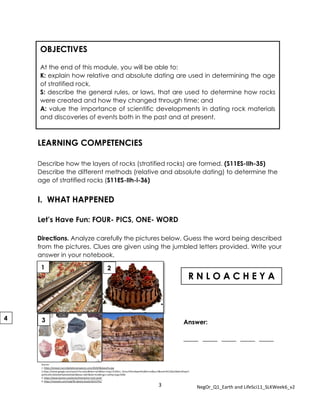
Let’s Have Fun: FOUR- PICS, ONE- WORD
Directions. Analyze carefully the pictures below. Guess the word being described
from the pictures. Clues are given using the jumbled letters provided. Write your
answer in your notebook.
Source:
1. https://amayei.nyc3.digitaloceanspaces.com/2020/06/poultry.jpg
2.https://www.google.com/search?q=cakes&tbm=isch&tbs=rimg:CV1E0nJ_1b1xuYSVnoNpeHfxo&hl=en&sa=X&ved=0CCQQuIIBahcKEwjo7-
qGl5LtAhUAAAAAHQAAAAAQDA&biw=1007&bih=415#imgrc=zGPpCJLIgUI34M
3. https://www.learner.org/series/interactive-rock-cycle/
4. https://newsela.com/read/lib-dating-fossils/id/53741/
OBJECTIVES
At the end of this module, you will be able to:
K: explain how relative and absolute dating are used in determining the age
of stratified rock,
S: describe the general rules, or laws, that are used to determine how rocks
were created and how they changed through time; and
A: value the importance of scientific developments in dating rock materials
and discoveries of events both in the past and at present.
1.
R N L O A C H E Y A
1 2
3
4
Answer:
____ ____ ____ ____ ____
4 NegOr_Q1_Earth and LifeSci11_SLKWeek6_v2
II. WHAT I NEED TO KNOW
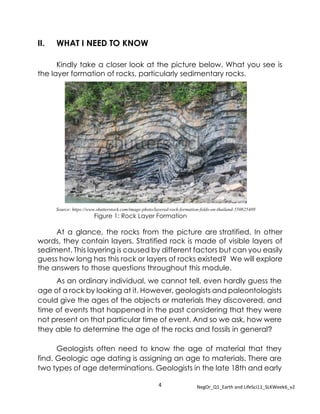
Kindly take a closer look at the picture below. What you see is
the layer formation of rocks, particularly sedimentary rocks.
Figure 1: Rock Layer Formation
At a glance, the rocks from the picture are stratified. In other
words, they contain layers. Stratified rock is made of visible layers of
sediment. This layering is caused by different factors but can you easily
guess how long has this rock or layers of rocks existed? We will explore
the answers to those questions throughout this module.
As an ordinary individual, we cannot tell, even hardly guess the
age of a rock by looking at it. However, geologists and paleontologists
could give the ages of the objects or materials they discovered, and
time of events that happened in the past considering that they were
not present on that particular time of event. And so we ask, how were
they able to determine the age of the rocks and fossils in general?
Geologists often need to know the age of material that they
find. Geologic age dating is assigning an age to materials. There are
two types of age determinations. Geologists in the late 18th and early
Source: https://www.shutterstock.com/image-photo/layered-rock-formation-folds-on-thailand-550825489
5 NegOr_Q1_Earth and LifeSci11_SLKWeek6_v2
19th century studied rock layers and the fossils in them to determine
relative age.
Relative dating is the process of determining if one rock or
geologic event is older or younger than another, without knowing
their specific ages like how many years ago the object was formed. It
is like saying that your granny is older than you.
The following are the principles in relative dating.
Stratigraphy is the science of understanding the variations in the
successively layered character of rocks and their composition.
These rocks may be sedimentary, volcanic, metamorphic or igneous
(see Figure 1).
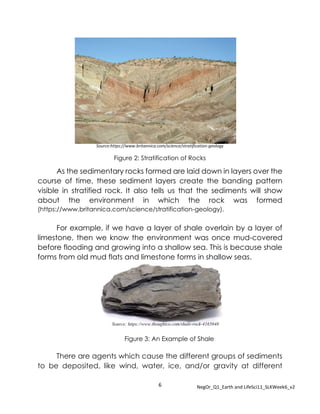
By definition, stratification is the layering that occurs in most
sedimentary rocks and in those igneous rocks formed at
the Earth’s surface, as from lava flows and volcanic fragmental
deposits. This layered structure is formed by the deposition of
sedimentary rocks.
The thickness of the layers varies in millimetres as well as in shape.
The layers may also extend few meters laterally or may cover in many
square kilometres.
Source: (https://www.britannica.com/science/stratification-geology)
6 NegOr_Q1_Earth and LifeSci11_SLKWeek6_v2
Source:https://www.britannica.com/science/stratification-geology
Figure 2: Stratification of Rocks
As the sedimentary rocks formed are laid down in layers over the
course of time, these sediment layers create the banding pattern
visible in stratified rock. It also tells us that the sediments will show
about the environment in which the rock was formed
(https://www.britannica.com/science/stratification-geology).
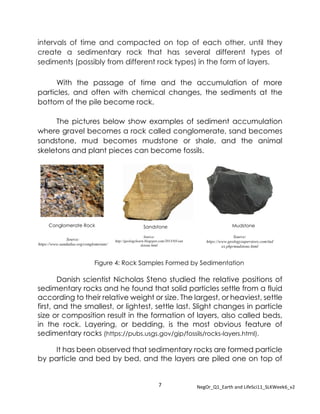
For example, if we have a layer of shale overlain by a layer of
limestone, then we know the environment was once mud-covered
before flooding and growing into a shallow sea. This is because shale
forms from old mud flats and limestone forms in shallow seas.
Figure 3: An Example of Shale
There are agents which cause the different groups of sediments
to be deposited, like wind, water, ice, and/or gravity at different
Source: https://www.thoughtco.com/shale-rock-4165848
7 NegOr_Q1_Earth and LifeSci11_SLKWeek6_v2
Source:
http://geologylearn.blogspot.com/2015/03/san
dstone.html
intervals of time and compacted on top of each other, until they
create a sedimentary rock that has several different types of
sediments (possibly from different rock types) in the form of layers.
With the passage of time and the accumulation of more
particles, and often with chemical changes, the sediments at the
bottom of the pile become rock.
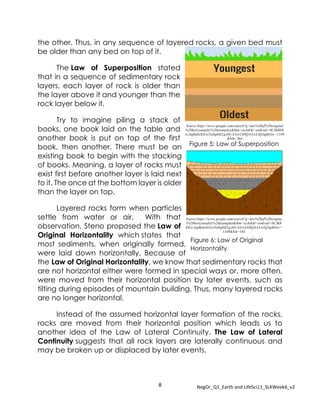
The pictures below show examples of sediment accumulation
where gravel becomes a rock called conglomerate, sand becomes
sandstone, mud becomes mudstone or shale, and the animal
skeletons and plant pieces can become fossils.
Figure 4: Rock Samples Formed by Sedimentation
Danish scientist Nicholas Steno studied the relative positions of
sedimentary rocks and he found that solid particles settle from a fluid
according to their relative weight or size. The largest, or heaviest, settle
first, and the smallest, or lightest, settle last. Slight changes in particle
size or composition result in the formation of layers, also called beds,
in the rock. Layering, or bedding, is the most obvious feature of
sedimentary rocks (https://pubs.usgs.gov/gip/fossils/rocks-layers.html).
It has been observed that sedimentary rocks are formed particle
by particle and bed by bed, and the layers are piled one on top of
Conglomerate Rock Sandstone Mudstone
Source:
https://www.sandatlas.org/conglomerate/
Source:
https://www.geologysuperstore.com/ind
ex.php/mudstone.html
8 NegOr_Q1_Earth and LifeSci11_SLKWeek6_v2
the other. Thus, in any sequence of layered rocks, a given bed must
be older than any bed on top of it.
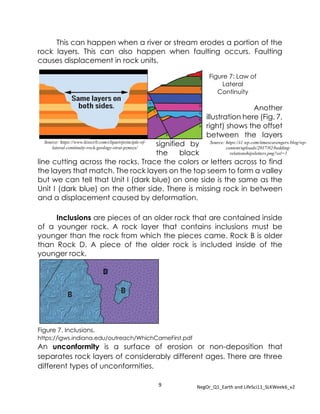
The Law of Superposition stated
that in a sequence of sedimentary rock
layers, each layer of rock is older than
the layer above it and younger than the
rock layer below it.
Try to imagine piling a stack of
books, one book laid on the table and
another book is put on top of the first
book, then another. There must be an
existing book to begin with the stacking
of books. Meaning, a layer of rocks must
exist first before another layer is laid next
to it. The once at the bottom layer is older
than the layer on top.
Layered rocks form when particles
settle from water or air. With that
observation, Steno proposed the Law of
Original Horizontality which states that
most sediments, when originally formed,
were laid down horizontally. Because of
the Law of Original Horizontality, we know that sedimentary rocks that
are not horizontal either were formed in special ways or, more often,
were moved from their horizontal position by later events, such as
tilting during episodes of mountain building. Thus, many layered rocks
are no longer horizontal.
Instead of the assumed horizontal layer formation of the rocks,
rocks are moved from their horizontal position which leads us to
another idea of the Law of Lateral Continuity. The Law of Lateral
Continuity suggests that all rock layers are laterally continuous and
may be broken up or displaced by later events.
Figure 6: Law of Original
Horizontality
Figure 5: Law of Superposition
Source:https://www.google.com/search?q=law%20of%20original
%20horizontality%20examples&tbm=isch&hl=en&ved=0CJkBEK
zcAigBahcKEwiYu6qtkKLqAhUAAAAAHQAAAAAQAg&biw=1349
&bih=564
Source:https://www.google.com/search?q=law%20of%20origina
l%20horizontality%20examples&tbm=isch&hl=en&ved=0CJkB
EKzcAigBahcKEwiYu6qtkKLqAhUAAAAAHQAAAAAQAg&biw=
1349&bih=564
9 NegOr_Q1_Earth and LifeSci11_SLKWeek6_v2
This can happen when a river or stream erodes a portion of the
rock layers. This can also happen when faulting occurs. Faulting
causes displacement in rock units.
Figure 7: Law of
Lateral
Continuity
Another
illustration here (Fig. 7,
right) shows the offset
between the layers
signified by
the black
line cutting across the rocks. Trace the colors or letters across to find
the layers that match. The rock layers on the top seem to form a valley
but we can tell that Unit I (dark blue) on one side is the same as the
Unit I (dark blue) on the other side. There is missing rock in between
and a displacement caused by deformation.
Inclusions are pieces of an older rock that are contained inside
of a younger rock. A rock layer that contains inclusions must be
younger than the rock from which the pieces came. Rock B is older
than Rock D. A piece of the older rock is included inside of the
younger rock.
Figure 7. Inclusions.
https://igws.indiana.edu/outreach/WhichCameFirst.pdf
An unconformity is a surface of erosion or non-deposition that
separates rock layers of considerably different ages. There are three
different types of unconformities.
Source: https://www.kisscc0.com/clipart/principle-of-
lateral-continuity-rock-geology-strat-pzmszs/
Source: https://i1.wp.com/timescavengers.blog/wp-
content/uploads/2017/02/bedding-
relationshipsletters.png?ssl=1
10 NegOr_Q1_Earth and LifeSci11_SLKWeek6_v2
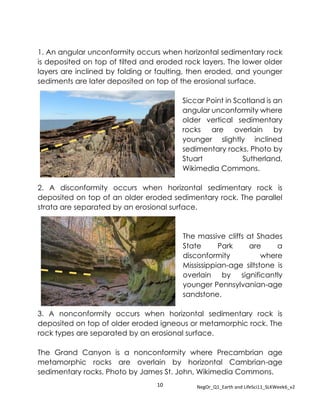
1. An angular unconformity occurs when horizontal sedimentary rock
is deposited on top of tilted and eroded rock layers. The lower older
layers are inclined by folding or faulting, then eroded, and younger
sediments are later deposited on top of the erosional surface.
Siccar Point in Scotland is an
angular unconformity where
older vertical sedimentary
rocks are overlain by
younger slightly inclined
sedimentary rocks. Photo by
Stuart Sutherland,
Wikimedia Commons.
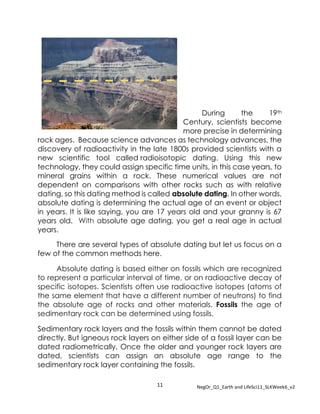
2. A disconformity occurs when horizontal sedimentary rock is
deposited on top of an older eroded sedimentary rock. The parallel
strata are separated by an erosional surface.
The massive cliffs at Shades
State Park are a
disconformity where
Mississippian-age siltstone is
overlain by significantly
younger Pennsylvanian-age
sandstone.
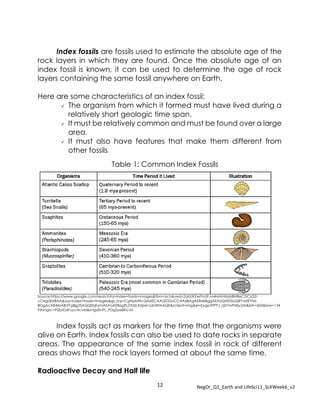
3. A nonconformity occurs when horizontal sedimentary rock is
deposited on top of older eroded igneous or metamorphic rock. The
rock types are separated by an erosional surface.
The Grand Canyon is a nonconformity where Precambrian age
metamorphic rocks are overlain by horizontal Cambrian-age
sedimentary rocks. Photo by James St. John, Wikimedia Commons.
11 NegOr_Q1_Earth and LifeSci11_SLKWeek6_v2
During the 19th
Century, scientists become
more precise in determining
rock ages. Because science advances as technology advances, the
discovery of radioactivity in the late 1800s provided scientists with a
new scientific tool called radioisotopic dating. Using this new
technology, they could assign specific time units, in this case years, to
mineral grains within a rock. These numerical values are not
dependent on comparisons with other rocks such as with relative
dating, so this dating method is called absolute dating. In other words,
absolute dating is determining the actual age of an event or object
in years. It is like saying, you are 17 years old and your granny is 67
years old. With absolute age dating, you get a real age in actual
years.
There are several types of absolute dating but let us focus on a
few of the common methods here.
Absolute dating is based either on fossils which are recognized
to represent a particular interval of time, or on radioactive decay of
specific isotopes. Scientists often use radioactive isotopes (atoms of
the same element that have a different number of neutrons) to find
the absolute age of rocks and other materials. Fossils the age of
sedimentary rock can be determined using fossils.
Sedimentary rock layers and the fossils within them cannot be dated
directly. But igneous rock layers on either side of a fossil layer can be
dated radiometrically. Once the older and younger rock layers are
dated, scientists can assign an absolute age range to the
sedimentary rock layer containing the fossils.
12 NegOr_Q1_Earth and LifeSci11_SLKWeek6_v2
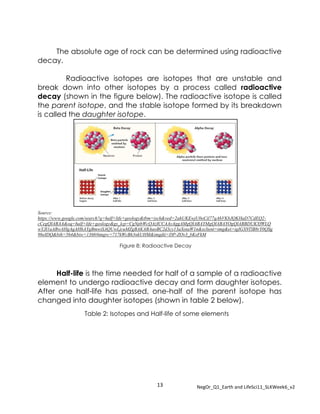
Index fossils are fossils used to estimate the absolute age of the
rock layers in which they are found. Once the absolute age of an
index fossil is known, it can be used to determine the age of rock
layers containing the same fossil anywhere on Earth.
Here are some characteristics of an index fossil:
✓ The organism from which it formed must have lived during a
relatively short geologic time span.
✓ It must be relatively common and must be found over a large
area.
✓ It must also have features that make them different from
other fossils.
Table 1: Common Index Fossils
Source:https://www.google.com/search?q=index+fossils+images&tbm=isch&ved=2ahUKEwiTm5f-m4HrAhX6zIsBHReCDCsQ2-
cCegQIABAA&oq=index+fossils+images&gs_lcp=CgNpbWcQAzIECAAQGDoCCAA6BAgAEB46BggAEAUQHlDSoQRYvr0EYMi-
BGgAcAB4AIABdYgBjg2SAQQ0LjEymAEAoAEBqgELZ3dzLXdpei1pbWfAAQE&sclient=img&ei=EygpX9PFJ_qZr7wPl4Sy2AI&bih=603&biw=134
9#imgrc=PQuIG6FuycHcvM&imgdii=PL_PDg5a6BEU-M
Index fossils act as markers for the time that the organisms were
alive on Earth. Index fossils can also be used to date rocks in separate
areas. The appearance of the same index fossil in rock of different
areas shows that the rock layers formed at about the same time.
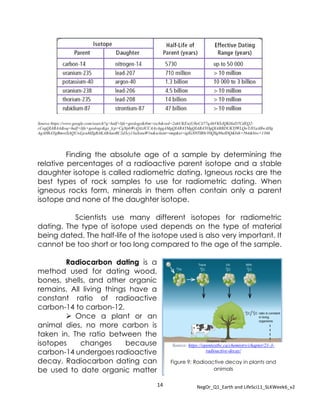
Radioactive Decay and Half life
13 NegOr_Q1_Earth and LifeSci11_SLKWeek6_v2
The absolute age of rock can be determined using radioactive
decay.
Radioactive isotopes are isotopes that are unstable and
break down into other isotopes by a process called radioactive
decay (shown in the figure below). The radioactive isotope is called
the parent isotope, and the stable isotope formed by its breakdown
is called the daughter isotope.
Half-life is the time needed for half of a sample of a radioactive
element to undergo radioactive decay and form daughter isotopes.
After one half-life has passed, one-half of the parent isotope has
changed into daughter isotopes (shown in table 2 below).
Table 2: Isotopes and Half-life of some elements
Source:
https://www.google.com/search?q=half+life+geology&tbm=isch&ved=2ahUKEwjU0oCil77qAhVKbJQKHaD7CdEQ2-
cCegQIABAA&oq=half+life+geology&gs_lcp=CgNpbWcQAzICCAAyAggAMgQIABAYMgQIABAYOgQIABBDUKYfWLQ
wYJI1aABwAHgAgAHhAYgBmwiSAQUwLjcuMZgBAKABAaoBC2d3cy13aXotaW1n&sclient=img&ei=igIGX9TlB8rY0QSg
96eIDQ&bih=564&biw=1366#imgrc=717kWcBh3nkUHM&imgdii=DP-ZOv3_bKsFkM
Figure 8: Radioactive Decay
14 NegOr_Q1_Earth and LifeSci11_SLKWeek6_v2
Finding the absolute age of a sample by determining the
relative percentages of a radioactive parent isotope and a stable
daughter isotope is called radiometric dating. Igneous rocks are the
best types of rock samples to use for radiometric dating. When
igneous rocks form, minerals in them often contain only a parent
isotope and none of the daughter isotope.
Scientists use many different isotopes for radiometric
dating. The type of isotope used depends on the type of material
being dated. The half-life of the isotope used is also very important. It
cannot be too short or too long compared to the age of the sample.
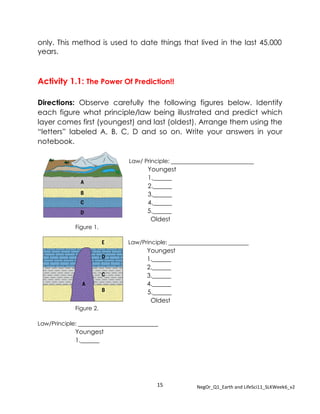
Radiocarbon dating is a
method used for dating wood,
bones, shells, and other organic
remains. All living things have a
constant ratio of radioactive
carbon-14 to carbon-12.
➢ Once a plant or an
animal dies, no more carbon is
taken in. The ratio between the
isotopes changes because
carbon-14 undergoes radioactive
decay. Radiocarbon dating can
be used to date organic matter
Source:https://www.google.com/search?q=half+life+geology&tbm=isch&ved=2ahUKEwjU0oCil77qAhVKbJQKHaD7CdEQ2-
cCegQIABAA&oq=half+life+geology&gs_lcp=CgNpbWcQAzICCAAyAggAMgQIABAYMgQIABAYOgQIABBDUKYfWLQwYJI1aABwAHg
AgAHhAYgBmwiSAQUwLjcuMZgBAKABAaoBC2d3cy13aXotaW1n&sclient=img&ei=igIGX9TlB8rY0QSg96eIDQ&bih=564&biw=1366
Source: https://opentextbc.ca/chemistry/chapter/21-3-
radioactive-decay/
Figure 9: Radioactive decay in plants and
animals
15 NegOr_Q1_Earth and LifeSci11_SLKWeek6_v2
only. This method is used to date things that lived in the last 45,000
years.
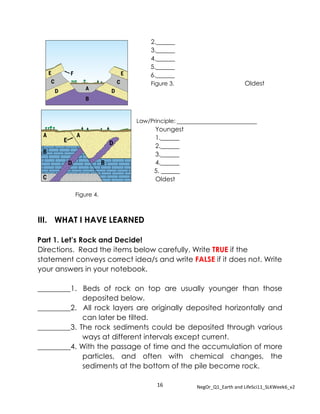
Activity 1.1: The Power Of Prediction!!
Directions: Observe carefully the following figures below. Identify
each figure what principle/law being illustrated and predict which
layer comes first (youngest) and last (oldest). Arrange them using the
“letters” labeled A, B, C, D and so on. Write your answers in your
notebook.
Law/ Principle: _____________________________
Youngest
1.______
2.______
3.______
4.______
5.______
Oldest
Figure 1.
Law/Principle: ____________________________
Youngest
1.______
2.______
3.______
4.______
5.______
Oldest
Figure 2.
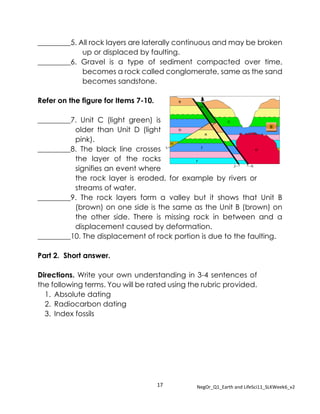
Law/Principle: ____________________________
Youngest
1.______
16 NegOr_Q1_Earth and LifeSci11_SLKWeek6_v2
2.______
3.______
4.______
5.______
6.______
Figure 3. Oldest
Law/Principle: ____________________________
Youngest
1.______
2.______
3.______
4.______
5. ______
Oldest
Figure 4.
III.MWHAT I HAVE LEARNED
Part 1. Let’s Rock and Decide!
Directions. Read the items below carefully. Write TRUE if the
statement conveys correct idea/s and write FALSE if it does not. Write
your answers in your notebook.
_________1. Beds of rock on top are usually younger than those
deposited below.
_________2. All rock layers are originally deposited horizontally and
can later be tilted.
_________3. The rock sediments could be deposited through various
ways at different intervals except current.
_________4. With the passage of time and the accumulation of more
particles, and often with chemical changes, the
sediments at the bottom of the pile become rock.
17 NegOr_Q1_Earth and LifeSci11_SLKWeek6_v2
_________5. All rock layers are laterally continuous and may be broken
up or displaced by faulting.
_________6. Gravel is a type of sediment compacted over time,
becomes a rock called conglomerate, same as the sand
becomes sandstone.
Refer on the figure for Items 7-10.
_________7. Unit C (light green) is
older than Unit D (light
pink).
_________8. The black line crosses
the layer of the rocks
signifies an event where
the rock layer is eroded, for example by rivers or
streams of water.
_________9. The rock layers form a valley but it shows that Unit B
(brown) on one side is the same as the Unit B (brown) on
the other side. There is missing rock in between and a
displacement caused by deformation.
_________10. The displacement of rock portion is due to the faulting.
Part 2. Short answer.
Directions. Write your own understanding in 3-4 sentences of
the following terms. You will be rated using the rubric provided.
1. Absolute dating
2. Radiocarbon dating
3. Index fossils
B
18 NegOr_Q1_Earth and LifeSci11_SLKWeek6_v2
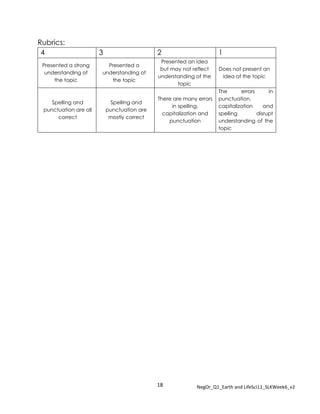
Rubrics:
4 3 2 1
Presented a strong
understanding of
the topic
Presented a
understanding of
the topic
Presented an idea
but may not reflect
understanding of the
topic
Does not present an
idea of the topic
Spelling and
punctuation are all
correct
Spelling and
punctuation are
mostly correct
There are many errors
in spelling,
capitalization and
punctuation
The errors in
punctuation,
capitalization and
spelling disrupt
understanding of the
topic
19 NegOr_Q1_Earth and LifeSci11_SLKWeek6_v2
REFERENCES
Cake layer image. Retrieved September 1, 2020 from
https://www.cookinglight.com/recipes/chocolate-and-cream-layer-cake
Conglomerate illustration. Retrieved June 27, 2020 from
https://www.google.com/search?q=gravel+become+conglomerate&tb
m=isch&ved=2ahUKEwjB6aS6h6fqAhWMBaYKHdDXB2UQ2-
cCegQIABAA&oq=gravel+become+conglomerate&gs_lcp=CgNpbWcQ
A1DygghY6ZAIYLyiCGgAcAB4AIAB7QGIAbEIkgEFMC42LjGYAQCgAQGqA
Qtnd3Mtd2l6LWltZw&sclient=img&ei=9OL5XsGfBoyLmAXQr5-
oBg&bih=613&biw=1366#imgrc=eI7oHbp_-7zQUM
Law of horizontality examples. Retrieved June 24, 2020 from
https://www.google.com/search?q=law%20of%20original%20horizontality
%20examples&tbm=isch&hl=en&ved=0CJkBEKzcAigBahcKEwiYu6qtkKLqA
hUAAAAAHQAAAAAQAg&biw=1349&bih=564
Layer Hen image. Retrieved September 1,2020 from
https://www.google.com/search?q=layer+hen&tbm=isch&source=iu&ictx
=1&fir=mpKPdWDIfY8JoM%252CmY3FspBdXdaQtM%252C_&vet=1&usg=AI
4_-
kSR7pxIPq0oAMJXTx3O9ZviaMB1BQ&sa=X&ved=2ahUKEwjMnr32_8brAhUe
xYsBHah7Bi0Q_h0wAXoECAwQBA&biw=985&bih=590#imgrc=b4N3GVJNV
kwdmM&imgdii=YtlwJCeUGnUuHM
Mudstone illustration. Retrieved June 27, 2020 from
https://www.google.com/searchA
q=mudstone&tbm=isch&ved=2ahUKEwj8-YS_iafqAhWUL6YKHXAmCxcQ2-
cCegQIABAA&oq=mudstone&gs_lcp=CgNpbWcQAzIECAAQQzIECAAQQ
zICCAAyAggAMgIIADICCAAyAggAMgIIADICCAAyAggAOgYIABAKEBg6B
AgAEBhQ1f8YWIiwGWDyuhloAXAAeAGAAe4GiAG2GJIBCjAuMTYuMS42LT
GYAQCgAQGqAQtnd3Mtd2l6LWltZw&sclient=img&ei=FuX5XvyWOZTfmAX
wzKy4AQ&bih=613&biw=1349&hl=en
Principles of Geology. Retrieved June 24, 2020 from
https://timescavengers.blog/introductory-material/geologic-
time/principles-of-geology/
20 NegOr_Q1_Earth and LifeSci11_SLKWeek6_v2
Principles of Geology. Retrieved June 27, 2020 from
https://i1.wp.com/timescavengers.blog/wp
content/uploads/2017/02/bedding- relationshipsletters.png?ssl=1
Rock image. Retrieved September 1, 2020 from
https://www.google.com/search?q=rock&tbm=isch&ved=2ahUKEwi77ND
HgsfrAhUN3pQKHfWEC6YQ2-
cCegQIABAA&oq=rock&gs_lcp=CgNpbWcQAzIECAAQQzIKCAAQsQMQ
gwEQQzIHCAAQsQMQQzIKCAAQsQMQgwEQQzIKCAAQsQMQgwEQQzIK
CAAQsQMQgwEQQzIHCAAQsQMQQzIECAAQQzIECAAQQzIECAAQQzoC
CAA6BggAEAUQHjoECAAQGDoFCAAQsQNQjrwKWPrWCmDn3QpoAHAA
eASAAfIBiAGlEZIBBjAuMTIuM5gBAKABAaoBC2d3cy13aXotaW1nsAEAwAEB
&sclient=img&ei=qMBNX7v4Ao280wT1ia6wCg&bih=590&biw=985
Rock layer image. Retrieved September 1, 2020 from
https://www.google.com/search?q=sedimentary+rocks+layers&tbm=isch
&ved=2ahUKEwiJ_fm5gcfrAhXjw4sBHcqWD8wQ2-
cCegQIABAA&oq=rocks+layer&gs_lcp=CgNpbWcQARgBMgIIADIGCAAQ
BRAeMgYIABAFEB4yBggAEAUQHjIGCAAQBRAeMgYIABAIEB4yBggAEAgQH
jIGCAAQCBAeMgYIABAIEB4yBggAEAgQHjoHCAAQsQMQQzoECAAQQzo
FCAAQsQM6CAgAELEDEIMBUITnD1jI7RFgwoISaABwAHgAgAG-B4gB4i-
SAQ0xLjUuNC4yLjEuMS4zmAEAoAEBqgELZ3dzLXdpei1pbWewAQDAAQE&s
client=img&ei=fr9NX4nGOOOHr7wPyq2-
4Aw&bih=590&biw=985#imgrc=xKuPqDGPBJB_HM&imgdii=isw1aU3K65EY_
M
Rocks and Layers. Retrieved June 22, 2020 from
https://pubs.usgs.gov/gip/fossils/rocks-layers.html
Sandstone illustration. Retrieve June 27, 2020 from
https://www.google.com/search?q=sand+become+sandstone&tbm=isch
&chips=q:sand+become+sandstone,online_chips:sandstone+formation&h
l=en&ved=2ahUKEwjD2KexiafqAhUEU5QKHfYWCAsQ4lYoCHoECAEQHg&b
iw=1349&bih=613
Shale sedimentary rock image. Retrieved June 22, 2020 from
https://www.google.com/search?q=shale+sedimentary+rock&tbm=isch&
ved=2ahUKEwiwxYz82qHqAhWyxIsBHUKrBFMQ2-
cCegQIABAA&oq=shale&gs_lcp=CgNpbWcQARgCMgQIABBDMgQIABBD
MgQIABBDMgIIADICCAAyAggAMgIIADICCAAyAggAMgIIAFCiS1jYVWDPb
21 NegOr_Q1_Earth and LifeSci11_SLKWeek6_v2
WgAcAB4AIABfogBgBGSAQQwLjE5mAEAoAEBqgELZ3dzLXdpei1pbWc&scl
ient=img&ei=NxX3XvDNMrKJr7wPwtaSmAU&bih=613&biw=1349&hl=en
Stratification Geology. Retrieved June 19, 2020 from
https://www.britannica.com/science/stratification-geology
Stratification image. Retrieved June 19, 2020 from
https://www.google.com/url?sa=i&url=https%3A%2F%2Fwww.pinterest.cl%
2Fpin%2F460282024406576244%2F&psig=AOvVaw3RjOOSG_PHvAlDOd0Hst
QT&ust=1592889343683000&source=images&cd=vfe&ved=0CLEBEK-
JA2oXChMI2LCn8NWU6gIVAAAAAB0AAAAAEA0
Stratification image. Retrieved June 19, 2020 from
https://www.shutterstock.com/image-photo/layered-rock-formation-folds-
on-thailand-550825489
Stratification: Definition, Theory & Examples. Retrieved June 18, 2020 from
https://study.com/academy/lesson/stratification-definition-theory-
examples.html
Superposition Illustration. Retrieved June 23, 2020 from
https://www.google.com/search?q=law+of+superposition+illustration&tb
m=isch&ved=2ahUKEwiE85CMiqLqAhVjxYsBHZxoDsEQ2-
cCegQIABAA&oq=Law+of+superposition&gs_lcp=CgNpbWcQARgDMgIIA
DICCAAyAggAMgIIADICCAAyAggAMgIIADICCAAyAggAMgIIADoECAAQ
QzoFCAAQsQM6BwgAELEDEENQ7JFHWNrwR2DypUhoBnAAeAGAAb8DiA
GjIJIBCjAuMjUuMi4wLjGYAQCgAQGqAQtnd3Mtd2l6LWltZ7ABAA&sclient=i
mg&ei=oUb3XsSeOOOKr7wPnNG5iAw&bih=564&biw=1366
Figure 1-4 illustrations. Retrieved July 22, 2021 from
https://igws.indiana.edu/lessonplans/
Absolute dating. Retrieved June 30, 2020 from
https://geo.libretexts.org/Bookshelves/Geology/Book%3A_An_Introduction_t
o_Geology_(Johnson%2C_Affolter%2C_Inkenbrandt%2C_and_Mosher)/07%3
A_Geologic_Time/7.02%3A_Absolute_Dating
Absolute dating. Retrieved July 1, 2020 from
https://www.sciencelearn.org.nz/resources/1486-absolute-
dating#:~:text=Geologists%20often%20need%20to%20know,geological%20e
vents%20in%20time%20order
22 NegOr_Q1_Earth and LifeSci11_SLKWeek6_v2
Common Isotope pairs chart. Retrieved July 2, 2020 from
https://www.google.com/search?q=half+life+geology&tbm=isch&ved=2ah
UKEwjU0oCil77qAhVKbJQKHaD7CdEQ2-
cCegQIABAA&oq=half+life+geology&gs_lcp=CgNpbWcQAzICCAAyAggA
MgQIABAYMgQIABAYOgQIABBDUKYfWLQwYJI1aABwAHgAgAHhAYgBmwiS
AQUwLjcuMZgBAKABAaoBC2d3cy13aXotaW1n&sclient=img&ei=igIGX9TlB8r
Y0QSg96eIDQ&bih=564&biw=1366#imgrc=717kWcBh3nkUHM&imgdii=DP-
ZOv3_bKsFkM
Dating fossils- how are fossils dated? Retrieved July 2, 2020 from
https://www.fossilera.com/pages/dating-fossils#:~:text=Absolute%20Dating-
,Absolute%20dating%20is%20used%20to%20determine%20a%20precise%20a
ge%20of,rocks%20they%20are%20found%20in.
Geologic dating explained. Retrieved June 30, 2020 from
https://www.kidsdiscover.com/teacherresources/geologic-age-dating-
explained/
Index Fossils illustration.Retrieved July 6,2020 from
https://www.google.com/search?q=index+fossils+images&tbm=isch&ved=2
ahUKEwiTm5f-m4HrAhX6zIsBHReCDCsQ2-
cCegQIABAA&oq=index+fossils+images&gs_lcp=CgNpbWcQAzIECAAQGD
oCCAA6BAgAEB46BggAEAUQHlDSoQRYvr0EYMi-
BGgAcAB4AIABdYgBjg2SAQQ0LjEymAEAoAEBqgELZ3dzLXdpei1pbWfAAQE&
sclient=img&ei=EygpX9PFJ_qZr7wPl4Sy2AI&bih=603&biw=1349#imgrc=PQuI
G6FuycHcvM&imgdii=PL_PDg5a6BEU-M
Introduction Stratigraphy. Retrieved July 6, 2020 from
http://www.sepmstrata.org/page.aspx?pageid=15#:~:text=Stratigraphy%20i
s%20the%20science%20of,%2C%20volcanic%2C%20metamorphic%20or%20i
gneous.
Law of cross-cutting relationships image. Retrieved July 6, 2020 from
https://imnh.iri.isu.edu/exhibits/online/geo_time/geo_principles.htm
Principle of inclusion image. Retrieved July 7, 2020 from
https://www.google.com/search?q=principle+of+inclusion+geology&tbm=is
ch&ved=2ahUKEwjg8MSonb3qAhWGAaYKHdEBCOQQ2-
cCegQIABAA&oq=principle+of+inclusion&gs_lcp=CgNpbWcQARgBMgIIADI
CCAAyAggAMgIIADICCAAyAggAMgIIADICCAAyAggAMgIIADoECAAQQzo
FCAAQsQNQjqeTCliw35MKYIP0kwpoAHAAeASAAYcDiAH9HZIBCDAuMjQuMi
4xmAEAoAEBqgELZ3dzLXdpei1pbWewAQA&sclient=img&ei=qoIFX-
DzKoaDmAXRg6CgDg&bih=613&biw=1366#imgrc=jhYXBRL4SOjCAM
23 NegOr_Q1_Earth and LifeSci11_SLKWeek6_v2
Principles of Geology. Retrieved July 6, 2020 from
https://timescavengers.blog/introductory-material/geologic-time/principles-
of-geology/
Principle of Succession illustration. Retrieved July 7, 2020 from
https://www.google.com/search?q=index+fossils+table&source=lnms&tbm=
isch&sa=X&ved=2ahUKEwiktfGom4HrAhWzJaYKHTHYDwgQ_AUoAXoECA0Q
Aw&biw=1349&bih=603#imgrc=GVKYlALKYRvjFM
Radioactive decay and half-life table. Retrieved July 6, 2020 from
https://www.google.com/search?q=half+life+geology&tbm=isch&ved=2ah
UKEwjU0oCil77qAhVKbJQKHaD7CdEQ2-
cCegQIABAA&oq=half+life+geology&gs_lcp=CgNpbWcQAzICCAAyAggA
MgQIABAYMgQIABAYOgQIABBDUKYfWLQwYJI1aABwAHgAgAHhAYgBmwiS
AQUwLjcuMZgBAKABAaoBC2d3cy13aXotaW1n&sclient=img&ei=igIGX9TlB8r
Y0QSg96eIDQ&bih=564&biw=1366
Radiocarbon dating illustration. Retrieved July 6, 2020 from
https://chem.libretexts.org/Courses/Furman_University/CHM101%3A_Chemis
try_and_Global_Awareness_(Gordon)/05%3A_Basics_of_Nuclear_Science/5.
07%3A_Calculating_Half-Life
Relative and absolute dating. Retrieved June 29, 2020 from
https://opentextbc.ca/chemistry/chapter/21-3-radioactive-decay/
Relative and absolute dating. Retrieved June 29, 2020
https://geo.libretexts.org/Bookshelves/Geology/Book%3A_An_Introduction_t
o_Geology_(Johnson%2C_Affolter%2C_Inkenbrandt%2C_and_Mosher)/07%3
A_Geologic_Time/7.01%3A_Relative_Dating#3
Steno’s Law of Startigraphy illustration. Retrieved July 6, 2020 from
https://kids.britannica.com/students/assembly/view/199325
Stratigraphy image. Retrieved July 6, 2020 from
https://www.google.com/search?q=stratigraphy&tbm=isch&ved=2ahUKEwj
b9ZHjnL3qAhWHzYsBHex7C1cQ2-
cCegQIABAA&oq=stratigraphy&gs_lcp=CgNpbWcQAzICCAAyAggAMgIIA
DICCAAyAggAMgIIADICCAAyAggAMgIIADICCAA6BggAEAcQHjoGCAAQC
hAYUPLUCFjV1whgkt8IaABwAHgAgAF8iAHkApIBAzAuM5gBAKABAaoBC2d3
cy13aXotaW1n&sclient=img&ei=GYIFX5uFCoebr7wP7PetuAU&bih=613&biw
=1366#imgrc=LVaHiLC6Ymp5DM
Stratigraphy image. Retrieved July 7, 2020 from
https://www.google.com/search?q=stratigraphy&tbm=isch&ved=2ahUKEwj
24 NegOr_Q1_Earth and LifeSci11_SLKWeek6_v2
b9ZHjnL3qAhWHzYsBHex7C1cQ2cCegQIABAA&oq=stratigraphy&gs_lcp=Cg
NpbWcQAzICCAAyAggAMgIIADICCAAyAggAMgIIADICCAAyAggAMgIIADI
CCAA6BggAEAcQHjoGCAAQChAYUPLUCFjV1whgkt8IaABwAHgAgAF8iAHk
ApIBAzAuM5gBAKABAaoBC2d3cy13aXotaW1n&sclient=img&ei=GYIFX5uFC
oebr7wP7PetuAU&bih=613&biw=1366#imgrc=l9YnnfU4mT_dTM&imgdii=FcQ
pxnmUmfDdZM
The Law of Superposition image. Retrieved July 7, 2020 from
https://www.google.com/search?q=stratigraphy&tbm=isch&ved=2ahUKEwj
b9ZHjnL3qAhWHzYsBHex7C1cQ2cCegQIABAA&oq=stratigraphy&gs_lcp=Cg
NpbWcQAzICCAAyAggAMgIIADICCAAyAggAMgIIADICCAAyAggAMgIIADI
CCAA6BggAEAcQHjoGCAAQChAYUPLUCFjV1whgkt8IaABwAHgAgAF8iAHk
ApIBAzAuM5gBAKABAaoBC2d3cy13aXotaW1n&sclient=img&ei=GYIFX5uFC
oebr7wP7PetuAU&bih=613&biw=1366#imgrc=l9YnnfU4mT_dTM&imgdii=FcQ
pxnmUmfDdZM
25 NegOr_Q1_Earth and LifeSci11_SLKWeek6_v2
SYNOPSIS
This module talks about the
stratification or the layering of rocks.
This layering of rocks is due to the
deposition or accumulation of
sediments over a period of time. There
are various ways where sediments may
be deposited, either by or
combination of water, current, wind,
gravity or ice.
There are laws which were used
to determine how rocks were created
and how rocks changed over time.
These are the Law of Superposition,
Law of Original Horizontality and Law of
Lateral Continuity. Furthermore, age of
particular matter or rock layers for
instance, can be determined through
either relative or absolute dating.
ABOUT THE AUTHOR
ACKNOWLEDGMENT
BERNADETTE NOVEM I. SARDON, is a licensed Professional
Teacher. She is a graduate of University of San Carlos with the degree
of Bachelor of Science in Biology. She is currently teaching at San
Miguel National High School as a Senior High teacher, at the same
time the Teacher-in-Charge of the same school. She has earned units
in Masters in Biology and Master of Education major in Guidance and
Psychology.
ANSWER KEY
Let’s Have Fun: FOUR PICS, ONE WORD
1. LAYER
Activity 1.1: The Power Of Prediction!!
Figure 1. Law of Superposition
A, B, C, D,
Figure 2. Principle of lateral continuity
A, E, D, C, B
Figure 3. Cross-Cut Relationship
A, F, E, C, D, B
Figure 4. Principle of Inclusion
E, D, A, B, C
Post Evaluation.
Part 1. Let’s Rock and Decide
1. True
2. True
3. False
4. True
5. True
6. True
7. False
8. True
9. True
10. True
Part 2. Answers may vary. (1-3)
26 NegOr_Q1_Earth and LifeSci11_SLKWeek6_v2
Division of Negros Oriental
SENEN PRISCILLO P. PAULIN, CESO V
Schools Division Superintendent
FAY C. LUAREZ, TM, EDD, PHD
OIC-Assistant Schools Division Superintendent
Acting CID Chief
NILITA L. RAGAY, EDD
OIC-Assistant Schools Division Superintendent
ROSELA R. ABIERA
Education Program Supervisor – (LRMDS)
ARNOLD R. JUNGCO
Education Program Supervisor - (SCIENCE/MATH)
MARICEL S. RASID
Librarian II (LRMDS)
ELMER L. CABRERA
PDO II (LRMDS)
BERNADETTE NOVEM I. SARDON
Writer
NOELYN E. SIAPNO
Lay-out Artist
_____________
BETA QA TEAM
JOAN Y. BUBULI
LIELIN A. DE LA ZERNA
MIEL C. PACULANANG
ALPHA QA TEAM
LIEZEL A. AGOR
MARY JOYCEN A. ALAM-ALAM
EUFRATES G. ANSOK JR.
JOAN Y. BUBULI
LIELIN A. DE LA ZERNA
THOMAS JOGIE U. TOLEDO
ARJIE T. PALUMPA
DISCLAIMER
The information, activities and assessments used in this material are designed to provide accessible
learning modality to the teachers and learners of the Division of Negros Oriental. The contents of this module
are carefully researched, chosen, and evaluated to comply with the set learning competencies. The writers
and evaluator were clearly instructed to give credits to information and illustrations used to substantiate this
material. All content is subject to copyright and may not be reproduced in any form without expressed written
consent from the division.

Earth-and-Life-Science-Q1-Week-6-22.pdf

  • 1.
    1 NegOr_Q1_Earth andLifeSci11_SLKWeek6_v2 SSTRATIFICATION OF ROCKS AND TYPES OF DATING for Earth & Life Science/ Grade 11 Quarter 1/ Week 6 NegOr_Q1_Earth and LifeSci11_SLKWeek6_v2
  • 2.
    2 NegOr_Q1_Earth andLifeSci11_SLKWeek6_v2 FOREWORD Dear students of Senior High School. Welcome back to this week’s self-learning kit where you will journey to the new lesson. This learning kit will serve as a guide in understanding deeply the concepts on stratification and dating of rocks. In this learning kit the students will gain knowledge in explaining the stratification or layering of rocks through the deposition, generally of sedimentary rocks. It will also broaden your ideas on the factors which cause the formation of layers of rocks and how rock stratification will be useful in understanding past environments. It will also describe the laws which help in explaining how rocks are formed and changed over time as well as the means of identifying the age or time rocks are formed, by means of relative dating and absolute dating. Activities and post evaluation are included to make learning more fun and exciting. Hence, this learning kit will be your aid as you embark new scientific words, ideas and enrich your existing knowledge about scientific concepts. The author of this module has been an experienced teacher in the field of Biology and teaching core and applied subjects in the Senior High Curriculum.
  • 3.
    3 NegOr_Q1_Earth andLifeSci11_SLKWeek6_v2 LEARNING COMPETENCIES Describe how the layers of rocks (stratified rocks) are formed. (S11ES-IIh-35) Describe the different methods (relative and absolute dating) to determine the age of stratified rocks (S11ES-IIh-i-36) I. WHAT HAPPENED Let’s Have Fun: FOUR- PICS, ONE- WORD Directions. Analyze carefully the pictures below. Guess the word being described from the pictures. Clues are given using the jumbled letters provided. Write your answer in your notebook. Source: 1. https://amayei.nyc3.digitaloceanspaces.com/2020/06/poultry.jpg 2.https://www.google.com/search?q=cakes&tbm=isch&tbs=rimg:CV1E0nJ_1b1xuYSVnoNpeHfxo&hl=en&sa=X&ved=0CCQQuIIBahcKEwjo7- qGl5LtAhUAAAAAHQAAAAAQDA&biw=1007&bih=415#imgrc=zGPpCJLIgUI34M 3. https://www.learner.org/series/interactive-rock-cycle/ 4. https://newsela.com/read/lib-dating-fossils/id/53741/ OBJECTIVES At the end of this module, you will be able to: K: explain how relative and absolute dating are used in determining the age of stratified rock, S: describe the general rules, or laws, that are used to determine how rocks were created and how they changed through time; and A: value the importance of scientific developments in dating rock materials and discoveries of events both in the past and at present. 1. R N L O A C H E Y A 1 2 3 4 Answer: ____ ____ ____ ____ ____
  • 4.
    4 NegOr_Q1_Earth andLifeSci11_SLKWeek6_v2 II. WHAT I NEED TO KNOW Kindly take a closer look at the picture below. What you see is the layer formation of rocks, particularly sedimentary rocks. Figure 1: Rock Layer Formation At a glance, the rocks from the picture are stratified. In other words, they contain layers. Stratified rock is made of visible layers of sediment. This layering is caused by different factors but can you easily guess how long has this rock or layers of rocks existed? We will explore the answers to those questions throughout this module. As an ordinary individual, we cannot tell, even hardly guess the age of a rock by looking at it. However, geologists and paleontologists could give the ages of the objects or materials they discovered, and time of events that happened in the past considering that they were not present on that particular time of event. And so we ask, how were they able to determine the age of the rocks and fossils in general? Geologists often need to know the age of material that they find. Geologic age dating is assigning an age to materials. There are two types of age determinations. Geologists in the late 18th and early Source: https://www.shutterstock.com/image-photo/layered-rock-formation-folds-on-thailand-550825489
  • 5.
    5 NegOr_Q1_Earth andLifeSci11_SLKWeek6_v2 19th century studied rock layers and the fossils in them to determine relative age. Relative dating is the process of determining if one rock or geologic event is older or younger than another, without knowing their specific ages like how many years ago the object was formed. It is like saying that your granny is older than you. The following are the principles in relative dating. Stratigraphy is the science of understanding the variations in the successively layered character of rocks and their composition. These rocks may be sedimentary, volcanic, metamorphic or igneous (see Figure 1). By definition, stratification is the layering that occurs in most sedimentary rocks and in those igneous rocks formed at the Earth’s surface, as from lava flows and volcanic fragmental deposits. This layered structure is formed by the deposition of sedimentary rocks. The thickness of the layers varies in millimetres as well as in shape. The layers may also extend few meters laterally or may cover in many square kilometres. Source: (https://www.britannica.com/science/stratification-geology)
  • 6.
    6 NegOr_Q1_Earth andLifeSci11_SLKWeek6_v2 Source:https://www.britannica.com/science/stratification-geology Figure 2: Stratification of Rocks As the sedimentary rocks formed are laid down in layers over the course of time, these sediment layers create the banding pattern visible in stratified rock. It also tells us that the sediments will show about the environment in which the rock was formed (https://www.britannica.com/science/stratification-geology). For example, if we have a layer of shale overlain by a layer of limestone, then we know the environment was once mud-covered before flooding and growing into a shallow sea. This is because shale forms from old mud flats and limestone forms in shallow seas. Figure 3: An Example of Shale There are agents which cause the different groups of sediments to be deposited, like wind, water, ice, and/or gravity at different Source: https://www.thoughtco.com/shale-rock-4165848
  • 7.
    7 NegOr_Q1_Earth andLifeSci11_SLKWeek6_v2 Source: http://geologylearn.blogspot.com/2015/03/san dstone.html intervals of time and compacted on top of each other, until they create a sedimentary rock that has several different types of sediments (possibly from different rock types) in the form of layers. With the passage of time and the accumulation of more particles, and often with chemical changes, the sediments at the bottom of the pile become rock. The pictures below show examples of sediment accumulation where gravel becomes a rock called conglomerate, sand becomes sandstone, mud becomes mudstone or shale, and the animal skeletons and plant pieces can become fossils. Figure 4: Rock Samples Formed by Sedimentation Danish scientist Nicholas Steno studied the relative positions of sedimentary rocks and he found that solid particles settle from a fluid according to their relative weight or size. The largest, or heaviest, settle first, and the smallest, or lightest, settle last. Slight changes in particle size or composition result in the formation of layers, also called beds, in the rock. Layering, or bedding, is the most obvious feature of sedimentary rocks (https://pubs.usgs.gov/gip/fossils/rocks-layers.html). It has been observed that sedimentary rocks are formed particle by particle and bed by bed, and the layers are piled one on top of Conglomerate Rock Sandstone Mudstone Source: https://www.sandatlas.org/conglomerate/ Source: https://www.geologysuperstore.com/ind ex.php/mudstone.html
  • 8.
    8 NegOr_Q1_Earth andLifeSci11_SLKWeek6_v2 the other. Thus, in any sequence of layered rocks, a given bed must be older than any bed on top of it. The Law of Superposition stated that in a sequence of sedimentary rock layers, each layer of rock is older than the layer above it and younger than the rock layer below it. Try to imagine piling a stack of books, one book laid on the table and another book is put on top of the first book, then another. There must be an existing book to begin with the stacking of books. Meaning, a layer of rocks must exist first before another layer is laid next to it. The once at the bottom layer is older than the layer on top. Layered rocks form when particles settle from water or air. With that observation, Steno proposed the Law of Original Horizontality which states that most sediments, when originally formed, were laid down horizontally. Because of the Law of Original Horizontality, we know that sedimentary rocks that are not horizontal either were formed in special ways or, more often, were moved from their horizontal position by later events, such as tilting during episodes of mountain building. Thus, many layered rocks are no longer horizontal. Instead of the assumed horizontal layer formation of the rocks, rocks are moved from their horizontal position which leads us to another idea of the Law of Lateral Continuity. The Law of Lateral Continuity suggests that all rock layers are laterally continuous and may be broken up or displaced by later events. Figure 6: Law of Original Horizontality Figure 5: Law of Superposition Source:https://www.google.com/search?q=law%20of%20original %20horizontality%20examples&tbm=isch&hl=en&ved=0CJkBEK zcAigBahcKEwiYu6qtkKLqAhUAAAAAHQAAAAAQAg&biw=1349 &bih=564 Source:https://www.google.com/search?q=law%20of%20origina l%20horizontality%20examples&tbm=isch&hl=en&ved=0CJkB EKzcAigBahcKEwiYu6qtkKLqAhUAAAAAHQAAAAAQAg&biw= 1349&bih=564
  • 9.
    9 NegOr_Q1_Earth andLifeSci11_SLKWeek6_v2 This can happen when a river or stream erodes a portion of the rock layers. This can also happen when faulting occurs. Faulting causes displacement in rock units. Figure 7: Law of Lateral Continuity Another illustration here (Fig. 7, right) shows the offset between the layers signified by the black line cutting across the rocks. Trace the colors or letters across to find the layers that match. The rock layers on the top seem to form a valley but we can tell that Unit I (dark blue) on one side is the same as the Unit I (dark blue) on the other side. There is missing rock in between and a displacement caused by deformation. Inclusions are pieces of an older rock that are contained inside of a younger rock. A rock layer that contains inclusions must be younger than the rock from which the pieces came. Rock B is older than Rock D. A piece of the older rock is included inside of the younger rock. Figure 7. Inclusions. https://igws.indiana.edu/outreach/WhichCameFirst.pdf An unconformity is a surface of erosion or non-deposition that separates rock layers of considerably different ages. There are three different types of unconformities. Source: https://www.kisscc0.com/clipart/principle-of- lateral-continuity-rock-geology-strat-pzmszs/ Source: https://i1.wp.com/timescavengers.blog/wp- content/uploads/2017/02/bedding- relationshipsletters.png?ssl=1
  • 10.
    10 NegOr_Q1_Earth andLifeSci11_SLKWeek6_v2 1. An angular unconformity occurs when horizontal sedimentary rock is deposited on top of tilted and eroded rock layers. The lower older layers are inclined by folding or faulting, then eroded, and younger sediments are later deposited on top of the erosional surface. Siccar Point in Scotland is an angular unconformity where older vertical sedimentary rocks are overlain by younger slightly inclined sedimentary rocks. Photo by Stuart Sutherland, Wikimedia Commons. 2. A disconformity occurs when horizontal sedimentary rock is deposited on top of an older eroded sedimentary rock. The parallel strata are separated by an erosional surface. The massive cliffs at Shades State Park are a disconformity where Mississippian-age siltstone is overlain by significantly younger Pennsylvanian-age sandstone. 3. A nonconformity occurs when horizontal sedimentary rock is deposited on top of older eroded igneous or metamorphic rock. The rock types are separated by an erosional surface. The Grand Canyon is a nonconformity where Precambrian age metamorphic rocks are overlain by horizontal Cambrian-age sedimentary rocks. Photo by James St. John, Wikimedia Commons.
  • 11.
    11 NegOr_Q1_Earth andLifeSci11_SLKWeek6_v2 During the 19th Century, scientists become more precise in determining rock ages. Because science advances as technology advances, the discovery of radioactivity in the late 1800s provided scientists with a new scientific tool called radioisotopic dating. Using this new technology, they could assign specific time units, in this case years, to mineral grains within a rock. These numerical values are not dependent on comparisons with other rocks such as with relative dating, so this dating method is called absolute dating. In other words, absolute dating is determining the actual age of an event or object in years. It is like saying, you are 17 years old and your granny is 67 years old. With absolute age dating, you get a real age in actual years. There are several types of absolute dating but let us focus on a few of the common methods here. Absolute dating is based either on fossils which are recognized to represent a particular interval of time, or on radioactive decay of specific isotopes. Scientists often use radioactive isotopes (atoms of the same element that have a different number of neutrons) to find the absolute age of rocks and other materials. Fossils the age of sedimentary rock can be determined using fossils. Sedimentary rock layers and the fossils within them cannot be dated directly. But igneous rock layers on either side of a fossil layer can be dated radiometrically. Once the older and younger rock layers are dated, scientists can assign an absolute age range to the sedimentary rock layer containing the fossils.
  • 12.
    12 NegOr_Q1_Earth andLifeSci11_SLKWeek6_v2 Index fossils are fossils used to estimate the absolute age of the rock layers in which they are found. Once the absolute age of an index fossil is known, it can be used to determine the age of rock layers containing the same fossil anywhere on Earth. Here are some characteristics of an index fossil: ✓ The organism from which it formed must have lived during a relatively short geologic time span. ✓ It must be relatively common and must be found over a large area. ✓ It must also have features that make them different from other fossils. Table 1: Common Index Fossils Source:https://www.google.com/search?q=index+fossils+images&tbm=isch&ved=2ahUKEwiTm5f-m4HrAhX6zIsBHReCDCsQ2- cCegQIABAA&oq=index+fossils+images&gs_lcp=CgNpbWcQAzIECAAQGDoCCAA6BAgAEB46BggAEAUQHlDSoQRYvr0EYMi- BGgAcAB4AIABdYgBjg2SAQQ0LjEymAEAoAEBqgELZ3dzLXdpei1pbWfAAQE&sclient=img&ei=EygpX9PFJ_qZr7wPl4Sy2AI&bih=603&biw=134 9#imgrc=PQuIG6FuycHcvM&imgdii=PL_PDg5a6BEU-M Index fossils act as markers for the time that the organisms were alive on Earth. Index fossils can also be used to date rocks in separate areas. The appearance of the same index fossil in rock of different areas shows that the rock layers formed at about the same time. Radioactive Decay and Half life
  • 13.
    13 NegOr_Q1_Earth andLifeSci11_SLKWeek6_v2 The absolute age of rock can be determined using radioactive decay. Radioactive isotopes are isotopes that are unstable and break down into other isotopes by a process called radioactive decay (shown in the figure below). The radioactive isotope is called the parent isotope, and the stable isotope formed by its breakdown is called the daughter isotope. Half-life is the time needed for half of a sample of a radioactive element to undergo radioactive decay and form daughter isotopes. After one half-life has passed, one-half of the parent isotope has changed into daughter isotopes (shown in table 2 below). Table 2: Isotopes and Half-life of some elements Source: https://www.google.com/search?q=half+life+geology&tbm=isch&ved=2ahUKEwjU0oCil77qAhVKbJQKHaD7CdEQ2- cCegQIABAA&oq=half+life+geology&gs_lcp=CgNpbWcQAzICCAAyAggAMgQIABAYMgQIABAYOgQIABBDUKYfWLQ wYJI1aABwAHgAgAHhAYgBmwiSAQUwLjcuMZgBAKABAaoBC2d3cy13aXotaW1n&sclient=img&ei=igIGX9TlB8rY0QSg 96eIDQ&bih=564&biw=1366#imgrc=717kWcBh3nkUHM&imgdii=DP-ZOv3_bKsFkM Figure 8: Radioactive Decay
  • 14.
    14 NegOr_Q1_Earth andLifeSci11_SLKWeek6_v2 Finding the absolute age of a sample by determining the relative percentages of a radioactive parent isotope and a stable daughter isotope is called radiometric dating. Igneous rocks are the best types of rock samples to use for radiometric dating. When igneous rocks form, minerals in them often contain only a parent isotope and none of the daughter isotope. Scientists use many different isotopes for radiometric dating. The type of isotope used depends on the type of material being dated. The half-life of the isotope used is also very important. It cannot be too short or too long compared to the age of the sample. Radiocarbon dating is a method used for dating wood, bones, shells, and other organic remains. All living things have a constant ratio of radioactive carbon-14 to carbon-12. ➢ Once a plant or an animal dies, no more carbon is taken in. The ratio between the isotopes changes because carbon-14 undergoes radioactive decay. Radiocarbon dating can be used to date organic matter Source:https://www.google.com/search?q=half+life+geology&tbm=isch&ved=2ahUKEwjU0oCil77qAhVKbJQKHaD7CdEQ2- cCegQIABAA&oq=half+life+geology&gs_lcp=CgNpbWcQAzICCAAyAggAMgQIABAYMgQIABAYOgQIABBDUKYfWLQwYJI1aABwAHg AgAHhAYgBmwiSAQUwLjcuMZgBAKABAaoBC2d3cy13aXotaW1n&sclient=img&ei=igIGX9TlB8rY0QSg96eIDQ&bih=564&biw=1366 Source: https://opentextbc.ca/chemistry/chapter/21-3- radioactive-decay/ Figure 9: Radioactive decay in plants and animals
  • 15.
    15 NegOr_Q1_Earth andLifeSci11_SLKWeek6_v2 only. This method is used to date things that lived in the last 45,000 years. Activity 1.1: The Power Of Prediction!! Directions: Observe carefully the following figures below. Identify each figure what principle/law being illustrated and predict which layer comes first (youngest) and last (oldest). Arrange them using the “letters” labeled A, B, C, D and so on. Write your answers in your notebook. Law/ Principle: _____________________________ Youngest 1.______ 2.______ 3.______ 4.______ 5.______ Oldest Figure 1. Law/Principle: ____________________________ Youngest 1.______ 2.______ 3.______ 4.______ 5.______ Oldest Figure 2. Law/Principle: ____________________________ Youngest 1.______
  • 16.
    16 NegOr_Q1_Earth andLifeSci11_SLKWeek6_v2 2.______ 3.______ 4.______ 5.______ 6.______ Figure 3. Oldest Law/Principle: ____________________________ Youngest 1.______ 2.______ 3.______ 4.______ 5. ______ Oldest Figure 4. III.MWHAT I HAVE LEARNED Part 1. Let’s Rock and Decide! Directions. Read the items below carefully. Write TRUE if the statement conveys correct idea/s and write FALSE if it does not. Write your answers in your notebook. _________1. Beds of rock on top are usually younger than those deposited below. _________2. All rock layers are originally deposited horizontally and can later be tilted. _________3. The rock sediments could be deposited through various ways at different intervals except current. _________4. With the passage of time and the accumulation of more particles, and often with chemical changes, the sediments at the bottom of the pile become rock.
  • 17.
    17 NegOr_Q1_Earth andLifeSci11_SLKWeek6_v2 _________5. All rock layers are laterally continuous and may be broken up or displaced by faulting. _________6. Gravel is a type of sediment compacted over time, becomes a rock called conglomerate, same as the sand becomes sandstone. Refer on the figure for Items 7-10. _________7. Unit C (light green) is older than Unit D (light pink). _________8. The black line crosses the layer of the rocks signifies an event where the rock layer is eroded, for example by rivers or streams of water. _________9. The rock layers form a valley but it shows that Unit B (brown) on one side is the same as the Unit B (brown) on the other side. There is missing rock in between and a displacement caused by deformation. _________10. The displacement of rock portion is due to the faulting. Part 2. Short answer. Directions. Write your own understanding in 3-4 sentences of the following terms. You will be rated using the rubric provided. 1. Absolute dating 2. Radiocarbon dating 3. Index fossils B
  • 18.
    18 NegOr_Q1_Earth andLifeSci11_SLKWeek6_v2 Rubrics: 4 3 2 1 Presented a strong understanding of the topic Presented a understanding of the topic Presented an idea but may not reflect understanding of the topic Does not present an idea of the topic Spelling and punctuation are all correct Spelling and punctuation are mostly correct There are many errors in spelling, capitalization and punctuation The errors in punctuation, capitalization and spelling disrupt understanding of the topic
  • 19.
    19 NegOr_Q1_Earth andLifeSci11_SLKWeek6_v2 REFERENCES Cake layer image. Retrieved September 1, 2020 from https://www.cookinglight.com/recipes/chocolate-and-cream-layer-cake Conglomerate illustration. Retrieved June 27, 2020 from https://www.google.com/search?q=gravel+become+conglomerate&tb m=isch&ved=2ahUKEwjB6aS6h6fqAhWMBaYKHdDXB2UQ2- cCegQIABAA&oq=gravel+become+conglomerate&gs_lcp=CgNpbWcQ A1DygghY6ZAIYLyiCGgAcAB4AIAB7QGIAbEIkgEFMC42LjGYAQCgAQGqA Qtnd3Mtd2l6LWltZw&sclient=img&ei=9OL5XsGfBoyLmAXQr5- oBg&bih=613&biw=1366#imgrc=eI7oHbp_-7zQUM Law of horizontality examples. Retrieved June 24, 2020 from https://www.google.com/search?q=law%20of%20original%20horizontality %20examples&tbm=isch&hl=en&ved=0CJkBEKzcAigBahcKEwiYu6qtkKLqA hUAAAAAHQAAAAAQAg&biw=1349&bih=564 Layer Hen image. Retrieved September 1,2020 from https://www.google.com/search?q=layer+hen&tbm=isch&source=iu&ictx =1&fir=mpKPdWDIfY8JoM%252CmY3FspBdXdaQtM%252C_&vet=1&usg=AI 4_- kSR7pxIPq0oAMJXTx3O9ZviaMB1BQ&sa=X&ved=2ahUKEwjMnr32_8brAhUe xYsBHah7Bi0Q_h0wAXoECAwQBA&biw=985&bih=590#imgrc=b4N3GVJNV kwdmM&imgdii=YtlwJCeUGnUuHM Mudstone illustration. Retrieved June 27, 2020 from https://www.google.com/searchA q=mudstone&tbm=isch&ved=2ahUKEwj8-YS_iafqAhWUL6YKHXAmCxcQ2- cCegQIABAA&oq=mudstone&gs_lcp=CgNpbWcQAzIECAAQQzIECAAQQ zICCAAyAggAMgIIADICCAAyAggAMgIIADICCAAyAggAOgYIABAKEBg6B AgAEBhQ1f8YWIiwGWDyuhloAXAAeAGAAe4GiAG2GJIBCjAuMTYuMS42LT GYAQCgAQGqAQtnd3Mtd2l6LWltZw&sclient=img&ei=FuX5XvyWOZTfmAX wzKy4AQ&bih=613&biw=1349&hl=en Principles of Geology. Retrieved June 24, 2020 from https://timescavengers.blog/introductory-material/geologic- time/principles-of-geology/
  • 20.
    20 NegOr_Q1_Earth andLifeSci11_SLKWeek6_v2 Principles of Geology. Retrieved June 27, 2020 from https://i1.wp.com/timescavengers.blog/wp content/uploads/2017/02/bedding- relationshipsletters.png?ssl=1 Rock image. Retrieved September 1, 2020 from https://www.google.com/search?q=rock&tbm=isch&ved=2ahUKEwi77ND HgsfrAhUN3pQKHfWEC6YQ2- cCegQIABAA&oq=rock&gs_lcp=CgNpbWcQAzIECAAQQzIKCAAQsQMQ gwEQQzIHCAAQsQMQQzIKCAAQsQMQgwEQQzIKCAAQsQMQgwEQQzIK CAAQsQMQgwEQQzIHCAAQsQMQQzIECAAQQzIECAAQQzIECAAQQzoC CAA6BggAEAUQHjoECAAQGDoFCAAQsQNQjrwKWPrWCmDn3QpoAHAA eASAAfIBiAGlEZIBBjAuMTIuM5gBAKABAaoBC2d3cy13aXotaW1nsAEAwAEB &sclient=img&ei=qMBNX7v4Ao280wT1ia6wCg&bih=590&biw=985 Rock layer image. Retrieved September 1, 2020 from https://www.google.com/search?q=sedimentary+rocks+layers&tbm=isch &ved=2ahUKEwiJ_fm5gcfrAhXjw4sBHcqWD8wQ2- cCegQIABAA&oq=rocks+layer&gs_lcp=CgNpbWcQARgBMgIIADIGCAAQ BRAeMgYIABAFEB4yBggAEAUQHjIGCAAQBRAeMgYIABAIEB4yBggAEAgQH jIGCAAQCBAeMgYIABAIEB4yBggAEAgQHjoHCAAQsQMQQzoECAAQQzo FCAAQsQM6CAgAELEDEIMBUITnD1jI7RFgwoISaABwAHgAgAG-B4gB4i- SAQ0xLjUuNC4yLjEuMS4zmAEAoAEBqgELZ3dzLXdpei1pbWewAQDAAQE&s client=img&ei=fr9NX4nGOOOHr7wPyq2- 4Aw&bih=590&biw=985#imgrc=xKuPqDGPBJB_HM&imgdii=isw1aU3K65EY_ M Rocks and Layers. Retrieved June 22, 2020 from https://pubs.usgs.gov/gip/fossils/rocks-layers.html Sandstone illustration. Retrieve June 27, 2020 from https://www.google.com/search?q=sand+become+sandstone&tbm=isch &chips=q:sand+become+sandstone,online_chips:sandstone+formation&h l=en&ved=2ahUKEwjD2KexiafqAhUEU5QKHfYWCAsQ4lYoCHoECAEQHg&b iw=1349&bih=613 Shale sedimentary rock image. Retrieved June 22, 2020 from https://www.google.com/search?q=shale+sedimentary+rock&tbm=isch& ved=2ahUKEwiwxYz82qHqAhWyxIsBHUKrBFMQ2- cCegQIABAA&oq=shale&gs_lcp=CgNpbWcQARgCMgQIABBDMgQIABBD MgQIABBDMgIIADICCAAyAggAMgIIADICCAAyAggAMgIIAFCiS1jYVWDPb
  • 21.
    21 NegOr_Q1_Earth andLifeSci11_SLKWeek6_v2 WgAcAB4AIABfogBgBGSAQQwLjE5mAEAoAEBqgELZ3dzLXdpei1pbWc&scl ient=img&ei=NxX3XvDNMrKJr7wPwtaSmAU&bih=613&biw=1349&hl=en Stratification Geology. Retrieved June 19, 2020 from https://www.britannica.com/science/stratification-geology Stratification image. Retrieved June 19, 2020 from https://www.google.com/url?sa=i&url=https%3A%2F%2Fwww.pinterest.cl% 2Fpin%2F460282024406576244%2F&psig=AOvVaw3RjOOSG_PHvAlDOd0Hst QT&ust=1592889343683000&source=images&cd=vfe&ved=0CLEBEK- JA2oXChMI2LCn8NWU6gIVAAAAAB0AAAAAEA0 Stratification image. Retrieved June 19, 2020 from https://www.shutterstock.com/image-photo/layered-rock-formation-folds- on-thailand-550825489 Stratification: Definition, Theory & Examples. Retrieved June 18, 2020 from https://study.com/academy/lesson/stratification-definition-theory- examples.html Superposition Illustration. Retrieved June 23, 2020 from https://www.google.com/search?q=law+of+superposition+illustration&tb m=isch&ved=2ahUKEwiE85CMiqLqAhVjxYsBHZxoDsEQ2- cCegQIABAA&oq=Law+of+superposition&gs_lcp=CgNpbWcQARgDMgIIA DICCAAyAggAMgIIADICCAAyAggAMgIIADICCAAyAggAMgIIADoECAAQ QzoFCAAQsQM6BwgAELEDEENQ7JFHWNrwR2DypUhoBnAAeAGAAb8DiA GjIJIBCjAuMjUuMi4wLjGYAQCgAQGqAQtnd3Mtd2l6LWltZ7ABAA&sclient=i mg&ei=oUb3XsSeOOOKr7wPnNG5iAw&bih=564&biw=1366 Figure 1-4 illustrations. Retrieved July 22, 2021 from https://igws.indiana.edu/lessonplans/ Absolute dating. Retrieved June 30, 2020 from https://geo.libretexts.org/Bookshelves/Geology/Book%3A_An_Introduction_t o_Geology_(Johnson%2C_Affolter%2C_Inkenbrandt%2C_and_Mosher)/07%3 A_Geologic_Time/7.02%3A_Absolute_Dating Absolute dating. Retrieved July 1, 2020 from https://www.sciencelearn.org.nz/resources/1486-absolute- dating#:~:text=Geologists%20often%20need%20to%20know,geological%20e vents%20in%20time%20order
  • 22.
    22 NegOr_Q1_Earth andLifeSci11_SLKWeek6_v2 Common Isotope pairs chart. Retrieved July 2, 2020 from https://www.google.com/search?q=half+life+geology&tbm=isch&ved=2ah UKEwjU0oCil77qAhVKbJQKHaD7CdEQ2- cCegQIABAA&oq=half+life+geology&gs_lcp=CgNpbWcQAzICCAAyAggA MgQIABAYMgQIABAYOgQIABBDUKYfWLQwYJI1aABwAHgAgAHhAYgBmwiS AQUwLjcuMZgBAKABAaoBC2d3cy13aXotaW1n&sclient=img&ei=igIGX9TlB8r Y0QSg96eIDQ&bih=564&biw=1366#imgrc=717kWcBh3nkUHM&imgdii=DP- ZOv3_bKsFkM Dating fossils- how are fossils dated? Retrieved July 2, 2020 from https://www.fossilera.com/pages/dating-fossils#:~:text=Absolute%20Dating- ,Absolute%20dating%20is%20used%20to%20determine%20a%20precise%20a ge%20of,rocks%20they%20are%20found%20in. Geologic dating explained. Retrieved June 30, 2020 from https://www.kidsdiscover.com/teacherresources/geologic-age-dating- explained/ Index Fossils illustration.Retrieved July 6,2020 from https://www.google.com/search?q=index+fossils+images&tbm=isch&ved=2 ahUKEwiTm5f-m4HrAhX6zIsBHReCDCsQ2- cCegQIABAA&oq=index+fossils+images&gs_lcp=CgNpbWcQAzIECAAQGD oCCAA6BAgAEB46BggAEAUQHlDSoQRYvr0EYMi- BGgAcAB4AIABdYgBjg2SAQQ0LjEymAEAoAEBqgELZ3dzLXdpei1pbWfAAQE& sclient=img&ei=EygpX9PFJ_qZr7wPl4Sy2AI&bih=603&biw=1349#imgrc=PQuI G6FuycHcvM&imgdii=PL_PDg5a6BEU-M Introduction Stratigraphy. Retrieved July 6, 2020 from http://www.sepmstrata.org/page.aspx?pageid=15#:~:text=Stratigraphy%20i s%20the%20science%20of,%2C%20volcanic%2C%20metamorphic%20or%20i gneous. Law of cross-cutting relationships image. Retrieved July 6, 2020 from https://imnh.iri.isu.edu/exhibits/online/geo_time/geo_principles.htm Principle of inclusion image. Retrieved July 7, 2020 from https://www.google.com/search?q=principle+of+inclusion+geology&tbm=is ch&ved=2ahUKEwjg8MSonb3qAhWGAaYKHdEBCOQQ2- cCegQIABAA&oq=principle+of+inclusion&gs_lcp=CgNpbWcQARgBMgIIADI CCAAyAggAMgIIADICCAAyAggAMgIIADICCAAyAggAMgIIADoECAAQQzo FCAAQsQNQjqeTCliw35MKYIP0kwpoAHAAeASAAYcDiAH9HZIBCDAuMjQuMi 4xmAEAoAEBqgELZ3dzLXdpei1pbWewAQA&sclient=img&ei=qoIFX- DzKoaDmAXRg6CgDg&bih=613&biw=1366#imgrc=jhYXBRL4SOjCAM
  • 23.
    23 NegOr_Q1_Earth andLifeSci11_SLKWeek6_v2 Principles of Geology. Retrieved July 6, 2020 from https://timescavengers.blog/introductory-material/geologic-time/principles- of-geology/ Principle of Succession illustration. Retrieved July 7, 2020 from https://www.google.com/search?q=index+fossils+table&source=lnms&tbm= isch&sa=X&ved=2ahUKEwiktfGom4HrAhWzJaYKHTHYDwgQ_AUoAXoECA0Q Aw&biw=1349&bih=603#imgrc=GVKYlALKYRvjFM Radioactive decay and half-life table. Retrieved July 6, 2020 from https://www.google.com/search?q=half+life+geology&tbm=isch&ved=2ah UKEwjU0oCil77qAhVKbJQKHaD7CdEQ2- cCegQIABAA&oq=half+life+geology&gs_lcp=CgNpbWcQAzICCAAyAggA MgQIABAYMgQIABAYOgQIABBDUKYfWLQwYJI1aABwAHgAgAHhAYgBmwiS AQUwLjcuMZgBAKABAaoBC2d3cy13aXotaW1n&sclient=img&ei=igIGX9TlB8r Y0QSg96eIDQ&bih=564&biw=1366 Radiocarbon dating illustration. Retrieved July 6, 2020 from https://chem.libretexts.org/Courses/Furman_University/CHM101%3A_Chemis try_and_Global_Awareness_(Gordon)/05%3A_Basics_of_Nuclear_Science/5. 07%3A_Calculating_Half-Life Relative and absolute dating. Retrieved June 29, 2020 from https://opentextbc.ca/chemistry/chapter/21-3-radioactive-decay/ Relative and absolute dating. Retrieved June 29, 2020 https://geo.libretexts.org/Bookshelves/Geology/Book%3A_An_Introduction_t o_Geology_(Johnson%2C_Affolter%2C_Inkenbrandt%2C_and_Mosher)/07%3 A_Geologic_Time/7.01%3A_Relative_Dating#3 Steno’s Law of Startigraphy illustration. Retrieved July 6, 2020 from https://kids.britannica.com/students/assembly/view/199325 Stratigraphy image. Retrieved July 6, 2020 from https://www.google.com/search?q=stratigraphy&tbm=isch&ved=2ahUKEwj b9ZHjnL3qAhWHzYsBHex7C1cQ2- cCegQIABAA&oq=stratigraphy&gs_lcp=CgNpbWcQAzICCAAyAggAMgIIA DICCAAyAggAMgIIADICCAAyAggAMgIIADICCAA6BggAEAcQHjoGCAAQC hAYUPLUCFjV1whgkt8IaABwAHgAgAF8iAHkApIBAzAuM5gBAKABAaoBC2d3 cy13aXotaW1n&sclient=img&ei=GYIFX5uFCoebr7wP7PetuAU&bih=613&biw =1366#imgrc=LVaHiLC6Ymp5DM Stratigraphy image. Retrieved July 7, 2020 from https://www.google.com/search?q=stratigraphy&tbm=isch&ved=2ahUKEwj
  • 24.
    24 NegOr_Q1_Earth andLifeSci11_SLKWeek6_v2 b9ZHjnL3qAhWHzYsBHex7C1cQ2cCegQIABAA&oq=stratigraphy&gs_lcp=Cg NpbWcQAzICCAAyAggAMgIIADICCAAyAggAMgIIADICCAAyAggAMgIIADI CCAA6BggAEAcQHjoGCAAQChAYUPLUCFjV1whgkt8IaABwAHgAgAF8iAHk ApIBAzAuM5gBAKABAaoBC2d3cy13aXotaW1n&sclient=img&ei=GYIFX5uFC oebr7wP7PetuAU&bih=613&biw=1366#imgrc=l9YnnfU4mT_dTM&imgdii=FcQ pxnmUmfDdZM The Law of Superposition image. Retrieved July 7, 2020 from https://www.google.com/search?q=stratigraphy&tbm=isch&ved=2ahUKEwj b9ZHjnL3qAhWHzYsBHex7C1cQ2cCegQIABAA&oq=stratigraphy&gs_lcp=Cg NpbWcQAzICCAAyAggAMgIIADICCAAyAggAMgIIADICCAAyAggAMgIIADI CCAA6BggAEAcQHjoGCAAQChAYUPLUCFjV1whgkt8IaABwAHgAgAF8iAHk ApIBAzAuM5gBAKABAaoBC2d3cy13aXotaW1n&sclient=img&ei=GYIFX5uFC oebr7wP7PetuAU&bih=613&biw=1366#imgrc=l9YnnfU4mT_dTM&imgdii=FcQ pxnmUmfDdZM
  • 25.
    25 NegOr_Q1_Earth andLifeSci11_SLKWeek6_v2 SYNOPSIS This module talks about the stratification or the layering of rocks. This layering of rocks is due to the deposition or accumulation of sediments over a period of time. There are various ways where sediments may be deposited, either by or combination of water, current, wind, gravity or ice. There are laws which were used to determine how rocks were created and how rocks changed over time. These are the Law of Superposition, Law of Original Horizontality and Law of Lateral Continuity. Furthermore, age of particular matter or rock layers for instance, can be determined through either relative or absolute dating. ABOUT THE AUTHOR ACKNOWLEDGMENT BERNADETTE NOVEM I. SARDON, is a licensed Professional Teacher. She is a graduate of University of San Carlos with the degree of Bachelor of Science in Biology. She is currently teaching at San Miguel National High School as a Senior High teacher, at the same time the Teacher-in-Charge of the same school. She has earned units in Masters in Biology and Master of Education major in Guidance and Psychology. ANSWER KEY Let’s Have Fun: FOUR PICS, ONE WORD 1. LAYER Activity 1.1: The Power Of Prediction!! Figure 1. Law of Superposition A, B, C, D, Figure 2. Principle of lateral continuity A, E, D, C, B Figure 3. Cross-Cut Relationship A, F, E, C, D, B Figure 4. Principle of Inclusion E, D, A, B, C Post Evaluation. Part 1. Let’s Rock and Decide 1. True 2. True 3. False 4. True 5. True 6. True 7. False 8. True 9. True 10. True Part 2. Answers may vary. (1-3)
  • 26.
    26 NegOr_Q1_Earth andLifeSci11_SLKWeek6_v2 Division of Negros Oriental SENEN PRISCILLO P. PAULIN, CESO V Schools Division Superintendent FAY C. LUAREZ, TM, EDD, PHD OIC-Assistant Schools Division Superintendent Acting CID Chief NILITA L. RAGAY, EDD OIC-Assistant Schools Division Superintendent ROSELA R. ABIERA Education Program Supervisor – (LRMDS) ARNOLD R. JUNGCO Education Program Supervisor - (SCIENCE/MATH) MARICEL S. RASID Librarian II (LRMDS) ELMER L. CABRERA PDO II (LRMDS) BERNADETTE NOVEM I. SARDON Writer NOELYN E. SIAPNO Lay-out Artist _____________ BETA QA TEAM JOAN Y. BUBULI LIELIN A. DE LA ZERNA MIEL C. PACULANANG ALPHA QA TEAM LIEZEL A. AGOR MARY JOYCEN A. ALAM-ALAM EUFRATES G. ANSOK JR. JOAN Y. BUBULI LIELIN A. DE LA ZERNA THOMAS JOGIE U. TOLEDO ARJIE T. PALUMPA DISCLAIMER The information, activities and assessments used in this material are designed to provide accessible learning modality to the teachers and learners of the Division of Negros Oriental. The contents of this module are carefully researched, chosen, and evaluated to comply with the set learning competencies. The writers and evaluator were clearly instructed to give credits to information and illustrations used to substantiate this material. All content is subject to copyright and may not be reproduced in any form without expressed written consent from the division.