Modern
Literary
Studies
Dr. Abdel-Fattah Adel
Part (6)
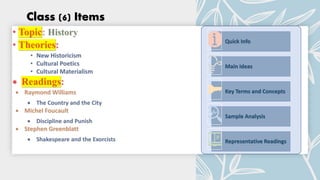
Class (6) Items
Quick Info
Main ideas
Key Terms and Concepts
Sample Analysis
Representative Readings
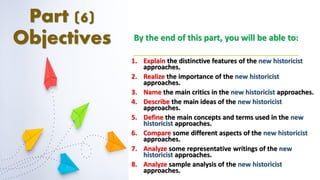
Part (6)
Objectives By the end of this part, you will be able to:
1. Explain the distinctive features of the new historicist
approaches.
2. Realize the importance of the new historicist
approaches.
3. Name the main critics in the new historicist approaches.
4. Describe the main ideas of the new historicist
approaches.
5. Define the main concepts and terms used in the new
historicist approaches.
6. Compare some different aspects of the new historicist
approaches.
7. Analyze some representative writings of the new
historicist approaches.
8. Analyze sample analysis of the new historicist
approaches.
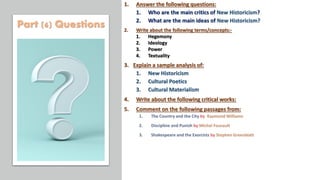
1. Answer the following questions:
1. Who are the main critics of New Historicism?
2. What are the main ideas of New Historicism?
2. Write about the following terms/concepts:-
1. Hegemony
2. Ideology
3. Power
4. Textuality
3. Explain a sample analysis of:
1. New Historicism
2. Cultural Poetics
3. Cultural Materialism
4. Write about the following critical works:
5. Comment on the following passages from:
Part (6) Questions
Intro
•History
•New Historicism
•Cultural Poetics
•Cultural Materialism
Main Ideas
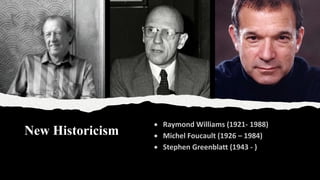
New Historicism
New Historicism
•New Historicism aims to understand intellectual
history through literature and literature through its
cultural context.
•It was first developed in the 1980s, primarily through
the work of the critic Stephen Greenblatt, and gained
widespread influence in the 1990s.
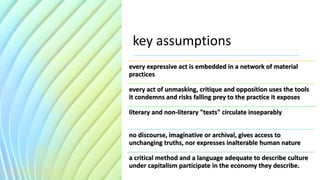
key assumptions
every expressive act is embedded in a network of material
practices
every act of unmasking, critique and opposition uses the tools
it condemns and risks falling prey to the practice it exposes
literary and non-literary "texts" circulate inseparably
no discourse, imaginative or archival, gives access to
unchanging truths, nor expresses inalterable human nature
a critical method and a language adequate to describe culture
under capitalism participate in the economy they describe.
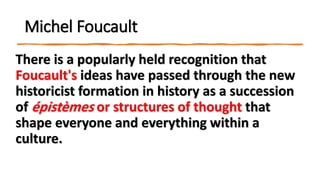
Michel Foucault
There is a popularly held recognition that
Foucault's ideas have passed through the new
historicist formation in history as a succession
of épistèmes or structures of thought that
shape everyone and everything within a
culture.
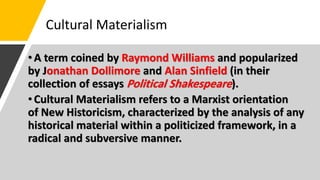
Cultural Materialism
•A term coined by Raymond Williams and popularized
by Jonathan Dollimore and Alan Sinfield (in their
collection of essays Political Shakespeare).
•Cultural Materialism refers to a Marxist orientation
of New Historicism, characterized by the analysis of any
historical material within a politicized framework, in a
radical and subversive manner.
Key Terms and Concepts
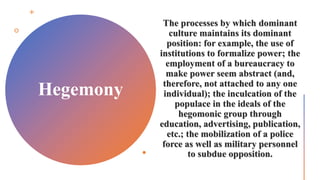
Hegemony
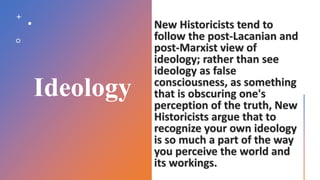
Ideology
Power
Textuality
According to New Historicism, all texts
may be examined for their historicity,
just as any historical phenomenon, no
matter how apparently trivial or
unimportant (e.g. Madonna videos or
Renaissance miniature portraiture),
can be analysed much as one would a
literary text.
Sample Analysis
Representative Readings

Mls 6

  • 1.
  • 2.
    Class (6) Items QuickInfo Main ideas Key Terms and Concepts Sample Analysis Representative Readings
  • 3.
    Part (6) Objectives Bythe end of this part, you will be able to: 1. Explain the distinctive features of the new historicist approaches. 2. Realize the importance of the new historicist approaches. 3. Name the main critics in the new historicist approaches. 4. Describe the main ideas of the new historicist approaches. 5. Define the main concepts and terms used in the new historicist approaches. 6. Compare some different aspects of the new historicist approaches. 7. Analyze some representative writings of the new historicist approaches. 8. Analyze sample analysis of the new historicist approaches.
  • 4.
    1. Answer thefollowing questions: 1. Who are the main critics of New Historicism? 2. What are the main ideas of New Historicism? 2. Write about the following terms/concepts:- 1. Hegemony 2. Ideology 3. Power 4. Textuality 3. Explain a sample analysis of: 1. New Historicism 2. Cultural Poetics 3. Cultural Materialism 4. Write about the following critical works: 5. Comment on the following passages from: Part (6) Questions
  • 5.
  • 6.
  • 7.
  • 8.
    New Historicism •New Historicismaims to understand intellectual history through literature and literature through its cultural context. •It was first developed in the 1980s, primarily through the work of the critic Stephen Greenblatt, and gained widespread influence in the 1990s.
  • 9.
    key assumptions every expressiveact is embedded in a network of material practices every act of unmasking, critique and opposition uses the tools it condemns and risks falling prey to the practice it exposes literary and non-literary "texts" circulate inseparably no discourse, imaginative or archival, gives access to unchanging truths, nor expresses inalterable human nature a critical method and a language adequate to describe culture under capitalism participate in the economy they describe.
  • 10.
    Michel Foucault There isa popularly held recognition that Foucault's ideas have passed through the new historicist formation in history as a succession of épistèmes or structures of thought that shape everyone and everything within a culture.
  • 11.
    Cultural Materialism •A termcoined by Raymond Williams and popularized by Jonathan Dollimore and Alan Sinfield (in their collection of essays Political Shakespeare). •Cultural Materialism refers to a Marxist orientation of New Historicism, characterized by the analysis of any historical material within a politicized framework, in a radical and subversive manner.
  • 12.
    Key Terms andConcepts
  • 13.
  • 14.
  • 15.
  • 16.
    Textuality According to NewHistoricism, all texts may be examined for their historicity, just as any historical phenomenon, no matter how apparently trivial or unimportant (e.g. Madonna videos or Renaissance miniature portraiture), can be analysed much as one would a literary text.
  • 17.
  • 18.