Name given to a style of criticism
advocated by a group of academics
writing in the first half of the 20th
century.
The New Criticism is a type of formalist literary
criticism that reached its height during the
1940 s and 1950s and that received its name
from John Crowe Ransom’s 1941 book The
New Criticism.
 The criticism of t s Eliot
 Theories of I A Richards
 Practice of William Empson
 texts as autonomous and “closed,”
meaning that everything that is needed
to understand a work is present within
it.The reader does not need outside
sources, such as the author’s biography,
to fully understand a text.
 Extrinsic analysis—
historical/biographical
 Moral and philosophical --New humanist
 Impressionist critics ,expressive school
I A Richards
(Practical Criticism)
William Empson
(SevenTypes of Ambiguity)
T S Eliot
“ HamletAnd His Problems”
“Traditional andThe IndividualTalent”
 Cleanth Brooks
 R.P. Blackmur
 Robert PennWarren
 W.K.Wimsat
 author's intention ,biographical fallacy
,genetic fallacy, reader's affective response
impressionism ,relativism ,paraphrase
heresy of paraphrase, poem as artifact vs.
poem as meaning
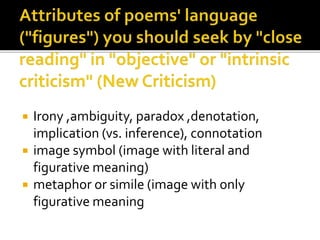
 Irony ,ambiguity, paradox ,denotation,
implication (vs. inference), connotation
 image symbol (image with literal and
figurative meaning)
 metaphor or simile (image with only
figurative meaning
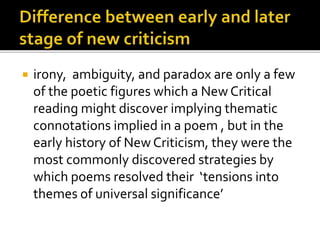
 irony, ambiguity, and paradox are only a few
of the poetic figures which a New Critical
reading might discover implying thematic
connotations implied in a poem , but in the
early history of New Criticism, they were the
most commonly discovered strategies by
which poems resolved their ‘tensions into
themes of universal significance’
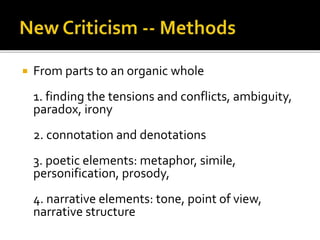
 From parts to an organic whole
1. finding the tensions and conflicts, ambiguity,
paradox, irony
2. connotation and denotations
3. poetic elements: metaphor, simile,
personification, prosody,
4. narrative elements: tone, point of view,
narrative structure
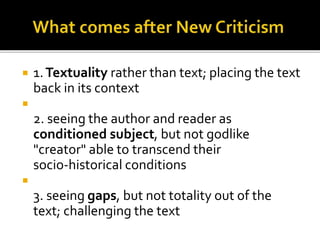
 1.Textuality rather than text; placing the text
back in its context

2. seeing the author and reader as
conditioned subject, but not godlike
"creator" able to transcend their
socio-historical conditions

3. seeing gaps, but not totality out of the
text; challenging the text
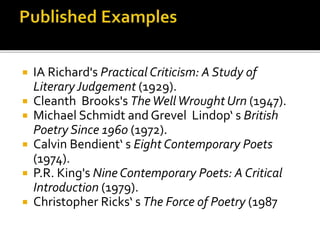
 IA Richard's Practical Criticism: A Study of
LiteraryJudgement (1929).
 Cleanth Brooks's TheWellWrought Urn (1947).
 Michael Schmidt and Grevel Lindop‘ s British
Poetry Since 1960 (1972).
 Calvin Bendient‘ s Eight Contemporary Poets
(1974).
 P.R. King's Nine Contemporary Poets: A Critical
Introduction (1979).
 Christopher Ricks‘ s The Force of Poetry (1987

New criticism by jamila anwer

  • 1.
    Name given toa style of criticism advocated by a group of academics writing in the first half of the 20th century.
  • 2.
    The New Criticismis a type of formalist literary criticism that reached its height during the 1940 s and 1950s and that received its name from John Crowe Ransom’s 1941 book The New Criticism.
  • 3.
     The criticismof t s Eliot  Theories of I A Richards  Practice of William Empson
  • 4.
     texts asautonomous and “closed,” meaning that everything that is needed to understand a work is present within it.The reader does not need outside sources, such as the author’s biography, to fully understand a text.
  • 5.
     Extrinsic analysis— historical/biographical Moral and philosophical --New humanist  Impressionist critics ,expressive school
  • 6.
    I A Richards (PracticalCriticism) William Empson (SevenTypes of Ambiguity) T S Eliot “ HamletAnd His Problems” “Traditional andThe IndividualTalent”
  • 7.
     Cleanth Brooks R.P. Blackmur  Robert PennWarren  W.K.Wimsat
  • 8.
     author's intention,biographical fallacy ,genetic fallacy, reader's affective response impressionism ,relativism ,paraphrase heresy of paraphrase, poem as artifact vs. poem as meaning
  • 9.
     Irony ,ambiguity,paradox ,denotation, implication (vs. inference), connotation  image symbol (image with literal and figurative meaning)  metaphor or simile (image with only figurative meaning
  • 10.
     irony, ambiguity,and paradox are only a few of the poetic figures which a New Critical reading might discover implying thematic connotations implied in a poem , but in the early history of New Criticism, they were the most commonly discovered strategies by which poems resolved their ‘tensions into themes of universal significance’
  • 11.
     From partsto an organic whole 1. finding the tensions and conflicts, ambiguity, paradox, irony 2. connotation and denotations 3. poetic elements: metaphor, simile, personification, prosody, 4. narrative elements: tone, point of view, narrative structure
  • 12.
     1.Textuality ratherthan text; placing the text back in its context  2. seeing the author and reader as conditioned subject, but not godlike "creator" able to transcend their socio-historical conditions  3. seeing gaps, but not totality out of the text; challenging the text
  • 13.
     IA Richard'sPractical Criticism: A Study of LiteraryJudgement (1929).  Cleanth Brooks's TheWellWrought Urn (1947).  Michael Schmidt and Grevel Lindop‘ s British Poetry Since 1960 (1972).  Calvin Bendient‘ s Eight Contemporary Poets (1974).  P.R. King's Nine Contemporary Poets: A Critical Introduction (1979).  Christopher Ricks‘ s The Force of Poetry (1987