The Rhythm off
Poetry:
Meter in Poetry andVerse
Syllable - Poetic feet - Meter
Syllables
 English words have clear syllables.
 We can usually divide words into syllables easily.
 We can also determine which syllables to emphasize, or
“stress” in each word.
 For example:
 Angel = AN-gel
 Complete = com-PLETE
More Syllables
 poem = PO-em…….(1 stressed + 1 unstressed)
 • poetry = PO-e-try…….(1 stressed + 2 unstressed)
 • relief = re-LIEF……. (1 unstressed + 1 stressed)
 • recommend = re-com-MEND……. (2 unstressed + 1 stressed)
 • discomfort = dis-COM-fort… (1 unstressed + 1 stressed + 1
unstressed)
 • entertainment = en-ter-TAIN-ment (2 unstressed + 1 stressed +
1 unstressed)
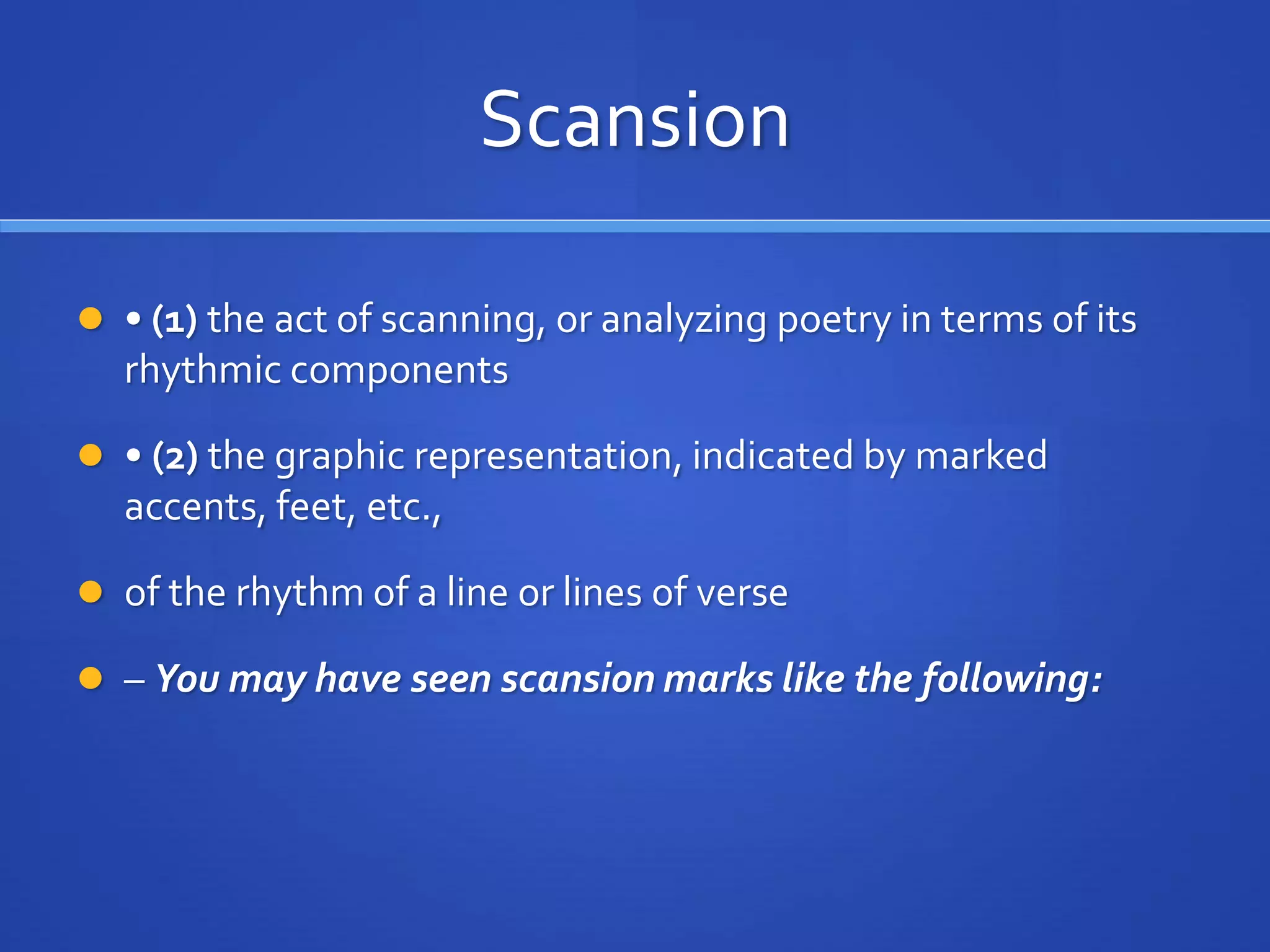
Scansion
 • (1) the act of scanning, or analyzing poetry in terms of its
rhythmic components
 • (2) the graphic representation, indicated by marked
accents, feet, etc.,
 of the rhythm of a line or lines of verse
 – You may have seen scansion marks like the following:
The curved lines are “unstressed” syllables while the
straight slashes are “stressed”
Poetic Meter
•
 • Meter is the pattern of stressed and unstressed syllables
in a poem. It is the rhythm within a poem.
Types of Meters
 A poetic foot is a repeated sequence of
rhythm comprised of two or more stressed
and/or unstressed syllables.
 Poetic meter is comprised of poetic feet
 Iamb – A foot that has unstressed syllable
followed by stressed syllable.
Types of Feet
Iamb (Iambic) Unstressed + Stressed Two Syllables
Trochee (Trochaic) Stressed + Unstressed Two Syllables
Spondee (Spondaic) Stressed + Stressed Two Syllables
Anapest (Anapestic) Unstressed +
Unstressed + Stressed
Three Syllables
Dactyl (Dactylic) Stressed + Unstressed +
Unstressed
Three Syllables
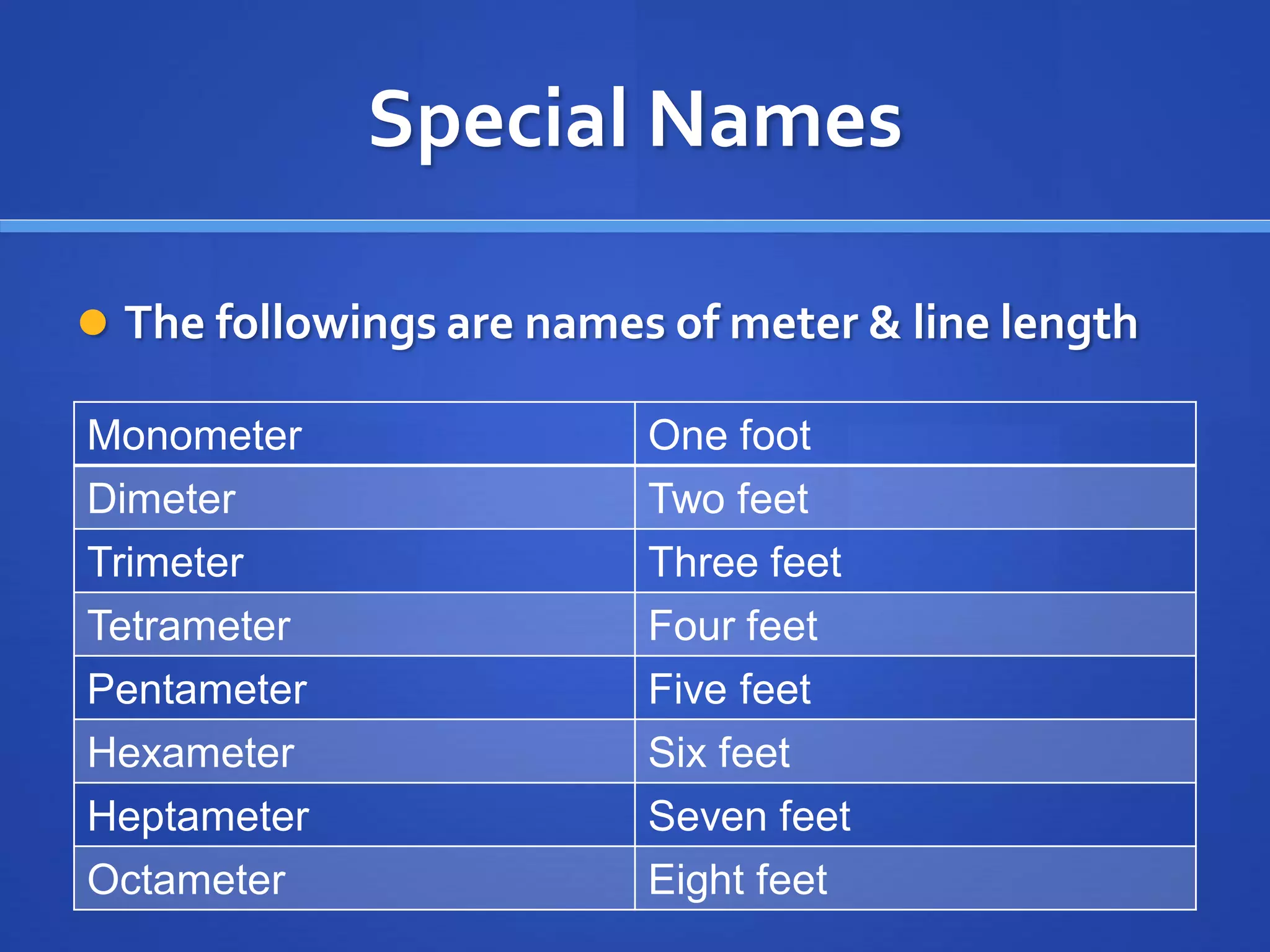
Special Names
 The followings are names of meter & line length
Monometer One foot
Dimeter Two feet
Trimeter Three feet
Tetrameter Four feet
Pentameter Five feet
Hexameter Six feet
Heptameter Seven feet
Octameter Eight feet
Iambic pattern
 1 unstressed syllable followed by 1 stressed syllable
 EXAMPLES:
 – repose (re-POSE)
 – belief (be-LIEF)
 – complete (com-PLETE)
Trochaic Pattern
 1 stressed syllable followed by 1 unstressed syllable
 EXAMPLES:
 garland (GAR-land)
 speaking (SPEAK-ing)
 value (VAL-ue)
Anapestic pattern
 2 unstressed syllables followed by 1
 stressed syllable
 EXAMPLES:
 on the road
 interrupt (in-ter-RUPT)
 unabridged, contradict, engineer,
 masquerade, Galilee
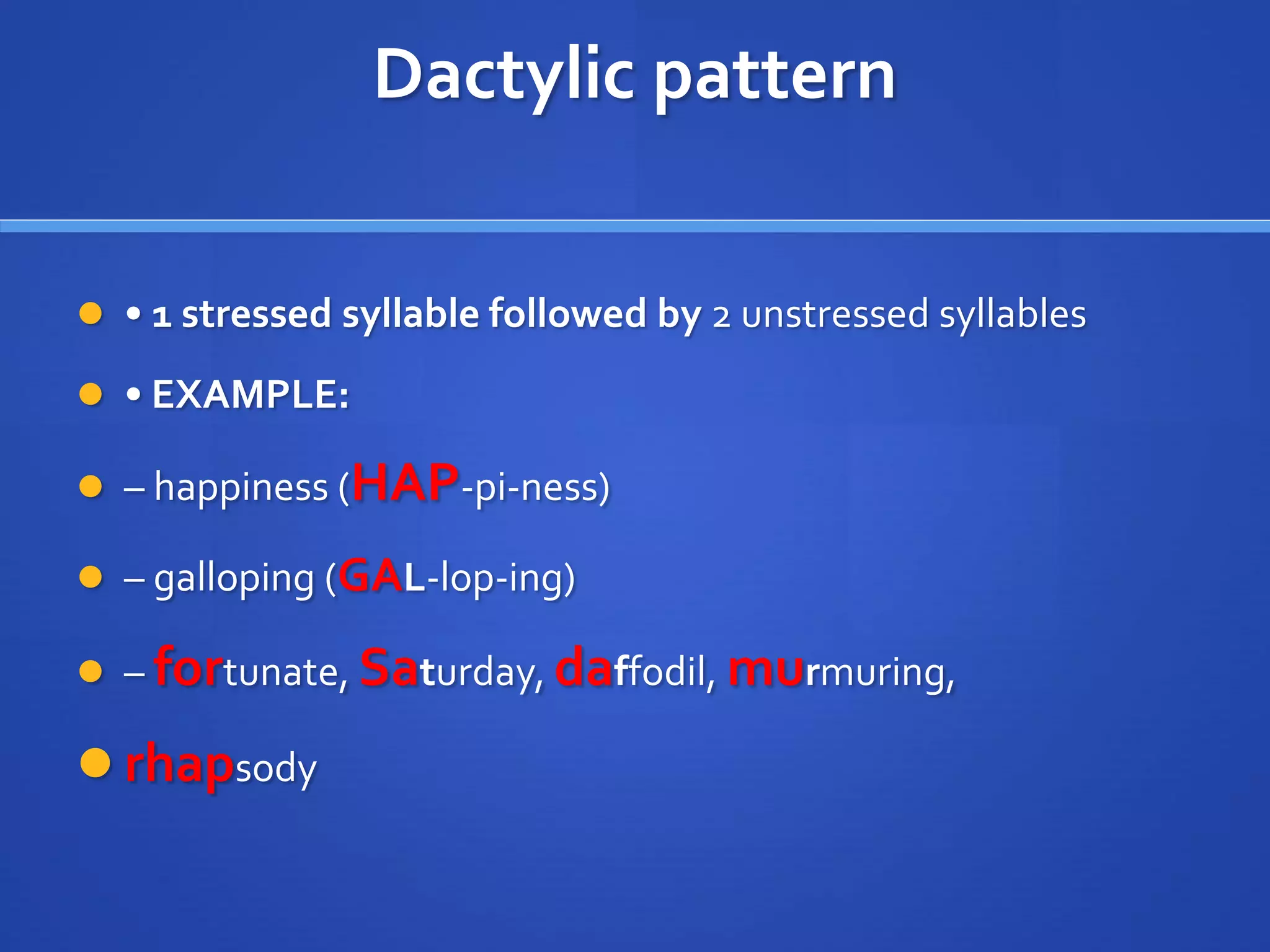
Dactylic pattern
 • 1 stressed syllable followed by 2 unstressed syllables
 • EXAMPLE:
 – happiness (HAP-pi-ness)
 – galloping (GAL-lop-ing)
 – fortunate, Saturday, daffodil, murmuring,
 rhapsody
Spondaic Pattern
 • All syllables have equal stress
 • EXAMPLE:
 – Heartbreak
 – “Out, out…”
 – "pen-knife," "ad hoc," "heartburn"
The Iambic foot
 •The iamb = (1 unstressed syllable followed by 1 stressed syllable) is the
most common poetic foot in English verse.
 • iambic foot examples:
 – behold
 – destroy
 – the sun(articles such as “the” would be considered unstressed syllables)
 – and watch(conjunctions such as and would be considered unstressed
syllables)
Lines containing iambic feet
 Behold / and watch / the sun / destroy / and grow (5 iambs)
 When I / do COUNT / the CLOCK / that TELLS / the TIME
[Shakespeare’s Sonnet 12] (5 iambs)
 • Shall I / compare /thee to / a sum / mer's day?
[Shakespeare’s Sonnet 12] (5 iambs)
 • Come live/ with me/ and be/ my love (4 iambs)
(poem by Christopher Marlowe)
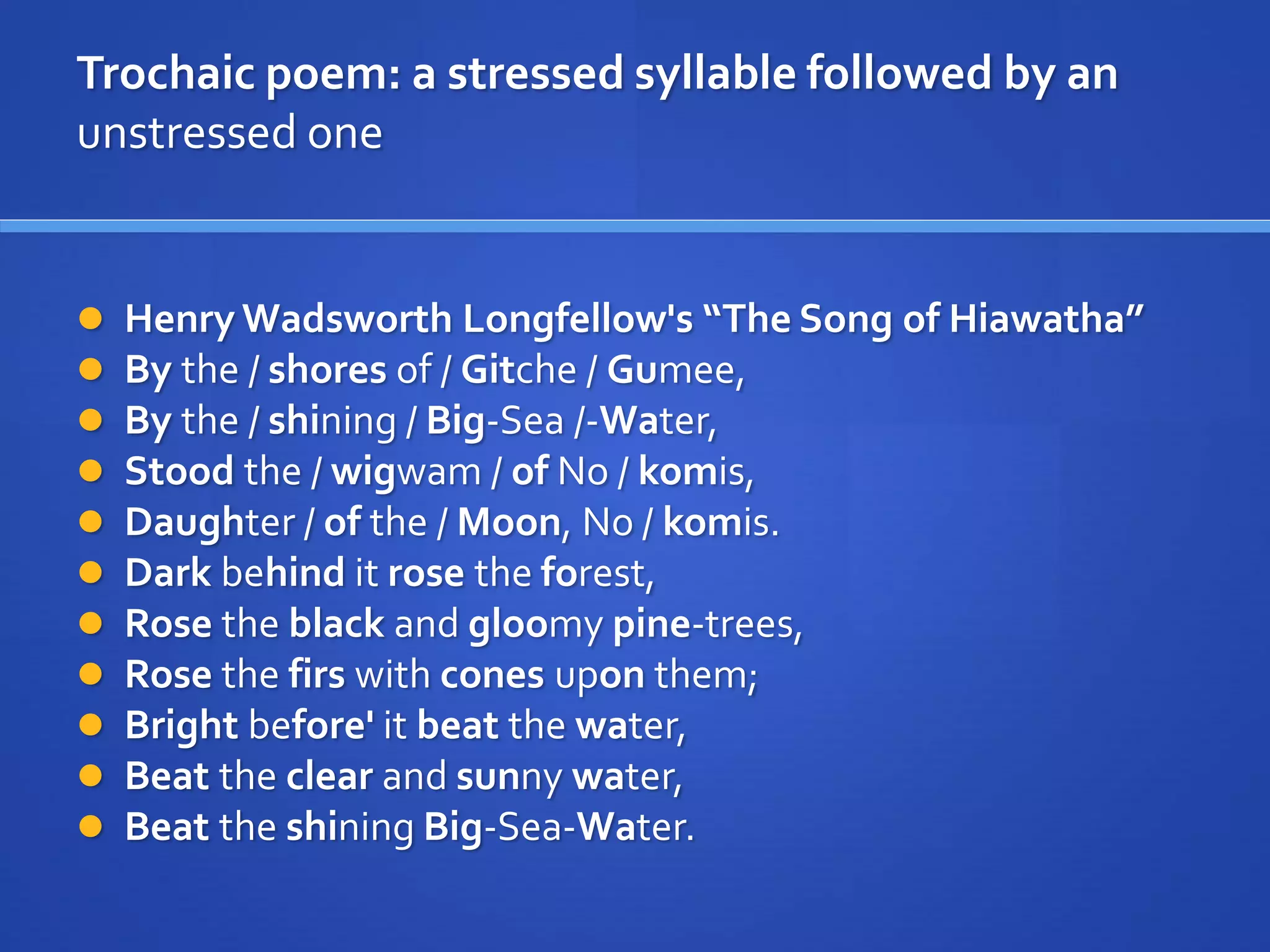
Trochaic poem: a stressed syllable followed by an
unstressed one
 Henry Wadsworth Longfellow's “The Song of Hiawatha”
 By the / shores of / Gitche / Gumee,
 By the / shining / Big-Sea /-Water,
 Stood the / wigwam / of No / komis,
 Daughter / of the / Moon, No / komis.
 Dark behind it rose the forest,
 Rose the black and gloomy pine-trees,
 Rose the firs with cones upon them;
 Bright before' it beat the water,
 Beat the clear and sunny water,
 Beat the shining Big-Sea-Water.
Anapestic poetry: 2 unstressed syllables + 1 stressed
one Limericks contain anapestic meter (in blue)
Limerick by Edward Lear:
There was / an Old Man / with a beard,
Who said, "It is just / as I feared!
TwoOwls / and a Hen,
Four Larks / and a Wren,
Have all / built their nests / in my beard!"
Dactylic poem: 1 stressed + 2 unstressed
Charge of the Light Brigade byAlfred, LordTennyson
Half a league, / half a league,
Half a league / onward,
All in the / valley of / Death
Rode the / six hundred.
"Forward, the / Light Brigade!
Charge for the / guns!" he said:
Into the / valley of / Death
Rode the / six hundred.
Spondaic Poem: 2 equal syllables
 Because of this nature of the spondee, a serious poem
cannot be solely spondaic.
 • It would be almost impossible to construct a poem entirely
of stressed syllables.
 •Therefore, the spondee usually occurs within a poem
having another dominant rhythm scheme.
Combinations of Poetic Feet
Meters & Feet
 •Q: If a poem had 1 foot per line, and
 the foot was iambic (1 unstressed + 1 stressed),
 what type of poem would it be?
 •A: Iambic monometer
Meters & Feet
 •Q: If a poem had 3 feet per line, and
 the foot was iambic (1 unstressed + 1 stressed),
 what type of poem would it be?
 •A: Iambic trimeter
Meters & Feet
 •Q: If a poem had 2 feet per line, and
 the foot was iambic (1 unstressed + 1 stressed),
 what type of poem would it be?
 •A: Iambic dimeter
Meters & Feet
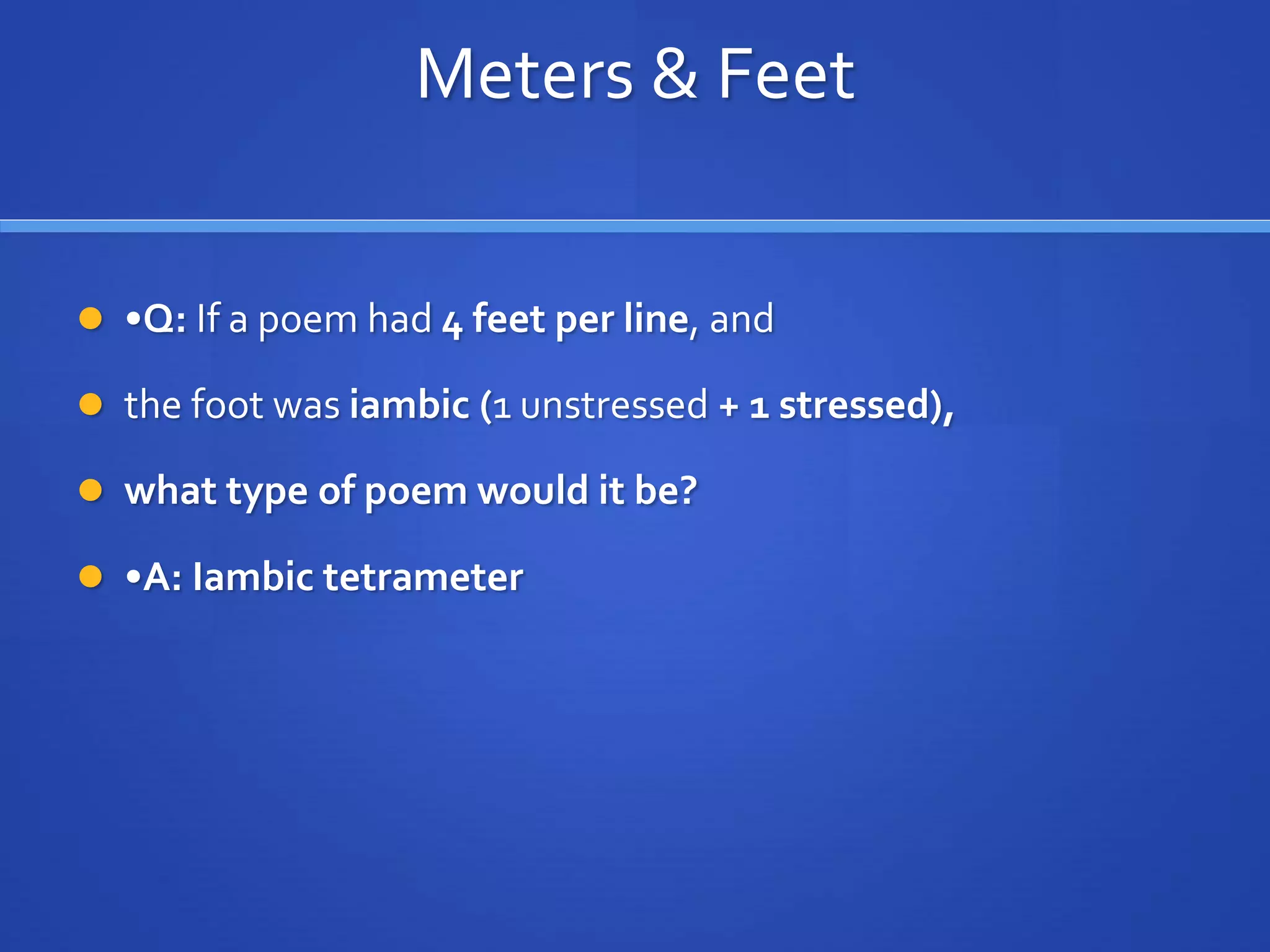
 •Q: If a poem had 4 feet per line, and
 the foot was iambic (1 unstressed + 1 stressed),
 what type of poem would it be?
 •A: Iambic tetrameter
Meters & Feet
 •Q: If a poem had 5 feet per line, and
 the foot was iambic (1 unstressed + 1 stressed),
 what type of poem would it be?
 •A: Iambic pentameter
Meters & Feet
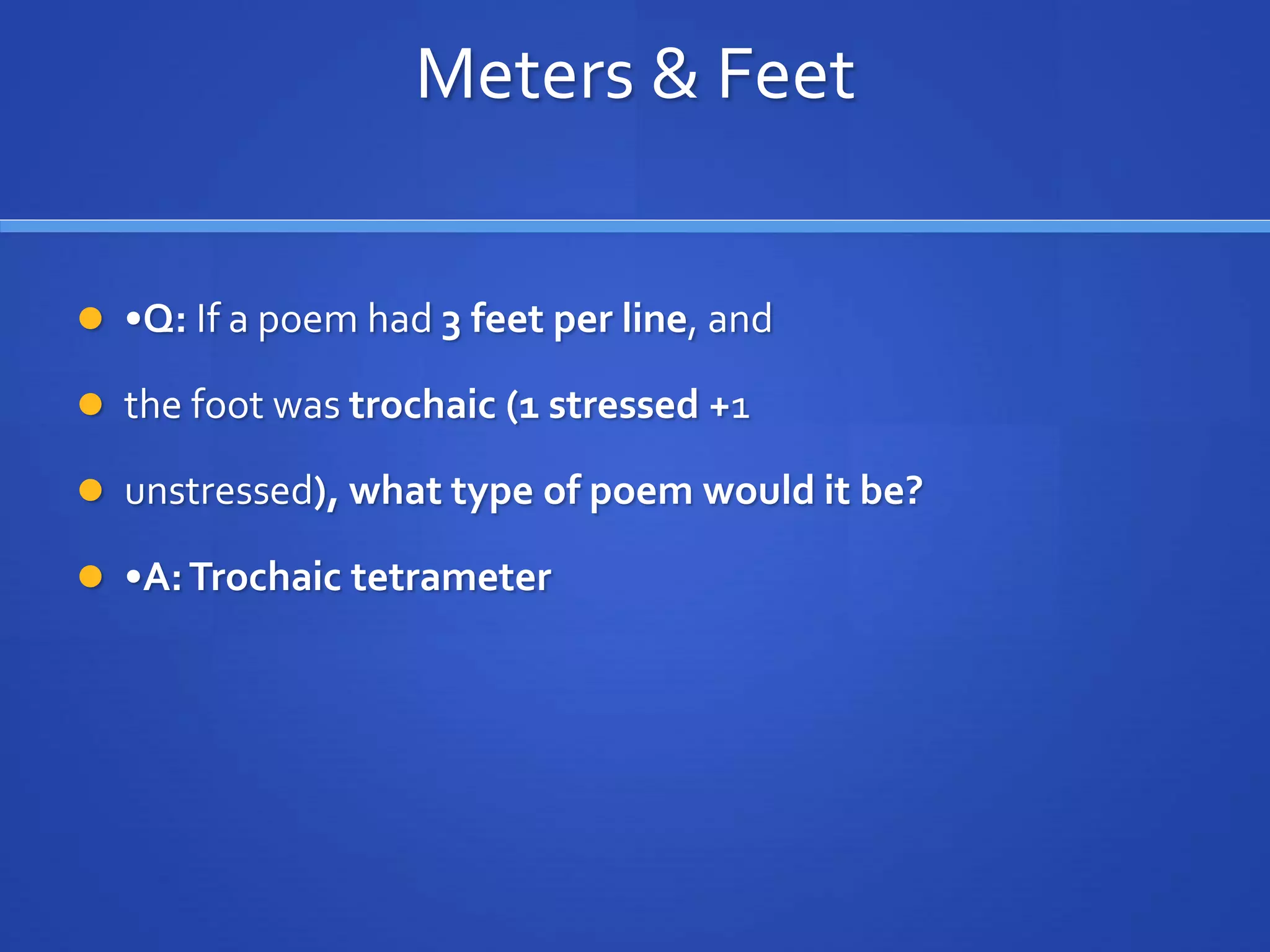
 •Q: If a poem had 3 feet per line, and
 the foot was trochaic (1 stressed +1
 unstressed), what type of poem would it be?
 •A:Trochaic tetrameter
 Go ahead…
 experiment with different metric styles in your own
poetry!
 End of presentation.
Thank you

1. meter in poetry and verse.pdf

  • 1.
    The Rhythm off Poetry: Meterin Poetry andVerse Syllable - Poetic feet - Meter
  • 2.
    Syllables  English wordshave clear syllables.  We can usually divide words into syllables easily.  We can also determine which syllables to emphasize, or “stress” in each word.  For example:  Angel = AN-gel  Complete = com-PLETE
  • 3.
    More Syllables  poem= PO-em…….(1 stressed + 1 unstressed)  • poetry = PO-e-try…….(1 stressed + 2 unstressed)  • relief = re-LIEF……. (1 unstressed + 1 stressed)  • recommend = re-com-MEND……. (2 unstressed + 1 stressed)  • discomfort = dis-COM-fort… (1 unstressed + 1 stressed + 1 unstressed)  • entertainment = en-ter-TAIN-ment (2 unstressed + 1 stressed + 1 unstressed)
  • 4.
    Scansion  • (1)the act of scanning, or analyzing poetry in terms of its rhythmic components  • (2) the graphic representation, indicated by marked accents, feet, etc.,  of the rhythm of a line or lines of verse  – You may have seen scansion marks like the following:
  • 5.
    The curved linesare “unstressed” syllables while the straight slashes are “stressed”
  • 6.
    Poetic Meter •  •Meter is the pattern of stressed and unstressed syllables in a poem. It is the rhythm within a poem.
  • 7.
    Types of Meters A poetic foot is a repeated sequence of rhythm comprised of two or more stressed and/or unstressed syllables.  Poetic meter is comprised of poetic feet  Iamb – A foot that has unstressed syllable followed by stressed syllable.
  • 8.
    Types of Feet Iamb(Iambic) Unstressed + Stressed Two Syllables Trochee (Trochaic) Stressed + Unstressed Two Syllables Spondee (Spondaic) Stressed + Stressed Two Syllables Anapest (Anapestic) Unstressed + Unstressed + Stressed Three Syllables Dactyl (Dactylic) Stressed + Unstressed + Unstressed Three Syllables
  • 9.
    Special Names  Thefollowings are names of meter & line length Monometer One foot Dimeter Two feet Trimeter Three feet Tetrameter Four feet Pentameter Five feet Hexameter Six feet Heptameter Seven feet Octameter Eight feet
  • 10.
    Iambic pattern  1unstressed syllable followed by 1 stressed syllable  EXAMPLES:  – repose (re-POSE)  – belief (be-LIEF)  – complete (com-PLETE)
  • 11.
    Trochaic Pattern  1stressed syllable followed by 1 unstressed syllable  EXAMPLES:  garland (GAR-land)  speaking (SPEAK-ing)  value (VAL-ue)
  • 12.
    Anapestic pattern  2unstressed syllables followed by 1  stressed syllable  EXAMPLES:  on the road  interrupt (in-ter-RUPT)  unabridged, contradict, engineer,  masquerade, Galilee
  • 13.
    Dactylic pattern  •1 stressed syllable followed by 2 unstressed syllables  • EXAMPLE:  – happiness (HAP-pi-ness)  – galloping (GAL-lop-ing)  – fortunate, Saturday, daffodil, murmuring,  rhapsody
  • 14.
    Spondaic Pattern  •All syllables have equal stress  • EXAMPLE:  – Heartbreak  – “Out, out…”  – "pen-knife," "ad hoc," "heartburn"
  • 15.
    The Iambic foot •The iamb = (1 unstressed syllable followed by 1 stressed syllable) is the most common poetic foot in English verse.  • iambic foot examples:  – behold  – destroy  – the sun(articles such as “the” would be considered unstressed syllables)  – and watch(conjunctions such as and would be considered unstressed syllables)
  • 16.
    Lines containing iambicfeet  Behold / and watch / the sun / destroy / and grow (5 iambs)  When I / do COUNT / the CLOCK / that TELLS / the TIME [Shakespeare’s Sonnet 12] (5 iambs)  • Shall I / compare /thee to / a sum / mer's day? [Shakespeare’s Sonnet 12] (5 iambs)  • Come live/ with me/ and be/ my love (4 iambs) (poem by Christopher Marlowe)
  • 17.
    Trochaic poem: astressed syllable followed by an unstressed one  Henry Wadsworth Longfellow's “The Song of Hiawatha”  By the / shores of / Gitche / Gumee,  By the / shining / Big-Sea /-Water,  Stood the / wigwam / of No / komis,  Daughter / of the / Moon, No / komis.  Dark behind it rose the forest,  Rose the black and gloomy pine-trees,  Rose the firs with cones upon them;  Bright before' it beat the water,  Beat the clear and sunny water,  Beat the shining Big-Sea-Water.
  • 18.
    Anapestic poetry: 2unstressed syllables + 1 stressed one Limericks contain anapestic meter (in blue) Limerick by Edward Lear: There was / an Old Man / with a beard, Who said, "It is just / as I feared! TwoOwls / and a Hen, Four Larks / and a Wren, Have all / built their nests / in my beard!"
  • 19.
    Dactylic poem: 1stressed + 2 unstressed Charge of the Light Brigade byAlfred, LordTennyson Half a league, / half a league, Half a league / onward, All in the / valley of / Death Rode the / six hundred. "Forward, the / Light Brigade! Charge for the / guns!" he said: Into the / valley of / Death Rode the / six hundred.
  • 20.
    Spondaic Poem: 2equal syllables  Because of this nature of the spondee, a serious poem cannot be solely spondaic.  • It would be almost impossible to construct a poem entirely of stressed syllables.  •Therefore, the spondee usually occurs within a poem having another dominant rhythm scheme.
  • 21.
  • 23.
    Meters & Feet •Q: If a poem had 1 foot per line, and  the foot was iambic (1 unstressed + 1 stressed),  what type of poem would it be?  •A: Iambic monometer
  • 24.
    Meters & Feet •Q: If a poem had 3 feet per line, and  the foot was iambic (1 unstressed + 1 stressed),  what type of poem would it be?  •A: Iambic trimeter
  • 25.
    Meters & Feet •Q: If a poem had 2 feet per line, and  the foot was iambic (1 unstressed + 1 stressed),  what type of poem would it be?  •A: Iambic dimeter
  • 26.
    Meters & Feet •Q: If a poem had 4 feet per line, and  the foot was iambic (1 unstressed + 1 stressed),  what type of poem would it be?  •A: Iambic tetrameter
  • 27.
    Meters & Feet •Q: If a poem had 5 feet per line, and  the foot was iambic (1 unstressed + 1 stressed),  what type of poem would it be?  •A: Iambic pentameter
  • 28.
    Meters & Feet •Q: If a poem had 3 feet per line, and  the foot was trochaic (1 stressed +1  unstressed), what type of poem would it be?  •A:Trochaic tetrameter
  • 29.
     Go ahead… experiment with different metric styles in your own poetry!  End of presentation.
  • 30.