Formal Concept Analysis
Big Data Analytics, Data Foresight and
Data Delivery using Drupal
Tzar C. Umang
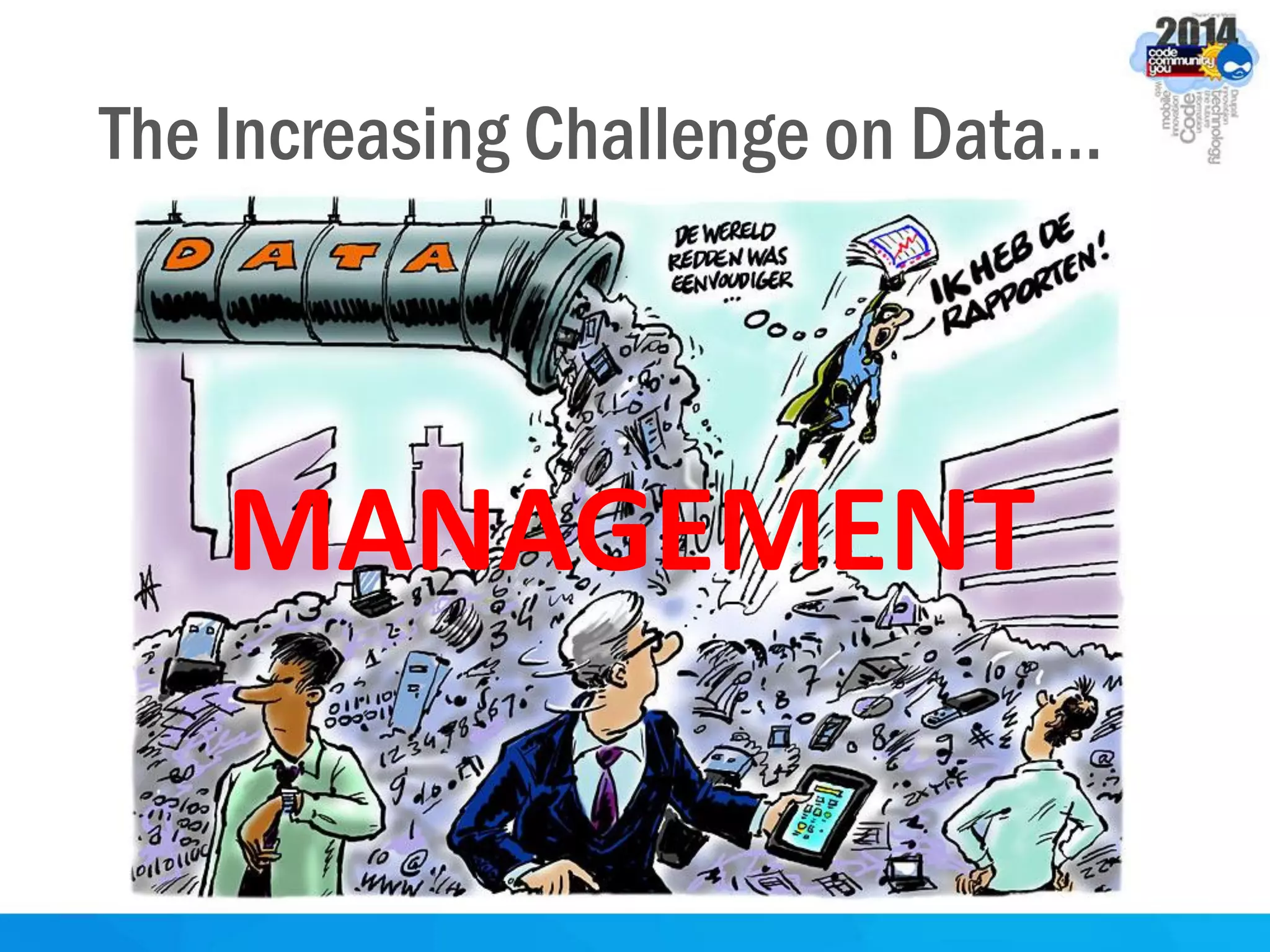
The Increasing Challenge on Data…
MANAGEMENT
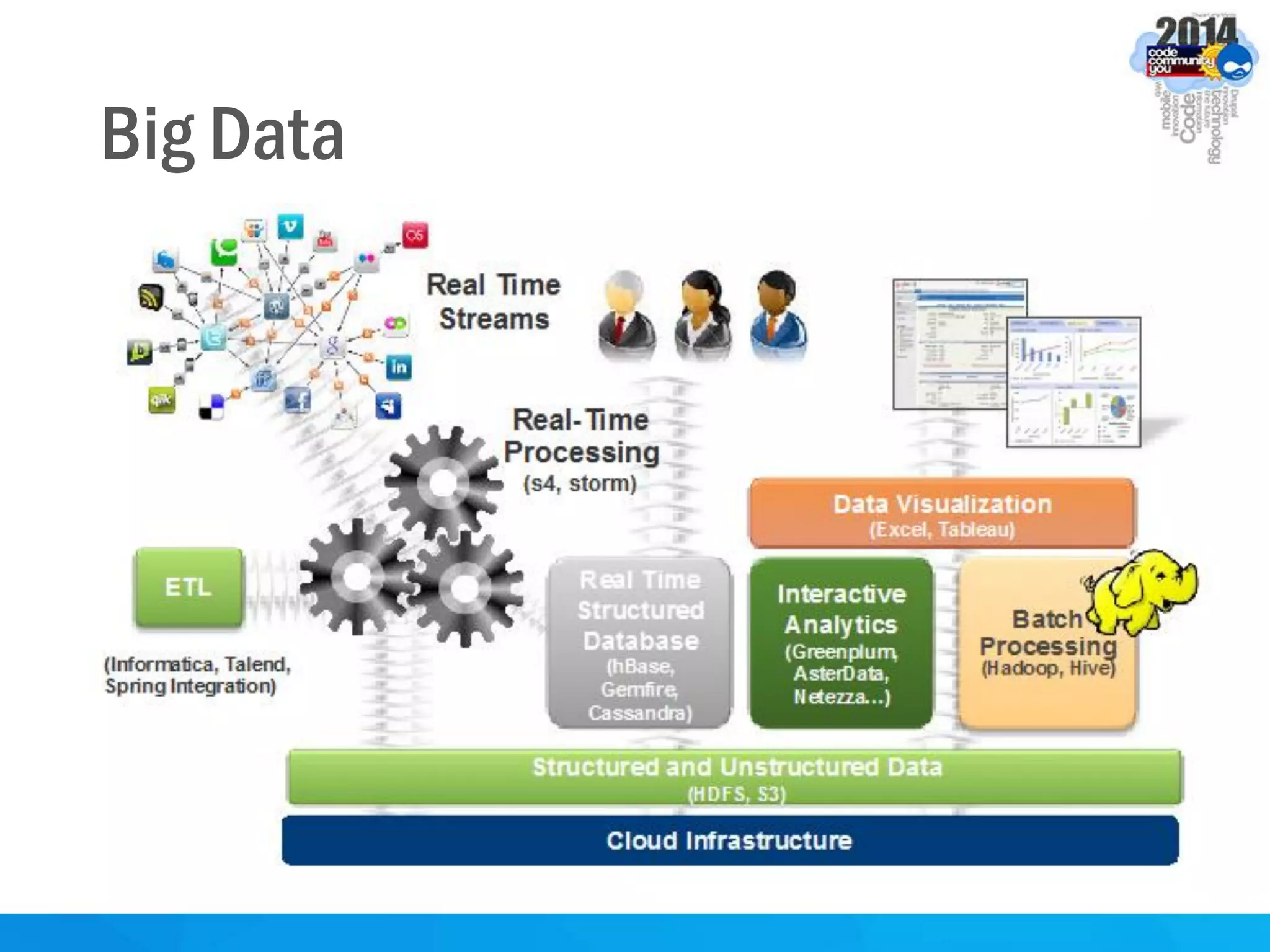
Big Data
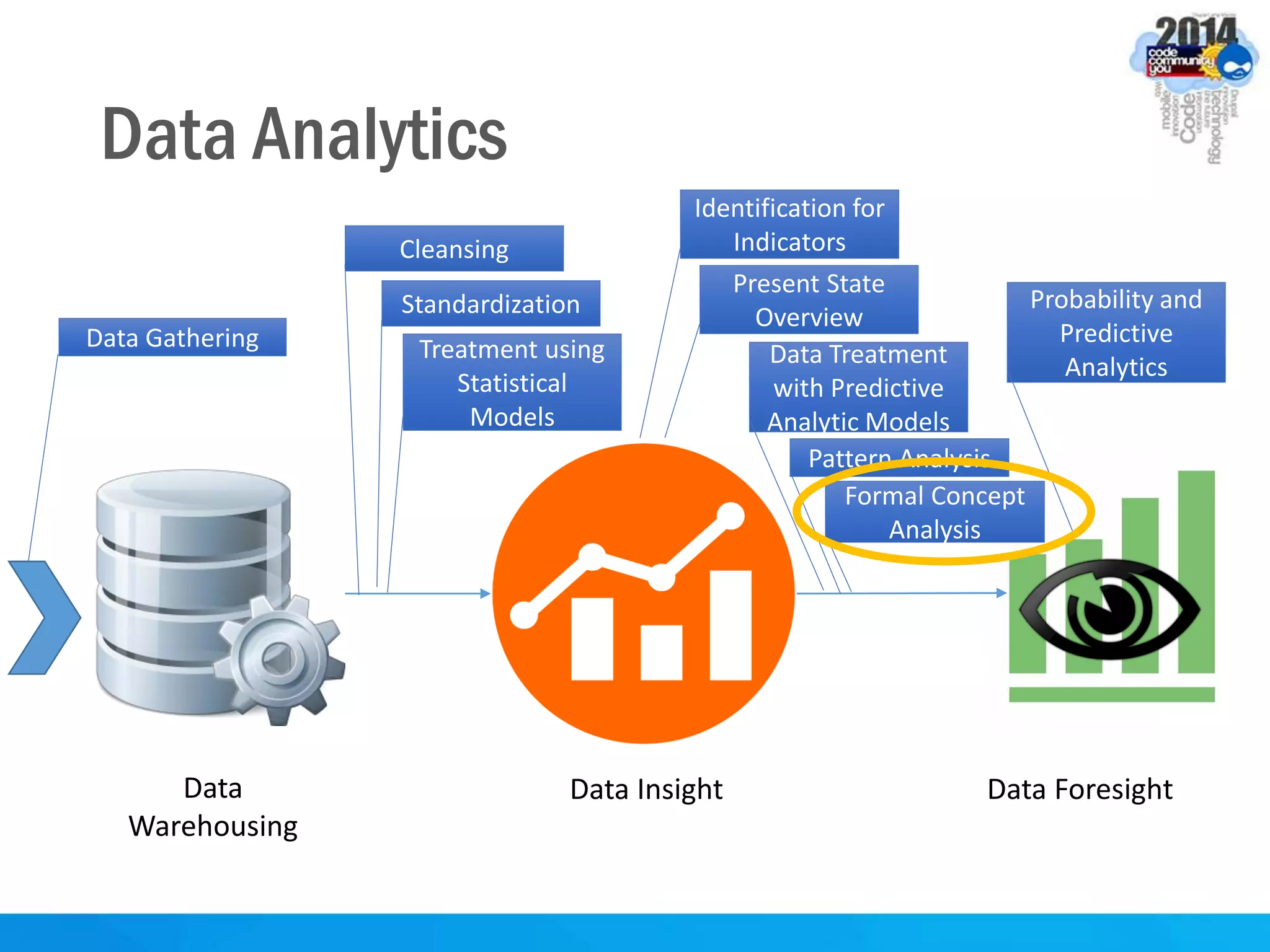
Data Analytics
Data
Warehousing
Data Insight Data Foresight
Data Gathering
Cleansing
Standardization
Treatment using
Statistical
Models
Identification for
Indicators
Present State
Overview
Data Treatment
with Predictive
Analytic Models
Probability and
Predictive
Analytics
Pattern Analysis
Formal Concept
Analysis
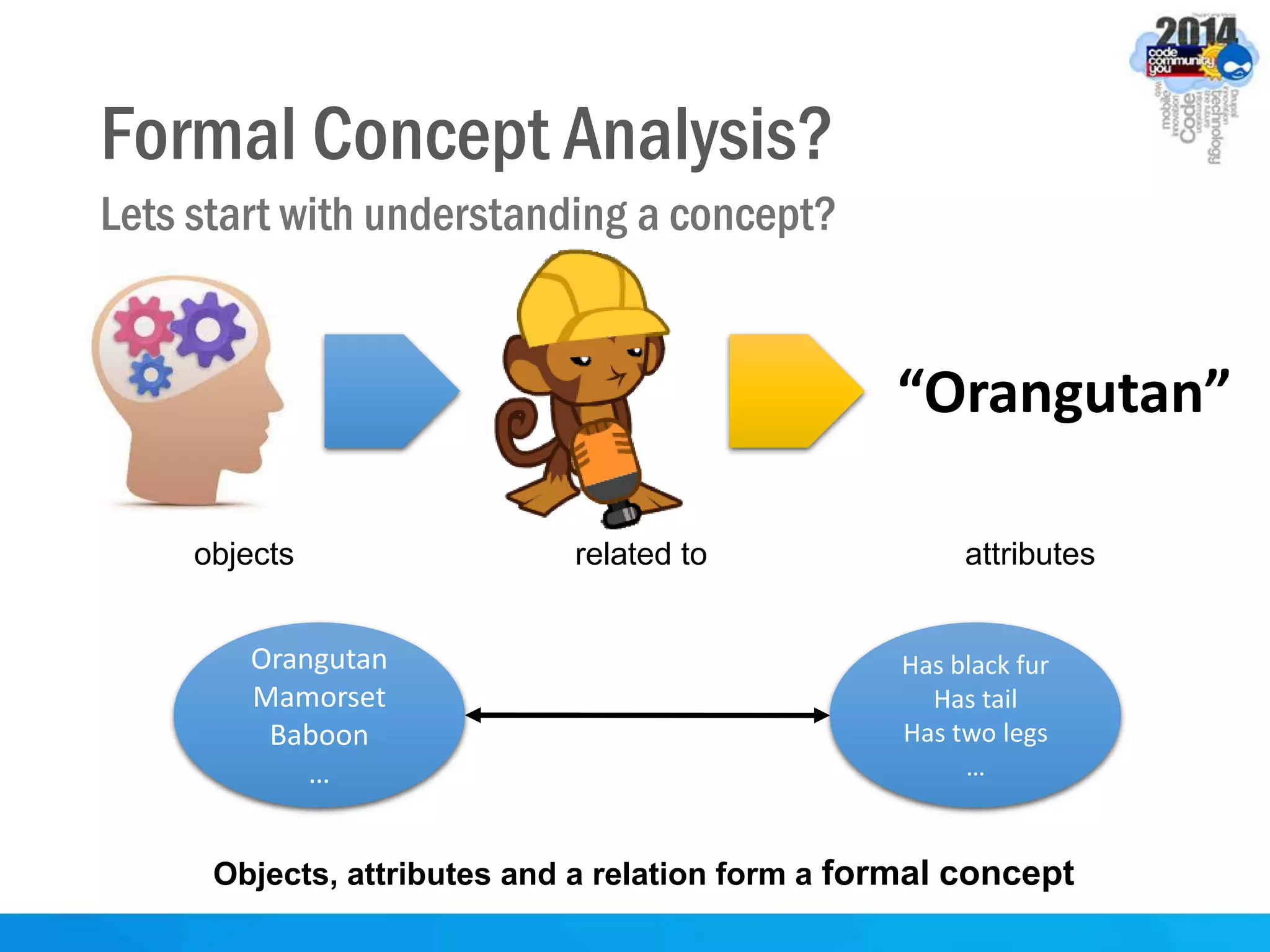
Formal Concept Analysis?
Lets start with understanding a concept?
“Orangutan”
Orangutan
Mamorset
Baboon
…
Has black fur
Has tail
Has two legs
…
objects related to attributes
Objects, attributes and a relation form a formal concept
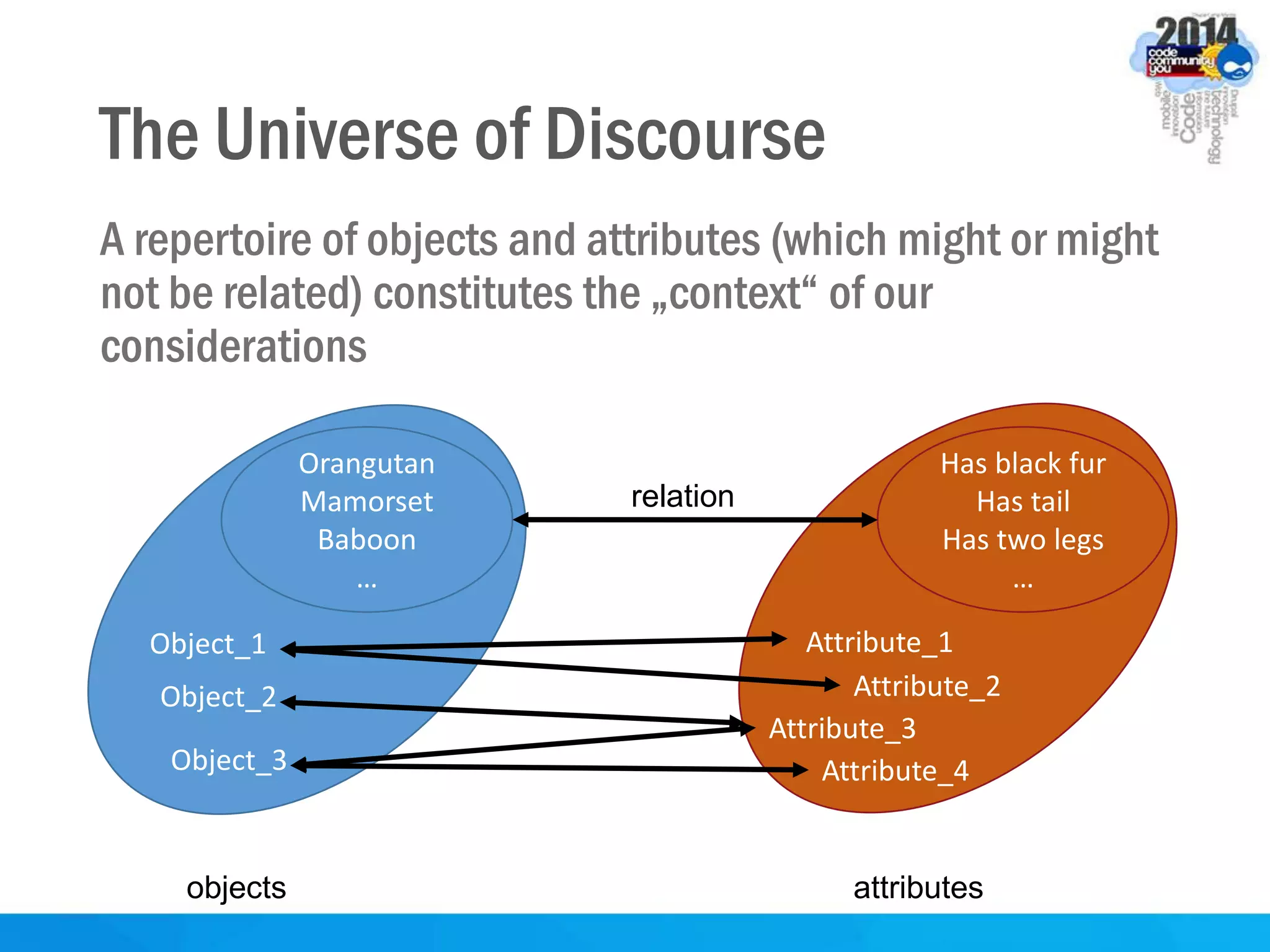
The Universe of Discourse
A repertoire of objects and attributes (which might or might
not be related) constitutes the „context“ of our
considerations
Orangutan
Mamorset
Baboon
…
Has black fur
Has tail
Has two legs
…
Object_1
Object_2
Object_3
Attribute_1
Attribute_2
Attribute_3
relation
objects attributes
Attribute_4
Formal Concept Analysis?
• Formal Concept Analysis is a method used for
investigating and processing explicitly given information,
in order to allow for meaningful and comprehensive
interpretation
• An analysis of data
• Structures of formal abstractions of concepts of human thought
• Formal emphasizes that the concepts are mathematical
objects, rather than concepts of mind
Formal Concept Analysis?
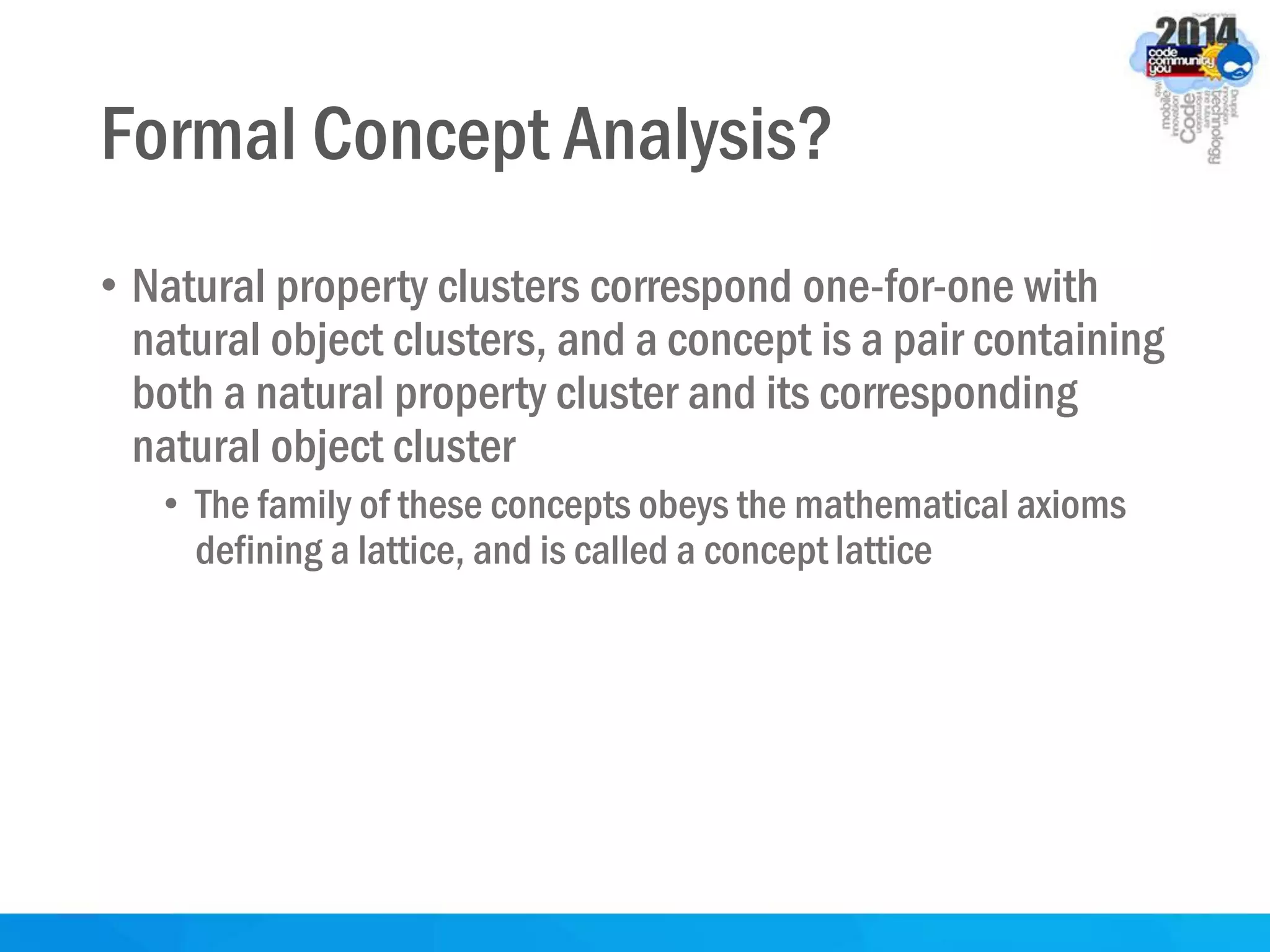
• Formal Concept Analysis takes as input a matrix
specifying a set of objects and the properties thereof,
called attributes, and finds both all the “natural” clusters
of attributes and all the “natural” clusters of objects in
the input data, where
• a “natural” object cluster is the set of all objects that share a
common subset of attributes, and
• a “natural” property cluster is the set of all attributes shared by
one of the natural object clusters
Formal Concept Analysis?
• Natural property clusters correspond one-for-one with
natural object clusters, and a concept is a pair containing
both a natural property cluster and its corresponding
natural object cluster
• The family of these concepts obeys the mathematical axioms
defining a lattice, and is called a concept lattice
FCA: Formal Context?
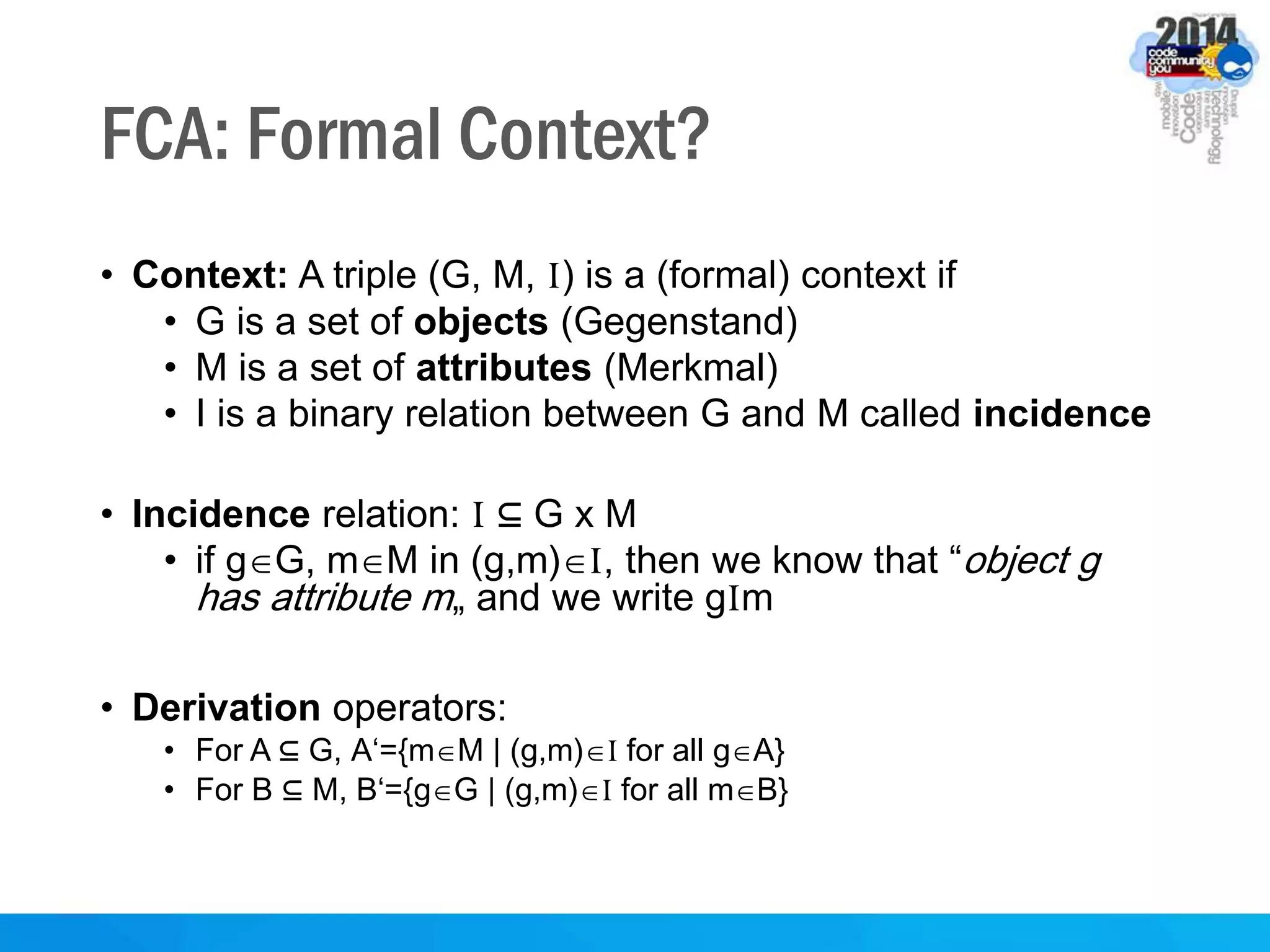
• Context: A triple (G, M, I) is a (formal) context if
• G is a set of objects (Gegenstand)
• M is a set of attributes (Merkmal)
• I is a binary relation between G and M called incidence
• Incidence relation: I ⊆ G x M
• if gG, mM in (g,m)I, then we know that “object g
has attribute m„ and we write gIm
• Derivation operators:
• For A ⊆ G, A‘={mM | (g,m)I for all gA}
• For B ⊆ M, B‘={gG | (g,m)I for all mB}
FCA: Formal Context?
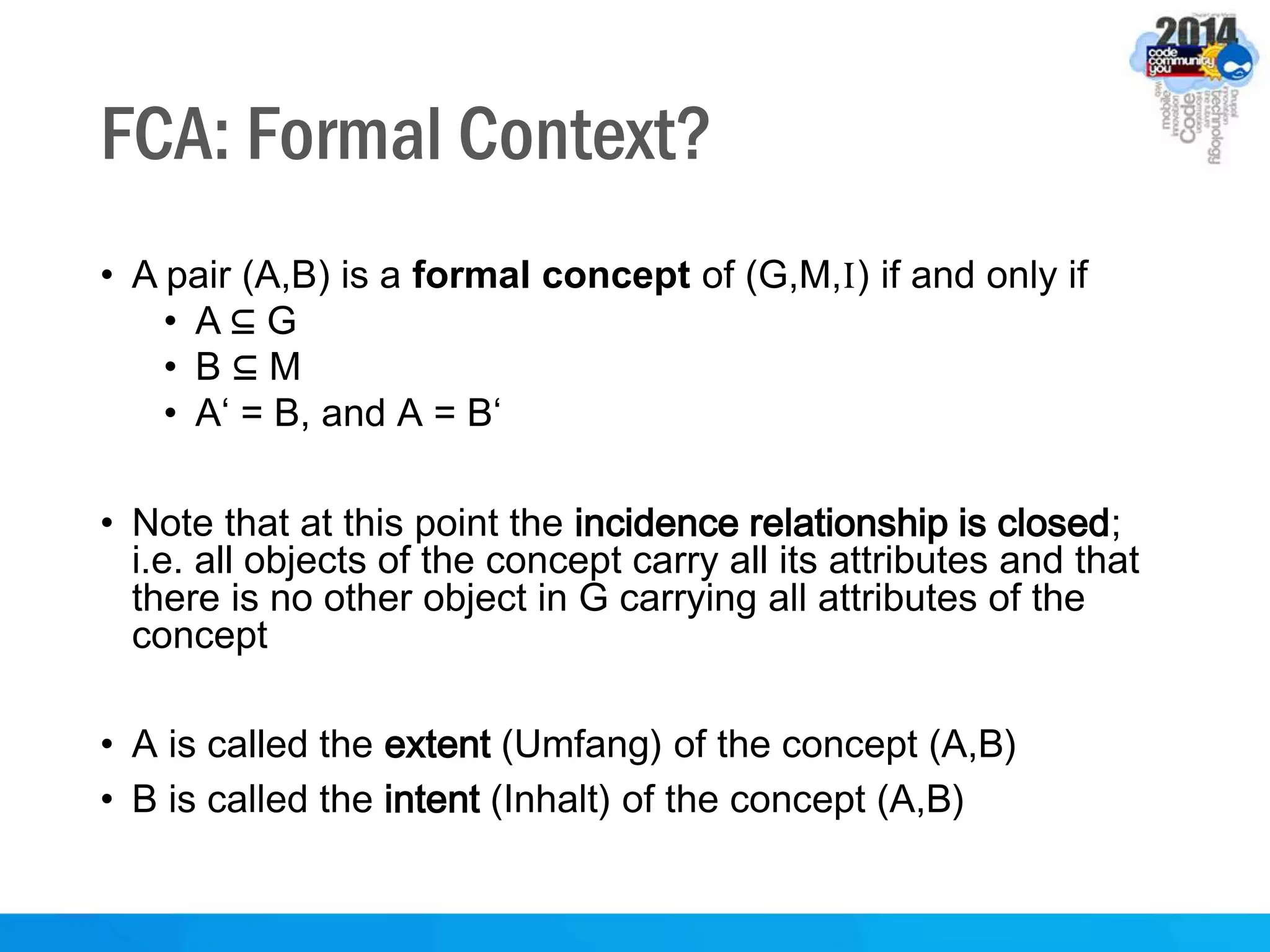
• A pair (A,B) is a formal concept of (G,M,I) if and only if
• A ⊆ G
• B ⊆ M
• A‘ = B, and A = B‘
• Note that at this point the incidence relationship is closed;
i.e. all objects of the concept carry all its attributes and that
there is no other object in G carrying all attributes of the
concept
• A is called the extent (Umfang) of the concept (A,B)
• B is called the intent (Inhalt) of the concept (A,B)
FCA: Generating a Formal Context
• Using the derivation operators we can derive
formal concepts from our formal context with
the following routine:
1.Pick a set of objects A
2.Derive the attributes A'
3.Derive (A')'
4.(A'',A') is a formal concept
• A dual approach can be taken starting with an
attribute
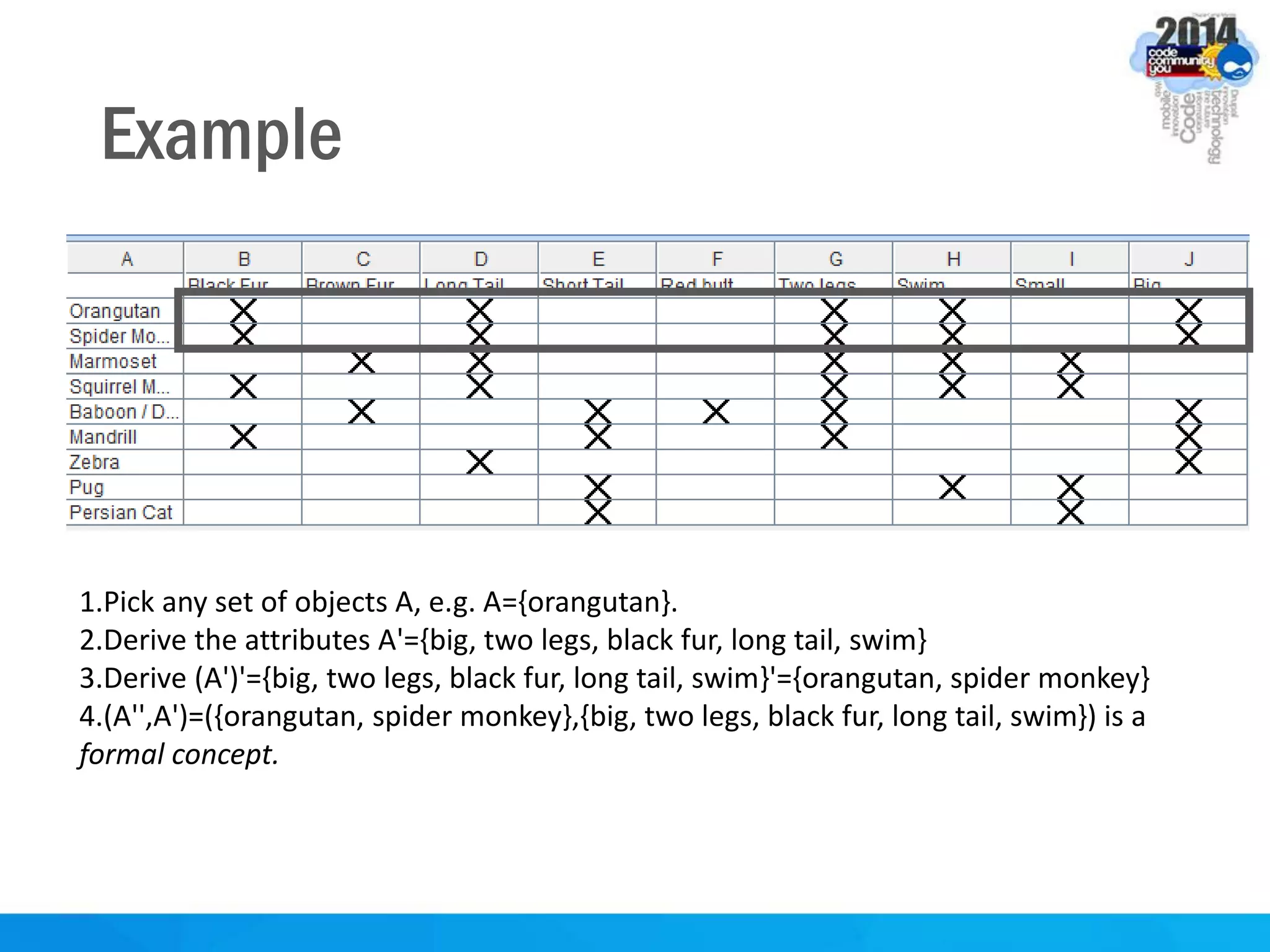
Example
1.Pick any set of objects A, e.g. A={orangutan}.
2.Derive the attributes A'={big, two legs, black fur, long tail, swim}
3.Derive (A')'={big, two legs, black fur, long tail, swim}'={orangutan, spider monkey}
4.(A'',A')=({orangutan, spider monkey},{big, two legs, black fur, long tail, swim}) is a
formal concept.
FCA: Concept Lattice?
• The concepts of a given context are naturally ordered by a
subconcept-superconcept relation:
• (A1,B1) ≤ (A2,B2) :⇔ A1⊆A2 (⇔ B2⊆B1)
• The ordered set of all formal concepts in (G,M,I) is denoted
by B(G,M,I) and is called concept lattice (Begriffsverband)
• A concept lattice consists of the set of concepts of a formal
context and the subconcept-superconcept relation between
the concepts
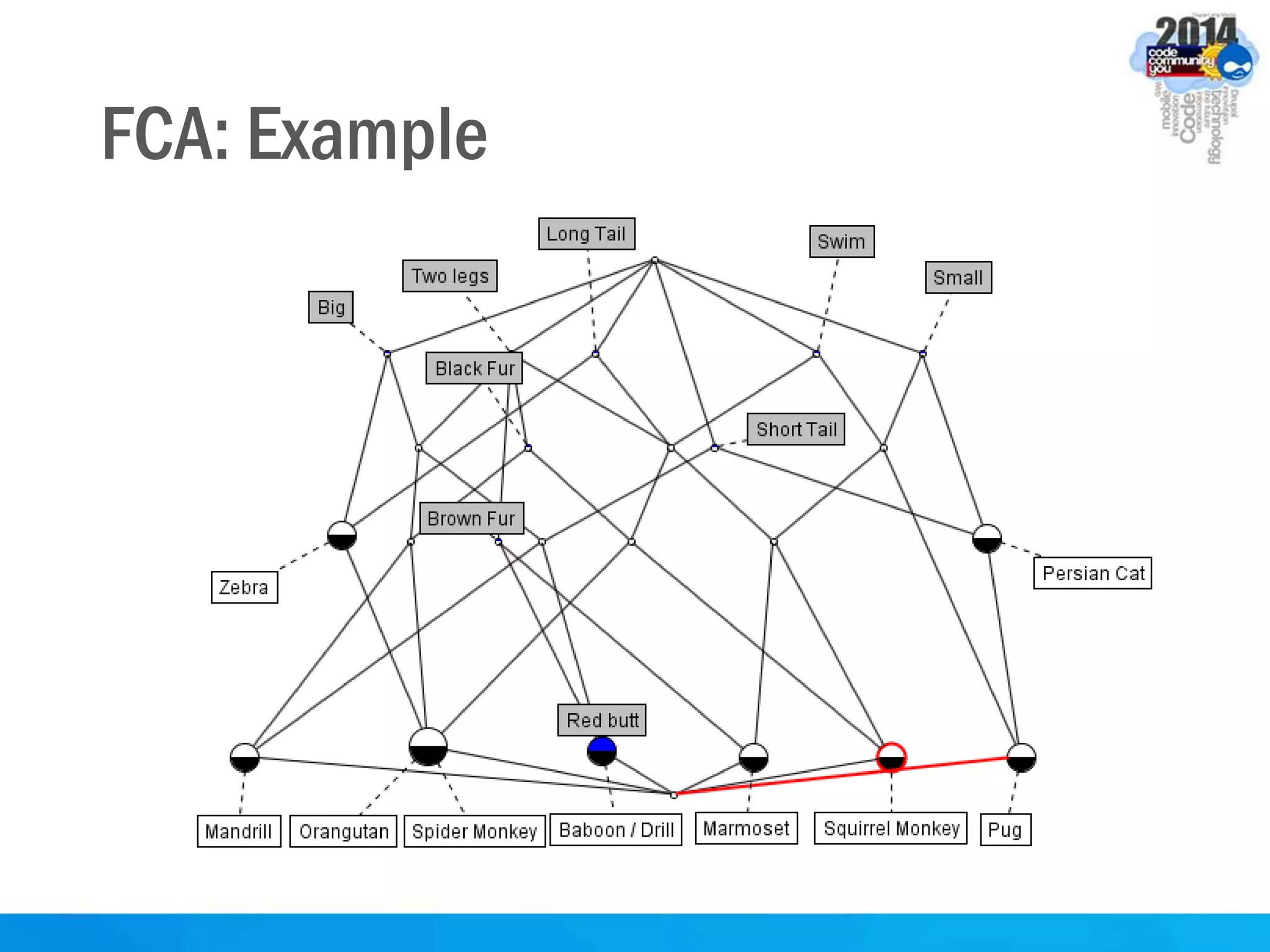
FCA: Example
FCA: Extent and Intent in a Lattice
• The extent of a formal concept is given by all formal
objects on the paths which lead down from the given
concept node
• The extent of an arbitrary concept is then found in the principle
ideal generated by that concept
• The intent of a formal concept is given by all the formal
attributes on the paths which lead up from the given
concept node
• The intent of an arbitrary concept is then found in the principle
filter generated by that concept
FCA: Subconcepts in the
Concept Lattice
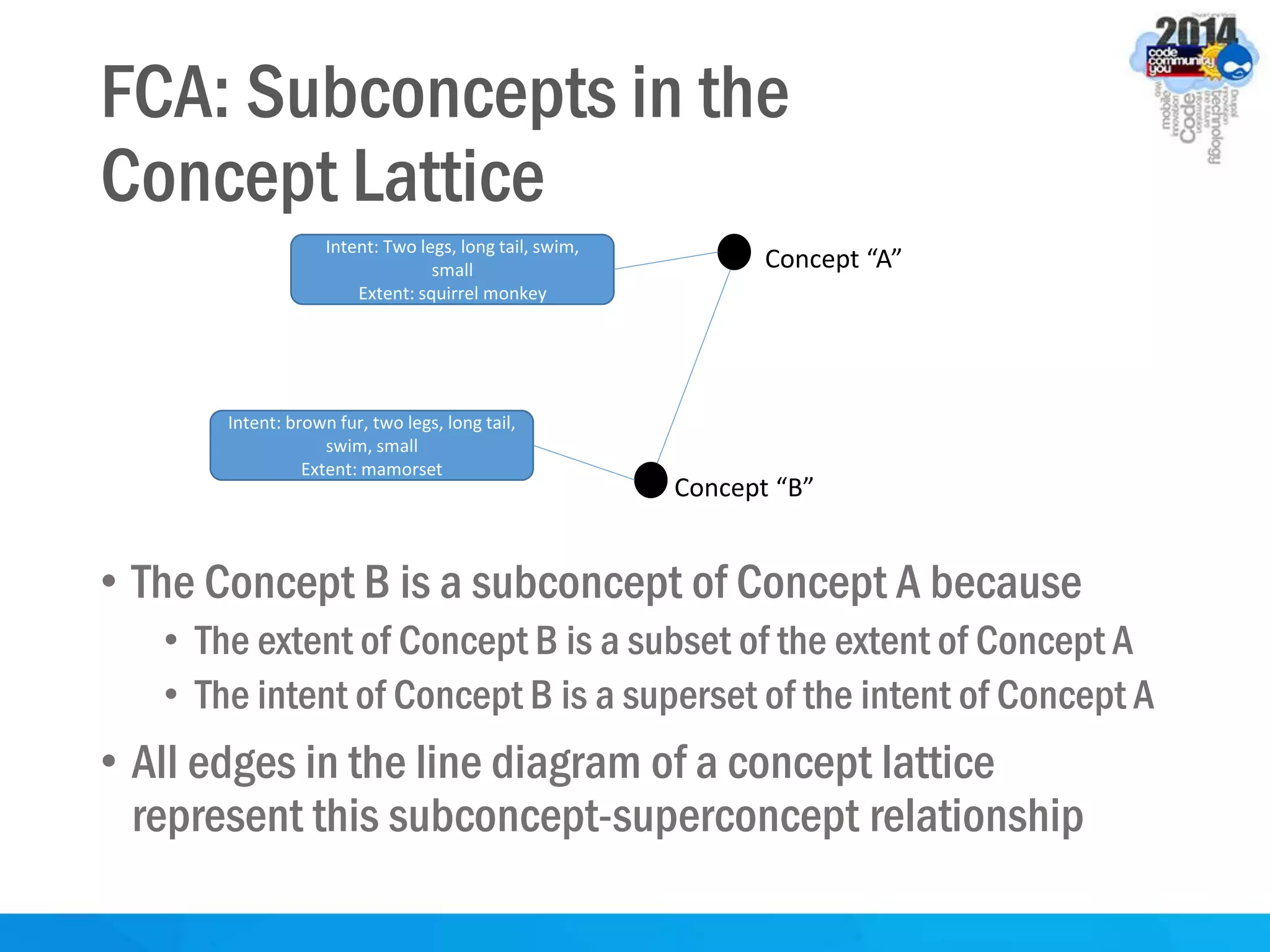
• The Concept B is a subconcept of Concept A because
• The extent of Concept B is a subset of the extent of Concept A
• The intent of Concept B is a superset of the intent of Concept A
• All edges in the line diagram of a concept lattice
represent this subconcept-superconcept relationship
Intent: Two legs, long tail, swim,
small
Extent: squirrel monkey
Intent: brown fur, two legs, long tail,
swim, small
Extent: mamorset
Concept “A”
Concept “B”
FCA: Implication
• An implication A → B (between sets A,BM of attributes)
holds in a formal context if and only if B⊆A‘‘
• i.e. if every object that has all attributes in A also has all
attributes in B
• e.g. if X has feather and has beak then is a bird
• The implication determines the concept lattice up to
isomorphism and therefore offers an additional
interpretation of the lattice structure
• Implications can be used for a step-wise construction of
conceputal knowledge
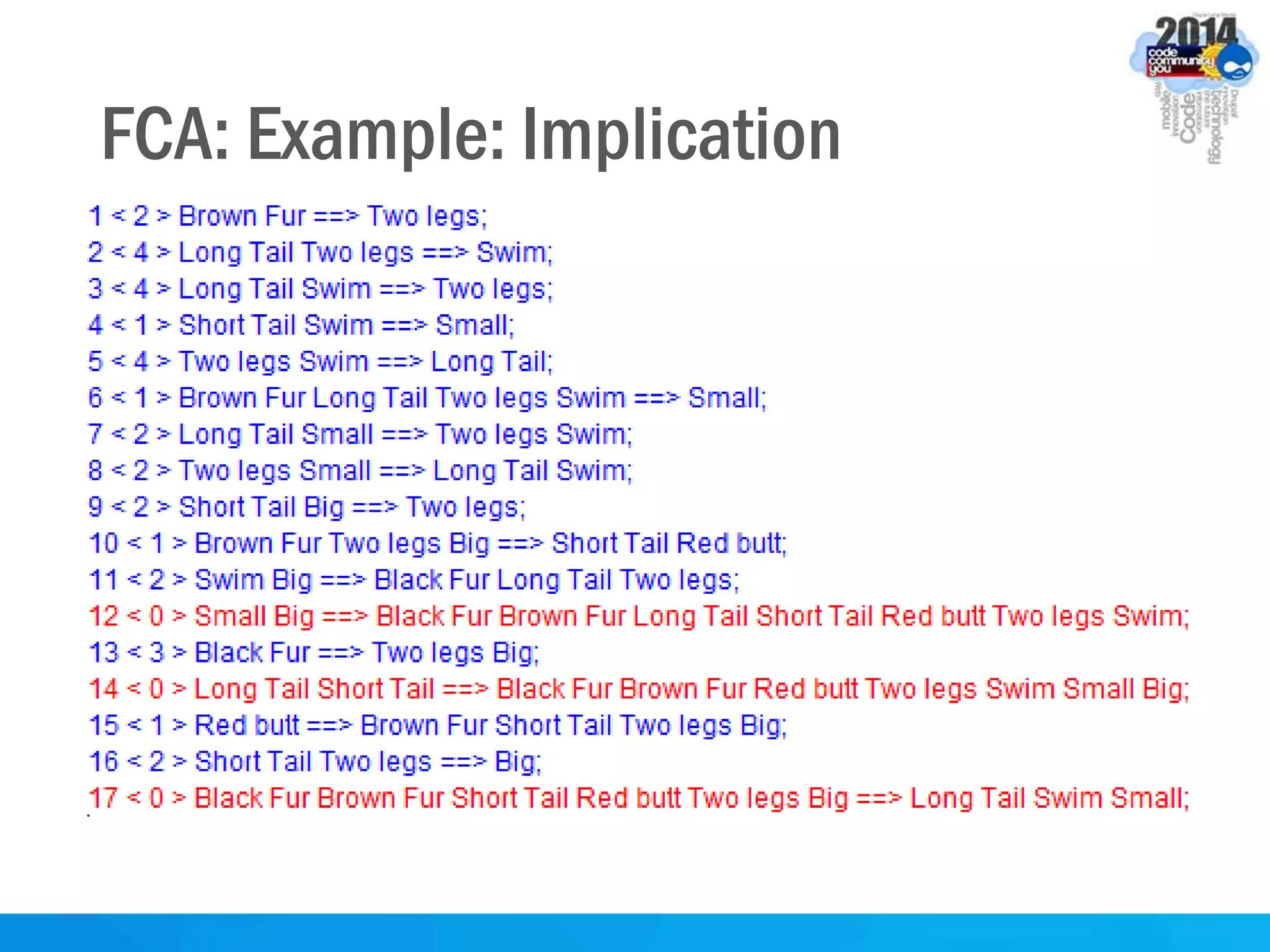
FCA: Example: Implication
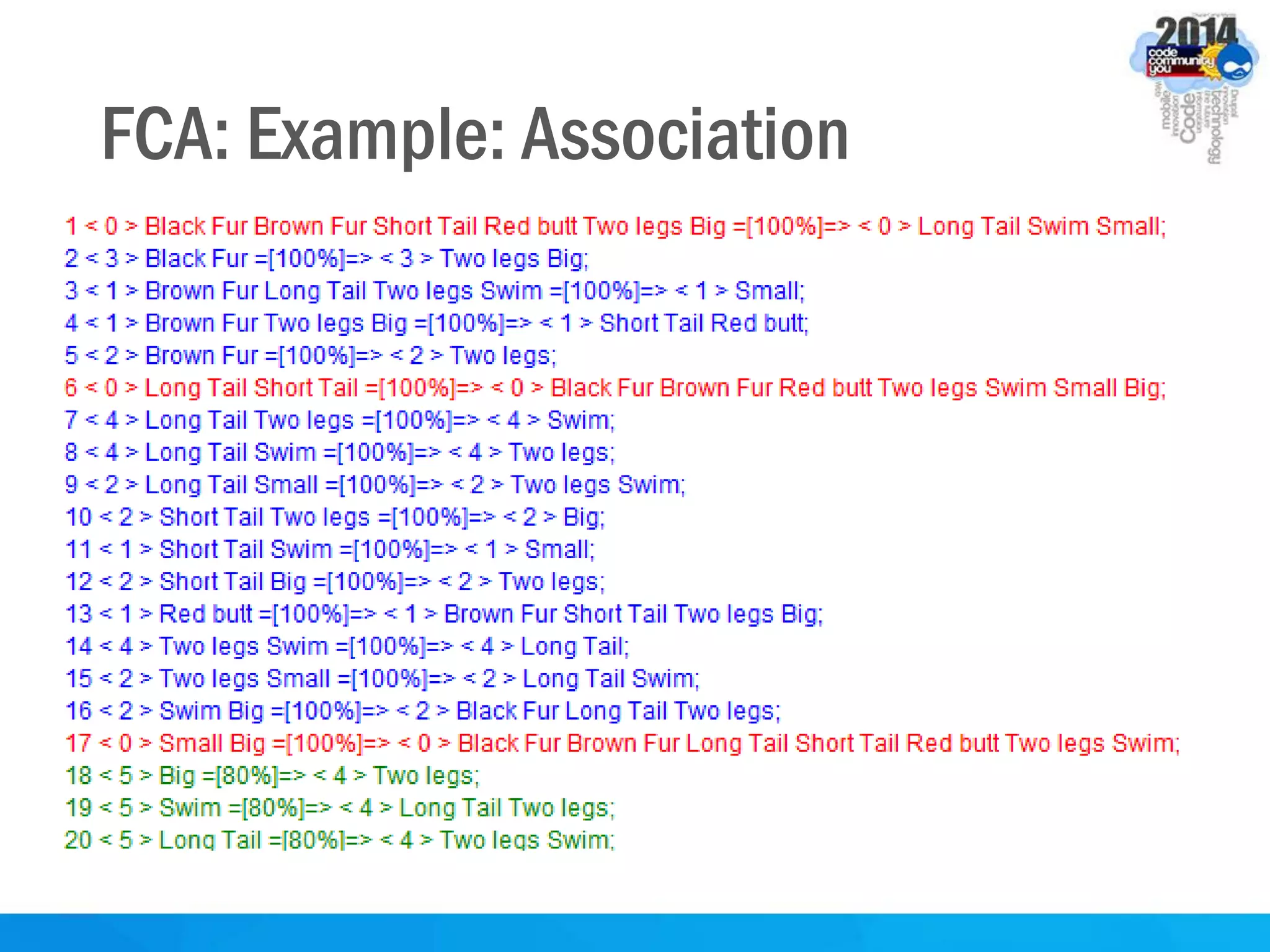
FCA: Example: Association
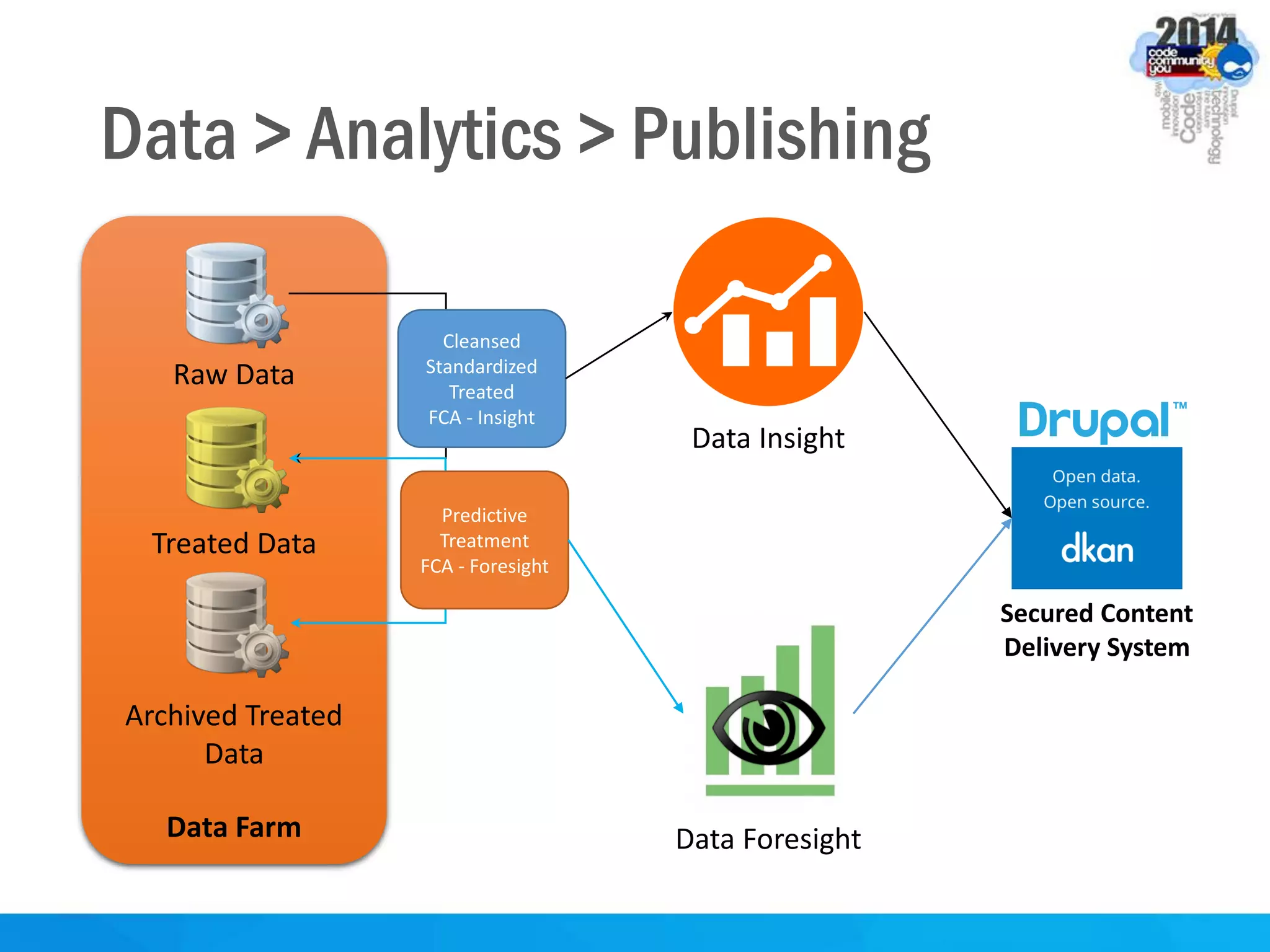
Data > Analytics > Publishing
Data Insight
Data ForesightData Farm
Raw Data
Treated Data
Archived Treated
Data
Cleansed
Standardized
Treated
FCA - Insight
Predictive
Treatment
FCA - Foresight
Secured Content
Delivery System
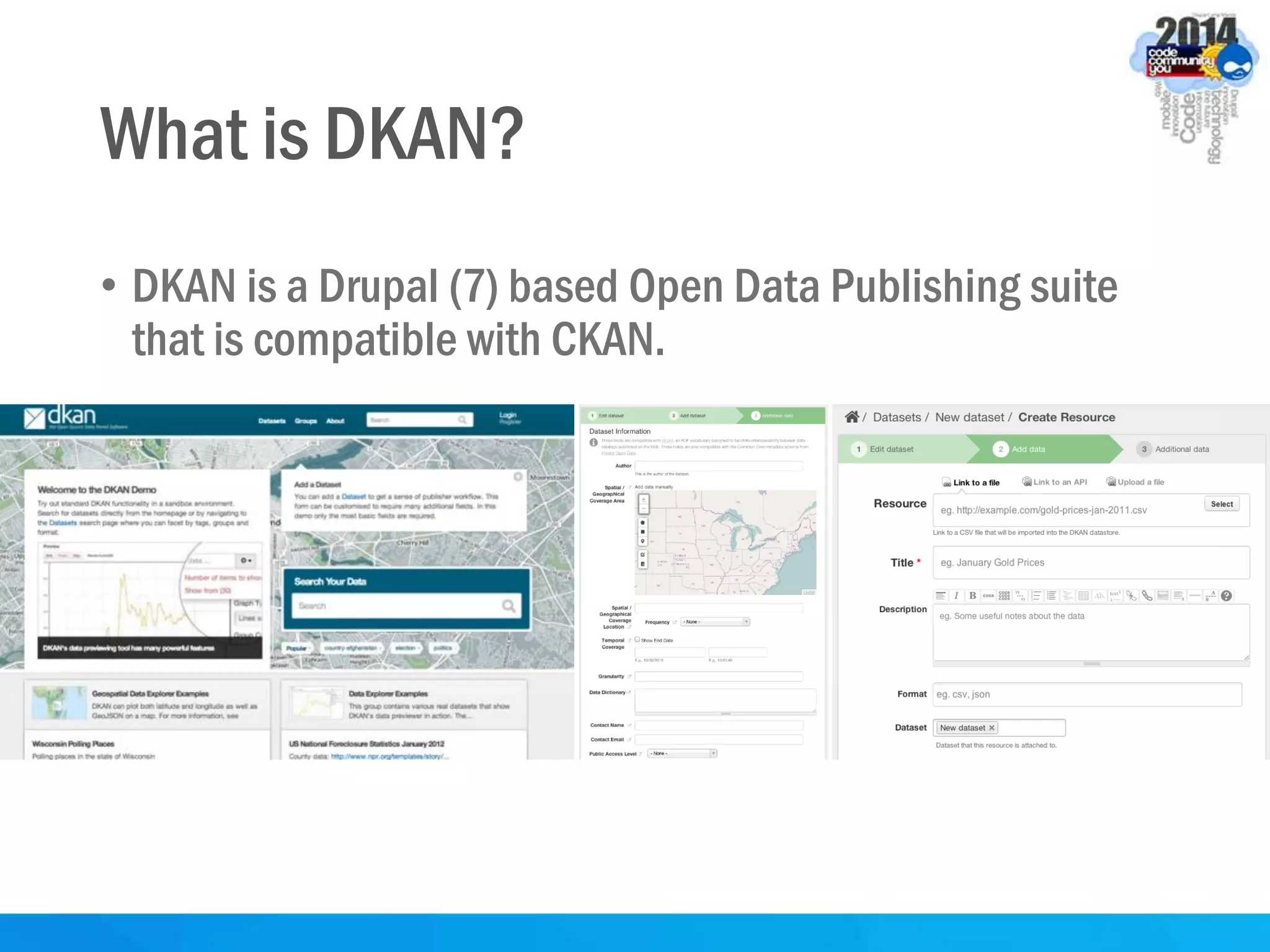
What is DKAN?
• DKAN is a Drupal (7) based Open Data Publishing suite
that is compatible with CKAN.
Why Drupal:DKAN as Data > Content
Delivery System?
• DKAN is built with Drupal making it a secured Open Data
Publishing Portal and at the same time a robust
enterprise grade content management system
• Easy to publish dataset
• Model Data presentation standards
• Line Graphs
• Pie – share Graph
• Geographic Information System
• Open Data and Open Government Compliant
• Share Data Presentations via API
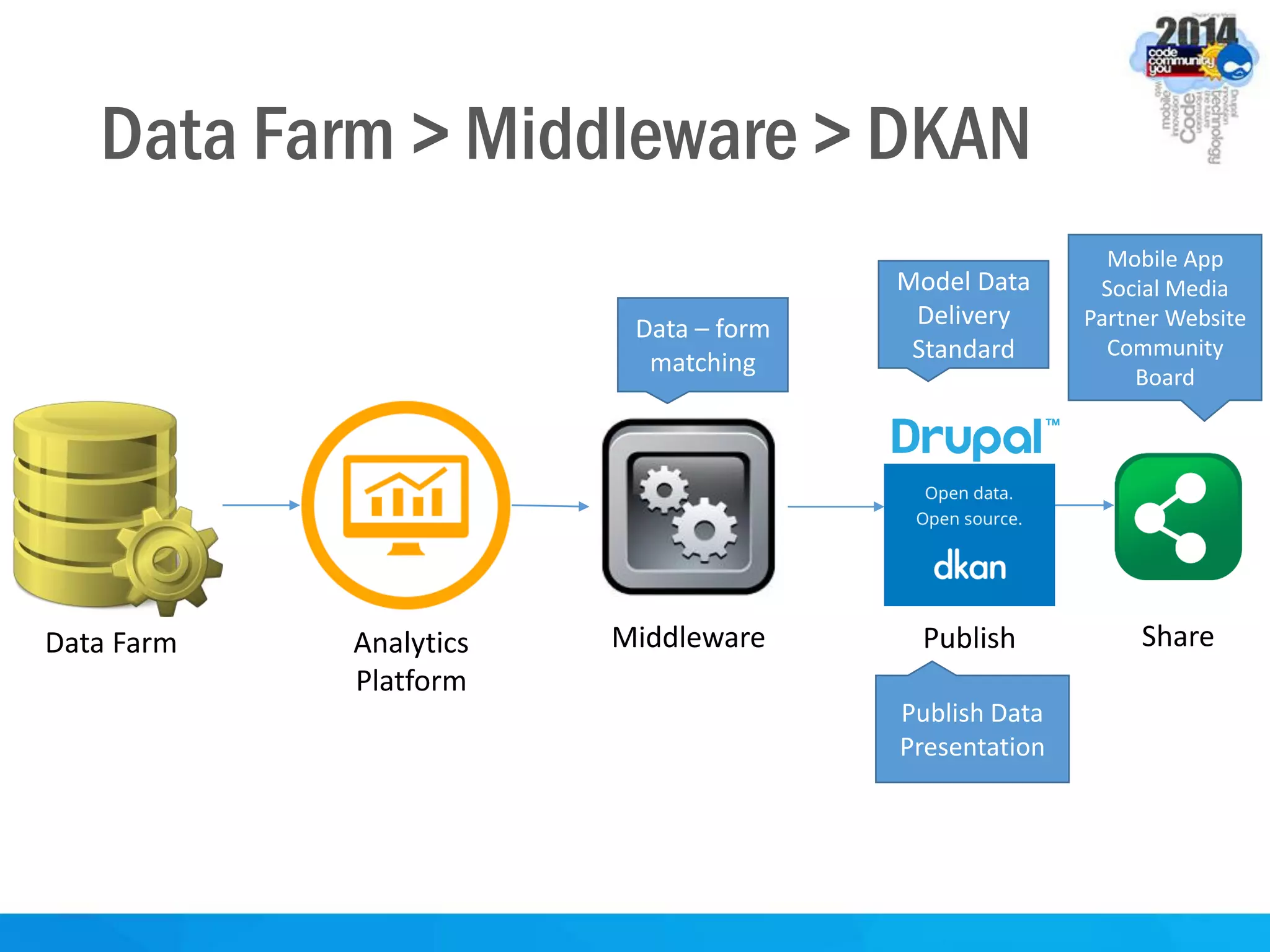
Data Farm > Middleware > DKAN
Data Farm Analytics
Platform
Middleware Publish
Data – form
matching
Model Data
Delivery
Standard
Share
Publish Data
Presentation
Mobile App
Social Media
Partner Website
Community
Board
Thank You!!

Formal Concept Analysis

  • 1.
    Formal Concept Analysis BigData Analytics, Data Foresight and Data Delivery using Drupal Tzar C. Umang
  • 3.
    The Increasing Challengeon Data… MANAGEMENT
  • 4.
  • 5.
    Data Analytics Data Warehousing Data InsightData Foresight Data Gathering Cleansing Standardization Treatment using Statistical Models Identification for Indicators Present State Overview Data Treatment with Predictive Analytic Models Probability and Predictive Analytics Pattern Analysis Formal Concept Analysis
  • 6.
    Formal Concept Analysis? Letsstart with understanding a concept? “Orangutan” Orangutan Mamorset Baboon … Has black fur Has tail Has two legs … objects related to attributes Objects, attributes and a relation form a formal concept
  • 7.
    The Universe ofDiscourse A repertoire of objects and attributes (which might or might not be related) constitutes the „context“ of our considerations Orangutan Mamorset Baboon … Has black fur Has tail Has two legs … Object_1 Object_2 Object_3 Attribute_1 Attribute_2 Attribute_3 relation objects attributes Attribute_4
  • 8.
    Formal Concept Analysis? •Formal Concept Analysis is a method used for investigating and processing explicitly given information, in order to allow for meaningful and comprehensive interpretation • An analysis of data • Structures of formal abstractions of concepts of human thought • Formal emphasizes that the concepts are mathematical objects, rather than concepts of mind
  • 9.
    Formal Concept Analysis? •Formal Concept Analysis takes as input a matrix specifying a set of objects and the properties thereof, called attributes, and finds both all the “natural” clusters of attributes and all the “natural” clusters of objects in the input data, where • a “natural” object cluster is the set of all objects that share a common subset of attributes, and • a “natural” property cluster is the set of all attributes shared by one of the natural object clusters
  • 10.
    Formal Concept Analysis? •Natural property clusters correspond one-for-one with natural object clusters, and a concept is a pair containing both a natural property cluster and its corresponding natural object cluster • The family of these concepts obeys the mathematical axioms defining a lattice, and is called a concept lattice
  • 11.
    FCA: Formal Context? •Context: A triple (G, M, I) is a (formal) context if • G is a set of objects (Gegenstand) • M is a set of attributes (Merkmal) • I is a binary relation between G and M called incidence • Incidence relation: I ⊆ G x M • if gG, mM in (g,m)I, then we know that “object g has attribute m„ and we write gIm • Derivation operators: • For A ⊆ G, A‘={mM | (g,m)I for all gA} • For B ⊆ M, B‘={gG | (g,m)I for all mB}
  • 12.
    FCA: Formal Context? •A pair (A,B) is a formal concept of (G,M,I) if and only if • A ⊆ G • B ⊆ M • A‘ = B, and A = B‘ • Note that at this point the incidence relationship is closed; i.e. all objects of the concept carry all its attributes and that there is no other object in G carrying all attributes of the concept • A is called the extent (Umfang) of the concept (A,B) • B is called the intent (Inhalt) of the concept (A,B)
  • 13.
    FCA: Generating aFormal Context • Using the derivation operators we can derive formal concepts from our formal context with the following routine: 1.Pick a set of objects A 2.Derive the attributes A' 3.Derive (A')' 4.(A'',A') is a formal concept • A dual approach can be taken starting with an attribute
  • 14.
    Example 1.Pick any setof objects A, e.g. A={orangutan}. 2.Derive the attributes A'={big, two legs, black fur, long tail, swim} 3.Derive (A')'={big, two legs, black fur, long tail, swim}'={orangutan, spider monkey} 4.(A'',A')=({orangutan, spider monkey},{big, two legs, black fur, long tail, swim}) is a formal concept.
  • 15.
    FCA: Concept Lattice? •The concepts of a given context are naturally ordered by a subconcept-superconcept relation: • (A1,B1) ≤ (A2,B2) :⇔ A1⊆A2 (⇔ B2⊆B1) • The ordered set of all formal concepts in (G,M,I) is denoted by B(G,M,I) and is called concept lattice (Begriffsverband) • A concept lattice consists of the set of concepts of a formal context and the subconcept-superconcept relation between the concepts
  • 16.
  • 17.
    FCA: Extent andIntent in a Lattice • The extent of a formal concept is given by all formal objects on the paths which lead down from the given concept node • The extent of an arbitrary concept is then found in the principle ideal generated by that concept • The intent of a formal concept is given by all the formal attributes on the paths which lead up from the given concept node • The intent of an arbitrary concept is then found in the principle filter generated by that concept
  • 18.
    FCA: Subconcepts inthe Concept Lattice • The Concept B is a subconcept of Concept A because • The extent of Concept B is a subset of the extent of Concept A • The intent of Concept B is a superset of the intent of Concept A • All edges in the line diagram of a concept lattice represent this subconcept-superconcept relationship Intent: Two legs, long tail, swim, small Extent: squirrel monkey Intent: brown fur, two legs, long tail, swim, small Extent: mamorset Concept “A” Concept “B”
  • 19.
    FCA: Implication • Animplication A → B (between sets A,BM of attributes) holds in a formal context if and only if B⊆A‘‘ • i.e. if every object that has all attributes in A also has all attributes in B • e.g. if X has feather and has beak then is a bird • The implication determines the concept lattice up to isomorphism and therefore offers an additional interpretation of the lattice structure • Implications can be used for a step-wise construction of conceputal knowledge
  • 20.
  • 21.
  • 22.
    Data > Analytics> Publishing Data Insight Data ForesightData Farm Raw Data Treated Data Archived Treated Data Cleansed Standardized Treated FCA - Insight Predictive Treatment FCA - Foresight Secured Content Delivery System
  • 23.
    What is DKAN? •DKAN is a Drupal (7) based Open Data Publishing suite that is compatible with CKAN.
  • 24.
    Why Drupal:DKAN asData > Content Delivery System? • DKAN is built with Drupal making it a secured Open Data Publishing Portal and at the same time a robust enterprise grade content management system • Easy to publish dataset • Model Data presentation standards • Line Graphs • Pie – share Graph • Geographic Information System • Open Data and Open Government Compliant • Share Data Presentations via API
  • 25.
    Data Farm >Middleware > DKAN Data Farm Analytics Platform Middleware Publish Data – form matching Model Data Delivery Standard Share Publish Data Presentation Mobile App Social Media Partner Website Community Board
  • 26.